Tag: million

  • More people died of 2 deadliest pathogens than HIV/AIDS in 2019 – New study

    A new study has revealed that more people died in 2019 from two of the deadliest pathogens, S. aureus and E. coli, than from HIV/AIDS (864,000 deaths) across the world.

    The analysis conducted by the Global Burden of Disease & Antimicrobial Resistance Collaborators show that HIV research received $42 billion dollars, while E. coli research received $800 million.

    According to the full study, which will be published in The Lancet on Monday, November 21, common bacterial infections were the second leading cause of death in 2019 and responsible for one in every eight deaths worldwide.

    The analysis identifies bacterial infections as a global public health priority, ranking second only to ischaemic heart disease as the leading cause of death in 2019.

    The latest finding raises concerns about the funding and research gaps on the two deadliest pathogens, but the authors argue that such funding gaps may have arisen due to a lack of data on the global burden of these infections until now.

    The new study provides the first global estimates of mortality associated with 33 common bacterial pathogens and 11 major infection types that lead to sepsis death.

    Estimates were generated for all ages and genders in 204 countries and territories that have country-level data available.

    The authors used 343 million individual records and pathogen isolates from the Global Burden of Disease 2019 and Global Research on Antimicrobial Resistance (GRAM) studies to estimate deaths associated with each pathogen and the type of infection responsible. 7.7 million of the estimated 13.7 million infection-related deaths in 2019 were linked to the 33 bacterial pathogens studied.

    In 2019, deaths caused by these bacteria accounted for 13.6% of all global deaths and more than half of all sepsis-related deaths. Lower respiratory infections (LRI), bloodstream infections (BSI), and peritoneal and intra-abdominal infections accounted for more than 75% of the 7.7 million bacterial deaths (IAA).

    E. coli (950 000 deaths), S. pneumoniae (829,000), K. pneumonia (790,000), and Pseudomonas aeruginosa (559,000) were the other pathogens linked to more than 500,000 deaths. The leading bacterial pathogens were linked to a similar number of female and male deaths.

    The most lethal pathogens and age-standardised mortality rates varied by location. With 230 deaths per 100,000 people, Sub-Saharan Africa had the highest mortality rate. The high-income super-region, which includes Western Europe, North America, and Australasia, had the lowest mortality rate, with 52 deaths per 100,000 people.

    In 135 countries, S. aureus was the leading bacterial cause of death, followed by E. coli (37), S. pneumoniae (24), and K. pneumoniae and Acinetobacter baumannii (4 countries each).

    Pathogens linked to the most deaths varied by age. S. aureus was linked to the most deaths in adults over the age of 15 years, accounting for 940,000 deaths. Salmonella enterica serovar Typhi was responsible for 49,000 deaths in children aged 5 to 14 years. S. pneumoniae was the most lethal pathogen in children older than newborns but under the age of five, accounting for 225,000 deaths. K. pneumoniae was the pathogen responsible for the most neonatal deaths, accounting for 124,000 deaths.

    The authors admit that their study has some limitations, many of which are due to a lack of data for some parts of the world, particularly many low- and middle-income countries (LMICs), where the estimated disease burden is highest.

    According to Authia Gray, study co-author and PostBachelor Fellow at IHME at the University of Washington’s School of Medicine, country-level estimates for parts of the world where people are most affected by bacterial infections have been noticeably absent until now.

    “These new data could act as a guide to help address the disproportionately high burden of bacterial infections in low- and middle-income countries and may ultimately help save lives and prevent people losing years of their lives to illness,” he said.

    According to the study, building stronger health systems with increased diagnostic laboratory capacity, implementing control measures, and optimising antibiotic use are all critical to reducing the disease burden caused by common bacterial infections.
     

  • Government misses T-bills target again, interest rate at 35.4%

    The Government of Ghana’s weekly Treasury bills has been under subscribed again.

    This will be the fifth consecutive time the government has missed its target of the auction of Treasury bills this year.

    However, interest rates have kept rising even though it is still below the current inflation rate.

    The target for the November 11 auction was GH¢2,060 million but the government secured GH¢1977.41 million.

    The interest rate for the 91-day bills stood at 34.39%. For the 182-day bill, interest rates stood at 35.49% whiles the interest rate for the 364-day bill stood at 35.07%.

    The 91-day treasury bills received GH¢1.827.52 million bids whiles the 182-day treasury bills received bids worth GH¢142.03 million of which all bids were accepted.

    The 364-day T-bills received GH¢7.86.

    The latest data from the Ghana Statistical Service showed that Ghana’s current inflation stands at 40.4% signifying a negative return on the investment. Meanwhile, the government is targeting GH¢1,168 million in its next auction.


  • Government has released GH₵50 million to pay scholarships – Scholarship Secretariat

    The Registrar of the Ghana Scholarship Secretariat, Dr. Kingsley Agyemang, has stated that a total of GH₵50 million has been released to the Controller and Accountant General Department to pay scholarships.

    He made this known to a delegation from the National Union of Ghana Students (NUGS), led by its president, Dennis Appiah Larbi-Ampofo, paid a courtesy call on the Secretariat at the end of October.

    According to him, the government, being very aware of the challenges being faced by beneficiaries due to the delay in scholarship payments, the government is speeding up processes to ensure the situation is remedied.

    “The government of Nana Akufo-Addo is very committed to education and all efforts are being made to close the gap. Discussions with the Ministry of Finance are going well and some 50 million cedis has been released to the Controller and Accountant General,” he said.

    The leadership of NUGS also discussed issues surrounding the closed scholarship portal, while urging the Secretariat to expedite the payment to their members. and amongst other issues.

    Dennis Larbi-Ampofo stressed the importance of this because a number of their members are on the verge of deferring their courses or dropping out of school altogether.

    “We acknowledge the effort of the scholarship secretariat but the education of these students on the government scholarship scheme can never be compromised especially not under my watch as the chief servant of the Union and that government must take swift measures in making sure this situation is curbed,” he reiterated.

    He further stated that the doors of the union are always open for discussions that seek to put the ordinary student in a position of a safe and sound educational environment.

    He added that they are willing to be part of any activity that is tailored around this mission.

    The NUGS president however stated that the students will only hold onto their patience until payments are made but should the government stretch them too long, they may be forced to resort to other extreme measures.

    Source: Ghanaweb

  • Glencore faces steep penalties over African bribery scandal; mining corporation used private jet to fly bribe

    Glencore is facing fines in millions of dollars for a series of corruption offences in which it used a private plane to fly money to bribe officials in different African governments.

    In June, a division of the FTSE 100 commodities behemoth admitted to paying many bribes to get access to oil supplies.

    Following the filing of a number of charges by the Serious Fraud Office, it was the first time a firm had ever been found guilty of bribery under UK law (SFO).

    Glencore may face fines of over £243 million, and the SFO is requesting the highest confiscation order ever against a British business of £93.4 million, as well as £4.5 million in fees.

    At today’s sentence hearing at Southwark Crown Court in London, the exact sum will be decided.

    Glencore’s attorney stated on Wednesday at a hearing that the company “unconditionally regrets the harm caused.”

    However, prosecuting attorney Alexandra Healy asserted that “corruption was pervasive inside the enterprise” and that “offering of bribes was an accepted method of conducting business for the company.”

    After a protracted inquiry, it was discovered that Glencore’s London-based oil trading department paid bribes totaling more than £24 million to get privileged access to cargoes in South Sudan, Nigeria, Cameroon, the Ivory Coast, and Nigeria.

    The investigation discovered that a Glencore agent in Nigeria took over £3.6 million from a slush fund and often used a private plane to fly the money to Cameroon to bribe authorities, among a long list of other offences.

    Agents, executives, and dealers for Glencore were so casual that they frequently addressed one another as “senorita” and “bro,” even when talking about bribery.

    Another agent received £870,000 in 2011 to pay bribes to Equatorial Guinean authorities in exchange for access to oil cargo, and the company reportedly approved £5,000 in “hotel charges” for the agent during a trip to London.

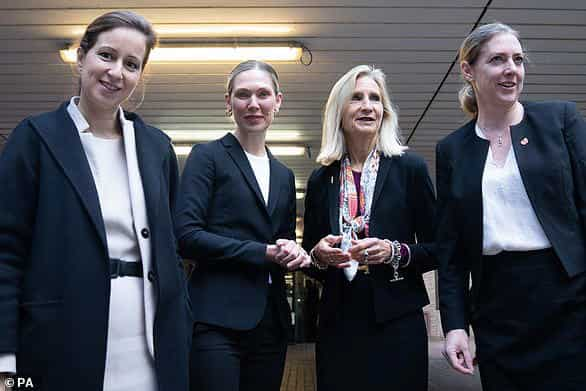
    A top SFO team comprised entirely of women led the Glencore inquiry.

    All women team

    Photo credits: The Guardian

    These included, (above) from left to right: Sara Chouraqui, joint head of fraud, bribery and corruption and Victoria Jacobson, the prosecutor for Operation Azoth – codename for the Glencore probe – as well as department director Lisa Osofsky and case controller Liz Collery.

    A Glencore official made a request for approximately £700,000 from the business’ Swiss cash desk the same year, purportedly for “establishing an office in South Sudan” soon after the country gained independence.


    Source: wionews.com

  • We’ll summon ministers to answer for Pwalugu dam project – Talensi MP

    The Member of Parliament for the Talensi constituency, Benson Tongo Baba, plans to push for answers on the delayed Pwalugu Multipurpose dam project sometime next year.

    Commenting on concerns that the $993 million project has been abandoned, the MP said there were plans in place to formally visit the project site.

    Following this, he said they will try to seek answers from the relevant ministers in Parliament.

    “We will definitely go there after the budget presentation by the Minister of Finance, this year,” Mr. Baba said on Eyewitness News.

    “Early next year, we will take appropriate action to drag either the Minister of Agriculture or the Ministry of Finance to respond to questions in Parliament as to why the project has come to a standstill.”

    The MP was speaking after some farmers in the Upper East and North East Regions protested at Nalerigu to demand the acceleration of the project.

    The protesting farmers were led by the Peasant Farmers Association of Ghana.

    Dr. Charles Nyaaba, the Executive Director of the association, called for the Vice President to intervene in the matter.

    “We are calling on Alhaji Mahamudu Bawumia, who is a son of the land, to lead this campaign. We are actually supporting him to ensure that as part of the IMF negotiations, money is allocated and provision is made for the construction of the Pwalugu Multipurpose dam.”


  • AirtelTigo ‘’To Gu Me So Reloaded’ promo ends

    AirtelTigo’s flagship promotion for 2022, ‘To Gu Me So Reloaded’, has come to a successful end, rewarding over 5,000 customers with cash prizes of over GH₵1,000,000. This makes “To Gu Me So Reloaded” one of the most rewarding promotions to hit the telecommunications industry in Ghana.


    Two lucky winners were present at the Prize presentation ceremony held at the AirtelTigo Head office in Accra.

    Benaiah Diallo Oppong, the overall grand prize winner received GH₵125,000, while Ruth Addison the second runner up received GH₵25,000.

    The Grand Prize winner Benaiah Diallo Oppong described his winning of GH₵125,0000 as a life-changing amount of money to win in a promotion.

    He disclosed that his initial thought when he was notified was the skepticism of the entire situation as it seemed unbelievable.

    “As I have been presented with the cheque today, I am truly grateful to AirtelTigo for coming up with the ‘To Gu Me So Reloaded’ promo. They have really touched my life in a big way. I still feel like it’s a dream,” he said.

    The second runner up  Ruth Addison said, “to think that I recently bought this AirtelTigo SIM, dialed *500# to join the promo, and just by consistently using the service through calls, browsing and ATMoney here I am today a winner of GH₵25,000. This tells me that AirtelTigo is not selective of who wins, this a blessing and I want to thank God and AirtelTigo for the opportunity. I will encourage others who are not on the network to go get an AirtelTigo SIM and join the AirtelTigo family.

    Presenting the prize to the winners, Director of Marketing at AirtelTigo, Isaac Boamah, congratulated the winners, saying, we at AirtelTigo are excited to see that this promo has sufficiently expressed our appreciation to our customers for their loyalty, and we are glad that we have been able to touch the lives of many customers by showering them with lots of cash during the promo. Our customers should look forward to more innovative products and services for their call, data and ATMoney needs.”

    The ‘To Gu Me So reloaded’ promotion was organized under the supervision of Gaming Commission of Ghana to provide a reliable and transparent method of selecting winners in weekly and grand draws with over 50,000 customers winning over GHC 1 million .


  • EU provides €10 million support for Ghana’s food security

    The European Union (EU) on Friday signed an agreement to provide €10 million support Ghana’s food security and agribusiness value chain sectors.

    The support is part of the € 600 million the EU has allocated to finance humanitarian food aid and food production in Africa.

    The funds will specifically support families in the country to grow crops so that they can generate income and make food readily available and affordable on the local market.

    It is also expected to help promote climate smart (adapting agricultural methods to climate change) and ecological initiatives in a number of agribusiness value chains including soybean, beekeeping and vegetable production in the country particularly in Northern Ghana.

    The funds comes in the wake of global food shortages, hunger and economic shocks being experienced by people across the World due to the negative impacts of the COVID-19 pandemic and the ongoing Russia-Ukraine war.

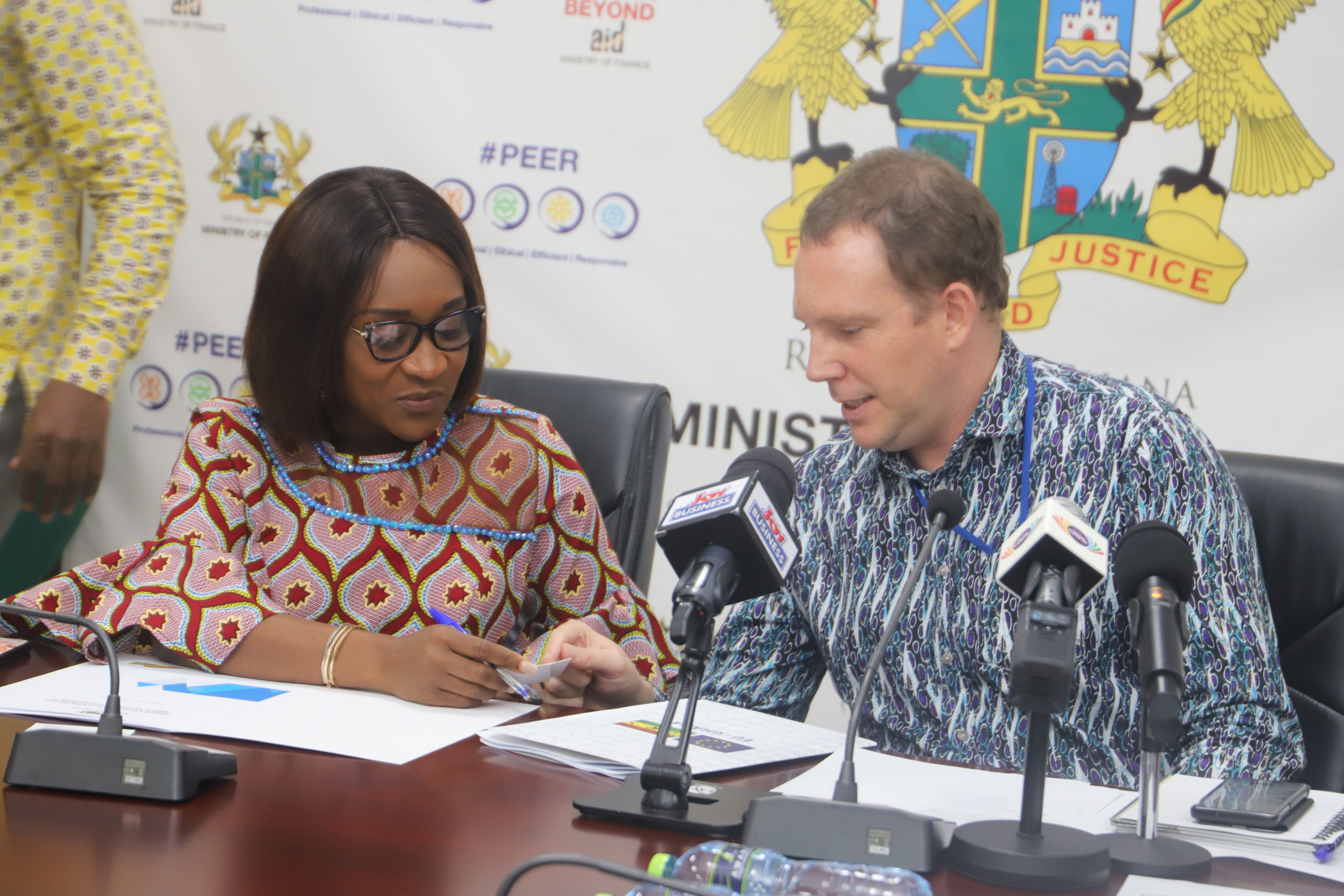
    The EU Charge d’ Affaires, Pieter Smidt Van Gelder accompanied by a six-member EU delegation presented a dummy cheque of €10 million to a Deputy Minister of Finance, Abena Osei-Asare who received it on behalf of government at a short ceremony at the Ministry of Finance in Accra.

    The EU delegation were Ambassadors Daniela D’Orlandi of Italy, Jean Claude Galea Mallia of Malta and Jeroen Verheul of the Netherlands.

    The rest were Jose Javier Blanco-Navarette of Spain, Tamas Endre Feher of Hungary and Franziska Jebens, Head of Cooperation of Germany.

    Prior to the presentation, Mr Gelder said the emergency measure was adopted “in record time directly following the outbreak of the war and its negative consequences on global food security”.

    He explained that the EU mobilised its member states to “join forces and fight together against the global food security crisis”.

    He indicated that the new funds comes on top of “our 203 million Euro joint programming support already dedicated to Ghana for 2021-2024″.

    Mr Gelder stated that the intervention will complement government’s efforts to reduce poverty, hunger and malnutrition especially in vulnerable areas most affected by high prices of food, fertiliser and fuel.

    He said the funds would also strengthen the ongoing €132 million EU-Ghana Agricultural Programme (EU-GAP) which aims at increasing agricultural productivity, protection of natural resources, access to markets, infrastructure and capital for smallholder farmers.

    Mrs Osei-Asare in her response, expressed gratitude to the EU for the support saying “we are grateful to the EU for its continuous support to Ghana’s development agenda since the beginning of our relationship in 1975”.

    She noted that the EU had been a strategic partner of Ghana over the years with support to the country in sectors such as infrastructure development, good governance, agriculture and public financial management among others.

    She recalled vividly the “flexibility” exhibited by the EU in the provision of €86.5 million to the country as Emergency Budget Support during the peak of the COVID-19 pandemic.

  • Tumu astroturf pitch: Project cost is GH¢2 million – Contractor clarifies

    At least GH¢2 million will be pumped into the construction of the controversial astroturf in Tumu in the Upper West region, the Contractor for the project, Sinkare has clarified.

    He told Francis Abban, host of Morning Starr on Starr 103.5 Fm, that the 100 by 120 feet pitch alone will cost 1.1 million cedis.

    The rest of the money is for floodlights and ancillary works, Mr Sinkare said.

    There has been a hue and cry over the project cost after the sod-cutting by Vice President, Mahamudu Bawumia on Tuesday, October 11, 2022.

    The average cost of astroturfs has been between 300,000 and 600,000 Ghana cedis, according to the Public Interest and Accountability Committee (PIAC).

    Some Ghanaians on social media reacted to the cost of the Tumu astroturf project questioning why government will splurge GH¢2 million to construct an artificial pitch.

    In July 2022, government revealed that it constructed 30 astroturfs at a total cost of GH¢40,779,395.79.

    However, a report by PIAC also quoted that the cost of the astroturfs amounted to GH¢8,188,000 million, a massive variance of GHS32,591,395.44.

  • Effia-Kwesimintsim Municipal Assembly exceeds 2021 IGF target

    The Effia-Kwesimintsim Municipal Assembly (EKMA) last year generated three million, seventy-nine thousand two hundred and sixteen Ghana Cedis, ninety-seven Ghana pesewas (GH¢3,079,216.97).

    The amount represented 104.87 per cent collection rate of Internally Generated revenue projection of GH¢2.93 million.

    Mr Kojo Acquah, the Municipal Chief Executive (MCE), who made this known to the Ghana News Agency, said a total budgeted revenue for the year was more than GH¢ 29.85 million.

    Of the amount, he said, GH¢20.08 million was realized as of 31st December, 2021.
    He said to meet the projections, a Revenue Management Committee was constituted to ensure that all rated properties were billed and collected.

    Mr Acquah said the Revenue Taskforce of the Assembly helped in a mass mobilization of revenue which accounted largely for the surplus of the actual collection of IGF.

    On expenditure, he said, the total expenditure budgeted for the period was GH¢29.88  million.

    He said the Assembly spent a total amount of GH¢21.7 million,  representing 72.83%.

    Mr Acquah announced that Management had formed a thirteen member Municipal Research and Proposal Committee to identify and submit proposals for financial aid from local and international institutions.

    He mentioned that work had begun and reports on the efforts and achievements of the Committee would be communicated to all relevant stakeholders in due course.

    On collection of Property Rates, he said, the Assembly was able to lobby GIZ, an International Organization in Germany, to assist in revenue mobilisation in the areas of property rate and Business Operating Permit (BOP) collections.

    Mr Acquah said an assessment of the property and business rates collection of the Assembly revealed that its existing data on property and business owners was not linked to its spatial maps of street addresses, which made it difficult for revenue officers to easily identify rate payers.

    “By virtue of this, the Assembly with support from GIZ would obtain fresh data on all properties and businesses within the Municipality for an update of its street address maps towards effective bill distribution and collection”, the MCE indicated.

  • LEAP to disburse Ghc54.7 million to beneficiaries

    A total of Ghc54.7 million is to be disbursed to 344,389 beneficiary households nationwide as social cash grants under the Livelihood Empowerment Against Poverty (LEAP) programme.

    The five-day disbursement, expected to start from Monday, is for the 77th and 78th cycles, meaning all beneficiary households constituting more than 1.5 million individuals — would receive double the regular bi-monthly grant.

    In view of this, one eligible member household would receive GHC 64.00; two eligible members, GHC 76.00; three eligible members, GHC 88.00 while a household with four and more eligible members would get GHC106.

    This was contained in a statement issued by the Head of LEAP Programme under the Ministry of Gender, Children and Social Protection (MoGCSP), Dr. Myles Ongoh, in Accra yesterday.

    LEAP is a social cash transfer programme for the poorest households in Ghana with the goals of reducing poverty by smoothening consumption and promoting human capital development.

    The category of persons who make a household eligible are orphan and vulnerable children (OVC); elderly (65 years+) without support; persons with severe disabilities who cannot work and very poor pregnant women and mothers with infants under one year.

    “The amount of money paid [through e-zwich] is not the same for all households benefiting from the Programme. The amount paid to a household is determined by the number of eligible household members,” the statement explained.

    The statement acknowledged the contribution of the Programme’s Development Partners and the staff of the Department of Social Welfare and Community Development and all community volunteers towards the implementation of the Programme across the country.