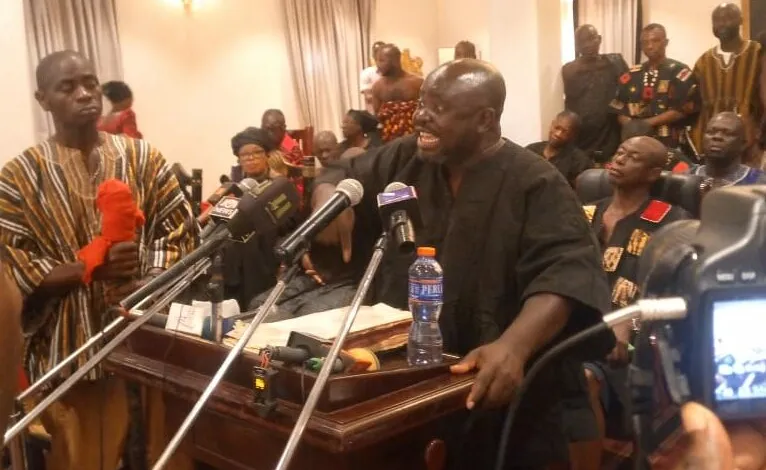
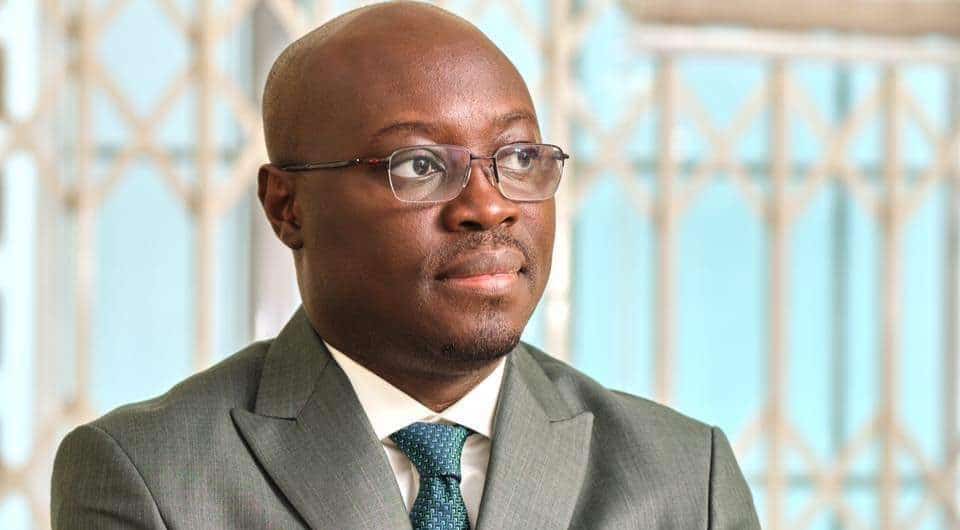
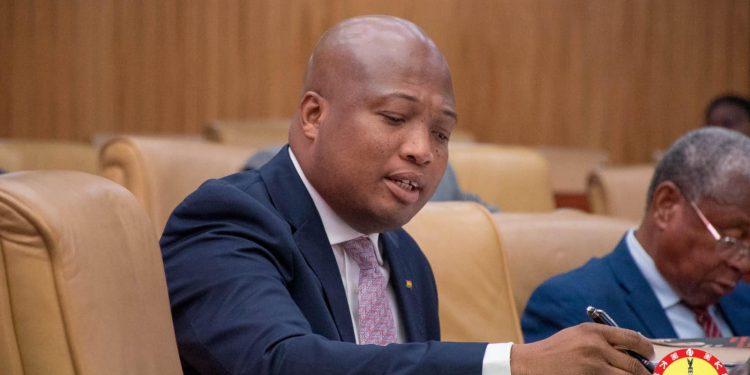
President Akufo Addo nominated Krapah, citing the heavy workload at the Ministry.
However, Deputy Minority Leader Emmanuel Armah Kofi Buah criticized the nomination process.
He noted the absence of public notification in national newspapers, denying the opportunity for public input.
Buah also questioned the necessity of appointing a Minister of State alongside the existing Minister.
The Minority alleges the process aims to exclude public participation and expand the government unnecessarily.
They have refused to participate, emphasizing their commitment to due process and public engagement in Ghana’s democracy.
“The Minority Council has taken note of attempts by the majority side to short-circuit and circumvent the due process required in the venture of the President’s nominee for the position of Minister of State and the Ministry of Energy.
“Long-standing parliamentary practice requires that persons nominated for appointment by the President shall be published in a newspaper of national circulation to inform and request memoranda or representation from the public.
“This ordinarily means that the public ought to be given reasonable notice and adequate time to submit memoranda or make representations to the appointment committee. Fortunately, as we speak this morning, this has not happened. These requests have totally been breached.
“The minority wishes to serve notice that it will not be part of any hasty process deliberately designed by the majority to deny the people of Ghana participation in the work of the appointment committee and Ghana’s democracy.
“Consistent with the minority’s earlier position, the caucus would not participate in the vetting of any ministerial nominee that adds to the already bloated size of this Akufo-Addo-Bawumia government.”
The Minority in Parliament has raised a strong demand for the exemption of all health facilities across the country from the ongoing load shedding, following a tragic incident at the Tema General Hospital.
Juaboso Member of Parliament and ranking member on the health committee of Parliament, Kwabena Mintah Akandho, emphasised the critical need for uninterrupted power supply in healthcare institutions to prevent avoidable deaths.
The demand comes in the wake of a heart-wrenching incident where a nursing mother lost her three-day-old baby at the Tema General Hospital reportedly due to a power outage on Tuesday, March 26, 2024.
Rashida Abubakar Tetteh, the grieving mother, revealed that medical equipment failure during the blackout led to the loss of her newborn.
She recounted how doctors informed her about her child’s inability to survive due to the non-functional incubator caused by the power outage.
Expressing deep sorrow, the grandmother of the deceased baby, Rebecca Johnson, lamented the tragic consequences of the power cuts on innocent lives, questioning the readiness of healthcare facilities in handling such emergencies.
“I went to visit my son, but I didn’t see him. I was waiting outside when one doctor came to inform me that they were sorry, but due to the lights out, my child could not survive because the incubator was not working.
“The lights went off on Tuesday evening. No staff has spoken to me, and they haven’t said anything to me,” she narrated.
Grandmother of the deceased baby, Rebecca Johnson, also expressed grief over the development.
“It’s painful, they have killed my child because of dumsor; I am in pain. We have nothing to say to the hospital. A hospital like Tema General said they didn’t have petrol in the generator. Is this how we are going to act in this country,” she cried.
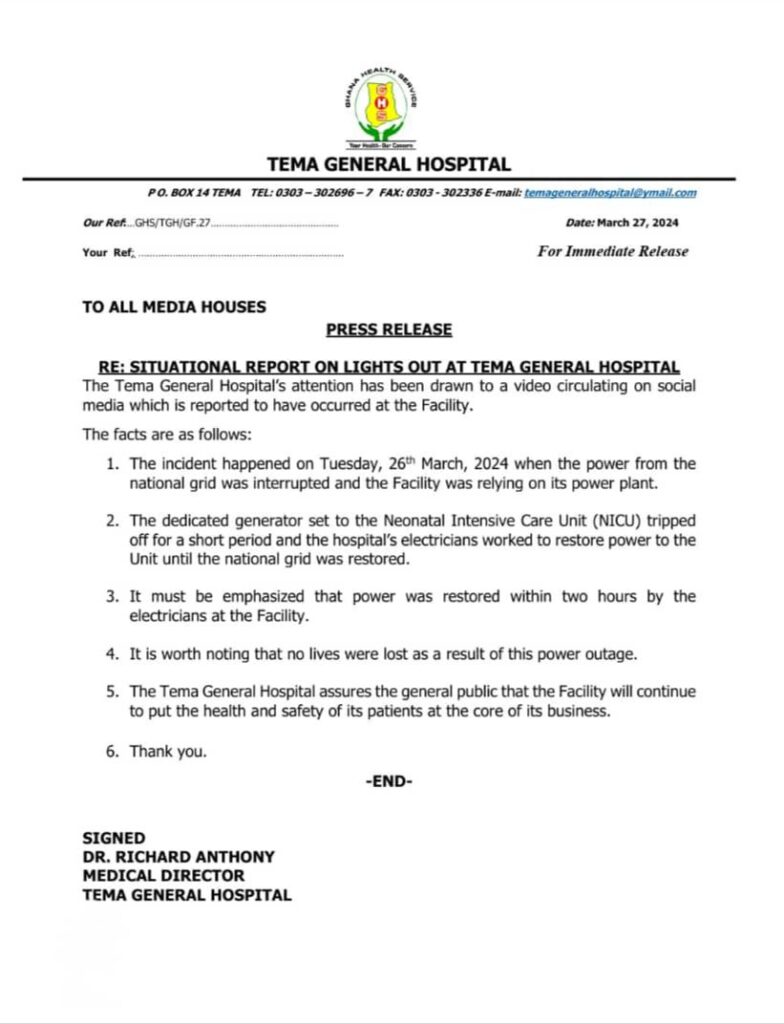
In response to these allegations, the Tema General Hospital refuted claims linking the power outage to the infant’s death, issuing a press release on Wednesday, March 27, to clarify the situation.
The hospital maintained its commitment to patient safety and wellbeing, reassuring the public of its dedication to providing quality healthcare services.
However, Mintah Akandoh, speaking on News Central on TV3, emphasised the necessity of investigating the incident to ascertain the true cause of the baby’s death.
He reiterated the urgent need to exempt all health facilities from load shedding and urged authorities to conduct power audits promptly.
“It will be very difficult for them to admit that it is due to the power cuts that caused the death of the baby, unless there is a probe into the matter you will not be able to establish the cause of the death of the baby. But that notwithstanding, it is a fact that every health facility needs electricity to be able to function well, it is also a fact that power cuts can lead to the death of patients so even if at that particular time it was not the power cuts that caused the death of the baby it is possible that power outages in other health facilities can cause deaths.
“So as a matter of urgency, we the Minorty side on the health committee and the minority as a whole, demand that all our health facilities must be exempted from this load-shedding going on, and then the Ministry together with the GHS must begin immediately power audits in the various health facilities.”
The opposition’s call underscores the vital role of consistent electricity supply in safeguarding lives within healthcare settings, urging swift action to prevent similar tragedies in the future.
Their demand aims to ensure continuous electricity supply for these facilities even during national grid outages.
Additionally, opposition lawmakers are calling for an immediate exemption of all health facilities from the ongoing load shedding exercise.
The move comes in response to concerns that power cuts in healthcare settings could lead to avoidable deaths.
Kwabena Mintah Akandoh, Member of Parliament for Juaboso and ranking member on the health committee, voiced these demands.
He highlighted a recent tragic incident at the Tema General Hospital where a nursing mother lost her three-day-old baby allegedly due to a power outage.
“We demand immediate action to prevent such tragic incidents in the future,” Akandoh stressed.
The bereaved mother, Rashida Abubakar Tetteh, recounted the heartbreaking experience of being informed by a doctor that her child couldn’t survive due to non-functional medical equipment during the blackout.
“I went to visit my son, but I didn’t see him. I was waiting outside when one doctor came to inform me that they were sorry, but due to the lights out, my child could not survive because the incubator was not working.
“The lights went off on Tuesday evening. No staff has spoken to me, and they haven’t said anything to me,” she narrated.
Grandmother of the deceased baby, Rebecca Johnson, also expressed grief over the development.
“It’s painful, they have killed my child because of dumsor; I am in pain. We have nothing to say to the hospital. A hospital like Tema General said they didn’t have petrol in the generator. Is this how we are going to act in this country,” she cried.
Rebecca Johnson, the grandmother of the deceased infant, expressed deep sorrow and questioned the hospital’s preparedness during power outages.
Responding to these claims, the Tema General Hospital issued a press release denying allegations that the power outage led to fatalities.
The hospital reaffirmed its commitment to patient safety but faced criticism over the alleged lack of preparedness during electricity disruptions.
“The Tema General Hospital assures the general public that the Facility will continue to put the health and safety of its patients at the core of its business,” the statement concluded.
The minority’s call for power audits and an end to load shedding in health facilities underscores growing concerns about healthcare infrastructure resilience in Ghana.
See post by Tema General Hospital disputing claims:
The Minority in Parliament has declared its intention to take the matter to the Supreme Court if the five reassigned ministers are not brought before Parliament for screening.
The Member of Parliament for South Dayi, Rockson-Nelson Dafeamekpor, contended that since the president revoked the appointments of the ministers in question, their reassignment must undergo parliamentary scrutiny.
Dafeamekpor stated in Parliament on Friday, “I am saying on the authority of the constitution that those persons’ appointments were revoked by the president, and their re-assignment must be subjected to parliamentary scrutiny.
“So, we are demanding that those five ministers he has reassigned must be subjected to parliamentary vetting, and that is the procedure, so they cannot escape parliamentary scrutiny,” he said in Parliament on Friday.
He added “We will do our duty as the constitution demands, and we will demand that their names be submitted to parliament for them to be vetted, and if this call is not heeded, we will proceed to the Supreme Court for legal interpretation.”
President Akufo-Addo recently executed a ministerial reshuffle, ten months before the end of his tenure.
While some ministers, including Ken Ofori-Atta, were dismissed, others like Kojo Oppong Nkrumah and Francis Asenso Boakye were reassigned to different portfolios.
The reshuffle was announced in a press release dated February 14, signed by Eugene Arhin, the Director of Communication at the presidency. According to Arhin, the President expressed appreciation for the commitment and hard work of the departing ministers and wished them well in their future endeavors.
The Minority in Parliament has urgently requested the government to issue necessary tax exemptions, allowing the immediate clearance of antiretroviral drugs and essential medical equipment and supplies currently held up at the country’s ports.
Their demand arises from the alleged neglect of donated containers containing HIV antiretroviral drugs since July this year at the ports, resulting in unnecessary shortages for Persons Living with HIV.
In a statement released on Friday, the minority caucus emphasized that individuals living with HIV, who rely on the Abacavir Lamivudine treatment, face an increased risk of developing resistance to this antiretroviral drug, making it ineffective against the virus.
Furthermore, the Minority cautioned that if this risk materializes, the government will require additional funding to address the HIV challenge in Ghana.
The Minority, therefore, demanded that “The Ministry of Finance as a matter of urgency issue the necessary tax exemption waivers to ensure that immediate clearance of the antiretroviral drugs and other medical equipment and consumables; implement an automated tax exemption waiver system for medical consumables and equipment to curtail needless delays in clearing such items at the port and institute reforms at the Ministry of Finance and Economic Planning to ensure that systemic failures that lead to needless delays in the performance of its functions are eradicated.”
The Minority underscored that it was a national emergency and if unchecked could lead to an increase in the prevalence rate of HIV in Ghana, an increase in morbidity and mortality for Persons Living with HIV, and an increase in the overall cost of HIV management in Ghana.
“The Health and well-being of Ghanaians are non-negotiable, and we urge the government to act swiftly and responsibly in addressing this crisis,” it added.
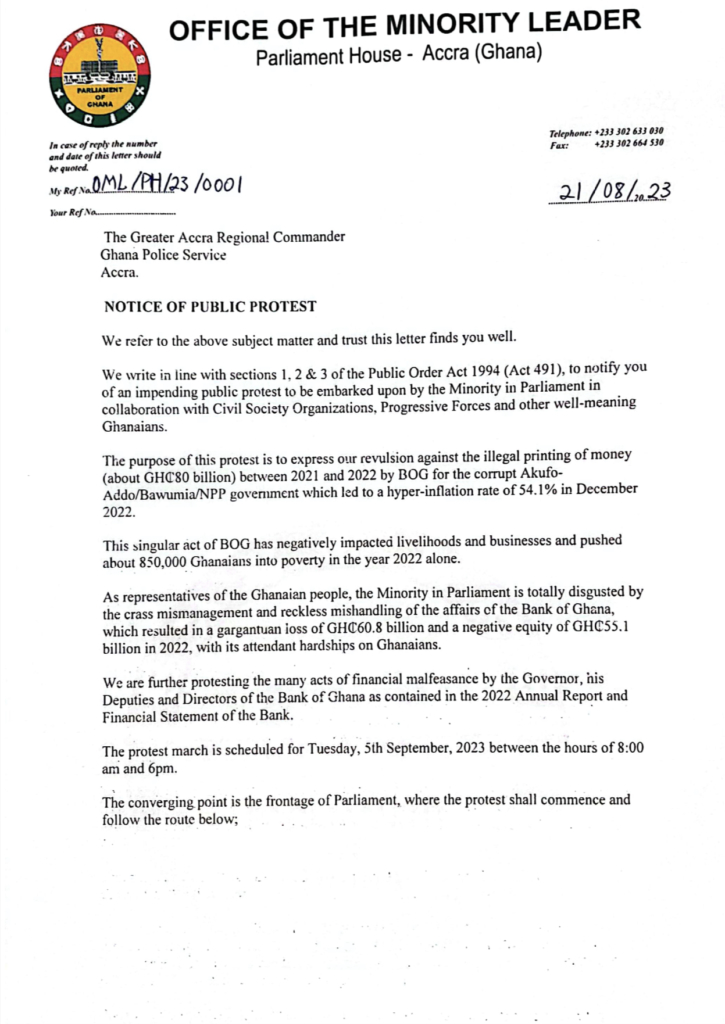
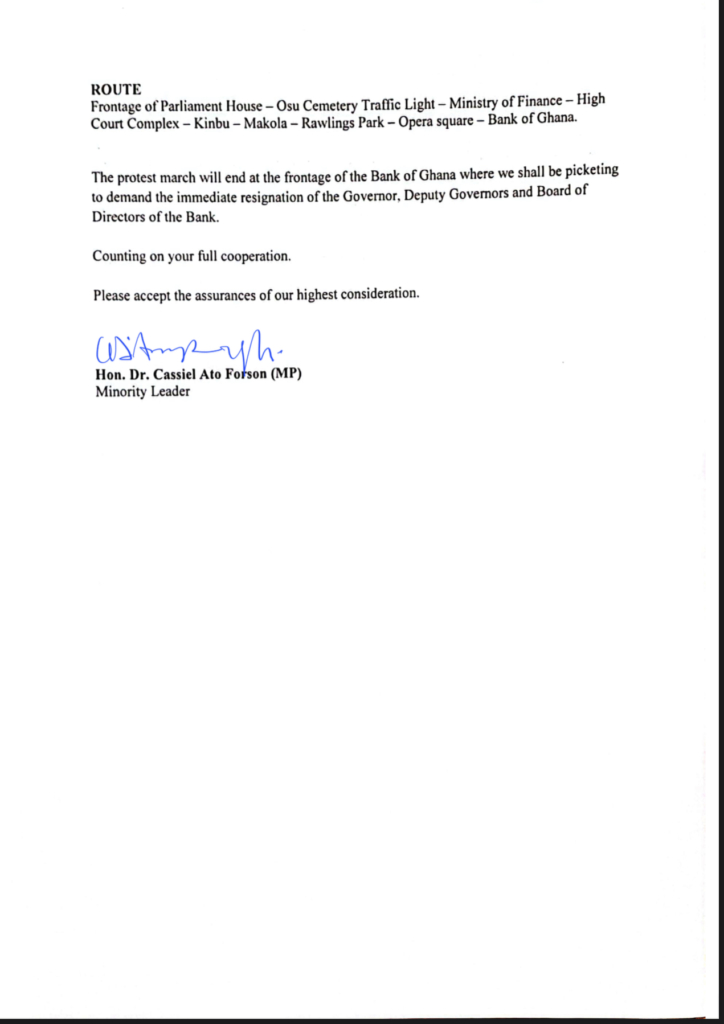
The Minority in Parliament, in conjunction with Civil Society Organizations, Progressive Forces, and other concerned citizens, has scheduled a demonstration against the Governor of the Bank of Ghana, Dr. Ernest Addison, and his two deputies for Tuesday, September 5.
The Minority Leader, Dr. Cassiel Ato Forson, made this known in a press statement dated August 21, 2023.
According to Dr Ato Forson, the Minority has submitted a letter to the Greater Accra Regional Police Command, dated Monday, August 21, outlining the caucus’s intention to hold a demonstration.
The protest is prompted by the alleged unauthorized printing of over GH¢80 billion by the central bank for the Akufo-Addo government.
“We write in line with sections ,1 2&3 of the Public Order Act 1994 (Act 491), to notify you of an impending public protest to be embarked upon by the Minority in Parliament in collaboration with Civil Society Organizations, Progressive Forces and other well-meaning Ghanaians.”
“The purpose of this protest is to express our revulsion against the illegal printing of money (about GH¢ 80 billion) between 2021 and 2022 by BoG for the corrupt Akufo-Addo/Bawumia/NPP government which led to a hyper-inflation rate of 54.1% in December 2022,” excerpts of the letter said.
According to the Minority, the Central Bank, by so doing, has pushed some 850,000 Ghanaians into poverty.
“This singular act of BOG has negatively impacted livelihoods and businesses and pushed about 850,000 Ghanaians into poverty in the year 2022 alone.”
“As representatives of the Ghanaian people,the Minority in Parliament is totally disgusted by the crass mismanagement and reckless mishandling of the affairs of the Bank of Ghana, which resulted in a gargantuan loss of GHC60.8 billion and a negative equity of GHCS5.1 billion in 2022, with its attendant hardships on Ghanaians,” the statement added.
In the meantime, Dr. Ernest Addison, the Governor of the Bank of Ghana (BoG), has clarified that the central bank only began providing funding to the government in 2020 and 2022, particularly during the COVID-19 Pandemic. This decision was made after investors in the capital market declined to lend to the government.
Dr. Addison emphasized that the central bank rigorously adhered to the principle of zero financing of government expenditure until economic challenges emerged last year. He noted that the financing of government policies in the previous year was carried out following prior consultation with the International Monetary Fund (IMF).
“It is not true that the Bank of Ghana has been providing financing for government every year. There has been zero financing in 2017, 2018, 2019 and 2021. The Bank of Ghana has only had to support in the pandemic year of 2020, and in the crises year of 2022”, he stressed.
He pointed out that the BoG Act as amended limits financing of the government to 5 percent of the previous year’s tax revenue.
“This provision in the law has been adhered to since I took office in April, 2017, between 2017 and 2019. In addition to the requirement of the Act, the bank signed a Memorandum of Understanding with the Ministry of Finance to even impose the tighter restriction of zero Central Bank financing and this was observed strictly even though the MOU’s were not legally binding.”
The Minority in Parliament has issued a stern warning to the Majority Caucus, stating that they should not expect any cooperation from the group in light of the ongoing prosecution of Member of Parliament for Assin North, James Gyakye Quayson.
The Court of Appeal recently dismissed an application from Gyakye Quayson’s legal team, who sought to overturn the High Court’s decision to subject the legislator to daily trials.
Speaking to journalists in Parliament, Dr. Cassiel Ato Forson, the Minority Leader, expressed his concern that this ruling undermines a constitutional provision stating that a Member of Parliament cannot be absent for more than fifteen sittings without valid reason.
He emphasized that as long as the prosecution of Gyakye Quayson continues, the Minority will withhold cooperation with the Majority on any matters within the House.
“Since they have escalated the persecution of James Gyakye Quayson, they should not expect cooperation from us, and we will not announce our strategy going forward, but what we can say is that all options are on the table, and they should not expect cooperation from us. I won’t go into the details but let them be assured that amidst persecution, cooperation will suffer and that is the position of the Minority.”
“Let Ghanaians be aware that the NPP doesn’t have the moral right to talk about patriotism because if you are patriotic you will not abandon Parliament and use state resources to be campaigning as the Vice President is doing. So let the public be aware that, it is not the NDC members of Parliament who do not want to do government business, but it is the NPP members.”
In response to the ongoing boycott by Minority Members, the Speaker of Parliament has expressed uncertainty about the remaining matters for the house to deliberate on.
This comes after the Majority deputy whip, Habib Iddrisu, proposed for adjournment just as the Deputy Whip Lydia Alhassan presented the business statement for the upcoming week as scheduled by the Business Committee.
Deputy Speaker Andrew Asiamah Amoako responded, “So there is nothing we can do?” However, Member of Parliament for Okaikwei Central Constituency, Patrick Yaw Boamah, seconded the motion, leading to the ultimate decision to adjourn parliament until Tuesday, July 17.
The boycott by the minority members has resulted from their solidarity with Assin North MP James Gyakye Quayson, who is currently involved in a criminal case related to allegations of dual citizenship, which is prohibited for Members of Parliament under Ghana’s constitution. Following the Supreme Court’s annulment of his 2020 parliamentary victory, a subsequent by-election was held, resulting in his even larger margin of victory.
During the parliamentary session, Boamah emphasized the significance of having sufficient members present for debates on new house rules and other important matters.
The Deputy Whip Lydia Alhassan proceeded to present the business statement for the upcoming week, following the adjournment as scheduled by the Business Committee.
The house ultimately decided to adjourn after Deputy Whip Lydia Alhassan presented the business statement for the week ending Friday, July 21, 2023.
The People’s National Convention (PNC) has stated that the decision of the Minority in Parliament to abstain from attending sessions in support of their colleague undergoing trial is resulting in financial detriment to the state.
The NDC Minority in Parliament boycotted sitting on Thursday, July 6, 2023, to enable Members accompany and solidarize with two members of their Caucus, namely the Minority Leader, Hon. Dr. Cassiel Ato Forson, and MP for Assin North, Hon. James Gyakye Quayson.
The two are due to appear in court in their respective ongoing prosecutions by the Attorney-General and the NPP Government.
A statement signed by the Minority Chief Whip, Kwame Governs Agbodza said “The Minority stands united with our colleagues, and as such will not be able to honour the business of the house today.”
But, the PNC disagrees with the decision.
The General Secretary for PNC Janet Asana Nabla in a statement dated July 7, 2023, said the Minority has every right to express their support for their fellow MP in these trying times of the Legislator.
“However, the decision to boycott sitting due to criminal charges instituted by the republic against their colleague is worrying. An opposition party which professes to believe in the rule of law is expected to have faith in the legal system of our nation where they held the reins of power some few years ago.
“The Minority Members in Parliament at this moment is causing financial loss to the state by abandoning their Parliamentary business to go to court to protest for their colleague. For how long will the Minority in Parliament continue this boycott of parliamentary sitting at the expense of the taxpayer? the General Secretary asked.
The Minority in Parliament (MP) has strongly criticized the Food and Drugs Authority (FDA) for suspending its market surveillance and General Manufacturing Processes Inspection duties. This decision is seen as jeopardizing public safety and putting the well-being of Ghanaians at risk.
According to the Minority, the FDA’s inability to carry out these essential responsibilities is primarily due to the delay in the release of funds by the Finance Ministry. They argue that the government should prioritize the health of its citizens and take immediate action to safeguard the public.
The Ranking Member on the Health Committee of Parliament, Kwabena Mintah Akandoh, expressed the Minority’s concerns during a media address.
He called upon the government to address the situation promptly and protect the welfare of Ghanaians.
Furthermore, the Minority accused the government of consistently displaying a lackadaisical attitude, thereby continuously exposing Ghanaians to potential dangers. This criticism suggests that they believe the government has not been proactive enough in ensuring the safety and well-being of the population.
It is important to note that this information is based on the provided statement and represents the perspective of the Minority in Parliament. The views and allegations expressed by the Minority may not necessarily reflect the full picture or the stance of the government.
The Minority in Parliament says it played its role in trying to prevent government from securing new loans, however, their efforts came to naught since they were eventually passed by Parliament.
According to the caucus, it did not give its blessings to the new loans and thus they were not approved unanimously.
The Minority Chief Whip, Governs Kwame Agbodza thus wants the public to disregard assertions that they supported the approval of the new loans.
Mr Agbodza added that they will not support any new loan approvals for the government until the government’s reckless borrowings is brought under control.
“Let it be placed on record that the Minority was implacably opposed to these loans coming at a time our nation has defaulted on both domestic and external debt servicing and is struggling to secure an IMF program due to our debt overhang.
“Indeed, we took turns to express our opposition, and still stand firmly in our conviction that only an irresponsible and unpatriotic Majority Group will support any additional borrowing of the Akufo-Addo/Bawumia NPP government that has defaulted on our debt repayments. Such recklessness will truly find expression in the Guinness Book of Records,” he said in a Facebook post.
Parliament on Tuesday approved an amount of $150 million dollars for the financing of the West Africa Food System Resilience Programme phase 2 under the Multi-phase programmatic approach.
Parliament also approved an on-lending agreement between the government and the Development Bank Ghana for an amount of £170 million Euros to support the establishment of a financially sustainable development Bank.
The House also approved a loan agreement between the government of Ghana and the World Bank for an amount of $200 million to finance the Ghana Digital Acceleration Project.
However, some New Patriotic Party (NPP) MPs have said the loans were approved unanimously.
This is what has compelled the Minority Chief Whip to issue this the rebuttal.
The Minority in Parliamenthas disproved claims that the caucus didn’t make a valiant effort to oppose the three new tax legislation voted on Friday.
Member of Parliament for Ningo-Prampram, Sam Nartey George, on the Citi Breakfast Show on Monday suggested that the clerks in Parliament have some questions to answer on how they went about Friday’s head count.
“If we had acquiesced we wouldn’t have gone through the vote, we wouldn’t have accounted for our 136, we wouldn’t have challenged what appeared to be an error in counting. We are aware now that at the time we did the first count Ahmed Tuferu was not in Parliament.
“There are two [majority] MPs who also walked in after the clerks had finished taking the vote from the majority side, so clearly, that vote shouldn’t have read 136, 137, but be that as it may, the Speaker only announces what it is presented to him,” Mr George told host Bernard Avle.
He added that “the clerks have a question to answer as to how they managed to get 137.”
Parliament on Friday, March 31, passed the Excise Duty Amendment Bill 2022, the Growth and Sustainability Levy Bill, 2022, the Ghana Revenue Authority Bill 2022 and the Income Tax Amendment Bill 2022.
The financial bills seek to raise about 4 billion Ghana Cedis annually as part of domestic revenue mobilisation.
The bills are also crucial to aid the government’s quest to facilitate the Board Approval for the $3 billion International Monetary Fund (IMF) Programme staff-level agreement.
The Minority in Parliament earlier communicated its opposition to the bills, but the bills were passed despite an MP from the majority suffering a near-fatal accident on his way to the House.
A constitutional review is required, in order to restrict the Supreme Court’s jurisdiction according to Head of the Judicial Service by the Committee Chairman, Alhassan Abdallah Iddi,.
The Minority in Parliament expressed worry that the Supreme Court’s expansion from 11 to 14 justices would deplete state funds, contradicting the president’s assertion that he was safeguarding the public purse.
But speaking to Citi News after a three-day visit to the Judicial Service by the committee, Chairman Alhassan Abdallah Iddi said “look at the number of cases the Supreme Court hears. Almost every case comes to the Supreme Court holding all other variables constant.
“Many times, people are not satisfied at the Court of Appeal level. They definitely want to go to the Supreme Court. For us to have a cap as others call it, I think that better will it be for a constitutional review to reduce the jurisdiction of the Supreme Court. I think that those who cry for the number of judges to the supreme court should look at it very well. It is tied to the jurisdiction of the Supreme Court.”
The Ghana Bar Association believes it is time for a cap to be placed on the number of Supreme Court judges Ghana has at a time.
Speaking to Citi News on the matter, the Public Relations Officer of the Association, Saviour Kudze, said “the way our constitution is now, if we don’t put a ceiling on it, it will not help us.”
For the limit to the number of judges possibly put in place, Mr. Kudze said, “it will depend on the work at hand.”
“Many more cases are going on appeal now and the Supreme Courthappens to be the highest and final appellate court, so for me, going forward, we need to look at it and see if you can have some ceiling.”
In the most recent chieftaincy conflict between the two sides, the Akyem Abuakwa traditional council has given notice to the residents of Nsawam Adoagyiri that it will not transfer any of its land to them.
Addressing at a news conference in Kyebi, in the Eastern Region, Akyem Abuakwa’s state secretary, D. M. Ofori-Atta, informed the Akyem Kotoku people that they are unwilling to make a concession in the dispute.
Ofori-Atta said the Abuakwa state has maintained a healthy and cordial relations with the Akyem Kotoku people and will strive to keep that relationship going forward.
He said at the appropriate time a new chief will be installed at Nsawam Adoagyiri.
“The actions of a few persons with parochial monetary interest to present George Twum as chief of Adoagyiri threaten the public peace and communal solidarity in these areas,” Ofori-Atta said.
“The appropriate law enforcement measures shall be taken if the situation persists,” he added.
The Adoagyiri stool has been vacant since the death of its chief Barima Adu Korkor in 2007.
Majority Leader, Osei Kyei-Mensah-Bonsu has accused the Minority in Parliament of fueling mistrust against the Electoral Commission.
This comes after the Minority rejected the justifications given by the Electoral Commission of Ghana (EC) for the new CI seeking to make Ghana card the only identification for voter registration.
Chairperson for the EC Jean Mensa on Tuesday February 28 2023 told Parliament the new CI is to safeguard the sanctity of the electoral process devoid of foreign interference.
Mrs. Jean Mensa also justified the scrapping of the guarantor system. When questioned about the existence of the same system for Ghana card registration, the EC boss argued that system is more robust.
Addressing the media, Minority Leader, Dr. Cassiel Ato Forson asked the EC to adopt the NIA system following the claim of the chairperson.
“We are quite sure many of you followed and reported on events in the Chamber last night, which showcased our opposition to an attempt by the Jean Mensa-led Electoral Commission to introduce a Constitutional Instrument before Parliament. The said C.I, the Public Elections (Registration of Voters) Instrument, 2022, seeks to make the Ghana Card the sole document for the registration of voters onto Ghana’s electoral roll.
“What Article 42 of the 1992 Constitution requires, is evidence of citizenship and not evidence or proof of identification. Any evidence of citizenship should therefore qualify a person to be registered. That is why under the current C.I 91 as amended by C.I 126, Ghanaian Passports and guarantor system are allowed as evidence of citizenship,” Mr. Forson stated.
He continued: “Clearly, the proposed C.I which makes the Ghana Card the sole requirement for voter registration serves as a restraint on citizen’s right to register and exercise their franchise in elections. It is important to remind the Electoral Commission headed by Madam Jean Mensah that the Commission is enjoined by the constitution to advance the right to vote and not introduce any law that seeks to curtail same.”
Chairman for Subsidiary Legislation Committee, Dr. Dominic Ayine argued there is not need for a new CI since the existing one used for the 2020 registration is still very potent.
Bawku Central MP Mahama Ayariga berated majority leader Osei Kyei-Mensah-Bonsu for arguing nobody can stop government business such as the laying of the CI from taking place. He questioned why EC business has become government business
Bolgatanga Central MP Isaac Adongo asked the EC to first wait for the NIA to issue cards to every qualified Ghanaian before tabling the idea of a new CI.
The Minority in Parliament has proposed a merger of 4 ministries as a cost cutting measure.
The NDC MPs want Ministry of Information added to that of Communications, Railways Development to that of Transport, Chieftaincy and Religious Affairs collapsed into Tourism and Creative Arts and Sanitation and Water Resources merged with Local Government.
Addressing the media in Parliament, Minority leader Dr. Cassiel Ato Forson assured a directive from the party for the nominees to be rejected will be adhered to, to the letter.
In a sharp reaction, the Majority has described as disappointing the position of the Minority.
Speaking to the media, Deputy Majority Leader, Alexander Afenyo-Markin argued the directive of the NDC to its MPs is unconstitutional.
He questioned why the Minority members of the appointments committee are joining the vetting process despite their reservations.
TheMinority in Parliamentis again demanding that the Finance Minister, Ken-Ofori Atta resigns or be sacked from his post.
The group contends that the Minister’s incompetence has contributed to the economic crisis which has necessitated the Domestic Debt Exchange Programme (DDEP) for $3 billion in support from the International Monetary Fund (IMF).
The Minority caucus filed the vote of censure motion against the Finance Minister, accusing him of mismanagement of the economy, financial recklessness, conflict of interest, and gross mismanagement of the economy.
The censure motion failed during voting on Thursday, December 8, 2022, as the Majority caucus staged a walkout.
This was because only 136 legislators on the Minority side voted to demand the removal of Mr. Ofori-Atta thus falling short of the two-thirds constitutional requirement for the motion to pass through.
The proponents of the motion needed the votes of 183 legislators to have the motion passed against Mr. Ofori-Atta.
Reacting to a briefing on the DDEP by the Finance Minister in Parliament, some members of the Minority caucus, MP for Asunafo South, Eric Opoku and MP for North Tongu, Samuel Okudzeto Ablakwa called for the resignation of the Minister.
“Mr. Speaker, the Finance Minister ought to have resigned long time ago, our colleagues on the other hand [Majority caucus], share this view with us. They agree with us that the Minister is messing up the economy. We must rise up against the incompetence and recklessness of the Honourable Minister of Finance,” Eric Opoku reiterated.
Ablakwa also insisted, “what did the Jamaicans do? Immediately they ran their country into the ditch, the Prime Minister, Finance Minister, Governor of the central bank of Jamaica all resigned. This Finance Minister must go”.
The new Minority Leader, Dr. Cassiel Ato Forson, has pledged that the NDC Caucus in Parliament under his leadership will not tolerate any bad governance from the current administration.
In his maiden speech to Parliament as a Minority Leader, Dr. Ato Forson said the minority will offer fair and unbiased, balanced, consultative, and principled leadership to ensure the Akufo-Addo and Alhaji Bawumia’s government account in a manner that helps deliver public goods.
“To you my colleagues in the Minority Caucus, we pledge to offer fair and unbiased, balanced, consultative, and principled leadership in our journey to broaden the frontiers of Parliamentary oversight and hold the Akufo-Addo & Alhaji Bawumia government to account in a manner that helps deliver public goods,” he said.
He thanked the party and colleagues for allowing him to serve, and also commended Haruna Iddrisu for his distinguished public service since 2017.
“In January 7, 2009, I took the first step in this very chamber towards becoming a representative for the people of Ajumako Enyan Essiam and contributing my quota to Ghana’s Parliamentary Democracy. Fourteen years on, from a fresh legislator, I have the unique honour of being entrusted with the leadership of the Minority Caucus in the 8th Parliament of the 4th Republic.
“I wish to convey our profound gratitude to my party, the great National Democratic Congress, and our colleagues on the Minority side for this opportunity to serve at an even higher level and help shape the trajectory of this Parliament. I want to express on behalf of my colleagues, our profound appreciation and thanks to the immediate past Minority Leader and my senior brother, the Hon Haruna Iddrisu, for his many years of distinguished public service and his sterling leadership of the Caucus since 2017,” he said.
Muntaka Mubarak, the former Chief Whip of the Minority in Parliament, has succumbed to the National Democratic Congress’s (NDC) plan to reshuffle the Minority’s front bench.
The reshuffle affected him (Muntaka Mubarak), the then leader of the caucus, Mr Haruna Iddrisu and the Mr James Klutse Avedzi, also the then Deputy Minority Leader.
However, the Asawase MP who was unhappy with the decision says he has accepted it in the interest of the party.
In the Facebook post on Monday, February 6, the former Minister for Sports thanked former President John Mahama for intervening in the matter.
According to him, the intervention has brought an end to all the misunderstanding that surrounded the reshuffle.
“To all our supporters within and without. I had a lengthy meeting with my big brother, His Excellency John Dramani Mahama, on Saturday evening over the parliamentary reshuffle.
“I want to first of all thank him for the words of advice and encouragement to me as a younger brother.
“His Excellency’s intervention has brought an end to all the brouhaha associated with the reshuffle.”
He thus urged the rank and file of the party to focus their energies towards election 2024.
“We are for the interest of our party NDC. We need to move on as a party and channel all our energies towards 2024 elections.
“I thank all our chiefs ,Queen Mothers Imams, supporters for your prayers and solidarity. I pray for Allah’s guidance in all our affairs. Long live NDC long live Ghana,” he concluded.
Last month, the NDC replaced Minority Leader Haruna Iddrisu with Dr Cassiel Ato Forson.
Emmanuel Armah-Kofi Buah, MP for Ellembelle also replaced Ketu North MP, James Klutse Avedzi as the Deputy Minority Leader while Kwame Governs Agbodza replaced Asawase MP, Muntaka Mubarak as the Minority Chief Whip.
This, led to some differences over what the aggrieved NDC MPs described as “lack of consultation.”
Meanwhile, the party leadership will later today meet with all the Minority MPs to introduce the new leadership to them.
The Minority in Parliament is set to embark on a series of meetings with investors and individual bondholders across the country over the government’s Domestic Debt Exchange (DDE) programme.
Minority leader, Haruna Iddrisu announced the nationwide roadshows to look at the poor qualities of the DDE programme while interacting with the press on Monday.
“We wish to take this opportunity to indicate our intention to embark on nationwide roadshows to foster a deeper understanding of this matter and rally Ghanaians to demand a more favorable resolution of the economic crisis,” he said.
The Minority’s stance on the programme is gloom-ridden as they believe that the government’s initiative “will leave affected persons, mainly the middle class, improvised while worsening the plight of the poor.”
“The inclusion of individual bondholders in the Domestic Debt Exchange is the biggest transfer of funds from the pockets of Ghanaians to the government,” Mr Iddrisu further lamented.
The Domestic Debt Exchange Programme, which is a voluntary exercise, seeks to classify domestic bonds into 12 categories. Government has increased the new bonds offered by adding eight new instruments to the composition of the new bonds, for a total of 12 new bonds, one maturing each year starting January 2027 and ending January 2038.
It is offering accrued and unpaid interest on eligible bonds, and a cash tender fee payment to holders of eligible bonds maturing in 2023.
“The Exchange Consideration Ratio applicable to eligible bonds maturing in 2023 will be different from other eligible bonds,” the government has stated.
The government has extended the expiration date of the Domestic Debt Exchange programme from Monday, 16th January 2023 to Tuesday, 31st January 2023.
According to the Ministry of Finance, the period before the expiration date of the programme will be used to further engage stakeholders especially individual bondholders to mitigate any adverse impacts they may face.
Already, the Ministry noted that important discussions are ongoing with financial institutions, notably in relation to forbearance measures, accounting treatment, as well as the structure and parameters of the Ghana Financial Stability Fund (GFSF).
The Minority in Parliamenthas served notice it will block the approval of the 2023 budgetary estimates for the Electoral Commission (EC).
The special budget committee is expected to present its report to the House today, Friday, but the Minority Caucus has said they will resist the approval of funds allocated to the EC.
Leader of the caucus, Haruna Iddrisu told JoyNews the EC has failed to conduct continuous registration of voters who have turned 18 since 2021 and this year.
According to him, the action of the EC violates Article 42 of the constitution.
“The Minority will not support the approval of the budget of the Electoral Commission unless the EC upholds the letter and spirit of article 42. Persons who attained the age of 18 years in 2021 have not been given the opportunity to be on the electoral roll and to be registered as voters and persons who attained the age of 18 years in 2022,” he stated.
The Tamale South MP explained that his side will only support the EC’s budget if the Commission publicly announces to make provision for the registration of persons who have turned 18 years in this year and 2021.
“I do not see why we should be giving them approval and more importantly, the EC is now seeking to depend on the data of the National Identification Authority.
“We still have difficulty appreciating the EC as an independent constitutional body and NIA under ministerial control. We simply will not accept the EC yielding unto an Executive institution that is subject to the control of the President or a Minister of State,” he added.
Meanwhile, the EC’s Constitutional Instrument currently before Parliament seeks to use the Ghana Card as the sole form of identification for the registration of eligible voters.
In July, the EC placed before Parliament a draft C.I titled: Public Elections (Registration of Voters) Regulations, 2021, which is expected to regulate continuous voter registration.
The C.I has been referred to the Subsidiary Legislation Committee of Parliament. By convention, the committee is chaired by a member of the Minority group.
The 8-member ad-hoc committee that probed allegations in a censure motion brought against Finance Minister, Ken Ofori Atta, has presented its report to Parliament.
This comes after the committee’s request for more time from the Speaker of Parliament, Alban Bagbin to finalise its report after the conclusion of public hearings last Friday.
The committee probed allegations of unconstitutional withdrawal of funds from the consolidated fund for the National Cathedral project, gross mismanagement of the economy, and financial recklessnesses leading to the collapse of the Ghana Cedi as the basis for a censure motion against the Finance Minister by the Minority in Parliament.
The Committee although was unable to conclude its work within the seven-day period offered by the Speaker, it has presented its report to the plenary with the Chairman of the Committee expected to move the motion for a debate on it.
On October 25, 2022, the Minority in Parliament filed a censure motion against the Finance Minister, Ken Ofori-Atta.
This occurred at the same time that the Majority MPs, numbering around 80, held a press conference to demand the removal of the Finance Minister and the then Minister of State in charge of Finance at the Ministry of Finance, Charles Adu Boahen, for their inability to manage the economy.
However, the NPP MPs failed to support the NDC MPs in their quest.
According to them, although they want the Finance Minister out, they would do that on their own terms.
They insisted that the Minority had their own parochial interest.
President of policy think tank, IMANI Africa, Franklin Cudjoe says the Finance Minister, Ken Ofori-Atta was given a fair hearing to respond to allegations leveled against him by the Minority.
This comes on the back of a motion of censure filed by the Minority in Parliament to sack the Mr. Ofori-Atta for what they describe as poor management of the economy.
Speaking on Citi FM/TV‘s news analysis programme, The Big Issue, Mr. Cudjoe said the Finance Minister who took his turn at the ad-hoc committee of Parliament on Friday has been able to clear himself with his explanations.
“I think that somehow the Minister acquitted himself with the explanations he gave simply because of the nature of the accusations or the grounds that were made against him. Some of them were on policy, others were on issues around divergence that constituted deliberate breaking of the law.”
“There were however a few explanations that were problematic, especially the ones that have to do with the cathedral. The grounds were a bit narrow, so it afforded him the opportunity to explain himself quite well, so he could have addressed them head-on.”
Minister of Finance, Ken Ofori-Atta, has said the country’s total debt stock currently stands at GH¢450 billion in 2022 from a total of GH¢120 billion in 2017.
This represents about GH¢300 billion in borrowing since the Akufo-Addo government came into office in January 2017.
Ken Ofori-Atta appearing before the ad-hoc committee probing a censure motion filed against him by the Minority in Parliament explained that although the figure is huge and worrisome, it is important to place focus on the loans secured and what the funds have been expended towards.
He said government has invested the GH¢330 billion loan under key initiatives such as the Planting for Food and Jobs, construction of interchanges, and educational infrastructure, among others.
When probed over claims he had mismanaged the Ghanaian economy which is now seeking IMF assistance, Ken Ofori-Atta said “government’s strenuous efforts to protect the public purse is what has helped”.
The vote of censure filed by the Minority in Parliament was based on seven grounds.
Below are the seven points for which the Minority wants KEN Ofori-Atta censured:
a. Despicable conflict of interest ensuring that he directly benefits from Ghana’s economic woes as his companies receive commissions and other unethical contractual advantages, particularly from Ghana’s debt overhang
b. Unconstitutional withdrawals from the Consolidated Fund in blatant contravention of Article 178 of the 1992 Constitution, supposedly for the construction of the President’s Cathedral.
c. Illegal payment of oil revenues into offshore accounts, in flagrant violation of Article 176 of the 1992 Constitution.
d. Deliberate and dishonest misreporting of economic data to Parliament
e. Fiscal recklessness leading to the crash of the Ghana Cedi which is currently the worst-performing currency in the world
f. Alarming incompetence and frightening ineptitude, resulting in the collapse of the Ghanaian economy and an excruciating cost of living crisis
g. Gross mismanagement of the Ghanaian economy which has occasioned untold and unprecedented hardship
National Cathedral project is state-owned, not Akufo-Addo’s property – Ofori-Atta clarifies.
Finance Minister Ken Ofori-Atta has refuted claims that he has mismanaged the country’s economy leading to the depreciation of the Ghana Cedi against the world’s major trading currencies.
The Minister was speaking when he appeared before parliament’s ad hoc committee, on Friday, 18 November 2022.
One of the 7 grounds, on which the Minority in parliament, is asking for the removal from office of the Finance Minister is “Fiscal recklessness leading to the crash of the Ghana cedi which is currently the worst-performing currency in the world.”
However, Mr Ofori-Atta told the Committee he has not been reckless in managing the country’s economy.
According to him, everything he did, was approved by Parliament.
“On all occasions, I have come to parliament to present the annual or mid-year budget, I have discussed all propositions of government in revenue and expenditure and financing, and on all these occasions, I have received approval as parliament subsequently passed appropriation bills on them.”
Mr Ofori-Atta added: “Every key expenditure made has been supported by this house. Indeed, we also saw the dire consequences when the house, for months, refused to pass a major revenue generation item introduced by the government to support the fiscal stability of the economy.”
Below is Mr Ofori-Atta’s full responses:
Introduction
Hon. Co-Chairs and members of this ad hoc Committee, good morning and through you, good morning to the Ghanaian people. I believe this process we are engaged in here is a useful opportunity to strengthen our democratic processes.
Hon. Co-Chairs, during the course of my remarks this morning, you can expect forthrightness. The Proponents’ motion of censure has accused me of many things and includes some very disparaging remarks and attacks on my person and integrity. I am certain that Ghanaians will have a more balanced view of the events “that led us here’ as I take the opportunity to speak to the matters raised.
My principal reflections today are to ensure that by the end of these proceedings, the “truth” will have taken centre stage and, in the process, any unfounded doubts about my motives, my competence, and my character would have been dispelled.
Before I proceed with my detailed responses, I would like to make a personal comment to the Ghanaian people:
Since, the Akufo-Addo government came into office in 2017, everything we have sought to do was aimed at making the lives of the people better.
We have been focused on this vision to improve lives and in the first 4 years, our efforts were leading to a realisation of the vision.
Today, I acknowledge our economy is facing difficulties and the people of Ghana are enduring hardships. As the person, President Akufo-Addo has put in charge of the economy, I feel the pain personally, professionally and in my soul. I see and feel the terrible impact of rising prices of goods and services on the lives and livelihoods of ordinary Ghanaians. I feel the stress of running a business. But, it is the strength and perseverance of the Ghanaian people that inspire me and my colleagues in Government every morning, to press on. That is what gives me the strength to press on to find solutions and relief for Ghanaians to the myriad of problems that our country and the rest of the world are facing, especially, since March 2020.
Co-chairs, let me use this opportunity to say to the Ghanaian people what I believe, with courage, every Finance Minister around the world may wish to say to his people now: I am truly sorry. When we set out so purposefully between 2017 and the early parts of 2020, we never imagined that a global pandemic such as Covid, with its prolonged economic fallout, would inflict such pain and suffering upon the Ghanaian people. The shock to our system has been hard and the impact on our livelihoods severe. But, we have not been resting on our oars. We continue to work to keep the lights on, to avoid the queues at our filling stations, our classrooms full, our hospitals and dispensaries mostly stocked with medicines, continue to pay salaries and our roads being built and fixed.
Now, let me get into the details:
The ground of the Proponents claiming that there has been “Unconstitutional withdrawals from the Consolidated Fund in blatant contravention of Article 178 of the 1992 Constitution supposedly for the construction of the President’s Cathedral”, I submit as follows:
Hon. Co-Chairs, let me first submit, that I am uncomfortable about the formulation of this ground. It presupposes that Parliament is assuming the jurisdiction to enforce and/interpret a provision of the Constitution, against the combined effect of articles 2(1) and 130(1), which grants the sole and exclusive power to the Supreme Court. Nonetheless, I say with both humility and confidence that I have not breached the Constitution in making payments to support the construction of the National Cathedral of Ghana.
Hon. Co-Chairs, three days ago, when the Proponents were here, they alleged that I had made payments from the Contingency Fund to support the National Cathedral. I want to state that this is just not true. Let me be categorical. I have taken no money from the Contingency Fund to make payments for the National Cathedral.
It appears the proponents have confused the Contingency Fund with the Contingency Vote. Let me explain. There is a difference between Contingency Fund and Contingency Vote.
The Contingency Fund, the Proponents refer to, is what is covered under the Constitution, specifically under article 177. This constitutes money voted by Parliament and advances from this must be authorised by the Parliamentary Finance Committee. The Contingency Vote, on the other hand, is a line under the “Other Government Obligations” vote which is approved by the Finance Committee and passed as part of the annual Appropriation Acts passed by Parliament.
Hon. Co-Chairs, in preparing the Annual Budgets, the practice is that provision is made for indicative expenditures that have not been fully costed at the time of the Budget presentation. Provisions are made in the Contingency Vote to cater for such expenditures. For example, in 2014, there was no specific allocation in the 2014 budget for Ghana’s participation in the FIFA World Cup in Brazil. The Cabinet of President John Mahama, in March 2014, at the time, approved some $9.622 million for that tournament, including that amount which was flown to Brazil in a private jet for the players. A more current example is Ghana’s participation in Qatar. The Black Stars qualified for the 2022 FIFA World Cup, way after the 2022 budget, presented on 16 November 2021, was approved by Parliament. No specific amount was budgeted for it but through the Contingency Vote, we have been able to provide funds legitimately for the team to participate in the competition.
Expenditures in respect of the National Cathedral were made from the Contingency Vote under the “Other Government Obligations” vote as has been the practice before my tenure (I have copies of several payments from the Contingency Vote dating back to 2015 to share). Hon. Co-Chairs, as Finance Minister, I am fully aware of the approval procedures for use of the Contingency Fund and have not breached its requirement.
The National Cathedral is 100% owned by the State and is not the President’s Cathedral as described by the Proponents. Indeed, the Attorney General issued an opinion on 6th January 2022, that the National Cathedral is a state-owned company limited by guarantee, under the Ghana Museums and Monuments Board.
Hon. Co-Chairs, the policy direction and updates on the National Cathedral have been publicly presented over the years through the National Budget Statement and Economic Policy presented to Parliament.
In paragraph 156 of my Budget Speech on the 2019 Budget Statement and Economic Policy, I announced on the floor of Parliament, Government’s vision for the National Cathedral as well as the commitment to facilitate the construction by providing the land, the Secretariat, and seed money. This subject was part of the policy approval of the Budget after extensive debate.
Subsequently, regular updates on the progress of the construction of the National Cathedral have been provided to Parliament and the nation. These include:
2020 Budget Statement and Economic Policy – Paragraph 385: which announced the establishment of the Board of Trustees and Secretariat for the Cathedral.
Mid-Year Review of the 2020 Budget Statement – Paragraph 279: which provided an update on the ground-breaking ceremony held on 5th March 2020 to mark the formal commencement of the construction phase of the project.
2021 Budget Statement and Economic Policy – Paragraphs 1132 and 1134: which informed the House of the Letter of Intent (LoI) signed on 25th November 2020 between NCG Trustees and RIBADE JV (led by Rizzanni de Eccher with M Barbisotti & Sons and Desimone. And, the Appointment of Apostle Prof. Opoku-Onyinah as the new Chairman of the Board of Trustees on 8th February 2021.
Mid-Year Review of the 2021 Budget Statement – Paragraphs 354 and 355: which announced the expansion of the Cathedral project to include a Bible Museum (Bible Museum of Africa – BMOA) and Biblical Garden; as well as
the establishment of the 100-Cedis-a-Month “Ketewa Biara Nsua” Club, in line with the original plan to encourage as many donors as possible to contribute towards the establishment of this national monument.
In conclusion, Co-Chairs, all the payments made for the National Cathedral were lawfully done and from the Contingency Vote under the “Other Government Obligations” vote and not from the Contingency Fund as alleged by the Proponents.
I now focus on the grounds claiming “Deliberate and dishonest misreporting of economic data to Parliament”.
The issue of deliberate misreporting of economic data to Parliament is not just unfortunate but simply untrue.
I and, for that matter, the Ministry of Finance (MoF) have never misreported data to Parliament as has been alleged.
On Tuesday 13th November 2022, the Proponents clarified their concerns relating to the reporting of fiscal data.
In their submission, they alleged that different sets of data were presented to the IMF and the people of Ghana. That is untrue. The 2019 Article IV, which they cited, actually clearly demonstrates that the computing and Reporting of the deficit is consistent between the Government and the IMF as shown in the Table labelled – Ghana: Selected Economic and Financial Indicators, 2017–24 on Page 4 of the IMF Article IV and appendix 3A of the 2019 budget. More importantly, we were under a Fund programme and could not have been able to exit if there were inaccuracies with the data we reported and the methodology used for computing the deficit.
In actual fact, in the most recent IMF Article IV Report from 2021, one sees clearly demonstrated that the methodology utilized in computing the deficit is and has been consistent as shown in the Table labelled – Ghana: Selected Economic and Financial Indicators, 2019–22 on Page 3 of the Press Release numbered PR21/221.
According to Hon. Ato Forson —“Mr Chairman, paragraph 16, page 11 of the Staff Report – article 4 says, fiscal rules under Ghana; Public Financial Management Act. Fiscal rules could be strengthened – Box one – it goes on to say that about 2.8 percentage points of GDP in financial and energy sector payments were recorded below the line in the year 2019 Budget because the Government considers the financial sector cost as a one-off and energy cost, as debt amortisation. Best international practices would include these transactions above the line as they reflect either direct Government obligation or Government transactions, transfers to State-owned Enterprises.”
Because of the exceptional nature of the expenditure – financial sector cleanup and energy sector IPP payment, we agreed with The Fund that it could be treated below the line as shown in the Table earlier referred to. (Turning to the Presentation on the Board: In fact, as can be seen in the presentation, the style is consistent. We both report with Finsec and without Finsec. All information is reported and none hidden).
Co-Chairs, it is also alleged that I have breached the second fiscal rule under the Fiscal Responsibility Act, 2018, (Act 982) namely the primary balance, in 2018 and 2019.
Firstly, I maintain the legal position that Act 982 was not passed to take a retrospective effect. It is equally instructive to note that the fiscal and primary balance targets presented to Parliament for those two years did not have any estimate on the finsec clean-up cost above the line. Consequently, the primary balance target that we were targeting were, actually, surpluses of 1.6% of GDP in the main budget for 2018 and 1.1% in 2019. This, per our definition, excluded the finsec clean-up cost. Thus, if applicable, could not be said to have breached the law. To reiterate, the agreed style of reporting with the IMF was to show both a deficit including finsec clean-up and one excluding it.
I wish to state that:
The allegation of deliberate misreporting of economic data to Parliament is completely not true. Since I took office in 2017, I have served the country with integrity and honesty.
Under my leadership at the Ministry of Finance, there have been significant improvements in the accurate reporting of public finances. Today, under President Nana Akufo-Addo, Ghanaians are enjoying greater accountability and transparency in the management of the public purse than any other period under the Fourth Republic.
Since 2017, Government has complied with the reporting provisions in the Public Financial Management Act 2016 (Act 921), including Budget Implementation report, Fiscal Reports, Public Debt Report, Petroleum Revenue Management Reports, ESLA report, etc.
The Proponents have raised the issue of the treatment of energy sector IPP payments and financial sector clean-up payments in the fiscal tables. The Ministry of Finance has explained its position on the treatment of these two items to the relevant Committees of Parliament during their scrutiny of the annual budget from 2018 to 2021. The Ministry of Finance actually issued a Press Release on the subject on 10th May 2020, which we had hoped should have put this matter to rest.
The Ministry included the energy sector IPP payments in the “amortisation” line in the Fiscal Framework during the 2018-2021. Financial sector clean-up costs were included in the fiscal framework annually for the period 2018 to 2021 to reflect the issuance of bonds to cover the non-cash costs.
Contrary to the position of others that the MOF did not reflect the Finsec Payments and the energy sector IPP payments in the fiscal framework, I want to emphasize, with the Budget document as evidence, that these payments were reflected in the fiscal framework. Energy sector IPP payments were treated as “amortisation” and the non-cash financial sector clean-up payments were reflected in the “memo item” (Refer to Appendix 2A of the Fiscal Tables in the relevant Annual Budget).
The MoF reflected Finsec clean-up payments in the memo item called “fiscal deficit (including finsec payments)” for the following reasons:
They are extra-ordinary payment items which need not be mixed up with traditional fiscal operations; and
They are largely bonds and capturing them above the line will imply recognizing their payments now and recognizing their payments again when the payments fall due in the future – a possible double counting. A method that the proponent is or ought to have been very much familiar with from his years as Deputy Minister of Finance.
Likewise, the Energy sector IPP payments were reflected in the fiscal framework as part of the Amortisation line under the Financing part of the fiscal table for the following reasons:
They are debts of SOEs that have been assumed by the government and are largely contingent liabilities that have crystalised for payments; and
They are extraordinary, one-off payments which need not be mixed up with traditional expenditure items. Something, again, which the proponent should be very familiar with.
However, the MoF agreed with the Finance Committee of Parliament in 2021 that going forward from 2022 onwards, both the Energy IPP payments and the Finsec Payments will be treated “above the line” in the fiscal framework for the following reasons:
the Finsec bailout exercise is largely completed and, therefore, ceases to be an extraordinary budget item; and
IPPs payments are expected to be made over the medium term. Given that they have become explicit contingent liabilities, appropriately budgeting for them “above the line” ensures that resources are duly allocated for their settlement.
The 2022 Budget, therefore, reflects this decision. Neither the Ministry nor I have deliberately or dishonestly misreported economic data to Parliament.
This is buttressed by the submissions made in May 2020 by the IMF Country Director, Dr Albert Touna Mama: “Our number includes these two elements (financial sector payments and energy sector payment) and we know why the Governor of Bank of Ghana made the decision not to have these two elements in the fiscal deficits.”
There is also a claim on “Fiscal recklessness leading to the crash of the Ghana cedi which is currently the worst performing currency in the world”, I will respond as follows:
Hon. Co-Chairs, the grounds of recklessness presuppose that I have not been guided by the laid-down regulations. I want to state that I have not been reckless in the management of the FISCAL Operations of Government. Rather, our strenuous efforts to protect the public purse is what has helped this government to have achieved much, much more than any government over a similar period in virtually all sectors, including education, health, social welfare, policing, security in general, roads, railways, agriculture, industrialisation, tourism, digitization, and funding for anti-corruption institutions.
Hon. Co-Chairs, I have come to Parliament House ten (10) times (eleven times since this Government) in the last 6 years to present the Annual and Mid-Year Budgets. On all occasions, I have discussed all proposed fiscal operations of the Government (revenues, expenditures and financing).
On all those occasions, I received approval as Parliament subsequently passed Appropriations Bills for all those Budgets. Every key expenditure made has been supported by this House. Indeed, we all saw the dire consequences when the House, for months, refused to pass a major revenue generation item introduced by this Government to support the fiscal stability of the economy. Sadly, the Minority Leader, when this government was compelled to approach the Fund this year, triumphantly took credit for frustrating the government’s efforts to meet its half-year revenue targets.
“He told the Parliamentary Press Corps last June that: “Thanks to the opposition Government has already lost half-year revenue. That can only be attributed to the purpose and tenacity of the Minority Group in Parliament.”
The consequences of this intentional stance have been dire. It precipitated a lack of confidence in the international market and closed access to Ghana’s traditional Eurobond issuance.
Hon. Co-Chairs, it is worthwhile to note that indeed, the Proponents offered only one item as not having been approved by Parliament for Payment –The National Cathedral of Ghana, and I have shown that to be untrue.
I would hope we can take it that by extension of their proposition, they accept that all other expenditures have been approved by Parliament.
We must all boldly share in the positive achievements regularly reported by the Bank of Ghana in its quarterly ‘Fiscal Development Reports’ for the years 2017-2021.
Hon. Co-Chairs, it cannot be sustained that I have been reckless in supporting the implementation of the decisions of Parliament.
Funding economic growth and transformation
Hon Co-Chairs, with the approval of funds by Parliament in the last 6 years, we have undertaken major transformative investments to improve the quality of life of Ghanaians:
We have mobilised and invested in excess of GH¢28.3 billion (as of Sept. 2022) to Implement transformative Flagship Programs that improve social mobility and the quality of life of Ghanaians; (most of these did not exist prior to 2017); this includes:
Supporting 1,765,977 Ghanaian students under Free SHS/TVET to promote human Capital Development and social mobility.
Enrolling 15,656,160 Ghanaians aged 15 years and above on the National Identification Programme by Sept 2021 to enhance security and economic efficiency.
Support about 100,000 Young graduates to enter the job market.
Providing needed infrastructure to support decentralisation and local governance to expand access to public services under the Regional Re- organisation programme.
Promoting the development of railway network to advance national and regional connectivity
Supporting the ongoing construction of fishing harbours to service key coastal communities including Axim, Dixcove, Moree, Mumford, Winneba, Senya Bereku, Gomoa Feteh, Teshie and James Town.
Increasing School Feeding beneficiaries from 1,677,322 in 2016 to 3,300,000 pupils in 2021.
Increasing LEAP beneficiaries from 195,860 households in 2017 to 344,023 in 2021 to improve the livelihoods of for the underprivileged in our society.
Increasing food production and security through Planting for Food and Jobs. It has led to a 71% increase in the national production of maize and 34% in paddy rice.
We have invested significantly in retooling the security sector to maintain territorial integrity and improve internal security (CCTV, motor bicycles, vehicles, Forward Operating Bases, recruitment of security personnel etc);
We have recruited over 200,000 Ghanaians into crucial service areas such as Education, Health, Security and Local Government; and
Established a Tree Crop Development Authority with a focus on mango, cashew, rubber, oil palm, shea and coconut, in order to diversify our economy and provide raw materials for industrialisation.
These and many more we have done.
On the issue of fiscal recklessness and depreciating cedi,
Hon. Co-Chairs, the idea that the depreciation of the Cedi is the result of fiscal recklessness is not supported by the available facts.
The Ghana Cedi consistently performed very well throughout my tenure as Finance Minister, up until March 2022. The records show that between 2012 and 2016, the Cedi depreciated by an average of 17% whilst between 2017 and 2021, the average rate of depreciation was 7%.
The major contributors to the currency problem are not necessarily fiscal factors Hon. Co-Chairs, unlike July 2014 when the cedi was last rated as the world’s worst-performing currency, the 2022 depreciation is largely attributed to extraordinary global factors including the strengthening of the US Dollar (even against major international currencies like the UK Pound and the Euro); and speculation due to economic uncertainties. For example, in this year, 2022, the Euro is worth less than the dollar for the first time in 20 years.
As stipulated in Article 183 of the Constitution, Section 2(a). The Bank of Ghana shall promote and maintain the stability of the currency of Ghana and direct and regulate the currency system in the interest of the economic progress of Ghana. As such, the Bank of Ghana, which manages our reserves is leading the interventions to contain the depreciation of the Cedi.
The government, on its part, is undertaking real sector interventions through initiatives such as 1D1F and the GhanaCARES programme, to accelerate the import substitution of products such as poultry and rice, and promote an export-led economy thereby reducing foreign exchange pressures from the imports of those products.
We intend to announce additional measures to promote the consumption of local produce. Furthermore, the implementation of the AfCFTA positions Ghana as a continental trade hub, and we shall take advantage and boost the export orientation of our industries.
The Ministry of Finance has also arranged significant financing including the US$750 million from Afrexim Bank to support the 2022 Budget and boost our foreign exchange reserves. This forex inflow has improved the supply of foreign currency and boosted the stability of the local currency. We continue to explore avenues to secure additional financing to boost the reserve position.
On the issue of “Alarming incompetence and frightening ineptitude resulting in the collapse of the Ghanaian economy and an excruciating cost of living crisis” I state as follows:
Hon Co-Chairs, these are very strong language. The choice of words for this part of the motion is worrying, especially as it relates to the functioning of the whole national economy. The truth is, considerable progress has been made under my tenure as Minister for Finance. Since 2017, we have competently managed the economy.
Hon. Co-Chairs, we have competently managed the economy since 2017. Indeed, to appreciate where we are now, we need to look back at where we came from. At the close of 2016, an assessment of the Economy revealed:
limited fiscal space (fiscal deficit 6.5%);
a distressed financial sector (NPL ratio-17.3%);
an asset quality review document which had not been released;
a derailed IMF-ECF programme and reduced economic output (GDP growth-3.4%);
Inflation was 15.4% at the end of 2016;
The monetary policy rate (interest rate) was 25.5% at the end of December 2016;
Limited CAPEX to MDAs; and
‘Dumsor’ which had decimated local industry and strongly impeded national productivity.
Hon. Co-Chairs, it is important to note that through our leadership and commitment to turn around the economy from its state in 2016, we made great strides and remarkable progress in the years before the pandemic and the records attest to this.
The headline facts are:
We doubled economic growth in our first three years, and Ghana’s growth in 2019 was touted as one of the highest globally;
Inflation came down significantly from 15.4% to 7.9% at the end of 2019 and remained in single digits till the pandemic hit in March 2020;
The fiscal deficit which was about 6.5% was brought down to under 5 per cent by the end of 2019;
Exchange rate depreciation reduced significantly to under [5 per cent] in 2017 and averaging [8.7 per cent} between 2017 and 2019;
We reduced interest rates in line with declining inflation expectations. The Monetary Policy Rate declined from 25.5% at the end of December 2016 to 16% at the end of 2019 while the average lending rate for the same period declined from 31.70% to 23.7%;
The government directly spent GH¢25 billion to save the banking and SDI sector, protecting the near-collapse of the financial sector; saving close to 5,400 direct jobs and 12,000 indirect jobs; making sure 4.6 million depositors were protected; and
The government also implemented comprehensive reforms across the energy sector and kept the lights on to date.
On the back of good economic management, in April 2019, Ghana successfully completed and exited the IMF-ECF programme that we inherited. To ensure the irreversibility of the macroeconomic gains, the government introduced a number of measures including:
passage of the Fiscal Responsibility Act, 2018 (Act 982) to cap the fiscal deficit at 5% of GDP and ensure maintenance of a positive primary balance;
passage of the Public Financial Management Regulations, 2019 (LI 2378) to strengthen regulation of the Public Financial Management System; and
establishment of the two Social Partnership Programmes with Labour and Faith-Based Organisations.
Clearly, there was strong momentum and optimism towards the Ghana Beyond Aid agenda at the end of 2019.
However, with the onset of the pandemic, the gains from over three years of fiscal rectitude were reversed as a result of efforts to ensure lives and livelihoods were protected.
Ultimately, these considerations informed the raft of revenue and expenditure measures outlined in the 2022 Budget Statement.
We laid out the 2022 Budget to achieve Fiscal Consolidation anchored on debt sustainability. It is important at this point, to also highlight that a key component of the national debt stock related to three (3) exceptional expenditure items that are neither external nor a creation of this Government:
Energy Sector Excess Capacity payments (GHC 17 billion), which relate to a legacy of take or pay contracts that saddled the country’s economy with annual excess capacity charges of close to US$1 billion;
Direct COVID-19 expenditure amounted to GHC 12.0 billion; and
the Banking Sector Clean up (GHC 25 billion).
These three items alone, contribute to about 23% of our annual debt servicing cost. These three items were not created through the recklessness of the New Patriotic Party. The long dumsor that Ghanaians endured under the NDC administration between 2012 and 2016 was more to do with the NDC government’s inability to pay for power. So, Co-Chairs, I find it curious that Hon. Ato Forson will choose to cite energy bills as an example of the recklessness that the Minority charges me with and seek my removal by censure. Especially when we have had to pay around
$500 million dollars a year in excess capacity charges, for power the previous administration negotiated that we do not need and we do not use.
Hon Co-Chairs, in actual fact, we have been able to renegotiate some of these power purchase agreements and the new agreements with the Priority IPPs, once finalized and executed will offer estimated nominal savings of more than USD 4 billion over the next 5 years.
We have also used a significant part of the borrowing to undertake key transformative investments such as:
The fixing and construction of over eleven thousand, five hundred (11,500) kilometres of new roads between 2017 and 2021;
The construction of 12 major interchanges since 2017 as compared to 5 interchanges in the previous 8 years.
the construction of the Eastern Regional and Central Gonja Hospitals;
Commencing work on eighty-seven (87) of the Agenda 111 projects;
funding ongoing airport projects, including the Kumasi International Airport; and
promoting the establishment of the Development Bank Ghana to provide competitive finance for Ghanaian Entrepreneurs.
Indeed, the E-Levy was borne out of this heightened need to mobilize resources sufficient for managing the pre-eminent
challenges of our time: fiscal consolidation, debt sustainability, and reducing youth unemployment.
Unfortunately, the delay in the passage of the E-levy adversely impacted market confidence and largely contributed to the downgrade in Ghana’s sovereign credit ratings in January 2022 and these resulted in a whole deterioration of the financial conditions for Ghana and closed Ghana’s access to the international capital markets (ICM) due to Deteriorated perception and loss of confidence by investors.
For this reason, access to ICM funds was no longer available which resulted in a severe BOP problem that needs to be addressed.
The Government thus resorted to the IMF as a lender of last resort to not only address the immediate and active BOP need but also to protect all the macro and social policy gains made in the last 5 years.
Undoubtedly, the last few months have seen considerable economic uncertainty and challenges. These have been characterised by high inflation levels and rapid depreciation of the cedi. Indeed, the economic challenges we are facing require deliberate but urgent, well-thought-out, strategic steps as well as the support of the Ghanaian people.
The above notwithstanding, there are still some bright spots.
Overall, our growth outturn of 3.4% and 4.8% in Q1 and Q2 2022 respectively, coupled with modest improvements in our fiscal position suggests our economy is gradually on the upswing despite the numerous shocks we have faced over the past two years.
This progress gives us a solid foundation to confront the challenges in front of us.
Undoubtedly, risks remain that we are highly attuned to; however, the Ministry of Finance is committed to working alongside all stakeholders, including the members of Parliament to ensure we can reposition our economy back on a path of growth and prosperity.
There is a claim of “Gross mismanagement of the Ghanaian economy, which has occasioned untold and unprecedented hardship”. I want to re-state that:
Hon Co-Chairs, the current economic challenges we are experiencing in Ghana is not the outcome of mismanagement. But we acknowledge the hardships our people are going through in these difficult times.
This assessment is wholly shared by objective observers. In the recent words of the Managing Director of the International Monetary Fund (IMF), Kristalina Georgieva and I quote: “to the people of Ghana, like everybody else on this planet, you have been hurt by exogenous shocks. First the Pandemic, then Russia’s War in Ukraine and what we need to realise is not because of bad policies in the country but because of this combination of shocks…”
I have already discussed the domestic triggers behind the depreciating Cedi. We simply cannot overlook the significant impact of the delayed passage of the revenue measures outlined in the 2022 Budget, which resulted in negative market reactions, credit rating downgrades, the narrowing of financing sources, and the eventual depreciation of the cedi. The timelines are obvious and cannot be ignored.
Going forward
Hon. Co-Chairs, it is time to have an honest national conversation on the patterns of expenditure as a people. Our preference for imported goods, which requires foreign exchange that we do not earn enough of, implies that our cedi will continue to be under pressure
It has become clear that we cannot continue in a business-as-usual mode. We have to significantly change our consumption patterns and support investments in local capacity for production and export.
Hon. Co-Chairs, even in these challenging times, we have not been rudderless. We have prepared the Post-COVID-19 Programme for Economic Growth (PC-PEG) as the domestic blueprint, which has benefitted from input from all key stakeholders including Civil Society Organizations (CSOs), social partners (labour unions, employers, and FBOs), academia, industry professionals, and the leadership of Parliament.
This document contains a set of time-bound structural reforms and fiscal consolidation measures to place our debt levels and fiscal accounts on a sustainable path over the medium term and has underpinned the Government’s engagement with the IMF.
The negotiation with the IMF is progressing steadily and well and we are working assiduously to achieve a Staff-Level Agreement (SLA) by end of December 2022.
As the President announced recently, Government is aggressively pursuing initiatives that will structurally boost the export orientation of this economy. In the coming 2023 Budget, and following consultations with key stakeholders, including AGI, Labour and the trading community, we expect to announce critical measures in this regard. This will complement the ongoing private sector-led interventions being promoted under the 1D1F and the GhanaCARES programme.
However, the world had no playbook to help us tackle the Covid-19 pandemic. Parts of the Ghanaian economy were shut- down, including hotels, restaurants, and events. Our efforts were further destabilised by the disturbances in the global supply chain. But even in those times, we provided electricity and water-free, grants and loans to businesses in the formal and in formal sectors. We also paid our workers even when some were home for 9 months and did not lay off anyone.
No country has been saved from the disruptions in supply chains, and record hikes in prices of energy, food and commodities. Every economy is facing macro-fiscal challenges, rises in public debt levels and narrowing fiscal space. Our situation was not helped by a combination of historic weaknesses in the structure of our import-dependent economy and our low capacity, even as compared to our neighbours, in raising domestic revenues. The 2023 Budget will contain policies directly aimed at tackling these vulnerabilities.
Hon. Co-Chairs, I am aware of the enormity of the challenges we face. I am aware that lives and livelihoods need to be protected. We have a well-consulted plan and the commitment to address this economic challenge. The Ministry of Finance and I
have been working so hard 24/7 to quickly restore market confidence and ensure economic growth. We are nearly through with the IMF negotiations. I am confident that once we conclude our debt sustainability programme and secure a Fund programme, the nation will next year see the stability and fiscal space that can spur us back on to a sustainable economic recovery and growth, which should endure considering on the investments we have made in all sectors.
Concluding remarks
Co-Chairs, as a child, I was taught a hymn that has guided me throughout my life:
Land of our birth, we pledge to thee our love and toil in the years to be,
when we are grown and take our place as men and women with our race.
Land of our birth, our faith, our pride, for whose dear sake our fathers died;
O Motherland, we pledge to thee head, heart and hand through the years to be.
Inspired by the words of this hymn, Hon. Co-Chairs, when I assumed the position of Minister of Finance, I resolved to serve the people of Ghana with my all.
Under my tenure as Minister of Finance, I have overseen some great strides in the development of Ghana and the improvement of the lives of the Ghanaian people.
As a nation, we are being tested. Our circumstances require a united and concerted response to the crisis. I implore our chiefs, elders and churches to take the mantle and speak a common language. Let us all work as one country to support labour negotiations, find a solution to the impasse in Parliament and rise above witch-hunting and entrapment. These are not ennobling and progressive for a society seeking transformation.
Hon Co-Chairs, Ghana is a resilient country. Ghana has faced economic challenges since independence. Ghana has always come through each of them stronger and better than before. God willing, we shall come out of these difficult times too. Ghana, will, and must rise again!!
The Minority in Parliament says government must suspend the implementation of the Ghana Standards Authority’s directive that bans the importation of used carswhich have no Certificate of Conformance (CoC).
On Wednesday, the Ghana Standards Authority (GSA) directed that effective January 1, 2023, all used vehicles imported into Ghana should be accompanied by a valid Certificate of Conformance from an approved body.
According to GSA, the certificate must thus demonstrate conformance of the used vehicle to requirements of the Ghana Standard for used vehicles GS 4510:2022 Road vehicles — requirements for imported used motor vehicles.
GSA’s directive is in line with the Customs (Amendment) Act 2020, Section 61 of Act 891 amended and related legislation.
The Customs (Amendment) Act 2020 specifically Section 61, requires that used vehicles imported into Ghana shall be accompanied by a valid Certificate of Conformance from an approved body.
But importers of used vehicles have criticised the directive as one that will collapse their businesses.
According to them, implementing the law will price out the poor from owning vehicles in the country.
Speaking to JoyNews on this development, Ranking Member on the Roads and Transport Committee, Governs Kwame Agbodza called on GSA to suspend the directive.
“I want to call on the Ghana Standards Authority to hasten slowly, probably suspend the implementation on this basis.
“They must learn from the hasty implementation of the luxury vehicle tax, they must learn from the hasty suspension of the collection of road tolls, they must learn from the other laws that were passed in this House and without adequate preparation, consultation and public education implemented and then drove us all into problems,” he said.
The Adaklu MP argued that more stakeholder consultations must be had prior to implementation. He warned that the implementation of the directive will fail if stakeholders are not consulted.
“Since we passed the law, I am not aware that the Ghana Standards Authority even approached the relevant committees in Parliament – Transport, Trade and Industry to tell them about the implementation process plan. I am not sure that GSA has done any stakeholder consultation between used vehicle traders, mechanics etc for everybody to be on board,” he said.
He added that the Trade and Industry Committee in Parliament is ready to haul the Ghana Standards Authority before Parliament to discuss the roadmap for the directive.
The 8-member committee tasked by Speaker Alban Bagbin to probe into the censure motion filed by the Minority against Finance Minister, Ken Ofori-Atta, has commenced its sitting.
The sitting co-chaired by MP for Bolga East, Dominic Ayine and Adansi-Asokwa legislator, Kobina Tahir Hammond is being broadcast live.
Minority leader Haruna Iddrisu is expected to testify today.
Other members of the committee include North Tongu MP, Samuel Okudzeto Ablakwa, Klottey-Korle, the Dr. Zanetor Agyeman-Rawlings, and Okaikoi North MP, Emmanuel Ahiaku, from the Minority side.
Representatives from the majority side are Okaikwei Central MP, Yaw Boamah, Asante-Akim Central legislator, Kwame Anyimadu- Antwi, and Sekondi MP, Egyapa Mercer. The clerk to the committee is Mr Boamah Camilo, the Speaker added.
According to Mr Ablakwa, the public sittings will ensure “transparency and accountability:.
Ningo Prampram, lawmaker Samuel Nartey George has called for the process to investigate the Finance Minister Ken Ofori-Atta by the 8-member committee formed by the Speaker, to be transmited by live television.
Sam George called for this to be live on television given the huge public interest in this matter.
“Mr Speaker, I will like to call for the sittings to be televised live given the nature of the matter.”
The Speaker of Parliament Alban Bagbin on Thursday November 10 set a committee to investigate the allegations made against Mr Ofori-Atta by the Minority in Parliament for which they filed a motion to get him removed from office.
The 8-member committee, co-chaired by Dr Dominic Ayine and KT Hammond, lawmakers for Bolgatanga East and Adansi-Asokwa respectively, has within seven working days to complete its work and submit the report
The Speaker’s ruling came after the Deputy Majority Leader in Parliament Alexander Afenyo-Markin challenged the motion of the Minority on the basis that the Finance Minister will suffer injustice if the House goes ahead with the application.
Mr Afenyo-Markin indicated that the claims by the Minority were criminal in nature upon a proper scrutiny.
To that end, he called for a fair hearing for the Minister.
The Minority accused Mr Ofori-Atta of, among other things, personally benefitting from every loan that the government takes.
But the Effutu Member of Parliament said “these matters, upon a proper scrutiny, are criminal in nature. The Minister should be given a fair hearing.”
“If we go ahead with the application we will be doing a lot of injustice to our colleague. If this application is allowed it will be injustice and unfairness, the Minister wouldn’t have been given adequate time to prepare for his defense,” he stressed.
Justifying the motion to get the Finance Minister removed, the Minority Leader Haruna Iddrisu said President Akufo-Addo was not ready to sack the Minister.
Therefore, he appealed the Majority Members of Parliament to support the move to get him removed.
In his ruling on this matter, Speaker Bagbin said after announcing the formation of the committee that “The evidence will be placed before the committee. The Minister will have the opportunity to defend himself.
“A report will be presented to the House, and we will debate that report.”
The Minority in Parliament has served notice that it will move its vote of censure motion against the Finance Minister, Ken Ofori-Atta, on Thursday, November 10, 2022.
The Minority filed the vote on censure against the Minister on grounds of conflict of interest and financial recklessness leading to the current economic crisis.
Addressing the media, the Deputy Minority Chief Whip, Ahmed Ibrahim, said the group will not relent in its efforts to have the Finance Minister removed from office.
“The motion of censure is slated to be moved on Thursday, the 10th of November 2022, and the Minority Chip Whip, Mubarak Muntaka has sounded a note of caution to all Minority MPs that all 136 minority MPs must be in the chamber on Thursday, so any member who absents himself does so at his own risk.”
Mr. Ahmed Ibrahim added that the Finance Minister has been duly served and will be in the Chamber to defend himself.
The grounds the Minority cites for the vote of censure are:
Despicable conflict of interest ensuring that he directly benefits from Ghana’s economic woes as his companies receive commissions and other unethical contractual advantages, particularly from Ghana’s debt overhang.
Unconstitutional withdrawals from the Consolidated Fund in blatant contravention of Article 178 of the 1992 Constitution, supposedly for the construction of the President’s Cathedral:
Illegal payment of oil revenues into offshore accounts, in flagrant violation of Article 176 of the 1992 Constitution:
Deliberate and dishonest misreporting of economic data to Parliament 5. Fiscal recklessness leading to the crash of the Ghana Cedi which is currently the worst-performing currency in the world:
Alarming incompetence and frightening ineptitude, resulting in the collapse of the Ghanaian economy and an excruciating cost of living crisis;
Gross mismanagement of the Ghanaian economy which as occasioned untold and unprecedented hardship
I can turn economy around
Meanwhile, the Finance Minister, Ken Ofori-Atta, is fighting to save his job and has called on Ghanaians to trust in his competence and ability to rescue Ghana’s ailing economy.
Speaking at a meeting with the Association of Ghana Industries, Mr. Ofori-Atta said Ghana remains the best destination to do business.
“Let me assure you that you have a Finance Minister who has gone through all the pains and the aches, and nobody can really say we don’t understand what we are doing. The question is what resources do we have and how are we going to deploy them in the nation that we have and how do we stand firm in very difficult circumstances but being very confident?”
“Let me assure you all that your best bet is still Ghana; we can do it, and we should do it,” the embattled Finance Minister said.
In a statement issued on Thursday, the Minority described the development as a serious concern.
“The decision by the current NPP government to transfer revenues accruing from about 944,164bbls of crude lifting in the Jubilee and TEN fields to a company established in a safe haven (outside Ghana) without Parliamentary approval, amounts to a gross violation of the Petroleum Revenue Management Act, 2011 (Act 815) and Public Financial Management Act (Act 921),” John Abdulai Jinapor, the ranking member on the Energy and Mines Committeeof Parliament, said.
The government is yet to respond to the allegation.
Below is the full statement:
US$100 MILLION WORTH OF GHANA’S OIL MONEY MISSING – MINORITY RAISES CONCERN
The Minority in Parliament has noted with serious concern the inability or refusal of the Akufo-Addo/Bawumia led Government to account for over $100Million accruing from Ghana’s Petroleum lifting in the first quarter of 2022.
The decision by the current NPP Government to transfer revenues accruing from about 944,164bbls of crude lifting in the Jubilee and TEN fields to a company established in a safe haven (outside Ghana) without Parliamentary approval, amounts to a gross violation of the Petroleum Revenue Management Act, 2011 (Act 815) and Public Financial Management Act (Act 921).
We have become aware that following the acquisition of a Seven percent (7%) interest in the Occidental (Oxy) transaction in respect of the Jubilee and TEN Fields by the Government ostensibly for GNPC in 2021, the Minister of Finance has clandestinely ceded the shares to an offshore company known as JOHL (a company set-up in the Cayman Islands) in a very surreptitious and opaque manner.
The Minority is very much alarmed that contrary to requirements of the PRMA, revenues accruing from the nation’s oil fields are not being paid into the Petroleum Holding Fund (PHF), which has been confirmed in the 2022 semi-annual report on petroleum receipts by the Public Interest and Accountability Committee (PIAC).
As if this is not enough, the report further reveals that Capital Gains Tax was not assessed and collected by the Ghana Revenue Authority (GRA) in the sale of the 7% interest by Anadarko in the Jubilee and TEN Fields in 2021.
This NPP Government is proving by the day, that the nation’s oil resources cannot be entrusted in their care because not long ago the PIAC under the chairmanship of Dr. Steve Manteaw accused them over their inability to account for about GHȼ2 billion of Ghana’s oil cash for the 2017, 2018 and 2019 fiscal years.
This is surely another “Agyapa” deal in the making and we as a Minority will not sit aloof for this Government to raid the national purse, especially at a time when the nation is struggling to raise much needed revenues for critical expenditure.
We demand that the Minister of Finance and for that matter Government, must with immediate effect repatriate all such illegal transfer payments back into the Petroleum Holding Fund (PHF).
Failure to comply with our ultimatum will compel the Minority to use the necessary parliamentary processes to haul the Minister of Finance to parliament for possible censure.
*John Abdulai Jinapor
(Ranking Member, Mines and Energy Committee)*
The Minority in Parliament has accused President Akufo-Addo of presiding over what they describe as “gargantuan fraud in the spending and disbursement of COVID expensesâ€.
According to Haruna Iddrisu, the Minority is vindicated by the fact that a leading member of the NPP disclosed publicly to the effect that, COVID Funds were shared with Party Executives.
His comment follows claims that some COVID monies were shared amongst NPP members.
Speaking at a press conference, the Minority Leader said: â€As much as we feel vindicated, we also feel equally scandalised by emerging reports by leading members of the NPP in particular, a leading Vice-Chair called Felicia Tetteh who is publicly reported to have said, that COVID monies were shared amongst party leadership, Constituencies Regional and for my purposes, I add National.â€
He said these claims call for an imminent investigation.
“That in fact makes our call for an imminent investigation of the highly anomalous COVID expenditure spending to be probed. We now can understand why a motion by the Minority in Parliament to probe Covid by an institution which should be the most fundamental institution and guardian of the public purse, Parliament, will dismiss the motion even at birth by actors of the New Patriotic Party political administration,†Mr. Iddrisu explained on May 31, 2022.
He added that the Minority will refile a motion for a probe.
“We will renew our position. We will refile a motion for a probe but to the Ghanaian public, these are those who parade that they care and they are protectors of the public purse.â€
“We are calling on President Akufo-Addo and reminding him that the 1992 constitution is premised on probity and accountability and that if he has any respect for the values of integrity let him probe COVID and COVID-19 spending across the country.â€