Tag: Missiles

  • Iran unleashes hundreds of missiles, drones in first direct attack on Israel

    Iran unleashes hundreds of missiles, drones in first direct attack on Israel

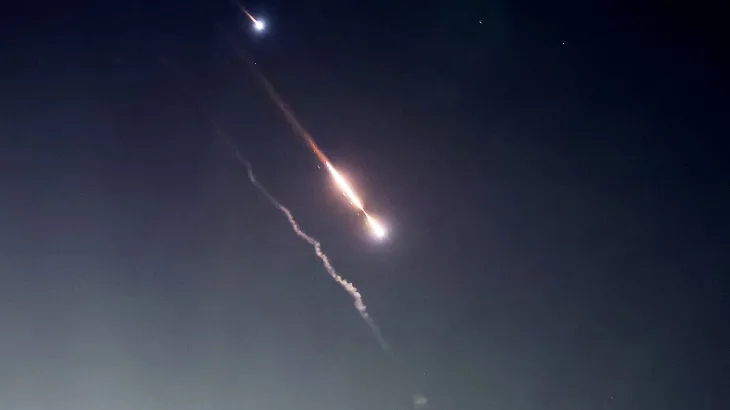
    Iran has initiated an unprecedented attack on Israel, launching hundreds of drones and missiles in retaliation to an Israeli raid on the Iranian consulate in Syria two weeks ago.

    The overnight escalation occurred amid Israel’s ongoing war on the Gaza Strip, which has resulted in the deaths of over 33,000 Palestinians and exacerbated the humanitarian crisis in the besieged territory. Tensions have further heightened in the region, extending to confrontations with Lebanon and Syria, and prompting long-range attacks on Israeli targets from as far as Yemen and Iraq.

    According to the Israeli military, the Iranian onslaught included more than 300 “killer drones, ballistic missiles, and cruise missiles,” with 99 percent intercepted with assistance from France, the United Kingdom, and the United States.

    The launches, originating from Iran, Iraq, and Yemen, triggered air raid sirens across Israeli cities, including Tel Aviv, with the sound of explosions echoing as air defenses thwarted incoming projectiles.

    Medics said a girl in southern Israel was wounded by shrapnel from an intercepted drone, while the military said “a small number of hits were identified, including at [an Israeli military] base in southern Israel, where minor damage was caused to infrastructure”.

    Iran’s Islamic Revolutionary Guard Corps (IRGC) confirmed the attack, stating that it launched the drones and missiles as part of Operation True Promise in retaliation for what they termed “the Zionist entity’s crime of targeting the Iranian consulate in Syria” on April.


    Iran’s Islamic Revolutionary Guard Corps (IRGC) confirmed the attack, stating it launched the drones and missiles under Operation True Promise in retaliation for what they termed “the Zionist entity’s crime of targeting the Iranian consulate in Syria” on April 1. The raid in Damascus resulted in the deaths of 12 individuals, including two senior generals in the IRGC’s elite Quds Force.

    Following the missile and drone attack, Iran’s mission to the United Nations declared the matter “concluded” and issued a warning to Israel of a “considerably more severe” response should the “Israeli regime make another mistake.” Additionally, it cautioned the US to refrain from involvement in the conflict.

    Concerns regarding a broader escalation arose. Prior to the Iranian attack, Iraq, Jordan, and Lebanon announced temporary closures of their airspace. Syria also heightened alert levels around Damascus and major bases, deploying Russian-made Pantsir ground-to-air defense systems, according to Reuters.

    Earlier on Saturday, Iranian armed forces seized a container ship linked to Israel near the Strait of Hormuz.

    Western nations, including the US, the UK, the Czech Republic, Denmark, France, Mexico, the Netherlands, and Norway, condemned Iran’s missile and drone assault. Egypt and Saudi Arabia called for restraint, while the UN Security Council scheduled an emergency session to address the issue at Israel’s request.

    US President Joe Biden shortened a weekend stay at his Delaware beach house to convene with his national security team at the White House on Saturday afternoon. He also held a discussion with Israeli Prime Minister Benjamin Netanyahu, reaffirming Washington’s “ironclad commitment” to Israel’s security.

    Biden stated he informed Netanyahu that “Israel demonstrated a remarkable capacity to defend against and defeat even unprecedented attacks,” sending a clear message to adversaries that they cannot effectively threaten Israel’s security.

    Netanyahu, in a brief post, asserted Israel’s determination to achieve victory.

    We intercepted, we repelled, together we shall win,” he added.

    The Pentagon meanwhile reported that defence chief Lloyd Austin had spoken with his Israeli counterpart “to discuss urgent regional threats … and made clear that Israel could count on full US support to defend Israel against any attacks by Iran and its regional proxies”.

    UN Secretary-General Antonio Guterres also condemned Iran’s attack, saying he was “deeply alarmed about the very real danger of a devastating region-wide escalation”.

    Russian Deputy UN Ambassador Dmitry Polyanskiy said on the Telegram social media app that in addition to a letter from Israel, the UNSC had received one from Iran asserting its attack was within the UN Charter framework governing the right to self-defence.

    “The latter warns that if Israel responds, Iran will respond in a more powerful and decisive manner,” Polyanskiy said.

    China’s Ministry of Foreign Affairs called on all parties to “exercise calm and restraint”, describing the situation as the “latest spillover of the Gaza conflict”. It said it was deeply concerned by the escalation and said Israel’s war on Gaza “must end now”.

    Analysts described Iran’s attack on Israel as carefully calibrated to prevent further escalation.

    “What the Iranians are trying to do is to come up with a measured, calculated attack in order to regain deterrence and not to be seen as weak in front of their own proxies,” said Hassan Barari, professor of international relations at the University of Qatar.

    However, he expressed worry that the attack could worsen the situation in Gaza.

    “I know some right-wing politicians in the government will see this as an opportunity because the world’s attention has shifted onto Iran-Israel and then they can do something probably horrendous in Gaza,” he said.


  • North Korea launches cruise missiles off coast of the east – Seoul reports

    North Korea launches cruise missiles off coast of the east – Seoul reports

    North Korea shot some missiles into the water on its east side, according to South Korea’s military.

    Recently, the country with nuclear weapons has been testing missiles a lot, causing tension in the area.

    The rocket was launched near the Sinpo port on Sunday. We don’t know how many or what kind of missiles there are yet.

    North Korea tested a new missile called Pulhwasal-3-31 on Wednesday, according to South Korea’s Yonhap news agency.

    South Korea’s military said they have been working with the United States to watch for any more actions from North Korea after the new launch at 08:00.

    In the past few months, North Korean leader Kim Jong Un has been more aggressive in his policies and what he says, and has stopped some agreements that were meant to keep peace and has increased military action.

    Pyongyang said it tested a new missile and underwater drones in January. They claim the drones can carry a nuclear weapon.

    For the past two years, they have been launching missiles and developing weapons almost every month, ignoring UN sanctions.

    Earlier this month, Kim Jong Un said that the goal of reuniting with South Korea is no longer important. He said that South Korea is now the main enemy.

    This has made people worry that North Korea is getting ready for a war.

    South Korean President Yoon Suk Yeol told his cabinet recently that if North Korea does something bad, South Korea will respond much more strongly, because its military is very powerful.

  • Seven people reportedly killed as Pakistan fires retaliatory attacks into Iran

    Seven people reportedly killed as Pakistan fires retaliatory attacks into Iran

    Pakistan shot missiles at Iran and reportedly killed nine people because Iran had shot missiles at Pakistan on Tuesday night.

    Pakistan said its attacks targeted places where terrorists were hiding in the south-eastern province of Sistan-Baluchestan in Iran.

    Iran’s state TV reported that three women, two men, and four children were killed.

    The air strikes are happening because there is a lot of tension in the Middle East with many different problems happening at the same time.

    Israel is in a battle with Hamas in Gaza and is also exchanging gunfire with Hezbollah in Lebanon. In addition, Iran-backed groups in Iraq and Syria are attacking US forces. The US and UK have also attacked the Iran-backed Houthis in Yemen, who have been attacking ships.

    Pakistan and Iran have been blaming each other for supporting terrorist groups that launch attacks from areas near their shared border.

    On Thursday, Pakistan’s government said that it had attacked an area near the city of Saravan in Iran.

    Pakistan said it had taken action because it had received information that big terrorist attacks were going to happen soon. They also said they killed some of the terrorists.

    It said that it respects Iran’s rights as a country but its actions on Thursday show that Pakistan is committed to protecting its national security from any threats.

    Pakistan strongly condemned Iran’s attack on Tuesday. The attack hit an area in Pakistan’s Balochistan province near the Iranian border and Islamabad said it killed two children.

    Iran said it only attacked Jaish al-Adl, a group from Pakistan, and not the people of Pakistan.

    Earlier this week, Iran attacked places in Iraq and Syria. They said they targeted the Islamic State and Israel’s spy agency, Mossad. Iran claimed that these two groups were involved in a bomb attack in the city of Kerman, Iran, which killed 84 people.

    Experts said that Pakistan’s reaction was expected and aligned with Iran’s, as both countries characterized the attack as targeting militants.

    Pakistan’s response increases the chance of things getting worse, but it also gives a chance to pull back and avoid a bigger problem. “In reality, both sides are equal now,” said Michael Kugelman, the director for South Asia at the Wilson Center.

    Islamabad wanted to make sure it could defend itself, especially because Iran was attacking other countries in the area using both direct and indirect methods. Simply put, if Pakistan hadn’t taken action, it would have been at risk of more attacks.

    Some people said that the government in Islamabad felt pressure from people in Pakistan to do something about the situation. The country is having an election next month after Imran Khan, its former leader, was removed nearly two years ago.

    Many people wanted the government to act, so they did this to show they are strong, according to retired Lt General Asif Yaseen, a former Pakistani defense secretary.

    He felt strongly that the conflict would end and both countries could talk again. Pakistan might be able to start talking with Iran now.

    Some people are saying that Iran attacked Iraq, Syria, and Pakistan this week because of the problems happening in the Middle East.

    Tehran says they don’t want to join in the bigger fight between Israel and Gaza, but the groups they support have been attacking Israel and its allies to support the Palestinians.

    Shashank Joshi, who is an expert on defense at The Economist, says he doesn’t think the attacks are because of the Hamas attacks on Israel in October. Those attacks killed around 1,300 people and led to Israel attacking Hamas in Gaza. The Hamas health ministry says about 24,000 people have been killed in the Israeli retaliation.

    This is a story about Iran showing its strength, maybe because it was very upset about a serious attack on its country in Kerman on 3 Jan, which is the worst terrorist attack in Iran since the revolution of 1979. Iran is hurt and is striking back. “I don’t believe there is a strong reason to say the bombing was caused by or is a result of 7 October,” Mr. Joshi said on the BBC’s Today program.

    He says that there have been border tensions before, but this is the most serious one he can remember.

    China, a good friend of both countries, has asked both sides to calm down and not make the situation worse.

  • US says that Russia and Iran are heading toward a ‘full defense partnership’

    White House has reported that Russia and Iran are forming a full-fledged defense alliance to support Russia in its conflict with Ukraine.

    John Kirby, a spokesman for the White House National Security Council, claimed that Russia is once more looking to Iran to replenish the Russian military with drones and surface-to-surface missiles.

    “Russia is offering Iran an unprecedented level of military and technical support that is transforming their relationship into a fully-fledged defence partnership,” Mr Kirby said.

    “I think it’s important for us to be clear this partnership poses a threat not just to Ukraine, but to Iran’s neighbours in the region.”

    Concerns about new weapon sales to Russia come after Iran sold hundreds of attack drones to Russian over the summer.

    The Biden administration recently unveiled sanctions against Iranian firms and entities involved in the transfer of Iranian drones to Russia for use in Putin’s ongoing invasion of Ukraine.

    In October, the White House accused Tehran of sending Iranian troops to Crimea to support Russian drone attacks on Ukraine’s power stations and other key infrastructure,

    The White House and British government said the relatively small number of Iranian personnel deployed to Crimea, a part of Ukraine unilaterally annexed by Russia in contravention of international law in 2014, were there to assist Russian troops in launching Iranian-made drones against Ukraine.

    “Supports flowing both ways,” said Mr Kirby.

    “Russia is seeking to collaborate with Iran on areas like weapons development and trade. As part of this collaboration, we are concerned that Russia intends to provide Iran with advanced military components.”


  • Olena Zelenska: We will endure

    Ukrainian first lady Olena Zelenska tells the BBC that Ukraine will endure this coming winter despite the cold and the blackouts caused by Russian missiles, and will keep fighting what she describes as a war of world views, because “without victory there can be no peace”.

    We meet in a storied city where a winter’s chill is biting, where charming street lamps are dimmed, where buildings are going dark and cold in the midst of blackouts as Russia keeps striking Ukraine’s energy grid. The Ukrainian people have won plaudits for standing their ground against Russia’s blistering assault. But this is yet another painful test of fortitude.

    “We are ready to endure this,” Olena Zelenska asserts when we sit down in a heavily secured compound tucked inside a sandbagged labyrinth of buildings in Kyiv.

    “We’ve had so many terrible challenges, seen so many victims, so much destruction, that blackouts are not the worst thing to happen to us.” She cites a recent poll where 90 % of Ukrainians said they were ready to live with electricity shortages for two to three years if they could see the prospect of joining the European Union.

    That seems like an awfully long cold road, and she knows it.

    “You know, it is easy to run a marathon when you know how many kilometres there are,” she says. In this case, though, Ukrainians don’t know the distance they have to run. “Sometimes it can be very difficult,” she says. “But there are some new emotions that help us to hold on.”

    All Ukrainians will become stronger because of this war, Ukraine’s first lady stoically predicts.

    President Volodymyr Zelensky now lives in his office on Bankova Street (left)
    IMAGE SOURCE,GETTY IMAGES Image caption, President Zelensky now lives at 10 Bankova Street (left), opposite the House of Chimaeras (right)

    Our wide-ranging almost hour-long interview, recorded for the BBC’s annual 100 Women season, takes place in the iconic House of Chimaeras, adorned with elephant-head gargoyles and sculptures of mythical creatures, facing 10 Bankova Street – Ukraine’s version of 10 Downing Street. The building formed the backdrop for President Zelensky’s famous 26 February speech to rally Ukrainians, filmed on his phone two days after Russian tanks rolled across the border. “I’m here. We won’t lay down our arms,” he declared.

    The night before, in one of what became nightly addresses, he had announced in another selfie video that Russia “has designated me as target number one, and my family as target number two”.

    “And so it was from the first day and it continues now,” Olena Zelenska recalls, her words barely hiding the enormous strain that her family, like all Ukrainian families now ripped apart, are going through.

    A few walls of sandbags and circles of security checks away, President Zelensky carries on, around the clock. So close and yet so far. She won’t give an exact date for when they last had dinner together with their children, 18-year-old Oleksandra and nine-year-old Kyrylo. “It’s very rare nowadays. Very rare,” she says.

    “I live separately with my children and my husband lives at work,” she explains. “Most of all, we miss simple things – to sit, not looking at the time, as long as we want.”

    Every Ukrainian’s life has been turned inside out – from engineers to ballerinas now fighting on front lines, to some eight million, mainly women and children, forced to flee into new lives across the border.

    The president and first lady’s lives have long been entwined. High school sweethearts, they went on to work together in a comedy troupe and TV studio, he a comic actor and she, backstage, a scriptwriter. When he ran for president three years ago, she made it clear this wasn’t a life she wanted. But this war has thrust her into the spotlight, on a global stage.

    Olena Zelenska and Volodymyr Zelensky as exit polls came out indicating he had made it to the final round of the 2019 presidential election
    IMAGE SOURCE,GETTY IMAGES Image caption, Olena Zelenska advised her husband not to run for president

    After Russia missiles started whistling into Kyiv in the early hours of 24 February, Olena Zelenska spent months in hiding in secret locations with her children. She emerged on 8 May – Mothers’ Day this year in Ukraine, and many other countries – when she joined the US First Lady Jill Biden at a shelter for the displaced in the relatively safe western Ukrainian city of Lviv.

    Now she keeps popping up in speeches on zoom, or at times in person, with her smartly styled hair and classic shirts or jackets, with a shy smile which gives way to strongly worded speeches which come from “a mother, a daughter, a first lady”.

    When the US Congress gave a standing ovation, twice, for a Ukrainian leader in July, it wasn’t President Zelensky at the podium – he hasn’t travelled since Russia invaded – it was his wife. And the first foreign first lady granted the privilege of addressing the US legislature never liked public speaking.

    In an exclusive interview in Kyiv, Ukraine’s first lady talks to the BBC’s Lyse Doucet about the impact of war on mental health, the new roles Ukrainian women are taking on, and what victory would look like.

    “I was scared,” she admits. “But I understood this mission… it was impossible to miss this chance.”

    She emphasised, as she always does, the profound suffering of Ukrainian children, condemning what she called Russia’s “hunger games”. Then, she went much further, asking the US Congress to send weapons.

    Had a first lady, without official powers, crossed a line? “It was not politics, it was what I had to say,” she says. “I asked for weapons, not to attack, but to prevent our children from being killed in their homes.”

    Olena Zelenska (right) with Nancy Pelosi, speaker of the House of Representatives, at the US Congress
    IMAGE SOURCE,GETTY IMAGES Image caption, Olena Zelenska – pictured with House speaker Nancy Pelosi – never liked public speaking

    The year before these momentous months, Olena Zelenska had already established a Summit of First Ladies and Gentlemen. Now it’s a powerful global network which has helped evacuate Ukrainian children needing cancer treatment and provide opportunities for education. It has arranged access to Ukrainian books in the countries that have welcomed millions of Ukrainian women and children forced to flee – without their husbands, who are barred from leaving in a time of war.

    I ask whether she now senses a certain “fatigue” in other capitals, as this crisis pushes up energy and food prices beyond the borders. “I don’t feel they are tired of us. They all understand that this is not just a war in Ukraine. It is a war of world views.”

    Her prominent role makes her the most visible face of a shattered society where women are taking up new roles everywhere, from fighting on front lines to taking charge as single parents. Check any UN document about Ukrainian society pre-war and it uses language like “patriarchal”, “traditional”, with women’s roles limited by gender.

    Olena Zelenska is adamant that Ukrainian society was changing even before war overwhelmed everything, and that this change is now accelerating. “Kitchen, children, church – this is not for our society any more. A woman who has lived through this will not take a step back.”

    Her newly formed Olena Zelenska Foundation deals with the toughest of challenges including mental health and domestic violence. As much as war can toughen individuals, it can also tear them apart.

    In a reflection of the hardening public view as allegations and evidence of Russian war crimes keep emerging, as entire cities and towns are pummelled to the ground, she insists, “We cannot betray those who are now in occupied territories. We cannot leave people who are waiting for liberation.”

    She hastens to add: “This is not a political position of the president or the government. This is the position of Ukrainians.”

    The BBC is not responsible for the content of external sites.View original tweet on Twitter

    Carefully stepping through this political minefield, the first lady is categorical. “We all understand that without victory, there will be no peace. It would be a false peace and wouldn’t last long.”

    And what does “victory” mean to her?

    She answers without hesitation. “A return to a normal life… sometimes it seems we have put everything on pause.” That includes a different kind of life with her husband. “We’re not just spouses. I can safely say we are best friends,” she says.

    My first question to the first lady had been, “How are you?” She replied that, for all Ukrainians, their answer was, “We are holding on.”

    But, for how long? It’s a question no-one can answer.

    Source: BBC.com 

  • What we know about the explosion in Poland

    The missile blast has intensified global fears about the Ukraine war spiralling even further.

    A blast in NATO member Poland, near the Ukraine border, on Tuesday sent shockwaves across the world, with fears of a direct confrontation between the alliance and Russia.

    After the incident, Polish President Andrzej Duda said the explosive, which killed two people in the eastern village of Przewodow, was “most likely Russian-made”.

    But on Wednesday, he said it was “very likely” that the missiles were from Ukraine’s air defence.

    “Absolutely nothing indicates that this was an intentional attack on Poland,” he said. “It’s very likely that it was a rocket used in anti-missile defence, meaning that it was used by Ukraine’s defence forces.”

    Washington and NATO have made similar statements, suggesting the blast was unintentional.

    An investigation is ongoing.

    Russia immediately denied its missiles struck Poland while Ukraine was quick to blame Moscow.

    Here’s what you need to know.

    What do we know about the explosion?

    First news of the incident was reported by Polish Radio ZET, which said on Tuesday that two missiles had hit Przewodow, a village in eastern Poland about six kilometres (3.5 miles) from the border with Ukraine, killing two men.

    Residents of the village, with a population in the hundreds, told local media that a missile had hit a grain drying facility, near a school.

    President Duda said “it was most likely a Russian-made missile” but noted Warsaw had no conclusive evidence on who fired it and that the incident was still under investigation.

    He also described the incident as “a one-off event” and said there was “no indication” it would be repeated.

    A day later, he said there was no evidence the blast was an intentional attack, and, in line with NATO, claimed the missile was likely part of Ukraine’s defensive air systems.

    What was happening in Ukraine at the time?

    The explosion in Poland came on a day of sustained Russian shelling in Ukraine.

    Moscow’s forces launched 110 missiles and 10 Iranian-made attack drones throughout the country, the general staff of Ukraine’s armed forces said, leaving millions of households without power.

    Ukraine said more than 70 missiles were shot down, but some hit the city of Lviv, near the border with Poland to the west.

    Al Jazeera’s Jonah Hull, reporting from Kyiv, said it had been a “hugely kinetic” day.

    “The explosion in Poland … only added to a sense of crisis,” Hull said.

    The turmoil started “receding” on Wednesday, as information suggested the blast was the result of a Ukrainian attempt to down a Russian missile.

    “NATO member after NATO member is now standing back and urging caution and saying they are awaiting the outcome of an investigation [into the incident],” Hull said.

    How did Ukraine and Russia react?

    Ukraine was quick to blame Russia for the missile blast.

    President Volodymyr Zelenskyy said on Tuesday, without producing evidence, that Russian missiles hit Poland in a “significant escalation” of the conflict.

    “The longer Russia feels impunity, the more threats there will be to anyone within reach of Russian missiles. To fire missiles at NATO territory. This is a Russian missile attack on collective security. This is a very significant escalation. We must act,” Zelenskyy said in his nightly video address.

    Russia said the explosion was caused by a Ukrainian air defence missile.

    “The photos published in the evening of November 15 in Poland of the wreckage found in the village of Przewodow are unequivocally identified by Russian defence industry specialists as elements of an anti-aircraft guided missile of the S-300 air defence system of the Ukrainian air force,” the Russian defence ministry said in a statement on Wednesday.

    The ministry also said that Russian attacks in Ukraine on Tuesday had been 35km (22 miles) from the Polish border at their nearest point to the NATO member state.

    Kremlin spokesman Dmitry Peskov accused a number of countries of having made “baseless statements” about Russia’s involvement “without having any idea of what had happened”.

    In rare praise for Washington, he lauded its “measured” response after United States President Joe Biden said it was “unlikely” the missile had come from Russia.

    As fears of an escalation eased, Ukraine said it wants access to the site of the explosion and to see the information that provided the basis for its allies’ conclusions.

    What have the US and NATO said?

    The US and its NATO were cautious in their early responses.

    Asked whether it was too early to say that any missile was fired from Russia, Biden said that the trajectory suggested otherwise.

    “There is preliminary information that contests that,” he told reporters at the G20 summit in Indonesia. “I don’t want to say that until we completely investigate it but it is unlikely … that it was fired from Russia, but we’ll see.”

    NATO Secretary-General Jens Stoltenberg said the alliance’s member states were “monitoring” the situation and “closely consulting” with one another.

    “[It is] Important that all facts are established,” he tweeted on Tuesday.

    On Wednesday, NATO said the blast was most likely the result of a Ukrainian accident but ultimately blamed Russia as the aggressor force.

    Was the incident talked about at the G20?

    Al Jazeera’s Rob McBride, reporting from the G20 summit in Indonesia, said the explosion in Poland was “very much overshadowing” the last day of the meeting – Wednesday – which is being attended by Sergey Lavrov, Russia’s foreign minister.

    Western leaders convened an emergency roundtable in Bali after reports of the blast on Tuesday.

    “I think the point that will be made by the US and its allies, even if it is determined to have been a Ukrainian missile, is that it was fired as a direct result of Russia’s invasion of Ukraine,” McBride said.

    What will happen next?

    The explosion has sparked concern that NATO, which Poland joined in 1999, might be drawn into the conflict between Russia and Ukraine.

    Poland, which has put its military on heightened alert following the blast, is protected by NATO’s commitment to collective defence enshrined in Article 5 of its founding treaty.

    If it is determined that Moscow was to blame for the blast, which seems very unlikely following NATO’s statement on Wednesday, it could trigger Article 5, starting deliberations on a potential military response.

    While the situation was less clear, Warsaw was expected to request urgent consultations under Article 4 of the NATO Treaty, which is invoked when any member state feels their “territorial integrity, political independence or security” are at risk.

    Any response by the alliance will be heavily influenced by whether the incident was accidental or intentional – and for now, the former seems the most probable scenario.

    Even so, Ukraine is still demanding more investigations.

    Source: Aljazeera.com 


  • Seven million homes without power after strikes

    Some seven million households have been left without electricity in Ukraine after Tuesday’s wave of Russian missile strikes targeted the country’s energy supplies, according to Ukraine’s presidential office.

    Customers experienced power cuts in the Kyiv, Vinnytsya, Volyn, Donetsk, Dnipropetrovsk, Zhytomyr, Kirovohrad, Lviv, Poltava, Rivne, Sumy, Ternopil, Kharkiv, Khmelnytskyy, Cherkasy, Chernivtsi and Chernihiv regions.

    Some 15 energy facilities were damaged as a result of the attacks, said the deputy head of Ukrainian President Volodymyr Zelensky’s office, Kyrylo Tymoshenko.

    “Our power engineers are now doing everything to reconnect the power supply as soon as possible,” he said.

    Source: Skynews.com 

  • ‘Our thoughts are with the brave Ukrainian people’ – US

    The United States has strongly condemned Russia’s latest missile attacks against Ukraine, which are reported to have struck residential buildings in Kyiv and additional sites across the country.

    US National Security Advisor Jake Sullivan has said the strikes will serve to only deepen the concerns among the G20 about the “destabilising impact of [Russian President Vladimir] Putin’s war”.

    “It is not lost on us that, as world leaders meet at the G20 in Bali to discuss the issues of significant importance to the lives and livelihoods of people around the world, Russia again threatens those lives and destroys Ukraine’s critical infrastructure,” Sullivan said.

    “Our thoughts are with the brave Ukrainian people, who continue to demonstrate resilience and courage in their defence of their sovereignty and democracy.”

    He said the US, its allies and its partners would continue to provide Ukraine with what it needed to defend itself, including air defence systems, adding the US would stand with Ukraine “for as long as it takes”.

    Source: BBC.com

  • 85 missiles hit Ukraine, 20 more expected – Zelensky

    President Volodymyr Zelensky has said that 85 missiles were launched against Ukraine on Tuesday and 20 more are expected to hit the country.

    In a video shared on Telegram, he also warned residents to stay in shelters.

    The deputy head of the president’s office, Kyrylo Tymoshenko, said the situation across the country was “critical” after missiles battered energy facilities, forcing emergency shutdowns and plunging parts of Kyiv into darkness.

    “Russian terrorists carried out another planned attack on energy infrastructure facilities,” he said.

    The situation in the capital Kyiv was, he added, “extremely difficult”.

    Source: BBC.com 

  • First missile strikes have occurred since Russia lost Kherson

    These are the first Russian missile strikes on Ukrainian cities since Kyiv‘s forces liberated Kherson, a key southern port city, on Friday.

    Ukrainians regard the recapture of Kherson as a major victory, comparable to the retreat of Russian troops from the Kyiv suburbs in March, as well as a humiliation for the Kremlin.

    Approximately 30,000 Russian troops withdrew to the Dnipro’s eastern bank, and Kherson celebrated the weekend. Since early March, the city has been under Russian occupation.

    But before today Russia had already fired hundreds of missiles at Ukrainian cities, hitting residential blocks, power stations and many other civilian installations. Many were cruise missiles fired from Russian bombers or ships positioned outside Ukrainian territory.

    Ukraine says its air defences have shot down many Russian missiles during these strikes.

    Russia claims the Kherson region and three other occupied Ukrainian regions to be part of Russia, as well as Crimea, which Russia annexed in 2014. The claim – following hastily organised local “referendums” – is rejected internationally.

  • N Korea condemns US-S Korea drills, promises ‘merciless’ response

    Official KCNA media says recent spate of launches were designed to simulate attacks on air bases, aircraft and a major South Korean city.

    North Korea has released images of its recent spate of missile launches, including an intercontinental ballistic missile (ICBM), as it condemned recent military drills between South Korea and the United States as an “open provocation and dangerous war drill” against which it said it had to respond.

    A statement from the General Staff of the Korean People’s Army said North Korea would continue to respond to military exercises by South Korea and the US with “sustained, resolute and overwhelming practical military measures”,  the official Korean Central News Agency (KCNA) reported on Monday.

    North Korea fired multiple missiles last week, including a possible failed ICBM, cruise missiles and hundreds of artillery shells, as its southern neighbour and the US conducted their Vigilant Storm air drills, which were extended from five days to six in response to Pyongyang’s tests.

    The North Korean military said the exercises were an “open provocation aimed at intentionally escalating the tension” and “a dangerous war drill of very high aggressive nature,” according to the KCNA report.

    Hundreds of US and South Korean warplanes, including B-1B bombers, took part in Vigilant Storm.

    It was the first time B-1Bs have flown to the Korean peninsula since December 2017.

    Composite photos show four missiles taking off from ground-based launchers against a blue sky.
    KCNA said the missiles launched included cruise missiles, tactical ballistic missiles and a ‘special functional warhead’ [KCNA via Reuters]

    North Korea’s army said it had conducted activities simulating various attacks on air bases and aircraft, as well as a major South Korean city, to “smash the enemies’ persistent war hysteria”, KCNA said. It did not mention whether North Korean leader Kim Jong Un had overseen the exercises.

    The report said North Korea had fired two apparently nuclear-capable “strategic” cruise missiles on November 2 towards the waters off Ulsan, a southeastern coastal city in South Korea; a claim that officials in Seoul said was “untrue” and that no missiles had been tracked near there.

    North Korea carried out some 23 launches that day, with one of the missiles landing 26km (16 miles) south of the Northern Limit Line, which serves as an unofficial maritime border between the two Koreas; the first time that has happened since the Korean War ended in an armistice in 1953.

    New ICBM or variant?

    The operations also included a launch of two “tactical ballistic missiles loaded with dispersion warheads”, a test of a “special functional warhead paralysing the operation command system of the enemy”, and an “all-out combat sortie” involving 500 fighter jets.

    Analyst Joseph Dempsey cast doubt on that claim, noting that such a deployment would involve nearly every dedicated combat aircraft in North Korea’s fleet even though many are decades old or not serviceable.

    “[The] 500 figure seems exaggerated or at least misleading,” the research associate at the London-based International Institute for Strategic Studies said in a thread on Twitter.

    The South Korean Navy rescue vessel used an underwater probe to recover the parts, which are being analysed, the official said.

    US-South Korea joint drills usually trigger strong reactions from North Korea, which sees them as rehearsals for an invasion.

    Experts say Pyongyang is particularly sensitive about drills such as Vigilant Storm because its air force, which lacks high-tech jets and properly trained pilots, is one of the weakest parts of its military.

    While some analysts questioned whether all of the images shared on KCNA were new, others noted that North Korea appeared to have tested either a new type of ICBM or a variant of an existing model.

    “It’s not explicit in their statement, but the design doesn’t correspond to one we’ve seen before,” said Ankit Panda, a weapons expert at the Carnegie Endowment for International Peace.

    He said the launch shown may have been a developmental platform for evaluating missile subsystems, including possibly a vehicle for multiple independently targetable reentry vehicles (MIRVs), which allow a single missile to drop nuclear warheads on different targets.

    “This is definitely an ICBM-size missile,” Panda said.

    North Korea Hwasong-15 missile on a transporter with Kim Jong Un looking on.
    Analysts said the images shared on Monday by KCNA suggested there might have been a new nose cone for the Hwasong-15, which was first tested in 2017 [File: KCNA via Reuters]

    George William Herbert, an adjunct professor at the Center for Nonproliferation Studies and a missile consultant, said the images appeared to show a new nosecone on the Hwasong-15 ICBM, which was first tested in 2017.

    The nosecone has a different shape and appears larger than necessary for the 200- to 300-kiloton nuclear device shown in state media and apparently tested in 2017, he said.

    Herbert said the shape is more suited for a single large warhead than multiple smaller warheads such as a MIRV.

    Source: Aljazeera.com 

  • North Korean missile lands near South Korean waters for the first time

    North Korea has launched the most missiles in a single day, and a ballistic missile has landed near South Korean waters for the first time since the countries’ division in 1948.

    North Korea launched at least 17 missiles off its eastern and western coasts on Wednesday morning, with one landing near the rivals’ tense sea border, according to South Korea’s military.

    Seoul responded quickly by launching missiles.

    It was the most missiles fired by the North in a single day – and the first time a ballistic missile had landed near the South’s waters since the countries’ division in 1948.

    “This is unprecedented and we will never tolerate it,” South Korea’s Joint Chiefs of Staff said.

    The missile landed outside South Korea’s territorial waters, but south of the Northern Limit Line (NLL), a disputed inter-Korean maritime border.

    It landed 35 miles from the South Korean city of Sokcho, on the east coast, and 100 miles from the island of Ulleung, where air raid warnings were issued.

    “We heard the siren at around 8.55 am and all of us in the building went down to the evacuation place in the basement,” an Ulleung county official said.

    “We stayed there until we came upstairs at around 9.15 am after hearing that the projectile fell into the high seas.”

    Yoon Suk-yeol, the South Korean president, said it was an “effective act of territorial encroachment”.

    South Korean warplanes fired three air-to-ground missiles into the sea across the NLL after Mr Yoon’s office pledged a “swift and firm response” so Pyongyang “pays the price for provocation”.

    South Korea is in a period of national mourning after more than 150 people were killed in a deadly crowd crush in the capital, Seoul.

    Hours before the missiles were launched, the North threatened to use nuclear weapons to get the US and South Korea to “pay the most horrible price in history” in protest over the two nations’ ongoing military drills that it views as an invasion rehearsal.

    Washington said the drills were “purely defensive in nature” and that the US had made clear to North Korea that it harbored no hostile intent towards the country.

    Today’s ballistic missile launches mark another step in what feels like an incremental but steady increase of tensions in the Korean Peninsula.

    Not only was this the closest a North Korean missile has come to the South Korean shore since the countries’ division in 1948, but it also comes shortly after its longest known missile flight yet over Japan in early October.


  • ‘We were prepared for days without heat but not running water,’ Ukrainian MP says

    A Ukrainian MP has said recent Russian attacks on energy infrastructure are making it “harder” for Ukrainians, but added that “no one is complaining”.

    Kira Rudik told Sky News: “There are no military targets in these objects Russia is attacking, Putin is attacking them just to make sure it is harder for us to survive winter. Today, people are figuring out how to get water for themselves and their families.

    “We were ready for spending a couple of days without electricity and heat, but we were not ready to spend days without running water and this is what may happen.”

    She added that while Ukrainians are working to restore damaged sites, she claimed Russia waits for them to be restored and targets them again.

    Ms Rudik added that people are preparing to supply water for themselves and using local sources.

    “People are supporting each other, but it’s getting harder and harder in Kyiv and other major cities in Ukraine.”

    Earlier, we reported that 80% of residents in the Ukrainian capital are without water, according to the city’s mayor.


  • North Korean tensions: Why is Kim Jong-un putting more on the country?

    Tensions with North Korea come and go, but the situation on the Korean peninsula is the most volatile it has been in five years, and it appears to be getting worse.

    The North has fired a missile over Japan in the last month, forcing residents to seek shelter; this is a hostile and provocative act. It has launched several other ballistic missiles, flown warplanes close to the South Korean border, and fired hundreds of artillery shells into the sea, which have landed in a military buffer zone established by the two Koreas in 2018 to maintain peace.

    Technically, the two countries are still at war.

    On Monday a North Korean merchant ship crossed the countries’ sea border, causing both sides to fire warning shots. South Korea says the incursion was intentional.

    So, what is Kim Jong-un up to? There are three reasons North Korea tends to launch missiles – to test and improve its weapons technology, to send a political message to the world (primarily the US), and to impress its people at home and shore up loyalty to the regime.

    It can be hard to decipher which of these ends Pyongyang’s actions serve, but this time Mr Kim has been explicit. State media has reported several times that the recent launches and drills are in response to military exercises being run by the US, South Korea, and Japan. The North has blamed its enemies for escalating tensions and says its launches are a clear warning they should stop.

    Washington, Seoul, and Tokyo have been holding large-scale military exercises, separately and together, for the past two months, to show they are ready for a North Korean nuclear attack. There is little doubt these have antagonised Mr Kim, who has always viewed such exercises as his enemies rehearsing for an invasion. The reason North Korea started developing nuclear weapons in the first place was to stop itself from being invaded.

    But there is a less explicit reason he could be upping the pressure now. Some believe may be preparing the ground for a more provocative test – the detonation of a nuclear weapon for the first time in five years, or even a small-scale attack on South Korea.

    Last year he laid out a five-year plan, detailing all the new weapons he planned to develop. It included smaller battlefield nuclear bombs and short-range missiles to carry them. The recent tests are evidence Mr Kim is not only working his way through this weapons wish list but that he is training his troops to use them. He used some of the recent drills, he said, to simulate a nuclear attack on South Korea.

    Now Mr Kim needs attention. He needs the world to notice the progress he has made if he is one day to get harsh international sanctions on his country lifted. Sanctions haven’t stopped North Korea from developing weapons, as they were designed to, but they are hurting its economy.

    Talks aimed at reducing those sanctions have long stalled and North Korea is slipping down the global agenda. The world is far more concerned with the war in Ukraine, and the rise of an authoritarian China. President Biden’s position is that sanctions on North Korea can only be eased when it agrees to give up all its nuclear weapons.

    In the meantime, Washington and Seoul have agreed to strengthen their defence of the Peninsula by holding the military exercises Pyongyang hates so much, and responding to its provocations with force. Following the North’s latest round of missile launches and drills, South Korea sent up warplanes and shot artillery of its own.

    If Mr Kim is to get the US to negotiate on terms more favourable to him, he must prove how dangerous his country has become. Last month he declared North Korea to be a nuclear weapons state, a position he said was irreversible.

    We should be worried about how assertive it seems to have become, said Kim Jong-dae, a former advisor in South Korea’s Defence Ministry. He pointed out how in the past North Korea has waited until US forces have finished their military exercises before retaliating. This time they fired artillery into the sea while exercises were ongoing.

    “We have never seen this audacity and aggression before, it is different. It is the North acting like a nuclear state,” he said.

    The US and South Korean governments believe preparations for North Korea’s seventh nuclear weapon test are complete and the North is waiting for the opportune political moment to act. An attractive window is opening, with China’s Communist Party Conference now over and the US midterm elections approaching.

    Meanwhile, South Korea is in the midst of yet another round of war games, with the US scheduled to join in. These may well provide Kim Jong-un with the pretext he has been waiting for.


  • Oleksandr Starukh: Zaporizhzhia region governor says three people injured in early attacks

    The territory was targeted by S300 missiles, according to Oleksandr Starukh, governor of Zaporizhzhia Oblast.

    He said: “A residential building and infrastructure facilities were destroyed.

    “According to preliminary information, there are no casualties.

    “There are three wounded.

    “The data is being verified.

    “As a result of the attack, the gas system was damaged in a residential high-rise building, there was a fire, and a wall was destroyed.

    “Specialised services are already working in the city of events.

    “The occupier also targeted a school in one of Zaporizhzhia’s districts.

    “The roof of the school was damaged and the windows were broken.

    “There were also hits on infrastructure facilities and open areas.


  • UK to provide missiles to Ukraine to defend against Russian airstrikes

    A shortage of defence systems means Western allies are struggling to meet increasingly urgent requests to protect Ukraine’s skies from missile and drone attacks.

    The UK will for the first time give Ukraine a number of powerful missiles to defend against Russian airstrikes, but it is not providing the weapons that launch them.

    Instead, the AMRAAM rockets – capable of shooting down cruise missiles – will help to arm air defence systems that will be given to Ukraine by the United States.


  • Arindam Bagchi: India ‘deeply concerned’ about escalation in Ukraine

    The foreign ministry of India has expressed its grave worry about the conflict’s escalation in Ukraine after dozens of Russian missiles have struck different cities.

    Spokesman Arindam Bagchi said India is willing to support “all attempts” at de-escalation in the coming weeks.

    “We reiterate that escalation of hostilities is in no one’s interest,” he said.

    “We urge immediate cessation of hostilities and the urgent return to the path of diplomacy and dialogue.”

    The European Commission earlier condemned the strikes as “heinous” as it emerged at least 11 people had died in the blasts, with upwards of 64 injured.


  • North Korea has fired Ballistic missile over Japan

    In what looks to be a calculated escalation to grab the attention of Tokyo and Washington, North Korea fired a suspected missile over Japan.

    The ballistic missile travelled about 4,000 kilometres (2,800 miles) before crashing into the Pacific Ocean; on another trajectory, it may have struck the US territory of Guam.

    It is the first missile launch by North Korea over Japan since 2017.

    The launch saw Japan issue a rare alert to some citizens to take cover.

    The UN prohibits North Korea from testing ballistic and nuclear weapons. Flying missiles towards or over other countries without any pre-warning or consultation also contravenes international norms.

    Most countries avoid doing it completely as it can easily be mistaken for an attack. While it is not as big as a nuclear test – which could be next – it can be considered hugely provocative.

    People in the north of Japan, including Hokkaido island and Aomori city, reportedly woke up to the noise of sirens and text alerts that read: “North Korea appears to have launched a missile. Please evacuate into buildings or underground.”

    As the missile flew overhead, they were warned to look out for falling debris. Many appeared to remain calm according to reports, with one video showing Tokyo commuters walking calmly as loudspeakers blared out warnings.

    But others were more shaken. “If a missile hit, I was worried it would be a big problem not only here but also nationwide,” Aomori resident Kazuko Ebina told the Asahi Shimbun newspaper.

    Officials later said the intermediate-range ballistic missile fell into the Pacific Ocean far from Japan, and there were no reported injuries.

    It had covered the longest distance ever travelled by a North Korean missile, and reached a height of around 1000km – higher than the International Space Station.

    Japan’s Prime Minister Fumio Kishida described the launch as “violent behaviour”, while defence minister Yasukazu Hamada said Japan would not rule out any options to strengthen its defences including “counterattack capabilities”.

    The US National Security Council spokesperson Adrienne Watson called it a “dangerous and reckless decision” that was “destabilising” to the region.

    The launch comes as Japan, the US and South Korea have been working together to strengthen their defences, in response to the growing threat posed by the North.

    Last week, the three countries conducted naval exercises together for the first time since 2017. Such drills have long antagonised Pyongyang leader Kim Jong-un, who views them as proof that his enemies are preparing for war.

    Following the combined exercises in 2017, North Korea fired two missiles over Japan in response. A week later, it conducted a nuclear test.

    Recent intelligence has suggested that North Korea is getting ready to test another nuclear weapon.

    It is expected that North Korea would wait till after China – its main ally – holds its Communist party congress later this month.

    But some experts are now asking if it could come sooner than expected – they believe Tuesday’s launch shows that North Korea is preparing the ground for a nuclear test.

    The missile launch is the fifth carried out by Pyongyang in a week. On Saturday, two rockets came down in waters outside Japan’s exclusive economic zone.

    Many of North Korea’s missile tests are conducted on a high, lofted flight path – reaching a high altitude, avoiding flights over its neighbours.

    But firing over or past Japan allows North Korean scientists to test missiles under circumstances “that are more representative of the conditions they’d endure in real-world use”, analyst Ankit Panda told news agency Reuters.

    These actions have contributed to enduring tensions between North Korea and Japan, rooted in Japan’s previous colonisation of Korea from 1910 to 1945 and the North’s abduction of Japanese citizens in the past.

    Earlier this month, North Korea passed a law declaring itself to be a nuclear weapons state, with leader Kim Jong-un ruling out the possibility of talks on denuclearisation.

    Pyongyang conducted six nuclear tests between 2006 and 2017, incurring widespread sanctions.

    The East Asian state regularly defies the ban on nuclear and missile tests, saying it needs to bolster its defences.

    Additional reporting by Nathan Williams.

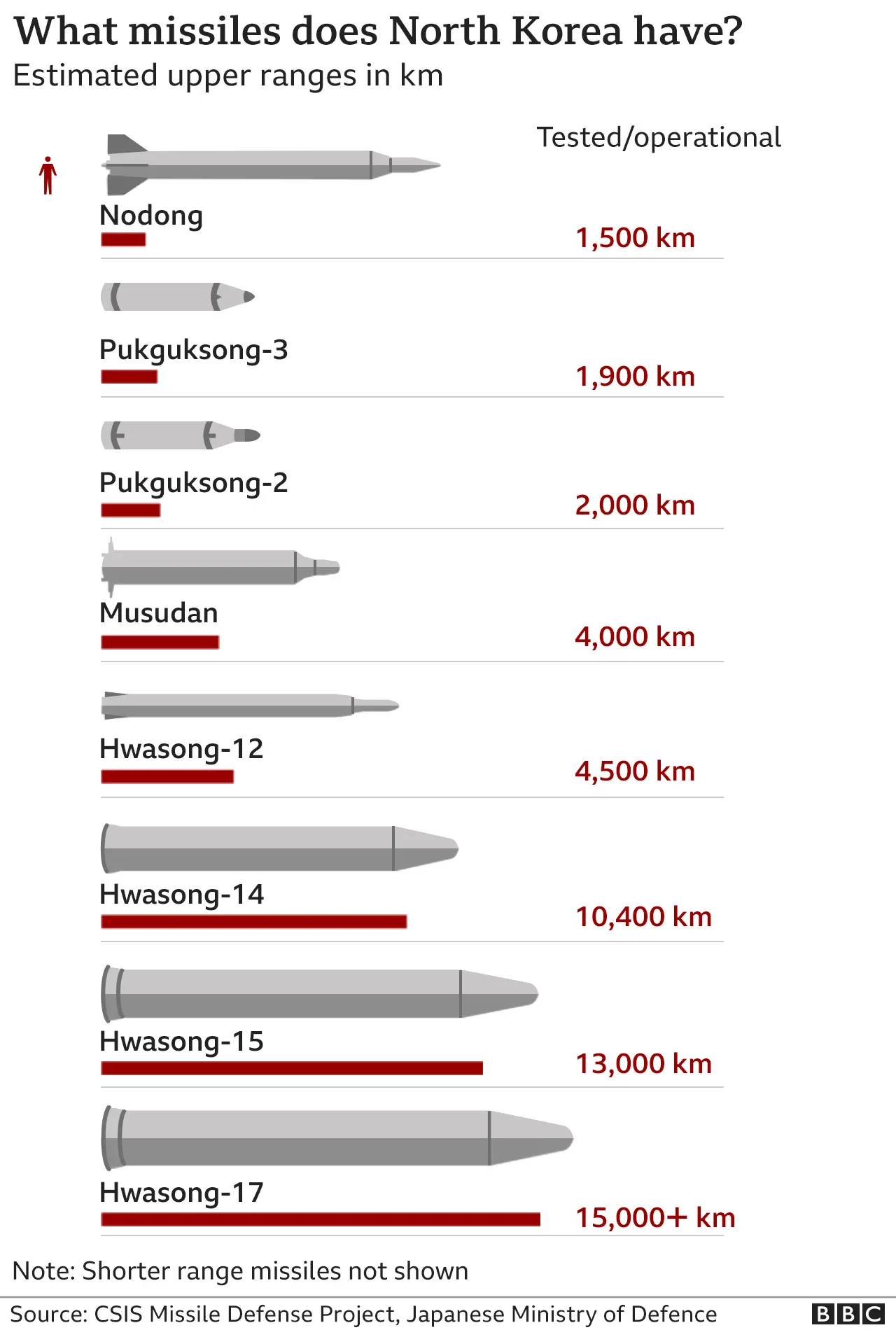
    List of missiles held by North Korea and their range
  • North Korea fires suspected ballistic missile into sea

    North Korea has fired a suspected ballistic missile off its east coast, its first known test since June, South Korean military officials have said.

    It came after a US aircraft carrier arrived in South Korea to participate in joint drills, and ahead of a planned visit by Vice President Kamala Harris.

    Seoul said the launch was an “act of grave provocation”.

    South Korea’s military said it detected a short range missile fired at just before 07:00 local time (23:00 GMT) close to Taechon, more than 100 km (60 miles) north of Pyongyang. It said it flew about 600 km at an altitude of 60 km.

    “Our military maintains a full readiness posture and is closely cooperating with the US while strengthening surveillance and vigilance,” it said in a statement.

    Japan’s coast guard confirmed the launch, warning ships to “be vigilant”. Tokyo’s defence minister Yasukazu Hamada said the missile reached a maximum altitude of around 50 km, falling in waters off North Korea’s eastern coast, and outside Japan’s exclusive economic zone.

    “It’s North Korea’s way of showing defiance of the [US] alliance,” Soo Kim, an analyst at the Rand Corporation, told AFP.

    The nuclear-powered USS Ronald Reagan docked in the southern port city of Busan on Friday, to take part in joint drills off South Korea’s east coast. The exercises are for the “sake of peace and stability on the Korean peninsula”, according to the South Korean navy.

    Ms Harris will visit South Korea in the coming days as part of a trip to the region that will include the funeral of former Japanese Prime Minister Shinzo Abe.

    Tensions on the Korean peninsula have spiked in the past year, with Pyongyang firing a number of ballistic missiles.

    South Korea’s President, Yoon Suk-yeol, who took office in May, has promised a tougher stance on North Korea and indicated closer ties with the US.

    Earlier this month, North Korea passed a law declaring itself to be a nuclear weapons state, with leader Kim Jong-un ruling out the possibility of talks on denuclearisation. Despite widespread sanctions, Pyongyang conducted six nuclear tests between 2006 and 2017.

    List of missiles held by North Korea and their range
    Source: BBC