Tag: mobile money

  • MTN CEO recounts how he was targeted by mobile money fraudsters

    MTN CEO recounts how he was targeted by mobile money fraudsters

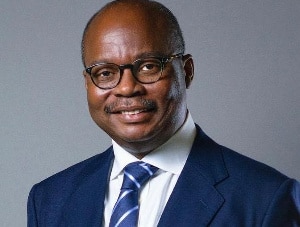
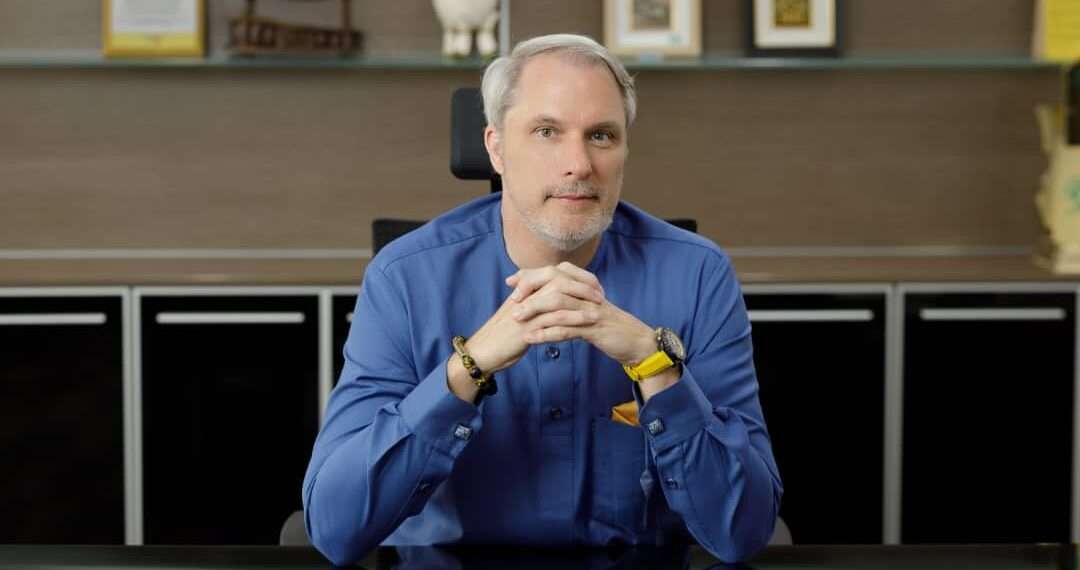
    MTN Ghana’s CEO, Stephen Blewett, has shared a personal experience in which he was targeted by mobile money fraudsters, emphasizing the growing threat of scams in the country.

    Speaking on his first anniversary as CEO, Blewett described how the incident unfolded during his first month at MTN Ghana. He received a call from a scammer who attempted to deceive him into believing that he had made a transfer.

    “In my first month here, I received a call from a fraudster. He claimed I had made a transfer and tried to manipulate me into believing it. I decided to keep him on the phone for about 15 minutes, hoping that by doing so, he wouldn’t scam someone else,” Blewett recalled.

    “Eventually, I told him I was the CEO of MTN, and he didn’t believe me. He got upset and hung up. But this experience serves as a reminder of how important it is to stay vigilant.”

    Blewett reassured customers that MTN remains committed to fighting mobile money fraud, stressing that the company is actively working on ways to better protect users.

    “We are constantly asking ourselves how we can improve. We are applying the same customer-first mentality to tackle these issues and are exploring better solutions for our users,” he stated.

    Mobile money fraudsters are advancing strategies that utilize the trust and reliance of patrons on mobile money agents.

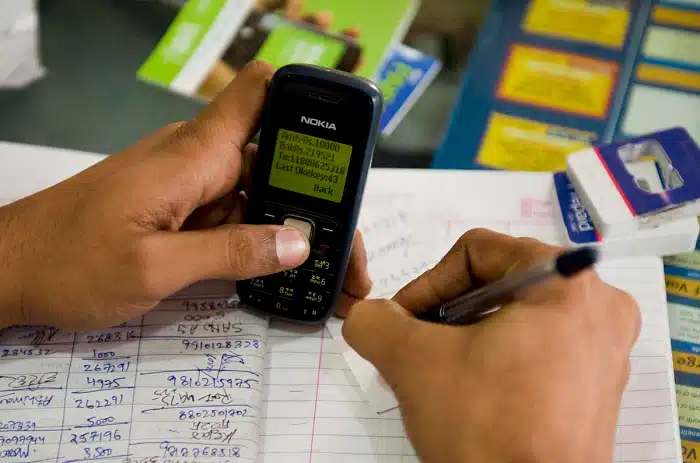
    The fraudsters take the form of agents or connected people from the telecommunication network; they obtain customer details (including names and phone numbers) from agents’ record books or through illicit channels.

    Using this information, they send a message that takes the messaging format of mobile money transaction prompts.

    They follow up with a call to the targeted mobile money user, calling them by name, and sharing stories of their previous transaction making the scamming process appear legitimate and trustworthy.

    The fraudster then claims there has been a wrong transaction or an error in depositing funds into the user’s account.

    They will often pressure the user to send back the “excess” money or provide their private information, claiming that it’s necessary to resolve the supposed issue or threaten to block the user.

  • GHc649.2bn mobile money transactions recorded in first two months of 2025

    GHc649.2bn mobile money transactions recorded in first two months of 2025

    Ghana’s mobile money industry saw a strong start to 2025, with transactions hitting GH₵649.2 billion within the first two months of the year.

    This marks a significant 64.68% increase compared to the same period in 2024, when mobile money transactions totaled GH₶394.2 billion.

    Data from the Bank of Ghana reveals that mobile money transactions in January 2025 amounted to GH₶333 billion. However, the figure dropped slightly to GH₶316.2 billion in February 2025.

    The surge in transactions comes despite the presence of the Electronic Transaction Levy (E-Levy), which was scrapped by the new government last week. Analysts predict that with the levy removed, mobile money transactions could see further growth, strengthening Ghana’s financial technology ecosystem.

    Meanwhile, mobile money usage continues to expand, with the number of registered accounts rising to 74.1 million, up from 66.9 million in early 2024. Despite this growth, only 411,000 out of 896,000 registered agents were actively processing transactions.

    In 2024, Ghana recorded an all-time high of GH₶3.0192 trillion in mobile money transactions, reflecting a year-on-year growth of 57.90%.

  • Transactions conducted through mobile money services surpasses GHS1.9tr – BoG

    Transactions conducted through mobile money services surpasses GHS1.9tr – BoG

    The Bank of Ghana’s (BoG) 2023 FinTech Sector Report indicates substantial advancements in the nation’s digital financial sector, with mobile money accounts exceeding 65 million and total transaction values surpassing GH¢1.9 trillion.

    This development represents a significant achievement in Ghana’s pursuit of a more inclusive and cashless economy.

    The surge in this sector is fueled by the growing acceptance of mobile financial services, which offer a dependable and efficient way for millions of Ghanaians, particularly in underserved and rural regions, to obtain financial services.

    According to the report, mobile money has established itself as a prominent player in Ghana’s financial framework, with transaction volumes growing exponentially each year.

    The Bank of Ghana emphasizes the vital contribution of Rural and Community Banks (RCBs) to the national financial inclusion strategy.

    The central bank has pointed out that RCBs, which act as crucial financial service providers for rural communities, have a unique chance to utilize technology and digitalization in their operations.

    By implementing digital solutions, RCBs could effectively narrow the financial access divide in rural areas, delivering more customized services tailored to the needs of local populations.

    At the 23rd Annual Chief Executive Officers’ Conference held in Ho, Mrs. Elsie Addo Awadzi, the BoG’s Second Deputy Governor, stressed the significance of digital transformation for the rural banking sector through remarks made by Mr. Yaw Sapong, Director of the Other Financial Institutions Supervision Department.

    She emphasized that RCBs should capitalize on technology to broaden their reach and enhance the quality of their service offerings.

    Mrs. Awadzi highlighted the BoG’s dedication to promoting financial inclusion through digital initiatives, referencing the success of the Ghanapay initiative, which serves as a national digital payments platform aimed at improving financial service access, particularly in rural regions.

    She encouraged RCBs to adopt this platform and build collaborations with FinTech companies via the ARB Apex Bank to foster innovation and tailor their offerings to customer needs.

    Furthermore, she emphasized the necessity for RCBs to move beyond standard financial products, asserting that to effectively assist rural communities, they must create specialized financial solutions that address the specific requirements of local populations.

    This entails comprehending the financial rhythms of farmers, small-scale traders—particularly women and individuals with disabilities—and local enterprises.

    By providing services such as savings and loan products that align with agricultural and business cycles, RCBs could ensure that their offerings remain relevant and accessible to their intended clients, she stated.

    She noted that this strategy would not only bolster the financial well-being of rural communities but also position RCBs as the primary source for financial services in those areas.

    To maintain this progress, Mrs. Awadzi urged RCBs to invest in capacity building and effective corporate governance practices, suggesting that enhancing staff skills would enable RCBs to adapt to changing financial needs, while robust governance structures would promote accountability and long-term stability.

    Mr. Alex Kwesi Awuah, Managing Director of ARB Apex Bank, also praised the successful rollout of the Financial Sector Development Project (FSDP).

    With support from the Government of Ghana and the World Bank, the FSDP has played a crucial role in implementing digital banking platforms for RCBs, facilitating seamless and secure digital financial services for their clients.

    Mr. Awuah pointed out that the digital transformation of RCBs has not only enhanced their operational effectiveness but also allowed them to broaden their customer base, integrating more Ghanaians into the formal financial system.

    The 23rd Annual CEOs Conference convened 147 CEOs from RCBs nationwide, offering a forum for rural banking leaders to explore challenges, opportunities, and the future of the sector.

    Held on the theme: “Positioning Rural Banking at the Centre of the National Financial Inclusion Agenda,” the event also featured representatives from the Bank of Ghana, executives from the Association of Rural Banks, and the Board Chairman of ARB Apex Bank, Dr Toni Aubyn.

    As the rural banking sector continues to play a pivotal role in Ghana’s financial landscape, the adoption of technology and a customer-centric approach will be essential in ensuring sustainable growth and widespread financial inclusion across the country.
  • Value of mobile money transactions surges by GHC744bn

    Value of mobile money transactions surges by GHC744bn

    The total value of mobile money transactions in Ghana surged by a remarkable GH¢744 billion, hitting GH¢1.775 trillion in the first eight months of 2024, according to data from the Bank of Ghana.

    This figure represents a significant rise compared to the GH¢1.031 trillion recorded during the same period in 2023.

    This impressive growth in mobile money transactions highlights the increasing adoption of digital payments and provides an opportunity to deepen financial inclusion in the country. However, it also raises questions about why the government isn’t generating substantial revenue from the Electronic Transaction Levy (E-Levy).
    The Bank of Ghana’s September 2024 Summary of Economic and Financial Data detailed the month-by-month performance of mobile money transactions. In January 2024, the value of transactions stood at GH¢198.4 billion, slightly dropping to GH¢195.8 billion in February. The downward trend continued in March, with transactions dipping to GH¢181.9 billion.

    However, the tide turned in April 2024, with mobile money transactions jumping to GH¢203.0 billion. The upward momentum continued in May 2024, with a rise to GH¢234.3 billion, although June saw a slight dip to GH¢224.0 billion.

    By July 2024, transactions had surged to GH¢264.9 billion, reaching GH¢273.6 billion in August 2024, marking a consistent increase in the latter months.

    This growth underscores the vital role mobile money plays in Ghana’s economy, but it also raises concerns about maximizing the potential revenue from the sector through initiatives like the E-Levy.

  • Armed robbers attack momo vendor, bolt away with GHC120,000 and mobile phones in Amanfrom

    Armed robbers attack momo vendor, bolt away with GHC120,000 and mobile phones in Amanfrom

    Famous Fiagbe, a 34-year-old Mobile Money (MoMo) vendor, is currently in critical condition at the Winneba Trauma and Specialist Hospital following a violent robbery.

    The incident occurred on Tuesday night in Amanfrom American Down, located in the Ga South Municipality of the Greater Accra Region.

    According to police reports, two armed assailants on a motorcycle attacked Fiagbe as he was closing his shop around 10:00 PM.

    In an emotional interview with Adom News, Fiagbe’s mother, Favour Dikah, recounted witnessing her son being shot while the robbers demanded his bag containing cash.

    Dikah described a harrowing scene where the suspects fired more than five shots before seizing the bag with GH₵120,000 and mobile phones, which also held substantial amounts of money.

    She has since reached out to the Inspector General of Police, Dr. George Akuffo Dampare, urging him to take action and apprehend the criminals, emphasizing that the money does not solely belong to her son.

  • AU approves Akufo-Addo’s plan to expand mobile money interoperability

    AU approves Akufo-Addo’s plan to expand mobile money interoperability

    The Sixth Mid-Year Coordination Meeting of the African Union (AU), held on July 21, 2024, in Accra, Ghana, represented a major advancement in the continent’s economic integration initiatives.

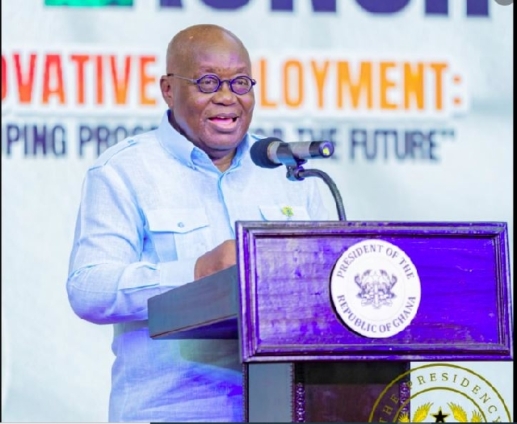
    The prominent gathering, which included Heads of State and Government from various African nations, featured the endorsement of a crucial proposal by Ghana’s President, H.E. Nana Addo Dankwa Akufo-Addo, aimed at enhancing mobile money interoperability across the continent.

    In his role as the AU Champion for AU Financial Institutions, President Akufo-Addo highlighted the essential contribution of mobile money to economic integration and trade facilitation within Africa. His proposal, “Scaling up Interoperability for Economic Integration: Using Mobile Money to Buy and Sell Across Africa,” was enthusiastically endorsed by the AU Assembly.

    The approval of this initiative marks a significant achievement in the AU’s larger plan to boost intra-African trade and economic collaboration. By facilitating seamless mobile money transactions across various countries and financial systems, the AU seeks to reduce transaction costs, broaden financial inclusion, and streamline trade processes among African nations.

    During the meeting, chaired by H.E. Mohamed Cheikh El Ghazouani, President of the Islamic Republic of Mauritania and AU Chairperson, the importance of aligning national and regional policies to enhance socio-economic development across Africa was emphasized. The endorsement of the mobile money interoperability plan supports the AU’s goals of improving economic stability and strengthening connections among member states.

    In his speech, President Akufo-Addo emphasized how mobile money interoperability could revolutionize operations for small and medium-sized enterprises (SMEs) and informal sector vendors, who are crucial to many African economies.

    “By leveraging mobile technology, we can break down barriers to trade, boost economic activities, and empower millions of Africans to participate in the continental and global economy,” he stated.

    The meeting’s declaration also called on member states to allocate sufficient financial resources to ensure the successful implementation of the integration agenda.

    The AU Commission, working with regional economic communities (RECs) and the African Development Bank (AfDB), has been assigned the task of producing a biennial Integration Report starting in 2025 to monitor progress and highlight areas needing improvement.

    As Africa navigates the complexities of globalization, the adoption of mobile money interoperability signifies a major step towards using technology to drive sustainable economic growth. The AU’s decision is anticipated to spur further advancements in financial services and strengthen the continent’s integration into the global economy.

  • Four detained for alleged robbery of mobile money vendor in Upper West Region

    Four detained for alleged robbery of mobile money vendor in Upper West Region

    The Tumu Magistrate Court within the Sissala East Municipality of the Upper West Region has detained four people on accusations of allegedly robbing a mobile money vendor.

    The individuals had been monitored by police in Tumu due to a series of thefts targeting travelers in the Sissala East Municipality.

    Their capture stemmed from an inquiry into an assault on the mobile money vendor.

    The detainees, Sumaila Tembieru (a mechanic), Hamidu Muniru (a farmer), Sumaila Issahaku (also a mechanic), and Salifu Abu (a farmer), were taken into custody on July 19 after extensive police investigations in Tumu concerning a robbery in the Kong community.

    The mobile money vendor had his cash and two mobile phones taken during the incident.

  • MOMO transactions experience 41.55% surge in first 4 months of 2024 despite E-Levy deductions

    MOMO transactions experience 41.55% surge in first 4 months of 2024 despite E-Levy deductions

    In the first four months of 2024, the total value of mobile money transactions hit an all-time high of GH¢779.1 billion, marking a 41.55% year-on-year increase.

    This surge contrasts sharply with the GH¢330.9 billion recorded during the same period in 2023.

    Notably, this remarkable growth persists despite the presence of the Electronic Transactions Levy.

    According to the March 2024 Summary of Economic and Financial Data by the Bank of Ghana, January 2024 saw transactions valued at GH¢198.4 billion, which slightly declined to GH¢195.8 billion in February 2024.

    However, there was a rebound to GH¢203.0 billion in April 2024 after a dip to GH¢181.9 billion in March 2024.

    This notable achievement is in the face of the Electronic Transaction Levy (E-Levy).

    The total number of transactions peaked at 631 million in March 2024, with January and February recording 618 million and 609 million transactions, respectively.

    Although there was a slight decrease to 630 million transactions in April, the active mobile money accounts continued to rise, reaching 23.9 million in April 2024 compared to 22.9 million in January 2024.

    The total value of mobile money transactions in 2023 soared to a record GH¢1.912 trillion, surpassing the GH¢1.07 trillion recorded in 2022.

    MONTH2023 (GH¢ billion)2024 (GH¢ billion)
    January130.1198.4
    February134.0195.8
    March147.5181.9
    April138.8203.0
    Total550.4779.1
  • Mobile Money accounts surge to GHS18.69b with commercial banks for March 2024

    Mobile Money accounts surge to GHS18.69b with commercial banks for March 2024

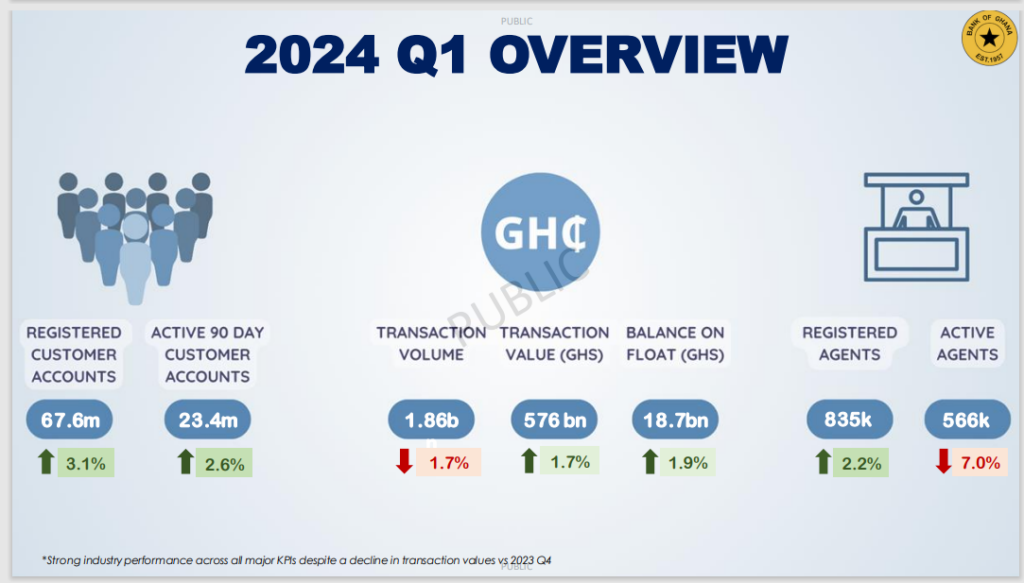
    The 2024 Fintech Sector Report unveiled by the Bank of Ghana indicates that the collective value of mobile money accounts held with commercial banks by March 2024 soared to GH¢18.69 billion cedis.

    This amount, as stated in the report, is referred to as the Balance on Float.

    The statistic reflects a 7.5 percent increase compared to the figures recorded in February 2024.

    Additionally, the report indicates that since February 2023, the GH¢18.69 billion represents the highest Balance on Float observed over the past 14 months.

    The Balance on Float encompasses the amalgamation of customer, agent, partner banks, and the service provider’s own cash deposit, which serves as the foundation for Electronic Money provision.

    It serves as a potent tool for mobilizing funds outside the traditional banking system.

    Other Transactions on the mobile money platform for first quarter

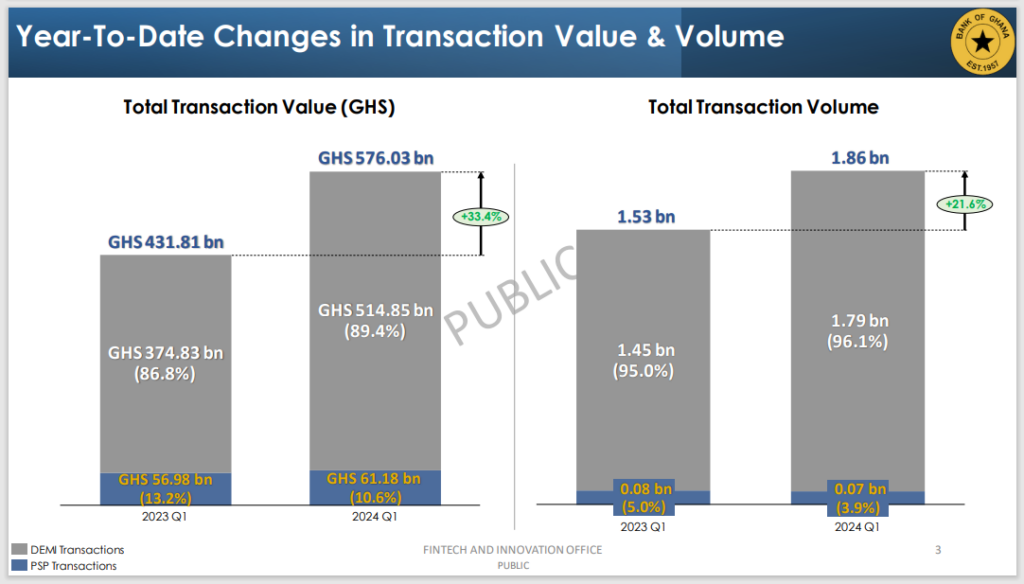
    The report additionally revealed that the aggregate value of mobile money transactions surged to GH¢576 billion during the initial three months of 2024.

    This marks a 33.4 percent surge compared to the GH¢431 billion recorded during the corresponding period in 2023.

    Conversely, the total transaction volume for the first quarter of 2024 amounted to GH¢1.86 billion, reflecting a 21.6 percent increase over the figures recorded for the same period in 2023.

    As of March 2024, the total registered customer accounts reached GH¢67.3 million, while the number of registered mobile money agents stood at 835,000.

  • 44m mobile money accounts registered as of 2023 – Akufo-Addo

    44m mobile money accounts registered as of 2023 – Akufo-Addo

    The mobile money market in Ghana is rapidly expanding, with a significant surge in the adoption of electronic wallet services. President Akufo-Addo revealed that by the close of 2023, a staggering 44 million accounts had been registered.

    This announcement, shared via a post on X on Tuesday, May 14, 2024, also highlighted that mobile money transactions had exceeded GH¢1 trillion.

    President Akufo-Addo further noted a substantial increase in the percentage of adults with access to financial services, rising from 58% in 2017 to 80% in 2023.

    He hailed mobile money as the most revolutionary addition to Ghana’s financial landscape, transforming countless lives and creating new avenues of opportunity.

    “Mobile money adoption has increased considerably, with some 44 million accounts registered by the end of 2023, and transactions surpassing GH¢1 trillion. Meanwhile, the percentage of adults with access to financial services has risen from 58% in 2017 to some 80% in 2023, representing a remarkable achievement that has transformed countless lives and opened up new horizons of opportunity,” President Akufo-Addo stated.

    Ghana’s remarkable achievement extends to boasting one of the world’s highest mobile money penetration rates. President Akufo-Addo emphasized that mobile money transactions annually surpass GH¢900 billion, underscoring the market’s robust growth and significant impact on the nation’s economy.

  • BoG expresses commitment to addressing illegal fees in Mobile Money transactions

    BoG expresses commitment to addressing illegal fees in Mobile Money transactions


    The Bank of Ghana (BoG) has committed to resolving issues related to illegal fees in mobile money transactions due to increasing consumer complaints about unauthorized charges imposed by certain mobile money service providers.

    In a statement, BoG reaffirmed its dedication to protecting consumers’ interests and upholding the integrity of the mobile money system.

    BoG highlighted its ongoing scrutiny of mobile money operators to detect and rectify any instances of unauthorized fees.

    “To my understanding, if you are doing this for yourself, there are no charges. I think that it is where there are third-party individuals involved that these charges come into play and it is something that we have raised in the past. It is an area that we are looking at because of the issue of financial inclusion. It is very important for all of us,” he said.

    The central bank stressed the significance of transparency and accountability within the mobile money sector to uphold consumers’ trust and confidence.

  • Mobile Money agent attacked by robbers in broad daylight at Tumu, elope with GHC600K 

    Mobile Money agent attacked by robbers in broad daylight at Tumu, elope with GHC600K 

    Five unidentified armed individuals have attacked and robbed a mobile money vendor at gunpoint in Zongo, a suburb of Tumu in the Sissala East Municipality.

    The armed robbers are said to have stolen GH¢600,000.00 along with several mobile phones during the robbery, which occurred on April 22, 2024, at approximately 4:30 pm.

    The victim, Mr. Fuseini Issaka Quendar, a 45-year-old businessman, promptly reported the incident to the Sissala East Municipal police command. Recounting the harrowing experience to the Ghana News Agency (GNA), Mr. Fuseini described how the five assailants, all clad in long black jackets and riding three unregistered motorcycles, brandished AK 47 rifles as they forcibly entered his shop.

    Once inside, the robbers coerced Mr. Fuseini and everyone else in the shop to lie down at gunpoint. After collecting the money, they fired shots within the shop and shattered all the glass.

    Mr. Fuseini recalled that one of the robbers threatened to shoot him in Mossie language, while others urged him to slit his throat.

    “He raised the machete towards my head, but I hid my head under the bench and the cutlass landed on the wooden bench and they left the cutlass in the shop and took off”, he explained. 

    After the robbery, Mr. Fuseini recounted that the armed men fired several shots into the air before fleeing through the crowded Tumu lorry station, making their escape towards the St. Clares Vocational School along the Gwollu road. It took approximately 15 minutes before people began emerging from their shops and hiding spots.

    Mr. Fuseini also mentioned an incident earlier that day, where a young boy of Fulani descent had left his phone at the shop to be charged. However, after the robbery, the boy and his mobile phone were both missing.

    When questioned about why he had such a large sum of money in his shop, Mr. Fuseini explained that the money belonged to maize buyers who typically conducted business during the weekend.

    “During weekends a lot of people transact business in cash in CFA, Cedis and others across the borders so we only (pick cash) on Friday and use it for the weekend business”, the victim stated.  

    Following the robbery, Mr. Fuseini reported that he contacted the police, but they took approximately an hour to arrive at the scene. The police have since launched an investigation, taking statements from Mr. Fuseini and urging him to report any further information about the incident. However, no arrests have been made yet.

    In a show of solidarity, over 15 mobile money operators in Tumu marched to the Paramount Chief of Tumu’s Palace a day after the robbery, demanding increased security measures. They threatened to cease their services if security in the area was not improved.

    This recent incident adds to a series of similar robbery attacks in the region. About six months ago, another daylight robbery occurred on the Navrongo-Wa road, where close to GH¢400,000.00 was stolen. Additionally, three weeks ago, a robbery took place during a market day in Bujan, where traders’ money was stolen. Last year, armed robbers attacked a mobile money vendor in Jefisi, collecting all his money and disrupting the market activities for the day.

    Residents of Tumu are concerned about the increasing audacity of the armed men, who now brazenly attack civilians in town centers with AK47 rifles. They fear that such attacks may escalate if not promptly addressed by the authorities.

    In response to these incidents, Mr. Fuseini Yakubu Batong, the Sissala East Municipal Chief Executive, stated that an emergency security meeting had been convened to address the situation.

  • Mobile money sales boy arrested for allegedly stealing over GHC1 million

    Richard Okai, a 26-year-old mobile money salesperson, stands accused of embezzling approximately GH¢ 1,385,910.3.

    His case is currently before the Adentan Circuit Court, awaiting guidance from the Attorney General (AG).

    Initially arraigned on March 7, 2024, before Judge Angela Attachie, Okai pleaded not guilty to six charges of misappropriating varying sums of money. These charges range from GH¢ 94,596.30 to GH¢ 451,048.60.

    During a subsequent hearing on April 23, 2024, before Relief Judge Nana Aba Quaiba Nunoo, the case was adjourned to April 29, 2024, awaiting directives from the AG.

    Chief Inspector Maxwell Lanyo, the prosecutor, presented the case, detailing that the complainant, residing in Kissieman near Achimota, Accra, owns a sizable cosmetic shop named Lilyna Enterprise at the Madina Market. Okai, also known as Kobby, works as a salesperson and resides in UN, a suburb of Madina.

    Okai’s responsibilities include handling mobile money transactions at Lilyna Enterprise, collecting payments from customers, and depositing them into the company’s merchant account. The prosecutor highlighted that due to the complainant’s trust in Okai, she did not scrutinize his handling of the mobile money transactions.

     “On February 20, 2024, at about 10 a.m., some customers were paying through mobile money when Naa Mayley, the complainant’s daughter and a witness in this case, noticed Richard acting suspiciously,” C/Insp Lanyo added.

    Naa Mayley confiscated the company’s mobile phone from Richard Okai and discovered that he had transferred GH¢1,697 from the company’s account to his personal mobile money account. She immediately informed her mother, and together they inspected Okai’s phone, uncovering numerous transfers from the company’s account to his own.

    Subsequently, they reported the incident to the police, leading to Okai’s arrest. During questioning, he admitted to the crime.

    The police obtained a statement from MTN regarding Okai’s accounts, revealing that from December 2022 to February 2023, he had embezzled GH¢159,315.5. From August 2023 to December 2023, the amount rose to GH¢463,489.6, and from January to February 2024, he had stolen GH¢87,098.5. This totaled GH¢709,903.6.

    Further investigations revealed that Okai had used some of the stolen money to purchase land in Akatanmaso, Accra. He also deposited GH¢7,000 in his Fidelity Bank account, kept GH¢3,000 in his mobile money account, and spent some money on gambling.

    Following the investigation, he was charged with theft and brought before the court.

  • E-levy: MoMo agents to strike over double taxation

    E-levy: MoMo agents to strike over double taxation

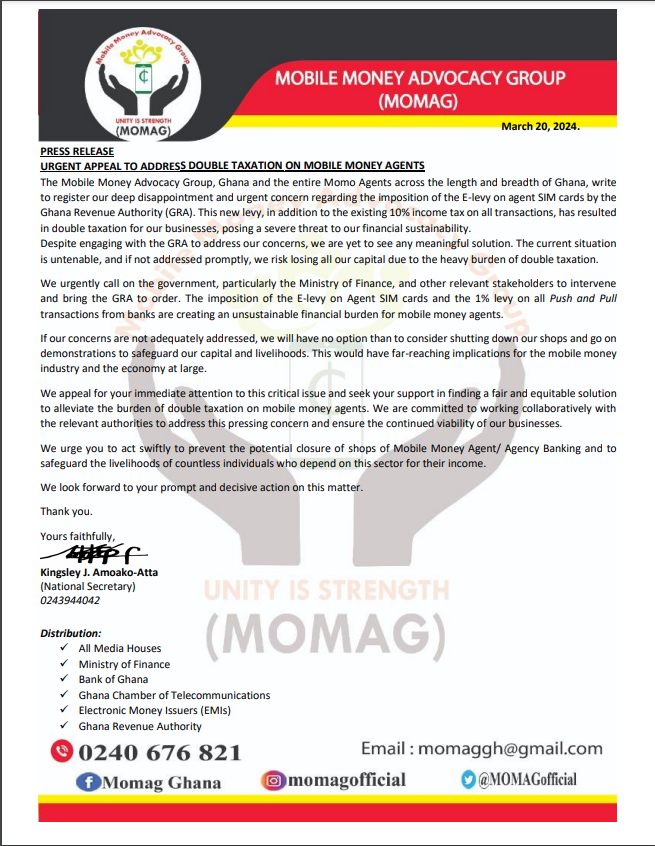
    The Mobile Money Advocacy Group Ghana (MOMAG) and mobile money agents have voiced their disappointment with the Ghana Revenue Authority (GRA) over the imposition of the E-levy on agent SIM cards, citing it as leading to double taxation for their businesses.

    In a statement issued on Wednesday, March 20, 2024, MOMAG stated that despite engaging with the GRA to address their concerns, no satisfactory outcome has been reached.

    The introduction of the new levy, combined with the existing 10% income tax on all transactions, is posing a threat to the financial viability of their businesses, according to MOMAG.

    “The current situation is untenable, and if not addressed promptly, we risk losing all our capital due to the heavy burden of double taxation,” the statement read.

    The Association is urging the government, especially the Ministry of Finance, and other pertinent stakeholders to step in and rectify the situation with the GRA.

    The statement, endorsed by the National Secretary, Kingsley J. Amoako-Atta, further highlighted that the imposition of the E-levy on Agent SIM cards and the 1% levy on all Push and Pull transactions from banks are placing an untenable financial strain on mobile money agents.

    MOMAG has issued a warning of potential shop closures and planned demonstrations if their grievances are not promptly resolved.

  • WHO utilizes Africa’s booming mobile money sector

    WHO utilizes Africa’s booming mobile money sector

    Since 2020, the World Health Organisation (WHO) has successfully automated payments for over two million African health professionals, transitioning from cash payments to mobile money.

    The WHO Digital Finance Team has implemented digital payment systems in 24 African countries, including Benin, Botswana, Madagascar, Rwanda, Togo, and Zimbabwe.

    This move aligns with WHO’s participation in the Better Than Cash Alliance, a UN alliance aimed at enhancing payment digitisation and advancing financial inclusion.

    “With these inspiring results, WHO is clearly taking a leadership role in accelerating the digital transformation in the provision of health outcomes globally,” said Tidhar Wald, managing director of the Better Than Cash Alliance.

    According to the WHO’s Digital Finance Team, more than 80% of workers surveyed in several countries prefer digital payments. Studies funded by the Bill and Melinda Gates Foundation have shown that timely compensation improves morale and staff retention.

    Maria May, senior program officer for Inclusive Financial Systems at the Gates Foundation, stated that over the last four years, WHO has leveraged the increasing presence of mobile money in Africa to ensure that frontline healthcare workers are paid quickly and securely.

  • Unknown man lures female university student to sea, dupes, sleeps with her

    Unknown man lures female university student to sea, dupes, sleeps with her

    A compelling video circulating on social media recounts a distressing incident involving a young woman who shares the harrowing experience of her friend falling victim to a scam, coupled with unwarranted advances under the guise of spiritual claims.

    In the footage, the narrator reveals that an undisclosed university student was approached by a driver of a matiz car, alleging that the young lady was under a spiritual attack.

    As the narrative unfolds, the young woman succumbs to the claims made by the driver and follows him to the sea.

    Along the way, a series of unsettling incidents occur, including the man making inappropriate advances while utilizing a makeshift protective measure and coercing the victim into disclosing her mobile money (momo) pin, to which she reluctantly agrees.

    The video has ignited a social media frenzy, with netizens expressing a range of reactions to the alarming scam alert.

    In light of this incident, individuals are urged to exercise caution and be vigilant against falling prey to such scams.

    Watch video below:

  • Telecoms Chamber to block MoMo agent accounts not registered with Ghana Card

    Effective February 1, 2024, all mobile money agent accounts without a Ghana Card or Tax Identification Number (TIN) will be blocked, according to the Ghana Chamber of Telecommunications.

    This decision was made following extensive engagements with the leadership of the Ghana Revenue Authority (GRA) regarding the requirement to link all agent accounts with either the Ghana Card or TIN.

    The GRA had provided a deadline until the end of Wednesday, January 31, 2024, for Electronic Money Issuers (EMIs) to work with agents and ensure the completion of the linking process.

    The Chamber of Telecommunications emphasized that information about this exercise has been communicated directly to all affected agents through multiple channels over the specified period.

    “We would like to use this press release as a last call to action to the agents, by urging them to regularise their operations through the linking of their accounts with their Ghana Cards or TIN if they haven’t already. Failure to do so before the end of Wednesday, January 31, 2023, will lead to the blocking of their accounts”, it said.

    Mobile money agents whose accounts will be suspended on February 1, 2024, have been informed to visit any operator outlets with their Ghana Card or Tax Identification Number (TIN) to complete the necessary linking process.

    The Chamber emphasized the crucial role of mobile financial services in promoting financial inclusion and contributing to economic growth in the country. They expressed a commitment to taking the necessary steps to ensure the delivery of convenient, secure, and accessible financial services to all Ghanaians.
  • BoG records over GHC900bn increase in mobile money transactions

    BoG records over GHC900bn increase in mobile money transactions

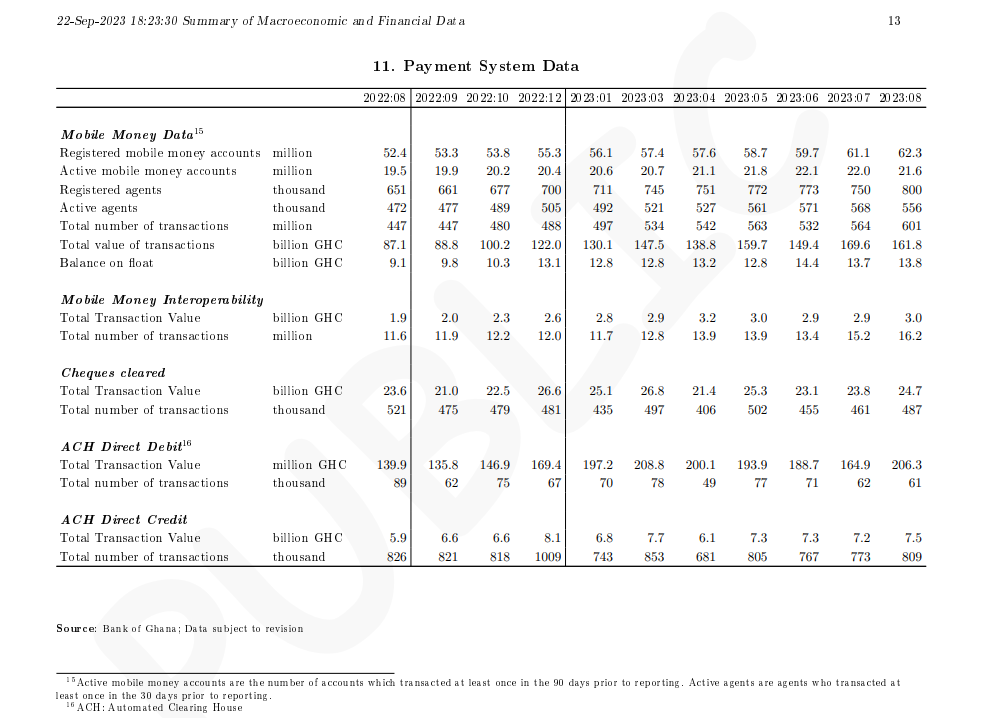
    The total value of mobile money transactions in Ghana reached a record level in 2023, according to the 2023 Summary of Economic and Financial Data by the Bank of Ghana (BoG).

    The total mobile money transactions for the year amounted to GH¢1.912 trillion, compared to GH¢1.07 trillion in 2022. In the first 10 months of 2023 alone, the total had reached a record GH¢1.527 trillion.

    The data showed consistent growth throughout the year, with December 2023 recording the highest mobile money transaction value of GH¢199.3 billion.

    Each of the 12 months in 2023 saw transaction values exceeding GH¢100 billion.

    In January 2023, the value of mobile money transactions stood at GH¢130.1 billion, compared with GH¢76.2 billion during the same period in 2022.

    It surged to GH¢134.0 billion in February 2023 (February 2022: GH¢76.5 billion) and subsequently to GH¢147.5 billion in March 2023 (March 2022: GH¢90.5 billion).

    It however, fell to GH¢138.8 billion in April 2023 (GH¢87.7 billion), but shot up to GH¢159.7 billion in May 2023 (May 2022: GH¢71.4 billion) before declining slightly to GH¢149.4 billion in June 2023 (June 2022: GH¢77.1 billion).

    But it achieved a then-record transaction of GH¢169.6 billion in July 2023, before declining to GH¢161.8 billion in August 2023.  It again fell to GH¢157.0 billion in September 2023 (GH¢88.2 billion: September 2022) before hitting an all-time record of GH¢179.2 billion in October 2023.

    It then surged to GH¢185.9 billion in November 2023 and to GH¢199.3 billion in December.

  • Ghana recorded mobile money transactions worth GHC1.912 trillion in 2023 – Report

    The mobile money landscape in Ghana witnessed an unprecedented surge in 2023, reaching a record-breaking total transaction value of GHS1.912 trillion, according to the January 2024 Summary of Economic and Financial Data released by the Bank of Ghana

    This substantial increase marked a significant rise from the GHS1.07 trillion recorded in the previous year, highlighting the growing reliance on mobile money services in the country.
    The report detailed that the first 10 months of 2023 alone saw a remarkable GHS1.527 trillion in mobile money transactions. December 2023 emerged as a standout month, recording the highest monthly transaction value of GHS199.3 billion.

    The data from the Bank of Ghana further revealed a consistent upward trend in mobile money transactions throughout the year. Every month in 2023 witnessed transactions surpassing GH¢100 billion, signifying the integral role mobile money plays in the financial landscape.

    In January 2023, the mobile money transactions amounted to GHS130.1 billion, a substantial increase from GHS76.2 billion in the same period in 2022. The momentum continued, with transactions reaching GHS134.0 billion in February 2023 (compared to GHS76.5 billion in February 2022) and further escalating to GHS147.5 billion in March 2023 (March 2022: GHS90.5 billion).

    Although there was a slight dip to GHS138.8 billion in April 2023 (compared to GHS87.7 billion in April 2022), the figures quickly rebounded. May 2023 saw a surge to GHS159.7 billion (May 2022: GHS71.4 billion), followed by GHS149.4 billion in June 2023 (June 2022: GHS77.1 billion).

    July 2023 marked a significant milestone with a record-breaking transaction value of GHS169.6 billion. Subsequent months showed fluctuations, with GHS161.8 billion in August 2023, GHS157.0 billion in September 2023 (compared to GHS88.2 billion in September 2022), and an all-time high of GHS179.2 billion in October 2023.

    The upward trajectory continued, reaching GHS185.9 billion in November 2024. Despite this impressive performance in the mobile money sector, it remains uncertain whether the government is meeting its Electronic Transfer Levy (E-Levy) target for 2023, given the current E-Levy rate of 1.0%.

    The surge in mobile money transactions underscores the increasing reliance on digital financial services in Ghana and sets the stage for further advancements in the country’s financial technology landscape.

  • KPMG Survey reveals 66% of Ghanaians use Mobile Money weekly 

    KPMG Survey reveals 66% of Ghanaians use Mobile Money weekly 

    A recent survey conducted by global audit and advisory firm KPMG has brought to light the remarkable surge in mobile money usage among Ghanaians. 

    The findings indicate that a staggering 66% of the population embraces the convenience of mobile money transactions on a weekly basis, signifying a significant shift in financial habits across the nation.

    The 2023 KPMG West Africa Banking Industry Customer Survey has revealed that mobile money has emerged as the dominant channel in Ghana’s payment landscape, with 66% of participants indicating weekly utilization.

    Even with a significant shift toward digital channels, the nation continues to primarily operate as a cash-based economy.

    The ease of transferring money between accounts and mobile wallets, the report said, emerged as the most important experience metric for retail customers.

    Notably, certain banks refrain from imposing fees on their customers for transferring funds between their mobile money wallet and bank account, fostering convenience. Additionally, there was an uptick in customers utilising financial technology platforms.

    Sixteen percent of respondents indicated using fintech platforms weekly, up from 10.0% in 2022.

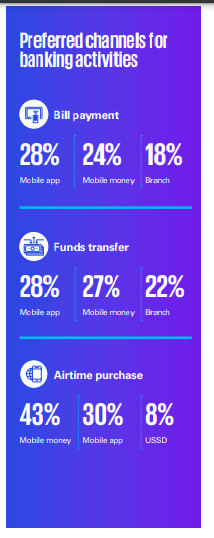
    Fifty three percent of respondents reported using their bank’s mobile app at least once a week, a 3-percentage point increase from last year.

    The USSD platform’s penetration also continued its upward trajectory, evidenced by a growth in weekly customer usage. Presently, 28% of respondents use their bank’s USSD platform weekly.

    Despite a substantial move towards digital channels, Ghana remains predominantly a cash-based economy.

    A significant 32.0% of respondents indicated weekly Automated Teller Machine (ATM) usage, emphasising the importance of 24/7 cash availability at these machines which ranks as the second most crucial metric for retail respondents.

    The report also stated that with 36% of respondents favouring the ATM for cash withdrawals and 22% preferring mobile money, the cultural preference for cash persists due to its perceived security and widespread acceptance, particularly in traditional markets and informal sectors.

    “Despite advancements in digital security, there persists a prevailing mistrust and reluctance toward the security of digital platforms”, it added.

    In summary, the report said the ongoing journey of digital adoption is gaining momentum, albeit moderately. Thus, the Ghanaian payment sphere presents a fertile ground, ripe with opportunities for substantial disruption and transformative change.

  • MoMAG lifts GHS1000 cap on mobile money withdrawals


    The Mobile Money Advocacy Group (MoMAG) has officially lifted the GHȻ1000 cap on withdrawals, effective immediately. This decision comes following discussions with relevant authorities regarding concerns over meager and static commissions for Mobile Money (MoMo) agents.

    Initially, MoMo agents in Ghana had announced a temporary measure limiting cash withdrawals to a maximum of GH¢1,000 per transaction from December 1, 2023. The move aimed to highlight their ongoing concerns about inadequate compensation for their services.

    In a statement issued on Thursday, MoMAG confirmed the immediate suspension of the withdrawal cap while waiting for the final resolution promised by the Ghana Chamber of Telecommunications and other telecom companies.

    The statement emphasized the importance of respecting institutions that engaged in fruitful discussions with the four mobile money associations. MoMAG urged its members to revert to the initial mode of transactions while awaiting the outcome of further discussions in 2024.

    MoMAG explicitly disassociated itself from any publication, announcement, or information linked to the previous decision on GHȻ1000 withdrawals made on November 25, 2023.

    “We believe that failure to heed this call of truncating this action will amount to disrespect to these institutions who had a fruitful meeting with us – the four mobile money associations. We think it will be prudent to hold on with the action for now.”

    “MoMAG, however, dissociates itself from any publication/announcement/information and any association(s) which seems to affix itself to the previous (November 25, 2023) decision of GHȻ1000 withdrawals,” it added.

    This development underscores MoMAG’s commitment to working towards a fair and sustainable compensation structure for Mobile Money agents in Ghana.

  • Mobile Money vendor runs away with his employer’s Gh¢20,600 capital

    Mobile Money vendor runs away with his employer’s Gh¢20,600 capital

    A mobile money vendor by the name Collins Mensah, has made an escape with the business capital of his employer, identified as Ms. Rosina.

    As reported by Rainbow Radio Accra, Ms. Nancy lodged a complaint with the police, alleging that the suspect absconded with Ms. Rosina’s business capital amounting to Gh¢20,600.

    Ms. Rosina, a mobile money operator, had employed Collins Mensah, also known as Pharmacy, to assist in the expansion of her business.

    However, within less than a month of employment, the young man chose to betray her trust by stealing from her.

    “I saw that he could do that work, so I employed her, but he said he wouldn’t be able to survive if he had to wait till the end of the month to receive her salary, so I decided to give her 20 cedis monthly and was taking care of his health bills too.”

    “So, I was not well on the 29th, so I didn’t go to work, and my mother came to tell me that he was passing by and Collins had locked the shop, so I decided to call him, but he didn’t answer after 16 attempts. I didn’t know he could do that to me. When I went there, he had taken Gh¢20,600 and had left the remaining in the shop,” Ms. Nancy said on Rainbow Radio Accra.

    https://youtu.be/aL-rLTsgKkk
  • E-levy forced 1 million Ghanaians to render their mobile money inactive – ISSER

    E-levy forced 1 million Ghanaians to render their mobile money inactive – ISSER

    A research study conducted by the Institute of Statistical, Social and Economic Research (ISSER) has revealed that approximately one million mobile money accounts became inactive following the implementation of the Electronic Transfer Levy (E-levy) in May 2022.

    This resulted in a decline in the total number of accounts, reducing from 19.1 million to 18.1 million by July 2022.

    According to ISSER’s review, the number of registered and active accounts and agents continued to rise in January 2023, although the number of active accounts dropped by 100,000 in February 2023.

    Between March and April 2022, there was a decrease of 10 million in the total number of transactions, and the total value dropped by GH¢2.8 billion. Likewise, between April 2022 and May 2022, the total number of transactions fell by 21 million, and the total value decreased by GH¢16.3 billion.

    During June 2022, there was a reduction in the total number of transactions, followed by a period of recovery between July 2022 and November 2022. Ghanaians quickly turned to alternative payment systems when the E-levy was introduced.

    Furthermore, ISSER reported that initially, less than 7% of the target revenue was realized, with only ¢93 million out of GH¢1.4 billion raised. Interestingly, upon the announcement of the E-levy, there was an increase in the usage of alternate payment systems, such as GHIPPS instant pay, cheques cleared, and internet banking.

    After the E-levy rate was adjusted to 1%, ISSER noted a drop in the usage of alternate payment systems. However, these figures increased again in February 2023, indicating that the effect of the revision was short-lived.

    In conclusion, ISSER observed that the E-levy failed to generate the expected revenue. Furthermore, it emphasized the significance of the tax rate, suggesting that even marginal reductions (e.g., 0.5%) could influence the acceptance or rejection of a tax policy by stakeholders.

  • Ghana ranks second in Africa for mobile money services growth – Report

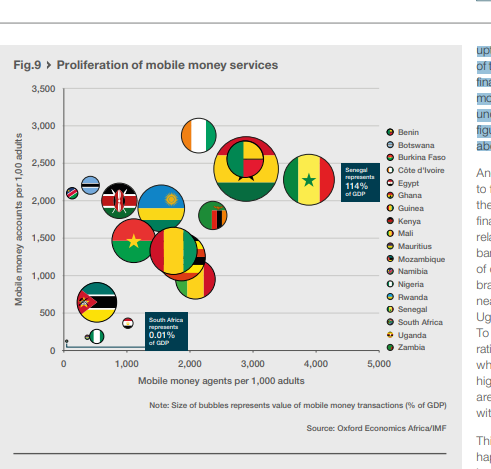
    Ghana has secured the second position in Africa for the growth of mobile money services, following Côte d’Ivoire, as revealed in the 2023 Oxford Economics Africa’s Report titled “The Africa Risk-Reward Index.”

    This noteworthy achievement is highlighted in the report, despite the presence of the Electronic Transfer Levy.

    The report further indicates that the value of mobile money transactions in Ghana, Côte d’Ivoire, and Senegal exceeds 100% of their respective Gross Domestic Product (GDP).

    “Specifically, mobile money services have made more inroads in Africa than in any other region, with West African countries – namely Senegal, Ghana and Côte d’Ivoire – leading the way”.

    “The uptake of mobile money services – indicative of the need (and desire) to leapfrog traditional financial infrastructure. The value of mobile money transactions in South Africa equates to under 1% of GDP, while the corresponding figures for Senegal and Ghana are well above 100% of GDP”, it added.

    When it comes to mobile money accounts per 1,000 adults, Ghana secured the second position, with Côte d’Ivoire taking the lead.

    In the category of mobile money agents per 1,000, Ghana achieved the second rank, while Senegal claimed the top spot.

    The report highlighted an interesting observation regarding the relationship between a country’s financial sector maturity and the adoption of mobile money services. It suggests an inverse correlation, indicating a strong inclination to leapfrog traditional financial infrastructure in favor of mobile money solutions.

    In the first eight months of 2023, total mobile money transactions in Ghana reached an impressive milestone of 1.190 trillion cedis. The Bank of Ghana reported that there were 21.6 million active mobile money accounts as of August this year, accompanied by 556,000 active agents.

    The 2023 Oxford Economics Africa’s Report delved into the benefits and challenges associated with polarization in African countries, African-led security interventions, and the financing strategies employed by African nations to prepare for the future.

  • BoG records over GHS1trn in total mobile money transactions for first 8 months

    BoG records over GHS1trn in total mobile money transactions for first 8 months

    The September 2023 Summary of Economic and Financial Data released by the Bank of Ghana (BoG) reveals that the total value of Mobile Money transactions in the first eight months of the year reached an unprecedented GH¢1.190 trillion.

    This figure marks a significant increase from the GH¢655.97 billion recorded during the same period in 2022.

    The data from the Central Bank also revealed that the highest mobile money transaction for the year was recorded in July 2023, amounting to GH¢169.6 billion. Month-on-month, mobile money transactions consistently exceeded ¢130 billion.

    These figures suggest that the government may be on track to meet its Electronic Transfer Levy (E-Levy) target for 2023. In January 2023, mobile money transactions amounted to GH¢130.1 billion, compared to GH¢76.2 billion in January 2022. The trend continued with GH¢134.0 billion in February 2023 (compared to GH¢76.5 billion in February 2022) and GH¢147.5 billion in March 2023 (compared to GH¢90.5 billion in March 2022).

    Although there was a slight dip to GH¢138.8 billion in April 2023 (compared to GH¢87.7 billion in April 2022), mobile money transactions surged to GH¢159.7 billion in May 2023 (compared to GH¢71.4 billion in May 2022) before leveling off at GH¢149.4 billion in June 2023 (compared to GH¢77.1 billion in June 2022).

    The peak was reached with a record transaction of GH¢169.6 billion in July 2023, followed by a decrease to GH¢161.8 billion in August 2023.

    On January 11, 2023, the government reduced the tax rate on electronic transactions from 1.5% to 1.0%. Despite the substantial growth in mobile money transactions, revenue generated from this sector has fallen below the government’s expectations.

    Additionally, the total value of Mobile Money Interoperability for the first six months was estimated at GH¢22.795 billion, with the largest single transaction of GH¢3.158 billion occurring in April 2023.

  • EOCO goes after Momo fraudsters after signing MOU with Mobile Money Ltd

    EOCO goes after Momo fraudsters after signing MOU with Mobile Money Ltd

    The Economic and Organized Crime Office (EOCO) and Mobile Money Limited, a division of the world’s largest telecoms company, MTN, have signed a Memorandum of Understanding (MoU) to increase their cooperation in the fight against mobile money fraud and other fraudulent online activities.

    The MoU aims to encourage cooperation in areas like information sharing on trends and patterns of scams, creating training manuals to increase investigators’ capacity, coordinating investigations, and looking into ways to improve the effectiveness of creating robust dockets for prosecuting offender

    Criminals

    At a quick signing ceremony yesterday at the EOCO headquarters in Accra, the Chief Executive Officer of MTN Mobile Money Limited, Shiabu Haruna, initialed for his company while the Executive Director for EOCO, Commissioner of Police (COP) Maame Yaa Tiwa Addo Danquah, initialed for hers.

    Mrs. Addo Danquah declared before the agreement was signed that EOCO was dedicated to working with all stakeholders to stay one step ahead of criminals.

    “If the criminals are working together, what about those of us who are fighting them,” she asked.

    She disclosed that the Economic and Organized Crime Office (EOCO) has successfully obtained convictions for certain criminals involved in SIM swap fraud, with assistance from telecommunication service providers and the banking industry.

    “The conviction should send a signal to perpetrators that you cannot get away with such crimes,” she said.

    She claimed that while using digital financial services and transactions had “made life simple for us in terms of making payments and transferring money, some criminals have taken advantage of that to swindle unwary individuals.

    “If the criminals are working together, what about those of us who are fighting them,” she asked.

    She disclosed that the Economic and Organized Crime Office (EOCO) has successfully obtained convictions for certain criminals involved in SIM swap fraud, with assistance from telecommunication service providers and the banking industry.

    “The conviction should send a signal to perpetrators that you cannot get away with such crimes,” she said.

    She claimed that while using digital financial services and transactions had “made life simple for us in terms of making payments and transferring money, some criminals have taken advantage of that to swindle unwary individuals.

    How do we stop them?”  

    According to the MOU, she stated that Mobile Money Limited will exchange information about vulnerabilities and things to watch out for when developing new products with EOCO in order to enable investigators know what to watch out for when handling cases. EOCO would also receive training support from Mobile Money Limited.

    Protection

    Mr. Haruna claimed that the collaboration would aid the company in better safeguarding its clients from national internet fraud.

    “Mobile money has become an integral part of our lives as individuals and businesses but we are saddled with issues of fraud that have permeated the services.

    We will use the partnership to combat the increasing rate of financial crimes,” he said.

    He pointed to a recent Bank of Ghana report on digital financial services fraud and claimed it indicated an increase in cases recorded between 2021 and 2022.

    According to the research, a sizeable sum of GH 26 million was lost via Electronic Money Issues (EMIs), representing a roughly 103% increase in financial crime.

    “This shows that there is some value that our customers are losing to organised and financial crime and it is our responsibility to work with law enforcement agencies to ensure that the perpetrators are brought to book,” said Mr Haruna.

    He said the two organisations would work together to fight emerging crimes in relation to financial crime.

    “As a leading provider of digital financial service, we owe it to our customers to collaborate and support the fight against crime and ensure our customers have a safe environment to conduct their business and personal transactions,” he said.

  • These 3 procedures will help you know the “next of Kin on your Momo

    These 3 procedures will help you know the “next of Kin on your Momo

    The advent of Mobile Money platforms has significantly enhanced the convenience and efficiency of cash transactions in the digital payment landscape.

    Over time, mobile service providers have implemented various security measures and transactional protocols to ensure accurate identification of cash transfers and other important customer details during registration.

    While some Mobile Money users may not readily provide information about their chosen ‘Next of Kin’ during the registration process, it is crucial for individuals to be aware of this information.

    The term ‘Next of Kin’ typically refers to a person’s closest living relative(s). This can include immediate family members with a blood relation, such as children, or individuals with a legal status, such as spouses or adopted children.

    In recent times, it has become imperative to know this status as many subscribers at the time of registry could not readily provide one, while there are some who relied on the telco agents to provide them with one.

    GhanaWeb Business in this article provides some three easy steps in checking one’s ‘Next of Kin’ status via MTN’s Mobile Money.

    How to check:

    1. Dial *170#
    2. Select option 6 for My Wallet
    3. Select option 10 for Next of Kin and wait for the prompt

    It is important to note that should one find a different name for this prompt, a change can be effected manually on the platform.

  • MTN to implement increase in cash out fees effective July 1st

    The mobile money withdrawal transaction charge will increase to GHS20 for all withdrawals of GHS2,000 or more starting on July 1st, according to telecommunications behemoth MTN in a broadcast.

    Telecommunications giant MTN has in a broadcast said its outfit will increase mobile money withdrawal transaction fees to GHS20 for all amounts GHS2,000 and above effective July 1st.

    In an SMS circular to customers, MTN MobileMoney Limited said, “Y’ello Valued Customer, kindly note that effective July 1, 2023, Cash out transactions below Ghc2,000 will attract a fee of 1%. Cash-out transactions from Ghc2,000 and above will attract a flat fee of Ghc 20. This will be charged to your wallet. Do not pay any other fee to any MoMo agent. Just Momo it”.

    Currently, the maximum fee charged for cash-out is 1% for any amount up to GHS1,000 and GHS10 for all cash-out transactions above GHS1,000. But per the new circular, the 1% is now applicable to amounts up to GHS2,000, and the maximum fee is now doubled to GHS20.

    It also means from July 1, 2023, any cash-out transaction between GHS1,000 and GHS2,000 will also attract more than GHS10.

    This comes in the wake of economic hard times when citizens are complaining of skyrocketing inflation, increasing prices of goods and services, job losses, and low income.

    Ghanaians have also had to live with an obnoxious 1% electronic transfer levy (e-levy) for the majority of digital financial transfers they make.

    MTN is, however, yet to explain the rationale for the increase in cash-out transaction fees at this time.

  • Telcos and BoG joining forces to retrieve locked funds on MoMo accounts – Comms Minister

    Minister of Communications and Digitalisation, Ursula Owusu-Ekuful, has revealed that Mobile Network Operators (MNOs) are partnering with the Bank of Ghana to facilitate the retrieval of locked Mobile Money (MoMo) belonging to customers of telcos whose SIM cards have been blocked.

    The collaborative effort, according to the Minister, seeks to address concerns of affected subscribers and also aims to streamline the process of retrieving locked funds in mobile money accounts.

    Updating Parliament on the status of the SIM re-registration exercise in Parliament on Thursday, June 8, the Minister assured affected subscribers that while they won’t be able to conduct mobile-related transactions with their deactivated SIMs, their funds will be recovered through the necessary processes.

    “We have been made aware of the difficulties facing subscribers in accessing their funds on their mobile money wallets.
    “These subscribers will not be able to transact money mobile-related activities, however, we are working with the Bank of Ghana to ensure that these subscribers are able to retrieve funds upon the presentation of a valid ID and going through the required processes,” she said.

    Telco subscribers who have not registered their SIM cards are unable to access their mobile money funds since their SIM cards have been blocked.

    The locking of funds has resulted in inconvenience and frustration for affected individuals who rely on mobile money services for their daily financial transactions. Although some have accepted blame for the development, others have attributed their failure to register their SIM cards to failure of the National Identification Authority (NIA) to issue their Ghana Cards to them.

    In view of this, the Communications Minister urged the NIA to expedite processes in printing out and issuing of outstanding Ghana Cards.

    “We continue to encourage the National Identification Authority (NIA) to assist people to acquire their Ghana Card.

  • E-Levy revision boosts mobile money transactions

    E-Levy revision boosts mobile money transactions

    The Electronic Transaction Levy (E-levy) introduced by Mobile Money Limited-MTN Ghana has led to a dip in mobile money transactions, according to Sylvia Otuo-Acheampong, Head of Products and Innovations.

    The levy’s introduction on electronic transactions impacted mobile money usage as it increased the cost of transactions for users. Consequently, some users became reluctant to use the service. The E-levy was introduced in 2022 and initially set at a rate of 1.75 percent on the value of transactions over GHȼ100.

    However, later in 2022 government announced a revision of the e-levy rate following public outcry, which reduced the rate to 1.5 to percent. Currently, the rate has been reduced to 1 percent across all transactions – without exemptions, unlike in 2022.

    The Head of Products and Innovations noted that like any other business, introduction of the E-levy led to a reduction in demand as the increase in price led to revenue reductions. However, despite the impact, Mobile Money Limited has noted a resurgence as customers return to digital payments amid a revised rate on e-levy transactions.

    “We saw in the statistics that we track…the number of customers which are using the service, and also revenue at the end of the day. So we saw this in the core metrics that we measure, but after a while, we saw the whole customer patronage really picking up again. So before we ended last year, we had seen customers come back; and also after the E-levy was lowered from 1.5 to 1 percent, we have seen the numbers coming up. So I would say we are now getting to where we were previously,” said Ms. Otuo-Acheampong.

    MTN Mobile Money Limited now counts over 13 million Ghanaians using its platform, with over 140,000 merchants using it as a form of payment – including face-to-face and remote transactions. Additionally, the platform has over 15,000 point-of-sale (POS) machines across the country that accept mobile money transactions, with 240,000 agents nationwide supporting the ecosystem.

    While the platform has seen significant success, Otuo-Acheampong also discussed the issue of fraud. The platform has been working to educate staff on fraud prevention and detection, both internally and through partnerships with security agencies, with the goal of protecting customer funds.

    However, Otuo-Acheampong noted that the biggest challenge remains educating vulnerable customers and encouraging them to keep their personal identification numbers (PINs) confidential.

    “There are certain metrics we have to fulfil, and so they [regulators] will come in to ensure you’re actually putting in place the right mechanisms, the right tools to curb fraudulent activities; and so it is a joint kind of ownership with the regulators… we can put all these measures in place, but if an individual chooses to share their PIN there is really nothing we can do from there,” said Ms. Otuo-Acheampong.

    Mobile Money Limited is not only committed to combatting fraud but also advocating cheaper transaction fees for customers. According to Otuo-Acheampong, this is achievable by reducing the cost of technology from government’s perspective, including decreasing taxes on technology products and encouraging vendors to offer affordable alternatives to perform similar transactions.

    “We have to find a way to reduce the cost of technology… it could also be the vendors themselves finding ways to bring in cheaper technology that performs the same transaction or delivers the same services… I think it is a multi-form approach,” said Ms. Otuo-Acheampong.

    Mobile Money Limited is committed to continuing its growth and success in the Ghanaian market, with further emphasis on fraud prevention and advocating more affordable options for customers.

  • Mobile money transactions  ‘recovering’ after E-Levy revision

    Mobile money transactions ‘recovering’ after E-Levy revision

    Mobile money transactions have signalled a recovery after having dipped following introduction of the Electronic Transaction Levy (E-levy), Head of Products and Innovations at Mobile Money Limited-MTN Ghana, Sylvia Otuo-Acheampong, has revealed.

    The levy’s introduction on electronic transactions impacted mobile money usage as it increased the cost of transactions for users. Consequently, some users became reluctant to use the service. The E-levy was introduced in 2022 and initially set at a rate of 1.75 percent on the value of transactions over GHȼ100.

    However, later in 2022 government announced a revision of the e-levy rate following public outcry, which reduced the rate to 1.5 to percent. Currently, the rate has been reduced to 1 percent across all transactions – without exemptions, unlike in 2022.

    The Head of Products and Innovations noted that like any other business, introduction of the E-levy led to a reduction in demand as the increase in price led to revenue reductions. However, despite the impact, Mobile Money Limited has noted a resurgence as customers return to digital payments amid a revised rate on e-levy transactions.

    “We saw in the statistics that we track…the number of customers which are using the service, and also revenue at the end of the day. So we saw this in the core metrics that we measure, but after a while we saw the whole customer-patronage really picking up again. So before we ended last year, we had seen customers come back; and also after the E-levy was lowered from 1.5 to 1 percent, we have seen the numbers coming up. So I would say we are now getting to where we were previously,” said Ms. Otuo-Acheampong.

    MTN Mobile Money Limited now counts over 13 million Ghanaians using its platform, with over 140,000 merchants using it as a form of payment – including face-to-face and remote transactions. Additionally, the platform has over 15,000 point-of-sale (POS) machines across the country that accept mobile money transactions, with 240,000 agents nationwide supporting the ecosystem.

    While the platform has seen significant success, Otuo-Acheampong also discussed the issue of fraud. The platform has been working to educate staff on fraud prevention and detection, both internally and through partnerships with security agencies, with the goal of protecting customer funds.

    However, Otuo-Acheampong noted that the biggest challenge remains educating vulnerable customers and encouraging them to keep their personal identification numbers (PINs) confidential.

    “There are certain metrics we have to fulfil, and so they [regulators] will come in to ensure you’re actually putting in place the right mechanisms, the right tools to curb fraudulent activities; and so it is a joint kind of ownership with the regulators… we can put all these measures in place, but if an individual chooses to share their PIN there is really nothing we can do from there,” said Ms. Otuo-Acheampong.

    Mobile Money Limited is not only committed to combatting fraud but also advocating cheaper transaction fees for customers. According to Otuo-Acheampong, this is achievable by reducing the cost of technology from government’s perspective, including decreasing taxes on technology products and encouraging vendors to offer affordable alternatives to perform similar transactions.

    “We have to find a way to reduce the cost of technology… it could also be the vendors themselves finding ways to bring in cheaper technology that performs the same transaction or delivers the same services… I think it is a multi-form approach,” said Ms. Otuo-Acheampong.

    Mobile Money Limited is committed to continuing its growth and success in the Ghanaian market, with further emphasis on fraud prevention and advocating more affordable options for customers.

  • Mobile Money transactions have increased in 2023 – GSMA Report

    Mobile Money transactions have increased in 2023 – GSMA Report

    The Groupe Speciale Mobile Association (GSMA) State of the Industry Report on Mobile Money 2023 shows adoption rates are even more significant than expected, with registered accounts, transaction values and deployments exceeding industry predictions.

    Mobile money services are growing faster than predicted around the globe, as digital services continue to rise in popularity, according to the GSMA’s annual ‘State of the Industry Report on Mobile Money 2023’ published yesterday.

    The report, published annually by the GSMA and funded by the Bill and Melinda Gates Foundation, demonstrates that rates of adoption are even quicker than expected; with the number of registered mobile money accounts growing by 13% year on year, from 1.4 billion in 2021 to 1.6 billion in 2022. While it took the industry 17 years to reach the first 800 million customers, this is extremely significant growth as it has taken just five years to reach the next 800 million.

    In 2022, daily transactions via mobile money reached US$3.45billion – exceeding the US$3billion amount predicted in 2021. Total transaction value for mobile money grew by an incredible 22% between 2021 and 2022, from US$1trillion to around US$1.26trillion.

    However, in many areas worldwide, more work is still needed to help give underserved communities access to safe, secure and affordable financial services. With 1.4 billion people worldwide remaining unbanked, the GSMA Mobile Money Programme is working with mobile operators and industry stakeholders worldwide to create a robust mobile money ecosystem, increasing the relevancy and utility of these services and ensuring their sustainability.

    The 2023 report shows there are now 315 live mobile money deployments across the globe, with peer to peer (P2P) transfers and cash-in/cash-out transactions still among the most popular use-cases. Bill payments using mobile money grew by 36% year-on-year – faster than any other use-case – and the industry continues to focus on use-case diversification, playing an important role in digitising economies.

    Pandemic-driven uptake

    As the world increasingly moves on from COVID-19, mobile money services have continued to show resilient growth that was instigated during the pandemic. Up to 400 million accounts were added during the pandemic alone. This rapid uptake is largely due to the technology’s role in enabling millions of people across low- and middle-income countries to access digital financial services. This upward trend continues, with the number of accounts active on a 30-day basis also growing by 13 percent year-on-year to 401 million in 2022.

    The report also shows that during 2022, mobile money-enabled international remittances grew by 28% year on year – to US$22billion. During the pandemic, many diasporas sent more funds via mobile money to friends and family than ever before. As a result, international remittances grew significantly in both 2020 and 2021, as many senders favoured mobile money for its efficiency, speed, safety and cost-effectiveness. The trend continued in 2022, albeit at a slower rate.

    Closing the gender-gap

    Mobile money is also continuing to drive financial inclusion for the world’s unbanked, particularly among women in rural communities where access to mobile money can play a transformational and empowering role.

    However, according to the latest GSMA data, there is still a mobile money gender-gap that has shown signs of widening over the last year – particularly in India, Indonesia and Pakistan. Mobile phone ownership is one of the main drivers of the mobile money gender-gap; however, a number of other barriers and cultural norms also prevent women from adopting mobile money. As a result, women in low- and middle-income countries are currently 28% less likely than men to own a mobile money account.

    Growing agency networks

    The number of mobile money agents also increased significantly last year, with a 41% increase between 2021 and 2022. The overall number of agents went from 12 million in 2021 to 17.4 million in 2022. The number of active agents increased by 25% to 7.2 million in 2022.

    A lot of this growth came from Nigeria, where a more liberal regulatory regime meant an increase in mobile money providers. Agents continued to prove to be an invaluable part of mobile money services, and were responsible for two-thirds of all cash-in transactions in 2022.

    “It is promising to see the continued growth of mobile money worldwide. Mobile money has afforded millions of unbanked and underserved people in low- and middle-income countries access to digital financial services for the first time,” said Max Cuvellier, Head of Mobile for Development, GSMA.

    “However, even with this significant growth, there is still a long way to go to bring those services to over a billion people worldwide who remain unbanked. The GSMA is therefore encouraging governments worldwide to keep developing the enabling policies that can support mobile money deployments and further boost the growth of this crucial ecosystem. Doing so helps accelerate the digitisation of national economies and builds financial resilience, allowing communities to support themselves in uncertain times.”

  • Mobile money transaction value grew   to $1.26tn in 2022 – GSMA report

    Mobile money transaction value grew to $1.26tn in 2022 – GSMA report

    According to the GSMA’s annual ‘State of the Industry Report on Mobile Money 2023’, published today, mobile money services are growing faster than predicted around the globe, as digital services continue to rise in popularity.

    The report, published annually by the GSMA and funded by the Bill and Melinda Gates Foundation, demonstrates that rates of adoption are even quicker than expected, with the number of registered mobile money accounts growing by 13% year on year, from 1.4 billion in 2021 to 1.6 billion in 2022.

    While it took the industry 17 years to reach the first 800 million customers, this is extremely significant growth as it has taken just five years to reach the next 800 million.

    In 2022, daily transactions via mobile money reached $3.45 billion, exceeding the $3 billion amount predicted in 2021. Total transaction value for mobile money grew by an incredible 22% between 2021 and 2022, from $1 trillion to around $1.26 trillion. 

    http://backend.theindependentghana.com/mobile-money-transactions-reached-264-1-billion-in-2-months/

    However, in many areas worldwide, more work is still needed to help give underserved communities access to safe, secure and affordable financial services. With 1.4 billion people worldwide remaining unbanked, the GSMA Mobile Money Programme is working with mobile operators and industry stakeholders worldwide to create a robust mobile money ecosystem,  increasing the relevancy and utility of these services and ensuring their sustainability.

    The 2023 report shows there are now 315 live mobile money deployments across the globe, with peer to peer (P2P) transfers and cash-in/cash-out transactions still among the most popular use cases. Bill payments using mobile money grew by 36% year-on-year – faster than any other use case – and the industry continues to focus on use case diversification, playing an important role in digitising economies.   

    Pandemic-driven uptake

    As the world increasingly moves on from COVID-19, mobile money services have continued to show resilient growth that was instigated during the pandemic. Up to 400 million accounts were added during the pandemic alone. This rapid uptake is largely due to the technology’s role in enabling millions of people across low- and middle-income countries to access digital financial services. This upward trend continues, with the number of accounts active on a 30-day basis also growing by 13 per cent year-on-year to 401 million in 2022.

    http://backend.theindependentghana.com/partnerships-are-the-reason-mobile-money-is-successful-in-ghana-eric-nsarkoh/

    The report also shows that, during 2022, mobile money-enabled international remittances grew by 28% year on year – to $22 billion. During the pandemic, many diasporas sent more funds via mobile money to friends and family than ever before. As a result, international remittances grew significantly in both 2020 and 2021, as many senders favoured mobile money for its efficiency, speed, safety and cost-effectiveness. The trend continued in 2022, albeit at a slower rate.

    Closing the gender gap

    Mobile money is also continuing to drive financial inclusion for the world’s unbanked, particularly amongst women in rural communities, where access to mobile money can play a transformational and empowering role.

    However, according to the latest GSMA data, there is still a mobile money gender gap that has shown signs of widening over the last year, particularly in India, Indonesia and Pakistan. Mobile phone ownership is one of the main drivers of the mobile money gender gap, however, a number of other barriers and cultural norms also prevent women from adopting mobile money. As a result, women in low- and middle-income countries are currently 28% less likely than men to own a mobile money account.

    Growing agency networks

    The number of mobile money agents also increased significantly last year, with a 41% increase between 2021 and 2022. The overall number of agents went from 12 million in 2021 to 17.4 million in 2022. The number of active agents increased by 25% to 7.2 million in 2022. A lot of this growth came from Nigeria, where a more liberal regulatory regime meant an increase in mobile money providers. Agents continued to prove to be an invaluable part of mobile money services and were responsible for two-thirds of all cash-in transactions in 2022.

    “It is promising to see the continued growth of mobile money worldwide. Mobile money has afforded millions of unbanked and underserved people in low- and middle- income countries access to digital financial services, for the first time,” said Max Cuvellier, Head of Mobile for Development, GSMA.

    “However, even with this significant growth, there is still a long way to go to bring those services to over a billion people worldwide who remain unbanked. The GSMA is therefore encouraging governments worldwide to keep developing the enabling policies that can support mobile money deployments and further boost the growth of this crucial ecosystem. Doing so helps accelerate the digitization of national economies and build financial resilience, allowing communities to support themselves in uncertain times,” he added.

    Source: GSMA

  • Mobile money transactions reached $264.1 billion in 2 months

    Mobile money transactions reached $264.1 billion in 2 months

    The total value of Mobile Money transactions in the first two months of 2023 hit ¢264.1 billion, about 72.6% growth year-on-year.

    This significant growth shows that Mobile Money transactions is hitting record highs despite the Electronic Transaction Levy (E-Levy).

    In the first two months of 2022, total Mobile Money Transactions stood at 153 billion

    According to the March 2022 Summary of Economic and Financial Data by the Bank of Ghana, Mobile Money transaction in January 2023 was estimated at ¢130.1 billion, compared with ¢76.2 billion during the same period in 2022.

    It rose further to ¢134.0 billion in February 2023. This is against ¢76.5 billion during the same period in 2022.

    Total Mobile Money transactions hit record ¢1.07trn in 2022

    In 2022, total Mobile Money transactions hit a record ¢1.07 trillion.

    This is compared with about ¢902.5 billion recorded in 2022

    According to the data, the biggest transactions occurred in December 2022 and November 2022, whereby ¢122 billion and ¢117 billion respectively were recorded.

    There were fears that the implementation of the E-Levy in May 2022 was going to affect Mobile Money transactions, but that was not the case.

    From the data, Mobile Money transactions have been surging since the implementation of E-levy in May 2022.

  • Partnerships are the reason mobile money is successful in Ghana- Eric Nsarkoh

    Partnerships are the reason mobile money is successful in Ghana- Eric Nsarkoh

    Head of Engineering at Stanbic Bank Ghana, Eric Nsarkoh, has attributed the success of the mobile money innovation to partnerships in the financial and fintech ecosystem.

    Eric Nsarkoh said this at the 2023 edition of the Mobile Technology for Development (MT4D) conference held at the Kempinski Hotel Gold Coast City Accra.

    Speaking on the initiatives that have driven the mobile money innovation, Eric Nsarkoh said, “The first 4 years of the mobile money innovation experienced very minimal growth. As at 2012, the number of active mobile money wallets in Ghana stood at about 220,000 whereas in Tanzania, it was around 8 million. So, the question we need to ask ourselves is, for something that was launched in 2009, what accounted for the slow growth in the first four years and what happened the 7 years after that took us to over 11 million active users. And I think the success in that second bucket was on the back of treasured partnerships.”

    “There was a conscious decision, based on the fact that we are not a cashiering economy, to invite banks as partners to have a frank and open discussion on the mobile money journey. The banks saw the potential and invested in the distribution where they signed contracts with microfinance institutions in rural areas and the money reached the agents. And mobile money is a liquidity game. So, once the money reaches the agent and you put incentives and interventions that secures it you are good to go. And I think that was the starting point of the success we currently have in the mobile money service”. He added.

    Mobile Technology for Development is organized by the Ghana Chamber of Telecommunication and the Africa Financial Inclusion Forum under the auspices of the Office of the Vice President in collaboration with the Bank of Ghana.

    The annual event provides a platform for stakeholders within the financial, technology and development sector to converge at a single location to share ideas, exhibit solutions and take stock of innovations in payments, deposit, credit, remittance and insurance, and build partnerships for enhanced effort towards financial inclusion in Ghana. This year’s conference was held under the theme, “Driving Digital Financial Inclusion in the Real Economy.”

  • Policies implemented by the BoG increase financial inclusion by 68%

    Policies implemented by the BoG increase financial inclusion by 68%

    Financial inclusion increased from 22 percent in 2011 to 68 percent in 2021 thanks to Bank of Ghana (BoG) policies, particularly those fueled by mobile money.

    Mobile money, digital banking, and the promotion of financial technology solutions, which have all gained popularity across the nation, including rural areas, were, in the Bank’s estimation, the three main drivers of inclusion over the ten-year period.

    Speaking at the Ghana Fintech Awards 2022, BoG Governor Dr. Ernest Addison claimed that the central bank’s proactive stance toward digital finance, which began with the issuance of the Branchless Banking Guidelines in 2008, paved the way for financial services to reach the unbanked and underserved populations quickly and at a lower cost with the help of technology.

    “Ever since then, various policies have been issued to promote fintech solutions – of which the current Payment Systems and Services Act 2019 (Act 987) is at the core. Based on the principle of proportionate regulation, six risk-based licence categories with corresponding permissible activities are accommodated in the Ghanaian fintech space; thereby permitting participation by fintechs of varying size,” Dr. Addison explained.

    “It is to be noted that this seemingly unusual policy approach is supported by about a decade of evidence on fintechs’ impact on financial inclusion. Subsequent increases in Ghana’s financial inclusion to 58 percent and 68 percent in 2017 and 2021 were largely due to fintech products and services delivered on the back of mobile money,” he added.

    Despite the progress, which sees Ghana better the sub-Saharan Africa average of 55 percent, Dr. Addsion emphasised that much work still needs to be done to improve financial inclusion – especially for women, the unbanked, and underserved segments of the population.

    He also stressed the importance of financial education and awareness, especially to protect users from fraudsters and scammers.

    Market Development

    The domestic digital finance market has recorded growth across all segments according to recently-released data from the BoG, a development that augurs well for the national digitisation and cash-lite agenda.

    The cumulative value of transactions for segment leader – mobile money – exceeded the GH¢1trillion barrier for the first time, to close 2022 at GH¢1.07trillion. This came despite a decline from GH¢90.5billion in March to GH¢77.4billion and GH¢77.2billion in June and July respectively, ostensibly as users reacted to enforcement of the E-levy. Recovery began in August, with December accounting for GH¢112billion – a 47.2 percent increase over the GH¢82.9billion recorded in December 2021.

    This dwarfed the value of transactions executed by cheques, which came in at approximately a quarter of mobile money with GH¢254.4billion – while Internet banking saw GH¢80.3billion worth of transactions completed.

    Also on the digital front, E-zwich, Gh-link and the Ghipss Instant Pay (GIP) recorded GH¢14.64billion, GH¢551.3million and GH¢58.7billion worth of transactions respectively.

    Reaffirming the BoG’s commitment to promoting financial inclusion through digital channels, Dr. Addison further stated: “Let me assure you that the Bank of Ghana is committed to the fintech agenda, and has demonstrated this through the conducive regulatory environment created for fintechs to thrive”.

    Other developments

    The BoG last month extended an invitation for financial innovators who seek to improve financial inclusion to submit applications for admission into its regulatory sandbox.

    The invitation, which is open to registered financial institutions and unlicenced fintech startups, will support innovations in new digital business models not currently covered explicitly or implicitly under any regulation; new and immature digital financial service technology; as well as innovative and disruptive digital financial service products that have the potential of addressing a present financial inclusion challenge, the central bank said.

  • Another suspect in Kasoa mobile money robbery incident arrested

    Another suspect in Kasoa mobile money robbery incident arrested

    The final suspect in the 20th December 2022 mobile money robbery incident in Kasoa has been detained, according to the Ghana Police Service.

    Ahmed, the suspect (also known as ARRESTED), was detained on January 2, 2023 in the Central Region in Nyanyano close to Kasoa.

    A statement issued in Accra on Tuesday said “With reference to our earlier publication on the Kasoa Mobile Money robbery which occurred on 20th December, 2022, we are pleased to announce, as promised, that through sustained Police intelligence operations, the last suspect has also been arrested.”

    The statement added that Ahmed, “is currently in Police custody assisting investigation and will be put before court accordingly.”

    “Meanwhile, as reported earlier, the two other suspects who were also arrested in connection with the case were remanded by the court to reappear on 12th January, 2023,” the Police said.

    The Police assured the public of their “commitment to keep our society safe.”

    In the municipality of Awutu Senya East’s Bigman Town, a neighborhood of Kasoa, a mobile money dealer was robbed and shot.

    Armed thieves attacked Mr. Calvin Nii Kpakpo Allotey on Tuesday in his container store, shooting him in the right arm before fleeing with an undisclosed sum of money.

    The patient is responding to therapy at the Winneba Trauma and Specialists Hospital where he was sent in an emergency.

  • BoG increases mobile money transaction limit

    The Bank of Ghana (BoG) has increased mobile money transaction and wallet limits.

    The Bank in a statement issued on December 22, 2022, noted the review is part of measures to facilitate more efficient payments, encourage the seamless transition to a cash-lite society as well as promote the use of non-cash models of payments.

    According to the release, “the aggregate monthly transaction limits will however remain unchanged.”

    Find below the new review:

    Daily transaction

    1. Minimum KYC Account which initially had a limit of ¢1,000 has been upgraded to ¢2,000.
    2. Medium KYC Account with a current limit of ¢5,000 has been increased to ¢10,000.
    3. Enhanced KYC Account with a ¢10,000 threshold has been reviewed to ¢15,000.

    Maximum account balance limit and monthly transaction limits are attached below:

    Source: MyJoyOnline.com

  • ‘Ghana is broke, government needs to increase revenue hence E-levy’ – Joe Jackson

    Joe Jackson, a financial analyst at Dalex Finance, claimed that the government’s financial crisis made the E-Levy crucial.

    Ghana remains insolvent! 50% of our revenue is used to pay interest, and 55% goes toward salaries.
    The government must raise taxes if it wants to continue borrowing money. The suggested E-levy is the result.
    He tweeted, “#TaxTheWealthy #HardDecisions #BrokeGhana.

    Read the full story below

    A Financial Analyst and Chief Operations Officer at Dalex Finance, Mr Joe Jackson, has said the government needs to increase the tax revenue.

    Mr Jackson said the introduction of the E-levy is meant to generate revenue for government expenditure as part of the move to widen the tax net.

    “Ghana is still broke! We spend 50% of revenue on interest payments and 55 % on Salaries. Govt needs to increase tax revenue else we may not be able to even borrow more. Hence the proposed E-levy. #TaxTheWealthy #HardDecisions #BrokeGhana,” he tweeted.

    Finance Minister Ken Ofori-Atta announced a new levy to be charged by the government in 2022 on all electronic transactions to widen the tax net and rope in the informal sector.

    “It is becoming clear there exists the enormous potential to increase tax revenues by bringing into the tax bracket, transactions that could be best defined as being undertaken in the ‘informal economy’,” Mr Ofori-Atta observed on Wednesday, November 17 as he presented the 2022 budget statement in Parliament.

    “After considerable deliberations, government has decided to place a levy on all electronic transactions to widen the tax net and rope in the informal sector. This shall be known as the ‘Electronic Transaction Levy or E-Levy’.”

    He explained that the new E-levy will be a 1.75 per cent charge on all electronic transactions covering mobile money payments, bank transfers, merchant payments and inward remittances to be borne by the sender except inward remittances, which will be borne by the recipient.

    This will, however, not affect transactions that add up to GH¢100 pr less per day.

    “A portion of the proceeds from the E-Levy will be used to support entrepreneurship, youth employment, cyber security, digital and road infrastructure among others.”

    This new levy is scheduled to start Saturday, January 1, 2022.

    In 2020, the total value of transactions was estimated to be over GH¢500 million with mobile money subscribers and users growing by 16 percent in 2019.

    According to a Bank of Ghana report, Ghana saw an increase of over 120 percent in the value of digital transactions between February 2020 and February 2021 compared to 44 percent for the period February 2019 to February 2020 due to the convenience they offer.

    This was definitely heightened by the advent of Covid-19, especially during the lockdown.

    But the proposal has met resistance from the Minority in Parliament.

    Their leader, Leader Haruna Iddrisu said the E-levy is a disincentive to the growth of the digital economy. To that end, he said, the Minority will not support it.

    Speaking at a post-budget workshop in Ho on Saturday, November 20, he said “Mr Speaker, understandably, we see that the Minister of Finance seeks to introduce some measures including the now popularly declared e-levy or digital levy as some have quite named it.

    “Mr Speaker, our concern is whether the e-levy itself is not and will not be a disincentive to the growth of the digital economy in our country. We are convinced that the e-levy may as well even be a disincentive to investment and a disincentive to private sector development in our country. We in the minority may not and will not support the government with the introduction of that particular e-levy. We are unable to build a national consensus on that particular matter.”
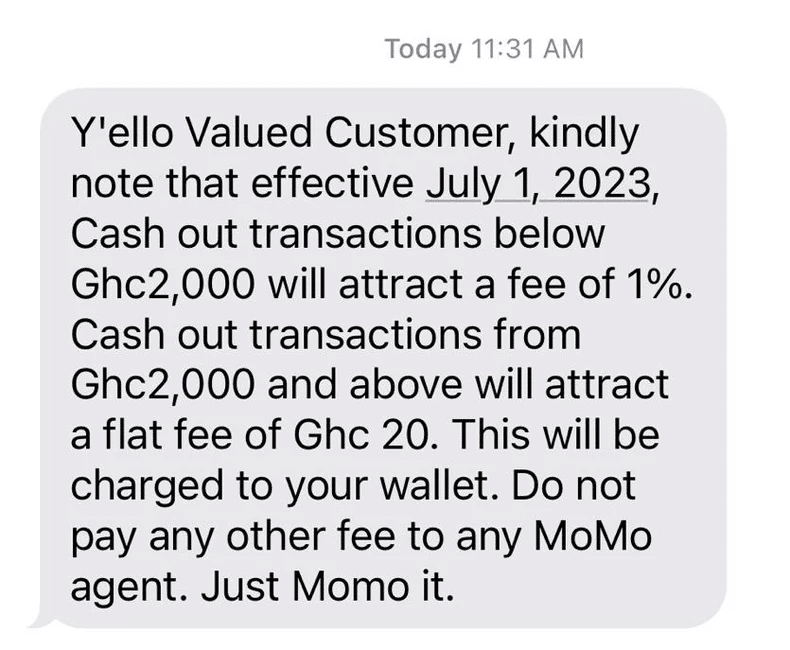
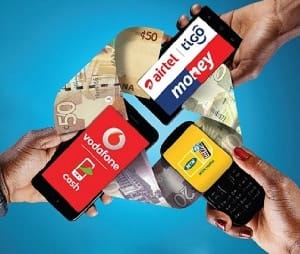

    Meanwhile, Mr Ofori Atta indicated at a press conference on Monday December 6 said that consultations were still going on regarding the proposal in order to reach a consensus.

    “On the matter of the E-levy, having regard to its serious fiscal implications, we will continue our consultations with the Minority Caucus in Parliament and other relevant stakeholders, with a view to achieving consensus and reverting to the House in the shortest possible time,” he said.

  • MoMo agents milking government’s expected E-Levy proceeds — Research

    According to research by the Centre for Economics, Finance, and Inequality Studies (CEFIS), the 1.5% fee is a major reason why many Ghanaians choose not to pay tax on electronic transactions over GHS100.

    This creates space for Mobile Money (MoMo) merchants, the number of whom has been rising, to “milk” the government of anticipated revenue from the Electronic Transactions Levy (E-levy), as merchants bargain with clients for a charge, forcing them to avoid paying tax.

    According to the Bank of Ghana’s (BoG) 2021 Payment Systems Oversight Annual Report, the overall number of active mobile money users climbed by 2.4% year over year, while the number of active mobile money agents increased by 29%.

    Some MoMo merchants in Accra who spoke on anonymity with the Ghana News Agency as well as mobile money users admitted going into such agreement to avoid paying taxes, especially on transactions amounting to GHS1,000 and above.

    The merchants said some people deposit money to recipients through them to avoid the payment of the E-levy, while others allowed cash-out from their end instead of transferring the money to the recipients directly and paying the corresponding tax.

    The Electronic Transactions Levy Act, which was introduced in May 2020, comes with a 1.5 per cent charge on transactions exceeding a cumulative GHS100 per day in addition to charges by service providers (MTN and AirtelTigo).

    The tax handle is to shore up Government’s revenue, which the study noted a reduction of the rate from the 1.5 per cent to 0.5 per cent would make existing active users patronise MoMo transactions.

    The revenue from the E-levy is to support the Government’s YouStart entrepreneurship programme, digital infrastructure, and cybersecurity, and increase Ghana’s tax-to-GDP ratio to 20 per cent by 2024 for national development.

    CEFIS observed that “in many commercial transactions, the parties involved negotiate based on a ‘gentleman’s agreement’, where the sender deposites cash into the wallet of the receiver through a MoMo merchant account to avoid the payment of its corresponding e-levy charge.”

    Prof Anthony Amoah, a co-author of the study, who spoke to GNA, said: “We observed that consumers have created a gateway to avoid the tax, giving that tax avoidance is not criminal.”

    He said that the strategy of using the e-levy as a conduit to get the informal sector to contribute to national revenue had failed, as the informal sector, the most active group, was exploiting the loopholes.

    “Those who do transactions like GHS50 and GHS100 are already exempted from paying the tax but those who pay above the cumulative GHS100 are avoiding it and it’s actually those who are doing bigger transactions that do it more,” he said.

    Prof Amoah added that: “This means that it is the agent that benefits and not the Government, and we found that the number of agents is going up because it’s more profitable to be in that business, but it is very discouraging to the Government.”

    “If the Government reduces the rate from the 1.5 per cent to 0.5 per cent and people don’t feel the impact, then you’re going to rake them in,” Prof Amoah, who is a Development Economist, said.

    The evidence from the simulations suggested that if the levy was revised to 0.5 per cent, and 54 per cent of the existing active users patronised MoMo transactions, the expected revenue for 2022 would be GHS2,640,600,000.81.

    That revenue would rise by 21.4 per cent to yield GHS3,205,688,401.01 in 2023, and in 2024, reach GHS3,635,234,306.60, and by 2025, the projected revenue from e-levy would reach GHS4,043,980,051.74.

  • Review or abolish E-Levy – Tax Analyst to government

    Dr. Alex Ampaabeng, a tax analyst, has urged the government to examine or eliminate the 1.5% fee imposed on all electronic payments exceeding GHC 100.

    He asserted that the tax plan put in place by the administration in March of this year has failed to accomplish its goals.

    According to Dr. Ampaabeng, lowering the E-Levy will make it more appealing to everyone, enticing many Ghanaians to pay it and generating cash for the nation.

    In an interview with CitiNews, the tax analyst said, “E-levy as it stands, I would say it has failed and it’s got to the point where the government has to review it, probably reduction in rates if it’s not to be abolished. The government needs to look at reducing the rates to make it less attractive for people not to pay.

    “But as it stands, if you spend about GH¢5000 and you’re going to pay maybe an E-Levy of close to GH¢100, surely the person would rather spend time and go to the bank to do physical transactions and you also need to look at what impact this is having on the broader economy,” he added.

    He opined that Ghana’s problems could only be solved if the country has substantial domestic revenue.

    Dr Ampaabeng listed property tax as a means the country can depend on to rake in more money to stabilize the wobbling economy.

    “What will solve Ghana’s problem is having substantial domestic revenue. We need a revenue base that will guarantee every year in and year out. IMF is going to be a one-off package to support the economy but post-IMF what happens? And that is why we keep slipping back. The country is not generating enough and it is time for us to do a proper system audit, and look at which areas can we really generate revenue. Property tax is one,” the tax analyst stated.

    It would be recalled that government, in March this year, imposed a 1.5% charge on all electronic transfers above GH¢100.

    The tax policy is a move by the government to widen the country’s tax net.

    Meanwhile, the charging entities for the E-Levy are telecommunications companies, commercial banks, special deposit-taking institutions and Payment Service Providers (PSPs).

    Mobile Money (MoMo) transaction since the introduction of the tax policy has witnessed a decline in business, MoMo Association has said.

    As of September this year, data from the GRA showed that about GH¢328 million has been collected as E-Levy.

    Government’s target for E-Levy by end of 2022 is GH¢600 million.

  • Total Mobile Money transactions fall by 2% year-on-year in August 2022; E-levy impact marginal

    Total Mobile Money transactions as of August 2022 compared to the same period in 2021 fell by ¢13.3 billion, about 2.02%,  the latest Summary of Financial and Economic Data by the Bank of Ghana has revealed.

    This indicates that the implementation of the Electronic Transaction Levy has had a marginal impact on the biggest payment system in Ghana.

    But the question is why government is failing to rake in the needed revenue from the indirect tax based on the numbers from the Central Bank.

    According to the data, total mobile money transactions stood at ¢657.6 in August 2022, as against ¢644.3 in August 2022.

    There were earlier fears that a sizeable number of consumers were going to boycott Mobile Money, following the implementation of the E-Levy in May 2022.

    So, it is not clear why the government is not raking in much revenue from the Mobile Money Transactions.

    From the data, Mobile Money transactions have been surging since its implementation in May 2022.

    It went up from ¢71.4 billion in May 2022 to ¢77.4 billion in June 2022, but remain relatively same at ¢77.2 billion in July 2022.

    It however shot up significantly by ¢9.9 billion to ¢87.1 billion in August 202.

    In May 2021, June 2021, July 2021 and August 2021, Mobile Money transactions were estimated at ¢86.5 billion, ¢89.1 billion, ¢99.1 billion and ¢81.8 billion.

    The government had initially projected ¢6.9 billion from E-Levy collections for 2022, but revised it to ¢4.9 billion and later to ¢611 million.

    Mobile Money Transactions in 8 months of 2021 and 2022

    MONTHS 2021 (billions) 2022 (billions)
    January 67.1 76.2
    February 67.9 76.8
    March 82.3 90.5
    April 83.8 87.7
    May 86.5 71.4
    June 89.1 77.4
    July 99.1 77.2
    August 81.8 87.1
    TOTAL 657.6 644.3

    Source: MyJoyOnline.com

  • E-Levy to be reviewed – Ofori-Atta hints

    Finance Minister Ken Ofori-Atta has hinted that government will soon review the Electronic Transfer Levy (E-Levy).

    Currently, all electronic money users including mobile money customers are charged 1.5 percent of accumulative transfers that exceed GH¢ 100 in a day.

    According to the Ministry of Finance, the proceeds from the E-Levy are woefully below projected numbers with only about 10 percent of the projected GH¢600 million monthly being realised.

    Speaking at a briefing in Accra on Wednesday, Ken Ofori-Atta said that the review of the E-Levy forms part of measures to help improve the government’s domestic revenue mobilisation.

    He added that the review is also targeted at ensuring that a lot of Ghanaians pay the levy.

    “Such exercises form part of an ongoing drive to ensure we take significant steps forward in remedying long-standing challenges with domestic revenue mobilization, indiscipline, corruption and leakages.

    “Of course, heightened tax compliance and increased tax audit exercises will continue to be complemented by policy initiatives that allow us to tap into a wider pool of taxpayers in the years ahead.

    “Towards this therefore we are looking at areas around the E-Levy to ensure its efficient implementation,” he said.

  • BoG: ‘Pay up your MoMo loans or risk losing creditworthiness’

    The Bank of Ghana has provided advice to those who have obtained loans using mobile money platforms but have consciously chosen not to register their SIM cards as part of the ongoing national SIM Card registration drive in an effort to avoid making loan repayments.

    The Central Bank in a statement indicated that data of all mobile money loan customers are domiciled in the databases of credit bureaus.

    BoG cautioned that failure to repay such loans will attract “negative repercussions on borrowers’ credit reports/history and could subsequently adversely affect any chance of obtaining loan facilities from other financial institutions and credit providers in the future.”


    The Central Bank advised all borrowers who have discarded their SIM cards to contact their telecommunication service providers or respective lenders, to discuss repayment arrangements to avoid adverse information on their credit reports, that could deny them access to future credit facilities.

  • Failure to repay loans will attract negative repercussions – BoG to MoMo defaulters

    The Bank of Ghana has issued a warning to people who have taken out loans through mobile money networks, advising them to pay back their debt.

    This comes after the central bank observed that some people have purposefully chosen not to register their SIM cards as part of the ongoing nationwide SIM registration drive in an effort to avoid repaying loans that they have incurred.

    The BoG revealed that all mobile money loan customers’ information is stored in credit bureau databases in a statement released on September 28. As a result, the decision to avoid repayment will likely have a negative impact.

    “Failure to repay such loans will attract negative repercussions on borrowers’ credit reports/history and could subsequently adversely affect any chance of obtaining loan facilities from other financial institutions and credit providers in future,” the BoG stated.

    It added that borrowers who have discarded their SIM cards are, however, advised to contact their respective lenders or telecommunication service providers to discuss repayment arrangements.

    The Central Bank said this is important to avoid adverse information on their credit reports, which could deny them access to future credit facilities.

  • I prefer mobile money business to office work – Masters degree holder

    Mobile Money vender, Priscilla Agyeman has revealed that she prefers the mobile money business to office work even with a Masters degree.

    In a chat with DJ Nyaami on Daily Hustle, Priscilla explained that she began the business four years ago with 2,000gh and has made enough money. Hence, the decision to stay in the MOMO business.

    ”I don’t want to work in the office anymore. Most of my friends who work in offices ask for loans from me. They are suffering but they keep it on the low, ” Priscilla said.

    She added that she settled for the MOMO business after several applications to different institutions.

    Priscilla has a degree in Agricultural Science from the University of Education, Winneba and a Masters degree from the same institution.

    Watch video below

    Source: svtvafrica.com

  • Karaga: Suspected robber lynched after attack on mobile money vendor

    Some residents of Karaga lynched a suspected armed robber to death on Thursday evening after a mobile money vendor was robbed.

    According to police, five men on motorbikes attacked the vendor and robbed him off an unspecified amount of money.

    One of the robbers was unable to escape and was beaten and burned alive in a drain by a mob.

    As police hunt for the robbers, the Gushegu Police Command is also looking for persons involved in the lynching.

    Speaking to Citi News, the Gushegu Police Commander, ASP Thomas Tolasi says the police will soon begin investigations into the mob attack and eventually arrest the perpetrators.

    “We are yet to get the perpetrators; those who were actually involved in killing the suspect. The mob had more than 200 people,” he said.

    Source: citinewsroom

  • Hackers reportedly break into mobile money system to steal unspecified billions belonging to Airtel, MTN, Stanbic and others

    Mobile payment service providers and digital payment systems are counting billions in lost cash after hackers hit a third party payment technology company.

    Daily Monitor could not readily establish the extent of the theft but sources who requested anonymity because of the sensitivity of the matter said billions of shillings were lost and that the hack extends beyond telecoms and banks to utility payment systems, among others that use Pegasus Technologies as a transaction aggregator.

    MTN and Airtel, which control at least more than 90 per cent of the mobile money market hold escrow accounts with Stanbic Bank and the two telecoms are believed to have been the biggest victims of the hack.

    In a joint statement Monday, signed by MTN, Airtel and Stanbic Bank the three companies said there had been a system incident in which hackers had accessed systems of a third party service provider (Pegasus Technologies) thus impacting all bank to mobile money or wallet transactions.

    The incident, which is believed to have started last Thursday and gone through the weekend, yesterday forced mobile money service providers to suspend bank to mobile money or wallet transactions.

    “Stanbic Bank, MTN and Airtel inform the public and their customers that on Saturday, a third party service provider experienced a system incident which impacted bank to mobile money transactions. All bank to mobile money [or] wallet services have since been temporarily suspended,” the statement read in part.

    Get the latest in African news delivered straight to your inbox

    However, the companies indicated that “the system incident has had no impact on any balances on both bank and mobile money accounts”.

    Police on Tuesday told Daily Monitor they had launched investigations into the alleged theft.

    CID spokesperson Charles Twine, said they had been briefed about the incident but were still analysising the extent of the hack.

    “We have commenced investigations today. However, we need some time to dissect the matter,” he said.

    Al though no details have been provided, the hackers are believed to operate from Eastern Europe with collaborations in the local systems.

    The incident that is believed to involve a number of other companies has Pegasus Technologies as the link.

    The technology company is an aggregator for inter mobile money service thus it links mobile money services between MTN and Airtel.

    Pegasus also provides financial services for Stanbic Bank’s mobile banking platform, FlexiPay.

    Source: allafrica.com

  • Value of mobile money transactions doubles in last twelve months BoG data

    Data from the Bank of Ghana has revealed that the value of mobile money transactions in the country has significantly doubled in the last twelve months.

    According to the latest Summary of Macroeconomic and Financial Data report by the central bank, the total value of transactions increased by 110 percent eight months into 2020 as compared to the same period in 2019.

    The Central Bank however indicated that from January to August 2020, the value of mobile money transactions increased as likened to figures within the same period in 2019.

    Per the figures, the increase can also be witnessed in May 2020, as it rose up from GH¢32.8 billion in April to GH¢41.5 billion in May, representing a staggering 26.5 percent increased.

    The central bank explained that the changeable figures in the first four months of 2020 was fairly influenced by the emergence of the coronavirus pandemic and its associated impact.

    This however can be witnessed in a three percent drop in the value of transactions in April 2020 following the coronavirus induced restrictions and three-week partial lockdown of Accra and Kumasi with many unable to perform cash or electronic transactions.

    Source: www.ghanaweb.com

  • Police chase mobile money vendor killers

    The Ashanti Regional Police have confirmed that they are on the heels of a number of suspects over the gruesome murder of a mobile money vendor in the region.

    Twenty-eight-year old, Owusu Agyekum, a mobile money merchant at Onwe, in the Ejisu Municipality, was shot dead in his metal container around 8:30 PM on Wednesday.

    The police managed to apprehend one key suspect, identified as Martin Agyei, who was wielding an AK47 assault rifle, barely four hours after the shooting incident.

    ASP Godwin Ahianyo, the Ashanti Regional Police PRO, explained to the media that Agyei, was in a taxi cab, around 12 midnight on Thursday when he was nabbed at Kodie, a town in the region.

    The Police PRO stated that four hours earlier, Owusu Agyekum, 32, was in his yellow metal container working at Onwe, when some suspected robbers, attacked and shot him dead.

    According to the Police, the robbers then snatched the money bag of the deceased and started to shoot indiscriminately, whilst they fled from the crime scene on foot.

    ASP Ahianyo, who was addressing the media, said the police suspect that Agyei had a hand in the murder of the mobile money merchant.

    He disclosed that the police are convinced that Agyei did not kill the mobile money merchant alone, so they are doing their best to arrest his runaway accomplices.

    Source: thepublisheronline.com