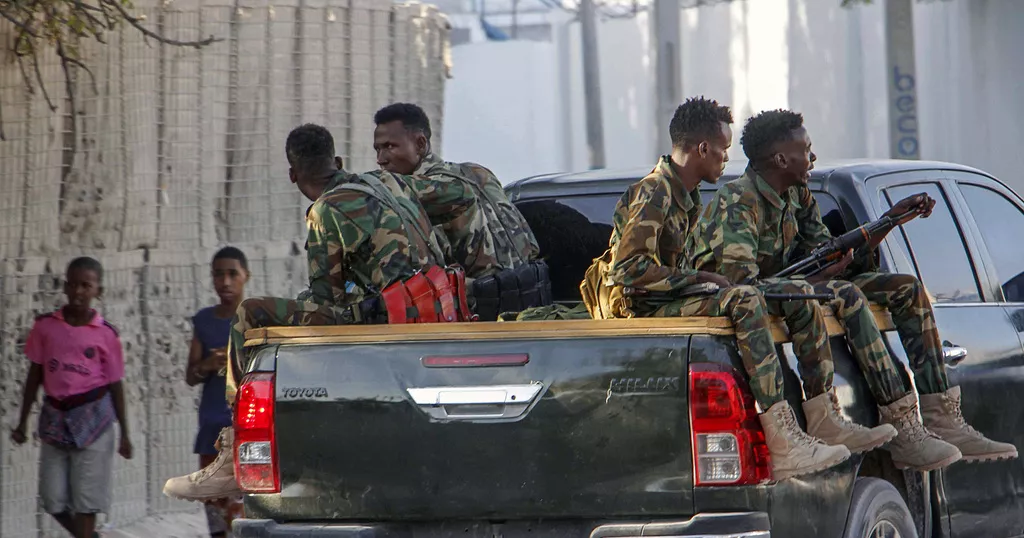
A blast struck a restaurant across from the camp, where Somali soldiers and police officers were stationed.
At least seven people lost their lives, and six others were injured at a café near a police training facility in Mogadishu, Somalia, after a suicide bomber detonated an unidentified device, according to police on Thursday.
Authorities reported that the victims included both officers and civilians who were having tea outside the General Kaahiye Police Academy.
Deeqsan Ahmed, eyewitness and attack survivor said, “There were people who found the suicide bomber suspicious due to the item he was carrying, questioning his intentions. After they voiced their worries, he blew himself up.”
Al-Shabab, an al-Qaeda-linked group, claimed responsibility for the attack in a statement published on its affiliated website.
The Thursday assault came two months after an attack on a public beach in Mogadishu that claimed 37 lives.
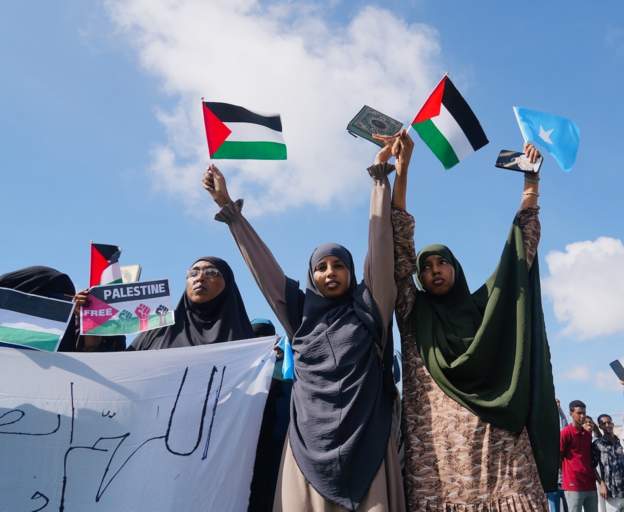
Young people and Muslim leaders in Somalia’s capital city have gathered hundreds of individuals to show their support for the people in Gaza. Many of these people in Gaza are going through difficult times without enough food, water, or a place to live because Israel has blocked off the area in response to violent actions by Hamas fighters.
Some people shouted, “We support Palestine and we are with you. ” at the protest on Friday.
Some people are reading from the Quran, and religious leaders are advising Somalis to pray to Allah to help the Palestinians who are suffering.
South Africa, Tunisia, Morocco, and Kenya are some other African countries where people have held protests in support of Palestine recently.
On Urubo, Liido, and Sugunto Liido beaches, the once pristine sands are now obscured by heaps of debris.
The pollution has marred the landscape, creating a stark contrast to the image of tranquility that draws people seeking solace from the conflicts between rival armed factions in this historic port city.
However, the local residents have rallied together, determined to reclaim their beaches. A collective effort is underway to clean up the coastline, with the hopes of reviving local tourism and bolstering the city’s economy.
At the heart of this endeavor are young volunteers, many of them students or university workers, who have taken the lead in this grassroots movement.
Week after week, these dedicated youth have been diligently gathering the litter that has defaced the beauty of the coast and posed a threat to marine life. Their hard work is already paying off, as patches of the beach are beginning to shine once more under the warm sun.
One of the enthusiastic volunteers, Maama Ugaaso, expresses her pride in being a regular participant in the beach clean-up sessions. She highlights how the younger generation is embracing a sense of ownership and responsibility for their city.
With their earnest efforts, they are sowing the seeds of hope for a brighter future for Mogadishu’s golden coast.
“It is the 87th week that we have been cleaning the beaches. This is a voluntary activity where young graduates, lecturers, and other ordinary Somalis participate. Among the reasons why these young people are doing such wonderful work is that they understand the fact that this country belongs to no one but themselves,” she says.
According to the organizers, 2 million kilograms of trash have already been gathered here.
That contained plastic waste, which is bad for aquatic life.
Even abandoned vehicles had been thrown on the shore, which had turned into a landfill.
All of the rubbish is being transported to a government dump outside of Mogadishu.
Arabow is pleading with the government to support the effort to restore beaches.
He says: “Currently, we are conducting this clean-up campaign on our beaches and we are hoping to expand it to other beaches across the country. Also, a beach clean-up campaign like the one we’ve done in the Liido should be replicated throughout the country. We also have done some cleaning up work on beaches like Isaley, Jazeera, and other places, but God willing, I hope that this campaign will reach every place in the country in order to live in a rubbish-free country.”
The primary focus of the beach restoration initiative is to actively engage young people, constituting 75% of the country’s population. For fisherman Hassan Mohamed, this work holds immense significance for the survival of the coastal region.
Expressing his pride in the dedicated young volunteers, Hassan emphasizes the importance of governmental support for their efforts.
He stresses that maintaining the health of marine life and promoting tourism go hand in hand, making this endeavor critical for the entire community.
The volunteers have garnered not only public but also government endorsement for their beach-cleaning endeavors. When the municipality of Mogadishu became aware of their restoration project, they stepped in to provide vehicles to assist in the removal of the accumulated rubbish.
Yaasir Baafo, an advisor to Somalia’s tourism authority, believes that aligning volunteer efforts with supportive government policies will lead to substantial progress. He emphasizes the vital role of the environment as a valuable resource that can breathe new life into the city and the entire country. With a collaborative approach, the initiative aims to harness the potential of the natural surroundings to foster growth and rejuvenation for Mogadishu.
Pointing to old photos on his laptop he says: “It’s really a breathtaking time, 1970s, 80s in Mogadishu as it was one of the most clean city in Africa, the most beautiful city in Africa. And when you look back at today what have been in Mogadishu, when we talk about the cleaning and the beach sites, so it’s really totally different and that’s what makes Mogadishu, people are still think about: how can we get back those glory and golden days of Mogadishu.”
With a bit of work, the beautiful sand beaches can be uncovered once again.
Under UK modern slavery legislation, the Ekweremadus and the doctor are accused of conspiring to arrange the travel of another person for the purpose of exploitation.
Senator Ike Ekweremadu’s trial on the alleged organ harvesting will resume today, Tuesday, January 31, 2023, in the United Kingdom.
SaharaReporters had earlier reported that the senator’s matter was adjourned in November, while arguments were heard on December 16 and 19, 2022.
Ekweremadu who represents Enugu West Senatorial District on the platform of the Peoples Democratic Party (PDP) and his wife, Beatrice were arrested on June 23 in London and charged with conspiracy for human trafficking and organ harvesting.
According to the UK court, Ekweremadu’s alleged crime was in violation of the Modern Slavery Act 2015.
According to prosecutors, the defendants planned to have a kidney removed from a 21-year-old Nigerian man so that it could be given to the politician’s daughter, Sonia.
The latest attack comes just days after al-Shabab carried out a suicide bombingnear a military base in Mogadishu, the capital.
According to the defense ministry, suspected al-Shabab fighters attacked a Somali military base in the central Galgaduud region on Monday, just days after the area was captured by government forces.
The army repelled an attack on a base housing national and local troops in Qayib, a village recaptured from al-Shabab last week, according to defense ministry spokesman Abdullahi Ali Anod, who spoke to the state-run news agency SONNA.
The attack began around 5 a.m. local time (02:00 GMT), followed by hours of heavy fighting, according to Ahmed Hassan, a military officer in the nearby town of Bahdo.
It was not immediately clear how many people had been killed in the raid, Hassan said.
In a statement, al-Shabab spokesman Abdiasis Abu Musab said the group launched the assault in Qayib using suicide car bombs before its fighters attacked from different directions. The fighters killed several soldiers and stole weapons and military vehicles, Abu Musab said.
Government forces, supported by clan militias, have made a number of battlefield gains against al-Shabab in the last three months, regaining territory long held by the group.
In response, al-Shabab killed at least 100 people in twin car bombings at the education ministry in the capital, Mogadishu, on October 29, the deadliest blasts in five years.
A suicide bomber also killed at least five people and wounded 11 others in an incident near a military training camp in Mogadishu on Saturday.
Al-Shabab, an al-Qaeda-allied armed group fighting in Somalia for more than a decade, is seeking to topple the country’s central government and establish its own rule based on a strict interpretation of Islamic law.
Its fighters were driven out of Mogadishu in 2011 by the African Union peacekeeping forces. But it still controls swaths of Somalia’s countryside and has stepped up attacks since President Hassan Sheikh Mohamud took office in May and pledged an “all-out war” against the group.
Somalisecurity forces have re-arrested Abdalle Ahmed Mumin, the secretary-general of the country’s journalists union.
He was re-arrested following an arrest warrant issued by the Somali police commissioner, privately-owned Radio Risala website reported.
Mr Mumin was first arrested last week after he criticised a government directive banning local media outlets from reporting on activities of the militant group al-Shabab.
CPJ is very disappointed to learn that Somali journalist and press freedom advocate Abdalle Ahmed Mumin has been re-arrested in Mogadishu.
Authorities should release him immediately and bring an end to this victimisation. https://t.co/n7xJ7rvhTw
The information ministry had then said that Mr Mumin was being “held on security-related charges” without giving further details.
He was freed by a regional court a day ago.
The journalists rights’ watchdog, the Committee to Protect Journalists, has called on the Somali authorities to immediately release Mr Mumin “and bring an end to this victimisation”.
Some of Somalia’s newly elected members of parliament are set to be sworn in on Thursday in the capital, Mogadishu, following parliamentary elections that took months.
They will be sworn in at a venue inside the main airport area – one of the highly guarded areas in the capital – as security remains a key concern.
The 11th parliament comprises two main houses – the upper house with 54 members and the people’s house with 275.
Their main task will be to elect a president who will be expected to lead the Horn of Africa nation for the next four years.
The swearing-in also marks a crucial step for the election process, dogged by conflict and political infighting between key stakeholders, leading to the elections being postponed several times.
The current President Mohamed Abdullahi Farmajo, whose first term ended in February last year, continued to stay in power to avoid a political vacuum.
It took the intervention of Somalia’s partners for the process to be hastened. The US imposed visa restrictions on some key players accused of sabotaging the election process.
Somalia has had no stability for over 30 years since the former military leader Siad Barre was toppled in 1991, followed by a bloody civil war.
However, a lot has changed in the last two decades as the country embarks on recovery.