Tag: moon

  • India launches the historic Chandrayaan-3 mission to the moon

    India launches the historic Chandrayaan-3 mission to the moon

    With the launch of its Chandrayaan-3 mission on Friday, India is attempting to become just the fourth nation to carry out a controlled landing on the moon.

    At 2:30 p.m. local time (5 a.m. ET), Chandrayaan, which means “moon vehicle” in Sanskrit, is anticipated to launch from the Satish Dhawan Space Centre at Sriharikota in southern Andhra Pradesh state.

    India is attempting a soft landing for the second time after Chandrayaan-2, its last attempt, failed in 2019. Chandrayaan-1, its first lunar probe, orbited the moon before being purposefully crash-landed onto the lunar surface in 2008.

    Developed by the Indian Space Research Organization (ISRO), Chandrayaan-3 is comprised of a lander, propulsion module and rover. Its aim is to safely land on the lunar surface, collect data and conduct a series of scientific experiments to learn more about the moon’s composition.

    Only three other countries have achieved the complicated feat of soft-landing a spacecraft on the moon’s surface – the United States, Russia and China.

    Indian engineers have been working on the launch for years. They are aiming to land Chandrayaan-3 near the challenging terrain of the moon’s unexplored South Pole.

    India’s maiden lunar mission, Chandrayaan-1, discovered water molecules on the moon’s surface. Eleven years later, the Chandrayaan-2 successfully entered lunar orbit but its rover crash-landed on the moon’s surface. It too was supposed to explore the moon’s South Pole.

    At the time, Indian Prime Minister Narendra Modi hailed the engineers behind the mission despite the failure, promising to keep working on India’s space program and ambitions.

    Just before Friday’s launch, Modi said the day “will always be etched in golden letters as far as India’s space sector is concerned.”

    “This remarkable mission will carry the hopes and dreams of our nation,” he said in a Twitter post.

    India has since spent about $75 million on its Chandrayaan-3 mission.

    Modi said the rocket will cover more than 300,000 kilometers (186,411 miles) and reach the moon in the “coming weeks.”

    India’s space program dates back more than six decades, to when it was a newly independent republic and a deeply poor country reeling from a bloody partition.

    When it launched its first rocket into space in 1963, the country was no match for the ambitions of the US and the former Soviet Union, which were way ahead in the space race.

    Now, India is the world’s most populous nation and its fifth largest economy. It boasts a burgeoning young population and is home to a growing hub of innovation and technology.

    And India’s space ambitions have been playing catch up under Modi.

    For the leader, who swept to power in 2014 on a ticket of nationalism and future greatness, India’s space program is a symbol of the country’s rising prominence on the global stage.

    In 2014, India became the first Asian nation to reach Mars, when it put the Mangalyaan probe into orbit around the Red Planet, for $74 million – less than the $100 million Hollywood spent making space thriller “Gravity.”

    Three years later, India launched a record 104 satellites in one mission.

    In 2019, Modi announced in a rare televised address that India had shot down one of its own satellites, in what it claimed was an anti-satellite test, making it one of only four countries to do so.

    That same year ISRO’s former chairman Kailasavadivoo Sivan said India was planning to set up an independent space station by 2030. Currently, the only space stations available for expedition crews are the International Space Station (a joint project between several countries) and China’s Tiangong Space Station.

    The rapid development and innovation has made space tech one of India’s hottest sectors for investors – and world leaders appear to have taken notice.

    Last month, when Modi met US President Joe Biden in Washington on a state visit, the White House said both leaders sought more collaboration in the space economy.

    And India’s space ambitions do not stop at the moon or Mars. ISRO has also proposed sending an orbiter to Venus.

  • China announces its plans to send astronauts to the moon by 2030

    China announces its plans to send astronauts to the moon by 2030

    Chinese officials attempted to become only the second country to send citizens to the moon on Wednesday by releasing additional information about their intentions for a human lunar trip.

    According to state-run news agency Xinhua, Zhang Hailian, deputy chief engineer with the China Manned Space Agency (CMSA), disclosed the preliminary plan on Wednesday during an aerospace summit in the city of Wuhan.

    The mission is a component of a plan to build a lunar research outpost and is anticipated to occur before 2030. According to Zhang, it will do moon exploration missions and other tests as well as look into the best way to construct the facility.

    Two launch vehicles will send a moon surface lander and manned spacecraft into lunar orbit, before they dock with each other, according to state-run Global Times. After docking, the Chinese astronauts on board the spacecraft will enter the lander, which is used to descend to the moon’s surface.

    While on the moon, they will collect samples and carry out “scientific exploration,” before leaving on the lander and reuniting with the spacecraft waiting in orbit – which will take them home to Earth, Global Times reported.

    To prepare for the mission, Chinese researchers are busy developing all the necessary equipment including moon suits, manned lunar rovers, manned spaceships and moon landers, Xinhua reported.

    The state media reports did not say how many astronauts China plans to send to the moon.

    The lunar mission is the latest development in China’s push to advance its space program, which has seen several breakthrough moments in recent years.

    China was late to the space race – it didn’t send its first satellite into orbit until 1970, by which time the United States had already landed an astronaut on the moon – but Beijing has been catching up fast.

    In 2013, China successfully landed a rover on the moon, becoming only the third country to do so. At the time, Chinese leader Xi Jinping said “the space dream is part of the dream to make China stronger.”

    Under Xi’s leadership, China has spent billions on its ambitious space program. While there are no official public figures on Beijing’s investment in space exploration, consulting firm Euroconsult estimated it to be about $5.8 billion in 2019.

    That year, China sent a rover to the far side of the moon – a historic first. Then in 2020, it became only the third country to successfully collect rock samples from the moon.

    China has also spent the past few years building its own Tiangong space station, which was completed in November. The station is only the second operational orbital outpost, alongside the International Space Station (ISS) – which Chinese astronauts have long been excluded from due to US political objections and legislative restrictions.

    But the ISS is expected to end operations in 2030 – which could leave Tiangong the only outpost left. China has sought to open up its station to collaboration with international partners, including by hosting experiments from other countries.

  • Dubai plans to build version of the moon that may cost £4,000,000,000

    Dubai plans to build version of the moon that may cost £4,000,000,000

    By erecting a massive moon model atop a tower, a resort in Dubai hopes to enable space travel without the need for a rocket ship.

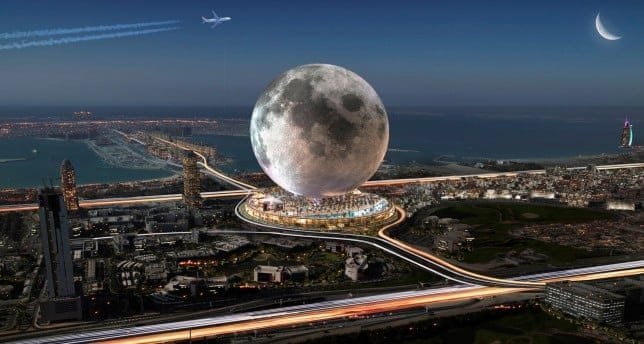
    In Dubai, which already has the tallest building in the world and other architectural marvels, businessman Michael Henderson wants to erect a 274-meter (900-foot) facsimile of the moon atop a 30-meter (100-foot) structure.

    Henderson’s MOON concept might sound fantastical, but it would fit right in in the futuristic city-state.

    The moon-shaped mega-resort is estimated to cost around the equivalent of £4.28billion and hopes to draw in a whopping 2.5million guests a year, featuring a nightclub and wellness centre.

    This artist rendering shows the $5 billion project, MOON envisioned on The Palm Jumeirah island in Dubai, United Arab Emirates. A proposed $5 billion real estate project wants to take skyscraper-studded Dubai to new heights by bringing a part of the heavens down to Earth. Canadian entrepreneur Michael Henderson envisions building a 274-meter (900-foot) replica of the moon atop a 30-meter (100-foot) building in Dubai, already home to the world's tallest building and other architectural wonders. (Michael Henderson/Moon World Resorts via AP)
    The Moon would sit on a giant pedestal-like building and glow at night (Picture: AP)

    Its huge size – the circumference of the sphere is planned to 622-metres – means it may well be able to bring in over £1.5billion in just a single year.

    And even though a previous boom-and-bust cycle in the arabic city saw many grand projects collapse, Henderson and others suggest his vision, funded by Moon World Resorts Inc., where he is the co-founder, might not be that far-fetched.

    ‘We have the biggest “brand” in the world,’ Henderson said, claiming that the moon itself was his brand. ‘Eight billion people know our brand, and we haven’t even started yet.’

    The project Henderson proposes includes a destination resort inside the spherical structure, complete with a 4,000-room hotel, an arena capable of hosting 10,000 people and a ‘lunar colony’ that would give guests the sensation of actually walking on the moon.

    The MOON would sit on a pedestal-like circular building beneath it and would glow at night. Henderson discussed the project at the Arabian Travel Market earlier in May in Dubai.

    In an earlier statement, Henderson and co-founder Sandra G Matthews said Moon Dubai will ‘significantly impact every aspect of the UAE’s economy, including tourism’.

    Also targeted are ‘transportation, commercial and residential real estate, infrastructure, financial services, aviation and space, energy, MICE, agriculture, technology and of course education’.

    The founders continued: ‘[It] will be the largest and most successful modern-day tourism project in the Middle East and North Africa (MENA) region, doubling annual tourism visitations to Dubai based on its global appeal, brand awareness and unique multiple integrated offerings.’

    Like other high-profile, eye-catching marvels, the MOON could fit well into ‘the legitimacy formula of Dubai’s ruling elite,’ said Christopher Davidson, a Middle East expert who wrote the recent book ‘From Sheikhs to Sultanism.’ Dubai also hosts the UAE’s space centre, which has sent a probe to Mars and unsuccessfully tried to put a rover on the moon.

    ‘They can be seen as a non-democratic elite but nonetheless believe strongly in science and progress — and that’s ultimately very legitimising and a megaproject like this would seem to tick all of those boxes,’ Davidson said.

    Henderson’s plan would go a step further than other globe-shaped projects, such as the MSG Sphere, a $2.3 billion dome blanketed by LED screens, that is set to open in Las Vegas later this year.

    His structure would be fully spherical, and could be illuminated alternatively as a full, half or crescent moon.

    The brightness may not go down well with potential neighbours — plans to build another MSG Sphere in London were halted after residents protested the significant light pollution and disruption the structure would cause.

    ‘It’s hard to please everybody,” Henderson acknowledged. “You might need dark curtains.’