Tag: MPs

  • MPs back in Parliament as  sessions resume today

    MPs back in Parliament as sessions resume today

    The Third Meeting of the First Session of the Ninth Parliament kicks off today, Tuesday, October 21, 2025, as Members of Parliament (MPs) return to session.

    During this session, one of the key agenda items will be the deliberations for the 2026 Budget Statement and Economic Policy.


    Member of Parliament-elect for Akwatia, and Professor Alidu Seidu, MP-elect for Tamale Central, are also expected to be sworn in.  Parliament was initially scheduled to resume sitting on October 14; however, the Speaker of Parliament, Alban Sumana Kingsford Bagbin, announced an indefinite suspension of Parliament through an official statement issued on October 6. 

    The statement cited “circumstances beyond control” without elaboration, sparking speculation among MPs and the public. The statement continued that the turnaround of events was in accordance with Order 58 of the Standing Orders of Parliament.


    Order 58 of the Standing Orders of Ghana’s Parliament empowers the Speaker to issue a formal notice of a parliamentary meeting. The exact wording is:


    “The Speaker shall give notice of a Meeting of Parliament by causing a notice to be published in the Gazette and in such other manner as the Speaker may determine.”


    Meanwhile, this final session of the year is expected to be intense, with Parliament set to debate and approve the 2026 Budget, address pending bills, including environmental and governance legislation, and also review committee reports on finance, infrastructure, and national policy.


    Meanwhile, Members of Parliament (MPs) were expected to reconvene in October, following their recess for the Second Meeting of the First Session of the Ninth Parliament of the Fourth Republic.


    This information was made known by the First Deputy Speaker, Honourable Bernard Ahiafor, on Friday, July 31. The legislators on Tuesday, May 17, began their official work following a recess for Easter celebrations last year.


    Parliament, from May to August this year, convened a total of 43 sittings; during this period, the legislative body passed several key bills, endorsed certain proposals, and debated several matters of national importance.


    On 24th July, Parliament wrapped up its debate on the Mid-Year Review Budget Statement and Economic Policy of the Government of Ghana for the 2025 financial year, which was presented by Finance Minister Dr Cassiel Ato Forson.


    In the course of the debate, the Deputy Majority Leader and Member of Parliament (MP) for Cape Coast South, George Kweku Ricketts-Hagan, acknowledged the government’s efforts while describing the budget’s content as commendable.


    According to him, Ghana now fully controls its gold resources. This, he described as a major and transformative achievement for the country.


    In his submission on the floor of the House, Minority Leader Alexander Afenyo-Markin contested the government’s celebratory claims regarding the performance of the local currency. He added that “2022 was a storm for the cedi, but I dare argue, despite all of this, the NPP government stabilized the cedi in 2023.”


    Also from the Minority side, Hon. Michael Kwesi Aidoo, Member of Parliament for Oforikrom, criticized the incumbent government for failing to address the real concerns of Ghanaians despite its claims of restoring the value of the cedi.


    He stressed, “Whenever you say anything about the issues of the economy, our colleagues will refer you to the dollar, that the dollar has reduced. Mr. Speaker, as I speak to you today, it has not reflected in our pockets.” To him, the Mid-Year Budget Review had nothing new except repetition of words.


    Also from the Minority Caucus, Member of Parliament for Takoradi, Kwabena Okyere Darko-Mensah, pushed back against the government’s assertion that its homegrown policies are fueling economic growth.


    He argued that the previous New Patriotic Party (NPP) administration’s policies have driven growth in agriculture and fisheries, hence boosting Gross Domestic Product (GDP).


    On Thursday, July 24, Finance Minister Dr. Cassiel Ato Forson delivered to Parliament the 2025 Mid-Year Budget Review. This was in accordance with Section 28 of the Public Financial Management Act, 2016 (Act 921), to inform the country on its economic performance and fiscal strategy halfway through the year.


    In his delivery, the sector minister noted that in less than 200 days the incumbent government has brought back clarity, certainty, stability, and purpose to the country’s economic policy direction. Dr. Cassiel Ato Forson revealed that in the first six months of the year, the government’s expenditure stood at GH¢109.7 billion, equivalent to 7.8% of the GDP.


    He noted that the current expenditure was 14.3% below the programmed amount of GH¢128.0 billion, equivalent to 9.1% of GDP. According to the sector minister, this reflects the government’s strong expenditure control.


    During the presentation of the 2025 budget statement, the minister noted that total expenditures (commitment) for 2025 have been programmed at GH¢270.9 billion, down from GH¢279.2 billion in 2024.


    Primary expenditure on a commitment basis (expenditures net of interest payments) is projected at GH¢206.8 billion in 2025 (14.8% of GDP), presenting a significant decline from 19.8% of GDP in 2024 and lower than the 2023 level of 15.6% of GDP.


    Providing a breakdown of the total expenditure in six months, the minister said that primary expenditure, or non-interest expenditures on a commitment basis, amounted to GH¢84.3 billion, or 6.0% of GDP. This is an improvement of about GH¢13.3 billion over the target of GH¢97.5 billion, which is 7.0% of GDP.
    The Finance Minister noted that although Ghana is relying on the domestic market for financing, “We have borrowed less than we planned, signifying strong expenditure control and fiscal discipline.”


    Presently, the government is revising both revenue and expenditure projections to reflect the impact of the additional revenue from the Energy Sector Levies (Amendment) Act, 2025 (Act 1141).


    Total expenditure on a commitment basis has been revised downward to GH¢269.5 billion from the original budget projection of GH¢270.9 billion. However, primary expenditure has been revised upwards to GH¢209.6 billion from the original budget projection of GH¢206.8 billion.


    Total revenue and grants have been revised upwards from the 2025 budget target of GH¢227.1 billion to GH¢229.9 billion, or from 16.2% of GDP to 16.4% of GDP, representing a nominal increase of 1.3%. “The additional revenue of GH¢2.9 billion will come from the increase in revenues from the amendment to the Energy Sector Levies Act,” the minister added.


    Interest payments have been revised downwards by GH¢4.3 billion, from the original budget projection of GH¢64.1 billion to GH¢59.9 billion. Domestic interest, on the other hand, has been revised downward by GH¢5.1 billion, mainly on account of gains from the reduction in the treasury bill rates as a result of the implementation of our prudent debt management policies.


    However, external interest payments have been revised upward by GH¢795 million to make additional provision for debt service due on post-cut-off date disbursements made by our bilateral creditors since 2023. Energy sector payments have also been revised upwards by GH¢2.9 billion to provision for fuel purchases for power generation.

    In June, Parliament gave the nod to the reinstatement of July 1 as a statutory public holiday following the amendment of the Public Holidays and Commemorative Days (Amendment) Bill, 2025, which amends Act 601.


    The amended Act grants an additional holiday for the Muslim community, Shaqq Day, a statutory public holiday to be observed the day after Eid-ul-Fitr. In the same vein, August 4 has been removed from the list of public holidays as Founders’ Day, and instead, September 21 will now be observed as Founders’ Day.


    In the same period, Parliament vetted and approved seven (7) justices of the Supreme Court nominated by President John Dramani Mahama.


    Parliament, before its recent recess, passed the following bills: the Fisheries and Aquaculture Bill 2025, the University for Development Studies Bill 2025, the Ghana Medical Trust Fund Bill 2025, also known as MahamaCares, and the Social Protection Bill 2025.


    The first two bills were approved by the House on July 19. Minister for Fisheries and Aquaculture Hon. Emelia Arthur was present in Parliament for the approval of the Fisheries and Aquaculture Bill 2025.


    The sector minister revealed to the House that the bill has been revised to reflect Ghana’s commitment to the Blue Economy agenda by harnessing marine and aquatic resources sustainably to support economic growth, social inclusion, food security, and environmental protection.


    Chairman of the Parliamentary Select Committee on Food, Agriculture, and Cocoa Affairs, Hon. Jasaw Seidu Godfred, while presenting the committee’s report, noted that the sustainable management, utilization, and exploitation of the fisheries and aquaculture resources require the existence of a robust legal framework that governs fishing activities, regulates resource extraction, and ensures compliance with international and national environmental standards.


    He indicated that the fisheries and aquaculture sectors contribute significantly to national development in areas such as job and wealth creation, poverty reduction, gross domestic product contribution, and foreign exchange.

  • Prof Akosa slams MPs over GETFund allocations amid economic hardships

    Prof Akosa slams MPs over GETFund allocations amid economic hardships

    A former Director-General of the Ghana Health Service, Professor Agyeman Badu Akosa,Renowned pathologist and former Director-General of the Ghana Health Service, Professor Agyeman Badu Akosa, has criticised the recent allocation of GETFund resources to Members of Parliament, describing it as unjustifiable amid the country’s economic challenges.

    According to Prof Akosa, Parliament recently disbursed GH¢200,000 to each MP for the execution of GETFund projects in their constituencies, alongside an additional GH¢150,000 strictly for monitoring those same projects — a move he labelled as excessive and unprecedented.

    “Last Friday, Parliament gave each Member of Parliament GH¢200,000 for GETFund projects and an additional GH¢150,000 to monitor those projects. There is nowhere in the world where you are given 75% of what you receive just to monitor a project. No, nowhere,” he stated.

    Prof Akosa expressed disappointment over the silence of MPs regarding the allocation, insisting they have failed to show the leadership required to ease the burden on ordinary Ghanaians.

    “Yet all the parliamentarians remained silent. They got the money; they got their ex-gratia; they got their car loans,” he remarked.

    He urged lawmakers to reflect on their responsibilities and realign their focus with the pressing needs of their constituents, who are grappling with the harsh effects of the current economic climate.

    “These are the people’s representatives, and meanwhile, the people are choking to death,” he lamented. “So please, our representatives, look back. Think about us. Think about us, and let’s all work together to move this country forward.”

    Prof Akosa’s comments come at a time when Ghanaians continue to raise concerns about the use of public funds and the accountability of elected officials. has criticised Members of Parliament for prioritising their personal interests over the welfare of their constituents.

    Speaking at the University of Education, Winneba (UEW) Public Lecture Series on Friday, April 11, 2025, he stated, “Nobody is prepared to help anybody. Everybody is prepared to help themselves. And I know an Honourable Member is here, but let me say something.”

    “Last Friday, Parliament gave each Member of Parliament GH¢200,000 for GETFund projects and an additional GH¢150,000 to monitor those projects. There is nowhere in the world where you are given 75% of what you receive just to monitor a project. No, nowhere. Yet all the parliamentarians remained silent. They got the money; they got their ex-gratia; they got their car loans.”

    He urged MPs to reflect on their responsibilities and prioritise the needs of their constituents.

    “These are the people’s representatives, and meanwhile, the people are choking to death. So please, our representatives, look back. Think about us. Think about us, and let’s all work together to move this country forward,” he added.

  • The Speaker’s seat is not just another chair – Bagbin reminds MPs

    The Speaker’s seat is not just another chair – Bagbin reminds MPs

    Speaker Alban Bagbin on Wednesday March 4, 2025 reminded members of the importance of proper conduct in the House during the March 4, 2025, parliamentary session, .

    He stressed that the Speaker’s seat is not just an ordinary chair but a symbol of authority that must be treated with the utmost respect.

    Bagbin explained that the role and responsibilities of the Speaker are different from those of regular MPs.

    He encouraged members to review the Constitution to gain a better understanding of the Speaker’s duties.

    “This is not something within your discretion or powers; it falls under the jurisdiction of the presiding officer, particularly the Speaker. Refer to the Constitution and the standing orders, they recognize only one person as the Speaker.

    The others are Deputy Speakers and Chairs. In the absence of the Speaker and the Deputy Speakers, one of you may chair the session. Many of you in Parliament will attest to the fact that sitting in this chair is not the same as sitting in yours,” he stated.

    To reinforce his point, Bagbin referenced the experience of former Member of Parliament for Adansi-Asokwa, KT Hammond, who once had the opportunity to serve as Speaker for a day.

    Bagbin recounted that KT Hammond admitted to feeling different after sitting in the Speaker’s chair, highlighting that this is exactly how he himself feels when occupying the seat.

    He stressed that the role of the Speaker demands neutrality and impartiality at all times.

    “One day, I invited the former Member of Parliament, Honourable KT Hammond, to chair a session. Afterwards, he confessed that when he sat in the Speaker’s chair, everything felt different. That is exactly how we feel when we sit here. You don’t just have to be neutral, you must strive to be impartial in everything you do,” he explained.

    “Whether people like it or not, once you are confident that you have exercised your discretion impartially, you will receive blessings from God,” Bagbin added.

  • Speaker Bagbin slams NPP MPs for boycotting workshop in Ho

    Speaker Bagbin slams NPP MPs for boycotting workshop in Ho

    The Speaker of Parliament, Alban Bagbin, has expressed disapproval over the New Patriotic Party (NPP) caucus’s decision to boycott a three-day orientation workshop for Members of Parliament, citing cost concerns.

    He deemed the boycott unacceptable. Speaking at the workshop on Monday, March 3, 2025, Bagbin urged the Minority MPs to transcend political differences for the benefit of the nation.

    “Don’t allow political differences to control you, nor let our history trap you,” he emphasized, calling this one of the country’s biggest challenges.

    He further pointed out that the choice of venues for such workshops should not be dictated by partisan interests.

    “Please don’t allow your political differences to enslave you. Don’t be also enslaved by our history. That’s one of the biggest challenges we have in this country,” he stated.

    Bagbin went on to explain the process behind selecting the venue for the workshop.

    “The final results are brought to the Speaker. And until I have a very good reason why it shouldn’t be at that place; I just give my [approval]. And to have 276 Members of Parliament and staff, because the staff work with you. And if you don’t build the capacity of the staff, the institution, they will not be in the position to serve you, to provide what you need to be able to satisfy the immeasurable, unlimited demands of the country, of your people, and of the world,” he added.

    Organized by the Parliamentary Training Institute (PTI), the workshop began on Saturday, March 1, 2025, and is scheduled to conclude on Monday, March 3, 2025.

    However, the NPP MPs chose to boycott the event, raising concerns about the venue and the associated costs, suggesting that Parliament House would have been a more suitable location.

  • Too much drama in Parliament disrupting proceedings – Speaker Bagbin

    Too much drama in Parliament disrupting proceedings – Speaker Bagbin

    Speaker of Parliament, Alban Sumana Kingsford Bagbin, has expressed concern over the increasing theatrics in the chamber, cautioning MPs to exercise restraint.

    He acknowledged that occasional displays of drama help to ease tension but warned that frequent indulgence could create confusion, disrupt proceedings, and hinder parliamentary business.

    Bagbin urged lawmakers to use such expressions sparingly to maintain order and the integrity of parliamentary discussions.

    “Theatrics and dramas are not meant for every day; otherwise, it will become like a boy’s game in football, where the owner of the ball grasps it and bolts when found losing,” he remarked.

    Speaking at the launch of a three-day orientation programme for Members of the Ninth Parliament in Ho, Speaker Alban Sumana Kingsford Bagbin emphasized the importance of equipping MPs with the necessary skills to effectively fulfill their legislative duties.

    The orientation, organized by the Parliamentary Training Institute (PTI), aims to strengthen lawmakers’ capacities in legislation, oversight, deliberation, and investigative functions. However, the Minority Caucus declined participation, citing concerns over cost, arguing that hosting the programme outside Parliament was financially imprudent.

    According to Speaker Bagbin, succeeding as an MP requires more than just following parliamentary rules and procedures. He highlighted the significance of communication strategies, body language, and political tactics, noting that a simple misstatement or public misstep could cost a legislator their seat. He added that even personal matters, such as neglecting social obligations like attending funerals or contributing to a bride price, could influence electoral fortunes.

    While the 1992 Constitution, Acts of Parliament, and Standing Orders define MPs’ roles, Speaker Bagbin stressed that true mastery of parliamentary affairs goes beyond formal regulations.

    He argued that applying strategic techniques and practical knowledge is essential for lawmakers to excel—something that cannot be learned from books alone.

    He said, “You must listen attentively to the resource personnel to know and prioritise the tools of your work in order to plan your career or change direction in your life to be able to cope with the mandate, numerous duties, and huge responsibilities.

    “Honourable Members, self-leadership is the best step to take to be successful in this career.”

  • MPs’ 3-day orientation workshop ends today with no show from Minority MPs over cost 

    MPs’ 3-day orientation workshop ends today with no show from Minority MPs over cost 

    The three-day parliamentary orientation workshop, aimed at equipping lawmakers with essential skills and knowledge, concludes today, March 3, at the Volta Serene Hotel in Ho. 

    However, the event has been marked by the absence of the Minority Caucus, who boycotted the programme over concerns regarding its cost.

    Speaker of Parliament, Alban Bagbin, confirmed their withdrawal, stating that the Minority had formally protested the financial implications of the workshop. “Their reason is that the cost component is too much, and they don’t want to be part of that,” he revealed during the opening ceremony.

    While the exact cost of the event remains undisclosed, the Speaker expressed disappointment over the Minority’s decision, emphasizing that the orientation was crucial for both new and returning members. He stressed that such training sessions play a vital role in strengthening parliamentary procedures and democracy in Ghana.

    Explaining the choice of venue, Speaker Bagbin noted that the selection process involved a thorough evaluation by a designated team. 

    “There is a good reason why we choose venues for this, it’s not partisan – there is always a search party and they go around, discuss with the various hospitalities, look at the cost components, their facilities, their suitability, and the convenience of your movement because there are other pressures on you and there are score marks before we decide where to go,” he explained.

    According to him, Volta Serene Hotel emerged as the most suitable venue based on these criteria.

    The workshop covered topics such as the code of conduct for MPs, their rights and obligations, parliamentary procedures, lobbying, advocacy, and debating skills. It was designed to provide lawmakers, especially first-time members, with the necessary tools to effectively navigate their roles in the legislature.

    Despite the Minority’s absence, the programme proceeded as planned, with participants engaging in discussions aimed at enhancing their effectiveness in Ghana’s legislative process.

  • SHS student opens up on secret life with sugar daddies, MPs

    SHS student opens up on secret life with sugar daddies, MPs

    A Senior High School (SHS) student has revealed how she and other students had sex in order to raise money.

    According to her, they use social media to connect with well-known individuals, such as Members of Parliament (MPs), and, depending on the needs of the customer, they occasionally have sex with one or several persons.

    Additionally, the female student revealed that some of these males want to have sex with them during their periods, a practice they refer to as a “rainbow party,” in order to satiate their desires.

    “They give you a WhatsApp link on TikTok to join, and afterwards, you pick numbers on the page to engage with people. Sometimes, they send GH¢100 just to buy something and ask you to change your phone if the one you’re using isn’t up to standard. Even though we’re in SHS, we know about threesomes.

    “The person would ask you to come with a female friend, which means there would be a threesome. These men are sugar daddies, including top personalities, some of whom are even MPs.

    “Sometimes, we also do ‘rainbow parties’ where we go on an outing, and the men have sex with us while we’re menstruating. Some of them even lick the blood. It happens a lot, and we do it,” she narrated in Twi.

    Watch student’s interview below:

  • Minority’s actions led to chaos during vetting – Bernard Ahiafor

    Minority’s actions led to chaos during vetting – Bernard Ahiafor

    Chairman of the Appointments Committee, Bernard Ahiafor, has accused the minority caucus of creating disturbances during the ministerial vetting on Thursday, January 31.

    The altercation between the majority and minority members resulted in the destruction of public property, leading Speaker Alban Bagbin to establish an investigation and suspend four MPs.

    While testifying before the investigative committee on Wednesday, February 5, Ahiafor stated that the minority’s actions were the main cause of the disruptions on that particular day.

    “I perceived members on the minority side to be putting up an attitude that is very disruptive. For me, I find it very difficult to go back on my words having agreed with you this is what we are going to do,” he said.

    He went on to elaborate on how events transpired during Thursday’s session, which ultimately led to the regrettable incident.

    “Now, the whole thing started this way. We programmed the vetting, we would all agree on the numbers. Sometimes, on the day of the vetting, instruction would be given to the clerk that the minority would be engaged in doing one thing or the other…,” he explained.

    The inquiry into the disturbance during the ministerial vetting, spearheaded by Emmanuel Kwasi Bedzrah, the MP for Ho West, is focused on collecting evidence via detailed investigations, with the intention of presenting a report to the Speaker for further measures.

  • It is clear NPP is so hurt that I have been approved – Sam George

    It is clear NPP is so hurt that I have been approved – Sam George

    The newly appointed Minister for Communications, Digital Technology, and Innovation, Samuel Nartey George, has addressed the backlash from New Patriotic Party (NPP) Members of Parliament (MPs) following his nomination.

    In a Facebook post shared soon after his appointment was confirmed in Parliament despite the boycott by the minority MPs, George suggested that the NPP was deeply displeased by his selection.

    He wrote,”It is clear to me that the NPP is so hurt by my nomination as Minister for Communications, Digital Technology, and Innovations and would stop at nothing to fight it.”

    The Ningo Prampram MP further claimed that the minority group had tried to persuade the NDC MPs to vote against his confirmation.

    His remarks followed the circulation of images on social media, one allegedly showing him messaging on WhatsApp during an Appointments Committee meeting, and another suggesting he was viewing inappropriate content on his device.

    George accused the NPP MPs of spreading false images and claims aimed at tarnishing his reputation, adding, “They have resorted to a smear campaign and cheap lies with fake photos.”

    The Minister vowed to turn this situation into an opportunity to fight against misinformation during his time in office.

    “I can assure them that the days of misinformation and cheap fabricated lies are coming to an end. The Ministry would tighten regulations on such illegal conducts of misinformation and disinformation in the coming weeks and sanitise our media space.”

  • Speaker has no right to suspend MPs – Osei kyei-Mensa-Bonsu

    Speaker has no right to suspend MPs – Osei kyei-Mensa-Bonsu

    Former Majority Leader, Osei Kyei-Mensah-Bonsu, has questioned the legitimacy of the Speaker of Parliament’s, Alban Bagbin’s decision to suspend Members of Parliament (MPs), stating that neither the Constitution nor the Standing Orders provide the Speaker with the authority to enforce such measures.

    In an interview on Newsfile on JoyNews, Kyei-Mensah-Bonsu acknowledged that the Speaker acted within the framework of Order 342 of the new Standing Orders by referring allegations of misconduct by MPs at the Appointments Committee to the Committee on Privileges and Immunities.

    However, he emphasized that suspending the MPs for two weeks went beyond the Speaker’s legal scope.

    “The Speaker is right to have availed himself of the imperative of Order 342 of the new Standing Orders,” which allows referring matters of privilege to the Committee of Privileges and Immunities.

    Nevertheless, he expressed doubts about the Speaker’s decision to immediately suspend four MPs implicated in the turmoil, stating “Now the question to ask is from where the Speaker is deriving his authority. Neither the Standing Orders nor the Constitution grants the Speaker any of such authority.”

    He clarified that Order 35 grants the presiding officer the authority to remove a member from Parliament due to disruptive conduct, but this removal is limited to the rest of the day’s proceedings, rather than extending for an extended period such as two weeks.

    He stressed that if an incident takes place during the plenary session, “the Speaker has the authority to cause the withdrawal of that person from the presence of Parliament,”

    Mr. Kyei-Mensah-Bonsu also observed that, as the incident took place within a committee, the chairman of the committee should have been the one to handle the situation, rather than the Speaker.

    He concluded that “the Speaker has not only jumped the gun but has gone outside the prescription of the law to impose his sanction. His own attitude and conduct is questionable.”

  • Cost of repairs, replacements of destroyed tables, microphones to be borne by culpable MPs

    Cost of repairs, replacements of destroyed tables, microphones to be borne by culpable MPs

    Speaker Alban Bagbin has confirmed that the MPs responsible for the chaos will bear the financial responsibility for repairing or replacing the parliamentary property damaged following the violent disruption of Thursday’s ministerial vetting session,

    The incident unfolded when a dispute between the Majority and Minority factions escalated into a physical confrontation. The disagreement began over the Majority’s insistence on continuing the vetting session past 10 PM, a decision vehemently opposed by the Minority. As tensions rose, Minority MPs began dismantling tables, causing microphones to fall and break.

    The situation quickly spiraled out of control, requiring police intervention to restore order and prevent further destruction. Despite efforts by Majority Leader Mahama Ayariga and other parliamentary leaders to calm the situation, the damage to equipment led to the immediate adjournment of the session.

    In the aftermath, Speaker Bagbin outlined a set of actions to address the incident:

    https://twitter.com/calebeshun/status/1885102375796363477/video/1

    1. Suspension of MPs Involved: Four MPs have been suspended for two weeks as a disciplinary measure. The suspended MPs, including Majority Chief Whip Rockson-Nelson Etse Kwami Dafeamekpor and Minority Chief Whip Frank Annoh-Dompreh, will not participate in parliamentary sittings and activities during this period.
    2. Criminal Complaint to the Police: The Clerk of Parliament has been directed to file a criminal complaint with the police to trigger an investigation into the matter, with the aim of prosecuting those responsible for the violence.
    3. Reconstitution of the Appointments Committee: The Committee on Selection will reconstitute the Appointments Committee to restore order and ensure the panel functions properly moving forward.
    4. Assessment of Property Damage: A full assessment of the damage to parliamentary property will be carried out. MPs found responsible for the destruction will be held financially accountable for the cost of repairs or replacement of the damaged tables and microphones.
    5. Seven-Member Investigative Committee: A seven-member committee, headed by Emmanuel Kwasi Bedzrah, has been established to thoroughly investigate the incident. The committee is expected to present its findings and recommendations within 10 days.

  • No DCE will disrespect an MP under my watch – Local Govt Minister-designate

    No DCE will disrespect an MP under my watch – Local Govt Minister-designate

    The Minister-designate for Local Government, Chieftaincy, and Religious Affairs, Ahmed Ibrahim, has expressed his firm commitment to resolving any conflicts between Metropolitan, Municipal, and District Chief Executives (MMDCEs) and Members of Parliament (MPs) within his administration.

    The Majority Chief Whip assured that he will prioritize fostering effective collaboration between MPs and MMDCEs to ensure seamless cooperation for the development of districts, municipalities, and metropolitan assemblies.

    In response to questions posed during his vetting by the Appointments Committee of Parliament on Tuesday, January 21, Ibrahim highlighted his strategies for handling any potential discord between MMDCEs and MPs representing the same constituencies.

    “When given the nod, having been a Whip in Parliament for twelve years, I will not allow any DCE to disrespect any Member of Parliament. In the same way, I will also make sure there is a common platform for any DCE and MPs to be able to have frequent discussions for us to understand our job descriptions,” he stated

    The legislator highlighted instances where MPs were compelled to stay in Accra for months, often over nine, due to supposed official responsibilities, unable to visit their constituencies because of organized attacks by DCEs and MMDCEs.

    The Minister-designate issued a firm warning to DCEs who were found to be misappropriating funds allocated for MPs, stressing that such actions would be dealt with decisively under his watch.

    “Finally, DCEs who sabotage their MPs in the last election couldn’t win. As a whip, there were several complains where DCEs were sitting on the common fund of their MPs yet the MPs won. So, it is not how you mishandle your MP’s common fund that will make him lose election,” he added.

  • Ahmed Ibrahim pledges to set up platform to foster communication between MPs and DCEs

    Ahmed Ibrahim pledges to set up platform to foster communication between MPs and DCEs

    Ahmed Ibrahim, the Local Government Minister-designate, has vowed to establish a communication platform to enhance the working relationship between Members of Parliament (MPs) and District Chief Executives (DCEs).

    Speaking during his vetting on Tuesday, January 21, Mr. Ibrahim underscored the importance of mutual respect and effective collaboration between the two groups to advance governance and development at the local level.

    “I will not allow any DCE to disrespect any Member of Parliament,” he stated firmly. “In the same way, I’ll ensure there is a common platform for smooth communication between MPs and DCEs.”

    He noted that fostering respectful and cooperative relationships between MPs and DCEs is crucial for the successful implementation of government policies and projects aimed at addressing the needs of local communities.

    According to Mr. Ibrahim, creating a structured avenue for dialogue will help to bridge gaps in communication and coordination, ensuring that both offices work together efficiently to achieve shared goals.

    “This approach reflects my commitment to maintaining a harmonious and productive working relationship between MPs and DCEs,” he explained. “Such collaboration is essential for fostering national development and delivering essential services to the public.”

  • 1st sitting of 9th Parliament slated for Jan 7 – Clerk announces

    1st sitting of 9th Parliament slated for Jan 7 – Clerk announces

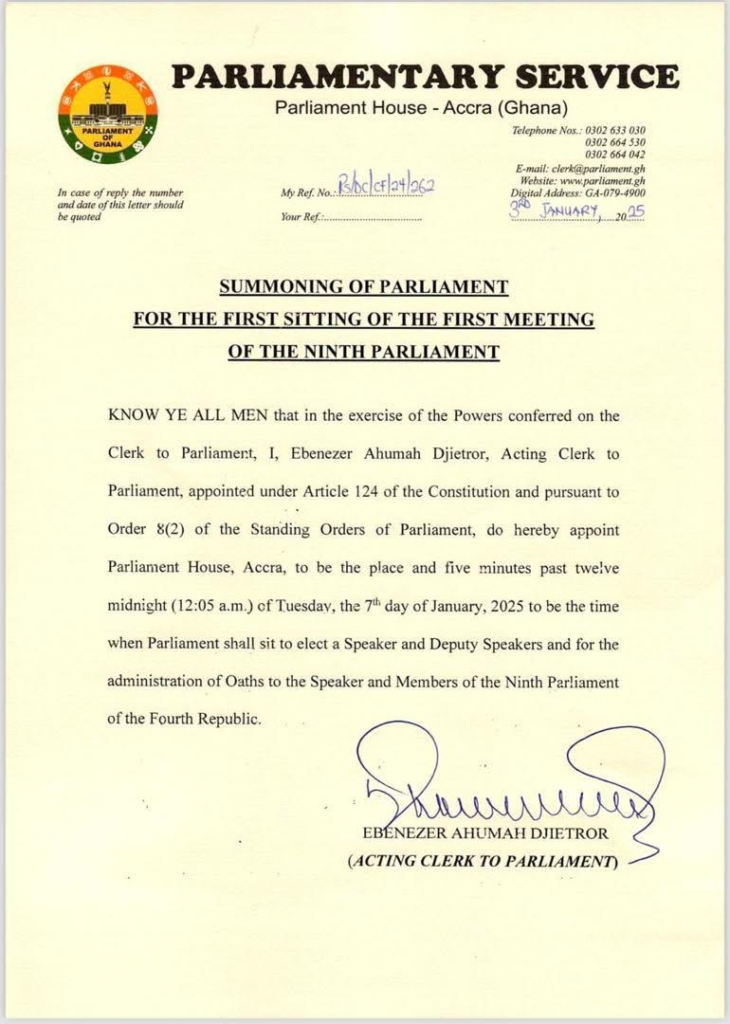
    Clerk to Parliament, Ebenezer Azumah Djietro, has announced that the Ninth Parliament will officially convene immediately after the dissolution of the Eighth Parliament.

    The first session is scheduled for 12:05 am on Tuesday, January 7, 2025.

    During this meeting, members will elect a new Speaker of Parliament and two deputies. Additionally, the newly elected MPs and Speaker will be sworn into office during the session.

    The 2025 mini-budget has already been approved by Parliament to support the incoming government.

    Later in the day, the current administration will formally transfer power to John Mahama‘s incoming government.

  • Registration for MPs-elect begins today

    Registration for MPs-elect begins today

    Parliament has launched the registration process for the Members of Parliament (MPs) -elect ahead of the 9th Parliament of the 4th Republic.

    A statement issued on December 24 revealed that the registration will begin online on today, Wednesday, December 25, 2024.

    The in-person registration will follow, taking place from January 2 to January 6, 2025.

    “Targeted messages inviting members will be sent to members elect via WhatsApp or emails. Physical registration will start on Thursday 2nd January 2025 and end on 6th January 2025.

    “Members who may need further clarifications or assistance may contact the officers in charge of the registration exercise on telephone number 055 022 2200 or 0503634466,” portions of the statement stated.

    For any questions or further assistance, members can reach out to the registration team at 055 022 2200 or 0503634466.

    The statement noted that, the registration is an important part of the preparations for the swearing-in of the new Parliament.

  • We don’t need more MPs to solve Ghana’s problems – Kofi Koranteng

    We don’t need more MPs to solve Ghana’s problems – Kofi Koranteng

    Independent presidential candidate Kofi Koranteng has asserted that Ghana does not need an increasing number of Members of Parliament (MPs) to address its challenges, emphasizing that the current 275 MPs lack the mental capacity to fulfill their responsibilities effectively.

    According to Koranteng, the country’s large legislative body has failed to deliver results, and instead of more representatives, he believes the nation should prioritize technological advancements for better governance.

    “They don’t have the mental capacity. Maybe they will hear and listen, but they won’t be able to do anything,” he said during an interview on Joy News’ AM Show on Wednesday, November 13.

    Koranteng argued that even with the existing number of MPs, critical issues remain unaddressed, underscoring that “you could bring in Alibaba, Mark Zuckerberg, or any of these guys, and they could run the whole of Ghana. Yet, you have 275 MPs, and they are still twiddling their fingers, biting their fingernails, and wanting to split this country up by bringing in more people (MPs) because they think more MPs will mean more progress.”

    Advocating for a shift in governance strategy, Koranteng explained that in this era of “humanoids, robotics, and quantum computing,” adding more MPs is unnecessary, as technological tools could enhance efficiency and reduce the need for a large parliamentary body.

    When host Benjamin Akakpo described his remarks as a “low blow” to legislators, Koranteng stood by his position, responding, “The problem is we don’t want to accept the truth.”

    Koranteng, who has previously criticized the current administration’s handling of illegal mining issues, reiterated his commitment to transforming Ghana if elected president in the December elections. He further argued that President Nana Addo and his ministers should be held accountable for failing to address the ongoing illegal mining crisis, which he believes has severely impacted the nation’s resources.

  • Put the people first, not party agendas – Kennedy Agyapong to MPs

    Put the people first, not party agendas – Kennedy Agyapong to MPs

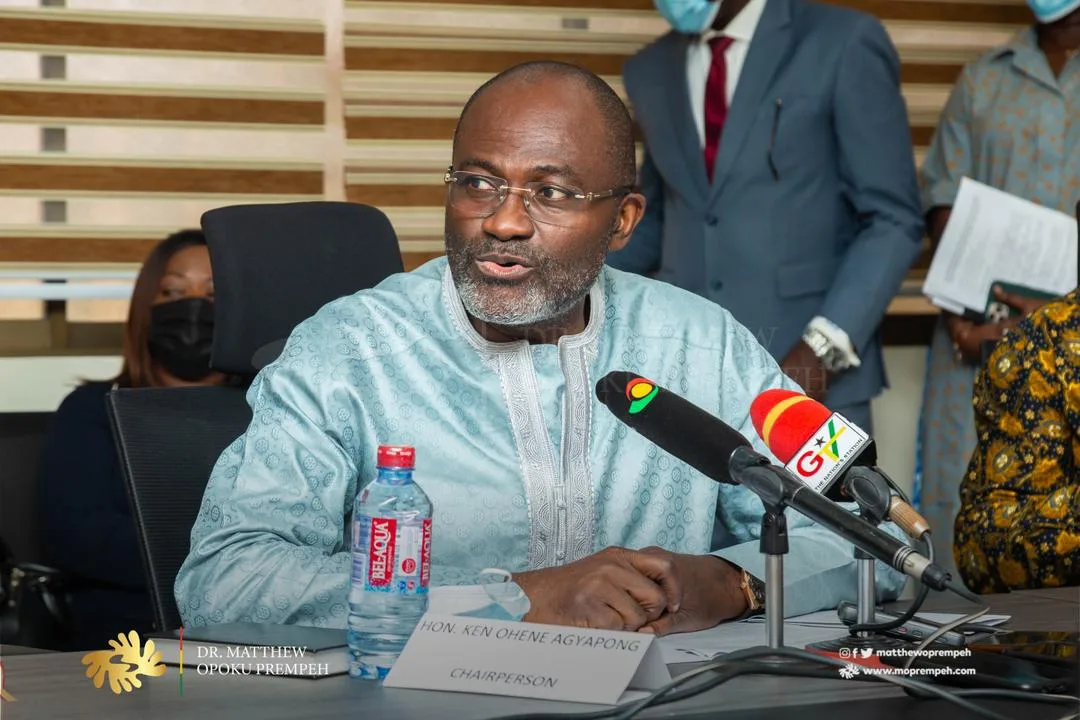
    Amid Ghana’s ongoing political impasse, outgoing Assin Central Member of Parliament (MP), Kennedy Agyapong, has called for greater cooperation between the majority and minority sides in Parliament, stressing that the institution’s purpose is to serve the people, not push party interests.

    During a media briefing, Agyapong emphasized that the Parliament’s role is to ensure the well-being of Ghanaians, a responsibility that transcends political agendas.

    “Parliament is meant to serve the people, not to push party agendas,” he asserted, underscoring the need for both sides of the aisle to work together for the greater good of the country.

    He specifically addressed the National Democratic Congress (NDC) MPs, urging them to reflect on their plans for governance, should they win the next elections. “NDC MPs need to consider how they plan to govern if they win the next elections,” Mr Agyapong said, pointing out that effective governance requires cooperation and constructive engagement between both sides of Parliament.

    The outgoing Assin Central MP’s comments come as tensions between the majority and minority parties continue to simmer, with each side holding firm to their positions on key issues. The deadlock has raised concerns about the ability of Parliament to effectively address critical national matters, including the passing of budgets and other laws.

    While acknowledging the political disagreements, Agyapong warned that Parliament cannot function properly without collaboration.

    “Parliament cannot function without both sides working together—this is a responsibility we can’t lose sight of,” he said.

    The former MP’s statement reflects his belief that unity is essential for the effective operation of Parliament and the smooth functioning of the country’s governance system.

    As Ghana navigates its political challenges, Agyapong’s call for unity is a reminder of the larger responsibilities lawmakers have in ensuring that their actions ultimately benefit the citizens they serve.

    The question remains whether both parties can set aside their differences and find common ground for the benefit of the nation.

  • AG backs MPs’ right to keep their seats in ongoing Supreme Court case

    AG backs MPs’ right to keep their seats in ongoing Supreme Court case

    Attorney General Godfred Dame has submitted his response as the second defendant in the Supreme Court case initiated by Majority Leader Alexander Afenyo-Markin.

    The case contests the Speaker of Parliament’s decision to remove four Members of Parliament (MPs) who declared their intentions to run as independent candidates ahead of the December 2024 elections.

    In his statement, filed on October 21, 2024, Mr. Dame argued that the Constitution does not require an MP to lose their seat simply for filing to contest a future election as an independent candidate or under a different political party. He clarified that an MP’s seat can only be vacated during their current term if they defect from their party or declare independence during the tenure of the sitting Parliament.

    “Filing a nomination to contest an upcoming election for a place in a future Parliament does not lead to a vacation of seat,” the statement reads, adding that the filing by an MP to contest in a future election does not impact their status in the current Parliament.

    Mr. Dame further emphasized that all state institutions, including Parliament, must adhere to the Constitution and are subject to the Supreme Court’s authority of judicial review.

    He asserted that any ruling or action by the Speaker of Parliament that contradicts constitutional provisions falls under the jurisdiction of the Supreme Court for review.

    He stressed that every branch of government, including Parliament, is bound by the Constitution and remains accountable to the Supreme Court in determining the constitutionality of its decisions and actions.

    “Consequently, an order, decision, ruling, or determination by the Speaker of Parliament, in contravention of and/or ultra vires to the Constitution, will render such order, decision, ruling, or determination amenable to the jurisdiction of the Supreme Court.”

    The controversy began when Speaker Alban Bagbin declared the seats of four MPs, who had expressed their intention to contest as independent candidates, vacant.

    However, the Supreme Court temporarily halted this decision by granting Majority Leader Alexander Afenyo-Markin’s request, allowing the MPs to retain their seats and continue representing their constituencies until a final ruling is delivered.

    Today, Speaker Bagbin adjourned parliamentary proceedings amid the ongoing debate over the vacant seats. The session unfolded with National Democratic Congress (NDC) MPs seated on the Majority side, after members of the New Patriotic Party (NPP) walked out in protest over the opposition’s claim to the majority position.

    During the brief session, Speaker Bagbin acknowledged a request from Madina MP Francis-Xavier Sosu to amend the record to reflect that, on Thursday, the NPP group, after walking out, were considered the Minority.

    After addressing the correction, the Speaker officially communicated his stance on the matter and confirmed that he had received court documents related to his ruling on the four MPs.

    “We don’t have at least half of all members of parliament present. Consequently, in view of the current circumstances, the fact that there’s a question on the composition and constitution of Parliament, and having regard to public interest and the exigencies of the state of affairs in Parliament, I will proceed to, in accordance with Standing Orders 59, adjourn the House indefinitely.”

  • We don’t want to see anything awkward in parliament – Peace Council to MPs

    We don’t want to see anything awkward in parliament – Peace Council to MPs

    An emergency meeting has been convened by the National Peace Council ahead of what promises to be a tense parliamentary session on Tuesday, October 22.

    The purpose of the meeting is to avert any disruptions following the Supreme Court’s decision to overturn Speaker Alban Bagbin’s previous ruling that declared four parliamentary seats vacant.

    Rising tensions in Parliament have been fueled by the Minority’s decision to occupy the Majority side of the chamber until the Speaker addresses the issue again.

    This development has further complicated the ongoing political uncertainty regarding which party maintains control in the legislature.

    To address this situation, the National Peace Council is working with important stakeholders, including parliamentary leaders, executives from the New Patriotic Party (NPP), the National Democratic Congress (NDC), and other relevant entities, to foster peace and stability.

    The council aims to ensure that Tuesday’s parliamentary session proceeds without any disruptions or conflicts.

    Sheikh Armiyawo Shaibu, a spokesperson for the National Chief Imam and a member of the Peace Council, stressed the importance of all parties acting with care and responsibility.

    He pointed out that the current situation calls for calmness to prevent worsening already strained relationships.

    The intervention of the Peace Council is focused on preventing the political deadlock from spiraling into chaos, as both sides in Parliament navigate the consequences of the Supreme Court’s stay on the Speaker’s ruling.

    “We don’t want to see anything untoward happen tomorrow. There have even been suggestions that military personnel might be deployed, though there is no solid basis for that. Still, we must prepare for any outcome.”

    “This moment is not about one party or the other. It is about reaching a point in our democratic journey where crucial decisions must be made for the betterment of our future,” he said.

  • The rights of the 4 MPs have been reinforced – Afenyo-Markin

    The rights of the 4 MPs have been reinforced – Afenyo-Markin

    The rights of four Members of Parliament (MPs) have been reinforced, according to Majority Leader Alexander Afenyo-Markin, following a Supreme Court decision that granted a stay of execution on the ruling by Speaker Alban Bagbin, which had declared their seats vacant.

    The affected MPs—Cynthia Morrison (Agona West), Kojo Asante (Suhum), Andrew Asiamah (Fomena), and Peter Kwakye Ackah (Amenfi Central)—were set to lose their seats after filing to run as independent candidates in the upcoming December elections.

    Speaker Bagbin had based his decision on Article 97(1)(g) of the 1992 Constitution, which mandates that MPs intending to contest as independent candidates must vacate their seats. However, the Supreme Court’s intervention has paused the enforcement of this ruling, pending further legal proceedings.

    “We came to court believing that the court will do right, and indeed the court has done right,” Afenyo-Markin said after the ruling, adding that the rights of the MPs had been “reinforced.”

    The Speaker’s ruling had briefly shifted the balance of power in Parliament, with the National Democratic Congress (NDC) gaining 136 seats to the New Patriotic Party’s (NPP) 135. However, the Supreme Court’s stay has allowed the NPP to maintain its majority, as no by-elections can be held within three months of a general election, scheduled for December 7.

    The NPP MPs, who had threatened to boycott parliamentary proceedings over the Speaker’s ruling, have welcomed the court’s decision and are expected to resume full participation in Parliament.

  • Appiah-Kubi admits MPs erred in approving LI 2462 permitting mining in forest reserves

    Appiah-Kubi admits MPs erred in approving LI 2462 permitting mining in forest reserves

    Asante-Akim North MP, Andy Appiah-Kubi, has admitted that Parliament made a mistake in passing Legislative Instrument (LI) 2462, which permitted mining in forest reserves.

    Speaking in an interview with TV3 on Saturday, October 12, he expressed remorse over the decision, acknowledging its role in the widespread environmental damage caused by mining activities throughout the country.

    “We have failed as Members of Parliament for passing LI.2462,” Andy Appiah-Kubi said.

    The controversial legislation that allowed mining in forest reserves under certain conditions is expected to be repealed when Parliament resumes on October 15.

    This law had permitted the issuance of mining licences in several forest reserves while safeguarding specific areas like biodiversity hotspots and cultural heritage sites.

    Forest reserves such as Draw River, Neung South, Boin Tano, and Oda River were among those affected by this regulation.

    Environmentalists and health experts have increasingly raised alarms about the irreversible harm caused by illegal mining, also known as galamsey.

    In a related move, the Attorney General (AG) has instructed the Environmental Protection Agency (EPA) to present Legislative Instrument (LI) 2462 for revocation in Parliament.

    This decision comes in response to growing pressure from organised labour, which has urged the government to abolish the law due to the environmental damage linked to galamsey operations.

    The government has reaffirmed its commitment to addressing the concerns of stakeholders about the negative effects of mining in sensitive ecological areas.

    The revocation of this Legislative Instrument is considered a pivotal step in the government’s broader strategy to tackle the environmental devastation caused by illegal mining.

    Once the EPA submits the Instrument to Parliament, lawmakers will have the authority to repeal it, thereby prohibiting all mining activities in forest reserves.

  • Irresponsible galamsey comments by MPs a symptom of Ghana’s challenges – GBA President

    Irresponsible galamsey comments by MPs a symptom of Ghana’s challenges – GBA President

    President of the Ghana Bar Association (GBA), Yaw Acheampong Boafo, has condemned recent remarks made by Nsawam-Adoagyiri Member of Parliament, Frank Annoh-Dompreh, regarding the pollution of water bodies under the previous National Democratic Congress (NDC) administration.

    Mr Boafo described the comments as “irresponsible” and a reflection of the broader issues currently plaguing the nation.

    Speaking at the GBA’s 2024/2025 annual general conference, Boafo expressed his concern over the partisan nature of the remarks.

    During an emergency parliamentary sitting on September 3, Annoh-Dompreh, who serves as the Majority Chief Whip, claimed that the NDC, during their time in power, had polluted more water bodies than the ruling New Patriotic Party (NPP). He further suggested that an investigation would validate his assertion.

    Frank Annoh-Dompreh

    Reacting to the comments, Boafo said, “It was quite shocking and most regrettable when a member of the leadership of parliament, on the floor of parliament, stated that the minority party during this period in government polluted the waters of Ghana more than the ruling party.”

    Boafo emphasized that such remarks divert attention from the pressing national issue of illegal mining, also known as “galamsey,” which continues to devastate the country’s natural resources. He highlighted the need for leaders to focus on addressing the environmental crisis rather than engaging in partisan blame games.

    “Such an irresponsible statement by a member of parliament is symptomatic of the malaise affecting our dear nation. Every issue must be reduced to partisan point-scoring by a parallel nation’s police drive,” Boafo lamented.

    The GBA President called for a unified national effort to combat illegal mining and restore Ghana’s water bodies, stressing that the country’s challenges should not be reduced to mere political point-scoring. He urged lawmakers to prioritize the well-being of the environment and the citizens over party interests.

    Galamsey has been a major issue in Ghana, with its impact seen in the destruction of water bodies, farmlands, and forest reserves. Boafo’s comments add to growing calls for a more robust and non-partisan approach to dealing with the menace.

  • MPs listen, you are fooling too much – Bridget Otoo on new LI

    MPs listen, you are fooling too much – Bridget Otoo on new LI

    Renowned media personality, Bridget Otoo, has vented her spleen against Ghanaian legislators over their decision to introduce a Legislative Instrument (LI) proposing amendments to the Road Traffic Regulations 2012.

    The Ministry of Transport initially proposed the LI to amend portions of the Road Traffic Regulations 2012. The amendment aimed to grant Members of Parliament (MPs) and Ministers of State privileges typically reserved for emergency and specialized vehicles. 

    Specifically, it sought to amend Regulation 74 of LI 2180 to allow sirens or bells to be fitted as warning appliances on vehicles owned by Supreme Court justices, MPs, and Ministers of State.

    Reacting to the issue in a post on X dated July 16, Bridget Otoo noted that the MPs are considering an initiative that ridicules their capabilities to lead the country.

    She further noted such an LI is a reason the recent protests that have seen the Kenyan government face intense backlash from Kenyans, amid numerous deaths and destruction, must also happen in the country.

    “MP’s listen! You are fooling too much in this country! This is why Kenya must happen in Ghana,” she wrote.

    Meanwhile, the Legislative Instrument (LI) proposing amendments to the Road Traffic Regulations 2012 has been withdrawn from Parliament. 

    The decision was announced by the Minister for Local Government and Rural Development, Martin Adjei Mensah Korsah, who acted on behalf of the Transport Minister. 

    This move follows significant backlash from the public and various stakeholders.

    “The withdrawal became necessary based on extensive engagement with leadership,” Mr. Korsah explained. 

    He continued, “Mr. Speaker, I would like to move that the Road Traffic Amendment 2024, which was laid on Friday, June 14, be withdrawn… it is so withdrawn.”

    The proposal faced strong opposition from both the public and the Minority in Parliament. The Minority issued a press statement urging the Transport Minister to withdraw the LI before it matured in 21 days.

    They also pledged to vote against the LI if it reached the chamber, stating, “We have instructed all our Members on the Committee to strongly oppose it at the committee level. We have also directed all 137 NDC Members of Parliament to vote en bloc against the LI when it is brought to the floor.”

    Critics argued that the LI represented an abuse of privileges and detracted from pressing national issues. 

    They urged the government to prioritize addressing critical challenges such as the high cost of living, food inflation, unemployment, high fuel costs, the depreciation of the cedi, and a high tax regime driving businesses to relocate to neighbouring West African countries.

  • Leaving home early won’t save MPs from traffic congestion – Dominic Ayine

    Leaving home early won’t save MPs from traffic congestion – Dominic Ayine

    The Bolgatanga East Member of Parliament, Dr Dominic Ayine, has defended the introduction of a new Legislative Instrument (L.I.) that seeks to amend parts of the Road Traffic Regulations 2012.

    The proposed L.I., currently before Parliament, aims to grant Members of Parliament (MPs) and Ministers of State certain privileges previously reserved for emergency and specialized vehicles.

    The amendment to Regulation 74 of L.I. 2180 will allow the installation of sirens or bells as warning devices on vehicles owned by Supreme Court justices, MPs, and Ministers of State.

    This legislative change is intended to facilitate the movement of these officials, who often face demanding schedules requiring travel to multiple locations for meetings and official duties.

    The proposed amendment has sparked debate among various stakeholders, with some advocating for its potential benefits in improving governmental efficiency, while others raise concerns about the broader implications of extending such privileges to elected officials.

    Mounting to its defense, Dr Ayine noted that the assertion that MPs should set off home early to address their administrative businesses does not hold.

    In an interview on GTV, he noted that there are emergencies that are unforeseen which cannot be catered for by leaving home early.

    He believes that the only way out of this would be to use the siren in order to deal with any traffic congestion they might encounter.

  • Withhold plans to travel to Kenya – Ghana High Commission cautions Ghanaians amid fierce protests

    Withhold plans to travel to Kenya – Ghana High Commission cautions Ghanaians amid fierce protests

    Ghana’s High Commissioner to Kenya, Damptey Bediako Asare, has issued a cautionary message to Ghanaians regarding travel to Kenya due to increasing unrest in the East African nation.

    The warning follows the eruption of protests labeled “7 Days of Rage” against a controversial finance bill proposing new tax hikes.

    Initially intended as peaceful demonstrations, the protests turned violent on Tuesday as clashes between protesters and security forces led to the vandalism of state properties and an attack on the Parliament building in Nairobi.

    Kenya has long been a favored destination for Ghanaian tourists and business owners, especially those exploring opportunities under the African Continental Free Trade Area (AfCFTA) Initiative, which both Ghana and Kenya have ratified.

    Recently, Ghana’s Ministry of Foreign Affairs and Regional Integration announced that Ghanaian travelers would be issued an Electronic Travel Authorisation (ETA) free of charge upon application for travel to Kenya, thanks to the existing visa-free regime agreement between the two countries. This development was expected to boost travel between Ghana and Kenya.

    However, High Commissioner Damptey Bediako Asare, speaking to Joy News’ Connect Africa, advised Ghanaians to exercise caution. He emphasized the need for Ghanaians to stay informed about the situation in Kenya, especially those already in the country.

    “If you are already in the country, our advice is that you keep updated with the latest news, particularly from local news outlets and international news platforms. If you are still in Kenya, it may be advisable to avoid protest areas,” he said. For those planning to travel to Kenya soon, he recommended contacting travel agents or airlines for the latest guidance and advice.

    Notably, several Ghanaian Members of Parliament, mostly from the Local Government Committee, found themselves amidst the chaos in Kenya’s Parliament when the protests outside turned violent.

    A video captured by Asuogyaman MP Thomas Ampen Nyarko showed MPs, including Sylvester Tetteh (MP for Bortianor-Ngleshie Amanfro), Emmanuel Akwasi Gyamfi, and Nii Lante Vanderpuye, being escorted to safety. The delegation also included Anita Quartey-Papafio, a parliamentary clerk in charge of Governance Cluster Committees.

    Despite the tense situation, High Commissioner Damptey assured that there have been no reported casualties or incidents involving Ghanaian nationals in Kenya so far.

    “There’s no unfortunate incident involving any Ghanaian or any member of the Ghanaian community so far,” he stated.

    The protests have already claimed at least ten lives, with paramedics expecting the death toll to rise as clashes between police and protesters continue.

    The unrest has brought businesses and transportation to a standstill across various cities and towns in Kenya.

    The finance bill, which introduces several unpopular taxes, has ignited a youth-led protest movement demanding its repeal. Despite the government’s concessions on some contentious measures, including exempting bread and imported sanitary items from the proposed taxes, public anger remains high.

    Protesters argue that the new taxes would disproportionately burden the poorest citizens, exacerbating their financial struggles. Scenes of ambulances ferrying the injured from the streets have become all too common in recent days.

  • MPs serving as ministers is the major cause of Ghana’s problem – Sam Okudzeto

    MPs serving as ministers is the major cause of Ghana’s problem – Sam Okudzeto

    Council of State member, Sam Okudzeto, has stated that Article 78 (1) of the 1992 Constitution is the ultimate cause of problems in Ghana.

    This article mandates the appointment of Members of Parliament (MPs) as ministers of state.

    He contends that this practice impedes the ability of the legislative branch to effectively check the executive branch, as mandated by the Constitution.

    According to him, serving as both an MP and a minister of state undermines the necessary separation of powers between the legislative and executive arms of government.

    The media reports that he emphasized that parliamentary duties demand full-time commitment and should not be combined with any other role.

    “How do you check something when you have one foot here and another foot there; which one is checking which? This is the problem that we have as a country,” he stated.

    “Being an MP in my time from 1969 was a part-time job, but now Parliament is a full-time job, and that is all the more reason why they even say that if you are a lawyer and an MP and want to go to court, you must seek permission from the Speaker because you are supposed to represent the people and be present in the House,” he is quoted as saying.

    He added, “You are supposed to make contributions to debates and vote on every issue that comes before the House. So, I think we are getting ourselves a little confused on every issue.”

    He emphasized that without amending Article 78 (1) of the 1992 Constitution, Ghana will struggle to make progress in its development journey.

    The legal expert also highlighted that due to the fundamental flaws in the constitution, Ghana, once seen as a leader on the African continent, is now lagging behind many countries.

    “We can talk and talk, and we will not get anywhere. So, let us understand the fundamental principles since we want a constitution to govern the country. We are supposed to have set the standard for the rest of the continent.

    “But I am afraid much of the continent is way ahead of us, and it is time for us to now sit down and evaluate the situation and do something which is reasonable; otherwise, I am afraid, we will be wasting our time,” he said.

  • Life of MPs become miserable when they leave parliament – Joe Wise

    Deputy Speaker of Parliament and Member of Parliament for Bekwai, Joseph Osei Owusu, has underscored the importance of MPs taking charge of their futures, pointing out the lack of societal support once they exit office.

    Speaking at a session honoring the late Kwadwo Tawiah, a former MP for Kpandai, Owusu lamented the challenging circumstances many former MPs encounter after leaving Parliament.

    He highlighted the tendency for society to overlook their difficulties, only recognizing them during emergencies or financial crises.

    “There have been several instances where former MPs are seen in miserable conditions, struggling to pay for hospital bills and support their families,” Joe Wise noted.

    Member of Parliament for Asawase, Alhaji Muntaka Mubarak Mohammed, echoed similar sentiments, emphasizing the absence of unity among MPs.

    He observed that many MPs are unfamiliar with their colleagues’ personal circumstances and challenges.

    “Life after Parliament is unbearable for many members,” Muntaka added, urging MPs to support each other regardless of political affiliations.


    In the wake of the untimely passing of Dr. John Kumah, Member of Parliament for Ejisu and Deputy Finance Minister, Parliament suspended its session on March 7.

    Kumah, aged 45, succumbed to a short-term illness. Tragically, he passed away in the early hours of Thursday, March 7, while en route from his constituency to Accra.

    It’s reported that his intended destination upon reaching Accra was Germany, where he had arrangements for medical treatment.

  • Incessant financial requests from constituents making MPs corrupt – Cletus Avoka

    Incessant financial requests from constituents making MPs corrupt – Cletus Avoka

    Member of Parliament for Zebilla constituency, Cletus Avoka, attributed corruption within the Legislature to unreasonable demands imposed on lawmakers, particularly by the public and constituents.

    In a conversation with Starr FM, Avoka underscored the challenges faced by MPs due to incessant financial requests.

    He revealed that these demands make it practically impossible for MPs to refrain from engaging in corrupt activities.

    Mr Avoka highlighted that many MPs divert their focus from legislative duties to use their positions for business, driven by the constant financial pressures they face.

    He stressed the need for understanding from the media, emphasizing that requests for healthcare expenses, wedding contributions, and school fees contribute to the public’s perception of corruption.

    He described a scenario where MPs are inundated with financial requests daily, making it difficult for them to allocate funds after spending long hours in parliamentary debates.

    “If I’m not corrupt, how can I maintain my seat? You have to be corrupt in one way or another. You have to look for more resources. If you have to look for more resources, you have to go out and do some work for a contractor. As a lawyer, maybe prepare a bill, or do this and that and whatnot? So I have half attention here, and half attention outside because I need more resources to be able to maintain my seat.”

    Mr Avoka acknowledged that financial constraints often lead MPs to engage in external activities to generate income, supporting the assertion that such circumstances justify the perception that all MPs are corrupt.

    In response to whether this situation justifies labeling all MPs as corrupt, Mr Avoka affirmed that maintaining one’s seat often requires seeking additional resources, leading to engagement in external activities for income generation.

    He expressed the dilemma MPs face, needing to divide their attention between parliamentary responsibilities and external endeavors to meet the financial demands placed upon them.

    “Everyday MoMo. Everyday MoMo. Somebody is sick and has to go to the hospital, you have to send money, somebody is going to do a wedding you have to send money, they are going to do outdooring, they are asking for you. They are asking for school fees and whatnot.

    “Many of us lose the election or Primaries not because we are not doing well but because we’re not giving money out. How do you give money out if you come and stay in parliament for 8 hours debating? You’re debating for 5 or 8 hours, you go home in the evening to sleep, and the following day you have no money to send. You have to go out and look for the money.”

  • You’re like a slave…indeed MPs are suffering – Charles Owusu

    You’re like a slave…indeed MPs are suffering – Charles Owusu

    An Independent parliamentary candidate for Nkoranza North, Charles Owusu, echoes the sentiment that being a Member of Parliament (MP) is not as glamorous as it may seem.

    He references the recent remarks made by the First Deputy Speaker in Parliament, Joseph Osei-Owusu, who highlighted the financial strain MPs often face.

    Owusu agrees, emphasizing that MPs are burdened with excessive expectations from their constituents, leading them to feel like slaves unable to accommodate everyone’s needs.

    “You have become like a slave that you endure anything someone is doing. Chairman the sad thing is that you that have showe up for it, you are the one they worry more than the one sitting on the chair. So for everything you have to do your best. The MPs are suffering. Sometimes lets have mercy on them.”

    Weeks ago, the first deputy speaker in Parliament, Joseph Osei Owusu, highlighted the resource constraints within Parliament, noting that MPs often serve as benefactors to their communities, tackling a multitude of challenges within their constituencies.

    His remarks follow the departure of certain MPs from the New Patriotic Party after the recent parliamentary primaries.

    Osei Owusu remains hopeful that those MPs who lost in the primaries will adhere to the party’s directives and continue to actively engage in parliamentary proceedings.

    “Parliament is a poor place. You spend all the money, you are community ATM, you are the financier for all party activity. You are the social burden, you carry all the social burdens of the community so you can’t save anything.”

    He continued that “Your emoluments is for the whole community so you are distressed from the beginning till the time of the primaries. Many of my colleagues who lost actually took loans to contest and they’ve lost. Some mortgage their properties. It is common knowledge that within one year when they leave Parliament they can’t pay hospital bills. That is why Parliament has made it a condition to support former Members of Parliament.”

  • Parliament’s move to use local languages during proceedings commendable – Franklin Cudjoe

    Parliament’s move to use local languages during proceedings commendable – Franklin Cudjoe

    President of IMANI Africa, Franklin Cudjoe, has embraced Parliament’s initiative to encourage the use of local languages during its sessions.

    Cudjoe commended the idea of Members of Parliament expressing themselves in their native dialects, deeming it a commendable practice, especially as the assembly gears up to welcome new members.

    On February 16, Speaker of Parliament, Alban Bagbin, directed committees on education, finance, culture, and tourism to investigate the factors contributing to the decline of local languages in the country.

    The aim is to propose recommendations to address this issue, prompted by concerns raised by MPs regarding the diminishing use of local languages, particularly in schools nationwide.

    Bagbin also disclosed plans for technological upgrades in the parliamentary chamber to facilitate the incorporation of local languages in future sessions.

    In a statement released on February 19, Cudjoe expressed his satisfaction, stating, “I was delighted to hear that Ghana’s Parliament will now allow the use of local languages in conducting business.”

    He speculated that this shift might be in anticipation of new members taking the place of experienced MPs proficient in parliamentary procedure and skilled in expressing themselves in English during debates.

    Mr Cudjoe envisioned the potential for MPs like Alexander Afenyo-Markin to deliver their initial remarks in Fante and Ewe.

    However, Mr Cudjoe underscored the irreplaceable position of the English language as a global communication tool.

    While endorsing the inclusion of local languages in internal communication systems, he emphasized the importance of being prepared to learn international languages for global relevance.

    Mr Cudjoe cited examples of others learning Chinese and Australian children learning Korean for economic reasons, highlighting the need to adapt to both local and international linguistic dynamics.

    READ THE FULL STATEMENT BELOW 

    I was delighted to hear that Ghana’s Parliament will now allow the use of local languages in conducting business.

    I remember as far back in July 2015, when the young and clever master of parliamentary procedure, Hon.Alexander kwamena Afenyo-Markin now Deputy Majority Leader, made a passionate appeal for the provision of facilities to encourage the use of local languages in parliament.

    In November 2015, Hon. fenyo-Markin again emphasized the urgency to allow MPs who felt comfortable making submissions in local languages be allowed. The situation had become critical against the background of grammatical errors made by two members of Parliament then, when reggae musician and radio show host, Blakk Rasta, appeared before the Parliamentary Select Committee on Privileges to interrogate the matter.

    The MP for Adentan at the time, “Mr Emmanuel Nii Ashie Moore, in a question to the Editor of the Searchlight newspaper, Mr Ken Kuranchie, asked: ” I will like to know from Mr Ken Kuranchie, in your paper, did you attributed (sic) the story to Adom FM online. Did you also spoke (sic) to Blakk Rasta?.”

    “The member for Effigya Sekyere East, Mr Henric David Yeboah, who filed the complaints with the House, also kept referring to Blakk Rasta as “Brack Rasta.” Since then, one news report said, “some radio presenters have played both voices on their stations and made humorous anecdotes of the errors to provoke laughter.” Hon. Afenyo-Markin then attempted to make his submission in the Fante language, arguing that one’s ability to speak fluent English wasn’t the yardstick of intelligence and wisdom.

    Today, with an activist Speaker of Parliament in Rt. Hon. Alban Bagbin, the stage is set for the adaptation of local languages in conducting Parliamentary business. It may well be timely as the House prepares to welcome many new entrants that will be replacing experienced MPs who were not just skilled in the art of Parliamentary procedure, but were able to communicate their positions during debates effortlessly in the English Language. It would be an admirable encounter to listen to Hon. Alexander Afenyo-Markin makes his preliminary remarks in Fante and Ewe when he becomes the Majority Leader in a few days. Even better it would have been if my SALL MP had been allowed to argue for a rehabilitation of very bad roads and schools in the Siwu or Sekpele language.

    However, it must be made clear that the English language is a universal language and can not be replaced. These days, others are learning Chinese in order to be part of the coming Chinese ‘ economic dragon’! While travelling in Australia , I enjoyed a discussion in the media about allowing Aussie kids to learn Korean! Yes, Korean! Reason? Not just for the fact that Australia may be closer to Korea, but mainly economic! So, there you have it! Adapt your internal communication systems to include local languages but also be prepared to learn international languages of the times, or you perish!

    I am looking for a great French, Spanish and Chinese teacher!

    Franklin Cudjoe!

  • Loss of experienced MPs every 4 years detrimental to Ghana’s democracy – Speaker

    Loss of experienced MPs every 4 years detrimental to Ghana’s democracy – Speaker

    Speaker of Parliament, Alban Sumana Kingsford Bagbin, has voiced concern over the loss of experienced Members of Parliament (MPs) during political party primaries held every four years, stating that it undermines Ghana’s democracy.

    Bagbin acknowledged that primaries are a fundamental aspect of the democratic process but emphasized that it is detrimental for seasoned MPs to be denied the opportunity to continue representing their constituencies.

    He highlighted the significant cost to the country associated with this loss of experience.

    The Speaker called upon political parties to address this issue urgently, emphasizing the importance of preserving the expertise and continuity that experienced MPs bring to governance.

    “We woke up one Saturday and by the evening we’ve lost 28 MPs through the primaries of the New Patriotic Party (NPP). Earlier last year, we lost 17 MPs through the primaries of the National Democratic Congress … the primaries are part of the process for the [voters] to determine who represents them in Parliament but the case of voluntary discontinuance of MPs [from the House] is not a good signal for the legislature and for Ghana’s democratic development,” Bagbin says.

    “Experience as we all know counts in this House but the endorsement of your parties to contest is equally important. The hemorrhage and cost to the nation is, however, a great concern worth considering by all stakeholders and I want to appeal to the political parties to take this matter up seriously because the investment that is made in an individual MP is so huge for the nation just to go waste after every four years.”

  • MPs serve as ATM’s for their constituents – Joe Wise

    MPs serve as ATM’s for their constituents – Joe Wise

    First deputy speaker in Parliament, Joseph Osei Owusu, asserts that Members of Parliament (MPs) shoulder a significant portion of the challenges in their communities.

    This assertion comes in light of the recent parliamentary primaries of the governing New Patriotic Party (NPP), where 28 MPs lost their seats to Chief Executives of state institutions and other contenders.

    Among the 28 sitting MPs who lost their seats, 10 are first-time MPs, while 18 have served more than one term in the House.

    In an interview with EIB Network Parliamentary correspondent Ibrahim Alhassan, the Bekwei lawmaker expressed the hope that MPs who have lost in the parliamentary primaries would continue to actively participate in Parliament and respond to the needs of their constituencies.

    “For sitting MPs they are disadvantaged because as soon as you become an MP you will pay till the next election period. Whereas for the other person who is coming he may have saved and deepened his pocket all the more.  If you are sitting MP you are disadvantaged

    “Parliament is a poor place. You spend all the money, you are community ATM, you are the financier for all party activity. You are the social burden, you carry all the social burdens of the community so you can’t save anything,” Mr. Owusu narrated.

    He continued: “Your emoluments is for the whole community so you are distressed from the beginning till the time of the primaries. Many of my colleagues who lost actually took loans to contest and they’ve lost.  Some mortgage their properties. It is common knowledge that within one year when they leave Parliament they can’t pay hospital bills. That is why Parliament has made it a condition to support former Members of Parliament.” 

  • Large number of ‘defeated’ MPs a huge loss to Ghana’s democracy – Speaker Bagbin

    Large number of ‘defeated’ MPs a huge loss to Ghana’s democracy – Speaker Bagbin

    Speaker of Parliament, Alban Bagbin, has expressed deep concern over the significant number of incumbent MPs who lost their seats in both the New Patriotic Party (NPP) and the National Democratic Congress (NDC) primaries.

    During the recent NPP primaries held in January, 28 sitting MPs were defeated, while the NDC primaries last year saw 17 MPs losing their candidacy bids.

    Additionally, prior to the NPP primaries, 19 incumbent MPs chose not to seek re-election, with five NDC MPs making similar decisions last year.

    Mr. Bagbin emphasized that the departure of numerous MPs represents a substantial loss of investment in these legislators, which is detrimental to the nation.

    In his welcome address to MPs in the house, the Speaker noted that this trend does not bode well for Ghana’s democratic development and legislative continuity.

    “Experience, as we all know, counts in this house, but the endorsement of your party to contest is equally important. Honourable members, the haemorrhage and cost to the nation is however, a matter of great concern worth considering by all stakeholders.”

    “Honourable members, the primaries are part of the process for the electorate to determine who represents them in parliament. However, the case of voluntary discontinuance of 5 and 19 followed by this election of 17 and 28 is not a good signal for the legislation and for Ghana’s democratic development,” he noted.

    He urged political parties to address this issue internally, emphasizing the impact of losing experienced MPs after just a single term in office.

    Speaker Bagbin stressed the importance of parties recognizing the value of continuity and experience in parliamentary representation, urging them to implement measures to support and retain seasoned lawmakers within their ranks.

    “I want to appeal to the political parties to take this matter up seriously because the investment that is made in an individual MP is so huge for the nation just to always go waste after every four years,” said the Speaker.

    Meanwhile, Majority Leader Osei Kyei-Mensah-Bonsu is also appealing to political parties to review their internal election mechanisms to safeguard sitting MPs.

    He asserts that the processes and procedures employed by parties in the selection of candidates directly impact the efficiency and effectiveness of parliament in conducting its business.

    He added that “This ultimately impacts the growth of apartment and democracy of the country.”

  • NPP female MPs are losing elections because most women don’t participate in DLEs – NALAG

    NPP female MPs are losing elections because most women don’t participate in DLEs – NALAG

    The National Association of Local Authorities of Ghana (NALAG) has attributed the recent loss of female incumbent Members of Parliament (MP) to the limited participation of women in district-level elections.

    NALAG contended that societal biases, viewing women as unfit for political roles, significantly contribute to the recurrent defeat of women in both national and district-level polls.

    This observation follows the New Patriotic Party parliamentary primaries on January 27, 2024, where 28 incumbent MPs, notably including female representatives like Adwoa Safo, MP for the Dome Kwabenya constituency, were unsuccessful in their reelection bids.

    “I think that the assembly level should be a training ground to aspire to higher political office, and so in a situation where we have 14.5% in the 2020 elections as female MPs who were elected to parliament and today we are seeing the numbers decrease from what we experienced in 2020, then we ought to be alarmed. We may not even get 14% in the national parliament and that is very worrying.”

    “As of now, we have not been able to kill the stereotype and the prejudices we have against women when it comes to leadership. However, leadership must take decisive action to implement Affirmative Action.”

    The gender disparity extended to the district-level elections, with only 4.1% of elected officials being women, while men constituted a dominant 95.9%.

    NALAG’s General Secretary, Kokro Amankwah, emphasized the importance of district-level elections as a foundational step in women’s political involvement, expressing concern about the declining numbers of female MPs.

    Mr Amankwah highlighted the need to challenge stereotypes and prejudices against women in leadership roles.

    He stressed that while the district level might pose challenges, the political landscape should become more favorable for women as they ascend the ranks.

    In response to the situation, NALAG and the Network for Women’s Rights are urging President Nana Addo Dankwa Akufo-Addo to appoint 60% women to the Metropolitan, Municipal, and District Assemblies.

    They advocate for decisive action, including the implementation of Affirmative Action, to address gender imbalances in leadership roles. The Local Government Act, 2016 (Act 936), allows the president to appoint 30% of Assembly members, with the remaining 70% elected.

  • MPs support Rwanda bill as Sunak defeats Tory rebels

    MPs support Rwanda bill as Sunak defeats Tory rebels

    Rishi Sunak got his important Rwanda bill approved by the House of Commons, despite a rebellion from some members of the Conservative party not happening.

    The bill to prevent legal challenges against sending asylum seekers to Rwanda was passed with 320 votes for and 276 votes against.

    Many Conservative party members thought the bill was wrong and had said they would not support it, but in the end, only 11 of them voted against it.

    The bill will now be reviewed by the House of Lords, and it’s expected to meet strong resistance.

    Mr Sunak thinks that sending some asylum seekers to Rwanda will stop others from trying to come to the UK by crossing the Channel in small boats. But the Labour party thinks this plan is just a costly trick.

    The government wants to start the flights to Rwanda by the spring.

    The prime minister will give a speech at Downing Street about the policy at 10:15 GMT.

    In the last two days, some Conservative Party MPs have tried to make changes to the bill. They say that, without changes, the government’s plan for Rwanda could be stopped by the courts.

    On Wednesday, ex-immigration minister Robert Jenrick proposed a change that would allow the UK government to not follow some human rights laws when sending people to Rwanda.

    Mr Jenrick suggested a change that would make sure that government officials will always say no to temporary orders from the European Court of Human Rights that come at the last minute.

    This rule stopped a flight to Rwanda in June 2022.

    The amendment was not supported by Members of Parliament but 61 Conservative members backed it – the largest rebellion during Mr. Sunak’s time as leader.

    Some Members of Parliament said they might not vote at all or vote against the whole bill if it didn’t change.
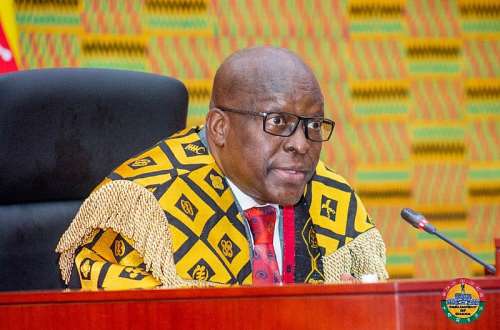
    If about 30 Conservatives had voted against the bill, it could have failed. This would have hurt the prime minister’s power a lot and could have been very bad for him.

    However, only 11 Members of Parliament, including Mr. Jenrick and former Home Secretary Suella Braverman, voted against it.

    Other members of the Conservative party on the list are Miriam Cates, Sir Simon Clarke, Mark Francois and Danny Kruger.

    Eighteen Conservative Members of Parliament didn’t vote, but some might have just missed the vote instead of intentionally choosing not to vote.

    Danny Kruger, a Conservative, voted against the bill. He said some of his colleagues supported the bill even though they were worried about it, to avoid causing problems in politics.
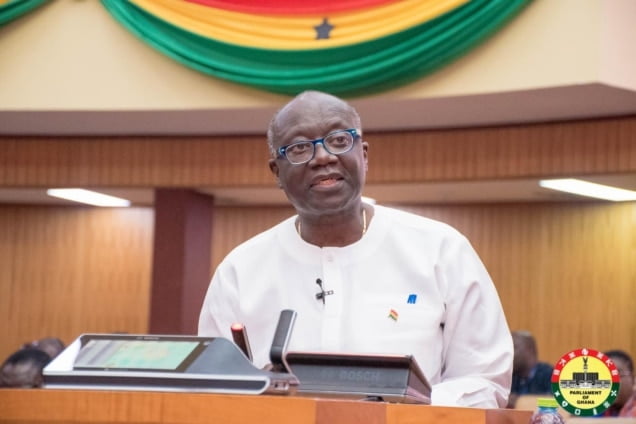
    Sir Simon Clarke, who is against the bill, said: “All Conservatives want the Rwanda policy to work well. Some of us are worried about the bill, but history will show who was correct.

    Labour did not like the bill. Yvette Cooper, who is in charge of home affairs for Labour, called the policy a “expensive trick” because it has not yet sent any asylum seekers to Rwanda.

    Home Secretary James Cleverly supported the plan by saying that it clearly shows if you come to the United Kingdom illegally, you can’t stay.

    “He said that this law was carefully written to stop the cycle of court battles. ”

    The argument about the law showed that Conservatives are still divided. On Tuesday evening, two deputy chairmen, Lee Anderson and Brendan Clarke-Smith, gave up their positions to vote for the changes proposed by rebels.

    Mr Clarke-Smith supported the bill at the end, even though he had worries about it, while Mr. Anderson did not vote.

    One person opposing the government told the BBC that the vote tonight won’t be the last decision.

    If the House of Lords decides to send back changes that make the bill less strong, some Conservative MPs might propose different changes to make the bill stronger.

    The new law may face even more resistance in the House of Lords, where many members are worried about if it follows the rules of international law.

    Crossbench peer Lord Carlile, a top lawyer and former independent reviewer of terrorism laws, said that although peers won’t stop the government, the Lords have a duty to safeguard the public from the government doing things that are not legally correct or principled.

    He told the BBC Radio 4’s Today programme that we have seen in other countries the harm caused when governments think they are more important than the courts because of their political goals.

    “This is a move towards a totalitarian government, which the United Kingdom usually disapproves of. ”

    Mr Sunak will ask the other leaders to pass the bill quickly so that the policy can start.

    However, some members of the conservative party who oppose the bill disagree and think that planes will still be stopped from flying due to legal challenges even after the bill is passed.

    Chris Philp, who works for the government, said on BBC Breakfast that they want flights to start in the spring.

    He downplayed disagreements in the party and said that almost everyone agreed that the bill was a good idea and a big step forward for the Conservative side.

    On Wednesday, the President of Rwanda, Paul Kagame, said that he would give the money back to the UK if they didn’t send any asylum seekers to his country.

    The UK has already given £240 million to the east African country and plans to give another £50 million.

    A Rwandan government spokesperson said that they don’t have to give the money back, but they will think about returning it if the UK asks.

    In Westminster, a person from Downing Street said they are not trying to change the Civil Service rules to say that emergency orders from the European Court of Human Rights should be ignored.

    Earlier in the day, Minister Michael Tomlinson from the Home Office said the government was considering changing the rules, but later No 10 said they were not trying to change them.

    The Cabinet Office said that civil servants should follow a minister’s decision to not listen to court rulings.

  • NPP firmly rejects proposal to shield experienced MPs in primaries

    NPP firmly rejects proposal to shield experienced MPs in primaries

    The New Patriotic Party (NPP) dismisses proposals to protect seasoned Members of Parliament (MPs) in the upcoming primaries, emphasizing the importance of upholding democratic values.

    The response follows comments by Kwame Ayimadu-Antwi, MP for Asante Akim Central, expressing dissatisfaction with the party’s perceived lack of support for experienced lawmakers.

    While NPP Director of Communications, Richard Ahiagbah, acknowledges the worth of considering measures to safeguard experienced MPs, he underscores the need for careful evaluation to prevent compromising the democratic foundations of party primaries.

    “The allegation that somebody is orchestrating somebody, that is just talk for people because maybe one thing is against them or the other. That should not be part of the conversation. But is it the expectation that the party should create a certain system? I think that I agree but my worry about that suggestion is what system is it and to what extent is it going to impact the basic allowance of democracy to prevail,” he remarked.

    Further highlighting the potential advantages of open competition, Richard Ahiagbah suggested that it guarantees the selected candidate has the strongest public support and acts as an incentive for performance.

    “If it is a system and arrangement that will affect a true and true practice of democracy then that will not be the system we want,” he added.

  • Nomination for NPP parliamentary primaries closed

    Nomination for NPP parliamentary primaries closed

    The nomination phase for parliamentary primaries in constituencies with incumbent Members of Parliament (MPs) from the New Patriotic Party (NPP) concluded on Monday, December 25.

    Reports suggest that notable NPP figures, including Majority Leader in Parliament Osei Kyei-Mensah-Bonsu, Daniel Kwaku Botwe, Minister for Local Government and Rural Development, and Samuel Atta-Akyea, MP for Abuakwa South, among others, have opted not to seek re-election.

    Initiated on December 20, 2023, the Party commenced the nomination process for parliamentary aspirants in constituencies with sitting MPs.

    Scheduled for January 27, 2024, the NPP plans to finalize its internal election process to determine parliamentary candidates for the upcoming 2024 elections.

    Anticipation for closely contested races is high in constituencies such as Dome-Kwabenya, Ablekuma West, Nsawam-Adoagyiri, and Asante Akyem South.

    Additionally, constituencies like Akim Swedru, Bantama, Bekwai, and Fomena are also expected to witness intense competition during the primaries.

  • Nominations opened for NPP parliamentary primaries

    Nominations opened for NPP parliamentary primaries

    The New Patriotic Party (NPP) is kicking off its nomination process today for potential parliamentary candidates in constituencies where the party currently has incumbent Members of Parliament (MPs).

    The nomination window, concluding on December 25, 2023, precedes the final phase of the internal election slated for January 27, 2024.

    A lineup of contenders, including Michael Oquaye Jnr., Roni Nicol, Hayford Siaw, Alois Mohl, and Bice Osei Kuffuor, known as Obour, has declared their intention to compete for the party’s representation in constituencies like Dome-Kwabenya, Ablekuma West, Nsawam-Adoagyiri, Nandom, and Asante Akyem South, respectively.

    Other aspirants, such as Kwasi Kwaning-Bosompem, Commissioner of Police (retd) Alex Mensah for Bekwai, and Raphael Agyapong for Bantama, are also gearing up for the internal contest.

    A focal point of interest is the Fomena constituency, where the incumbent, Andrew Asiamah Amoako, secured victory as an independent candidate after departing from the NPP. This situation sparks curiosity about the number of sitting MPs seeking re-election.

    In anticipation of the nominations, a statement by the NPP’s General Secretary, Justin Frimpong Kodua, stressed that no aspirant should face obstacles in obtaining nomination forms. Those encountering challenges at the constituency level can acquire the forms at the regional secretariat or download them from the party’s website.

    Nomination forms will be priced at GH¢3,000, accompanied by a non-refundable filing fee of GH¢35,000. Women, Persons with Disabilities, and youth (aged 18-40) will enjoy a 50% rebate on the filing fee.

    Additionally, aspirants must remit a non-refundable Development Fee of GH¢40,000, with all payments made via Banker’s Draft to the NPP National Headquarters in Accra.

    A National Parliamentary Appeals Committee will handle appeals from disqualified aspirants from January 10 to January 12, 2024, with the deadline for appeal submissions set for January 9, 2024.

  • You demand fees, bills, funeral, church donations from MPs yet hate it when their salaries are increased – Speaker to Ghanaians

    You demand fees, bills, funeral, church donations from MPs yet hate it when their salaries are increased – Speaker to Ghanaians

    Speaker of Parliament, Alban Bagbin has questioned why some Ghanaians are protesting against the increase in salaries of Members of Parliament (MPs) while some constantly seek financial assistance from these same individuals.

    Speaking at a public event in Takoradi, Mr. Bagbin observed that despite constituents regularly approaching their elected officials for monetary assistance for various needs such as school fees, hospital bills, church donations, and event contributions, there exists a reluctance to support salary hikes for these MPs.

    “Whatever is given to the one you struggled to elect, you are opposed to it, even though every day you knock at his door to request money to pay school fees and hospital bills, donate to churches, festivals, and funerals”.

    “You hate to hear that his salary is being increased,” Mr. Bagbin said.

    Mr. Bagbin elaborated that the recurring scenario suggests an underlying issue. He questioned the motivations behind this phenomenon, stating, “There must be a problem.” He drew attention to the sentiments surrounding the topic and indicated that this discrepancy in attitudes calls for introspection.

    Illustrating this point further, former National Democratic Congress (NDC) MP for the Buem Constituency, Mr. Daniel Ashiamah, shared his personal experience.

    While serving in parliament, Mr. Ashiamah disclosed that he encountered challenges balancing financial commitments, such as paying constituents’ education and medical expenses, with his own family’s needs.

    “I guess I must have forgotten about him because his fees were so so small in the scheme of the fees that I was paying for my constituents’ children”, he added.

    He recalled a distressing incident in which his own son was unable to attend school due to unpaid fees, while he was funding various expenses for his constituents. This disheartening situation underscored the complex financial dynamics that MPs often face.

    In an interview with the media on May 13, 2022, Mr. Ashiamah recounted his decision to prioritize constituents over his immediate family, even to the detriment of his own son’s education.

    He explained that despite the appearance of prestige associated with being an MP, the reality behind the scenes involves significant financial burdens and expectations that far exceed their official salaries.

    Mr. Ashiamah emphasized the challenges MPs encounter, including the necessity to make contributions to various events, including funerals and weddings, which further strain their financial resources.

    Reflecting on his own entry into parliament through a by-election, he acknowledged the pressure to conform to constituents’ expectations and the associated emotional toll.

    In light of these insights, Mr. Ashiamah advised aspiring politicians to carefully consider their ambitions to enter parliament.

    He stressed that a clear vision and understanding of the demands and challenges associated with being an MP are crucial prerequisites for success in this role.

    He cautioned that those who lack the foresight and dedication necessary for effective representation may find the experience overwhelming and unfulfilling.

    In essence, both Speaker of Parliament, Alban Bagbin and former MP Daniel Ashiamah shed light on the complex relationship between constituents and their elected representatives, revealing the intricate financial and emotional dynamics that underlie the role of an MP in Ghana’s political landscape.

  • Finance Minister to present Mid-Year budget review July 31

    Finance Minister to present Mid-Year budget review July 31

    The much-anticipated Mid-Year Budget Review, which was initially scheduled for July 27, 2023, and later rescheduled to July 25, 2023, has been postponed once again.

    The new date for the presentation is Monday, July 31.

    The unexpected and last-minute cancellation of the budget review has sparked curiosity among Members of Parliament (MPs) and the public, leading to various speculations about the reasons behind the delay.

    Engaging MPs in parliament, the Speaker of Parliament, Alban Bagbin, announced that the Finance Minister, Ken Ofori-Atta, will now engage in an intensive meeting with the MPs on Friday, July 28, 2023, ahead of the newly rescheduled presentation.

  • Female MPs seek funds to retain seats in Parliament

    Female MPs seek funds to retain seats in Parliament

    Some female Members of Parliament (MPs) are calling for financial assistance from various civil society organizations and stakeholders to effectively fulfill their constituency duties.

    They believe that such support would contribute to retaining the majority of female MPs and promote gender parity in politics.

    According to the 2021 Population and Housing Census, Ghana has a higher female population, accounting for 50.7 percent of the total population, while males constitute 49.3 percent.

    However, within the 8th Parliament, both the National Democratic Congress (NDC) and the New Patriotic Party (NPP) have 20 female members each, totaling 40 out of 275 MPs.

    During recent NDC primaries, three female MPs lost their bids to contest in the upcoming parliamentary elections.

    Expressing their concerns during a breakfast meeting organized by the Parliamentary Network Africa, Members of Parliament Patricia Appiagyei, Betty Krosbi Mensah, and Sheila Bartels called for financial support to retain their seats.

    “It is very important that if we are working with the CSOs, wherever you are getting your funding from, it is critical that you appreciate the challenges we have in ensuring that we are servicing our constituencies and support us especially even during our primaries. What do you do to support and ensure that we retain our numbers and be able to even appreciate the numbers that we have in Parliament?”

    Patricia Appiagyei stressed the importance of recognizing the challenges MPs face while serving their constituencies, especially during primaries, and urged the civil society organizations (CSOs) to offer necessary support.

    Betty Krosbi Mensah, representing Afram Plains North, highlighted the limited resources available to MPs, making it difficult to effectively represent their constituencies.

    Sheila Bartels, MP for Ablekuma North, emphasized that empowering women in Parliament would encourage more women to seek these positions.

    She expressed concerns about women in politics not getting the same support as their male counterparts and urged for equitable financing opportunities.

    The financial support sought by these female MPs aims to ensure they can continue their parliamentary roles effectively and pave the way for greater gender representation in Ghanaian politics.

  • Minority MPs criticises government’s One Village, One Dam initiative

    Minority MPs criticises government’s One Village, One Dam initiative

    Following the recent revelations of construction lapses in the dams built under the ‘One Village, One Dam’ policy by the governing New Patriotic Party, (NPP) Minority MPs have strongly criticized the initiative, labelling it a mere political gimmick.

    They argue that the policy was hastily implemented without proper consideration.

    The criticism from the Minority MPs comes in the wake of JoyNews’ documentary, titled ‘Thirsty Dams,’ which exposed the poor condition of the dams constructed during the Akufo-Addo government’s tenure.

    Among those expressing their concerns was Samson Ahi, the NDC MP for Bodi Constituency in the Western North Region.

    According to Mr. Ahi, the ‘One Village, One Dam’ policy lacked careful planning and was primarily used as a propaganda tool to deceive the Ghanaian public.

    He pointed out that despite the government’s claims of having built dams, many of them were unable to retain water even during the rainy season, indicating poor execution.

    Furthermore, the MPs accused the NPP government of prioritizing fulfilling a manifesto promise over the well-being of the communities affected by the dams. They emphasized that the policy’s rushed implementation led to subpar construction, causing ongoing challenges with water supply in those areas.

    Henry Yiadom Boakye, the NDC MP for Akwatia Constituency in the Eastern Region, echoed these concerns, highlighting the failure of the dams to deliver on their promised benefits.

    He lamented that despite significant financial investments exceeding 200 million, the project failed to provide any meaningful returns or benefits to the communities.

    The MPs argued that such resources could have been better utilized in other sectors like education, instead of being wasted on a project that did not meet its intended objectives.

    They concluded that the evidence presented in the documentary reinforces their initial opposition to the ‘One Village, One Dam’ policy and calls for a more responsible approach to infrastructure development in the future.

  • Allowances should not be awarded to MPs boycotting parliament – Economist

    Allowances should not be awarded to MPs boycotting parliament – Economist

    Renowned economist Kwame Pianim has stated that Members of Parliament (MPs) should not receive their allowances if they choose to boycott their parliamentary duties as a form of protest against situations they are content with.

    According to him, lawmakers have no justification for boycotting their responsibilities within the parliament.

    “A parliamentarian has no business to boycott parliament. If they boycott parliament their allowances should be taken off,” he said.

    “Parliament is young, there is a tendency now to put a lot of burden on the fledgling judiciary which is not fair,” he added.

    In response to the Minority in Parliament’s decision to boycott parliamentary sessions as a means of protesting the trial of Assin North Member of Parliament James Gyakye Quayson, Mr Pianim voiced his strong disagreement.

    The Minority justified their actions by claiming that they are reciprocating the government’s perceived “persecution” of Mr. Quayson.

    However, Pianim maintains that MPs should not resort to such boycotts and instead should fulfill their parliamentary duties, regardless of their concerns or disagreements.

    In a statement, the opposition lawmakers expressed their concerns regarding the trial of Hon. James Gyakye Quayson, the Assin North Member of Parliament.

    The Attorney-General and Minister for Justice, Mr. Godfred Yeboah Dame, had requested that the trial proceed on a daily basis, even though there was an application for a stay of proceedings and a pending application before the Court of Appeal against the daily trial.

    Despite these circumstances, the High Court ruled in favor of continuing the daily hearings. This decision by the court prompted the opposition lawmakers to react, with their statement highlighting their dissatisfaction with the perceived “persecution” and the subsequent boycott of parliamentary duties in protest.

    “In essence, the rulings by the High Court put Hon. James Gyakye Quayson in the same position that he was placed in by the Supreme Court before the Assin North Constituency by-election

    “If the Member of Parliament must appear in court every week day for trial, what time will he have to attend to Parliamentary business to represent the people of Assin North? We are therefore, at this point, including all options available to us to defend and protect our colleague. Hon. James Gyakye Quayson is the only person to have been elected twice within a Parliamentary term. He first won the 2020 Parliamentary election in Assin North Constituency, which was declared null and void by the Supreme Court after two and a half years. This triggered a by-election which he won again by an overwhelming 57.56% on 27th.”

    On Tuesday, July 18, an Accra High Court rejected Mr. Quayson’s application for a stay of proceedings, which aimed to halt his criminal trial until the appeal process at the Court of Appeal and Supreme Court was concluded.

    Consequently, the court permitted the cross-examination of the prosecution’s first witness to proceed.

    However, Abraham Amaliba, one of Mr. Quayson’s lawyers, raised doubts about the credibility of the prosecution’s first witness in the ongoing criminal trial of Mr. Quayson.

    “He swore an oath that his statement was written in English [but] it turned out that when he was shown his own statement he spoke in Twi and it was recorded, that goes to the credibility of the witness, that goes to his mindset.

    “So clearly, you notice that the prosecution witness was not helpful to the prosecution at all,” he told journalists after the court hearing on Tuesday, July 18.

  • MPs told to fight against corruption like they did for anti-gay bill

    MPs told to fight against corruption like they did for anti-gay bill

    Governance Lecturer at the Central University, Dr. Benjamin Otchere-Ankrah has entreated Members of Parliament who wholeheartedly fought for the approval anti-gay bill to extend same energy in fighting corruption in the country.

    The bill, which aims to uphold Ghanaian family values and ensure appropriate human sexual rights, was unanimously accepted by the Members of Parliament on Wednesday.

    It is currently undergoing the final stages of approval before it can be enacted into law.

    Once in effect, individuals found engaging in homosexual acts or openly expressing support for the LGBTQ+ community and their activities will be subject to criminal charges, including imprisonment, fines, or both.

    Discussing the matter during a media engagement,Dr. Benjamin Otchere-Ankrah noted that LGBTQ+ was said to be a “mental disorder” but the forces that be have managed to convince the World Health Organization to revise their documents in support of them.

    To him, those who practice homosexuality are “mad people”.

    He, therefore, commended the MPs for fully supporting the bill and also advised them to display the same energy in fighting corruption.

    “The way they have all unanimously accepted this with one voice, I am expecting that they will also, with one voice, fight against corruption,” he said.

  • Parliament’s washrooms have no toilet rolls – NDC MP laments

    Parliament’s washrooms have no toilet rolls – NDC MP laments

    Member of Parliament (MP) for Krachi West Constituency, Helen Ntoso has raised concerns about the insufficient supply of toilet rolls in the female washrooms used by Members of Parliament (MPs).

    Speaking to the Speaker, Alban Bagbin, she stated that “Mr. Speaker, if you go to the washroom, there are no toilet rolls since yesterday. There are no toilet rolls in the washroom, so I need to draw the attention of the House,” she voiced her concern on the floor of the Parliament on June 30, following the business statement for the week.

    She further called for urgent action to address the issue, stating that Parliament has a responsibility to ensure the availability of basic amenities.

    In order to ensure the comfort and convenience of all MPs and guests, the MP’s statement emphasized the significance of maintaining appropriate supplies in the parliamentary washrooms.

  • Speaker urges Ghanaians to allow hardworking MPs stay in parliament

    Speaker urges Ghanaians to allow hardworking MPs stay in parliament

    The Speaker of Parliament, Alban Bagbin, has advised constituents who frequently change their Members of Parliament (MPs), to desist from the act.

    He said that to be able to sustain development, an MP must have stayed long in parliament to mature and network to be able to bring about development.

    ”Those of you who change your MPs like shirts that’s your problem because to be able to get the development you have to be there for some time, you have to mature, you have to network, you must be known.

    “So if I’m now a speaker do I need a minister to come and give me development? He has to come because he needs favour from me. I don’t need to call him. If you are a first-time MP and you call, they do not even know you,”he said.

    The Speaker said this when he paid a courtesy call on the overlord of the Gonja Traditional area as part of activities marking the 30th celebration of Parliament.

    He was talking about Ghana’s democracy in the last 30 years.He stated that, despite being an advocate for MPs staying in parliament for a long time, he was referring to MPs who are performing, and the need for them to be allowed to stay for a long time to mature.

    The Speaker Parliament said Ghana has practiced democracy for the past 30 years without any interruption, something he said has never happened in the country’s history.

    In celebrating the achievement, he said there was the need for an evaluation to find out where the country got it right and wrong.

  • MPs fear the rise of AI; propose legislation

    MPs fear the rise of AI; propose legislation

    Several Members of Parliament (MPS) have demanded the establishment of laws to control the use of artificial intelligence (AI) in the country.

    Artificial Intelligence tools refer to software applications that employ algorithms based on artificial intelligence to carry out specific tasks and address various challenges.

    During discussions held on the floor of Parliament on Wednesday, some legislators emphasized the substantial benefits offered by AI technologies, however, also stressed the need for regulation to ensure they are used in a manner that aligns with appropriate objectives.

    “If we do not act now the future will be bleak for the future of our country. Probably Mr. Speaker, we should consider establishing an artificial intelligence council,” MP for Tamale South, Haruna Iddrisu, said.

    MP for Ofoase Ayirebi, Kojo Oppong-Nkrumah who doubles as the Information Minister added that “those who worked on AI are beginning to worry about the potential.”

    “So it is opportune time for us to consider what kind of architecture, legal or regulatory to limit the most dangerous parts of AI,” he added.

    Geoffrey Hinton, who is regarded as the godfather of AI after quitting Google expressed concerns over the growth of artificial intelligence in all sectors of an economy.

    “I think that it’s conceivable that this kind of advanced intelligence could just take over from us,” the renowned British-Canadian computer scientist told As It Happens host Nil Köksal. 

    “It would mean the end of people,” he added.

    AI tools find applications across numerous industries such as healthcare, finance, marketing, and education. They serve purposes like task automation, data analysis, and enhanced decision-making capabilities.

  • MPS to begin phase 2 of Tema Port development

    MPS to begin phase 2 of Tema Port development

    The operator of Tema Port, Meridian Port Services Ltd. (MPS), has announced that phase two of the port’s expansion project will begin, marking yet another key milestone in the port’s growth.

    The expansion project aims to enhance the capacity and infrastructure of Tema Port to meet the growing demands of trade and connectivity and is scheduled to commence on June 19, 2023. According to the company, construction will be completed by September 2025.

    So far, MPS said it has finalised the necessary arrangements to commence phase-two, which involves significant civil works and construction activities. The project will be executed in collaboration with EIFFAGE Génie Civil Marine SA and De Simone Limited, both renowned companies with extensive experience in delivering top-quality infrastructure solutions.

    The selection of EIFFAGE Génie Civil Marine SA and De Simone for this phase builds upon their successful completion of Phase-1 and the pavement works for the 4th Berth of the Tema Port expansion project.

    Mohamed Samara, Chief Executive Officer of Meridian Port Services, highlighted his outfit’s unwavering dedication to realising its vision of providing Ghana and West Africa with a cutting-edge trade connectivity platform.

    “To meet the future trade facilitation needs, establishing efficient and robust infrastructure is paramount. The Tema Port expansion project plays a pivotal role in creating a dedicated maritime gateway and hub in the West African region. We firmly believe that Ghana’s Tema Port is exceptionally positioned to fulfil this mission,” Mr. Samara said at the contract signing ceremony in Tema.

    He added that MPS remains steadfast in its commitment to fostering regional trade growth and establishing a state-of-the-art trade connectivity platform for Ghana and West Africa.

    Mr. Samara said the shareholders of MPS, Meridian Port Holding (MPH) and Ghana Ports and Harbours Authority (GPHA) are resolute in their pursuit of excellence, collaboration and responsible practices to ensure that infrastructure initiatives have a lasting positive impact on trade connectivity and regional development.

    “The shareholders of Meridian Port Holding, Africa Global Logistics (AGL) and APM Terminals are firmly committed to infrastructure development in Ghana, driven by the vision of creating a robust, interconnected and sustainable marine infrastructure network. We firmly believe that by investing in port infrastructure we can unlock Ghana’s full potential as a trade and economic powerhouse in the sub-region and beyond,” he said.

    The focus of Phase-2 is on paving a substantial area measuring 270,000 square metres, utilising 14 million pavement blocks of the highest industry standards. This meticulous paving effort ensures the necessary stability required to accommodate heavy cranes operating within the area.

    Furthermore, the project includes installing 16 kilometres (km) of cable conduits and 5.5km of drainage pipes, supporting the operational yard and expanding the terminal’s holding capacity from 80 hectares to 120 hectares.

    During the contract finalisation meeting, Laurent Guilbaud – deputy Chief Executive Officer for EIFFAGE Génie Civil Marine SA, expressed his gratitude to MPS; emphasising the joint venture’s commitment to meeting all expectations and delivering the project within its designated time-frame.

    “With our combined local and international expertise, we are confident in our ability to successfully execute Phase-2 of the Tema Port expansion project. We are proud to contribute in the development of this crucial national infrastructure,” stated Mr. Guilbaud.

    Going green

    In alignment with its corporate social initiative (CSI) objectives, and inspired by the launch of 2023 Green Ghana Day, Mr. Samara indicated that MPS plans to collaborate with the construction companies to undertake a phased tree-planting exercise.

    This initiative aims to plant 1,000 trees along the beach and within the terminal, contributing to environmental sustainability.

    He said the execution of Phase-2 for Tema Port will generate significant employment opportunities for construction workers, empowering them with enhanced skills for future endeavours.

    “We firmly believe that infrastructure development must be pursued with a long-term perspective, taking into account sustainability, inclusivity and resilience. Our shareholders are committed to adhering to internationally recognised best practices, ensuring that infrastructure projects are executed with the utmost care for environmental and social considerations. We will actively seek to collaborate with all stakeholders and development partners to ensure that the Tema Port infrastructure initiatives yield tangible benefits for all stakeholders involved,” he added.

  • Driving fines are’manifestly improper’ for MPs to claim on expenses

    Driving fines are’manifestly improper’ for MPs to claim on expenses

    Chris Bryant, leader of parliament’s standards committee and Labour MP for Rhondda, told Sophy Ridge on Sunday that MPs should not claim the cost of fines on expenses.

    It comes as it has emerged today a Tory minister and three other MPs claimed hundreds of pounds of driving fines on expenses.

    Mr Bryant says the standards committee, which he chairs, has “no power” to investigate rule breaches related to expenses.

    The Independent Parliamentary Standards Authority (IPSA) is the body that would do that, and it has said that it will be asking the MPs concerned to repay the money “where appropriate”.

    But Mr Bryant added his own, saying: “To my mind, it is manifestly wrong. I don’t care whether it breaches a rule – it is manifestly wrong.”

    He says that members of the public cannot claim expenses for parking fines, adding: “I don’t see why MPs should be any different.”

  • Parliament to reconvene on June 6

    Parliament to reconvene on June 6

    Parliament will reconvene on June 6, 2023, following a recess that began on March 31, 2023.

    The Speaker of Parliament, Alban Sumana Bagbin in a statement recalling the MPs for the Second Meeting of the Third Session of the Eighth Parliament said the House will commence proceedings at 10:00am.

    Parliament adjourned sine die for the Easter festivities in March 2023 after passing the controversial three revenue bills presented to the house by the government seeking to boost domestic revenue mobilisation.

    The Speaker of Parliament, Alban Bagbin, presenting his closing remarks to the house urged the MPs to do away with inexplicable decisions that could mar activities of the house in the next meeting.

    Mr. Bagbin said, “We have really endeared ourselves, particularly the leaders, my deputies to try and build more consensus. But we have had some rather sometimes inexplicable U-turns. And that sometimes saddens me. I hope we will not go through this experience in the next meeting. You have shown that Friday you all came prepared to work hard. So are some of the ministers”.

    Below is the recall statement from Bagbin