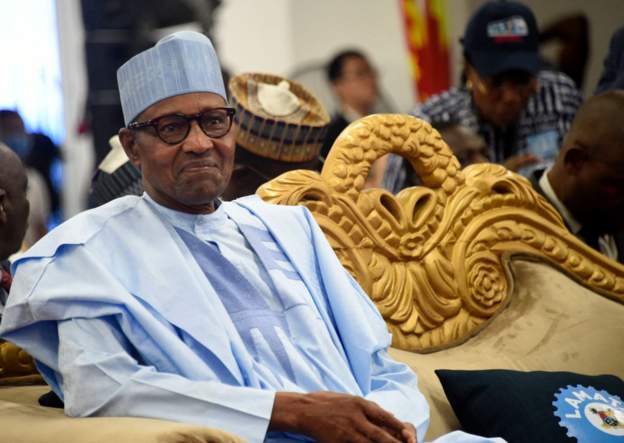
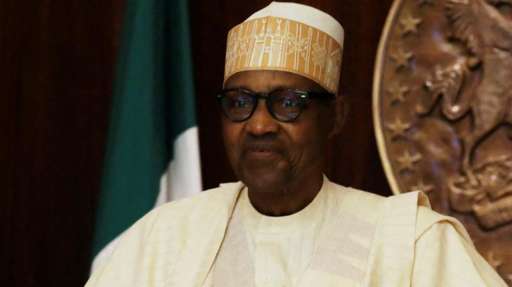
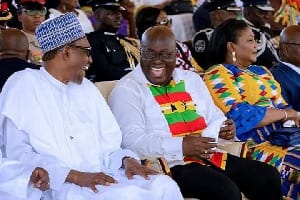
President Nana Addo Dankwa Akufo-Addo has been criticized by Nigerians for praising his Nigerian Counterpart, Muhammadu Buhari on Friday, May 19, 2023.
The Ghanaian President while delivering a speech as the guest of honour to launch two biographies of Buhari noted that Africa and the world at large will miss his leadership.
He further said posterity will be kind to Muhammadu Buhari.
“As leaders, we all have our high and low moments, but I have no doubt that posterity will be kind to Muhammadu Buhari,” President Akufo-Addo said.
“President Buhari, we will miss you. West Africa, Africa, and indeed, the world will miss your leadership. The leadership of a military ruler turned consummate democrat who was extremely solicitous of Nigeria’s and Africa’s interests and who sought principles in all decisions which he took,” he added.
These words did not sit well with some Nigerians as they have taken to the micro-blogging site – Twitter – to pour scorn on President Nana Addo Dankwa Akufo-Addo’s comments.
While some stated categorically that they will not miss Buhari as he exits office as President of Nigeria, others, described Ghana’s President as a hypocrite.
A user by the name Ambassador of Hope said, “Thunda faya Nana. Is this how you led your country Ghana?”
“This Ghana man get something wey dey worry am! I thought he was good,” A tweep called I STAND FOR TRUTH wrote.
“Ghana can have him. We won’t miss him a second.”
Another tweep named Royalty Stevens said, “He must be a hypocrite. In Ghana there is stable power supply, in Nigeria Buhari and his men stole all the energy budgets. If life must be kind to Buhari then no one deserves an unkind life.
President Nana Addo Dankwa Akufo-Addo hs eulogized his Nigerian counterpart Muhammadu Buhari who exists office in a little over a week.
Akufo-Addo was a guest of honour at the May 19, 2023 launch of two biographies by the former military ruler turned elected democratic president of Africa’s most populous nation.
In comments made at the launch, local media captured Akufo-Addo as saying: “As leaders, we all have our high and low moments, but I have no doubt that posterity will be kind to Muhammadu Buhari,” Akufo-Addo said.
“President Buhari, we will miss you. West Africa, Africa, and indeed, the world will miss your leadership. The leadership of a military ruler turned consummate democrat who was extremely solicitous of Nigeria’s and Africa’s interests and who sought principles in all decisions which he took.
“I’m yet to have a book written about me, let alone author one myself. I have some 19 months to leave office, and I guess I have to take a cue from my senior and hope the books will give about me.”
The two books about Buhari
The books are titled: “State of Repair: How Muhammadu Buhari tried to transform Nigeria for the better” and “The Legacy of Muhammadu Buhari.”
They were authored by Anthony Goldman, a former journalist and ex-Africa editor of the Financial Times of London; and Abu Ibrahim, former federal lawmaker from his native Katsina State respetively.
In Daura on Saturday, President Muhammadu Buhari advised Nigerians to accept the bribes offered by politicians rather than succumbing to them and cast their ballots in accordance with their moral convictions.
The Patagonia Desert- A 4k Aerial Film of Argentina
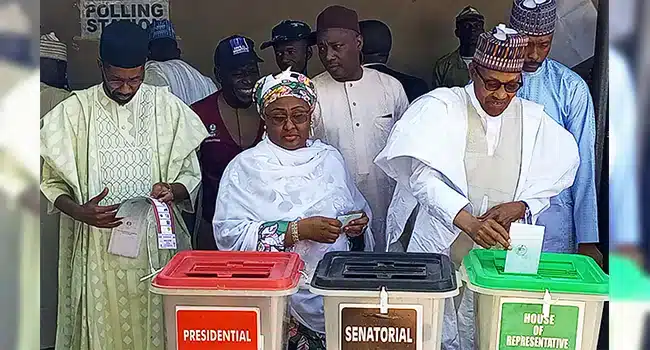
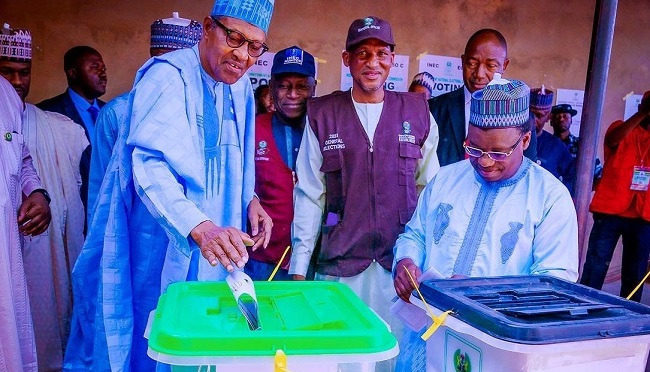
The President made this known in a chat with journalists after casting his vote at Ward A, Sarkin Yara Polling Unit, 003 in Daura, Katsina State.
He also said the new naira policy has ensured a shortage of naira notes that would have been used by unscrupulous elements to influence the outcome of the elections in their favour.
“I am aware that the money is not there like before for people to sway voters like they used to do.
“And if they bring out money now, the people should pocket it, and still vote their conscience,” he said.
Senior Special Assistant to the President on Media and Publicity, Garba Shehu, disclosed this in a statement he signed on Saturday titled ‘Nigerians know we mean what we say, they will vote for us again, says President Buhari.’
According to Buhari, the electorate should follow their conscience in choosing the right leaders, both state executives and legislatures.
He affirmed that his regime had “diminished” the era of vote buying.
The President also commended the role of the media in empowering people with information on their rights and providing a platform for voters to challenge leaders on promises and records, therefore, deepening democratic culture and awareness among Nigerians.read moreTribune Online5hLagosDecides2023: APC’s Sanwo-Olu votes, kicksagainst voters intimidationRedeem your image by conducting credible governorship- election- —TMG- to- INEC-Share Story FacebookLinkedInTwitterTelegramWhatsAppCopyAboutLogin
“The media is doing very well in creating awareness and enabling the right conversation. You can hear the tough questions for leaders during interviews on TV, radio and other platforms, and the journalists always press for answers,” the President noted.
On the outcomes of the Governorship and State of Assembly elections, he expressed confidence that they will favour the All Progressives Congress (APC) across the country as Nigerians know the party “means what it says, and says what it means.”
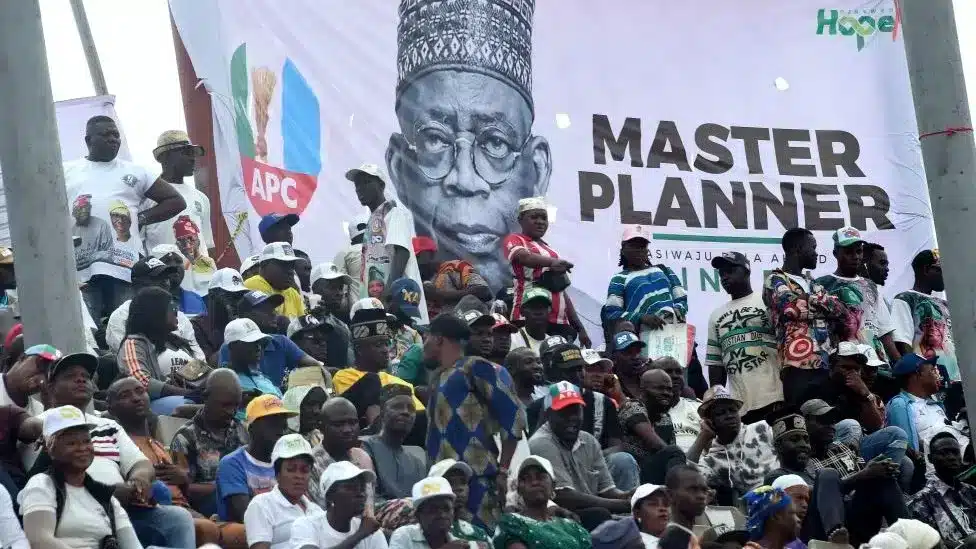
The President noted that he was not surprised at the results of the Presidential elections on February 25, 2023, which saw Asiwaju Bola Ahmed Tinubu emerging as President-elect, since the APC campaigns were thorough and detailed.
“I am sure we are going to win, again,” he said.
Buhari urged the electorate to follow their conscience in choosing the right leaders, both state executives and legislatures, admonishing that the era of vote buying had been diminished.
“I am aware that the money is not there like before for people to sway voters like they used to do. And if they bring out money now, the people should pocket it, and still vote their conscience,” he said.
The President noted that the APC followed the constitutional procedure for the entire electoral process, choosing a party Chairman, Sen. Abdullahi Adamu, who had served as a two-term Governor in Nasarawa State, and legislator in the Senate, with experience that will secure the electoral value and relevance of the party.
“Nigerians trust us because we mean what we say and say what we mean. We have maintained that trust. We told Nigerians that we will work for them, and we have done our best in education and health facilities, and Nigerians appreciate our efforts,’’ he said.
Buhari’s family members and aides also voted at the ward.
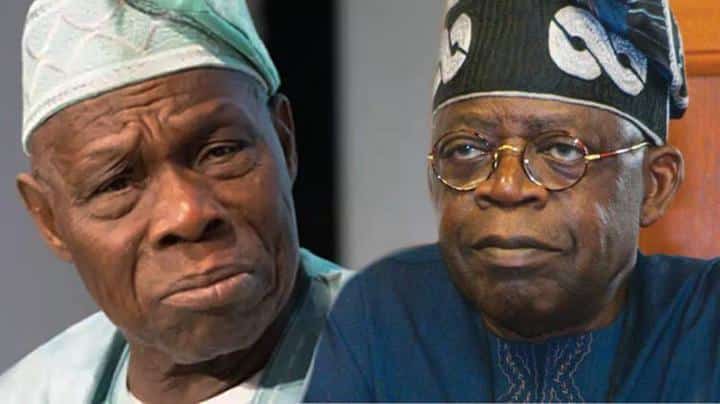
Bola Ahmed Tinubu, the All Progressives Congress (APC) candidate, has slammed former president Olusegun Obasanjo over his call for cancellation of some results of Saturday’s presidential election on the grounds of fraud.
In an open letter on Monday, Obasanjo had called on President Muhammadu Buhari to prevail on the Independent National Electoral Commission (INEC) to cancel results that fail to “pass the credibility and transparency test” and schedule a fresh election for March 4, 2023.
The former president warned that failure by President Buhari and the INEC Chairman, Mahmood Yakubu, to act may pose serious danger for the country as tensions are already building up.
But responding through a spokesperson of his campaign organization, Dele Alake, Tinubu described Obasanjo’s request as “reckless” while further accusing him of seeking to “endanger and derail our democratic process for utterly selfish, egoistic and malicious reasons.”
Part of Tinubu’s response reads: “Obasanjo repeated without the slightest iota of evidence rumours he had picked up that the Bimodal Voters Accreditation System had been compromised and that the results of elections being announced are fraudulent. It is tragic that a former President who ought to be a statesman in comportment and speech will recklessly seek to endanger and derail our democratic process for utterly selfish, egoistic and malicious reasons. He offers not a single credible piece of evidence to prove his laughable and ridiculous allegations against INEC and the credibility of the ongoing process.
“Of course, we are all aware that Obasanjo is not an impartial and disinterested party as far as this election is concerned. On January 1, 2023, he had issued a characteristically lengthy epistle to Nigerians endorsing the candidacy of Mr Peter Obi and asking Nigerian youths to vote en masse for him. Of course our reaction was that the former President was entitled to his view and that the outcome of the elections would demonstrate if he had any electoral value. As fate would have it, Peter Obi was defeated even in Obasanjo’s own polling unit in Abeokuta in Ogun State. But it is now obvious that the only election Obasanjo will agree to being free, fair and credible is one that produces Obi as winner which is ridiculous.
“Is Obasanjo also querying the outcome of the presidential elections in Lagos or Delta where Obi won? If the outcome in Lagos won by Obi is free and credible, on what basis is he querying the outcome of the elections in other places? This is pure mischief and sheer hypocrisy. Obasanjo wants President Muhammadu Buhari to intervene in an undemocratic manner to truncate the ongoing political process just the way he did most shamelessly in the 2003 and 2007 elections widely described as the worst in our political history. Luckily, President Buhari is made of finer and more principled democratic stuff. He will not allow Obasanjo to lure him into tainting his democratic credentials in this regard. We recall that in his last trip to the United States, President Joe Biden praised Buhari ‘s commitment to democratic values and principles. Obasanjo has no such record to be applauded. The world has not forgotten his fraudulent and undemocratic attempt at a third term agenda in violation of the letter and spirit of the Nigerian constitution.
“This is an election in which ASIWAJU Tinubu, for instance, has lost in Lagos state in his South West region while Atiku and Obi have also won elections outside their own regional bases. No true democrat must seek an abortion of the process just because he believes the elections are not going his way. What Obasanjo is subtly calling for in his nefarious statement is a coup against democracy and the constitution. He should be roundly condemned and severely ignored. The constitution has stipulated processes for seeking redress against electoral malpractices in the past and these have been tested several times and used to redress electoral injustice where such has been proven. Nigerians must reject Obasanjo’s dubious and hypocritical advice and stay strictly and firmly on the path of constitutionalism and democratic due process.
President Muhammadu Buhari has taken his turn to cast his ballot in the ongoing presidential election.
The outgoing President did so in his hometown of Daura, Katsina State. He voted alongside his wife, Aisha.
The President, whose two-term tenure of eight years ends on May 29, 2023, is a member of the All Progressives Congress (APC) and a campaigner for his party’s flag bearer, Bola Tinubu.
Addressing reporters, the President urged Nigerians to vote for the candidate of their choice, adding that nobody has more than one vote.
Nationwide, officials of the country’s electoral agency, the Independent National Electoral Commission (INEC) have arrived at some of the 176,606 polling units scattered across the 36 states and the Federal Capital Territory that make up Nigeria.
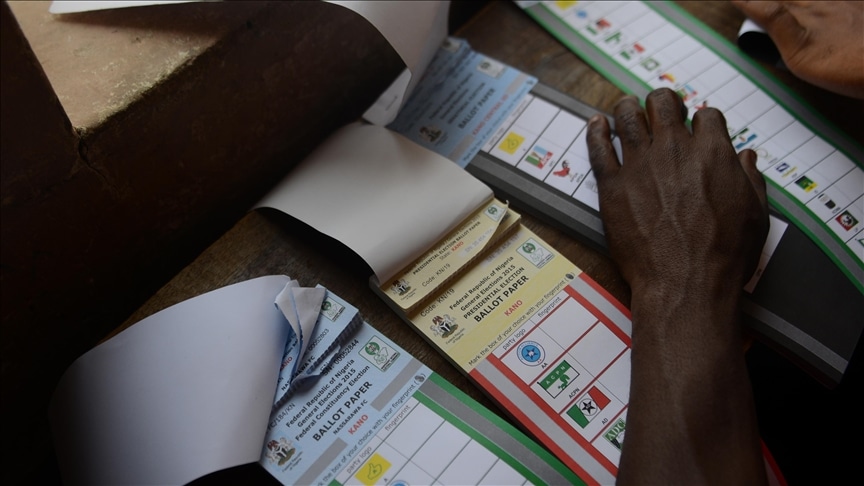
Accreditation and voting commenced around 08:30 am in some polling units in parts of Nigeria as the 87.2 million voters with Permanent Voter Cards go to the polls to elect a new president and members of the country’s National Assembly.
Nigerians will go the polls on Saturday, February 25, 2023, to elect a President to man the affairs of the state.
The elections which will come off nationwide will be keenly contested by three staunch politicians in the country. Whoever will win this bid, will replace Muhammadu Buhari.
While voting to elect a new President, it will be important for voters to also take care of their well-being. In line with this, The Independent Ghana has outlined a number of ‘dos’ and ‘don’ts’ needed to stay safe during the election period.
Here are some tips:
1. Confirm polling units before election day
Voters should physically visit their polling stations before the polls open to avoid getting lost on election day. As an alternative, the Independent Electoral Commission has made a polling unit locator available on its website at https://punchng.com/how-to-confirm-polling-unit-location-via-inec-portal/, which offers approximate location information for every polling unit nationwide.
It’s vital to remember that moving vehicles are not allowed on election day. If a voter’s home is distant from their polling station, they are recommended to find a convenient place to stay.
2. Avoid wearing political merchandise to polling booths
Voters should safeguard themselves by not publicly announcing the people or parties they plan to support at polling places because Nigeria has a secret ballot system.
Going to polling places in normal clothes is the best option to prevent needless conflict with political thugs and miscreants.
Branded items must to be hidden as well.
3. Report unusual activities:
Reporting any odd activity to the right authorities is another crucial safety measure that voters can implement during the voting process.
The Nigerian Army has set up emergency lines for voters to use in order to report any suspicious activities occurring during the voting process. https://punchng.com/elections-army-unveils-hotlines-to-report-criminal-activities/.
Voters shouldn’t go up against people who are violent. They should first look for safety, then get in touch with security personnel as quickly as they can.
4. Avoid bringing children to the polling units:
Because of the high stakes involved, it is critical to keep children safe during the elections.
Children should not be brought to polling units in case violence breaks out. Instead, families should make adequate babysitting arrangements ahead of election day.
5. Avoid political arguments at polling booths:
Voters should go to polling units with one goal in mind: to cast their ballots and ensure that they are properly counted.
As campaign activities have been halted, it is inappropriate to engage in political discussions that could escalate into arguments or violence at polling units.
Voters in Africa’s most populous country, Nigeria, will head to the polls this week to select their next president amid mounting unhappiness in the country due to worsening insecurity and economic hardship. Will any of the frontrunners, most of whom have been in the political system for decades, be able to turn the country around?
Nigeria’s outgoing President Muhammadu Buhari is stepping down after nearly eight years in power amid a backdrop of chaos and widespread unrest, as many people are unable to access the cash they need to buy food because of a botched roll-out of new banknotes.
But the cash crisis is not the only problem Nigerians face, with the last year being marked by struggle and tragedy, including high inflation and deadly attacks by gunmen against innocent civilians.
Mr Buhari’s supporters say he has done his best and highlight achievements, such as his work on infrastructure projects and attempts to combat violent extremism. But even his own wife, Aisha Buhari, has apologised to the Nigerian people for falling short of their expectations.
So whoever wins the election will not have an easy job.
Who is running for president?
A total of 18 candidates are campaigning for the top job, but only three have a realistic chance of winning, according to opinion polls. Only one of the 18 is a woman.
Bola Ahmed Tinubu, 70, is standing for the governing All Progressives Congress (APC) party. Known as a political godfather in the south-west region, he wields huge influence but has been dogged by allegations of corruption over the years and poor health, both of which he denies. Some say his campaign slogan Emi Lokan, which means “it’s my turn [to be president]” in the Yoruba language, shows a sense of entitlement.
Atiku Abubakar, 76, is running on behalf of the main opposition People’s Democratic Party (PDP). He has run for the presidency five times before – all of which he has lost. Most of his career has been in the corridors of power, having worked as a top civil servant, vice-president under Olusegun Obasanjo and a prominent businessman. Just like Mr Tinubu, he has been accused of corruption and cronyism, which he denies.
Peter Obi, 61, is hoping to break up the two-party system which has dominated Nigeria since the end of military rule in 1999 and is running for the little known Labour Party. Although he was in the PDP until last year, he is seen as a relatively fresh face and enjoys fervent support on social media and among Nigeria’s youth. The wealthy businessman served as governor of the south-eastern Anambra State from 2006 to 2014. His backers, known as the “OBIdients” say he is the only candidate with integrity, but his critics argue that a vote for Obi is wasted as he is unlikely to win.
Who is likely to win?
Convention suggests a candidate from one of the two main parties will win – Mr Atiku or Mr Tinubu. But Mr Obi’s supporters are hoping he can spring a surprise if they can mobilise the large youth vote to back him.
When is the election?
It is due to take place on Saturday 25 February 2023. If there is no clear winner, a second round will be held within three weeks. There will also be elections for the country’s powerful state governors on Saturday 11 March.
The head of the election commission has dismissed suggestions that the vote could be delayed because of insecurity.
When will the election results be announced?
In the last two presidential elections the winner has been known on the third day after voting.
But votes will be counted as soon as voting ends on Saturday 25 February. Those who stay behind at their polling station will have the result announced to them, but it is a long process before all the results work their way up to Abuja from the tens of thousands of polling units across the country.
BVAS might speed up the process this year, but Inec-appointed officials will still have to travel to Abuja from the 36 states with hard copies to be read aloud.
Only then will the Inec chairman announce a winner – or that a second round is needed.
How does the election work?
In order to win, a candidate has to obtain the highest number of votes nationwide, and more than a quarter of ballots cast in at least two-thirds of Nigeria’s states.
If none of the candidates manage this, there will be a second round run-off between the top two candidates within 21 days.
What are the main issues?
Reducing insecurity is one of the key concerns of voters, in a country which is currently experiencing a kidnapping-for-ransom crisis, battling militant Islamists groups in parts of the north and a separatist insurgency in the south-east.
Two of the most shocking cases last year were a mass shooting at a Catholic Church in Owo and the storming by gunmen of a passenger train in which dozens of people were killed or kidnapped.
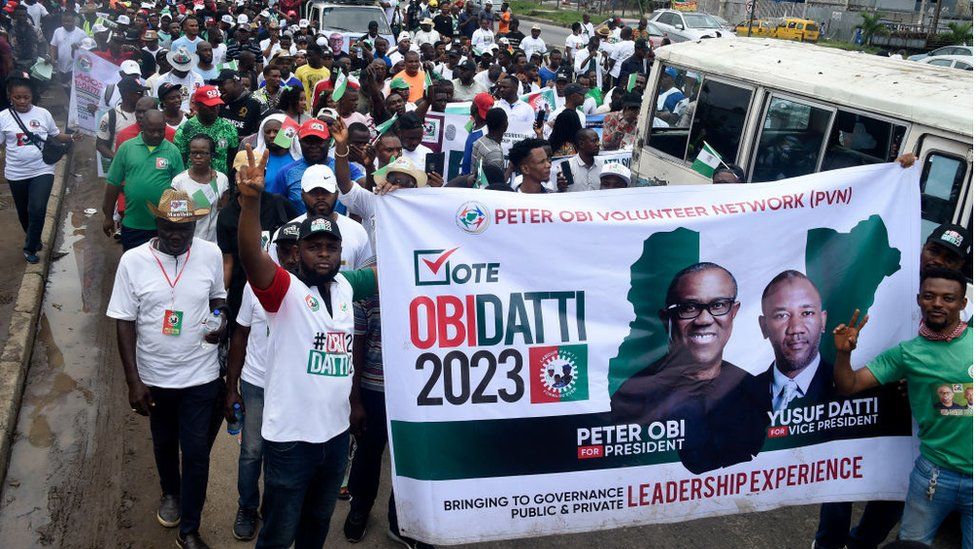
Image caption, Peter Obi’s supporters, who appear to be younger Nigerians, are vocal on social media
President Buhari says he has fulfilled his promise to “frontally and courageously tackle terrorism”, but many Nigerians feel the country is still not safe.
The economy is another area of concern. Inflation now stands at 21.8%, according to the latest figures released this month. This rising cost of living has left many families struggling to make ends meet, with local media describing the situation as “dire”.
Unemployment is also a major problem, leaving many graduates fearful that they may not find work even after years of university study, which has prompted many to try and leave the country. Latest figures from the country’s National Bureau of Statistics show that 33% of the population is unemployed – jumping to 42.5% for younger adults.
Despite being a major oil producer, four out of 10 Nigerians live below the poverty line and “lack education and access to basic infrastructure, such as electricity, safe drinking water, and improved sanitation,” according to the World Bank.
Many of the candidates have put these issues at the centre of their campaigns.
But these problems have been mounting for several years, leaving some Nigerians sceptical about whether whoever wins the election will actually be able to fix them. Despite the large number of registered voters – 93.5 million – concerns persist about apathy and how many people will actually show up on the day to cast their ballot.
With almost 40% of registered voters under 34, the vote has been called the “election of young people” by elections chief Mahmood Yakubu.
PresidentMuhammadu Buhari has asked his United Arab Emirates (UAE) counterpart, Sheikh Mohamed bin Zayed Al Nahyan, to lift a visa ban his nation imposed on Nigerians.
“Nigeria and the UAE have enjoyed excellent and beneficial relations for many years, including at the highest political levels. We can and must continue to iron out whatever issues arise between us”, Mr Buhari tweeted.
Nigeria and the UAE have been embroiled in several diplomatic disputes with the UAE imposing a visa ban on Nigerians, and suspending its national carrier, Emirates Airlines, from operating in Nigeria since October 2022.
President Buhari assured the UAE that judicial sanctions will be imposed on Nigerians found to have committed criminal acts in the UAE.
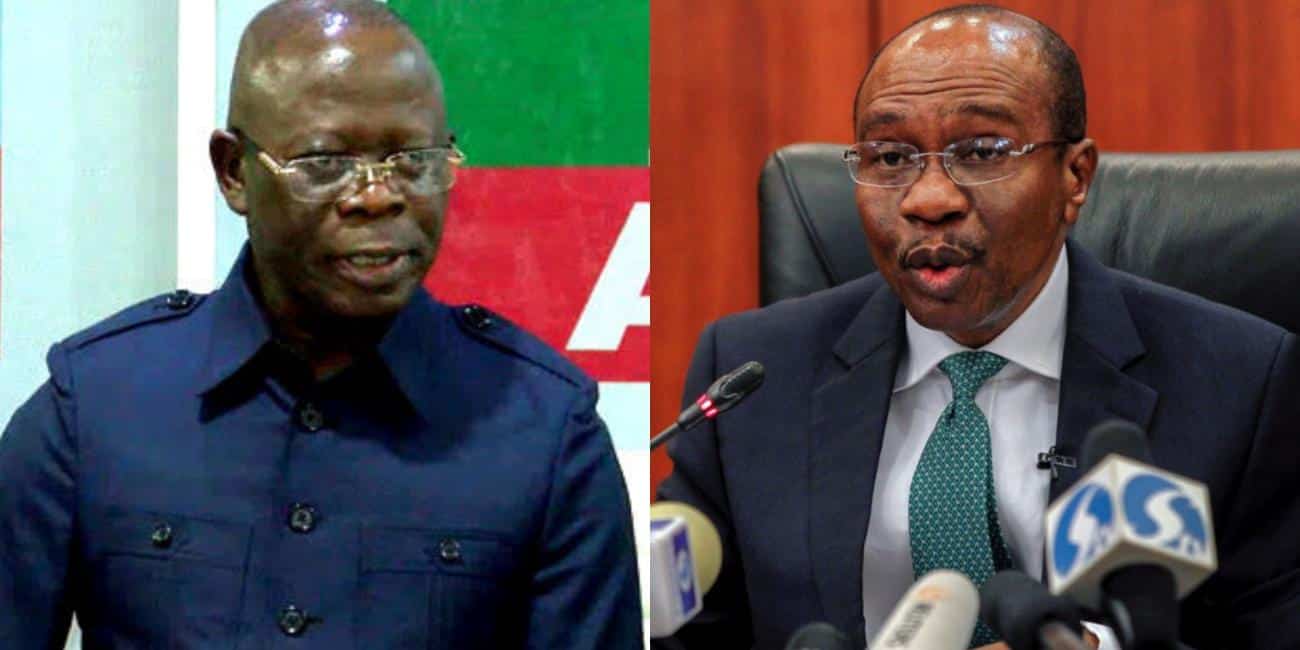
The former National Chairman of Nigeria’s ruling All Progressives Congress (APC), Comrade Adams Oshiomhole has faulted the cashless policy of the Central Bank of Nigeria (CBN), insisting that the nation’s apex bank cannot govern the country by decree.
He described the policy as senseless, adding that he believes the apex bank led by Godwin Emefiele deceived President Muhammadu Buhari into agreeing to support it.
The former governor of Edo State and one-time president of the Nigerian Labour Congress (NLC) described the current economic crisis the CBN policy had brought as unacceptable.
He said during an interview with Channels TV on Sunday evening.
Oshiomhole, who was reacting to the scarcity of new naira notes of N200, N500 and N1000 and attendant consequences, noted that there are 18 local government areas in Edo State, yet there is only one local government with banks.
He added that even in the most industrialised part of the state where there are two giant cement factories, there is no bank there.
He said he believed the CBN told the President that redesigning naira notes would curb vote-buying and reduce corruption.
“So, I can guess, I was not there, that in obtaining the approval, I believe the CBN deceived the President by amplifying the need to have corruption-free electioneering as if election is the only project this President has a responsibility for.”
He added that the President Buhari he knows “will have no difficulty in agreeing”.
Accusing the CBN management of having an ulterior motive, Oshiomhole said, “You could see that the intention of the bank is not to eliminate abuses but to stop the elections from taking place.”
He described a situation where Nigerians will be forced to pay 20 percent of their legitimately earned money to Point of Sale operators to get their money to feed themselves and their family as gravely painful.
“We have 18 local governments in Edo and yet we have only one local government with banks. And so even in the most industrialised part of Edo State where you have two giant cement factories, there’s no bank there. And so it is painful to me and I am shocked because you know you and I sit in the city.
“We pontificate about election etc…. a motor mechanic tells me in the cause of my campaign that POS operator in his neighborhood, he says that he should pay 20 percent, so when he wants to withdraw N5000 he has to part with N1000. Nigeria is not exactly a banana republic.
“I am shocked that CBN could pursue this senseless policy and let me be clear when I said senseless – it is not about the idea of changing currency. This Governor has broken no new grounds because we have changed currencies before, and I daresay check the records when General Muhammadu Buhari changed colours of naira when he did in his first coming as military head of state.
“He did not forbid the banks from paying people in new notes. He did not impose restrictions as to how much you can withdraw provided it is your lawful money. To assume that every Nigerian is corrupt; that the motor mechanic is corrupt and this policy is meant to check corruption. The CBN is not part of institutions charged with the responsibility of ensuring free, fair and credible elections.
“That is not in the Act establishing CBN. So, when I heard argument that seems to criminalise and in a sense blackmail the political elite as though they are responsible. In fact, I got angry and I said if corruption is at the heart of CBN challenge, how do they explain that you Seun, because you are one of the most popular TV programme, and so you were to import a camera, you can get a dollar at N440 to the dollar; and your cameraman who knows nobody, he wants to pay for his child’s school fees, he has to go to Wuse market to buy the same dollar at N740. If that is not corruption, what is it?
“So I think what Nasir El-Rufai was saying is that – if you have pockets of riots and protests and because our armed forces whether the police, obviously the army is not trained for that to manage discontent, mass uprising you may end up with a situation where you were unable to conduct election. So, it is not only APC that will lose, everybody will lose.
“Do you notice that even Atiku Abubakar, the presidential candidate of PDP appealed for extension? Citizens shouldn’t beg the government to extend the value of their legitimately earned money because in a democracy, don’t forget that what distinguishes democracy from dictatorship is popular participation, a sense of ownership of public policy. And so it is not enough, we can’t be governed by decrees.
“If the president cannot govern by decree, nobody in Nigeria should govern by decree. We must be governed by our constitution, we have parliament.”
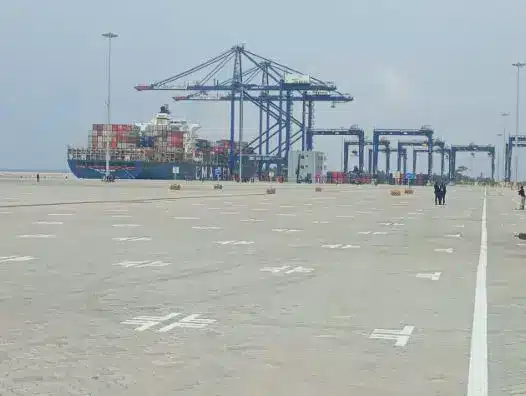
Nigeria’s President Muhammadu Buhari has officially opened a new port near Lagos which could have an economic impact across West Africa.
The vast $1.5bn-Lekki Deep Sea Port, which took six years to complete, will serve as a gateway for cargo vessels in the region.
Lagos state Governor Babajide Sanwo-Olu said the new facility will create about 200,000 jobs both directly and indirectly and generate billions of dollars in revenue for the country.
The port is expected to reduce the high cost of bringing goods into the country by reducing the vessel turnaround time, which has hampered business at the country’s other ports.
Lagos currently relies on old and congested ports whose waters are unable to dock larger vessels and contribute to traffic congestion within the city.
The leader of a new militant group in the Niger Delta region of Nigeria has threatened to unleash hell on the country and make the forthcoming general elections bloody.
The militant group which identified itself as ‘Force of Ekpesu’ in the region threatened that the 2023 general elections will be bloody unless President Muhammadu Buhari and governors of the Niger Delta states meet them for negotiation, which the armed militant group described as doing the needful for the well-being of the oil-rich region of the country.
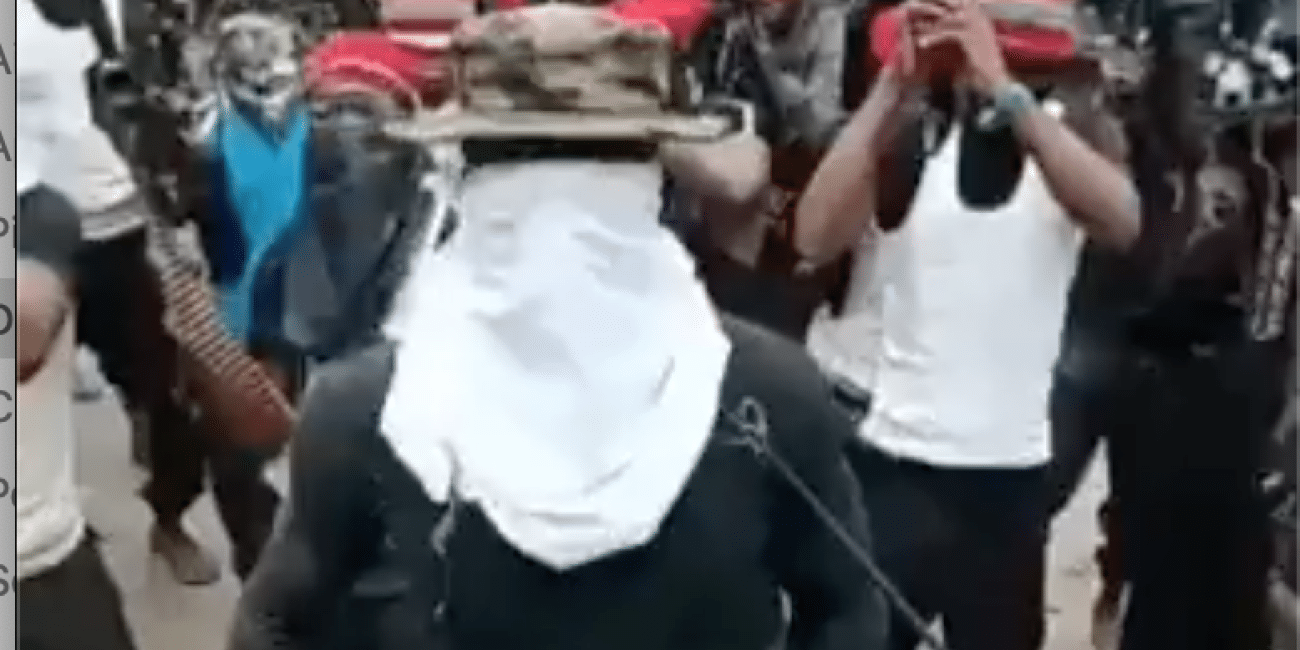
The armed group issued the threat in video footage posted by @GoldmyneTV, showing over 20 militants with various offensive guns and masked faces at a riverside with operational boats.
Speaking on behalf of the group, the leader who did not disclose his identity said, “This video that I’m doing Mr. President, listen to me and listen very good. Also, you governors that are in Niger Delta. I’m the Force of Ekpesu.
“I’m doing this video for Bayelsa State and also the President. This coming up election, if the governor and the President don’t know what to do, I am the Force of Ekpesu, look at my war boats and these are my fighters. I’m getting myself ready all the 24 hours.
“I’m coming for you people for the elections. If you don’t know what to do. And President, if you know what to do, come to me. Also, governor, come to me or else there will be no election for the Basan clan.
“President, governors and senators, listen to me, this coming election, there will be bloody elections in the Basan clan, Southern Ijaw Local Government. You know what to do.”
After it was revealed that American rapper Meek Mill had gotten entry to the Jubilee House, had the privilege of seeing the president, and also had the opportunity to make some of a music video, Nigerians on Twitter had a field day making fun of Ghanaians.
“Ghana had to go so low just to sell Ghana. Given Meek Mill a pass to shoot a music video in their presidential house “Jubilee”. Thats some disrespect man. Meek Mill can’t try that in the White House. E nor fit try am for Aso Rock if he eventually visit naija,” a tweep with the handle @Olise_Emmanuel posted.
Aso Rock is the equivalent of Jubilee House, it is Nigeria’s presidential villa as they call it and most Nigerians are without a shred of doubt that Meek Mill will be lucky to be allowed in the Villa in the first place.
This is the latest installment in the Ghana versus Nigeria social media banter which in recent times is rooted on which country has the best jollof rice.
Ghana going back to the International Monetary Fund (IMF) and Twitter choosing to open its offices in Ghana are some other incidents that have triggered banter on especially Twitter.
Meek Mill vs. Ghana social media: What happened?
Meek Mill, Jubilee House and White House have been in Ghana’s Twitter trends since January 8, 2022 when the musician released a promo for his new video.
The video was taken when he met with President Nana Addo Dankwa Akufo-Addo at the Jubilee House late last year when he came to town for a musical concert.
Social media users were incensed about what they describe as near desecration of the presidency, citing moral and security grounds.
Meek Mill is sighted in different places at the presidency, from the frontage, through the main corridors, in the main conference hall – at a point positioned behind the presidential lectern – and later in a sitting area, rapping.
Meek Mill has since the outrage on social media deleted the controversial video and also rendered an unqualified apology to Ghanaians and to the presidency for the brouhaha he had caused.
President of Nigeria, Muhammadu Buhari, might not be viewed as a failure, but the toll banditry and terrorism have taken on his security services may mark the end of his two terms as Nigeria’s civilian leader.
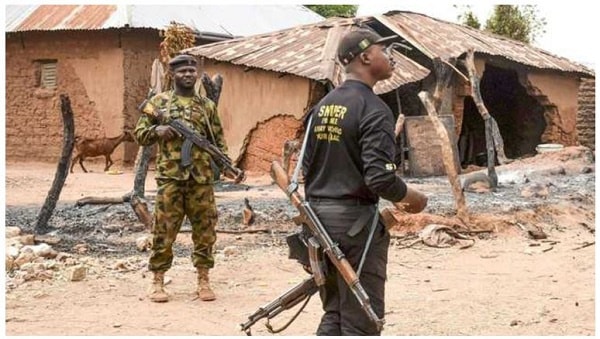
Hardly a week passes before the forces declare killings of bandits or terrorists. But the terror gangs also, occasionally take a toll on the forces and civilians.
In one recent attack, the bandits saw 83 civilians killed, most of them women and children and according to a statement from the Nigerian military, the bandits had used the civilians as human shields in a battle with forces.
The surge in banditry has forced the military to deploy aerial firepower in some cases to tackle the menace in the 12 states in North Central and North West Nigeria.
Caught in crossfire
But the 83 killed on Tuesday, December 20, 2022, in Mutunji in Maru Local Government Area of North West Zamfara States shows the dangers of it. The Nigerian Air Force (NAF) jets dropped bombs that killed 215 persons, most of them bandits in their hideouts.
It was indiscriminate.
Bandits who were fleeing from NAF airstrikes ran into a small village called Mutunji to take refuge but were hit by bombs, a military dispatch indicated. “
Mr. Zailani Bappa, the Special Adviser on Public Enlightenment, Media, and Communications to Governor Bello Matawalle of Zamfara, delivered condolences and heartfelt sympathy to the families of victims caught in military crossfire against the bandits.
The incident, one of the worst so far, is an indication that the military is becoming more desperate in its offensive against bandits that have been legally declared terrorists, Mr. Agboola Olayinka, a security expert, told The EastAfrican in Abuja on Tuesday.
Nigeria had been battling whether to classify bandits as terrorists or just as criminals keen on kidnapping for ransom. Recently, officials decided to categorize bandits as terrorists which would allow security forces to consider their threats as dangerous and use weapons that would otherwise draw criticism.
Besides atrocities, bandits have seized some remote communities in the 12 states of North West and North Central, imposed illegal levies and taxes on people as well as destroyed social infrastructure especially schools, telecom, and electricity facilities.
In Kwata, a small farming settlement in Zurmi local government area of Zamfara state and Shirroro in Niger state bandits invaded, forcing peasant farmers to abandon their homes and farmlands.
The bandits, as known as terrorists like Boko Haram, kill, maim, kidnap, and rape women in the troubled states of Zamfara, Sokoto, Kebbi, Katsina, Kaduna, Niger, Kaduna, Kogi, Benue, Jigawa, Plateau, and part of FCT.
Governors worried
Banditry is, however, older than Buhari’s administration. It started as a farmers-versus-herders crisis in 2011 and was initially considered to be a passing cloud. But it has ballooned into full-blown terrorism displacing over 2.1 million people.
In Zamfara state, for instance, about 69,000 Internally Displaced Persons, Kaduna 71,000, Katsina 61,000, and Sokoto 45,000, while at least 3,000 have crossed the borders through the axis of Maradi to take refuge in Niger and Chad Republics.
One of the farmers in Shiroro, Mr. Tarka Mohamed, said the bandits demanded farmers pay N1.2 million ($2,500) to allow them to access and cultivate farmlands.
Mr. Usman Kelly, another farmer in Zamfara, who said many farmers have fled their stead, said they were forced to pay levies, yet the bandits prevent them from entering their farms.
The Nigerian Red Cross Society has confirmed the fear of imminent food insecurity in the North West and North Central saying: “The situation is critical and is one that needs immediate attention.”
Buhari, expected to leave his post in 2023, had said he wants forces to eliminate the banditry problem before the end of 2022, a missed deadline.
“The military is now strong, well-fortified, and impregnable. If anyone or group dares to test our will now, they may not live to regret it,” argued Nigerian Interior Minister, Rauf Aregbesola, in Abuja.
But governors of the affected states are frustrated the problem is increasing.
Governor Abubakar Sani Bello of Niger state expressed his helplessness over the incessant invasion of bandits from various communities. In his state, some 50 villages are now occupied by bandits.
Ibrahim Dan-Musa, the spokesperson of the northern youth lobby Northern Ethnic Group Assembly, NEYGA, says the police are poorly funded and poorly motivated, and the military, which is fighting a decade-long insurgency in the North East, appears to be at the end of its wits on how to curtail the spiraling insecurity.
The war on banditry may be helped, however. Original terror groups Boko Haram and ISIS in West Africa are in a deadly battle of supremacy which has seen fighters kill one another in a bid to carve out an Islamic state.
Nigeria’s President Muhammadu Buhari has signed into law a budget of more than $45 billion (£37 billion) for 2023.
It is his administration’s final budget.
According to the budget, the government intends to sell some public assets in order to reduce the massive deficit, which amounts to just less than 5% of GDP.
Along with the main budget, there is an additional budget to deal with the aftermath of the recent nationwide floods, which damaged critical infrastructure.
A large portion of the budget is funded by the earnings from crude oil, but volatility in the oil price has meant that borrowing has increased and forced the government to look for other ways to raise funds.
Mr Buhari’s two terms in office will come to an end after voters elect hissuccessornext month.
A Nigerian university studentarrested and detained for more than two weeks after he allegedly defamed President Muhammadu Buhari’s wife on Twitter has apologised to the first lady.
Aminu Adamu Mohammed was released on Friday after authorities dropped the charges on ”compassionate grounds.”.
Mr Mohammed denied spreading ”false” information during a court appearance.
He denied defaming Aisha Buhari in a tweet suggesting she had misused public money to her satisfaction.
But in a series of tweets and video messages over the weekend, the 24-year-old undergraduate apologised to Mrs Buhari for the initial tweet.
”It was never my intention to hurt your feelings” he said, promising to ”change for the better.”
Mr Mohammed also thanked Mrs Buhari for forgiving him, describing her as ”our mother.”
He described his experience as ”the darkest hours of my life.”
Amnesty International said Aminu Adamu Mohammed was subjected to “torture” after his arrest
He did not give details but he expressed his ”heartfelt gratitude” to those who showed him support saying his case should serve as a ”lesson to all of us”.
His apology to Mrs Buhari has sparked controversy on social media in Nigeria with many users saying the first lady should apologise to him instead because of the way he was treated.
But there are some who say his apology was right in order to resolve the dispute.
The arrest and the subsequent charge against the student had sparked outrage in Nigeria with many social media users and rights campaigners calling for his immediate release.
On Thursday, Amnesty International said Mr Mohammed was subjected to “torture” and other forms of “ill-treatment” after his arrest, calling it a “deeply repressive act” that “brazenly violates his human rights”. Nigerian authorities have not yet commented on these allegations.
Mr Mohammed is studying environmental management at the Federal University in Dutse, in the northern state of Jigawa, and is due to start his final exams on Monday.
Nigerian President Muhammadu Buhari has said that the Russia-Ukraine conflict and the Sahel insurgency have caused a proliferation of arms in the Lake Chad Basin countries.
He said weapons being used in Ukraine and Russia were “beginning to filter to the region” and arms used in the Libya war “continues to find [their] way” there.
He said this was a major threat to the security of the regional countries of Cameroon, Chad, Niger and Nigeria,
“Regrettably, the situation in the Sahel and the raging war in Ukraine serve as major sources of weapons and fighters that bolster the ranks of the terrorists in the region,” he said at the summit for the Lake Chad region in the Nigerian capital, Abuja.
Mr Buhari said the countries in the region must improve border security to stop arms trafficking, noting that the region faced a complex and dynamic security situation.
He said this was “increasingly influenced by the impact of climate change and other variables, including sadly, some external factors”.
The summit – attended by presidents of Benin, Chad, Niger, Central African Republic, and representatives of the Cameroon and Libya – approved further joint army operations against Boko Haram and Islamic State group militants active in the region.
Three months prior to the presidential and parliamentary elections in Nigeria, the Nigerian Electoral Commission (INEC) reported that one of its offices was burnt down on Sunday, Novemeber 27, in the state of Ebonyi in the southeast.
On 25 February, Nigerians will elect a successor to President Muhammadu Buhari, who is not standing for re-election after two terms in office and a record that has been deemed catastrophic both economically and in terms of security, two major issues in the election.
INEC recently warned of the threat of escalating violence during the election campaign, adding that it had recorded at least 50 attacks since the exercise began nearly two months ago.
Although no group has claimed responsibility for Sunday’s attack, southeast Nigeria has seen a large number of attacks attributed to the Indigenous Peoples’ Movement of Biafra (IPOB).
The IPOB, which is seeking to revive a separate state for the Igbo ethnic group, has repeatedly denied responsibility for the violence.
According to local media, more than 100 police and other security personnel have been killed since the beginning of last year in targeted attacks.
Nigeria has a long history of election-related unrest and malfeasance. In 2011, more than 800 people were killed in post-election violence in the country.
President Muhammadu Buhari has expressed confidence that the ruling All Progressives Congress, APC and its presidential candidate, Asiwaju Bola Tinubu will win the forthcoming 2023 general elections.
Buhari stated this on Wednesday in an interview in the United Kingdom after meeting with His Royal Majesty, King Charles III in Buckingham Palace.
According the President, APC is lucky to have Tinubu as its presidential candidate ahead of the 2023 general elections.
When asked the chances of the APC in the 2023 elections, Buhari said, “What are the chances of my party not winning the election? We are going to win the election.
“Tinubu, the presidential candidate, a very well-known politician in the country, he was a two-term governor in Lagos State, the most resourceful state and the most visited state. So, I think the party was lucky to get him to be the candidate,” he added.
Recall Tinubu contested presidential primary in June alongside Vice President Yemi Osinbajo; Senate President Ahmad Lawan and former Minister of Transportation, Rotimi Amaechi.
More than 2,300 delegates voted in the contest that produced Tinubu, who polled a total of 1,271 votes – over four times the votes scored by his closet rival, Amaechi who had 316 votes.
Osinbajo, Lawan, and Governor Yahaya Bello of Kogi State came behind the duo with 235, 152, and 47 votes respectively.
Tinubu will be contesting the presidency in 2023 alongside frontline contenders including Atiku Abubakar of the Peoples Democratic Party (PDP), Rabiu Kwankwaso of the News Nigeria People’s Party, NNPP and Peter Obi of the Labour Party (LP).
The Nigerian leader said the meeting was initially scheduled to take place in the Rwandan capital, Kigali, during the Commonwealth Heads of Government Meeting in June but it was postponed.
President Buhari has been in London since last week for what his office called a “routine medical check-up”. He is expected back in Nigeria next week.
King Charles will later this month host the first state visit of his reign when he welcomes the South African president to Buckingham Palace.
The visit will take place from 22-24 November.
It will be the first time a South African leader has visited the UK in an official capacity in more than a decade, with the last state visit being in 2010 when Jacob Zuma visited the late Queen.
Amid controversies over the position of the Finance Minister, Mrs Zainab Ahmed, on the decision of the Central Bank of Nigeria, CBN, to embark on the redesigning of Naira notes, President Muhammadu Buharisaid yesterday that the CBN has his support on the project.
Ahmed, at the weekend, declared that the CBN did not carry her Ministry along in the new Naira note plan, warning that the new notes could have dire consequences on the value of the Naira.
But Buhari in a statement by his Senior Special Assistant on Media and Publicity, Mallam Garba Shehu, said he is convinced the nation will gain a lot by doing so.
Speaking in a Hausa radio interview with Halilu Ahmed Getso and Kamaluddeen Sani Shawai, Buhari said reasons given by the CBN convinced him that the economy stands to benefit from a reduction in inflation, currency counterfeiting and the excess cash in circulation.
He said he did not consider the period of three months for the change to the new notes as being short.
According to him, “people with illicit money buried under the soil will have a challenge with this, but, workers, businesses with legitimate incomes will face no difficulties at all.”
Experts call for harmony
Meanwhile, economists and financial experts have harped on the need for harmony between the fiscal and monetary policy authorities while maintaining the independence of the CBN.
David Adonri, Vice-Chairman, Highcap Securities, said that, while it is important for both the CBN and the Finance Ministry to synergise on policy-making in order to achieve a better outcome, the independence of the CBN as obtained in other economies does not require the permission of even the president to undertake a project such as the redesigning of the Naira.
In his words: “The economy is managed by the government through macro-economic policies (fiscal and monetary policies); while the Federal Ministry of Finance (FMoF) is the fiscal authority, CBN is the monetary authority. They are expected to work harmoniously in policy formulation and implementation. Any discord between these authorities is detrimental to economic management.
“Before any policy is formulated by any of them, there ought to be in-depth consultation between them and thorough analyses to know the sensitivity on either side of the economy.
“Although each authority has its areas of exclusivity, which it may exercise without recourse, carrying each other along will facilitate superior policy outcomes.
“In this particular instance, the reasons for changing of currency by CBN are justifiable but there is no reason for not carrying the FMoF along for them to be prepared for the change. Where the monetary authority is independent, which we clamour for, the Central Bank does not even require permission from the President to undertake any monetary action.
“Independence of a central bank is essential so that monetary policy will not be influenced by political expediency.”
Further insight from CBN
The CBN, reacting to the position of the Finance Minister at the weekend, said it was surprised by the minister’s outburst and that due process was followed in arriving at the Naira redesign project, including obtaining the approval of President Muhammadu Buhari.
Also, the apex bank doused concerns about the cost of printing the new notes, saying they will come at no outrageous cost, printed in the country and within the budget of the apex bank.
According to a statement from the CBN’s spokesman, Mr Osita Nwanisobi, the apex bank stressed that the CBN remains a very thorough institution that follows due process in its policy actions.
According to Nwanisobi, the management of the CBN, in line with provisions of Section 2(b), Section 18(a), and Section 19(a)(b) of the CBN Act 2007, had duly sought and obtained the approval of the President, Major General Muhammadu Buhari (retd.) in writing to redesign, produce, release and circulate new series of N200, N500, and N1,000 banknotes.
However, urging Nigerians to support the currency redesign project, he said it is in the overall interest of Nigerians, and that some persons were hoarding significant sums of banknotes outside the vaults of commercial banks. This trend, he said, should not be encouraged by anyone who means well for the country.
Why Naira redesign is necessary — Moghalu
Commenting on the issue, a former Deputy Governor of the CBN, Kingsley Moghalu, said that the decision of the CBN to redesign the naira notes is a ‘necessary step’ for the good of the economy.
Moghalu averred his support for the decision in a series of tweets on his Twitter account on Friday.
He explained that the CBN is trying to gain control over the money supply in the economy.
“I fully support the Central Bank’s redesign of the Naira,” he said. “If 80% of banknotes in circulation are outside the banks, that’s troubling. The CBN obviously wants to force all those notes back into the banking system. Those with the notes must surrender to get new ones or else it becomes illegal tender after January 31 2023.
“This is also a way to withdraw currency from circulation, an unorthodox way of tightening the money supply since the country is battling high inflation.
“The flip side is that people who are holding huge amounts of cash outside the banking system for nefarious reasons will go the parallel forex market to buy hard currency, putting further downward pressure on the value of the Naira as too much Naira will be chasing too few dollars.
“I doubt it will solve inflation because there also are other major reasons for inflation such as the forex crisis, which this new move could exacerbate, as well as impact of the security crisis on food price inflation. But overall it is a necessary step.
“I just think the time window for its implementation is rather short. This will put a lot of operational pressure on commercial banks and the financial system in general. A 90-day window would have been better, but one can understand the need to avoid interfering with the elections.”
President Muhammadu advises the nation’s security establishment and entire citizens to continue being vigilant and careful with security, saying it is important to avoid panic.
He urges citizens to remain calm. The recent changes in travel advice from the US and UK governments should not be a cause for panic.
Nigeria is no exception in having terror threats listed in foreign government’s travel advice to their citizens. UK and US travel advisories also state there is a high likelihood of terror attacks in many Western European nations.
Indeed, the UK and US advice to their respective citizens for travel to one another’s countries contain the same warning. Unfortunately, terror is a reality the world over.
However, it does not mean an attack in Abuja is imminent. Since the July prison raid, security measures have been reinforced in and around the FCT. Heightened monitoring and interception of terrorist communications ensure potential threats are caught further upstream.
Attacks are being foiled. Security agents are proactively rooting out threats to keep citizens safe – much of their work unseen and necessarily confidential.
Nigerians’ safety remains the highest priority of government.Security services are working around the clock to keep harm at bay.
The President gives assurances that the government is on top of the security situation in country.
While noting, in addition that security threats are real and have been with us for a long while, the nation’s military, the police and other security agencies have shown a capability to deal with it, as is evident from the fact that a majority of our partners, including the United Nations agencies in our midst have not seen the threat as being sufficient to warrant any form of panic or order citizen evacuations.
The President stresses that that while being security conscious, being alert and careful is crucial, it is also important that responsible members of the society do not create situations leading to unnecessary panic.
President Buhari commends the military and other security agencies for the recent turn around in the nation’s security, and directs that additional precautionary measures be put in place and that these must not slacken now, and during the upcoming festive period.
President Buhari expresses optimism that given the on-going efforts on the part of the military and other security and intelligence agencies with the active support of the civilian population, the nation will emerge victorious against the current challenges facing it.
Religious intolerance is one of the problems dominating discourse ahead of next year’s elections in one of the most religious countries in Africa, if not the globe.
In a country that is basically divided into a Muslim north and a Christian south, it is rare to meet a Nigerian who is not religious.
The constitution guarantees religious freedom – the country has no official religion and none of its 36 states is allowed to adopt one. It also prohibits religious discrimination.
Yet many who live in areas where they are in a religious minority do feel discriminated against and live in fear – and with good reason given the history of religious-based violence.
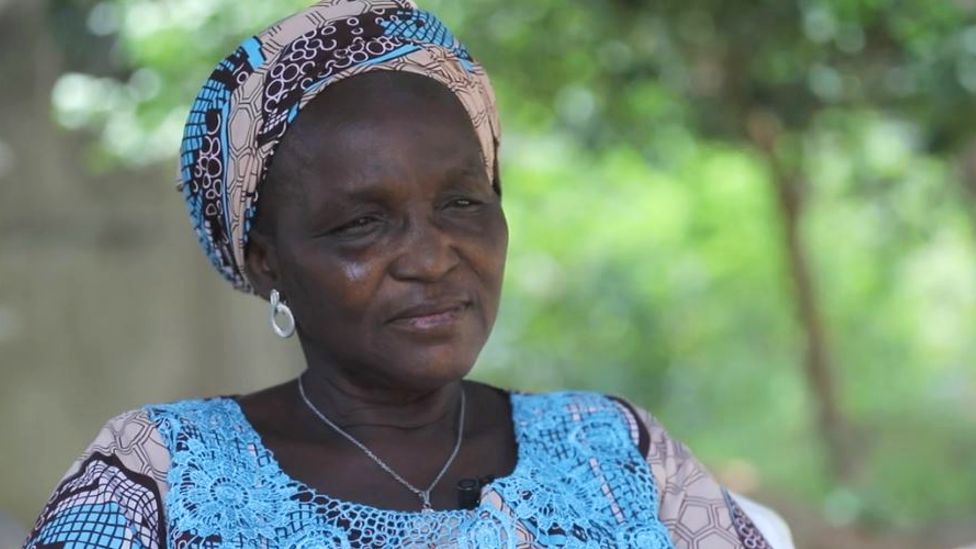
“We don’t have the freedom to worship. If you dress like a Muslim, you are in trouble. We are just hiding our religion in fear of not being attacked,” Ibrahim Bello, a Muslim living in south-eastern Nigeria, told the BBC.
Obinna Nnadi, a Christian who once lived in northern Kaduna statefelt similarly fearful: “I felt it was not safe to practice my religion there. I had to pack my family and leave.”
IMAGE SOURCE, GETTY IMAGES Image caption, Islamic law is in place in much of northern Nigeria, while the south is mostly Christian
Neither has much confidence in the authorities to clamp down on intolerance – and Mr Bello says attacks do not always make the news, except those involving the Islamist insurgency in the north-east in which both Muslims and Christians are attacked by militants.
This lack of faith in the political class to deal with such discrimination has become more heated as the governing All Progressive Congress (APC) has upset a cross-party tradition – in practice since the return to democracy in 1999 – of having both a Christian and a Muslim on the presidential ticket.
The incumbent president is Muhammadu Buhari, a northern Muslim, while his deputy is Yemi Osinbajo, a southern Christian.
But the APC ticket for 2023 has Bola Tinubu, a southern Muslim, with Kashim Shettima, a northern Muslim, as his running mate.
Some feel this could inflame tensions. The Armed Conflict Location and Event Data Project (Acled) has recorded that the average number of monthly incidents of violence targeting Christians has risen by more than 25% in the last year.
While Acled has not separately captured religion-linked attacks on Muslims – except for attacks by militant groups like Boko Haram – some told the BBC of their experiences, especially in the south-east, an area largely inhabited by members of the Igbo ethnic group.
Aisha Obi is an Igbo Muslim – a growing community. Some are converts, although the majority were born into the faith in the predominantly Christian region.
BBC
They see you as a saboteur”
She said women were the prime targets because of their Islamic dress and were subject to a hostility born of the civil war that started in 1967 when Igbo leaders declared independence.
The secessionist rebellion ended in defeat but some wounds are yet to heal with resentment felt towards the Muslim Hausa-Fulani community from the north, which then dominated the government.
“They see you as a saboteur,” Ms Obi told the BBC.
“Even inside a vehicle or on a motorcycle, they call you: ‘Hausa person, who knows what they are carrying. It could be a bomb.’ They feel Igbos are not supposed to be Muslims,” she said.
There are frequent attacks on individuals and mosques in the region which the authorities do not take seriously, she says.
“They don’t believe us. When we tell them, they accuse us of us wanting to cause religious war.”
Rev Caleb Ahima, vice-president of the Christian Association of Nigeria (CAN), acknowledges that religious discrimination is a consequence of location.
“In some states like [north-eastern] Borno, Christian religious knowledge is not allowed to be taught. Christians are not given plots of land to build their churches,” he said.
Segregation
Rifkatu Aniya, from Kaduna state which has large Christian and Muslim communities, said she had never felt safe since her Christian husband, a pastor, was killed in religious violence that erupted in 2000.
Image caption, Rifkatu Aniya, whose husband died in religious violence 22 years ago, said she didn’t feel safe as a Christian in Kaduna city
The state’s main city, also called Kaduna, has since been divided into Christian and Muslim areas, explains resident Emeka Okeiyi, which impacts on their religious freedom.
“I can’t say I have any restriction to practising my faith in the southern part of the city,” he said – but he knows of Christians in the Muslim northern suburbs who would not dare set up a church.
There are followers of African traditional religions who also say they face intolerance – especially from those who follow the dominant faiths.
Odinani, or Odinala, was the religion of the vast majority of people in eastern Nigeria before the introduction of Christianity – and is making a comeback with younger people.
Odinani follower Cletus Chukwuemeka Ogbodo says the idea of religious harmony as enshrined in Nigeria’s constitution is in stark contrast to how people are treated.
Image caption, Shrines from the traditional Odinani religion are sometimes targeted – with the authorities doing little to stop the attacks
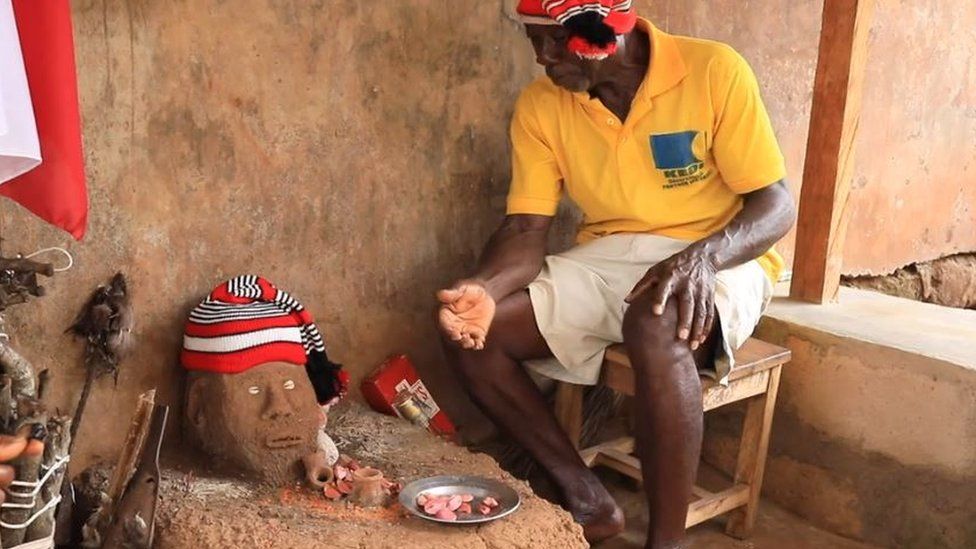
“Pastors burn down shrines. Pastors burn people’s ancestral heritages down during ‘crusades’,” he says about Christian attacks on traditional places of worship.
If the government adhered to the constitutional provisions, it would come to the aid of the people and prosecute the perpetrators, he said.
Inter-faith future?
There has been a long legal battle in Nigeria’s biggest city, Lagos, which has seen fierce arguments over religious freedom vs secular rights.
It ended this year when Nigeria’s Supreme Court upheld a ruling that female Muslim students had the right to wear a head scarf to school.
Image caption, Lawyer Malcolm Omirhobo maintains if secularism is not the norm, he should be able to turn up to work in court dressed in traditional attire
For Ishaq Akintola, director of Muslim Rights Concern (Muric), it was a victory for Muslims in the south who regularly feel they are not treated fairly.
But for others like lawyer Malcolm Omirhobo, it went against the secular spirit of the constitution.
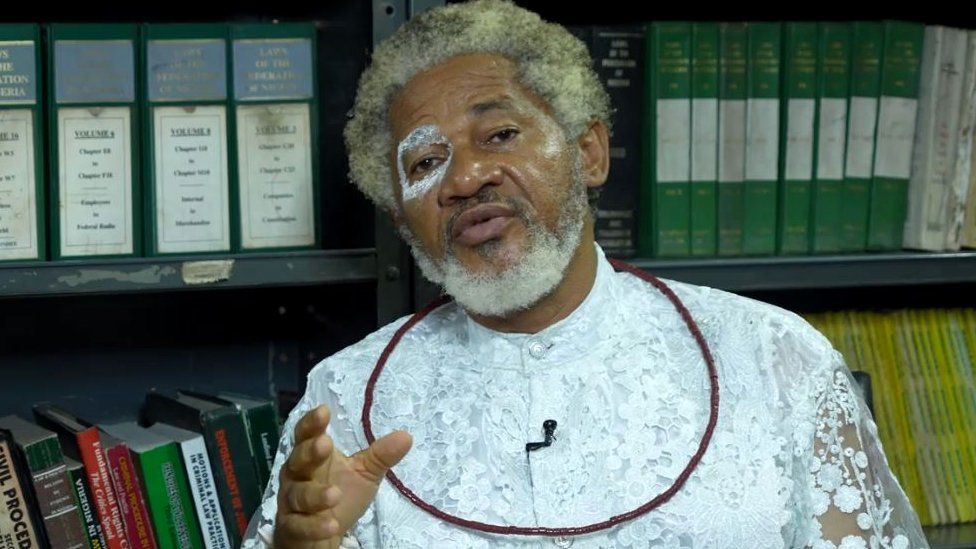
To make a point he attended court in a traditional outfit – including a beaded gourd necklace and had a white circle drawn in chalk around his right eye like a priest of African religions.
“My fight is for secularity to be the norm,” he told the BBC.
When the authorities do intervene tangibly in religious affairs it can also lead to resentment.
To stop religious incitement in Kaduna state, a ban was imposedon preaching last year – limiting it to those who are licensed by a council made up of members of both faiths.
This infuriated some Christian religious leaders, who suggested it was an example of government overreach – in particular Pastor Johnson Suleman of the Omega Fire Ministry, who accused the governor when it was first proposed of wanting to “Islamise Kaduna” in a sermon that went viral.
But the inter-faith council may be a way to foster local understanding – and could be a blueprint for other states.
Some Muslim and traditional leaders in Kaduna are now joining evangelical worshippers on Sundays – as part of efforts to ease tensions before the polls.
Nigeria’s president Muhammadu Buhari has confirmed plans to remove a costly petrol subsidy as he presented Friday his final budget as leader of the west African foreseeing deep revenue shortfalls. Despite being a major oil exporter, Nigeria imports the bulk of its petrol and a subsidy keeps the prices at the pump low for consumers.
While popular with Nigerians, the subsidy is costly, with the price tag estimated at $9 billion this year. “Petrol subsidy has been a recurring and controversial public policy issue in our country since the early eighties,” Buhari told a joint session of the National Assembly in Abuja on Friday. “However, its current fiscal impact has clearly shown that the policy is unsustainable,” he said.
If the government goes forward with ending the subsidy it would add to the burden of Nigeria’s consumers who are battling with the inflationary fallout from Russia’s war in Ukraine and the end of the Covid pandemic.
Buhari presented a record budget of 20.51 trillion naira ($47.4 billion) for 2023, with spending up 18.4 percent from this year in nominal terms. But with inflation currently running at over 20 percent, and forecast at 17.16 percent for next year in the budget, there is unlikely to be much, if any change in real terms.
Buharisaid Nigeria’s economy is projected to grow 3.7 percent in 2023, up marginally from the 3.55 percent rate expected this year.
Nigeria’s tax revenue has yet to recover from the Covid-19 pandemic, and has also been battered by the economic effects of the Ukraine war. The budget deficit is projected to be 10.78 trillion naira, said Buhari, which is just over half of planned spending.
Oil revenueis projected at 1.92 trillion naira, with non-oil taxes estimated to contribute 2.43 trillion naira, he said. Buhari said the budget expects oil-rich Nigeria will produce 1.69 million barrels per day (bpd) of crude, assumes an oil price of $70 per barrel and an exchange rate of 435.57 naira to the dollar.
Nigeria, a member of OPEC, has been unable to meet its quota of 1.8 million bpd because of a lack of production capacity and large-scale oil theft, hurting revenue and draining foreign reserves. The budget must be approved by lawmakers
Nigerians go to the polls in February to elect a successor for Buhari, 79, who will step down after leading Africa’s most populous nation for eight years.
With Nigeria’s economy flagging, its vital oil production at all-time lows, and insecurity a major problem, the next president faces a host of urgent issues.
As the Muhammadu Buhariadministration draws to a close, Aisha Buhari, the first lady of Nigeria, has pleaded with people to pardon her husband for failing to advance the country’s economy during his nearly eight years in power.
Aisha Buhari made the prayer of forgiveness at a special Juma’at service and public lecture to celebrate the nation’s 62nd independence anniversary, held at the National Mosque Conference Hall in Abuja on Friday. The event was themed: ‘Shura: The Islamic Foundation of True Democracy.
“Your Excellencies, distinguished guests, ladies, and gentlemen, as you may be aware that this government is making its exit and perhaps witnessing the last anniversary of the regime, I ask Nigerians to pray for a successful election and transition programme,” urged Mrs. Buhari.
“The regime might not have been a perfect one,but I want to seize this opportunity to seek forgiveness from the Ulamas and Nigerians in general. We all need to work together to achieve a better Nigeria,” she added.
The First Lady acknowledged that the naira’s helpless fall in her husband’s tenure had subjected many citizens to untold hardship. The policies of Godwin Emefiele appointed by Mr. Buhari to man the nation’s apex bank, the Central Bank of Nigeria, had yet to positively impact the economy.
“Your Excellencies, distinguished guests, it is also noticeable that our Naira is being evaluated and the foreign exchange rate has affected our economy causing a lot of hardship and difficulties in terms of education, health, and other day-to-day activities of our citizens.”
She commended the efforts of security operatives in fighting terrorists and bandits, she prayed “for more successes in their operations,”
“I’m particularly happy that our security agents have stood up to the challenges of security more than ever before. And at the moment, their efforts have been pushing the effects of banditry, kidnapping, and many other ills in society.
“I commend the efforts of our gallant security men and women.”
Image caption: MPs have summoned the Nigerian president
Nigerian MPs have summoned President Muhammadu Buhari over the recent killing of at least 43 farmers in north-east Borno State, local media report.
The lawmakers while debating the motion said it was of urgent national importance.
Most of those killed on the Saturday attack – which was claimed by Islamist militant group Boko Haram – were rice farmers in Zabarmari, a community in Jere Local Government Area.
More than a dozen others are missing, reports say.
The United Nations has retracted its initial casualty figure of 110 farmers killed, saying the number was not yet confirmed.
The army has come under heavy criticism following the massacre but blamed lack of equipment for its inability to tackle the insurgency.
It also accused residents of working as informants for the militants.
President Muhammadu Buhari has said at least 69 people have been killed during the #EndSARS protests across the country.
According to the BBC, Buhari gave the number during a virtual meeting with former leaders and security chiefs on Friday.
He was quoted as saying 51 civilians, 11 police officers and seven soldiers had died.
A statement released by presidential spokesman, Femi Adesina, at the end of the meeting also quoted Buhari as saying it is unfortunate that the “initial genuine and well-intended protest of youths was hijacked and misdirectedâ€.
The past Nigerian leaders present at the meeting included Gen. Yakubu Gowon, President Olusegun Obasanjo, Gen. Ibrahim Badamasi Babangida, Chief Ernest Shonekan, Gen. Abulsalami Abubakar and former President Goodluck Jonathan.
Each of them commended President Buhari for steps taken so far, in restoring peace and order in the country and also applauded the presidential broadcast of Thursday.
Nigeria’s President Muhammadu Buhari has promised “extensive” police reforms as protests against police brutality continue despite his announcement that the notorious Special Anti-Robbery Squad has been disbanded.
In a video posted on Twitter, he also promised justice for victims of police abuse, and expressed regret for the loss of lives in south-western Oyo state during the protests.
Mr Buhari added that most police officers were hard-working, and the reputation of the force should not be tarnished by a “few bad eggs”.
You can watch him speak here:
The disbanding of SARS is only the first step in our commitment to extensive police reforms in order to ensure that the primary duty of the police and other law enforcement agencies remains the protection of lives and livelihood of our people. pic.twitter.com/XjQMSr3jlm
Nigerian President Muhammadu Buhari’s office has dismissed a media report that indicated one of his aides had tested positive for Covid-19.
The presidency said all aides are routinely tested for coronavirus and the named staff member had always returned a negative test.
“The general public is hereby advised to ignore such stories that are intended to mislead the people an create unnecessary anxiety about the safety of the president,” a statement by the president’s spokesperson said.
President Buhari’s former chief of staff Abba Kyari died of Covid-19 in April.
Nigeria’s President Muhammadu Buhari has faced criticism after listing only one woman in the renaming of railway stations.
On Monday, Mr Buhari named 23 train stations after “deserving Nigerians†seen to have contributed to the progress and development of their communities and the country.
Among those named were former Nigerian leaders, serving ministers and Nobel laureate Wole Soyinka.
But Funmilayo Ransome-Kuti, a feminist and activist who was also mother of late Afrobeat music legend Fela Kuti, was the only woman honoured.
Some on social media have likened this announcement to the president’s previous appointments – like in 2019 when only seven women, out of the 43, were appointed as ministers.
They have suggested that women who deserved to be honoured include Stella Adadevoh, the medical doctor who died preventing Ebola from spreading in Nigeria, and Dora Akunyili, who spearheaded the crusade against fake drugs before her death in 2014.
Former lawmaker Shehu Sani has asked the president to name a station in Kaduna after the female combat helicopter pilot, Tolulope Arotile, who died two weeks ago in an accident.
In the clearest indication yet that the two-week lockdown imposed on Lagos, Ogun and the Federal Capital Territory (FCT) on March 29 to curb the spread of the coronavirus pandemic may be headed for extension, President Muhammadu Buhari, saturday, said the movement restrictions would last as long as necessary, particularly, as he would be relying on experts’ advice on the issue.
A statement by Senior Special Assistant on media and publicity to the President, Malam Garba Shehu, just 24 hours to the end of the initial 14-day lockdown, appealed to Nigerians to remain at home in the interest of the entire country.
Buhari said there was no cure for COVID-19 yet, and complying with the instruction to stay at home was necessary to avoid dire consequences.
“The freedoms we ask you to willingly forsake today will only last as long as our scientific advisers declare they are necessary. But they are essential – world over – to halt and defeat the spread of this virus,” the president said.
Meanwhile, Nigeria recorded 13 new cases of COVID-19, bringing to 318 the total number of confirmed cases in the country with 70 discharged. Announcing this on Saturday, the Nigeria Centre for Disease Control (NCDC) said Lagos recorded 11 new cases, while Kano and Delta states recorded one each.
A breakdown of the figures showed that Lagos had 174 cases, FCT had 56, Osun 20, Edo 12, Oyo 11, Ogun seven, Bauchi and Kaduna six each, Akwa Ibom five, Katsina four, Delta three, Enugu, Ekiti, Rivers, Kwara and Ondo two each, while Benue, Niger, Anambra and Kano had one each.
Abuja and Lagos State, yesterday, announced that they had discharged four new COVID-19 patients, respectively, while Kano recorded its index case of the deadly virus.
However, religious leaders in many parts of the country were said to have mounted pressure on state governments to relax the lockdown orders.
Nigeria’s President Muhammadu Buhari has unveiled a new visa policy which he says is intended to attract innovation, specialised skills and knowledge from abroad.
The president had last November in Egypt, announced the new visa policy which he described as a “strategic decision to bring down barriers that have hindered the free movement of our people within the continent”.
The new policy sees the introduction of visas on arrival for short visits for holders of passports of African Union countries.
There are 79 new categories which the government say is to ensure that “visas are more efficiently matched to the purpose of travel, thus helping improve the efficiency of processing and response”.
The government also announced a new biometric visa database which is able to conduct checks for those on Interpol watchlists.

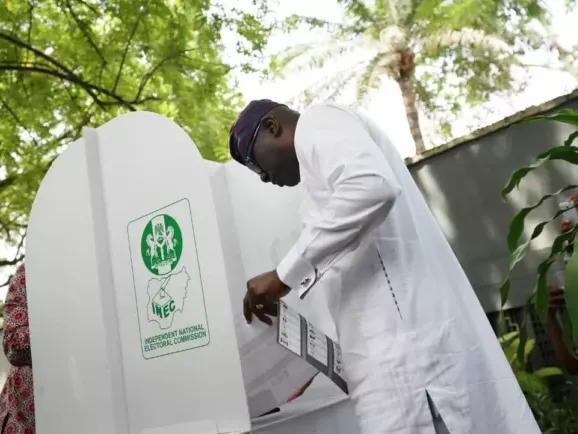
 LagosDecides2023: APC’s Sanwo-Olu votes, kicksagainst voters intimidationRedeem your image by conducting credible governorship- election- —TMG- to- INEC-Share Story