The Bethel Methodist Church in Tema Community 8, on Saturday, August 13, 2022, will host a one-week observation service in honor of the late Ghanaian Highlife veteran, AB Crentsil AB Crentsil.
AB Crentsil known for several hits songs such as Devil, Atia, Juliana, I Go Pay You Tomorrow, Papa Shamo, Ayen among other songs died at The Bank Hospital, Accra on Wednesday, July13, 2022.
According to the Abrodze Ebusua of Ewoya family, after the service, the celebration will continue with a gathering at the Community 8 Number 2 School Park where the final funeral and burial plans would be made known.
AB Crentsil was born in 1943, in Prestea in the Western Region. He had his primary and middle school education at the Takoradi Methodist Primary and Rev Cleveland Middle School respectively.
After his middle-school examinations, he worked as an electrical apprentice under his father, who was Works Superintendent of the technical branch of Ghana Railways at Takoradi.
While in middle school, he was introduced to the guitar by a Mr Thedoh. AB Crentsil became proficient in playing guitar and started singing along when playing it.
He was simultaneously working as an electrician and playing with the Strollers Band owned by one Kwesi Donkor.
He has played with bands such as El Dorados, Sweet Talks and his own band, Ahenfo.
He won numerous Ghanaian music awards, including the Fontomfrom Evergreen Award, a special honour bestowed upon a musician with 1520 years of continuous music experience.
At the 2013 MTN Legends and Legacy (LAL) Ball at the Accra International Conference Centre(AICC) AB Crentsil was honoured for the immense contribution he had made to the progress of popular music in this country.
On December 30, 2017, a concert dubbed A Tribute to AB Crentsil was held in his honour at the +233 Jazz Bar and Grill in Accra.
Fast-rising Ghanaian musician, LasmidOwusu Nathaniel known in showbiz circles as Lasmid has indicated that he sings like a Nigerian because they are taking over the music space in Africa.
Speaking in an interview with Sammy Kay on the Go online show, the highly spiritual signee disclosed that sounding Nigerian is personally a good thing for him.
According to him, there is a plus in learning the ways of people to overtake them or do better than them hence he feels it’s a good thing to sound like Nigerian to hit the global market.
The former MTN hitmaker winner is already topping chats with his recently release banging single titled “Friday Nightâ€.
J Hus has been named the top Afrobeats artist in the UK over the past 12 months, as the genre finally gets its own chart.
Based on streaming data and sales, he’s followed by Nigeria’s Burna Boy and Hackney collective NSG.
The Official UK Afrobeats Top 20 will be announced on BBC Radio 1Xtra on Sunday.
Mark Strippel,​ 1Xtra’s head of programmes​ said the chart was “much-needed and long overdue”.
Afrobeats has quickly grown to dominate playlists and radio, with UK artists developing their own style and sound (Afroswing/Afro bashment) from its origins in west Africa.
Young T & Bugsey’s Don’t Rush has been named the top Afrobeats track of the past year.
An Afrobeats History
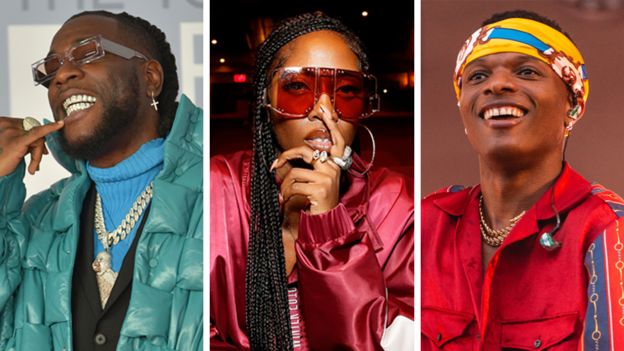
Burna Boy, Tiwa Savage and Wizkid are among the genre’s superstars
The ‘s’ in Afrobeats is crucial.
Don’t confuse it with Afrobeat – which was pioneered in the late 1960s by Nigerian artist and activist Fela Kuti.
Fela and his drummer Tony Allen formed a movement when they fused funk and jazz with Ghanaian highlife, traditional Yoruba music and conscious lyrics.
The 2010s saw the rise of another musical movement out of Nigeria with a completely different sound, dubbed Afrobeats.
D’Banj’s 2012 hit Oliver Twist, which reached number nine in the UK charts, was probably the first time the sound really took hold in the UK.
Oliver Twist by D’Banj reached number nine in the UK charts
Big tracks from Fuse ODG like Antenna and Azonto followed, but more recently in the UK, the lines have been blurred between sounds from the West Indies, London and West Africa.
Brixton rapper Sneakbo’s music hinted at the genesis to come at the start of the decade, and by the end of it artists like Yxng Bane and Not3s were at the forefront of what was being dubbed Afro bashment, or Afroswing.
Along with the likes of NSG, Juls, Naira Marley and Afro B, they’ve helped popularise the sound in the UK – while J Hus and his producer JAE5 have arguably had the most success combining dancehall with West African sonics and black British genres and flows.
Fuse ODG is from London but got his musical identity after returning to Ghana
Afrobeats reached new levels internationally when Drake featured Wizkid on 2016’s One Dance.
It’s arguably not got too much of an Afrobeats sound – borrowing more from dancehall and UK funky house – but it put a spotlight on Wizkid and the genre he flies the flag for.
Fuse ODG’s spoken of wanting to create a new image of Africa through Afrobeats music too.
His Tina movement – which stands for This Is New Africa – “urges Africans in the Motherland and the diaspora to use their skills to rebuild their community and show the world the more beautiful side of Africa”.
An Afrobeats Hijack?
In 2019, Afrobeats artists collectively spent 86 weeks in the Official Chart Top 40, up from 24 weeks in 2017.
The number of tracks featuring a lead or featured Afrobeats act has also doubled in the same period, led predominantly by British artists.
“London is the home of Afrobeats outside of Africa,” says Folabi Ogonkoya, who runs CocoCure – a venue dedicated to the genre.
Born in Lagos, Folabi’s been putting on Afrobeats nights in the UK for 13 years to reflect the music he enjoyed when he was growing up.
“I was listening to Afrobeats before it even had a name,” he says.
“The parties started off a bit slow but they picked up as the genre got more popular and so I decided to stay in the UK. ”
Folabi Ogonkoya nearly moved back to Nigeria but saw an Afrobeats opportunity
He says lots of British artists have “hijacked” Afrobeats in a good way, moving the music forward and increasing its popularity.
“The fans are huge now. At first it was Africans in the diaspora but now everyone’s embraced it. Things have worked out for the best.”
From Manchester to London to Lagos
Male artists dominate the Afrobeats scene but Manchester-born Ezi Emela is one of several female singers making their mark.
“I can see Afrobeats becoming the world’s biggest musical genre soon,” she says.
Until January 2019, she was living in London but decided she wanted a change. During a holiday to Nigeria, she phoned her mum to tell her she was sticking around.
“My sounds has grown so much since I’ve been here,” she tells Radio 1 Newsbeat, from her home in Lagos.
Ezi Emela has released tracks including Chineke Meh, Confam It and new single No Love
Nigeria is her parents’ birth country and Ezi says “being in the actual continent where my genre stems from” has given her “a new juj”.
“In the UK, I don’t think I was connected to the music and I felt I was faking it a little bit.
“I hadn’t connected to the culture.”
She thinks every artist “getting into the African swing of things” should try to get to Africa at some point (travel restrictions permitting obviously).
“It’s changed me a lot. It has changed my style. It has given me a lot of inspiration and it’s all made a big difference to my music.”
The UK’s Official Top 10 Afrobeats artists of the past 12 months are:
There are reports that rapper and music mogul, Dr Dre and his wife are getting a divorce.
According to TMZ, Dre’s wife, Nicole Young filed the paperwork Monday, June 29, 2020, citing the usual irreconcilable differences as the reason for her split from the hip-hop mogul.
There are reports that the couple’s marriage has no prenup and the music mogul is worth an estimated $800M.
The couple got married in 1996 and are blessed with two children, Triuce and Truly.
Young was formerly married to NBA player, Sedale Threatt, and is a trained lawyer.
About a week ago, there were allegations of rape levelled against two members of the La Meme Gang music group on social media.
These claims on social media came out with receipts to support that Ghanaian musicians of the La Meme Gang group namely RJZ and David Duncan had indeed being accused of rape and have been reported to the police.
The La Meme Gang group however put out an official statement to debunk these allegations by stating that these allegations are calculated efforts to tarnish their image.
Lawyer for the victim, Lawyer Lebrecht Hesse, has, on the other hand, threatened lawsuits against the group by as he reveals that there is overwhelming evidence against the accused persons.
In an interview with Doctor Cann on the Showbiz Xtra show, he revealed: “As far as we are concerned we have hard evidence against them. The Doctor who has examined the lady has revealed that our client has gone through a difficult phase. We are seeking justice. The evidence we have confirms that it was a gang rapeâ€.
Responding to the official statement by the music group, the Lawyer believed that the statement was probably directed to other ladies who voiced out on their sexual abuse after his client came out with her story and not at his client. “The issue started trending on twitter and other ladies were also making allegations against them so their statement released is in respects to the allegations by the other ladiesâ€, he added.
Lawyer Lebrecht Hesse appealed to the general public to support their cause of seeking justice for his client who he believes has been subjected to a traumatizing experience by the La Meme Gang Group.
“Sometimes our criminal jurisdiction is problematic and you know with these issues depending on the traction it gets either from lawyer or civil society organizations that is when some great results come. Aside from that, few people are able to push to achieve the desired results so it is a consensus effort. We need to help the lady because given the evidence at hand, we need to seek justice for her. For now, we have been able to meet the police. We are yet to issue a writ against the culprit in the civil law of court and slap the culprit with the heavy damageâ€.
Disclaimer : “Opinions expressed in this article are the sole responsibility of the author(s) and do not in any way reflect those of backend.theindependentghana.com. Our outfit will hereby not be liable for any inaccuracies contained in this article.â€
Jamaican singer Millie Small has died at the age of 73 after suffering a stroke.
The star was most famous for her hit single My Boy Lollipop, which reached number two in both the US and the UK in 1964.
It remains one of the biggest-selling ska songs of all time, with more than seven million sales.
Island Records founder Chris Blackwell announced her death and remembered her as “a sweet person… really special”.
It was Blackwell who brought Small to London in 1963 and produced her version of My Boy Lollipop, showcasing her childlike, high-pitched vocals.
“I would say she’s the person who took ska international because it was her first hit record,” he told the Jamaica Observer.
“It became a hit pretty much everywhere in the world. I went with her around the world because each of the territories wanted her to turn up and do TV shows and such, and it was just incredible how she handled it.
“She was such a sweet person, really a sweet person. Very funny, great sense of humour. She was really special,” said Blackwell.
Born Millicent Small in Clarendon, south Jamaica, she was one of seven brothers and five sisters, raised on the sugar plantation where her father was an overseer.
At the age of 12, she won a talent contest at the Palladium Theatre in Montego Bay; and by her teens, she was recording for Sir Coxone Dodd’s Studio One label in Kingston.
There, she teamed up with reggae singer Roy Panton, and they became one of the island’s most prolific duos, scoring a major hit with We’ll Meet.
Blackwell took an interest in the singer after releasing some of those records in the UK on his fledgling record label, Island, and brought her to London in 1963.
Small was enrolled at the Italia Conti Stage School for speech training and dancing lessons; and she toured the UK before cutting My Boy Lollipop with a group of London session musicians (Small claimed Rod Stewart played the harmonica solo, but he has denied being present at the recording).
Released in February 1964, it made her an international star, and helped popularise ska music around the world.
“It is the ska equivalent of Elvis’ Heartbreak Hotel or the Sex Pistols’ God Save The Queen – the disc that popularised a sound previously considered to be on the margins of mainstream consciousness,” wrote music historian Laurence Cane-Honeysett in Record Collector magazine.
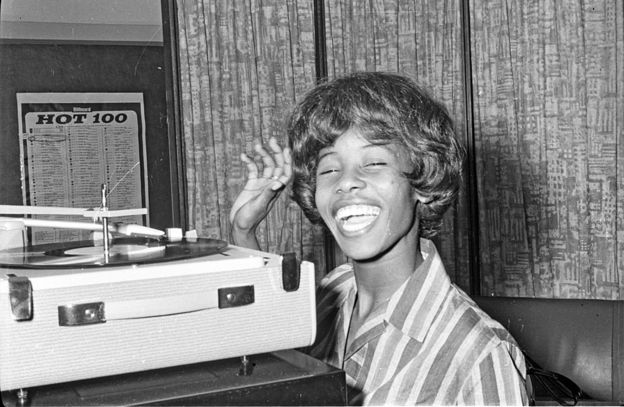
Image copyrightGETTY IMAGESImage captionSmall was given a hero’s welcome when she returned to Jamaica after the success of My Boy Lollipop
However, Small was unable to replicate the success of My Boy Lollipop, scoring only one further hit, a soundalike called Sweet William, later the same year.
But she continued to tour and record, and appeared frequently on 1960s pop shows like Juke Box Jury and Ready Steady Go.
“My life seemed very normal to me – even though I was only 17, I took fame in its stride,” she told the Express in 2016.
After leaving Island in 1970, she recorded for legendary reggae label Trojan Records, where her first single was a cover of Nick Drake’s Mayfair.
However, it was the b-side that attracted greater attention. Called Enoch Power, it was a defiant response to Enoch Powell’s inflammatory, anti-immigration “Rivers of Blood” speech.
Small’s lyrics, which captured the mood of the UK’s Caribbean population, received a rapturous response when she played the song at the Caribbean Music Festival at Wembley Arena, a month after its release.
Soon after that single, and the accompanying album Time Will Tell, Small stepped away from music, saying “it was the end of the dream and it felt like the right time”.
In later years, she lived in Singapore and New Zealand before returning to London, where she concentrated on writing, painting and raising her daughter.
When My Boy Lollipop was re-released in 1987 to mark Island Records’ 25th anniversary, the singer gave a rare interview to Thames TV, where she revealed she had, at one point, been penniless and sleeping rough in London.
However, she took the hard times in good grace, explaining: “That’s all experience. It was great. I didn’t worry because I knew what I was doing.
“I saw how the other half live. It’s something I chose to do.”
In 2011, Jamaica’s Governor-General made Small a Commander in the Order of Distinction for her contribution to the Jamaican music industry.
The singer is survived by her daughter, Joan, who is also a musician based in London.
Tributes were led by actor Vas Blackwood, who said Small “lit the fuse for Jamaican ska music”.
R I P MILLIE SMALL. ‘My Boy lollipop’ 1964 lite the fuse for Jamaican SKA music, her track went Global making history & developed the foundational structures of Jamaican Reggae Music. SLEEP WITH ANGELS SISTER MILLIE X pic.twitter.com/Ydl0za0st4
Sad to hear about Millie Small. Her early journey was steered initially by Coxone Dodd’s label, then Chris Blackwell’s Island….. My Boy Lollipop put island Records on course to become an influential record label with an excellent musical reputation. pic.twitter.com/orKLmSqToJ
Sad to hear about Millie Small. Her early journey was steered initially by Coxone Dodd’s label, then Chris Blackwell’s Island….. My Boy Lollipop put island Records on course to become an influential record label with an excellent musical reputation. pic.twitter.com/orKLmSqToJ
Yve Digital, distribution and online marketing company has held its third music and money conference at the Hilla Liman Hall, University of Ghana.
The conference aimed at sensitizing musicians on ways of making money through the digital online space like includes Facebook, Soundcloud, audiomack, among others.
Speaking to the media after the conference, Mr. Kwame Baah, Content Manager of Yve Digital, said his outfit looks to spread its tentacles across the country and teach musicians on the need to capitalize on the digital space.
“The music and money conference seeks to teach upcoming musicians and content creators the skills and tools needed to become successful in the online marketing space.
“We engaged them in topics which include branding, planning, execution and promotion techniques in the online space and hopefully it could impact significantly on their knowledge about the digital space,” he said.
The music and money Workshop which started in 2019 has seen some massive participation by lots of Ghanaian artistes.
The Centre for National Culture (CNC) Accra, also known as the “Art Centreâ€, has held the 34th Choral Festival in Accra to celebrate the works of the late Emmanuel Pappoe Thompson.
Emmanuel Pappoe Thompson was an outstanding Ghanaian composer and educationist, whose works contributed to the development and promotion of patriotic choral music in the country; he is said to have contributed to the lyrics of the national anthem.
Mrs Alice Alima Kala, Director of the Centre for National Culture, Greater Accra, said in her opening remarks that the Centre, would continue to promote choral music in the Region and would rope in other stakeholders.
She said the programme would sustain patriotism and inculcate choral music into the younger generation.
Mrs Kala said it is important to introduce the youth to such patriotic songs which would influence and direct their service and love for their culture and nation.
She said the Centre would also hold the “Adesa Village”, a folksongs and storytelling competition for Primary and Junior High Schools within the Region.
Madam Edna Nyame, Executive Director of the National Commission on Culture, in her address, commended the Centre for their initiative.
She encouraged the participating choirs and organisers to have more of such programmes, which carry a national identity.
The event brought choirs from various institutions, including the Bank of Ghana Choir, The Treasury Choir from Controller & Accountant, Fire Vibrations from Fire Service, GHAPOHA Choir, Freeman Methodist Choir and La Nazareth Choir, who sang songs composed by Pappoe Thompson and other soothing choral songs.
The programme was interlaced with cultural performances by the Unity Ensemble.
The Ghanaian Gospel music industry has really gone from strength to strength and there is a growing scene of incredible upcoming gospel acts.
The list features the new face of Gospel Music who are making an impressive statement about their music and mission using the new media and sharing the gospel through their songs to take believers by storm.
One such personality is Rita Nkansah popularly known as Ritaqueen who has taken her talent into new territory with creative arrangement, song choice and production.
She is raising the flag of Ghana outside the territories of the country and has been praised for her exceptional ministration at events and churches.
She has used her incredible talent to serve at the House of Prayer Ministries International, preparing to release her maiden thrilling gospel song titled ‘He Reigns’ which projects God’s goodness.
”I want the world to know that it doesn’t matter what the enemy brings on our way, he that is in us is greater, stronger, bigger, wiser, than he that is in the world, so no matter what we go through in life we should never give up because God will see us through and we shall overcome.” she speaks ahead of the release in March.
Ritaqueen is changing lives with the raw emotion and passion delivered with every note she sings. She delivers a powerful worship song that congregations around the world can easily sing along.
Ghanaian dancehall musician Stonebwoy has opined that the decision taken by organizers of Vodafone Ghana Music Awards, Charterhouse to ban him and Shatta Wale is a good one and will go a long way to help the music industry.
Speaking at a press conference in Accra at the Golden Tulip Hotel monitored by Attractivemustapha.com, Stonebwoy said the “punishment†from Charterhouse is good to check musicians and guide them to desist from possible future occurrences.
According to Stonebwoy, even though the ban has not affected him, it is good for the music industry because the young and upcoming musicians must know that you cannot just misbehave on an awards stage and go free.
Stonebwoy also added that he wishes
the ban would last for about three years to serve as a deterrent to young artistes