The town council in Nadine Dorries‘ Mid Bedfordshire district has called for her immediate resignation, claiming that she has been more concerned with ‘political machinations’ than with serving her citizens.
After failing to obtain a peerage in Boris Johnson‘s departure honours list, the former Cabinet minister declared her decision to resign as an MP last month, but she has not yet done so formally.
Due to her procrastination, Flitwick Town Council has written a stern letter to Ms. Dorries requesting that she “immediately resign your seat” due to their “concerns and frustration” with her preoccupation with her TV work and “political manoeuvres to embarrass the Government.”
The letter stated, “The last time you spoke in the Commons was June 7, 2022.”
It’s well known that you haven’t held a Flitwick surgery since March 2020, and you haven’t kept up a constituency office for a long time.
“The council is concerned that your concentration appears to have been squarely on your television show, future book, and political ploys to shame the Government for not sending you to the House of Lords, rather than representing citizens.
Council members highlighted that your actions “are not consistent with the Seven Principles of Public Life set out by Lord Nolan in 1995.”
They stated that Flitwick residents, who number about 13,800, represent those who “desperately need effective representation now.”
The main voting bloc in the constituency is made up of the 13,800 people who live in Flitwick.
Then they added, “Flitwick Town Council calls on you to resign your position immediately to make way for a by-election.”
On June 9, Ms. Dorries announced her resignation from Westminster, but a week later she changed her mind and said she would remain while she looked into the reasons why the former prime minister’s honours list did not include her for a seat in the House of Lords.
The steadfast supporter of Mr. Johnson holds a weekly chat show on Talk TV and is the author of The Plot: The Political Assassination of Boris Johnson, which is scheduled for release just before the Conservative Party convention in September.
Ms. Dorries has held Mid Bedfordshire since 2005, and the Conservative Party has held it usually since 1931.
The Tories just managed to hold onto the Uxbridge and South Ruislip seat left vacant by Mr. Johnson last week after losing two by-elections last week in Selby and Ainsty and Somerton and Frome.
Mid Bedfordshire residents, according to Labour’s Alistair Strathern, are “sick of being taken for granted; they want proper representation and a local MP who puts them first.”
The interactions I have with people on the doorstep every day reflect the two-horse battle between Labour and the Conservatives, according to polling, he continued.
“The people of Mid Beds are ready for change, and I’m ready to speak up for them and be the most dedicated, approachable MP they have ever had.”
The locals are tired of being taken for granted by an absent MP and this Conservative government, said Liberal Democrat MP Sarah Olney, who termed the action “unprecedented.”
Nadine Dorries “continues to hold onto a job she has no interest in doing” as families in Bedfordshire struggle to get appointments with doctors and deal with skyrocketing mortgage prices.
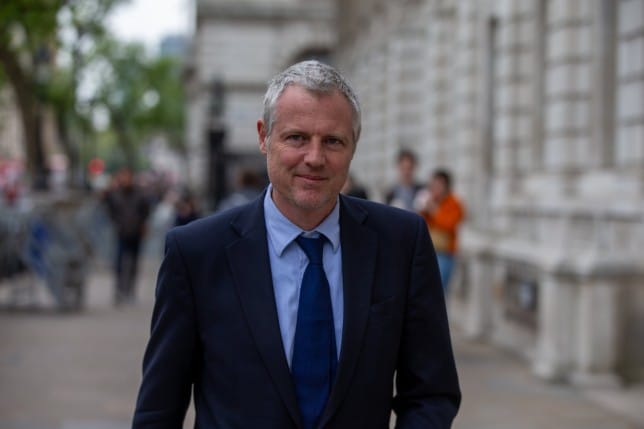
In an angry tirade against the government’s alleged “apathy” towards environmental issues, Lord Zac Goldsmith announced his resignation.
Just one day after receiving criticism in the wake of the Partygate scandal investigation, he announced his resignation.
After Lord Goldsmith was listed in a report listing those who had “undermined” the probe together with former cabinet members Nadine Dorries and Jacob Rees-Mogg, Rishi Sunak received calls to fire Lord Goldsmith.
However, yesterday the prime minister supported his colleague and declared that he had “confidence” in the minister.
But this morning, it was a different story for Lord Goldsmith and his comments on Mr Sunak.
The Tory peer said the Prime Minister was ‘simply uninterested’ in the environment as he stepped down as a Foreign Office minister.
In his blistering two-page resignation letter, Lord Goldsmith wrote: ‘Prime Minister, having been able to get so much done previously, I have struggled even to hold the line in recent months.
‘The problem is not that the government is hostile to the environment, it is that you, our Prime Minister, are simply uninterested.
‘That signal, or lack of it, has trickled down through Whitehall and caused a kind of paralysis.’
Lord Goldsmith released his letter on the same day Mr Sunak makes a major announcement on the NHS – with some speculating he is attempting to ‘steal his thunder’.
He concluded the letter: ‘It has been a privilege to be able to work with so many talented people in government, in particular my Private Office, and to have been able to make a difference to a cause I have been committed to for as long as I remember.
‘But this government’s apathy in the face of the greatest challenge we have faced makes continuing in my current role untenable.
‘With great reluctance I am therefore stepping down as a Minister in order to focus my energy where it can be more useful.’
Lord Goldsmith’s responsibilities in his role had surrounded overseeing work in overseas territories, the Commonwealth and on energy, climate and environment.
LORD GOLDSMITH’S RESIGNATION LETTER IN FULL
Here is Lord Goldsmith’s resignation letter in full:
Dear Prime Minister,
I became involved in politics above all because of my love and concern for the natural environment. We depend on nature for everything, and we are degrading the natural world at an astonishing speed. Logically, there is nothing more important.
So when you asked me to stay on as minister for the international environment, I of course accepted. I did so with a view to guarding the progress we had seen in recent years on the international environment, and to building on a record of international leadership that has been so warmly welcomed around the world.
The past four years have been an exhilarating experience for me, and I will forever be grateful that I was put in a position where I could do more for the environment than I thought possible in a lifetime.
I’m proud that in recent years the UK has played a critical, indeed defining role – leading powerful coalitions of ambition and securing world-changing commitments over a very wide range of environmental issues.
And even if in the highly polarised political environment here in the UK there is an unwillingness to acknowledge it, that leadership has been recognised and appreciated by civil society and governments around the world.
As a direct consequence of our environmental leadership, we have seen countries previously ambivalent towards the UK stepping up to support us on numerous unrelated issues. We often find ourselves invited to regional environmental summits as the only ‘outsider’ country present.
It is the UK that civil society routinely turns to for help advancing their cause. In many respects, the UK has become the single most important voice for nature globally.
I believe we can be proud of our record. At Cop26 we secured unprecedented commitments from countries, philanthropists and businesses that – if delivered – will put the natural world on the road to recovery. At the time, WWF said “Nature truly arrived at Cop26”.
The Tropical Forest Alliance said “we’ll look back and realise that this was the day we finally turned the tide on deforestation”. Forbes called it a “Paris moment” for forests. In Glasgow, with strong support from the then prime minister, we were able to achieve far more than any of us ever thought possible.
Since then the UK has been the driving force behind successful global efforts. We led calls to protect 30% of the world’s land and ocean by the end of this decade, a goal that was agreed at the Biodiversity COP in Montreal last year where the UK did more than almost any other country to make it a historic success.
Separately we helped galvanise agreement for a new global treaty on plastic pollution. And it was our team of negotiators who – more than any other – secured an agreement for the creation of new laws to protect the high seas.
Our G7 negotiators meanwhile persuaded the main donor countries to align their aid spending not only with the Paris goals, but with nature too.
We have created world-class funding programmes like our new biodiverse landscapes fund, which is creating vast wildlife corridors between countries, providing safe passage for wildlife and jobs for people living in and around the corridors; and our new blue planet fund, which is supporting marine protection, coral and mangrove restoration, and efforts to stop plastic pollution and illegal fishing.
These and other funds are world-class and have leveraged a wave of financial support from other countries and philanthropists.
It has been my privilege to grow our wonderful Blue Belt programme so that today it fully protects an area of ocean significantly larger than India around our Overseas Territories.
The UK has been able to win arguments internationally in part because we were taking action at home. I won’t pretend we have gone nearly far or fast enough, but there is no doubt that since 2019 we have made meaningful progress.
We strengthened our environmental laws, provided more funding for nature, committed to more protected areas, more action on plastic pollution, and the UK is one of the only countries with legal targets to reverse biodiversity loss.
We have committed to restore our peatlands and plant trees on an unprecedented scale and we are transforming our land subsidy system to support the environment. We have also taken steps to address our international environmental footprint, including new laws stopping the import to the UK of agricultural commodities grown on illegally deforested land.
We also made progress on animal welfare. The government signed off an ambitious action plan for animal welfare, which would have represented the biggest shake up of animal welfare in living memory.
As minister responsible I was able to translate it, bit by bit, into law. We increased sentencing for cruelty from six months to five years, we recognised in law the sentience of animals, enacted and extended the ivory trade ban, introduced measures to break the pet smuggling trade and banned glue traps.
Before you took office, you assured party members, via me, that you would continue implementing the action plan, including the Kept Animals Bill and measures like ending the live export of animals for slaughter, banning keeping primates as pets, preventing the import of shark fins and hunting trophies from vulnerable species.
But I have been horrified as, bit by bit, we have abandoned these commitments – domestically and on the world stage. The Kept Animals Bill has been ditched, despite your promises. Our efforts on a wide range of domestic environmental issues have simply ground to a standstill.
More worrying, the UK has visibly stepped off the world stage and withdrawn our leadership on climate and nature. Too often we are simply absent from key international fora. Only last week you seemingly chose to attend the party of a media baron rather than attend a critically important environment summit in Paris that ordinarily the UK would have co-led.
Worse still, we have effectively abandoned one of the most widely reported and solemn promises we have made on this issue; our pledge to spend £11.6 billion of our aid on climate and environment.
Indeed the only reason the government has not had to come clean on the broken promise is because the final year of expenditure falls after the next general election and will therefore be the problem for the next government, not this one.
This is a promise, remember, that has been consistently repeated by prime ministers in the past four years, including by you, and for good reason.
It is the single most important signal of intend for the dozens of small island and climate vulnerable states on an issue that is existential for them. These states, remember, have equal sway in the UN where we routinely seek their support on other issues.
That same promise was also used successfully by the UK as leverage to persuade G7 countries to follow suit, and breaking it would not only infuriate them, along with those small island states in the Commonwealth and beyond – it would shred any reputation we have for being a reliable partner.
Prime Minister, having been able to get so much done previously, I have struggled even to hold the line in recent months.
The problem is not that the government is hostile to the environment, it is that you, our Prime Minister, are simply uninterested. That signal, or lack of it, has trickled down through Whitehall and caused a kind of paralysis.
I will never understand how, with all the knowledge we now have about our fundamental reliance on the natural world and the speed with which we are destroying it, anyone can be uninterested.
But even if this existential challenge leaves you personally unmoved, there is a world of people who do care very much. And you will need their votes.
Every survey and poll – without exception – tells us that people care deeply about the natural world, about the welfare of other species, about handing this world in better shape to the next generation. And as these issues inevitably grow in importance, so too will the gap between the British people and a Conservative Party that fails to respond appropriately.
It has been a privilege to be able to work with so many talented people in government, in particular my private office, and to have been able to make a difference to a cause I have been committed to for as long as I remember.
But this government’s apathy in the face of the greatest challenge we have faced makes continuing in my current role untenable.
With great reluctance I am therefore stepping down as a minister in order to focus my energy where it can be more useful.
Former culture secretary Nadine Dorries has said that Liz Truss has “thrown under a bus” her chancellor, Kwasi Kwarteng.
It comes after a morning interview in which the prime minister said that Mr Kwarteng made the decision to lower the top, 45%, rate of taxation.
Ms Dorries tweeted: “One of Boris Johnson‘s faults was that he could sometimes be too loyal and he got that.
“However, there is a balance, and throwing your chancellor under a bus on the first day of the conference really isn’t it.”
Using a finger crossed emoji, Ms Dorries said she hoped “things improve and settle down from now”.
One of @BorisJohnson faults was that he could sometimes be too loyal and he got that. However, there is a balance and throwing your Chancellor under a bus on the first day of conference really isn’t it. 🤞 things improve and settle down from now. https://t.co/72cBRWo2c1
Ms Dorries, who left the government when Liz Truss became prime minister, has also given an interview to The Sunday Times, in which she describes Boris Johnson as “one of the world’s best leaders”.
Since the mini-budget, nine days ago, the Conservatives have plummeted in the polls.
A YouGov/Times survey placed Labour 33 points ahead of the Tories.
Ms Dorries reflected: “The day they ousted Boris we were five points behind in the polls, which was actually fantastic.
“To be only five points behind in the polls when you have been in power for 12 years was an incredible place to be.
“Those of us who had been around in politics for more than five minutes knew in the full heat of the general election campaign that would burn away like the June mist on a morning lawn.
“At the time it seemed utterly incomprehensible the position MPs were about to put the government in by removing our most electorallysuccessful prime minister.”