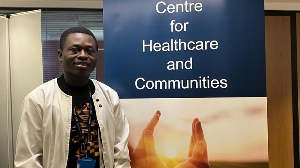
Ghanaian nurse making waves in the UK, Ebenezer Akore Yeboah, has been celebrated for his groundbreaking research on reducing carbon emissions within the National Health Service (NHS).
The accolade, bestowed by the UK government, recognizes Yeboah’s dedication to environmental sustainability in healthcare.
Yeboah’s doctoral research, spotlighted by the BBC, delved into strategies to curb the NHS’s carbon footprint.
His study revealed that a significant portion of England’s carbon emissions—around 4%—stemmed from NHS activities.
By addressing issues like single-use plastic waste, efficient waste management, and energy consumption, Yeboah’s work underscored the vital role healthcare professionals play in combating climate change.
At his post in University Hospitals Coventry and Warwickshire, where he serves as an emergency department nurse and a PhD researcher at Coventry University, Yeboah engaged in a global study involving 500 individuals across 56 nations.
His efforts earned recognition from the Royal College of Nursing (RCN), culminating in an invitation to an international conference.
Reflecting on his journey, Yeboah expressed gratitude for the opportunities afforded in the UK. “It’s been a beautiful journey—the UK is a land of opportunity,” he remarked. “In Ghana, I read about the RCN in textbooks, and now I’m part of it and have won a national award.”
“When people are displaced by situations created by climate change, health professionals are the ones to look after them and when we are doing that we are adding to the carbon footprint,” he is quoted to have said by the BBC.
“It’s been a beautiful journey – the UK is a land of opportunity when I look at how much I’ve been able to achieve in just over two years.”
He added, “In Ghana, I read about the RCN in textbooks and now I’m part of it and have won a national award”.
His work not only highlights the importance of sustainability in healthcare but also advocates for comprehensive training and eco-conscious practices among healthcare providers.
The head of a major nursing organization has expressed concern about the recruitment of nurses from poorer nations by high-income countries.
The comments come as the BBC finds evidence of how Ghana’s health system is struggling due to the “brain drain”.
Many specialist nurses have left the West African country for better-paid jobs overseas.
In 2022 more than 1,200 Ghanaian nurses joined the UK’s nursing register.
This comes as the National Health Service (NHS) increasingly relies on staff from non-EU countries to fill vacancies.
Although the UK says active recruitment in Ghana is not allowed, social media means nurses can easily see the vacancies available in NHS trusts. They can then apply for those jobs directly. Ghana’s dire economic situation acts as a big push factor.
Howard Catton from theInternational Council of Nurses (ICN) is concerned about the scale of the numbers leaving countries like Ghana.
“My sense is that the situation currently is out of control,” he told the BBC.
“We have intense recruitment taking place mainly driven by six or seven high-income countries but with recruitment from countries which are some of the weakest and most vulnerable which can ill-afford to lose their nurses.”
The head of nursing at Greater Accra Regional Hospital, Gifty Aryee, told the BBC her Intensive Care Unit alone had lost 20 nurses to the UK and US in the last six months – with grave implications.
“Care is affected as we are not able to take any more patients. There are delays, and it costs more in mortality – patients die,” she said.
She added that seriously ill patients often had to be held for longer in the emergency department due to the nursing shortages.
One nurse in the hospital estimated that half of those she had graduated with had left the country – and she wanted to join them.
‘All our experienced nurses gone’
The BBC found a similar situation at Cape Coast Municipal Hospital.
The hospital’s deputy head of nursing services, Caroline Agbodza, said she had seen 22 nurses leave for the UK in the last year.
“All our critical care nurses, our experienced nurses, have gone. So we end up having nothing – no experienced staff to work with. Even if the government recruits, we have to go through the pain of training nurses again.”
Smaller clinics are also affected by staff migration because even one nurse leaving a small health centre can have a large knock-on effect.
At Ewim Health Clinic in Cape Coast, one nurse has left their small emergency department and another has left the outpatient unit. Both nurses were experienced and had found jobs in the UK.
The chief doctor there, Dr Justice Arthur, said the effects were enormous.
“Let’s take services like immunisation of children. If we lose public health nurses, then the babies that have to be immunised will not get their immunisation, and we are going to have babies die,” he told the BBC.
He said adult patients would also die if there were not enough nurses to look after them after surgery.
Most of the nurses that the BBC team spoke to wanted to leave Ghana due to the fact they could earn more elsewhere.
At Kwaso healthcare centre near the city of Kumasi, Mercy Asare Afriyie explained that she was hoping to find a job in the UK soon.
“The exodus of nurses is not going to stop because of our poor conditions of service. Our salary is nothing to write home about and in two weeks you spend it. It’s from hand to mouth.”
Ghanaian nurses told the BBC that in the UK they could get more than seven times what they are receiving in Ghana.
Perpetual Ofori-Ampofo from Ghana’s Nurses and Midwives Association said her country’s healthcare system needed more help.
“If you look at the numbers, then it is not ethical for the UK to recruit from Ghana because the number of professional nurses compared to trainee or auxiliary nurses is a problem for us,” she said.
But she added that it was not possible to stop nurses from leaving as migration was a right and that the Ghanaian government needed to do more to persuade them to stay. The health ministry in the capital, Accra, declined to comment.
Fewer nurses in Ghana means that critical care for patients there is being affected, medics say
Ghana is on the World Health Organization’s list of 55 vulnerable countries, which have low numbers of nurses per head of population. The list – dubbed by some as the “red list” – is designed to discourage systematic recruitment in these countries.
The UK government recently gave £15m ($18.6m) to Ghana, Nigeria and Kenya to help boost their healthcare workforces.
But the country is known to be looking at brokering a formal deal with Ghana whereby it might be able to recruit more proactively in return for giving the government there a sum of money per nurse.
It already has a similar agreement with Nepal.
But the ICN’s Mr Catton questioned whether it was enough.
He told the BBC that he believed such deals were “trying to create a veneer of ethical respectability rather than a proper reflection of the true costs to the countries which are losing their nurses”.
The WHO’s Director of Health Workforce, Jim Campbell, explained to the BBC that Brexit had been a factor in the UK turning to African countries for nurses to fill NHS vacancies.
“The labour market is extremely competitive around the world and, having closed off the potential labour market from European freedom of movement, what we’re seeing is the consequences of that in terms of attracting people from the Commonwealth and other jurisdictions.”
In her later years, Princess Diana opened up about her struggles with an eating disorder.
She previously told a royal biographer she began experiencing bulimia following her engagement.
A new royal book claims that by the time of her honeymoon, Diana’s wedding ring was too big for her.
Princess Diana‘s struggle with bulimia took such a toll after her wedding that her ring had to be adjusted following her honeymoon, according to a new book.
Valentine Low, a Times of London royal correspondent, authored “Courtiers: The Hidden Power Behind the Crown,” which was released in the UK on Thursday. In the book, he traces the modern history of the royal family through the lens of courtiers, a term used for the people working within each royal household.
In the chapter “Growing Up,” Low covers the experience of Michael Colborne, a private secretary who worked for Charles and Diana early into their marriage. Colborne, the author wrote, witnessed not only the “disintegration” of the couple’s marriage, which began after their 1981 wedding but the beginning of Diana’s struggle with bulimia nervosa, an eating disorder.
According to Low, Charles had summoned Colborne to Balmoral, Scotland, where he and Diana spent some time following their tumultuous two-week honeymoon in 1981. It was there that Low wrote Diana opened up to the private secretary about how unhappy she was and, after an argument between her and Charles, that the prince threw her wedding ring at him.
“Colborne heard Charles and Diana having a massive row. Then Charles suddenly appeared, and threw something at Colborne: it was Diana’s wedding ring, which Colborne somehow managed to catch,” the author wrote.
“Diana had lost so much weight that it no longer fitted and needed to be adjusted,” he added.
Diana’s ring required an adjustment soon after their wedding in July 1981. David Levenson/Getty Images
Then 20 years old, Diana had already shown signs of her condition for months. The UK’s National Health Service describes it as an eating disorder and mental health condition which involves the individual eating “a lot of food in a very short amount of time (binge eating) and then making themselves sick” in order to prevent weight gain.
According to Andrew Morton’s 1992 biography, based on confession tapes recorded by the princess, Diana’s condition began before her wedding to Charles.
“The bulimia started the week after we got engaged and would take nearly a decade to overcome,” she said on the tapes, according to Vogue. “My husband put his hand on my waistline and said: ‘Oh, a bit chubby here, aren’t we?’ and that triggered off something in me.”
Her wedding ring is also not the only item to have been sized down due to her struggle with bulimia. As Vogue also reported, her wedding dress designer said when they began fittings for the big day, Diana’s waist measured between 26 to 27 inches. But by her wedding in July 1981, her waist dropped to 23 inches.
During a keynote address in 1993, she opened up public discourse surrounding eating disorders and touched on how they can affect an individual’s overall health.
Users trying to access their pass via the NHS app and website on Thursday were told it was unavailable.
“We are sorry the NHS Covid Pass is currently unavailable,” a message read.
“At this time there is no alternative route for accessing this information via the NHS App or online.
“If you have already downloaded the information then your access should not be affected.”
The requirement to show a pass to enter certain venues and events in the UK was scrapped earlier this year.
However, some countries still require travelers to show they have been vaccinated before allowing them to enter.
On social media, some holidaymakers said they had been unable to check in at airports because they were unable to prove their vaccination status.
NHS Digital tweeted: “We are aware of issues with availability of the NHS Covid Pass. We are investigating this urgently and will provide an update as soon as possible.
“We apologize for any issues this may cause and appreciate your patience as we work to resolve it.”
The cost of living crisis could spark a “public health emergency” and lead to a rise in excess winter deaths unless the government takes action to help people with rising energy costs, health chiefs have warned.
Families are looking ahead to a grim winter as experts predict the cap on energy bills will hit close to £3,600 per year from October – before rising again in April next year.
Surging prices mean people will have to choose between skipping meals to heat their homes or living in poor conditions, the National Health Service(NHS) Confederation said in a letter to ministers.
This will inevitably lead to more people falling ill and seeing their health deteriorate.
The body, which represents NHS leaders across England, Wales and Northern Ireland, also warned rising rates of poverty will lead to increased hospital admissions as well as a huge increase in demand on other parts of the NHS, placing front-line services and staff under “intolerable pressure”.
“If people cannot afford to heat their homes sufficiently and if they cannot afford nutritious food, then their health will quickly deteriorate,” the health chiefs wrote.
“This will increase the already high number of annual deaths associated with cold homes – estimated at around 10,000 a year.