In response to a recent direction from the National Communications Authority (NCA) about the ongoing SIM re-registration process, the Ghana Chamber of Telecommunications announced that it will abide by the directive.
In a statement, theChamber said its members have been blocking services of subscribers who have not completed both stages of the SIM registration process as directed by the Ministry of Communications and Digitalisation since November 2022.
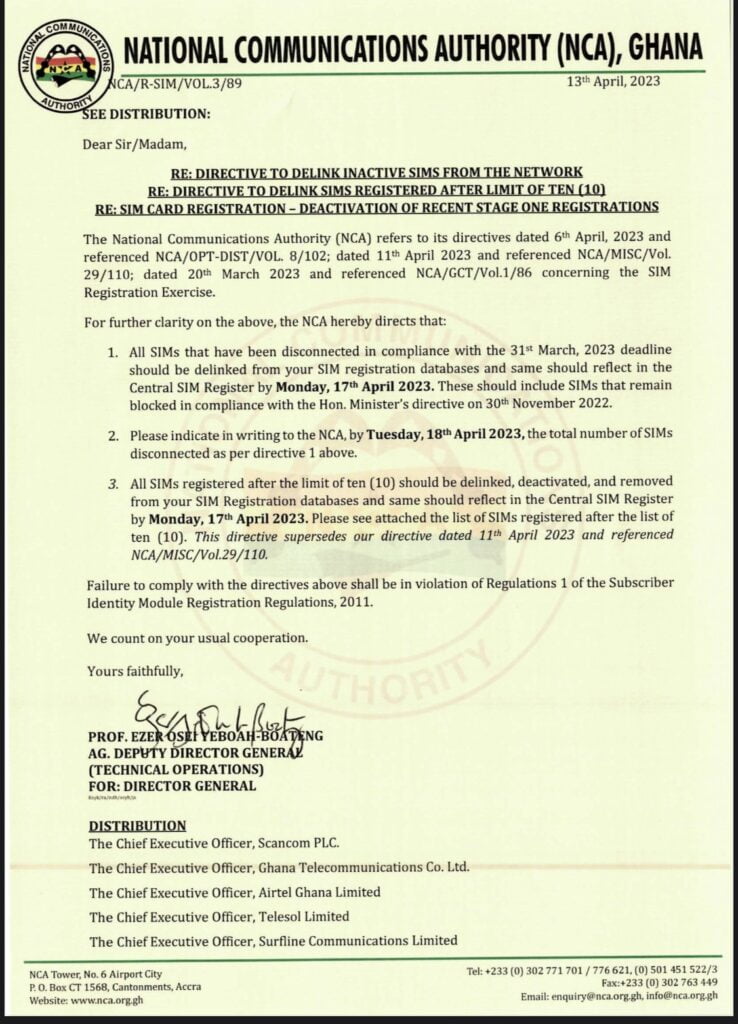
The NCA in a statement dated April 13, 2023, directed that all disconnected SIMs must be delinked from all databases by April 17, 2023.
This includes SIMs blocked in November 2022 for failing to complete both stages of the SIM registration process.
Additionally, all SIM cards registered after the limit of 10 per individual will be delinked, deactivated and removed from all databases by Monday, April 17, 2023.
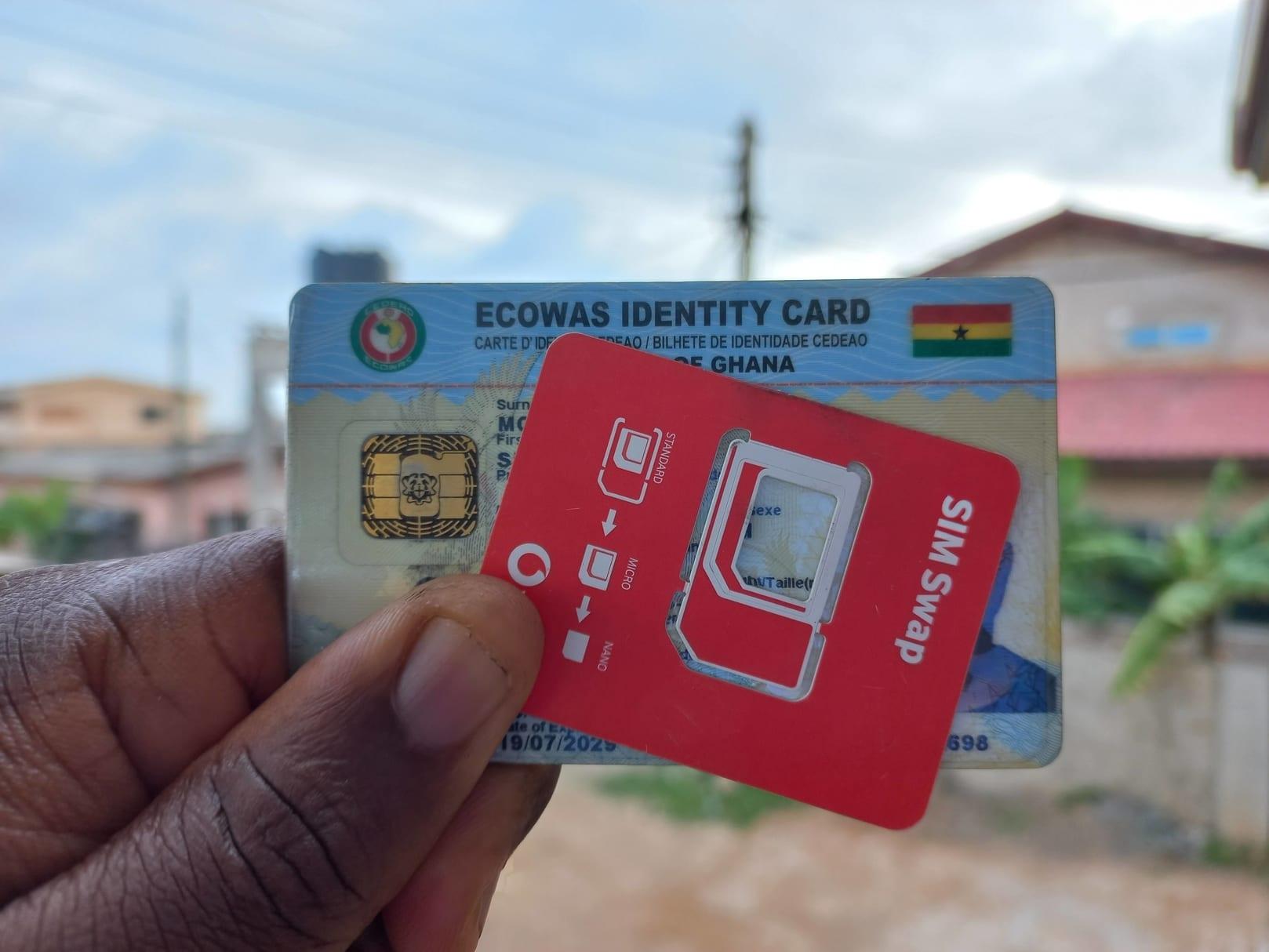
The Chamber of Telecommunication is thus encouraging subscribers who have acquired Ghana cards but are yet to complete registration to do so before April 17, 2023.
It also urged subscribers with more than 10 SIMs registered to themselves to verify their SIMs on record at their nearest mobile network operator’s service centres urgently.
Furthermore, the Chamber stated that its members are obligated to completely deactivate all impacted subscriber SIMs which have not completed the registration by the said date without any further notice or extension of time for subscribers.
“It is crucial that the networks’ cherished customers are not barred from using voice, data, USSD, mobile money services and continue to have access to emergency and other important services.”
The Chamber added that subscribers with Ghana cards could avoid inconvenience by completing stage 2 (the biometric capture) of the registration process.
It emphasized that since the start of the SIM Registration Exercise, the members of the Chamber have invested heavily in arrangements to ensure that subscribers who have their Ghana cards and are ready to register, get registered at any of our several touchpoints across the country.
“For those that require special assistance to carry out the registration exercise, they are advised to contact their service provider.”
“Our members remain committed to supporting the efforts of all stakeholders to ensure that every customer in every part of the country is able to register their SIM card(s) with the Ghana card.”
The National Communications Authority (NCA) has instructed telecom companies to ensure that all SIM cards that have been disconnected are deleted from the registration databases.
The SIMs removed from the databases of the various network according to the NCA should reflect in the Central SIM Register by Monday, April 17, 2023.
The NCA’s directive, which provides clarity on earlier directives dated 6th April 2023, 11th April 2023, and 20th March 2023, stipulates that this should include SIMs that remain blocked in compliance with the Communication Minister’s directive on 30th November 2022.
Telecom operators have also been instructed to provide in writing to the NCA by Tuesday, 18th April 2023, the total number of SIMs disconnected in compliance with the directive.
Furthermore, the NCA has directed that “all SIMs registered after the limit of ten (10) must be removed from SIM registration databases and deactivated, with the same reflected in the Central SIM Register by Monday, 17th April 2023.”
The NCA has stressed that non-compliance with these directives would be in violation of Regulation 1 of the Subscriber Identity Module Registration Regulations, 2011.
“We count on your usual cooperation,” the NCA added.
The National Communications Authority (NCA) has announced to the Ghanaian public that it is coming out with a short code for individual subscribers to verify the number of SIM cards associated with a Ghana card.
The NCA is introducing a short code to prevent subscribers from trooping into the offices of telcos to verify the number of SIM cards associated with a Ghana card.
This comes after reports that SIM cards linked to peoples’ Ghana Cards are on the rise.
On its Facebook page on Tuesday, April 11, 2023, the NCA indicated that the short code will be operational by the end of April 2023.
This is because testing by telecommunications service providers is yet to be completed and approved.
“The NCA and the Telcos have already been actively working on a short code for Individual Subscribers to verify the number of SIMs associated with a Ghana card; you just type the short code on your phone, and after a verification process using your Ghana card pin, the number of SIMs associated with the Ghana card will be displayed,” a part of the statement read.
Currently, all SIM cards that have not been re-registered with a Ghana card have been blocked from receiving voice and data services.
The Ministry of Communications and Digitalisation began the SIM re-registration exercise in October 2021 as part of efforts “rid the country’s cyberspace of fraud, monitor and track down persons who use their phones for criminal activities.”
On March 31, 2023, subscribers who had linked their Ghana cards to their SIM cards but failed to complete the re-registration process had their SIMs disconnected.
About eight million Ghanaians are likely to have their SIM cards disconnected by March 10, 2023, if they have not completed their SIM card registration, accordingto a statement by the National Communications Authority (NCA) issued on Monday, February 27, 2023.
The disconnection will be in line with a directive issued by the Minister for Communications and Digitalisation, Ursula Owusu Ekuful, on November 30, 2022.
“The National Communications Authority (NCA) wishes to remind subscribers who have completed stage one (1) but not stage two (2) of their SIM registration, as part of the ongoing SIM registration exercise, to immediately do so or risk having their SIMs disconnected after 10th March 2023,” said the NCA statement.
On February 9, 2023, the Communications Minister, Ursula Owusu Ekuful, revealed in Parliament that the total number of people who had completed stage 1 of the registration, i.e., linking their Ghana Card to their SIMs, was 33,793,132, representing 79.60% of the total number of SIM cards in Ghana.
The number of unregistered SIM cards, i.e., those who had not attempted to link their Ghana Card to their SIMs, was 8,658,164, representing 20.40%.
The number of people who had completed the process of SIM registration, i.e., stage 2 (Biometric Capture), was 25,150,522, representing 59.25%, and the number of unregistered SIM cards under stage 2 was 17,300,774, representing 40.75%.
According to the NCA, there have been additional subscribers who have completed stage one of the registration process but are yet to conclude with the final stage.
The statement also noted that subscribers who begin the registration process (stage 1) and fail to complete their registration within a period of 2 weeks will have their SIM cards deactivated from their networks.
The NCA urged subscribers who are in the stage 2 process to complete registration by March 10, 2023.
The Communications Authority also highlighted the importance of the SIM card registration exercise, stating that it is aimed at developing and building a SIM database with integrity, which will assist in curbing fraudulent activities.
“To reiterate, the importance of the SIM card registration exercise is to develop and build a SIM database with integrity, which will assist in curbing fraudulent activities.
The NCA continues to urge all subscribers to complete their SIM card registrations with their Ghana Cards to avoid deactivation,” the statement added.
The NCA began the re-registration of SIM cards in October 2021 across the country to develop and build a SIM database with integrity, which will assist in curbing fraudulent activities.
Network subscribers who thronged theMTN office at Achimota Mall in Accra to register their SIM cards on Monday morning were unable to so.
The office of the telecommunication giant remained closed as at 10am.
Hundreds of subscribers whose SIM cards have been deactivated gathered in front of the office to register their SIMS in order to make and receive calls, as well as access data and SIM services.
MTN has deactivated the SIM cards of over 5 million subscribers.
As of November 26, 22,112,943 MTN Ghana subscribers had successfully linked their Ghana card to their SIM cards (Stage 1), while 16,411,794 had successfully completed the bio-capture phase (Stage 2).
On December 1, 2022, the National Communications Authority (NCA) deactivated the SIM cards of subscribers who had linked their Ghana card to their SIM cards but had failed to complete the biometric data registration.
According to the Ministry of Communications, these SIMs have been blocked because these individuals have deliberately refused to register their SIM cards despite having the Ghana card.
Meanwhile, the NCA has revealed that persons who have not commenced the process of registering their SIMS or do not have the Ghana card will not have their SIM cards deactivated.
A Russian businessman has been arrested at his multi-million-pound London home by officers investigating potential criminal activity by oligarchs.
The man, 58, was held on suspicion of money laundering, conspiracy to defraud the Home Office and conspiracy to commit perjury.
A 35-year-old man was arrested on suspicion of money laundering.
He was also arrested for obstructing an officer when trying to leave with a bag containing thousands of pounds in cash.
A third man, 39, who is the former boyfriend of the businessman’s current partner, was arrested at his home in Pimlico, central London, for offences including money laundering and conspiracy to defraud.
The National Crime Agency (NCA) said more than 50 officers from its Combatting Kleptocracy Cell were involved in the operation at the businessman’s property, where a number of digital devices and a significant quantity of cash was seized following a search.
Graeme Biggar, director general of the NCA, said the unit, which was established this year, was having “significant success investigating potential criminal activity by oligarchs”.
He added: “We will continue to use all the powers and tactics available to us to disrupt this threat.”
All three of the arrested men, who have not been named by the NCA, have been released on bail.
The NCA said it was the latest operation carried out as part of its efforts to disrupt the activities of corrupt international business figures and their enablers.
Almost 100 “disruptions” – actions that remove or reduce a criminal threat – have been carried out against Putin-linked elites and their enablers, including account freezing orders (AFOs) over accounts held by people closely linked to sanctioned Russians, according to the NCA.
The ongoing SIM deactivation would not affect anyone who have not yet received their Ghana Cards, according to the National Communications Authority (NCA).
According to a statement made on Wednesday by the Ghana Chamber of Telecommunication, some services would be cut off for users who did not finish the biometric registration step.
Voice, data (mobile, phones, mifis, and other data-providing devices), SMS (incoming and outgoing), USSD, mobile money services, and emergency services are among the services that will be blocked.
However, Nana Defie Badu, the NCA’s Director for Consumer & Corporate Affairs, stated that those who have not yet received their Ghana Cards will be excused.
“For those who did not have their Ghana cards and have not been able to register, those people will be exempt from any punitive measures pending the NIA giving them their Ghana card,” she disclosed on JoyNews on Thursday.
She continued by saying that the reason the NCA had been established was to assist in addressing the general public’s worries regarding their incapacity to register SIM cards.
“We acknowledge that there are some people who actually did the stage where they actually linked the sim to the Ghana card but unfortunately, after doing that their Ghana card were either lost, damaged or through no fault of theirs, they could not proceed to do stage two.
“So, for these people, we have actually asked that they should engage the NCA by calling our toll-free number. After we do an investigation and verify the issue, these people will also be put on the exclusion list pending them getting their Ghana cards reissued to them,” she told the host.
Meanwhile, AirtelTigo has announced that all SIM cards that are not fully registered on its network as of November 30 2022, will be blocked from accessing all services.
Customers who have successfully linked their SIM cards to their Ghana Cards but have not undergone biometric capture will effectively have all partially registered SIM cards blocked from making and receiving calls, accessing the internet and mobile money services, sending and receiving SMS, and other services.
In the next 24 hours, approximately six million network subscribers who have only linked their Ghana card and SIM card would be debarred from making or receiving calls, as well as data and SMS services.
These individuals have failed to complete the biometric stage before the fourth deadline extension of the SIM card re-registration exercise elapses.
On its part, telecommunication giant, MTN, has noted that it will deactivate 5,701,149 subscribers on December 01, 2022.
The deactivation of SIM cards forms part of measures introduced by the Ministry of Communications and Digitalisation to ensure all SIM cards are re-registered in the country.
In a statement issued on Friday, November 11, Communications Minister, Ursula Owusu-Ekuful, mentioned that SIM card registration will help minimise fraudulent activities.
The SIM re-registration exercise which commenced in October 2021 was expected to end on July 31, 2022.
However, it was extended to September 30 to allow Ghanaians link their SIM cards to their Ghana Cards.
The deadline was again extended for the third time [October 31] due to the low number of re-registered SIM cards.
With several complaints about long queues at the premises of network providers, a self-serving registration app was launched to assist individuals to register in the comfort of their homes at a cost of GH5.
Yet, the numbers of registered SIM cards were not encouraging. As such, the NCA in September blocked outgoing calls for a sequential batch of numbers for 2 days.
The Ministry in a press conference noted that defaulters of the SIM card registration exercise will be blocked on Sunday, October 31, 2021.
However, after the October 31 deadline, unregistered SIM card holders continue to make and receive calls, as well as enjoy data and SMS services.
Currently, a total of 30,011,082 SIM cards have been linked to Ghana Cards, thereby completing the first phase of the registration process.
As of November 9, 20,892,970 subscribers had completed both the linkage and capture of their biometric data.
Meanwhile, the National Communications Authority (NCA) has disclosed that individuals whose SIM cards will be blocked will be given a six-month grace period to reclaim their SIM cards after registering.
Unregistered SIM cards after the six-month grace period will be churned out.
Nevertheless, it is unknown what will happen to individuals who have not begun the registration exercise due to the unavailability of a Ghana card since the
communications ministry did not factor them in their recent communique.
The National Communications Authority (NCA) yesterday inaugurated a new Broadcasting Monitoring Centre (BMC) in Accra to help monitor broadcast content in the country.
The BMC would help improve the NCA’s capability to fully monitor the Broadcasting sector and also expand its Broadcast Monitoring System (BMS).
NCA in line with its mandate under section 62 of the Electronic Communications Act 2008, Act 775, is clothed with the power to monitor the quality of service of television and FM radio broadcasting services.
The Board Chairman of NCA, Mr Isaac E. Osei-Bonsu (Jnr), said the BMC would “provide a classic example of how the provision of systems or solutions by one Agency could be useful and critical for the other Agencies.”
He said the BMC would provide information to the various agencies when needed for investigations, and verification, and provide a digital plug for the recording and storing of broadcasting content in a digital manner and format.
“Again, the BMC also shows how State Agencies can collaborate and harness each other’s systems, solutions and data to impact on their delivery without having to face obstacles or hurdles when sourcing for information critical to their work.”
“This is also the concept that the SIM Database or Registry is also intended to take. While the BMC and the SIM Registry will make it easy for State Agencies to access information or data, the difference is that State Agencies will have to provide the relevant court orders to have access to SIM Related data to protect the subscriber and to comply with the tenets of the Data Protection Act whereas information from the BMC will require no such requirements, given that the content has already been published in the public domain,” he said.
Mr Osei-Bonsu (Jnr) said until 2018, monitoring the quality of broadcasting services required human intervention which was phased out due to the implementation of the BMS system.
The Director General, of NCA, Mr Joe Anokye, said“In 2021, there was widespread public concern about the negative repercussions of the ritualists’ contents of television stations that entertained spiritualists as well as charlatanic advertisements which mislead large sections of the public,” he said.
That, he said, prompted the stakeholders to brainstorm ideas and ways in dealing with the issue.
He said the NCA last year signed a Memorandum of Cooperation with the National Media Commission to regulate Broadcast Content which had helped in establishing the BMC to provide the required technical support for the objectives of the Memorandum of Cooperation.
Mr Anokye said the new system had 16 satellite receivers and monitors, all 13 satellites providing Free to Air (FTA) satellite TV services over the territory.
The Executive Secretary of NMC, Dr. George Sarpong, commended NCA for setting up the BMC and was optimistic that it would help promote the broadcasting of goon content to accelerate national development.
General Jurisdiction High Court presided over by Justice Charles Edward Ekow Baiden, has dismissed an application filed by nine Ghanaian citizens against the Attorney General (AG) and the National Communications Authority (NCA), seeking judicial review in the nature of certiorari and an interlocutory injunction against the AG and NCA, from going ahead to implement the 30 September 2022, deadline for SIMCard re-registration in Ghana.
The application was premised on the argument that the applicants had applied for Ghana Cards at various times but were yet to receive their identity cards.
The Applicants assert that the issuance of the Ghana Card by the National Identification Authority (NIA) has been bedeviled with several challenges to the extent that the NIA has not been able to carry out its mandate as such, many Ghanaians could not register their SIM Cards at the close of exercise which even made the Respondents, the 2nd Respondent (NCA) in particular to grant an extension of the deadline.
The Applicants therefore argued that should the court allow the state and the NCA to stick to the re-registration deadline, they risked losing their SIM cards through no fault of theirs.
Reliefs sought
The nine applicants in the case are; Belynda Naa Odey Hammond, Jennifer Elorm Dzikunu, Charisty Mansah Afua N Ackotia, Nsor Sabasi, Josephine Annor Prempeh, Vida Delacy Kemevor, Regina Elkplim Dagadu, Irene Ayariga and Tracy Ashong. In their application filed on 22 September 2022, the applicants were seeking seven reliefs.
First, they sought a declaration that the impugned directive of the respondents requiring the applicants to re-register their mobile phone sim with the Ghana Card as the only identity document, at a time when the National Identification Authority had not been able to issue Ghana Cards to applicants, was in breach of Articles 21, 23 and 296 of the 1992 constitution of the Republic of Ghana, the National Communications Authority Act 2008 (Act 769), the Subscriber Identity Module Registration Regulation 2011 (LI 2006) and the National Identity Register Regulation 2012 (LI 2111) and so, to that extent, null and void.
Second, they wanted a declaration that the impugned directives of the respondents, on the use of the applicants’ mobile phone sim cards and network services, imposing punitive measures/sanctions commencing 5 September 2022, breach Articles 21, 23 and 296 of the 1992 constitution of the Republic of Ghana, the National Communications Authority Act 2008 (Act 769), the Subscriber Identity Module Registration Regulation 2011 (LI 2006) and the National Identity Register Regulation 2012 (LI 2111) and so, to that extent, were null and void.
Third, the applicants sought a declaration that the impugned directives of the respondents to applicants’ mobile telecommunication companies to block, disconnect, deactivate, churn and/or in any other way or manner limit the use of the applicants’ mobile phone sim cards and network services by 30 September 2022, at a time when there was no reasonable possibility of applicants receiving their Ghana Cards from the National Identification Authority on or before 30 September 2022 for the purpose of using the identity cards to register their sim cards, was unfair, unreasonable, contrary to law and to that extent, unenforceable.
Fourth, the applicants sought an order of the court in the nature of certiorari directed at respondents to bring before the court for the purpose of being quashed any order, decision, policy and/or directive issued to mobile telecommunication companies operating in Ghana to block, disconnect, deactivate, restrict and/or in any other way or manner limit the use of the applicants’ mobile phone sim cards and network services, unless applicants register or re-register the said sim cards on or before 30 September 2022.
Fifth, the nine applicants sought an order of the court in the nature of certiorari directed at respondents to bring before the high court for the purpose of being quashed any order, decision, policy and/or directive issued to mobile telecommunications companies operating in Ghana to impose punitive measures/sanctions against applicants’ mobile phone sim cards and network services during the period commencing 5 September 2022.
Sixth, they requested the court to issue an order of perpetual injunction restraining the respondents, whether acting by themselves or through agents, workmen, contractors and subcontractors, associates, as well as any and all such person or persons, from claiming and/or deriving authority through and/or under any or all of the respondents named in the application from imposing punitive measures. The potential sanctions included blocking, deactivating, restricting, churning and/or in any other way or manner limiting the applicants’ use of their mobile phone sim cards and network services.
The applicants desired the injunction to remain in place until such time as the National Identification Authority would make available to the applicants their Ghana Cards. Finally, they prayed the court to issue any further order, relief or reliefs as might seem just to it.
Court’s decision
In his decision, Justice Charles Edward Ekow Baiden, noted that “the Applicants admit that pursuant to Regulation 7 of L.I. 2111, the Respondents had the power to limit the national identity document required for the purpose of registering SIM Cards to the Ghana Card issued by the NIA”.
“I have carefully examined Exhibit “S”(NCA press release announcing the 30 September 2022 re-registration deadline) attached to the affidavit in support of this application.
“It sets out measures that may be applied to unregistered SIM Cards at the end of September 2022. Exhibit “S” does not satisfy legal standards to constitute a penal legislation within the meaning of Article 19 of the 1992 Constitution.
“To my mind therefore, the measures announced in the Exhibit “S” falls within the ambit of Section 3(a) of Act 769 which mandate the 2nd Respondent to “establish and monitor the implementation of standards and ensure compliance” Justice Baiden noted in his ruling.
“It seems to this Court that in its zeal to ensure compliance, the Respondents characterized Exhibit “S” as punitive measures which the Applicants have construed in its technical meaning.
“In the light of Articles 11(1)(D); 93(2); and 106 of the 1992 Constitution, this Court cannot share the view adopted by the Applicants that Exhibit “S” is intended to have effect as a penal legislation or that the Respondents exceeded their discretion when they issued out Exhibit “S”.
“For all the above reasons, I dismiss the application for judicial review in the nature of certiorari as without merit. For these same reasons, the application for interim injunction is also hereby dismissed. All parties shall bear their own costs” the High Court Judge ruled.
Representation
The Attorney General (1st Respondent) was represented in Court by assistant state attorney, Reginald Nii Odoi.
The 2nd Respondent, National Communication Authority (NCA), had Gary Nimako Marfo, as its legal representative and the nine applicants were represented by Gafaru Ali.
Telecommunications companies (Telcos) in the country have begun blocking SIMcards of mobile subscribers yet to register their SIM cards.
The exercise is in compliance with a recent directive from the Ministry of Communications and Digitalization. The telcos are AirtelTigo, MTN, and Vodafone.
“On November 11, 2022 the Ministry announced some measures to be implemented by Operators. Since the 20th of November 2022 our members have been blocking data services for all subscribers who have only completed stage 1 (linkage to Ghana Card) but not stage 2 (biometric capture) of the SIM registration process, as directed by the Ministry”, a statement from the Ghana Chamber of Telecommunications said.
“The Chamber is encouraging all subscribers who have acquired Ghana cards but are yet to complete stage 2 (biometric capture) to do so before November 30, 2022,” it added.
According to the Chamber, the telcos are obliged by the directive to completely deactivate all subscriber SIMs which have not completed the biometric capture registration step by the said date.
It however pointed out that customers of the networks are not barred from using voice, data, USSD, mobile money services and access to emergency services among others.
“Subscribers with Ghana cards can avoid this inconvenience by completing the registration process”.
The Chamber stated that since the start of the SIM registration exercise, telcos have invested heavily in arrangements to ensure that subscribers who have their Ghana cards and are ready to register, get registered at any of the several touchpoints across the country.
“For those that require some special assistance to carry out the registration exercise, kindly contact the NCA or your Mobile Network Operator. We are confident that the sector Ministry and NCA will announce measures to accommodate individuals who genuinely do not have Ghana cards, once ongoing consultations have been completed. Our members remain committed to supporting the efforts of all stakeholders to ensure that every customer in every part of the country is able to register their SIM card(s) with the Ghana card”.
The Chamber also urged all subscribers to note that all network services for those who have done only the first stage registration will be deactivated on the 30th of November 2022.
The Chamber of Telecommunications has bemoaned the costly nature of the sim registration exercise.
According to the Chief Executive of the Ghana Telecommunications Chamber, Ken Ashigbey, telecommunication companies have had to procure more devices and personnel to aid in the SIM registration process.
Speaking on the sidelines of the launch of the Mobile Industry Transparency Initiative, 2021 he said: “There are development costs that went into being able to put our systems in place to align with the NCA’s systems to be able to do the verifications, there’s an app we use that we pay for. Before the policy came in place, most of our agents were using feature phones to do registration but now for them to be able to do it, we need smartphones, so it cost a lot of money to be able to do that.”
“Then you have to recruit extra people needed to be able to do the exercise and we had to pay those people that we recruited and that is cost. The collaboration between the NCA and NIA needs to be stronger. We need to collaborate a lot more so that the verification processes will be tighter.”
Ashigbey added that when the NCA and NIA are able to collaborate effectively when anyone is “on the database, I don’t need to hold my card to be able to register.”
He, therefore, called on the NCA, the Ministry of Communications to hasten the process to end the registration and also make room for persons who are yet to register their SIM cards.
SIM cards that have been linked to Ghana Cards but not done the second phase of registration will be blocked from accessing data services on November 20 and completely deactivated on Wednesday, November 30, 2022.
The Communications and Digitalisation Minister, Ursula Owusu-Ekuful, announced this in a statement issued on Friday, November 11.
She said an announcement will be made on measures to accommodate persons who do not have Ghana Cards to register their SIM cards.
This is expected to take place after ongoing consultations have been completed, she noted.
Currently, a total of 30,011,082 SIM cards have been linked to Ghana Cards, thereby completing the first phase of the registration process.
As of November 9, 20,892,970 subscribers had completed both the linkage and capture of their biometric data.
“One key reason why some of those who have linked phone numbers to Ghana Cards have been unable to complete the bio capture of stage two is because they used other people’s cards to link their numbers. This includes vendors who used the cards of others without the knowledge or consent of the card owners,” the statement said.
“Their inability to complete phase two attests to the robustness of the authentication process designed into the SIM registration architecture. It will flush out all fakes. You cannot use someone else’s Ghana Card to register your SIM,” the Minister outlined.
Ursula Owusu-Ekuful asked subscribers facing challenges in registering their SIM cards to contact the National Communications Authority (NCA) or their respective network operators for necessary assistance.
According to her, the priority of the Communications Ministry is to ensure digital inclusion and to provide a secure environment for Ghanaians to access digital services.
“The Ministry has been working tirelessly on the development and implementation of policies to this effect. We can all attest to the fact that there has been a noticeable decline in SIM-related fraud since the commencement of the registration exercise.”
“Despite the ample opportunity afforded all to complete the registration of their SIM cards, some who have the Ghana Cards and have begun the process have failed to complete the registration. That is their choice and we cannot begrudge them,” the Minister added.
The National Communications Authority (NCA) has refuted claims made by Ningo-Prampram Member of Parliament Samuel Nartey George regarding the use of a voter’s ID card as a source of identification for SIM card re-registration.
Mr George, on Saturday, November 5, 2022, posted on his Facebook page that the Minister of Communication and Digitalisation had finally heeded calls to amend the guidelines for the SIM card registration exercise.
According to him, after several deliberations and consultations with stakeholders, the sector minister, Ursula Owusu Ekuful, directed Mobile Network Operators (MNOs) to accept voter ID cards as a document for registration.
Mr Sam George touted that “Our struggles have yielded success. We have had a breakthrough. I can reliably inform you that the Ministry of Communications and Digitalisation Ghana has finally seen wisdom in our position.”
“They have through the National Communications Authority Ghana directed the MNOs to accept the Voter’s ID Card as a document for the registration of our SIM cards. Finally, Ursula Owusu has given in to the power and will of the people. This is our collective victory,” he announced.”
The Ningo-Prampramlegislator who has been vocal about his displeasure with the sole documentation of the Ghana card in registering SIM cards, commended Madam Ekuful for amending the guidelines for the process.
However, the NCA, in a sharp rebuttal, noted that Mr Sam George’saccount is untrue.
The authority indicated in a statement that the Ghana Card remains the only identification document for the ongoing SIM card registration exercise.
“There is currently no medium for registration with Voter’s ID in the current SIM registration exercise; Ghana Card remains the only ID,” NCA clarified.
What was rather discussed at the technical meeting, according to NCA, was the possible update of the SIM registration app to allow temporary use of voter ID.
NCA noted that “the development effort will take several weeks, if not months, to complete – and the deep dive technical discussions on the integration effort with the MNOs/BWAs have not even been held.”
“A similar effort with passport integration has taken more than three months and counting and still not complete. If necessary, the general public will be duly informed when both integration efforts are complete as well as the modalities and conditions of use,” the NCA explained.
SIM card registration deadline
The SIM re-registration exercise, which commenced in October 2021, was expected to end on July 31, 2022.
However, it was extended to September 30 to allow Ghanaians to link their SIM cards to their Ghana Cards.
The deadline was again extended for the third time [October 31] due to the low number of re-registered SIM cards.
With several complaints about long queues at the premises of network providers, a self-serving registration app was launched to assist individuals to register in the comfort of their homes at a cost of GH5.
Yet, the numbers of registered SIM cards were not encouraging.
As such, the NCA in September blocked outgoing calls for a sequential batch of numbers for 2 days.
The Ministry in a press conference noted that defaulters of the SIM card registration exercise will be blocked on Sunday, October 31, 2021.
However, after the October 31 deadline, unregistered SIM card holders continue to make and receive calls, as well as enjoy data and SMS services.
More than 10 million network subscribers, who have not completed Stage 2 of the SIM card registration exercise, will have their SIMs blocked effective today, October 31, 2022.
“All SIM Cards that have been linked to Ghana Cards (i.e. completed Stage 1 registration), but have not completed their Stage 2 registration will be blocked from the end of October.”
Stage 1 involves linking one’s SIM card(s) with the Ghana Card while Stage 2 requires subscribers to verify biometrically either on the Ghana SIM Registration App or at the registration centres.
Communications and Digitalisation Minister, Mrs Ursula Owusu-Ekuful explained that this is because “these good people have the Ghana card (and) have started the process and (therefore) will be encouraged to complete it with this gentle reminder.”
The release signed by the Minister also clarified that the grace period provided was not an extension of the deadline “but a temporary moratorium to encourage these individuals to complete the process.”
Details from the Ministry go to imply that individuals who have not commenced the process of registering their SIM cards, possibly due to the absence of a Ghana Card, the sole identification document for the exercise, won’t be affected on Monday.
However, the “other unregistered SIMs will also be blocked progressively,” the statement added.
People whose SIMs will be blocked will be unable to make or receive calls, as well as access data and SMS services, until they register their SIM cards in 6 months time.
The SIM re-registration exercise commenced in October 2021. From then to October 4, 2022, 28,959,006 SIM cards have been linked to Ghana Cards (Stage 1 registration); representing 67.28% of the 42,749,662 total SIM cards issued nationally.
A total of 18,930,664 SIM cards have been fully registered (completed both Stages 1 and 2), representing 44.28% of the total SIM cards issued. This equates to 69.64% of all Stage 1 registrations.
“13,720,687 unique Counts of Ghana cards have been issued so far for the registration exercise,” the Ministry revealed.
Nine people filed a lawsuit in response to this and asked the court to prevent the NCA from enforcing any punitive measures or sanctions, including deactivating, restricting, churning, and/or otherwise limiting their use of mobile phone SIMs and network services, until the case is resolved.
They argue that it would be unfair for SIMs to be blocked as the National Identification Authority (NIA) has been unable to issue out all Ghana cards to their respective holders.
The NIA has so far issued 15,826,148 Ghana cards out of the 16,627,325 printed cards from 17,109,627 registrations as of the end of August this year.
The National Communications Authority (NCA) has urged the Accra High Court to dismiss a suit seeking to stop the regulatory body from blocking the SIM cards of people who fail to register them with Ghana Cards by September 30, 2022.
The nine applicants wanted the court to put an injunction on the NCA on the basis that they had registered for Ghana Cards but were yet to get them from the National Identification Authority (NIA) in order to register their sims.
However, the NCA, in its affidavit in opposition filed Thursday, September 29, 2022 argues that the suit is incompetent because the Ghana Cards of the applicants were ready but they had failed to collect them from the NIA.
According to the NCA, a search conducted by the NIA upon request by the NCA, through its lawyer, Gary Nimako Marfo, revealed that the Ghana Cards of the applicants had been printed but they had failed to pick them up.
“It is clear that the applicants have been indolent and have not taken any positive steps to collect their Ghana Cards from the National Identification Authority,” the NCA argued.
It is also the case of the NCA that the suit was failed to invoke the jurisdiction of the court because the affidavit in support of the applicants’ case was not sworn before a commissioner of oath as required by the rules of court.
Reliefs
In their application filed on September 22, 2022, the applicants were seeking seven reliefs.
First, they sought a declaration that the impugned directive of the respondents requiring the applicants to re-register their mobile phone sim with the Ghana Card as the only identity document, at a time when the National Identification Authority had not been able to issue Ghana Cards to applicants, was in breach of Articles 21, 23 and 296 of the 1992 constitution of the Republic of Ghana, the National Communications Authority Act 2008 (Act 769), the Subscriber Identity Module Registration Regulation 2011 (LI 2006) and the National Identity Register Regulation 2012 (LI 2111) and so, to that extent, null and void.
Second, they wanted a declaration that the impugned directives of the respondents, on the use of the applicants’ mobile phone sim cards and network services, imposing punitive measures/sanctions commencing 5 September 2022, breach Articles 21, 23 and 296 of the 1992 constitution of the Republic of Ghana, the National Communications Authority Act 2008 (Act 769), the Subscriber Identity Module Registration Regulation 2011 (LI 2006) and the National Identity Register Regulation 2012 (LI 2111) and so, to that extent, were null and void.
Third, the applicants sought a declaration that the impugned directives of the respondents to applicants’ mobile telecommunication companies to block, disconnect, deactivate, churn and/or in any other way or manner limit the use of the applicants’ mobile phone sim cards and network services by 30 September 2022, at a time when there was no reasonable possibility of applicants receiving their Ghana Cards from the National Identification Authority on or before 30 September 2022 for the purpose of using the identity cards to register their sim cards, was unfair, unreasonable, contrary to law and to that extent, unenforceable.
Some nine residents in the Ningo-Prampram Constituency have filed an interlocutory injunction to restrain the National Communications Authority (NCA) from implementing punitive measures against unregistered SIM card subscribers.
The NCA has said network subscribers who default will not have access to any services, as their SIMs will be deactivated after September 30, 2022. In a writ shared by Member of Parliament for the area, Sam Nartey George, on Tuesday, the applicants want the High Court of Justice to restrain the “blocking, deactivating, restricting, churning and/ or in any other way or manner limiting the Applicants’ use of their Mobile Phone SIM Cards and Network Services until the complete and final determination of the substantive application for judicial review.”
“Subscribers will have a period of six months to register to redeem their SIMs, failing which their numbers will be churned – that is, re-assigned to the pool to be sold to potential new subscribers,” the Authority added in its statement dated September 4, 2022.
Mr George, speaking to the media, explained that the applicants have been deprived of their Ghana cards despite registering with the National Identification Authority, thus the need to seek legal redress as their current situation is no fault of theirs. “These are citizens who have complied with the directive and taken every reasonable step to get registered. Whatever is left is outside their control. Either for the NIA to provide them with the card that they have registered for,” he worriedly revealed.
“Some registered as far back as 2019, and they still haven’t received their cards. Others have registered, and the NIA has asked them to come for it in December. So in this case, they can’t do anything except what they have done,” he added.
The major challenge affecting the ongoing SIM card re-registration exercise has been registrants not receiving their Ghana Card promptly after registration. This is because the national identification authority issued card is the sole identification document for the SIM card re-registration exercise.
On July 31, 2022, Mrs Ursula Owusu-Ekuful, Minister for Communications and Digitalization, “reluctantly” extended the SIM card registration deadline for a second time to September 30, 2022, with conditions. Mrs. Owusu-Ekuful acknowledged that the government was having difficulties with the exercise because of the delays in the issuance of the Ghana card during a press conference to announce the extension.
“Upon consultation with the industry and in view of the challenges enumerated above, I have very reluctantly decided to grant a conditional extension. The programme will be extended to September 30th to end on the anniversary of its commencement, “she said.
Delays in the issuance of the Ghana card was the largest challenge bedevilling this exercise. My information is that the NIA has not been able to issue all eligible
persons with the Ghana card,” she explained.
Due to the challenges it is facing, the NIA has said it will be unable to register all Ghanaians before the September 30th deadline. “We cannot do that. There is no way that the NIA can register those people. It is technically, physically impossible. We had said way back in March that it was impossible. I have said it is like expecting a maiden to make a baby every three months,” Executive Secretary of the NIA, Professor Kenneth Agyeman Attafuah, told the press on Friday, September 16, 2022.
Some Ghanaians have challenged the Authority to implement its initiatives as planned in light of public concerns regarding the sanctions implemented by the
NCA. The Communications Minister, in rebuttal to the numerous public concerns, has however, advised mobile network subscribers “not to blame your service provider” for the sanctions yet to be implemented, stating that “to be forewarned is to be forearmed”.
The National Communications Authority (NCA) and the Cyber Security Authority (CSA) have reaffirmed their commitment to work together to develop cybersecurity in the Country.
The two institutions led by their respective Director-Generals met on 5th April 2022 at the NCA Tower in Accra to discuss how to collaborate towards the successful collaboration of the Cybersecurity Act, 2020 (Act 1038) which was assented into law on 29th December 2020.
The Directors recognized the importance of securing the Critical Information Infrastructure (CII) and ensuring a safe online experience for citizens as the adoption of internet technology in Ghana is increasing at very fast pace.
The two institutions have been collaborating in several areas since 2017 towards the development of cybersecurity in Ghana; these collaborative efforts, among others, have been recognized by the International Telecommunication Union (ITU) and Ghana was scored 86.69% in the latest Global Cybersecurity Index (GCI), a major progress from previous ratings in 2017 and 2018 which were 32.6% and 43.7% respectively.
The Directors thus reaffirmed their commitment to collaborate in order to improve upon this rating and ensure a safe and secure digital ecosystem in Ghana.
After successful deliberations, recommendations, suggestions, they agreed to collaborate more closely on the following critical areas and to provide each other with all the necessary assistance for the performance of their functions:
1. Hold joint discussions with various designated (CII) owners and come up with sector-specific directives to serve as guidelines for the protection of these CIIs.
2. Collaborate in the area of capacity building of the staff of both institutions to ensure that the personnel have fundamental knowledge and appreciation of cybersecurity. These capacity building projects may include exchange programmes, technical workshops, and consultations.
3. Work together to determine a minimum certification as baseline requirements for Computer Emergency Response Team staff in both institutions.
4. Collaborate in the area of awareness creation and public education on critical national issues, technology usage, cybersecurity, cybercrime and related matters.
5. Adopt a multi-stakeholder engagement approach through partnerships to enhance stakeholder-knowledge on the law and to create a cooperative environment to support law enforcement and build capacities among various sectors.
The National Communications Authority (NCA) has stated that there have so far been 13,676,648 SIM Cards successfully linked to the Ghana Card system.Â
This number is the total number of subscribers who have completed their registration process using the *404# platform. Â
Also, the Authority said that there has also been a total of 9,744,071 completed SIM Card registrations in the country.Â
This figure, a photo statement shared by the NCA on its Twitter handle said, are those who have fully completed their SIM registrations in the country.Â
All these figures were however as of March 11, 2022, it added.Â
According to the Minister of Communication, Ursula Owusu-Ekuful, the re-registration of SIM cards is to monitor and track down persons who use their phones for criminal activities.Â
This is to end the rising cybercrime issues in the country.
With the first stage of the registration process, you will have to link the SIM card to the Ghana Card via USSD (*404#).
For stage 2, you visit your service provider (agent or customer care) to complete this stage of the registration.
People who fail to re-register their SIM cards will have them blocked, the communication minister noted.
Governance expert, Dr. Benjamin Otchere-Ankrah has given rapturous applause to the National Communication Authority (NCA) regarding their move to shut down some Television stations.
NCA Shuts Down TV Stations
The National Communications Authority (NCA) has released a list of forty-nine (49) Television stations operating without authorization and announced its mission to shut them down.
The NCA stated in a press release that the move is part of a continuous monitoring exercise conducted on various Satellite Free-to-Air Television platforms using the Broadcast Monitoring System (BMS) and the Radio Spectrum Monitoring System (RSMS).
“The monitoring revealed that some channels were operating without valid Authorisations, contrary to Section 2(4) of the Electronic Communications Act 775 of 2008, which states that, Except as provided by this Act or any other law not inconsistent with this Act, a person shall not operate a broadcasting system or provide a broadcasting service without a frequency authorisation by the Authority,” the press release stated.
“As a result, forty-nine (49) channels have been identified to be operating without valid Authorisations from the Authority and is being shut down accordingly,” the statement read.
It added; “The NCA will continue monitoring to ensure that the use of spectrum is done in an efficient manner.”
Nana Agradaa Arrested
The NCA announcement comes on the heels of the arrest of the fetish priestess, Patience Asiedua, popularly known as Nana Agradaa.
She has been apprehended for operating illegally and other fraud charges.
Nana Agradaa owns two TV stations, Thunder TV and Ice TV, which have been currently shutdown on grounds that she uses her channels to advance her fraudulent activities and swindle innocent people.
A joint team of Police and National Security Intelligence Operatives, in collaboration with the National Communications Authority on Tuesday, April 20, 2021, raided the premises of the satellite Television stations; Thunder TV and Ice1 TV.
NCA Gets Thumbs Up
Making submissions on Peace FM’s ‘Kokrokoo’ programme, Dr. Benjamin Otchere-Ankrah bemoaned the influx of unauthorized TV and radio stations that have crowded the media space.
He expressed disgust over the stations using their platforms to corrupt society by showing inappropriate, money-doubling and deceitful contents.
He patted the NCA on the back over their move and appealed to the Authority to continually monitor the media stations contents.
“NCA has done a good job but they shouldn’t sit unconcerned for too long. They should crack the whip. They must ensure those who have to face the full rigours of the law are indeed dealt with.”
Percival Kofi Akpaloo, the founder of the Liberal Party (LPG), has averred that the National Communication Authority (NCA) and National Media Commission (NMC) have the power to clamp down on media houses promoting activities of mallams and ritualists.
Mr. Akpaloo said contrary to claims that the bodies have what it takes to stop these activities on television and on the radio.
Speaking on Frontline on Rainbow Radio on 87.5Fm, he said the NMC has the power to regulate contents on television and the media in general.
The politician was reacting to the murder of the 10-year-old boy un Kasoa forme alleged ritual purposes.
He said life is not a shortcut and young persons should understand that working hard is the best.
Such acts in the media space he added is affecting the moral fibre of society.
He told host Kwabena Agyapong that these persons parading themselves as money doublers should be treated as criminals.
He charged the Ministries of the interior, information and defence to also act with immediate effect.
The National Communication Authority (NCA) has refuted claims that it intends to cause disruptions in media broadcast and internet service on December 7, 2020.
This comes on the back of media reportage attributed to the flagbearer of the National Democratic Congress (NDC), John Mahama, suggesting that the NCA is scheming to interfere with broadcasting signals and internet connectivity.
In a statement, the NCA asked the public to disregard the “misleading†publication because it has no basis.
“The National Communications Authority (NCA) has taken note of remarks on the online news portal Ghanaweb, dated 22nd November 2020, and attributed to former President John Mahama in which he claims the NCA might shut down the internet on Election Day, 7th December 2020. The NCA hereby advises Ghanaians to disregard the remarks as completely unfoundedâ€, portions of the statement read.
Additionally, the NCA also described as “wholly falseâ€, accusations in a separate publication that were attributed to a Deputy Communication Minister, Ato Sarpong, who blasted the NCA for allegedly taking Abusua FM off-air before an interview with Mr. Mahama.
The Authority, in furtherance, expressed worry over allegations that it orchestrated the break in transmission experienced by Accra-based Joy FM during the airing of a documentary on the NLA on Wednesday, November 18, 2020.
“Finally, a break in transmission of a documentary by Accra-based station, Joy FM, which was, apparently, experienced on multiple digital platforms on the night of 18th November 2020, was also erroneously attributed by some to deliberate interference by the NCAâ€, the statement added.
The NCA explained that, as part of its mandate, it has licensed several categories of service providers to deliver internet connectivity to Ghana and thus does not have access or “keys†to any of these networks, and therefore cannot remotely shut the internet down.
It, therefore, stated that†“the Authority has not directed any of its licensees to shut the Internet down on Election Day as claimed in the news report, and there is no intention to do so. The NCA does not have the capability to block, jam or interfere with broadcasting signals. As a telecommunications and broadcasting regulator, and in line with global best practice, the NCA has frequency spectrum monitoring equipment whose ability is limited to receiving signals and detecting their source, but not to jam them.â€
About NCA
The National Communications Authority, (NCA), was established by an Act of Parliament, Act 524 in December 1996, which has been repealed and replaced by the National Communications Authority Act, 2008 (Act 769).
The Authority is the statutory body mandated to license and to regulate electronic communication activities and services in the country.
The National Communications Authority (NCA) has asked the Media Foundation for West Africa (MFWA) to pay a sum of GHS2000 in order to have access to information the Foundation requested.
In a letter written back to the MFWA dated, 20 August 2020, the NCA explained that the payment satisfies a requirement per Section 82 (1) (b) of the Electronic Communication Act 2008, Act 775 to facilitate the generation of the search report.
Responding to the NCA’s letter, the Executive Director of MFWA, Mr Sulemana Braimah, took to Facebook on Wednesday, 26 August 2020 to say: “NCA paaa! You shut down radio stations. We write to ask you under RTI for the full list of the stations you shut down and you say we should pay GHS2,000 for you to do a search to get us the list? A search for what? The list? OK, we hear.”
The MFWA wrote to the NCA requesting information under Article 12 (1) (f) of the 1992 Constitution of Ghana and section 18 of the Right to Information Act 2019 (Act 989).
The letter, signed by Mr Braimah and dated Wednesday, 22 July 2020, requested “the full list of all authorised FM stations as of the second quarter of 2020, indicating the dates of first authorisation, dates of last authorisation renewals, locations, and operational status (on-air or off-air).â€
The MFWA also requested “the full list of all authorised television stations as of the second quarter of 2020, indicating dates of first authorisation, dates of last authorisation renewals, locations and operational status.â€
Additionally, the MFWA demanded “an explanation for the recent replacement of your published 2020 second-quarter report titled: “List of authorised VHF-FM Radio Stations in Ghana as at Second-Quarter 2020†which contained columns of date of first authorisation and date for last authorisation renewal, with one that excludes the dates of first authorisation and dates of first authorisation renewals.â€
The letter also requested “the full list (name of the company, name of the radio station, location and frequency number) of all FM radio stations that were shut down following the 2017 FM spectrum audit and in line with the 2018 decision of the Electronic Communication Tribunal.â€
The Media Foundation for West Africa (MFWA) has invoked the Right to Information Law and requested details of radio stations shut down by the National Communications Authority (NCA).
In a letter to the Authority, MFWA demanded a “full list (name of the company, name of the radio station, location and frequency number) of all FM radio stations that were shut down following the 2017 FM spectrum audit and in line with the 2018 decision of the Electronic Communications Tribunal.â€
The letter, which is signed by the Executive Director of the MFWA, Sulemana Braimah, said the request for information was in the exercise of the rights “Article 21(1) (f) of the 1992 Constitution of Ghana and Section 18 of the Right to Information Act, 2019, (Act 989).â€
It was addressed to the Information Officer of the NCA and copied to the Director General of the NCA, Joe Anokye; and Chairman of the NCA Board, Kwaku Sakyi-Addo.
Apart from the list of radio stations shut down, the request for information also demands the the full list of all authorised FM stations and television stations “as of the second quarter of 2020, indicating the dates of first authorisation, dates of last authorisation renewals, locations, and operational status (on air or off air).â€
The MFWA also is also asking the NCA for “explanation for the recent replacement of your published 2020 second quarter report titled: “List of Authorised VHF-FM Radio Stations in Ghana as it Second Quarter 2020†which contained columns for date of first authorisation and date for last authorisation renewal, with one that now excludes the dates of first authorisation and dates of last authorisation renewals.â€
Making reference to provisions of Act 989, the MFWA said in its request to the NCA that it would be grateful to receive the requested information within Fourteen (14) days of the receipt of the letter.
The NCA was criticized after it shut down a number of FM stations, notably Radio Gold, Montie FM and Radio XYZ, which were aligned with the opposition National Democratic Congress.
Even though the NCA said it had not targeted the opposition media houses, it is yet to publish the list of radio stations it shut down it said it had down.
Disclosures of details on the closed radio stations and others pieces of information are expected to provide greater transparency in the activities of the NCA.
The Right to Information Law was passed in 2019 after almost 20 years of advocacy by the media and civil society organsations.
Already, the Electoral Commission has been dragged to court and compelled by the court to provide information on its procurements to the MP for Ashaiman, Ernest Norgey. The EC had refused to provide information to the MP who had written under the Right to Information Law.
The National Communications Authority (NCA) has reacted to claims by journalist, Manasseh Azure Awuni, that government is seeking to shut down Joy FM and tame Telco giant, MTN Ghana.
According to the NCA in a statement, Mr Azure as a seasoned and well respected journalist should have refrained from commenting on the two issues knowing that they are in court.
It said “it should be noted that the two issues that the writer speaks about (Reclassification of FM Radio Coverage, which process commenced in 2013, and Declaration of Significant Market Power (SMP) in relevant markets, which process commenced in 2014), are in court.â€
“Mr. Azure Awuni, as a seasoned and well respected journalist, should have refrained from commenting in such a prejudicial manner on issues that have been put before court for determination by the parties that he seeks to defend. Further, Mr. Awuni owed the public a duty to have contacted the NCA for its side of the story,†the statement added.
“The Authority, in respect to the court and the laws of the land, will refrain from making any prejudicial comments thereto,†it said.
It added that “for the avoidance of doubt, all regulatory actions undertaken by the NCA are well intended to among others, protect the interests of consumers, promote competition in the provision of communications services and to serve the public interest.â€
“In doing so, the NCA acts in accordance with the relevant regulatory and legal framework. The general public is therefore entreated to disregard news, information and opinions which claim otherwise.â€
The NCA will continue to discharge its duties as required by the law and will also continue to ensure that all licensed and authorised players within the industry comply accordingly, it assured.
The National Communications Authority was established by an Act of Parliament, Act 524 in December 1996, which has been repealed and replaced by the National Communications Authority Act, 2008 (Act 769).
The Authority is the statutory body mandated to license and to regulate electronic communication activities and services in the country.
National Communications Authority (NCA) says no mobile network operator or telecommunication company has breached any personal data or privacy of customers in compliance with the requirements of law.
A statement issued by the NCA said the attention of the Authority had been drawn to some misleading media reportage regarding the breach of privacy of consumer information.
The NCA said in March, 2020, it requested passive mobile positioning data logs from mobile network operators for undertaking historical and current analysis of persons potentially infected with COVID-19 for contact tracing purposes in accordance with the establishment of Emergency Communications Systems Instrument, 2020 (E.I. 63).
It noted that the Instrument required network operators or service providers to cooperate with the NCA Common Platform to provide information to state agencies in the case of an emergency including a public health emergency.
“All MNOs (All Mobile Network Operators) i.e. AirtelTigo, Glo, MTN and Vodafone, complied with the request for information, which was subsequently processed and forwarded to the Ghana Health Service for contact tracing purposes,†the statement said.
“There was no objection by any Party in respect of COVID-19 contact tracing data request until an application for injunction order was filed.â€
The NCA was established by an Act of Parliament, Act 524, in December 1996, but has been repealed and replaced by the NCA Act, 2008 (Act 769).
The Authority is the statutory body mandated to license and regulate electronic communication activities and services in the country.
The attention of the National Communications Authority (NCA) has been drawn to some misleading media reportage regarding breach of privacy of consumer information.
The NCA would like to clarify that in March 2020, we requested passive mobile positioning data logs from Mobile Network Operators (MNOs) for undertaking historical and current analysis of persons potentially infected with COVID-19 for contact tracing purposes in accordance with the Establishment of Emergency Communications Systems Instrument, 2020 (E.I. 63). The Instrument required network operators or service providers to cooperate with the NCA Common Platform to provide information to State agencies in the case of an emergency including a public health emergency.
All MNOs i.e. AirtelTigo, Glo, MTN and Vodafone, complied with the request for information which was subsequently processed and forwarded to the Ghana Health Service for contact tracing purposes. There was no objection by any Party in respect of COVID-19 contact tracing data request until an application for injunction order was filed.
The NCA would like to assure consumers and the general public that there has been no breach of personal data and privacy in the compliance of MNOs to the requirements of law.
Three appointees of former president John Mahama, who were convicted and slapped with a 16-year jail term for stealing and causing financial loss to the State are forfeiting their assets in addition.
An Accra Commercial High Court presided over by Justice Eric Kyei Baffour convicted the three; Eugene Baffoe-Bonnie former Board Chairman of the National Communications Authority (NCA); William Tetteh Tevie, former Director-General of NCA and Alhaji Salifu Mimina Osman, a former Deputy National Security Coordinator.
The court said the convicts were liable for causing financial loss to the state and therefore they should refund the money they illegally appropriated.
The accused persons, the Court said were in a conspiratorial drill to cause financial loss to the State.
The first accused Eugene Baffoe-Bonnie who was the architect of the entire deal used his public office for private benefit to the tune of $200,000.
Baffoe Bonnie is to serve six years jail term while William Tevie, serving five years imprisonment each on the charges of conspiracy and willfully causing financial loss to the state.
Baffoe Bonnie will serve an additional three years for money laundering but his sentences will run concurrently.
The court had found them guilty on the charges after the Prosecution had called six witnesses during the trial which began in December 22, 2017.
The court further ordered the Attorney-General to seize assets of the convicts amounting to $3 million.
The National Communications Authority (NCA) has ordered the Tongu Community Multimedia Network (Radio Tongu) in the Volta Region to cease operations.
The shutdown, according to the regulatory body is on grounds of “the illegal activities of some persons involved in the operations of Radio Tongu 92.1 MHz without a valid authorisation.”
It was also in accordance with the Electronic Communications Act, 2008 (Act 775) which provides that “the Authority may suspend or revoke a license or a frequency authorization where the suspension or revocation is necessary because of national security or is in the public interestâ€.
A statement from the NCA and copied to Ghanaweb.com further noted that Radio Tongu has “defied all odds and illegally re-opened the Station for mass communication in spite of the fact that the Authorisation of the Station is suspendedâ€, adding that the “equipment used in the illegal operations have been seized and confiscated, and the persons involved in the illegal operations have been arrested for prosecution.â€
Earlier this year, the National Security in the Volta Region picked up the Director of Radio Tongu, Bestway Zottor, at his residence over some comments he allegedly made about his involvement in the activities of the secessionist group, Homeland Study Group Foundation.
The National Communications Authority (NCA) has said it has taken measures to ensure the the public is protected from the effects of radiations.
The NCA said as part of its consumer protection mandate, it has established a Type Approval laboratory with test and measurement equipment for Radio Frequencies (RF), Electromagnetic Fields (EMF) and Specific Absorption Rate (SAR) (See attached pictures).
The laboratory undertakes measurements to ascertain the safety of mobile devices (phones, tablets, etc) and field measurements of radiations from mobile base stations at frequencies below 6GHz which is the range of frequencies for 2G, 3G and 4G in Ghana, according to the regulator in a statement issued on Thursday April 9.
Further stating that future 5G deployments in Ghana will also utilize some frequencies below 6GHz as well as higher frequencies and within safe limits.
The measurements taken by the NCA clearly indicate that the non-ionizing radiations from mobile base stations are even more stringent and safer than those set by the International
Commission on Non-Ionizing Radiation Protection (ICNIRP), which is the international body responsible for safe use of non-ionizing radiation.
Additionally, in 2019, the NCA contracted independent private agencies to audit all base station masts/towers in Ghana for structural integrity and to assess the level of radiations from all the sites. The audit reports confirmed that radiation levels are significantly lower than the ICNIRP reference levels.
The NCA said also that it has taken note of recent widespread rumours about 5G technology and its alleged link with the COVID-19 virus.
Describing the rumuor as misinformation, the NCA stated that “there is absolutely no link between 5G technology and COVID-19. The public is therefore advised to disregard the misleading videos and audios circulating on social media.â€
The statement explained that the First Generation (1G) wireless mobile technology was analogue which was launched in Ghana in March 1991.
It enabled customers to make voice calls on a hand-held telephonewhile on the move, an improvement over stationary telephone sets. It was soon followed by Second Generation (2G) digital mobile technology which, in addition to voice calls, enabled Text Messaging (SMS) and a very limited amount of data to be sent over the Internet although it was rather slow.
Further innovations led to the introduction of Third Generation (3G) mobile technology enabling mobile Internet access and browsing, and transmission of images and videos at substantial speeds to facilitate messaging, video calling and mobile television.
Fourth generation (4G) came with even faster internet data speeds to improve the consumer experience.
Operators in Ghana continue to expand access to both 3G and 4G technology.
The fifth generation (5G) is the next generation of mobile technology which has not yet been deployed in Ghana.
However, it promises significantly higher internet data speeds which will enable innovative products and services in agriculture, transportation, education, health, security and commerce.
All generations of mobile cellular technology (1G, 2G, 3G, 4G and 5G) operate on radio frequencies (RF). These frequencies are not visible, but they exist in the atmosphere; they are what enable radio and television stations to transmit news and information to us. They generate non-ionizing radiation which pose no harm to human beings.
There have been over 50 years of scientific research about the potential health risk associated with radiations from radio frequency signals and telecommunication installations.
The World Health Organisation (WHO) reports that no evidence has been found to conclude that exposure to RF radiations are harmful to human health despite extensive research to date. RF radiations from FM radio and TV broadcasting signals have not caused any health hazards despite the many years of human exposure to them. Comparing the characteristics of the RF radiations from 1G, 2G, 3G, 4G and 5G base stations and handsets to that of FM radio and TV, the NCA does not expect any harm to human health.
In Ghana, the Radiation Protection Institute (RPI) of the Ghana Atomic Energy Commission (GAEC) works with the Environmental Protection Agency (EPA), NCA, and the telecommunications industry to ensure that electromagnetic emissions from telecommunications infrastructure are within safe limits.
The National Communications Authority has clarified the recent speculation that the evolution of the fifth generation (5G) technology is the reason behind the coronavirus pandemic.
According to the NCA, there is absolutely no link between 5G technology and COVID-19. Urging the public to disregard the misleading videos and audios circulating on social media.
It explained that the 5G is the next generation of mobile technology which has not yet been deployed in Ghana.
However, it promises significantly higher internet data speeds which will enable innovative products and services in agriculture, transportation, education, health, security and commerce.
“All generations of mobile cellular technology (1G, 2G, 3G, 4G and 5G) operate on radio frequencies (RF). These frequencies are not visible, but they exist in the atmosphere; they are what enable radio and television stations to transmit news and information to us. They generate non-ionizing radiation which pose no harm to human beingsâ€, it emphasised.
The NCA, as part of its consumer protection mandate, it said has established a Type Approval laboratory with test and measurement equipment for Radio Frequencies (RF), Electromagnetic Fields (EMF) and Specific Absorption Rate (SAR).
The laboratory undertakes measurements to ascertain the safety of mobile devices (phones, tablets, etc) and field measurements of radiations from mobile base stations at frequencies below 6GHz which is the range of frequencies for 2G, 3G and 4G in Ghana.
Future 5G deployments in Ghana it stressed out will also utilize some frequencies below 6GHz as well as higher frequencies and within safe limits.
The measurements taken by the NCA clearly indicate that the non-ionizing radiations from mobile base stations are even more stringent and safer than those set by the International Commission on Non-Ionizing Radiation Protection (ICNIRP), which is the international body responsible for safe use of non-ionizing radiation.
Additionally, in 2019, the NCA contracted independent private agencies to audit all base station masts/towers in Ghana for structural integrity and to assess the level of radiations from all the sites. The audit reports confirmed that radiation levels are significantly lower than the ICNIRP reference levels.
The NCA assured the general public that all mobile technologies are safe, and as part of its regulatory mandate, the NCA in collaboration with the relevant state institutions will continue to measure and check compliance to the safety levels of RF exposure to ensure protection of all users of communication services including 5G (when it becomes available in Ghana) and future advanced technologies.
The authority further assured the public that there is absolutely no relationship between any mobile technology and COVID-19.
The National Communications Authority (NCA) has, on Thursday, September 12, 2019, inaugurated its Bootcamp for the 2019/2020 National Service Personnel at the NCA Tower in Accra.
The event took place ahead of a six (6) week intensive boot camp which is tailored to orient and develop the personnel as they get ready to serve in various roles in the Authority.
From 2017, the NCA has made a conscious effort to accommodate over a hundred (100) NSP for each year and subsequently, the Authority has received one hundred and seventy-six (176) personnel for this service year.
Gracing the event as the Special Guest of Honour was the Director-General of the Criminal Investigations Department (CID) of Police, COP Mrs. Maame Tiwaa Addo-Danquah.
Also present at the event were the Management and staff of the NCA.
In his welcome address, the Director-General of NCA, Mr. Joe Anokye said the Authority was privileged to welcome the Director-General of CID to the event.
He was elated that the Authority has accepted the third batch of National Service Personnel since he took over as the Director-General of the NCA. He went on to say that, the Authority accepted 35 NSP in 2016 however, there has been a tremendous increase of 500% in the subsequent years; 168 in 2017, 118 in 2018 and 176 this year.
Adding on, Mr. Anokye noted that the NCA was the first to introduce the Boot Camp Experience in Ghana which was duly launched by H.E. Vice President, the Minister for Communications and the National Service Scheme Director in 2017.
He was hopeful that during the service period, the Authority will make a conscious effort to build their capacity and equip them with relevant skills needed to build their careers and for the world of work.
In her remarks, the Special Guest of Honour, COP Mrs. Maame Tiwaa Addo Danquah said she was elated to be invited to grace the event and share her experience through the Police Service.
She reiterated that hard work and humility has facilitated her rising through the ranks in her career to her present position.
She encouraged the personnel to work hard and make an impact regardless of the challenges they may encounter since their training at the various tertiary institutions have already given them a broader horizon.
Again, she urged them to take part in all activities of the Authority and mind their appearance, actions and utterances both in and out of work as they are now ambassadors of the NCA.
Speaking further, COP Addo-Danquah admonished the personnel to have good human relations with stakeholders, learn positively from staff and avail themselves for work always. She cautioned them not to take decisions on baseless opinions but seek clarifications and politely relay suggestions where necessary.
Bringing her remarks to a close, COP Addo-Danquah wished them well in their stay at the NCA.
Mr. Edmund Yirenkyi Fianko, Deputy Director of the Engineering Division of NCA also gave tried and tested tips for career success and encouraged the personnel to be achievers who will also leave good trails wherever they may find themselves.