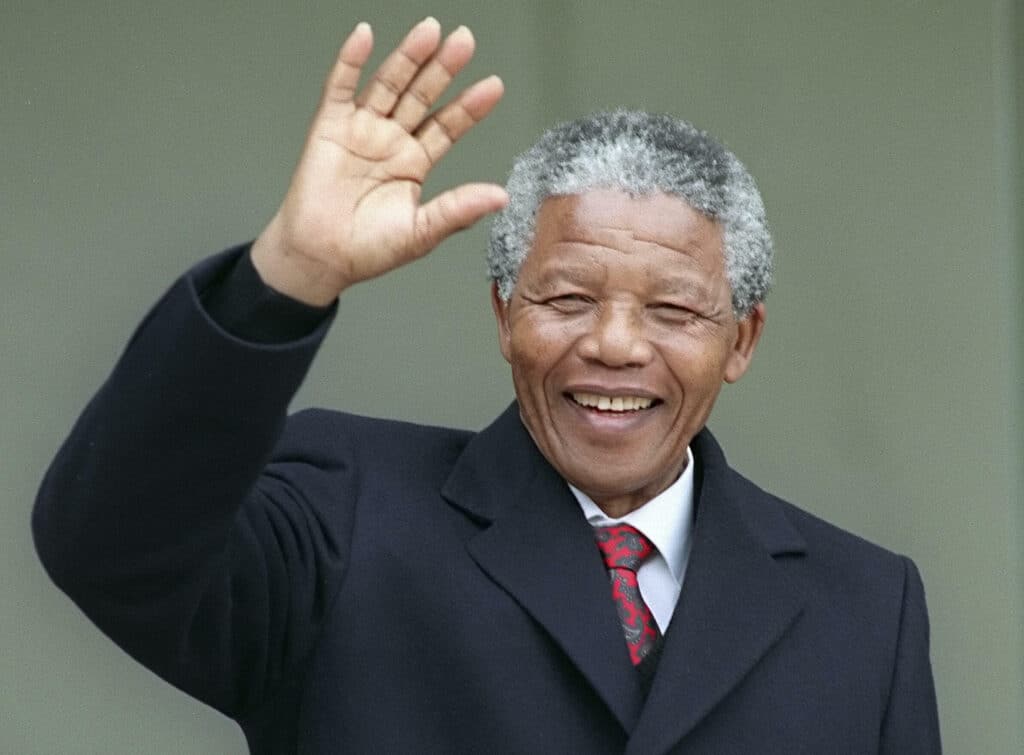
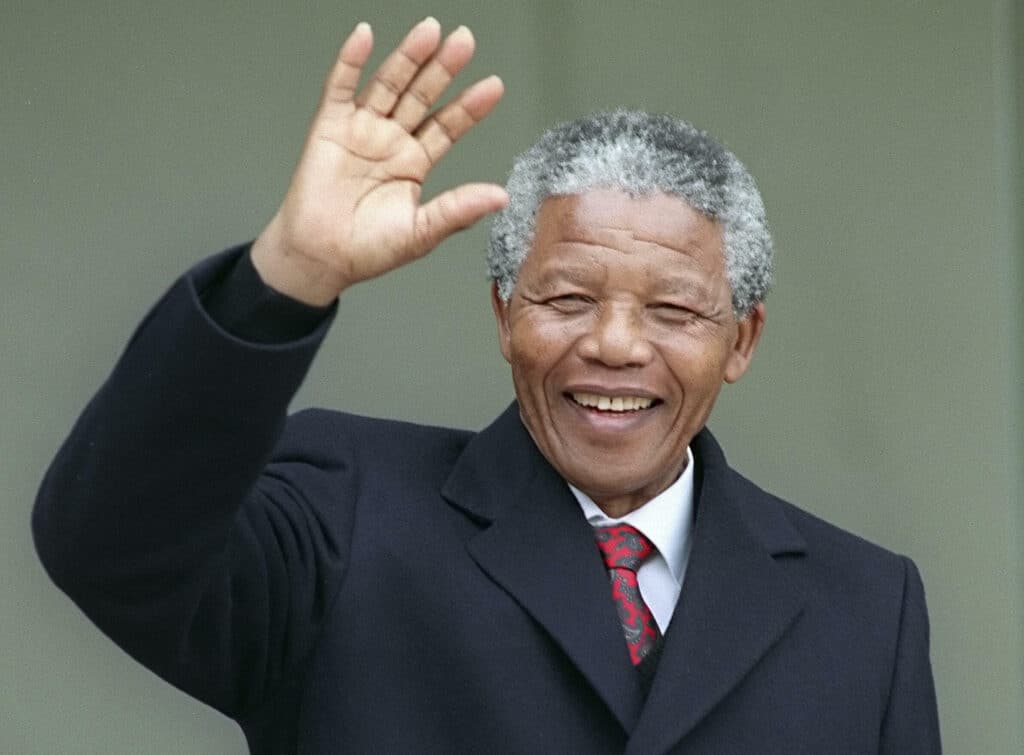
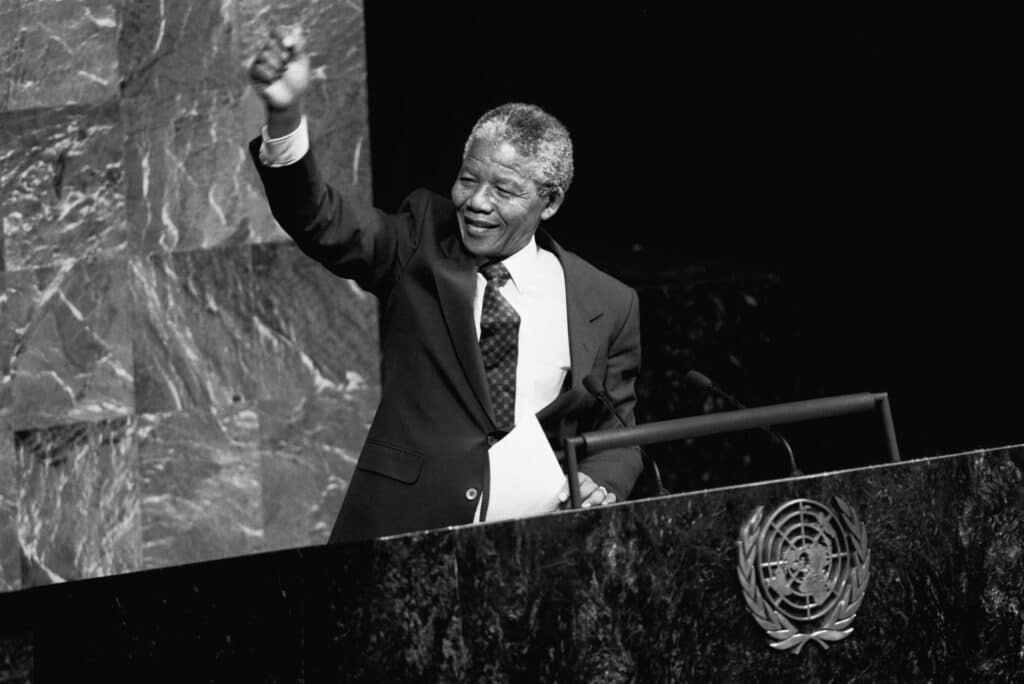
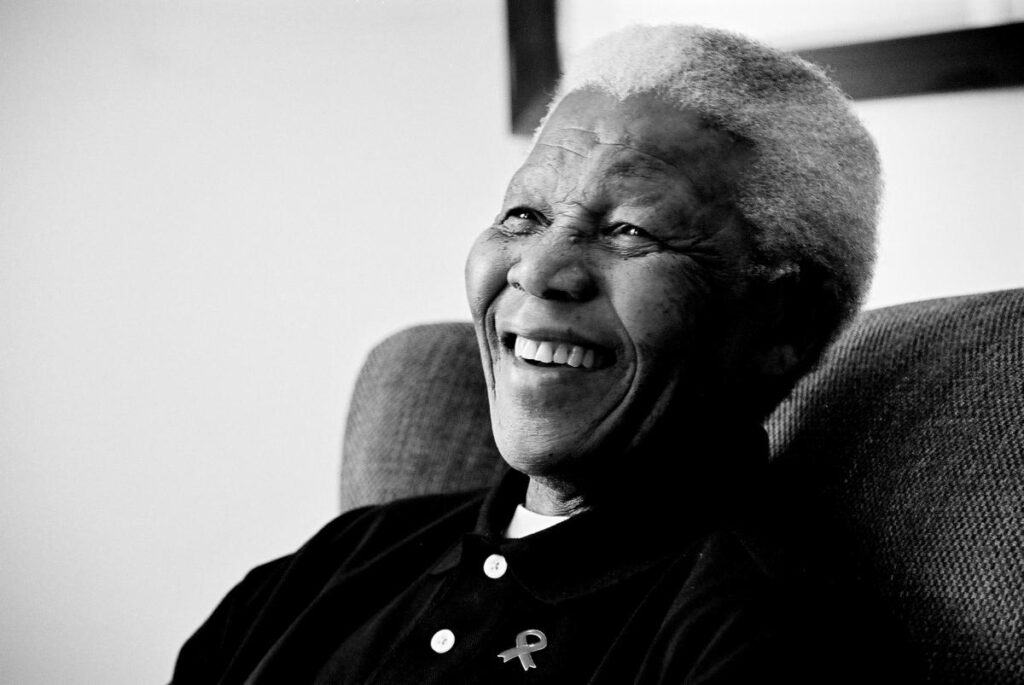
The late South African icon, Nelson Mandela, reportedly made a prophetic statement about the outcome of Ghana’s match against Uruguay in the 2010 World Cup, hosted by South Africa.
Lee Addy, a former defender for the Black Stars, revealed that the team had an audience with Mandela before the quarter-final clash with Uruguay.
During this meeting, Mandela cautioned that the team would face unfair treatment from the referee, as Addy recounted to sports journalist Ernest Brew Smith.
This prediction came true in a memorable quarter-final. Asamoah Gyan missed a pivotal penalty following Luis Suarez’s infamous handball, leading to a penalty shootout that Ghana lost 4-2.
Additionally, Addy shared insights into a conversation with Ghana’s late president, Professor John Evans Atta Mills, before their match against the United States.
Professor Mills visited the team to boost their morale, emphasising the historical significance of the match and the importance of securing a win, reinforcing Ghana’s historical advantage over the US team.
“Professor Mills came to our locker room to inspire us. He urged us to aim for victory, reminding us of Ghana’s historical upper hand against the US.
He was confident that history was onour side and encouraged us to pursue a win. His support for our quest was unwavering,” Addy recalled.
An auction featuring 70 personal items belonging to anti-apartheid hero Nelson Mandela, including his iconic shirts, is facing opposition from the South African government.
The auction, organized by Mandela’s eldest daughter, Makaziwe Mandela, is under scrutiny as the government asserts that the items rightfully belong to the nation.
Among the items are hearing aids, an ID card, gifts from world leaders, and clothing like Mandela’s distinctive “Madiba” shirts. South Africa contends that, under the country’s laws, items deemed part of the national heritage cannot be taken out of the country.
The South African Heritage Resources Agency (Sahra), responsible for safeguarding the nation’s history and culture, has filed an appeal to block the sale.
The appeal has been supported by the sport, arts and culture ministry. Minister Zizi Kodwa said it was was backing the case “for the sake of maintaining the country’s rich heritage”.
He added that blocking the sale was necessary as Mandela “is integral to South Africa’s heritage”.
“It is thus important that we preserve the legacy of former President Mandela and ensure that his life’s work experiences remain in the country for generations to come.”
In 2021, the South African government opposed the proposed auction of Nelson Mandela’s personal items, claiming some were national artifacts. This led to the cancellation of the 2022 auction and initiated a two-year legal battle. Last month, the High Court in Pretoria granted Ms. Mandela permission to proceed with the sale, challenging the government’s assertion that the items held national heritage status.
Despite the court’s decision, the government, through Sahra and the culture ministry, has filed a request to appeal, citing concerns over the “unpermitted export for exhibition or sale” of the items. The auction, scheduled for January 22, faces uncertainty pending the appeal’s outcome.
The listed items, including hearing aids and Mandela’s iconic shirts, could fetch substantial amounts at the New York-based Guernsey’s auction house, with estimates reaching up to $20,000 and $70,000, respectively.
While Ms. Mandela plans to allocate auction proceeds to a memorial garden in Mandela’s honor, the government’s opposition has generated mixed reactions in South Africa. Some argue for the preservation of these “priceless” items, while others believe the matter should be left to the discretion of Mandela’s family.
Nelson Mandela, an anti-apartheid hero, passed away in 2013 at the age of 95, leaving an enduring legacy for his role in South Africa’s struggle against apartheid.
The government of South Africa is trying to prevent a controversial sale of 70 personal items that belonged to Nelson Mandela, who fought against apartheid.
They have hearing aids, an ID card, presents from world leaders, and some of the clothes worn by the first democratic president, like his “Madiba” shirts.
Makaziwe Mandela, the oldest daughter, is selling the items in the US.
However, the government of South Africa says that the items belong to the country.
Under the law in South Africa, things that are considered part of the country’s history and culture cannot be taken out of the country.
The appeal got help from the ministry of sports, arts and culture. Minister Zizi Kodwa supports the case to protect the country’s important history.
He said stopping the sale was important because Mandela is a big part of South Africa’s history.
It is important to keep alive the memory of former President Mandela and make sure that future generations in the country learn from his example.
The government did not approve of the auction when it was first announced in 2021. They said that some of the things being sold were important to our country.
So, the first auction that was supposed to happen in 2022 was cancelled and then there was a two-year fight in court.
Mr Kodwa says the auction should not happen because Sahra and the culture ministry want to appeal the decision from last month. They say the items were not allowed to be taken out of the country to be shown or sold.
The auction is supposed to start on January 22, but we don’t know if the government’s appeal will stop it.
The New York-based Guernsey’s auction house has already put the items up for sale. The hearing aids could sell for up to $20,000 and one shirt might sell for up to $70,000.
Ms Mandela and others in the Mandela family and the Nelson Mandela Foundation have not given their thoughts on the government’s latest opposition.
She said that the money from the auction will be used to create a special garden to remember Mandela, close to where he is buried.
The auction in South Africa has made a lot of people upset. Some think the government should not sell the valuable items.
But some people think that Mandela’s family should decide about the issue.
Mandela passed away in 2013 when he was 95 years old. He was the leader of the African National Congress and fought against a system called apartheid, where racism was allowed by the law. He was in prison for 27 years.
He was chosen as the first president of South Africa in 1994 through a fair voting process.
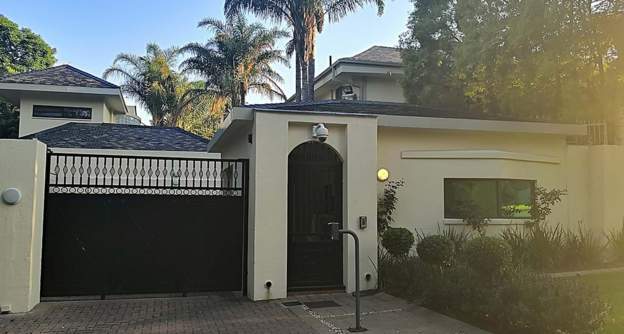
Ten years after Nelson Mandela, a famous person who fought against apartheid, passed away, a South African TV station called eNCA went to the house where he lived before he died. They found that the house had been left empty and was not in good condition.
Famous people like Michael Jackson, Oprah Winfrey, and Michelle Obama visited former President Mandela at his house in Houghton, Johannesburg.
On Friday, they showed parts of the run-down home, like the garden covered in weeds and the dusty ceiling in the bedroom where Mandela passed away.
Mandela’s grandchildren used to live in the house, but they had to leave because the city turned off the electricity because Mandela’s trust didn’t pay the bills. eNCA told the media.
“I left because my family trust was causing problems. ” Mandela’s grandson, Mbuso Mandela, said that we had to keep asking the trustees to pay the water and electricity bills. He moved out around 2019.
Some people in South Africa are very sad and upset on social media. They want Mandela’s family and the government to fix up his old house to remember and honor him.
The Johannesburg home where Mandela first lived after he was released from prison has been turned into a fancy hotel called Sanctuary Madiba. It is very different from how it used to be.
The granddaughter of South Africa’s first democratically elected President Nelson Mandela, has passed away at the age of 43 after battling cancer.
She peacefully departed on Monday evening, surrounded by loved ones, according to a spokesperson.
In recent years, Ms. Mandela had gained recognition for openly sharing her journey through cancer treatment and her past struggles with drug addiction. Her courageous efforts were celebrated by the Nelson Mandela Foundation, which praised her for raising awareness about cancer prevention and reducing the stigma associated with the disease.
Ms. Mandela also bravely discussed her battles with depression and her experience of childhood sexual abuse. Additionally, she actively campaigned for improved road safety following the tragic loss of her 13-year-old daughter in a car accident in 2010. Sadly, she also endured the loss of a prematurely born son. She is survived by four children.
As the granddaughter of Nelson Mandela’s second wife, Winnie, she chronicled her life story in her autobiography titled “When Hope Whispers.” Diagnosed with breast cancer at the age of 32, she initially went into remission after receiving treatment, but the illness later returned.
Last year, she revealed that the cancer had spread to her liver and lungs, affecting other organs. While she had been receiving outpatient treatment, she was admitted to the hospital just over a week ago.
“What do I tell my children? How do I tell them that this time around I may not get to live my life as a survivor? How do I tell them everything will be OK when it’s not? I’m dying… I don’t want to die,” she posted on Instagram early last month.
In an interview with Kaya FM in April, Ms Mandela said: “I’m learning to be okay with my eventuality.”
When her grandfather was freed from prison after 27 years in 1990, she was just ten years old.
Ms Mandela had only ever known him as a jailed man, so when he was released, she was overjoyed.
Tuesday, July 18, marks Nelson MandelaDay, an annual commemoration of the South African leader’s extraordinary achievements on his birth anniversary.
Established by the United Nations in 2009, this day serves as a tribute to Mandela’s life and lasting legacy.
The theme for Nelson Mandela Day 2023 is “It’s in your hands,” emphasizing the connection between food and climate change. The aim is to raise awareness and encourage individuals to contribute by planting trees and cultivating food in their communities.
The organizers have set a goal of planting one million trees globally, highlighting the significance of environmental sustainability.
Nelson Mandela was a renowned global figure who left an indelible impact on the 20th century and continues to shape the 21st century. He dedicated his life to effecting profound change and improving the lives of countless South Africans.
To delve deeper into the inspiring life story of Nelson Mandela, keep reading.
Why was Nelson Mandela important?
WATCH: A look back at Nelson Mandela’s life (December 2013)
Nelson Mandela became the first black president of South Africa in the country’s first democratic elections in 1994, but it wasn’t an easy road to get there.
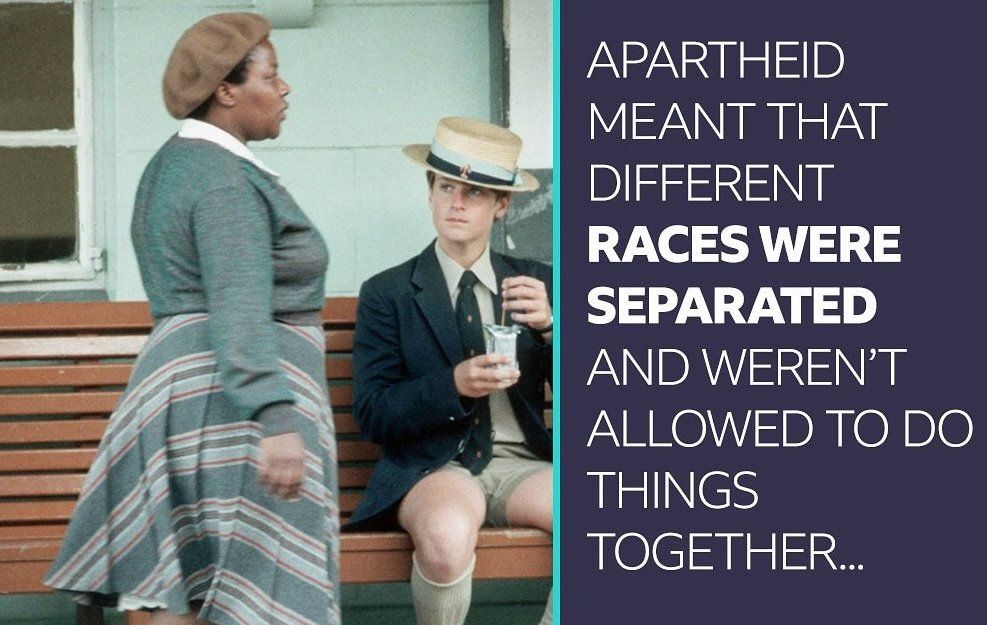
When Nelson Mandela was a young man, white and black people in South Africa were not allowed to do things together and had to live separate lives under a system called apartheid.
White people, who were a small proportion of the population, were in charge of everything in South Africa.
Image caption,Apartheid in South Africa saw black people treated very differently with fewer rights than white people
Black people had fewer rights and couldn’t vote and white people controlled which jobs black people could have, and even where they lived. They also had access to better schools and hospitals.
Nelson Mandela wanted South African apartheid to end and protested against it.
Mandela sent to prison
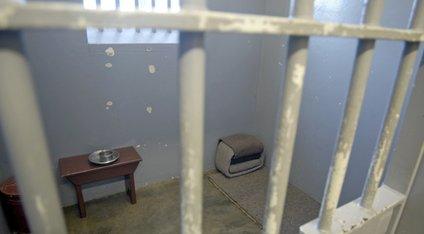
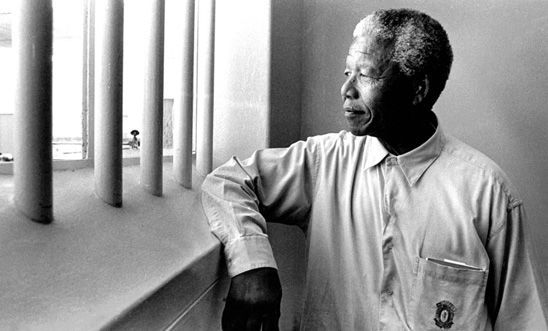
Image caption,This was Mandela’s prison cell, which is now a museum
During this time, some anti-apartheid demonstrations in South Africa turned violent, prompting Mandela’s detractors to brand him and his supporters as terrorists.
Mandela spent time on Robben Island while serving a life sentence in jail after being found guilty of treason and attempting to undermine the government in 1964.
For 300 years, a jail operated on the island off the South African city of Cape Town. The majority of prisoners, including Nelson Mandela, were black men who had committed political crimes.
In spite of this, a large number of individuals supported Nelson Mandela’s cause and worked to secure his release.
2020: Children discuss what Nelson Mandela means to them.
Mandela released from prison
Finally in 1990, after being in prison for 27 years, the South African President FW de Klerk – a white man – allowed Mandela to go free, signalling a new era in the country.
Mandela had become a symbol of resistance against apartheid and his release saw celebrations not only in South Africa but across the world.
Remembering the day Nelson Mandela was released from prison (2020)
Apartheid in South Africa ended a year later in 1991, and three years after that, South Africa held its first fully-democratic elections in which black people, as well as white, were allowed to vote.
Nelson Mandela was elected president and set about trying to bring people of different races together.
In 1993, he was awarded the Nobel Peace Prize – the highest honour of its kind – for his work.
YouTuber Caspar Lee speaks to Newsround about South Africa, Rugby and Nelson Mandela
In 1995, South Africa held its first major sports competition – the Rugby World Cup.
Mandela gave his support to the South African rugby team, made up mostly of white men, so that it would unite the country. The team, known as the Springboks went on to lift the trophy.
Mandela has gone down in history as one of the most famous world leaders ever and is remembered by many for promoting a message of forgiveness and equality.
On July 18th, the world celebrates Nelson Mandela Day, honoring the remarkable achievements of the South African leader on the anniversary of his birth. This day, established by the United Nations in 2009, serves as a tribute to Mandela’s extraordinary life and enduring legacy.
Under the theme “It’s in your hands,” Nelson Mandela Day 2023 seeks to raise awareness about the impact of climate change on food and encourages individuals to make a difference in their communities by planting trees and cultivating food. The organizers aim to plant one million trees globally as part of this initiative.
Nelson Mandela, a renowned global statesman, left an indelible mark on the 20th century and continues to shape the 21st. Through his unwavering dedication, he brought about significant changes in the lives of countless South Africans, inspiring generations with his message of peace, reconciliation, and social justice.
Nelson Mandela Day stands as a reminder of the power of individual action and the importance of fostering a better world. It encourages people worldwide to embrace Mandela’s spirit of compassion, equality, and determination to make a positive impact in their communities and beyond.
Nelson Mandela’s journey to becoming the first black president of South Africa in the nation’s inaugural democratic elections in 1994 was a challenging one.
During Mandela’s youth, South Africa was deeply divided by apartheid, a system that enforced racial segregation and discrimination. Under apartheid, white and black individuals were prohibited from engaging in activities together and were forced to lead separate lives.
In this unjust system, the minority white population held absolute power over all aspects of South African society. Black individuals had limited rights, including the denial of voting privileges. White authorities controlled employment opportunities for black citizens, as well as where they could reside. Disparities in education and healthcare were also prevalent, with white individuals having access to superior facilities and resources.
Nelson Mandela, driven by his deep conviction for equality and justice, dedicated himself to fighting against the oppressive apartheid regime. He became a prominent figure in the anti-apartheid movement and led numerous protests and demonstrations against the unjust policies.
Mandela’s unwavering determination and commitment to ending apartheid were instrumental in reshaping the course of South African history. His leadership, coupled with the efforts of countless activists, ultimately led to the dismantling of apartheid and the establishment of a more inclusive and democratic South Africa.
Image caption, This was Mandela’s prison cell, which is now a museum
Amidst the struggle against apartheid in South Africa, certain protests escalated into acts of violence, leading critics to brand Nelson Mandela and his supporters as terrorists.
In 1964, Mandela faced conviction for treason and conspiracy to overthrow the government, resulting in a life sentence. He served a significant portion of his imprisonment on Robben Island, located off the coast of Cape Town, South Africa. This island had served as a prison for political offenders, predominantly black men, for over three centuries.
However, despite the negative portrayal by some, Mandela garnered widespread international support for his cause. People from around the globe rallied behind him, advocating for his release and standing in solidarity with the fight against apartheid.
Mandela’s resilience and the global solidarity he received played a pivotal role in shedding light on the injustices of apartheid and contributed to the eventual dismantling of the discriminatory system.
In a historic moment in 1990, Nelson Mandela was finally released after spending 27 years in prison. The decision to release Mandela came from South African President FW de Klerk, who, as a white man, played a crucial role in ushering in a new era for the country.
Mandela had emerged as a powerful symbol of resistance against apartheid, capturing the hearts and minds of people around the globe. His long-awaited release sparked widespread celebrations, not only in South Africa but also across the world. Mandela’s freedom marked a significant turning point in South African history, symbolizing the potential for reconciliation, unity, and the dismantling of the oppressive apartheid system.
The release of Nelson Mandela paved the way for his subsequent involvement in negotiations and ultimately his election as South Africa’s first black president in 1994.
Apartheid in South Africa officially ended in 1991, and the following year, the country witnessed its first fully-democratic elections, enabling both black and white citizens to exercise their right to vote. In this historic election, Nelson Mandela was elected as the president of South Africa, embarking on a mission to foster unity and reconciliation among people of different races.
In recognition of his remarkable efforts, Nelson Mandela was honored with the Nobel Peace Prize in 1993, the highest accolade in its category, for his tireless work in promoting peace and justice.
In 1995, South Africa hosted the Rugby World Cup, a significant sporting event. Mandela saw an opportunity to use the occasion to bridge racial divides and foster national unity. He offered his support to the South African rugby team, predominantly composed of white players, known as the Springboks. Against the odds, the team went on to win the tournament, symbolizing a triumph that transcended the boundaries of sport and united the nation.
Nelson Mandela’s impact as a world leader has secured his place in history. He is widely revered for advocating messages of forgiveness and equality, leaving an indelible legacy that continues to inspire people across the globe. His unwavering commitment to justice and the pursuit of a more inclusive society has left an enduring mark on the world’s collective memory.
Rabat is upset by the grandson of Nelson Mandela’s comments calling for the “liberation” of Western Sahara.
The ongoing political crisis between the two North African neighbors was exacerbated when Morocco denounced “provocative” behavior and “transgressions” prior to the start of a regional soccer competition in Algeria.
The bitter conflict between Rabat and Algiers is partly fueled by theWestern Sahara, a region that is claimed by both countries and where the Polisario movement, which is backed by Algeria, wants to hold an independence vote.
The Moroccan football association criticised the grandson of Nelson Mandela for making a “provocative and surreal speech” at the African Nations Championship (CHAN) opening ceremony on Friday, calling for the “liberation” of the disputed territory.
Rabat sees Western Sahara as an integral part of the kingdom and a highly sensitive issue of security and national pride.
“Let us fight to free Western Sahara from oppression,” Mandla Mandela told the crowd at the stadium named in honour of his grandfather, South Africa’s first democratically elected president after the fall of apartheid, in the Algerian city of Constantine.
“Don’t forget the last colony of Africa, Western Sahara,” he added.
The desert territory boasts rich Atlantic fisheries, phosphate resources and a land route to markets in West Africa.
The Moroccan football federation said the speech “flouted the rules governing the organisation of football events under the auspices of the Confederation of African Football (CAF)”.
The Moroccan federation also decried “racist” anti-Moroccan remarks at the opening ceremony, as videos circulated on social media appearing to show Algeria supporters chanting derogatory slogans against Moroccans.
The federation said it had written to the CAF to ask it to uphold “all its responsibilities in the face of these flagrant transgressions that have no relation to the principles and values” of football.
The United States in 2020 recognised Moroccan sovereignty over Western Sahara in a quid pro quo for re-establishing ties with Israel, to the chagrin of Algiers – which for decades has seen itself as North Africa’s main champion of the Palestinian cause.
“We stand together to fight for the liberation of Palestine,” Mandla Mandela also said in his speech.
On Thursday, Morocco said it was pulling out of the tournament after Algeria refused to authorise a direct flight from Rabat.
On Friday, the Moroccan under-23 team to the CHAN tournament arrived at Rabat airport as last-minute negotiations over travel to the tournament took place. However, the Moroccan football federation said the team did not travel as the flight to Constantine remained unauthorised.
Algeria’s airspace has been closed to Moroccan flights since Algiers broke off diplomatic ties with Rabat in August 2021 over what it called “hostile actions”.
CHAN organisers said the team could have taken an indirect flight.
Morocco made history in December by becoming the first African or Arab team ever to reach the semi-finals of a World Cup. Morocco’s Atlas Lions’ under-23 team won the last two CHAN tournaments.
Nelson Mandelawas once asked why he still had relationships with, among others, Fidel Castro and Yasser Arafat, the Cuban and Palestinian leaders who had been branded terrorists by Western powers. The revered South African statesman replied that it was a mistake “to think that their enemies should be our enemies.”
This stance has largely typified some African nations’ response to the Russia-Ukraine war. Across the continent, many appear hesitant to risk their own security, foreign investment and trade by backing one side in this conflict.
While there has been widespread condemnation of the attacks on Ukrainian civilians and their own citizens fleeing the warzone — from countries such as Ghana, Nigeria, Kenya — there has been a much more muted response from some key African nations.
Countries on the continent find themselves in a delicate position and will not want to get drawn into proxy battles, says Remi Adekoya, associate lecturer at England’s University of York.
“There’s a strong strand of thought in African diplomacy that says African states should maintain the principle of non-interference and so they shouldn’t get caught up in proxy wars between the East and the West. As some states did get caught up in proxy wars during the Cold War, for instance,” Adekoya told CNN.
One influential voice that has made it clear he will not make an enemy out of Russian leader Vladimir Putin is South African President Cyril Ramaphosa.
While addressing his country’s parliament Thursday, he said: “Our position is very clear … there are those who are insisting that we should take a very adversarial stance and position against, say Russia. And the approach that we have chosen to take … is we are insisting that there should be dialogue.”
After initially releasing a statement calling for Russia to immediately pull its forces out of Ukraine, South Africa has since laid the blame for the war directly at NATO’s doorstep for considering Ukraine’s membership into the military alliance, which Russia is against.
“The war could have been avoided if NATO had heeded the warnings from amongst its own leaders and officials over the years that its eastward expansion would lead to greater, not less instability in the region.” Ramaphosa said in parliament Thursday.
Former South African President Jacob Zuma also earlier issued a statement saying Russia “felt provoked.”
“Putin has been very patient with the western forces. He has been crystal clear about his opposition of the eastern expansion of … NATO into Ukraine … and is on the record about the military threat posed to Russia by the presence of the forces … it looks justifiable that Russia felt provoked,” Zuma said in a statement issued by his foundation on March 6.
South Africa has strong ties to Russia and Ramaphosa has written about being approached to be a mediator in the conflict given its membership of BRICS — a group of emerging economies comprising Brazil, Russia, India, China and South Africa.
The ties between the two countries also date back to apartheid times when the former Soviet Union supported South Africa and the African National Congress party in their liberation struggles. “Those favors have not been forgotten,” said Adekoya.
South Africa was one of 17 African nations to abstain on the UN resolution demanding that Russia immediately withdraw from Ukraine on March 2. It took a similar stance during Putin’s annexation of Crimea in 2014.
Nigeria and Egypt were among the 28 African nations that voted to condemn Russia, while eight others didn’t submit a vote. Eritrea was the only African country that outrightly voted against the resolution.
Zimbabwe’s foreign ministry said in a statement it was unconvinced that the UN resolution was driven towards dialogue, rather “it poured more fuel to the fire, thus complicating the situation.”
‘Strongman leadership’
Many of the countries that abstained from the UN vote are authoritarian regimes. They see Putin’s unilateral decision to invade Ukraine as a show of power and ego that they can appreciate and align with, Yetunde Odugbesan-Omede, a political analyst and professor at New York’s Farmingdale State College, told CNN.
One of those who have spoken out prominently in support of the Russian leader is Lt. Gen. Muhoozi Kainerugaba, the influential son of Ugandan President Yoweri Museveni.
His father has ruled Uganda with an iron fist for 36 years and there has been speculation that Kainerugaba is a would-be successor when the 78-year-old Museveni eventually stands down.
Kainerugaba tweeted that: “The majority of mankind (that are non-white) support Russia’s stand in Ukraine. Putin is absolutely right!”
Some African countries have also hesitated in speaking out against Russia because they want to “keep their options open if they face existential threats or some kind of revolution in their own country in the future,” said Adekoya.
“They saw Putin keep Assad in power in Syria because if not for Russia’s intervention, Assad’s regime would have fallen long ago,” he added.
Adekoya also pointed out that some of the muted response stems from what is perceived as Western hypocrisy.
Kenya’s UN Security Council representative Martin Kimani gave a powerful speech on the brink of Russia’s invasion of Ukraine.
Kimani drew a parallel between Ukraine’s emergence as an independent state after the collapse of the Soviet Union and the experience of post-colonial states in Africa, criticizing Vladimir Putin’s buildup of forces and his support for redrawing Ukraine’s borders by recognizing the breakaway statelets of Donetsk and Luhansk.
“Kenya rejects such a yearning from being pursued by force,” he said, referring to Russia’s recognition of the two territories as independent states. “We must complete our recovery from the embers of dead empires in a way that does not plunge us back into new forms of domination and oppression.”
During the speech, he also mentioned other nations on the Security Council who had breached international law and faced no sanctions. He didn’t mention them by name, but he was talking about the US and UK who invaded Iraq in 2003 … and were never really held to account,” Adekoya said.
“There are many people in many parts of the world who would like to see other regions gaining strength and would like to see the end of Western domination of the world order, putting it simply … of course, no right-thinking person in Africa or anywhere in the world looks at what is going on in Ukraine now and thinks that it’s a good thing … but many people do see the hypocrisy,” he added.
Establishing stronger ties
In recent years, Russia has established itself as one of Africa’s most valuable trading partners — becoming a major supplier of military hardware with key alliances in Nigeria, Libya, Ethiopia and Mali.
Africa accounted for 18% of Russian arms exports between 2016 and 2020, according to the Stockholm International Peace Research Institute (SIPRI) think tank.
Some analysts say the support or non-censure of Russia speaks to a wider sentiment in parts of Africa that Western policy positions do not always work in their favor.
“The message that Moscow is pushing is that if you are tired of the paternalistic way the West approaches you, we are going to be your security partners. It will be a relationship of equals,” Aanu Adeoye, a Russia-Africa analyst at Chatham House, told CNN.
Unlike many of its European counterparts, Russia is not a former colonial power in Africa and so has a wider scope of opportunity in making soft power moves that aim to challenge Western dominance on the continent.
The Soviet Union also had client relationships with many African states during the Cold War, and Moscow has looked to revive some of those ties.
Before the invasion, Russian state media outlet RT announced plans to set up a new hub in Kenya with a job ad that said it wanted to “cover stories that have been overlooked by other organizations” and that “challenge conventional wisdom about Africa.
Yet Africa has often been at the heart of the tussle for influence in the great power competitions between key geopolitical players such as the US, China and Russia.
Some countries are trying to leverage this position in a variety of ways.
Odugbesan-Omede explained that Tanzania, for example, has identified the current situation as a chance for its energy industry to profit. “Tanzania’s President, Samia Suluhu Hassan, sees this an opportunity to look for markets to export gas,” she said.
“Tanzania has the sixth largest gas reserve in Africa. While some African countries will sustain some economic shock from the Russian-Ukraine fight, others are trying to weather the storm by looking for new avenues of profitability,” Odugbesan-Omede added.
Andrew Mlangeni, the last surviving anti-apartheid activist convicted with Nelson Mandela at South Africa’s infamous Rivonia Trial, has died at 95.
This was the trial considered to have brought Mandela to global attention.
Mr Mlangeni died after being admitted to a military hospital in Pretoria because of an abdominal complaint.
His death “signifies the end of a generational history and places our future squarely in our hands,” President Cyril Ramaphosa said.
Who was Andrew Mlangeni?
According to Mr Mlangeni’s 2017 biography, The Backroom Boy, Mandela selected him to join five other men in the first group of South African anti-apartheid activists to be sent to China for training.
Their training included classes in bomb-making, booby traps and secret communication techniques.
He returned to South Africa in 1963 and became a member of the high command of the ANC’s armed movement, Umkhonto we Sizwe.
He disguised himself as a priest and travelled around South Africa recruiting young people to go abroad for training as fighters, until he was arrested and put on trial in the Rivonia treason trial.
Mr Mlangeni served 26 years in prison, incarcerated for most of the time on Robben Island, alongside Mandela.
After his release in 1989, he served as a member of parliament and lived in Soweto until his death.
Mr Mlangeni was a man of principle – a quiet authority, whose humility won over the hearts of many South Africans.
He described himself as “a backroom boy”, never one to want political fame but instead working behind the scenes in helping to carve a new South Africa at the end of white minority rule.
He buried every last one of his fellow Rivonia trialists and friends.
His passing marks the end of an era, the last of a generation of indomitable struggle stalwarts.
Mr Mlangeni believed in the rights of black people, that their lives matter – but believed in unity too.
He did not want his jailers to suffer the same fate he did. Like Mandela, he believed that, in order for the majority of South Africans to be free, people like him would need to advocate peace instead of revenge.
What was the Rivonia trial?
The Rivonia Trial, lasting from October 1963 to June 1964, is widely considered to have been a pivotal point in the fight against the white minority government in South Africa and brought Mandela to the world stage.
Mandela’s famous speech from the dock, declaring that freedom and equality was “an ideal for which I am prepared to die”, became a rallying cry for black people under the apartheid regime.
Mandela and Mr Mlangeni were convicted along with six others of sabotage in the trial, named after the suburb of Johannesburg where some of them were arrested.
They served long prison terms with Mr Mandela’s being the longest, 27 years, until his release in 1990.
Zindzi Mandela, the youngest daughter of South Africa’s first democratically elected president Nelson Mandela and anti-apartheid activist Winnie Madikizela-Mandela, had tested positive for Covid-19 on the day of her death.
She died in a Johannesburg hospital earlier this week at the age of 59.
Her son Zondwa Mandela told public broadcaster SABC that it was unclear if the disease caused her death. The family is waiting for the autopsy report.
“Simply by the virtue that there was a positive test, we are therefore obligated to function and work within the framework of the existing regulation related to such cases,” he said.
He is quoted as saying his mother will be buried on Friday morning.