Tag: Network Rail

  • RMT union members vote to end strikes

    RMT union members vote to end strikes

    The RMT in Network Rail has reported that its members have chosen to accept a salary offer.

    Following a dispute over salary and working conditions, about 20,000 employees and the government have been at odds for months.

    The strikes in January disrupted thousands of commuters’ travel plans.

    Members voted 76 percent to 24 percent to approve the offer in a turnout of nearly 90 percent.

    Members of the RMT union and PCS (Public and Commercial Services) union demonstrating outside the UK Government Office at Queen Elizabeth House in Edinburgh, over pay and conditions. Picture date: Wednesday March 15, 2023. PA Photo. Hundreds of thousands of workers will stage a strike on Budget Day in what threatens to be the biggest walkout since the current wave of industrial action started last year. Members of several trade unions will take action, mounting hundreds of picket lines across the country amid continuing anger over issues including pay, jobs, pensions and conditions. Those striking on Wednesday include teachers, university lecturers, civil servants, junior doctors, London Underground drivers and BBC journalists. See PA story SCOTLAND RMT. Photo credit should read: Jane Barlow/PA Wire
    Around 20,000 members of the RMT have now voted to accept the offer (Picture: PA)
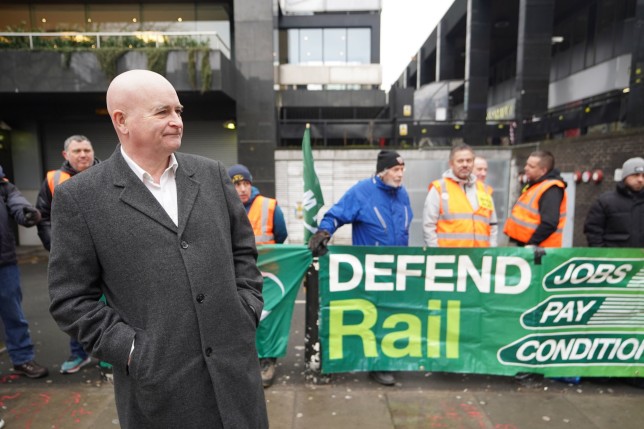
    Mick Lynch, general secretary of the Rail, Maritime and Transport union (RMT) (sixth left blue jacket), joins union members on the picket line outside Euston station in London during a rail strike in a long-running dispute over jobs and pensions. Picture date: Saturday March 18, 2023. PA Photo. See PA story INDUSTRY Strikes Rail. Photo credit should read: Jeff Moore/PA Wire
    The last round of RMT strikes was in January.

    Members of other unions including Aslef (Associated Society of Locomotive Engineers and Firemen) are still taking strike action.

    The new offer which was also improved with the new money was made following the most recent strike action in January and the threat of more action.

    Key features of the offer include an uplift on salaries of between 14.4 percent for the lowest paid grades to 9.2 percent for the highest paid.

    It also includes a total uplift on basic earnings between 15.2 percent for the lowest-paid grades to 10.3 percent for the highest-paid grades.

    There will also be increased backpay, and there will be a renewal of the no compulsory redundancy agreement until January 2025.

    Network Rail withdrew their previous because the offer was conditional on RMT accepting the company’s ‘modernising maintenance’ agenda, which the union will continue to scrutinize and challenge including on safety.

    There will also be discounted rail travel benefits.

    RMT general secretary Mick Lynch said that when the union first declared the dispute with Network Rail a year ago in the Spring of 2022, RMT was told that Network Rail workers would only get two percent to three percent.

    Mr Lynch said today: ‘However, since then strike action and the inspiring solidarity and determination of members has secured new money and a new offer which has been clearly accepted by our members and that dispute is now over.

    ‘Our dispute with the Train Operating Companies remains firmly on and our members recent highly effective strike action across the fourteen train companies has shown their determination to secure a better deal. 

    ‘If the government now allows the train companies to make the right offer, we can then put that to our members but until then the strike action scheduled for March 30 and April 1 will take place. 

    ‘The ball is in the government’s court.’
  • Rail strikes: Scotland and Wales suffer a knock-on effect

    Rail strikes: Scotland and Wales suffer a knock-on effect

    Rail workers are continuing their strike action this week in a dispute over pay, jobs, and conditions, and passengers in Scotland and Wales have been warned to expect significant disruption.

    The RMT union has declared that on January 3, 4, 6, and 7, employees at Network Rail will go on strike.

    Transport for Wales and ScotRail, who are not parties to the dispute, have both issued warnings that the walkouts in England will have a negative impact on their services.

    According to ScotRail, this is due to the fact that many of the Network Rail employees protesting in safety-sensitive positions.

    David Simpson, ScotRail service delivery director, said: “It’s really disappointing to see more widespread disruption across the whole Great Britain rail network as a result of the dispute between Network Rail and the RMT at a time when we need to be encouraging more people back to the railway.

    “For ScotRail, it’s going to mean that we won’t be able to operate the vast majority of our services between 3 and 7 January, which we know will be really frustrating for our customers.”

    Meanwhile, Transport for Wales told the BBC that as Network Rail owns and operates the track, stations, and signaling in Britain, the strikes mean only a limited number of trains can run.

    It said, “The industrial action resulting from the dispute between the unions and Network Rail means we’ll be unable to operate rail services on Network Rail infrastructure.”

    Source: BBC.com
  • New date for rail strikes: 40,000 workers set to strike

    Their union says more than 40,000 employees of Network Rail and 15 train operators will go on strike once more on October 8.

    As part of a protracted dispute over salary, employment, and working conditions, the RMT declared that it will “effectively shut down the railway network.”

    It will come just a week after an even bigger strike by members of RMT and the train drivers union Aslef.

    Network Rail warned passengers to expect very significant disruption and only travel if absolutely necessary.

    It added that full timetables for upcoming strike days would be published soon.

    The latest action comes after a series of large-scale walkouts as unions call for pay increases in line with the rising cost of living.

    In June, the biggest rail strikes for 30 years threatened to grind the country to a halt. But while some people faced substantial disruption it was business as usual for others.

    RMT general secretary Mick Lynch said the union had met with new Transport Secretary Anne-Marie Trevelyan to discuss the disputes.

    “However, as no new offer has been tabled, our members have no choice but to continue this strike action,” he said.

    “We will continue to negotiate in good faith, but the employers and government need to understand our industrial campaign will continue for as long as it takes.”

    The RMT, which represents rail workers including guards and signalling staff, had already announced its 40,000 members would strike on 1 October. This is the day before the London Marathon and the Conservative Party conference in Birmingham.

    Train drivers at 12 operators who are members of Aslef will also walk out on 1 October, meaning that only 10% of UK services are likely to run that day.

    Aslef members will also hold a second day of strike action on 5 October.