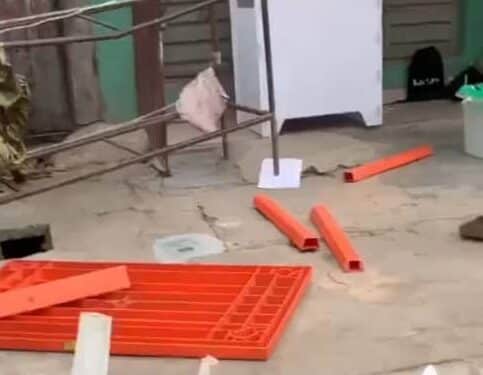
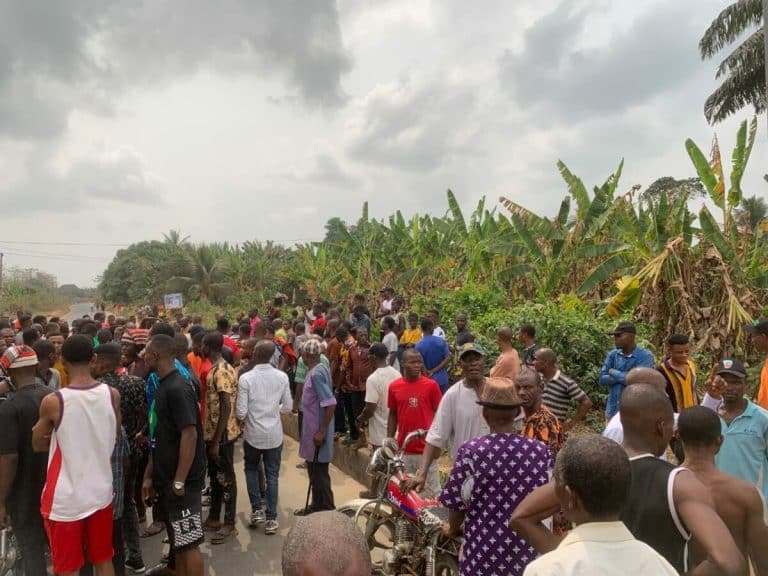
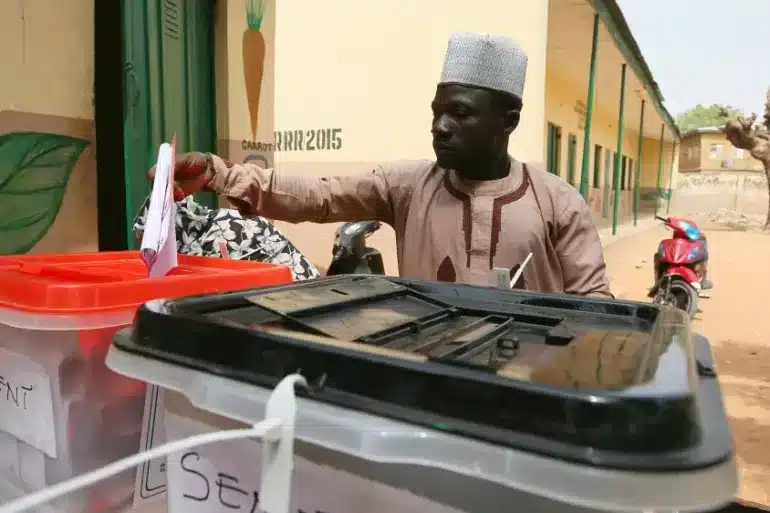
Some persons suspected to be political thugs have reportedly disrupted the voting exercise at a polling unit in 254 Borno Way, Ebute-Metta area of Lagos State.
According to a source, bottles were broken by the thugs to scare people away, disrupting the exercise
Sources confirmed that the military and police together with more senior INEC officials have shown up in the area.
Voting was said to have been cancelled by the INEC officials, citing the Electoral Act.
Rivers State Governor, Nyesom Wike has explained that the G-5 governors of the Peoples Democratic Party (PDP) have withdrawn from talking regularly in public to embark on strategic actions in silence in order to achieve set goals…
Governors and ministers from the South-West of Ogun, Lagos, Ondo, and Ekiti, including the immediate past governor of Osun State, Alhaji Isiaka Oyetola, will grace the rescheduled presidential rally of the All Progressives Congress…
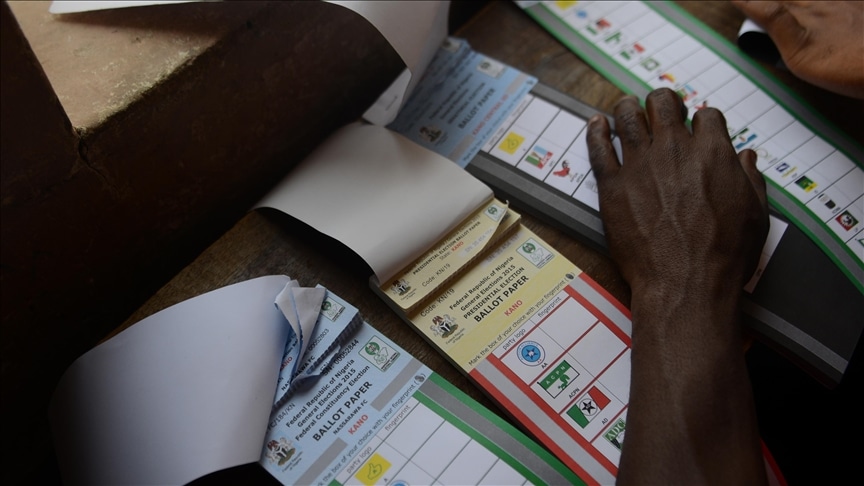
Nigerians will go the polls on Saturday, February 25, 2023, to elect a President to man the affairs of the state.
The elections which will come off nationwide will be keenly contested by three staunch politicians in the country. Whoever will win this bid, will replace Muhammadu Buhari.
While voting to elect a new President, it will be important for voters to also take care of their well-being. In line with this, The Independent Ghana has outlined a number of ‘dos’ and ‘don’ts’ needed to stay safe during the election period.
Here are some tips:
1. Confirm polling units before election day
Voters should physically visit their polling stations before the polls open to avoid getting lost on election day. As an alternative, the Independent Electoral Commission has made a polling unit locator available on its website at https://punchng.com/how-to-confirm-polling-unit-location-via-inec-portal/, which offers approximate location information for every polling unit nationwide.
It’s vital to remember that moving vehicles are not allowed on election day. If a voter’s home is distant from their polling station, they are recommended to find a convenient place to stay.
2. Avoid wearing political merchandise to polling booths
Voters should safeguard themselves by not publicly announcing the people or parties they plan to support at polling places because Nigeria has a secret ballot system.
Going to polling places in normal clothes is the best option to prevent needless conflict with political thugs and miscreants.
Branded items must to be hidden as well.
3. Report unusual activities:
Reporting any odd activity to the right authorities is another crucial safety measure that voters can implement during the voting process.
The Nigerian Army has set up emergency lines for voters to use in order to report any suspicious activities occurring during the voting process. https://punchng.com/elections-army-unveils-hotlines-to-report-criminal-activities/.
Voters shouldn’t go up against people who are violent. They should first look for safety, then get in touch with security personnel as quickly as they can.
4. Avoid bringing children to the polling units:
Because of the high stakes involved, it is critical to keep children safe during the elections.
Children should not be brought to polling units in case violence breaks out. Instead, families should make adequate babysitting arrangements ahead of election day.
5. Avoid political arguments at polling booths:
Voters should go to polling units with one goal in mind: to cast their ballots and ensure that they are properly counted.
As campaign activities have been halted, it is inappropriate to engage in political discussions that could escalate into arguments or violence at polling units.
Many Nigerians live in constant fear of being kidnapped and held for ransom by armed gangs, especially in the north-west of the country, where thousands of people have had to flee their homes. The insecurity means many in the region, which has the country’s largest number of registered voters, may not take part in the 25 February elections.
An unpaved mile-long road that ends at a tree stump is the only way for vehicles to get into Bakiyawwa village in Nigeria’s northern Katsina state.
This community of mostly subsistence farmers is not where you would expect criminals behind Nigeria’s lucrative kidnap-for-ransom business to go looking for victims.
It came as a surprise therefore when motorcycle-riding armed men invaded last September and abducted 57 villagers.
“They held my wife for 38 days,” said Abduljabara Mohammed, a civil servant and one of those considered well-off. He paid 1m naira ($2,100; £1,700) for her release.
Image caption,Zaradeen Musa will not say how much he gave the kidnappers, but said it was a lot of money
“I gave them all my money and a motorcycle, then pleaded with them not to take me,” said Zaradeen Musa, 30, whose door was kicked in around 01:00 as the armed men, commonly referred to as bandits, operated unchallenged for four hours after repelling a police unit called in by the villagers.
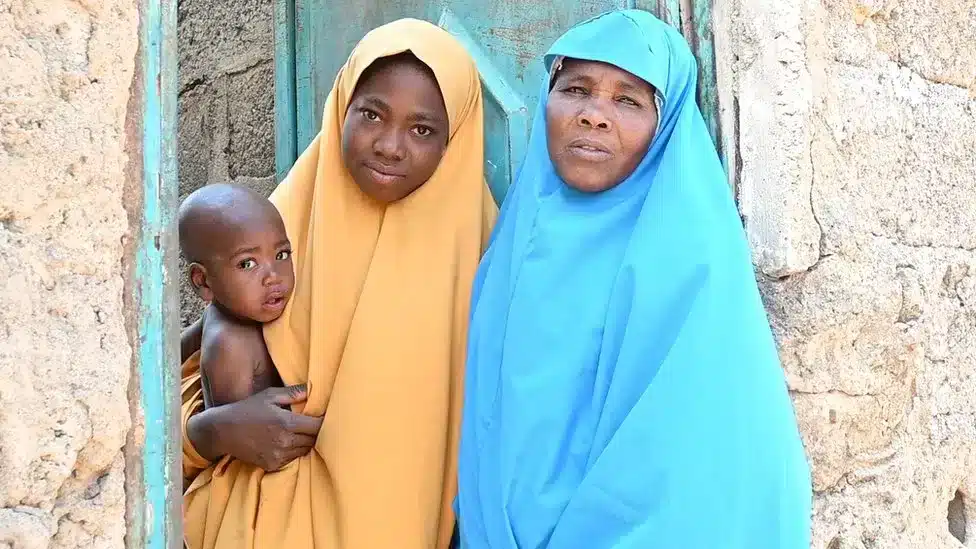
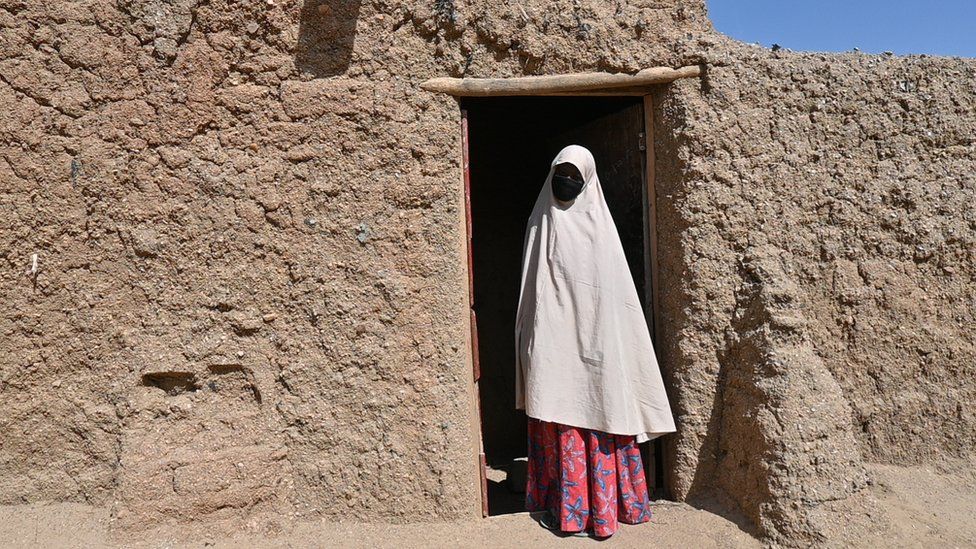
Maria Sani, 45, was seized but managed to slip away as the bandits led the victims to their forest hideout.
She was left wondering what would have become of her if she had not escaped as, like many abducted that day, she could never have afforded the ransom.
All those kidnapped were eventually freed but only after months of negotiations that resulted in them paying with cash or valuables such as motorcycles. The abductions show how far the kidnapping problem has spread – not even the poorest are spared.
Nevertheless, those in Bakiyawwa would consider themselves lucky as the attacks sometimes turn deadly, such as the reported killing of more than 100 villagers by armed men last Friday in another part of Katsina.
Such armed groups in the north-west and violent secessionists in the south-east pose real threats to the 25 February elections, analysts say.
Attacks on offices of the Independent National Electoral Commission (Inec) led to polls being moved by a week in 2019, and the recent burning of an Inec office in the south-east has led to fears of another postponement, although officials have said there will be no delays.
In December, Inec announced that it was too dangerous to hold the polls in some parts of Katsina state but it is not clear what will happen on election day.
Law professor Chidi Odinkalu argues that this election risks being dragged into unchartered legal territory if insecurity hampers voting and a candidate believes they have been robbed of vital support.
In the past, people have stayed away from voting over fears of violence in southern states like Imo, Anambra, Lagos and Rivers, but now, the kidnap crisis in the north has left many disinterested in the elections.
“You let kidnappers take me, now you want my vote,” said Mrs Sani through an interpreter.
Like many here she previously voted for President Muhammadu Buhari but she is sitting this one out.
Image caption,Maria Sani has no interest in the coming elections after the attack on her village
President Buhari is standing down after serving two terms and Bola Tinubu is standing for the governing All Progressives Congress (APC).
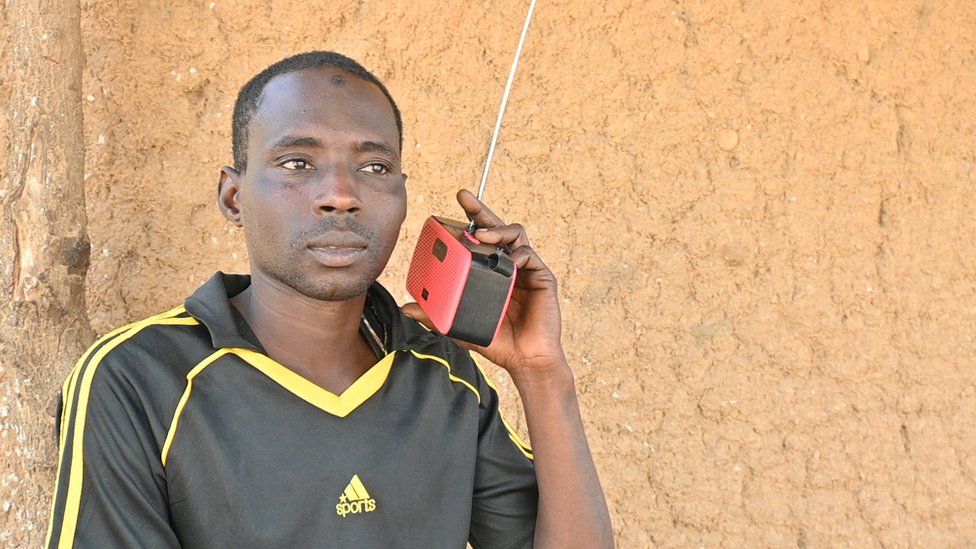
“How can you see all the suffering and still vote for the APC?” said Lawal Suleiman, a former party member but now a lone voice in the village campaigning for the Labour Party’s Peter Obi.
Many others in Bakiyawwa say they would probably back the main opposition Peoples Democratic Party (PDP), if they vote at all.
“If Buhari couldn’t solve the problems of this country, no-one else can,” Nana Samaila, who fled her village in Batsari three years ago after attacks by armed groups, told the BBC.
Her daughter, Aisha Mama, also recently fled with her husband from the village of Dangyya after persistent night-time attacks forced her family to sleep in their farm for weeks.
Mrs Samaila had high hopes that President Buhari, a former military ruler who comes from Katsina, would solve Nigeria’s myriad issues when she first voted for him in 2003, but like many others, she is now disillusioned by the failures of his government.
Hundreds of school children have been abducted and released, and the state governor once asked residents to arm themselves against the bandits in a show of helplessness.
The leading candidates in the election recognise that insecurity, which is intertwined with rising food prices that have caused record levels of inflation, is Nigeria’s biggest challenge at the moment.
Atiku Abubakar of the PDP, Mr Tinubu of the APC and Mr Obi of the Labour Party are proposing police reforms, revamping the military and improved welfare, among other ideas.
Their plans are not radically different from what President Buhari, who was elected on a promise of tackling Islamist groups in the north-east, has done with only limited little success.
While he has largely succeeded in containing the Islamist insurgency, violence in the north-west and south-east has massively increased on his watch.
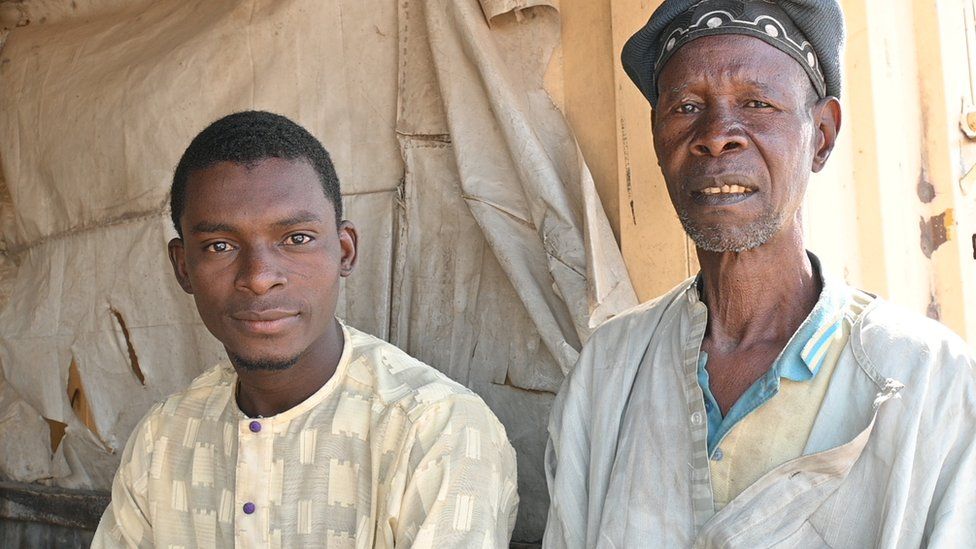
“He scattered [destroyed] the economy, there is so much insecurity,” said Mohammed Yusuf, a farmer originally from Katsina now forced into selling tea and cooked noodles on the streets of the region’s biggest city, Kano.
Image caption,Mohammed Yusuf (L) says he will be voting PDP this time
Kano, Katsina and Kaduna, dubbed the three Ks, are considered key states for whoever wants to emerge as Nigeria’s president because of their large voting population. There are more registered voters here than in the five south-eastern states.
Mr Buhari’s bloc of votes in the trio of states helped him win two elections in a row, and while some will still back the APC, there is a feeling that the party has lost ground in a region battered by insecurity.
Just two weeks ago, this was illustrated when stones were thrown at the president’s helicopter during a visit to Kano.
There is also a dark horse in the form of Rabiu Kwankwaso of the New Nigeria Peoples Party (NNPP). Only his die-hard supporters expect him to win the presidency, but he has emerged as a major disruptor who might decide who becomes the next president.
A former governor of Kano state and one-time defence minister, Mr Kwankwaso is immensely popular in Kano and neighbouring Jigawa state.
If he takes the majority of votes in Kano, whose six million registered voters rank second only to Lagos, it will greatly affect other candidates, especially those of the APC and PDP.
This might work in favour of the Labour Party which does not have a strong support base in the region.
Mr Kwankwaso, like many other Nigerian politicians, has switched parties several times. Last time, he backed the PDP and there are rumours he will step down for its candidate and fellow northerner, Mr Abubakar, at some point.
“He and Obi won’t win, though they are better alternatives to Mr Abubakar who is a crony capitalist,” said Umar Yahaya, a university student driving a taxi in nearby Kaduna.
“But anyone that votes the APC is rewarding them for failure,” he said, as we headed to the recently reopened Rigasa station to board the Kaduna-Abuja train. The line had been shut for months after a deadly attack by militants which saw the killing and abduction of dozens of passengers.
When Mr Buhari inaugurated the line in 2016 it was considered a sign of progress in the north, but now it has become a symbol of the violence consuming the region.
Between 2019 and 2022, there were 50 documented attacks on electoral commission offices nationwide.
The electoral commission has warned that failure to address insecurity could result in the cancellation or postponement of Nigeria’s general election in late February.
“If the insecurity is not monitored and dealt with decisively, it could ultimately culminate in the cancellation and/or postponement of elections in sufficient constituencies to hinder declaration of elections results,” said Abdullahi Abdu Zuru, chairman of the Independent National Electoral Commission (INEC)’s Board of Electoral Institute, on Monday.
President Muhammadu Buhari, who steps down after two terms, is leaving office without addressing insecurity that continues for 13 years due to armed groups like Boko Haram in the northeast, increased abduction and killings by bandits and herders in northwestern and central states, as well as separatist tensions in the southeast.
This could “precipitate [a] constitutional crisis”, he said, adding it “must not be allowed to happen and shall not be allowed to happen” before the February 25 vote. Security personnel and election officials needed to be fully equipped to deal with “any challenge at all times”, he said.
Zuru was speaking on behalf of INEC Chairman Mahmood Yakubu at the validation of election security training resources in the capital, Abuja, according to local daily The Cable.
He however asserted that Nigeria’s national security adviser, Mohammed Babagana Monguno, and INEC’s chairman had jointly “assured the nation that conducive environment will be provided for [the] successful conduct of the 2023 general election”.
“The Commission is not leaving anything to chance in ensuring that intensive and extensive security are provided for election personnel, materials and processes,” he said.
The threats facing Nigeria are multiple and widespread.
On Saturday, armed men attacked a train station in the southern state of Edo, kidnapping about 30 people and wounding others.
Kidnapping has become a serious problem, with “bandits” carrying out mass abductions, mostly in the northwest, though violence has spilled over to other regions.
INEC recorded 50 attacks on its offices between 2019 and 2022 in election-related violence, as well as protests and criminality unrelated to elections.
In July last year, armed men bombed a prison on the outskirts of Abuja, freeing hundreds of inmates in an attack claimed by ISIL (ISIS)-allied fighters.
The United States ordered diplomats’ families to leave Abuja in October due to what it called a “heightened risk of terrorist attacks” in the capital.
Authorities later said they had beefed up security.
Eighteen candidates are vying to replace Buhari, including Bola Tinubu of the governing All Progressives Congress (APC) party, Atiku Abubakar of the opposition Peoples Democratic Party (PDP), and Peter Obi of the Labour Party (LP).