The Nigeria Football Federation (NFF) has announced the departure of head coach Jose Poseiro.
Portuguese coach Poseiro revealed the separation on his X page on Friday.
“Yesterday, we concluded our contract with the NFF. It was a pride and honour to coach the Super Eagles. It has been 22 months of immense dedication, sacrifice, emotion, and enormous enthusiasm. We feel a sense of fulfilment,” he stated
Upon concluding his 22-month tenure with the West African nation, Mr. Poseiro conveyed his gratitude to the current administration and the former President of the NFF.
“We would like to express our gratitude to Sir Amaju Pinnick (the president who signed us), President Ibrahim Gusau, General Secretary Mohammed Sanusi, Secretary Dayo Enebi, the NFF, all the Staff, and especially all the PLAYERS, with whom leading has been a great pleasure.
“Guys, we are thankful; it has been a privilege to be part of this family. We will miss you, but we will always be there for you, no matter where you are. A big hug to all of you.”
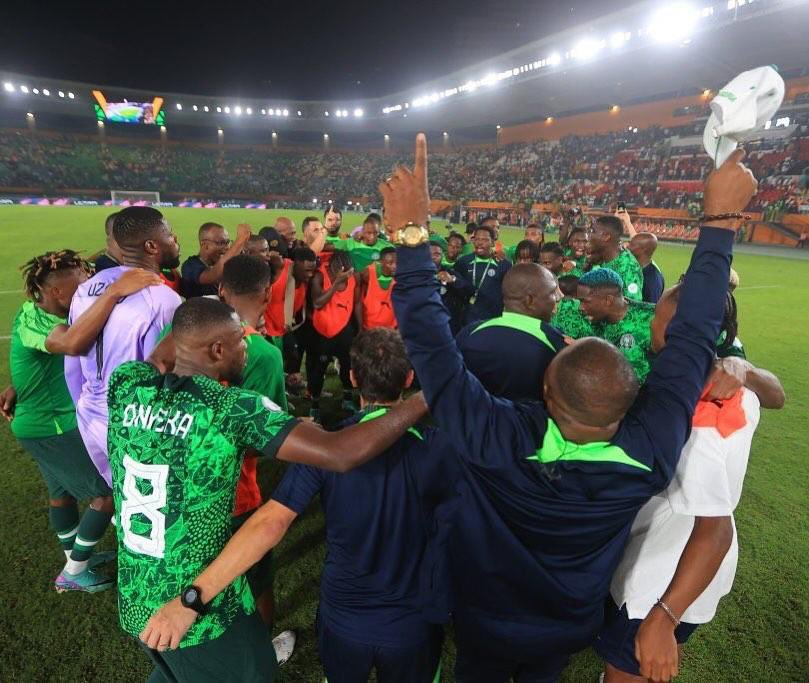
Jose Poseiro led the Super Eagles to the finals of the 2023 African Cup of Nations, losing 2-1 to host Côte d’Ivoire.
It was the first final Nigeria since the AFCON in South Africa in 2013.
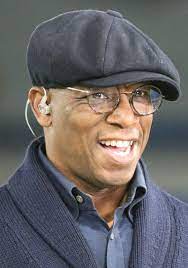
Ian Wright, an Arsenal legend, has called on the Nigeria Football Federation (NFF) to settle the salary arrears of players in the senior national women’s team following their victory over Australia.
After the Super Falcons secured an impressive 3-2 win over the tournament co-host, Wright took to Twitter to write, “Pay them!!!!!! @thenff.”
According to a report by Daily Mail, the Super Falcons have not yet received FIFA’s £15,760 (AUS$30,000) payment, which is meant to be disbursed to the associations for distribution to players participating in the group stages of the tournament.
Additionally, the players are owed other bonuses from their qualification for the tournament.
Before their opening game against Canada, the Super Falcons threatened to boycott the match due to the outstanding issues.
However, head coach Randy Waldrum intervened, and the team decided to honor the game, which ended in a goalless draw.
Prior to the match, Waldrum expressed his frustration at the lack of support from the NFF during the team’s preparations, including the NFF canceling the team’s camping.
“I know we are not prepared the way we need to be … I’ve been very frustrated with the federation and the lack of support.
“We were supposed to have a camp for 10 to 12 days in Nigeria before going to Australia for another 10 to 15 days, but the federation cancelled the home camp.
“We have less days than a College pre-season to prepare for the World Cup, and it blows my mind because we’ve known about this since last year,” Waldrum was quoted as saying on the Sounding Off on Soccer podcast.
The NFF through their Director of Communications, Ademola Olajire responded to Waldrum’s claims, explaining what triggered the federation’s action to neglect the team.
“Only home-based professionals (whom he already gave very little consideration in his provisional list),” he said as quoted by DailyPost Nigeria.
“Like two weeks ago, he released his final list of 23, meaning there was absolutely no need for any camping for home-based again except to simply waste resources.”
“He knows he will not have Ajibade & Ayinde (2 key players) for the opening match against Canada, yet he left out Okobi & Otu from the squad. The NFF felt it would make more sense for the 23 to go straight to Australia & camp for 15/16 days acclimatising to the weather & conditions.”
Meanwhile, the Super Falcons are a step away from progressing to the knockout phase as they need just a draw against theRepublic of Ireland in their final group game.
When you’ve just won promotion back to the top division for your country’s most successful female football team, you’d imagine that heady days are around the corner.
That may have been the case for Chinenye Okafor but far from the way she imagined.
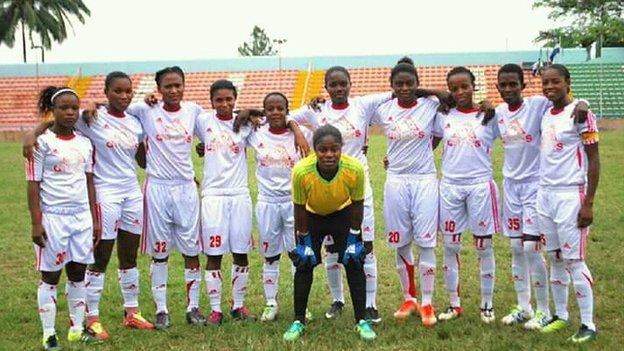
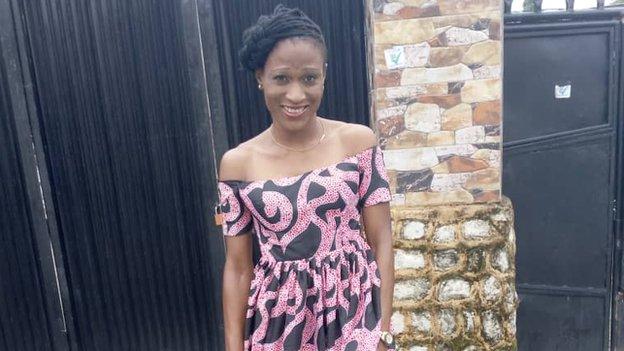
Okafor, a vice-captain of Pelican Stars, quit football in July to take up a job as a hairdresser after going without pay for over a year.
While some of this was caused by the coronavirus pandemic, the rest was caused by officials at the club owned and run by Cross River State, located in southern Nigeria.
“I can’t even tell someone that I’m a footballer because I’m ashamed that after loving football for 22 years, there is nothing to show for it,” the 28-year-told BBC Sport Africa.
“I’m now a hairdresser and I can see that with this, I can go on with my life. I work from 8.30 to 5.30, Mondays to Saturdays. It’s tough but thank God I’m making it.”
It is quite a contrast to when she was pursuing her lifelong passion of playing football yet suffering deeply because of it, as club officials simply failed to pay the women’s team.
Not just any women’s team but Nigeria’s most successful with 8 league titles, two better than their nearest rivals, and which counts two former African Players of the Year in Perpetua Nkwocha and Mercy Akide-Udoh as past stars.
Six titles came in nine years at the turn of the century but Stars’ fortunes have hugely dimmed since following years of underfunding and poor administration.
“I sometimes cried at night because the next morning, I didn’t have anything to eat. After two-three times, I made up my mind to come back to Lagos – because I can’t keep suffering,” she said.
Bright Stars’ start
In 2019 Chinenye Okafor and Pelican Stars’ earned immediate promotion back to the top-flight of women’s football in Nigeria
Okafor joined Stars in 2018 and although her first season with the club ended in relegation, she relished the experience and lifestyle.
“Everything was going fine and I was happy that this was my breakthrough,” the defender explained.
“The payment was coming in, management were kind but at the end of the season, we were relegated.
“We decided that as players that since we were the ones that took the team to relegation, we would take the team back to the Premier League.”
They were as good as their word, bouncing back with an immediate promotion that was even celebrated at Cross River State’s Government House.
But the waters were muddying.
Midway through the season, a club that regularly paid salaries – which ranged from $78-182 – to its players by the end of every month started falling behind with payments.
The first time it happened was when February’s wages came in March. By June 2019, the payments simply stopped coming altogether.
Fall to earth
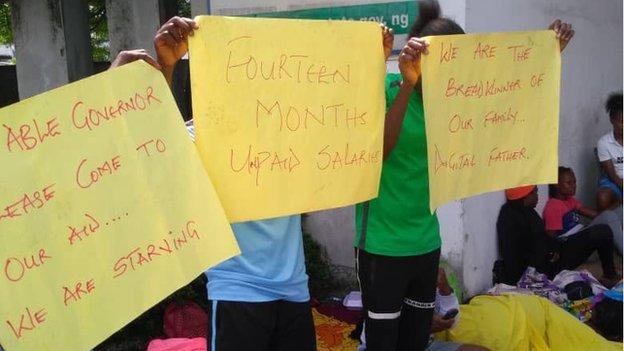
The Pelican Stars team hav been forced to protest outside Cross River State’s Government House.
Even before Covid-19 struck earlier this year, the situation had been rapidly deteriorating for Okafor and her team-mates as they held out for their delayed payments.
“Our club vice-chairman brought bags of rice and beans for us to have at home before the pandemic started,” she recalled.
“It was so bad in camp that we shared food. We also got mocked by local traders because sometimes we had to buy things on credit.”
A state commissioner brought more rice once coronavirus made its unwelcome entrance but Okafor’s challenging existence grew intolerable after Cross River State officials continued to fund men’s teams while ignoring the Stars’ pleas.
“I feel that women are discriminated against. They paid the men’s team, Unicem Rovers, and even the junior team, without paying us – even though our salary had been outstanding since June 2019.
“That was when I got angry. It was too much. We needed to do something for the state governor to know that something is going on.”
In April this year, after ten months without pay, the Stars players held their first protest outside state headquarters.
“The security at Government House harassed us and even brought out guns, saying we should all leave the premises. They said that because of Covid, we were not supposed to be there.
“I felt embarrassed. We had a team-mate that was sick, because she hadn’t had food to eat. She got a chronic ulcer and even now, I don’t think she (is in a state to) play football again.
“They did not even say: ‘Because of her, let us release one-two months’ salaries’.”
A second protest followed shortly after, whereupon the club management said all arrears would be settled by the end of April.
None ever came.
In order to feed themselves, Okafor and some team-mates started looking for other ways to make money while also having to ask others for help.
“Some of us were doing hair for a living or sewing clothes. We also had help from our family and from some fellow female professional footballers,” she said.
Meanwhile, the head of Nigeria’s Women’s League barred Pelican Stars from playing in the league until the salaries are paid – a situation that still stands today.
From heady to head days
Chinenye Okafor dreams about being able to play football again
Ultimately, the lack of pay and regrettable living conditions eventually caused Okafor’s family to step in more forcefully.
“My dad began to call me to come back home, so I left the club in July. I’m now a hairdresser in Lagos,” she said.
“Nothing can be as fulfilling as playing football. to me, football makes me happy whenever I’m on the field of play
“I never saw myself hairdressing so I think I can say at the moment it is a chore.
“I am slowly getting to like it now and am even thinking of having my own salon sooner or later.”
Chinenye Okafor is managing to make a living by being a hairdresser rather than a footballer
But while she concentrates on styling her clients, the bounce Okafor is after is really that of a football – whose lure is irresistible for this fighter.
“If the 2021 season starts, I will for trials with another club,” she rallies. “I still do evening training after work to keep myself fit.”
Okafor’s former team-mates, meanwhile, have now gone 14 months without being paid, despite Cross River State’s Sport Commissioner promising to pay them last week.
“I will never give up on by career because of Pelican Stars,” says Okafor.
“My dream is to play for the Super Falcons of Nigeria and I know my dreams will come true one day. Football has been my joy, my life, my everything and I’ll keep fighting for it.”
Kano state said Muhammadu Sanusi II had disrespected the regional authorities.
After he was taken away from the palace by security forces, the son of a former emir – Aminu Ado Bayero – was installed in his place.
Muhammadu Sanusi II became the emir in 2014 shortly after he was sacked as the central bank governor, after exposing massive corruption in the oil sector.
As emir he was critical of some government policies that put him at loggerheads with politicians.