Tag: Nigerian students

  • Nigerian students expelled from UK universities due to currency crisis

    Nigerian students expelled from UK universities due to currency crisis

    Nigerian students have been expelled from university courses and ordered to leave the UK after a currency crisis left them unable to pay tuition fees on time.

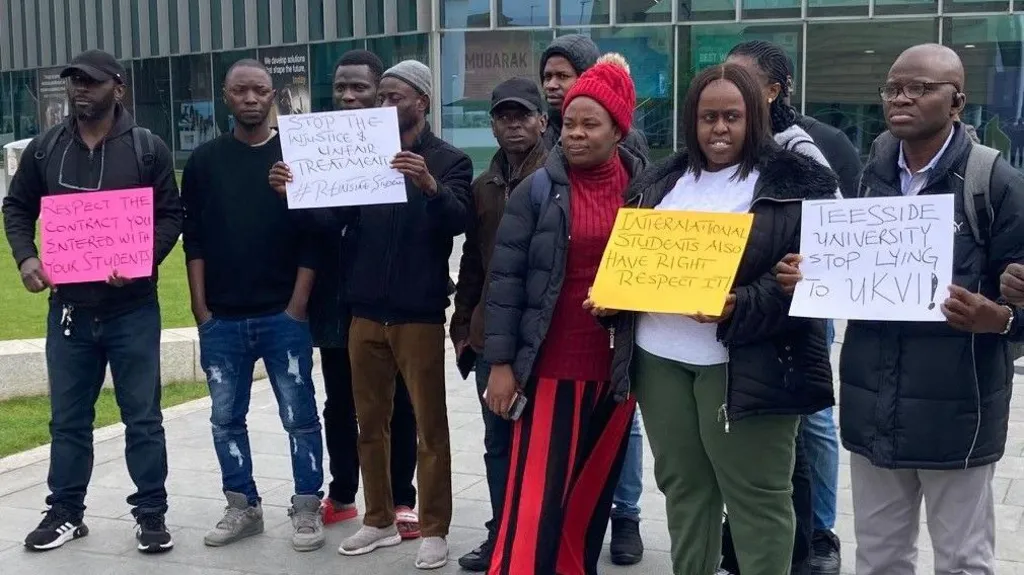
    Students at Teesside University were blocked from their studies and reported to the Home Office after the value of Nigeria’s naira plummeted, depleting their savings.

    Some students told the BBC they felt suicidal, accusing the university of taking a “heartless” approach to those who fell into arrears due to the crisis.

    A university spokesman stated that failure to pay was a breach of visa sponsorship requirements, leaving them “no choice” but to alert the Home Office.

    The Home Office responded that visa sponsorship decisions were the responsibility of the institution.

    Nigeria is facing its worst economic crisis in a generation, significantly affecting Nigerian students at some UK universities.

    Average inflation is nearly 34%, and the situation worsened when the country’s president attempted to replace old currency with new.

    As a result, the currency depreciated by over 100% against the dollar within a year.

    Before starting their studies at Teesside, affected students were required to show proof of sufficient funds to cover tuition fees and living expenses.

    However, those funds were significantly depleted due to the currency crisis in their home country.

    This crisis exacerbated the financial problems students were already facing because the university changed the tuition fee payment plans from seven installments to three.

    A group of students, 60 of whom shared their names with the BBC, began pressing the university for support after several individuals who defaulted on payments were locked out of their university accounts and involuntarily withdrawn from their courses.

    Some students were also reportedly contacted by debt collection agencies contracted by the university.

    Adenike Ibrahim was close to handing in her dissertation at the end of two years of study when she missed one payment and was then kicked off her course and reported to the Home Office.

    She subsequently paid the outstanding fees, but said she had not been re-enrolled and was told she must leave the country, along with her young son.

    “I did default [on payments], but I’d already paid 90% of my tuition fees and I went to all of my classes,” she said.

    “I called them and asked to reach an agreement, but they do not care what happens to their students.”

    She said the experience was “horrendous” and she did not know what was happening with her qualification.

    “It has been heartbreaking for my son especially, he has been in so much distress since I told him,” Ms Ibrahim added.

    No right of appeal

    The Home Office told students, including Ms Ibrahim, that their permission to enter the UK had been cancelled because they stopped studying at the university.

    The letters, seen by the BBC, offer a date by which the student must leave the country and say they do not have a “right of appeal or administrative review against the decision”.

    Since receiving his letter, one masters degree student – who did not want to be named – said he had seriously considered suicide and was not eating or drinking.

    The university said it had made “every effort” to support affected students, who had now been offered individual meetings with specialist staff and bespoke payment plans where requested.

    Esther Obigwe said she repeatedly tried to speak to the university about her financial struggles but received no response, until she too was blocked from her studies and received notice to leave the country.

    “I attended all of my classes and seminars, I’m a hell of an active student,” she said.

    “It is disheartening, I am now on antidepressants and being here alone, I have nobody to talk to.

    “For over two months, I’ve barely eaten or slept and I don’t understand why this is being meted at us, we didn’t do anything wrong.”

    She added that most of the students had “spent a lot of money to be here”.

    Jude Salubi, who was studying to be a social worker, was midway through a placement when he was told his access to the university was suspended and he would have to leave the country.

    Prior to that, he travelled from Teesside to Liverpool each weekend to work 18 hours in an attempt to pay off the outstanding fees.

    “As of now I have paid £14,000 and have a balance of £14,000,” he said.

    “I am willing to come to an agreement as to how I will make this payment, but I need guarantees that I will be re enrolled into school and my visa restored.”

    Some affected students have managed to pay off outstanding fees, but the university is now unable to intervene in the Home Office process, the BBC understands.

    A university spokesman said: “Teesside University is proud to be a global institution with a diverse student population but is also very aware of its obligations regarding visa issuance and compliance.

    “These strict external regulations ensure that the university fully supports a robust immigration system and is outside of the university’s control.”

    The spokesman added it was “aware of the challenging financial situation faced by some students” and had “actively offered bespoke payment plans where requested”. 

    “This option has been taken up by many of our international students; however, some students have still defaulted on these revised payment plans,” he said.

    The Home Office said a decision to offer or withdraw visa sponsorship rested with the sponsoring institution.

    A spokesman said wherever a visa was shortened or cancelled, individuals should “take steps to regularise their stay or make arrangements to leave the UK”.

  • Nigerian students spend $340.84m on foreign university applications in H1 2023

    Nigerian students spend $340.84m on foreign university applications in H1 2023

    Nigerian students applying for admission to foreign universities expended a total of $340.84 million to support their applications from January to June 2023, according to data analysis by The PUNCH.

    This figure is based on data from the Central Bank of Nigeria, specifically related to the amount spent on educational services under the sectoral utilization for transactions eligible for foreign exchange.

    The Central Bank reported that in April 2023, there was a total expenditure of $40.54 million on foreign education, and in May 2023, this amount increased to $48.81 million. However, in June 2023, there was a noticeable decrease, with the bank reporting an expenditure of $32.61 million.

    When comparing this expenditure with the $218.88 million recorded in the first quarter of 2023, there is a decrease of $96.92 million or 44.28 percent.

    Additionally, the first quarter of 2023 performed poorly when compared to figures from the second quarter of 2022, indicating a decrease of $124.42 million, equivalent to a 50.5 percent decline.

    The PUNCH reported that the funds remitted to foreign academic institutions lacked significant reciprocity, with limited inflows from foreign sources into the local education sector.

    Experts have predicted that the challenges with the Central Bank’s supply have led international students to seek dollars from Bureau De Change operators due to delays by banks in processing Form A requests.

    Recent data released by the Home Office of the United Kingdom revealed a 222.8 percent increase in study visas issued to Nigerians, with 65,929 visas issued as of June 2022 compared to 20,427 during the same period in 2021.

    The Central Bank currently faces a backlog of accumulated forex demand on the official market, pushing individuals and businesses to resort to the black market for dollar transactions. Dollar inflows to Nigeria have decreased in recent years due to declining investment and lower crude oil exports, which contribute over 90 percent of the country’s export income.

    In an earlier interview, Dr. Anderson Ezeibe, the National President of the Academic Staff Union of Polytechnics, expressed concerns about the government’s inadequate investment in the education sector and its negative impact on education in Nigeria.

    “You go to tertiary institutions and you see dilapidated buildings, lecturers and students alike are not happy, students do not have access to good equipment for practicals, and at the end of the day, the system continues to churn out half-baked graduates.

    “The only solution to this is for the government to invest fully in the sector. If we operate world-class schools in the country, there will be no need for people to go to other countries to obtain a good education.”

    Prof. Alabi Thomas, an education professor at the Federal University of Technology, Minna, also attributed the migration to government policies that have, in his opinion, continued to severely damage the education sector.

  • Provide us grace period for payment of school fees – Nigerian students in Ghana to universities

    The Ghana Chapter of the National Association of Nigerian Students (NANS) has appealed to the administrations of various tertiary institutions in the country for a grace period for the payment of fees by their members.

    In a media interview, the President of NANS, Sam Edem, pointed out the volatility in the exchange rate between the Ghanaian cedi and the Nigerian naira. This exchange rate instability has resulted in continuous increases in school fees.

    Mr. Edem acknowledged that the Nigerian government is taking steps to address the naira’s challenges and urged tertiary institutions in Ghana to consider their request for a grace period in light of these currency fluctuations.

    “So, while I am putting out word to our government back home, we would appreciate it if a lot more is done about this issue. And we appeal to our institutions here to give the Nigerian students that allowance for the period to ensure that they are able to meet their obligations with regard to fees.”

    In a public lecture in 2022, Lamido Sanusi, the former governor of the Central Bank of Nigeria, disclosed that there were more than 70,000 Nigerian students pursuing their education in Ghana.

    He said “about 71,000 Nigerian students in Ghana (are) paying about US$1 billion annually as tuition fees and upkeep, as against the annual budget of US$751 million for all federal universities.”

    “In other words, the money spent by Nigerian students studying in Ghana with a better-organised system is more than the annual budget of all federal universities in the country. Nigeria is today placed third on the list of countries with the highest number of students studying overseas,” he added.

  • Families of International students  to be affected by new UK ban

    Families of International students to be affected by new UK ban

    Under new immigration restrictions, international postgraduate students enrolled in non-research degrees will no longer be permitted to bring family members to the UK.

    Nigerian nationals are among top five nationalities granted sponsored study visas to the UK.

    Statistics show that Nigerian nationals saw the second largest percentage rise in the number of visas granted, increasing from 6,798 in 2019 to 59,053 in 2022.

    Last year, Nigerian sponsored study visa holders in the UK had the highest number of dependants – 60,923, increasing from 1,586 in 2019.

    The announcement by the UK government has been made two days before official statistics are expected to show legal migration has hit a record 700,000 this year.

    From January 2024, partners and children of postgraduate students other than those studying on courses designated as research programmes will no longer be allowed to apply to live in the UK during the course.

    Currently, students coming to the UK with a visa need to provide documents proving their relationship to dependants, who have to pay £490 for a visa.

    Dependants are also required to pay the immigration health surcharge – an annual contribution between £470 ($584) and £624 towards NHS services.

  • Calm restored after Nigerian students attacked in India

    Nigerian officials have called on the authorities in India to ensure the safety of Nigerian students in the country.

    This followed fighting between Nigerian and Indian students at the GD Goenka University in the capital Delhi, sparked by a football match dispute last weekend.

    Footage of the clash has been shared on Twitter.

    The incident at the university’s Gurugram campus forced more than 80 Nigerians to flee and take refuge at the country’s embassy.

    The chairwoman of the Nigerians in Diaspora Commission, Abike Dabiri-Erewa, said “a few injuries” had been recorded during the violence.

    But Mrs Dabiri added that “calm” had been restored and that the Nigerian students have since returned to the campus after a meeting between officials of the two nations.

    In a tweet, the Nigerian representative also said the country’s embassy had got a “written commitment by the Indian authorities to protect” Nigerian students.

    She also advised that any students who felt “threatened” should report to the diplomatic mission of Nigeria.

    The Indian authorities said they are investigating the incident – including reviewing CCTV footage of the violence, according to local media.

    Thousands of African students – many of them Nigerians – are studying at several Indian universities.

    But there have often been tensions between the locals and Africans.

    Local media report that last month some Indian students had protested against African students praying on a football pitch, insisting that they should instead do so inside their hostels.

    Source:myjoyonline.com