Investigators have found traces of explosives at the site of the damaged Nord Stream pipelines, confirming that sabotage had taken place, a Swedish prosecutor said on Friday.
Swedish and Danish authorities are investigating four holes in the Nord Stream 1 and 2 pipelines which link Russia and Germanyvia the Baltic Sea and have become a flashpoint in the Ukraine crisis.
Denmark last month said a preliminary investigation had shown that the leaks were caused by powerful explosions.
“Analysis that has now been carried out shows traces of explosives on several of the objects that were recovered,” the Swedish Prosecution Authority said in a statement.
“The investigation is highly complex and comprehensive. The ongoing probe will determine whether any suspects can be identified,” it added.
The prosecutor’s office declined to give further comment.
As a result of the energy crisis caused by Russia’s invasion of Ukraine, German Chancellor Olaf Scholz has ordered the country’s three remaining nuclear power plants to remain operational until mid-April.
Germany had originally planned to phase out all three by the end of this year.
Mr Scholz’s order overruled the Greens in his coalition, who wanted two plants kept on standby, to be used if needed.
Nuclear power provides 6% of Germany’s electricity.
But gas prices have soared since Russia’s invasion of Ukraine in February, which disrupted Russia’s huge oil and gas exports to the EU. In August Russia turned off the gas flowing to Germany via the Nord Stream 1 undersea pipeline.
After relying so heavily on Russian gas Germany is now scrambling to maintain sufficient reserves for the winter. The crisis has also prompted it to restart mothballed coal-fired power stations, though the plan is to phase out coal in the drive for green energy.
Last year Germany got 55% of its gas from Russia, but in the summer that dropped to 35% and it is declining further.
Chancellor Scholz’s third coalition partner, the liberal Free Democrats (FDP), welcomed his move to keep nuclear power as part of the mix. The three remaining nuclear plants are Isar 2, Neckarwestheim 2, and Emsland.
The Social Democrat (SPD) chancellor also called for ministries to present an “ambitious” law to boost energy efficiency and to put into law a phase-out of coal by 2030.
Last week climate activist Greta Thunberg said it was a “mistake” for Germany to press on with nuclear decommissioning while resorting to coal again.
The Russian leader says a mothballed pipeline can ferry energy exports west if it is proven safe following a spate of recent explosions.
Russian President Vladimir Putin has said Moscow is ready to resume gas supplies to the European Union via a link of the Germany-bound Nord Stream 2 pipeline under the Baltic Sea – an offer quickly rejected by Berlin.
Speaking at a Moscow energy forum on Wednesday, Putin said that one of the two links of the pipeline remained pressurised despite a series of ruptures last month which caused major leaks, sending gas spewing out off the coast of Denmark and Sweden.
TheNord Stream 1pipeline was also ruptured by powerful underwater explosions in September.
Western officials have linked the incidents to “sabotage” but have held back from attributing responsibility for the blasts while investigations by German, Danish and Swedish officials continue.
Putin said that if checks prove the Nord Stream 2 link is safe to operate, Russia stands ready to use the pipeline to pump gas to Europe, adding its capacity stands at 27 billion cubic meters (bcm) a year.
The Nord Stream 2 pipeline has never brought natural gas to Europe because Germany prevented the flows from ever starting just before Russia launched military action in Ukraine on February 24.
Putin also repeated an earlier accusation that the United States was likely behind the blasts on the Nord Stream pipelines, without providing any evidence to support his claim, and floated the idea of creating an alternative European gas hub via Turkey.
“The act of sabotage of the Nord Stream 1 and 2 is an act of international terrorism aimed at undermining energy security of the entire continent by blockingsupplies of cheap energy,” Putin said, alleging that the US wants to force Europe to switch to importing more expensive liquefied natural gas.
According to a Gazpromofficial, 2015 saw the discovery of a NATO mine destroyer near the Nord Stream 1 offshore gas pipeline.
The spokesperson, Sergei Kupriyanov, said the device was pulled out and rendered harmless by the Swedish arm forces.
Earlier today, Swedish Prime Minister Magdalena Andersson said it would not share findings of an investigation into the explosions of the Nord Stream gas pipelines with Russian authorities or Gazprom.
A Swedish crime scene investigation of the Nord Stream 1 and 2 gas pipelines from Russia to Europe has found evidence of detonations and prosecutors suspect sabotage.
Last week Russian Prime Minister Mikhail Mishustin sent a letter to the Swedish government demanding that Russian authorities and Gazprom be allowed to be involved in the investigation.
And today, Ms Andersson said Sweden would not share the findings of the explosions that took place in the Swedish economic zone, with Russian authorities.
“In Sweden, our preliminary investigations are confidential, and that, of course, also applies in this case,” she told reporters.
However, Ms Andersson said Sweden had no power to stop Russian vessels from visiting the sites of the explosions now that the crime scene investigationwas concluded.
The Nord Stream 1 and Nord Stream 2 pipelines sustained significant damage last week as a result of “detonations,” according to the Swedish Security Service’s initial investigation.
The agency also said the leaks from the two Russian gas pipelines in the Baltic Sea “has strengthened the suspicions of serious sabotage” as the cause.
Last week, undersea explosions ruptured Nord Stream 1 and Nord Stream 2, at two locations off Sweden and two off Denmark. The pipelines were built to carry Russian natural gas to Germany.
While Vladimir Putin accused the West of attacking the pipelines, the US and its allies have vehemently denied it.
The agency did not give details about its investigation, but in a separate statement Swedish prosecutor Mats Ljungqvist said: “Seizures have been made at the crime scene and these will now be investigated.”
Danish authorities said the two leaks they were monitoring in international waters stopped over the weekend. One of the leaks off Sweden also appeared to have ended.
A Kremlin spokesperson on Thursday said he did not think the investigation could be objective without Russia’sparticipation after Russia had not been invited to take part.
The International Energy Agency (IEA) has announced that theworld’s natural gas markets will likely remain constrained well into 2023 as Russia limits supplies and Europe reduces consumption in the face of high costs and energy-saving initiatives.
Global gas consumption is expected to drop by 0.8 percent in 2022 – the result of a record 10 percent contraction in Europe and static demand in the Asia-Pacific – and grow just 0.4 percent next year, the IEA said in its quarterly gas market report on Monday.
Still, the market outlook is subject to a “high level of uncertainty” due to Russia’s future actions and the economic effect of high energy prices over time, the IEA said.
“Russia’s invasion of Ukraine and sharp reductions in natural gas supplies to Europe are causing significant harm to consumers, businesses, and entire economies – not just in Europe but also in emerging and developing economies,” said Keisuke Sadamori, the IEA’s director of energy markets and security.
“The outlook for gas markets remains clouded, not least because of Russia’s reckless and unpredictable conduct, which has shattered its reputation as a reliable supplier. But all the signs point to markets remaining very tight well into 2023.”
Russia’s supply of gas to Europe has dwindled to a trickle since the shutdown of the Nord Stream 1 last month and the recent discovery of leaks in the pipeline.
Moscow has threatened to sanction Ukrainian energy firm Naftogaz, one of the last remaining Russian gas supply routes to Europe, a move that would exacerbate energy shortages coming into winter.
Europe has offset the decline in Russian gas supplies by importing LNG and using alternative pipeline supplies from producers such as Norway.
The IEA said it expected Europe’s LNG imports to increase by more than 60 billion cubic metres this year, keeping the market under pressure for the short to medium term.
However, China’s new LNG contracts since 2021 and a colder-than-average winter could cause additional demand from Northeast Asia, the Paris-based intergovernmental organization said.
Downing Street says that during her meeting with Danish Prime Minister Mette Fredriksen, the leaders agreed that the ruptures of the Nord Stream 1 and 2 pipelines on Monday were clearly sabotaged and more work needs to be done to increase energy independence.
Liz Truss has agreed the cause of the leaks in the Nord Stream pipelines was “sabotage”, her spokesperson has said.
The British prime minister was discussing the ruptures in the Russia-Germany gas supply lines with the Danish PM during the latter’s visit to Downing Street on Saturday.
It is believed to be the first time Ms Truss has described what happened in the Baltic Sea on Monday as a deliberate act.
While Western governments are yet to do so, many commentators have said that Russia is most likely to be responsible for damage to the pipelines. Moscow, meanwhile, has sought to blame the West.
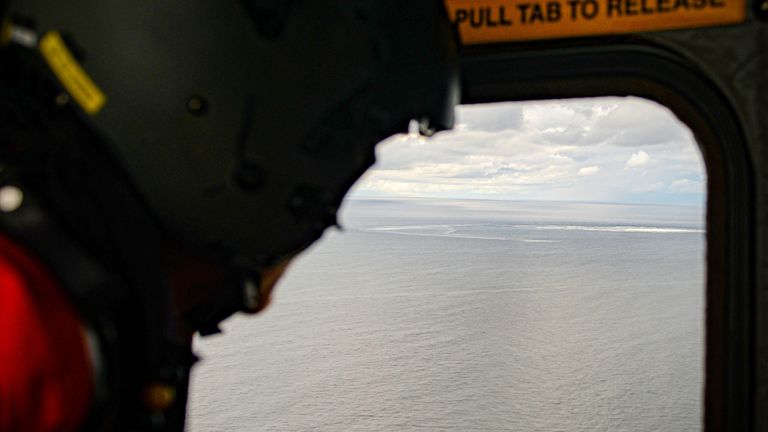
Image: Aircrew on board a Danish defense aircraft monitor Nord Stream gas leak over the Baltic Sea
The leaks have caused huge alarm in Europe as, if deliberate attacks are found to have caused them, it reveals how vulnerable the vast network of undersea pipelines and infrastructure is to interference, as the Ukraine war rages on the continent.
The prime ministers also said their nations looked forward to working witheach other more closely through the Joint Expeditionary Force, which involves sending UK troops to the Baltic, to work alongside Danish and other forces.
A Downing Street spokesperson said after the visit of Danish Prime Minister Mette Fredriksen to Number 10: “The leaders stressed the need to stay united in the face of Russia’s despicable action in Ukraine.
“Prime Minister Fredriksen updated the prime minister on the damage caused to the Nord Stream pipelines last week. They agreed the incidents were clearly an act of sabotage. The prime minister offered the UK’s support for the ongoing investigation.
“The leaders agreed that the safety and security of the Baltic Sea are in everyone’s interest, and welcomed increased cooperation through the Joint Expeditionary Force.
“On energy security more widely, the prime minister and Prime Minister Fredriksen agreed on the need for like-minded democracies to work together to increase our energy independence.”
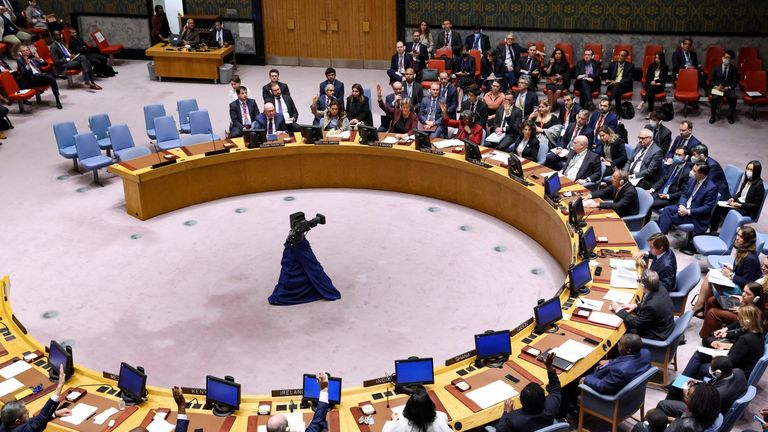
Image:Members of the United Nations Security Council convene at the request of Russia to discuss damage to two Russian gas pipelines to Europe in New York
A network of pipelines runs under the North Sea from gas fields in Britain’s economic zones and there are also electricity and data cables going to and from the UK, including those involving the huge wind farms off the coast.
Overnight, Washington said the US and its allies would send divers to find out what happened before a series of leaks erupted in the Nord Stream 1 and 2 pipes on Monday night, close to the Danish island of Bornholm.
At the time, they were not carrying gas from Russia to Germany but remained pressurized.
Nord Stream ‘sabotage sends powerful message’
Analysts have said that explosions were the most likely cause for the ruptures.
On Friday, Vladimir Putin, without providing evidence, blamed the United States and its allies for blowing up the pipelines.
At the United Nations, Russia’s ambassador told the UN Security Council that the US had much to gain in gas trade from damage to the Nord Stream pipeline system but stopped short of blaming Washington.
Russians ‘pumping out lies and disinformation’
US President Joe Biden said the leaks were a result of “a deliberate act of sabotage” and added, “now the Russians are pumping out disinformation and lies”.
Gazprom – Russia’s state-owned gas supplier which is the majority shareholder of Nord Stream’s holding company – said 800 million cubic metres of gas had escaped after the blasts.
The United Nations Environment Programme said the release of gas from the pipelines adds up to what is likely the biggest single release of climate-damaging methane ever recorded.
The growing insecurity comes as gas started flowing on Saturday morning to Poland through the new Baltic Pipe pipeline from Norway via Denmark and the Baltic Sea, a move that was supposed to help boost the amount of gas reaching northern Europe after Russia cut supplies in the wake of Ukraine war sanctions
The EU is preparing its own kind of response after Russia shut down the main Nord Stream 1 pipeline a few days ago, but it acknowledges that consumers and businesses are already paying “astronomical rates.”
A new confrontation between the European Union and Russia over gas supplies appears to be imminent.
The bloc has revealed plans for a price cap on Russian gas imports in retaliation for the war in Ukraine and measures to help member states cope with the energy squeeze.
Ursula von der Leyen, the president of the European Commission, laid out five proposals on Wednesday, hours after Russia’s leader threatened to turn off the taps to any Western nations moving to impose price caps on his country’s energy.
She said Russia had become an “unreliable supplier” after state-run Gazprom’s decision to turn off the taps on the major Nord Stream 1 pipeline indefinitely last week, adding that the EU’s reliance on Russian gas had fallen significantly since the invasion and stocks were back at 82% across the bloc.
One of the other measures however betrayed the perilous position the bloc continues to face ahead of winter.
Ms Von der Leyen proposed a mandatory cut in electricity use across the EU to preserve power by 10% a month based on a five-year average and by a further 5% during times of peak price periods.
She also planned a cap on the revenue of non-gas fuelled generators – bolstered by record raw energy costs – to re-channel their “unexpected profits” into measures that support households and companies.
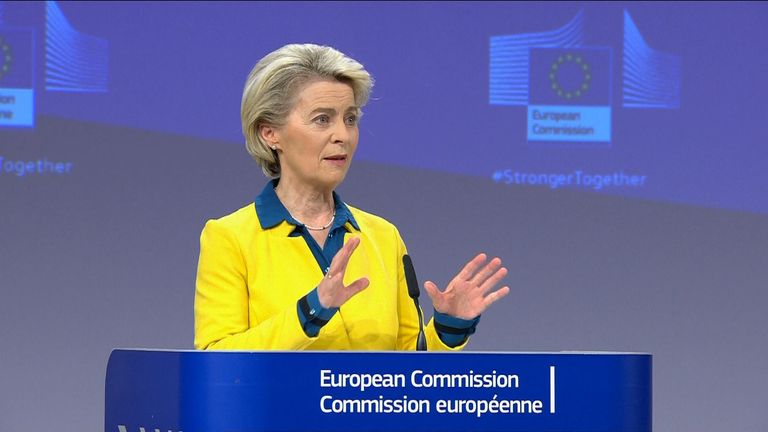
Image: Ursula von der Leyen said consumers across the EU were facing ‘astronomic’ bills
A windfall tax on fossil fuel firms was also on the cards, she said, along with aid for utility providers struggling under the weight of wholesale prices.
The plans, which will have to be agreed upon by member states, may face opposition.
Some EU countries are wary of capping Russian gas prices in case that costs them the dwindling supply they still receive from Moscow.
It follows confirmation that the UK is planning to bring down its own energy bills through a taxpayer-funded bailout. The details are expected this week.
Ms Von der Leyen explained that the planned cap on wholesale prices from Russia was now possible after the bloc had eased its reliance on Russian energy.
“We have increased our preparedness and weakened Russia’s grip on our energy supply through demand reduction – which allowed our common storage to be at 82%,” she said.
“Through diversification, we have increased deliveries of LNG or pipeline gas from the US, Norway, Algeria, Azerbaijan, and others. For example, Norway is now delivering more gas to the EU than Russia.”
The UK has also been pumping record volumes to the EU via interconnectors for months as part of EU efforts to bolster storage.
The news comes amid growing fears that families in the EU will not be able to afford the cost of heating this winter.
Energy prices have soared since Russia invaded Ukraine and scarce supplies could push up the cost even further.
Europe is attempting to wean itself off Russian energy in an effort to reduce Moscow’s ability to finance the war, but the transition may not come quickly enough.
EU Council President Charles Michel said the Russian move was “sadly no surprise”.
“Use of gas as a weapon will not change the resolve of the EU. We will accelerate our path towards energy independence. Our duty is to protect our citizens and support the freedom of Ukraine,” he tweeted.
It has blamed the sanctions for holding up routine maintenance of Nord Stream 1, but the EU says this is a pretext.
Germany’s network regulator, the Bundesnetzagentur, said the country was now better prepared for Russian gas supplies to cease, but it urged citizens and companies to cut consumption.
Gazprom’s announcement came shortly after the G7 nations agreed to cap the price of Russian oil in support of Ukraine.
The G7 (Group of Seven) consists of the UK, US, Canada, France, Germany, Italy, and Japan.
Their introduction of a price cap means countries that sign up to the policy will be permitted to purchase only Russian oil and petroleum products transported via sea that are sold at or below the price cap.
However, Russia says it will not export to countries that participate in the cap.
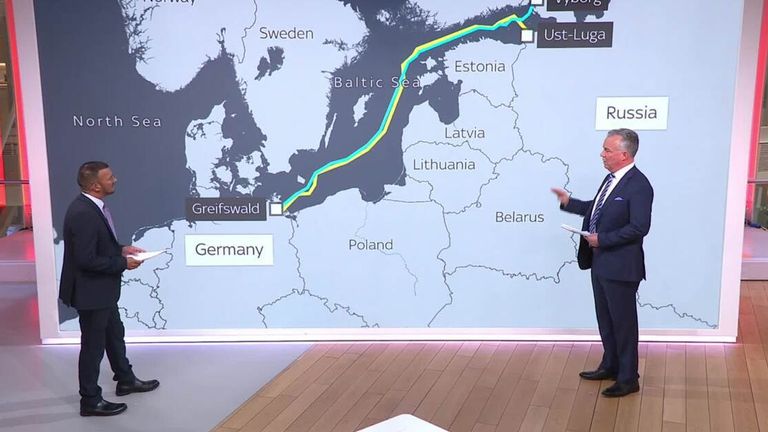
The gas pipeline stretches from the Russian coast near St Petersburg to north-easternGermany and can carry up to170 million cubic metres of gas a day.
It is owned and operated by Nord Stream AG, whose majority shareholder is Gazprom.
Germany had also previously supported the construction of a parallel pipeline – Nord Stream 2 – but the project was halted after Russia invaded Ukraine.
Gazprom said the fault had been detected at the Portovaya compressor station, with the inspection carried out alongside workers from Siemens, the German firm that maintains the turbine.
It said that fixing oil leaks in key engines was only possible in specialized workshops, which had been hindered by Western sanctions.
However, Siemens itself said: “Such leaks do not normally affect the operation of a turbine and can be sealed on site. It is a routine procedure within the scope of maintenance work.”
This is not the first time since the invasion that the Nord Stream 1 pipeline has been closed.
In July, Gazprom cut off supplies completely for 10 days, citing “a maintenance break”. It restarted again 10 days later, but at a much-reduced level.
Speaking to the BBC from the Swiss capital Bern, an economist and energy analyst, Cornelia Meyer, said the gas shutdown would have a major impact on employment and prices.
“That really has huge ramifications for gas in Europe which is about four times more expensive than it was a year ago and this cost of living crisis will really soar because it’s not just gas,” she said. “Gas becomes fertilizer and it’s used in many industrial processes, so that will affect jobs, and it will affect costs.”
The flow of gas through Nord Stream 1 had already been reduced to a relative trickle. Now, once again, it has been halted completely.
An oil leak, claims Gazprom – which has previously attributed reduced flows through the pipeline to technical issues related to sanctions.
Europe, though, believes President Putin is weaponizing gas supplies – deliberately limiting flows through the pipeline to push up prices, in order to test the resolve of Russia’s critics.
The result, as we’ve already seen, is soaring energy costs – with businesses and consumers paying a heavy price.
The timing of Gazprom’smove is certainly interesting. It comes on the same day the G7 announced moves to cap the price of Russia’s oil exports.
But it also comes shortly after Germany – which is heavily reliant on Russian gas – revealed that its winter storage was filling up faster than expected.
A cynic might say this was the last opportunity to tighten the screw, in order to inflict maximum damage over the colder months.
Due to the need for maintenance, Russia has fully stopped supplying gas to Europe through a major pipeline.
The Nord Stream 1 pipeline will be restricted for the next three days, according to Russian state-owned oil company Gazprom.
Russia already considerably cut back on pipeline-based gas shipments.
It also denies claims that energy supplies were used to penalize Western countries for enacting sanctions in response to the invasion of Ukraine.
The Nord Stream 1 pipeline stretches 1,200km (745 miles) under the Baltic Sea from the Russian coast near St Petersburg to north-eastern Germany.
It opened in 2011 and can send a maximum of 170m cubic metres of gas per day from Russia to Germany.
The pipeline was shut down for 10 days in July – again for repairs, according to Russia – and has recently been operating at just 20% capacity because of what Russia describes as faulty equipment.
European leaders fear Russia could extend the outage in an attempt to drive up gas prices, which have already risen by 400%.
The steep rise threatens to create a cost of living crisis over the winter months, potentially forcing governments to spend billions to ease the burden.
On Tuesday, French Energy Minister Transition Minister Agnes Pannier-Runacher accused Russia of “using gas as a weapon of war”.
She was speaking after Gazprom said it would be suspending gas deliveries to the French energy company Engie.
But Russian President Vladimir Putin‘s spokesman has rejected the accusations and insisted that Western sanctions have caused the interruptions by damaging Russian infrastructure.
He insisted that “technological problems” caused by Western sanctions are the only thing preventing Russia from supplying gas via the pipeline, without specifying what the problems were.
The most recent controversy has been over a turbine that arrived in Germany after being repaired in Canada and which Russia refused to take back, arguing it was subject to the Western sanctions.
Germany, however, denies this.
Earlier this month, Economy Minister Robert Habeck said the pipeline was fully operational and said there were no technical issues as claimed by Russia.
Earlier this week, EU Commission President Ursula von der Leyen promised to intervene in energy markets, telling a conference in Slovenia that they are “no longer fit for purpose”.
“We need a new market model for electricity that really functions and brings us back into balance,” she said.