Russian President Vladimir Putin and Uzbekistan leader Shavkat Mirziyoyev met on Monday and signed some agreements to make their relationship stronger. One of the agreements is for Russia to build a small nuclear power plant in Uzbekistan.
Mirziyoyev said the project is very important and Uzbekistan has a lot of uranium. Putin promised to work hard to sell nuclear energy in Uzbekistan.
If the deal goes through, the factory will be the first of its kind in Central Asia, making Russia even more powerful in the area.
Putin also said he would send more gas to Uzbekistan.
Putin and Mirziyoyev had a meeting in Tashkent, Uzbekistan. Putin went there on Sunday, which was his third trip to another country since he started his new term as president.
He went to China first and said he liked China’s ideas to end the Ukraine conflict. Then he went to Belarus where Russia has put nuclear weapons.
The trips show that the Kremlin is trying to gain more support because of the continuing tensions with the West over the situation in Ukraine.
Tag: nuclear power
-

Russia plans to construct little nuclear power facility in Uzbekistan
-

Vendor for Ghana’s first nuclear power plant to be selected by close of 2024
The Ministry of Energy has revealed plans to select a vendor for Ghana’s inaugural nuclear power plant by the close of 2024, aiming for operational status by 2030.Dr. Robert Sogbadji, Deputy Director of Power (Nuclear and Alternative Energy), shared this information during a policy dialogue marking World Sustainable Energy Day in Accra.
The event was organized by the Centre of Excellence in Public Utility Regulation (CEPUR), a collaboration between the Public Utilities Regulatory Commission (PUCR) and the Ghana Institute for Management and Public Administration (GIMPA).
Dr. Sogbadji outlined that the country is currently in phase two of its nuclear power program, with plans to announce the selected vendor company by year-end.
The first nuclear power plant is anticipated to become part of Ghana’s energy mix by 2030 or 2032, contributing significantly to achieving net-zero goals and energy transition objectives.
Addressing the country’s US$561.9 billion financing requirement for energy transition, Dr. Sogbadji mentioned the government’s strategic plan to secure about 46% from the private sector.
Herbert Krapa, Deputy Minister of Energy, affirmed the progress of Ghana’s energy transition agenda, emphasizing the implementation of a clear strategy to attract investments. He highlighted pipeline projects, including 2,000 megawatts of solar and wind energy, to attract financing from various investors.
Mr Krapa emphasized efforts to scale up the domestic currency and explore technologies like carbon capture utilization, electronic vehicles, and green hydrogen to align with the transition pathway.
He indicated the government’s commitment to balancing conventional (hydro), solar, and nuclear power for sustainable electricity.
Kwame Jantuah, Chairman of the Oil and Gas sector at the Association of Ghana Industries, called for a balanced approach in utilizing conventional, solar, and nuclear power for sustainable electricity.
He suggested incentivizing residential solar panel adoption to reduce conventional costs, with excess energy contributing to the overall mix for export.
Jantuah emphasized the importance of leaving vendor selection in the hands of the nuclear energy body to prevent political interference. Ghana envisions implementing both a large reactor (1,000-1,200 megawatts) and a small modular reactor (about 300 megawatts) for its nuclear power plant, aligning with the country’s industrialization goals and sustainable development objectives.
“We’re currently in phase two of our nuclear power programme, and by the end of this year, we should be able to announce our vendor company to build our first nuclear power plant, which we foresee to be in the energy mix by 2030,” Dr Sogbadji said.
“So, by 2030 or 2032, we would have advanced strongly towards meeting net zero and meet energy transition goals,” he said.
-
Hungary’s risky bet on Russia’s nuclear power
“If this new power plant is built,”, says Janos, a tall, friendly nuclear engineer who works in Reactor block 2 of the existing nuclear power station at Paks, “it will be good for the town, and good for the country.”
It’s a big if.
Despite the Hungarian government’s unswerving commitment to the Paks 2 project, despite the Russian commitment to supply the finance and technology, the Russian war in Ukraine is making the new power station less likely by the day.
It is the biggest single investment in Hungarian history.
The government claims it will make the country less dependent on Russia, from which Hungary gets most of its oil and gas. Critics say it will make Hungary even more dependent on Russia for much of this century.
Paks 1 nuclear power station, on the shore of the Danube and an hour’s drive south of Budapest, was built by the Soviet Union in the 1980s, and its four reactors still supply around 40% of Hungary’s electricity needs.
Their working life is due to end in the 2030s. In 2014, Prime Minster Viktor Orban signed a deal with Russian President Vladimir Putin to build two new 1,200 MW reactors beside the old ones.
Russia will finance the plant with a €10bn loan, which Hungarian consumers should pay back in their electricity bills, starting in 2026, when the plant was due to come on line.
Years of delays with permits meant that ground-clearing work at the site only began last August.
While Hungary has pressed ahead with Paks 2, last May Finland cancelled a similar, Russian-built plant on the Hanhikivi peninsula in mid-construction, because of the Russian invasion of Ukraine.
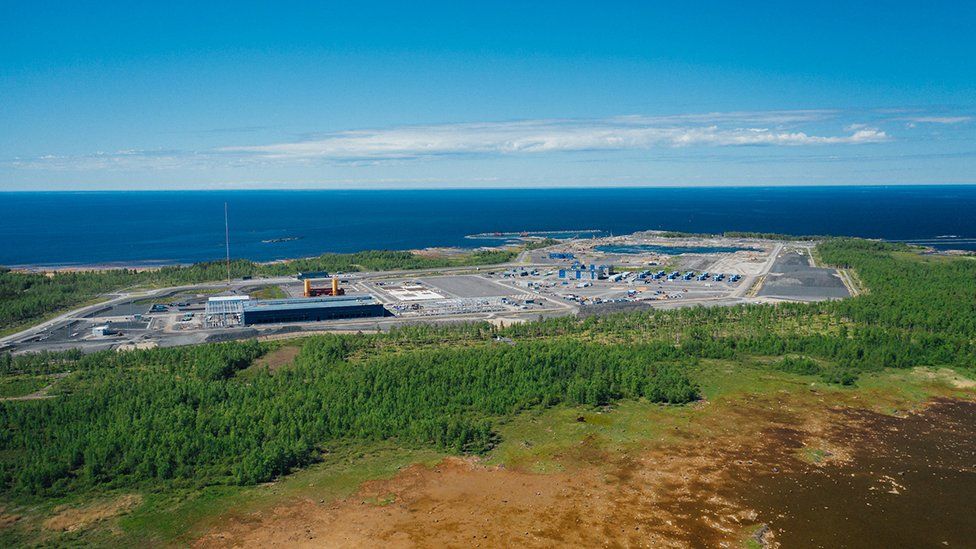
IMAGE SOURCE,FENNOVOIMA Image caption, Finland cancelled its first nuclear plant for 50 years citing delays and the war in Ukraine The war in Ukraine is now hanging like a dark cloud over the Paks project, too.
Fighting in the early days of the war around Ukraine’s former nuclear plant at Chernobyl and artillery duels around the Zaporizhzhia plant, the biggest in Europe, have harmed the project.
Even those who believe in Paks 2 with an almost religious zeal sound worried.
“Isolation of Russia is not a solution, even in this war situation,” says Attila Aszodi, former government commissioner for Paks 2.
BBCI really believe that the war will be closed in a short time with conditions that can leave the project running
Dyed-in-the-wool opponents, such as former Green MEP Benedek Javor, are more blunt.
“Paks 2 is a purely political project,” he says, pointing to close relations established by Viktor Orban with Russian Vladimir Putin since 2009.
Since Russia’s invasion of Ukraine, the Hungarian leader has pushed back repeatedly against EU sanctions on Russia and its officials have maintained close diplomatic ties with Moscow.
“From an energy perspective it’s not necessary to build [Paks 2], and it’s definitely not necessary to build it with the Russians,” says Mr Javor.
He argues the money would be better spent on renewables like solar, from which Hungary already gets 10% of its energy, and improving the electricity grid.
This autumn, the government abruptly ended subsidies for households installing solar panels, because the grid could not cope with the new inputs.
The Fidesz government has also made wind power practically impossible, by banning the construction of turbines within 10km (6.2 miles) of a settlement.
“We might arrive at a point where Paks 2 cannot be constructed but there is no alternative,” says Mr Javor. “Then Hungary will have a serious problem with the security of supply.”
The list of complications from the war in Ukraine is long.
Many major components of the plant are supposed to be built in Russia, and transported overland.
The original plan was to bring them through Ukraine and there are no obvious alternative routes.
Several thousand welders are supposed to be employed.
Back in 2014, everyone I asked said Ukrainian welders would be found. And the plant is not simply a Russian one.
Under EU pressure, it is now a hybrid, using Russian hardware and a control system to be built by the Siemens-led, French-German consortium Framatome.
The turbines are supposed to be built by GE Hungary, a subsidiary of US firm General Electric. It is hard to imagine US, German and French engineers working shoulder to shoulder with their Russian comrades, 400 km from the border of a country the Russians shell day and night.
There are other question marks, too. How will Russia supply nuclear fuel? How will Hungary send highly radioactive used fuel elements back to Russia?
And will the EU eventually extend sanctions to nuclear technology and employees of Russian state nuclear firm Rosatom?
Nuclear power transformed Paks from a small, sleepy, riverside town into one of the richest in provincial Hungary.
The streets are lined with hairdressers, clothes shops, restaurants and bars – 2,700 people work at Paks 1, with another 7,000 dependent on the plant as sub-contractors.
During construction, Paks 2 is supposed to attract 10,000 more. Smart new blocks of flats are nearly finished for the Russian engineers to be employed here. But, for now, the town is holding its breath.
“To tell the truth, I just don’t know what will happen. I’m not a prophet. I can’t predict when it will be built,” says Janos, from Reactor block 2.
Hungary’s Foreign Minister Peter Szijjarto, who’s in personal charge of the project, recently met Rosatom directors in Istanbul and still speaks confidently of 2030.
While he is optimistic Russia will deliver on its promises, the reluctance of Hungary’s EU partners to work on any Russian energy project because of the war is likely to cause Budapest future headaches.
Source: BBC.com
