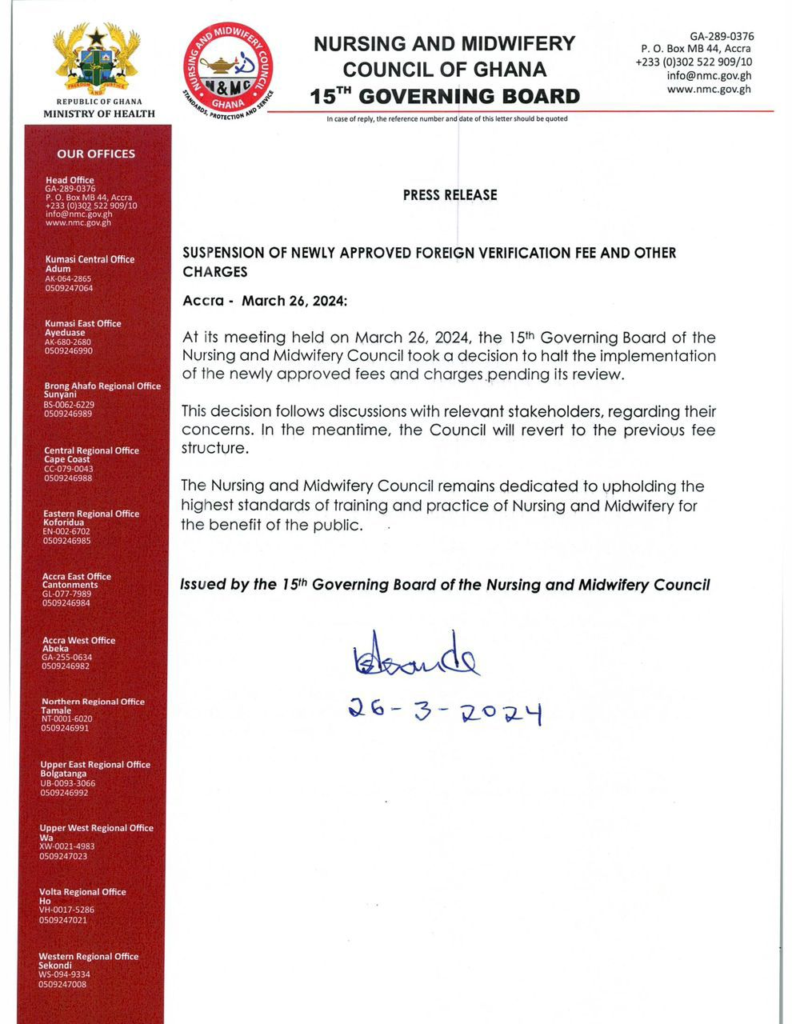
The Nursing and Midwifery Council of Ghana has halted the implementation of recently approved fees for nurses, pending a review of the charges.
This decision comes after the Ghana Nurses and Midwives Association threatened to strike over the Council’s significant increase in the nursing verification fee, raising it from GH¢500 to GH¢3,000.
Following discussions with the Health Ministry, the association withdrew their planned protest.
The Nursing and Midwifery Council’s decision to suspend the new fees was reached during a meeting of its 15th Governing Board on Tuesday, March 26, 2024.
The Council stated that its decision was made after engaging with relevant stakeholders regarding their concerns, and it will revert to the previous fee structure.
“At its meeting held on March 26, 2024, the 15th Governing Board of the Nursing and Midwifery Council took a decision to halt the implementation of the newly approved fees and charges pending its review.
“This decision follows discussions with relevant stakeholders, regarding their concerns. In the meantime, the Council will revert to the previous fee structure.”
President Akufo-Addo has encouraged nurses and midwives to embrace postings to rural areas, where their valuable services are in high demand.
He said the refusal of some healthcare professionals to accept postings to some parts of the country was not helpful to efforts at making quality healthcare services accessible to all Ghanaians.
The President made the call on Friday at a grand durbar to commemorate the 60th anniversary of the School of Nursing and Midwifery, of the College of Health Sciences of the University of Ghana, Legon.
The anniversary is being celebrated under the theme: “Resilience in Developing Nursing and Midwifery Workforce: Embracing Technology and Promoting Excellence.”
Underlining the need for the equitable distribution of healthcare professionals across the country, President Akufo-Addo thought it was unfair for health workers to be concentrated in cities and urban areas to the detriment of people in rural settings.
He asked nurses and midwives to emulate their forebearers who accepted work in any part of the country even when the national infrastructure was not the best and without the incentive packages being offered presently by the government.
“Our schools of Nursing and Midwifery have got a good reputation and have been training good nurses and midwives who easily find work in all parts of the world.
“But the nurse-population ratio in our country remains unsatisfactory after 66 years of our nation. We currently do not have the number of healthcare professionals with the right mix of skills and expertise in some of our regions, districts, and deprived communities, especially in the newly created regions and districts.
“Nurses refusing postings is particularly distressing. I want to use this platform to encourage all health practitioners to follow the worthy example of your great forebearers who readily accepted postings in their early years when the national infrastructure was even more harrowing than it is.
“Therefore, I am appealing to you as passionately as I can to accept postings to all regions and district hospitals where your services are most needed,” he said.
As shown in recently published data, the NHS has spent more than £4,000,000 on legal fees and compensation for sexual misconduct claims over the last five years.
More than 1,500 reports of harassment, assault, and inappropriate behaviour by employees at the health service since 2018 were also revealed via a freedom of information request.
According to The Times, these include rape and inappropriate touching claims made by both patients and coworkers.
According to statistics, $2,174,658 in damages as well as an additional £1.5 million for claimants’ legal fees were awarded to victims of sexual misconduct.
The NHS also paid £338,194 for its own legal costs, bringing the total bill to just over £4 million.
Campaign group Surviving in Scrubs, which records stories of sexual harassment in the health service, told the newspaper: ‘As shocking as these findings are, they are not surprising.
‘Trusts seem to hold their reputations in such high regard that they are glossing over the issues of sexism, misogyny, sexual harassment and sexual assault.
‘More needs to be done to protect and support the survivors of these behaviours.’
The group’s website features more than 150 anonymous stories of sexism, harassment and assault in the healthcare sector.
One says: ‘I lost count of the number of times my surgical male colleagues would accidentally touch my breasts and apologise.
‘It happened so often I assumed it was because that just happened all the time and that my body was just getting in the way.
‘I’ve been a consultant 5 years, we have loads of female trainees and I’ve never ever accidentally touched their breasts.’
Last December, a nurse was stripped of his licence to practice after sexually assaulting female patients by filming up their gowns as they were unconscious post-surgery.
Paul Grayson had been sentence to 12 years in prison the previous May, with a judge saying he had ‘betrayed the nursing profession’ with his actions.
A Nursing and Midwifery Council tribunal found Grayson had also installed recording equipment in the women’s staff toilets, and possessed indecent images of children.
Responding to the latest sexual misconduct statistics, an NHS spokesman said: ‘Sexual misconduct, violence, harassment and abuse are criminal acts.
‘All NHS organisations must have robust measures in place to ensure immediate action is taken in any cases reported to them.’
Deputy Director of Operations for the Nursingand Midwifery Council, Ampem Oklodu-Abbey has said that the Council’s duty is more focused on the preventive measures of medical negligence rather than being reactive about it.
In an interview on Prime Morning, Wednesday, Mr. Oklodu-Abbey said that it’s not deliberate that nurses and midwives and other health professionals would harm patients or be careless with their work, but sometimes in the line of duty, some mishaps may happen which can cause injury to patients.
He, however, indicated that if a patient feels something is wrong, he/she can report to the Council and once the complaint is received, they analyse it and begin investigation.
According to him, the complaint is then referred to the Council’s disciplinary committee and both parties (patient and facility) are listened to for actions to be taken.
Mr. Abbey also mentioned some of the punishments that are meted out to guilty professionals depending on the magnitude of the offense which include; reprimand, suspension, cancelling of name from their books for a period of time and outright dismissal or revocation of license as a nurse or midwife.
“Sometimes there’s a cost component to it,” he added.
He also mentioned that previously, nurses and midwives were required to renew their license every 3 years, but currently it’s done annually and prior to that, nurses and midwives are required to bring evidence of continuous professional development.
Mr. Abbey continued that this initiative is to ensure that nurses and midwives undergo some form of professional training over the period before their license would be renewed for them to improve safety and effectiveness.
“Nurses and midwives are always expected to update their knowledge so your professional development as a nurse or midwife is your personal responsibility, the regulator creates the enabling environment for you to be able to meet the minimum standards required for you to function as a safe nurse or midwife”, he stated.
The Deputy Director also advised that before victims of medical negligence decide to go to court, they must first engage the facility to investigate what actually happened.
From there, they could also go to the regulatory body for better understanding and advice before they proceed to court if they’re still not convinced.
“Because if you’re going to make a complaint to a lawyer, you need to get the facts right to be able to brief them appropriately to advise you on what to do”, he mentioned.
He also shared that sometimes the fault isn’t solely from the professionals, the necessary equipment to help them are also unavailable and these are the challenges they’re facing.
The Deputy Director of Operations for the Nursing and Midwifery Council, Ampem Oklodu-Abbey, has stated that the Council’s responsibility is more focused on the preventative measures of medical negligence than it is on being reactive to it.
Mr. Oklodu-Abbey stated in a Prime Morning interview on Wednesday that it isn’t on purpose for nurses, midwives, or other healthcare personnel to hurt patients or be reckless with their job, but that mistakes can occasionally occur in the course of duty and damage people.
He did, however, say that if a patient thinks something is incorrect, he or she may report it to the Council, and once the complaint is received, they analyze it and start an inquiry.
He claims that the Council’s disciplinary committee then receives the complaint and consults with both the patient and the institution to determine the appropriate course of action.
According to the severity of the violation, Mr. Abbey also stated some of the penalties meted out to guilty professionals, including reprimand, suspension, temporary removal from their records, outright dismissal, or loss of a nurse or midwife license.
“Sometimes there’s a cost component to it,” he added.
Additionally, he highlighted that nurses and midwives now just need to renew their licenses yearly, as opposed to the former requirement that they provide documentation of ongoing professional growth.
Mr. Abbey went on to say that the goal of this project is to make sure that nurses and midwives receive some kind of professional training prior to having their licenses renewed in order to increase their safety and efficacy.
“Nurses and midwives are always expected to update their knowledge so your professional development as a nurse or midwife is your personal responsibility, the regulator creates the enabling environment for you to be able to meet the minimum standards required for you to function as a safe nurse or midwife”, he stated.
The Deputy Director further recommended that patients who had experienced medical malpractice contact the hospital to conduct an investigation before making a decision to file a lawsuit.
If they’re still not satisfied, they might next turn to the regulating authority for clarification and guidance before going to court.
“Because if you’re going to make a complaint to a lawyer, you need to get the facts right to be able to brief them appropriately to advise you on what to do”, he mentioned.
He also mentioned that sometimes it’s not only the experts who are at fault; they occasionally have difficulties since the tools they need to assist them are also not available.
Asantehene has urged the youth in Ghana to choose the nursing profession because they have the heart for it and not because of its relative job assurance and other benefits that come with being in nursing training institutions.
Otumfuo Osei Tutu II said that most people go into nursing and teaching not because of the love they have for these professions and they end up becoming frustrated.
The Asantehene, who made these remarks when a team from the Nursing and Midwifery Council of Ghana paid him a courtesy call, reiterated that only people who have the calling can become good nurses.
“If you don’t have the heart for the nursing profession don’t go into it because you will not be able to do the work effectively.
“People who go into nursing because it is a reliable source of employment are mostly not happy. People who are called, who love taking care of people are those who become better nurses.
“If you want to become a good nurse it must come from your heart. You must have patience. Dealing with sick people is very stressful but you are the person who will be taking care of them. You have to help bedridden people ease themselves, you must bathe them and so on. In all these, it is the empathy that you have that can make you an excellent nurse,” he said in Twi.