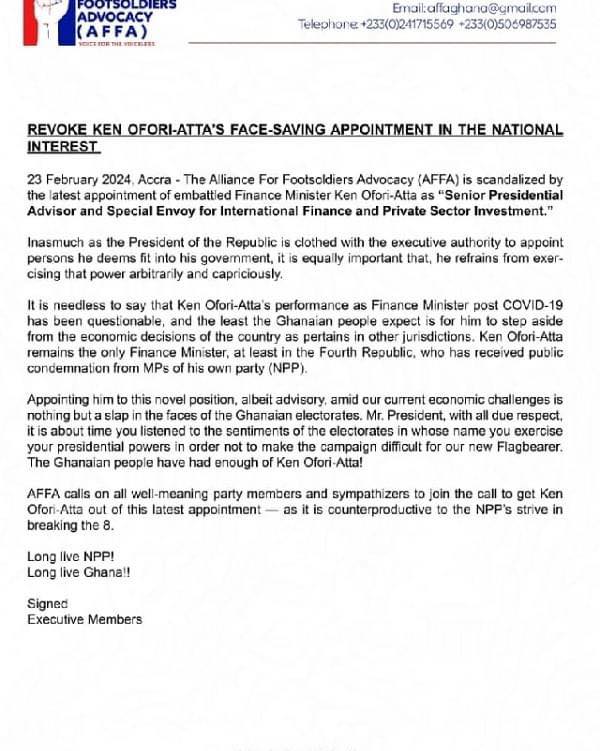
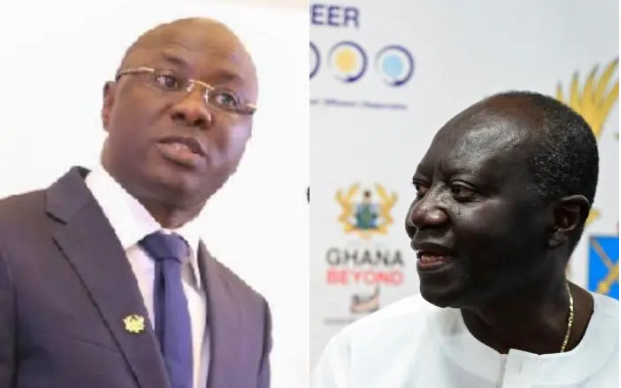
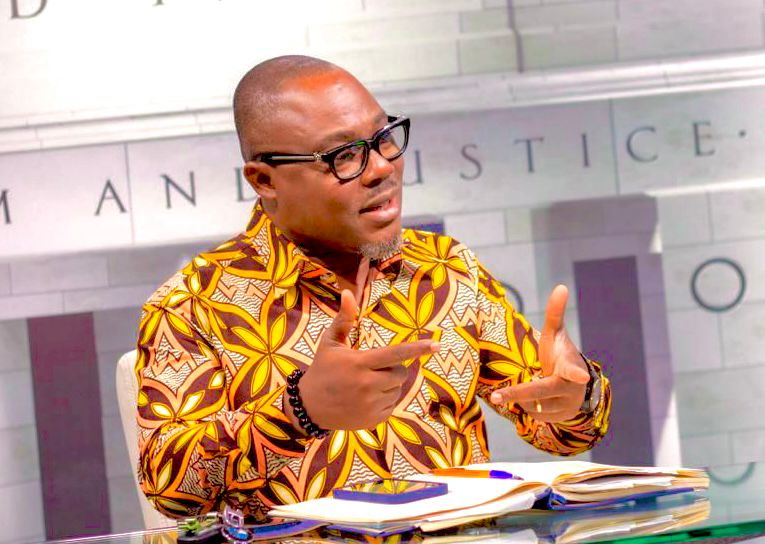
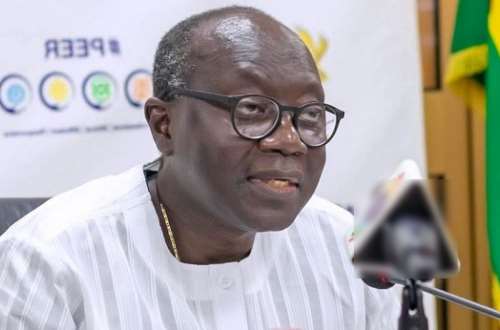
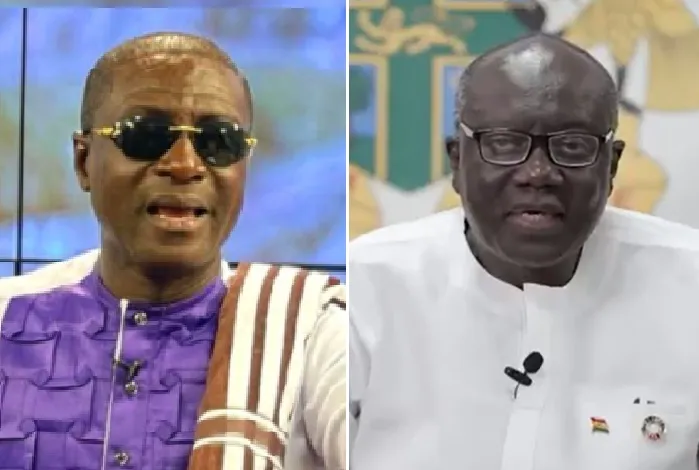
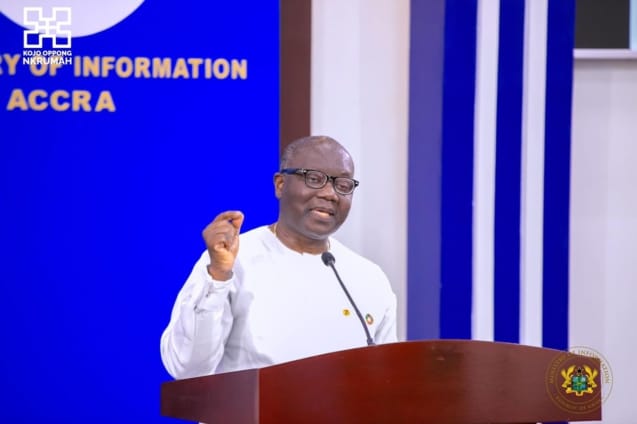
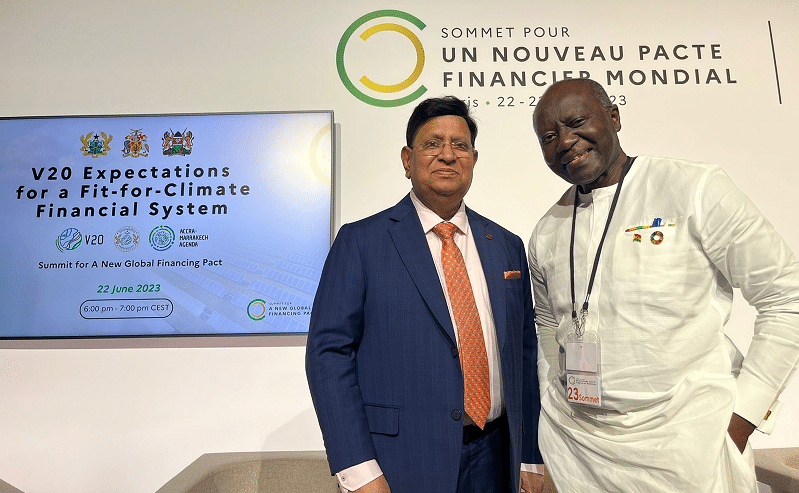
The Alliance For Footsoldiers Advocacy (AFFA) has criticized the recent appointment of embattled Finance Minister, Ken Ofori-Atta as “Senior Presidential Advisor and Special Envoy for International Finance and Private Sector Investment.”
The advocacy group in a press statement contended that the appointment, viewed as a face-saving measure, is detrimental to the nation’s interests.
While recognizing the President’s executive authority to make appointments, AFFA emphasized the importance of refraining from arbitrary and capricious exercises of power.
“The Alliance For Footsoldiers Advocacy (AFFA) is scandalized by the latest appointment of embattled Finance Minister Ken Ofori-Atta as “Senior Presidential Advisor and Special Envoy for International Finance and Private Sector Investment.”
Inasmuch as the President of the Republic is clothed with the executive authority to appoint persons he deems fit into his govemment, it is equally important that, he refrains from exer- cising that power arbitrarily and capriciously,” parts of the statement read.
Ofori-Atta’s performance as Finance Minister, particularly in the post-COVID-19 era, has raised concerns, with the Ghanaian people expressing dissatisfaction and even condemnation from MPs within his own party, the NPP.
The advocacy group argued that, given the economic challenges facing the nation, appointing Ofori-Atta to this advisory role sends the wrong message to the electorate.
According to them, it is viewed as a disregard for public sentiment and a potential impediment to the NPP’s efforts to secure an eighth consecutive term.
In a strongly-worded statement, AFFA calls on all party members and sympathizers to unite in demanding the revocation of Ofori-Atta’s appointment.
The group asserts that this move is necessary to safeguard the party’s reputation and to avoid complicating the upcoming campaign for the new Flagbearer.
“It is needless to say that Ken Ofori-Atta’s performance as Finance Minister post COVID-19 has been questionable, and the least the Ghanaian people expect is for him to step aside from the economic decisions of the country as pertains in other jurisdictions. Ken Ofori-Atta remains the only Finance Minister, at least in the Fourth Republic, who has received public condemnation from MPs of his own party (NPP).
“Appointing him to this novel position, albeit advisory, amid our current economic challenges is nothing but a slap in the faces of the Ghanaian electorates. Mr. President, with all due respect, it is about time you listened to the sentiments of the electorates in whose name you exercise your presidential powers in order not to make the campaign difficult for our new Flagbearer,” it added.
The advocacy group concluded its statement with a plea to the President to heed the sentiments of the electorate, whose trust and support he depends on in exercising presidential powers. AFFA emphasizes that the Ghanaian people have had enough of Ken Ofori-Atta and calls for his removal from the advisory position.
“The Ghanaian people have had enough of Ken Ofori-Atta! AFFA calls on all well-meaning party members and sympathizers to join the call to get Ken Ofori-Atta out of this latest appointment as it is counterproductive to the NPP’s strive in breaking the 8,” it concluded.
In a biting critique of President Akufo-Addo’s recent ministerial reshuffle the Minority Leader, Dr. Cassiel Ato Forson, has taken aim at what he perceives as an expansion of the government’s size.
The appointment in question is that of former Finance Minister Ken Ofori-Atta, who has been named as the Senior Presidential Adviser and Special Envoy for International Trade.
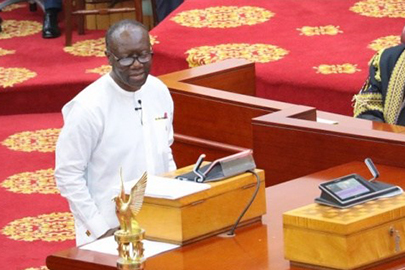
Dr. Ato Forson voiced his disapproval after President Akufo-Addo delivered the State of the Nation Address today in Parliament, emphasizing the perceived consequences of the president’s decision.
“Our president, following the recent ministerial reshuffle, has increased the size of government,” he remarked. “Mr. Speaker, today we have a Minister for Finance Domestic and Minister for Finance International.”
The recent appointment has been condemned by many. Renowned Ghanaian economist Kwame Pianim described the appointment as unfortunate, stating that it has eroded the goodwill that came with the recent reshuffle of ministers.
Ofori-Atta was relieved of his position as Finance Minister on Wednesday, February 14, and replaced by Mohammed Amin Adam. Subsequently, the Chief of Staff, Akosua Frema Osei-Opare, announced Ofori-Atta’s new role in a statement dated February 15.
Speaking on the AM Show, Mr Pianim, a leading member of the NPP, expressed his disapproval of the appointment, emphasizing that it was not a wise decision.
“Ken Ofori-Atta going is good for the optics. But the person who led us into the financial and economic crisis that we are in, we haven’t been here before… there has never been a time where Ghana has not been able to pay its bills and we are not going to start paying them until 2025 and this is the same guy who gets us kicked out of the Eurobond market, how can he be an envoy?
“I think Nana (President Akufo-Addo) knows that the international community are not that gullible so you don’t send him there. We don’t have an economy now, so what is he going to advise on?
“Too many people are walking around the Presidency. Let’s remove them. Both governments when they come, they remove a minister and he becomes special adviser at the presidency. We don’t want that,” he stressed.
Economist and Professor of Finance, Prof. Godfred Bokpin, has criticized the appointment of former Minister of Finance, Ken Ofori-Atta, as Senior Presidential Advisor and Special Envoy for International Finance and Private Sector Investments.
Prof. Bokpin expressed disappointment, stating that Ofori-Atta’s track record does not merit a promotion to a higher position.
In an interview on JoyFM’s Top Story on February 26, Prof. Bokpin explained that while he initially supported Ofori-Atta’s appointment as Finance Minister due to his qualifications, he believes Ofori-Atta has not lived up to expectations in recent years and has left behind a disappointing legacy.
“I respect Honourable Ken Ofori-Atta. Look, when he was appointed I supported his appointment looking at his performance in the private sector, we couldn’t have gotten it better, right? But overall let me tell you, what we see right now really does not give a compelling reason for him to be given another responsibility in the government,” he said.
“Ghana and Kenya exited Covid-19 with similar economic fundamentals, similar challenges. The difference between Kenya and Ghana, as we speak right now, was simply because Kenya was a bit more proactive in reaching out to the IMF for fund-supported programmes right after Covid-19.
“But Ghana, that is where I think that Honourable Ken Ofori-Atta failed Ghanaians because part of leadership is to recognise the signs and the magnitude before the average Ghanaian gets to know.
“And the failure on the part of the Finance Minister then and the government overall in being proactive in reaching out to the IMF actually brought so much hardship on Ghanaians and I have said it, I won’t run away from that,” he added.
President Akufo-Addo appointed the former Finance Minister as Senior Presidential Advisor and Special Envoy for International Finance and Private Sector Investments on February 15. However, this move has sparked concerns among many, questioning the need for his elevation to a new position.
In response, individuals and grassroots organization, the Alliance for Foot Soldiers and Advocacy, have called for the revocation of the appointment.
Economic Advisor on Dr. Mahamudu Bawumia’s Manifesto Committee, Kwame Pianim, has criticized President Akufo-Addo’s appointment of former Finance Minister Ken Ofori-Atta as a Senior Presidential Adviser and Special Envoy for International Trade.
Mr Pianim, a renowned economist, described the appointment as unfortunate, stating that it has eroded the goodwill that came with the recent reshuffle of ministers.
Ofori-Atta was relieved of his position as Finance Minister on Wednesday, February 14, and replaced by Mohammed Amin Adam. Subsequently, Chief of Staff Akosua Frema Osei-Opare announced Ofori-Atta’s new role in a statement dated February 15.
Speaking on the AM Show on JoyNews, Mr. Pianim, a leading member of the NPP, expressed his disapproval of the appointment, emphasizing that it was not a wise decision.
“Ken Ofori-Atta going is good for the optics. But the person who led us into the financial and economic crisis that we are in, we haven’t been here before… there has never been a time where Ghana has not been able to pay its bills and we are not going to start paying them until 2025 and this is the same guy who gets us kicked out of the Eurobond market, how can he be an envoy?
“I think Nana (President Akufo-Addo) knows that the international community are not that gullible so you don’t send him there. We don’t have an economy now, so what is he going to advise on?
“Too many people are walking around the Presidency. Let’s remove them. Both governments when they come, they remove a minister and he becomes special adviser at the presidency. We don’t want that,” he stressed.
Mr. Pianim further expressed his dissatisfaction with the resignation of Osei Kyei-Mensah-Bonsu from his role as Majority Leader in Parliament.
He believes that the Suame MP should have been retained to manage Parliament and facilitate connections between MPs and other party groups in preparation for the 2024 elections.
“Osei Kyei-Mensah-Bonsu is an icon in Parliament. I think that managing Parliament is not easy. He has to make sure that all the bills that cabinet ministers and the president send are in line with the constitution.
“I am saddened. I think he should have been left there to manage Parliament and also lead the Parliamentary group to join forces with the presidential group of the party and then the party itself that is the chairman and his group and the leader of the party that is the flagbearer.”
Touching on the NDC flagbearer, John Mahama’s proposed 24-hour economy if voted into power in the December general election, Mr. Pianim said the policy lacks clarity.
“People are talking about the 24-hour economy but I don’t understand it. What is it? We don’t even have electricity for one shift so where are we going to get electricity for three shifts?
“We started the 24-hour economy. I was Minister of Finance and we told PwD that all the repairs should be done at night, so that traffic will move. But when they started doing that the managers were refusing to go and supervise because they didn’t have security to go around.
“So let’s think through everything carefully and say what can we do now. There is nowhere in the world that they run a 24-hour economy.”
Renowned Ghanaian economist Kwame Pianim has criticized President Akufo-Addo’s appointment of former Finance Minister Ken Ofori-Atta as a Senior Presidential Adviser and Special Envoy for International Trade.
Mr Pianim described the appointment as unfortunate, stating that it has eroded the goodwill that came with the recent reshuffle of ministers.
Ofori-Atta was relieved of his position as Finance Minister on Wednesday, February 14, and replaced by Mohammed Amin Adam. Subsequently, the Chief of Staff, Akosua Frema Osei-Opare, announced Ofori-Atta’s new role in a statement dated February 15.
Speaking on the AM Show, Mr Pianim, a leading member of the NPP, expressed his disapproval of the appointment, emphasizing that it was not a wise decision.
“Ken Ofori-Atta going is good for the optics. But the person who led us into the financial and economic crisis that we are in, we haven’t been here before… there has never been a time where Ghana has not been able to pay its bills and we are not going to start paying them until 2025 and this is the same guy who gets us kicked out of the Eurobond market, how can he be an envoy?
“I think Nana (President Akufo-Addo) knows that the international community are not that gullible so you don’t send him there. We don’t have an economy now, so what is he going to advise on?
“Too many people are walking around the Presidency. Let’s remove them. Both governments when they come, they remove a minister and he becomes special adviser at the presidency. We don’t want that,” he stressed.
Mr. Pianim further expressed his dissatisfaction with the resignation of Osei Kyei-Mensah-Bonsu from his role as Majority Leader in Parliament.
He believes that the Suame MP should have been retained to manage Parliament and facilitate connections between MPs and other party groups in preparation for the 2024 elections.
“Osei Kyei-Mensah-Bonsu is an icon in Parliament. I think that managing Parliament is not easy. He has to make sure that all the bills that cabinet ministers and the president send are in line with the constitution.
“I am saddened. I think he should have been left there to manage Parliament and also lead the Parliamentary group to join forces with the presidential group of the party and then the party itself that is the chairman and his group and the leader of the party that is the flagbearer.”
Touching on the NDC flagbearer, John Mahama’s proposed 24-hour economy if voted into power in the December general election, Mr. Pianim said the policy lacks clarity.
“People are talking about the 24-hour economy but I don’t understand it. What is it? We don’t even have electricity for one shift so where are we going to get electricity for three shifts?
“We started the 24-hour economy. I was Minister of Finance and we told PwD that all the repairs should be done at night, so that traffic will move. But when they started doing that the managers were refusing to go and supervise because they didn’t have security to go around.
“So let’s think through everything carefully and say what can we do now. There is nowhere in the world that they run a 24-hour economy.”
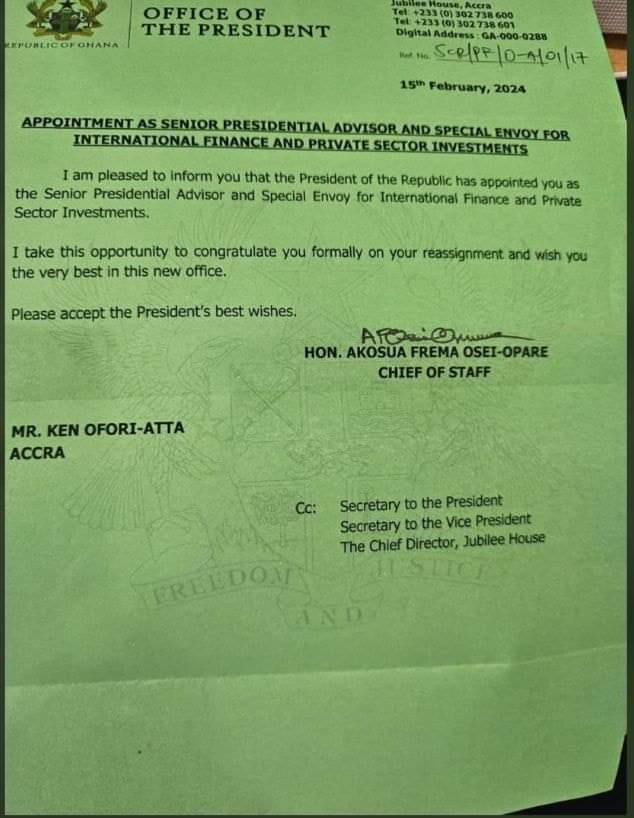
Former Minister of Finance, Ken Ofori-Atta, has been appointed by President Akufo-Addo to the position of Senior Presidential Advisor and Special Envoy for International Finance and Private Sector Investments.
Having been relieved of his duties as Finance Minister on February 14, with Mohammed Amin Adam taking up the role, Mr. Ofori-Atta received congratulations from Chief of Staff Akosua Frema Osei-Opare.
In a statement dated February 15, she announced his new appointment, expressing pleasure and extending formal congratulations.
“I am pleased to inform you that the President of the Republic has appointed you as the Senior Presidential Advisor and Special Envoy for International Finance and Private Sector Investments.
“I take this opportunity to congratulate you formally on your reassignment and wish you the very best in this new office,” she stated.
Outgoing Finance Minister Ken Ofori-Atta has expressed his commitment to the prudent management of resources allocated during his tenure.
He aimed to bolster economic growth, enhance social welfare, and facilitate infrastructural development.
In a letter of appreciation issued on Wednesday, February 14, Mr. Ofori-Atta emphasized the importance of safeguarding vulnerable segments of society through implemented initiatives. He noted that these efforts have led to significant progress and contributed to an improved quality of life for Ghanaians.
“We reminded ourselves that we had only two fishes and five loaves for the monumental task ahead while ensuring a deliberateness of the preferential options for the poor and promoting private sector productivity. Since March 2020, our four (4) budgets, however have focused on protecting lives, preserving livelihoods and recovering from the impact of the, that truly once-in-a- lifetime apocalyptic pandemic, COVID-19, as well as geopolitical upheavals. Indeed, amidst these poly-crises, we at MoF stood strong as the Midwives of the Republic to help ease the pain on our Fellow Citizens.
“Through prudent financial management and strategic allocation of resources, we have pursued initiatives aimed at boosting economic growth, promoting social welfare, and expanding infrastructural development. As a result of these efforts, our country has experienced remarkable progress.”
He also expressed confidence in his successor, Dr. Mohammed Amin Adam, urging Ministry of Finance staff to support him.
Mr Ofori-Atta thanked the staff for their service and commitment, encouraging them to uphold professionalism, ethics, efficiency, and responsiveness.
He emphasized his vision for a Ghana Beyond Aid and described Dr. Amin Adam as a smart, humble, and inclusive leader, stressing the importance of collective effort for a successful tenure.
“The future is here with us as we are blessed with a new leader, Dr Mohammed Amin Adam, who replaced the venerable Charles Adu Boahen and has been with us through some of the most difficult times. Let us all circle the wagons and ensure a blazing success for his stewardship.
“We all know him as a smart, humble and inclusive leader. Let me state with all humility that nothing would honour me and the ‘Office of the Minister’ more than for you to work with renewed diligence to guide Hon. Amin and our nation to the successful execution of the IMF-ECF programme to promote economic growth and transformation.
“Once again, I thank you for your tireless service and commitment to excellence. It has been my utmost honour and a rare privilege to serve alongside each, and every one of you. I pray that you continue to be resolute, dedicated, unwavering and committed to the work of the Republic and care for the finances of the State.”
President Akufo-Addo appointed Dr. Mohammed Amin Adam as the new Finance Minister on February 14, replacing Ken Ofori-Atta, who served in the position for seven years. The appointment was part of a ministerial reshuffle announced on the same day.
Despite facing challenges and calls for his dismissal from some members of Parliament, Ken Ofori-Atta served as Ghana’s longest-serving finance minister.
In October 2022, around 80 NPP MPs demanded his resignation due to the country’s struggling economy, with similar calls from the NDC parliamentary caucus in February 2023.
However, President Akufo-Addo rejected these calls, urging Parliament to wait until discussions with the IMF were concluded.
Outgoing Finance Minister, Ken Ofori-Atta, has expressed his confidence in his successor, Dr. Mohammed Amin Adam, urging the Ministry of Finance staff to support him in his new role.
In a heartfelt letter issued on Wednesday, February 14, Mr Ofori-Atta thanked the staff for their tireless service and commitment to excellence during his tenure.
He encouraged them to uphold professionalism, ethics, efficiency, and responsiveness, emphasizing his vision for a Ghana Beyond Aid. Ofori-Atta described Dr. Amin Adam as a smart, humble, and inclusive leader, stressing the importance of collective effort to ensure a successful tenure for the new appointee.
“The future is here with us as we are blessed with a new leader, Dr Mohammed Amin Adam, who replaced the venerable Charles Adu Boahen, and has been with us through some of the most difficult times. Let us all circle the wagons and ensure a blazing success for his stewardship.
“We all know him as a smart, humble and inclusive leader. Let me state with all humility that nothing would honour me and the ‘Office of the Minister’ more than for you to work with renewed diligence to guide Hon. Amin and our nation to the successful execution of the IMF-ECF programme to promote economic growth and transformation.
“Once again, I thank you for your tireless service and commitment to excellence. It has been my utmost honour and a rare privilege to serve alongside each, and every one of you. I pray that you continue to be resolute, dedicated, unwavering and committed to the work of the Republic and care for the finances of the State.”
President Akufo-Addo appointed Dr. Mohammed Amin Adam as the new Finance Minister, replacing Ken Ofori-Atta, who served in the position for seven years.
The announcement was part of the latest ministerial reshuffle released on February 14. Despite facing challenges and calls for his dismissal from some members of Ghana’s Parliament, Ofori-Atta served as Ghana’s longest-serving finance minister.
On October 25, 2022, around 80 NPP MPs demanded his resignation due to the country’s struggling economy, with similar calls echoed by the NDC parliamentary caucus in February 2023.
However, President Akufo-Addo rejected these calls, urging Parliament to wait until discussions with the IMF were concluded.
Prof Ransford Gyampo has criticized President Akufo-Addo’s decision to reshuffle Ken Ofori-Atta as the Finance Minister, arguing that Mr. Ofori-Atta should have remained in his position to take full responsibility for the economic challenges the country is facing under his leadership.
He believes the reshuffle was not solely based on competence but also had partisan motivations, raising doubts about its transparency and fairness in a democratic society.
“If you do this last-minute change it becomes difficult. Now who do we apportion the blame and who do we praise? Even though I also called for the removal of Ofori-Atta I think he should have been allowed to stay because he has spoilt things already. This reshuffle is more partisan in direction than nation building.”
On Wednesday, President Akufo-Addo appointed Dr. Mohammed Amin Adam as the new Finance Minister, replacing Ken Ofori-Atta, who held the position for seven years.
The appointment was part of a recent ministerial reshuffle announced by President Akufo-Addo on February 14.
Despite facing significant challenges and calls for his dismissal from some members of Ghana’s Parliament, Ken Ofori-Atta served as Ghana’s longest-serving finance minister.
In October 25, 2022, approximately 80 NPP MPs demanded Ofori-Atta’s resignation due to the country’s struggling economy. Similar demands were made by the NDC parliamentary caucus in February 2023.
However, President Akufo-Addo rejected these calls for resignation, urging Parliament to wait until discussions with the IMF concluded.
Ningo-Prampram MP, Samuel Nartey George, has criticized President Akufo-Addo’s recent reshuffle, suggesting that it indicates a disconnection from the sentiments of the Ghanaian populace.
Mr. George contends that the President disregarded the public’s calls to downsize the government, as evidenced by the reshuffle’s failure to address this issue.
In his view, President Akufo-Addo’s decision to retain and promote former Finance Minister Ken Ofori-Atta instead of dismissing him entirely reflects a lack of concern for the prevailing sentiments and mood of Ghanaians.
During an appearance on JoyNews’ Newsfile on Saturday, February 17, the lawmaker expressed skepticism about the potential effectiveness of the newly appointed Ministers given the current circumstances.
“The president clearly does not listen to Ghanaians. He clearly does not understand what the pulse of the nation is and has lost connection with the country.
“With this reshuffle, the President has not done what the Ghanaian people asked for. Ghanaians wanted Ken Ofori-Atta out of government. He has actually been promoted.”
“He has been given more or less a supervisory role over the Finance Ministry because, in his roles to do negotiations, he has become the ambassador of the President on financial matters and the Finance Minister works under him.
“So Ofori-Atta has actually been promoted when we asked for him to be taken out of government. This shows a President who is completely out of sync with the country,” he said.
After facing months of public pressure, President Akufo-Addo has made adjustments to his government. These changes come following the resignation of former Trade Minister Alan Kyerematen and Agriculture Minister Dr. Owusu Afriyie Akoto, who stepped down to focus on their political campaigns.
According to the 1992 Constitution, the President formally notified the Speaker of Parliament of the government’s new composition on Tuesday, February 13.
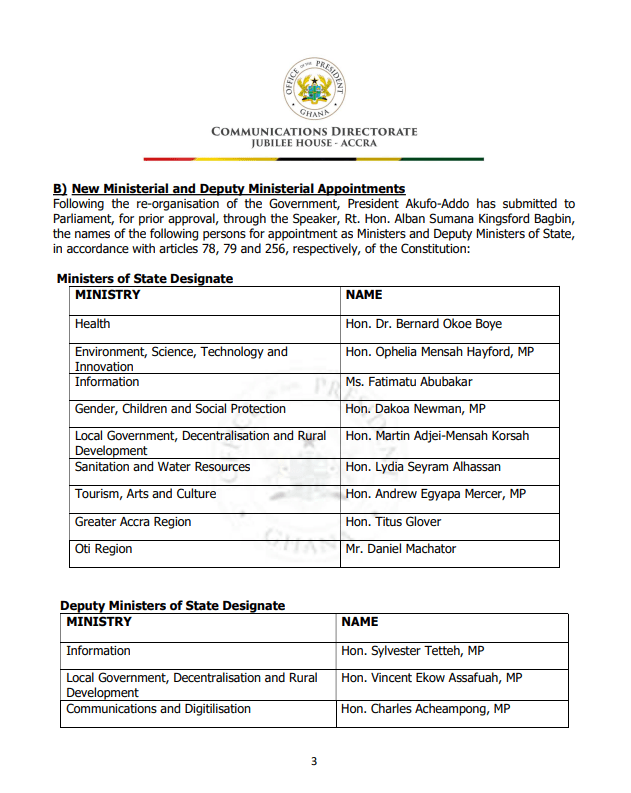
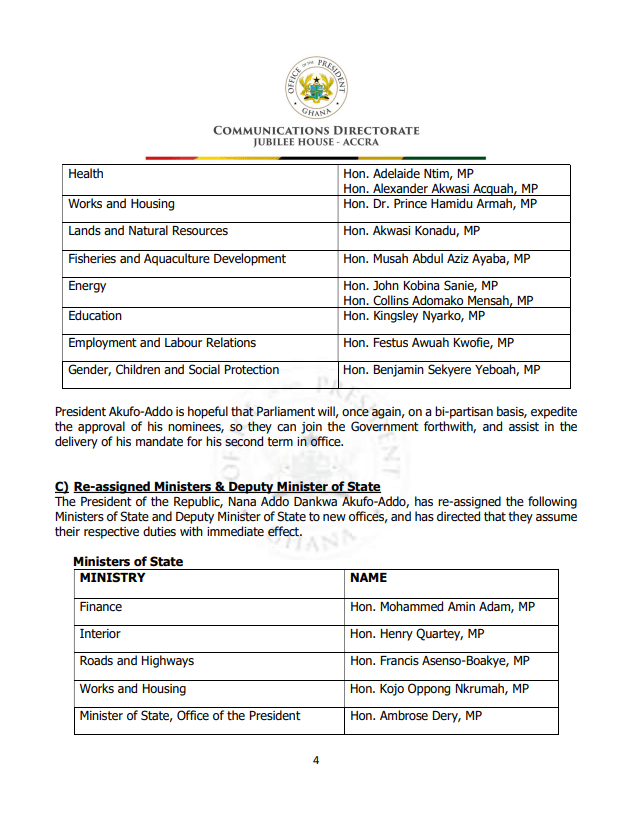
The adjustments include the appointment of new individuals to ministerial positions, as well as reshuffling some members to different ministries.
Professor Ransford Gyampo from the University of Ghana expressed dissatisfaction with the recent ministerial reshuffle conducted by President Akufo-Addo, describing it as a ‘last-minute’ decision.
Speaking on TV3’s Key Points on Saturday, February 17, Professor Gyampo criticized the timing of the changes, stating that it did not align with any conceptual frameworks of reshuffling, and he was not pleased with the outcome.
According to him, the removal of Ken Ofori-Atta as Finance Minister, Prof Gyampo noted the difficulty in assigning blame or praise due to the last-minute nature of the change.
He emphasized the importance of the timing of reshuffling, saying, “If you refuse reshuffling, it means you are pampering incompetence. The periodization of reshuffling is more important than the frequency.”
“It doesn’t satisfy any of the conceptual frameworks of reshuffling. I have not been happy with it.”
He added “If you refuse reshuffling, it means you are pampering incompetence. The periodization of reshuffling is more important than the frequency.”
Regarding the removal of Mr Ofori-Atta as Finance Minister, Prof Gyampo said ” If you do this last-minute change it becomes difficult, now who do we apportion the blame and who do we praise? Even though I also called for the removal of Ofori-Atta I think he should been allowed to stay, because he has spoilt things already. This reshuffle is more partisan in direction than nation building.”
Despite having called for Ofori-Atta’s removal, he suggested that the Finance Minister should have been allowed to stay, as the reshuffle seemed more partisan than focused on nation-building.
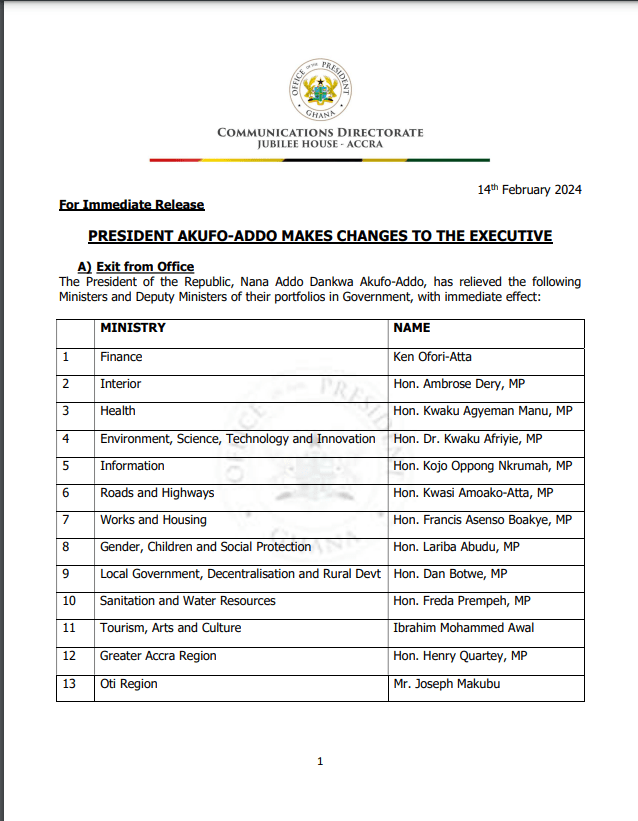
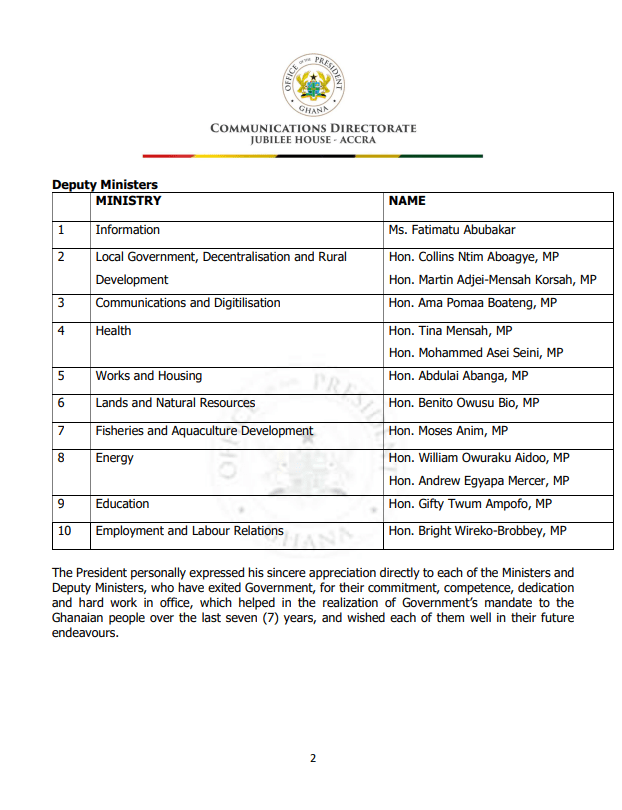
President Akufo-Addo relieved Finance Minister Ken Ofori-Atta of his portfolio along with several other ministers, including Kojo Oppong Nkrumah, Francis Asenso Boakye, Kwaku Agyemang Manu, Kwasi Amoako Attah, Hon. Dr. Kwaku Afriyie, Hon. Lariba Abudu, Hon. Dan Botwe, Hon. Freda Prempeh, Ibrahim Mohammed Awal, Hon. Henry Quartey, and Mr. Joseph Makubu. Kojo Oppong Nkrumah and Asenso-Boakye were reassigned to Works and Housing and Roads and Highways, respectively.
The reshuffle, announced by the Director of Communications at the Presidency Eugene Arhin on February 14, acknowledged the contributions of the outgoing ministers and wished them well in their future endeavors.
Asante Akim North’s Member of Parliament, Kwame Andy Appiah-Kubi, who was among the New Patriotic Party (NPP) lawmakers advocating for the removal of former Finance Minister Ken Ofori-Atta two years ago, clarified that their intention was not to prevent Mr. Ofori-Atta from serving in government altogether.
He explained that their concern was that Ghana’s economy could have performed better without Mr. Ofori-Atta as the Finance Minister.
Mr. Appiah-Kubi made these remarks in response to reports that Mr. Ofori-Atta has been assigned a new role after his removal from the Finance Ministry.
Sources indicate that Mr. Ofori-Atta is expected to be appointed as a Senior Presidential Advisor to President Nana Akufo-Addo, focusing on all matters related to the economy.
Speaking on the Ghana Tonight show on TV3 on Thursday, February 15, Mr Appiah-Kubi said: “Sometimes when you make a call it is subject to certain urgencies of the time. It has come a little late but better late than never because if it had come at the time we made the call, it would have been much greater than it is now.”
He added, “we will take it as it is and say thank you Mr President for listening to us. Indeed it is the prerogative of the President to appoint persons to to positions depending upon his vision and the strategy of achieving the vision so I will give that to him.
“He has the constitutional mandate to do what he has done but we were complaining about the performance in the Finance Ministry and we thought that if he wanted the Finance Minister we would perform better so if he has listed to us and transferred him from one office where we thought that he needed a transfer we will take it as it is. But we did not say that Mr. Ofori-Atta should not be given any opportunity to work with the government at all, we were saying that we thought if he wanted the Finance Minister our situation would be better.”
He continued, “If this is a position that will be superior to the Finance Minister then I should be worried but I am not sure it is. The Finance Ministry has always worked independently of others, just that there is a collaboration, I don’t think there will be another portfolio that will be bigger than the Finance Minister and that the Finance Minister will submit to that newly created portfolio, I do think so. As long as the Finance Minister is not supplicated to the new portfolio I don’t have any problem, unless it becomes clear that the Finance Minister will have to work under the new portfolio, we will have problems.”
President Akufo-Addo relieved Finance Minister Ken Ofori-Atta of his portfolio in government, with immediate effect, replacing him with Mohammed Amin Adams.
The other ministers who have also been removed include Information Minister Kojo Oppong Nkrumah, Works and Housing Minister Francis Asenso Boakye, Kwaku Agyemang Manu, Health, Kwasi Anoako Attah, Roads and Highways, Environment, Science, Technology and Innovation Hon. Dr. Kwaku Afriyie, Gender, Children and Social Protection Hon. Lariba Abudu, Local Government, Decentralisation and Rural Devt Hon. Dan Botwe, Sanitation and Water Resources Hon. Freda Prempeh, Tourism, Arts and Culture Ibrahim Mohammed Awal, Greater Accra Region Hon. Henry Quartey, Oti Region Mr. Joseph Makubu.
The Member of Parliament for Bolgatanga Central, Isaac Adongo, has described President Nana Addo Dankwa Akufo-Addo’s removal of Ken Ofori-Atta as Finance Minister as mere ‘window dressing.’
Mr Adongo explained that ‘window dressing’ refers to making something appear deceptively attractive or favorable.
President Akufo-Addo removed Ken Ofori-Atta in a major ministerial reshuffle on Wednesday, February 14, which affected a total of 13 current ministers of state, including 10 cabinet ministers and two regional ministers. Mohammed Amin Adam has been appointed as the new Finance Minister, while Ken Ofori-Atta has been made the Presidential Advisor on the economy.
In an interview on Eyewitness News on Citi FM, Mr Adongo expressed doubt about the effectiveness of the reshuffle, suggesting that Mohammed Amin Adam might have limited influence as long as Ken Ofori-Atta remains involved and influential in economic matters.
“This is clearly window dressing. If you follow events and watch critically what has happened, I do not doubt the competence and the abilities of Dr. Mohammed Amin. He was my former colleague on the Finance Committee, my senior at school. I have a very good respect for him, except to say that they have given him the job in one hand and taken it with the right.”
“Because now he is the Minister and they have appointed the very person they are removing as the Senior Presidential Advisor on the Economy what that simply means is that for Mohammed Amin to get any policy through in cabinet or through executive approval of the president, the president has to go and consult Ken Ofori Atta. And so technically it means that Mohammed Amin cannot do anything if Ofori-Atta is not in agreement because he would advise the president against it,” he stated.
Founding President and Chief Executive Officer of IMANI Centre for Policy and Education, Franklin Cudjoe, has noted that Ken Ofori-Atta’s removal as Finance Minister does not necessarily prevent him from taking key decisions that affect the country’s economy.
According to Mr Cudjoe, reports from Asaase Radio indicate that former Finance Minister Ken Ofori-Atta is set to assume the role of Senior Presidential Advisor on the Economy and will also serve as the President’s Special Envoy on International Investment and the Capital Markets.
In a Facebook post, Mr Cudjoe noted that Mr Ofori-Atta’s appointment, if proved to be true, will help him obtain authority that exceeds that of the Finance Minister.
“The former finance minister Ken Ofori-Atta is to be appointed as the senior presidential advisor on the economy. He will also serve as the president’s special envoy on international investment and the capital markets, according to Asaase News sources in the Office of the President.”
“Meaning he will be in charge of negotiating most big deals.. he is now bigger than MoF……,” he wrote.
This revelation comes directly from sources within the Office of the President, adding a new chapter to Ofori-Atta‘s distinguished career. As the former Finance Minister, he held the position for an impressive seven years, making him the longest-serving finance minister in Ghana’s Fourth Republic.
As Ofori-Atta steps into his new advisory roles, Kwaku Afriyie, the former Minister of Environment, Science, Technology, and Innovation, is also slated to become an advisor. According to Asaase’s sources, Afriyie will take on the crucial role of President Akufo-Addo’s Special Envoy on Climate.
The reshuffling of roles within the government signals a strategic move, with Mohammed Amin Adam, the current Minister of State at the Ministry of Finance, assuming the position of the substantive Minister for Finance.
This transition is expected to be seamless, ensuring continuity in the government’s debt restructuring negotiations with private creditors and for Ghana’s second review under its extended credit facility (ECF) arrangements with the International Monetary Fund.
The developments do not end here, as sources from the Office of the President hint at further significant changes, possibly announced later today. The morning’s press release from Jubilee House primarily focused on ministerial appointments presented to the Speaker of Parliament, with consequential matters regarding appointees.
Inside sources at Jubilee House anticipate the potential reshuffling of the Majority leadership in Parliament, a move that might be officially disclosed following a scheduled National Executive Committee meeting of the New Patriotic Party(NPP)on Monday.
This suggests a broader restructuring within the government’s leadership, marking a pivotal moment for Ghana’s political landscape. This is happening some nine months to Ghana’s next general election.
Amidst a major cabinet reshuffle, former Finance Minister Ken Ofori-Atta is reportedly set to assume the role of Senior Presidential Advisor on the Economy and will also serve as the President’s Special Envoy on International Investment and the Capital Markets, as reported by Asaase Radio.
This revelation comes directly from sources within the Office of the President, adding a new chapter to Ofori-Atta‘s distinguished career. As the former Finance Minister, he held the position for an impressive seven years, making him the longest-serving finance minister in Ghana’s Fourth Republic.
As Ofori-Atta steps into his new advisory roles, Kwaku Afriyie, the former Minister of Environment, Science, Technology, and Innovation, is also slated to become an advisor. According to Asaase’s sources, Afriyie will take on the crucial role of President Akufo-Addo’s Special Envoy on Climate.
The reshuffling of roles within the government signals a strategic move, with Mohammed Amin Adam, the current Minister of State at the Ministry of Finance, assuming the position of the substantive Minister for Finance.
This transition is expected to be seamless, ensuring continuity in the government’s debt restructuring negotiations with private creditors and for Ghana’s second review under its extended credit facility (ECF) arrangements with the International Monetary Fund.
The developments do not end here, as sources from the Office of the President hint at further significant changes, possibly announced later today. The morning’s press release from Jubilee House primarily focused on ministerial appointments presented to the Speaker of Parliament, with consequential matters regarding appointees.
Inside sources at Jubilee House anticipate the potential reshuffling of the Majority leadership in Parliament, a move that might be officially disclosed following a scheduled National Executive Committee meeting of the New Patriotic Party(NPP)on Monday.
This suggests a broader restructuring within the government’s leadership, marking a pivotal moment for Ghana’s political landscape. This is happening some nine months to Ghana’s next general election.
The 2024 flagbearer of the opposition National Democratic Congress (NDC), John Dramani Mahama, has once again criticized the state of Ghana’s economy under President Nana Addo Dankwa Akufo-Addo.
Mahama asserted that President Akufo-Addo did not inherit a problematic situation, attributing the current challenges to what he described as the “clueless economic management team and finance minister” of the current administration.
Encouraging Ghanaians to vote against the New Patriotic Party (NPP) in the upcoming December general elections, Mahama highlighted the achievements of his administration before the NPP took office in 2016.
Expressing disappointment that the Akufo-Addo-led administration continued to blame his previous government for their failures, Mahama defended his term, stating that the state of the economy during his leadership was far better than the current situation under the Nana Akufo-Addo-Bawumia administration.
Mahama stated, “You didn’t inherit a mess; it is your clueless economic management team and finance minister that created the mess we are experiencing today.”
Emphasizing his economic successes, Mahama positioned himself as the most qualified candidate for leading the nation after the December general elections.
He urged Ghanaians to reject what he considers the NPP’s rhetoric, emphasizing that the country has not made substantial progress as recently portrayed.
Former Central Regional Chairman of the National Democratic Congress, Bernard Allotey Jacobs, has noted that the introduction of numerous taxes by the government will have a toll on Vice President Dr Mahamudu Bawumia’s campaign ahead of the 2024 general elections.
In a post on X platform, February 2, Mr Jacobs held the Finance Minister, Ken Ofori-Atta responsible for the introduction of more taxes.
According to him, the taxes being introduced are “useless” and pose a danger to the New Patriotic Party’s chances of retaining power with Dr Bawumia as its flagbearer.
He therefore charged the Finance Minister to take a step back and desist from taking any further actions that could jeopardise the Vice President’s political chances as it is unwise to worsen the wellbeing of citizens in an election period.
“Mr Ken Ofori Atta don’t close the Electoral Door against Dr Mahamadu. Bawumia with this useless taxes. Ken Ofori Atta it seems you are not in tune with our political system and how elections are won in this country,” he wrote.
Mr Ken Ofori Atta don’t close the Electoral Door against Dr Mahamadu Bawumia with this useless taxes. Ken Ofori Atta it seems you are not in tune with our political system and how elections are won in this country
The Vice-President, Dr Mahamudu Bawumia, is expected to address concerns regarding recent policies, particularly the implementation of VAT on electricity bills and the controversial Emissions Levy.
The New Patriotic Party (NPP) flagbearer is scheduled to address the nation on Wednesday, February 7, 2024, unveiling his vision for the country in his bid to succeed President Nana Akufo-Addo in January 2025.
However, the anticipation of this address is reported to be overshadowed by the enforcement of Value Added Tax (VAT) on household electricity bills and the Emissions Levy Act, 2023 (Act 1112), which imposes significant taxes on vehicle owners.
Insiders have hinted at surprises in Dr. Bawumia’s address, themed “Ghana’s next chapter: selfless leadership and bold solutions for the future,” as per a memo issued by the NPP.
The Emissions Levy, enforced by the Ghana Revenue Authority (GRA) from February 1, 2024, has sparked public outcry, especially due to the substantial annual amounts imposed on some vehicle owners. The levies range from GH¢75 for motorcycles and tricycles to GH¢300 for cargo trucks and articulated trucks.
Critics argue that these tax policies, along with recent levies, may impact the NPP’s popularity negatively in the lead-up to the December 2024 elections.
Many communicators within the party are reported to have expressed dissatisfaction with Finance Minister Ken Ofori-Atta, accusing him of mismanaging the economy and diminishing the party’s appeal amid economic challenges and unemployment.
The Emissions Levy Act, enacted in December 2023, aims to address greenhouse gas emissions by imposing levies on carbon dioxide equivalent emissions from internal combustion engine vehicles. The government hopes that these measures will encourage the adoption of environmentally friendly technologies and align with global efforts toward net-zero targets.
The Vice-President, Dr Mahamudu Bawumia, is expected to address concerns regarding recent policies, particularly the implementation of VAT on electricity bills and the controversial Emissions Levy.
The New Patriotic Party (NPP) flagbearer is scheduled to address the nation on Wednesday, February 7, 2024, unveiling his vision for the country in his bid to succeed President Nana Akufo-Addo in January 2025.
However, the anticipation of this address is reported to be overshadowed by the enforcement of Value Added Tax (VAT) on household electricity bills and the Emissions Levy Act, 2023 (Act 1112), which imposes significant taxes on vehicle owners.
Insiders have hinted at surprises in Dr. Bawumia’s address, themed “Ghana’s next chapter: selfless leadership and bold solutions for the future,” as per a memo issued by the NPP.
The Emissions Levy, enforced by the Ghana Revenue Authority (GRA) from February 1, 2024, has sparked public outcry, especially due to the substantial annual amounts imposed on some vehicle owners. The levies range from GH¢75 for motorcycles and tricycles to GH¢300 for cargo trucks and articulated trucks.
Critics argue that these tax policies, along with recent levies, may impact the NPP’s popularity negatively in the lead-up to the December 2024 elections.
Many communicators within the party are reported to have expressed dissatisfaction with Finance Minister Ken Ofori-Atta, accusing him of mismanaging the economy and diminishing the party’s appeal amid economic challenges and unemployment.
The Emissions Levy Act, enacted in December 2023, aims to address greenhouse gas emissions by imposing levies on carbon dioxide equivalent emissions from internal combustion engine vehicles. The government hopes that these measures will encourage the adoption of environmentally friendly technologies and align with global efforts toward net-zero targets.
Finance Minister, Ken Ofori-Atta, has expressed his personal commitment to fiscal discipline, assuring that he will avoid budget overruns in 2024, ahead of the elections in December.
“We have moved inflation from over 50.0% to about 23.0% and you think that did not come with exercising some fiscal prudence? The Ministry of Finance is not here to be loved, but to make sure that the community crosses the Jordan”, he said on PM Express, Business Edition on January 18, 2023.
Fiscal discipline is crucial for sound economic management and to instill confidence in the financial stability of the country.
In addition, he added that the Bank of Ghana is doing its part to ensure that monetary policy tools are properly used to continue bringing inflation down.
“We want to ensure that the right things are done going forward as a country. If the expenditure does not fall in line with the budget, I will not sign the cheque”, he said.
He stated that the government will strictly abide by its fiscal policies to attain its targets in the 2024 budget.
“I think the country is aware of the cost of inflation and cedi depreciation and we are going to do everything on our part to ensure that things don’t go bad”.
Mr. Ofori-Atta said all government officials have been reminded to maintain fiscal prudence. He disclosed that the government has taken some tough measures to contain spending, reflecting in the downward trend of inflation.
He is of the view that the right policies can be pursued to help the government achieve its 2024 end-of-year inflation target of 15%.
“If we should look at 2022 and 2023, we cannot forget about what government has done when it comes to expenditure and we intend to continue. It is an election year, we will not let our eyes off the ball when it comes to fiscal discipline”, he reiterated.
Mr. Ofori-Atta expressed optimism that Ghana’s programme with the IMF will yield good results.
On the issues taxes, he noted that it is a very difficult decision taken by government to introduce some new measures to increase revenue.
“We are still not doing well when it comes to Ghana’s tax-to-Gross Domestic Product (GDP) ratio and something has to be done about it”.
It is reported that there is a growing strain in the relationship between Vice President Dr. Mahamudu Bawumia and Finance Minister Ken Ofori-Atta.
According to The Herald, information from insiders within the New Patriotic Party (NPP) points to management of Ghana’s economy as the reason for the rift.
The Herald reports that the two high-ranking officials are engaged in persistent disagreements over economic policies.
Despite their close understanding, reports suggest that the Finance Minister does not consistently attend Economic Management Team meetings chaired by Dr. Bawumia. When present, he is said to arrive late or act contrary to the team’s decisions.
The ongoing conflict between the Vice-President and the Finance Minister has left insiders perplexed, questioning why the President has not taken action, especially with a looming general election this year, the Herald says.
The government is facing internal unrest, notably regarding the Finance Minister’s implementation of a 15% Value Added Tax (VAT) on electricity consumers to boost revenue for the COVID-19 recovery program.
Member of Parliament for Akim Abuakwa South, Atta Akyea, has urged the Finance Minister to consider stepping down for his well-being and the benefit of the government. Calls for Ofori-Atta’s resignation have been growing amid the country’s economic challenges.
Atta-Akyea went further, stating that Ofori-Atta’s resignation might even contribute to calmer waters for both the government and the nation.
“He should look at himself and look at all the troubles that everybody believes that I mean when he is not there then the nation will have peace, if that is what is the thinking of the people, I will advise myself. He should save himself and save the government and have his peace because he needs it, a man cannot be troubled in the manner in which he has been troubled,” Mr Atta Akyea said.
Surprisingly, influential figure Gabby Asare Otchere-Darko, a cousin of President Akufo-Addo, reportedly supports the idea of the Finance Minister leaving the government.
The NPP general secretary, Justin Frimpong Kodua, has also called on ministers, CEOs, and MMDCEs experiencing fatigue to resign rather than undermine the party’s progress.
Insiders within the ruling New Patriotic Party (NPP) have disclosed a growing strain in the relationship between Vice President Dr Mahamudu Bawumia and Finance Minister Ken Ofori-Atta, particularly concerning the management of the nation’s economy.
The conflict is reportedly centered on economic policies, leading to a strained association between the two high-ranking officials.
Member of Parliament Samuel Atta Akyea, representing Akim Abuakwa South, has hinted at the discord, characterizing their association as “adversary.” President Nana Akufo-Addo and Finance Minister Ofori-Atta, often referred to as “Husband and Wife” within the NPP, are seen as key figures in the worsening economic crisis.
Despite their supposed understanding, reports suggest that the Finance Minister does not actively participate in Economic Management Team meetings chaired by Dr Bawumia. The intensifying conflict has left insiders puzzled about the President’s inaction, especially with the approaching general election and the promise to break the 8-year electoral cycle of governing parties.
Internal unrest within the government has been exacerbated by the Finance Minister’s implementation of a 15% Value Added Tax (VAT) on electricity consumers to boost revenue for the COVID-19 recovery program. MP Atta Akyea has urged Ofori-Atta to consider stepping down for his well-being and the government’s benefit, while calls for the Finance Minister’s resignation mount amid the country’s ongoing economic challenges.
Surprisingly, powerful presidential cousin Gabby Asare Otchere-Darko is reportedly advocating for the Finance Minister’s exit from the government. NPP General Secretary Justin Frimpong Kodua has also called on fatigued ministers, CEOs, and MMDCEs to resign instead of undermining the party’s progress.
In December last, he declared “If you are a minister, a CEO or an MMDCE and you have not been reshuffled and you think you are tired resign. Don’t sabotage the party.” he added.
The opposition National Democratic Congress (NDC) has also been outspoken in attributing the current fiscal difficulties to Ofori-Atta.
In a Face to Face interview on CITI TV on Tuesday, January 16, Atta-Akyea emphasized the importance of self-reflection on Ofori-Atta’s part, suggesting that stepping down could bring relief to both him and the NPP.
Expressing concern about the burdens on Ofori-Atta, Atta-Akyea highlighted that the Finance Minister’s resignation could contribute to a more peaceful environment for the government and the nation at large.
Furthermore, Atta Akyea criticized those who blame Vice President Bawumia for the economic challenges, acknowledging the tough economic conditions but refuting the notion that Dr. Bawumia is solely responsible.
He emphasized the Vice President’s challenging role and suggested that attributing economic issues solely to him is unkind and unfair.
“For me, what is very frightening is the fact that you have a whole army of people saying look you’ve had enough…I think that that could be a way for him to relax. Look at all the burdens on one man. So it is his individual decision to make as to whether he should go or he should continue.”
Atta-Akyea went further, stating that Ofori-Atta’s resignation might even contribute to calmer waters for both the government and the nation.
“He should look at himself and look at all the troubles that everybody believes that I mean when he is not there then the nation will have peace, if that is what is the thinking of the people, I will advise myself. He should save himself and save the government and have his peace because he needs it, a man cannot be troubled in the manner in which he has been troubled,” Mr Atta Akyea said.
Mr. Atta Akyea also criticized individuals who hold Vice President Dr. Mahamudu Bawumia responsible for the country’s economic challenges.
He acknowledged that the economy is currently not in its best form, describing it as ‘unkind’ and ‘cruel’ for anyone to attribute economic issues in the Akufo-Addo government to Dr. Bawumia.
Mr. Atta Akyea insisted that the vice president was in a very serious adversary role that prevented him from making some sensitive decisions for the country.
The NPP’s General Secretary has also expressed similar concerns about the impact of certain appointees’ actions on the party’s popularity and urged those tired to resign and make way for new faces.
He additionally called on President Nana Akufo-Addo to conduct a reshuffle to bring fresh perspectives, stating that such changes are essential for the NPP to achieve its objectives and retain power in the next election.
“If you are tired, resign and leave so the party can retain power,” Kodua said during the party’s annual Thanksgiving service at its headquarters in Accra.
“If you are a minister, a CEO or an MMDCE and you have not been reshuffled and you think you are tired resign. Don’t sabotage the party,” he added.
He stressed the importance of appointing new faces to propel the NPP towards achieving its objectives, urging the president to consider reshuffling the government for the party’s continued success.
“It is time for some changes in the government, so we get some new faces to continue. We believe that if we get new appointments, we will be able to retain power in the next election,” Kodua added.
Despite earlier reports suggesting his resignation, Finance Minister Ken Ofori-Atta seems poised to continue leading the Ministry of Finance in 2024.
During a thanksgiving event with the Ministry of Finance staff in 2023, Mr. Ofori-Atta expressed gratitude for God’s mercy and preservation. He conveyed his belief that the Lord would continue to lead and guide the country in the coming year.
“I’m assure that the Lord will continue to lead and guide us in 2024. Our testimony is indeed victory on every side! Humbled to be leading the brilliant and resilient staff of Ministry of Finance,” the sector minister said.
In the face of economic challenges stemming from debt exchange and the impact of the COVID-19 pandemic, Finance Minister Mr. Ken Ofori-Atta is positioned to spearhead a turnaround aimed at fostering productivity, prosperity, and employment.
Mr. Ofori-Atta consistently emphasizes that the government has successfully ‘turned the corner,’ highlighting achievements such as a notable reduction in inflation from 54% in December 2022 to 26.4% in November 2023, a stabilized exchange rate, and a significant decrease in the government fiscal deficit.
Following the post-COVID-19 period, the Minister initiated the ¢100 billion GhanaCARES (Obaatanpa) program, representing a four-year ‘clinical structural focus’ aligned with President Akufo-Addo’s transformation agenda. This program aims to expedite the government’s digitalization agenda, enhance efficiency in public service delivery, revitalize the housing and construction industry to address housing deficits, create job opportunities, and position Ghana as a regional hub.
The early stages of the GhanaCARES “Obaatan Pa” Programme are already showing promising results, with Mr. Ofori-Atta at the forefront of efforts to revolutionize Ghana’s rice sector through the implementation of the Harnessing Agricultural Productivity and Prosperity for Youth (HAPPY) Programme.
As a crucial component of the revitalization efforts, Mr. Ofori-Atta spearheaded the establishment of “YouBanC” under the ambitious ¢100 billion GhanaCARES ‘Obaatanpa’ Programme.
“Our strategy to place the private sector at the heart of this endeavour is to accelerate competitive import substitution and export expansion to generate sustainable jobs for our teeming youth (under 35 years), who make up about 71% of the population”, Mr. Ofori-Atta stated.
In the first of this series, The Fourth Estate’s Evans Aziamor-Mensah, Adwoa Adobea-Owusu and Manasseh Azure Awuni revealed that Strategic Mobilisation Ghana Limited (SML), which started revenue assurance services to the government of Ghana in 2020 had made a number of false claims.
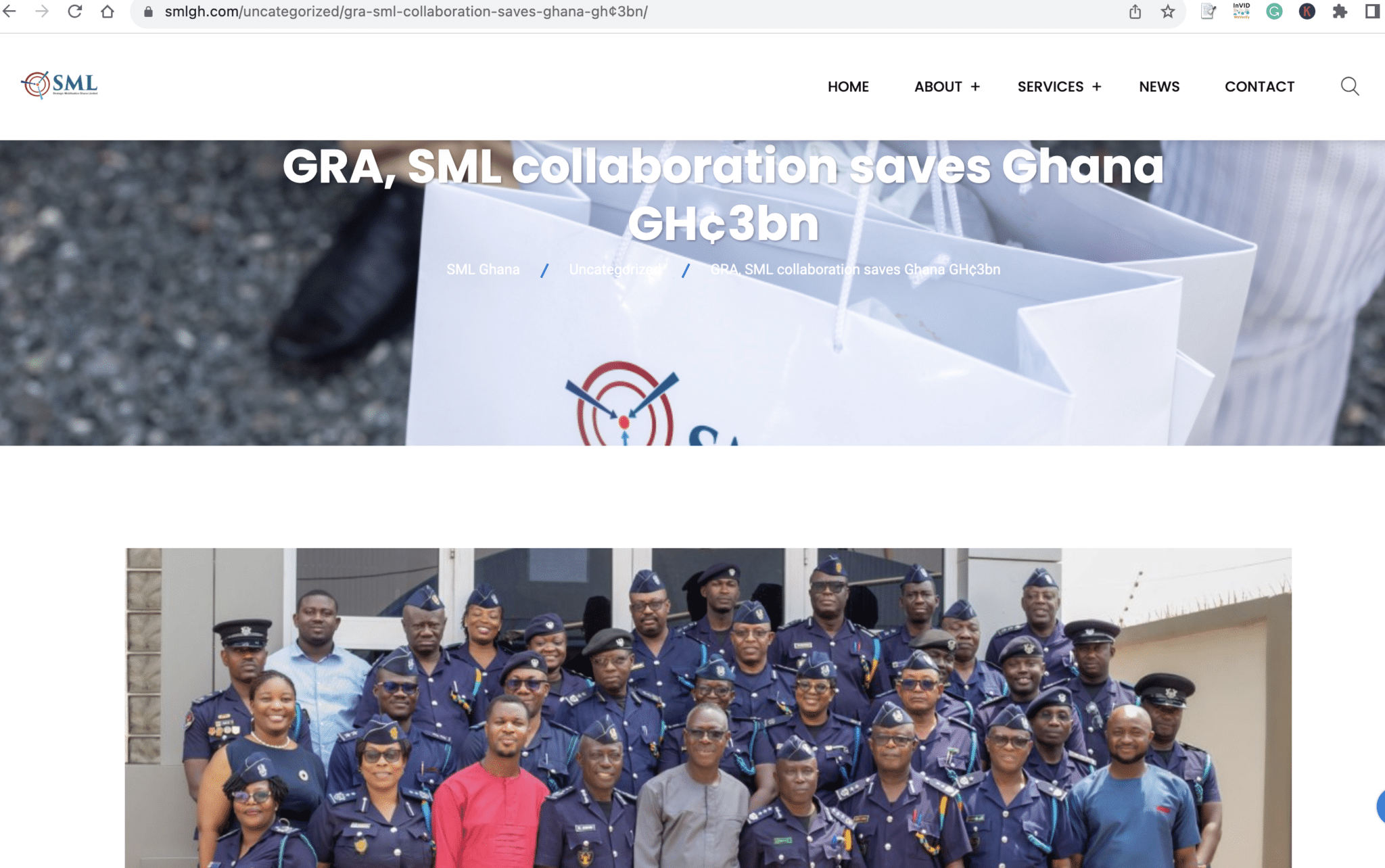
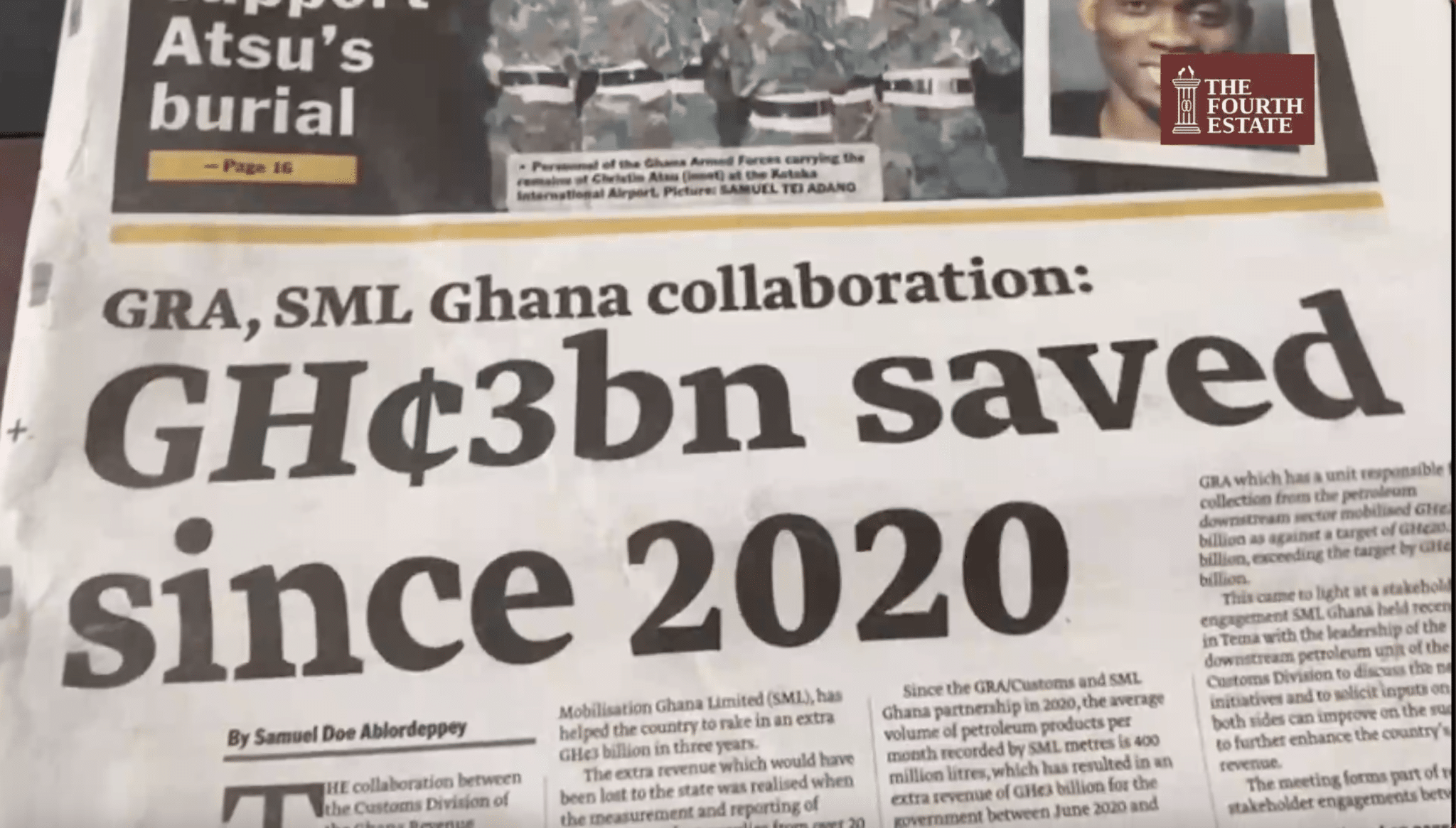
The company claimed in February 2023 that it had saved Ghana over GHc3 billion in revenue that would have been lost to the state but for its services in the contract it signed with the Ministry of Finance and the Ghana Revenue Authority (GRA).
The investigation found this claim to be completely false. The Managing Director of SML, Christian Tetteh Sottie, claimed he did not know about the figure when The Fourth Estate confronted him with counter evidence. He said the media, including the state-owned Daily Graphic, had taken a presentation SML made to the GRA board out of context and reported the wrong information. He said SML had called the journalists to draw their attention to the supposed error.
When asked why the story of saving Ghana GHc3 billion was still on the website of SML the morning of the interview with The Fourth Estate, in July 2023, he said, “I don’t of any website matter(sic).”
When asked why the story of saving Ghana GHc3 billion was still on the website of SML the morning of the interview with The Fourth Estate, in July 2023, he said, “I don’t of any website matter(sic).”
SML admitted its false claims and deleted them from the website of SML shortly after our interview
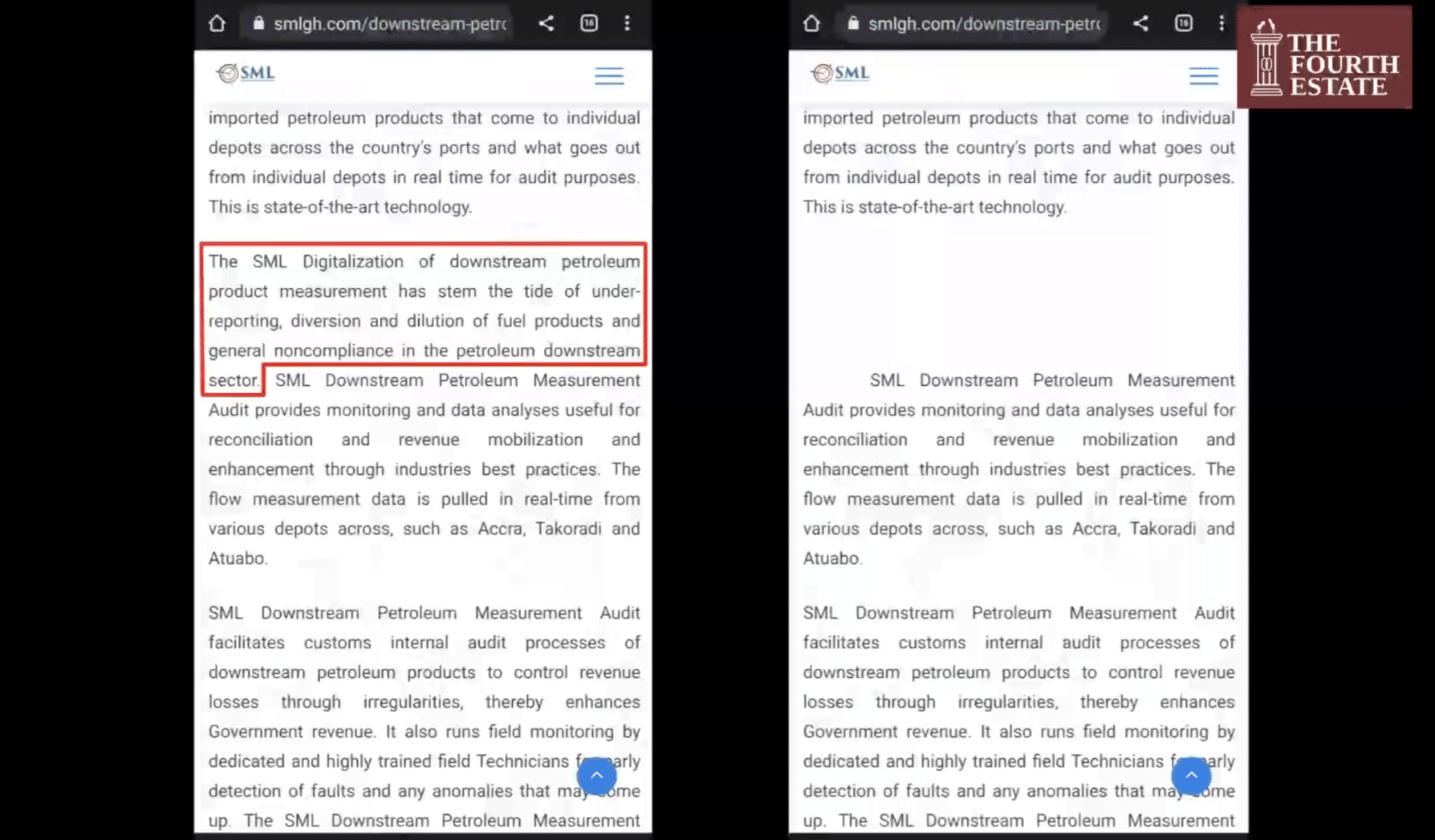
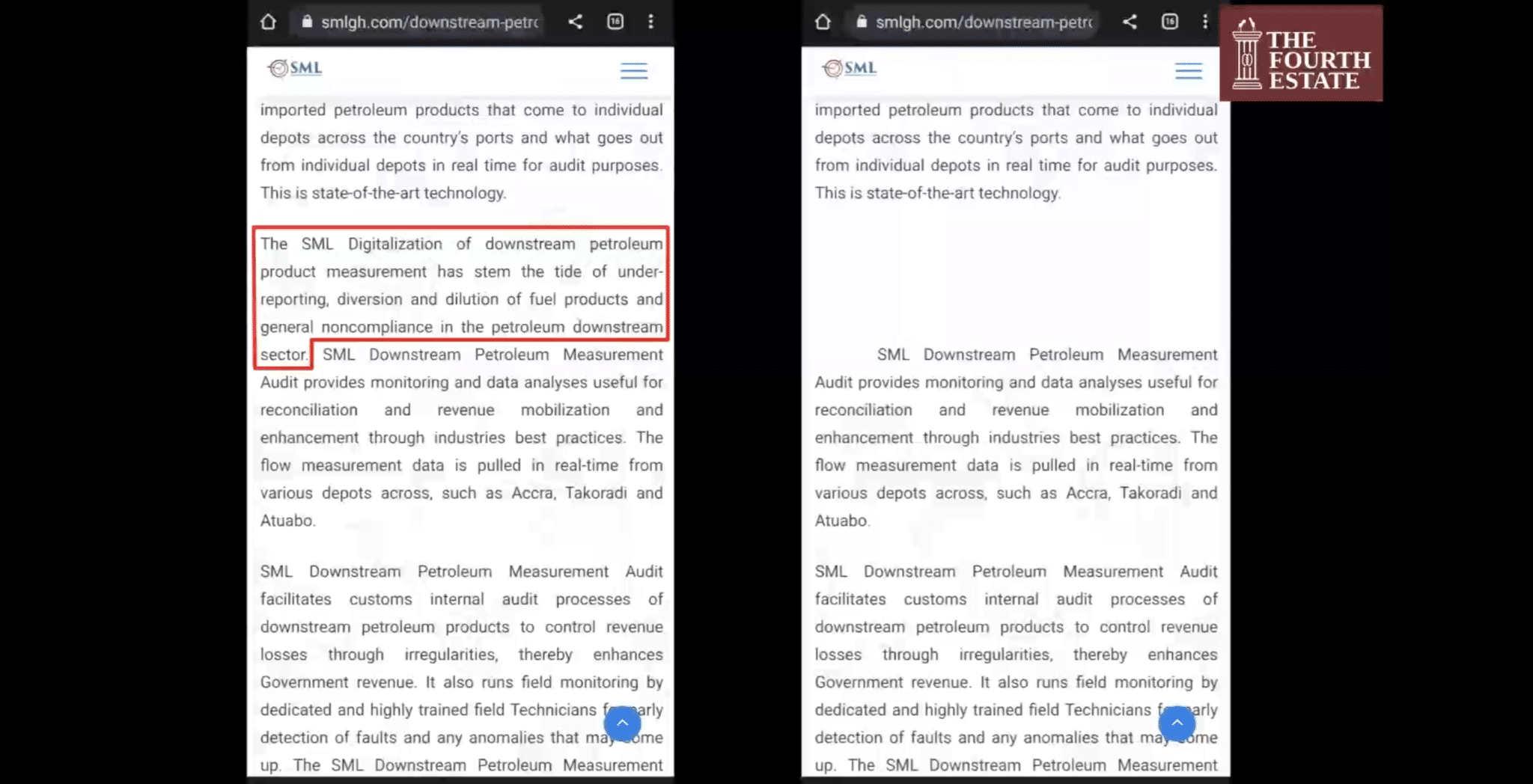
The company had also claimed that its services had stopped “under-reporting, diversion and dilution of fuel products and general non-compliance in the petroleum industry sector.”
When The Fourth Estate confronted the company with evidence that it did not perform any of those services that tackled those problems, which were the causes of revenue leakages in the downstream petroleum sector, SML admitted its claims were false and deleted them from the website of SML that same day.
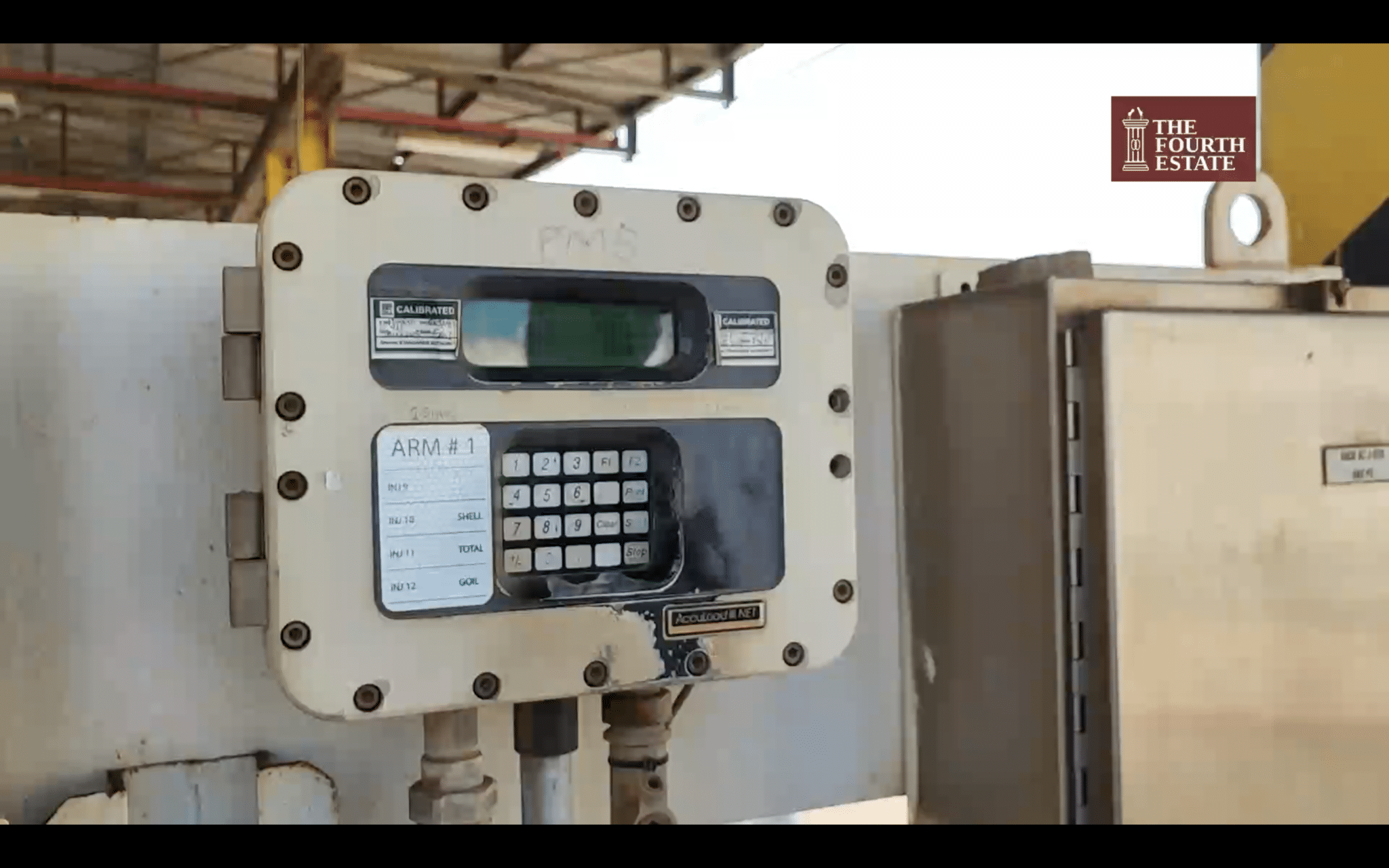
SML also admitted its ultrasound metres at the nation’s fuel depots were less accurate than the metres of the loading gantries at the depots, which are calibrated and certified by the Ghana Standards Authority every six months.
The GRA and the Ministry of Finance contracted SML to monitor the volumes of petroleum products lifted. However, the GRA told The Fourth Estate that the figures SML churned out as its monitoring of volumes were not the ones GRA uses to calculate petroleum taxes or revenue for the state. The GRA uses figures from the loading gantries, which the authority was using even before SML was contracted.
The Managing Director of SML, Christian Sottie, denied knowledge of the GHc3 billion savings and claimed the media misreported SML. But the story is still on the website of SML.
SML also confirmed to The Fourth Estate that it had never detected any case of under-declaration since it started its monitoring services for the GRA over three years ago.
Apart from the false claims, SML does not tackle any of the problems identified as causing revenue losses in the downstream sector, a fact SML and government officials admitted when we interviewed them.
This notwithstanding, the Ministry of Finance, in June 2023, instructed the GRA to expand the scope of SML Ghana’s work.
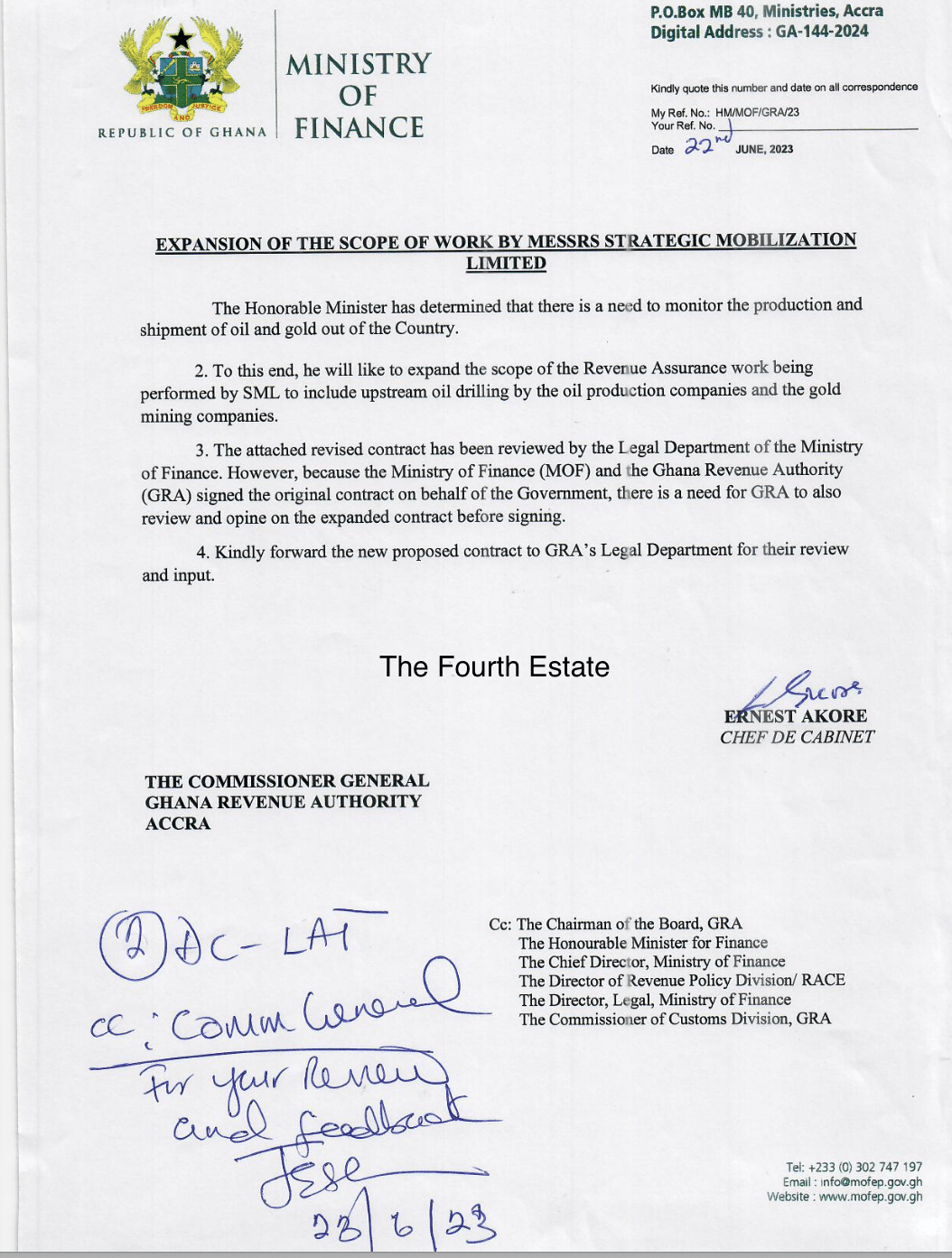
A Ministry of Finance letter sighted by The Fourth Estate said the “Honourable Minister [Ken Ofori-Atta] has determined that there is the need to monitor the production and shipment of oil and gold out of the country.
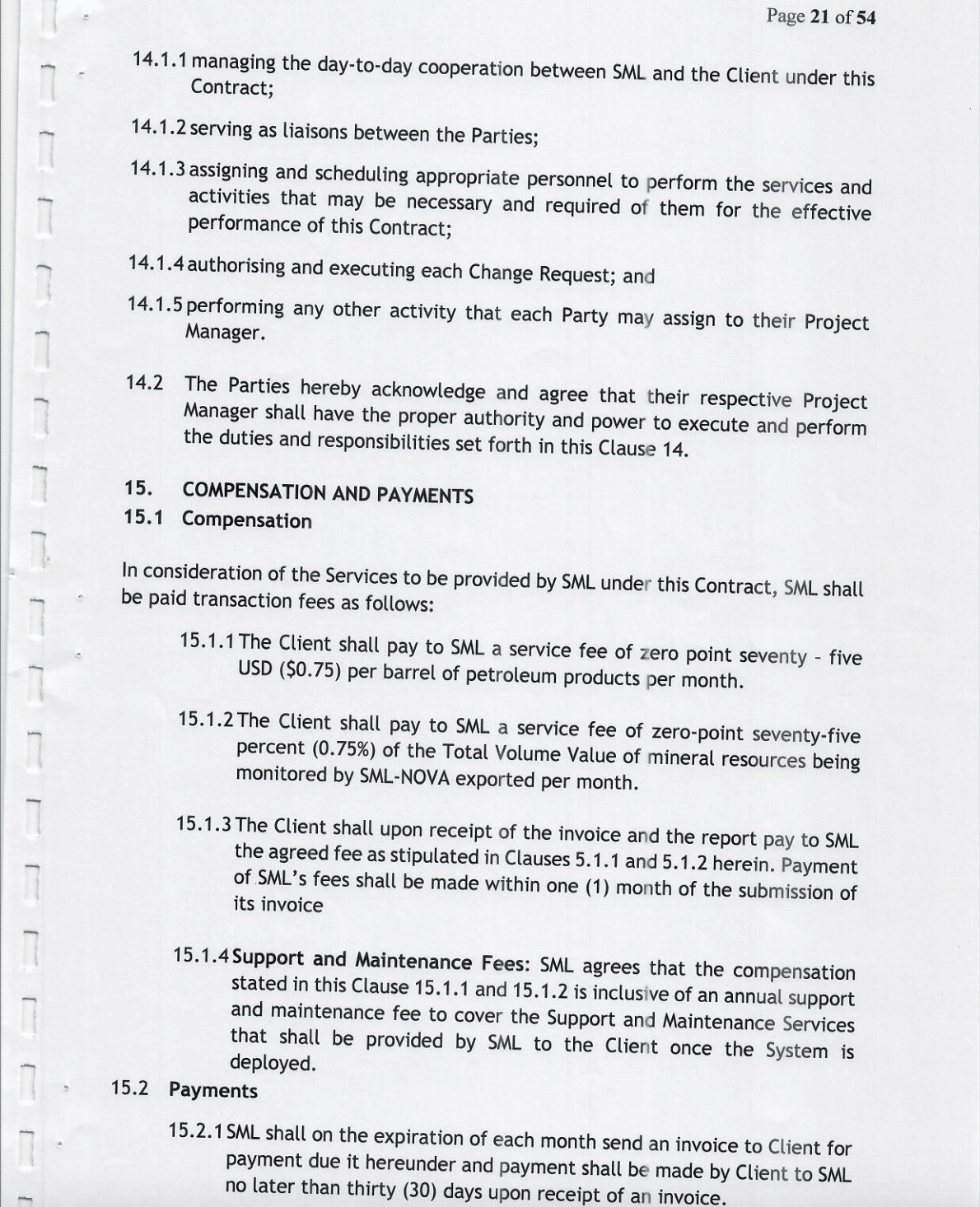
“To this end, he will like to expand the Revenue Assurance work being performed by SML to include upstream oil drilling by the production companies and the gold mining companies,” the letter dated June 22, 2023, stated.
The Ministry of Finance letter on the expansion of SML Contracts to cover oil and gold production in Ghana
Sources close to the Ministry and SML Ghana have confirmed the contract has been signed and stakeholders in the mining industry have been contacted in writing to help SML operationalise the terms of the contract.
Last week, representatives from the GRA and SML met the Ghana Chamber of Mines to discuss the execution of the contract. The Fourth Estate’s sources familiar with discussions at the meeting said SML invited the Ghana Chamber of Mines to visit the company to inspect the setup it is putting in place to implement the new contract. The Chamber is to visit.
Per the terms of this new contract, the government will pay SML US$0.75 for any barrel of oil produced in Ghana.
Ghana currently produces between 160,000 to 170,000 barrels of oil per day. The Pecan field project is expected to add 80,000 barrels per day in a year, a Deputy Minister of Energy, Andrew Mercer, recently told Reuters.
SML’s share of US$0.75 per barrel a day means the company will make at least US$120,000 per day from the 160,000 barrels per day.
The contract also mandates the state to pay SML Ghana 0.75 per cent of the total amount of gold that is produced and monitored in Ghana. Ghana is currently the largest producer of gold in Africa, beating South Africa with 3.7 million ounces of Gold in 2022.
Using the 2022 production figures to estimate SML’s earnings, the company’s 0.75% share of 3.7 million ounces at a global price of US$1,800 per ounce (as contained in the Finance Minister’s 2024 budget statement) will amount to US$50 million from the gold sector alone.
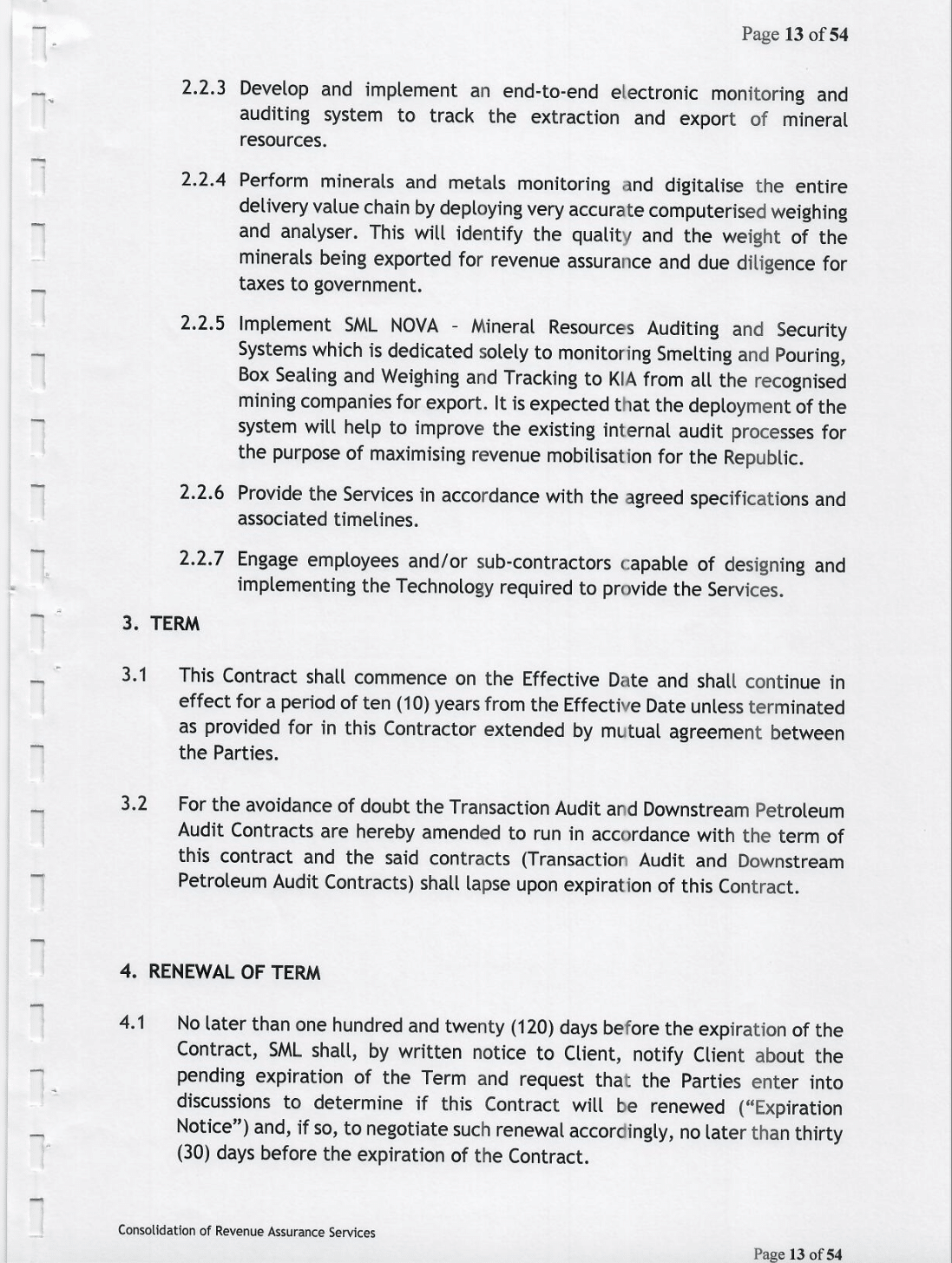
The Contract spells out what should be paid to SML under the gold and oil upstream petroleum sectors. Together with the downstream sector, the company will be paid over $100 million a year
Together with the downstream and upstream petroleum sectors, SML Ghana will be paid more than US$100 million by the government of Ghana through the “revenue assurance” contracts.
This money is more than the amount allocated to 19 out of the 27 ministries in the 2024 budget of the Republic of Ghana by the Ministry of Finance.
The amount due SML per this contract is more than the annual revenue from many taxes, including the controversial electronic transaction tax (E-Levy).
The contract term is 10 years which means the company would have rake-in 1 billion dollars in 2032
“A typical create loot and share”, a mining expert.
A mining expert who spoke to The Fourth Estate on condition of anonymity described the engagement of SML to monitor gold production as a “typical create, loot, and share” scheme to plunder the resources of the state.
The source said SML has no role in the mining sector and won’t perform any function that is not already in place to monitor and assure revenue for the government.
“To put it simply, what we do here is that we crash rocks in search of gold. After crashing, we take the rocks that have gold particles to what we call the Gold Room to extract the gold,” the source explained.
“In the gold room of every mining company, we have officials of the Ghana Revenue Authority to protect the government’s interest and calculate taxes on whatever we produce,” the source continued.
The source further explained that aside from the GRA officials, the Gold Room also has officials from the Precious Minerals Marketing Company (PMMC), the state institution certified to grade, assay, value and process precious minerals.
“The PMMC is the government’s assayer, so they take samples of the gold we produce to their labs in Accra to test and report of the percentage of actual gold in the bars.”
The source said the mining companies in Ghana refine their gold outside the country and reports from the gold refineries abroad are returned to Ghana for reconciliation with the PMMC report.
“For instance, if the PMMC’s test report says a bar has 97% gold and 3% silver, and the refinery report says it has 94% gold and the rest are of silver and other metals, the report is reconciled.”
The source explained that all the gold that leaves the mines is airlifted by helicopters with security protection to the Kotoka International Airport in Accra for onward export.
“Between the mines and the airport, anything could happen, so we have Customs officials in every helicopter that lifts the gold from the mines to Kotoka, where they hand over to their superiors for the paperwork and export.
“So, what is SML coming to do?” the source asked. “Are they coming to do the work of PMMC or GRA?”
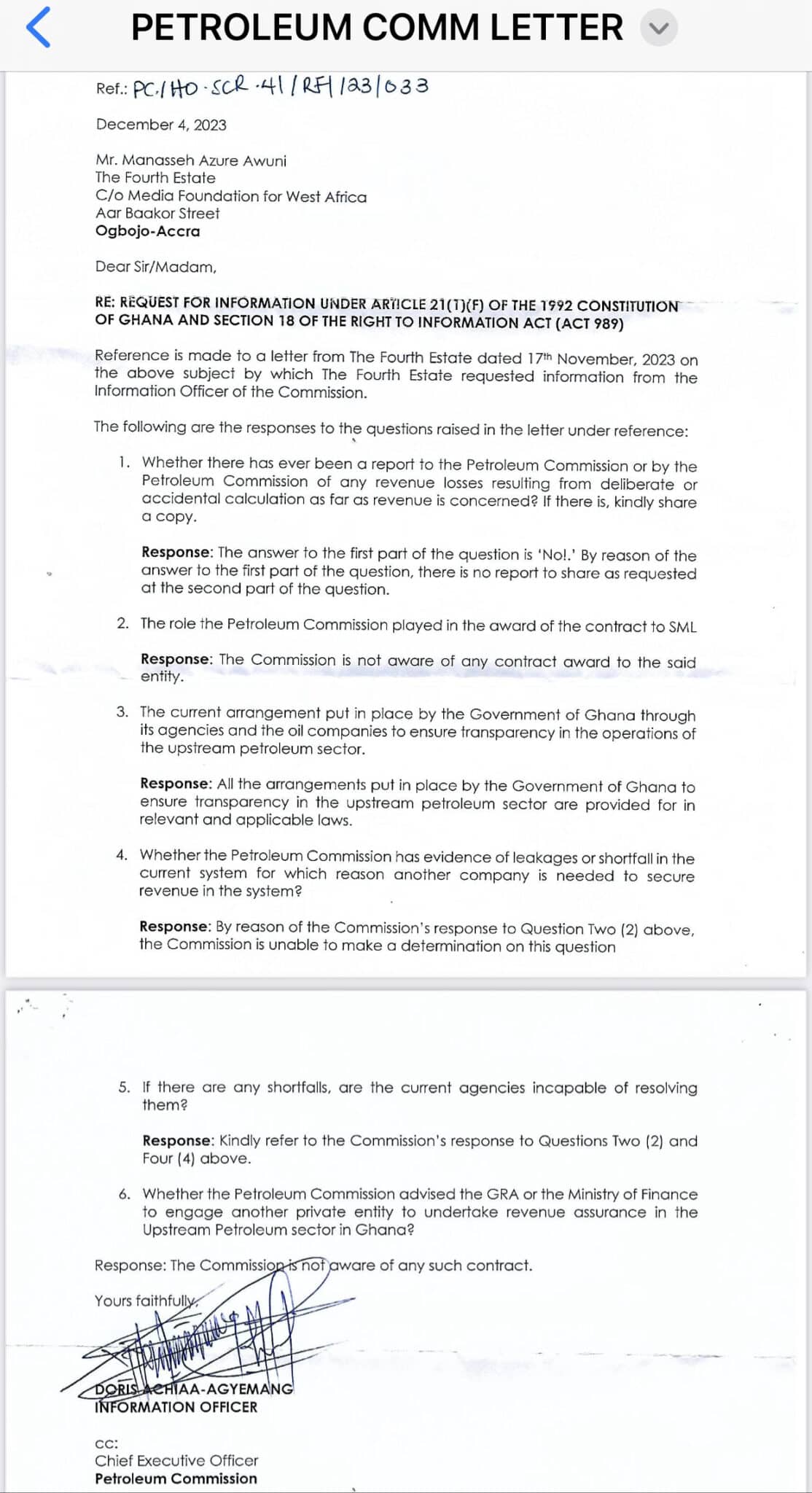
The Petroleum Commission says it is not aware of the contract with SML
The regulator of the upstream sector, the Petroleum Commission, has told The Fourth Estate that it has no knowledge of the contract with SML to monitor petroleum production in Ghana. It also said in a response to a right to information request that it has no report of leakages in the sector, a reason SML was contracted to monitor.
The Commission, according to its official website, was established by “an Act of Parliament, 2011 (Act 821) as a result of hydrocarbon discoveries in commercial quantities, to regulate and manage the utilisation of petroleum resources and, coordinate the policies in the upstream petroleum sector.”
Executive Director for Africa Centre for Energy Policy, Benjamin Boakye
The Executive Director of the Africa Centre for Energy Policy (ACEP), Benjamin Boakye, told The Fourth Estate that, SML’s role is needless and would result in loss of revenue to Ghana without adding value to the process.
“Recently, Tullow installed new metering systems that will be calibrated by the Standards Authority. Is the Finance Ministry saying that those metres are wrong?,” he asked.
In a control room in Tema in the Greater Accra Region, officials of Strategic Mobilisation Ghana Limited (SML) tried to convince The Fourth Estate of its wild claims that it had helped to save Ghana billions of cedis that would have been lost in the downstream petroleum sector but for its intervention.
The company also tried to justify why it receives up to GH₵24 million monthly payments from the government of Ghana in a questionable contract it signed with the Ministry of Finance and the Ghana Revenue Authority (GRA).
A year-long investigation by Evans Aziamor-Mensah, Adwoa Adobea-Owusu and Manasseh Azure Awuni of The Fourth Estate, however, revealed that the company, with the help of a section of Ghana’s media, had made false and unsubstantiated claims of its operations that have served as the basis for the payment it received. It appears the Ministry of Finance and the GRA were aware the claims were false, for some officials of the GRA said they had confronted the company about its claims of savings and volumes on two separate occasions.
(Left)A picture of the false claim that SML made and (right) a picture of the disappeared claim on its website.
A few hours after the reporters confronted the management of SML with the findings of the investigation and asked for a response, the major services it claimed to render to the government disappeared from the company’s website.
The investigation also uncovered that at a time players in the downstream petroleum sector were questioning the relevance of SML’s involvement, the Minister of Finance, Ken Ofori Atta, initiated a more outrageous deal that would entitle the company to over $100 million every year for the next 10 years.
In the first of this series, we focus on a 2019 contract the Government of Ghana signed with SML. The contract was signed at a time when superior and comprehensive measures had already been introduced by the government in 2018 to curtail losses in the downstream petroleum sector.
SML admits false claim of services it renders to the GRA
Managing Director of SML Ghana, Christian Sottie
SML Ghana started what it calls “revenue assurance” services to the GRA in the downstream petroleum sector in June 2020. The downstream sector is responsible for the refining, distribution, and retail of oil and gas products. The Managing Director of the company, Christian Tetteh Sottie, said SML was an offshoot of a timber company he would not name.
Online records, however, link SML to Evans Timbers Limited. The CEO of SML, Evans Adusei, is also the CEO of Evans Timbers GH, a company that won a defamation case against The Informer newspaper in 2014. In that case, Justice Uuter Paul Dery, who was later dismissed by the Judicial Service of Ghana for bribery and corruption, ruled that the newspaper could not substantiate its claim that Evans Timbers GH used its political connections with Chief of Staff Kojo Mpiani to undertake dubious transactions.
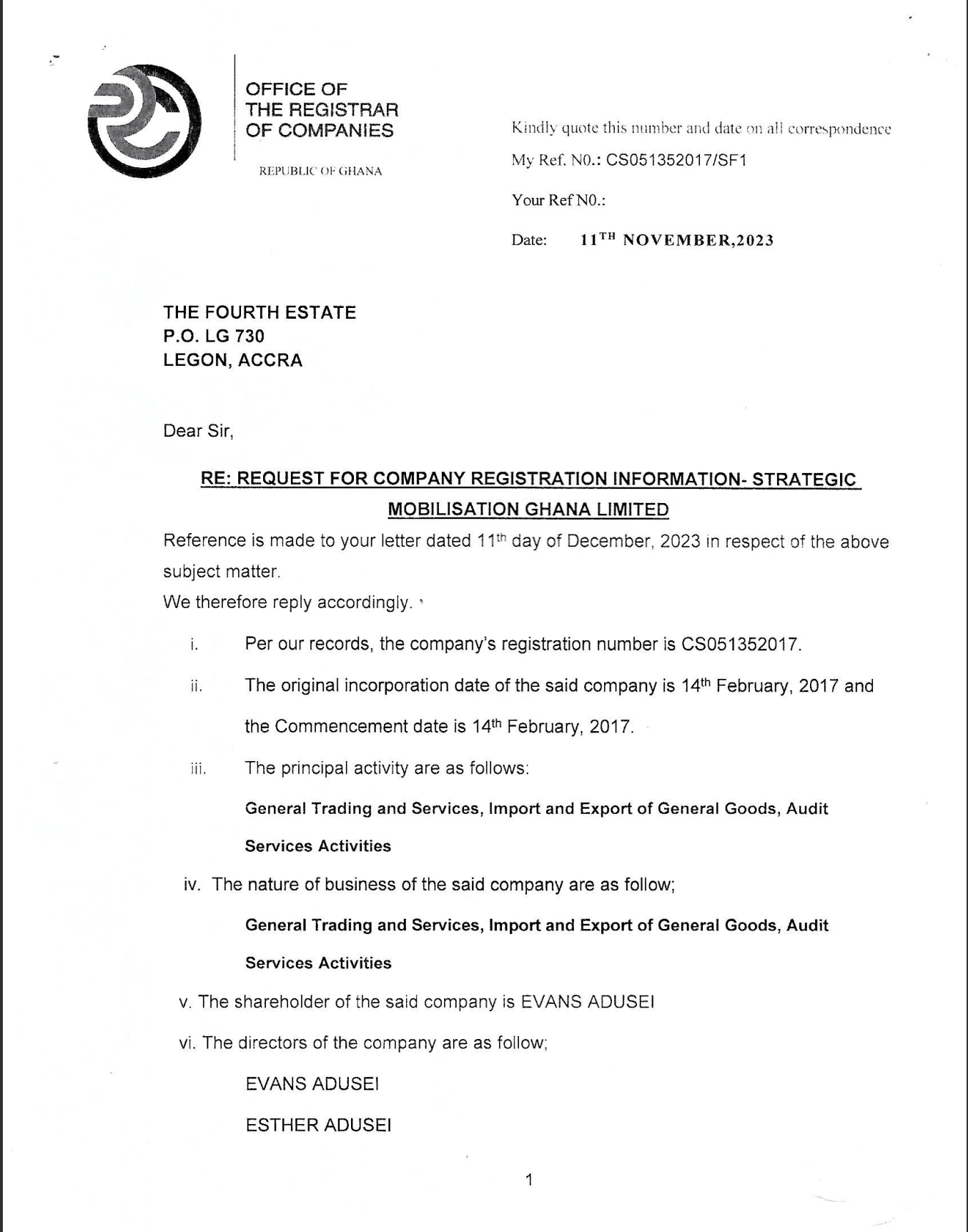
SML registration details at the Office of the Registrar of Companies
Information The Fourth Estate obtained from the Office of the Registrar of Companies shows that Evans Adusei is the sole shareholder of SML. Also, Evans Adusei and his daughter, Esther Adusei, are the directors of the company. SML’s principal activities are “general trading and services, import and export of general goods and audit service activities.”
The Managing Director of SML, Christian Tetteh Sottie, was Ghana’s Controller and Accountant-General from 2005-2009 and is currently a board member of the Internal Audit Agency. He was once an Assistant Commissioner at the GRA.
In 2019, when the GRA entered into an agreement with SML Ghana, Mr. Sottie was the Technical Advisor to the Commissioner General of the GRA. Mr. Sottie left his job as the Technical Advisor to the GRA Commissioner General in the same year to manage SML Ghana in 2020 when the company started implementing its contract with the GRA.
The GRA has been the only customer of SML Ghana since its establishment, according to Mr. Sottie. This means at the time the company was handpicked for the contract through the single source procurement method, it had no prior experience in the services it claimed to have expertise.
A procurement expert and consultant, Kobina Ata-Bedu, says the contract raises questions about a possible breach of Ghana’s procurement laws. He questions the basis for which a company that had no prior experience in the services being procured was single sourced for the contract.
To justify its contract and why it has been paid hundreds of millions of cedis by the government of Ghana, SML falsely claimed that it was rendering a wide range of services that had stopped malfeasance in the downstream petroleum sector.
On its website, SML stated: “The SML Digitalisation of downstream petroleum product measurement has stem(sic) the tide of under-reporting, diversion and dilution of fuel products and general non-compliance in the petroleum industry sector.”
As part of this investigation, The Fourth Estate team spent months interrogating the systems put in place by the Government of Ghana through its sector agencies and third-party contractors to curtail the anomalies SML Ghana claimed to be tackling. The team had rare access to the National Command Centre of the National Petroleum Authority (NPA), where we interviewed officials of the NPA and private sector service providers.
Third-party companies working with the NPA were responsible for checking dilution, diversion, under-declaration and other anomalies in the sector. The Customs Division of the GRA also has officials at the depots and various entry points to ensure that all petroleum products that enter the country are properly accounted for. They do this with independent monitors who police the processes for the owners of petroleum products at various points of the product chain.
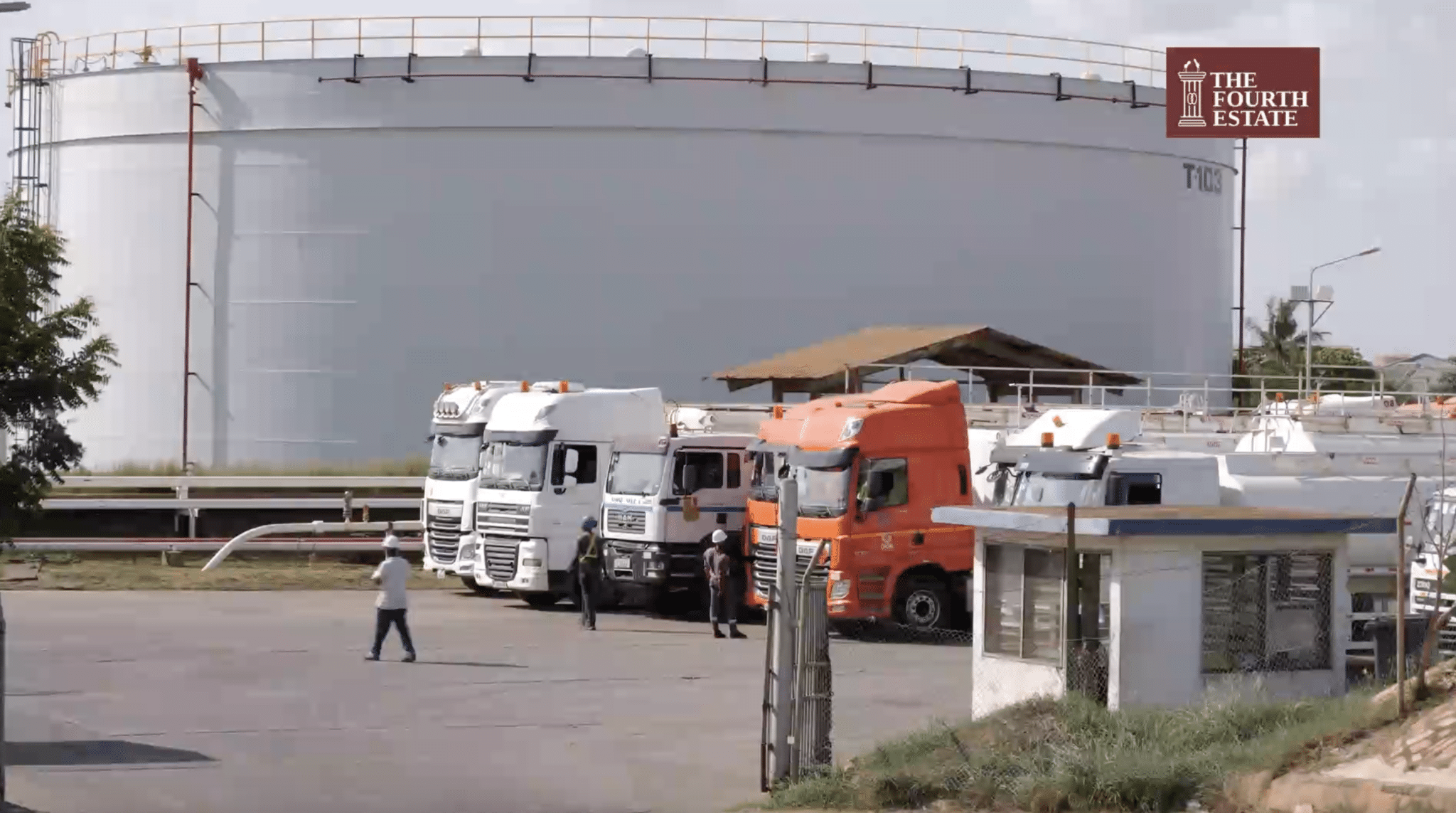
The Fourth Estate team also toured some fuel depots in the country and interviewed depot operators as well as oil marketing companies and officials of the GRA. The evidence gathered showed that SML’s claim that it was checking diversion, dilution and under-declaration was completely false.
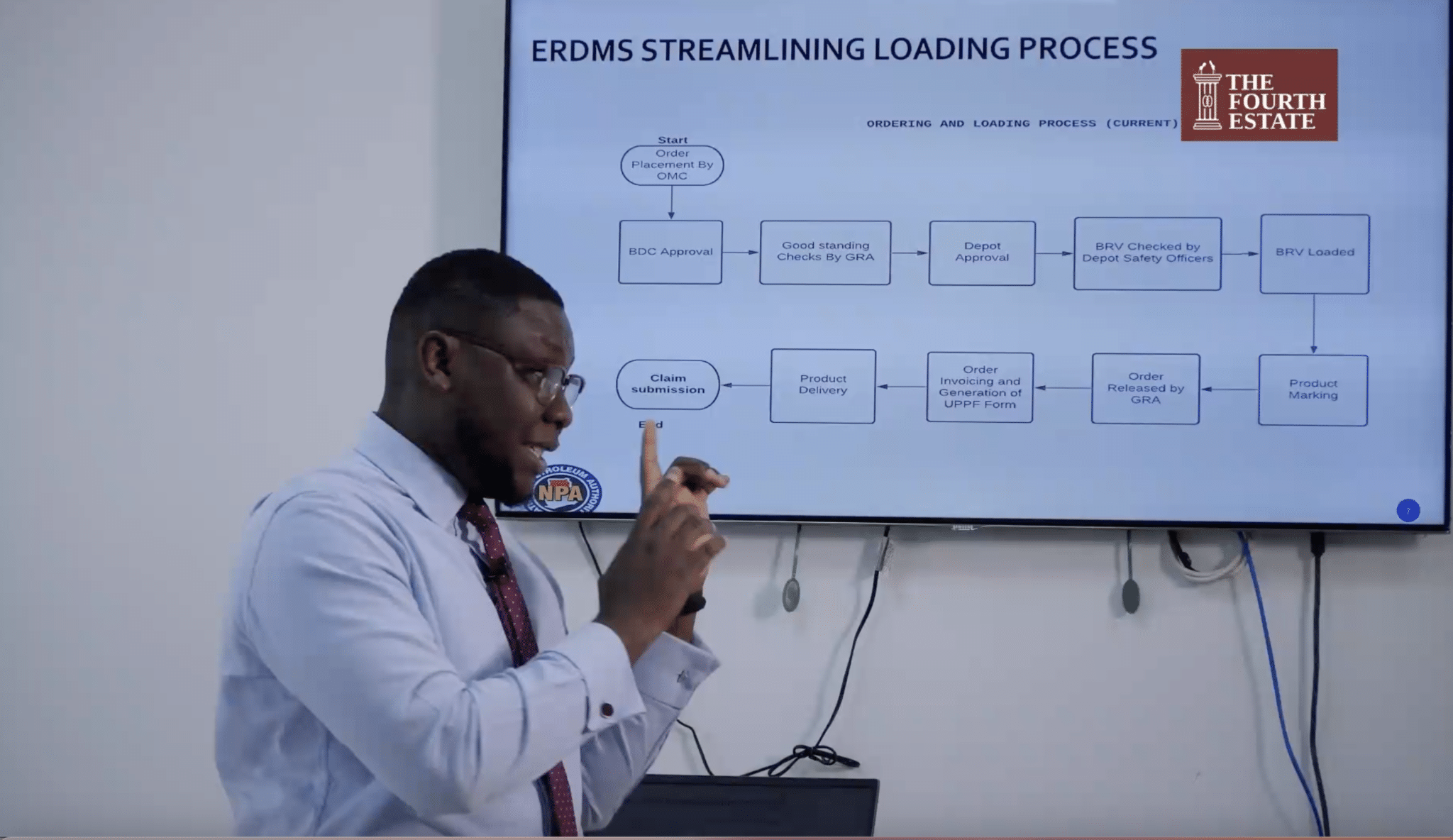
Our investigation revealed that the introduction of the Enterprise Relational Database Management System (ERDMS) in 2018 had curtailed the continuous operations of oil marketing companies that owed the government in taxes and margins and did not pay within the stipulated time. This was confirmed by the GRA and NPA.
The NPA and GRA said the ERDMS had curtailed under-reporting and other anomalies in the downstream petroleum sector.
A company called Rock Africa was also engaged by the NPA to electronically monitor the tankers that load petroleum products at the depots. The electronic seals send signals to the NPA Command Centre if a truck discharges products outside the fuel station it is supposed to discharge.
This, according to the NPA, curtails the diversion of tax-free petroleum products that are declared as exports to landlocked West African countries but sold in Ghana.
Another company, Nationwide Technologies Limited, had been engaged to undertake fuel marking, which tackles the problem of dilution and the smuggling of petroleum products into the country.
Our investigation showed that the problems that occasioned revenue leakages in the sector were being tackled by different companies to the satisfaction of state authorities, but SML was not one of them. SML, regulatory authorities, and independent operators in the sector could not establish any of the problems SML was solving.
Mr. Sottie also admitted to The Fourth Estate that SML was not into checking underreporting or anomalies in the downstream sector.
“We don’t go into that,” he said when we asked whether SML had “ever detected or identified any issues of under declaration.”
Despite evidence to the contrary, SML made false claims on its website about resolving the problems “under-reporting, diversion and dilution of fuel products and general non-compliance in the petroleum industry sector.”
Officials of the Petroleum Division of the GRA expressed shock when The Fourth Estate team mentioned the listed services SML claimed to provide. SML was contracted to render the services to the GRA.
The GRA officials, led by the Head of Petroleum, Meshack Kwame Danso, were present when we visited SML to confront the company with our findings. Before we started our interview, the GRA officials said SML needed to clear the air on the stated service before we began our interview.
The Company’s Managing Director, Christian Sottie, said SML did not state anywhere that the company was providing services that checked under-declaration, dilution, and diversion of petroleum products. When we pointed out the claims to the management of SML from the company’s website, Mr. Sottie said the information was put on the website in error.
“Oh no, we are not involved in diversion. We are only at the depots. If the thing [petroleum product] is lifted, we don’t know if [it is diverted],” Mr. Sottie said.
He added: “It is GRA, Customs, that will determine where it goes, and they will follow up. We are not capable. We don’t have men outside.”
A few hours after our meeting, the claim of providing services that checked dilution, diversion and under-declaration disappeared from the website of SML.
Executive Director for Africa Centre for Energy Policy, Benjamin Boakye
The Executive Director of the Africa Centre for Energy Policy, Benjamin Boakye, told The Fourth Estate that players in the industry were surprised when the government awarded a contract to SML. He said solutions to most problems in the sector had already been provided and they wondered what SML was coming to do.
Mr. Boakye said the remaining problems in the sector were not at the depots, where SML was stationed to monitor. By problems, Mr Boakye was referring to the non-payment of taxes and margins by OMCs after the sale of products. Even at the depots, the GRA confirmed to The Fourth Estate that it was practically impossible to lose products—and by extension, revenue to the state—even if there were no electronic systems in place.
False Claim of Saving Ghana GH₵3 billion
The false claim by SML made it to the headlines and front pages of newspapers, including the state-owned Daily Graphic. When the company was confronted with evidence, it denied ever claiming to save Ghana GH₵3 billion
The Fourth Estate also confronted the Managing Director of SML Ghana with the figures the company churned out as savings Ghana made in the downstream petroleum sector because of its operations.
First was the claim SML made in March 2021 that it had saved Ghana over GH₵1 billion in revenue because of its services.
The company started its operations in 2020. From the revenue figures we obtained from the GRA, the difference in the total revenue from the downstream petroleum sector between 2019 and 2020 was GH₵800 million.
So, if all the incremental revenue in the sector were attributed to the company’s operations, it would still fall short of the GH₵1 billion it claimed to have saved Ghana.
In February 2023, SML Ghana made a more audacious claim that became the banner headline in Ghana’s biggest newspaper, the state-owned Daily Graphic. The story also received wide coverage in major media outlets in Ghana. In its report to the media, the company claimed its operations had helped to save Ghana GH₵3 billion.
Finance Minister, Ken Ofori-Atta, was the first to claim that the SML contract had resolved the problems that caused “two to three billion cedis losses” in the downstream petroleum sector
The Minister of Finance, Ken Ofori-Atta, was the first to mention billions of losses in the sector, which SML Ghana was going to save. When he commissioned the operations of SML in 2020, Mr. Ofori-Atta claimed that, by engaging SML, the government had eliminated the problems which existed prior to the entry of SML and “it was about two to three billion cedis of losses”.
“We are really excited about this change where we can now determine and get the exact revenues we want,” Ken Ofori-Atta said.
SML Ghana admitted it did not perform the services it listed on its website as curtailing irregularities in the sector and deleted them from its website after we confronted its management.
But even if the company was carrying out those services and all the incremental revenue within the period of its operations was credited to its efforts, the figure would have been GH₵2.4 billion cedis and not the GH₵3 billion it claimed to have saved.
When we put these facts to the managing director, he said he did not know about the GH₵3 billion savings.
“What I want is the agreement from here that the figures are not accurate and that we cannot say that your intervention saved GH₵3 billion,” The Fourth Estate’s Manasseh Azure Awuni insisted that Mr. Sottie should admit the false claim, which was still on the website of the company even while the interview was taking place.
“I have told you that [in terms of the] GH₵3 billion, I am not aware [of it] because when we were told about the publication, we even called the journalist … I think he [journalist] picked it out of context,” Mr. Sotie responded. “I can’t remember the GHS 3 billion. I remember the GHc 1 billion.”
MANASSEH: But the GH₵3 billion was from your outfit?
MR SOTTIE: Yes, you remember when you were talking, I was still speaking about GH₵1 billion. Because, after one year, that was the statement I put out.
MANASSEH: So, who put the GH₵3 billion out?
[The IT Systems Engineer of SML Ghana, Prince Sarpong, interrupts the interview and whispers into Mr. Sottie’s ears].
MR SARPONG: It was a mistake because if you look at other publications, it was just a consultation between GRA and SML. I did the presentation, and I was giving them the expected revenue. Our system can generate expected revenue, so what we did was not even the accurate figure because only GRA can give accurate figures. So, that is a caption by journalists.
MANASSEH: The problem here is that if the journalist made a mistake, it is also on your website this morning even as we speak [in July 2023]. This has been there since February [2023]. So, if a journalist makes a mistake and reports something I did not say, and I put that same thing on my website, then it means an endorsement.
MR SOTTIE: As for me, I don’t know about any website matters.
The Managing Director of SML, Christian Sottie, denied knowledge of the GHc3 billion savings and claimed the media misreported SML. But the story is still on the website of SML.
When asked how much SML was paid for its services in the downstream sector, Mr. Sottie said he did not know. The GRA has not responded to our Right to Information request for the contract and payments made to SML. We sent letters to the GRA in July and November 2023 but neither letter has been acknowledged. The Ministry of Finance is also yet to respond to our request for information sent in November.
Sources close to the Ministry of Finance have, however, revealed that payments to SML are done monthly. Payment details sighted by The Fourth Estate show that SML receives up to GH₵24 million a month for its contract in the downstream sector alone, a figure that may rise when the company finishes the extended contract to undertake tank gauging at the depots.
With the current figures, the company receives at least GH₵240 million for services whose value it could not show when we asked.
“SML Ghana is essentially a plugin into the revenue stream of the state taking money for no job done because what they are supposed to be doing is already being done. It’s just people finding ways to hive off some of our revenues into private pockets and the reasonable thing to do is to cancel that contract,” Benjamin Boakye said of the contract.
Is SML Responsible for Revenue Increment in the Downstream Petroleum Sector?
An official of the National Petroleum Authority explains to The Fourth Estate team how the ERDMS makes it impossible for oil marketing companies owing the government to trade
While SML Ghana claimed its activities resulted in revenue increases—which it interpreted as savings for Ghana—in the downstream petroleum sector, the GRA told The Fourth Estate that revenue increments in the sector are due to two factors.
One of the factors, according to the GRA, is an increase in the volumes of petroleum products imported and consumed in the country. As the economy grows and more people buy vehicles, industries and other economic activities that are fueled by petroleum products also increase. The volumes of petroleum products, therefore, grow naturally from year to year.
“It is not only the volume increase that gives us an increase in revenue. Sometimes, within the period, there are changes in [tax] rates. The tax is on specifics. It’s on volumes so as the rate changes, … as the volume increases, the revenue will naturally grow,” Napoleon Simons of the Policy and Programs Unit of the GRA told The Fourth Estate.
SML Ghana admitted to The Fourth Estate that it does not import petroleum products and its operations have not added a litre of petroleum product to the volumes.
Since SML started its operations, the government of Ghana has increased tax rates twice and added new taxes on petroleum products, according to the GRA. This means more revenue for the government, and a company that played no role in either of the two variables cannot take credit for revenue increment and purported savings for the state.
The GRA and NPA said revenue losses in the sector occurred when oil marketing companies lifted petroleum products from the depots and absconded with taxes. Some OMCs also claimed that the petroleum products were meant for sale in other West African countries and, therefore, were not supposed to attract tax, but they turned around to sell them in the country. The state regulatory institutions have put in measures to track and stop these practices and SML Ghana is not involved in any of these systems.
The measures put in place before SML Ghana was contracted were said to be adequate according to players in the industry and state regulators.
The CEO of the NPA, Dr. Mustapha Hamid, said the ERDMS installed by the NPA and linked to the GRA’s system “allows us to disable people from operating or lifting petroleum products once they are found to be in default of whatever statutory margins or taxes or levies that they haven’t lived up to. So, the absence of the ERDMS at that time where things were done manually and so on was perhaps some of the regulatory challenges. But since that system was installed, a lot of that has been stemmed.”
Sukhwinder Singh, the manager of the Accra Plains Depot Limited, said there was no problem with the ERDMS. He said it ensured “hundred percent” efficiency and transparency.
The ERDMS was introduced in 2018 a year before SML was engaged. Officials of the GRA said the ERDMS resolved the loss of revenues that occurred when the process was manual. Apart from helping to track volumes, the ERDMS ensures that the trading and transportation of petroleum products are done on a digitized platform that has the GRA, NPA, oil marketing companies and bulk oil distributors on board. An oil marketing company that is indebted to the government in taxes and margins is automatically disabled on the ERDMS from loading petroleum products anywhere in the country.
Head of Petroleum Downstream, GRA, Samson Anim
“Once we are able to track whatever is happening on the ERDMS to ICUMS [Integrated Customs Management System], by and large, you would have tracked all your volumes. And once you are able to track your volumes, you are likely to get your taxes right,” said Samson Anim, the head of GRA’s downstream petroleum sector.
The Managing Director of SML Ghana, however, said his company had taken credit for revenue increment in the sector because its operations may have deterred those diverting and under-declaring fuel products.
When asked to name at least one instance in which SML Ghana detected anomalies in the sector or by any sector through his company’s work, Mr Sotie said there was none.
This was in addition to his earlier admission that the company did not perform any of the functions aimed at curbing the anomalies—under declaration, diversion and dilution of petroleum products.
Refusal of Information on contracts and payments
When The Fourth Estate asked the Managing Director of SML Ghana how much his company was paid by the government for its services, he claimed he did not know.
The GRA officials we interviewed for this story also said they could not give us the cost and copies of the contract when we asked. They said they did not have the authorisation to disclose such information and suggested that we write to the Commissioner General of the GRA for that information.
In July 2023, we wrote to the Commissioner General of the GRA but have since not received any response.
The Fourth Estate has also written to the Ministry of Finance, which jointly signed the contract, but we have not received any response to our questions.
The Right to Information Law, under which we made the request considers it a refusal if the institution or agency fails to respond after 14 days.
What SML Currently Does
SML Ghana says its ultrasound metres at the fuel depots across the country record volumes of petroleum products lifted at the loading gantries. The GRA, however, does not use the SML figures for revenue collection.
SML Ghana has metres attached to pipelines at the fuel depots, which record the volumes of products that flow through the pipelines to the loading gantries and give SML real-time records of the volumes that go through the pipelines.
Operators in the industry say the real-time readings at the depots mean nothing because taxes or revenues are not collected in real time. They are collected only after the fuel product is lifted and sold.
Besides, the Ghana Revenue Authority and the National Petroleum Authority do not use SML’s figures to collect taxes or margins on petroleum products.
The gantries are where fuel tankers of the OMCs load petroleum products. The readings of these metres at the gantries determine the volumes of products that leave every fuel depot at the end of each day. These recordings at the gantries are the ones used for tax purposes and not the SML Ghana readings.
SML Ghana also scans the Waybills that GRA officials receive at the fuel depots, which are intended for later reference should an issue arise with an oil marketing company’s indebtedness and there’s the need for a reference.
Sources within the GRA told The Fourth Estate that their officials can scan these documents if they are given the scanners, equipment and resources given to SML through the contract. The sources say GRA does not need a third-party company to scan documents GRA officials collect as part of their work at the depots.
The Executive Director of ACEP told The Fourth Estate, “A very flamboyant GRA with a lot of people packed there who are supposed to deliver the same service. And we assume suddenly that they cannot deliver that function and we need the private sector to be able to do that. I think perhaps, it’s time to evaluate some of these arrangements and save ourselves some money.”
Why GRA Uses “More Accurate” Metres for Revenue, not SML Readings.
The metres at the loading gantries are more accurate than the SML metres. Readings of these metres are the figures the GRA and NPA use for calculating taxes and margins. SML has admitted these metres are more accurate than the SML metres.
SML Ghana has explained to The Fourth Estate that its ultrasound metres are not intrusive, so they are less accurate than the other metres.
Hamdan Abubakari, the Head of Engineering at SML Ghana told The Fourth Estate that contact metres at the loading gantries of the depots, which are calibrated and certified by the Ghana Standards Authority every six months, take more accurate readings than the SML metres, which are non-contact metres installed outside the pipes.
“The contact metres are always the best,” Mr. Abubakari of SML, emphasised why the SML metres are not as accurate as the ones at the loading gantries.
He said those metres are more accurate because they get the actual amount of fuel that flows through the pipelines and are loaded. The SML metres, he said, are external and use sound technology to take measurements.
The recording from metres at the loading gantries, according to the GRA, is captured on ERDMS, an electronic platform for transacting business in the entire supply chain process within the petroleum chain industry. This platform has the NPA, GRA, bulk distribution companies (BDCs) and (OMCs) on board to ensure transparency, facilitation, and tracking of transactions.
The ERDMS is connected to the Integrated Customs Management System (ICUMS). Taxes and revenues from the sector are calculated from the volumes that go through the ERDMS and customs.
None of that involves the figures churned out by SML through its “revenue assurance” services.
At all the depots, GRA officials measure the volumes of petroleum products in the tanks before the beginning of work at the end of each day’s business. The GRA has custody of the seals to valves of every tank, and, until the designated GRA officials open, no depot in Ghana can load petroleum products.
These and other rigorous measures make the role of SML irrelevant in the sector, according to some operators of the depots who want to remain anonymous.
Duplication of Roles
The management of SML also told The Fourth Estate that the scope of its contract had been expanded to include the tank gauging at the depots. With this service, the company said it was in the process of installing an automatic tank gauging system that would show the quantity of fuel in the tanks at the depots.
Apart from the fact that the GRA gauges the volumes of products in the tank at the beginning and end of business every day, some of the depots have already installed tank gauging systems. When The Fourth Estate team visited Chase Petroleum, one of the biggest fuel depots in Ghana, we saw the metres, whose measurement corresponded with the recording of the GRA officials stationed at the depots.
NPA CEO, Dr. Mustapha Abdul-Hamid, said they consider SML Ghana’s decision to undertake automatic tank gauging “potentially duplicitous.”
The Chief Executive of the NPA, Dr. Mustapha Hamid, told The Fourth Estate that some management members of the NPA had raised concerns about possible duplication of roles when they learned that SML Ghana had been contracted to undertake automatic tank gauging.
“Potentially, we consider it duplicitous. However, we have agreed to meet with them [SML] to understand the real rationale for which they also want to do an automatic tank gauging system,” Dr. Hamid told The Fourth Estate.
The NPA has a system that tracks the lifting and transportation of fuel products from the depots to the tanks of the oil marketing companies. With that system, the NPA can tell the volumes of petroleum products in all the fuel stations across Ghana at any given time.
The authority says it was already in the process of extending it to the depots to have an end-to-end system and wonders why another company was engaged to do the same thing.
The GRA further added that even without the other electronic systems put in place, it would be almost impossible to lose petroleum products at the depots, where SML has its metres. Officials of the GRA explained that many players with different roles and interests are present every time to police the products at every point.
A Senior Revenue Officer (SRO) of the GRA at the Tema Oil Refinery(TOR) Collection, Naomi Chartey, told The Fourth Estate that it is impossible to steal fuel products due to measures that had been put in place by the NPA and the GRA.
“The product is owned by the BDC [Bulk Distribution Companies], so the BDC must be in the known. Customs must be in the known, and for most of the depots, access to the depots is controlled by us. We have national security at the depots. We have NPA reps at the depots. So, by the time you are done [compromising all the players to dupe the system], you will realise that exercise is not even lucrative. Even when there are no systems, it is virtually impossible and we haven’t had such a case ever since,” Ms Chartey said.
Cancel SML’s contract
The Executive Director of ACEP, Ben Boakye, said the SML Ghana contract is only a duplication of roles being performed by the NPA, the GRA and other third-party companies in the sector. He, therefore, demands a cancellation of the contract.
When asked if he would have advised the GRA Commissioner to contract SML for this revenue assurance services if he were still the technical advisor, Mr Sottie said he could not answer.
Flagbearer of the opposition National Democratic Congress (NDC), John Dramani Mahama, has rejected Finance Minister Ken Ofori-Atta’s claims that Ghana is on the path to overcoming its economic challenges.
During the 9th Ghana CEO Network Business Cocktail, the former President argued that the current state of the economy contradicts the Finance Minister’s optimism.
In November, Ofori-Atta had expressed confidence, stating that the nation’s economy is gradually recovering and that the government has laid a strong foundation for future prosperity. However, addressing a gathering of business leaders and professionals, Mahama voiced concerns about the persistent economic difficulties faced by many businesses.
Mahama highlighted that, in his view, the country’s economy is in disarray, leading to widespread poverty among Ghanaians. Despite the Finance Minister’s positive outlook, Mahama emphasized the challenging economic conditions experienced by the people and businesses in Ghana.
“Many businesses still bear the brunt of the economic meltdown. This is because, contrary to the Finance Minister’s assertion, we have not turned any corner, and 2024 will be a very challenging year,” he said on Thursday.
The former President underscored a range of concerns during his address, pointing out issues such as business closures, layoffs, delays in international funding, and the repercussions of the country’s debt default.
In his critique, the opposition leader placed blame on the government for what he described as an economic catastrophe, attributing it to poorly executed policies.
He particularly highlighted the adverse effects on significant infrastructure projects, the energy sector, and the broader business environment. According to the flagbearer, these policy shortcomings have contributed to the challenging economic conditions faced by businesses and individuals in the country.
“As I speak, the second tranche of the IMF’s Extended Credit Facility, due on November 1, has still not been received because of a delay by our external creditors to sign off on our debt restructuring programme. Of course, the consequences of our debt default have also started manifesting.
“Major infrastructure projects have stopped because lenders have cut funding as a direct fallout from our debt default. Independent Power Producers continue to threaten power cuts due to mounting debts affecting their operations…Ghanaians face grave uncertainty if more of them follow suit,” he stated.
Addressing the recently approved budget, Mr. Mahama voiced criticism over the introduction of new taxes outlined in the 2024 budget. He expressed concern that these new tax measures, combined with elevated interest rates, would place a heavy burden on Ghanaian businesses, impeding their competitiveness.
The former President called for a shift in the current economic approach, asserting that the challenges faced by the country are a result of self-inflicted actions by the current government.
“As flagbearer of the National Democratic Congress, I have put forth several proposals to ensure that the economy is returned to a stable footing, and that economic activity is expanded for job creation and growth,” Mahama stated.
He pledged to enforce fiscal discipline, cut government expenditure, and streamline agencies to enhance efficiency.
University of Ghana senior lecturer, Prof Kobby Menah, criticizes Finance Minister Ken Ofori-Atta’s suggestion that the National Cathedral of Ghana could be the ‘new Jerusalem.’
Prof Menah notes that the Akufo-Addo government initially pledged to transform Ghana into a Singapore-like success within its first two years, yet after seven years, the country has not achieved that goal.
He emphasizes that now the finance minister is proposing the idea of a new Jerusalem in Ghana.
“Ghana into Singapore in 18 months didn’t work. Now Ghana will become the ‘new Jerusalem’ … eiii!!! Ghana abre,” the academic wrote in a post he shared on X on Tuesday, December 5, 2023.
What Ofori-Atta said:
Ken Ofori-Atta advocates for a reevaluation of discussions surrounding the National Cathedral, emphasizing its potential to drive economic progress.
During the 2023 Ghana Tourism Investment Summit, he underscores the cathedral’s significance as a robust infrastructure that could significantly boost the country’s tourism sector.
Ofori-Atta envisions the cathedral becoming a pilgrimage site for millions of African Christians, anticipating the possibility of visitors spending an average of $3,000 each.
This, he believes, could result in substantial economic benefits for Ghana.
The finance minister said, “As we look at something like the Cathedral that has economic benefits beyond what we see…In Africa, we have some 600 million people who are Christians so imagine Ghana as the new Jerusalem and these 600 million people floating through with $3,000 to spend, it is a very different reality.”
In the midst of ongoing debates and controversies surrounding the cathedral project, Ofori-Atta called for a more constructive approach.
He suggested a careful assessment of the cathedral’s capacity to actively contribute to Ghana’s economic advancement, urging the government to consider its potential impact thoughtfully.
The finance minister reiterated the government’s commitment to revitalizing the tourism and arts sector, recognizing its substantial economic potential for fostering growth and generating employment opportunities.
View the post below:
Ghana into Singapore in 18months didn’t work. Now Ghana will become “new Jerusalem” 🤷♂️ eiii!!! Ghana abre🧐 https://t.co/8FU3qrxH8Z
Finance Minister Ken Ofori Atta has acknowledged concerns regarding the cut-off date for the external debt restructuring, stating that it is causing delays in the International Monetary Fund (IMF) Board meeting on Ghana.
The IMF has had to reschedule its meeting twice this month for the approval of the second tranche inflow of $600 million. The rescheduling is attributed to China’s stance, pushing for December 2022 as the new date for restructuring Ghana’s loans.
Despite these challenges, Mr. Ofori-Atta expressed optimism that a deal would be reached by next week, paving the way for the board meeting to take place.
“One of the key issues is the cut-off date and ensuring that there is comparability of treatment which affects each country’s liabilities or credit that is in our country. But am hopeful we will be able to get there”.
“I hope that by the end of next week, we will have what we need so that the Fund’s Board can sit”, he said.
Meanwhile, talks between Ghana and its creditors to rework the nation’s bilateral debt which would unlock $600 million from the IMF are deadlocked.
Former General Secretary of the New Patriotic Party (NPP), Kwabena Agyepong, has dismissed claims suggesting that he harbors any personal animosity towards the Minister for Finance, Ken Ofori-Atta.
According to Mr Agyepong, such reports are blatant lies.
During an interview on Starr FM, Mr. Agyepong said, “Sometimes, people create the impression that I have an issue with him but I don’t.”
He made this known when he expressed the opinion that the Minister for Finance, Ken Ofori-Atta, should have resigned after deciding to seek a bailout from the International Monetary Fund (IMF).
Mr. Agyepong believes that in situations of failure, individuals in positions of responsibility should exhibit humility and step down. He pointed out that Ofori-Atta initially stated that Ghana would not seek assistance from the IMF, but later reversed this stance within a few weeks, opting for a bailout to address the challenges facing the economy.
He argued that in a properly functioning democracy, such actions should warrant a resignation.
He expressed disagreement with the President’s decision to refrain from taking action and instead retain the Finance Minister in his position.
“He [Ofori-Atta] had stood in front of all Ghanaians and said that we were not going to the IMF and did a full U-turn in a couple of weeks. And I said in any decent democracy you stand down as a person. He chose not to go and I disagree with the President for not taking the action to let him go.
“Months down the line the MPs, how many of them 88 [MPs called for his resignation] so I wasn’t wrong. I was just having that foresight, months down the line. So these are difficult things that as Ghanaians as party people we have to deal with,” Mr. Agyepong said.
He continued: “Again it is important that we have the humility that we have been through a lot of difficulties, difficult times, and challenges. Although the government has delivered on several fronts there are other fronts that we have struggled with.”
President Akuffo-Addo can enhance the chances of Dr Bawumia by making certain changes.
Hon. Ken Ofori Atta promised us we were not going to IMF but made a U-Turn weeks later. He should've made the honorable move by resigning.
The former General Secretary of the New Patriotic Party (NPP), Kwabena Agyepong, has expressed the opinion that the Minister for Finance, Ken Ofori-Atta, should have resigned after deciding to seek a bailout from the International Monetary Fund (IMF).
Mr. Agyepong believes that in situations of failure, individuals in positions of responsibility should exhibit humility and step down. He pointed out that Ofori-Atta initially stated that Ghana would not seek assistance from the IMF, but later reversed this stance within a few weeks, opting for a bailout to address the challenges facing the economy.
During an interview on Starr FM, Mr. Agyepong argued that in a properly functioning democracy, such actions should warrant a resignation.
He expressed disagreement with the President’s decision to refrain from taking action and instead retain the Finance Minister in his position.
“He [Ofori-Atta] had stood in front of all Ghanaians and said that we were not going to the IMF and did a full U-turn in a couple of weeks. And I said in any decent democracy you stand down as a person. He chose not to go and I disagree with the President for not taking the action to let him go.
“Months down the line the MPs, how many of them 88 [MPs called for his resignation] so I wasn’t wrong. I was just having that foresight, months down the line. So these are difficult things that as Ghanaians as party people we have to deal with,” Mr. Agyepong said.
He continued: “Again it is important that we have the humility that we have been through a lot of difficulties, difficult times, and challenges. Although the government has delivered on several fronts there are other fronts that we have struggled with.”
Mr. Agyepong also clarified that he does not harbor any personal animosity towards the Minister for Finance.
“Sometimes, people create the impression that I have an issue with him but I don’t.”
President Akuffo-Addo can enhance the chances of Dr Bawumia by making certain changes.
Hon. Ken Ofori Atta promised us we were not going to IMF but made a U-Turn weeks later. He should've made the honorable move by resigning.
Finance Minister Ken Ofori-Atta has given the Ministry of Health a five-day deadline to complete the infrastructural design for the reconstruction of La General Hospital.
The directive follows Mr Ofori-Atta’s site visit. The Finance Ministry has secured €50 million in domestic funding for the project’s reconstruction, which has stalled for 3 years.
In July 2020, the La General Hospital was demolished due to severe structural issues. Subsequently, President Akufo-Addo initiated the La General Hospital Redevelopment Project with a groundbreaking ceremony on August 10, 2020.
Majority Leader in Parliament, Osei Kyei-Mensah-Bonsu, has blamed the delay in the reconstruction of the La General Hospital in Accra on the withholding of funds by the sponsors of the facility.
The stalled work has gotten residents living in La furious. They have threatened to take matters into their own hands if government fails to reconstruct the hospital.
Finance Minister Ken Ofori-Atta has given the @mohgovgh a five-day deadline to complete the infrastructural design for the reconstruction of La General Hospital.
The directive follows his site visit, and the Finance Ministry has secured €50 million in domestic funding for the… pic.twitter.com/LXjVCgiexv
Member of Parliament for Bawku Central, Mahama Ayariga, has filed a class action suit against the Finance Minister, Ken Ofori-Atta, over the establishment of the Ghana Financial Stability Fund (GFSF).
He has accused the Minister of Finance, Ken Ofori-Atta, of coming up with a scheme with the potential to deprive private indigenous bank owners of the ownership of their assets.
Mr. Ayariga contends that the Finance Minister’s use of unscrutinized methods in handling the Fund constitutes a violation of the 1992 Constitution of Ghana.
In a writ submitted to the Supreme Court on Wednesday, November 15, the former Information Minister is pursuing multiple reliefs, including a declaration that the establishment of the GFSF is both illegal and unconstitutional.
Mr. Ayariga is urging the court to compel the Finance Minister to present the Ghana Financial Stability Fund (GFSF) to Parliament for a comprehensive examination.
The filed writ states, “Declaration that the establishment of the Ghana Financial Stability Fund (GFSF) through administrative fiat issued by the Ministry of Finance and Economic Planning is illegal and unconstitutional, as it violates the provisions of articles 175, 176, 178, and one 179 of the 1992 Constitution of Ghana.”
The lawmaker further requests a declaration that the “Ministry of Finance’s use of opaque and unscrutinized mechanisms for the administration and disbursement of funds from the GFSF, without the necessary authorization by an express Act of Parliament, is a clear disregard for the 1992 constitution of Ghana, as outlined in articles 175, 176, 178, and one 179.”
He earlier petitioned the World Bank and the International Monetary Fund (IMF), not to lend their support to the Ghana Financial Stability Fund (GFSF).
Mr Ayariga indicated that the International Monetary Fund (IMF) and the World Bank will be acting in clear violation of the Constitution of Ghana of 1992 “if they lend their support to this arrangement or are in anyway party to it.”
“Article 192 of the Constitution of the Republic of Ghana states categorically that a “public corporation shall not be established except by an Act of Parliament.” Article 179 recognizes the setting up of public corporations as commercial ventures. The current arrangement by which the Government of Ghana seeks to use NTHC Ltd to ho
ld shares in GAT for a commercial venture offends the Constitutional requirement, which vests Government with the authority to only engage in a commercial venture through the medium of a public corporation enacted by an Act of Parliament,” he added.
The Akufo-Addo government has spent about GH¢16 billion to make the road network better and bigger, according to Finance Minister Ken Ofori-Atta.
Mr Ofori-Atta said in the budget he gave to parliament on November 15, 2023, that the government made a lot of roads and interchanges.
He also said that they gathered and used resources to make the railway network bigger. They connected Tema to Mpakadan to help trade in the Eastern Corridor.
He also mentioned that 12 places where fish are brought in and two fishing harbors were built for the coastal people. It cost GH¢19. 5 This was done to help the people who make a living from fishing.
The government spent a lot of money to make the community better by investing in over 2,000 projects. They also spent money to help improve the inner city.
Over the course of seven years, the Akufo-Addo-led government has consistently presented its financial plan, delineating expected income and expenses for a specific period.
The Finance Minister, Ken Ofori-Atta, has been the bearer of these budget statements, presenting them in Parliament on behalf of the government.
From 2017 to the present, seven distinct budget statements have been presented, each given a unique title. Despite the differences in titles, they all share a common theme: inspiring hope among the many Ghanaians facing challenges due to the country’s economic conditions.
Check out the names of the budget statements.
2017 – Asempa budget (good word budget)
2018 – Adwumapa budget (good work budget)
2019 – Mpuntuo budget (development budget)
2020 – Nkosuo budget ( progressive budget)
2021 – Obatanpa budget ( good mother budget)
2022 – Agyenkwa budget (saviour budget)
2023 – Nkabom budget (unity budget)
2024 – Nkunim budget (victory budget)
Since 2020, Ghana has experienced a significant decline in its economic growth, primarily attributed to the impact of the COVID-19 pandemic. As time has progressed, the situation has further deteriorated due to additional factors such as the Russia-Ukraine war, internal issues like excessive borrowing, and corruption.
This challenging economic environment has sparked frustration among a segment of the public, particularly regarding the names given to government budgets. Critics argue that these titles do not accurately reflect the reality on the ground, which includes high inflation rates, elevated interest rates, unemployment, and other pressing issues.
Minister of Finance, Ken Ofori-Atta, announced on Wednesday, November 15, 2023, that the construction of the La General Hospital is set to commence next week.
Before the 2020 elections, the existing La General Hospital in Labadi, Accra, was demolished, and the government pledged to build a modern facility in its place.
Although President Nana Addo Dankwa Akufo-Addo initiated the construction of the ultra-modern hospital on August 10, 2020, no progress has been made at the project site three years later, causing frustration among residents of the La community and its surroundings.
During the presentation of the 2024 Budget and Financial Statement, Ken Ofori-Atta assured that the contractor for the project will begin work on the site next week.
He emphasised that the project is now included in the government’s budget.
“Mr. Speaker, the government has renegotiated the contract terms of the La General Hospital Project and will now be funded through the national budget.
“The contractor is expected back on-site next week to complete a significant amount of work by 2024,” he said.
Government has named the 2024 Annual Budget Statement and Economic Policy a victory budget.
Speaking on the floor of Parliament today, Finance Minister, Ken Ofori-Atta referred to the statement as the “Nkunim budget”.
In his subsequent submissions, the Finance Minister reiterated that the government has managed to “turn the corner” which has seen to the growth in the economy.
“So far, growth in 2023 has been more resilient than expected, inflation has declined in line with the fundamentals, the fiscal and external balances have improved, and the exchange rate has stabilised,” he added.
The Cedi has stabilized against the dollar since early 2023 with a year-to-date, cumulative depreciation of 25.7 percent compared to 54.1 percent over the same period in 2022. Specifically, the cedi has only depreciated by 6.4 percent on cumulative basis since February 2023 compared to 53.9 percent over same period in 2022.
The Minister currently continues to update Parliament on government’s plans for the economy next year.
The Minister of Finance, Ken Ofori-Atta, is set to present the government’s 2024 Annual Budget Statement and Economic Policy to Parliament.
The Finance Minister earlier announced that the formulation of the 2024 budget will take into consideration long-term relief measures for the victims of the Akosombo Dam spillage.
Meanwhile, information from some NPP MPs indicates that the government will revise some tax measures and introduce some more, however, these will not exacerbate the current conditions of citizens.
The Minister of Finance, Ken Ofori-Atta, is scheduled to present the government’s 2024 Annual Budget Statement and Economic Policy to Parliament.
Leading up to this crucial presentation, there have been calls for the government to implement substantial cuts to its expenditures as a response to the challenges confronting the ailing economy.
The Chief Executive Officer (CEO) of Dalex Finance and Leasing Company Limited, Kenneth Thompson, has recently issued a warning about the potential for an economic downturn in 2024 if the government persists in its current trajectory of escalating and substantial expenditures.
Speaking to the media, Mr Thompson stressed the urgency of protecting the vulnerable segments of society.
He urged a strategic focus on essential sectors, including health, education, infrastructure, food, and other critical areas, as a prudent approach to addressing the economic challenges facing the country.
Meanwhile, in response to recent events, the Finance Minister has announced that the formulation of the 2024 budget will take into consideration long-term relief measures for the victims of the Akosombo Dam spillage.
Mr Ofori-Atta, who was addressing journalists after visiting the affected communities, acknowledged that while the government had already provided some relief items to the victims, there was a firm commitment to doing more.
This commitment to aiding those affected by the spillage is expected to be clearly outlined in the upcoming budget, with a specific emphasis on social interventions designed to meet the genuine needs of the affected communities.
Minister of Finance, Ken Ofori-Atta, has expressed scepticism regarding the possibility of Ghanaians favouring the National Democratic Congress over the ruling New Patriotic Party in the 2024 elections.
He emphasised that the government has been confronted with unprecedented global challenges, such as the COVID-19 pandemic and the Russia-Ukraine conflict, but remains committed to addressing these issues.
“We don’t know that. It’s amazing when you think that something that has not happened in 100 years has happened and we are where we are compared to other countries.
And knowing that we understand the problem and are committed to solving it,” he told journalists when they appeared to vote during the NPP delegates conference.
Furthermore, he suggested that Ghanaians would have a clearer understanding of which decision to make at the 2024 polls as the year approaches.
“I think Ghanaians will make up their minds at that time. I’m sure the economy will be stronger; we have a growth agenda that tackles the issue of jobs and we will prevail. We’ve done it before and we will do it again,”Ofori-Atta said.
Finance Minister, Ken Ofori-Atta, has indicated that the International Monetary Fund’s (IMF) Executive Board is set to deliberate on Ghana’s approval for the second tranche of the Extended Credit Facility in the third week of November 2023.
He expressed the government’s optimism that the Official Creditor Committee (OCC) and the Paris Club would come to an agreement, allowing the signing of a Memorandum of Understanding (MoU) for the release of the second tranche, which amounts to $600 million of the total $3 billion bailout package.
Ofori-Atta emphasized the critical nature of the period until year-end in steering Ghana toward economic stability during his speech at the inaugural Ghana Mutual Prosperity Dialogues (GMPD) held in Accra on November 2.
“This period between now and the year-end are critical. We do have the budget on November 15 [2023], the IMF Board meeting on November 22 and in between, we are also negotiating with the Independent Power Producers to get stability in our energy sector and we are hopeful that this would be done by the end of November [2023],” the Finance Minister said.
“We have also initiated discussions with our Eurobond investors and gave them broad contours for what we would like to see and they have also brought us some illustrative scenarios to consider. I believe that by year-end, we should be able to conclude on those and therefore set 2024 to work on the issues of the private sector to ensure the economy continues to strengthen,” he added.
Mr. Ofori-Atta also highlighted that the Ghana Mutual Prosperity Dialogues (GMPD) has the goal of realigning the government’s strategy to foster closer partnerships with the private sector, including both domestic and foreign players, development partners, labor, and the government.
The GMPD’s primary objectives are to enhance Ghana’s business environment, attract more foreign direct investment (FDI), and elevate the nation’s competitiveness.
By promoting cooperation between the public and private sectors, the GMPD aims to unlock investment opportunities and stimulate economic growth in Ghana.
The Ministry of Finance is the driving force behind this initiative, responsible for FDI dialogues in the country, with support from the International Finance Corporation (IFC), which offers facilitation and technical assistance to the government.
Finance Minister Ken Ofori-Atta has revealed that the 2024 Budget will incorporate strategies and initiatives aimed at tackling the elevated cost of conducting business within the nation.
In addition, he emphasised that the budget will also confront issues pertaining to the burden of excessive taxation that impacts the private sector.
Mr. Ofori-Atta made this announcement during his appearance on the PM Express Business Edition with host George Wiafe on October 19, 2023.
“It’s very important that, looking at where we are as a country , everything be done to support the private sector to help them play a critical role in the recovery of the economy”, he said.
“We have met all the interest groups from the private sector and their concerns will definitely be taken into account when it comes to the 2024 budget,” he promised.
Mr. Ofori-Atta also announced that the ministry has met all relevant stakeholders and unions.
“We have also met with the Association of Ghana Industries, the Ghana National Chamber of Commerce and Industry, and the Ghana Union of Traders Association. Predominately, issues about taxes have been their major priority and we have to deal with them,”, he said.
He added that there will be a Mutual Prosperity Dialogue engagement with the private sector before the budget presentation. In terms of focus, the Finance Minister also disclosed that the government will be prioritising how to get the private sector back “into a stable” position.
“This is because the government cannot do everything. So the private sector needs to be supported to help managers of the economy create jobs”, he added.
As per Ghana’s Financial Administration Act, Parliament is mandated to review and endorse the Annual Budget for the forthcoming financial year by December 31 each year.
In accordance with this directive, the presentation of the 2024 budget should take place before the conclusion of November 2023.
This timeline will provide ample opportunity for Parliament to thoroughly examine and deliberate on the budget in preparation for the upcoming year.
Additionally, the Finance Minister revealed that the formulation of the 2024 Budget will be influenced by the post-Covid-19 Program for Economic Growth, a plan that receives support from the International Monetary Fund.
“We are targeting to present the budget to parliament by November 15, 2023”, the Finance Minister disclosed.
The Finance Minister also announced that the government will also implement programmes that will help in the expansion of the economy and sustain the recent recovery.
He also disclosed that the government is seeking to achieve economic growth beyond 2.5% by December 2023.
“The IMF expected Ghana to do averagely about 1.5%, but they have already indicated that they will be reviewing that projection going forward. We believe that we are going to do better when it comes to the expansion of the economy,” he said.
“We are committed to instituting programmes that will help sustain the numbers that we are witnessing when it comes to growth,” he added.
The Minister for Finance, Ken Ofori-Atta, has characterized the IMF-World Bank Annual Meetings as an opportunity to initiate a fresh start for the global financial structure.
Addressing a Roundtable Discussion on “IMF Policy Priorities,” Mr. Ofori-Atta urged the IMF to bolster the global financial safety net by implementing substantial reforms to the global financial framework, stressing that “we need to stretch the IMF to do more.”
During the Roundtable, hosted by US Treasury Secretary Janet Yellen, Mr. Ofori-Atta commended the transformative leadership of IMF Managing Director Kristalina Georgieva, which has resulted in the accomplishment of significant milestones.
Mr. Ofori-Atta also advocated for an IMF that can offer substantial resources on a large scale to enhance the global financial safety net.
“The need is great. And at these Annual Meetings, the developing world is asking the international community to do all it can to advance a reform agenda that ensures institutions like the IMF have the requisite mandates, financing, and governance models to deliver transformative impact,” he said.
He called for “reform of the available tools and lending instruments of the Fund to deal with global exogenous shocks.”
Ken Ofori-Atta exchanging pleasantries with a member of Kuwaiti Delegation after IMF High Level Event on Poverty Reduction and Growth Trust (PRGT) on 11th October 2023 in Marrakech
On Governance, Mr Ofori-Atta pushed for broad-based prosperity anchored on bold reforms to the global financial architecture, by calling for increased Sub-Saharan African representation on the IMF Executive Board, through the creation of a Sub-Saharan African seat at the IMF Executive Board Level.
The Marrakech gathering marks only the second time that Africa has hosted the Annual Meetings, the first time being fifty years ago in Kenya, in 1973.
The Minority caucus in Parliament has responded strongly to Finance Minister Ken Ofori-Atta’s accusations against the previous National Democratic Congress (NDC) administration regarding the state of the International Monetary Fund (IMF) program.
In a written piece, Ofori-Atta stated that when the New Patriotic Party (NPP) government took office in 2017, they inherited what he described as a ‘derailed IMF program’ and a financial industry that was facing significant ethical challenges from their predecessors.
This statement comes amidst a series of demands from the Minority for the resignation of the Governor of the Bank of Ghana (BoG), whom they accuse of mismanaging the Central Bank.
Additionally, the Finance Minister, in his article, appealed for support in constructing a suitable new office for the Bank of Ghana (BoG).
In response to Ofori-Atta, Minority Leader Ato Forson released a statement asserting that the Mahama administration left behind a strong and stable economy.
“The Minister of Finance should not say anywhere again that the NDC administration left behind a derailed IMF programme. Clearly, at the time we were leaving office, there was no monetary finance. For the first time in the history of Ghana, the government did not take money from the central bank even though the law allowed the then administration to take 5% of the previous year’s revenue from the central bank.”
“The people of Ghana would recall that because the Mahama administration left behind a robust economy, the Akufo-Addo/Bawumia government within the first three months of its assumption of office was able to borrow US$2.25 billion from Franklin Templeton”.
Ato Forson underscored that the NDC government achieved remarkable performance in contrast to what Ghanaians are currently observing during the Akufo-Addo administration.
“We did better than they are doing and the NDC will always do better when the good people of Ghana give John Mahama and our party the opportunity to govern from January 2025. Finally, the Minority in Parliament wishes to remind Governor Addison and Mr. Ken Ofori-Atta that the day of reckoning is very near and they will be held accountable for their collective mess,” he said.
He additionally stated that history will not forget Ofori-Atta for leading Ghana to the IMF under challenging circumstances, while also maintaining his insistence on the resignation of the Bank of Ghana Governor.
“History will remember this Minister of Finance and the government’s Economic Mismanagement Team headed by Alhaji Mahamudu Bawumia for taking Ghana to the IMF in an ambulance”.
Finance Minister Ken Ofori-Atta has urged the Ghanaian public to abstain from criticizing the leadership of the Bank of Ghana.
The Central Bank’s leadership has faced scrutiny due to the GH¢60 billion impairment loss incurred in 2022.
In an opinion piece authored by Ken Ofori-Atta, he emphasized that despite these losses, rigorous measures will be implemented to rehabilitate the Bank’s balance sheet in the medium term.
He clarified that this is aimed at ensuring the Bank of Ghana operates efficiently.
“As the Minister for Finance, I do have opinions about the reforms needed to strengthen the governance of many financial institutions including the Bank of Ghana. But this requires a positive and sober national debate on the governance structure; should we, for example, revisit a separate chairmanship and governorship (such was the case prior to governor Dr. Agama’s years) and whether our democracy and institutional experience support Governors playing both board leadership and management roles as enshrined in our laws,” Ofori-Atta shared.
“We also need to have the discourse for policy clarity on what the operational independence of the Central Bank implies, especially in a Lower-Middle Income Country and transformational economies such as ours. I do personally believe that Central Banks must have independence in executing their monetary policy mandate especially if it is based on a price target, where the government sets the price targets, and Central Banks, in our case, BoG, independently uses its operational tools to achieve it”, he pointed out.
The Finance Minister, on the other hand, came to the defense of Governor Addison, who has faced public criticism recently, including calls for his resignation.“Governor Addison, just like me, has faced major economic hurdles since 2017, inheriting a derailed International Monetary Fund programme and a highly impaired and ethically strained financial industry from our predecessors, having to navigate the serious revenue shocks on the back of COVID-19 and distortions to our supply chain induced by both Covid-19 and international geopolitics”.
Finance Minister Ken Ofori-Atta has appealed to the Ghanaian populace for their support in the construction of the new headquarters for the Bank of Ghana (BoG).
He emphasized that the central bank requires a modernized infrastructure to align with its evolving operations, especially as Ghana is the host country for The African Continental Free Trade Area (AfCFTA) headquarters and aspires to become the financial services hub of the continent.
“With respect to the BoG’s new headquarters, the evidence is clear that decisions to build had already been made long before these ‘losses’ occurred.”
“It is important for us to support such a critical institution to modernise its operations and have a befitting office space for a country that hosts the AfCFTA and has the vision to become the financial services hub of the continent,” he said in a write up issued on Thursday, September 14.
Mr. Ofori-Atta additionally expressed his backing for the Governor of the central bank to remain in his position, opposing the Minority’s call for his removal or resignation in the wake of the bank’s financial losses in 2022.
He asserted that Dr. Ernest Addison is a dedicated professional who is actively contributing to the country’s development.
“Governor Addison is a competent professional of quiet courage. In these nearly seven years, we have worked together to ensure: the inviolability of the banking system; the establishment of the Consolidated Bank of Ghana (CBG) and the Development Bank of Ghana; the raising of over $10 billion in the Eurobond market and AfriExim bank.”
“He brought inflation down to single digits of 7.9% for the first time; and managed an impressive period of currency stability in our country including the implementation of the Gold-for-Oil programme.
“It is either simply the height of irony or a sad reflection of the state of public discourse in our country that this man, steps up in a period of unprecedented global economic meltdown and domestic economic crises, and he is being pilloried for his good work.”
The Minority in Parliament has criticized the Governor of the Central Bank and his deputies following the announcement of a ¢60.8 billion loss for the year 2022.
Dr. Cassiel Ato Forson, the Minority Leader, has raised concerns about Dr. Ernest Addison’s decision to allocate $250 million for the construction of a new central bank headquarters while the Bank is facing financial challenges. He has accused the BoG Governor of resorting to printing money to fund this project.
“The Bank of Ghana does not have money but spending $250 million for a new head office, which means he is printing additional money to finance this project,” Dr Forson alleged.
During a news conference held on Monday, August 8, Minority Leader Dr. Forson declared that if Dr. Addison and his deputies do not step down from their positions, the NDC will organize and rally concerned citizens to occupy the central bank.
But in a response, the BoG explained that the current “building also does not have the required strength to withstand the expected imposed significant earthquake loads that would be expected to occur in the Accra area.
It said, “Based on the above and looking at the strategic objective of positioning Ghana as the financial hub of the subregion, with prospects of a potential Headquarters for a future regional Central Bank, the Board and Management of the Bank considered a new Head Office building as the most important priority project to support the operational efficiency of the Bank.”
The Bank said it also places it “in a very good position to be the host of the regional Central Bank as we currently host the West African Monetary Institute (WAMI) of the Sub-region.”
There is an anonymous quote that says “banks are to the economy what the heart is to the human body. They cycle necessary capital through the whole and they are barely noticed until pressure, necessity, or crises.”
In much the same way, our Central Bank these past almost seven years has been prudent, strong, resilient, and functioning efficiently, and been barely noticed until the interruption of unprecedented global events.
Our Central Bank’s assets have grown almost in tandem with the size of our financial sector and economy. From GHS53b in 2016, the Bank’s assets have grown by nearly one and half to GHS126b as at the end of 2022.
The foundation has never been conspicuous – our revenue has more than doubled since 2016, with total revenue increasing from GHS32b in 2016 to GHS96.7 (end December 2022). The size of our economy has also more than doubled from a GDP value of GHS219.6b in 2016 to an estimated GHS610.2b by the end of 2022; and more pragmatically the number of active contributors on the SSNIT register has increased from 1.3 million in 2016 to over 1.8 million in 2022.
We can all attest to the progress made in digitization, infrastructure, the armed forces and police, public spending on education, agriculture (cocoa and PFJ), health, and school feeding among others. Indeed, spending on the education sector including our universities, second-cycle institutions and basic schools collectively constitute about 20% of tax revenue – and includes compensation, goods and services, and GETFund spending on infrastructure, while the health sector consumes about 8-10% of tax revenue, among others.
However, the vision for and progress in social mobility and economic freedom is often in budget conflict with short-term macroeconomic volatility, where the activist roles of fiscal and monetary policy, and if blessed with a Keynesian benefactor or fiscal windfall, must be deployed to ensure that these gains are not eroded.
This is especially the case in instances where the volatility is mainly induced by cataclysmic events such as pandemics and geo-politics – the controls are often outside the remits of small open economies with independent central banks like Ghana.
It is within this context that since 2017 and especially between November 2019 and now, both the Ministry of Finance and the Bank of Ghana have shown the strongest collaboration yet to reset the financial architecture and to keep the economy strong.
In managing its balance sheet, the Bank of Ghana (BoG) issues currency, conducts foreign exchange operations, invests its own funds, engages in emergency liquidity assistance, conducts monetary policy operations, and liquidity management, last but not least, for a developing country, serves as a banker to Government which role may include bridge financing to support budget, in line with the applicable laws. In essence, this makes the central bank balance sheet, in the long run, central to its operations.
However, as many central banks, including Bank of Ghana, moved away from pursuing quantitative targets of monetary policy towards price targets, dominance of the Central Bank’s balance sheet as the key metric has waned in many economies and in academic literature as well.
In practice, many central banks have incurred losses, and we can cite as examples, the Bank of Jamaica, the central banks of Argentina, Brazil, Chile, the Philippines, Singapore, Turkey, and UK. Historically, some central banks have operated with negative equity (as a result of losses) yet fully met their policy objectives, as long as they remain policy solvent.
The pandemic and Russia-Ukraine war have reinforced and increased the number of Central banks that have moved into negative equity and have thrown light into this ‘new normal.’ Thus, the Central Banks of Chile, Czech Republic, Israel and Mexico have experienced years of negative equity.
The Reserve Bank of Australia fell into negative equity in 2022 due to valuation losses on its bond holdings, and the bank stressed that it will not affect its mandate or operational efficiency. And unheard of in the modern financial setup, the German central bank, that citadel of fiscal purity, recorded a loss in 2022.
The US Federal Reserve Bank in April 2022 also declared a negative equity position, on account of the rapid rise in rates that began in 2022, renewed interest expenses on commercial bank reserves deposits, and low income on its security holdings, including US Government securities. In fact, as indicated by the Brookings Institution, “the Fed’s cumulative losses came to more than $52 billion as at the end of April 2022, exceeding its paid-in capital and surplus, and in effect, leaving it in negative equity.”
(I cite these examples just to make the point that hitherto unheard of things have been happening in central banks around the world recently.)
Accordingly, as the focus shifts from direct targets of money supply to interest rates as operational targets, the framework for analysing central bank balance sheets has shifted, enabling central banks to play more interventionist roles in the economy than before.
As seen during the 2007 global financial crisis and the COVID era, over $16 trillion of quantitative easing (QE) was reported to have been spent by the G7 countries.
The modern economic policy consensus is clear: central banks can and do run on negative equity and they can make losses to support economic recovery; and these losses will not be counted as failure as in commercial banks and enterprises.
In fact, as some critics of the Central Bank in our country do observe, the primary objective of a central bank is not to make profit but to be managed as a financially sustainable institution. We must in these extraordinary times deploy all the instruments we have available and sail together through this odyssey. The call for us as Citizens, is not to be seen as punishing the Bank of Ghana for pitching up to support the greater public good!
It is probably a good time to recall the wise words of the late Professor P.A. V Ansah that even as we educate and inform, we must foster national cohesion because “…national cohesion is the foundation upon which any and everything is built.”
The Government’s debt operations that commenced in 2022, and executed this year, has had a significant impact on Bank of Ghana’s balance sheet while reducing the amount of money spent on interest payment for the
Government. As of 2022, the Central Bank held about GHS42.3b of Government’s domestic debt, out of the total (domestic) debt stock of GHS194.3b. This debt holding, in addition to others, resulted in a loss impairment provision of about GHS48b for the Bank in 2022.
As indicated by the IMF, the BoG was the loss absorber for the debt exchange to ensure that in light of the concessions to other domestic bondholders, its burden share of the debt exchange will enable the economy to still achieve the overall objectives of the Exchange – the Domestic Debt Exchange Programme will ensure the NPV of the stock of public sector debt is halved from the then 105 percent of GDP (later recalculated as 89%) to 55 percent of GDP by 2028, thereby putting the country on a sustainable debt trajectory.
As indicated by the Board of Directors of the Bank in their 2022 annual reports, all efforts will be made to restore the balance sheet of the Bank in the medium term, continue to improve the efficiency of their operations, and resort to the Government for recapitalization over the medium to long term if necessary. There is, therefore, no need for a direct attack on the leadership of the Central Bank.
As the Minister for Finance, I do have opinions about the reforms needed to strengthen the governance of many financial institutions including the Bank of Ghana.
But this requires a positive and sober national debate on the governance structure; should we, for example, revisit a separate chairmanship and governorship (such was the case prior to governor Dr. Agama’s years) and whether our democracy and institutional experience support Governors playing both board leadership and management roles as enshrined in our laws. We also need to have the discourse for policy clarity on what the operational independence of the central bank implies, especially in a Lower-Middle Income Country and transformational economies such as ours.
I do personally believe that central banks must have independence in executing their monetary policy mandate especially if it is based on a price target, where the Government sets the price targets, and Central Banks, in our case, BoG, independently uses its operational tools to achieve it.
Governor Addison, just like me, has faced major economic hurdles since 2017, inheriting a derailed IMF programme and a highly impaired and ethically strained financial industry from our predecessors, having to navigate the serious revenue shocks on the back of Covid-19 and distortions to our supply chain induced by both COVID-19 and international geopolitics. In resolving these, we have all had to make sacrifices, and the BoG balance sheet was significantly affected.
With respect to the BoG’s new headquarters, the evidence is clear that decisions to build had already been made long before these “losses” occurred. It is important for us to support such a critical institution to modernize its operations and have a befitting office space for a country that hosts the AfCFTA and has a vision to become the financial services hub of the continent.
Governor Addison is a competent professional of quiet courage. In these nearly seven years, we have worked together to ensure: the inviolability of the banking system; the establishment of the Consolidated Bank of Ghana (CBG) and the Development Bank of Ghana; the raising of over $10 billion in the Eurobond market and AfriExim bank.
He brought inflation down to single digits of 7.9% for the first time; and managed an impressive period of currency stability in our country including the implementation of the Goldfor-Oil programme. It is either simply the height of irony or a sad reflection of the state of public discourse in our country that this man, steps up in a period of unprecedented global economic meltdown and domestic economic crises, and he is being pilloried for his good work.
The challenges that confront us are surmountable, as we can all bear witness to the fact that the economy is beginning to turn the corner, and we are confident that “He who began a good work in [us] will carry it on to completion” (Phil 1:6).
Some developments appear expensive in the short term but will actually turn out to provide the right impetus for more innovation and reforms and a can-do spirit for the long term. l will urge this mindset for us to address our common future. I therefore ask for restraint in our choices and actions as we pursue our democratic rights… for “’All things are lawful,’ but not all things are helpful. ‘All things are lawful,’ but not all things build up” (1 Cor 10:23). National cohesion should remain paramount for us all.
These are critical times when the two institutions, MoF and BoG, have synchronized their efforts to achieve expedited responses from the IMF, the World Bank, the Paris Club, and China to enable us to rebuild confidence and for our economy to turn the corner in record time as evidenced by a 4.2% growth in GDP, declining inflation, and a stabilized currency.
We have in the past few weeks successfully completed the DDEP with over 90% tendering of cocoa bills, domestic dollar bonds, and pension fund investments while making the first DDEP coupon payments of GHS2.4 billion to honour the government’s obligation to domestic bondholders on 22nd August 2023 and about GHS2.3 billion on 5th September 2023 to pension funds bondholders. We are in like manner, looking forward to successful negotiations with the Paris Club and our Eurobond investors.
This should be a period to build hope and hitch all our wagons together in order to take our community across the Jordan. This is a period in which we must as a nation work with equanimity and dispel any cloud of nihilism. We cannot continue to contend with the old Promethean punishment which frustrates the steady regeneration of our economy.
We must be mindful and deliberate in fighting with a fierce sense of urgency to guarantee economic freedom and social mobility for all and critically social cohesion. We must work together with a spirit to build up and not to tear down, as we progress our democracy.
I am confident that working together, this nation will not only prevail, but enjoy prosperity for “Behold, the people are one, and they have all one language… and now, nothing will be restrained from them which they have IMAGINED” (Genesis 11:6).
DISCLAIMER: Independentghana.com will not be liable for any inaccuracies contained in this article. The views expressed in the article are solely those of the author’s, and do not reflect those of The Independent Ghana
Finance Minister, Ken Ofori-Atta, has responded to calls for his dismissal, characterizing them as a manifestation of democracy and freedom of speech.
Speaking with the media on August 6, 2023, Ofori-Atta addressed the criticism he has faced from both his party members and opposition lawmakers regarding the country’s economic challenges and his decision to seek assistance from the International Monetary Fund (IMF).
Despite facing pressure to resign, Ofori-Atta emphasized that during challenging times, his focus remained on alleviating the economic difficulties faced by Ghanaians.
He highlighted the recent parliamentary censure vote, which upheld his position, as a testament to the democratic process in the country.
Ofori-Atta expressed his commitment to his role and his determination to steer the country’s economy in a positive direction.
He acknowledged the urgency of the situation and the efforts his team made to meet the requirements set by the IMF.
Regarding his potential removal from office, Ofori-Atta noted that such decisions ultimately rest with the President and that he is dedicated to restoring confidence in the country’s economy.
An Accra High Court has ordered Blessed Godsbrain Smart (aka Captain Smart), the host and presenter of Maakye on Onua TV and Onua FM, to pay a cost of GHC 5,000 for failing to file a defense within the stipulated time in the defamation suit filed against him by Finance Minister Ken Ofori-Atta.
On Thursday, July 27, 2023, lawyers representing Ofori-Atta appeared in court to pursue their motion for judgment in default of defense. However, they were informed that Captain Smart’s defense team had filed their statement of defense at 8:54 am on the same day.
As a result, Ofori-Atta’s lawyers withdrew their motion for judgment in default of defense and requested a cost. The court awarded a cost of GHC 5,000.00 against Captain Smart and ruled that the GHC 10 million defamation suit should proceed as usual.
In his statement of defense, Captain Smart denies the accusation of defamation made against him by Finance Minister Ken Ofori-Atta. He also asserts that Mr. Ofori-Atta is not entitled to the reliefs he is seeking from the court.
On June 2, 2023, Finance Minister Ken Ofori-Attafiled a GHC 10 million defamation lawsuit against Blessed Godsbrain Smart (aka Captain Smart), the host and presenter of Maakye with Captain Smart on Onua TV and Onua FM. The lawsuit was in response to defamatory claims made by Captain Smart concerning the recently approved International Monetary Fund $3 billion extended credit facility secured by Ghana for a three-year period.
In the writ submitted by Bright Okyere Adjekum, the lawyer representing Ken Ofori-Atta, it is stated that on May 22, 2023, during the course of the Maakye with Captain Smart program, the defendant, Blessed Godsbrain Smart, broadcasted and published the following defamatory words about the plaintiff on Onua TV and Onua FM, as well as on the internet: “Are you aware that Ken Ofori Atta has taken his 10% of the IMF money? Every loan we take, he takes 10%.”
“The above statements are not only palpably false [and] absolutely fabricated, but were also deliberately calculated to disparage the plaintiff. Those words are malicious and were clearly further intended to convey and would be understood to convey meanings that diminish the plaintiff in the minds of right-thinking members of society,” the statement of case filed by Ofori-Atta’s lawyer read.
“The said words, set out in their natural and ordinary meaning, meant and were understood to mean, inter alia, that the plaintiff is corrupt, that the plaintiff has diverted public funds and that the plaintiff has abused his office.
“By reason of the foregoing, Plaintiff has been greatly injured in his credit, character and reputation, and has been brought into public scandal, ridicule, distress and embarrassment and has thereby suffered damage,” the statement of case further read.
Ofori-Atta’s lawyer also said that by a letter dated 29 May 2023, they wrote to Blessed Godsbrain Smart (also known as Captain Smart) demanding an apology and retraction of the defamatory statements, but the defendant failed as well as refused to do so.
Reliefs sought
The plaintiff is praying the court for five reliefs. First, Ken Ofori-Atta is praying for “a declaration that the words uttered by the defendant, ‘Are you aware that Ken Ofori Atta has taken his 10% of the IMF money? Every loan we take he [Ken Ofori-Atta] takes 10%’ are defamatory of the plaintiff” (Ofori-Atta).
Second, “recovery of the sum of ten million Ghana cedis (GHC10,000,000) as general damages, including aggravated and/or exemplary damages for defamation, for the libel uttered by defendant”.
Third, Ofori-Atta is demanding “an apology for and retraction of the words complained of and particularized” and, fourth, a “perpetual injunction restraining the defendant, whether by himself, his servants, agents or assigns, from repeating similar or other defamatory words against the plaintiff”. Ofori-Atta’s last prayer is for the court to award costs against Captain Smart.
IMF support
On 1 July 2022 the government made known to Ghanaians its decision to engage the IMF for support to mitigate the devastating impact of the COVID-19 pandemic and the Russia’s all-out invasion of Ukraine on Ghana’s economy.
From the date of the decision to go to the IMF, the Finance Minister, Ken Ofori-Atta, has been at the forefront of Ghana’s negotiations with the Fund.
The Ofori-Atta-led negotiating team secured a staff-level agreement with the IMF on 12 December 2022 and obtained board-level approval on 17 May 2023.
Ghana’s minister of finance, Ken Ofori-Atta, has voiced confidence in Ghana’s capacity to obtain the second installment of the $3 billion IMF loan in November 2023.
Ofori-Atta expressed his confidence that Ghana will fulfill the requirements for the upcoming transfer of $600 million.
Following the IMF staff’s recent working visit to Ghana, he made the remarks.
“Between cabinet and parliament, so far, we’ve gone through the qualitative performance criteria. So, we expect that the review will go well in September to get a Staff-Level Agreement. We’ll go to the Board in November and we’re sure we can get it,” the Minister told journalists on July 11, 2023.
He added that “We had an IMF Staff visit about three weeks ago which went very well and we’re expecting that review in September.”
In May 2023, Ghana got the first installment of the IMF loan after obtaining board clearance.
The nation had satisfied the basic requirements for program approval, which included receiving financial guarantees from outside creditors and having a successful domestic debt swap scheme.
With the rapid devaluation of the cedi and rising inflation rates in mind, the $3 billion lending facility is anticipated to aid in restoring macroeconomic stability to the nation.
Minister for Finance, Ken Ofori-Atta, has reiterated calls for support for global financial system reform as advanced by the V20 Group of Finance Ministers of the Climate Vulnerable Forum (CVF) through the recently launched Accra-to-Marrakech Agenda.
Speaking at a summit organized by the French government on the New Global Financing Pact in France on June 25, Mr Ofori-Atta noted that “it is Important to develop powerful coalitions that are willing to fight for our common humanity as we coordinate our efforts to respond positively to the need for the development of a fit-for-climate global financial system.”
The review, the Minister noted, could revolutionize how countries who were in debt due to their efforts to rebuild after climate events had wrought devastation in their economies or countries that were seeking funds to build resilience and adapt to the ongoing climate events could be supported.
Mr Ofori-Atta, who represented Ghana, the Chair of the V20, called for “the kind of leadership the world saw that led to the abolishment of apartheid, the drive behind the civil rights movement and the development of the Bretton Woods institutions”.
The French government organized a summit on the New Global Financing Pact in order to facilitate the resolution of global challenges like global warming, loss of biodiversity, debt, pandemics, and the return of extreme poverty since the current state of cooperation between states has been satisfactory.
The summit brought together heads of state and government, leaders of major international organizations, representatives of global financial institutions, and private sector and civil society representatives.
Very engaging panel by the @V20Group on the sides of the #ParisSummit. Leadership of today has to develop enlightened self interest to ensure that the world speeds up towards action & real solutions, for a global financial architecture that works for climate vulnerable countries. pic.twitter.com/AUjxkkLDk5
— Office of the Finance Minister-Ghana (@oofmghana) June 25, 2023
The discussions over the two-day period centred on addressing the financing required to meet the global challenges and to build solidarity amongst countries and all the critical stakeholders as governments work in solidarity towards a just green transition exploring a change of scale and methods.
Representing the Government of Ghana were the President of the Republic of Ghana, Nana Addo Dankwa Akufo-Addo, Minister for Finance, Hon. Ken Ofori-Atta and Minister for Environment, Science, Technology and Innovation, Hon. Dr. Kwaku Afriyie.
The V20 Group is a dedicated cooperation initiative of economies systematically vulnerable to climate change.
The V20 membership stands at 58 countries representing some 1.5 billion people from Afghanistan, Bangladesh, Barbados, Benin, Bhutan, Burkina Faso, Cambodia, Chad, Colombia, Comoros, Costa Rica, Côte d’Ivoire, the Democratic Republic of the Congo, Dominican Republic, Eswatini, Ethiopia, Fiji, The Gambia, Ghana, Grenada, Guatemala, Guinea, Guyana, Haiti.
The remaining countries are: Honduras, Kenya, Kiribati, Kyrgyzstan, Lebanon, Liberia, Madagascar, Malawi, Maldives, Marshall Islands, Mongolia, Morocco, Nepal, Nicaragua, Niger, Palau, Palestine, Papua New Guinea, Philippines, Rwanda, Saint Lucia, Samoa, Senegal, South Sudan, Sri Lanka, Sudan, Tanzania, Timor-Leste, Tunisia, Tuvalu, Uganda, Vanuatu, Viet Nam, and Yemen.
Ghana’s Finance Minister, Ken Ofori-Atta, has stated that State Owned Enterprises (SOEs) like COCOBOD and those in the energy sector account for around 25% of the country’s estimated debt load.
According to him, the government’s ability to institute better governance standards for these institutions will address their liabilities and promote their growth.
Speaking at a recent press conference, Mr. Ofori-Atta said all must remain committed to the agreed wide-ranging and strong structural reforms designed to address structural weaknesses and build resilience in key areas including tax policy and tax administration, expenditure commitment control and arrears clearance, financial stability, financial sector plans, review of statutory funds, governance and corruption, debt management, fiscal credibility, and energy sector/cocoa sector SOEs reformation.
Other structural reforms to entrench fiscal discipline and bolster transparency that the Finance Minister said include reforms to enhance revenue administration and tax policy, operationalisation of the Human Resource Management Information System, enhancing spending controls and prevention of arrears build-up, and streamlining of earmarked funds.
In addition, Mr. Ofori-Atta said the government is transitioning from central government reporting to general government, and from cash to accrual reporting.
Furthermore, he said “our commitment to these reforms is matched by our relentless pursuit of innovation and strengthened partnerships”.
He added that backed by the renewed drive for reforms, the government is working towards securing significant support from the country’s multilateral partners.