Tag: OSP

  • OSP begins probe into alleged palm oil diversion; suspected customs, national security officers under investigation

    OSP begins probe into alleged palm oil diversion; suspected customs, national security officers under investigation

    Some customs officers, clearing agents, and national security operatives have been implicated in a suspected illegal diversion of fifty (50) twenty-foot containers of palm oil valued at GHS 25.8 million into the Ghanaian local market.

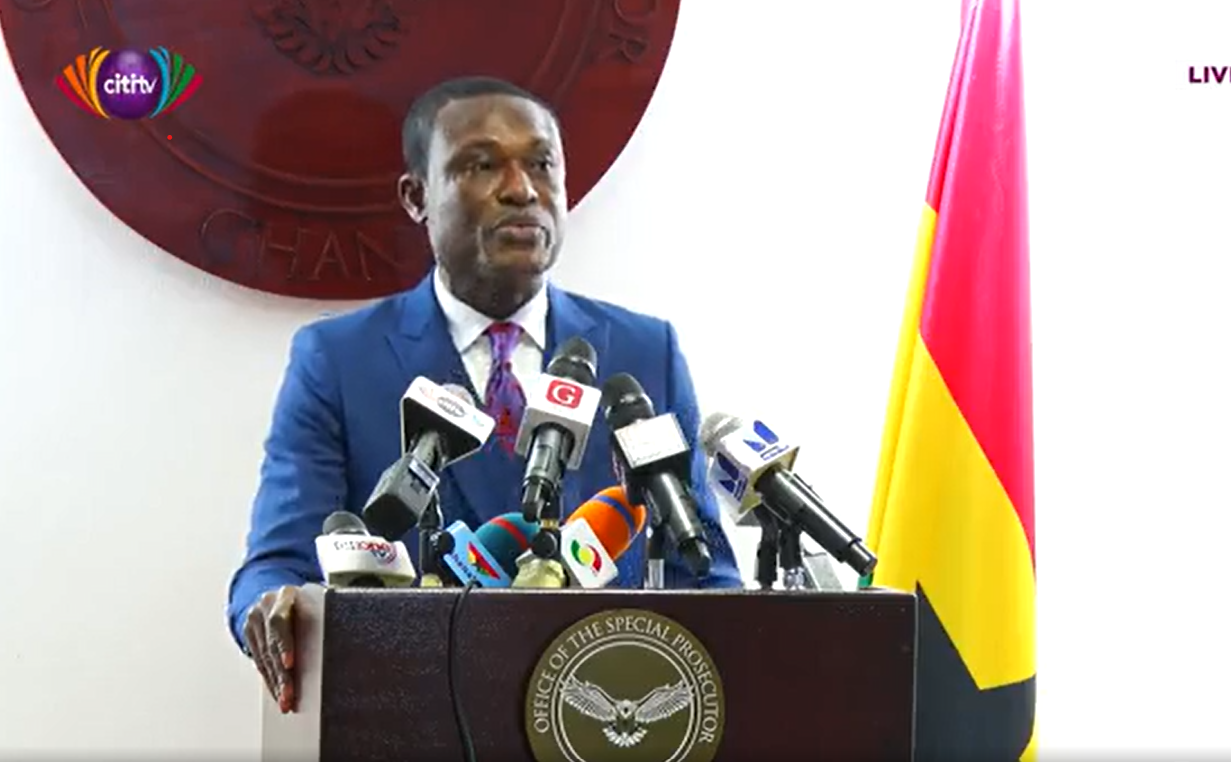
    The Office of the Special Prosecutor (OSP) on Tuesday, February 24, announced in a formal statement that the consignment in question was destined for Burkina Faso and was transiting through Ghana. However, it failed to reach its intended destination and was instead offloaded in Ghana without the payment of the appropriate taxes and applicable duties.

    Consequently, the OSP disclosed that Ghana has lost an estimated GHS 10.5 million in taxes as a result of the diversion.

    “The Office of the Special Prosecutor (OSP) is investigating suspected corruption involving the diversion of fifty (50) twenty-foot containers of palm oil valued at GHS 25.8 million…. The Office has identified the involvement of some Customs officers, National Security operatives, and clearing agents in a corrupt scheme. The consignment, declared as in transit to Burkina Faso, was unlawfully diverted into the local market without payment of applicable duties and taxes,” the statement noted.

    The disclosure comes after the Deputy Minister for Finance, Thomas Nyarko Ampem, accused some customs officers within the Customs Division of the Ghana Revenue Authority (GRA) of collaborating with importers to deliberately undervalue goods by paying lower taxes or import duties. These individuals, he added, reduce insurance costs, which results in significant revenue losses to the state.

    His comments come after the interception of 18 articulated trucks at the Akanu and Aflao border posts on February 18. The trucks, declared in transit to Niger, were found carrying assorted goods, including cooking oil, spaghetti, and tomato paste, and were suspected to be part of a broader transit diversion scheme.

    According to authorities, the trucks were stopped following a suspected irregularity and the absence of a customs human escort, which is considered a major violation of transit regulations.

    Under the Customs Act, 2015 (Act 891) and GRA guidelines, goods declared as “in transit,” passing through Ghana to another country such as Niger, must follow transit rules, which include mandatory escort to prevent diversion of goods to designated countries to avoid import duties, thereby causing huge losses to the state.

    Preliminary investigations indicated that the consignments could have led to potential revenue losses of GH¢85.3 million, with an immediate revenue exposure estimated at GH¢2.62 million.

    Post-interception examinations in the recent case uncovered material discrepancies in declared unit values, tariff classifications, and weights, which revised the suspended revenue exposure from approximately GH¢2.6 million to over GH¢85 million.

    Speaking on Citi FM’s Citi Breakfast Show, Mr Nyarko Ampem said concerns about customs officers aiding importers in manipulating declarations had persisted for some time. He revealed that officers had been monitoring the trucks before their interception.

    “I have seen a letter from one officer to the Aflao border, directing that the goods should not be allowed to enter. This indicates the matter had been under surveillance for a while,” he noted.
    While acknowledging that most customs officers perform their duties professionally, the Deputy Minister said a few “bad nuts” within the system are undermining efforts to protect state revenue.

    “There are some bad nuts in customs who are aiding importers to defraud the nation through practices such as undervaluation and diversion of goods. When diligent officers realised what was happening, they acted,” he stated.

    Due to the recent bust, Ghana will no longer transit cooking oils through its borders, as the Finance Minister has announced a sweeping ban on such consignments following the interception of 18 articulated trucks declared for transit to Niger but suspected to be part of a broader transit diversion scheme.

    The Finance Minister, Cassiel Ato Forson, announced the ban in a formal statement on Friday, February 21. According to the new directive, all such consignments must henceforth be routed exclusively through the country’s seaports.

    The statement indicated that cooking oil shipments destined for landlocked countries that transit via Ghana will no longer be permitted to move through land border collection points; they must be processed exclusively through Ghana’s seaports, where stricter valuation systems, electronic tracking, scanning infrastructure, and layered customs controls are in place.

    Aside from the border ban, the Finance Minister charged the Ghana Revenue Authority (GRA) to implement enhanced monitoring and strict enforcement of compliance for all transactions originating from land collection points, including intensified cargo tracking, reinforced escort protocols, and tighter supervisory oversight.

    In a suspected case of customs complicity, Dr Ato Forson ordered a crackdown on customs officers, importers, and clearing agents implicated in diversion schemes, warning that officers found culpable would face strict sanctions and that heightened monitoring systems at seaports would be strengthened to prevent future diversions.

    The Minister also ordered the prompt commencement of disciplinary proceedings against any Customs officers found culpable in similar breaches. Criminal investigations are to extend to importers and clearing agents where evidence supports prosecution.

    Officials said the measures are designed not only to protect state revenue but also to safeguard local edible oil producers from unfair competition arising from diverted transit goods.

    The government reaffirmed its resolve to apply the full rigour of the law, including confiscation and auction of impounded goods where applicable, and to ensure that Ghana’s customs regime is not exploited to undermine domestic revenue mobilisation and national development.

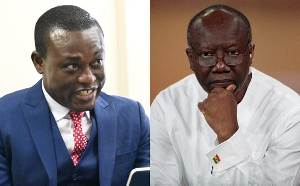
  • US judge denies bail request for Ofori-Atta over extradition request from Ghana

    US judge denies bail request for Ofori-Atta over extradition request from Ghana

    The US judge who presided over the immigration hearing of Ghana’s former Finance Minister has declined his bail application, citing an extradition request from Ghanaian authorities.

    Mr Ofori-Atta was tried yesterday, Tuesday, January 20, in a private hearing following a request for privacy by his lawyers.

    He has remained in detention since his arrest on 6 January by the U.S. Immigration and Customs Enforcement (ICE).

    Consequently, his lawyers requested bail so that he could be released while his case is pending. However, this was rejected by the government lawyers over his extradition links, though the judge, David A. Gardey, didn’t make any final decision on the extradition but noted that no documents were shown in court to prove that an extradition request had actually been submitted.

    “The court cannot act on assertions without proof,” the judge indicated, directing the federal government to file any evidence of an extradition request on or before February 19, 2026.

    The case has been adjourned to Thursday, April 27, at 1 pm, when the tribunal is expected to hear both the bail application and any documents the government may submit. Until then, Mr Ofori-Atta will remain in ICE detention.

    His detention was first announced on January 7 by his Ghanaian legal representatives, Minkah-Premo, Osei-Bonsu, Bruce-Cathline & Partners (MPOBB), who said he had been taken into custody a day earlier over concerns about his immigration status.

    “The United States Immigration and Customs Enforcement (ICE), as of January 6, 2026, detained the former Minister for Finance, Mr Ken Ofori-Atta, regarding the status of his current stay in the United States,” the firm said in a public notice signed by Justice Kusi-Minkah Premo, Esq.

    According to the lawyers, Mr Ofori-Atta has a pending petition for adjustment of status, a legal process that allows individuals to remain in the US beyond the validity of their visa.

    “Under US law, a change of status by this method is common,” the statement added, stressing that the former minister is “a law-abiding person” and is fully cooperating with ICE.

    Official records from the US Department of Homeland Security indicate that Mr Ofori-Atta is currently being held at the Caroline Detention Facility in Bowling Green, Virginia.

    The development has attracted attention in Ghana, especially given Mr Ofori-Atta’s recent legal and medical history.

    On January 7, Ken Ofori-Atta’s lawyers, Menka-Premo, Osei-Bonsu, Bruce-Cathline and Partners issued a statement confirming their client’s arrest by US Immigration and Customs Enforcement (ICE) over his immigration status.

    While it was widely reported that he had been detained for overstaying his visa term, the Attorney General’s Department has clarified that his visa was revoked in June last year and he was given up to November 29 to leave the USA; however, he ignored the order, leading to his detention by ICE.

    “ICE will not come for you unless you have visa issues; that is what has happened. In June 2025, his visa was revoked; it’s not an expiration of the Visa. The information we have is that his visa was revoked. So he has been living in America without a visa,” he said on the KeyPoints on TV3 Saturday, January 10.

    According to reports, a US visa can be revoked if the holder becomes ineligible for it. This can happen if they violate their status, commit fraud, or otherwise fall under a ground of inadmissibility.

    Dr Srem-Sai also mentioned that Ghanaian authorities collaborated with the US law enforcement agencies on Ken’s arrest.

    “We are keenly involved in this matter. We collaborate with law enforcement agencies in this matter,” he said on the Key Points on TV3 Saturday, January 10.

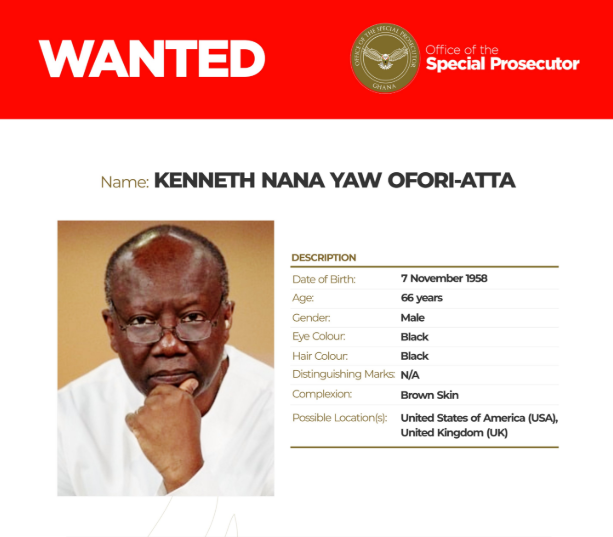
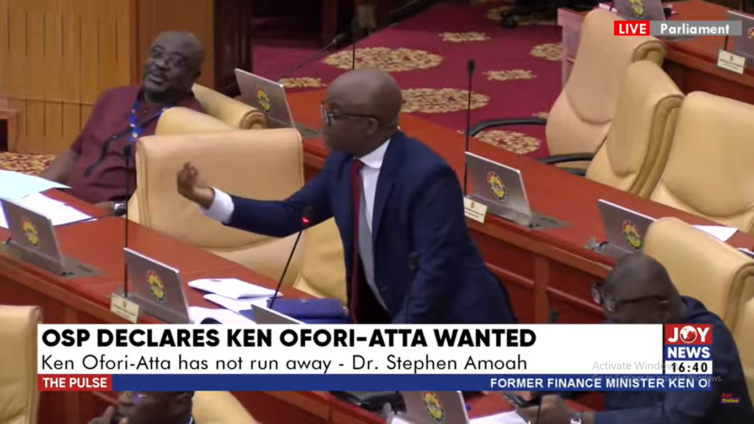
    Mr Ofori-Atta has been on Ghana’s wanted list for months now, and all efforts to bring him down to Ghana appear to have proven futile.

    Ofori-Atta continues to be a central figure in a legal battle, despite his current health condition. He appeared on Interpol’s website for “using public office for profit” after being declared wanted by the Office of the Special Prosecutor (OSP). This followed his failure to appear before the OSP on Monday, June 2.

    His lawyers are said to have formally communicated the development to the OSP and the Human Rights Court, submitting medical reports that detail his current condition and outline scheduled surgical procedures. The OSP, during an engagement with the press on Tuesday, June 3, noted the failure of the former minister to inform the OSP of changes in medical procedures that were to have happened in March of this year.

    “He has failed to show any medical report that shows he is a medical risk. We want him physically, and we insist on it,” the OSP said, while noting that Mr Ofori-Atta cannot indicate the mode of investigation. “His conduct is totally unacceptable. We will no longer tolerate him,” the OSP noted.

    Later, the legal representatives of the former finance minister informed the OSP that their client is currently undergoing medical treatment in the United States and is unable to honour an invitation for questioning. Ofori-Atta then assured the OSP of his commitment to appearing for questioning on a fixed date, which influenced the OSP’s decision to temporarily take his name off the wanted list in March.

    However, the office stressed that he is legally obligated to show up on June 2. Failure to do so would result in an Interpol Red Notice being issued and extradition proceedings being initiated in any country where he may be located.

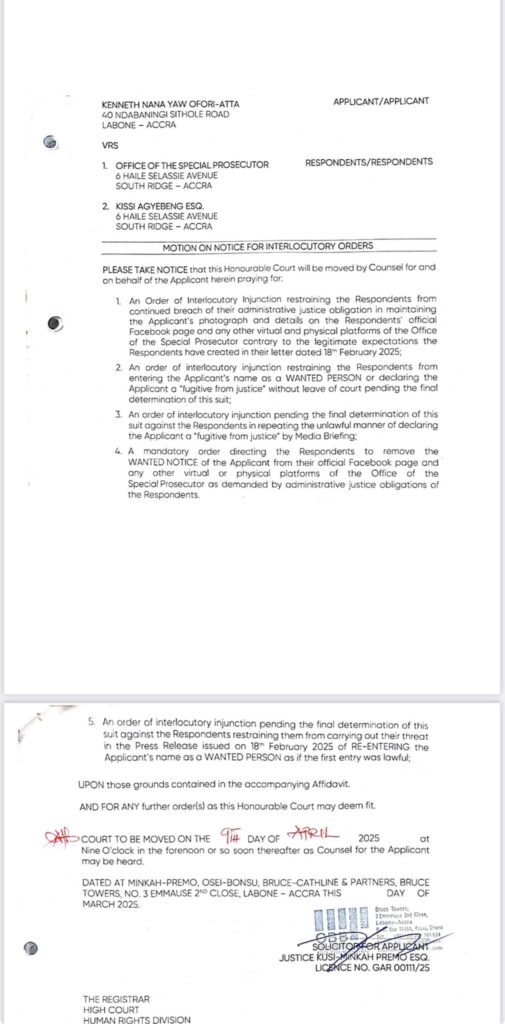
    Ken Ofori-Atta then took legal steps to block the OSP from re-declaring him wanted. His lawsuit argues that the agency’s actions are baseless and unjustified. Ofori-Atta has dismissed allegations of financial misconduct and corruption, insisting that he has been cooperating with investigators through his legal representatives.

    In his court filing, he contends that the OSP’s actions have inflicted serious harm on his reputation and personal life. He is seeking a legal injunction to prevent further declarations against him until the case is fully resolved.

    The Human Rights Court adjourned to June 18 for a ruling on the motion filed by the former finance minister, seeking to restrain the OSP from declaring him wanted, among other reliefs. In February, the OSP declared Ofori-Atta wanted for causing financial loss to the state in several dealings.

    These dealings include contractual arrangements between Strategic Mobilisation Ghana Limited (SML) and the Ghana Revenue Authority, aimed at enhancing revenue assurance in the downstream petroleum sector, upstream petroleum production, and the minerals and metals resource value chain.

    They also include the termination of a distribution, loss reduction, and associated network improvement project contract between the Electricity Company of Ghana Limited and Beijing Xiao Chen Technology BXC. Other issues involve the procurement of contractors, materials, and activities, as well as payments related to the National Cathedral project.

    Additionally, activities and payments connected to a contract awarded by the Ministry of Health-initially commenced by the Ministry for Special Development Initiative -to service Ghana Auto Group Limited for the purchase, after-sales service, and maintenance of 307 Mercedes-Benz Sprinter 304 5 CDI ambulances for the National Ambulance Service are included.

    Finally, payments from and utilisation of the tax refund account of the Ghana Revenue Authority were also cited.

  • Extradition of accused Ghanaians in U.S may take time – U.S Embassy says as OSP ‘sweats’ to bring Ofori-Atta for trial

    Extradition of accused Ghanaians in U.S may take time – U.S Embassy says as OSP ‘sweats’ to bring Ofori-Atta for trial

    The long-awaited trial of Ghana’s former Finance Minister Ofori-Atta began on Thursday, December 11; however, it was done in absentia, sparking several questions about the US’s extradition process. It’s been 11 months since the Office of the Special Prosecutor (OSP) put him on its wanted list with a 78-count indictment alleging corruption and financial loss to the state.

    Reacting to these concerns, Chargé d’Affaires at the U.S. Embassy in Accra, Rolf Olson, during a media roundtable conversation with visiting Deputy Assistant Secretary for West Africa in the U.S. Department of State’s Bureau of African Affairs, William B. Stevens, on Friday, December 12, 2025, at the U.S. Embassy in Accra, emphasised that, the US government is always open to extradition requests from Ghana however, because the process is structured, and judicially driven, it usually takes time to complete.

    “We are always open to receiving extradition requests. That is an important part of any good bilateral relationship, and certainly of ours. The process of evaluating an extradition request on the American side is very well established, but it is not generally very quick. Once we receive a request, it goes through the various mechanisms we have in place,” he said.

    Meanwhile, during the trial at the Criminal Court 5 in Accra, the OSP told the courts that while Mr Ofori-Atta is currently outside Ghana and has cited health reasons for his absence, it has applied appropriate legal mechanisms, including summons and cooperation with international law enforcement where applicable, to ensure appearances as required by law.

    As of Monday, December 8, 2025, more than 3,100 people had signed a public petition addressed to the US Embassy in Accra demanding the extradition of former Finance Minister Ken Ofori-Atta.

    US-based Ghanaian Professor Stephen Kwaku Asare, also known as Kwaku Azar, started the petition on December 2, asking American authorities to work with the Ghanaian government to help extradite Mr Ofori-Atta, who has been officially charged with economic crimes and corruption-related offences.

    It requests that the Embassy help confirm Mr Ofori-Atta’s location, encourage cooperation between Ghanaian and US authorities, and speed up the processing of any official extradition request.

    However, commenting on whether or not the American government was willing to cooperate with local authorities to trigger any process in the US, Rolf Olson explained that processes for evaluating an extradition request on the American side are “very well-established and it is generally not very quick.”

    He added that if the US receives a request, it goes through the various mechanisms. “But the door is always open to requests. There is no individual case that can be prejudged because US judges make the decisions, so they can approve or disapprove a request.”

    Mr Rolf Olson revealed that, since President Mahama took office this year, the US government has extradited nine Ghanaians, with the majority of the cases linked to romance scams or what is recently described as “elder crime”.

    “Since President Mahama took office at the beginning of the year, Ghana has extradited nine individuals to the United States. Most of them have been involved in cybercrime, or what is commonly referred to as elder crime. These individuals can victimise anyone, and perhaps they already have, though that remains to be established. If proven in court, they are the kind of people who should be in prison, not free to take advantage of others, particularly older persons.

    Although anyone could fall victim to such crimes, the idea of being targeted in this way is understandably horrifying,” he stressed.

    Meanwhile, before Ofori Atta’s trial, the OSP announced on Monday, November 24, that it had postponed it to a later date.

    Although the OSP did not provide a reason for the adjournment, it indicated on the X platform on Monday that the new date would be made public.

    According to the OSP, “CR/0106/2026 Kenneth Nana Yaw Ofori-Atta & 7 Ors. This case has been adjourned as the Court would not sit on the originally scheduled date of 24 November 2025. A new date would be communicated to the Republic and the Accused Persons”.

    Although the OSP did not provide a reason for the recent adjournment, it indicated on the X platform on Monday that the new date will be made public.

    The Office of the Special Prosecutor (OSP) has emphasised that the Red Notice issued by the INTERPOL Commission for former Finance Minister Ken Ofori-Atta remains in force.

    According to the OSP, the former Finance Minister wrote to the INTERPOL Commission requesting the removal of the Red Notice placed on him. This information was disclosed by the OSP in a public notice issued on Wednesday, November 19.

    Parts of the notice read, “notified Ghanaian authorities that accused Kenneth Nana Yaw Ofori-Atta had applied for from INTERPOL’s Red Notice.” The statement added that the OSP further gave a response to the INTERPOL commission on 22 October 2025.

    The OSP’s clarification comes after some media reports claimed that INTERPOL had removed the Red Notice from its website, adding that “the proceedings are still pending and the Commission for the Control of INTERPOL’s Files is still studying the case.”

    Ofori-Atta appeared on Interpol’s website for “using public office for profit” after being declared wanted by the OSP in June. This was after he failed to appear before the Office of Special Prosecutor (OSP) on Monday, June 2.

    His lawyers are said to have formally communicated the development to the OSP and the Human Rights Court, submitting medical reports that detail his current condition and outline scheduled surgical procedures.

    The OSP, during an engagement with the press on Tuesday, June 3, noted the failure of the former minister to inform the OSP of changes in medical procedure that were to have happened in March of this year.

    “He has failed to show any medical report that shows he is a medical risk .We want him physically, and we insist on it,” the OSP said, while noting that Mr Ofori-Atta cannot indicate the mode of investigation. His conduct is totally unacceptable. We will no longer tolerate him,” the OSP added.

  • Analysis: After allocating over ₵1bn, parliament now turns on the OSP

    Analysis: After allocating over ₵1bn, parliament now turns on the OSP

    The Office of the Special Prosecutor has returned to the centre of national debate, this time over questions of effectiveness and recent controversy.

    Tensions rose after the arrest of lawyer Martin Kpebu for what the office described as “obstructing an officer in the lawful execution of their duties”.

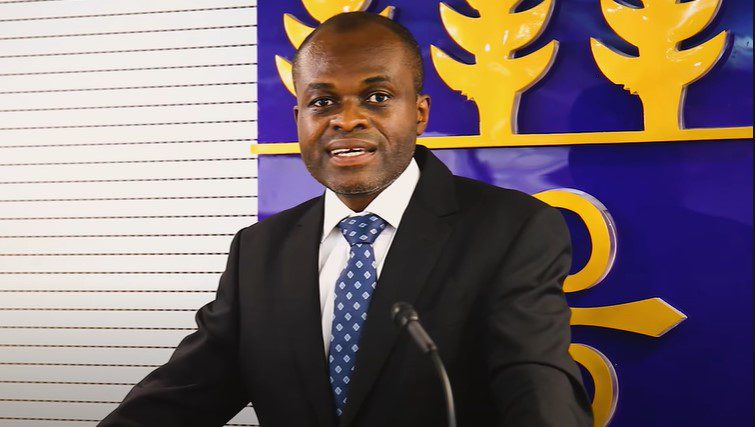
    Mr. Kpebu has in recent weeks criticised the Special Prosecutor, Kissi Agyabeng, for failing to prevent former Finance Minister Ken Ofori Atta from leaving the country. He now argues that the difficulty in securing Mr Ofori Atta’s extradition is grounds for the removal of Mr Agyabeng.

    Given his vocal position, the arrest has generated suspicion about the motives of the Office.

    These concerns quickly reached parliament. Both the Speaker and the Majority Leader questioned the effectiveness of the Special Prosecutor and the relevance of the institution to the fight against corruption.

    What began as an effort to replace the Special Prosecutor, with 3 petitions already before the Chief Justice and an additional petition reportedly being prepared by Mr Kpebu, has widened into what appears to be a bipartisan call to consider scrapping the office entirely.

    The OSP was created in 2018 as Ghana’s focal institution for corruption and corruption related offences. It draws its prosecutorial powers from the Attorney General, which allows the office to prosecute independently.

    The rationale was simple. A specialised institution insulated from political influence, led by a Special Prosecutor with a 7 year nonrenewable tenure, would be better positioned to investigate corruption across successive administrations.

    The fixed tenure was meant to guarantee continuity and limit political pressure during transitions.

    Parliament now argues that the substantial resources allocated to the office have yielded little in return.

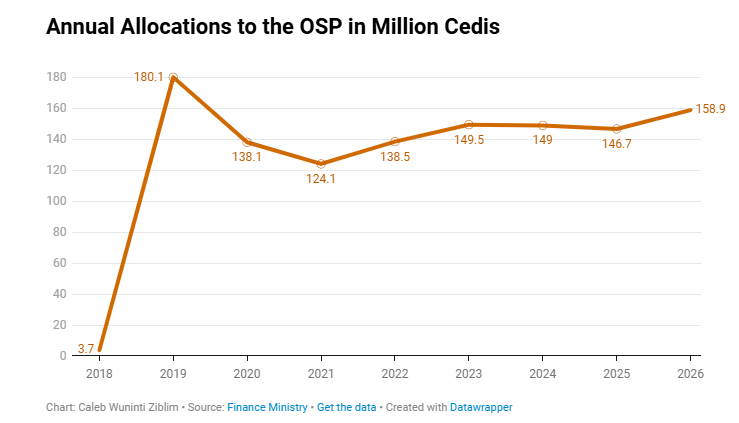
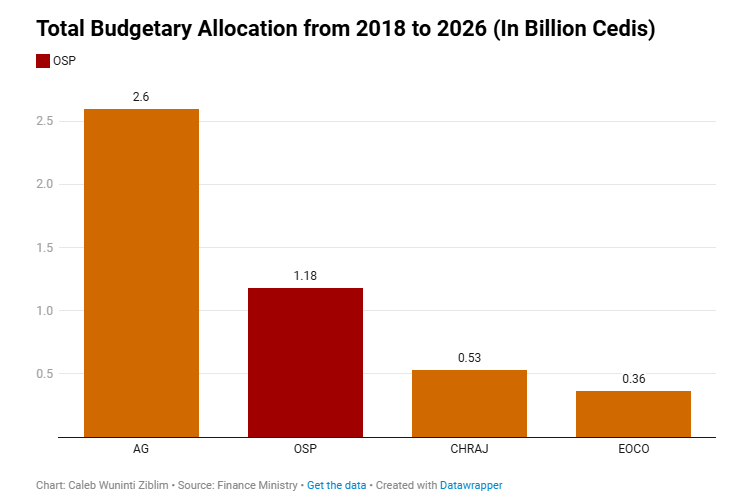
    From 2018 to the end of 2026, the OSP will have been allocated more than ₵1.18 billion.

    For 2026, the office requested ₵310 million but was allocated ₵158 million.

    In comparison, the Economic and Organised Crime Office (EOCO) has received a little over ₵300 million between 2018 and 2026 and CHRAJ has received ₵529 million over the same period.

    The Attorney General’s office has received about ₵2.6 billion, although that amount covers a range of agencies including legal education, the Registrar of Companies, the Law Administration Department and EOCO.

    Budget allocations tell only part of the story.

    In practice, the OSP struggled to receive its approved funds. Between 2018 and 2023, the office received less than half of what parliament allocated.

    Even when funds were released, operational challenges prevented their effective use. The OSP lacked permanent accommodation, had incomplete staffing and could not undertake procurement because it did not have the required Entity Tender Committee.

    These start up constraints significantly limited the institution’s early performance.

    Conditions improved in 2024 when the OSP received 95% of its allocated ₵149 million. The office has since argued that a larger allocation is needed for effective operations.

    Parliament’s committee on legal affairs agreed with this assessment, although fiscal pressures prevented approval of the full amount.

    In 2025, the OSP secured its first convictions. There are now 7 in total, although 6 arise from a single payroll fraud case.

    The seventh relates to the trial involving Charles Bissue, former secretary of the Inter Ministerial Committee on Illegal Mining. One of the accused persons in that case secured a plea bargain and is reportedly cooperating with prosecutors in the continuing proceedings against Mr Bissue.


    These outcomes have not met public expectations. When the OSP was created, many Ghanaians anticipated high profile convictions.

    Several such cases are now at different stages in the OSP’s pipeline. These include matters involving former Finance Minister Ken Ofori Atta, the controversial GRA and SML contract linked to former Commissioner Ammishaddai Owusu Amoah and the former NPA Chief Executive Dr Mustapha Abdul Hamid.

    Until such cases reach clear outcomes, criticism of the office will continue.

    Whether the OSP survives the current pressure will depend on parliament’s next steps, especially given the ruling NDC’s super majority and a Majority Leader who has stated his position openly.

    The institution was created to strengthen the fight against corruption. It now faces the prospect of abolition before having the opportunity to demonstrate what it can achieve when fully resourced and fully operational.

    Author: Caleb Wuninti Ziblim, JoyNews Research | caleb.ziblim@myjoyonline.com

    DISCLAIMER: Independentghana.com will not be liable for any inaccuracies contained in this article. The views expressed in the article are solely those of the author, and do not reflect those of The Independent Ghana

  • Martin Kpebu suspects OSP’s actions partisan to make NDC govt unpopular

    Martin Kpebu suspects OSP’s actions partisan to make NDC govt unpopular

    Private legal practitioner, Martin Kpebu believes that, the OSP’s actions are politically inspired since he was appointed by the erstwhile Akufo-Addo led administration.

    Following his release from custody on Wednesday, December 3 he suggested that, the recent actions and controversies surounding the Special Prosecutor, Kissi Agyebeng may be part of a ploy by the anti-corruption institution to mar the reputation of the incumbent National Democrartic Congress (NDC) government.

    The Office of the Special Prosecutor (OSP) invited Kpebu to its office to provide evidence of some corruption allegations he had made against the anti-corruption office. And according to him, his invitation over his speech cannot be interpreted as a ploy by the NDC government to stifle free speech hence he believes that, Agyebeng’s actions are politically motivated.

    “Kissi Agyebeng is an Akufo-Addo appointee, so you can’t say government is criminalizing free speech. Maybe all these arrests are to make the NDC government unpopular because NPP appointees can do it to spite government,” he said on Asempa FM’s Ekosii Sen show.

    Kpebu had a fracas with security personnel at the OSP’s premise which later caused his arrest. He was detained for nearly five hours, transferred to the National Intelligence Bureau (NIB), and later released on bail , with conditions requiring landed property and one surety.

    Speaking to the media, Mr. Kpebu described his arrest as extremely risky and life-threatening. According to him, the OSP deliberately arrested him without any legitimate cause, as he did not do anything to warrant his arrest.

    “I didn’t do anything that deserves an arrest, so somehow it was like a dream, like a fairytale, so my spirits were still up. What they have actually done is that this is a suicide mission that Kissi Agyebeng’s OSP has embarked on. He can pretend he has nothing to do with it, but he is the head,” Kpebu stated.

    Mr. Kpebu suggests that he was verbally assaulted by a soldier, who called him stupid and he was also mistreated at the OSP’s premises by security. In giving the main reason behind his invitation and all events surrounding his arrest, the OSP noted that Mr. Kpebu insulted officers and called Kissi Agyebeng “a nobody who will be removed soon”.

    The OSP indicated that “This is not the first, or even the second, time Mr. Kpebu has acted improperly toward OSP security personnel in the discharge of their lawful duties. After each incident, he publicly presents a completely different version of events”.

    Find below OSP’s full text:

    A pattern of misconduct

    This is not the first—or even the second—time Mr. Kpebu has acted improperly toward OSP security personnel in the discharge of their lawful duties. After each incident, he publicly presents a completely different version of events.

    Having monitored his conduct for some time, it became clear that unless his interactions were recorded, he would misrepresent the facts.

    A notable example is his false claim that there were 16 petitions calling for the removal of the Special Prosecutor. When confronted by KSM on his show, he admitted that he merely repeated what he heard someone say on Newsfile, without verifying it. It is concerning that a lawyer would make such a statement without checking the facts.

    The Investigation is separate from his allegations

    The confrontation at the OSP has nothing to do with the ongoing inquiry into the unsubstantiated allegations he made against the SP and the Office. He continues to claim that he is “gathering evidence” and will eventually present it to an OSP Board—despite knowing there is currently no board in place.

    This behaviour follows a familiar pattern: he refuses to cooperate, demands that certain officers be removed from the panel, gets his wish, and then introduces a new obstacle. Fortunately, the investigators have continued their work professionally despite his lack of cooperation and abusive conduct.

    Misleading the public about investigators

    Mr. Kpebu repeatedly misleads the public by claiming that those handling the case are “junior staff,” when in reality their ranks are equivalent to Deputy Commissioners of Police.

    He also falsely claims that “the OSP is investigating itself,” which shows either a misunderstanding or deliberate misrepresentation of institutional processes.

    Fact-finding committees exist to establish facts—not to pronounce guilt or innocence. Police misconduct is not investigated by fire service officers; GRA misconduct is not investigated by immigration officers; and alleged misconduct in one university is not investigated by another. The principle is the same.

    What actually happened at the OSP premises

    Events at the GateUpon arriving, Mr. Kpebu parked his vehicle and stepped outside the gate to conduct an interview. He always does this, brings in media men to speak to them before entering and after exiting.Security personnel cautioned him to move away from the entrance, so he moved to the fried yam seller’s spot and continued speaking to the media.Afterwards, he entered the compound alone. The guards reminded him that photography and videography are not permitted around the premises.

    Escalation and ArrestHe reacted angrily to the reminder and insulted the guards. They issued a formal warning about his conduct, but he insisted he could act as he pleased and threatened to report them.He told them they are nobodies, even their boss, the head of the agency, is nobody and will be removed soon.His continued insults and obstructive behaviour led to his arrest for the offence of obstruction of officers in the performance of their duties.He was informed of his arrest on suspicion of obstruction, in accordance with the law. The arrest was executed without force, and there is no internal record of any assault or mistreatment.Bail, Processing, and Conduct of Counsel

    Bail Granted: Following the arrest, bail was granted according to standard administrative procedures. The conditions were explained to him and his counsel. However, one of the lawyers refused to leave the premises until Mr. Kpebu was brought back.She insulted officers and caused a scene, all of which was recorded. Despite her behaviour, officers removed her gently and without force. Their professionalism deserves commendation.

    Transfer to Holding AreaMr. Kpebu was transferred to a secured holding area as part of normal processing. Public concerns have been raised about the detention location, but internal records show that all transfers followed protocol. At no point was he denied access to counsel or due process.No Trap. Just AccountabilityFinally, the claim that the OSP “fell into a trap” is unfounded. The Office has not fallen for any trap. It has simply applied the law to protect its personnel and maintain order on its premises.The message is clear: connections, public influence, or media prominence do not place anyone above the law. If this was intended as a trap, then the OSP passed—because it acted strictly within legal and procedural bounds.Such unruly behaviour would result in an immediate arrest at any law enforcement facility. Could he attempt this at the Police Headquarters or the NIB Headquarters?Mr. Kpebu is expected to report this morning at 11am after bail was granted last night for further investigations of the offence of obstruction of justice.A different date will be announced for continuation of enquiry into his allegation of corruption.

  • OSP vs Manasseh: Sammy Darko provides clarity

    OSP vs Manasseh: Sammy Darko provides clarity

    Manasseh, the investigative journalist, has been an interesting figure for some time. His new claim—that the OSP has taken credit for his work and that he must therefore “fight” the OSP—is quite surprising.

    To date, he has abandoned almost all his allegations except two:

    -That the OSP began the SML investigation on 29 January; and

    -That because he was invited in February, the investigation must have started in February.

    To support this, he displays what he describes as a “Diary of Action” from one team, arguing that since he was contacted in February, that must mark the beginning of the investigation. The assumption that he is somehow the centre of, or alter ego of, the SML investigation is unusual. The investigation did not revolve around him. Once he submitted a petition based on his journalistic work, the matter became that of the Republic. Those with the mandate to conduct criminal investigations took over. He was invited as a person of interest when necessary—not as the focus of the entire inquiry.

    Second, Mr. Ken Ofori-Atta was directed to appear before the OSP on 24 January 2025. This alone indicates that substantial investigative work had already been done before any invitations were issued. Establishing probable cause requires groundwork. As if that were not enough, he further argues that because the OSP identified Mr. Ernest Akore later, the investigation must have begun only in February. He should rather appreciate that through thorough investigative work, the OSP uncovered Mr. Akore’s role, identified him as a suspect, and he is now an accused person. Both Mr. Ofori-Atta and Mr. Akore are subjects of an extradition request.

    Third, what makes his claim even more puzzling is that as early as January 2024, a news portal he once edited—and under his own hand—reported that the OSP had begun the SML investigation. The same individual now insists the OSP did not start early, preferring instead to rely on a single team’s diary of action, while he has no knowledge of how many teams worked on SML, how many experts were consulted, or the volume of engagements undertaken before concluding that the suspects had a case to answer. If he wishes to give accused persons an advantage, that is his choice—but a whole prosecutorial body will not humour him. The OSP will present its evidence before the court, not before media houses that continue to amplify his claims.

    He also appears to suggest that the OSP should arrest before investigating. The Office has long moved away from that outdated approach and does not conduct “pen-and-paper” or arrest-first investigations.

    What, then, is the complaint? First, he said the work was delayed—but the investigation has been completed. He said prosecution was delayed—but prosecution is now underway. Now that the Republic is focused on the trial, he joins a coordinated effort to create the impression that the investigation started late, at a time when we are prosecuting eight high-profile individuals who possess significant resources to challenge the Republic. Ken and his colleagues must be delighted with the narrative he is pushing.

    Whether the investigation began early or late, the facts remain simple: it has been completed; people are standing trial; contracts have been cancelled; and significant public funds have been saved—US$173 million in oil revenue, US$2.6 billion in gold revenue. Furthermore, based on the actions of the eight individuals involved, the Republic was at risk of losing US$2.7 billion over five years. One wonders whether his discomfort stems from the exposure of the magnitude of the potential losses.

    Finally, the recognition he seeks was already given when the OSP published the investigative report. Allow the Republic to prosecute its case with its witnesses. If you cannot assist the process, refrain from distorting it—unless the intention is to undermine the trial rather than support accountability.

    And by the way, he now wants credit given to former President Nana Akufo-Addo for cancelling the contract. That is simply inaccurate. In December 2024, Nana Akufo-Addo, through his lawyers, authorised the GRA to allow SML to continue upstream operations. It is the cancellation by President Mahama that terminated the contract. That is why SML is currently appealing to the new administration to reconsider.

    I hope these clarifications help.

    By:

    Sammy Darko

    Director of the Strategy, Research, and Communication Division at the Office of the Special Prosecutor

    DISCLAIMER: Independentghana.com will not be liable for any inaccuracies contained in this article. The views expressed in the article are solely those of the author’s, and do not reflect those of The Independent Ghana

  • OSP takes formal legal action against Ofori-Atta, SML, and six others

    OSP takes formal legal action against Ofori-Atta, SML, and six others

    The Special Prosecutor has officially filed charges against former Finance Minister Ken Ofori-Atta, SML, and six others, signaling a major step in the corruption case.

    This move comes after President John Mahama directed that all SML-linked contracts be cancelled on October 31.

    His directive followed the OSP’s announcement that it had completed its investigation into the deals, which had generated widespread public concern.

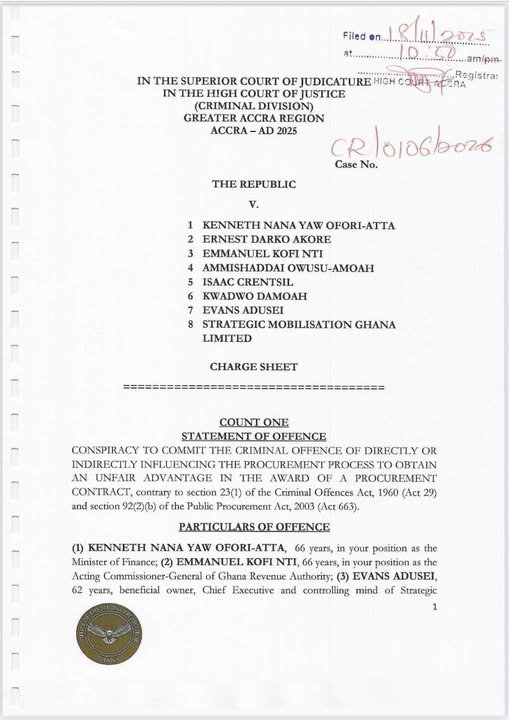
    However, according to a statement released by the Superior Court of Judicature, OSP formally charges Ofori-Atta, SML and the six others have been charged for “conspiracy to commit the criminal offence of directly or indirectly influencing the procurement process to obtain an unfair advantage in the award of a procurement contract, contrary to section 23(1) of the Criminal Offences Act, 1960 (Act 29) and section 92(2)(b) of the Public Procurement Act, 2003 (Act 663).”

    “Kenneth Nana Yaw Ofori-Atta, 66 years, in your position as the Minister of Finance. Emmanuel Kofi Nti, 66 years, in your position as Acting Commissioner-General of Ghana Revenue Authority. Evans Adusei, 62 years, beneficial owner, Chief Executive and controlling mind of Strategic Mobilisation Ghana Limited.”

    Weeks ago, The Special Prosecutor, Kissi Agyepong, has concluded that there was “no genuine need” for the controversial revenue assurance contract between the Ghana Revenue Authority (GRA) and SML (Strategic Mobilisation Ghana Limited).

    In a highly detailed press briefing following a comprehensive investigation, the OSP mentioned critical findings that exposed systemic breaches of public financial regulations and a clear misuse of authority that caused the state to lose money.

    “There was no genuine need for contracting SML for the obligations it’s purported to perform,” the Special Prosecutor declared.

     Mr Agyebeng has solidified the case against the contentious Strategic Mobilisation Ghana Limited (SML) contract, alleging that former Finance Minister Ken Ofori-Atta approved payments without any technical or operational justification.

    According to the OSP, Ofori-Atta failed to intervene even though SML openly lacked the necessary capacity, expertise, and tools to execute its contract. Instead, he allegedly remained complicit, approving payments from the Consolidated Fund, the Petroleum Revenue Account, and the Tax Refund Account.

    The OSP’s investigation concluded, “Had he not been personally benefiting from the SML’s unlawfully procured contracts, the openly displayed by SML of a lack of capacity’s expertise and tools would have immediately triggered his intervention to halt payments to SML and demand accountability. Instead, he looked on conspiratorially in silence, while endorsing and approving payments to SML from the Consolidated Fund, Petroleum Revenue Account, and Tax Refund Account with no technical or operational basis,” the OSP said during a press conference on Thursday, October 30.

    The OSP’s findings expose SML’s clear inability to perform the revenue assurance services it was contracted for, which included key responsibilities such as transaction audits and external price verification.

    According to the investigation, the continuous “troubleshooting displayed during this period was born of the unlawful imposition of SML in the space and the still lingering reality of SML’s lack of capacity to carry out transaction audits and external price verification.”

    Even after 15 months of engagement, SML reportedly “had no system in place to receive CCVRs” (customs control and valuation records), the essential data needed to execute its tasks. Additionally, the existing data provider, West Blue, was under “no legal obligation to release the vital data” to SML.

    As a result, the assigned work remained uncompleted, yet the company “continued to be paid,” reinforcing the OSP’s conclusion that the situation led to a financial loss to the state.

    It is important to note that former Finance Minister Ken Ofori-Atta has been declared wanted by the OSP for causing financial loss to the state in several dealings, including the contractual arrangement between Strategic Mobilisation Ghana Limited and the Ghana Revenue Authority for the stated objective of enhancing revenue assurance in the downstream petroleum sector, upstream petroleum production, and minerals and metals resource value chain.

    The activities of SML came to light years ago after Manasseh Azure Awuni raised contractual breaches in a deal involving the Ghana Revenue Authority (GRA) and Strategic Mobilisation Limited (SML).

    The original purpose of the GRA-SML contract was to boost revenue assurance in vital sectors of Ghana’s economy, including the downstream petroleum sector, upstream petroleum production, and the minerals and metals value chain. The goal was to streamline revenue collection, ensuring greater transparency and efficiency in these high-revenue sectors.

    Following concerns, an in-depth audit was carried out by international firm KPMG, commissioned by former President Nana Addo Dankwa Akufo-Addo. The audit was launched to examine the contractual agreements between the Ghana Revenue Authority (GRA) and SML, with a particular focus on the procedures and approvals related to the contract.

    The KPMG audit uncovered significant procedural errors and regulatory violations in awarding the contract. Specifically, the GRA did not obtain the required approvals from the Public Procurement Authority (PPA) and failed to seek parliamentary oversight before finalising the agreement with SML.

    The Ghana Revenue Authority (GRA) entered into six service agreements with Strategic Mobilisation Ghana Limited (SML) using the single-source procurement method without obtaining approval from the Public Procurement Authority (PPA).

    The first agreement, covering Transaction Audit Services, was signed on June 1, 2018. This was followed by a Contract Extension on January 1, 2019. On April 1, 2019, the GRA entered into another agreement with SML for External Price Verification Services. Subsequently, on October 3, 2019, the two parties signed a Consolidation Services Agreement, which combined the Transaction Audit and External Verification Services.

    That same day, a separate agreement was also signed for the Measurement Audit of Downstream Petroleum Products. Later, on July 29, 2020, an Addendum to the Measurement Audit for Downstream Petroleum Products Agreement was executed.

    The audit report also revealed that SML owes the government over GHC31 million in taxes.

    During the period from September 1, 2020, to April 30, 2021, a bulk payment to SML covering invoices for eight months did not have VAT and WHT deductions, amounting to GHC13.38 million. This contradicts GRA’s standard practice of deducting such taxes for payments to SML between June 1, 2020, and August 31, 2023.

    Additionally, SML failed to fulfil its statutory obligations by neither filing returns nor remitting these taxes to the GRA. Pursuant to Section 71(1) of the RA Act, the accrued interest on the tax liability is estimated at GHC18.50 million owed by SML to the GRA as of January 31, 2024. Consequently, the total liability incurred by SML amounts to GHC31.88 million.

  • GRA boss and top officials to appear before OSP over SML scandal

    GRA boss and top officials to appear before OSP over SML scandal

    The Commissioner-General of the Ghana Revenue Authority (GRA), Anthony Sarpong, together with other top officials, have been summoned by the Office of the Special Prosecutor (OSP) for questioning over the controversial GRA–Strategic Mobilisation Ghana Limited (SML) revenue assurance contract.

     The other GRA officials include  the Assistant Commissioner in charge of Finance, Celestine Annan; and the Technical Assistant to theCommissioner-General, Kenneth Agyei-Duah. Their invitation follows the recent arrest of the Acting Head of Legal Affairs at the GRA,  Freeman Sarbah for his alleged involvement in the controversial deal as well as trying to interfere with justice. 

    The Strategic Mobilization Limited has been operating in Ghana for the past five years to check revenue in the oil (upstream) and mining (mineral) sectors.  In 2024, the revenue arm of the government discontinued two contract transactions (the Audit and External Verification Service Contract (AEVS) with SML, as well as halting portions of the contract agreement.

    The GRA also suspended the SML’s Upstream Petroleum and Minerals Revenue Audit until further notice. The suspension came after the then-President, Akufo-Addo received a report from KPMG against SML’s deals. Last week, President John Dramani Mahama ordered the  termination of the SML deal following a comprehensive investigation conducted by the Office of the Special Prosecutor, led by Mr Kissi Agyebeng. The President issued the termination through a letter to  the Finance Minister Dr Cassiel Ato Forson. 

    Following the investigations, the anti-corruption agency discovered procurement breaches and irregularities in contract awards, contractual overreach beyond SML’s original mandate, lack of value for money due to inflated costs and questionable service delivery, and legal concerns.

    The SML contracts included several components, thus a Transaction Audit and External Price Verification service agreement, a Measurement Audit for Downstream Petroleum Products contract, and later agreements for Upstream Petroleum and Minerals & Metals audit services.

    On 3 May 2024, GRA terminated two of those contracts (the Transaction Audit & External Price Verification) and suspended the Upstream Petroleum & Minerals Audit portion under the erstwhile government.

    In June this year, following the OSP’s findings, the Measurement Audit for Downstream Petroleum Products (the main SML contract) was completely terminated, saving Ghana over GHS 1.2 billion.

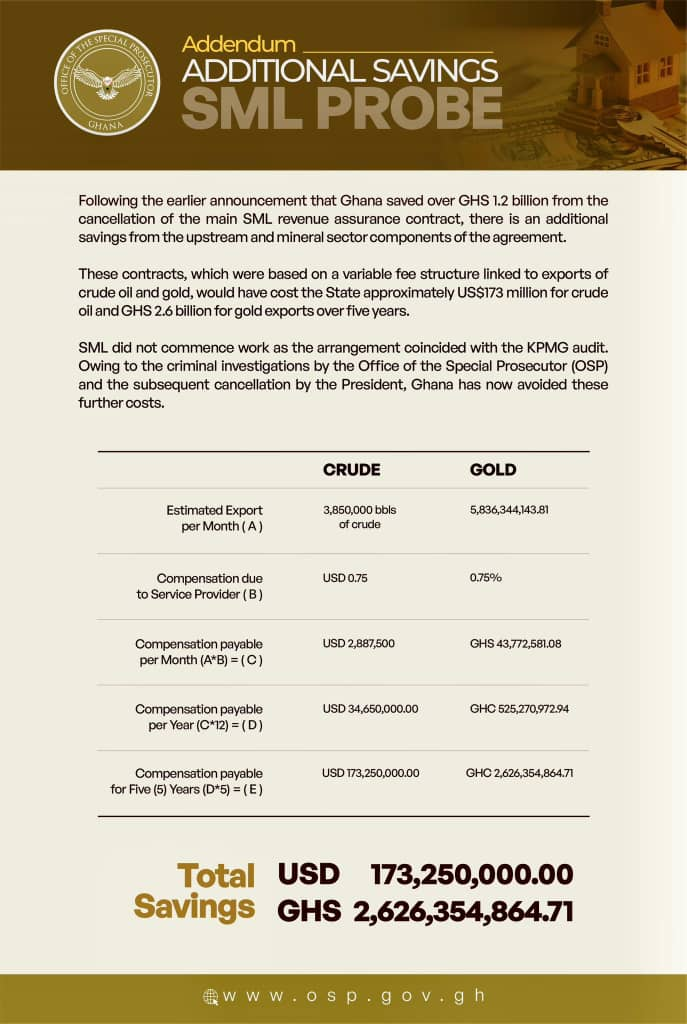
    In an addendum shared on its X (formerly Twitter) handle, the OSP noted that more has been saved in finances aside from the GHC 1.2billion. The OSP announced that Ghana has saved more than GHS 2.6 billion and US$173 million.

    The additional savings, it said, arose from avoiding payments tied to crude oil and gold export monitoring services that were never implemented.

    “Following the earlier announcement that Ghana saved over GHS 1.2 billion from the cancellation of the main SML revenue assurance contract, there an additional savings from the upstream and mineral sector components of the agreement. These contracts, which were based on a variable fee structure linked to exports of crude oil and gold, would have cost the State approximately US$173 million for crude oil and GHS 2.6 billion for gold exports over five years.

    SML did not commence work as the arrangement coincided with the KPMG audit. Owing to the criminal investigations by the Office of the Special Prosecutor (OSP) and the subsequent cancellation by the President, Ghana has now avoided these further costs,” the OSP noted in its statement.

    In a highly detailed press briefing following a comprehensive investigation, the OSP mentioned critical findings that exposed systemic breaches of public financial regulations and a clear misuse of authority that caused the state to lose money.

    “There was no genuine need for contracting SML for the obligations it’s purported to perform,” the Special Prosecutor declared.

    Mr Agyebeng has solidified the case against the contentious Strategic Mobilisation Ghana Limited (SML) contract, alleging that former Finance Minister Ken Ofori-Atta approved payments without any technical or operational justification.

    According to the OSP, Ofori-Atta failed to intervene even though SML openly lacked the necessary capacity, expertise, and tools to execute its contract. Instead, he allegedly remained complicit, approving payments from the Consolidated Fund, the Petroleum Revenue Account, and the Tax Refund Account.

    The OSP’s investigation concluded, “Had he not been personally benefiting from the SML’s unlawfully procured contracts, the openly displayed by SML of a lack of capacity’s expertise and tools would have immediately triggered his intervention to halt payments to SML and demand accountability. Instead, he looked on conspiratorially in silence, while endorsing and approving payments to SML from the Consolidated Fund, Petroleum Revenue Account, and Tax Refund Account with no technical or operational basis,” the OSP said during a press conference on Thursday, October 30.

    The OSP’s findings expose SML’s clear inability to perform the revenue assurance services it was contracted for, which included key responsibilities such as transaction audits and external price verification.

    According to the investigation, the continuous “troubleshooting displayed during this period was born of the unlawful imposition of SML in the space and the still lingering reality of SML’s lack of capacity to carry out transaction audits and external price verification.”

    Even after 15 months of engagement, SML reportedly “had no system in place to receive CCVRs” (customs control and valuation records), the essential data needed to execute its tasks. Additionally, the existing data provider, West Blue, was under “no legal obligation to release the vital data” to SML.

    As a result, the assigned work remained uncompleted, yet the company “continued to be paid,” reinforcing the OSP’s conclusion that the situation led to a financial loss to the state.

    It is important to note that former Finance Minister Ken Ofori-Atta has been declared wanted by the OSP for causing financial loss to the state in several dealings, including the contractual arrangement between Strategic Mobilisation Ghana Limited and the Ghana Revenue Authority for the stated objective of enhancing revenue assurance in the downstream petroleum sector, upstream petroleum production, and minerals and metals resource value chain.

    The activities of SML came to light years ago after Manasseh Azure Awuni raised contractual breaches in a deal involving the Ghana Revenue Authority (GRA) and Strategic Mobilisation Limited (SML).

    The original purpose of the GRA-SML contract was to boost revenue assurance in vital sectors of Ghana’s economy, including the downstream petroleum sector, upstream petroleum production, and the minerals and metals value chain. The goal was to streamline revenue collection, ensuring greater transparency and efficiency in these high-revenue sectors.

    Following concerns, an in-depth audit was carried out by international firm KPMG, commissioned by former President Nana Addo Dankwa Akufo-Addo. The audit was launched to examine the contractual agreements between the Ghana Revenue Authority (GRA) and SML, with a particular focus on the procedures and approvals related to the contract.

    The KPMG audit uncovered significant procedural errors and regulatory violations in awarding the contract. Specifically, the GRA did not obtain the required approvals from the Public Procurement Authority (PPA) and failed to seek parliamentary oversight before finalising the agreement with SML.

    The Ghana Revenue Authority (GRA) entered into six service agreements with Strategic Mobilisation Ghana Limited (SML) using the single-source procurement method without obtaining approval from the Public Procurement Authority (PPA).

    The first agreement, covering Transaction Audit Services, was signed on June 1, 2018. This was followed by a Contract Extension on January 1, 2019. On April 1, 2019, the GRA entered into another agreement with SML for External Price Verification Services. Subsequently, on October 3, 2019, the two parties signed a Consolidation Services Agreement, which combined the Transaction Audit and External Verification Services.

    That same day, a separate agreement was also signed for the Measurement Audit of Downstream Petroleum Products. Later, on July 29, 2020, an Addendum to the Measurement Audit for Downstream Petroleum Products Agreement was executed.

    The audit report also revealed that SML owes the government over GHC31 million in taxes.

  • Ghana saves additional GHS 2.6bn and US$173m after SML contract termination -OSP

    Ghana saves additional GHS 2.6bn and US$173m after SML contract termination -OSP

    President Mahama issued a termination directive of Strategic Mobilisation Ghana Limited (SML), a deal that was supposed to help check revenue in the oil (upstream) and mining (mineral) sectors, on October 31.

    The order was communicated through a letter signed by Dr Callistus Mahama, Secretary to the President, and addressed to Finance Minister Dr Cassiel Ato Forson, following a comprehensive investigation conducted by the Office of the Special Prosecutor (OSP), led by Mr Kissi Agyebeng.

    Following the investigations, the anti-corruption agency discovered procurement breaches and irregularities in contract awards, contractual overreach beyond SML’s original mandate, lack of value for money due to inflated costs and questionable service delivery, and legal concerns. 

    The SML contracts included several components, thus a Transaction Audit and External Price Verification service agreement, a Measurement Audit for Downstream Petroleum Products contract, and later agreements for Upstream Petroleum and Minerals & Metals audit services.  

    On 3 May 2024, GRA terminated two of those contracts (the Transaction Audit & External Price Verification) and suspended the Upstream Petroleum & Minerals Audit portion under the erstwhile government.

    In June this year, following the OSP’s findings, the Measurement Audit for Downstream Petroleum Products (the main SML contract) was completely terminated, saving Ghana over GHS 1.2 billion.

    In an addendum shared on its X (formerly Twitter) handle, the OSP noted that more has been saved in finances aside from the GHC 1.2billion. The OSP announced that Ghana has saved more than GHS 2.6 billion and US$173 million.

    The additional savings, it said, arose from avoiding payments tied to crude oil and gold export monitoring services that were never implemented.

    “Following the earlier announcement that Ghana saved over GHS 1.2 billion from the cancellation of the main SML revenue assurance contract, there an additional savings from the upstream and mineral sector components of the agreement. These contracts, which were based on a variable fee structure linked to exports of crude oil and gold, would have cost the State approximately US$173 million for crude oil and GHS 2.6 billion for gold exports over five years. 

    SML did not commence work as the arrangement coincided with the KPMG audit. Owing to the criminal investigations by the Office of the Special Prosecutor (OSP) and the subsequent cancellation by the President, Ghana has now avoided these further costs,” the OSP noted in its statement.

    In a highly detailed press briefing following a comprehensive investigation, the OSP mentioned critical findings that exposed systemic breaches of public financial regulations and a clear misuse of authority that caused the state to lose money.

    “There was no genuine need for contracting SML for the obligations it’s purported to perform,” the Special Prosecutor declared.

    Mr Agyebeng has solidified the case against the contentious Strategic Mobilisation Ghana Limited (SML) contract, alleging that former Finance Minister Ken Ofori-Atta approved payments without any technical or operational justification.

    According to the OSP, Ofori-Atta failed to intervene even though SML openly lacked the necessary capacity, expertise, and tools to execute its contract. Instead, he allegedly remained complicit, approving payments from the Consolidated Fund, the Petroleum Revenue Account, and the Tax Refund Account.

    The OSP’s investigation concluded, “Had he not been personally benefiting from the SML’s unlawfully procured contracts, the openly displayed by SML of a lack of capacity’s expertise and tools would have immediately triggered his intervention to halt payments to SML and demand accountability. Instead, he looked on conspiratorially in silence, while endorsing and approving payments to SML from the Consolidated Fund, Petroleum Revenue Account, and Tax Refund Account with no technical or operational basis,” the OSP said during a press conference on Thursday, October 30.

    The OSP’s findings expose SML’s clear inability to perform the revenue assurance services it was contracted for, which included key responsibilities such as transaction audits and external price verification.

    According to the investigation, the continuous “troubleshooting displayed during this period was born of the unlawful imposition of SML in the space and the still lingering reality of SML’s lack of capacity to carry out transaction audits and external price verification.”

    Even after 15 months of engagement, SML reportedly “had no system in place to receive CCVRs” (customs control and valuation records), the essential data needed to execute its tasks. Additionally, the existing data provider, West Blue, was under “no legal obligation to release the vital data” to SML.

    As a result, the assigned work remained uncompleted, yet the company “continued to be paid,” reinforcing the OSP’s conclusion that the situation led to a financial loss to the state.

    It is important to note that former Finance Minister Ken Ofori-Atta has been declared wanted by the OSP for causing financial loss to the state in several dealings, including the contractual arrangement between Strategic Mobilisation Ghana Limited and the Ghana Revenue Authority for the stated objective of enhancing revenue assurance in the downstream petroleum sector, upstream petroleum production, and minerals and metals resource value chain.

    The activities of SML came to light years ago after Manasseh Azure Awuni raised contractual breaches in a deal involving the Ghana Revenue Authority (GRA) and Strategic Mobilisation Limited (SML).

    The original purpose of the GRA-SML contract was to boost revenue assurance in vital sectors of Ghana’s economy, including the downstream petroleum sector, upstream petroleum production, and the minerals and metals value chain. The goal was to streamline revenue collection, ensuring greater transparency and efficiency in these high-revenue sectors.

    Following concerns, an in-depth audit was carried out by international firm KPMG, commissioned by former President Nana Addo Dankwa Akufo-Addo. The audit was launched to examine the contractual agreements between the Ghana Revenue Authority (GRA) and SML, with a particular focus on the procedures and approvals related to the contract.

    The KPMG audit uncovered significant procedural errors and regulatory violations in awarding the contract. Specifically, the GRA did not obtain the required approvals from the Public Procurement Authority (PPA) and failed to seek parliamentary oversight before finalising the agreement with SML.

    The Ghana Revenue Authority (GRA) entered into six service agreements with Strategic Mobilisation Ghana Limited (SML) using the single-source procurement method without obtaining approval from the Public Procurement Authority (PPA).

    The first agreement, covering Transaction Audit Services, was signed on June 1, 2018. This was followed by a Contract Extension on January 1, 2019. On April 1, 2019, the GRA entered into another agreement with SML for External Price Verification Services. Subsequently, on October 3, 2019, the two parties signed a Consolidation Services Agreement, which combined the Transaction Audit and External Verification Services.

    That same day, a separate agreement was also signed for the Measurement Audit of Downstream Petroleum Products. Later, on July 29, 2020, an Addendum to the Measurement Audit for Downstream Petroleum Products Agreement was executed.

    The audit report also revealed that SML owes the government over GHC31 million in taxes.

  • OSP releases fresh list of corruption cases; more expected in final quarter

    OSP releases fresh list of corruption cases; more expected in final quarter

    The Office of the Special Prosecutor (OSP) has announced a list of cases it is currently pursuing as the courts resume from vacation.

    In a post shared on its official Facebook page, the independent anti-corruption agency in Ghana noted that several individuals were currently facing charges, and more others will be prosecuted in the last quarter. 

    “With the courts resuming from vacation, these are the cases the OSP is actively prosecuting on your behalf, with more cases to be filed in the last quarter of the year, he said.

    According to the OSP, “earlier this year, seven individuals were convicted through plea bargains”.

    Among the cases highlighted by the OSP are those involving former National Petroleum Authority (NPA) Chief Executive Mustapha Abdul-Hamid and nine others, as well as former Public Procurement Authority (PPA) boss Adjenim Boateng Adjei, former presidential staffer Charles Bissue, and two others.

    The Office reiterated its commitment to ensuring accountability and transparency in public life and pledged to continue its work without fear or favour.

    On 23 July 2023, the Office initiated criminal proceedings in the High Court, accra against Mustapha abdul-Hamid (a former Chief executive of the National Petroleum Authority) and nine (9) others, including three (3) corporate entities. the accused persons are charged with twenty-five counts of conspiracy to commit extortion by a public officer; extortion by a public officer; using public office for profit; conspiracy to commit money laundering, and money laundering. the case is adjourned till 26 august 2025.

    The Republic v. Issah Seidu & 3 others

    On 27 June 2025, the Office arraigned three (3) public officials and one (1) retired public official – Issah Seidu, James Keck Osei, John Abban, and Peter Archibald Hyde—before the High Court, Accra on charges for corruption by and of a public officer and using public office for profit concerning an attempt to unlawfully appropriate ten containers of imported rice at the tema Port. the case is adjourned to 21 October 2025.

    With regard to concluded investigations, the Office has concluded investigation into suspected corruption

    and corruption-related offences in respect of the procurement and the award of a contract to turfsport Ghana limited by the Gaming Commission of Ghana. The suspects have made an offer of restitution to the republic under section 71 of act 959. The Special Prosecutor, in exercise of his mandate under section 71(3) of act 959, has considered that the offer is acceptable. the terms would be duly placed before the High Court for adoption.

    Meanwhile, the Office is currently seized with sixty-seven (67) cases which are at the full investigation stage. The Office is investigating suspected corruption and corruption-related offences in respect of the operations of the Minerals Income Investment fund (MIIf) between 2020-2024 – especially regarding payments made in respect of agyapa royalties limited; Small Scale Mining Incubation Programme (SSMIP); Quarry Value addition Programme (QVaP); lithium asset (projected lithium-focused exploration and development corporation); Gold asset 2 (enchi gold project); all other investments by MIIf; funds expended on the Chairman of the Board of Directors; the operational funds of MIIF; purchase of parcel of land for intended office building; contracts and agreements entered into by MIIf; and publications by MIIF. the investigation targets some former and serving officials of MIIF and the following entities:

    • Asante Gold Corporation

    • ElectroChem Ghana Limited

    • Goldridge Ghana Limited

    • GIG Minerals Limited

    • RCM Properties

    • Energy & Resources Company Limited

    • Goldstrom Ghana Limited

    • BH Minerals Limited

    Also, the Office is investigating suspected corruption and corruption-related offenses in respect of the operations and contractual arrangements of Ghana airports Company limited between 2020-2024.

    In August this year, the Office of the Special Prosecutor (OSP) clarified that the widely circulated media reports that former Sanitation Minister Cecilia Dapaah has been cleared of corruption-related charges filed against her are misleading and false.

    In an official release shared yesterday, the OSP noted that certain media outlets reported that the FBI “found no evidence of corruption,” while others claimed the FBI “found no direct evidence of corruption.” Some have gone further to publish that the FBI has cleared Cecilia Dapaah.

    “These reports are inaccurate and a mischievous misrepresentation of the OSP’s Half-Yearly Report (page 9, bullet 2.26). The findings were the result of investigations conducted by the OSP and a parallel aspect by the FBI at the instance of the OSP,” a part of the statement read.

    The release comes after some media houses misinterpreted a section of the OSP’s 2025 half-yearly report released yesterday, Tuesday, August 19. On page 15 of the fifty-page document, item number 2.25 is subtitled ‘Cecilia Dapaah’.

    The Office commenced an investigation in July 2023 in respect of suspected corruption and corruption-related offences regarding large amounts of money and other valuable items involving Ms. Cecilia Abena Dapaah, a former Minister of Sanitation and Water Resources, and her associates.

    After nearly seven months of extensive investigation by the Office and a parallel inquiry by the Federal Bureau of Investigation (FBI) in the United States, no direct and immediate evidence of corruption was found in respect of seized funds and frozen bank accounts linked to Ms. Dapaah and her associates—though the investigation identified strong indications of suspected money laundering and structuring, beyond the direct mandate of the Office.”

    The statement continued that, following investigations by his office, there were discoveries of money laundering in the former Sanitation Minister’s case, which falls outside the office’s jurisdiction; hence, the need for it to be forwarded to the Economic and Organised Crime Office (EOCO).

    However, the previous leadership of EOCO did nothing about it and returned the case docket to their office.

    “The OSP further emphasises that the case was referred to the Economic and Organised Crime Office (EOCO) under the previous leadership of EOCO because Investigations uncovered strong Indications of suspected money laundering and structuring, which fall within EOCO’s direct mandate. The previous leadership of EOCO did not act on it and returned the docket to the OSP,” the statement read.

    However, following the change in administration, the docket of Cecilia Dapaah has been sent back to EOCO upon request.

    Following this detailed explanation of the report on Cecilia Dapaah’s case, the OSP has urged all media outlets to report with precision and fidelity to the text of official documents to ensure accurate, fair, and responsible public communication on matters of high national interest.

    As part of its update, the OSP noted that there were seven (7) convictions and one (1) acquittal in respect of the cases pending before the criminal courts during the period under review. The Office has filed an appeal in respect of the case in which the accused was acquitted.

  • OSP collaborates with AngloGold Ashanti to tackle corruption in mining sector

    OSP collaborates with AngloGold Ashanti to tackle corruption in mining sector

    The office of the Special Prosecutor (OSP), has announced it partnership with AngloGold Ashanti (AGA) as part of efforts to fight corruption in the mining sector.

    This initiative, he said, was led by  Director for Strategy and Research at the OSP, Samuel Appiah Darko.

    “The Office of the Special Prosecutor (OSP) is stepping up efforts to reduce corruption in the mining sector.”

    “In a bid to push back against corruption, AngloGold Ashanti (AGA) partnered with the Office to engage its stakeholders on the risks of engaging in corrupt acts within its operations in Obuasi, in the Ashanti Region,” the OSP wrote on it X page Monday, June 30 2025.

    He shed light on the core responsibilities of the OSP, emphasizing its authority to investigate and prosecute corruption cases, as well as recover illicitly acquired assets linked to public officials, politicians, their relatives and players in the private sector.

    Following an invitation to the Office of the Special Prosecutor (OSP), selected journalists were trained on the legal frameworks and procedures surrounding the confiscation of assets linked to individuals suspected of corruption and other financial crimes.

    The session, organized by the Ghana Anti-Corruption coalition (GACC) in collaboration with the Inter-Governmental Action Group against Money Laundering in West Africa (GIABA), forms part of a broader effort to engage the media as vital partners in advancing transparency and accountability in Ghana.

    Director of Asset Recovery and Management at the OSP, Albert Akurugu, took participants through the Office’s jurisdiction in asset recovery and management.

    This included the legal processes for identifying, freezing, and confiscating assets suspected to be linked to corruption.

    Article image 1

    Albert Akurugu explained the lawful steps the OSP is empowered to take under Ghanaian law.

    He clarified that it is not an unlawful act but a legitimate part of investigations—either to gather evidence or to preserve assets believed to be tainted.

    He further stressed the vital role journalists play in fighting corruption: “The media must raise public awareness, promote transparency, and hold institutions to account through accurate and responsible reporting.”

    The session brought together other state law enforcement bodies, including the Economic and Organised Crime Office (EOCO) and the Financial Intelligence Centre (FIC), creating a shared platform for engaging the media on their complementary roles in combating financial crime.

    In 2023, the Office of the Special Prosecutor (OSP) complied with the ruling and order of the High Court, Accra, dated 31 August 2023, by unfreezing the frozen bank accounts and investments of former Sanitation Minister Cecilia Abena Dapaah.

    The OSP also returned the seized cash sums of Ms. Dapaah in the presence and assent of Ms. Dapaah and her lawyers.

    The satisfaction by the OSP of the order of the High Court terminated the proceedings of the seizure of the cash amounts from Ms. Dapaah commenced on 24 July 2023 and the freezing of her bank accounts and investments effected from 26 July 2023.

    The OSP was investigating Ms. Dapaah for suspected corruption and corruption-related offenses involving the ownership and source(s) of large amounts of money associated with her.

    This was after the reports emerged that the domestic help of former Sanitation Minister Cecilia Dapaah, had been dragged to court for allegedly stealing $1 million, 300,000 euros, several million cedis, and personal effects of the former minister and her husband valued at thousands of Ghana cedis and dollars.

    Subsequent to the indicated ruling and order of the High Court and the compliance by the OSP with said ruling and order, the Special Prosecutor considered that he had reasonable grounds to suspect that the cash amounts seized from and returned to Ms. Dapaah were tainted property and it was necessary to exercise the power of seizure to prevent the concealment or loss of said cash amounts.

    Therefore, the Special Prosecutor again invoked his statutory power under section 32(1)(a) of Act 959 by directing the seizure from Ms. Dapaah of the cash amounts previously seized from her. Authorized officers of the OSP have seized said cash amounts from Ms. Dapaah.

    Read post below:

  • OSP files appeal challenging High Court ruling in former Juaben MCE nominee bribery case

    OSP files appeal challenging High Court ruling in former Juaben MCE nominee bribery case

    A ruling by the High Court in Kumasi, which acquitted and discharged Alexander Kwabena Sarfo Kantanka, 2021 nominee for Municipal Chief Executive (MCE) of Juaben, Ashanti Region, is being challenged by the Office of the Special Prosecutor (OSP).

    In a post on the X platform on Wednesday, June 25, the OSP argued that “the judgment is inconsistent with the weight of the evidence and that the trial judge erred on key legal and factual issues”.

    According to the OSP, “justice was not served and has taken steps to challenge the decision at the appellate level”.

    In 2022, the OSP leveled 26 counts of corruption against Alexander Kwabena Sarfo Kantanka under the Akufo-Addo-led government, following a viral video of him demanding money he had given to assembly members to gain approval for his nomination.

    Sarfo Kantanka ‘s demand came after failing to secure the needed votes to become the MCE for the Juaben Municipal Assembly in the after two rounds of voting in September and November.

    The OSP’s charges were in respect of a public election contrary to Section 256 (1)(2) of the Criminal Offences Act, 1960 (Act 29) as amended by Section 9 of the Criminal Offences (Amendment) Act, 2020 (Act 1034) by the Office of the Special Prosecutor.

    The suspect allegedly gave the elected members of the assem­bly GH¢5000 each and gave GH¢2,500 to each of the govern­ment appointees.

    The trial commenced at the Kumasi High Court on 20 October. The following year in July, the OSP closed its case. Four months later, the then-accused filed a Submission of No Case.

    On November 29, the OSP filed a written response to the Submission of No Case by the accused. The court on April 9, 2024, dismissed the Submission of No Case.

    This prompted Mr. Sarfo-Kantanka to file an appeal at the Court of Appeal and concurrently file for a stay of proceedings at the Kumasi High Court, but both failed.

    The trial judgment was delivered on May 26, which was initially ready for delivery in November 2024 after the presiding judge was transferred.

    The Republic vs. Alexander Sarfo Kantanka legal tussle that spanned 2 years and 11 months came to an end with the latter emerging victorious.

    The court ruled that the video evidence does not show that he gave money to influence assembly members.

  • Ofori-Atta’s family petitions Interpol bodies over Red Notice, accuses OSP of power abuse

    Ofori-Atta’s family petitions Interpol bodies over Red Notice, accuses OSP of power abuse

    The family of former Finance Minister Ken Ofori-Atta has officially submitted a petition to the National Central Bureau and the Commission for the Control of INTERPOL’s Files (CCF) requesting the immediate removal of the Red Notice issued against him.

    In the petition, the family strongly rebuked the issuance of the notice by the Office of the Special Prosecutor (OSP), citing the move as a violation of due process, constitutional rights, and international law.

    They said the OSP is abusing its authority in what they labelled as a “premeditated vendetta” against Mr. Ofori-Atta.

    The petition questioned the legitimacy of the arrest warrant issued on February 11, 2025, for allegedly using public office for private profit, noting that it was secured under “unusual circumstances” without a supporting affidavit and that no formal charges had been filed.

    Mr. Ofori-Atta’s family also criticized the OSP for turning down his request for a virtual interview, despite providing valid medical records to support the request.

    According to the family, Mr. Ofori-Atta has been undergoing cancer treatment at the Mayo Clinic in the United States, following post-COVID complications dating back to 2021. He was scheduled for surgery on June 13, 2025, and had requested to be interviewed virtually due to his medical condition.

    “Rather than respecting the medical records shared and permitting a virtual engagement as permitted under law, the OSP chose to portray a man scheduled for surgery as a fugitive,” the statement read.

    They accused the OSP of concealing medical evidence and ignoring offers for remote cooperation, opting instead for what they described as a “public lynching” to damage Ofori-Atta’s reputation.

    The family further questioned whether the OSP disclosed the pending court proceedings, medical documentation, or cancer diagnosis to INTERPOL before requesting the Red Notice.

    “Had these been disclosed, the INTERPOL filing would have violated Articles 2 and 3 of its Constitution, which protect the right to health and prohibit political abuse,” they argued.

    Additionally, the family disclosed that a new lawsuit was filed on June 3, challenging both the legality of the arrest warrant and the conduct of the OSP.

    “Mr. Ofori-Atta has never fled from accountability. He has appeared before CHRAJ, Parliament, and ECOWAS Court inquiries and was cleared each time,” the statement said.

    “This is not justice. This is vengeance. We are confident that Mr. Ofori-Atta’s rights will be restored and, when these investigations are completed, he will be acquitted in full view of our entire nation. Justice will find the Hamans,” the family added.

    The Office of the Special Prosecutor (OSP) has denied receiving a letter from a hospital containing an alleged medical report on former Finance Minister Kenneth Ofori-Atta.

    “It is notable that this alleged hospital letter has been circulated through the media rather than submitted to the law enforcement agency actively investigating him and responsible for decisions regarding his return to Ghana.”

    “To date, no certified medical records or official document from any hospital authority has been submitted to the OSP indicating that Mr. Ofori-Atta is incapacitated or unable to travel to Ghana,” the OSP added.

    Last week, INTERPOL listed the former finance minister as “Wanted” on its official website, following a notice from the OSP after he failed to appear for a scheduled interrogation on Monday, June 2.

    In February, the OSP declared Ofori-Atta wanted for causing financial loss to the state in several dealings, which include the following:

    Contractual arrangement between Strategic Mobilisation Ghana Limited and the Ghana Revenue Authority for the stated objective of the enhancement of revenue assurance in the downstream petroleum sector, upstream petroleum production, and minerals and metals resource value chain.

    Termination of a distribution, loss reduction, and associated network improvement project contract between the Electricity Company of Ghana Limited and Beijing Xhao Chen Technology BXC.

    Procurement of contractors and materials and activities and payments in respect of the National Cathedral project

    Activities and payments in respect of a contract awarded by the Ministry of Health initially commenced by the Ministry for Special Development Initiative to service Ghana Auto Group Limited for purchases and after-sales service and maintenance of 307 Mercedes-Benz Sprinter 304 5 CDI Ambulances for the National Ambulance Service.

    Payments out of and utilization of the tax refund account of the Ghana Revenue Authority.

    Later, the legal representatives of the former finance minister informed the OSP that their client is currently undergoing medical treatment in the United States and is unable to honor an invitation for questioning.

    Ofori-Atta then assured the OSP of its commitment to appearing for questioning on a fixed date, which influenced the OSP’s decision to temporarily take his name off the list in March.

    However, the office stressed that he is legally obligated to show up on June 2. Failure to do so, an Interpol Red Notice would be issued and extradition proceedings would be initiated in any country where he may be located.

    Ken Ofori-Atta then took legal steps to block the OSP from re-declaring him wanted. His lawsuit argues that the agency’s actions are baseless and unjustified.

    Ofori-Atta has dismissed allegations of financial misconduct and corruption, insisting that he has been cooperating with investigators through his legal representatives.

    In his court filing, he contends that the OSP’s actions have inflicted serious harm on his reputation and personal life. He is seeking a legal injunction to prevent further declarations against him until the case is fully resolved.

    The Human Rights Court has adjourned to June 18 for a ruling on the motion filed by the former Finance Minister, seeking to restrain the OSP from declaring him wanted, among other reliefs. 

    INTERPOL Red Notice

    A Red Notice is a request to law enforcement worldwide to locate and provisionally arrest a person pending extradition, surrender, or similar legal action. 

    It is based on an arrest warrant or court order issued by the judicial authorities in the requesting country. Member countries apply their own laws in deciding whether to arrest a person.

    INTERPOL cannot compel the law enforcement authorities in any country to arrest someone who is the subject of a Red Notice.

    Each member country decides what legal value it gives to a Red Notice and the authority of their law enforcement officers to make arrests.

  • OSP, Police pledge to strengthen anti-corruption cooperation

    OSP, Police pledge to strengthen anti-corruption cooperation

    The Office of the Special Prosecutor (OSP) and the Ghana Police Service have reaffirmed their commitment to working closely in the fight against corruption following a high-level engagement between their respective leaderships on Thursday, 8 May.

    Special Prosecutor Kissi Agyebeng paid a courtesy visit to the newly appointed Inspector-General of Police, Mr. Christian Tetteh Yohuno, in what marked their first formal interaction since the IGP’s assumption of office.

    The visit aimed to strengthen ties and enhance coordinated law enforcement efforts between the two key state institutions.

    During the meeting, Mr. Agyebeng emphasized the necessity of institutional synergy, stressing that while the OSP holds independent investigative and prosecutorial authority under Act 959, collaboration with the Police Service remains central to advancing its nationwide anti-corruption efforts. He highlighted the importance of tapping into the Police Service’s broad presence across the country to boost the reach and efficiency of the OSP’s mandate.

    Inspector-General Yohuno expressed full support for the renewed partnership, pledging the Police Service’s dedication to aiding the OSP in rooting out corruption. He acknowledged that addressing corruption effectively requires a unified and strategic approach among state agencies and called for continuous cooperation, especially in intelligence gathering and sharing.

    Senior Police officers who participated in the meeting commended the OSP for its persistent pursuit of accountability and transparency in public life. They reaffirmed their interest in promoting closer institutional collaboration to combat corruption and related offenses.

    The Special Prosecutor was joined by Mr. Emmanuel Basintale, Director of Investigations at the OSP. Receiving them were several top police officials, including COP Iddi Lansah Seidu, COP Ernest Owusu, COP Okyere Darko Asumadu, and DCOP Kofi Blagodzie.

    The meeting concluded with a shared resolve to intensify joint efforts aimed at fostering integrity and strengthening rule of law across Ghana.

  • Ofori-Atta heads to court again to prevent OSP from declaring him ‘a wanted person’

    Ofori-Atta heads to court again to prevent OSP from declaring him ‘a wanted person’

    Former Finance Minister Ken Ofori-Atta has initiated fresh legal proceedings against the Office of the Special Prosecutor (OSP), seeking to block the agency from branding him as a fugitive.

    His latest court action aims to prevent the OSP from publicly labeling him as “a wanted person” on its digital platforms.

    In his suit, Ofori-Atta contends that the OSP’s decision to display his photograph and details on social media undermines his rights to fair administrative processes. He argues that this move contradicts prior assurances from the anti-corruption agency, further insisting that the public notices have caused undue harm to his reputation.

    As part of his legal demands, the former minister is requesting a mandatory court order to compel the OSP to remove all references to him as a wanted individual. Additionally, he is seeking an interlocutory injunction to halt any further press statements or publications reinforcing that designation.

    Ofori-Atta’s legal team maintains that these actions infringe on his fundamental rights, including personal liberty and freedom of movement, as protected by the 1992 Constitution. They assert that the OSP’s approach lacks due process and constitutes an overreach of its mandate.

    The case is expected to be heard in April 2025. Should the court grant the injunction, the Special Prosecutor will be barred from making further public pronouncements on Ofori-Atta’s alleged fugitive status until a final judgment is rendered.

  • “First focus on clearing your name” – Edem Senanu to Ofori-Atta on OSP fugitive case

    “First focus on clearing your name” – Edem Senanu to Ofori-Atta on OSP fugitive case

    Anti-corruption advocate Edem Senanu has urged former Finance Minister Ken Ofori-Atta to focus on proving his innocence instead of taking legal action against the Office of the Special Prosecutor (OSP).

    Senanu believes that Ofori-Atta’s decision to go to court over the OSP’s investigation casts doubt on his willingness to cooperate with the process.

    “I assume that the context within which the lawyers for Mr Ken Ofori-Atta had negotiated his name being taken off was simply the fact that they have now confirmed with further and better particulars when exactly he would be making himself available for the Special Prosecutor to engage.

    “So I find it curious that subsequent to that, Mr Ken Ofori-Atta is now raising issues that would seem to suggest that he doesn’t seem to present himself,” he said on JoyNews’ The Pulse on Monday, March 17.

    Senanu made these remarks in response to Ken Ofori-Atta’s recent lawsuit against the Office of the Special Prosecutor (OSP). The former finance minister is challenging the OSP’s decision to label him as “WANTED” and a “fugitive from justice.”

    Ofori-Atta claims that the OSP exceeded its legal authority by making these statements during a media briefing. He argues that this action violated his basic human rights and went against constitutional rules.

    Senanu also raised concerns that this situation could damage trust, as the OSP had taken Ofori-Atta’s name off the wanted list based on an understanding that he would cooperate and appear for questioning.


    “In my understanding, the Special Prosecutor took his name off on the assumption that whatever the layers had negotiated was a firm commitment to showing up to be questioned so that these five cases where he is a prime suspect could be dealt with and concluded, ” he noted.

    The anti-graft campaigner questioned the former minister’s decision to pursue legal action instead of engaging with the OSP.

    “I think this is a war that – when you want to start a war, you need to think through whether it is really worthwhile. I wonder why Mr. Ofori-Atta at this stage would want to take this up,” he stated.

    Mr Senanu suggested that a better approach would be for Mr Ofori-Atta to first provide evidence to prove his innocence before considering any legal action against the OSP.

    “If I were in his position, I would have first engaged with the Special Prosecutor, provided the evidence and information to show that I hadn’t committed any crime and subsequent to that, taken the Special Prosecutor on for any legal procedures that he made any mistakes, any right that he’s infringed on but first focus on clearing your name,” he advised.

  • We must write the OSP into the constitution and board it up firmly – Special Prosecutor

    We must write the OSP into the constitution and board it up firmly – Special Prosecutor

    Special Prosecutor Kissi Agyebeng has called for the formal inclusion of the Office of the Special Prosecutor (OSP) in Ghana’s constitution to ensure its longevity and independence beyond any individual’s tenure.

    Speaking at the UPSA Law School and One Ghana Movement Constitution Day Public Lecture, he emphasized the need for structural reforms to strengthen the fight against corruption.

    “First, we must write the Office of the Special Prosecutor into the constitution and board it up firmly. Do not dwell on me. Leave me out of the equation. I am just one person – obviously. My tenure will end at some point, and like everyone else, I will leave the scene,” he stated.

    Agyebeng warned against associating the work of the OSP with his personal efforts, stressing that the fight against corruption must be institutionalized for sustainability.

    Beyond constitutional entrenchment, he proposed the enactment of a Corrupt Practices Act to clearly define corruption-related offenses and eliminate ambiguities that hinder effective prosecution. He criticized the current legal framework, describing it as unnecessarily complex.

    “The present formulation under section 79 of Act 959 is unhelpful and circuitous. It engenders confusion. It is symptomatic of our penchant for crafting criminal legislation in an arcane and roundabout fashion instead of simply stating what we mean to say,” he remarked.

    To enhance the efficiency of corruption trials, the Special Prosecutor recommended the establishment of specialized anti-corruption courts with judges specifically trained to handle such cases.

    “Third, we must set up specialised anti-corruption courts manned by especially trained judges in the field to swiftly and efficiently deal with corruption cases,” he noted, adding that swift justice would serve as a deterrent to corrupt practices.

    Agyebeng also stressed the need to tackle unexplained wealth, not just among public officials but also within the private sector. He advocated for rigorous lifestyle audits and greater transparency in political party financing.

    “On this score, we must forcefully address unexplained wealth not only among public officers but also private persons, with biting lifestyle auditing. Then again, we must highlight the vexed question of the opacity attending political party financing and the monetisation of public elections,” he urged.

    He further suggested incorporating anti-corruption education into Ghana’s basic and secondary school curricula to instill a culture of integrity from an early age.

    “All I am saying is this – we must channel our anti-corruption laws as a construct for national development,” he concluded.

  • Ghana is not really ready to tackle corruption – Special Prosecutor doubts

    Special Prosecutor Kissi Agyebeng has cast doubt on Ghana’s genuine commitment to fighting corruption, highlighting public resistance and conflicting attitudes toward anti-corruption efforts.

    Delivering a lecture on the theme “A Few Good Men: Suppressing and Repressing Corruption and State Capture in Aid of Development” during Constitution Day, Agyebeng underscored a troubling paradox. While many acknowledge the need to combat corruption, some groups actively work against the Office of the Special Prosecutor (OSP), undermining its mandate and efforts.

    “There have been attempts to discredit the principles of the office and its officers, unjustly attended by formidable resistance and pushback,” he noted, adding that these attacks often come from individuals facing investigations or prosecution.

    Agyebeng described the situation as a “curious cycle,” where the public protests both when the OSP takes action and when it is perceived as inactive.

    “There is an outcry when the OSP acts and an outcry when it is seen as not acting. It is as if we do not know what we want. The situation in Ghana now appears to be, ‘We must fight corruption, but we must not fight corruption.’ That is our state now,” he said.

  • BREAKING: Ken Ofori-Atta no longer a fugitive – OSP makes U-turn

    BREAKING: Ken Ofori-Atta no longer a fugitive – OSP makes U-turn

    The Office of the Special Prosecutor (OSP) has withdrawn the fugitive tag placed on former Finance Minister Ken Ofori-Atta over his failure to aid investigation into some corruption cases.

    In a statement dated February 18, the OSP explained that Mr. Ofori-Atta transmitted a communication through his lawyers to the OSP by which he stated a definite date of his voluntary return to the jurisdiction.

    “This marks a major shift from Mr. Ofori-Atta’s previous intention of remaining outside the jurisdiction indefinitely”, the OSP said, adding that it acceded to Mr. Ofori-Atta’s request as it deemed his stated date of voluntary return to the jurisdiction reasonable in the circumstances.

    The Special Prosecutor Kissi Agyebeng has rescheduled the date of Mr. Ofori-Atta’s attendance at the OSP taking into account Mr. Ofori-Atta’s stated date of voluntary return to the jurisdiction.

    “Consequently, Mr. Ofori-Atta has been removed from the OSP’s list of wanted persons and the OSP ceases to consider Mr. Ofori-Atta a fugitive from justice pending his voluntary return to the jurisdiction circa his stated date,” the statement read.

    The OSP, however, indicated that “If Mr. Ofori-Atta fails to voluntarily return to the jurisdiction circa his stated date, and if Mr. Ofori-Atta fails to attend the OSP on the rescheduled date, he shall be re-entered on the OSP’s list of wanted persons and the OSP shall then consider him a fugitive from justice, and the OSP shall take all necessary legal steps to secure his return to the jurisdiction and attendance at the OSP at our own choosing.”

    The Office of the Special Prosecutor (OSP) earlier shared on its social media platform an infographic detailing Minister Ken Ofori-Atta. In its post, the OSP noted that Mr Ofori-Atta could possibly be in the United States of America (USA) or the United Kingdom (UK).

    “Anyone with information on the whereabouts of this individual should alert the Office by calling or sending a WhatsApp message to 0554494499/0554484488,” the OSP further entreated.

    The Special Prosecutor Kissi Agyebeng last week declared the statesman wanted during a press conference on the grounds of causing financial loss to the state in several dealings, including;

    • Contractual arrangement between Strategic Mobilisation Ghana Limited and the Ghana Revenue Authority for the stated objective of the enhancement of revenue assurance in the downstream petroleum sector, upstream petroleum production, and minerals and metals resource value chain.
    • Termination of a distribution, loss reduction, and associated network improvement project contract between the Electricity Company of Ghana Limited and Beijing Xhao Chen Technology BXC.
    • Procurement of contractors and materials and activities and payments in respect of the National Cathedral project
    • Activities and payments in respect of a contract awarded by the Ministry of Health initially commenced by the Ministry for Special Development Initiative to service Ghana Auto Group Limited for purchases and after-sales service and maintenance of 307 Mercedes-Benz Sprinter 304 5 CDI Ambulances for the National Ambulance Service.
    • Payments out of and utilization of the tax refund account of the Ghana Revenue Authority.
  • OSP shares profile of “fugitive” Ken Ofori-Atta to obtain his whereabout

    OSP shares profile of “fugitive” Ken Ofori-Atta to obtain his whereabout

    The Office of the Special Prosecutor (OSP) has shared on its social media platform an infographic detailing the profile of former Finance Minister Ken Ofori-Atta, who has been declared a fugitive for failing to appear for interrogation into corruption-related investigations.

    In its post, the OSP noted that Mr Ofori-Atta could possibly be in the United States of America (USA) or the United Kingdom (UK).

    “Anyone with information on the whereabouts of this individual should alert the Office by calling or sending a WhatsApp message to 0554494499/0554484488,” the OSP further entreated.

    The Special Prosecutor Kissi Agyebeng declared the statesman wanted during a press conference on the grounds of causing financial loss to the state in several dealings, including;

    • Contractual arrangement between Strategic Mobilisation Ghana Limited and the Ghana Revenue Authority for the stated objective of the enhancement of revenue assurance in the downstream petroleum sector, upstream petroleum production, and minerals and metals resource value chain.
    • Termination of a distribution, loss reduction, and associated network improvement project contract between the Electricity Company of Ghana Limited and Beijing Xhao Chen Technology BXC.
    • Procurement of contractors and materials and activities and payments in respect of the National Cathedral project
    • Activities and payments in respect of a contract awarded by the Ministry of Health initially commenced by the Ministry for Special Development Initiative to service Ghana Auto Group Limited for purchases and after-sales service and maintenance of 307 Mercedes-Benz Sprinter 304 5 CDI Ambulances for the National Ambulance Service.
    • Payments out of and utilization of the tax refund account of the Ghana Revenue Authority.

    https://twitter.com/ospghana/status/1891454109573665059/photo/1

  • 6 charged payroll fraud and corruption by OSP in court

    6 charged payroll fraud and corruption by OSP in court

    The Office of the Special Prosecutor (OSP) has charged six individuals with payroll fraud and corruption-related offences at the High Court in Tamale, Northern Region.

    The accused are facing 17 counts of corruption for allegedly orchestrating fraudulent salary payments, resulting in financial loss to the state.

    The individuals charged include Yakubu Tahidu, Abdulai Abukari Sadic, Sammy Suuk, Mohammed Yusif Jay, Stafford Korletey Azudey-Barres, and Osman Issahaku. Their prosecution stems from a National Security investigation, which uncovered that Yakubu Tahidu continued to receive a government salary despite no longer being a teacher. The other accused persons are alleged to have either facilitated or failed to prevent the fraudulent transactions.

    According to the OSP, Yakubu Tahidu, a former teacher at Balogu M/A JHS, illegally remained on the government payroll after taking up a position at the Microfinance and Small Loans Centre (MASLOC).

    The prosecution alleges that Abdulai Abukari Sadic, the Yendi Municipal IPPD Coordinator, and Sammy Suuk, a Schools Improvement Support Officer, played roles in validating salary payments for Tahidu despite his departure.

    Mohammed Yusif Jay, a former headteacher of Balogu M/A JHS, allegedly validated the fraudulent payments even after his reassignment to a different school.

    Stafford Korletey Azudey-Barres, an Assistant Chief Accounts Technician at the Controller and Accountant-General’s Department, is accused of enabling the processing of unauthorized salaries.

    Additionally, Osman Issahaku, the current headteacher of Balogu M/A JHS, is alleged to have continued validating the wrongful salary payments.

    https://twitter.com/ospghana/status/1891398145696845971

  • See what Asiedu Nketia said about Ofori-Atta and fugitive tag

    See what Asiedu Nketia said about Ofori-Atta and fugitive tag

    National Chairman of the ruling National Democratic Congress (NDC), Johnson Asiedu Nketia,has promised that former Finance Minister Ken Ofori-Atta will face consequences for alleged corruption during his time in office.

    In a viral video circulating on X, formerly known as Twitter, Asiedu Nketia emphasized that any official involved in corruption would be brought to justice, no matter where they are now.

    “Wherever Ken Ofori-Atta is hiding, they’d get him to answer questions on the cases of corruption against him. He will come. All of them, every crime they have committed, they would account,” he stated.

    His comment comes after the Office of the Special Prosecutor (OSP) has officially declared the former Finance Minister a fugitive in connection with ongoing corruption investigations.

    However, the Minority in Parliament has strongly opposed the description, condemning the OSP’s action as politically motivated.

    According to them, the move is an attempt to tarnish Mr Ofori-Atta’s reputation.

    Meanwhile, his lawyers have clarified that he is currently out of the country seeking medical care, urging authorities to refrain from misrepresenting his situation.

    However, Mr Nketia assured Ghanaians that the current administration remains committed to enforcing strict accountability measures, even among its members.

    “We will tighten the noose on accountability, and even elements within this government who engage in corrupt activities will not go scot-free,” he added.

  • “Is this really the way to fight corruption?” – Stephen Amoah quizzes OSP over Ofori-Atta saga

    “Is this really the way to fight corruption?” – Stephen Amoah quizzes OSP over Ofori-Atta saga

    Former Deputy Minister of Trade, Dr. Stephen Amoah, has questioned the actions of the Office of the Special Prosecutor (OSP) regarding its handling of former Finance Minister Kenneth Ofori-Atta’s case.

    Dr. Amoah criticised the decision to declare Ofori-Atta a fugitive and the reported raid on his residence, arguing that such moves could harm Ghana’s international reputation and security.

    “Sometimes, actions like these give people an undue opportunity to engage in anti-social behaviour. As a financial economist, my concern is how this affects our country globally and within Africa,” he stated.

    He warned that these developments could deter investors, saying, “Globalisation is key for investors, who look for democracy and security. If these issues persist, aren’t we compromising our sovereignty, particularly in terms of security?”

    Speaking on JoyNews’ AM Show on Thursday, Dr. Amoah acknowledged the importance of tackling corruption but insisted that due process must be followed.

    “Is this really the way to fight corruption? The constitution clearly outlines how these matters should be handled,” he added.

    Meanwhile, the OSP has denied any involvement in a raid on Ofori-Atta’s home. The former Finance Minister was declared a fugitive on Wednesday, with the OSP citing allegations of financial loss to the state linked to five key contracts signed during his tenure.

  • Stephen Amoah fumes over OSP-Ofori-Atta saga, says ex-minister has not run away

    Stephen Amoah fumes over OSP-Ofori-Atta saga, says ex-minister has not run away

    Member of Parliament for Nhyiaeso and former Deputy Finance Minister, Dr. Stephen Amoah, has firmly stood by former Finance Minister Ken Ofori-Atta amid growing scrutiny.

    On Wednesday, February 12, the Office of the Special Prosecutor (OSP) declared Ofori-Atta a fugitive, accusing him of causing financial loss to the state. The allegations stem from his involvement in multiple transactions, including the construction of the controversial National Cathedral and the Ghana Revenue Authority’s (GRA) partnership with Strategic Mobilisation Ghana Ltd (SML).

    Speaking on the floor of Parliament, Dr Amoah emphatically stated that Ofori-Atta has not “run away” from the country, countering the narrative pushed by some detractors.

    “I want to make it emphatically clear that Ken Ofori-Atta hasn’t run away,” Dr Amoah told the House.

    “Mr Speaker, I would like to advise this august house. Our actions and omissions over the years have actually defined us, and we have allowed external stakeholders to view us through different lenses. It is time we stop doing this to each other,” he said

    Dr Amoah also condemned the harsh language used by members, particularly regarding the state of the economy.

    “Some of the descriptions they give him, some even went to the extent of commenting on the economy that he left behind. In fact, I cannot repeat those evil words they use in-house,” he added, alluding to the strong criticism that Ofori-Atta has faced.

    In his remarks, Dr Amoah pointed to the achievements made during Ofori-Atta’s tenure, particularly in managing Ghana’s economy.

    “In 2016, the economy that Ken Ofori-Atta inherited was growing at just 3.4 percent, with an inflation rate of 15.4 percent. Under his leadership, we have been able to implement one of the most enviable, strong policy frameworks on the African continent,” Dr Amoah argued, asserting that Ofori-Atta’s tenure was marked by significant progress despite challenges.

  • Let him face the law if there’s sufficient evidence –   Mpraeso MP on Ofori-Atta’s saga

    Let him face the law if there’s sufficient evidence – Mpraeso MP on Ofori-Atta’s saga

    New Patriotic Party (NPP) MP for Mpraeso, Davis Ansah Opoku, has supported investigations into alleged corruption involving former Finance Minister Ken Ofori-Atta.

    His statement comes after the Office of the Special Prosecutor (OSP) named Ofori-Atta as a suspect in four major cases. These include issues related to the National Cathedral Project, the Strategic Mobilization Limited (SML) revenue deal, and two other cases.

    Speaking on Channel One Newsroom on Wednesday, February 12, Opoku raised concerns about how the OSP is handling the case, especially its decision to call Ofori-Atta a fugitive.

    He stressed the importance of accountability but questioned whether the Special Prosecutor’s approach was fair and followed due process.

    “I am not here to defend anybody that the state feels has engaged in any wrongdoing. I mean, we are public officers and we are expected to govern with a certain dignity and so if there is sufficient evidence to indicate that the former Finance Minister has engaged in any wrongdoing, I believe that he ought to face the law and the due process must be followed.

    “However, we strongly believe that the processes leading to that process ought to follow a particular rule of law.

    We need to uphold the fundamental rights of every Ghanaian, irrespective of your service or whether the Ghanaian people like you or not and that has been our position.”

  • Ofori-Atta is receiving treament in the USA – Lawyers to OSP

    Ofori-Atta is receiving treament in the USA – Lawyers to OSP

    Legal representatives of former Finance Minister Ken Ofori-Atta have informed the Office of the Special Prosecutor (OSP) that their client is currently undergoing medical treatment in the United States and is unable to honor an invitation for questioning.

    In a letter dated February 7, 2025, and sighted by The Independent Ghana, Mr. Ofori-Atta’s lawyers responded to the OSP’s February 5 directive, requesting that any in-person appearance be rescheduled to accommodate his medical treatment schedule.

    “Our client is receiving medical attention at Mayo Clinic in the USA, detailing his appointment and timelines suggestive of a post-March date when our client may be able to be in Ghana,” the letter stated.

    “We shall be grateful if any attendance in person required by your august office is fixed taking into account the medical report from his doctors,” it added.

    This response follows the Special Prosecutor, Kissi Agyebeng, declaring Mr. Ofori-Atta a fugitive during a press conference on Wednesday, February 12.

    The OSP has accused the former minister of allegedly causing financial loss to the state and is investigating suspected corruption linked to several contracts, including deals involving Strategic Mobilization Ghana Limited, the Ghana Revenue Authority, the Electricity Company of Ghana, and Beijing Xiao Cheng Technology (BXC). The probe also extends to the National Cathedral project and the Ministry of Health’s procurement of ambulances.

    Meanwhile, reports emerged that security personnel raided Mr. Ofori-Atta’s residence in Accra ahead of the OSP’s announcement. However, Kissi Agyebeng dismissed these claims, stating that his office had no involvement in such an operation.

  • Mustapha Hamid investigated by OSP over alleged GHc1.3bn embezzlement at NPA

    Mustapha Hamid investigated by OSP over alleged GHc1.3bn embezzlement at NPA

    The Office of the Special Prosecutor (OSP) has launched an investigation into former National Petroleum Authority (NPA) Chief Executive Mustapha Abdul-Hamid over allegations of GH¢1.3 billion embezzlement from the Unified Petroleum Pricing Fund (UPPF).

    Speaking at a press briefing on Wednesday, February 12, Special Prosecutor Kissi Agyebeng confirmed that his office is probing suspected corruption and corruption-related offenses tied to the misappropriation of funds meant to regulate fuel price stability across the country.

    “The OSP has commenced investigations into suspected corruption and corruption-related offenses in respect of an alleged embezzlement of GH¢1.3 billion from the Unified Petroleum Pricing Fund (UPPF) at the National Petroleum Authority (NPA).

    “The investigation primarily targets the following persons: the coordinator of the UPPF, Jacob Amoah, NPA’s staff Wendy Ashong Newman, NPA’s staff Freda Tandoh, and a former Chief Executive of the NPA, Mustapha Abdul-Hamid.”

    Mustapha Abdul-Hamid, who led the NPA from 2021 until early 2024, oversaw the regulation of petroleum product pricing, fuel quality assurance, and the management of the UPPF. The OSP’s inquiry seeks to uncover the extent of financial irregularities and hold accountable those responsible for any wrongdoing.

  • We will pull Ofori-Atta back to Ghana if he fails to come voluntarily – OSP

    We will pull Ofori-Atta back to Ghana if he fails to come voluntarily – OSP

    Special Prosecutor, Kissi Agyebeng, has announced that the Office of the Special Prosecutor (OSP) will compel former Finance Minister Ken Ofori-Atta to return to the country to aid the OSP with some five corruption-related cases he is involved in to assist with investigation.

    Engaging the media today, the OSP revealed that the lawyers of Mr Ofori-Atta indicated that he is currently outside the jurisdiction indefinitely due to medical reasons. Mr Kissi Agyebeng indicated that such a reason will not be taken and his office will be required to bring Mr Ofori-Atta in for questioning should he fail to return voluntarily.

    “OSP is unconvinced that the purported medical report letter transmitted by Mr. Ofori through his lawyers to the OSP represents a medical report to the effect that Mr Ofori is so incapacitated or so sickly to return to the jurisdiction without impairing his life.”

    “No serious law enforcement agency and certainly not the OSP would be convinced that the purported medical report stops it from demanding the physical appearance of Mr Ofori Atta before it in the described circumstances. We are of a firm conviction that this is a ruse by Ofori-Atta to avoid returning to the jurisdiction and to personally answer questions before the OSP.”

    “He has no intention of willingly returning to the jurisdiction, and that is much clear to us. Consequently…and this is to Mr Ofori Atta, you have 2 choices: you can either return to the jurisdiction voluntary or the OSP will enforce your return,” the Special Prosecutor said.

    The OSP has declared Mr Ofori-Atta a fugitive for failing to appear for interrogation into corruption-related investigations. The said dealings, include:

    • Contractual arrangement between Strategic Mobilisation Ghana Limited and the Ghana Revenue Authority for the stated objective of the enhancement of revenue assurance in the downstream petroleum sector, upstream petroleum production, and minerals and metals resource value chain.
    • Termination of a distribution, loss reduction, and associated network improvement project contract between the Electricity Company of Ghana Limited and Beijing Xhao Chen Technology BXC.
    • Procurement of contractors and materials and activities and payments in respect of the National Cathedral project
    • Activities and payments in respect of a contract awarded by the Ministry of Health initially commenced by the Ministry for Special Development Initiative to service Ghana Auto Group Limited for purchases and after-sales service and maintenance of 307 Mercedes-Benz Sprinter 304 5 CDI Ambulances for the National Ambulance Service.
    • Payments out of and utilization of the tax refund account of the Ghana Revenue Authority.


  • We did not raid Ofori-Atta’s house – OSP

    We did not raid Ofori-Atta’s house – OSP

    The Office of the Special Prosecutor (OSP) has dismissed claims that it raided the residence of former Finance Minister Ken Ofori-Atta.

    This follows reports that on Tuesday, February 11, 2025, a group of individuals dressed in military uniforms stormed Ofori-Atta’s home in Cantonments.

    Addressing the press on Wednesday, February 12, Special Prosecutor Kissi Agyebeng dismissed the allegations, stating unequivocally that the OSP was not involved in the raid.

    “Mr. Ofori-Atta, the OSP did not raid your house on Tuesday, 11th February 2025, or on any other day. Mr. Ofori-Atta, the OSP did not cause any persons, however, uniformed or bedecked, to raid your house on Tuesday, 11th February 2025, or on any other day. Mr. Ofori-Atta, that could not have been the OSP, and that is not our style,” the statement read.

    Unknown individuals, including some in military and police uniforms, beseeched the residence of former Finance Minister Ken Ofori-Atta on Tuesday afternoon.

    According to reports, about 12 individuals—five in military uniforms, one in a police uniform, and the rest in plain clothes where at his residence.

    The incident occurred in Cantonments. Some family members, including his wife, were present at the time, per reports.

    The OSP sought to clear the air following reports that it had declared Mr Ofori-Atta a fugitive for failing to appear for interrogation into corruption-related investigations.

    The said dealings, include:

    • Contractual arrangement between Strategic Mobilisation Ghana Limited and the Ghana Revenue Authority for the stated objective of the enhancement of revenue assurance in the downstream petroleum sector, upstream petroleum production, and minerals and metals resource value chain.
    • Termination of a distribution, loss reduction, and associated network improvement project contract between the Electricity Company of Ghana Limited and Beijing Xhao Chen Technology BXC.
    • Procurement of contractors and materials and activities and payments in respect of the National Cathedral project
    • Activities and payments in respect of a contract awarded by the Ministry of Health initially commenced by the Ministry for Special Development Initiative to service Ghana Auto Group Limited for purchases and after-sales service and maintenance of 307 Mercedes-Benz Sprinter 304 5 CDI Ambulances for the National Ambulance Service.
    • Payments out of and utilization of the tax refund account of the Ghana Revenue Authority.

  • LIVESTREAMING: OSP declares Ofori-Atta a fugitive

    LIVESTREAMING: OSP declares Ofori-Atta a fugitive

    Special Prosecutor Kissi Agyebeng is updating the public on corruption-related matters involving former Finance Minister Ken Ofori-Atta, who has been declared a fugitive.

    Follow the presser via the video below.

  • Ofori-Atta in hot waters, declared wanted by the OSP

    Ofori-Atta in hot waters, declared wanted by the OSP

    The Office of the Special Prosecutor (OSP) has declared former Finance Minister Ken Ofori-Atta a fugitive for failing to appear for interrogation into corruption-related investigations.

    He declared him a fugitive today during a press conference on the grounds of causing financial loss to the state in several dealings, including;

    • Contractual arrangement between Strategic Mobilisation Ghana Limited and the Ghana Revenue Authority for the stated objective of the enhancement of revenue assurance in the downstream petroleum sector, upstream petroleum production, and minerals and metals resource value chain.
    • Termination of a distribution, loss reduction, and associated network improvement project contract between the Electricity Company of Ghana Limited and Beijing Xhao Chen Technology BXC.
    • Procurement of contractors and materials and activities and payments in respect of the National Cathedral project
    • Activities and payments in respect of a contract awarded by the Ministry of Health initially commenced by the Ministry for Special Development Initiative to service Ghana Auto Group Limited for purchases and after-sales service and maintenance of 307 Mercedes-Benz Sprinter 304 5 CDI Ambulances for the National Ambulance Service.
    • Payments out of and utilization of the tax refund account of the Ghana Revenue Authority.

    This information comes after a group of individuals, including some in military and police uniforms, beseeched the residence of former Finance Minister Ken Ofori-Atta on Tuesday afternoon.

    According to reports, about 12 individuals—five in military uniforms, one in a police uniform, and the rest in plain clothes where at his residence.

    The incident occurred in Cantonments. Some family members, including his wife, were present at the time, per reports.

    The OSP has indicated that it is not responsible for the said raid.

    More soon……

  • OSP releases 2024’s second Half-Yearly Report 

    OSP releases 2024’s second Half-Yearly Report 

    The Office of the Special Prosecutor (OSP), Ghana’s leading independent anti-corruption agency, has unveiled its Half-Yearly Report for July to December 2024, detailing the agency’s achievements, challenges, ongoing investigations, and prosecutions.

    A major focus during the reporting period was the 2024 general elections, where the OSP actively pursued electoral corruption cases. The agency deployed covert operatives to monitor and disrupt vote-buying and selling schemes while launching nationwide public education campaigns to raise awareness about the dangers of electoral corruption and encourage citizens to reject bribery and manipulation.

    Challenges Impacting Progress

    Despite its efforts, the OSP noted significant challenges hindering its operations:

    • Legal Hurdles: Persistent challenges questioning the constitutionality of the OSP’s mandate at the Supreme Court delayed progress on critical cases.
    • Resource Constraints: Limited financial and logistical support restricted the agency’s capacity to manage its caseload effectively.
    • Institutional Resistance: Some government institutions delayed compliance with OSP directives, impeding investigations and enforcement actions.
    • Public Misinformation: Efforts to discredit the OSP through misinformation campaigns further complicated its operations, undermining public confidence.

    Significant Cases Under Prosecution

    The report highlighted three major corruption cases currently in court:

    1. The Republic v. Adjenim Boateng Adjei (Accra):
      The former Public Procurement Authority CEO is facing eight counts of corruption, including using public office for profit. Case management proceedings will resume on January 16, 2025.
    2. The Republic v. Sumaila Abdul Rahman & Others (Tamale):
      Former executives of the Northern Development Authority and A&QS Consortium Limited face 11 counts of procurement-related corruption. Defence proceedings are ongoing, with the next hearing scheduled for January 2025.
    3. The Republic v. Alexander Kwabena Sarfo Kantanka (Kumasi):
      The case involves corruption linked to a public election. However, procedural delays due to judicial reassignment have stalled the case, which now awaits judgment.

    Completed Investigations

    The OSP has concluded several high-profile investigations, including:

    • Ghana Police Service: A probe into recruitment-related corruption during the Course 51 Cadet Officers Training programme. The next steps await direction from the Special Prosecutor.
    • Gaming Commission of Ghana: Irregularities in the procurement contract awarded to Turfsport Ghana Limited have been investigated, and directives are pending.
    • Charles Bissue (Inter-Ministerial Committee on Illegal Mining): Allegations of profiteering using public office have been examined, with further action under review.

    Ongoing Investigations

    The report also lists ongoing high-profile corruption investigations, such as:

    • National Cathedral Project: A probe into procurement and construction payments, including those involving former Finance Minister Kenneth Nana Yaw Ofori-Atta.
    • Ministry of Health/Service Ghana Auto Group (The Ambulance Case): Investigations into procurement irregularities in the acquisition and maintenance of 307 ambulances.
    • National Service Authority: Corruption in recruitment processes and other administrative malpractices under scrutiny.
    • Ghana Revenue Authority/Tata Consulting Services: A review of a contract for the Integrated Tax Administration System (ITAS) over suspected corruption.
    • Strategic Mobilization Ghana Limited/GRA: Investigations targeting procurement offences.
    • Illegal Mining Activities (“Galamsey”): A sweeping probe targeting officials and entities linked to illegal mining, including Akonta Mining Limited and former members of the Inter-Ministerial Committee on Illegal Mining.

    Caseload and Public Accountability

    The OSP disclosed it is reviewing 197 additional complaints, with cases meeting its investigative threshold set to be publicized and pursued.

    Despite the outlined challenges, the OSP reaffirmed its commitment to combating corruption and restoring public trust. The agency emphasized its dedication to strengthening Ghana’s anti-corruption framework while calling for increased resources and institutional cooperation to bolster its capacity.

    https://twitter.com/ospghana/status/1878740519830061412

  • NDC govt plans on re-evaluating the OSP – Joyce Bawah Mogtari

    NDC govt plans on re-evaluating the OSP – Joyce Bawah Mogtari

    Special Aide to the President, Joyce Bawah Mogtari, has revealed that the government’s plan to address corruption includes re-evaluating the Office of the Special Prosecutor (OSP).

    She confirmed that the mandate of Operation Recover All Loot (ORAL), which is part of the government’s strategy during the transition period, will conclude with the appointment of an Attorney General.

    “The work of ORAL will end with the appointment of the Attorney General. Its mandate is to prepare a comprehensive report as part of the transition process. The NDC’s anti-corruption plan also includes re-evaluating the Office of the Special Prosecutor (OSP),” Mogtari explained.

    “We are examining whether to retain or reform the OSP. Mr. Mahama has emphasised the need to strengthen all governance institutions to fight corruption effectively,” she added in an interview with Serwaa Amihere on GHOne TV, as reported by starrfm.com.gh.

    Recently, President Mahama appointed Samuel Okudzeto Ablakwa, Nathan Kofi Boakye, Martin Kpebu, Raymond Archer, and Daniel Domelevo to investigate and gather evidence on state capture and asset misappropriation.

    Meanwhile, Samuel Okudzeto Ablakwa, the Member of Parliament for North Tongu and Chairman of the Operation Recover All Loot team, revealed that his team has gathered substantial evidence of looted state assets by appointees of the previous administration. He shared that the evidence would soon be submitted to President John Dramani Mahama for further action.

    “We will not disclose the nature of our achievements until we have presented our report to His Excellency the President. When we present our report, at that presentation, the Ghanaian people will see the tremendous work that has gone on and the extent of the loot and how all of us collectively have worked successfully to make sure that the evidence is put together, is coordinated to make sure that our attorney general and our institutions help us to recover these loots,” Ablakwa stated confidently to journalists in the Eastern Region.

  • Conduct of Public Officers Bill is a white elephant, will be an inefficient law when passed – OSP

    Conduct of Public Officers Bill is a white elephant, will be an inefficient law when passed – OSP

    The Director of Strategy, Research & Communication at the Office of the Special Prosecutor (OSP), Samuel Appiah Darko, has voiced strong reservations about the potential effectiveness of the long-pending Conduct of Public Officers (CoPO) Bill, labelling it a “white elephant.”

    Speaking at JoyNews’ “Election and Anti-Corruption” event on Thursday, Darko warned that the bill, if passed without significant amendments, would become just another ineffectual law in Ghana’s legal system.

    “Ghana is a country that has so many laws. But we don’t have efficient laws,” Darko stated. “From me, the Office of the Special Prosecutor, and as a lawyer, I am happy we have not passed the Conduct of Public Officers Bill, although I am in the anti-corruption business, because as it stands now, if we pass it, it will become another white elephant.”

    Darko, a member of the Ghana Bar Association (GBA), the University Teachers Association of Ghana, and the Ghana Journalists Association argued that the bill in its current form would undermine the OSP’s role in addressing corruption. He highlighted concerns that many of the offences covered under the CoPO Bill would be redirected to the Attorney-General’s office rather than the OSP, the very institution created to independently tackle corruption cases.

    “We are in this country and we say that we are worried that the Attorney-General is sometimes conflicted and unable to prosecute his own, that is why we came up with the Office of the Special Prosecutor. But all the offences that the Conduct of Public Officers Bill will go to the Attorney-General,” he stated.

    According to Darko, the bill requires amendments to ensure that corruption-related offences can be managed by the OSP rather than solely by the Attorney-General. “Other than that, it will not work,” he added.

    The Conduct of Public Officers Bill, first proposed in 2008, is intended to introduce reforms in asset and liability declarations, address conflicts of interest, and establish a code of conduct for public officials. President Akufo-Addo has assured Civil Society Organisations (CSOs) that the bill will be enacted before the end of his tenure, but delays have raised concerns. The Cabinet maintains that existing laws are sufficient to regulate public officers’ conduct, yet many in the public and civil society argue that the bill is essential for addressing corruption effectively.

    A coalition of CSOs, including OccupyGhana, the Ghana Integrity Initiative (GII), the Ghana Anti-Corruption Coalition (GACC), the Ghana Center for Democratic Development (CDD-Ghana), and the Citizen’s Movement Against Corruption (CMaC), is urging the Cabinet to expedite approval of the CoPO Bill for enactment. They have called on Ghanaians, other CSOs, and the media to advocate for the bill, arguing that the delays reflect a lack of political will to address corruption.

    Nicholas Opoku, Legal and Governance Policy Analyst at CDD-Ghana, has also expressed concerns regarding the bill’s current structure, noting that it does not sufficiently address the weaknesses in the existing regulatory framework, including Chapter 24 of the 1992 Constitution and the Public Office Holders (Declaration of Assets and Disqualification) Act, 1998 (Act 550). In September 2020, Opoku pointed to key issues such as the narrow definition of a public officer, inadequate transparency in asset declaration processes, and the absence of rigorous verification mechanisms.

    The CSOs insist that the passage of the CoPO Bill is critical for enhancing transparency and accountability within Ghana’s public sector. They warn that failure to pass a robust and enforceable bill could perpetuate public distrust in the government’s commitment to combating corruption.

  • Court rejects Charles Bissue’s lawsuit against the OSP

    Court rejects Charles Bissue’s lawsuit against the OSP

    Human Rights Court has ruled against Charles Bissue in his case against the Office of the Special Prosecutor (OSP), instructing him to pay a penalty of GH₵10,000 for causing unnecessary delays in court proceedings.

    The court found Bissue’s claims—that the OSP had unlawfully obtained an arrest warrant to harass him—to be without basis, describing them as a “figment of his imagination.”

    The case originated from an injunction obtained by Bissue, in which he sought a 10-day ex parte order to prevent the Office of the Special Prosecutor (OSP) from arresting him.

    Bissue’s legal team contended that the OSP had unlawfully secured an arrest warrant aimed at their client. However, the court clarified that the OSP had not, in fact, obtained such a warrant.

    In his judicial review application, Bissue requested the cancellation of an alleged arrest warrant, the invalidation of a notice declaring him wanted by the OSP, and a prohibition on any further arrest attempts until the matter was resolved.

    Justice Nana Brew presided over the case and thoroughly reviewed the evidence. He pointed out that the central issue was whether the Kaneshie District Court had issued an arrest warrant in favour of the OSP.

    Justice Brew ruled that the responsibility to prove the existence of such a warrant rested with Bissue, which he failed to do.

    As a result, the judge dismissed the application and ordered Bissue to pay ₵10,000 in costs to the OSP.

  • OSP petitioned to probe alleged alleged diversion of DRIP equipment at Wa West

    OSP petitioned to probe alleged alleged diversion of DRIP equipment at Wa West

    The Minority caucus in Parliament has formally petitioned the Office of the Special Prosecutor (OSP) to investigate alleged misappropriation within the District Road Improvement Programme (DRIP) in Wa West.

    The petition calls for a thorough probe into claims that District Chief Executive (DCE) Vida Dioretey transferred project equipment and a significant maintenance fund to the New Patriotic Party’s (NPP) parliamentary candidate in the district.

    The Minority alleges that these actions constitute a clear misuse of public resources for partisan gain, igniting public concern over the integrity of local governance. Central to the accusations is the claim that Dioretey provided DRIP machinery and a GH¢400,000 maintenance fund to the NPP candidate, who has no official role within the district assembly or its use of allocated resources.

    Edwin Nii Lante Vanderpuye, Ranking Member on Parliament’s Local Government and Rural Development Committee, condemned the alleged actions, urging the OSP to act swiftly.

    “The NPP PC, what right has she got? Is the NPP PC a member of parliament? Is he the District Chief Executive? We are protesting about this and we have already petitioned the Office of the Special Prosecutor that that woman should be investigated and immediately punished for what she has done,” Vanderpuye stated.

    He continued, “The total amount of money is almost about GH¢400,000 which is going to every district assembly for the management of the DRIP and I don’t know why that woman will hand over the money and the machines to the PC who is contesting elections and who has nothing to do with these machines. When there is a sitting Member of Parliament, who sat in Parliament and approved this in the first place.”

    The DRIP project was established to address district road network issues, improve accessibility, and support rural development. The Minority caucus insists these resources should remain dedicated to their intended purpose and not be directed toward individuals seeking political office without formal authority within local government.

  • Court orders OSP to release Cecilia Dapaah’s caution statements to her former housekeeper

    Court orders OSP to release Cecilia Dapaah’s caution statements to her former housekeeper

    Accra High Court has ordered the Office of the Special Prosecutor (OSP) to release the investigation caution and charge statements of former sanitation minister Cecilia Dapaah and her husband to Patience Botwe, the primary accused in an ongoing theft trial.

    Botwe, a former house help, is accused of stealing large sums of money from Dapaah’s residence. Her legal team filed an application requesting access to these documents, claiming they were crucial for her defence.

    Botwe’s lawyers argued that the statements were vital for effectively cross-examining Dapaah and her husband, key witnesses in the case. Previously, they attempted to obtain the documents through a Right to Information (RTI) Act request, but the OSP denied it, citing exemptions.

    In response, Botwe’s legal team sought a court ruling to compel the release of the documents. The OSP opposed the request, arguing that it was premature and that the court’s jurisdiction had been improperly invoked.

    However, Justice Marie-Louis Simmons dismissed these objections, emphasising the court’s duty to ensure a fair trial.

    Justice Simmons cited Article 19(2)(e)(g) of the 1992 Constitution, which guarantees an accused person’s right to adequately prepare a defence.

    She stated that access to the requested documents was crucial for Botwe’s defence, especially in light of inconsistencies in the accounts provided by Dapaah and her husband regarding the source of the stolen funds.

    The court ruled that withholding these documents would undermine the accused’s ability to challenge the prosecution’s case. However, the court denied Botwe’s request for recordings and transcripts of the interrogations, noting that they were not essential at this stage of the trial.

    The OSP was instructed to provide the requested documents within a week, allowing Botwe’s legal team adequate time to prepare for cross-examination.

  • Special Prosecutor petitioned to probe Bawumia over PDS scandal

    Special Prosecutor petitioned to probe Bawumia over PDS scandal

    A group of concerned Ghanaian citizens has formally petitioned the Office of the Special Prosecutor (OSP) to investigate Vice President Dr. Mahamudu Bawumia’s alleged involvement in the controversial Power Distribution Services (PDS) scandal.

    The petitioners, who are committed to combating corruption in Ghana, have requested a thorough probe into Dr. Bawumia’s role in what has become one of the country’s most significant corruption controversies in recent years.

    The PDS scandal traces back to October 2019 when the Government of Ghana abruptly terminated a concession agreement with Power Distribution Services (PDS) Limited. This agreement had involved the takeover of the Electricity Company of Ghana’s (ECG) assets for electricity distribution across southern Ghana.

    The termination followed a forensic audit by the Millennium Challenge Corporation (MCC), which revealed serious breaches of contract and concerns over the integrity of the process.

    In 2014, the Government of Ghana signed a Millennium Challenge Compact with the MCC, aiming to stimulate private-sector investment in the power distribution sector. Meralco, a company based in the Philippines, was selected as the concessionaire through an international tender process.

    To meet Ghana’s local content laws, Power Distribution Services (PDS) Limited was established, with Meralco holding a 30% stake and various Ghanaian and Angolan entities holding the remaining shares.

    As part of the agreement, PDS was required to meet 41 conditions precedent, five of which were critical for ensuring transparency and protecting Ghanaian taxpayers. Among these, Conditions Precedent 24 and 31 mandated that PDS provide payment securities in the form of a Demand Guarantee or a Letter of Credit issued by a qualified bank.

    However, the audit revealed that PDS secured an insurance guarantee instead—allegedly facilitated by a meeting chaired by Vice President Bawumia.

    The petitioners’ request to the Special Prosecutor highlights a key meeting, reportedly chaired by Vice President Dr. Bawumia, where the decision was made to accept a downgrade of the required bank guarantee to an insurance guarantee. This meeting was also attended by the Chief of Staff, the Minister of Finance, and the Minister of Energy. The petition alleges that this decision led to the eventual transfer of ECG’s assets to PDS under questionable circumstances.

    The insurance guarantee in question was purportedly issued by Al Koot Insurance and Reinsurance, a Qatari firm. However, subsequent investigations revealed that the guarantee was fraudulent, with the signatory, Yahaya Al Nouri, lacking the authority to bind the company to the deal. Despite this, the transfer of ECG’s assets proceeded, violating the agreement’s terms and international best practices.

    The petition further outlines the financial losses Ghana suffered due to the botched PDS deal. The audit report revealed that PDS’s local shareholders spent approximately $12.25 million to procure the fraudulent insurance guarantee, with $4.25 million allegedly taken from ECG’s operating accounts after the illegal takeover of its assets.

    The termination of the PDS agreement also resulted in Ghana losing $190 million in funding from the Millennium Challenge Corporation, which was intended for critical infrastructure and financial recovery in the energy sector.

    In their petition, the citizens call on the Special Prosecutor to investigate Dr. Bawumia’s involvement in the decision to downgrade the payment security requirements, which they argue directly led to the fraudulent acquisition of ECG’s assets by PDS.

    They also demand an investigation into the circumstances surrounding the entire PDS deal, including the misuse of $4.25 million from ECG’s accounts and the overall cost to Ghanaian taxpayers.

    The petitioners argue that under the 1992 Constitution of Ghana and the Office of Special Prosecutor Act, they have the right to request such an investigation. They emphasize the importance of holding those responsible accountable to prevent similar occurrences in the future.

  • Forum for Accountable Governance submits petition to OSP over $245m spending on All African Games

    Forum for Accountable Governance submits petition to OSP over $245m spending on All African Games

    Forum for Accountable Governance has formally requested the Office of the Special Prosecutor (OSP) to launch an investigation into alleged corruption surrounding the 13th All African Games.

    The event, held from March 4 to March 23, 2024, saw a significant expenditure of $245 million, raising concerns about the transparency and accountability of the fund’s allocation.

    Kwame Owusu Danso, the Convener of the group, has voiced serious concerns regarding potential irregularities, including breaches in procurement processes, conflicts of interest, and other forms of corruption.

    He emphasized the need for a detailed and unbiased inquiry and expressed strong confidence in the ability of Special Prosecutor Kissi Agyebeng to carry out a comprehensive investigation into these allegations.

    “I have so much confidence in the Office of the Special Prosecutor. We are all law-abiding citizens, and if the investigations are conducted properly and reveal no corruption-related issues in the organization of the All-African Games, I will be satisfied that I have done my duty for the good people of this country,” he stated.

    Director-General of the Ghana Broadcasting Corporation (GBC), Prof. Amin Alhassan, has denied recent assertions made by the Sports Ministry regarding the funds allocated for the coverage of the 13th African Games.

    During a Public Accounts Committee hearing on August 19, Sports Minister Mustapha Ussif claimed that GBC had received over $3 million for its coverage of the event.

    Contradicting this, Prof. Alhassan clarified that GBC was actually allocated only $105,000.

    He explained that this funding was provided to facilitate GBC’s decision to dedicate an entire channel to the African Games, which required the suspension of regular programming on GTV Sports Plus.

    Prof. Alhassan’s clarification came in response to questions raised by Committee member Sam George, who expressed concerns over unpaid debts owed to the technical staff involved in covering the games

  • GSPGD commends the OSP for its unbiased probe into the Airbus scandal

    GSPGD commends the OSP for its unbiased probe into the Airbus scandal

    Group Stands for Peace, Growth, and Development (GSPGD) has lauded the Office of the Special Prosecutor (OSP) for its impartial investigation into the Airbus scandal.

    Former President John Mahama has been named as ‘Government Official 1’ in UK court documents and ‘Individual 1’ in U.S. filings.

    Despite these references, Special Prosecutor Kissi Agyebeng’s comprehensive investigation found no evidence linking Mr. Mahama to corruption or bribery in the procurement of the aircraft.

    The Airbus scandal, which dates back to Mahama’s presidency, involved allegations of misconduct related to Ghana’s purchase of military aircraft from Airbus.

    However, the OSP’s report, after an in-depth inquiry, determined that Mr. Mahama’s actions were based on good faith and did not involve corrupt practices.

    GSPGD expressed sincere appreciation for the OSP’s commitment to independence and resistance to political pressure, underscoring the importance of fairness and justice in public service.

    The group also praised Mr. Mahama for his openness and encouraged him to focus on patriotism and integrity if he returns to power.

    GSPGD emphasized the necessity for leaders who prioritize national interest above all else to drive the country’s growth and development.
  • Domelevo salutes OSP for resolving Airbus bribery scandal

    Domelevo salutes OSP for resolving Airbus bribery scandal

    Former Auditor General and prominent anti-corruption advocate, Daniel Yaw Domelevo, has praised the Office of the Special Prosecutor (OSP) for its commendable handling of the Airbus bribery scandal.

    Speaking on The Big Issue on Channel One TV, Domelevo lauded the OSP for conducting an independent and thorough investigation into the matter.

    Domelevo highlighted the courage and integrity displayed by the OSP, particularly in maintaining its independence despite potential pressures.

    He noted that it is common for public officials to feel compelled to align their actions with perceived preferences of the president when cases are referred by the presidency. However, Domelevo commended the OSP for resisting such pressures and delivering an impartial report.

    “I was full of commendations for him [the Special Prosecutor] because especially when a request comes from the office of the president, public servants are likely to read between the lines in order to toe the line of the president or what they think the president wants or wanted, but I think he independently did his assessments or his investigations and came out with his report,” Domelevo remarked.

    He acknowledged that while opinions on the report may vary among Ghanaians, the most important outcome is the OSP’s commitment to transparency and independence.

    “Some aspects of the report I think did not sit well with Ghanaians, some Ghanaians are very happy about the report but be it as it may, my happiness is that he has done his work independently and boldly come out with his findings…I think the OSP has done a good job,” Domelevo added.

    The Airbus scandal, which came to light on January 31, 2020, involved allegations of bribery by the global aerospace company in multiple countries, including Ghana.

    The scandal led to a historic £3 billion settlement by Airbus with France, the United Kingdom, and the United States to avoid corporate criminal charges.

    In Ghana, President Akufo-Addo referred the matter to the OSP for investigation. The former Special Prosecutor, Martin Amidu, had earlier identified John Mahama as “Government Official 1” in connection with the scandal, a claim Mahama denied, and no conclusive evidence was provided at that time.

    Recently, the current Special Prosecutor, Kissi Agyebeng, confirmed Mahama as “Government Official 1” in the ongoing investigation. Agyebeng also identified Samuel Mahama, the former president’s brother, as “Intermediary 5” involved in the transactions.

    The OSP however cleared Mr Mahama of any wrong doing due to lack of evidence.

  • Airbus scandal: OSP can’t clear Mahama, he is not a judge – Dep. Minister

    Airbus scandal: OSP can’t clear Mahama, he is not a judge – Dep. Minister

    Deputy Health Minister Alexander Akwasi Acquah has taken issue with former President John Dramani Mahama following the Office of the Special Prosecutor’s (OSP) report that cleared him of any corruption charges related to the Airbus scandal.

    The OSP’s investigative findings confirmed that Mahama neither accepted a bribe nor engaged in any corrupt activities concerning the acquisition of three military aircraft from Airbus.

    “The OSP found no evidentiary basis that suggests that former President John Dramani Mahama or any other public official was induced to improperly favour or did improperly favour Airbus in respect of the purchase by the Government of Ghana of military transport aircraft from Airbus,” the OSP stated.

    The OSP therefore cleared the former President and leader of the National Democratic Congress, saying, “The Special Prosecutor has directed the closure of the OSP investigation into the alleged bribery of high-ranking Ghanaian officials by Airbus SE, through intermediaries, in respect of the sale of military transport aircraft by Airbus SE to the Republic of Ghana between 2009 and 2015.”

    But Alexander Akwasi Acquah, who doubles as MP for Akim Oda, finds the OSP’s report inconclusive, stating that the Special Prosecutor, Kissi Agyebeng, is not a judge.

    “OSP is a prosecutor, special prosecutor. He is not a judge, therefore cannot clear any person of wrongdoing,” he replied.

    He explained on Peace FM’s “Kokrokoo” show that the duty of Agyebeng is to investigate a matter and prosecute a person for wrongdoing; hence, he has no power to acquit anyone.

    “It is only a court of competent jurisdiction,” he stressed, “that can determine whether or not Mahama is guilty of the accusations leveled against him in the Airbus scandal.”

    He added that the issue is not over because, to him, what Ghanaians want to know is who the “Government Official 1” cited in the Airbus scandal is. So Mahama being identified as Government Official 1 doesn’t conclude the investigations, but rather, the matter is yet to begin as it will take a court to establish the truth.

  • Bottom line is Mahama is innocent, OSP can keep their advice – Sammy Gyamfi on Airbus scandal

    Bottom line is Mahama is innocent, OSP can keep their advice – Sammy Gyamfi on Airbus scandal

    The National Communications Officer of the National Democratic Congress (NDC), Sammy Gyamfi, has dismissed the advice offered by the Special Prosecutor regarding former President John Dramani Mahama’s involvement in the controversial Airbus procurement deal.

    This comes after the Special Prosecutor, Kissi Agyebeng, concluded a four-year investigation into the bribery allegations surrounding the deal, ultimately clearing Mr. Mahama and other officials of any wrongdoing.

    Despite this exoneration, Mr. Agyebeng expressed concerns about the former President’s interactions with Airbus officials during the transaction, suggesting that such involvement by a highly elected public official could raise suspicions of a conflict of interest.

    “It ought reasonably to have occurred to former President Mahama and the Government of Ghana that the familial relationship between former President Mahama and Foster and the direct participation by former President Mahama in the communications and meetings with Airbus officials were bound to raise reasonable suspicions of improper conduct and dealings notwithstanding any claims to good faith conduct and above board dealings,” Mr. Agyebeng stated.

    He further advised that sitting Presidents and Vice Presidents should avoid direct involvement in commercial transactions on behalf of the state.

    However, in a firm rebuttal during an appearance on JoyNews’ AM Show, Sammy Gyamfi made it clear that the NDC is not concerned with the advice given by the Special Prosecutor, emphasizing that the primary focus should be on Mr. Mahama’s exoneration.

    “The Special Prosecutor, after revealing his findings, proceeded to give advice. That is his advice; we are not interested in his advice,” Gyamfi stated. “We are not interested in suspicions. We are interested in the bottom line. The bottom line is that there was no evidence found against Mahama in the Airbus Scandal.”

    Gyamfi also challenged the expectations placed on Mr. Mahama during his time as Vice President, when the controversial transaction occurred. He questioned whether Mahama should have resigned simply because the military chose to do business with Airbus, a company whose agent happened to be his brother.

    “The Military had decided to do business with Airbus, a company whose agent was his brother. What did we expect Mahama to do? Should he have resigned as Vice President?” Gyamfi questioned.

    Sammy Gyamfi’s comments underscore the NDC’s stance that the only important outcome of the investigation is Mahama’s innocence, dismissing any additional advice or commentary from the Special Prosecutor.

  • Mahama is a man of integrity – Joyce Bawah on OSP’s Airbus scandal findings

    Mahama is a man of integrity – Joyce Bawah on OSP’s Airbus scandal findings

    The Office of former President John Dramani Mahama has expressed great satisfaction with the recent ruling by the Office of the Special Prosecutor (OSP), which clears the former president of any involvement in the Airbus scandal.

    Special Prosecutor Kissi Agyebeng confirmed that John Dramani Mahama, the National Democratic Congress (NDC) flagbearer, had no part in the controversial Airbus dealings during his time in office.

    The OSP’s findings were announced after the investigation identified Mahama as the individual referred to as Government Official 1 by the UK court and Individual 1 by the US court in the Airbus case. Special Prosecutor Agyebeng disclosed these details during a media briefing, following investigations that began in February 2020.

    Throughout the years, Mahama has consistently denied any involvement in the Airbus scandal, even challenging the Akufo-Addo government to prosecute him if any evidence of wrongdoing was found.

    In response to the OSP’s ruling, Mahama’s office released a statement, emphasizing that the decision reaffirms the former president’s integrity and his unwavering commitment to honesty and transparency in his political career.

    “The OSP’s ruling reaffirms what we have always known: John Dramani Mahama is a man of integrity, a leader committed to the principles of honesty and transparency,” the statement read.

    The statement, signed by special aide Joyce Bawah Mogtari, also addressed the broader political context of the scandal. It criticized the current government for allegedly using the issue as a tool for political advantage, despite the UK’s Serious Fraud Office having cleared Mahama’s brother and others involved. The ruling government, according to the statement, continued to misrepresent the matter for its gain.

    A noteworthy point in the OSP’s findings, according to Mahama’s office, was the revelation that President Nana Akufo-Addo had personally requested an investigation into Mahama. This, the statement suggested, raises questions about the true motivations behind the accusations, which were seen as attempts to tarnish Mahama’s reputation.

    “The lies and fabricated stories against President Mahama over the last eight years have been consistently proven false,” the statement asserted, highlighting Mahama’s consistent cooperation with investigations and his confidence in having nothing to hide.

    Mahama’s office concluded with a challenge to Vice President Dr. Mahamudu Bawumia and President Akufo-Addo, urging them to embrace the same level of scrutiny and transparency, emphasizing the importance of accountability for all leaders.

    “In this spirit, we extend the same challenge to Vice President Dr. Mahamudu Bawumia and President Akufo-Addo to subject themselves to equal scrutiny and transparency as we strive for accountability in our leadership,” the statement added.

    The airbus bribery scandal emerged after the previous Mahama government bought three Military Airplanes from Airbus.

    Then Minority Leader, Osei Kyei-Mensah-Bonsu slammed the deals as both questionable and non-transparent, adding that the contract sums, over 70 million euros and over 100 million dollars, had been padded by the government.
    The matter gained international recognition and England’s Crown Court in Southwark in its judgement highlighted that Airbus, through intermediaries, attempted to bribe officials linked to a high-ranking Ghanaian government figure between 2011 and 2015 to secure the sale of two C295 aircraft.

    Initially, Airbus planned to pay a 5 million euro bribe disguised as a commission to an insider who had close ties to a powerful Ghanaian official overseeing the aircraft purchase deals.

  • OSP requests Interpol to revoke Red Notice for Samuel Mahama, others

    OSP requests Interpol to revoke Red Notice for Samuel Mahama, others

    The Office of the Special Prosecutor (OSP) has announced that it has requested the International Criminal Police Organisation (INTERPOL) to retract the Red Notice issued against Samuel Adam Foster, also known as Samuel Adam Mahama, in connection with his involvement in the Airbus bribery case.

    A Red Notice is an alert issued to law enforcement agencies worldwide, asking them to locate and temporarily detain an individual pending extradition, surrender, or other legal processes.

    INTERPOL stated that Mr. Adam Mahama was being sought on allegations of accepting a bribe from Airbus to influence public officials to expedite the deal.

    Speaking at a press briefing in Accra today, the Special Prosecutor, Kissi Agyebeng, explained that the request to withdraw the notice was made after no evidence of bribery or corruption was found against Adam Mahama, his brother, former President John Dramani Mahama, or their business associates.

    “The Special Prosecutor has also directed authorised officers of the OSP to rescind the 13 May 2020 warrants of arrest obtained from the Circuit Court, Accra for the arrest of Samuel Adam Foster (also known as Samuel Adam Mahama), Philip Sean Middlemiss, Leanne Sarah Davis, and Sarah Furneaux.

    “On 8 August 2024, the Special Prosecutor notified INTERPOL of the withdrawal of the Red Notice in respect of Samuel Adam Foster (also known as Samuel Adam Mahama), Philip Sean Middlemiss, Leanne Sarah Davis, and Sarah Furneaux,” Mr. Agyebeng said.

    Mr. Agyebeng also revealed that his office has decided to conclude the investigations into the alleged bribery of top Ghanaian officials by Airbus SE, carried out through intermediaries, concerning the sale of military transport aircraft to the Republic of Ghana between 2009 and 2015.

    According to him, the office will also not “institute criminal proceedings against any person in respect of this investigation”.

  • FULL TEXT: OSP’s findings into Airbus scandal

    FULL TEXT: OSP’s findings into Airbus scandal

    The Office of the Special Prosecutor (OSP) has concluded its investigation into the Airbus bribery case, which had drawn significant public attention.

    At a press briefing on Thursday, August 4, Special Prosecutor Kissi Agyebeng disclosed that former President John Dramani Mahama was identified as ‘Government Official 1’ in the scandal.

    Despite this identification, the investigation, which spanned four years, found no evidence that Mahama received any bribes.

    Mr. Agyebeng emphasized that revealing the identities involved was necessary, given the intense public interest surrounding the case.

  • Mahama is innocent – OSP exonerates NDC flagbearer in Airbus scandal

    Mahama is innocent – OSP exonerates NDC flagbearer in Airbus scandal

    Special Prosecutor Kissi Agyebeng has revealed that the flagbearer of the National Democratic Congress (NDC) and former President of Ghana, John Dramani Mahama, played no role in the controversial Airbus scandal during his administration.

    The Office of the Special Prosecutor confirmed that after revealing that the individual referred to Government Official 1 by the UK court and Individual 1 by the US court in the Airbus scandal is former President John Mahama.

    Special Prosecutor Kissi Agyebeng made this known while briefing the media on the Office’s findings of the case after initiating investigations in February 2020.

    According to Mr Agyebeng, the UK and US courts muffled the identities of the government officials involved in the case.

    He, however, said, “we deem it necessary to reveal the identity of some of the individuals owing to the very heightened interest in the fact that the conduct of airbus was held by the up UK and US court to be able to aimed at courting undue favor and advantage from Ghanaian public officials and an elected high government official in the sale of C292 aircraft to Ghana and the persons held to be closely associated with the conduit of the courting of such undue favor and advantage….”

    “The individual described as Government Official 1 by the UK court and Individual 1 by the US court is John Dramani Mahama,” the Special Prosecutor said.

    Mahama has on several occasions refuted that he played a role in the Airbus scandal and further challenged the Akufo-Addo-led government to prosecute him should he be found guilty.

    Former President John Dramani Mahama was among the government officials implicated in the scandal, with former Special Prosecutor Martin Amidu suggesting that the label “Government Official One” in the scandal referred to the former president.
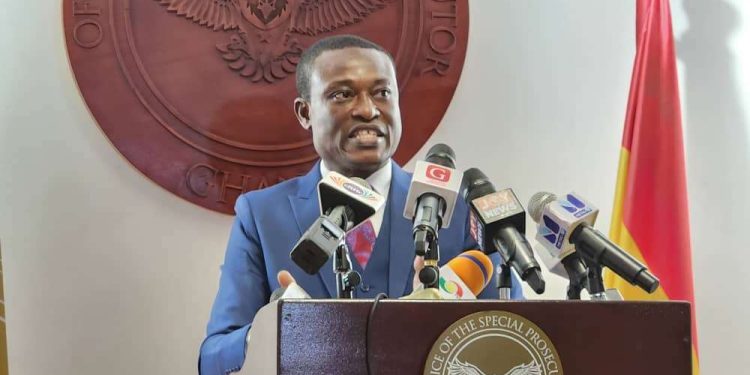
    In a communication during his tenure as Special Prosecutor, Martin Amidu disclosed how John Mahama allegedly leveraged his position to secure a Ghanaian passport for his brother, Samuel Adam Mahama.

    Martin Amidu said, “Amongst other reasons for the letter to the said Ministry, Samuel Adam Mahama’s elder brother of full blood, who without a doubt and the evidence available to this Office answers to the description of the elected Government Official 1, allegedly granted a denial interview to the Daily Graphic which published the same on June 20, 2020, fortunately containing suspected admissions that he is the elected Government Official 1 referred to in the UK judgement.

    “Serving appointees of this government have been unable to obtain the voice recording of this interview to enable the Office to confront the former president with his own admissions in the interview as answering to the description of the brother of Samuel Adam Mahama as Intermediary 5.”

    About the Airbus scandal case

    Ghana’s acquisition of three C295 military aircraft from Airbus, a process that began in 2011, has come under renewed scrutiny following a recent ruling by England’s Crown Court in Southwark.

    The purchases, which were initially presented as part of the 2009-2012 Strategic Plan of the Ghana Armed Forces, were approved by Ghana’s Parliament despite significant debate.

    These aircraft were intended to modernize the Ghana Air Force and were funded by loans from Deutsche Bank S.A.E. and Fidelity Bank Ghana Limited, with additional financing from the Brazilian Development Bank (BNDES) for related military purchases.

    The deals were met with opposition, particularly from Minority Leader Osei Kyei-Mensah-Bonsu, who questioned the transparency and legitimacy of the contracts.

    He argued that the contract sums were inflated and criticized the government for a lack of transparency, relying on publicly available information to substantiate his claims, which were largely dismissed at the time.

    The recent judgement by the Crown Court has brought these concerns back to the forefront. On January 21, 2020, the court approved a Deferred Prosecution Agreement (DPA) between the UK’s Serious Fraud Office (SFO) and Airbus SE, which admitted to extensive bribery schemes across several countries, including Ghana.
    The DPA allows the SFO to delay prosecution if the company complies with specific conditions, a decision that the court deemed fair, reasonable, and in the public interest, given the potential economic impact of immediate prosecution on Airbus.

    The court’s findings revealed that Airbus engaged in corrupt practices to secure contracts in multiple countries, including Ghana.

    The judgement highlighted that Airbus, through intermediaries, attempted to bribe officials linked to a high-ranking Ghanaian government figure between 2011 and 2015 to secure the sale of two C295 aircraft.

    Initially, Airbus planned to pay a €5 million bribe disguised as a commission to “intermediary 5,” who had close ties to a powerful Ghanaian official overseeing the aircraft purchase deals.

    Although this particular payment was never completed due to procedural safeguards, subsequent transactions were arranged through a Spanish third-party company, enabling Airbus to funnel nearly €4 million in bribes to the intermediary.

    The third-party company, inserted into the deal to bypass due diligence processes, facilitated the sale of two aircraft.

    However, the arrangement fell apart during negotiations for the third aircraft after Airbus conducted an internal investigation, leading the Spanish company to withdraw. Claims by “intermediary 5” for an additional €1.6 million related to the third aircraft were also not honored by Airbus.

    The Crown Court’s judgement does not grant Airbus and its officials immunity from prosecution. The SFO retains the right to pursue criminal charges if Airbus fails to meet the conditions of the DPA.

    Moreover, ongoing investigations could result in criminal proceedings against those who paid or received the alleged bribes, including intermediaries and associated individuals in Ghana. Under English law, the SFO could utilize Mutual Legal Assistance (MLA) agreements to pursue these charges internationally.

  • OSP updates public on findings of Airbus scandal probe

    OSP updates public on findings of Airbus scandal probe

    The Office of the Special Prosecutor (OSP) has concluded its investigations on the Airbus scandal.

    Special Prosecutor Kissi Agyebeng is briefing the media on the Office’s findings.

    About the Airbus Scandal:

    Airbus, the European aircraft manufacturer, was accused of paying bribes in Ghana during the sale of three military aircraft.

    The aerospace company acknowledged hiring the brother of a prominent Ghanaian official as its consultant for the sale of the aircraft to the country.

    Additionally, Airbus admitted to making payments to the consultant through a third party after its Compliance Unit raised concerns about the close relationship between the consultant and the senior Ghanaian official, who played a significant role in the military aircraft purchase.

    Former President John Dramani Mahama was among the government officials implicated in the scandal, with former Special Prosecutor Martin Amidu suggesting that the label “Government Official One” in the scandal referred to the former president.

    In a communication during his tenure as Special Prosecutor, Amidu disclosed how John Mahama allegedly leveraged his position to secure a Ghanaian passport for his brother, Samuel Adam Mahama.

    Martin Amidu said, “Amongst other reasons for the letter to the said Ministry, Samuel Adam Mahama’s elder brother of full blood, who without a doubt and the evidence available to this Office answers to the description of the elected Government Official 1, allegedly granted a denial interview to the Daily Graphic which published the same on June 20, 2020, fortunately containing suspected admissions that he is the elected Government Official 1 referred to in the UK judgement.

    “Serving appointees of this government have been unable to obtain the voice recording of this interview to enable the Office to confront the former president with his own admissions in the interview as answering to the description of the brother of Samuel Adam Mahama as Intermediary 5.”

    John Mahama, however, refuted the allegations and urged Martin Amidu, who was serving as Special Prosecutor at the time, to prosecute him if he was indeed the individual referred to as Government Official One.

  • Special Prosecutor launches probe into Joy News’ Porous Borders exposé

    Special Prosecutor launches probe into Joy News’ Porous Borders exposé

    Office of the Special Prosecutor (OSP) has initiated an investigation into suspected corruption and related offences exposed in JoyNews’ recent documentary, “Porous Borders”.

    The OSP has requested the unedited footage of the documentary to facilitate a thorough investigation into alleged bribery and corruption involving some staff of the Customs Division of the Ghana Revenue Authority (GRA).

    The OSP becomes the third public institution to respond to the documentary, following reactions from Parliament and the GRA.

    Porous Borders showcased real-time footage of corrupt activities by some customs officials at Ghana’s eastern border.

    In the wake of the documentary’s release, the Customs Division of the GRA announced on July 31 that it had assembled a team to investigate the corruption claims. Parliament also reacted, with Yusif Suleiman, Ranking Member on the Trade and Industry Committee and MP for Bole-Bamboi, describing the country as “sick” after viewing the exposé.

    On August 2, 2024, the Special Prosecutor confirmed the commencement of an investigation into the allegations in the documentary.

    The office has formally requested the documentary’s unedited recordings to support its inquiry.

    Additionally, the documentary producers have been invited to assist with the investigation as witnesses.

  • Supreme Court throws out Ken Kuranchie’s suit challenging OSP’s constitutionality

    Supreme Court throws out Ken Kuranchie’s suit challenging OSP’s constitutionality

    The Supreme Court has dismissed a lawsuit filed by Editor-in-Chief of the Daily Searchlight Newspaper, Kenneth Kwabena Agyei Kuranchie challenging the constitutionality of the Office of the Special Prosecutor (OSP).

    The 2024 independent parliamentary candidate sought to have the creation of the OSP and its powers declared unlawful. His lawsuit targeted the OSP’s powers of arrest, detention, freezing, and seizure, describing them as abusive.

    Kuranchie’s writ requested the Supreme Court to declare the Special Prosecutor Act, 2017 (ACT 957) as contrary to multiple articles of the 1992 Constitution, including Articles 11, 17(1)(2) and (3), 88(3) and (4), 289(2), 290(1)(f), 290(2) to (4), 12(2), and 107(b).

    He argued that the OSP’s prosecutorial powers should be placed under the direct control of the Attorney General, similar to the arrangement for the Economic and Organized Crime Office (EOCO), Police, and National Investigation Bureau (NIB).

    The Special Prosecutor Act was established to create the OSP as a specialized agency to investigate specific cases of alleged or suspected corruption and corruption-related offenses involving public officers and politically exposed persons, as well as persons in the private sector involved in such offenses. The OSP prosecutes these offenses on the authority of the Attorney General.

    This was not Kuranchie’s first legal challenge against the OSP; he had previously filed and later discontinued a similar case last year. His recent filing, however, met the same fate, with the Supreme Court dismissing it.

    The Court emphasized that the OSP should not be distracted by such lawsuits and should instead focus on its mandate. The ruling reinforces the legitimacy and constitutional backing of the OSP, allowing it to continue its work in combating corruption and related offenses without hindrance.

    Kuranchie’s legal attempts to alter the structure and authority of the OSP have thus far been unsuccessful, solidifying the current framework under which the OSP operates. The dismissal by the Supreme Court underscores the judiciary’s support for the OSP’s role in upholding accountability and integrity within Ghana’s public and private sectors.