Israeli bombing and air attacks killed 37 people, mostly in tents, outside the southern Gaza city. This happened in the same area where earlier strikes caused a deadly fire in a camp for displaced Palestinians. Witnesses, emergency workers, and hospital officials confirmed this.
The fire in the tent camp has made many people around the world very angry. Even Israel’s friends are upset about the military’s attacks in Rafah. Israel is becoming more and more isolated in the world. On Tuesday, Spain, Norway, and Ireland officially acknowledged that there is a Palestinian state.
The Israeli military said that the fire on Sunday at the tent camp might have been caused by more explosions, maybe from weapons belonging to Palestinian militants. Israel released its findings about the fire on Tuesday. Daniel Hagari said the fire is still being looked into, but the weapons used by Israel were too small to cause the fire.
The strike or the fire could have also started the fuel, cooking gas canisters, or other things in the camp. The fire killed 45 people from Gaza, as reported by their health officials. Israeli leader Benjamin Netanyahu said the fire was a very sad accident.
Israel attacked Rafah on May 6, causing over one million people to leave the city, according to the UN agency that helps Palestinian refugees. Many people had to move many times during the almost eight-month war between Israel and Hamas. The families are living in temporary tent camps and other areas that have been destroyed by war.
In the last few days, bombings have hit areas in the west of Rafah, where the military did not tell people to leave. Israeli soldiers and tanks are moving in the eastern part of Rafah city, in the middle of the city, and along the border between Gaza and Egypt.
On Monday night and Tuesday morning, bombs hit the Tel al-Sultan neighborhood in Rafah, and at least 16 people were killed, according to the Palestinian Civil Defence and the Palestinian Red Crescent. Seven people died in tents next to a UN building about 200 meters from where the fire happened on Sunday.
“Muslim Abdel-Rahman Abu Ismail, a person from Gaza City, said it was a very scary night. He has been living in Tel al-Sultan since December. ” He said he heard lots of explosions all night and on Tuesday, and saw fighter jets and drones flying above.
He said it made him think of when Israel attacked his neighborhood of Shijaiyah in Gaza City. They bombed it a lot and then sent in soldiers in late 2023. “We have seen this before,” he said.
The US and other friends of Israel have said not to launch a big attack in the city. The Biden administration has said this would be very bad and they won’t give weapons for that kind of action. On Tuesday, a spokesperson from the US State Department, Matthew Miller, said that the administration does not think Israel has gone too far in attacking Rafah. He said the attack is not as bad as the ones on other parts of Gaza.
The International Court of Justice told Israel to stop its military operation in Rafah. This is because South Africa accuses Israel of committing genocide against the Palestinians in Gaza.
On Tuesday afternoon, a drone from Israel attacked tents near a hospital by the coast, west of Rafah. At least 21 people were killed, including 13 women, according to Gaza’s Health Ministry.
Ahmed Nassar, a person who saw what happened, said that his four relatives and some of their family members were killed in the attack. Some tents were also damaged or destroyed. Many of the people who lived there had run away from the same area in Gaza City during the war.
“He said they don’t have anything to do with anything. ”
Netanyahu promised to continue fighting in Rafah. He said that Israeli troops need to go into the city to break up Hamas and rescue the hostages from the attack on Oct 7 that started the war.
The Israeli military looked into the strike and fire that happened on Sunday and shared pictures taken from space that show where they believe Hamas shot rockets from. They said it was only about 40 meters away from some sheds that were hit. In the picture, it didn’t look like the launcher was hit.
He said Israeli planes used really small bombs – two bombs with 17-kilogram warheads. “We don’t have enough weapons to start a fire this big,” he said.
Hagari said that the fire was a very bad thing that we didn’t think would happen, and it started because of unexpected things.
However, the bombings have caused many people to leave areas to the west of Rafah. Sayed al-Masri, who lives in Rafah, said lots of families were going to the busy Muwasi area or to Khan Younis, a city in the south that was badly damaged during months of fighting.
“Things are getting worse,” al-Masri said about the situation in Rafah.
Gaza’s Health Ministry said two hospitals in Tel al-Sultan cannot operate because of heavy bombing nearby. Medical Aid for Palestinians, a charity that helps people in the area, said that the Tel al-Sultan medical center and the Indonesian Field Hospital are unable to operate. Medics, patients, and displaced people are stuck inside.
Many of Gaza’s hospitals are no longer working. Rafah’s Kuwait Hospital closed on Monday because two health workers were killed in a strike near the hospital entrance.
A person from the World Health Organization said that there were too many people hurt in the strike and fire on Sunday. The hospitals there didn’t have enough supplies to help the people with bad burns.
Dr Margaret Harris said that it needs a lot of attention, electricity, and advanced medical care.
Tag: Palestinians
-

At least 37 Palestinians killed by Israeli attacks
-
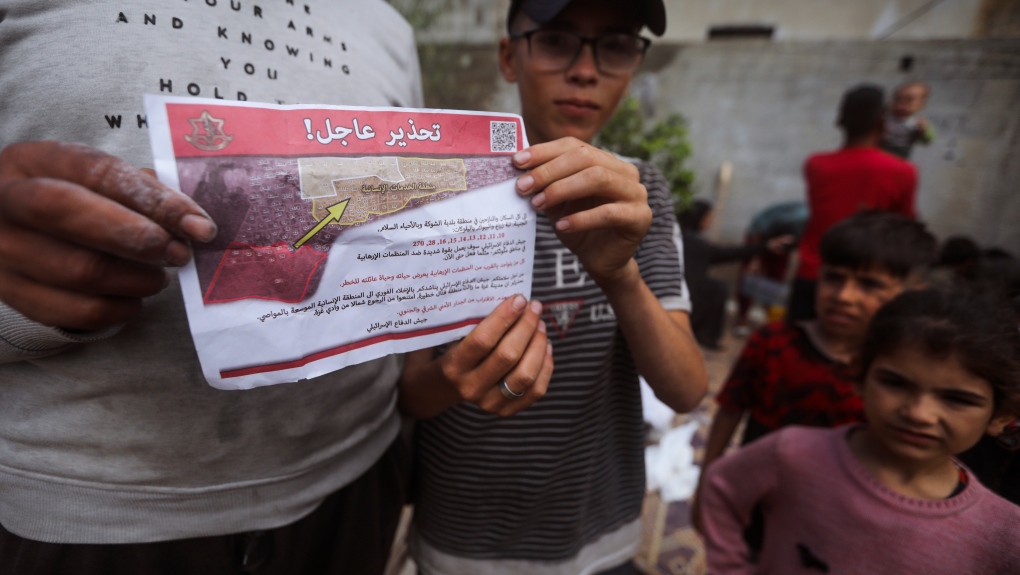
Israeli forces order Palestinians to leave some areas of Rafah ahead of planned attack
The Israeli army told about 100,000 Palestinians to leave the city of Rafah in Gaza on Monday. This makes it more likely that a ground attack will happen soon and makes it harder to make a deal to stop the fighting.
The upcoming operation in Rafah, where more than 1 million Palestinians are staying, has made people around the world worried. Israel’s closest friends have advised against it because they are afraid that many people could be killed. On Monday, the United Nations organization that helps Palestinian refugees said it will not follow the order to leave.
Israel says that Rafah is an important place for Hamas after fighting for seven months. They say they need to invade to defeat the Islamic militant group, which started the conflict by attacking Israel on Oct 7th.
Hamas and Qatar warned that going into Rafah, which is near the border with Egypt, could ruin the work of international mediators trying to make a cease-fire.
Lieutenant Colonel Nadav Shoshani, who speaks for the army, said that about 100,000 people are being told to go to a place called Muwasi. It is a zone set up by Israel to help people in need. Muwasi is a camp by the coast with tents where many Palestinians have gone to find safety. The conditions there are not good.
Shoshani said Israel was getting ready for a small operation and did not say if this was the start of a bigger invasion of the city. Israel did not officially tell everyone that they were starting to send soldiers into Gaza.
Last night, Defense Minister Yoav Gallant told US Defense Secretary Lloyd Austin that Israel had to take action in Rafah.
On Sunday, Hamas launched a rocket attack from the Rafah area that killed four Israeli soldiers. It’s not clear if the upcoming operation is a response to this attack.
He said Israel made a map of the area people need to leave, and they are giving out orders using leaflets dropped from airplanes, text messages, and radio. He said Israel has given more help to Muwasi by providing hospitals, tents, food, and water.
Israel’s army posted on social media that they will use strong force against militants and told people to leave quickly to stay safe.
Jan Egeland, the leader of the Norwegian Refugee Council, criticized the order to make people leave and go to Muwasi. He said it was wrong and against the law.
“The area is already too full and doesn’t have important services,” Egeland said.
Around4 million Palestinians, which is more than half of the people living in Gaza, are living in a crowded area called Rafah and the places nearby. Many people left their homes in the area to escape from Israel’s attack. Now, they have to move again or stay and face the danger of another attack.
They live in very crowded tent camps, full UN shelters, or small apartments, and rely on help from other countries for food. The sanitation and medical facilities are not working well.
People in Rafah, Palestine talked about what to do after getting some papers.
“Many people here had to leave their homes and now they have to move again. It’s not safe for anyone to stay here,” said Nidal Alzaanin in a phone call to The Associated Press.
Alzaanin is a dad of five kids and he works for a group that helps people around the world. He ran away to Rafah from Beit Hanoun when the war started. He said that people are worried because Palestinians have said they were shot at during previous evacuations. Israel says it did not shoot at civilians.
Alzaanin said he’s ready to move with his papers and bags. But he’ll wait a day to see what other people do before he moves. He said his friend in Khan Younis can put up a tent for his family.
The UN agency called UNRWA has been helping many Palestinians in Gaza and the West Bank for a long time. They said that if there is an attack in Rafah, it will cause a lot of harm to innocent people and could lead to more deaths. Juliette Touma, who is in charge of talking to the public for the agency, said they have not made anyone leave their jobs and don’t plan to. The agency has a lot of workers in the city.
The Rafah crossing in Egypt, which is an important place for aid going to Gaza, is in the area that people have to leave because of danger. The crossing stayed open on Monday even though Israel said it should be closed.
The war started when Hamas and other fighters attacked southern Israel on October 7th. They killed about 1,200 people, mostly innocent civilians, and took about 250 people as hostages.
The fighting has caused the deaths of over 34,000 Palestinians, as reported by local health officials. The count doesn’t show who is a civilian or a fighter, but officials say most of the people who died are kids and women. The fighting has caused a lot of damage in Gaza, and most of the people there have left to go to other areas.
Lately, more people want the war to stop. Even though the US, Egypt, and Qatar want fighting to stop, the leader of Israel says their military will keep moving into the city, even if a deal is made to stop fighting in exchange for hostages being released.
On Monday, Netanyahu blamed Hamas for ruining a deal and not giving up their strong demands. He promised to prevent the militants from taking over Gaza again. He gave a strong speech on Sunday for the country’s Holocaust memorial day and said that Israel will keep fighting even if no one helps them.
A Hamas leader said to The Associated Press that Israel is trying to force the group to give in on the cease-fire, but Hamas will not change its demands. Hamas wants the war to stop completely, Israeli soldiers to leave Gaza, and the strip to be rebuilt in the future. -
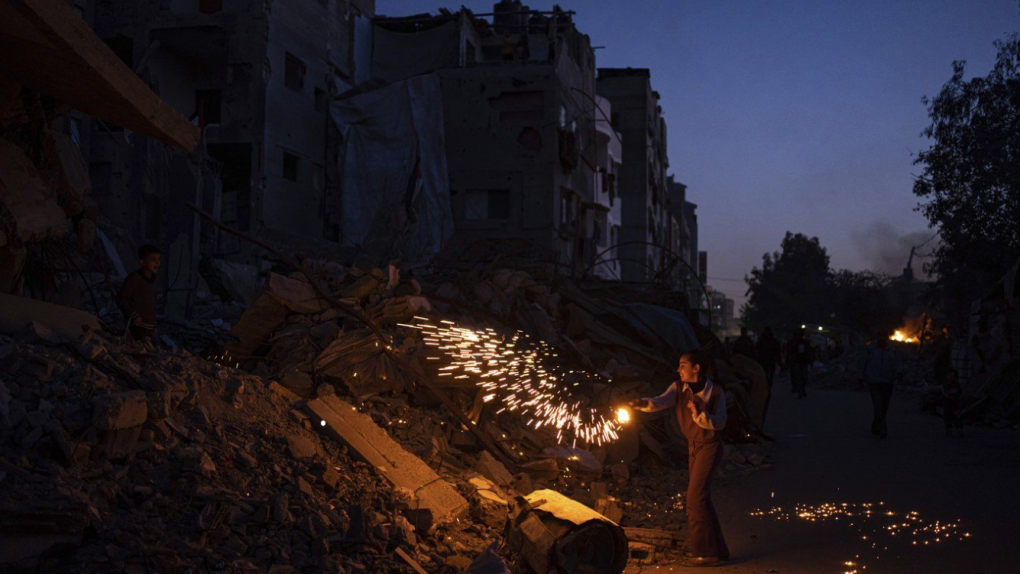
Palestinians in Gaza start Ramadan with hunger
Palestinians started fasting for Ramadan on Monday. The ceasefire talks are at a standstill, and people in Gaza are getting hungrier. The war between Israel and Hamas has been going on for five months, and there is no sign of it ending.
People prayed outside among the wreckage of destroyed buildings on Sunday night. Some people put up lights and decorations in crowded tent camps. At a UN-school-turned-shelter, children were dancing and playing with foam while a man sang into a loudspeaker.
However, there wasn’t much to be happy about after five months of fighting, which has resulted in the deaths of over 30,000 Palestinians and caused extensive damage to Gaza. Families usually eat big meals to end their daily fast during holidays. But even if there is food, it’s mostly canned and too expensive for many people to buy.
Sabah al-Hendi, who was buying food in Rafah on Sunday, said that no one looked happy. “Every family feels unhappy. ” Every family has someone who sacrifices a lot for the family.
The United States, Qatar, and Egypt were trying to help make a peace agreement before a special month of fasting. They wanted to free Israeli and Palestinian prisoners and bring in a lot of aid. But the talks stopped last week.
Hamas wants to make sure that any deal will bring an end to the fighting, and Israeli Prime Minister Benjamin Netanyahu has promised to keep fighting until they defeat Hamas and free all the hostages.
The fighting started when Hamas-led fighters attacked southern Israel on Oct. Seven attacks happened, and they killed about 1,200 people, most of them were not soldiers, and they also took about 250 people as hostages. Hamas still has around 100 people and the bodies of 30 others after an exchange last year.
The fighting made almost 80% of the 2. 3 million people in Gaza leave their homes, and many are struggling to find enough food to eat. Health experts say that at least 20 people, mostly kids, have passed away from not eating enough and not drinking enough water in northern Gaza.
Israeli soldiers have mostly blocked the north since October. Aid groups say it’s very difficult to safely deliver much-needed food there because of Israeli restrictions, ongoing fighting, and the lack of law and order.
Israel has promised to attack the southern city of Rafah, where many people from Gaza have gone for safety. But they haven’t said where the civilians will go to stay safe. The United States. President Joe Biden said if Rafah is attacked, it is a serious issue for him, but the US will still give military help to Israel.
Biden said in his yearly Ramadan message that the holy month is happening “when there is a lot of suffering. ”
“As Muslims come together in the next few days and weeks to eat after fasting, many will be thinking about the hardships faced by the Palestinian people. ” “I’m thinking about it a lot,” he said.The United States and other countries are dropping aid from the air to help people in need. But some groups say this is expensive and not enough to help everyone. The US military is moving equipment to build a sea bridge for delivering aid. It will take a few weeks for it to be ready.
A boat from the Spanish aid group Open Arms with 200 tons of food was going to sail to Gaza from Cyprus, but it wasn’t known when it would leave. Israel is okay with ships bringing stuff to Gaza from the sea. But first, they want to check the stuff on the ships before it goes from Cyprus to Gaza.
The boat in Cyprus will take two to three days to reach a secret place in Gaza. The food is given by a group called the World Central Kitchen, from the United States. A charity started by famous chef José Andrés has started building a jetty in Gaza. Once the ship gets to Gaza, the aid will be taken off using a crane, put on trucks, and driven to the north.
The United States has helped Israel with their military and defended them from other countries asking for a stop to the fighting. They have also told Israel to try to avoid hurting innocent people and make it easier for people to get help.
The Health Ministry in Gaza reported on Monday that 31,112 Palestinians have died since the war started. This includes 67 bodies that were brought to hospitals in the last day. The government doesn’t separate civilians from soldiers when counting the dead, but it says that two-thirds of the dead are women and children.
Israel says that many innocent people are dying because Hamas is fighting in crowded neighborhoods where there are a lot of houses, schools, and mosques. They also place their fighters, tunnels, and rocket launchers near these places. The army claims to have killed 13,000 Hamas soldiers, but there is no proof of this.
On Saturday, Biden told MSNBC that Israel had the right to react to the Oct. 7 attacks, but Netanyahu needs to care more about the innocent people who are being killed. He said you can’t have 30,000 more Palestinians dead. -
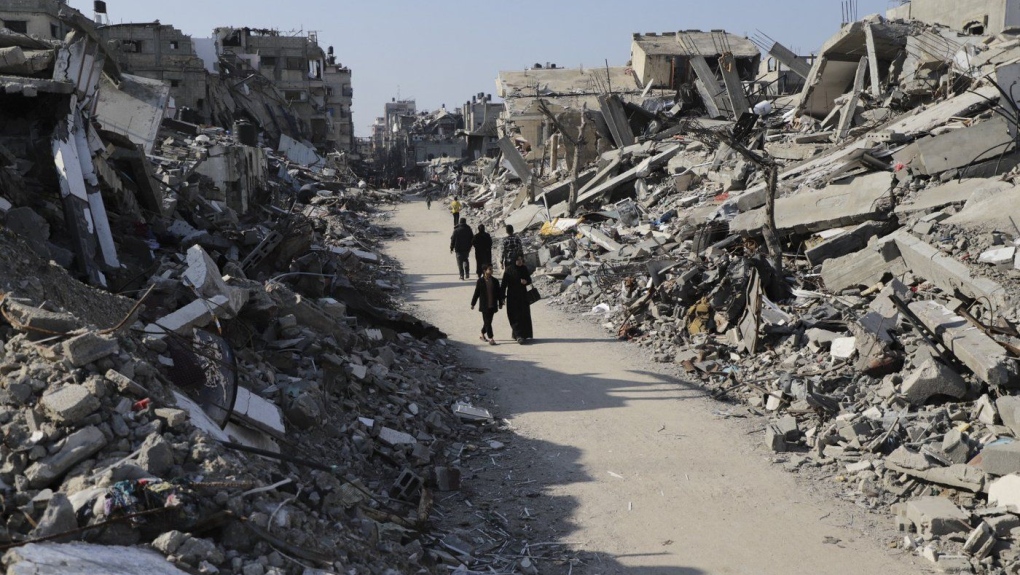
Israeli forces allegedly kill Palestinians as they hunt for food
A group of Palestinians in Gaza City have been killed by Israeli soldiers as they tried to access food from a delivery truck. Witnesses saw this happen on Thursday. Over 100 people died in the Israel-Hamas war, making the total number of deaths more than 30,000.
Israel said a lot of people were crushed in a crowded rush for food aid and that their soldiers only shot when they felt threatened by the crowd.
The Arab countries and the U. Swere quick to speak out against the violence. President Joe Biden said he was worried that it would make it harder to agree on a peace agreement in the almost five-month-long fighting.
The Gaza City area was one of the first places that Israel attacked with its planes, ships, and soldiers. They did this because of Hamas’ actions in October. Seven attacks on Israel.
Many Palestinians left when the area was attacked, but a few hundred thousand are thought to still be there in the damaged and isolated area. This week, trucks delivered food to northern Gaza, which was the first big aid delivery in a month, according to officials.
Aid groups are finding it very hard to deliver supplies to most of Gaza because they are having trouble working with the Israeli military. There is a lot of fighting and chaos, and it is very hard to keep things under control. Lots of people are in need and it is getting difficult to get them the help they need. The United Nations says that 25% of the 2. 3 million people in Gaza do not have enough food to eat, and 80% of them have had to leave their homes.
The military said that early in the morning, a group of 30 trucks carrying supplies to northern Gaza were met by a large crowd of people trying to take the aid. Many Palestinians died in the chaos, and some were hit by trucks while the drivers tried to escape, according to Rear Admiral. Daniel Hagari is the main person who talks about the military.
Israeli soldiers in charge of protecting the area shot warning shots at the crowd because they felt that the crowd was dangerous, he explained.
“We didn’t shoot at the people asking for help. ” We did not shoot at a humanitarian aid convoy, neither from the air nor from the ground, despite what people are saying. “We made it safe for it to get to northern Gaza,” he said.
Kamel Abu Nahel was at Shifa Hospital for a gunshot wound. He and some other people went to the distribution point in the middle of the night because they heard there would be food. “We’ve been eating food for animals for two months,” he said.
He said that Israeli soldiers shot at the crowd while people were taking food from the trucks. This made them run away and some of them hid under cars. After the shooting ended, people returned to the trucks, and the soldiers started shooting again. He got shot in the leg and fell down. Then a truck ran over his leg as it drove away, he said.
At least 112 people died, said a spokesman for the Health Ministry named Ashraf al-Qidra. The Health Ministry called it a very violent and deadly attack.
Saudi Arabia, Egypt, and Jordan said Israel is attacking innocent people. They asked for more safe ways to deliver aid to people in need. They also asked other countries to do something to make Israel follow the rules of the world, and to make a deal for peace right away.
Biden talked to the leaders of Egypt and Qatar about the deaths, according to the U. SgovernmentGovernment leaders and the UN Security Council plan to have urgent private discussions about the issue on Thursday.
“We really need to know more information about what happened,” said Matthew Miller, spokesperson for the State Department.
More and more people are worried about hunger in Gaza. They want the fighting to stop so that food and supplies can reach the people who need them.Violence has also increased a lot in the West Bank since October. The text is missing and may have been cut off. Can you provide the text you want to be rewritten in simple words. Someone attacked and killed two Israelis at a gas station in the settlement of Eli on Thursday, as reported by the Israeli military. The military said the person who attacked was killed.
At the same time, the UN officials have said that many more people could die if Israel attacks the city of Rafah in the south, where over half of Gaza’s 2. 3 million people are staying. They also say that an attack on Rafah could destroy the little of aid operations that are left.
Many Palestinians are still in northern Gaza even though Israel told them to leave in October. They are struggling to find enough food to eat and are even eating animal food to survive. The UN says that in the northern areas, one out of every six children under two years old is suffering from severe malnutrition and weight loss.
The Israeli military group in charge of helping Palestinian civilians, COGAT, said that about 50 trucks carrying aid went into northern Gaza this week. It was not clear who gave the help. Some countries have been dropping supplies from airplanes in the past few days.
The World Food Program stopped sending food to the north because of the increasing disorder. Palestinians took all the food from a delivery truck while it was on its way.
Ever since it started attacking Gaza after Hamas’ Oct. Israel has stopped food, water, medicine, and other supplies from coming into the area, except for a small amount from Egypt and Israel. Despite many countries asking for more help, the number of trucks bringing supplies is much lower than before the war. -
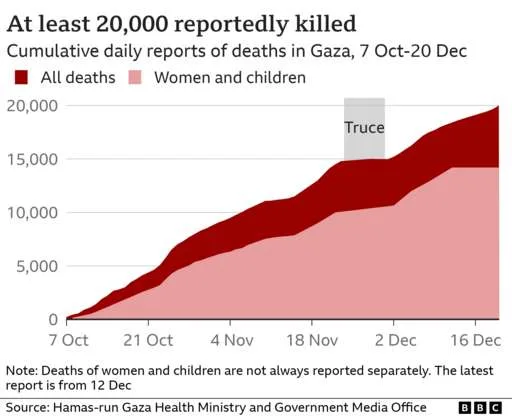
Close to 400 palestinians killed in last 48 hours – Hamas reports
The Gaza Strip’s health ministry, under the control of Hamas, reports that almost 400 people have lost their lives in the past two days.
According to their statement, the total death toll is 390, with an additional 734 individuals injured.
Since the conflict erupted on October 7, the health ministry asserts that over 20,000 people have been killed. It’s important to note that the BBC has not independently verified this death toll.
-
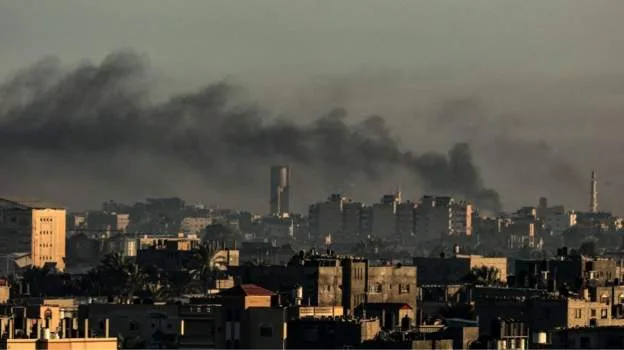
Israeli Defence Chief directs soldiers to intensify their campaign
A person who saw it said Khan Younis was really scary at night with lots of loud gun and bomb noises.
Hamas said that there was very heavy fighting on the road to Rafah in the south of Gaza, where many Palestinians have been running away.
General Herzi Halevi told Israeli soldiers that Hamas seemed to be weakening after two months of war and that they needed to keep fighting hard.
Iran-supported Houthi rebels in Yemen said they will stop any ships from going to Israel until Gaza gets food and medicine. This has raised worries about a bigger fight in the area.
United Nations officials are upset because not enough help is getting to a small part of the area, causing a lack of food and clean water. -

Funerals for Palestinians slain in West Bank raid to be held
Six Palestinians were killed by Israelis in al-Fara refugee camp. The funerals will happen soon. The camp is near Tubas in the north of the West Bank.
The Israeli military has not answered questions yet.
People in the camp saw Israeli special forces come in early this morning.
A man said that his family member was killed by getting shot after opening a door to see what was going on.
A small group of people with weapons works from the camp.
The Palestinian Authority says that 263 Palestinians have been killed by Israeli forces and settlers in the West Bank since the war in Gaza started.
That is more than the total number of Palestinians who died in the Israeli-Palestinian conflict last year. -
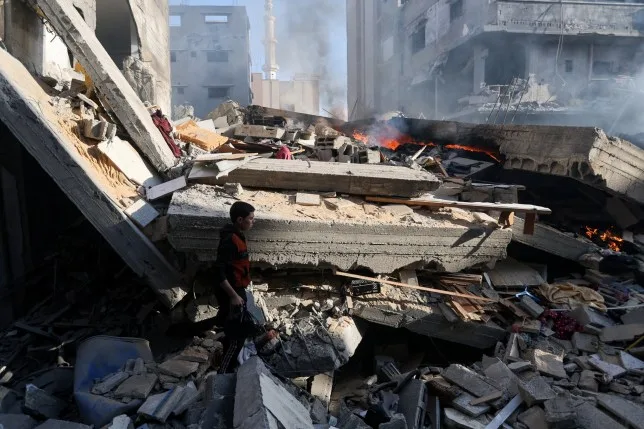
UN warns of ‘apocalyptic’ situation in Gaza as Israeli troops move southward
The United Nations said that there is nowhere safe for Palestinians in Gaza because Israeli troops are moving into more areas.
The UN officials say the situation is very bad in the besieged area because there is a lot of fighting and bombing.
The IDF told people to leave a part of Khan Younis because there were airstrikes there.
UN emergency relief official Martin Griffiths said that every time we think things can’t get worse in Gaza, they do.
People are being told to move, but they don’t have much to live on and are forced to make really tough decisions.
“He said that we need to stop being so disrespectful to each other as human beings. ”
Israel is attacking Hamas more and sending soldiers to more areas in the territory.
The Israeli military surrounded the Jabalia refugee camp in the northern part of the Gaza Strip, near the border with Israel.
The place has seen lots of fighting lately after a break of one week.
Trucks full of help have gone into Gaza in the last two days, but they have had trouble moving because of the fighting.
At the same time, a soldier named Binyamin Needham from Britain and Israel was mentioned by the IDF as one of three troops who died on Sunday while the military continued its ground attack in the southern area of the Strip.
People are honoring the soldier who was seriously hurt and died two days after going to the frontline with the 401st Brigade.
Reports say he died while Israel keeps attacking Gaza and killing lots of innocent people since the break ended on December 1. -
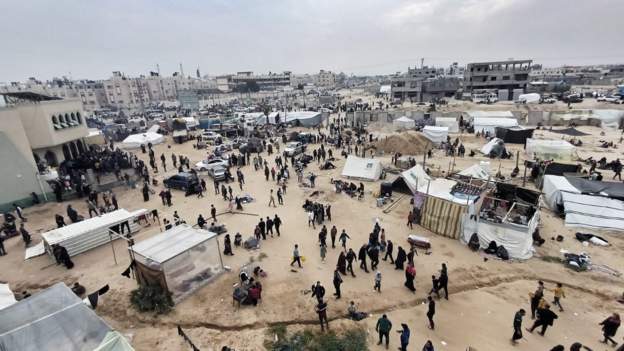
‘Gaza is not a place for human beings’ – Displaced Gazans
We have been talking to Palestinians who had to leave their homes in the al-Mawasi area. Israeli officials say it is a safe place for them to stay.
They say the narrow piece of land on the south of Gaza’s coast is very bad, like a desert, and has too many people.
Reem Abd Rabu lives with 16 other people in one tent. She left her home in northern Gaza with her family in October because the Israeli military said it was not safe to stay there.
She says al-Mawasi is a place with no amenities for people, and thinks it should hold 10,000 people but now has over 100,000.
One of the people in a tent with Reem is Dr. Mona Al Astal. She says their situation is really bad, and many people in the makeshift al-Mawasi communities are getting sick with skin and breathing problems.
“She says people have no water, food, or electricity. They have nothing. ”
“This morning, some people forcefully entered a UNRWA storage to take food. “ -

Hamad City: Airstrikes target Gaza houses funded by Qatar
During the weekend, there was a video of people running away from Hamad City in Khan Younis because of Israeli air strikes. Smoke was rising from the air strikes. Many apartment buildings were completely destroyed and turned into blackened rubble.
Qatar knows that this is important, especially because they couldn’t help make the temporary truce between Israel and Hamas last longer.
Qatar paid for and built the smart housing project, including a big mosque and gardens. It was named after the old leader of Qatar, who started the project when he visited 11 years ago. He was the first leader to visit the Palestinian area after it was controlled by Hamas.
The first apartments in the complex were given to Palestinians whose homes were destroyed in the 2014 war between Israel and Hamas. Many people have lost their houses once more.
Islam al-Farah, a local government worker, told the BBC that the population of Hamad City has doubled from 15,000 to over 30,000 in the past few weeks. This is because people who were forced to leave their homes in northern Gaza are now living there.
“He said that many people are living on the streets, in tents, or in parking areas. ”
“Recently, we got a notice telling us to leave Hamad City because it’s going to be attacked,” he said. -

Hamas fears Israelis and Palestinians living side by side in peace – Biden
Joe Biden said that if the fighting in Gaza keeps going, it will give Hamas what they want.
The President of the United States said that Hamas started fighting on October 7th because they are afraid of Israelis and Palestinians living peacefully together.
“He said that if we keep fighting and causing harm, we will be giving Hamas what they want. ”
His tweet made people confused. Some people wondered if Biden was suggesting that the US might be less strict in the conflict.
Biden did not support stopping the fighting because he didn’t think it would help make peace between Israel and Hamas.
“He wrote in an article that as long as Hamas wants to destroy things, a ceasefire is not real peace. ”
However, a high-ranking official from Biden’s administration told Jewish Insider that his message on social media was “not a change in policy”. The official added that the message was a shortened version of a longer speech he gave last week.
“He said we should not give up hope for peace in the region. It’s very important to keep working towards a lasting peace through a two-state solution. “ -
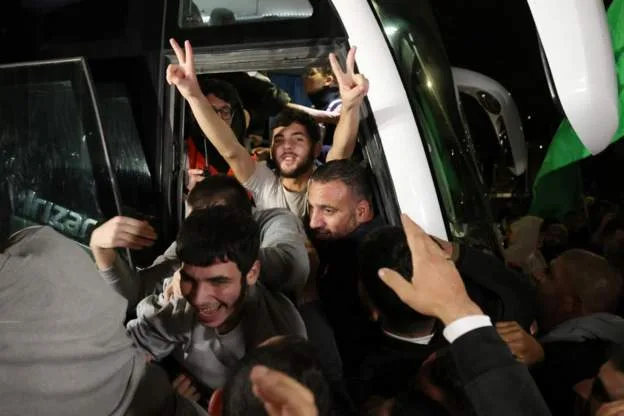
3 Palestinians to be freed daily in exchange of Israeli hostage after extended truce
The truce will continue, and for every Israeli hostage returned from Gaza, three Palestinians will be freed from Israeli jails.
Prime Minister Benjamin Netanyahu’s office said they got the list of captives who will be released today and their families are being told.
Last night, two women and nine children and teenagers were set free. They were all kidnapped from the same kibbutz.
About 170 people are still being held in Gaza, but Hamas claims they are not responsible for all of them. This could make it harder to free the most vulnerable people.
The youngest person being held captive is a ten-month-old baby.
US officials are saying that they will keep working to extend the deal until everyone is let go.
In Gaza, the fighting has stopped for now. This has helped deliver essential supplies to people in need. But the United Nations says they still need a lot more help. -
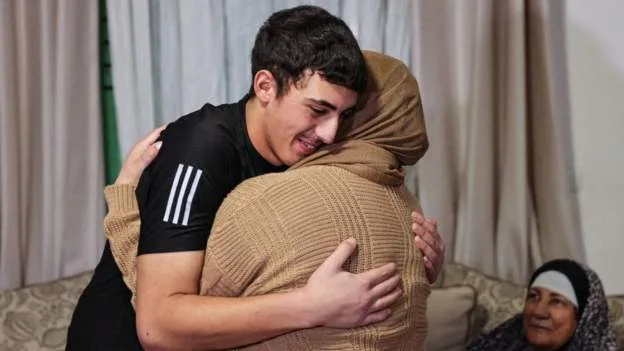
Israel releases 33 Palestinian detainees on the fourth day of truce
More Palestinians were released from Israeli jails on the fourth day of a break in fighting between Israel and Hamas.
33 people were let go, making a total of 150 Palestinians who have been released since last Friday. This is when both sides started trading hostages and prisoners.
Not much has been said about the new group of Palestinians who have been set free.
On Monday, Hamas and Qatar said that 30 Palestinian children and three women are going to be released. Qatar has been helping with talks between the fighting groups.
The Israel Prison Service said 33 people were released from Ofer prison in the West Bank and a detention center in Jerusalem. They did not say how old they were or if they were male or female. -
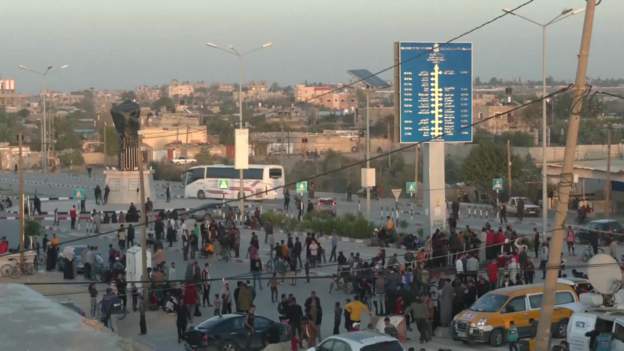
Hostage release agreement: When will it take place?
Here’s what is expected to happen in the next few minutes and hours:
At 2:00 PM GMT (4:00 PM local time), Hamas is going to let go of 13 hostages in Gaza. The International Committee of the Red Cross (ICRC) will then take them to Egypt at the Rafah border.
The Israeli military will arrive in Israel around 16:00 GMT and will get a medical checkup at an airbase.
The 13 people will go to the hospital in a helicopter and see their families there.
We don’t know their names yet, but we do know they will all be women and children.
After the prisoners are moved, 39 Palestinians are going to be let go from Israel’s Ofer prison, which is in the West Bank, and given to the ICRC.
We now know the names of 24 women and 15 men on the list.They will be taken to an Israeli military checkpoint in the West Bank and then allowed to go back home, according to Israel’s prison service.
The buses are prepared to pick up the Palestinians who are going to be released from prison. Israeli ambulances have been sent to the Kerem-Shalom border area in southern Israel. -
Conflict at West Bank checkpoint where release of Palestinians scheduled to occur
The road near Beitunia checkpoint in Ramallah smells strongly of tear gas. This is where the 39 Palestinian prisoners will go after they are let out of Israeli prisons.
Palestinian men and boys are standing in front of the Israeli army on the road.
When we got there, the soldiers shot rubber bullets and tear gas at the crowd to make them move away.
Some kids here threw rocks and tear gas back at the soldiers.
A feeling of somewhat quiet has come over this place as families start to come. The crowd is getting closer to the checkpoint and there have been more shots fired. People are feeling nervous and tense right now.More update on this story soon…
-
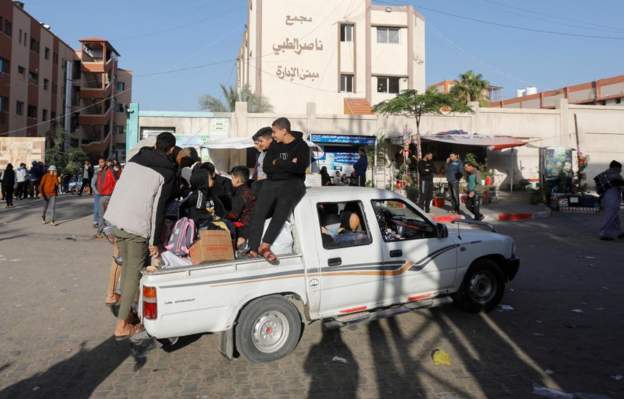
Numerous obstacles to arise if Palestinians attempt to return northward
First, as we’ve been observing, the fighting didn’t stop at 07:00 in Gaza. In fact, there was very intense fighting just before this deadline.
Now we need to see what’s happening on the ground. Israel is strict about people moving back to the north after being told to relocate to the south.
Many Palestinians in Gaza want to go back to their homes and see if they can find anything that wasn’t destroyed. They want to check if their houses are still there and if they can find their belongings.
Some people want to have the ability to bury their deceased loved ones.
Movement inside Gaza is being controlled very strictly and it’s not clear how Israeli forces will handle it if they face resistance. -
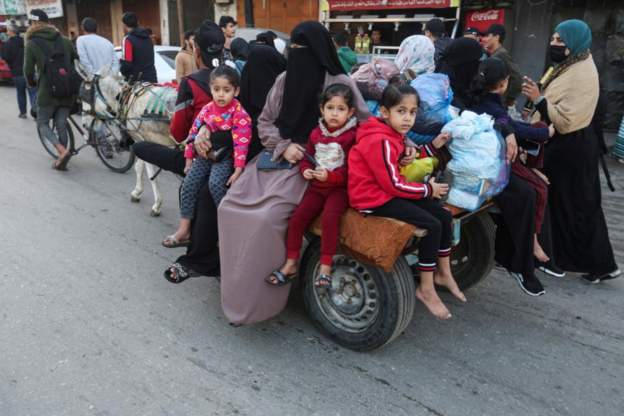
Palestinians in Khan Younis hoping for extended truce
The media talked to people in Khan Younis in southern Gaza about the ceasefire.
Mohammad Meqbil, who had to leave his home in Jabaliya in the north of the territory, said he is happy about the ceasefire, but he still can’t go back home.
“We, the people who live in the north, had to leave our homes because they were bombed. We can’t go back there anymore. ”
“We want to see the people who died for their beliefs, the people who got hurt, we want to see our kids that we had to leave at home,” Meqbil said.
“We want the ceasefire to continue, so everyone can return home,” Meqbil said.Jihan Qanan, who lives in Khan Younis, said she wants the ceasefire to last a long time.
“May God make people peaceful and stop homes from being destroyed. ” “People’s houses fell on them, they had to leave in a hurry and lost everything they owned,” Qanan said. -
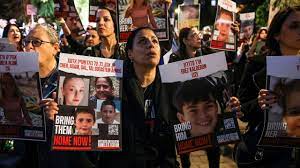
Hostage-prisoner exchange scheme going well so far
It’s been a really up-and-down time for the families of the hostages and for Palestinians waiting for three times as many people to be released from Israeli jails.
On the first day everything is going according to plan. At 2:00 PM GMT, 13 Israeli hostages will be released and handed over to the International Committee of the Red Cross (ICRC). They will then go to Egypt for medical checks before going back to Israel to be with their families.
Israel will let go of 39 Palestinian prisoners once they have them. This will happen over the next three days.
After that, there might be a longer break from fighting if Hamas lets go of 10 hostages each day.
Yesterday there was a problem with the numbers and lists not matching, but now everything seems okay. -
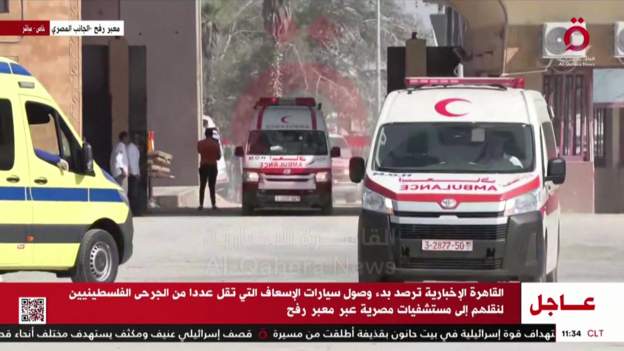
Ambulances from Gaza arrive in Egypt as bridge eventually opens
The first ambulances carrying injured people from Gaza have entered Egypt through the Rafah border, as confirmed by the media.
In Cairo, our team reported that at least seven people have entered Egypt, and they expect more people to come.
We heard that today, 88 Palestinians who got hurt will be allowed to go away, and also around 500 people from other countries will be allowed to leave.More update on this story soon…
-
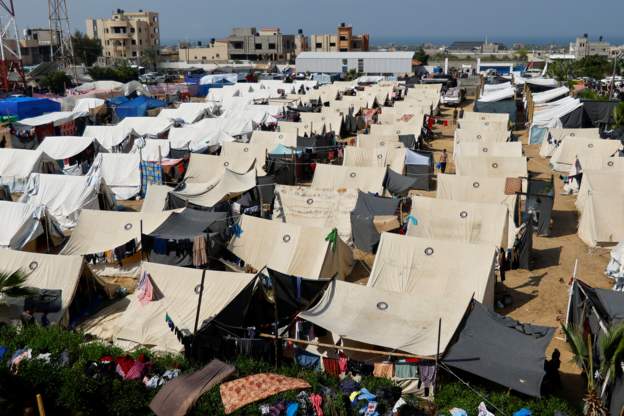
Khan Younis has limited food and water supplies – Gaza refugee
Ghada Ouda, a Palestinian translator who left her home in Gaza City, describes the constant sound of bombing in her surroundings.
Ouda sent a voice recording to the BBC, where he talks about what is happening in the southern part of the area. We don’t have much food or water left. “She says we sleep on the ground. ”
The Palestinians who are living there only have canned food and some vegetables, but it is not enough for them to survive.
“According to her, bread is hard to find. ” We have to travel long distances. It takes you about five hours to get enough bread for everyone in the family, but there still isn’t enough for everyone. -
Israeli attacks killing hundreds of Palestinians as Gaza crisis spread to the West Bank
Ibrahim Wadi, who is 62 years old, and his son, Ahmad, who is 24 years old, were going to a funeral for four Palestinians who were killed by Israeli settlers in their community in the occupied West Bank. While they were driving in their car, they were attacked.
The dad and son were driving in a small village called Qusra, near Nablus. This village has had a lot of violence lately. On Thursday, while they were driving, some armed settlers shot at them. Relatives told CNN that the men were taken to a hospital close by and passed away shortly after because of their injuries.
At least 61 people, including children, have been killed in the occupied West Bank since October 7. Hamas attacked Israel unexpectedly and it was a first-time occurrence. This information comes from the Palestinian Ministry of Health there. Over 1,250 people have been hurt.
The attack by Hamas has caused the death of over 1,400 people in Israel, mostly ordinary people, and it is believed that at least 199 people are being held captive in Gaza, as reported by Israeli authorities.
Israel has declared a “total blockade” in response to the situation and has attacked multiple areas in the Gaza Strip. This has resulted in the deaths of at least 3,478 people. The health ministry in Gaza, which is under Hamas control, has also mentioned the possibility of a ground invasion. Right now, there is growing tension in the West Bank. Palestinians in the area have been involved in conflicts with both Israeli forces and settlers, and unfortunately, some Palestinians have lost their lives.
Hani Odeh, the mayor of Qusra, said to CNN that Israeli settlers freely move around the village with the support of the Israeli police. He told someone from COGAT, an organization in Israel, that he was going to the funeral with Ahmad and Ibrahim.
A little while ago, the Israeli person advised him to choose a different path instead of the usual one to stay away from the settlers in the area. Surprisingly, the road Odeh and the others were told to go on had settlers on it. Sadly, the settlers ended up shooting and killing Ahmad and Ibrahim while they were in their car.
Odeh said to CNN that he saw the attack from his own car while Israeli soldiers were guarding the street. He approached an officer and asked him to make the settlers go away, but nobody took any action. He explained that it seemed like a trap.
CNN asked COGAT and the IDF for a response to Odeh’s claims, but they haven’t received a reply yet.
BrigadierGeneral Hagari said that anyone who tries to oppose us in Judea and Samaria, which are the Jewish names for the West Bank, will face a strong and powerful response.
CNN talked to people who live in the West Bank and they told CNN that they are scared of violence from the Israeli army and security forces. They are also worried about revenge attacks from the approximately 700,000 Israeli settlers who live in that area. In simple words: Recently, there have been a lot of violent incidents in the West Bank, including attacks by settlers. These incidents have been happening more frequently than before, and one attack was so severe that an Israeli military commander described it as a “pogrom. ”
Even before the fighting with Hamas, there was already a lot of tension in the West Bank. Israel started going into the West Bank after there were many attacks from Palestinians. They were looking for places where they believed militants were gathered. The violence caused a lot of deaths among both Palestinians and Israelis, more than at any time in the past ten years.
Days after the violent incident in Qusra, a town with about 7,000 people, the residents are still shocked and upset. Pictures remembering the six people who died cover the walls of houses and buildings. The air feels very sad and empty.
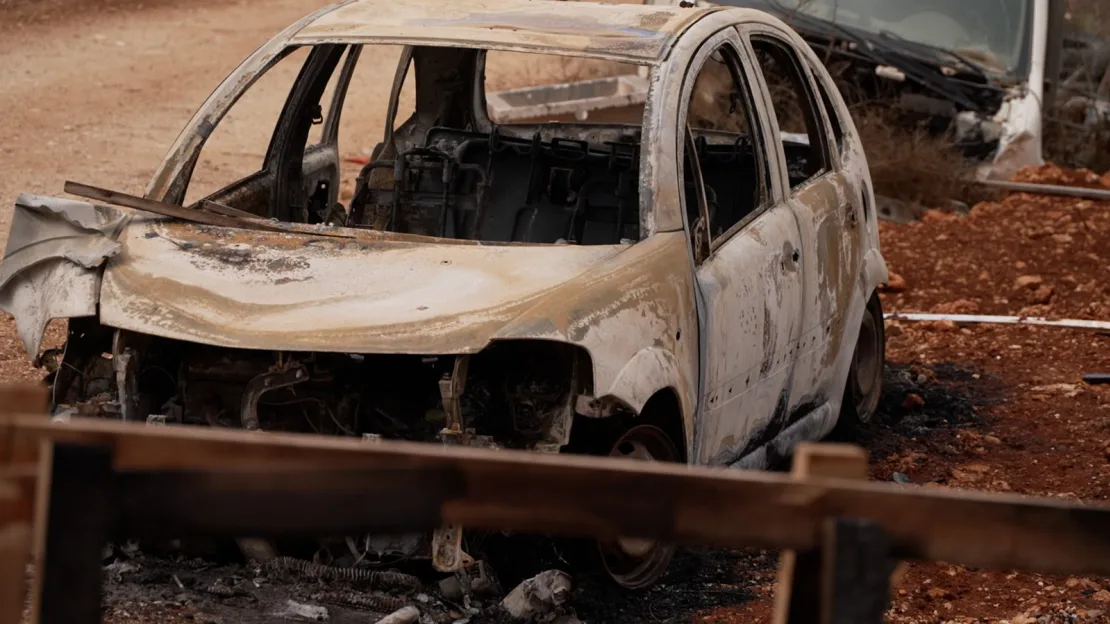
Cars are set on fire, water pumps are damaged, and electricity lines are broken near an apartment building located at the outskirts of the village where the initial four murders happened. There is broken glass all over the floor, and there are bullet holes on the walls.
On October 11, some people with weapons attacked the building. This made the residents ask for help. When a few neighbors came to the place, the settlers started shooting and killed four people. The people who died were Musa’ab Abu Raidi, who was 19 years old, Obaida Abu Srour, who was 18 years old, Hassan Muhannad, who was 22 years old, and Moath Odesa, who was 29 years old.Rabeea, who is 19 years old, and her younger brother Abdulrahman, who is 12 years old, were in their apartment building. They were really scared as they saw the attack happening. The brothers and sisters, who requested CNN to not mention their last name because they worry about punishment from Israeli settlers, described how settlers threw rocks and shot at the building while they, along with their mother, hid inside.
Their big brother and his 6-year-old daughter got hurt and are getting help at a hospital close by. Odeh, who is the mayor, said in an interview with CNN that there were 12 people, including them, who had to be taken to the hospital following the attack.
Rabeea explains that her brother cannot sleep at night because he is feeling very scared to be by himself. CNN visited the family while they were putting their stuff in boxes and getting ready to relocate to a different village.
I feel really upset. “I want to cry, but what can we do. “”I want to remain here, but we are unable to take any action. ”
They have come here in the past. Seven years ago, Rabeea and Abdulrahman told everyone that their father was killed by Israeli settlers close to Nablus. Their family had to move to Qusra because they were scared of getting attacked. Now, they are feeling very afraid to stay, so they are being forced to leave their home once more.
Israel gained control of the West Bank in 1967 during a war and has occupied it since. Israeli citizens have moved into the area, sometimes with military protection. The people who live there hope that the West Bank will become part of a future Palestinian state.
Many countries believe that these settlements break the rules of international law. However, Israeli governments have promised to continue supporting them. Israel sees the West Bank as an area where there is disagreement about who should control it, and they believe that their actions of building settlements there are allowed by the law.
This year, after the election of a very conservative and extreme government in Israel led by Prime Minister Benjamin Netanyahu, there has been increased violence between Israeli settlers and Palestinians in the West Bank.
By mid-September of this year, the United Nations reported that there were 798 incidents caused by settlers in the occupied territory, which resulted in 216 Palestinians getting hurt. During that time, Israeli soldiers caused the death of 179 Palestinians in the West Bank.
The IDF claims that most of the people they target are either suspected of being involved in terrorism or are engaging in violent actions against their troops during raids. However, they do not always provide proof for this claim.
People who have moved to live in a new place have been accused of hurting Palestinians. In addition to killings, these attacks have also involved physical attacks, causing harm to property, and disturbing behavior towards others.
Odeh said that they want to make Palestinians leave their homes and eventually leave the occupied West Bank.
This year, due to global criticism, Netanyahu told Jewish settlers that they can’t take land in the West Bank without the Israeli government’s approval. But with him as the leader, Israel has given permission for a lot of new houses to be built in West Bank settlements.
People in the government who are part of a right-wing group have been accused of causing harm to Palestinians. These government members include National Security Minister Itamar Ben Gvir and Finance Minister Bezalel Smotrich, who are settlers themselves.After Hamas attacked on October 7, Palestinians are facing strict limits on how they can move around the West Bank and between the West Bank and Israel. Israeli military forces have closed off checkpoints and roads, making it difficult for people to travel, as reported by residents speaking to CNN.
Palestinians who live in the West Bank said to CNN that the closure has made a big impact on their daily lives. It has limited their ability to travel for work, school, medical treatment, and other important activities.
During a conversation with US President Joe Biden, Palestinian Authority President Mahmoud Abbas asked for an immediate stop to attacks on people living in Palestinian areas by settlers in the West Bank. He also emphasized the importance of preventing the killing of innocent people on both sides.
At Ibrahim and Ahmad’s house, which was not far from the apartment building that was attacked in Qusra, their family was very sad on Sunday. They could see an Israeli settlement getting closer to their home. The family includes their wives, daughters, and sisters.
Thank goodness, we are powerful. “And if God allows, we will keep having the energy and calmness,” Khitam Wadi, the wife of Ibrahim and mother of Ahmad, told CNN.
My husband really enjoyed his land. He protected his property. “And we will keep doing the same as long as we are alive,” she said.
Clearly upset, Khitam struggled to explain her sadness. But the younger women in the family, even though they were hurting, were determined to stick to their opinions.
I feel unhappy, obviously. All of this has an impact on me, but it doesn’t make me weaker. Aseel, who is Ibrahim’s daughter and Ahmad’s sister, said that we have always experienced the same thing and nothing has changed in our lives.
This is where we live. My dad showed me how important it is to care about and appreciate my country. I will teach my children the same things. And I will stay forever. -
Palestinians worry about ‘speedy’ West Bank annexation in response to Netanyahu’s judicial reform
For almost nine months, many Israelis have been protesting every week against Prime Minister Benjamin Netanyahu‘s plan to change the judicial system. They are worried that it could greatly limit the Supreme Court’s authority, which is the only group that checks the government’s power.
Many Palestinians are scared that if the Supreme Court becomes weaker, it could allow for more Jewish settlements to be built in the occupied West Bank. This could eventually lead to the annexation of the land that Palestinians want for their own state.
Many Israelis have been protesting because they are worried that democracy and human rights are getting worse. However, not many people are talking about how this could affect the over three million Palestinians who live in the West Bank under Israeli control.
Sawsan Zaher, who is a lawyer that defends the rights of Arab minorities in Israel, believes that the consequences of this situation could be very significant. She calls the overhaul a “judicial coup,” saying it could lead to the West Bank being taken over without any criticism or review from the Supreme Court.
Zaher is worried because of the things that the Netanyahu government has done and said since they took office at the end of last year. The group of people in charge of the government includes several individuals from West Bank who have a lot of influence. The agreement they made states that Israel should have control over the West Bank, like it is a part of Israel.
Under Prime Minister Netanyahu’s very conservative government, Israel has given its approval for a very large number of houses to be built in settlements in the West Bank, according to a report by the peace organization Peace Now in July.Many countries and the United Nations believe that the West Bank and East Jerusalem are being controlled by Israel against the law. They also see the Israeli settlements in these areas as illegal according to international law. Israel says that there is an ongoing disagreement about who owns the land and disagrees with the idea that their settlements in that area are against the law.
Many people in Israel agree with their government’s decision to take over more land in areas that are currently controlled by others. A survey done in 2020 by a group in Jerusalem called the Israel Democracy Institute found that over half of Jewish Israelis agreed with the idea of Israel having control over the West Bank. This is something that Netanyahu has expressed he wants.
The overhaul consists of several new laws. The first of these laws was approved in July with a unanimous vote of 64-0. This happened because all members of the opposing party left in protest before the vote. This law takes away the Supreme Court’s ability to say if government decisions are wrong.
People who are in favor of the change believe that the way the judicial system works in Israel is not good and strongly favors the court by giving it too much power. For a long time, some people have been asking for changes in the court system, believing it would help create a fair balance among the different branches of the government.
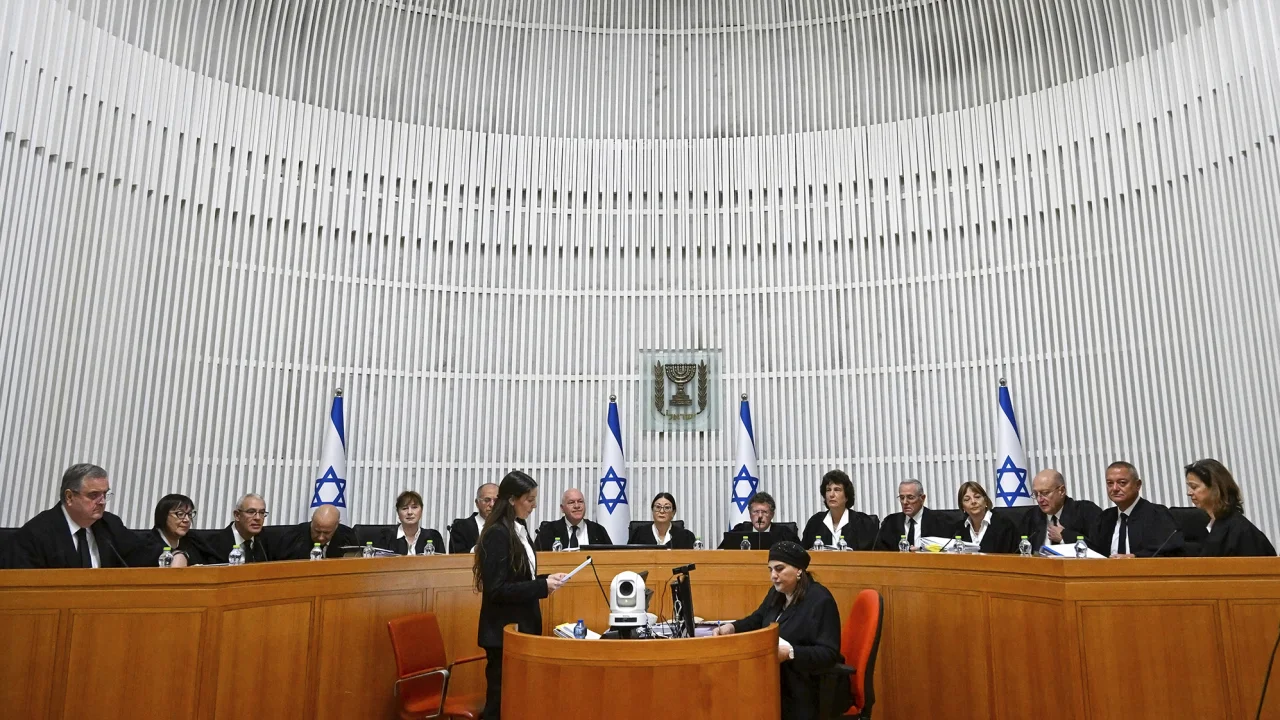
Last week, all 15 judges of the Supreme Court came together for the first time to hear a case about the reasonableness law.
The judges asked both sides’ lawyers many tough questions, making it hard to tell how they will decide. We don’t know when the court will tell us if they think the reasonableness law is fair or not.
This decision could be very important because the reasonableness law changes one of Israel’s 13 fundamental laws. Israel is different from many other countries because it doesn’t have a written constitution. Instead, it depends on fundamental rules and previous court decisions that might eventually become a constitution. The court has never invalidated a Basic Law or a change to it.
Zaher told CNN that the main goal of the judicial coup is to prevent the Supreme Court from reviewing Basic Laws or government decisions.
Experts say that the Supreme Court of Israel usually supports the expansion of settlements in Israel, but sometimes it allows Palestinians to seek legal remedies in limited situations.
Eliav Lieblich, a professor of law at Tel Aviv University, stated that the court has never prevented the settlement movement from progressing. “It never decided whether the settlement projects were legal or not. ”
According to Lieblich, it helped in offering special protections when the land or property of Palestinians was taken or used for settlements.
Zaher stated that Palestinians have never thought the Supreme Court supports their cause. Netanyahu’s changes might eliminate any remaining ways to oppose policies seen as violating their rights.“Zaher estimated that the Supreme Court did not protect Palestinian rights in the West Bank in 95% of cases. ”
Palestinians in the West Bank have different laws compared to Israelis. They have to follow the rules of different authorities, like the Palestinian Authority and Israeli military laws. Palestinians living in the West Bank can ask Israeli courts to make decisions against their houses being taken away, destroyed, or their lands being seized. However, it may be difficult for their petitions to be successful.
Human rights groups say that the Supreme Court mostly agrees to destroy the homes of Palestinian families involved in attacks on Israelis. They hardly ever side with Palestinians who try to stop this from happening. The practice has received negative feedback from rights groups because it is seen as a form of punishment for a whole group of people. Israel believes that by taking actions to prevent and discourage future attacks, it can make sure they do not happen again.
Palestinians have occasionally experienced some uncommon successes. In 2005, the highest court told the government to find a different path for some of its security wall in the northern West Bank, so that it wouldn’t cause too many troubles for the Palestinians. A year before, the International Court of Justice in The Hague stated that the whole barrier is against the law.
In 2012, Israel’s highest court said that some Palestinian people who owned land should take down five buildings. These buildings were built by Israeli settlers in the West Bank near a Palestinian village called Dura al-Qara.
In 2017, Israeli security forces destroyed nine houses that were illegally built on Palestinian land in a West Bank village called Ofra. The people living in the settlement of Ofra asked a court to let them stay in their homes, but the court said they need to leave and their homes will be destroyed. The court decided in 2015 that the building should be knocked down. The case was filed by a group helping the person who owns the land 7 years before that.
In some situations, rulings that were initially in support of Palestinians have been changed to be against them. Last year, something unusual happened when the high court made a decision. They ruled that a settlement outpost – Israeli houses in the West Bank that were built without permission from the government – can stay on private Palestinian land. This happened even though the court had originally said that the outpost should be taken away almost two years ago.
Palestinians believe that if the Netanyahu government continues to expand settlements, there will be even less control on expansion when the Supreme Court is no longer a bureaucratic obstacle for the government.
Zaher said that the annexation might happen much faster than expected.
Ahmed Tibi, a Palestinian-Israeli member of Israel’s parliament and leader of the Ta’al party, stated that the reasonableness law is supported by far-right ministers Bezalel Smotrich and Itamar Ben Gvir, who are both settlers. According to Tibi, these supporters want to manipulate the legal system to make it easier to take over land that is currently under the control of others.
Tibi told CNN that many ideas in the judicial overhaul would help the settlers. Anything that helps the settlers become stronger makes the Palestinians become weaker.
Gershon Baskin, who runs the Holy Land Bond investment fund, thinks that Netanyahu’s plan for the courts is mainly focused on expanding settlements in East Jerusalem.
Baskin said that if Netanyahu succeeds in implementing the reform, the limited opportunities that Palestinians have within the Israeli High Court will be taken away in the near future.
If the Supreme Court is weakened and not able to review government decisions, it would be easier to formally annex the West Bank, although this is seen as an extreme possibility. He said that if judicial review becomes weaker, it would be easier to slowly take actions that could effectively lead to annexation.
He said that if you reduce the power of judicial review, you give more power to the executive branch. This is already a situation where one side gains while the other loses, between Israel and the Palestinians. -
Five Palestinians killed in explosion near Gaza border wall
The burials have happened for five Palestinians who died in a blast in Gaza near the wall separating Israel.
Many people had joined two gatherings when the explosion happened on Wednesday evening.
The Israeli army said that some people tried to throw a bomb at their soldiers.
A Palestinian security source told the BBC that a homemade device, typically used to make a loud and annoying sound that can cause trouble, exploded while young men were trying to throw it.
Palestinian medics say that more than 20 people got hurt.
The IDF said that the protesters had already thrown explosives and grenades at soldiers before.
The IDF has shared a low-quality black and white video that shows an explosion near a strong wall built by Israel around Gaza. In the video, we can see a group of people quickly moving away from the explosion.
A video from Palestine was shown to the BBC. In the video, a lot of young men were near the Israeli barrier, about 2 meters away. Suddenly, there was a big explosion that seemed to immediately kill some of the protesters. You cannot see any Israeli military.
Saif Muhareb, a person who saw something, said he was with a group of about 50 individuals.
We discovered a dark thing that resembled a camera – it measured 10 centimeters wide and 50 centimeters long. I was standing at the back when someone touched it and it blew up.
There were big protests between 2018 and 2019 called the Great March of Return.
Israeli soldiers shot at people protesting every week, causing over 300 Palestinians to die and many others to get hurt, says the Palestinian health ministry. The Israeli army said it fired at individuals attempting to enter its land.
On Wednesday, there was a protest organized by Palestinian political groups, including the Hamas group that controls Gaza, to remember when Israel left the Gaza strip in 2005 without any agreement. Another protest was organized to express solidarity with Palestinian prisoners who are currently being held in Israeli prisons.
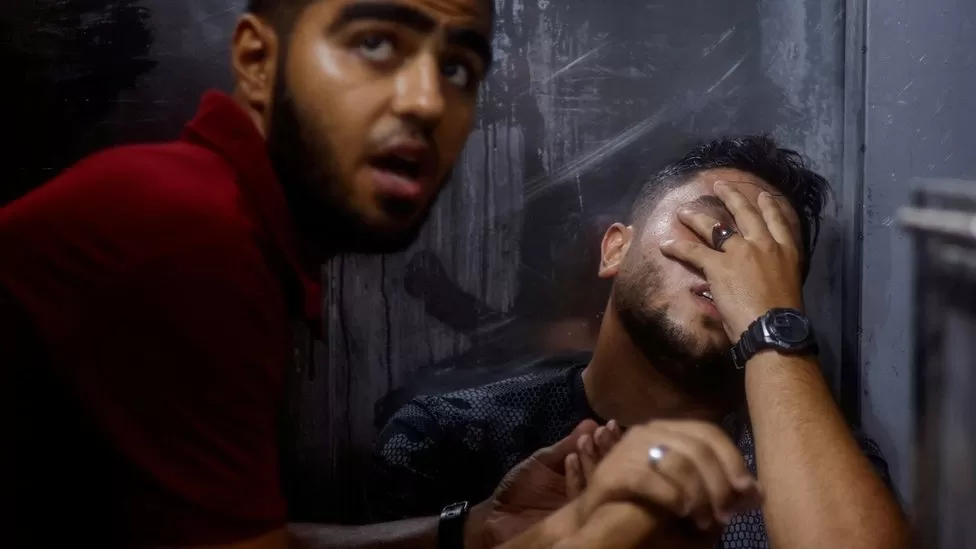
On Thursday morning, a group of people who were sad got together to move the dead bodies of the people who died in the big blast from Shifa Hospital, which is in the middle of Gaza City.
Wael al-Zard, who is a leader in the local Hamas group and gives religious talks at the big Mosque, had his son Baraa died. Baraa was 18 years old.
“He said that he feels very sad and his eyes are crying because he lost his son, who brings him a lot of happiness. ”
But we are grateful to God that I am proud to be the father of a hero who gave his life for his country. He made me feel confident and proud. -

Palestinians specify conditions for approving historic Saudi-Israeli agreement
The Palestinians want a lot of money and more power over the land in the West Bank if the United States, Saudi Arabia, and Israel work together.
Officials from the Palestinian Authority (PA) met with Saudi representatives in Riyadh on Wednesday for discussions.
They were also going to meet American officials.
Many people believe that for a long time, Americans have been working towards an important agreement to make Israel and Saudi Arabia have more normal and friendly relations.
It means that Washington would support and financially back it, and it would involve an important agreement on security that the Saudis are trying to make with the US. However, there are many obstacles that make it difficult to reach these agreements, and they may not happen anytime soon.
White House National Security Adviser Jake Sullivan said on Tuesday that we shouldn’t expect any immediate announcements or significant advancements in the near future.
But, because there is potential for big changes in the relationships between countries in the Middle East, people are still wondering about the specific details of any agreement. American diplomats have been traveling to places like Riyadh, Amman, and Jerusalem to talk and negotiate with officials there.
US President Joe Biden will probably view a Saudi-Israel agreement as a significant achievement in his foreign policy. He sees it as an opportunity to impress voters before the upcoming election next year.
Saudi Arabia is a powerful country among the Arab and Muslim nations. It has never officially acknowledged Israel since it was formed in 1948.
Last month, the Israeli Prime Minister, Benjamin Netanyahu, said that we are going to see a very important change in history.
However, any agreement would be highly disputed and cause disagreement among people.
Saudi Arabia wants advanced weapons from the US and a nuclear program that includes uranium enrichment in exchange for recognizing Israel.
Israel wants to have good trade and defense relationships with the Gulf superpower and become more connected to the region. This is because they have been trying to integrate themselves into the area, which other Arab countries have also recently done.
These agreements mostly deal with keeping things safe and assisting in buying and selling goods. In 2023, Saudi Arabia also wants to be part of this, according to Diana Buttu, a former legal adviser to the Palestinian negotiating team during peace talks with Israel.
In order for an agreement to be successful, it must include significant compromises from Israel that benefit the Palestinians.
Saudi Crown Prince Mohammed bin Salman, who essentially runs the country, has to calm down the people of Saudi Arabia – who have traditionally not liked Israel and are very supportive of the Palestinian cause.Meanwhile, President Biden also needs to show that he has made important progress for the Palestinians in order to receive support from his Democratic Party. A lot of people in the party don’t like the idea of giving benefits to Saudi Arabia because of their bad human rights record and their involvement in the war in Yemen. They also don’t like the idea of giving a reward to Israel’s current government, which they think is making things worse in the West Bank and causing a lot of problems in Israel too.
A group of important Palestinian officials, including two men who are very close to President Mahmoud Abbas, met with the Saudi national security adviser in Riyadh. The officials are Majed Faraj, the intelligence chief of the Palestinian Authority, and Hussein al-Sheikh, the secretary-general of the Palestine Liberation Organisation.
They gave a list of things they wanted in order to participate in the American-supported process. This happened during a meeting with US Assistant Secretary of State Barbara Leaf last week in Amman. The Palestinian official said to the BBC that they have some things they want, such as certain requests or requirements.
Moving some areas of the West Bank, which are currently controlled completely by Israel (called Area C under Oslo peace agreements in the 1990s), to be governed by the Palestinian Authority.
Israeli settlement growth in the West Bank coming to a full stop.
Saudi Arabia is starting to give money again to the Palestinian Authority (PA) after reducing and stopping it completely three years ago. They will give around $200m (£160m) every year.
The US consulate in Jerusalem, which was closed by President Donald Trump, will now be reopened. This consulate is a diplomatic office that works with the Palestinians.
Starting again the discussions between Israel and the Palestinians that were put on hold by former Secretary of State John Kerry in 2014, with the help of the US.
These changes are very important – the Americans think that the Palestinians are asking for too much. But the unofficial Palestinian stance on Saudi-Israel normalisation is very different from their official position. The official position is that they completely reject normalisation unless it leads to the creation of an independent Palestinian state.
This text talks about the Arab Peace Initiative, a plan from Saudi Arabia in 2002. The plan offered to recognize Israel if Israel gives back the territories it took and allows Palestine to have their own state in the West Bank and Gaza, with its capital in East Jerusalem.
MsButtu says that the current approach shows that the Palestinian leadership is in a difficult situation.
“Palestinians mostly do not want to participate in any of these normalization deals because the support from the Arab world is the only thing we have left,” she explained.
We were told that we cannot fight back using violence. We are informed that we cannot use the law to ask for the occupation to stop. “We are being told that we are not allowed to participate in boycotts, divestment, and sanction actions. ”
The Palestinian Authority is now considering whether they should try to make their demands heard and achieved or continue to ignore them like they did in 2020. Regardless of what they choose, Ms. Buttu believes they will fail either way.In 2020, three Arab nations – the United Arab Emirates, Bahrain, and Morocco – made agreements to have normal relations with Israel. These deals were arranged by the United States, led by President Trump. Another country, Sudan, also promised to work towards having a friendly relationship with Israel that same year. But things stopped because people in the country disagreed, and then there was a military takeover the next year.
This was considered a big change in the relationship between old enemies in the Middle East. It included improvements in diplomacy, trade, and security connections. But people who criticize the situation pointed out that the United States also offered tempting benefits, such as giving Arab autocratic governments access to high-quality weapons made in America.
At the time, the Palestinian Authority was excluded from talks because it refused to have diplomatic relations with the United States. This was in response to President Trump’s peace plan that heavily favored Israel and his decision to relocate the US embassy to Jerusalem. The PA thought that the normalisation deals were a betrayal of unity among Arab countries.
Instead, another important Palestinian leader suggested that engaging with the Saudis at this time could be a way to remind Riyadh about the Arab Peace Initiative’s main goal – which is the creation of a separate Palestinian state. This way, the Palestinians wouldn’t be left out of the entire process.
However, if the Palestinian leadership decides to get involved, it may face major risks because they are already disliked by their own people. This is especially true if the benefits of getting involved are seen as unimportant or insignificant.
After the UAE-Israel normalization in 2020, most Palestinians believed that the deal was a betrayal of their cause and only benefited Israel.
If Israel gives in to the Palestinians, the ultranationalists in Mr. Netanyahu’s group will likely say no, which will make it even harder to reach an agreement. Earlier this year, Mr. Netanyahu ignored the concessions made by the Palestinians, considering them just as something to mark off a list. He believed these concessions would not be included in any meaningful discussions between the United States and Saudi Arabia. -

US denounces Israeli minister’s remarks on Palestinians
The US has criticized Itamar Ben Gvir, Israel’s national security minister, for saying that his rights in the occupied West Bank are more significant than the rights of Palestinians.
The state department said it strongly disapproved of the hurtful words and any racist talk.
His comments on Israeli television caused a lot of negative feedback on the internet.
Mr Ben Gvir said that the news coverage was not true and criticized the radical left for misrepresenting his words.
On the platform called X (previously known as Twitter), Mr. Ben Gvir criticized Bella Hadid for sharing a video of his remarks. He called her an “Israel hater” and accused her of making him appear racist and negative.
Ms Hadid shared the video on Instagram, and she has 60 million people who follow her there. She wrote a comment with the video saying that no life should be considered more important than another, no matter where or when.
MrBen Gvir is the leader of the ultra nationalist party called “Jewish Power,” and they support racist and anti-Arab policies. He has been found guilty in the past for encouraging racism and backing terrorism.
In December, Prime Minister Benjamin Netanyahu made him a high-ranking official. He was given a position in the security cabinet and put in charge of the police within Israel and its border police force operating in occupied East Jerusalem and the West Bank.
On Wednesday, there was a lot of violence where Palestinian gunmen killed three Israelis in different attacks. One attack happened near the city of Hebron in the West Bank, where Mr. Ben Gvir lives in a Jewish settlement.
This caused more limitations on the movement of many Palestinians as Israeli forces looked for the armed individuals.Ben Gvir believes that my right, my wife’s right, and my children’s right to freely travel on the roads of Judea and Samaria are more important than the Arab’s right to move around. He used a biblical term for the West Bank to refer to the area.
He then spoke to Mohammad Magadli, a journalist from Israel who is Arab, in the studio. He said, “I’m sorry Mohammad, but what I just said is the real situation and it’s the truth. ” My life is more important than their ability to move.
A video of people’s comments became very popular on the internet and caused a negative response, including from Palestinians and Israeli politicians who disagree with the government.
The leaders of the Palestinian Authority strongly criticized the racist and terrible comments made by Israel’s minister Itamar Ben Gvir. They believe that these remarks confirm Israel’s unfair system of favoring Jewish people and promote fear among Palestinians.
It requested that Mr. Ben Gvir and other Israeli officials be punished and responsible for their actions.
Karine Elharrar, a member of the Yesh Atid party who disagrees with the government, called the minister a true representative of a very racist and extremist government that we have never had before.
MrBen Gvir has a background in Kahanism, which is a very racist movement that supports removing Palestinians from their homes forcefully.
An American spokesperson from the US state department said they strongly disagree with Israeli minister Ben Gvir’s hurtful comments about how Palestinian people can move around in the West Bank.
“We strongly denounce all racist speech. It is especially harmful when powerful people spread such messages, and it goes against the goal of promoting respect for the rights of every person. ”On Friday, the EU criticized Mr. Ben Gvir’s comments and expressed disapproval. They emphasized that democracy and human rights are very important in the partnership between the EU and Israel, especially when it comes to the people living under occupation in Palestinian territory.
Palestinians in the West Bank currently face strict limitations on their ability to move around freely. They are unable to travel to Jerusalem or their family’s lands in Israel unless they have special permits. The Israeli government says they do this to make sure everyone stays safe.
Political parties that speak for Arab Israelis, who are Palestinian citizens of Israel, along with Israeli groups against the occupation, criticized Mr. However, they acknowledged that he was just expressing well-established facts in the West Bank.
In response to the statement from the US state department, Ahmed Tibi, an Arab Israeli MP, said that Ben Gvir, who was described as an important minister in Israel, supports the broad and overall Israeli policy that has been in place since 1967. Why are you crying about the description of a racist apartheid reality instead of acknowledging the actual reality.
B’tselem, an organization in Israel, helps Palestinians living under the control of the Israeli military. They said, “This is what we see happening every day for fifty years now. ” The rights of the Jews are seen as more important than the rights of the Arabs, and this is similar to how apartheid works.
MrBen Gvir blamed the “Israeli radical left” for misquoting him and accused them of selectively choosing his comments. This statement was posted online in English, possibly as a response to the global reaction to his remarks.
He explained that fake news spreads by twisting words. He mentioned that in a TV show, he expressed the belief that the safety of Jewish people is more important than the ease of travel for Arabs in Judea and Samaria. That’s why it’s important to have checkpoints on roads where Jewish people are often targeted by terrorists and jihadists who shoot at them.
“He said that this is exactly how the Left continues to provoke and encourage negativity towards the Israeli government worldwide. ”
After the attack on Monday, Israeli forces started putting up checkpoints at the entrances and exits of Hebron. They were talking to Palestinians and looking for the people who killed Batsheva Nigri. She was a 40-year-old nursery teacher and a mother of three who lived in a nearby settlement.
On that day, an Israeli soldier shot a Palestinian man in the head and he was badly hurt. It happened in a village close to Nablus. A video showed him without a weapon, running towards someone who was hurt. Then, he got hit by one shot.
Last week, a 15-year-old boy from Palestine was shot in the head by Israeli forces in East Jerusalem and he is now in serious condition. The police claimed that he tried to throw a homemade explosive at them while they were conducting a search.
On the same day, a video showed that Israeli soldiers shot and injured a Palestinian man. The man was not carrying any weapons and is reported to have mental health issues. The incident took place during a protest near the separation barrier in Qalqilya, Israel. -
Israeli forces conduct deadly attack in Jenin, West Bank
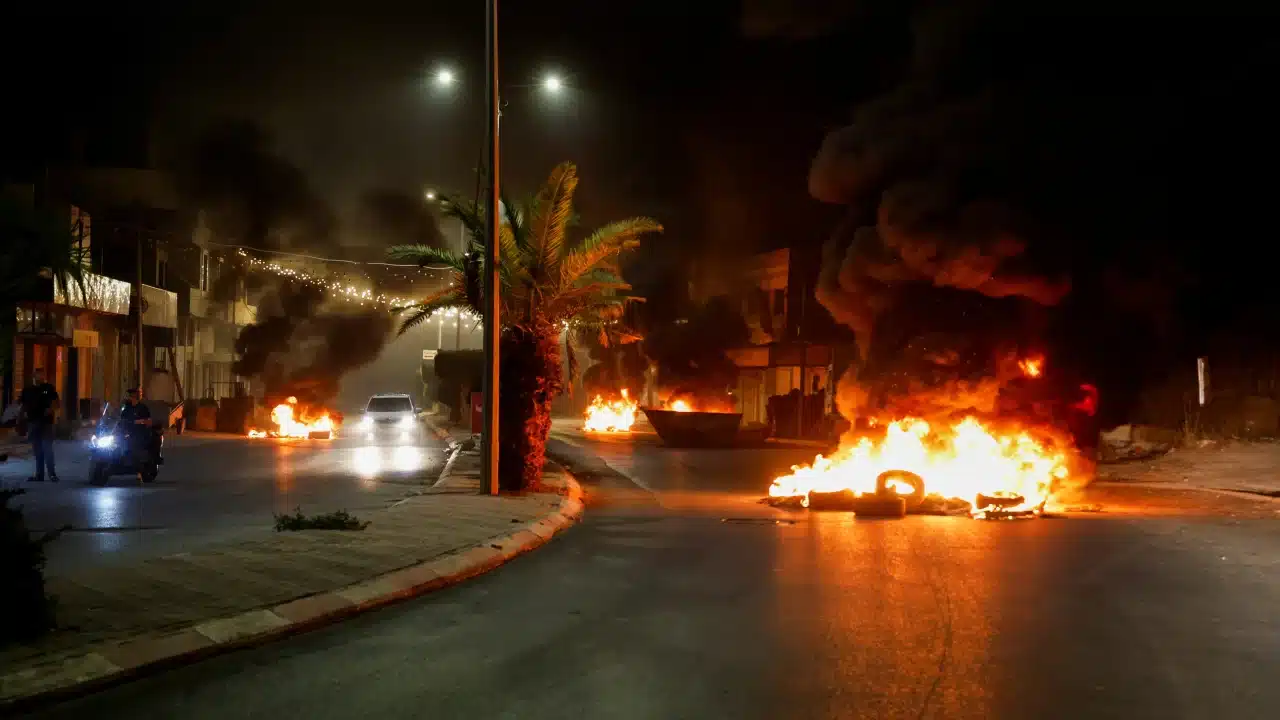
At least three Palestinians were killed and 25 others were hurt as Israeli forces conducted a significant military operation in Jenin in the northern West Bank overnight on Sunday, according to the Palestinian Health Ministry.
The Israeli Defence Forces (IDF) said in a statement that it started an “extensive counterterrorism effort in the area of the city of Jenin and the Jenin Camp” and that it struck “terrorist infrastructure” in the early hours of Monday morning.
Residents of Jenin reported hearing explosions and a lot of gunfire in the neighbourhood to CNN, while footage from the scene showed wounded Palestinians being transported to the hospital by ambulance.
Of those injured, seven are critical, according to the Palestinian Ministry of Health. Mahmoud al-Saadi, director of the Palestinian Red Crescent in Jenin, said most of the injuries are “serious and in the upper part of the body,” adding the process of transferring the injured has been difficult.
Footage shared with journalists appeared to show operations ongoing in parts of the Jenin refugee camp and Israeli military vehicles on the streets of Jenin on Monday morning. CNN has not been able to independently verify the videos.
The IDF said it struck a joint operational command center for the Jenin Camp and operatives of the Jenin Brigade, a Palestinian militant group associated with Islamic Jihad.
“The operational command center also served as an advanced observation and reconnaissance center, a place where armed terrorists would gather before and after terrorist activities,” the IDF said, adding that the camp was a “site for weapons and explosives” and “hub for coordination and communication among the terrorists.”
“Additionally, the command center provided shelter for wanted individuals involved in carrying out terror attacks in recent months in the area,” it said.
The IDF later said it had seized explosive devices during the operations, which were carried out in coordination with the Israel Securities Authority (ISA).
Israeli Defense Minister Yoav Gallant said in a statement the IDF have been “operating against terror hotspots” in Jenin and that “anyone who harms the citizens of Israel, will pay a heavy price.”
“We are closely watching the actions of our enemies and Israel’s defense establishment is prepared for every scenario,” the minister said.
The Jenin Brigade claimed it had severely damaged at least one Israeli military vehicle with improvised explosive devices and its militants continue to clash with Israeli forces “to prevent its advance inside the camp.”
Palestinian Islamic Jihad said it will face its enemy “with all possible retaliation options,” in response to the Israeli operations in Jenin.
“The aggression on Jenin will not achieve its targets, Jenin will not surrender. We will face the enemy with all possible retaliation options in response to the enemy aggression on Jenin,” the militant group posted to its official Telegram channel.
Palestinian Authority President Mahmoud Abbas condemned the large-scale Israeli military operation, calling it “a new war crime.”
“Security and stability will not be achieved in the region unless our Palestinian people feel it. What the Israeli occupation government is doing in the city of Jenin and its camp is a new war crime against our defenseless people,” he said, according to presidential spokesman Nabil Abu Rudeineh.
The raid comes less than two weeks after an Israeli military raid on Jenin erupted into a massive firefight, leaving at least five Palestinians dead and dozens wounded. Eight Israeli troops were injured and successfully evacuated, according to the IDF.
In a separate incident, a 21-year-old man, identified as Muhammed Hassanein, was shot and killed by Israeli forces at the northern entrance of Al-Bireh near Ramallah in the West Bank, according to the Palestinian Ministry of Health on Monday. The IDF has not yet commented on the incident.
-
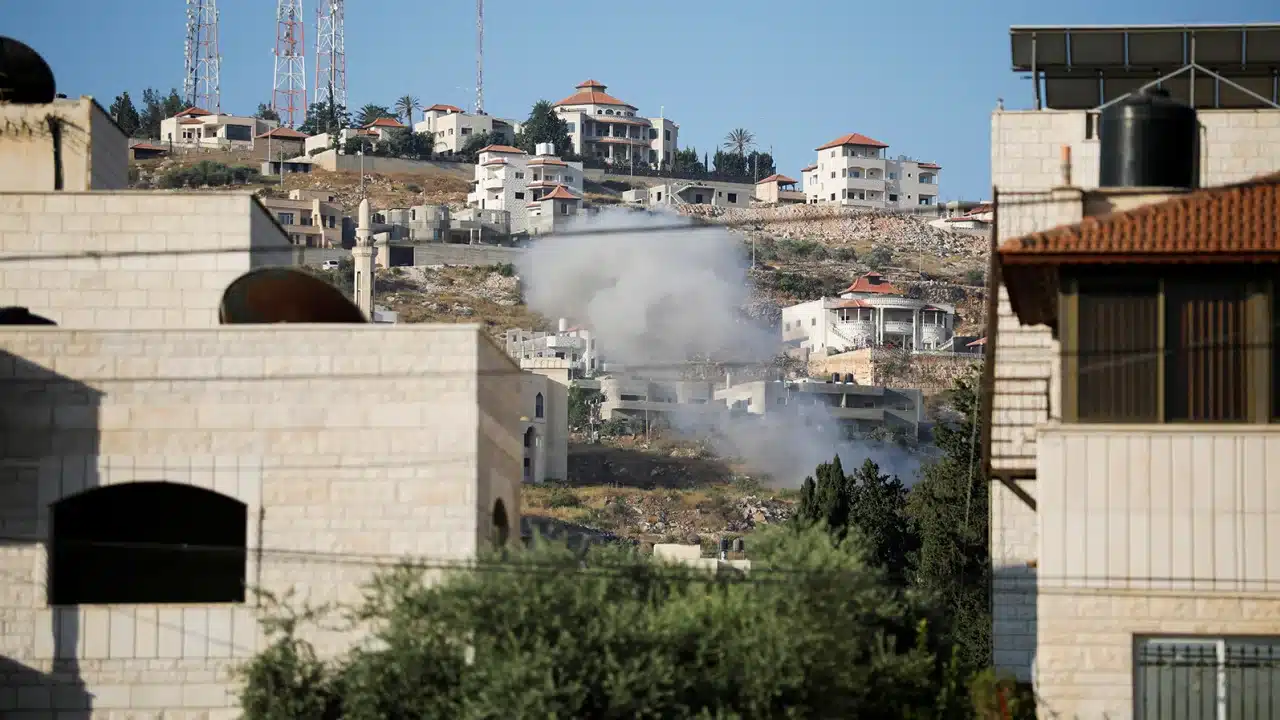
Three Palestinians killed in massive battle as Israeli forces attack Jenin
Authorities reported that at least three Palestinians were killed in a large-scale firefight that broke out Monday in the occupied West Bank city of Jenin between Israeli armed forces and Palestinian militants.
One of the three fatalities, according to the Palestinian Ministry of Health, was a teenager, and the conflicts also left more than two dozen people injured.
According to the Israel Defence Forces (IDF), attack helicopters from the Israeli Air Force began firing over Jenin to assist Israeli troops in leaving the city.
It was the first time since the Second Intifada that Israeli helicopters had opened fire while evacuating wounded troops, Israel Army Radio reported. The Second Intifada – a major Palestinian uprising – ended in 2005.
Army Radio said the wounded Israeli soldiers had been successfully evacuated.
The Jenin Brigade, a locally based militant group, said its fighters had fired at an Israeli helicopter, forcing it to retreat, and said they had managed to immobilize Israeli military vehicles with gunfire and ambushes.
The firefight was still ongoing as of 10:45 a.m local time (3:45 a.m. ET), doctors speaking on Palestine TV said.
The Palestinians killed included two men in their 20s: Khalid Azam Asa’asa, 21, and Qasam Faisal Abu Seriya, 29, and teenager Ahmed Youssef Saqer, who was 15, the Palestinian Health Ministry said, citing hospitals in Jenin.
Some 31 Palestinian people were wounded, including a girl with a critical head injury, the ministry said.
The IDF and Border Police said they were carrying out an operation to arrest two wanted suspects in Jenin when “a massive exchange of fire took place.”
They were attacked with gunfire and hurled explosive devices and responded with live fire, hitting people, the IDF said.
An IDF vehicle was hit by an improvised explosive device on the way out, video from the scene showed.
-

Nine Palestinians killed in Israeli raid in Jenin
Nine Palestinians, including an elderly woman, have been killed in an Israeli military raid in the occupied West bank, Palestinian officials say.
The Palestinian health minister warned that the situation was “critical” in Jenin, with many other people injured and ambulances unable to reach them.
The children’s ward of a local hospital was hit by Israeli tear gas, she said.
Israel’s military released few details, but Israeli media said it had acted to foil “a major attack” by militants.
The Palestinian militant groups Hamas and Islamic Jihad said they were battling Israeli troops in the flashpoint town, where there have been repeated Israeli raids.
Tensions have recently risen in the West Bank as the Israeli military continues what it describes as an anti-terrorism offensive.
At least 29 Palestinians have been killed by Israeli forces in the West Bank so far this year, including militants and civilians.
Last year, more than 150 Palestinians were killed, nearly all by Israeli forces, while a series of Palestinian attacks targeting Israelis, as well as militant gunfire at troops during arrest raids, killed more than 30 people, including civilians, police and soldiers.
Source: BBC
-
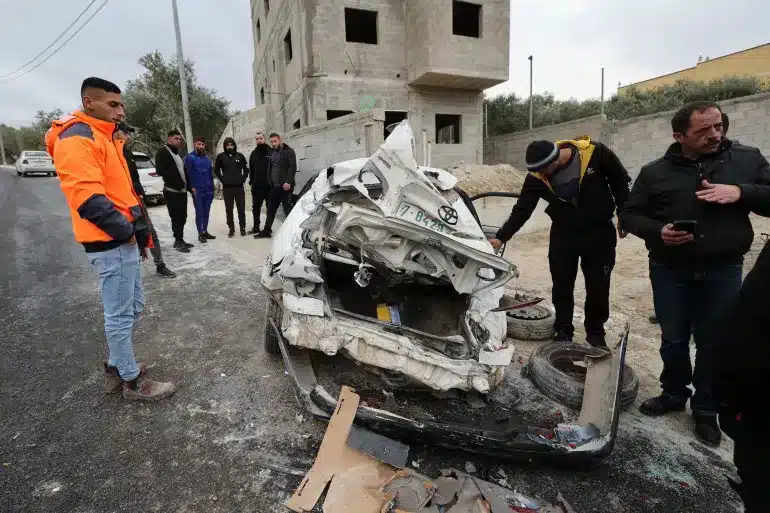
Two Palestinians shot dead by Israel troops in occupied West Bank
Israeli troops have shot dead two Palestinian men in the occupied West Bank during an army raid near a flashpoint town.
The two men – Ezzedine Bassem Hamamreh, 24, and Amjad Adnan Khaliliyeh, 23 – were killed on Saturday “during an assault on the village of Jaba, south of Jenin”, the Palestinian Ministry of Health said.
The Palestinian Islamic Jihad group said Hamamreh and Khaliliyeh were its members. In a statement, the group condemned the killings, describing the two men as “heroic martyrs”.
It said they were killed while trying to intervene against the “occupation forces, which were carrying out a cowardly assassination operation”.
A third Palestinian, 19-year-old Yazen Samer Ja’abari, died of injuries he received when he was shot by Israeli forces on January 2, the ministry added. Ja’abari was wounded in the village of Kufr Dan near Jenin during an army raid, in which two other Palestinians were killed.
The latest deaths bring to 12 the number of Palestinians killed this year by Israeli forces in the West Bank, occupied by Israel since 1967. The number includes three minors. The Israeli military has been engaged in a campaign of intensified raids and killings that has lasted almost a year.
Since a string of attacks carried out by Palestinians in Israel that began in March, the Israeli army has launched a campaign called Break the Wave, which has included near-daily raids, mass arrests and killings in the occupied West Bank with a focus on Jenin and Nablus, where Palestinian armed resistance has grown more organised over the past year.
-

Israel rescinds travel permits of senior Palestinian officials
In the midst of various punitive measures by the new right-wing government, the Israeli entrance permits for the Palestinian foreign minister and three Fatah officials have been revoked.
As part of a series of sanctions against the Palestinians that Israel’s new hardline government declared days ago, the Palestinian foreign minister claims that Israel has withdrawn his travel authorization.
According to a spokesperson for the Israeli defense ministry, the action is part of the implementation of a cabinet decision made on Friday to punish the Palestinians for pressuring the world body with the highest authority on justice to express its position on the Israeli occupation.
On Saturday, Israel said it had revoked entry permits for three senior officials from Palestinian President Mahmoud Abbas’s Fatah party after they visited a Palestinian citizen of Israel recently released from prison.
Mahmud al-Alul, Azzam al-Ahmad and Rawhi Fattouh had visited Karim Younis in his home village of Ara in northern Israel following his release on Thursday after serving a 40-year sentence for killing an Israeli soldier.
“The three men took advantage of their status and entered Israel this morning [Saturday] to travel to the home of the terrorist Karim Younis,” the office of defence minister Yoav Galant said in a statement later on Saturday. Galant ordered their Israeli entry permits be revoked in response, it said.
The moves follow a decision on Friday by Israel’s security cabinet to withhold $39m in revenues from the Palestinian Authority and impose a moratorium on Palestinian construction projects in most of the Israeli-occupied West Bank.
The office of Prime Minister Benjamin Netanyahu said that decision was in response to the UN General Assembly’s recent vote to refer Israel’s occupation of the Palestinian territory to the International Court of Justice at the PA’s request.
Israel’s Security Cabinet also said it would further deduct revenue it typically transfers to the cash-strapped PA – a sum equal to the amount the authority paid last year to families of Palestinian prisoners and those killed in the conflict, including those implicated in attacks against Israelis.
The Palestinian leadership describes the payments as necessary social welfare, while Israel says the so-called Martyrs’ Fund incentivises violence. Israel’s withholding of the funds threatens to exacerbate the PA’s fiscal woes.
“Israeli blackmailing of our tax revenues will not stop us from continuing our political and diplomatic struggle,” said Palestinian Prime Minister Mohammad Shtayyeh. He added that the Israeli measures will deepen the Palestinian financial crisis and budget shortfall.
Netanyahu took office late last month at the head of a coalition with far-right and Jewish ultra-Orthodox parties that is regarded as the most right-wing in Israeli history.
Source: Aljazeera.com
-
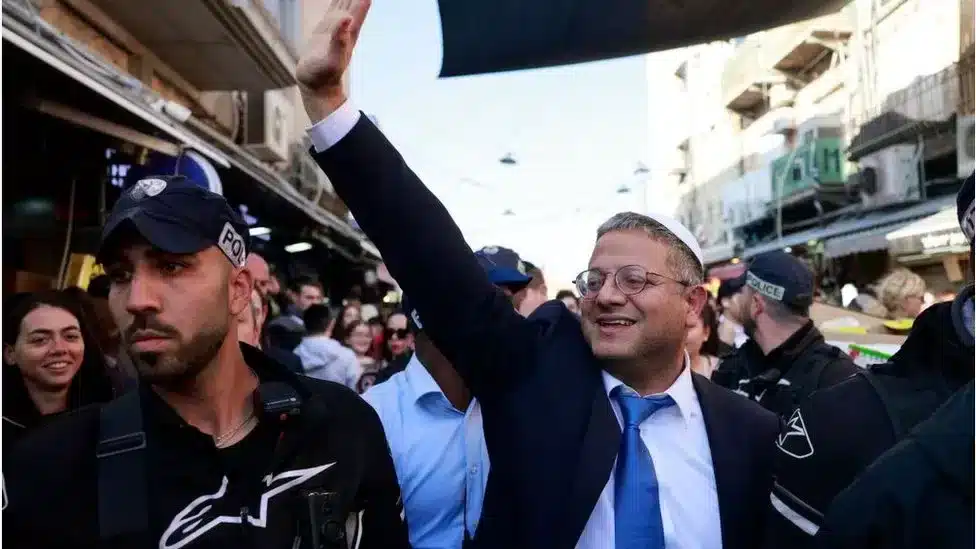
Jerusalem: Far-right Israeli minister pays a visit to the flashpoint site
A far-right Israeli minister’s visit to a contentious holy site in Jerusalem has been denounced by Palestinians as a “unprecedented provocation.”
Itamar Ben-Gvir, the minister of national security who has called for a tougher stance against the Palestinians, toured the area while being guarded by law enforcement.
Israel and the Palestinians are bitterly divided by competing claims to the compound.
With the election of Israel’s new nationalistic government, tensions have increased.
Mr Ben-Gvir’s visit was his first public act since the government, led by Prime Minister Benjamin Netanyahu, was sworn in five days ago.
The hilltop site is the most sacred place in Judaism and third holiest in Islam. It is known to Jews as the Temple Mount, site of two Biblical temples, and to Muslims as Haram al-Sharif, the site of Muhammad’s ascent to Heaven.
Jews and other non-Muslims are allowed to go there but not pray, though Palestinians see visits by Jews as attempts to change the delicate status quo.
The most religious and hard-line government in Israel’s history has been sworn in.
Benjamin Netanyahu returns as prime minister, after his Likud party formed a coalition with ultranationalist and ultra-Orthodox Jewish allies.
There is domestic and international concern it will inflame the conflict with the Palestinians, damage the judiciary and restrict minority rights.
Mr Netanyahu has promised to pursue peace and safeguard civil rights.
Addressing a special session of the Knesset (parliament) in Jerusalem, he stated that his administration would “restore governance, peace and personal security to the citizens of Israel”.
“I hear the opposition’s constant laments about ‘the end of the state’, ‘the end of democracy’, members of the opposition, losing the elections is not the end of democracy – this is the essence of democracy.”
Mr Netanyahu was heckled by his opponents, some of whom chanted “weak”.
They suggest he has been forced to sign deals with hard-line parties because more liberal ones refuse to sit in government with him while he is on trial on charges of bribery, fraud and breach of trust. He denies any wrongdoing.
Several hundred protesters meanwhile gathered outside, waving Israeli flags, rainbow flags bearing the Star of David, and signs reading “shame”, “danger” and “down with racism”.
Mor, a woman from Jerusalem, told the BBC: “I’m here because my country’s falling apart from its democratic values.”
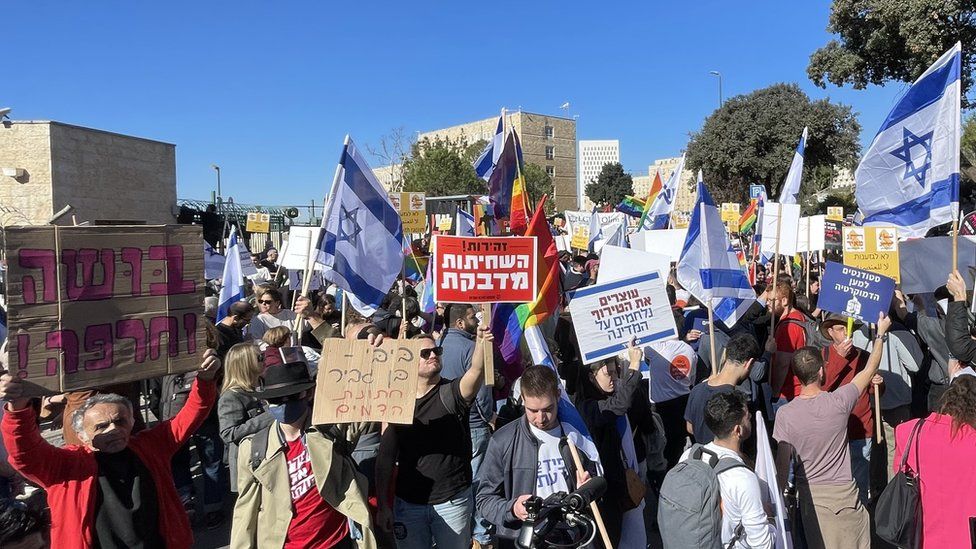
Image caption,Hundreds of protesters gathered in front of the Knesset ahead of the swearing-in ceremony This is a record sixth term as prime minister for Mr Netanyahu, who was ousted by his opponents 18 months ago, but his coalition partners are pledging to lead the country in a new direction.
The first guiding principle of the new government, published on Wednesday, declares that “the Jewish people have an exclusive and unquestionable right to all areas of the land of Israel”. It says that includes the occupied West Bank and promises to “advance and develop” settlements there.
About 600,000 Jews live in about 140 settlements built since Israel’s occupation of the West Bank and East Jerusalem in 1967. Most of the international community considers the settlements illegal under international law, though Israel disputes this.
There are also some 100 outposts – small settlements built without the Israeli government’s authorisation – across the West Bank.
In a coalition deal with the ultranationalist Religious Zionism party he signed last week, Mr Netanyahu agreed to retroactively legalise the outposts. He also promised to annex the West Bank while “choosing the timing and weighing all of the State of Israel’s national and international interests”. Such a step would be opposed by Israel’s Western and Arab allies.
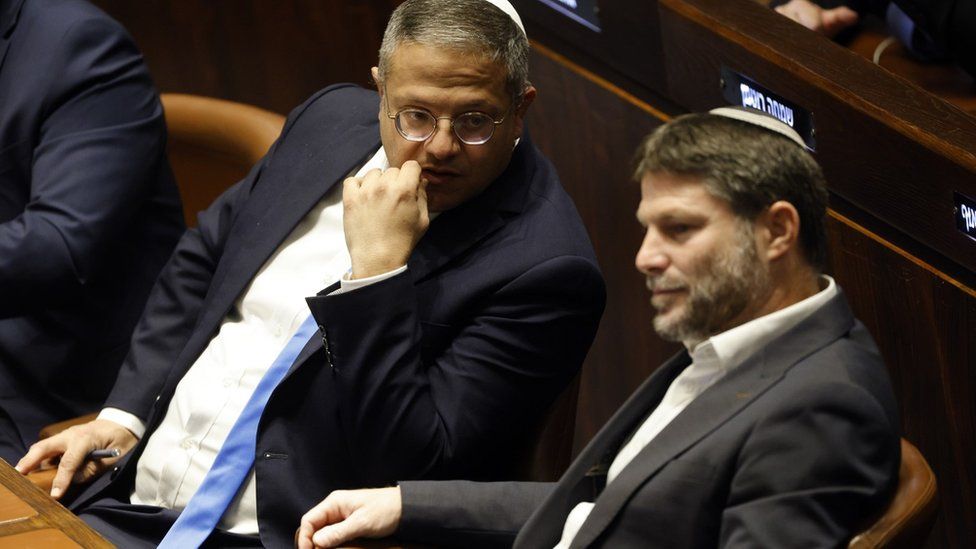
Image caption,Far-right politicians Itamar Ben-Gvir (L) Bezalel Smotrich (R) will hold key positions in the new government Religious Zionism leader Bezalel Smotrich, a West Bank settler, will be finance minister and also oversee the Civil Administration, which approves settlement building in the West Bank and controls important aspects of Palestinians’ lives.
Otzma Yehudit (Jewish Power) party leader Itamar Ben-Gvir, another settler and ultranationalist politician who has previously been convicted of racism and supporting a terrorist organisation, will be national security minister, responsible for the police.
A spokesman for Palestinian President Mahmoud Abbas warned that the plans to develop West Bank settlements would have “repercussions for the region”.
Mr Netanyahu’s coalition partners reject the idea of a two-state solution to the Israel-Palestinian conflict – the internationally backed formula for peace which envisages an independent Palestinian state in the West Bank alongside Israel, with Jerusalem as their shared capital.
There have also been expressions of concern both inside and outside Israel about some ministers’ very rigid views on the application of Jewish law and LGBTQ rights.
Avi Maoz, head of the anti-LGBTQ Noam party, will serve as a deputy minister in the prime minister’s office. He has called for Jerusalem’s Gay Pride event to be banned, disapproves of equal opportunities for women in the military, and wants to limit immigration to Israel to Jews according to a strict interpretation of Jewish law.
Activists, doctors and business leaders have meanwhile warned that discrimination against LGBTQ individuals could potentially be legalised if the anti-discrimination law is changed to allow businesses to refuse services to people on religious grounds.
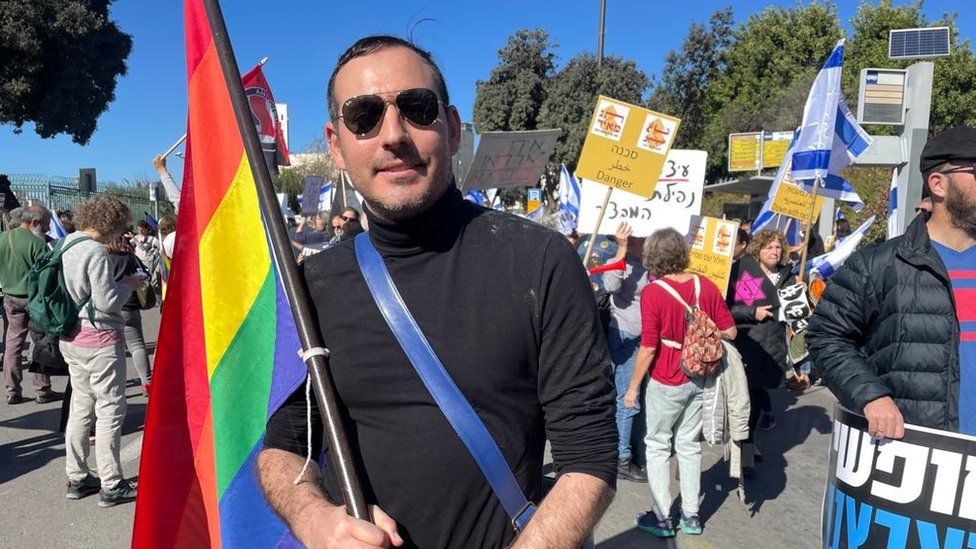
Image caption,Daniel Johnas said he was concerned about future of life in Israel for himself, his husband and children Although the coalition deal between Likud and the ultra-Orthodox United Torah Judaism party calls for such an amendment, Mr Netanyahu has said his administration will not allow any harm to the LGBTQ community. He has also chosen an openly gay member of Likud, Amir Ohana, to be parliamentary Speaker.
Critics have expressed concern at the coalition’s intention to pass legislation that would give a parliamentary majority the ability to override Supreme Court rulings.
Mr Netanyahu’s coalition partners have also proposed legal reforms that could end his corruption trial.
At Thursday’s protest, a woman from Tel Aviv, who did not want to give her name, said: “I refuse to accept what I feel is the possibility of the beginning of a fascist regime and I want to protect the rights of every citizen living in this country.”
Daniel Johnas, an activist in the religious LGBTQ community, said he was worried for the first time to go on the street with the rainbow flag. He was also concerned about the future of life in Israel for himself, his husband and children.
Source: BBC.com
-
Israelis, Palestinians to fly together to Qatar for 2022 FIFA World Cup
FIFA has finalized plans that will enable Israelis and Palestinians to attend matches at the FIFA World Cup Qatar 2022, which gets underway on 20 November.
This follows a meeting with representatives from FIFA World Cup Qatar 2022 LLC (Q22), the operational arm for tournament delivery, and from Israel’s Ministry of Foreign Affairs and Ministry of Culture and Sport conducted by Qatar’s commitment to FIFA’s hosting requirements.
Direct charter flights will be temporarily operated between Ben Gurion Airport in Tel Aviv and Hamad International Airport in Doha by an airline with existing landing rights in Qatar for the duration of the FIFA World Cup, subject to Israel’s security requirements and operational capabilities. More details will be announced in due course. Visitors will need a registered Hayya (the fan ID required for entry into Qatar during the tournament) and a valid flight ticket to travel to and from Qatar.
Consular services for Israeli citizens will be provided in coordination with the Israeli Ministry of Foreign Affairs through a designated privately-operated international travel company based in Doha. Palestinians will have access to consular services at the Palestinian embassy in Doha.
Commenting on the announcement, FIFA President Gianni Infantino said: “We are delighted that an agreement has been reached for Israeli and Palestinian fans to visit Qatar and attend matches during the FIFA World Cup. With this deal, Israelis and Palestinians will be able to fly together and enjoy football together. I would like to thank our Israeli, Palestinian and Qatari counterparts for helping to make this happen. Football has the power to bring people together, it transcends all boundaries, crosses all borders, and fosters unity like nothing else. The World Cup is the ultimate symbol of football’s unifying power, and today’s historic announcement provides a platform to improve relations across the Middle East”.
A spokesperson for Q22 said: “Since winning the rights to host the FIFA World Cup 2022, we have always said that all ticket holders will be able to attend matches in Qatar. The announcement today illustrates our commitment to respecting FIFA’s policies and hosting requirements including the right of everyone to attend matches. This also includes the requirement that Palestinian ticket holders and media can travel on these chartered flights with no restrictions as they have an equal right to enjoy the tournament, which is made extra special by it being the first World Cup to be hosted in the Arab and Muslim world. The FIFA World Cup Qatar 2022 is on course to leave a positive legacy on Qatar, the Middle East, and the Arab world, and with 2.9 million of the three million tickets now sold, we look forward to welcoming fans from around the globe.”
Director General of the Israeli Ministry of Foreign Affairs, Alon Ushpiz, said: “Today’s announcement will allow Israeli citizens to freely travel to Qatar and attend matches at the World Cup. We have successfully secured all guarantees, including access to consular services for Israelis during their stay in Qatar. As the first World Cup ever hosted in the Middle East, it promises to be a celebration of football and an opportunity for Israelis to build connections and share cultural experiences with people from across our region and the wider world.”
Source: FIFA
-
‘Bodies everywhere’: Survivors recount Lebanon boat disaster
Ninety-seven people have died – including 24 children – after a boat full of asylum seekers heading from Lebanon to Europe capsized in the Mediterranean.
Speaking from a hospital bed, still in shock, Ibrahim Mansour, one of 20 people who survived one of the deadliest boat disasters in the Eastern Mediterranean, says he can’t forgive himself for not saving others.
More than 150 people were on board the small boat that sailed from crisis-hit Lebanon on Wednesday morning, with the hope of reaching Italy for a better life.
Those on board were mostly Lebanese, Syrians, and Palestinians, and included both children and the elderly, according to the United Nations.
Four hours after the boat set sail, the engine stopped. Mansour, 29, recounted to Al Jazeera that those on board called the smuggler on shore, but he said: “If you come back, we will shoot you.
“We also called 112 to seek help from Lebanese authorities, but no help came.”
Due to the high waves, the boat lost control and capsized off the Syrian port of Tartous, some 50km (30 miles) north of Tripoli in Lebanon. In a matter of moments, 100 people died, Mansour said. He saw “bodies everywhere”.
Those who survived were clinging onto the boat that overturned.
“I cry all the time; I’m in shock. I saw bodies and horrible images. My heart hearts,” Mansour said. “I tried to help children and another man; I tried to keep their spirits alive, but I couldn’t. This is hurting me, especially because of the child who was holding onto me before I lost him. They told me he died.”
Mansour eventually swam to the Syrian shore, reaching the coast on Thursday night.
Syrian state media reported that 97 people have died, 20 people have been rescued and others are still missing.
Among the dead are 24 children and 31 women, according to Lebanese Transport Minister Ali Hamie.
In a statement on Sunday, the secretary-general of Lebanon’s Higher Relief Commission, Mohammad Khair, said that five Lebanese and eight Palestinians, who were on the boat, are still being treated at the al-Basel Hospital in Syria’s Tartous city and will return soon to Lebanon.
The Lebanese army said it arrested a man it believes was behind the suspected “smuggling operation” to Italy.
Another young man, who survived what he calls “a nightmare”, told Al Jazeera his story from an ambulance as he made his way back from Syria to Lebanon: “It’s impossible to forget what has happened and the scenes I’ve been through.
When the boat capsized, “people onboard were pushed by waves to all directions, left and right, under and above the water. No one came to rescue us,” he said.
“I stayed almost 24 hours near the boat, which was overturned, floating; it hadn’t sunk. I managed to keep myself over the boat, and then I swam for 13 hours until I reached the Syrian Tartous coast. I’ve been told that some survivors were saved and rescued by Russian and Syrian boats, but I saw nothing until I reached the shore,” he said.
‘Situation is reaching a desperate level’
The disaster highlights the crippling poverty and mounting despair that has been forcing many people in Lebanon, including Mansour, to attempt the perilous crossing across the Mediterranean, in hopes of reaching Europe.
Lebanon, a country that hosts more than a million refugees from Syria’s war, has since 2019 been mired in a financial crisis branded by the World Bank as one of the worst in modern times.
Since 2020, Lebanon has seen a spike in the number of Lebanese citizens, who have joined Palestinian and Syrian refugees in attempting dangerous boat journeys in search of a better life.
Al Jazeera’s Zeina Khodr, reporting from Tripoli, said that “according to the UN High Commissioner for Refugees (UNHCR), approximately 3,500 individuals attempted to make the journey this year alone, but security sources tell us that is a conservative figure”.
Many on the boat were Palestinian refugees, who, since the Nakba in 1948 (when hundreds of thousands of Palestinians were ethnically cleansed from their homes by Zionist militias), have been living across Lebanon in overcrowded, makeshift camps that lack basic infrastructure. Palestinian refugees living in Lebanon do not have basic rights; they are denied citizenship and have no access to healthcare or education.Tamara Alrifai, the spokesperson for the UN Relief and Works Agency for Palestine Refugees (UNRWA), told Al Jazeera that there were an estimated 25-30 Palestinian refugees on the capsized boat. Most of them were from the Nahr al-Bared refugee camp, “a camp that was very much destroyed around 15 years ago in one of the rounds of violence in Lebanon.”
“The situation of Palestine refugees in Lebanon is reaching such a desperate level, that they are willing to risk their lives along these perilous routes if there is hope on the other side,” Alrifai said. “The other side always looks better than what many of them describe as hell.”
“[Palestinian refugees in Lebanon [are] marginalized, disenfranchised, barred from owning property, barred from professions. The economic and financial collapse of Lebanon, particularly this last year, has hit the most vulnerable first [including Palestinian refugees].”
Alrifai said among the Palestinian group of migrants, two of them were UNRWA schoolchildren.
“These are people we know, these are young people who go to school, who have an education, who wanted to go to the other side, and search for a better life for themselves and for their kids. This is truly tragic and my colleagues at UNRWA are horrified at the news.“No one wants to be a refugee. No one wants to live such a humiliating life as Palestinian refugees live in many of these camps,” Alrifai said.
Khodr, the Al Jazeera correspondent reporting from northern Lebanon, said many families are still waiting to receive the bodies of their relatives.
“Some have been identified and brought back for burial,” she said. “Others are still in Syria awaiting the results of DNA tests. Until they’re received, it won’t be known how many or who remains missing at sea.”
“Lebanese and Palestinian refugees [survivors] are arriving home, but Syrian refugees have not returned. Neither have their bodies. Their families who escaped the rule of President Bashar al-Assad will be afraid to cross the border to identify their loved ones.”
DISCLAIMER: Independentghana.com will not be liable for any inaccuracies contained in this article. The views expressed in the article are solely those of the author’s, and do not reflect those of The Independent Ghana
Source: Aljazeera