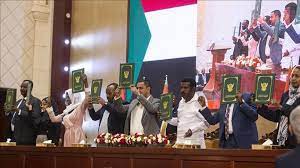
On Tuesday (July 25), a group of Sudanese who support democracy demanded an end to the country’s strife and opposed the deployment of different militaries there.
The group, known as the Forces for the Declaration of Freedom and Change, expressed their hope that a solution to the conflict would result in the establishment of a “Sudanese state free from wars and the building of an armed forces that serve the Sudanese people based on principles and values” in a press conference with reporters in Cairo, the capital of Egypt.
Yasir Arman, a member of the bloc’s executive office, declared: “We are against the multiple armies.”
Arman added that the bloc has no issues with the arrival of IGAD and other international forces to oversee any cease-fire and an end to hostilities.
As part of the process to end the war, he emphasised, “there should be preparation for the deployment of these forces to monitor the final ceasefire, not to occupy Sudan.”
Since the beginning of April, when months-long tensions between the military and its competitor, the paramilitary Rapid Support Forces, erupted into open combat in Khartoum, the capital, and other parts of the country in northeastern Africa, the country of Sudan has been in a state of turmoil.
Over 2 million people have been displaced by the battle between the leader of the RSF paramilitary group and the general of the Sudanese army.
The horrors of the conflict include assaults on hospitals and rapes.
Accountability was demanded by representatives of the FFC, a coalition of militants and many political parties.
According to Sediq al Sadik al- Mahdi, a member of the Sudan Forces for the Declaration of Freedom and Change’s executive office, “in this context, we affirm that we deal with violations as a matter of human rights and ethics.”
“We demand that any infractions stop right away, and that an independent inquiry be carried out to find the offenders and hold them accountable. Adopting efficient processes is necessary to provide victims justice, hold offenders accountable, offer restitution, and pay those who have been harmed.
The fighting dashed Sudanese expectations of resuming the nation’s democratic transition, which had started with the overthrow of longtime tyrant Al-Bashir. The transition was halted in October 2021 by a coup that was organised by the military and RSF.
Gunmen reportedly broke into the residences of those who work for the United Nations and other international organizations on Tuesday, amid contradicting reports of a mutually agreed ceasefire in the nation. Gunfire, explosions, and overhead fighter jets could be heard around Sudan’s capital Khartoum at the time.
The country’s armed forces and the paramilitary Rapid Support Forces (RSF) are engaged in fighting in Khartoum, which has been going on for four days now close to the army command, the presidential palace, and two RSF camps to the north and west of the capital.
After agreeing to a 24-hour ceasefire that began at 6 p.m. local time (12 p.m. ET), the two sides’ attempts at a truce failed late on Tuesday as fighting broke out again in central Khartoum, according to witnesses.
Residents remain trapped in the middle elsewhere in Sudan; Medical charity Médecins Sans Frontières (MSF) said a lack of medical supplies, blood and electricity are threatening lifesaving treatments in Sudan, adding that 11 have died from their injuries in North Darfur and the western region’s the last running hospital has received dozens of wounded patients in the past 48 hours.
At least 270 people have been killed and more than 2,600 injured in the unrest, according to the World Health Organization (WHO) officials citing Sudan’s Ministry of Health Emergency Operations Center.
Armed personnel raided the homes of UN staff and employees of other international organizations in downtown Khartoum, according to reports in an internal UN document seen by CNN.
According to the document, the gunmen sexually assaulted women and stole belongings including cars. “In Khartoum armed uniformed personnel, reportedly from RSF, are entering the residences of expats, separating men and women and taking them away,” reads the report. One incident of rape was also reported.
The RSF denied those reports, telling CNN in a statement that it “will never assault any UN staff or employees. RSF is very mindful of respecting international law.”
The statement went on to blame the opposing side in the fighting, led by Sudan’s military leader Abdel Fattah al-Burhan: “That is the new desperate way of Burhan’s army of fighting. They supply their people RSF uniform clothing so they can commit crimes against civilians and embassies and other groups including the UN so the image and perspective of RSF can be damaged to everyone, international and local.”
Sudan’s Armed Forces (SAF) denied their troops were involved in the violations and pointed to a previous statement regarding crimes against humanity allegedly committed by RSF forces.
Khartoum has been wracked by violence and chaos in a bloody tussle for power between Burhan, Sudan’s military chief, and Mohamed Hamdan Dagalo, also known as Hemedti, who is head of the RSF.
The two leaders have traded blame for instigating the fighting and breaking temporary ceasefires.
Colonel Khaled Al-Aqeel, a SAF spokesman told Al Jazeera they were keen on continuing the truce on Tuesday, shortly after sounds of gunfire were heard in the country’s capital.
RSF commander advisor Mousa Khaddam also said the paramilitary force is also committed to the truce, telling al-Jazeera: “Our forces that are deployed in multiple regions in Khartoum are committed to the ceasefire.”
Yet fighting appeared to continue hours after the truce was meant to go into effect. An eyewitness told CNN that they heard sounds of explosions around the Army General Command building and the Presidential Palace in Khartoum.
For more than three days, students at the University of Khartoum have been trapped inside campus buildings as artillery and gunfire rain down around them in Sudan’s capital. “It is scary that our country will turn into a battlefield overnight,” said 23-year-old Al-Muzaffar Farouk, one of 89 students, faculty members and staff sheltering inside the university library.
Food and water are running low, but leaving is not an option – one student has already been killed by gunfire outside. Khalid Abdulmun’em had been trying to run to the library from a nearby building when he was struck, said Farouk.
The students retrieved his body and brought it inside “despite the bullets that were falling on us,” he added.
The university confirmed Abdulmun’em’s death in a Facebook post, saying he had been shot in the campus’ surroundings. In a separate post on Monday, the university urged humanitarian organizations to help evacuate dozens of people stranded on campus.
Eyewitnesses described the scenes across the Sudanese capital.
“I can see outside smoke rising from buildings. And I can hear from my residence blasts, heavy gunfire from outside. The streets are totally empty,” said Red Cross staffer Germain Mwehu from Khartoum.
“In the building where I stay, I saw families with children, children crying when there are airstrikes, children horrified,” Mwehu said, adding that people had little to no access to food or medicine given the fierce fighting outside.
Children are among those killed; a 6-year-old child died on Monday after the RSF shelled a hospital in Khartoum and damaged a maternity ward. Medics were forced to evacuate, leaving patients behind – some just newborns in incubators.
At least half a dozen hospitals have been struck by both warring sides, according to Sudan’s Doctors Trade Union.
Health services have been heavily impacted by the fighting. Cyrus Paye, Project Coordinator for MSF in El Fasher of North Darfur, said in a statement that the only remaining hospital in North Darfur is “rapidly running out of medical supplies to treat survivors.”
Other hospitals in North Darfur have had to close, either due to their proximity to the fighting, or due to the inability of staff to get to the facilities because of the violence, he added.
MSF teams are also facing “serious challenges” in other parts of the country, the statement said. The group’s premises in Nyala, South Darfur, have been looted and in the capital Khartoum most teams are trapped by the ongoing heavy fighting and are unable to access warehouses to deliver vital medical supplies to hospitals.
Multiple diplomats and humanitarian workers have been targeted.
US Secretary of State Antony Blinken confirmed there was an attack on a US diplomatic convoy on Monday.
“Yesterday, we had an American diplomatic convoy that was fired on. All of our people are safe, but this the action was reckless, it was irresponsible and, of course, unsafe,” Blinken said in a press conference on Tuesday.
The European Union ambassador to Sudan was also assaulted in his residency on Monday, though he is now doing fine, according to a spokesperson for the EU’s top diplomat.
And three workers from the UN’s World Food Programme (WFP) were killed in Darfur, prompting the WFP to temporarily halt all services in the country.
In statements early Tuesday morning, the two rival factions pointed fingers at each other.
The RSF accused the army of conducting airstrikes on residential neighborhoods and of attacking the EU ambassador’s headquarters in Khartoum; meanwhile, the army accused the RSF of targeting the ambassador’s residency, and of targeting the WFP’s headquarters in Darfur.
Various foreign leaders have called for peace, with Blinken speaking separately with Burhan and Dagalo on Tuesday.
Blinken “expressed his grave concern about the death and injury of so many Sudanese civilians,” and argued a ceasefire was necessary to deliver aid, reunify separated families, and ensure the safety of diplomatic and humanitarian staff, according to a readout from the US State Department.
And Egypt has been “in direct communication with both parties” encouraging restraint, cessation of hostilities and a return to dialogue,” Egyptian Foreign Minister Sameh Shoukry told CNN’s Christina Macfarlane in an exclusive interview Tuesday.
The Sudanese Armed Forces later issued conflicting statements on a proposed 24-hour ceasefire, intended to go into effect later on Tuesday.
A statement citing a spokesperson on the official SAF Facebook page said the armed forces are “not aware of any coordination with mediators and the international community about a truce” and that the RSF announcement for a 24-hour truce “aims to cover up the crushing defeat it will receive within hours.”
But Burhan told CNN earlier that the SAF will “adhere” to a ceasefire proposal by the tripartite mechanism, comprising of the United Nations Integrated Transition Assistance Mission in Sudan (UNITAMS), the African Union (AU), and the Intergovernmental Authority on Development (IGAD).
Dagalo meanwhile said on Twitter that a 24-hour ceasefire “to ensure the safe passage of civilians and the evacuation of the wounded” was approved by the paramilitary force.
WHO Director-General Dr. Tedros Adhanom Ghebreyesus condemned the conflict in Sudan on Tuesday, saying that medical supplies have been depleted, there is a lack of medical personnel on the ground and some health care facilities have been looted or are being used for military purposes.
Volker Perthes, the UN Secretary General’s Special Representative for Sudan, said on Monday the organization has been trying to convince the two rival parties to “hold the fire” for a period of time, and asked them to protect embassies, UN offices, humanitarian and medical facilities.
Both sides had previously agreed to a three-hour ceasefire on Sunday, and again on Monday, with fighting resuming afterward, Perthes said.
But both Burhan and Dagalo have since accused the other of breaking that ceasefire.
When CNN spoke to Burhan on Monday afternoon, the sound of gunshots rang out in the background despite the supposed ceasefire – and Burhan claimed Dagalo had violated it for the second day.
A spokesperson for the RSF rebutted the accusation, claiming that they had been trying to abide by the ceasefire, but “they keep firing which leaves no choice” but for the RSF to “defend itself by firing back.”
A resident of Khartoum, the capital of Sudan, informed the BBC that she had run out of drinking water as violence between opposing forces has continued there for a fourth day.
“This morning we ran out,” Duaa Tariq admitted, adding that she was reserving one bottle specifically for her two-year-old child.
There are ongoing efforts to persuade the army and the paramilitary Rapid Support Forces (RSF) organization to enforce a 24-hour ceasefire.
In certain residential parts of the capital, the RSF has started plundering.
Residents of the Khartoum 2 area told the BBC that the RSF militia had been going home-to-home in the neighbourhood demanding water and food.
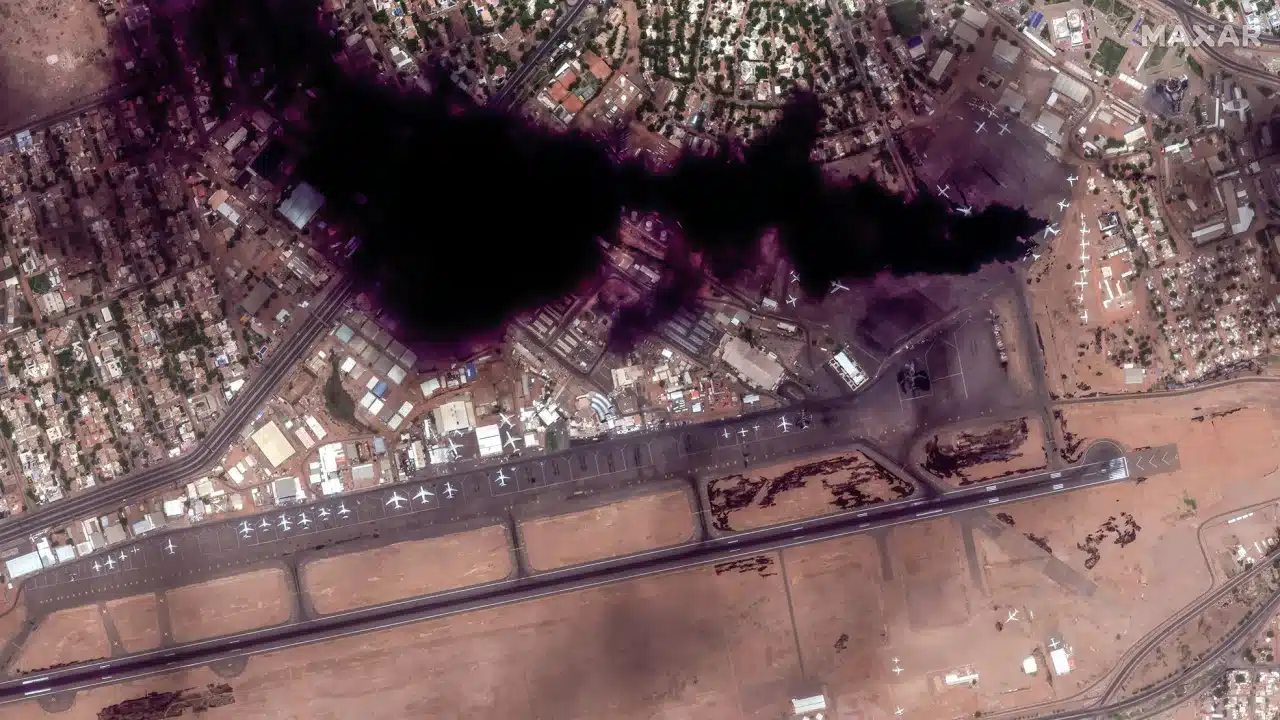
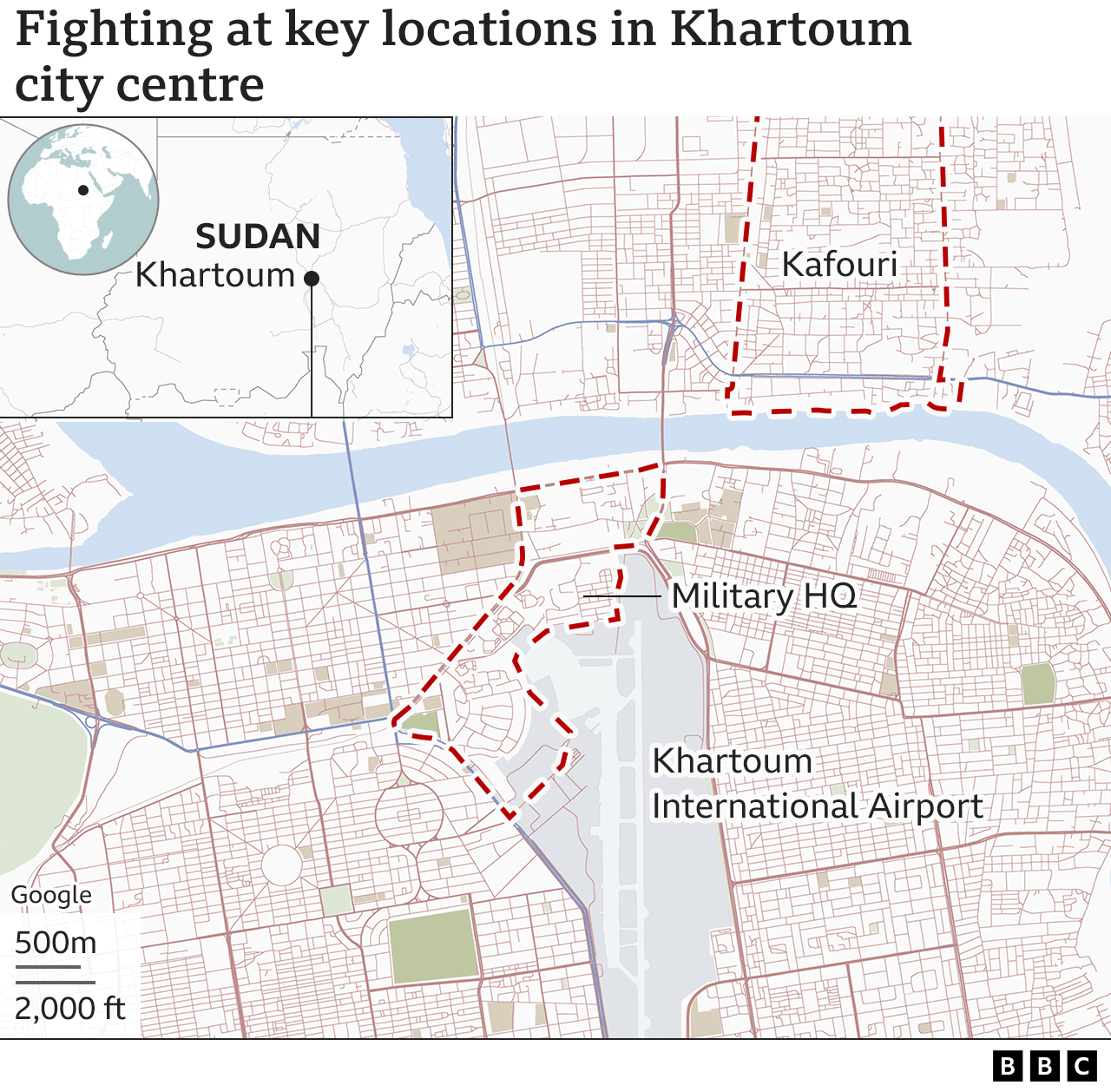
Heavy bombardments and black smoke can be seen around the airport, which is in the centre of Khartoum and right next to the military headquarters, as tanks are reported on some streets.
Residential areas surround the airport and staff and patients at a nearby cancer hospital say there are trapped by the fighting.
A female patient at Al-Zara Hospital told the BBC on Monday the situation was deteriorating as there were no medicine or food. The hospital is already overcrowded as it took in patients from another hospital that had come under attack by the RSF.
Lack of supplies is a problem countrywide, in up to seven states, according to the World Health Organization (WHO).
“Now most of the hospitals are reporting [being] out of medical supplies, blood bags, oxygen and other many important medicine and surgical kits,” WHO’s Sudan representative Dr Nima Saeed Abid told the BBC’s Newsday radio programme.
UN special envoy to Sudan Volker Perthes has told the BBC that he is in daily contact with the two generals whose forces are fighting for control, but he says they are not talking to each other.
Sudan’s de facto leader, Gen Abdel Fattah al-Burhan, told CNN earlier on Tuesday the ceasefire would start at 16:00 GMT. Some elements of the army have denied this.
RSF head Mohamed Hamdan Dagalo, who is better known as Hemedti and is also Sudan’s deputy leader, tweeted that he had approved a ceasefire to ensure the evacuation of wounded civilians, but said previous deals to halt fighting had been violated.
Mr Perthes said agreements to pause the fighting for several hours on Sunday and Monday were not fully observed.
The Red Cross said it was receiving multiple calls for help from people trapped in their homes by the fighting – the city has an estimated population of 10 million residents.
But the aid group said providing humanitarian support was “almost impossible”, amid airstrikes and artillery attacks.
Around 185 people have been killed and more than 1,800 injured since the fighting erupted on Saturday, according to the UN.
For Ms Tariq the only safe place to be in her home is “one tiny corridor” where “we’re laying and spending the whole day” on one shared mattress.
“Most of the people [that] died, died in their houses with random bullets and missiles, so it’s better to avoid exposed places in the house” like windows, she said.
There is not sufficient light because there is no electricity, but she goes to a neighbour’s flat to charge her phone as they have a power bank.
“Last night I wasn’t able to sleep and I feel very sick,” she added.
A group in her community were forming a “crisis room,” and had “promised to provide food and water for those in need”, she said.
People are also organising anti-war campaigns online, she added.