Tag: “Parliament

  • Matthew Nyindam remains Kpandai MP until December 1 – Speaker Bagbin

    Matthew Nyindam remains Kpandai MP until December 1 – Speaker Bagbin

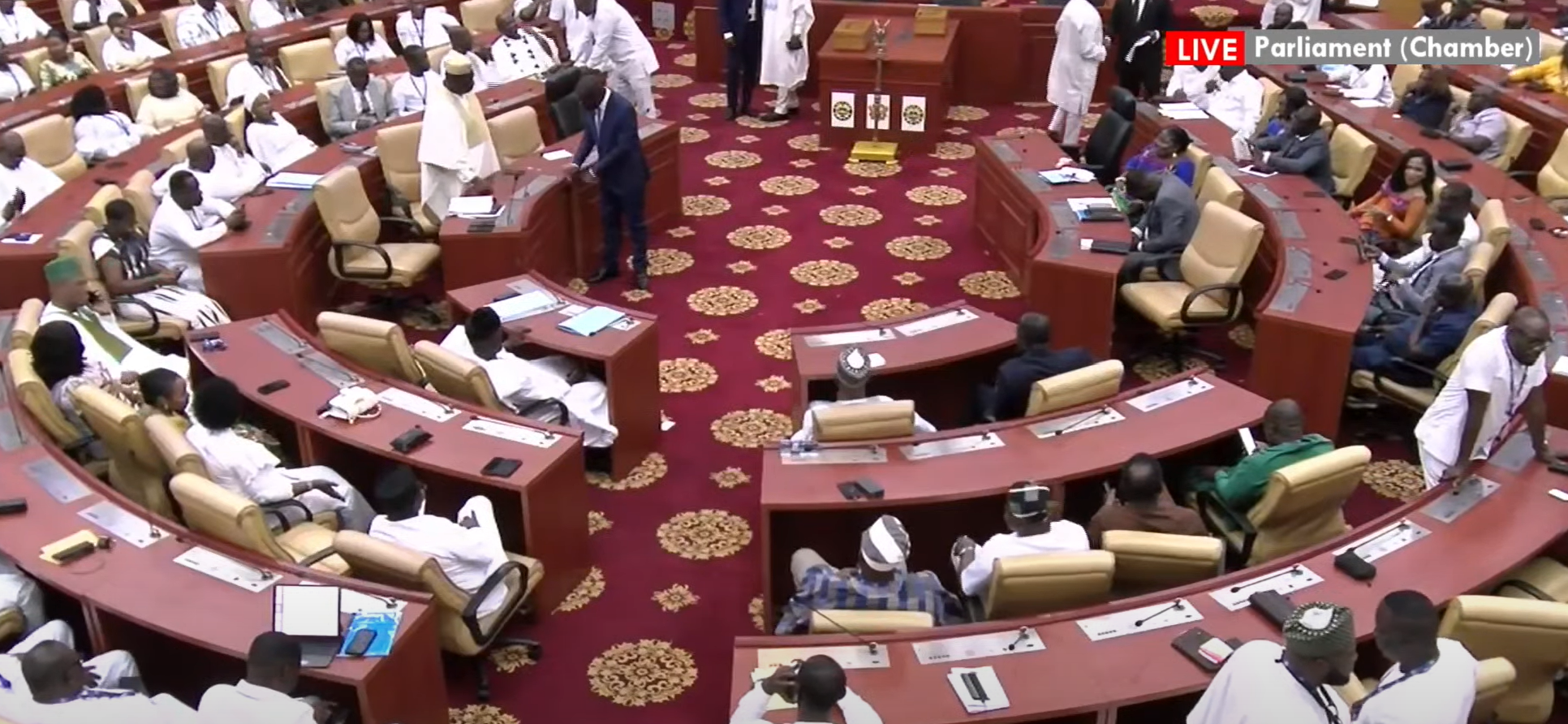
    The Speaker of Parliament, Alban Bagbin, has reacted to the High Court’s declaration that the 2024 Parliamentary election in the Kpandai constituency is invalid.

    Addressing the House on Thursday, November 27, Bagbin indicated that it is inappropriate for the seat in the area to be declared vacant as per the Court of Appeal Rules.


    According to him, the Court of Appeal Rules 1997 (CI 19), as amended by CI 132, rule 27(3), states: “there shall be a stay of execution of the judgment or decision appealed against for a period of seven days immediately following the giving of notice of the judgment or decision.”


    As such, the Member of Parliament (MP) for the area, Matthew Nyindam, can only step aside after a mandatory seven-day stay of execution in all appealable High Court rulings.

    The Speaker of Parliament, therefore, ruled that, until December 1, Matthew Nyindam will still hold his position as the MP for the Kpandai constituency.


    “In this instance, the ruling of the High Court was delivered on the 24th of November 2025. The statutory 7-day stay therefore remains in force until 1st December 2025. During this period, the High Court ruling cannot form the basis for the Speaker to instruct the Clerk to notify the Electoral Commission that the Kpandai seat is vacant,” he added.


    On Monday, November 24, the Tamale High Court declared the Kpandai parliamentary election conducted in 2024 invalid. As a result, His Lordship Emmanuel Brew Plange has directed the Electoral Commission (EC) to conduct a new poll in the constituency within 30 days.


    Earlier this year, the former Member of Parliament (MP) and National Democratic Congress (NDC) Parliamentary Candidate for Kpandai, Daniel Nsala Wakpal, submitted a petition to the Tamale High Court challenging the results of the 2024 parliamentary election in the constituency.


    According to the petitioner, the Kpandai parliamentary election was marred by irregularities in the voting and collation processes. He argued that Pink Sheets from many polling stations were not accurate or consistent.


    He stated, “The parliamentary election held in the Kpandai constituency on 7th December 2024 was not conducted in compliance with Regulations 39 of the Public Elections Regulations, 2020 (CI 127) and the principles laid down by Regulations 39, and that the said non-compliance affected the results of the elections.


    “The declaration and publication of the parliamentary election results held in the Kpandai constituency on 7th December 2024 were not made in compliance with Regulations 43 of the Public Elections Regulations, 2020 (CI 127) and the principles laid down by Regulations 43, and that the said non-compliance affected the entire results of the parliamentary elections in the Kpandai constituency.”


    This will be the second time the country will witness a rerun of elections after the 2024 general polls. Ablekuma North had remained the only constituency in Ghana without a sitting MP due to unresolved disagreements over the outcome of the parliamentary vote.


    In view of this, the Electoral Commission on Friday, July 11, held a rerun election in 19 polling stations in Ablekuma North to provide constituents with a representative. Ewurabena Aubynn polled 34,090 votes to beat the New Patriotic Party’s (NPP) Akua Afriyie, who secured 33,881 votes.


    On December 10, 2024, three days after the national polls, the EC declared Ewurabena Aubynn of the NDC the winner of the Ablekuma North parliamentary seat, defeating the New Patriotic Party’s (NPP) Nana Akua Owusu Afriyieh.


    However, the EC later revoked the announcement, revealing that results from 62 of the 281 polling stations had not been included in the initial collation.


    Efforts to restart the collation in January 2025 were disrupted by multiple challenges. These included interruptions due to the submission of unverified Pink Sheets and a violent intrusion at the collation centre that heightened security concerns.


    After extensive deliberations, the Electoral Commission in July announced that it would hold a rerun election because the 19 scanned polling station results used for the collation, though approved by agents of both political parties, were not verified by the presiding officers responsible for those polling stations.


    The EC arrived at this decision after meeting with representatives of the National Democratic Congress (NDC) and the New Patriotic Party (NPP) on Tuesday, July 1.


    Violence mars Ablekuma North rerun election


    At the Odorkor Methodist 1 polling station in the Ablekuma North constituency, some individuals engaged in a fisticuff with police personnel. Also, a JoyNews journalist was slapped by an unknown individual.


    Former Minister of Fisheries and Aquaculture Development and Member of Parliament for Ewutu Senya East Constituency, Hawa Koomson, was also assaulted by a group of men. A journalist with GH One Television, Banahene Agyekum, was also slapped by a police officer.


    The Ghana Police Service has interdicted one of its officers who was caught on camera slapping a journalist with GH One Television, Banahene Agyekum, during the rerun election at Ablekuma North.


    In line with internal disciplinary procedures, he has been referred to the Police Professional Standards Bureau (PPSB) for investigation.


    The officer concerned has been withdrawn from the ongoing election duty at Ablekuma North. The police have assured the public that a thorough investigation will be conducted into the matter, and further updates will be communicated.


    It is unknown what exactly transpired between the reporter and a group of police officers that led to him being slapped. The police officer’s action has been condemned by all, including the mayor of Accra, Michael Kpakpo Allotey, who witnessed the unfortunate incident.


    Deputy Minister for Government Communications, Shamima Muslim, in reaction to the said incident, commended the police for its swift action to reprimand its officer for such unlawful acts and condemned the recent attacks against civilians and journalists during the Ablekuma North election rerun.


    “What we are happy about is the swift action that the Ghana Police itself has taken in interdicting the officer in question. It is completely unwarranted. Government itself takes a very serious stance, especially on security agencies meting out unwarranted attacks to civilians under any circumstances,” she added.


    President of the Ghana Journalist Association (GJA), Albert Kwabena Dwumfuor, also condemned the attack on journalists. Due to the chaos that erupted, Inspector General of Police Christian Tetteh Yohuno visited some polling stations in the constituency.


    The Minority in Parliament has also condemned the violence that took place during the just-ended Ablekuma North rerun election, accusing members of the ruling National Democratic Congress (NDC) of instigating violent activities.


    In a statement signed by Minority Leader Alexander Afenyo-Markin, the caucus said, “The most disturbing aspect of today’s violence is not just the brutality itself, but the deliberate endorsement and celebration of these attacks by senior government officials.”


    The Minority registered its displeasure with the operation of the Ghana Police Service at the polling stations.


    “The Ghana Police Service’s response raises serious questions about their preparedness and commitment to protecting our electoral process. Security personnel were overwhelmed by the perpetrators, failing to prevent these attacks on political figures, party agents, and journalists. More concerning are allegations surrounding Chief Superintendent Lumor Frederick Senanu and his potential role in facilitating these disruptions.”


    The caucus stressed the need for increased protection for voters, electoral officers, journalists, and candidates. It also called on the international community, civil society, and media to monitor developments closely.

  • Parliament will vet Acting CJ while Torkornoo’s lawsuit remains before court – Bagbin replies Minority

    Parliament will vet Acting CJ while Torkornoo’s lawsuit remains before court – Bagbin replies Minority

    Speaker of Parliament, Alban Bagbin, has dismissed a motion presented by the Minority caucus calling for a halt in the vetting of Acting Chief Justice, Paul Baffoe-Bonnie.

    According to the Speaker, granting such a request by the Minority would create a dangerous precedent, explaining that “any litigant could hold Parliament hostage, that is, file a case and freeze the work of Parliament and its committees.”

    He ruled that “there is no constitutional or standing order basis for Parliament to halt the process simply because there are pending cases in court. The motion is inadmissible and has been returned to the sponsor, the Minority Leader, Honorable Alexander Afenyo-Markin, as stated clearly by our Standing Orders.”

    Speaking on the floor of Parliament on Friday, November 7, the Minority Leader, Alexander Kwamena Afenyo-Markin, argued that it would be inappropriate to proceed with the vetting while former Chief Justice, Gertrude Torkornoo, awaits the verdict on her lawsuit presented to the court.

    In October, Gertrude Torkornoo initiated a legal action seeking to prevent the vetting and appointment of Justice Baffoe-Bonnie as Ghana’s next Chief Justice. She is asking the court to nullify all activities carried out by the Justice Gabriel Scott Pwamang Committee, which was set up under Article 146 to review petitions seeking her removal from office.

    She further wants the court to overturn all proceedings undertaken by the Committee and to declare the Presidential Warrant authorising her dismissal as unlawful and without legal effect. Her legal challenge came at a time when Parliament’s Appointments Committee was preparing to vet Justice Baffoe-Bonnie for the top judicial position.

    Addressing the floor on Friday, November 7, Afenyo-Markin emphasised that commencing the vetting of the Acting Chief Justice would breach judicial propriety. According to him, given the ongoing disputes over the revocation of the former Chief Justice’s appointment, proceeding with the vetting process could undermine Articles 125 and 127 of the Constitution.

    “Proceeding to vet a new person to fill that office will be rendering the application of justice. We are not into blows; we are here to argue law and for you to determine. This kind of attack, ‘it will happen, it will happen,’ is inappropriate. They should take it easy,” Afenyo-Markin said.

    Article 125 vests judicial power solely in the courts, not in Parliament or the Executive. Article 127, on the other hand, requires all other state institutions to refrain from interfering with the Judiciary’s work and to protect its independence.

    The lawsuit follows Chief Justice Torkornoo’s dismissal from office on September 1, 2025, by President John Mahama, after a constitutionally mandated committee found her guilty of misconduct and stated misbehaviour under Article 146.

    The investigation, carried out in consultation with the Council of State, concluded that Justice Torkornoo had violated constitutional requirements, including the misuse of public funds, and therefore recommended her removal.

    Justice Baffoe-Bonnie has been serving as Acting Chief Justice since April 22, 2025, following Torkornoo’s suspension. He was later nominated by the President in September to assume the substantive position.

    His nomination aligns with Article 144(6) of the 1992 Constitution, which provides that:
    “Where the office of Chief Justice is vacant, or where the Chief Justice is for any reason unable to perform the functions of his office—(a) until a person has been appointed to, and has assumed the functions of, that office; or (b) until the person holding that office has resumed the functions of that office; as the case may be, those functions shall be performed by the most senior of the Justices of the Supreme Court.”

    Appointed to the nation’s highest court in June 2008 by former President John Agyekum Kufuor, Justice Baffoe-Bonnie has served for over a decade, earning distinction as a seasoned judicial figure and now stepping into a critical leadership role during a sensitive period for the judiciary.

    The change in leadership came after President John Dramani Mahama ordered the suspension of Chief Justice Gertrude Torkornoo following the submission of multiple petitions against her, prompting a formal inquiry into her conduct.

    A statement signed by the Minister of Government Communications, Felix Kwakye Ofosu, and released on Tuesday, April 22, explained that the President’s decision was based on advice from the Council of State, in accordance with Article 146(6) of the Constitution.

    The statement noted that: “There is a prima facie case for the Chief Justice to respond to.”

    Following the development, a five-member committee was formed to assess the allegations contained in the petitions. The committee was chaired by Justice Gabriel Scott Pwamang of the Supreme Court, with members including Justice Samuel Kwame Adibu-Asiedu, Daniel Yaw Domelevo (former Auditor-General), Major Flora Bazwaanura Dalugo of the Ghana Armed Forces, and Professor James Sefah Dzisah of the University of Ghana.

    The committee was tasked with conducting a thorough review to determine the merit of the claims and recommend appropriate action in line with constitutional procedures.

    The five-member committee, backed by Article 146, concluded its investigations last month and recommended the Chief Justice’s removal from office. Acting on the committee’s recommendations, President Mahama relieved Justice Gertrude Torkornoo of her duties with immediate effect on Monday, September 1.

    The Chief Justice was earlier suspended by President Mahama on Tuesday, April 22, after a prima facie case was established following multiple petitions calling for her removal.

    Among the petitions was one filed by a group known as Shining Stars of Ghana, alleging that she violated Article 144 of the Constitution by personally recommending judges for promotion to the Supreme Court. The group also claimed she ruled on a case involving the Speaker of Parliament without granting him a hearing, despite his refusal to respond to the suit.

    Another petition from a police officer who is also a lawyer accused the Chief Justice of manipulating evidence and abusing her authority during a Supreme Court session where he was reportedly reprimanded, arrested, and detained.

    Court records, however, show that the lawyer’s conduct during proceedings prompted a unanimous caution from the bench, not just from the Chief Justice.

    A third petition, submitted by a private individual, listed 21 alleged misconducts and four claims of incompetence, including the misuse of public funds — specifically, spending over GH¢261,000 and $30,000 on a family trip abroad in 2023 and misusing an additional GH¢75,580 and $14,000 during another foreign assignment without proper accountability.

    Subsequent reports indicate that two more petitions were later filed, intensifying pressure on the judiciary.

    Chief Justice Gertrude Torkornoo, in her written response to President Mahama, strongly denied allegations of misconduct and abuse of office, describing them as baseless and lacking grounds for her removal.

    In July, an application for review filed by the embattled Chief Justice at the Human Rights Division of the Accra High Court was dismissed. The court, presided over by Justice Amoako on Thursday, July 31, ruled that several claims—such as the illegal composition of the committee and wrongful conduct of proceedings—were already before the Supreme Court.

    Justice Amoako stated that relitigating these issues would result in duplication and abuse of court processes, and therefore dismissed the case.

    The Chief Justice’s judicial review application, filed on June 9, sought nine reliefs, including declarations that the Article 146 committee acted unlawfully and violated her right to a fair hearing.

    As the Article 146 committee’s proceedings are held in camera in accordance with Article 146(8) of the Constitution, the court noted it could not inquire into certain matters raised by the suspended Chief Justice.

    Following these developments, Justice Gertrude Torkornoo proceeded to the ECOWAS Community Court in Abuja, Nigeria, seeking $10 million in compensation over her suspension.

    Her application includes 10 reliefs, among them a request for precautionary measures ensuring she continues to enjoy the entitlements of her office pending final determination of the case.

    Meanwhile, government spokesperson Felix Kwakye Ofosu has refuted Justice Torkornoo’s claims, insisting that her suspension aligns with the Constitution.

    On Thursday, August 14, the Bar Council of England and Wales and the Commonwealth Lawyers Association jointly called for the immediate reinstatement of Ghana’s Chief Justice by President Mahama and the Executive arm of government.

    “Immediately and without delay, reinstate the Chief Justice of Ghana to her office, consistent with both the hitherto strong attachment to the rule of law demonstrated by Ghana and the constitutional duties incumbent upon them,” the statement said.

    The groups further urged a fair and transparent investigation into the disciplinary charges against her and the establishment of clear procedural rules with a definite timeframe for the committee’s work.

    However, Attorney General Dr. Dominic Ayine has emphasised that his office can only act after the committee concludes its work and submits its report to the President. “The suspension will, therefore, remain in effect until the inquiry committee completes its work and submits its report, to which His Excellency the President will adhere,” he stated.

  • Acting CJ can’t be vetted while Torkornoo’s lawsuit remains before court – Minority

    Acting CJ can’t be vetted while Torkornoo’s lawsuit remains before court – Minority

    Minority Leader, Alexander Afenyo-Markin, has said that it would be inappropriate to proceed with the vetting of Acting Chief Justice, Paul Baffoe-Bonnie, while former Chief Justice, Gertrude Torkornoo, awaits the court’s verdict on her pending lawsuit.

    In October, Gertrude Torkornoo initiated a court action to prevent the vetting and appointment of Justice Baffoe-Bonnie as Ghana’s next Chief Justice. She is asking for the nullification of all activities carried out by the Justice Gabriel Scott Pwamang Committee, which was set up under Article 146 to review petitions seeking her removal from office.

    She further wants the court to overturn all proceedings undertaken by the said Committee and to declare the Presidential Warrant authorizing her dismissal as unlawful and without legal effect. The legal move came as Parliament’s Appointments Committee readied to vet Justice Baffoe-Bonnie for the top judicial position.

    Addressing the floor on Friday, November 7, the Minority emphasized that commencing the appointed CJ’s vetting would breach judicial propriety. According to him, given the ongoing disputes over the revocation of the former Chief Justice from office, proceeding with the vetting process could undermine Articles 125 and 127 of the Constitution.

    “Proceeding to vet a new person to fill that office will be rendering the application of justice. We are not into blows; we are here to argue law and for you to determine. This kind of attack, ‘it will happen, it will happen,’ is inappropriate. They should take it easy,” Afenyo-Markin said.

    Article 125 gives judicial power only to the courts and not to Parliament or the Executive. Article 127, on the other hand, requires all other state institutions not to interfere with the Judiciary’s work but to protect its independence.

    The lawsuit follows her dismissal from office on September 1, this year, by President John Mahama, after a constitutionally mandated committee found her guilty of misconduct and stated misbehaviour under Article 146.

    Article image 1
    Article image 2
    Article image 3
    Article image 4

    That investigation, carried out in consultation with the Council of State, concluded that Justice Torkonoo had violated constitutional requirements, including the misuse of public funds, and therefore recommended her removal.

    Justice Baffoe-Bonnie has been serving as Acting Chief Justice since April 22, 2025, after Torkonoo’s suspension, and was later nominated by the President in September to assume the substantive position.

    His elevation was in line with Article 144(6) of the 1992 Constitution, which provides that:

    “Where the office of Chief Justice is vacant, or where the Chief Justice is for any reason unable to perform the functions of his office –(a) until a person has been appointed to, and has assumed the functions of, that office; or(b) until the person, holding that office has resumed the functions of that office;as the case may be, those functions shall be performed by the most senior of the Justices of the Supreme Court.”

    Appointed to the nation’s highest court in June 2008 by former President John Agyekum Kufuor, Justice Baffoe-Bonnie has served for over a decade, earning distinction as a seasoned judicial figure and now stepping into a critical leadership role during a sensitive period for the judiciary.

    Suspension of the Chief Justice

    The change in leadership came after President John Dramani Mahama ordered the suspension of Chief Justice Gertrude Torkornoo. This action followed the submission of multiple petitions against her, prompting a formal inquiry into her conduct.

    A statement signed by the Minister of Government Communications, Felix Kwakye Ofosu, and released on Tuesday, April 22, explained that the President’s decision was based on advice from the Council of State, in accordance with Article 146(6) of the Constitution.

    The statement noted that:”There is a prima facie case for the Chief Justice to respond to.”

    Investigation Committee Formed

    In light of the development, a five-member committee has been formed to assess the allegations contained in the petitions. The committee was chaired by Justice Gabriel Scott Pwamang, also of the Supreme Court.

    Other members include, Justice Samuel Kwame Adibu-Asiedu, Supreme Court Justice, Daniel Yaw Domelevo, Former Auditor-General, Major Flora Bazwaanura Dalugo, Ghana Armed Forces, and Professor James Sefah Dzisah, Associate Professor, University of Ghana

    The committee was tasked with conducting a thorough review to determine the merit of the claims and recommend the next steps in accordance with constitutional procedures.

    The five-member committee, backed by Article 146, concluded its investigations last month and recommended that the Chief Justice be removed from office. The President upon the recommendations received from the committee on Monday, September 1 relieved the suspended Chief Justice Getrude Tokornoo of her duties with immediate effect.

    The Chief Justice was earlier suspended by President Mahama on Tuesday, April 22, after a prima facie case was established, following separate petitions calling for her removal.

    A series of petitions filed against Chief Justice Torkornoo, beginning with one from a group known as Shining Stars of Ghana.

    The group alleges she violated Article 144 of the Constitution by personally recommending judges for promotion to the Supreme Court, and further claims she ruled on a case involving the Speaker of Parliament without granting him a hearing, despite his refusal to respond to the suit.

    A series of petitions filed against Chief Justice Torkornoo, beginning with one from a group known as Shining Stars of Ghana. The group alleges she violated Article 144 of the Constitution by personally recommending judges for promotion to the Supreme Court, and further claims she ruled on a case involving the Speaker of Parliament without granting him a hearing, despite his refusal to respond to the suit.

    The group alleges she violated Article 144 of the Constitution by personally recommending judges for promotion to the Supreme Court, and further claims she ruled on a case involving the Speaker of Parliament without granting him a hearing, despite his refusal to respond to the suit.

    Another petition from a police officer who is also a lawyer accuses the Chief Justice of manipulating evidence and abusing her authority, following an incident during a Supreme Court session where he was reportedly reprimanded, arrested, and detained.

    However, court records suggest the lawyer’s conduct during proceedings prompted a unanimous caution from the bench, not just the Chief Justice.

    A third petition, submitted by a private individual, lists 21 alleged misconducts and four claims of incompetence. Among the accusations is the misuse of public funds—specifically, that she spent over GH¢261,000 and $30,000 on a family trip abroad in 2023 and misused an additional GH¢75,580 and $14,000 during another foreign assignment without proper accountability.

    Subsequent reports indicate two more petitions have been added to the list, intensifying pressure on the judiciary.

    Chief Justice Gertrude Torkornoo, in her written response to President Mahama, strongly denied allegations of misconduct and abuse of office brought against her by a senior police officer, describing them as baseless and lacking grounds for her removal from office.

    In July, an application for review regarding an ‘abuse of court processes’ by the embattled Chief Justice, Justice Gertrude Torkornoo, was dismissed by the Human Rights Division of the Accra High Court.

    The court presided over by Justice Amoako on Thursday, July 31, revealed that several claims, such as illegal composition of the committee and wrongful conduct of adversarial proceedings, were already before the Supreme Court.

    Justice Amoako argued that relitigating these issues would result in duplication of litigation and abuse of court processes. As such, such claims were dismissed.

    The judge also dismissed reliefs such as an order of certiorari to quash the committee’s proceedings and nullify its sittings on the basis that the Chief Justice did not receive a fair hearing, on jurisdictional grounds.

    The judicial review application filed on June 9 this year sought nine reliefs, which included a series of declarations that the Article 146 committee set up to probe her removal from office had acted unlawfully.

    She wanted the court to prevent the committee from proceeding with its work without providing her with authenticated copies of the petitions seeking her removal and the subsequent responses.

    The Chief Justice notes that the president’s purported prima facie determination contained no reasons or justification and was entirely devoid of the elements of judicial or quasi-judicial reasoning expected under the Constitution.

    As the proceedings of the Article 146 committee are to be held in-camera in accordance with Article 146(8) of the Constitution, the court noted that it could not inquire into matters raised by the suspended Chief Justice.

    In response, Justice Gertrude Torkornoo proceeded to the ECOWAS Community Court in Abuja, Nigeria, seeking compensation worth $10 million over her suspension from office by His Excellency President John Dramani Mahama.

    This forms part of 10 reliefs being requested. The Chief Justice’s recent suit follows several unsuccessful cases at the Supreme Court this year after her suspension.

    The suspended Chief Justice wants the court to ensure she continues to enjoy the paraphernalia and entitlements of her office as the Chief Justice of Ghana pending the hearing and determination of the case.

    The measures are;“That the Republic of Ghana suspend the disciplinary/ removal from office as Chief Justice process against the Applicant, pending the hearing and determination of the complaint on the merits.”

    “That Ghana refrains from taking any other measures that may harm the rights claimed by the Applicant and /or aggravate or extend the dispute submitted to the Court, or compromise the implementation of any decision that the Court may render.”

    “Given the urgency of the situation, the Applicant respectfully requests the Court to hold a hearing on this request as soon as possible, and that the President of the Court ask Ghana to act in order to allow any order that the Court may issue on the Request for Assignment of Precautionary Measures to have its appropriate effect.”

    The other reliefs are as follows;

    “A declaration that the panel instituted by the Respondent (Ghana) to investigate and determine the allegations of misconduct against the Applicant was not constituted to guarantee its independence and impartiality and as such has violated the Applicant’s human right to fair hearing guaranteed by Article 7 of the African Charter on Human and Peoples’ Rights.”

    “A declaration that the purported suspension of the Applicant as the Chief Justice of the Republic of Ghana by the President of the Respondent State on 22 April 2025, constitutes a violation of her human right to fair equitable and satisfactory conditions guaranteed by Article 15 of the African Charter on Human and Peoples’ Rights.”

    “A declaration that the purported suspension of the Applicant as the Chief Justice of the Republic of Ghana by the President of the Respondent State on 22 April 2025 has exposed her to public ridicule and odium locally and internationally and the said act constitutes a violation of her human right to dignity guaranteed by Article 5 of the African Charter on Human and Peoples’ Rights.”

    “A declaration that by subjecting the Applicant to an illegal and unfair investigation and trial since April 2025, the Respondent has inflicted injuries on her professional standing and image, thereby ‘exposing her and her family to immeasurable public ridicule.”

    “An order to the Respondent Republic to act immediately to prescribe the rule of procedure to govern the investigation of allegations of misconduct against the Chief Justice of the Republic of Ghana in conformity with the right to fair hearing guaranteed by the Constitution of Ghana and the African Charter on Human and Peoples’ Rights.”

    “An order directing the Respondent to immediately lift the suspension and restore the Applicant to full office until the conclusion of fair constitutional proceedings.”

    “An order restraining the Respondent from continuing with the purported inquiry for the removal of the Applicant as the Chief Justice of the Republic of Ghana in its current form, until it conforms to fair hearing guarantees.”

    “An award of USD 10 million as compensation for moral and reputational damages suffered by the Applicant as a result of her illegal suspension and unfair investigation, and lastly, “Any other relief(s) as the Honourable Court deems just.”

    The suspended Chief Justice wants the court to ensure she continues to enjoy the paraphernalia and entitlements of her office as the Chief Justice of Ghana pending the hearing and determination of the case. The applicant has also requested the ECOWAS Court to assign four precautionary measures to the country.Meanwhile, the government’s spokesperson, Felix Kwakye Ofosu, has refuted claims made by Justice Torkornoo, noting that the Chief Justice’s suspension aligns with the constitution.

    On Thursday, August 14, the Bar Council of England and Wales and the Commonwealth Lawyers Association called for the immediate reinstatement of Ghana’s Chief Justice by President John Dramani Mahama and the Executive arm of government.

    “Immediately and without delay, reinstate the Chief Justice of Ghana to her Office. consistent with both the hitherto strong attachment to the rule of law demonstrated by Ghana and also, the constitutional duties incumbent upon them.

    “And afford the Chief justice due and fair process in the investigation and determination of the disciplinary matters brought against her, including but not limited to full and transparent access to that process by her legal representatives,” the group demanded in a joint statement issued on August 14.

    Additionally, the group asked the government for a proper and impartial investigation of the disciplinary charges against her, with her lawyers given full and transparent access to the proceedings.

    Also both groups demanded the establishment of transparent procedural rules to guide the disciplinary process, including a definite timeframe within which the investigative committee must conclude its work and communicate its decision.

    However, Attorney General Dr. Dominic Ayine has emphasised that his outfit can only intervene after the committee concludes its work and submits a report to President John Dramani Mahama.“The suspension will, therefore, remain in effect until the inquiry committee completes its work and submits its report, to which His Excellency, the President will adhere,” he said.

  • MPs back in Parliament as  sessions resume today

    MPs back in Parliament as sessions resume today

    The Third Meeting of the First Session of the Ninth Parliament kicks off today, Tuesday, October 21, 2025, as Members of Parliament (MPs) return to session.

    During this session, one of the key agenda items will be the deliberations for the 2026 Budget Statement and Economic Policy.


    Member of Parliament-elect for Akwatia, and Professor Alidu Seidu, MP-elect for Tamale Central, are also expected to be sworn in.  Parliament was initially scheduled to resume sitting on October 14; however, the Speaker of Parliament, Alban Sumana Kingsford Bagbin, announced an indefinite suspension of Parliament through an official statement issued on October 6. 

    The statement cited “circumstances beyond control” without elaboration, sparking speculation among MPs and the public. The statement continued that the turnaround of events was in accordance with Order 58 of the Standing Orders of Parliament.


    Order 58 of the Standing Orders of Ghana’s Parliament empowers the Speaker to issue a formal notice of a parliamentary meeting. The exact wording is:


    “The Speaker shall give notice of a Meeting of Parliament by causing a notice to be published in the Gazette and in such other manner as the Speaker may determine.”


    Meanwhile, this final session of the year is expected to be intense, with Parliament set to debate and approve the 2026 Budget, address pending bills, including environmental and governance legislation, and also review committee reports on finance, infrastructure, and national policy.


    Meanwhile, Members of Parliament (MPs) were expected to reconvene in October, following their recess for the Second Meeting of the First Session of the Ninth Parliament of the Fourth Republic.


    This information was made known by the First Deputy Speaker, Honourable Bernard Ahiafor, on Friday, July 31. The legislators on Tuesday, May 17, began their official work following a recess for Easter celebrations last year.


    Parliament, from May to August this year, convened a total of 43 sittings; during this period, the legislative body passed several key bills, endorsed certain proposals, and debated several matters of national importance.


    On 24th July, Parliament wrapped up its debate on the Mid-Year Review Budget Statement and Economic Policy of the Government of Ghana for the 2025 financial year, which was presented by Finance Minister Dr Cassiel Ato Forson.


    In the course of the debate, the Deputy Majority Leader and Member of Parliament (MP) for Cape Coast South, George Kweku Ricketts-Hagan, acknowledged the government’s efforts while describing the budget’s content as commendable.


    According to him, Ghana now fully controls its gold resources. This, he described as a major and transformative achievement for the country.


    In his submission on the floor of the House, Minority Leader Alexander Afenyo-Markin contested the government’s celebratory claims regarding the performance of the local currency. He added that “2022 was a storm for the cedi, but I dare argue, despite all of this, the NPP government stabilized the cedi in 2023.”


    Also from the Minority side, Hon. Michael Kwesi Aidoo, Member of Parliament for Oforikrom, criticized the incumbent government for failing to address the real concerns of Ghanaians despite its claims of restoring the value of the cedi.


    He stressed, “Whenever you say anything about the issues of the economy, our colleagues will refer you to the dollar, that the dollar has reduced. Mr. Speaker, as I speak to you today, it has not reflected in our pockets.” To him, the Mid-Year Budget Review had nothing new except repetition of words.


    Also from the Minority Caucus, Member of Parliament for Takoradi, Kwabena Okyere Darko-Mensah, pushed back against the government’s assertion that its homegrown policies are fueling economic growth.


    He argued that the previous New Patriotic Party (NPP) administration’s policies have driven growth in agriculture and fisheries, hence boosting Gross Domestic Product (GDP).


    On Thursday, July 24, Finance Minister Dr. Cassiel Ato Forson delivered to Parliament the 2025 Mid-Year Budget Review. This was in accordance with Section 28 of the Public Financial Management Act, 2016 (Act 921), to inform the country on its economic performance and fiscal strategy halfway through the year.


    In his delivery, the sector minister noted that in less than 200 days the incumbent government has brought back clarity, certainty, stability, and purpose to the country’s economic policy direction. Dr. Cassiel Ato Forson revealed that in the first six months of the year, the government’s expenditure stood at GH¢109.7 billion, equivalent to 7.8% of the GDP.


    He noted that the current expenditure was 14.3% below the programmed amount of GH¢128.0 billion, equivalent to 9.1% of GDP. According to the sector minister, this reflects the government’s strong expenditure control.


    During the presentation of the 2025 budget statement, the minister noted that total expenditures (commitment) for 2025 have been programmed at GH¢270.9 billion, down from GH¢279.2 billion in 2024.


    Primary expenditure on a commitment basis (expenditures net of interest payments) is projected at GH¢206.8 billion in 2025 (14.8% of GDP), presenting a significant decline from 19.8% of GDP in 2024 and lower than the 2023 level of 15.6% of GDP.


    Providing a breakdown of the total expenditure in six months, the minister said that primary expenditure, or non-interest expenditures on a commitment basis, amounted to GH¢84.3 billion, or 6.0% of GDP. This is an improvement of about GH¢13.3 billion over the target of GH¢97.5 billion, which is 7.0% of GDP.
    The Finance Minister noted that although Ghana is relying on the domestic market for financing, “We have borrowed less than we planned, signifying strong expenditure control and fiscal discipline.”


    Presently, the government is revising both revenue and expenditure projections to reflect the impact of the additional revenue from the Energy Sector Levies (Amendment) Act, 2025 (Act 1141).


    Total expenditure on a commitment basis has been revised downward to GH¢269.5 billion from the original budget projection of GH¢270.9 billion. However, primary expenditure has been revised upwards to GH¢209.6 billion from the original budget projection of GH¢206.8 billion.


    Total revenue and grants have been revised upwards from the 2025 budget target of GH¢227.1 billion to GH¢229.9 billion, or from 16.2% of GDP to 16.4% of GDP, representing a nominal increase of 1.3%. “The additional revenue of GH¢2.9 billion will come from the increase in revenues from the amendment to the Energy Sector Levies Act,” the minister added.


    Interest payments have been revised downwards by GH¢4.3 billion, from the original budget projection of GH¢64.1 billion to GH¢59.9 billion. Domestic interest, on the other hand, has been revised downward by GH¢5.1 billion, mainly on account of gains from the reduction in the treasury bill rates as a result of the implementation of our prudent debt management policies.


    However, external interest payments have been revised upward by GH¢795 million to make additional provision for debt service due on post-cut-off date disbursements made by our bilateral creditors since 2023. Energy sector payments have also been revised upwards by GH¢2.9 billion to provision for fuel purchases for power generation.

    In June, Parliament gave the nod to the reinstatement of July 1 as a statutory public holiday following the amendment of the Public Holidays and Commemorative Days (Amendment) Bill, 2025, which amends Act 601.


    The amended Act grants an additional holiday for the Muslim community, Shaqq Day, a statutory public holiday to be observed the day after Eid-ul-Fitr. In the same vein, August 4 has been removed from the list of public holidays as Founders’ Day, and instead, September 21 will now be observed as Founders’ Day.


    In the same period, Parliament vetted and approved seven (7) justices of the Supreme Court nominated by President John Dramani Mahama.


    Parliament, before its recent recess, passed the following bills: the Fisheries and Aquaculture Bill 2025, the University for Development Studies Bill 2025, the Ghana Medical Trust Fund Bill 2025, also known as MahamaCares, and the Social Protection Bill 2025.


    The first two bills were approved by the House on July 19. Minister for Fisheries and Aquaculture Hon. Emelia Arthur was present in Parliament for the approval of the Fisheries and Aquaculture Bill 2025.


    The sector minister revealed to the House that the bill has been revised to reflect Ghana’s commitment to the Blue Economy agenda by harnessing marine and aquatic resources sustainably to support economic growth, social inclusion, food security, and environmental protection.


    Chairman of the Parliamentary Select Committee on Food, Agriculture, and Cocoa Affairs, Hon. Jasaw Seidu Godfred, while presenting the committee’s report, noted that the sustainable management, utilization, and exploitation of the fisheries and aquaculture resources require the existence of a robust legal framework that governs fishing activities, regulates resource extraction, and ensures compliance with international and national environmental standards.


    He indicated that the fisheries and aquaculture sectors contribute significantly to national development in areas such as job and wealth creation, poverty reduction, gross domestic product contribution, and foreign exchange.

  • Parliament endorses govt’s plan to use oil revenue for Big Push Agenda

    Parliament endorses govt’s plan to use oil revenue for Big Push Agenda

    Parliament on July 30 unanimously endorsed the government’s proposal to divert all royalties that will be received from oil revenues and mineral royalties to support the implementation of the Big Push Programme.

    This comes after the government requested Parliament approve committing funds to assist in the construction of certain road projects. Mr Isaac Adongo, the Chairman of the Parliament’s Finance Committee, while presenting the report by the Budget and Finance joint committee to the plenary, said, “the Committee has carefully considered the Referral, and it is of the opinion that the request is in the right direction.”

    The Committee also noted that Parliament had already approved the policy and the allocation to the “Big Push” Programme in the 2025 Budget Statement. Granting the request would enable the Government to enter into multi-year contracts to execute the road infrastructure projects under the Programme.

    “The Committee accordingly recommends to the House to approve the Request for the multi-year commitments for the selected road projects under the “Big Push” Programme contained in the Mid-Year Fiscal Policy Review of the 2025 Budget Statement and Economic Policy of the Government of Ghana, in accordance with Section 33 of the Public Financial Management Act, 2016, (Act 921),” Mr Adongo said.

    The initiative aimed at improving road infrastructure across the country is estimated at GHC13.8 billion, and it is expected to be completed by 2028 with support from the country’s own financial resources. According to the 2025 budget, GH¢5.75 billion is owed by the Road Fund, with an allocation of GH¢2.81 billion programmed for road maintenance.

    This represents a 155.5% increase from the 2024 allocation of GH¢1.1 billion, underscoring the government’s emphasis on sustaining Ghana’s road network. The Minister for Roads and Highways, Kwame Governs Agbodza, on Wednesday, July 30, revealed that his ministry has undertaken studies and prepared comprehensive engineering interventions and cost estimates for road projects under the Big Push Programme.

    The Ministry of Finance has since issued commitment authorizations for some twenty-nine (29) road infrastructure projects under the Big Push Programme which include: Upgrading of Akosombo-Gyakiti-Kudikope Road, Road Dualization of Winneba-Mankessim Road, Rehabilitation of Mankessim-Ajumako-Breman Asikuma-Agona Swedru, Construction of nchi-Elubo Road, and Rehabilitation of Atimpoku-Asikuma Junction Road.

    The government has also selected a number of abandoned road projects, for which no dedicated funding was allocated by the previous administration. They include rehabilitation and upgrading of Kasoa-Winneba Road, construction of Suame Interchange and Local Roads, reconstruction of Navrongo-Chuchuliga-Sandema Road, and upgrading of Tumu-Chuchuliga-Navrongo, including construction of a 36m span reinforced concrete bridge over the Kanyibie River and a 24m span reinforced concrete bridge over the Bechelihu river.

    The government will, by the end of July, settle GHC4 billion out of the large debt owed to road contractors. Currently, the government owes road contractors GHC21 billion, according to the Roads Minister. President John Mahama emphasized his government’s commitment to infrastructure development under his administration’s 24-hour economy agenda. On his part, prioritising road construction and the swift resumption of stalled road projects holds the key to promoting economic growth and productivity by ensuring adequate regional connectivity.

    The announcement has been met with excitement and optimism by many stakeholders in the construction sector. The Ghana Institute of Engineers and the Association of Road Contractors have largely welcomed the president’s announcement, but they have called for transparency. They have called on the government to publish clear timelines and payment schedules to ensure that contractors can plan and mobilize resources effectively.
    In March this year, Deputy Minister for Roads and Highways Alhassan Suhuyini acknowledged the significant financial burden facing the government to clear outstanding debts owed to contractors and suppliers. His remarks followed the presentation of the 2025 budget by Finance Minister Dr. Cassiel Ato Forson, who disclosed that the government’s total commitments to contractors stand at a staggering GH¢67.5 billion.

    He emphasized the importance of prioritizing road maintenance, a sector that has suffered due to poor upkeep. “The minister has stressed that a significant portion of these funds will be directed toward road maintenance. This is a smart move because our poor maintenance culture has resulted in roads deteriorating within 8 to 10 years instead of lasting longer,” he explained.

    Mr Suhuyini noted that, in addition to paying off some existing road maintenance debts, the government is looking at a broader infrastructure push. “With GH¢10 to GH¢13 billion allocated under the ‘Big Push’ initiative, several new road projects will commence, while some outstanding debts will also be retired,” he added.

  • Parliament to resume sitting  today after Easter break

    Parliament to resume sitting today after Easter break

    Members of Parliament (MPs) are expected to reconvene today, Tuesday, May 27, to continue their official legislative work following a recess for Easter celebrations.

    This will be the Second Meeting of the First Session of the 9th Parliament. The legislators will deliberate on pressing national issues and committee engagements.

    Parliament is anticipated to return to full parliamentary business, including legislative debates.

    The forthcoming session will feature discussions regarding the Minister for Finance’s presentation in August for the 2025 Mid-Year Budget Review to the House.

    Before the break, several key legislative activities were undertaken by the House.

    Notably, it passed the 2025 Appropriation Act (Act 1126), allocating funds for government operations, and debated the 2024 Mid-Year Fiscal Policy Review.

    Parliament also approved significant appointments, including ministerial nominees.

    Speaking to Citi News, Second Deputy Majority Whip Richard Acheampong noted, “The ministers will make their statements so we can assess their achievements over the past three months and understand their plans going forward. We have a packed agenda this sitting, including the mid-year budget review in August.”

    The Minority Caucus, on the other hand, met to reflect on its performance and also plans for the new parliamentary session.

    During the meeting, Minority Leader Alexander Afenyo-Markin noted that the opposition group will watch the ruling National Democratic Congress (NDC) party closely to ensure good governance.

    He pledged that the opposition party has worked on its flaws and is prepared to take the battle come 2028.

    “We are sending a strong message to our opponents—we will hold their feet to the fire while remaining a responsible opposition. I assure Ghanaians that we are ready to take power in 2028,” he stated.

  • New Scholarships Authority Bill to be laid before Parliament – President Mahama

    New Scholarships Authority Bill to be laid before Parliament – President Mahama

    President John Dramani Mahama has revealed that his administration plans to introduce a Scholarships Authority Bill in Parliament.

    The goal of this legislation is to overhaul the management of government scholarships, ensuring increased transparency, fairness, and accountability.

    Speaking during a national address on the progress of his 120-Day Social Contract, Mahama confirmed that Cabinet has already approved the policy, and the bill will be introduced when Parliament reconvenes.

    The President explained that this initiative is a direct response to concerns regarding political interference and inequality within the current scholarship system.

    “To ensure fairness and transparency and eliminate political patronage and corruption in awarding government scholarships, we promised to lay before Parliament a new bill to streamline administration and prohibit political appointees from accessing government scholarships,” Mahama stated.

    The proposed Ghana Scholarships Authority will be responsible for managing a merit-based scholarship system that focuses on supporting genuinely needy and deserving students.

    “Cabinet has given policy approval for the new Scholarships Authority Bill to be laid before Parliament to fulfil this promise. I hope Parliament will consider and pass this bill expeditiously when it resumes sitting,” he added.

  • GoldBod Bill process wasn’t rushed in Parliament – Sammy Gyamfi insists

    GoldBod Bill process wasn’t rushed in Parliament – Sammy Gyamfi insists

    The Acting Managing Director of the Precious Minerals Marketing Company (PMMC), Sammy Gyamfi, has rejected claims that the GoldBod Bill was hurried through Parliament without proper scrutiny.

    He insists that the bill underwent a comprehensive and consultative process before its approval.

    According to Gyamfi, who has been assigned by President Mahama to oversee the establishment of GoldBod under the direction of the Finance Minister, accusations that the bill lacked due diligence are baseless. He detailed the various stages of consultation, stakeholder engagements, and legislative reviews that shaped the final version of the bill.

    Gyamfi stressed that extensive consultations were carried out to develop a solid legal and operational framework for GoldBod.

    “It became clear from our engagements that a broad consultative approach was imperative in creating a legal and operational framework for the GoldBod that is fit for purpose,” he stated.

    To ensure a well-structured bill, the Finance Minister set up a technical committee composed of representatives from key industry bodies, including the Ghana National Association of Small-Scale Miners, the Chamber of Bullion Traders, the Bank of Ghana, the Minerals Commission, and the Minerals Income Investment Fund. This committee engaged with stakeholders across the mining and financial sectors to refine the bill’s provisions.

    The initial discussions involved experts from the Finance Ministry, followed by engagements with the Ministry of Lands and Natural Resources. Based on these inputs, a legal consultant was tasked with drafting legislative instructions, forming the foundation of the bill.

    Once the draft was prepared, further consultations were held with gold traders, small-scale miners, bullion dealers, and civil society organizations specializing in the extractive sector.

    To encourage broader participation, the committee extended discussions to various regions, ensuring that diverse perspectives were considered.

    “We held three regional programs in Akyem Tafo, Kumasi, and Tarkwa, where chiefs, miners, and traders were taken through the draft legislation and given the opportunity to contribute their views,” Gyamfi explained.

    Following these regional engagements, additional adjustments were made before the bill was forwarded to the Attorney-General’s office for formal drafting. Legal experts from the Attorney-General’s department had been involved throughout the process to guarantee legal clarity and compliance. The final version was then submitted for Executive Approval before being presented to Parliament by the Finance Minister.

    Gyamfi described the legislative review process as one of the most meticulous in recent history, emphasizing that lawmakers had ample time to examine the bill in detail.

    “At the first meeting of the Joint Committee on Finance and Lands and Natural Resources, the NPP minority requested a one-day adjournment to study the bill in detail. This request was granted,” he noted.

    Following this pause, the committee conducted a thorough examination of each clause, making several amendments where necessary. Although the NPP, led by Hon. Mohammed Amin Adam, expressed general support for the GoldBod initiative, they sought assurances that the bill was appropriately structured.

    One of the key moments in the legislative process was the “winnowing” session, where MPs debated over 50 proposed amendments put forward by the NPP minority.

    “At this session, which lasted over four hours, several amendments were accepted, while others were abandoned after extensive discussions,” Gyamfi recounted.

    Despite this exhaustive review, the NPP minority later walked out of Parliament, arguing that the bill was being rushed through the process. Gyamfi dismissed this claim outright, asserting:

    “A very respected NPP MP confided in me that he had never seen a bill undergo such stringent parliamentary scrutiny.”

  • Bagbin inaugurates 9th Parliamentary Service Board

    Bagbin inaugurates 9th Parliamentary Service Board

    The 9th Parliamentary Service Board of Ghana has been inaugurated to oversee parliamentary administration, operations, and welfare.

    The board, chaired by Speaker of Parliament Rt. Hon. Alban Sumana Kingsford Bagbin, consists of both current and former MPs.

    Their mandate includes managing parliamentary affairs, ensuring the well-being of MPs and staff, and addressing operational challenges.

    The members of the board are Alban Bagbin, Speaker of Parliament and Chairman; Ebenezer Ahumah Djietror, Clerk to Parliament; Mahama Ayariga, MP for Bawku Central and Majority Leader; Alexander Afenyo-Markin, MP for Effutu and Minority Leader; Angela Oforiwa Alorwu-Tay, former MP for Afadjato South; and Dr. Mark Assibey-Yeboah, former MP for New Juaben South.

    During the inauguration, Speaker Bagbin urged the Majority Leader to focus on strengthening security within the parliamentary precincts.

    “One of the challenges that need to be addressed is to secure the parliamentary enclave to ensure the safety of members and staff. This has been a worrying matter for parliament for some time now; we are actually insecure here.

    “We are not safe. Sometimes people can come in and attack us or staff, and anytime there is an attempt to apprehend them, they scale over the wall and escape into the forest. This is vital for the functioning of parliament. I believe the ninth board will work assiduously to make this a reality.

    “I will call on the leaders of the house to follow up on this matter,” he stated.

  • Minority clashes with Majority over low turnout in Parliament

    Minority clashes with Majority over low turnout in Parliament

    The Minority in Parliament has criticized the Majority caucus for their poor attendance at Friday’s session, which led to a lack of quorum.

    With fewer than the required 91 MPs present, parliamentary business on March 7, 2025, could not proceed, forcing First Deputy Speaker Bernard Ahiafor to suspend the sitting.

    Addressing journalists, Kwadaso MP, Professor Kingsley Nyarko, shared his concerns about the situation.

    “We need one-third of the House to commence business. We come to the House to work. Ghanaians voted for us to come to the House to conduct business. The NDC claims to be the super majority, but they struggle to get their members to come to the House to do business.

    “Today what we have seen is just embarrassing… For us, this is worrying. How long can we continue to do this? We want Ghanaians to know and to tell our friends from the NDC to take the business of the House seriously because Ghanaians expect a lot from us. They want us to meet their needs and aspirations,” he said.

  • Your time is up! – Bagbin as he firmly ends Afenyo-Markin’s address in Parliament

    Your time is up! – Bagbin as he firmly ends Afenyo-Markin’s address in Parliament

    Parliamentary proceedings took an interesting turn when Speaker Alban Bagbin firmly cut short the address of Minority Leader Alexander Afenyo-Markin during his response to former President John Mahama’s State of the Nation Address.

    Following Mahama’s address, several Members of Parliament were given the floor to share their remarks. When it was Afenyo-Markin’s turn, he passionately presented his response but was soon interrupted by the Speaker, who reminded him that his time had elapsed.

    “So, when Akufo-Addo was here on his last occasion, there was patience for Emmanuel Kofi Buah to speak. Mr. Speaker, there must be patience for the Minority side. I cannot be limited. Let me finish,” Afenyo-Markin argued.

    His plea, however, did not sway the Speaker, who intervened with finality, stating, “Your time is up, Honourable Minority Leader.”

    With that, Afenyo-Markin’s address was brought to an end as the House moved on with proceedings.

    The Minority Leader, began his remarks with a congratulatory message to the President, acknowledging that it was Mahama’s first address to Parliament since being re-elected.

    However, he quickly shifted into a critical analysis of the address, citing contradictions and unfulfilled promises.

    He referenced Mahama’s 2013 remarks about Ghana’s struggling economy, where the then-president had said, “the meat is now down to the bones” and accused him of repeating similar lamentations without demonstrating progress.

    Further criticizing the President, Afenyo-Markin pointed out what he perceived as inconsistencies in governance, arguing that despite appointing fewer ministers, Mahama had significantly increased the number of presidential staffers.

    His remarks drew jeers from the Majority side, who chanted “away, away” in an attempt to drown him out.

  • Raid on Ofori-Atta’s house was unjust – NPP MP

    Raid on Ofori-Atta’s house was unjust – NPP MP

    Patrick Yaw Boamah who represents Okaikwei Central in Parliament, has condemned the National Intelligence Bureau (NIB) for conducting a search at the private home of former Finance Minister Ken Ofori-Atta.

    During an interview with the media, Mr Boamah expressed his belief that the operation violated Ofori-Atta’s constitutional right to privacy.

    He emphasized that such actions go against the legal framework that safeguards citizens’ privacy rights.

    “If you want to search the person’s home, comply with the provisions of the constitution. Article 18(2) says a person is entitled to his privacy. What I expected the state security agency to have done was to engage his lawyers when they wrote to him informing the office of his whereabouts or secured a warrant from the court if they were having challenges.

    “But for them to have gone to his residence, I believe was a violation of his privacy and fundamental human rights,” he explained.

    He argued that state agencies, including the OSP, should have contacted Ken Ofori-Atta’s legal team first.

    He suggested that the proper course of action for the OSP would have been to file a case in court if they had reason to believe a crime had been committed by any former government official.

    Boamah also stressed that, irrespective of any accusations or charges, the former minister continues to be a citizen entitled to the protections guaranteed by the constitution.

    Ken Ofori-Atta is a citizen of Ghana and subject to the constitution of the country and any other law.

    “We set up the OSP and office of the Attorney General, a principal legal advisor to government and has the right to initiate all civil and criminal actions for and behalf of the state. If a former government official or any officer of the erstwhile administration is deemed to have committed any crime, the law is there, go to court,” he stated.

    Following talks with his legal representatives, the OSP has decided to remove Ken Ofori-Atta from the list of wanted persons.

  • Annoh-Dompreh must resign immediately – Concerned Nsawam-Adoagyiri NDC members

    Annoh-Dompreh must resign immediately – Concerned Nsawam-Adoagyiri NDC members

    A group of National Democratic Congress (NDC) members in the Nsawam-Adoagyiri constituency, Eastern Region, has sharply criticized the parliamentary behavior of the sitting MP, Frank Annoh-Dompreh.

    They claim that his alleged incitement of New Patriotic Party (NPP) supporters to engage in altercations with NDC members has fueled unrest and heightened tensions ahead of the December 7 parliamentary elections.

    Additionally, Annor-Dompreh is accused of instructing the removal of essential cables and devices, including consoles, right before the nominees were set to take their oath.

    Addressing the media, Nana Kwame Okyere, the representative for the concerned NDC members, denounced Annor-Dompreh’s actions, calling them unacceptable and a threat to democratic principles.

    “No one in this constituency supports the idea that Annor-Dompreh leads us. We have observed a lot of his shameful conduct in Parliament. For a whole MP, having the ranking member carry a chair and place it in the committee proceedings dents the image of our constituency. No one wants such a leader in this country, that’s why we called for this press conference,” he remarked.

    He added, “He should resign as a Member of Parliament immediately. We call on the National Executive Council of the NDC to support our parliamentary candidate here at Nsawam,” urging the NDC Majority Caucus to support their parliamentary candidate, Amenorpe Philbert Fummey, as they challenge the results in court.
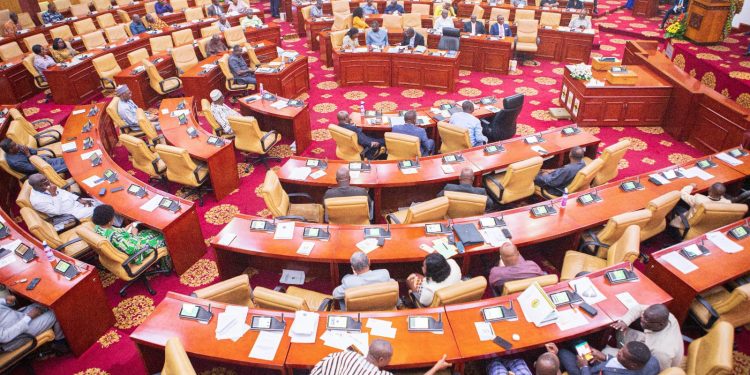
    Mr Okyere accused Dompreh of instigating turmoil in Parliament by urging NPP supporters to attack NDC members, tarnishing the constituency’s reputation.

    He asserted that the people of Nsawam-Adoagyiri no longer back the incumbent MP and challenged anyone who disagrees to face them in court on Tuesday, February 18.

    Mr Okyere further claimed that Annor-Dompreh announced a narrow 210-vote lead in the December 7 parliamentary election, citing provisional figures from the Electoral Commission (EC). However, the NDC disputed these results, triggering unrest and destruction.

    “Those Electoral Commission (EC) officials who had been incited to avert the results are warned,” he said.

    Okyere appealed to the entire Majority Caucus to stand in solidarity with their parliamentary candidate on February 18 as they dispute the 2024 parliamentary election results in court.

  • Parliamentary business is suffering because of Minority’s conduct – MP

    Parliamentary business is suffering because of Minority’s conduct – MP

    Bodi MP, Samson Ahi, has criticized the current minority in Parliament for opting for disorder instead of coordinated boycotts when expressing opposition.

    He argued that this approach has disrupted parliamentary activities and made governance more challenging.

    “The normal parliamentary practice is that if a group does not support a certain course of action, they will register their displeasure by walking out. But this current Minority will not stage a walkout; instead, they will make the place ungovernable. They ensure that nothing can proceed,” he mentioned this while appearing before the panel examining the vetting disorder.

    He lamented the lack of an immediate remedy for this tactic, highlighting that while exiting the chamber is the most suitable form of protest, the minority continues to reject that option.

    “Unless security intervenes, which I do not recommend, it will be difficult to maintain order in the chamber,” he added.

    Mr. Ahi proposed that Parliament implement well-defined measures to regulate behavior during crucial discussions.

    He noted that the Privileges Committee has the mandate to address disorder, providing members with a platform to report cases of misconduct.

    “If a member’s conduct disrupts parliamentary proceedings, a complaint can be lodged on the floor. If the Speaker finds merit in the complaint, the matter is referred to the Privileges Committee, which has the authority to recommend sanctions,” he explained.

    Mr Ahi underscored that the Privileges Committee’s dormancy has hindered the enforcement of parliamentary rules. He emphasized the urgent need to reestablish the committee to restore order and accountability.

    On Thursday, January 30, turmoil erupted during the Appointments Committee’s vetting of President Mahama’s ministerial nominees, escalating tensions in the chamber.
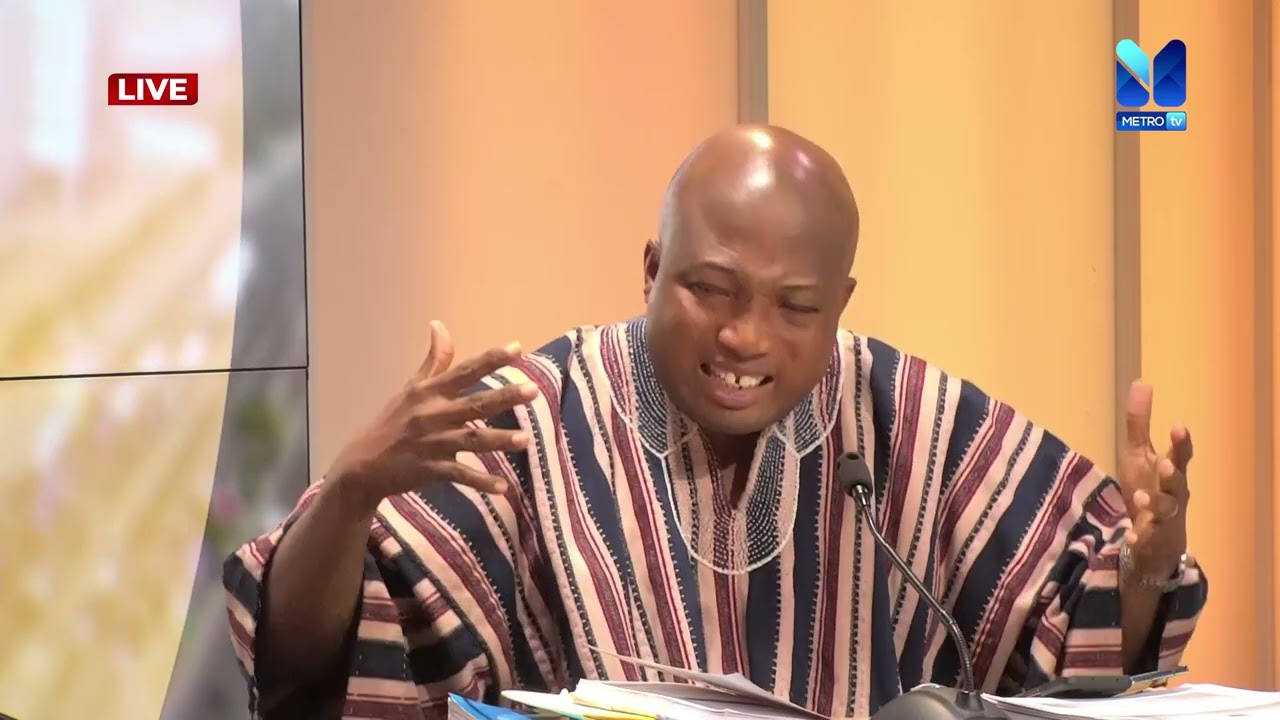
    The confrontation between the majority and minority factions led to property damage, prompting Speaker Alban Bagbin to establish a special committee to probe the incident.

  • NPP MPs stage protest in Parliament against growing violence

    NPP MPs stage protest in Parliament against growing violence

    Opposition Members of Parliament (MPs) from the New Patriotic Party (NPP) staged a protest in the chamber, demanding government action against the escalating violence in the country.

    The MPs were seen singing the patriotic song “Yen Ara Asaase Ni” [This is our land], calling on the government to address what they described as widespread violence in the aftermath of the recent elections.

    JoyNews’ Parliamentary Correspondent, Kwaku Asante, captured the scene as the MPs voiced their concerns over increasing disturbances in various regions, including a recent violent incident in Obuasi, Ashanti Region, where clashes between military personnel and local youth resulted in the deaths of nine civilians.

    The violence occurred when the military intervened to prevent the youth from entering an AngloGold Ashanti mining concession.

    Alongside the Obuasi incident, there have been reports of state institutions being targeted following the December 2024 elections.

    The NPP MPs condemned these actions as undemocratic, calling on the President to take swift action to restore peace and prevent further violence across the nation.

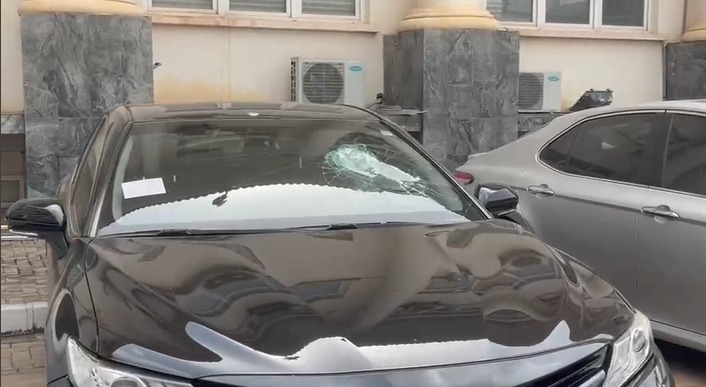
  • Man detained for smashing windscreens of vehicles at Parliament

    Man detained for smashing windscreens of vehicles at Parliament

    A man has been taken into custody for allegedly the windscreens of multiple vehicles parked at the premises of Parliament.

    Witnesses reported seeing the suspect, whose name has not been disclosed, walking among the parked cars and using a metal object to smash the windscreens.

    The reason behind the act remains unclear.

    Security personnel stationed at Parliament responded quickly and apprehended the suspect at the scene.

    While being held by the security personnel, he was heard saying, “Father have mercy on them. Daddy, they don’t know what they are doing… It is for your own good.”

  • Let’s learn from 2008 defeat – Kufuor urges NPP to secure win in December polls

    Let’s learn from 2008 defeat – Kufuor urges NPP to secure win in December polls

    Former President of Ghana, John Agyekum Kufuor, has opened up about the role of voter apathy and internal divisions within the New Patriotic Party (NPP) in the party’s loss during the 2008 general elections.

    Reflecting on the election results, Kufuor expressed his disappointment that the NPP failed to secure a victory, blaming the party’s internal fractures for its defeat.

    Speaking to morning show hosts at his residence, Kufuor highlighted how some party chairmen worked against certain Members of Parliament, leading them to contest as independents.

    “Some chairmen connived to remove some Members of Parliament, and these persons contested as independents, and that affected us greatly. We lost, I think, eighteen seats, and that did not help us as a political party.

    “If we want to win the election and continue the great policies to ensure continuity, we must vote massively for a first-round win. It was worrying that we lost in 2008. We won the first round but lost the second round. At that time, most people who did not vote realized they had to vote; it was too late.

    The former president stressed that the key to winning future elections and ensuring the continuity of successful policies is a strong voter turnout.

    He recalled the tense 2008 election, in which the NPP won the first round but lost in the second round.

    “The NDC came with a different vision, and so some of the things we started were left to rot because they did not believe in our policies. We planned to dualize the Accra and Kumasi roads, but it did not see the light of day.

    “We took an interest-free loan from the Chinese to dualize the road and construct the Nsawam bypass; we constructed the Suhum road to Apedwa, but the ones that were left when we left power, the NDC did not touch them and did nothing about them,” he said.

    The former president concluded with a stark warning about the dangers of voter apathy.

    “So during elections, if you say you won’t vote, the others will vote, so please avoid voter apathy and vote massively so that your party can win. If you don’t vote, you will be left in slavery,” he said.

    Kufuor also reflected on the NDC’s approach after their victory in 2008, which he claimed led to the abandonment of several policies and projects initiated by the NPP.

    Kufuor’s comments come at a crucial time as the country prepares for another round of elections, with political leaders and citizens alike being urged to turn out in full force to secure the nation’s progress.

  • Supreme Court to decide on vacant Parliamentary seats today

    Supreme Court to decide on vacant Parliamentary seats today

    The Supreme Court will deliver a ruling today, Tuesday November 12, on the contested decision to declare four parliamentary seats vacant, a case that has sparked political debate and raised questions about the Speaker of Parliament’s constitutional authority.

    Initially scheduled for Monday, November 11, the court postponed its judgment until today, November 12.

    The case, initiated by Majority Leader Alexander Afenyo-Markin, questions Speaker Alban Bagbin’s decision to declare the seats vacant without judicial approval or the initiation of by-elections.

    At the heart of the dispute is Bagbin’s interpretation of the 1992 Constitution concerning parliamentary vacancies. On October 17, 2024, Bagbin deemed the four seats vacant, arguing that the MPs in question had violated constitutional requirements, thus justifying their removal.

    Afenyo-Markin contends that Bagbin acted beyond his constitutional limits, insisting that only the judiciary has the authority to interpret the Constitution in such cases.

    He argues that Bagbin’s decision bypasses proper legal processes and effectively denies those constituencies their right to representation.

    Following Afenyo-Markin’s suit, the Supreme Court issued an injunction preventing further action regarding the seats until a final judgment.

    Bagbin, however, challenged this injunction, arguing that it restricted his duties as Speaker and that his declaration was necessary to maintain parliamentary integrity.

    The court dismissed Bagbin’s motion to lift the injunction, reinforcing its stance and paving the way for today’s crucial ruling on the matter.

  • What’s happening in parliament is embarrassing, show leadership – Kufuor to Bagbin

    What’s happening in parliament is embarrassing, show leadership – Kufuor to Bagbin

    Former President John Agyekum Kufuor has urged Speaker of Parliament, Alban Sumana Bagbin, to take decisive action in resolving the ongoing deadlock over the seating arrangements in Parliament.

    Kufuor, expressing his frustration, referred to the standoff as “embarrassing” and warned that it could tarnish Bagbin’s well-established political career if not addressed swiftly.

    The controversy stems from the Supreme Court’s decision to stay Bagbin’s earlier ruling that declared four parliamentary seats vacant.

    While members of the New Patriotic Party (NPP) disagree with Bagbin’s ruling, the National Democratic Congress (NDC) continues to support it, claiming a majority in the House.

    Despite the Supreme Court’s intervention, the NDC MPs still occupy seats traditionally reserved for the NPP majority, asserting their position as the new ruling party in Parliament.

    In response, NPP MPs, led by Alexander Afenyo-Markin, have decided to stay out of the chamber to avoid potential confrontations, which has brought parliamentary proceedings to a standstill and escalated tensions between the two parties.

    Speaking to Asempa FM, Kufuor highlighted the critical role Bagbin plays in restoring order and called for leadership that prioritizes the smooth functioning of Parliament.

    He cautioned that failing to resolve the issue could damage Bagbin’s legacy and his contributions to Ghana’s political development.

    “I will plead with the Speaker of Parliament to step up and show leadership. What’s happening in parliament is embarrassing. It can destroy his illustrious record,” he said.

  • Govt spending GHS1m on Parliamentary recall justifiable – Ayariga

    Govt spending GHS1m on Parliamentary recall justifiable – Ayariga

    MP for Bawku Central, Mahama Ayariga, has justified the expenses linked to recalling Parliament, emphasizing the significance of such sessions for Ghana’s democratic process.

    In an interview on the Citi Breakfast Show with Caleb Kudah on Friday, November 8, Mr Ayariga addressed public concerns regarding the reported GH¢1 million cost per recall.

    He argued that this expenditure is a necessary investment to preserve Ghana’s constitutional democracy, contrasting it with the costs of living under a military regime or dictatorship, which he believes would bring greater harm to the country’s stability and development.

    The topic drew attention after Tamale Central MP, Ibrahim Murtala Mohammed, disclosed that each parliamentary recall costs around GH¢1 million, igniting a national discussion on the financial implications, particularly amid Ghana’s current economic difficulties.

    The conversation intensified after Speaker Alban Bagbin’s decision to adjourn Parliament indefinitely on Thursday, November 7. Some members of the National Democratic Congress (NDC) questioned whether the expense is warranted, given the strain on state resources.

    In response, Ayariga upheld that these costs are essential for maintaining democratic values. He asserted that convening Parliament, even at a considerable expense, is necessary for promoting critical debate, safeguarding citizens’ rights, and supporting Ghana’s commitment to a stable constitutional government.

    “You cannot place value on when the constitution is protected, when the constitution is defended and when people stand up to make sure that we imbibe the appropriate constitutional culture that should inform the governance of this country.

    “You cannot place monetary value and calculate and say this is how much it costs and so when a practice takes place, it might appear to have cost money but we know what it costs us to live under military regimes.

    “We now have a constitution and it says Parliament can be convened and Parliament can adjourn and people have the right to demand that it should be convened and this is how we go about it and all that will cost money, but it is far better than military rule and dictatorship, and so you cannot place real monetary value on it.”

  • Let parliament do its job – Bagbin tells stakeholders over vacant seats

    Let parliament do its job – Bagbin tells stakeholders over vacant seats

    Speaker of Parliament, Alban Bagbin, has called on stakeholders to cease fueling unnecessary panic and allow Parliament to function as intended.

    In a statement on November 6, 2024, he urged the public to stop spreading fear, emphasizing that Parliament is not in disarray, contrary to some criticisms.

    “Stop pressing the panic buttons and fear-mongering. Let the system work,” Bagbin said during a press briefing in Parliament.

    Drawing on his extensive experience, with over 30 years in parliamentary service and more than 40 years in public service, Bagbin reassured Ghanaians that he is capable of leading the third arm of government effectively, without causing disarray.

    His comments came in the wake of remarks made by Chief Justice Gertrude Torkornoo during a Supreme Court session on October 30, 2024, where she expressed concerns over the Parliament’s inactivity.

    “This is a constitution crisis, we’re living in a country where the Parliament is not sitting, What is going on?” she quizzed.

    Bagbin, who has consistently worked towards strengthening Parliament, reiterated his commitment to leave the institution in as strong a position as he found it when he assumed leadership.

  • Senyo K. Hosi: Open letter to the Speaker of Parliament rest the hawk, save our democracy

    Senyo K. Hosi: Open letter to the Speaker of Parliament rest the hawk, save our democracy

    Dear Mr. Speaker, a while ago, I published an open letter to the Chief Justice of our Republic, Her Ladyship Justice Gertrude Araba Esaaba Sackey Torkornoo.

    The sentiments contained in that letter came from puritanical intentions and aligned, I believe, with pervasive public perceptions of our apex court.

    I argued that the waning trust in the judiciary is a major risk to our democracy. We may I have enjoyed over 30 years of our 4th Republic, but we should not get too comfortable.

    Reports of democratic recession globally and a disenchanted African youth must guide our governments and leaders.

    The disillusionment of many in the failure of our democracy to deliver the promises of our 1992 Constitution paints more a fragile democracy.

    Please let’s not take our progress for granted. Mr. Speaker, following the dismissal of your motion to have the Supreme Court vacate its orders in the Afenyo Markin vs.

    The Speaker case, there are many expecting that you will ignore the apex court and proceed in an assertive fashion.

    Well, you may do that, perhaps with limited consequences for your person as the rest of us would have faced if we disobeyed the Supreme Court.

    But that may be High Crime. One that must be punished irrespective of whose ox is gored. While the hawks would applaud the no-nonsense ‘kinkong’ Bagbin persona on the sidelines, it would ring uncertainty, or even doom, for our democratic governance.

    Our Constitution has granted hegemony of adjudicative powers in our courts, and installed the Supreme Court as the final arbiter in that enterprise.

    Your disrespect of the court’s decision will set a dangerous precedent and disturb the harmony in our governance institutions.

    Can you imagine the anarchy of having the various arms of government opt to disregard the orders of the Supreme Court? Maybe the citizenry and security agencies will follow suit and there goes our statehood.

    The constitution envisages the occurrence of conflicts in the everyday dealings of the citizenry as well as the dealings of our governance structures.

    For the sustenance of governance and the progress of the State, conflicts cannot be allowed to continue in perpetuity and for which reason, the Supreme Court in Article 129 is charged with bringing finality to conflicts, including conflicts with itself.

    We-the-people’ through the constitution, empowered it with counter majoritarian powers. We did this in full knowledge that it may hurt intertemporally but sure provides structural stability for the advancement of the State.

    Respectfully, Mr. Speaker. Like all of us, you are entitled to disagree with rulings and judgments of the court when they are perverse, or even threaten the ideals of our Constitution.

    The mere existence of a flaw in the court’s decision does not necessarily mean it should be disobeyed, any more than the mere existence of a bad character trait in a child means he should be abandoned.

    It is true that the indeterminacy and manipulability of law means a court’s decision can sometimes be atrocious, offensive and a desecration of justice.

    But disobedience resets our governance systems to a primordial anarchic state. Judges themselves accept that they can be wrong.

    It was a former Nigerian Chief Justice, Chukwudifu Oputa, who said that the law is what the Supreme Court says it is even when it is wrong.

    In other words, a court’s decision may be subject to decisive objections, like this current one, but until reversed, or steps are taken to change it, must be obeyed, nonetheless.

    Mr. Speaker, while the hawkish voices may be loud, cacophonous and tempting, I strongly urge you not to fall into the trap of counter-productive inter-organ collision which now threatens the efficiency of our state.

    I urge you to put country first and save our democracy from the excessive partisan polarization we face today. If you can do this, your place in our history as an extraordinary statesman is assured.

    From the caves of Klefe-Demete, my humble village, I remain.

    Senyo K. Hosi

    PS: Dear Speaker Alban, it’s not time to be Man, it’s time to be Statesman, posterity will be kind to your time.

    DISCLAIMER: TIGPost.co will not be liable for any inaccuracies contained in this article. The views expressed in the article are solely those of the author’s, and do not reflect those of The Independent Ghana.

  • Chaos in parliament a threat to democracy – Allotey Jacobs

    Chaos in parliament a threat to democracy – Allotey Jacobs

    The former Central Regional Chairman of the National Democratic Congress (NDC), Bernard Allotey Jacobs, has labeled the Speaker of Parliament’s, Alban Bagbin’s recent declaration of four vacant seats as a “parliamentary coup d’état.”

    Speaking on Peace FM’s Kokrokoo on Wednesday, October 23, 2024, Jacobs expressed his belief that this move was part of a scheme by the NDC caucus, in conjunction with the Speaker, to illegitimately seize control that does not rightfully belong to them.

    “My interpretation of what happened last week in the declaration of four vacant seats of parliament was an act of parliamentary coup d’état led by Alban Sumana Bagbin. It was an act of coup d’état and it must never happen again.

    “You can’t force yourself to take power when it is not yours. If you want Majority, go and do your campaign on the ground, come back to Parliament in 2025, and be the Majority,” he explained.

    Mr Jacobs insisted that the NDC should focus on winning the Majority through legitimate electoral processes rather than trying to forcibly take power.

    “For me, I sense certain motives behind the declaration. A declaration of a false Majority to come and abolish policies they helped approve and passed, that’s one way of a coup d’état. You don’t live in that kind of Alice Wonderland where you abolish and you expect the president to assent and what happens next is for Parliament to vote no confidence in the presidency.

    “It is a sequence of strategies adopted by them and that is my interpretation of what happened at the parliament house…,” he added.

  • Parliament should be a place for meaningful discussions, not chaos – Joe Wise

    Parliament should be a place for meaningful discussions, not chaos – Joe Wise

    The First Deputy Speaker of Parliament, Joseph Osei-Owusu, has voiced his profound disappointment regarding the performance and behavior of Members of the 8th Parliament of Ghana.

    In a recent interview with Citi News, often referred to as Joe Wise, he criticized the current parliamentary session for its lack of focus and overwhelming controversies, arguing that it has neglected its primary duty of lawmaking.

    He noted that this Parliament has not met the legislative benchmarks set by its predecessors, ultimately falling short of public expectations.

    Joe Wise lamented the state of affairs in the 8th Parliament, emphasizing that instead of dedicating time to lawmaking, Members have often engaged in unproductive disputes.

    He pointed out that the number of laws passed during this session is significantly lower than in previous sessions, highlighting the inadequate legislative output, both in terms of major laws and smaller legislative instruments.

    “Let me say that I am disappointed in the eighth Parliament, generally. I said the other time that we have done very little in legislation. You can just take the number of laws and smaller legislations we have done. We have wasted so much time on inconsequential things, inconsequential matters. Our main job is making laws.

    “You go and take the number of laws we have made in the last four years and compare with the other Parliaments and you see that the eighth Parliament has been the least.

    “It has been full of controversy. Matters that previously we used to sit down and discuss and overcome and do, now we take them into fisticuffs and that is most disappointing to me.”

  • Integrity of 8th Parliament is at stake – Ursula warns

    Integrity of 8th Parliament is at stake – Ursula warns

    The Member of Parliament for Ablekuma West, Ursula Owusu-Ekuful has called on Speaker Alban Bagbin to restore order in the House, cautioning that the ongoing turmoil could tarnish the legacy of the 8th Parliament, marking it as the worst in Ghana’s history.

    Owusu-Ekuful voiced her concerns regarding the escalating disorder in Parliament, highlighting that it falls on the Speaker to take decisive action to prevent further disruptions.

    She recalled the chaotic atmosphere during Bagbin’s election as Speaker, stressing the need for strong leadership to uphold Parliament’s integrity.

    Her comments come at a time when tensions are running high, with both the New Patriotic Party (NPP) and National Democratic Congress (NDC) factions asserting their claims to majority status, which has exacerbated conflicts.

    Speaking to the media during the launch of an industry forum and the inauguration of an independent assessor by the Cyber Security Authority, she urged all parties to prioritize peace and stability within Parliament for the nation’s advancement.

    “I am deeply worried about the negative image that this 8th Parliament is cultivating as the most chaotic we have ever witnessed. This reflects poorly on Parliament and is detrimental to its reputation. Rowdiness and confrontations have no place here,” she stated.

    Owusu-Ekuful further implored the Speaker to engage with parliamentary leadership to address these challenges calmly, asserting that such an approach would ultimately benefit both Parliament and democracy.

    “If we’re not careful, we risk doing a great disservice to ourselves and future generations, and we may be remembered as the worst Parliament, if not one of the worst led by a Speaker whose role is to maintain order in the House,” she cautioned.

    She also expressed hope that Bagbin would avoid letting the situation deteriorate under his leadership. “Given the contentious circumstances surrounding his election, we certainly don’t want his tenure to end in more discord. It is crucial for him to promote a spirit of calm and collaboration,” she added.

  • Peace Council meets with Majority, Minority over tension in Parliament

    Peace Council meets with Majority, Minority over tension in Parliament

    The National Peace Council has urgently convened a meeting to address potential disruptions ahead of a tense parliamentary session set for Tuesday, October 22, 2024.

    This initiative comes in light of the Supreme Court’s recent decision to suspend Speaker Alban Bagbin’s ruling, which had declared four parliamentary seats vacant.

    As tensions escalate, the Minority in Parliament has announced plans to occupy the Majority side of the chamber until a new ruling is issued by the Speaker, intensifying the political uncertainty surrounding the distribution of power in the legislature.

    In a bid to ensure a peaceful session, the National Peace Council is engaging with crucial stakeholders, including leaders from both the New Patriotic Party (NPP) and the National Democratic Congress (NDC), parliamentary leadership, and other relevant organizations.

    Their primary objective is to facilitate a smooth parliamentary meeting on Tuesday, thereby avoiding any chaotic incidents.

    Sheikh Armiyawo Shaibu, a member of the National Peace Council and spokesperson for the National Chief Imam, stressed the importance of caution and called on all parties to act responsibly to defuse rising tensions.

    “We don’t want to see anything untoward happen tomorrow. There have even been suggestions that military personnel might be deployed, though there is no solid basis for that. Still, we must prepare for any outcome,” he stated.

    Sheikh Shaibu also urged all branches of government to set aside political differences and view the current circumstances as a chance to strengthen Ghana’s democracy. 

    “This moment is not about one party or the other. It is about reaching a point in our democratic journey where crucial decisions must be made for the betterment of our future,” he added.

  • MPs deserve police escort, it’s not a sin – Kennedy Agyapong

    MPs deserve police escort, it’s not a sin – Kennedy Agyapong

    The Member of Parliament (MP) for Assin Central, Kennedy Agyapong, is discontent over some amendments made to the Roads Regulations Act LI 2180 sidelining parliamentarians from the list of Ghanaians permitted to use sirens and motorcade.

    The Roads Regulations Act LI 2180 from the Ministry of Transport seeking to exclude the Speaker and MPs is before Parliament for approval.

    Speaking at an emergency sitting of Parliament on Wednesday, September 4, 2024, Ken Agyapong argued that providing police escorts for MPs is a rightful measure, not a privilege.

    He noted that legislators have been belittled by society but they have retreated into their shells due to fear of public criticism.

    Kennedy Agyapong further called on his colleagues to stand up against intimidation and advocate for laws that benefit both the interests of the house and their personal lives, emphasizing the need for enhanced security.

    “I want to caution my colleagues to be bold for once because we’ve been cowards to the public. When it comes to anything concerning Parliament, we are afraid of the reaction of the public, but anything that the government needs, they will first come to Parliament. For a whole Speaker, you say that he cannot even enjoy a motorcade. Who is Kennedy Agyapong? Who went to the Senate and enjoyed a motorcade under President Kufuor’s administration? We must be bold and speak the truth,” he said.

    “Every money this country needs, it has to go through Parliament, but society belittles us as if we are servants to them. Although we are servants to them, we also have to enjoy rights. I want you guys to be bold. Members have to be bold.
    “In case there is an emergency and you need Members of Parliament from, say, Adenta to come here. If he enjoys a motorcade, is it a sin? Mr. Speaker, I am speaking for Parliament, that it is a very important institution and therefore we should not be afraid to demand opportunities for ourselves.
    “If they are doing this to the Speaker, then who are you? A member of Parliament sitting here, and we are the same people who are going to approve this (the amended act). Are you saying that ministers are also not important?” he quizzed.

    In a similar vein, Minority Leader Haruna Iddrisu has expressed alignment with Kennedy Agyapong’s concerns, emphasizing the need for better security measures and privileges for legislators.

    Expressing his dissatisfaction, Mr Iddrisu underscored the importance of the Speaker’s role within Ghana’s governance framework.

    He argued that it is inappropriate for the Speaker, who holds the third-highest position in the country, to be excluded from the use of a motorcade or police siren.

    “Without personalizing it, it is not Alban Sumana Bagbin. It is the Speaker of Ghana’s Parliament, and he is not entitled to a motorcade or a police siren? In my view, Mr. Speaker, it is wrong for the number three to be out of this privilege,” Iddrisu stated.

    Mr Iddrisu further highlighted that the Chief Justice, another key figure in the Republic, is also excluded from the Motor Traffic Regulation.

    He emphasized that the governance of Ghana relies on the leadership of four principal personalities: the President, the Vice President, the Speaker, and the Chief Justice. Excluding any of these figures from such privileges undermines their role and significance.

    The Legislative Instrument had been previously withdrawn following public backlash over a proposal to grant Members of Parliament (MPs) similar privileges.

  • Parliament did not approve $660m for Tema Motorway project but $339m – Minority

    Parliament did not approve $660m for Tema Motorway project but $339m – Minority

    The Minority in Parliament has clarified that the approved budget for the Accra-Tema Motorway expansion project is $339 million, not the $660 million previously mentioned.

    President Akufo-Addo launched the project on Monday, August 26, with plans to transform the motorway into a modern 10-lane highway.

    The Minority spokesperson for infrastructure, Governs Agbodza, expressed concerns about the project’s transparency, drawing parallels to other delayed government initiatives such as Agenda 111 and various housing projects.

    “Parliament ONLY approved $339m Multi-Year funding for the project. We did not approve $660m. No one has the right to commit the country to future spending on the project without approval from Parliament,” Governs Agbodza wrote in a statement on Tuesday, August 27.

    The expansion project seeks to reduce traffic congestion and improve safety, ensuring the motorway becomes fully accessible and more efficient.

    Spanning 27.7 kilometers, the project will be carried out in three phases: the first phase will rehabilitate the motorway, the second phase will upgrade the George Walker Bush Highway, and the third phase will enhance the Nsawam Road.

    Below is Agbodza’s full statement.

    ACCRA-TEMA MOTORWAY PROJECT-PARLIAMENT DID NOT APPROVE $660m

    1. The NDC is not against improving the Accra-Tema Motorway. Indeed, we support the principles behind the project and demonstrated same in the past. But will not shirk our responsibility to ensure value for money and accountability.
    2. ⁠Parliament ONLY approved $339m Multi-Year funding for the project. We did not approve $660m. No one has the right to commit the country to future spending on the project without approval from Parliament.
    3. ⁠The source of funding for the project is NOT SUSTAINABLE. The NPP is claiming the source of funds for the project is Mahama’s Ghana Infrastructure Investment Fund (GIIF). The NPP said the same thing about how they were going to fund the so-called Agenda 111, housing projects etc. We all know the status of Agenda 111, etc today . The NPP has collapsed the Ghana Infrastructure Investment Fund (GIIF). Unlike the past when GIIF backed projects that are self-financing and sustainable, such as Kotoka Airport Terminal 3 etc, the NPP incompetently invested the funds in unproductive ventures like SKYTRIAIN, PULLMAN HOTEL etc.
    4. In any case, why is NPP not explaining why they cancelled the contract between the Road Ministry and Morta Engils and why they paid $2.5 million towards that unwholesome contract?
    5. The government currently OWES ROAD CONTRACTORS ABOUT GH¢15BILLION for works completed and certified and NOT PAID FOR.

    Currently, the government cannot even fund the payment of salaries, pay Statutory Funds to District Assemblies, NHIA, GETFund, etc. What is the point of cutting sod for $338 million project 3 months before you are booted out of office? IT IS PROPAGANDA FOR VOTES . Ghanaians will not fall for this . NPP, NOT AGAIN.

  • Renovation of parliamentary chamber pegged at €2.26m

    Renovation of parliamentary chamber pegged at €2.26m

    Speaker of Parliament Alban Bagbin has disclosed that the ongoing renovation of the Parliamentary Chamber will cost the Ghanaian government approximately €2.26 million.

    Parliament adjourned indefinitely at midnight on July 30 to expedite the renovation, which is projected to take about three months.

    On Friday, August 23, Speaker Bagbin toured the Chamber to assess the progress of the work. During his visit, he highlighted several challenges facing the House, including issues with voting, quorum, and faulty audiovisual systems.

    Bagbin recalled that in 2014, Bosch DICENTIS Multimedia Company was commissioned by former Speaker Doe Adjaho to convert the House into an E-Parliament, aimed at cutting costs related to bulk printing and paperwork.

    He noted that former Speaker Prof. Mike Ocquaye later revised the contract to include the installation of biometric gadgets in the Chamber. Following a competitive tendering process, the contract was awarded to Michel Africa Parliament Services.

    Bagbin also mentioned that the adjournment on July 30 was partly due to the need to attend an international parliamentary conference in the United States.

    The renovation, funded by the government, will see work tables produced locally by Fernac, while all other equipment will be imported. The project is expected to be completed by the end of October 2024.

  • Africa’s sovereign debt surpasses $1 trillion – ECA

    Africa’s sovereign debt surpasses $1 trillion – ECA

    African nations collectively hold over $1 trillion in sovereign debt, with several countries struggling to keep up with payments, according to a United Nations agency official.

    Executive secretary of the United Nations Economic Commission for Africa, Claver Gatete, highlighted the continent’s challenges in financing, security, and climate change during a regional meeting of the Southern African Development Community at Zimbabwe’s Parliament.

    “This is also happening when long term concessional finance, official development assistance and foreign direct investments are declining.”

    He noted that this strain is exacerbated by a decline in long-term concessional financing, official development assistance, and foreign direct investments.

    Countries like Ghana and Zambia have recently secured deals with dollar bondholders after prolonged negotiations under the Group of 20’s Common Framework.

    Ethiopia is also set to resume talks with its bondholders soon, following a significant agreement with the IMF last month.

    Mr Gatete pointed out that climate change is further compounding Africa’s economic woes, eroding an average of 5% of the continent’s GDP annually. Mozambique alone lost 15% of its GDP to climate impacts last year.

    He emphasized the need for reform in the global financial architecture to ensure Africa’s needs are considered, expressing concerns that multilateral financial institutions like the World Bank and the International Monetary Fund do not adequately address the continent’s challenges.

    “That is is why we are working on an African position to reform of the global financial architecture so that Africa’s needs are taken into account,” he said, referring to concerns that the continent is not treated fairly by multilateral financial institutions such as the World Bank and International Monetary Fund.

  • Muntaka blames parliament for 70% of Ghana’s problems – Manasseh

    Ghanaian investigative journalist and author Manasseh Azure Awuni has highlighted the dissatisfaction of Asawase MP Muntaka Mubarak and First Deputy Speaker Joseph Osei-Owusu with the current state of Parliament.

    In an interview with Bernard Avle on The Point of View, Manasseh disclosed that Muntaka Mubarak, during a discussion prior to the release of Manasseh’s new book, claimed that 70% of Ghana’s issues can be traced back to Parliament.

    According to Manasseh, both Muntaka and Osei-Owusu are frustrated with Parliament, recognizing its significant problems but struggling to address them from within.

    “Generally, there are people who especially Joe Osei-Owusu, Muntaka, they are not happy with Parliament. Muntaka said 70% of the problems in this country should be traced to Parliament. They are not happy, they know they are in a mess, but it’s difficult to fight from within. So, when they get the platform, they can speak.”

    Manasseh’s latest book, “The President Ghana Never Got,” was launched on August 8.

    Manasseh’s book is his most recent work on Ghana’s successive governments, following his 2016 publication,“The Fourth John: Reign, Rejection & Rebound,” which detailed the presidency of John Dramani Mahama as he exited office.

  • Parliament is not privy to govt’s decision to lease Komenda Sugar Factory – MP

    Parliament is not privy to govt’s decision to lease Komenda Sugar Factory – MP

    The Ranking Member on the Trade and Industry Committee and MP for Bole Bamboi, Yusif Sulemana, has expressed significant concerns regarding the government’s possible plan to lease the Komenda Sugar Factory to the Indian company, West Africa Agro Limited, for a duration of 15 to 20 years.

    The factory is currently undergoing a test run in preparation for full production. During a recent visit, Trade and Industry Minister Kobina Tahiru Hammond announced that the government intends to lease the facility to West Africa Agro Limited, with an option for renewal, as part of an effort to revive its operations and meet domestic demand.

    The Komenda Sugar Development Company Limited, founded in 1964, has faced numerous challenges, including interruptions in production.

    Despite investments from the Indian Export-Import Bank and previous funding from the NDC government, the factory has not yet met its operational goals.

    In an interview with Citi FM, Mr Sulemana criticized the lack of disclosure to Parliament regarding this decision and called for Trade Minister K.T. Hammond to be summoned to address the issue.

    With Parliament currently in recess, Mr Sulemana plans to release a statement questioning the Trade Minister’s plans for the factory.

    He underscored that the factory’s goals remain unfulfilled under the current administration and stressed the need for Parliament to be informed about any decisions affecting its future.

  • Efforts to release govt lands list are being blocked by Lands Commission – Ablakwa

    Efforts to release govt lands list are being blocked by Lands Commission – Ablakwa

    The Government Assurances Committee of Parliament has criticized the Lands Commission for its failure to provide data on public lands and their use over time.

    The Committee argues that this data is crucial for addressing fraudulent practices, such as the improper registration of government lands as private properties.

    At its meeting on Wednesday, July 31, the committee chairman, Samuel Okudzeto Ablakwa, expressed frustration over the unsuccessful attempts to obtain these documents from the Lands Commission over the past two years.

    “If this data is put together and provided, it will help all of us. These instances of government lands being registered as private lands and the fraud that is going on at the Lands Commission, as exposed by the Soul Enquirer, the only way to stem this, to prevent this, to forestall this, is to have the data, to put the data together.

    “That is why I am clear in my mind that there are elements at the Lands Commission who don’t want the Ghanaian people to have this data.”

    In response, Samuel Abdulai Jinapor, the Minister for Lands and Natural Resources, explained the delay.

    “The Lands Commission for all these years has been operating manually and it is just recently that we have started making efforts to digitise the records of the Lands Commission.

    “The information I have from the Commission since I gave them the instructions to compile this list is that compiling the list from the 16 regions of the Lands Commission across the country from 1993 to now is an extraordinary undertaking and therefore they have not been able to put it all together as yet. And so I am unable to provide it now, but there is work in progress.”

  • Ghana Road Fund’s debt to contractors exceeds GHS6bn – Annoh-Dompreh

    Ghana Road Fund’s debt to contractors exceeds GHS6bn – Annoh-Dompreh

    The Ghana Road Fund faces a debt of over GH¢6 billion owed to contractors, primarily due to limited inflows resulting from the capping law.

    This financial constraint stems from a 2017 parliamentary law that restricts the allocation of funds to various statutory bodies to a maximum of 25% of tax revenue.

    During the launch event of the road maintenance app, a speech on behalf of Chairman of the Road Fund, Frank Annoh-Dompreh, emphasized the need for an exemption from this capping law.

    Annoh-Dompreh noted, “That I am advised by counsel and verily believe same to be true that the conduct of the respon­dents is not only wilful but it also constitutes an unlawful interference with the administration of justice and undermines the authority of the court,” the application said.

    It said, “that the respondents’ wrongful conduct is tantamount to contempt of court and warrants imposition of such appropriate punitive sanction, to serve as a deterrent to others who may dare threat the same path as the respon­dents.”

    He further stated his intention to engage with the Ministry of Finance and Cabinet to seek an exemption for the Road Fund from the Earmarked Funds Capping and Realignment Act, 2017 (Act 947).

    This exemption, he argued, would make necessary funds available to support ongoing initiatives and settle debts to maintenance contractors, ensuring the continuation of road projects.

  • Parliament gives green light to Ghana Shippers Authority Bill

    Parliament gives green light to Ghana Shippers Authority Bill

    Parliament has approved the Ghana Shippers Authority Bill 2024, granting the authority the power to regulate and standardize shipping charges, fees, and requirements imposed by service providers.

    In support of the bill, the Roads and Transport Committee of Parliament highlighted that local shippers are fragmented and lack bargaining power against multinational shipping service providers, leaving them vulnerable to unfair practices.

    The committee noted that this situation has allowed multinational companies to dominate the ports, imposing exorbitant fees on users, which increases the cost of shipping and trade for local businesses.

    The Ghana Shippers Authority Bill aims to ensure fair and transparent pricing, protecting local businesses from exploitative practices.

    During the parliamentary session, Speaker of Parliament Alban Bagbin declared, “Honourable members, the Ghana Shippers Bill 2024 duly read the third time and passed.”

  • Parliament endorses €1,594k tax waiver for E-Learning Labs in SHSs

    Parliament endorses €1,594k tax waiver for E-Learning Labs in SHSs

    Parliament has approved a tax waiver of €1,517,040.00 for the installation of integrated e-learning laboratories in senior high schools across the country.

    The waiver, proposed by Minister of State at the Ministry of Finance, Hon. Abena Osei-Asare, is in accordance with Article 174 (2) of the Constitution and Parliament’s Standing Orders.

    On June 28, 2024, the Rt. Hon. Speaker sent the waiver proposal to the Finance Committee for detailed review. The Committee held discussions with key stakeholders, including Minister for Education Yaw Osei Adutwum, Hon. Abena Osei-Asare, Deputy Minister for Education Professor Kingsley Nyarko, and representatives from the Ministry of Finance, Ministry of Education, and the Ghana Revenue Authority (GRA).

    The Committee examined several documents, including the 1992 Constitution of Ghana, the Public Financial Management Act, the Parliament Standing Orders, and the €11,594,000.00 Commercial Contract with Televic Group N.V. for the e-learning laboratories (TELEVIC Phase II).

    Background

    The Integrated E-Learning Laboratories Project aims to enhance ICT facilities in senior high schools. Phase I successfully provided ICT labs to 240 schools and two resource centers. Phase II will extend this to 175 additional senior high schools.

    To finance Phase II, the government obtained a Credit Agreement from KBC Bank NV of Belgium for €3,866,425.20, which includes a €272,425.20 Credendo ECA insurance premium. Additionally, a Commercial Contract worth €11,594,000.00 was signed with Televic Group N.V. for project implementation.

    As required by Clause 14.1 of the General Conditions of the Contract Agreement, a tax exemption is essential for the project. Without this waiver, the contractor would need to be reimbursed for any taxes and duties paid.

  • Key highlights from the Mid-Year Budget Review presentation

    Key highlights from the Mid-Year Budget Review presentation

    After a nearly four-hour delay due to a standoff between the leadership of the Minority caucus and the government, the Minister of Finance, Dr. Mohammed Amin Adam, delivered the Mid-Year Budget review on Tuesday, July 23, 2024.

    This review, in compliance with Section 28 of the Public Financial Management Act, 2016 (Act 921), requires the minister to present the mid-year fiscal policy review of the Budget Statement and Economic Policy of the government.

    With Ghana’s economy showing signs of recovery from recent challenges, the Mid-Year Budget review provided the finance minister an opportunity to update Parliament and the nation on the progress made and highlight major upcoming policies.

    Return of Road Tolls

    Dr. Mohammed Amin Adam announced that the cabinet has approved the reintroduction of road tolls.

    According to the minister, this decision aims to generate additional revenue for the maintenance and development of the country’s road network.

    “Mr. Speaker, Cabinet has approved the establishment of a framework for the reintroduction of road and bridge tolls in 2025,” he said.

    Economic Growth at 4.7%

    The finance minister revealed that Ghana’s economy is on an upward trajectory, with a 4.7% growth in the first quarter of the year. This growth reflects the effectiveness of the government’s policies in building a resilient economy.

    “Our economy grew by 4.7% in the first quarter of this year, surpassing our expectations. This growth demonstrates the resilience of our economic policies and the hard work of Ghanaians,” he stated during his mid-year budget review presentation to Parliament on July 23, 2024.

    Third Coupon Payment for Investors in August 2024

    Following the successful implementation of the Domestic Debt Exchange Program (DDEP) in 2023, Dr. Amin Adam announced progress in paying returns to investors. He confirmed that the third coupon payment would be made in August, demonstrating the government’s commitment to honoring its financial obligations.

    “I am pleased to report that the Government has made substantial progress since the completion of the Domestic Debt Exchange Programme (DDEP) in September 2023.

    Ghana’s Public Debt Reaches GH¢742bn

    The finance minister disclosed that the country’s public debt has increased from GH¢658.6bn to GH¢742bn as of June 2024, representing 70.6 percent of the Gross Domestic Product (GDP).

    “This indicates an increase of 22.0 percent due to the effect of the cedi depreciation and continuous disbursements from creditors.”

    “The stock consists of external debt of GH¢452.0 billion and domestic debt of GH¢290.0 billion, representing 60.9 percent and 39.1 percent of the total debt stock, respectively.

    GH¢9.9 Billion Spent on Free SHS Since 2017

    During the presentation, it was revealed that the government’s flagship Free SHS education program has cost over GH¢9.9 billion since its inception.

    Dr. Amin Adam emphasized the government’s commitment to providing free high school education to Ghanaians.

    “The impact of the program is evident. To date, a total of over GH¢9.9 billion has been spent on the program and a cumulative total of 5.7 million young people have benefited from this initiative, many of whom may not have had this opportunity.

    Mr. Speaker, to further support this initiative, we have established facilities under TVET to equip our youth with employable skills, enrolling 168,000 students in the 2023-2024 academic year.

    Additionally, we are constructing 10 STEM schools and 10 STEM centers nationwide, and have distributed 900,000 tablets to secondary school students. We have placed a significant emphasis on quality education. The students’ performance at the 2023 WASSCE is the best since 2015,” he explained.

  • I am the voice of every Ghanaian, not just your voters – Bagbin to Sefwi-Wiawso MP

    I am the voice of every Ghanaian, not just your voters – Bagbin to Sefwi-Wiawso MP

    On Monday, July 22, 2024, Speaker Alban Sumana Kingsford Bagbin criticized Kwaku Afriyie, the MP for Sefwi Wiawso, for challenging his authority.

    During his announcement of the president’s nominations for two new Supreme Court justices, Bagbin suggested that the House should debate legislation to limit the number of judges on the court.

    Afriyie, representing his constituency, objected to Bagbin’s remarks, asserting his right to question the Speaker’s position.

    “Mr. Speaker, with all due respect to your chair, this preliminary comment you are making is prejudicial, and I believe that as representing the good people of Sefwi-Wiawso, it doesn’t lie in your mouth to remind us of the things that you have said, thank you,” he remarked.

    The MP’s comment, however, was not well received by the Speaker, who considered it rude.

    In response, Speaker Bagbin emphasized his superior role and subsequently ordered the MP’s immediate removal from the chamber.

    “This is a completely rude remark, and I can send you out of the House now. It lies in my authority to do so. You represent the good people of Sefwi-Wiawso; I represent the whole country. Please, Marshal, take him out of the House. I will not entertain such disrespect,” he ordered.

    Following the Speaker’s order, Majority Chief Whip Frank Annoh-Dompreh issued an apology to Mr. Bagbin on behalf of his colleague and the caucus.

    “Speaker, we acknowledge the wisdom you have guided us with and how you have navigated us to this point. We have had moments of tension; we have had some tense moments in the House, and through all that, you have shown leadership, and it is incumbent upon us as leaders to help you right now. What happened a moment ago was unfortunate,” he told the Speaker.

    However, in an interview on Monday evening, Mr. Kwaku Afriyie maintained that his objection was justified and rejected the apology issued on his behalf.

    “He (Hon. Frank Annoh-Dompreh) does not have my permission to apologize to the Speaker. And this one you can put on record: I haven’t done anything wrong; why should I apologize?

    “Whatever happens, I will advise myself. I will not be prejudicial in saying some things. That will be very unfortunate on my part, so you let the issue unfold, and then we shall see. So far, I haven’t done anything wrong; I haven’t insulted the Speaker; I haven’t disrespected him; where’s the disrespect?” he stated in an interview on Citi FM.

    “Actually, it was with a lot of humility that I acted, and that was why I told the Marshal to let me bow to the chair. I was raised in the palace. That is all. I have not done anything wrong to apologize for,” he added.

  • Parliament approves contracts for timber utilisation

    Parliament approves contracts for timber utilisation

    Parliament has approved the Timber Utilisation Contracts (TUCs) for timber exploitation during the third meeting of the Fourth Session of the Eighth Parliament of the Fourth Republic.

    This decision ratifies eleven TUCs from an initial batch of nineteen, fulfilling constitutional requirements.

    This approval permits Ghana to issue Forest Law Enforcement, Governance and Trade (FLEGT) Licences, thereby enabling the export of timber and timber products to European markets.

    Ghana is set to become the first African country, and the second globally after Indonesia, to issue FLEGT Licences for timber.

    On March 31, 2022, the Cabinet approved the conversion of 156 timber concessions and permits into TUCs, in line with Section 19 of Act 547, which was then presented to Parliament for ratification.

    Act 547, effective from March 18, 1998, mandates that timber harvesting requires a TUC, replacing the previous system of timber rights under the Concessions Act of 1962 (Act 124).

    The introduction of TUCs represents a significant policy reform designed to enhance the competitiveness of timber resource allocation.

    Section 19 of Act 547 stipulates that timber rights granted prior to the Act’s enactment were only valid for six months, necessitating the application for TUCs within that timeframe.

    Despite this, it took nearly 25 years for these concessions and leases to be converted into TUCs.

    The recent ratification of these TUCs by Parliament signifies a major step forward in the legal timber trade, aligning with European Union standards.

    According to a statement from the Ministry of Lands and Natural Resources dated Thursday, July 18, this ratification concludes the process of granting timber rights and highlights the government’s dedication to managing Ghana’s forest resources sustainably.

    This move also enables Ghana to meet its commitments under the Voluntary Partnership Agreement (VPA) with the EU regarding FLEGT Licences.

    It supports efforts to combat deforestation and forest degradation, improves environmental governance, and contributes to the achievement of Sustainable Development Goals (SDGs).

  • EC to address Parliament on 2024 elections preparations today

    EC to address Parliament on 2024 elections preparations today

    Today, Friday, July 19, 2024, the Electoral Commission (EC) is expected to appear before Parliament to brief the House on the 2024 General Elections preparations.

    The purpose of the meeting, which is anticipated to occur in the chamber, is to address a request from members to determine the level of readiness of the electoral management body for the 2024 elections.

    This was disclosed on Thursday, July 18, during proceedings by Andrew Asiamah Amoako, the Second Deputy Speaker of Parliament.

    “We will be meeting the Electoral Commission, they are going to be here at our instance, we have invited them to come and brief us on the preparations they have made so far towards the 2024 elections.

    “If you have any issue relating to the EC, just come and ask, it’s not going to be a banter, we’re going to respectfully enquire about what they are doing. So, let’s prepare and come and meet them,” the Second Deputy Speaker of Parliament said.

    On December 7, Ghana will hold elections to choose its presidential and legislative representatives.

  • People still live in tents: Ablakwa ‘cries’ for dam spillage victims ahead of second spillage

    People still live in tents: Ablakwa ‘cries’ for dam spillage victims ahead of second spillage

    Member of Parliament for North Tongu, Samuel Okudzeto Ablakwa, has issued a warning that another spillage of the Akosombo Dam without resettling the victims of the first spillage could be disastrous, as many are still living in tents.

    Ablakwa has called for immediate action in anticipation of the upcoming spillage of the Akosombo Dam. He highlighted that some victims of the previous disaster remain in temporary shelters.

    The Volta River Authority (VRA) has announced plans for community engagement ahead of a controlled spillage. However, during the presentation of the business statement for next week in parliament, Ablakwa mentioned that the spillage is scheduled for August 1, according to his information from the VRA.

    He also questioned why the parliamentary probe, initiated by Speaker Alban Bagbin, has not conducted any checks to inform the public about the impending spillage.

    “Mr. Speaker, it is with a heavy heart that I remind you and this house that it has been 10 good months since the September 15 spillage, which unleashed untold devastation. More than 60,000 people were displaced; in my constituency, more than 12,000 were displaced. We filed a motion, and Mr. Speaker assured us that there would be a committee of inquiry so that, most importantly, we would learn lessons.

    I am not too fixated on any sanction or punishment per se; that is not in our interest. Best practices all over the world: when disasters of such nature occur, they carry out a probe so that it will lead to institutional reforms so that there will be far-reaching recommendations so that lessons can be learned and it will be avoided.

    “As we speak, there are people still living in tents. If you go to Mepe Degomey Camp 1 or Mepe Degomey Camp 2, there are hundreds of our fellow citizens still living in tents. So those living in tents who lost their properties, Mr. Speaker, how do you think they see us if they hear there’s going to be spillage soon?

    Indeed, my follow-ups show that the spillage is going to occur as soon as August 1. That is what I am picking up from my usual deep-throat, impeccable sources.”

    Dr. Emmanuel Marfo, the MP for Oforikrom, called for the sector minister to appear before parliament regarding the recent developments. His demand found support from Patrick Yaw Boamah, MP for Okaikwei Central.

    Ampem Nyarko, MP for Asuogyaman, who had already filed an urgent question on the issue, urged the Speaker to summon the ministry.

    In response, Deputy Majority Chief Whip Frank Annoh-Dompreh announced that parliament would conduct a closed-door session with the Ministry for Energy on the matter.

    Severe flooding in the Lower Volta area of Ghana resulted from heavy downpours, marking the region’s worst flooding on record.

    The flooding was triggered by a deliberate release of water from the Akosombo Dam, displacing over 26,000 people. Fortunately, no fatalities have been reported.

    The last documented spillage from the dam occurred in 2010. The Volta River Authority, responsible for managing the dam, opened its floodgates to alleviate pressure caused by unusually high rainfall.

    By September, the Volta Lake, a vast reservoir stretching 400 km behind the dam, reached full capacity. Communities along the Volta River suffered extensive damage due to the overflow, with residents evacuating to safety, leaving behind their homes and belongings.

    Agricultural lands were submerged, resulting in substantial crop losses, while businesses in low-lying areas also endured significant damage.

  • National Service Authority Bill 2024 approved by parliament

    National Service Authority Bill 2024 approved by parliament

    Parliament has approved the National Service Authority Bill 2024.

    This legislation seeks to establish the National Service Authority, tasked with mobilizing and deploying qualified individuals to critical national sectors to enhance national development and employability.

    Furthermore, the bill establishes the authority as a corporate entity empowered to formulate and execute policies and initiatives for national service.

    Speaking during a media session on Tuesday, July 9, Osei Assibey Antwi, the Executive Director of the National Service Scheme, expressed enthusiasm about the bill’s approval and its anticipated advantages.

    “If you have a vibrant youth, if you have a youth that has a future, if you have a youth that knows where they are going, if you have a youth that has the policy to guide them, especially at this time that the current management and the board have now moved into a new direction called deployment for employment. This deployment for employment can only be enhanced with this current backing.”

    Mr. Assibey Antwi noted that the approval of the bill would enable the authority to generate internal revenue to support the government’s initiatives in fostering employment opportunities for young people.

    “Now, Parliament has given us autonomy, an authority vested with powers in areas where it will enhance entrepreneurship.

    “With this current status, NSS can work to achieve a lot of internally-generated funds to reduce the burden on the central government, and we know the President will assent to it to give it the finality.”

  • Draft better laws to prevent a Kenyan situation – Kwame Agbodza to Parliament

    Draft better laws to prevent a Kenyan situation – Kwame Agbodza to Parliament

    The member of parliament for the Adaklu constituency in the Volta region, Kwame Governs Agbodza, has raised concerns following violent protests in Kenya triggered by new tax laws.

    These demonstrations, where protesters stormed the Kenyan parliament, have sparked a continent-wide debate on legislative accountability and public trust.

    Speaking passionately in parliament, the Ghanaian MP warned his colleagues about the potential for similar unrest in Ghana if lawmakers do not reconsider their approach to legislation.

    “Kenyan public are beating up Members of Parliament for passing bad laws. Mr. Speaker, it is a serious matter. I saw colleagues and Members of Parliament beaten to a pulp and I saw my colleague running on TV …so Mr. Speaker this is an opportunity to advise us on how to pass good laws to avoid being beaten by the public. We should be worried.

    “In fact, when I saw him running and the police ushering him through a tunnel to escape it was not a laughing matter. It is not a joke,” he said.

  • Trade Minister’s cement L.I. laid before Parliament

    Trade Minister’s cement L.I. laid before Parliament

    The Trade Minister, K.T. Hammond, has sparked debates in Parliament with a proposed Legislative Instrument (L.I) aimed at regulating the price of cement, which has now been laid for consideration.

    Initially intended to enforce price controls on cement, the L.I. has undergone amendments following criticisms from various stakeholders, including the Minority Chief Whip, Kwame Governs Agbodza.

    Agbodza expressed cautious approval after clarifying that the revised L.I. focuses on requiring cement manufacturers to regularly report pricing decisions to the government rather than imposing direct price controls.

    “We (Minority) are okay to support it. The price control element has been taken out. It is now about price reporting to the committee,” Agbodza stated during deliberations on the floor of Parliament.

    The Minority’s acceptance of the revised L.I. hinges on its new provisions, which they believe mitigate concerns about government overreach into market pricing dynamics.

    Meanwhile, tensions have risen among cement manufacturers, prompting discussions about seeking intervention from the Economic Management Team (EMT).

    Dr. Dawson Amoah, President of the Cement Manufacturers Association, emphasized the significance of the issue for both producers and consumers.

    “We’re exploring options beyond the Ministry of Trade and Industry, including engaging with the Economic Management Team,” Dr. Amoah disclosed, highlighting ongoing efforts to address industry concerns during the 21-day period the L.I. is before Parliament.

    The proposal has stirred broader discussions about government intervention in pricing policies and its implications for market dynamics and consumer affordability.

    Stakeholders await further developments as Parliament deliberates on the future of cement pricing regulations in Ghana.

    As the debate unfolds, both proponents and critics of the L.I. are expected to present their arguments, shaping the final decision on whether the amended instrument will become law or face annulment by Parliament.

  • Minority absent from Deputy Trade Minister-designate vetting

    Minority absent from Deputy Trade Minister-designate vetting

    Members of the Minority Caucus on the Appointments Committee of Parliament have opted out of the vetting process for the Deputy Minister-designate for Trade and Industry.

    Kofi Ahenkorah-Marfo, set to undergo vetting on July 2, has been the subject of this decision, as indicated in a press release signed by Minority Leader Dr. Cassiel Ato Forson.

    The Minority cited ongoing economic challenges as their reason for abstaining from the vetting, emphasizing that current conditions make participation untenable.

    They highlighted issues such as the relocation of international companies from Ghana, arguing that these circumstances call for government downsizing rather than expansion.

    “We are again unable to support this nomination by President Akufo-Addo at this time because our country has gone through (and continues to go through) very difficult periods, including the crippling economic crisis, food insecurity, debt default as a result of excessive borrowing, corruption in government and wasteful and reckless expenditures.

    “With ordinary Ghanaians going through excruciating hardships and businesses relocating from Ghana as a result of the high tax regime created by the Akufo-Addo/Bawumia government, one would have expected the President to downsize his already large government. This would have sent a signal to the people that the President was mindful of the economic realities and was willing to do things differently to restore the needed confidence in the economy.”

    They expressed disappointment that amid widespread hardship and business departures due to high taxes, President Akufo-Addo has not downsized his administration to reflect economic realities and restore public confidence.

  • The ex gratia system is outdated, it must be abolished – Bagbin

    The ex gratia system is outdated, it must be abolished – Bagbin

    The Speaker of Parliament, Alban Sumana Kingsford Bagbin, has reaffirmed his stance against ex-gratia payments for Article 71 officeholders, arguing that they no longer serve their original purpose.

    Speaking at a public forum in Kumasi to commemorate the 30th anniversary of the Fourth Republican Parliament, Bagbin explained that these payments were initially designed to combat corruption by assuring public servants and political officeholders that their post-office financial needs would be met, thus encouraging them to prioritize public interest over personal gain.

    However, he noted that this goal has not been achieved in practice, and the payments have failed to effectively curb corruption.

    “The issue of ex gratia is a very thorny issue. The founders envisaged a situation where they wanted some particular category of public servants, including political officeholders. The ex gratia is not for members of Parliament and it’s not even ex gratia, it’s gratuity.

    Bagbin expressed his support for amending Article 71 of the Constitution to eliminate ex-gratia payments, which he believes have become redundant.

    He clarified that these payments are not exclusive to members of parliament but also include various categories of public servants and political officeholders, such as the auditor general, chairpersons of constitutional commissions, ministers of state, the presidency, and the judiciary.

    Bagbin highlighted that the original concept was to reassure officeholders of their financial security after their term, allowing them to focus on representing the people’s interests.

    Unfortunately, this concept has not been successful in reducing corruption, leading him to advocate for the removal of Article 71 from the Constitution, as it no longer serves its intended purpose.

    “But the concept was to assure them, because of the importance of the position they occupy, and the decisions they take on your behalf, the concept was to assure them, don’t think about yourself, think about the people you represent because, after your office, we will take care of you. So it was to assist us to contain corruption. And I’m happy that a number of industrial chiefs from this region were members of the consultative assembly.”

    “Unfortunately, in practice, it has not served its purpose. It has not been able to assist us to curb or contain corruption. And so when I made an attempt to contest as a presidential candidate, I did announce that if elected as president, I was going to ensure that that article is amended from the constitution. So I agree totally with anybody who comes to say that we should do away with Article 71 of the Constitution. It hasn’t served its purpose, there’s no use maintaining it.”

  • ‘What is it about parliament that people will beat, insult others for?’ – Asantehene questions Speaker

    ‘What is it about parliament that people will beat, insult others for?’ – Asantehene questions Speaker

    Otumfuo Osei Tutu II, the Asantehene, has voiced worries about the widespread ambition of numerous individuals to enter Parliament.

    At a gathering with Speaker of Parliament Alban S.K. Bagbin at the Manhyia Palace in Kumasi on Sunday, June 30, 2024, Otumfuo Osei Tutu II queried the reasons behind the eagerness to pursue Parliamentary roles.

    He observed the lengths to which some individuals are prepared to go, including resorting to insults and physical aggression.

    “Why is it that everyone wants to go to Parliament? What is there that people will beat others and insult people just to go to Parliament? This is something that you have to pay attention to,” Otumfuo Osei Tutu II said.

    He pointed out the unrealistic promises made by certain parliamentary candidates, emphasizing that MPs do not have budgets to fulfill such promises.

    “As an MP, you don’t even have a budget, so why make promises to fix roads and other things that you know you cannot deliver?”

    Bagbin is currently on a three-day official visit to the Ashanti Region as part of a nationwide tour commemorating the 30th anniversary of the Fourth Republic.

  • Why will people beat, insult others just to have a seat in parliament? – Otumfuo to Bagbin

    Why will people beat, insult others just to have a seat in parliament? – Otumfuo to Bagbin

    The Asantehene, Otumfuo Osei Tutu II, has raised concerns about the widespread ambition to become Members of Parliament (MPs).

    In a meeting with Parliament Speaker Alban S.K. Bagbin at the Manhyia Palace in Kumasi on Sunday, June 30, 2024, Otumfuo Osei Tutu II questioned the reasons behind this strong desire, highlighting the extreme measures some individuals are willing to resort to, including insults and physical confrontations.

    “Why is it that everyone wants to go to Parliament? What is there that people will beat others and insult people just to go to Parliament? This is something that you have to pay attention to,” Otumfuo Osei Tutu II said.

    He also criticized the unrealistic pledges made by certain parliamentary candidates, emphasizing that MPs lack the necessary budgetary resources to fulfill such promises.

    “As an MP, you don’t even have a budget, so why make promises to fix roads and other things that you know you cannot deliver?”

    Bagbin is presently undertaking a three-day official tour of the Ashanti Region as part of a nationwide commemoration of the 30th anniversary of the Fourth Republic.

  • Government is yet to present Free SHS bill before parliament – Minority

    Government is yet to present Free SHS bill before parliament – Minority

    Minority Leader, Dr. Cassiel Ato Forson has called on the government to promptly present the Free SHS bill to the House, emphasizing the minority’s support for any legislation aimed at improving and sustaining the Free SHS policy.

    Addressing the media, Dr. Forson debunked claims that the minority will oppose the Free Senior High School (SHS) bill, which is yet to be presented before Parliament.

    “We are here to address a major desperation on the ruling NPP and the members of parliament working for the government, particularly the majority leader. In the last few days, the majority leader is on record to have accused the NDC minority of not supporting the Free SHS bill. Let me put on record that there is no such bill before Parliament.”

    “We are hearing from him, for the first time, that the government is considering a bill to be presented to Parliament called the Free SHS bill. As we speak, there is no bill. It is important for us to reiterate that we cannot oppose a bill we have not seen. We have not said anywhere that we are going to oppose such a bill. We are rather urging the NPP to hurry up in presenting such a bill to Parliament.”

    He further highlighted that this is the first time the minority is hearing about the government’s consideration of a Free SHS bill.

    “The minority will at all times support any legislation that seeks to improve and sustain the Free SHS policy,” he stated.

    He also addressed accusations regarding the NDC’s stance on the policy, pointing out that Vice President Dr. Mahamudu Bawumia is on record expressing skepticism about the need for a Free SHS law.


    “In fact, if there is anybody in this country who is on record to have said that he does not believe in the Free SHS law, it is rather Dr. Bawumia. He is on record to have said that there is no need for a law or a bill to regulate Free SHS, not the NDC. All he said we need is commitment.”

  • Committee delivers findings on leaked IGP tape to Parliament

    Committee delivers findings on leaked IGP tape to Parliament

    The ad hoc committee established by Speaker of Parliament Alban Bagbin to investigate the leaked audio discussing an alleged plot to remove Inspector General of Police Dr. George Akuffo Dampare has submitted its report to Parliament.

    Chaired by Abuakwa South MP Samuel Atta Akyea, the committee was assigned to examine the leaked audio in which senior police officers were heard conversing with former Northern Regional Chairman of the New Patriotic Party (NPP) Bugri Naabu about planning the IGP’s removal.

    The audio included remarks indicating that the IGP was considered too professional and difficult to compromise.

    On Tuesday, June 18, the committee’s report was formally presented to Parliament.

    “Report of the Special Committee of Inquiry into the contents of a leaked audio tape of a high-ranking police officer and others in an alleged conspiracy to remove the current Inspector General of Police, Dr George Akuffo Dampare and related matters has been duly presented,” the Clerk of Parliament announced.