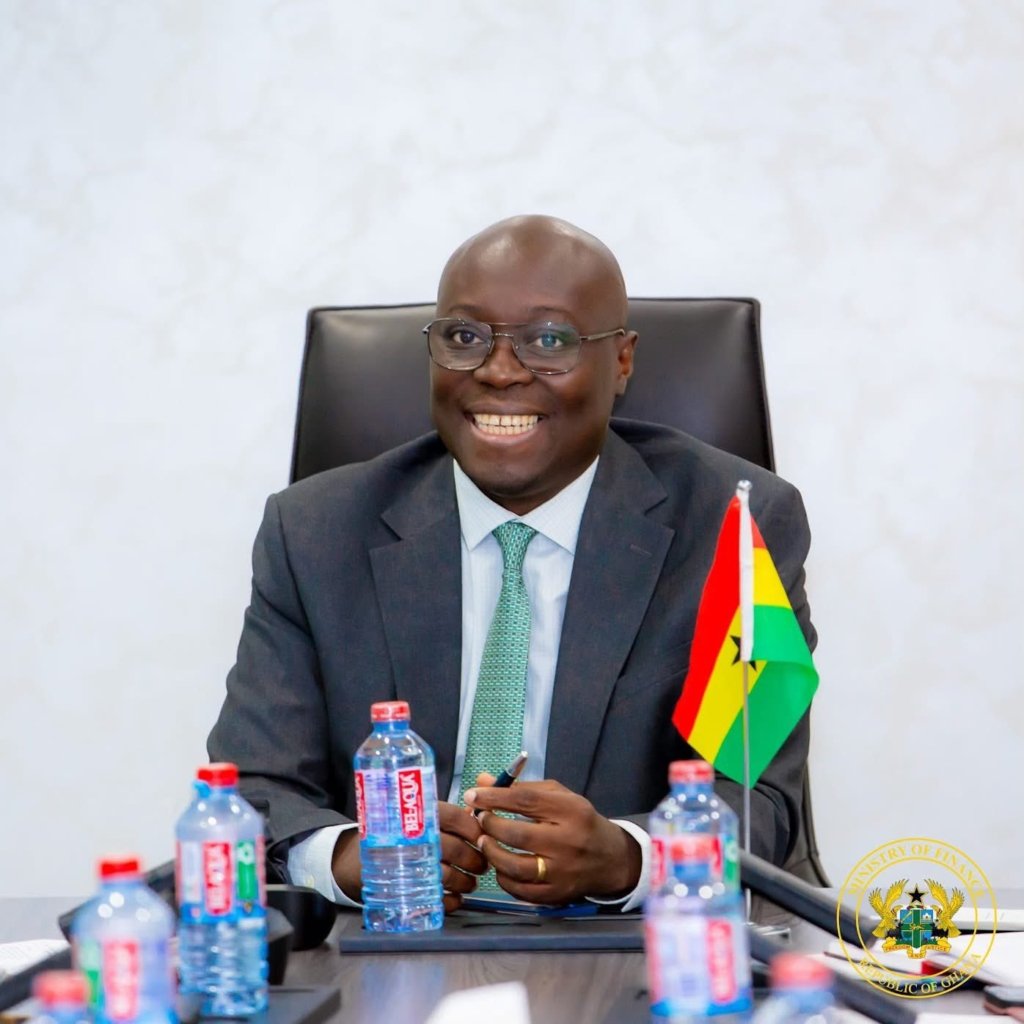
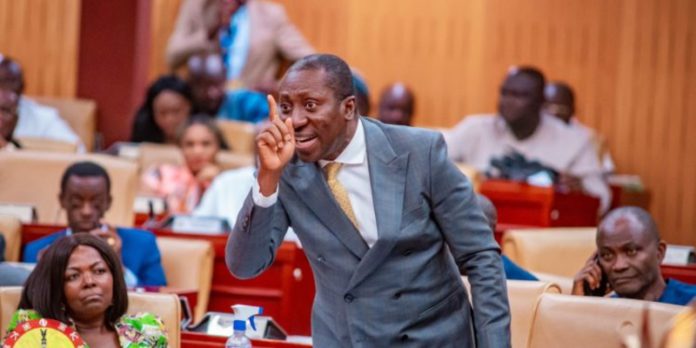
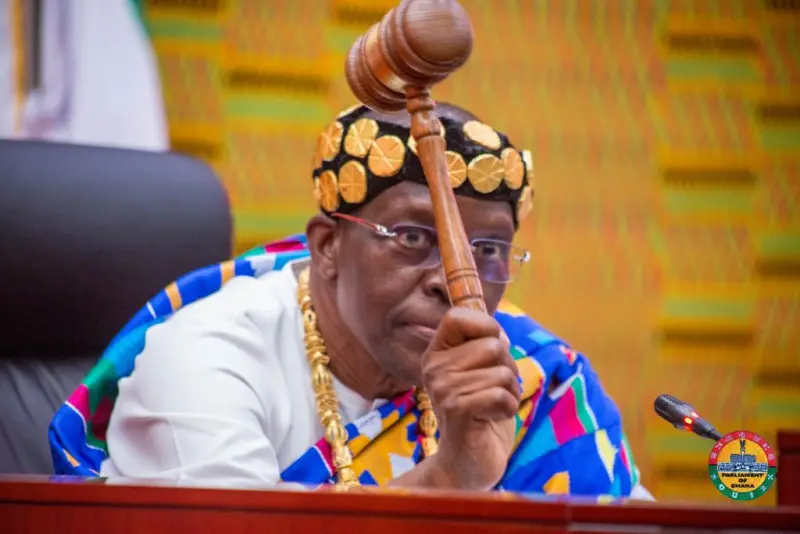
The 2027 Fiscal Budget is scheduled to be presented in the first week of November this year, Finance Minister Dr Cassiel Ato Forson has hinted.
Speaking in an interview on Kumasi-based radio station Ahenfie FM on September 15, he said the budget is likely to be presented about a week earlier than expected, highlighting the government’s focus on stronger economic expansion and greater private-sector participation.
“The 2027 Budget will be presented to Parliament in the first week of November 2026. The Government has spent the first two years stabilising the economy. The next phase will focus on creating conditions for stronger growth and increased private-sector activity.”
What to expect in the budget
According to the Minister, 2027 will focus on prioritising employment creation and measures to strengthen businesses.
“The budget will outline major infrastructure projects and policy initiatives to create more jobs, alongside incentives to support businesses,” the Minister said.
He said the government will also introduce fresh incentives to support businesses and enable them to expand into new areas.
According to the Finance Minister, the initiatives form part of the government’s broader strategy to move the economy into its next phase of growth.
He said the government has spent the first two years of its administration focusing on stabilising the economy and is now preparing to push ahead with measures to stimulate stronger growth.
Dr Ato Forson said the details of the new programmes and policies will be contained in the 2027 Budget.
He also linked the planned initiatives to the government’s new economic programme, under which it intends to invest about US$10 billion to stimulate economic activity.
2027 Budget Preparations Underway
The Finance Minister has started meeting with key government institutions as preparations continue for the 2027 Budget and the implementation of the government’s new economic programme.
The consultations are expected to help the government identify priority sectors and investment opportunities to drive the next phase of economic growth.
Some ministries have already appeared before the Finance Ministry to justify their proposed expenditure for 2027.
Why the budget is presented: Timelines under the Constitution
The Finance Minister’s presentation of the budget estimates is based on Article 179 of the 1992 Constitution, which requires the President, through the Finance Minister, to lay before Parliament estimates of revenue and expenditure for the following financial year.
It is reinforced by Section 21 of the Public Financial Management Act, 2016 (Act 921), which sets timelines for the submission.
The planned November presentation is in line with Ghana’s public financial management framework.
The Public Financial Management Act requires the Finance Minister to present the budget for the following year no later than November 15.
The timeline is intended to give Parliament sufficient time to consider and approve the necessary expenditure before the start of the new financial year on January 1.
This ensures that the government has the required legal authority to undertake expenditure from the beginning of 2027.
The Minority in Parliament has stated that the Damang Gold Mine now under the Engineers and Planners (E&P) Limited did not go through a “proper transparent and fair manner”.
In an interview with the media on Tuesday, April 7, the Deputy Ranking Member on Parliament’s Lands and Natural Resources Committee, Akwasi Konadu, insisted that the process was rushed and failed to meet the necessary standards.
“The same ministry goes ahead in doing that job on behalf of the President, sets up a committee with agencies appointed directly by the minister to oversee these processes and executes these processes just under four days. And you find this as going through a proper transparent and fair manner?
“You see, local participation is something that we all encourage but the process must be above par. That is what we look for, not anything. It must be so open such that any other person could put in a fortified bid. In this one, the person and the object are so bad that they do not speak well of us,” he added.
The Minority Caucus’ statement follows comments by the Acting Director of Legal Affairs at the Minerals Commission, Josef Iroko, who insisted that the handover of the Damang Mine to Engineers and Planners Limited (E&P) followed due process.
His comment comes amid allegations of favouritism in the awarding of the Damang mining lease to Engineers and Planners Limited. On April 1, the government initiated the official process to transfer the Damang Gold Mine from Gold Fields to Engineers and Planners after months of dispute over ownership.
The Minister for Lands and Natural Resources led a delegation responsible for overseeing the transition process.
In April 2025, the government announced an agreement with Gold Fields Ghana for a 12-month transitional lease, after Parliamentary approval allowed continued operations under Abosso Goldfields Limited while preparing for the handover.
The non-renewable lease was explicitly designed to facilitate an orderly transition to state ownership.
Earlier in May, the company announced it had paused its proposed joint venture with AngloGold Ashanti involving the Tarkwa and Iduapriem mines to focus on maximising Tarkwa’s potential as a standalone asset.
“We have operated here for 30 years, and we intend to continue for decades to come,” Fraser reiterated.
Gold Fields posted strong financial and operational results for the first half of 2025. Attributable production rose 24% to 1,136koz, keeping the company on track to meet its annual guidance. Damang is expected to reach commercial production in the third quarter and steady-state production by the fourth quarter of 2025.
Revenue rose 64% to US$3.48 billion, up from US$2.24 billion during the same period in 2024, driven by a 17% increase in gold sales and a 40% rise in gold prices. No fatalities were recorded across operations, compared to two incidents in the first half of 2024, which the company had previously described as an “unacceptable safety performance.”
Background
Parliament earlier approved a one-year transitional lease between the government and Abosso Goldfields Limited for continued operations at Damang in the Wassa West District of the Western Region.
The initial lease was expected to expire in April 2025 but was extended to April 2026 after stakeholder consultations.
Moving the motion for ratification, Lands and Natural Resources Minister Emmanuel Armah Kofi Buah stressed that the lease carried no option for further extension, transfer, or mortgage beyond April 2026.
Months ago, tensions rose at the Damang Mine as workers feared job losses after news of a government takeover. The Ghana Mine Workers’ Union, representing over 1,000 employees, threatened protests but was assured of job security.
“We want to assure the hardworking employees, contractors, and service providers at Damang that your dedication has been the backbone of this mine, and it will remain indispensable. Valid contracts will be honoured, wages paid, and operations sustained as we work to regularise arrangements under State stewardship,” the Minister said.
The decision to assume direct operational control came after Abosso Goldfields Limited failed to meet critical requirements for a lease renewal, including declaring verifiable mineral reserves, presenting a technical programme, and making financial provisions for exploration.
Despite these setbacks, the government is determined to maintain the mine’s contribution to the economy. “We recognise the importance of Damang Mine to the local economy and the country as a whole. We are committed to ensuring the mine continues to operate efficiently and effectively,” the Minister added.
To ensure a seamless transition, the government has developed a plan to preserve jobs, support local businesses, and maintain safety and infrastructure. Community engagement and transparency will remain central throughout the process.
“Regular updates will be provided to keep all stakeholders informed,” Buah assured, adding that the takeover aligns with Ghana’s broader goal to ensure mineral wealth contributes more directly to national development.
Parliament on Wednesday, March 18, 2026, approved the Security and Intelligence Agencies Bill, 2025, aimed at reinforcing Ghana’s internal and external security systems in line with government policy.
The legislation introduces the Office of the National Security Coordinator as a key component of the country’s security and intelligence structure, while repealing the existing Security and Intelligence Agencies Act, 2020 (Act 1030).
Under the new arrangement, the President will designate a Minister to take charge of national security matters.
The Bill is designed to enhance coordination among security and intelligence agencies by clearly defining their roles and aligning their operations within a unified national security framework.
It also outlines provisions relating to the National Security Council, including the creation of Regional and District Security Councils, and identifies the institutions responsible for implementing government policies on national security.
Comprising 46 clauses and a schedule, the law addresses key areas such as the composition of the National Security Council in accordance with Article 83 of the 1992 Constitution, procedures governing its meetings, its functions as stated in Article 84, as well as its committees and ministerial oversight.
Officials say the passage of the Bill marks a major step toward strengthening Ghana’s security governance system and enhancing the country’s capacity to respond effectively to both domestic and external threats.
The 24-Hour Economy Authority Bill, 2025, proposed by the administration of President John Dramani Mahama, has received parliamentary approval. The House gave the nod after extensive deliberations and debate between the Majority and Minority caucuses on Friday, February 6.
During the debate, members of the Minority caucus cautioned that if not carefully implemented, the policy could pose security challenges and cause inconvenience to Ghanaians.
In response, the Majority caucus argued that the government has put in place adequate regulatory measures to ensure the smooth and effective implementation of the policy.
The Association of Ghana Industries (AGI) adds to the majority who are pessimistic about the success of the government’s 24-hour economy policy.
AGI has pointed to the increases in utility tariffs. Speaking to Citi News, Greater Accra Regional Chairman of AGI, Tsonam Akpeloo, said businesses that will participate in the programme will run at a loss as they will consume much electricity.
According to him, “If you’re talking about a 24-hour economy, you’re asking industry to work beyond the usual eight hours and continue through the night. That means higher electricity consumption. The cost of power will increase—possibly doubling what we’ve previously paid.”
“A 2.5% increase under normal production is one thing, but with extended hours, the actual cost impact will be far greater,” he added.
About the 24-hour economy
The government’s 24-hour economy policy, a key promise during President John Mahama’s campaign in 2024, was launched today, Wednesday, July 2, 2025.
The policy’s objective is to enhance economic productivity by encouraging businesses to operate continuously, creating more job opportunities, boosting revenue generation, and improving service delivery.
Sectors such as manufacturing, transportation, retail, healthcare, hospitality, and financial services stand to benefit significantly from this model.
Presenting the policy to the Speaker of Parliament, Kingsford Sumana Alban Bagbin, last year, July, Mr Goosie Tanoh, the Presidential Advisor on the 24-hour economy policy, mentioned the move is to officially inform ‘the people’s representatives’ about the government’s readiness to roll out the programme.
On some details on the policy, Mr Goosie Tanoh said the programme is expanded into three anchors: “production transformation, supply chain and market efficiency, and human capital development.” The three anchors, according to him, are supported by eight sub-programmes.
“Roll 24 – which is the agricultural component, Make 24 – which is the manufacturing component, Connect 24 – the supply chain component, Aspire 24 – which is the mindset change, the resetting of the Ghanaian and Ghanaian bureaucracy with a strong and powerful attitude to work and productivity,” he explained.
According to him, the government was set to include strong digital technology training in the TVET curriculum to train and equip an employable workforce with the requisite skills for employment opportunities.
Another component, dubbed ‘Show Ghana,’ is also set to focus on an intentional effort and approach by the government to give visibility to Ghana’s rich cultural heritage to the rest of the world, to attract more tourists and increase revenue generation through tourism.
Speaker Alban Bagbin, in response, mentioned that the team’s arrival had been anticipated and his outfit would call on them for any clarity when the need be, urging the legislation to back the programme.
Earlier, President John Dramani Mahama stated that the 24-Hour Economy Policy is a long-term goal that will keep the country productive on a 24/7 basis, alongside stabilising the economy through the creation of more jobs.
According to him, the final draft of the policy has undergone review by him, and he is confident it will realise its objectives.
Meanwhile, Speaker of Parliament, Alban Bagbin, noted that the Parliamentary Service will begin operating under the 24-hour economy policy.
This initiative, according to the Speaker, will enhance national productivity and address unemployment. He made this known during the presentation of the 24-hour economy policy document.
He bemoaned the lack of time to tackle the numerous tasks in Parliament and expressed optimism in addressing this issue with the 24-hour economy policy.
“This means they are going to work more hours; they will be reporting at 8:00 a.m. and may be going home at 10:00 p.m. or sometimes 11:00 p.m., particularly those in the official division of the House.
This will allow more people to work here and will help reduce unemployment. I can assure you that the load of work here is unimaginable,” Bagbin stated.
Minority Leader in Parliament and Member of Parliament for Effutu, Alexander Afenyo-Markin, has debunked claims that he went near a polling station in the constituency to influence voters during the New Patriotic Party’s ongoing flagbearer contest.
Mr Afenyo-Markin described the allegations as false and misleading, saying he has strictly adhered to the Electoral Commission and party guidelines throughout the process.
“At no time have I been anywhere near the voting area as claimed, nor have I engaged in any conduct that could be construed, even remotely, as undue influence,” he stated.
The Effutu MP said his activities in the constituency were restricted to casting his vote and carrying out legitimate oversight, in line with the regulations guiding the process.
Mr Afenyo-Markin added that the accusation forms part of what he described as a sustained and coordinated effort by opponents to discredit him since the start of the flagbearer contest.
He further referenced a previous episode in which an edited video circulated on social media after the NPP peace pact was signed in Accra on January 22, 2026, wrongly implying that he declined to applaud a specific candidate.
“These vile tactics are as transparent as they are desperate,” he said.
The Minority Leader urged the Electoral Commission, security agencies, and political stakeholders to uphold peace, ensure transparency, and protect the credibility of the democratic process, cautioning that the spread of misinformation could undermine public trust in elections.
“Crass fabrications such as these only seek to sow discord and undermine the integrity of our democracy,” he added, urging all parties to allow the process to proceed freely and fairly.
He further invited journalists and independent observers to verify events on the ground in Winneba, noting that media coverage provides objective accounts of developments at polling centres.
Executive Director of Global InfoAnalytics, Mussa Dankwah has predicted Former Vice President, Dr. Mahamudu Bawumia, to win 14 out of the 16 regions.
Speaking to the media on Wednesday, January 28, he noted that Dr. Bawumia would sweep massive votes in the party’s stronghold, the Ashanti Region.
He added, “Yes, [Bawumia will win in 14 regions out of 16 regions].“All the areas we have looked at are pointing in one direction, and that direction is that Bawumia will win this Saturday’s election one-touch.
According to him, “Based on our model, his lowest score will be 54 percent, which is the 57 percent we are giving him minus the three percent margin of error, or he could get up to 60 percent”.The Executive Director of Global InfoAnalytics emphasised that the data is consistent across all regions. “I am very confident in Bawumia’s numbers because they are more stable in terms of variability. There is no noise in the data,” he added.
Last year, the National Tracking Poll by Global InfoAnalytics disclosed that 56 per cent of voters and 72 per cent of committed NPP delegates want former Vice President Dr Mahamudu Bawumia as their flagbearer for the 2028 general elections.
According to the poll, 28 per cent of voters are rooting for former Assin Central MP Kennedy Agyapong, with 6 per cent each for Dr Bryan Acheampong and Dr Yaw Osei-Adutwum, and 4 per cent supporting Kwabena Agyapong.
Among NPP delegates, 19 per cent want Kennedy Agyapong, while Dr Bryan Acheampong records 4 per cent, Dr Osei-Adutwum 3 per cent, and Kwabena Agyapong 1 per cent.
The poll was conducted between December 1 and December 21 across all 16 regions of the country. Methods used include a combination of web-based, telephone, and face-to-face interviews.
In October 2025, the Pan-African civil society organisation Sanity Africa, which predicted the victory of Bernard Baidoo of the National Democratic Congress (NDC) in the tightly contested Akwatia by-election, released its Phase Two survey on the NPP presidential primaries.
According to the organisation’s survey, there has been a shift in the landscape as the party gears up towards the January 2026 primaries.
The abridged October report suggests that Kennedy Ohene Agyapong, popularly known as Ken, has strengthened his lead among NPP delegates, commanding 53.1% of voting intentions, representing a 1.7 percentage-point increase from the Phase One survey conducted in July.
Dr Mahamudu Bawumia (DMB) trails with 39.0%, indicating a 3.2-point drop. Behind them are Dr Bryan Acheampong at 5.0% (up 1.9 points), Dr Yaw Osei-Adutwum at 2.0% (down 1.0 point), and Ing. Kwabena A. Agyepong at 0.9% (rising from 0.3%).
The survey, carried out between July and October 2025, sampled 15,000 delegates from an estimated 218,000 in the expanded voter album across all 276 constituencies.
It boasts a 99% confidence level with a ±5% margin of error. At the regional level, Ken Agyapong sits atop as the leading candidate in 10 out of Ghana’s 16 regions, including strongholds such as Ashanti (54.8%), Central (69.0%), and Eastern (54.8%).
His biggest contender, Dr Bawumia, on the other hand, still holds his lead in the northern sector, with an advantage in the remaining six regions. He leads in the North East (70.0%) and Upper West (60.2%). Competitive races are unfolding in Bono East, Savannah, and Upper East, where margins remain slim.
Notable shifts include Dr Bawumia widening his lead in the North East Region from 51.6% to 70.0%, while Ken strengthened his position in Volta (50.8%) and Bono (53.0%).
Dr Bryan Acheampong registered significant gains in his home region of Eastern, rising to 21.7%. Sanity Africa noted that these shifts reflect evolving delegate sentiments influenced by campaign strategies and regional dynamics.
The organisation emphasised that while Ken Agyapong currently has the upper hand, the contest remains fluid. Endorsements, messaging, and campaign strategies, it said, are expected to play critical roles in shaping the outcome.
With Phase Three of the survey scheduled for release in January 2026, Sanity Africa concluded that Ken may be the one to beat, but the race is far from over.
However, the Global InfoAnalytics tracking poll named Dr Mahamudu Bawumia as the people’s preferred candidate to lead the NPP into the 2028 general election, ahead of his closest contender, Kennedy Ohene Agyapong.
The poll suggests that 57% of voters prefer Dr Bawumia as the party’s presidential candidate, while 29% picked Kennedy Ohene Agyapong.
The other contenders—former Minister of Education Dr Yaw Osei-Adutwum (6%), Minister of Food and Agriculture Dr Bryan Acheampong (5%), and former NPP General Secretary Kwabena Agyapong (3%)—trailed behind.
In the critical swing regions of Greater Accra, Central, and Western, Dr Bawumia also led decisively with 57%, followed by Kennedy Agyapong at 32%. Dr Adutwum and Dr Acheampong each secured 4%, while Kwabena Agyapong obtained 3%.
The survey further indicated that in a potential runoff between Dr Bawumia and Kennedy Agyapong, Dr Bawumia would extend his lead with 62% against Agyapong’s 38%.
A planned demonstration at the Jubilee House has been announced by a group known as the Concerned Importers of Vehicles following claims that the ages of imported vehicles are being manipulated at Ghana’s ports.
The group says gaps in enforcement continue to allow some importers to alter the stated ages of vehicles brought in from Japan and Dubai in order to avoid penalties on over-aged cars.
Speaking to the media on January 25, 2026, a leading member of the group, Fredericka Ackah, said importers were assured last year that the ages of vehicles from Japan and Dubai would no longer be reduced, but some individuals are still benefiting from the practice.
“Last year, in 2025, we were told that importers bringing in cars from Japan and Dubai should not have the ages reduced, but some people are still doing it. Recently, a friend of mine imported vehicles from Japan; the ages of some were reduced while others were not,” she said.
She said the lack of consistency has caused uncertainty among vehicle importers and created opportunities for corrupt practices.
Ackah cautioned that the group would take the matter to the Presidency if the issue remains unresolved.
“The Commissioner should take action or we will storm the Jubilee House to report what is going on at the Ports and Harbours,” she stated.
She claimed that vehicles produced in 2007 or 2008 are sometimes recorded as 2011 or 2013, enabling importers to avoid penalties for over-aged cars.
The group has therefore urged the Driver and Vehicle Licensing Authority to strengthen inspections at the ports to stop the practice.
“There is a lot of confusion among importers. If the age can be reduced, people will take their vehicles to others who can do it for them just to dodge the over-age penalty. DVLA should be vigilant and ensure that any vehicle whose age has been reduced is thoroughly checked,” Ackah said.
She noted that the group possesses documents supporting their claim that the ages of some imported vehicles have been altered.
Ghana currently prohibits the import of salvaged vehicles and used cars over ten years old. This restriction is outlined in the Customs (Amendment) Act, 2020, which Parliament passed in March 2020 and which was signed into law by then-President Nana Addo Dankwa Akufo-Addo on April 30, 2020.
Under Section 154 (5) of the Act, the ban took effect six months after the presidential assent, starting in October 2020.
The rule is intended to encourage a viable market for vehicles manufactured or assembled in Ghana. It also offers import-duty incentives to companies that set up local vehicle production or assembly plants, supporting the government’s goals of industrialisation and job creation.
In 2024, the Ghana Institute of Freight Forwarders (GIFF), alongside the Association of Customs House Agents of Ghana, Freight Forwarders Association ofGhana, and Customs Brokers Association of Ghana, in collaboration with various trade groups and manufacturers, are protesting against what they label as exploitative actions by shipping lines operating in the country.
Also participating are the Ghana Union of Traders Association, EXIM Frozen Foods Association of Ghana, and the Food and Beverages Association of Ghana.
They are marching through Tema, submitting petitions to the Ministries of Transport, Trade, Finance, and other key bodies, urging immediate regulatory intervention.
GIFF asserts that these unregulated practices have severely harmed the logistics industry and the broader Ghanaian economy.
“Shipping lines have operated with impunity for too long, imposing unjustifiable costs that harm freight forwarders, importers, exporters, and ultimately consumers,” said a spokesperson for GIFF.
The group highlighted that these charges, when combined with delays and inefficiencies, inflate the cost of doing business and contribute to Ghana’s weakened foreign exchange position.
The protest also seeks to address a practice in which shipping lines, contrary to the Customs Act of 2015, are engaging in customs brokerage, sidelining freight forwarders and monopolizing services in a manner that the association views as anti-competitive.
Some of the clearing agents told 3news.com that many of their mates have folded up with many more of the getting out of business.
“The shipping lines now engage our clients behind us making us lose our business”.
The group has served notice of another massive protest towards the presidency in 14 days if their concerns are not addressed.
Chairman of Parliament’s Health Committee, Dr. Mark Kurt Nawaane, has said that the presence of Zipline was a mistake in the first place.
According to him, Mahamudu Bawumia misdiagnosed the health sector’s real challenges.
“Zipline’s presence in this country is a mistake,” he said. He emphasized that this is not a political statement but an observation on mismanagement,” he told journalists in Accra.
Dr. Nawaane stated that the main issue is not transportation of medical supplies. Instead, it is the ongoing shortage of voluntary blood donors nationwide.
He noted that the funds allocated to Zipline could have been used to equip hospitals with cold rooms, which are vital for preserving blood and other critical medical supplies.
“If we wanted to establish cold rooms over the past five years, we could have done it,” he noted.
His comments come at a time when discussions surrounding Zipline’s future are becoming more heated in Ghana, with increasing pressure from lawmakers such as Majority Leader Mahama Ayariga to end the company’s contract.
They argue that Zipline represents poor use of public resources and does not provide value for the money spent.
Health Minister Kwabena Mintah Akandoh explained that talks with Zipline are still underway, and no definite decision has been reached about the company’s future.
Speaking at the Government Accountability Series on December 1, he noted that engagements with Zipline are ongoing. “When we get there, you will hear what decision we will take,” he assured.
Health Minister Kwabena Mintah Akandoh has confirmed that government is required to pay Zipline over $500,000 each month, irrespective of the volume of medical supplies delivered.
He explained at the Government Accountability Series in Accra on Monday, December 1, 2025, that the 2018 ‘take-or-pay’ sole-sourced contract places colossal financial burden on the government purse.
“For every month, the government is supposed to pay $88,000 per centre. So with six centres, we are paying a little over $500,000 every month,” he said.
Under the terms of the contract, which began in 2019, each operational hub attracts a fixed monthly fee and the system prevents any adjustment in expenditure, irrespective of reduced activity levels or shifts toward non-critical deliveries.
The minister described the agreement as a “sole-sourced contract” that effectively “binds government to continuous payments,” underscoring the lack of fiscal flexibility.
The Majority Leader in Parliament, Mahama Ayariga, has indicated that the government cannot continue to spend GHS170million annually for the Zipline to be sending blood and other products to health facilities using drones.
Responding to concerns raised by the Minority Leader, Alexander Afenyo-Markin, over the cancellation of the contract, Mr Ayariga explained that the Ministry of Health should have bought its own drones after all those years the contract had existed.
“…you cannot continue spending that kind of money that you are paying a service provider, as it is a total waste of money,” he said on the floor of Parliament on Friday, Nov 28, 2025.
Mr. Afenyo-Markin then urged that the Minister of Health address the matter, particularly the measures being taken to resolve it, “because it is not those of us in the cities that will suffer from this shutdown.”
“It is those in the rural areas who otherwise would need emergency medical care and if there is blood, there is the need for them to get blood transfusion as quickly as possible,” he said.
He recalled that the Zipline contract was signed somewhere in 2021, but such a contract had been a drain on national resources.
“Can you imagine every year we are spending GH¢170 million so that they will go and drop blood in some village and then come back?”
“Meanwhile, there is a road network leading to almost every town, every community in this country, and there are only a few locations that you would say the roads are not accessible,” Mr Ayariga said.
The Bawku Central MP argued that the money spent could have been invested in tarring roads to all the regions Zipline served, while the GHS could have obtained drones to make deliveries on its own schedule.
The Leader asked about the price of drones, stating that some models are sold for $4,000–$5,000, while the costliest drones stay below $10,000–$20,000.
“By now we would have had drones for every district in this country managed by the Ghana Health Service.
“Let us go and do a total calculation of how much money we have wasted on this Zipline contract,” he said.
On the 6th-year anniversary of commencing operations in Ghana, Zipline, the world’s largest autonomous logistics system,
has successfully delivered more than 8.4 million medical products in the country, marking a major milestone in the country’s journey toward equitable healthcare access.
Since its launch in 2019, Zipline has served as a critical infrastructure partner for the Government of Ghana.
It has delivered more than 8.4 million medical units – including medications for malaria, HIV, and TB, family planning products, blood products, vitamins, nutritional products, medicines for pregnant women, and more than 17 million vaccine doses – to over 3,000 hospitals, health centers, and CHPS compounds in 14 regions of the country.
Operating from six hubs, Zipline’s autonomous drones enable real-time delivery of medical products regardless of weather, terrain, or infrastructure challenges – revolutionizing last-mile delivery in the health sector.
In 2021, Zipline partnered with Gavi and the UPS Foundation to deliver the COVID-19 vaccine and has since delivered more than 3.4 million doses, including hundreds of thousands of mRNA vaccines.
Research conducted shows that the company disproportionately serves the most vulnerable populations in Ghana, with rural and hard-to-reach districts receiving 30 percent more COVID-19 vaccines than less remote districts during the COVID-19 pandemic.
Zipline is set to scale up its life-saving drone delivery services across Africa following a landmark $150 million pay-for-performance commitment from the U.S. Department of State.
The initiative will boost the company’s AI and robotics infrastructure and strengthen support for African governments implementing national health logistics systems. Under the expanded programme, more than 10,000 additional health facilities and community drop sites are expected to be added, enabling on-demand delivery of essential medicines to over 130 million people.
The expansion is also projected to generate more than 800 high-tech jobs on the continent and unlock over $1 billion in annual economic growth.
According to Zipline, the partnership marks a new phase in global health delivery—one driven by African leadership, advanced technology, and measurable impact.
Country Director, Daniel Merki, joined Citi FM on November 2022, to discuss how Zipline is working with the Government of Ghana to transform healthcare access,
According to him, it has made over 800,000 deliveries nationwide to a 56% drop in maternal deaths in Zipline-supported areas.
“Zipline is more than a service provider; we’re infrastructure in service of the government’s agenda,” he added.
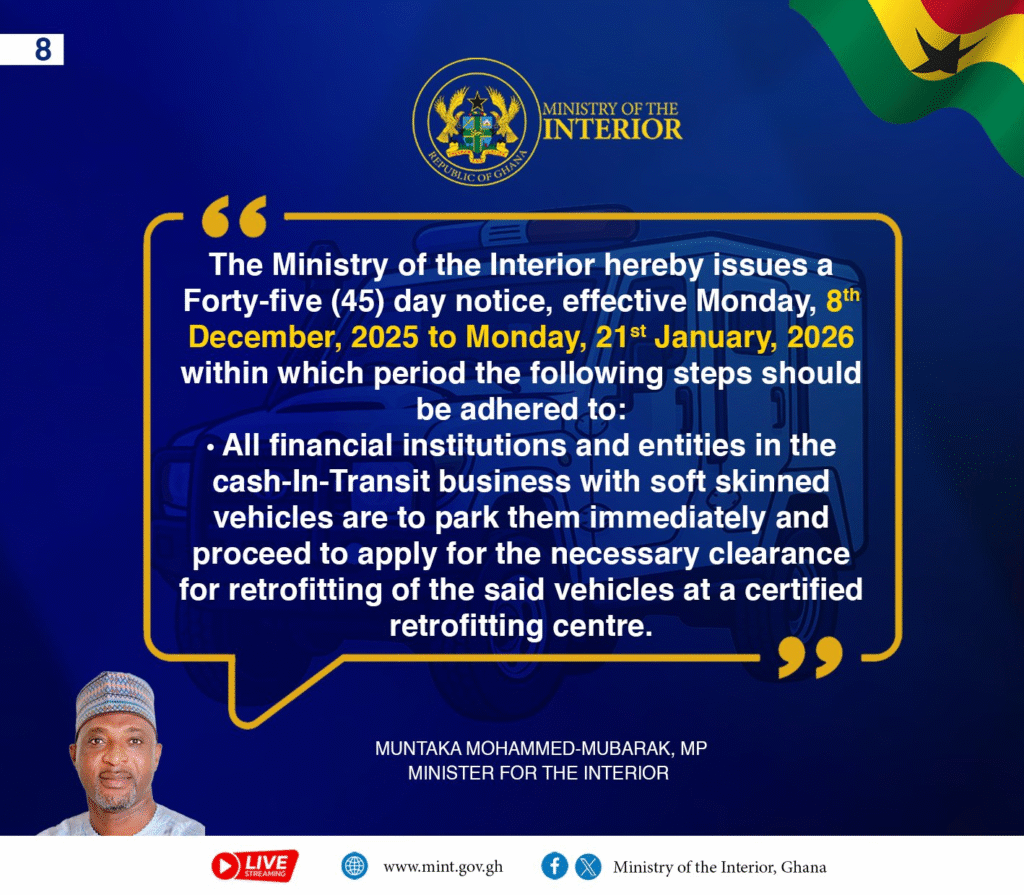
A forty-five-day ultimatum has been issued to all companies and institutions involved in the cash-in-transit and bullion-van business to adhere to new national guidelines directed by the Ministry of the Interior.
Interior Minister, Muntaka Mohammed Mubarak, made the announcement at a press briefing on Thursday, December 4, on the Roll Out of Guidelines and standards to regulate the importation, retrofitting, usage, and decommissioning of Armoured Bullion Vehicles.
“The Ministry of the Interior hereby issues a Forty-five (45) day notice, effective Monday, 8th December, 2025 to Monday, 21st January, 2026 within which period the following steps should be adhered to:
“Entities operating in the cash-In-Transit/Bullion business are to cease operations henceforth and proceed to register and acquire the needed licenses and certification from the Ministry of the Interior before operations.”
“All stakeholders should note that, after the 45-day notice period, there shall be nationwide enforcement and full implementation of the Guidelines and Standards including taking legal action and applying sanctions against those who breach the directives,” he said.
He also asked, entities engaged in the retrofitting of Armoured Bullion Vehicles for the cash-In-Transit/Bullion services are to cease operations henceforth and proceed to register and acquire the needed licenses and certification from the Ministry of the Interior before operations.
The Ghana Police Service and the Bank of Ghana are therefore expected to strictly enforce these guidelines and standards alongside the Standard Operating Procedures on Armoured Bullion Vehicles (ABVs).
In 2023, bullion van robberies occurred in broad daylight in the country, particularly in the capital city of Accra.
It posed significant dangers to public safety and the overall economy of the country.
Despite the presence of stringent surveillance systems, substantial amounts of money were stolen, and police escorts were shot and killed.
One police officer who unfortunately died in the Ablekuma Bullion Van Robbery event was promoted from General Lance Corporal to General Corporal posthumously.
The solemn announcement was made during a pre-burial service held at the St. George Catholic Church in Tesano, Accra, as a heartfelt tribute to the fallen hero, Callistus Amoah.
General Corporal Callistus Amoah, while on official duty in a bullion van at Ablekuma Fan Milk in Accra, bravely faced armed robbers at a fuel station and tragically succumbed to their gunfire.
The news of his promotion was met with profound respect, serving as a profound recognition of his unwavering dedication and ultimate sacrifice.
Expressing deep condolences, the Inspector General of Police, Dr. George Akufo Dampare, conveyed heartfelt sympathy to Callistus Amoah’s family and extended his support to the institutions with which the officer was associated during his honorable service.
Dr. Dampare further assured the public that relentless efforts would be exerted to bring the perpetrators of this heinous crime to justice.
“On behalf of my colleagues and the leadership of the Police, I extend my condolences to Amanda, the parents of my brother and the institutions that when my brother was alive was involved in. Since the incident happened, I have been in an unmeasurable pain which I have not been able to quantify and define until I came here today.
“Calis is a colleague to all of us at the top but to me, he is a brother because the village he comes from is close to a village I have adopted because of the benevolence of an old lady towards me.”
The wife of the late Callistus Amoah, Amanda Amoah,stood before the mournful assembly and tenderly paid tribute to her beloved husband, portraying him as a remarkably generous soul.
The gathering resonated with solemnity as friends, family, and colleagues united in remembrance, joining together to pay homage to the cherished memory of a dedicated police officer who selflessly sacrificed his life in the line of duty.
Vice President for Innovation and Technology at IMANI Africa, Selorm Branttie, has criticised the 2025 Cybersecurity (Amendment) Bill, describing it as ambiguous and potentially oppressive.
In an interview with Joy FM, he observed that several sections of the draft law are vaguely written and overly broad, making it challenging to separate minor online infractions from serious cyber offences.
Mr. Branttie warned that such lack of clarity could lead to misinterpretation and abuse, allowing ordinary digital activities to be unfairly criminalised.
“A lot of the lettering for the Cybersecurity Bill, for example, is ambiguous in terms of the kinds of offenses that are being discussed and the ramifications for you being seen as contravening some of these offences makes them draconian, makes it unsuitable for the current day and age and society that we have” he said on
“You are looking at things that could either be minor or major, and bottling it up into just one category and then criminalising all of it.”
Mr. Branttie noted that several Ghanaians maintain additional social media profiles or alternative online identities for valid purposes such as protecting their privacy or adhering to workplace policies.
He explained that, as the bill currently stands, such practices could easily be misconstrued as dishonest or unlawful.
According to him, the absence of precise definitions and a clear categorisation of offences could give authorities undue power, potentially paving the way for the harassment of individuals, journalists, or political critics under the pretext of enforcing cybersecurity measures.
“It’s a dangerous to have laws like this, or some of the stipulations in laws like this dictating the what should be the government’s response or the security aparatus’ response to some of these things that happen digitally because in the wrong hands, this could be used to abuse the personal rights of many indivuduals and could be used to target people percieved as political opponents or people perceived as not liked by anybody who is in authority,” he explained.
Mr. Branttie called on Parliament to carefully revise the language of the bill before its approval to ensure it maintains a fair balance between strengthening national cybersecurity and upholding citizens’ online rights.
He recommended that legislators work closely with technical professionals, civil society groups, and private sector stakeholders to refine the scope of offences, classify their severity, and establish transparent oversight systems.
IMANI Africa, a policy think tank recognised for its advocacy in governance and technology, has long championed openness and fairness in the formulation of Ghana’s digital regulations.
The 2025 Cybersecurity (Amendment) Bill aims to update the Cybersecurity Act, 2020 (Act 1038) by addressing new digital threats, reinforcing the country’s online security systems, and expanding enforcement authority for state institutions.
Nonetheless, sections of the public and digital rights organisations caution that certain provisions, if not properly clarified, could threaten privacy, restrict free speech, and compromise data protection.
The draft legislation is presently under review by Parliament’s Communications Committee, with stakeholder engagements expected to continue in the coming weeks.
Ghana has witnessed a sharp rise in financial damage caused by online sextortion and blackmail, with losses hitting GH¢499,044 within the first four months of 2025.As per data by the Cyber Security Authority (CSA) this is nearly five times the GH¢103,663 recorded over the same period in 2024, pointing to an alarming trend in digital exploitation.
In its recent advisory, the Authority revealed a slight uptick in the number of reported incidents from January to April 2025, surpassing the 155 cases logged during the comparable period last year.
These schemes are typically launched through fake social media profiles—often using attractive images to entice users into romantic exchanges.
Once trust is established, victims are coerced into sharing intimate visuals, which are then weaponized to extort money.
Perpetrators usually demand mobile money payments under threat of publishing the explicit material. But paying doesn’t always end the torment—victims often face continued harassment even after fulfilling ransom demands.
To cover their tracks, scammers frequently move chats to encrypted apps like WhatsApp, Telegram, or Signal, making detection more difficult.
The CSA has advised the public to exercise caution by avoiding interactions with unknown digital identities, refraining from sharing any explicit content online, and reporting any suspicious encounters through its round-the-clock support services.
Since the start of January 2023, victims targeted by online impersonation have incurred substantial losses amounting to GH¢49.5 million, as reported by the Cyber Security Authority (CSA).
Online impersonation, also known as identity theft, involves malicious actors adopting the persona of notable figures such as politicians, businesspeople, government officials, diplomats, or reputable brands. This is done either for financial gain or to subject victims to harassment, intimidation, or threats.
The CSA recently issued an official public warning, revealing that between January and July of 2023, they received a total of 58 reports regarding online impersonation cases. These incidents have resulted in victims collectively losing an alarming sum of GH¢49.5 million.
This development follows a joint operation carried out by the Economic and Organised Crime Office (EOCO), the Bank of Ghana (BoG), and the Cyber Security Authority (CSA). This operation involved raids on illicit lending applications at three separate locations in Accra, which led to the arrest of 422 suspects. The task force’s investigations encompassed 270 cases involving cyberbullying, fraud, extortion, and the misuse of customer data.
These investigations unveiled 150 unlicensed digital loan application platforms. The operators of these platforms were found to be engaged in disconcerting practices, including issuing death threats and unauthorized sharing of private messages, images, and videos. These actions were made possible by exploiting permissions unwittingly granted by unsuspecting victims on their digital platforms.
Modus operandi
As detailed in the alert, impostors employ deceptive strategies by fabricating false profiles or accounts that mimic legitimate individuals or well-known brands. They use coercive techniques to push their unsuspecting victims, including associates and business partners, into making impulsive decisions without thorough consideration.
Online impersonation can manifest in various forms, such as job and recruitment scams. In these scenarios, scammers pretend to be government agencies or reputable employers, offering attractive job opportunities that demand victims to part with money or reveal personal information.
Another common scheme is advance fee fraud, where scammers pose as wealthy businesspeople, representatives of respected companies, government entities, or distant relatives. They convince victims to make upfront payments for goods, services, or financial gains that ultimately never materialize.
Furthermore, the investment scam involves impostors presenting themselves as investment service providers, financial advisors, or fund managers. They make alluring pledges of substantial profits with minimal risk, which ultimately serve as tactics to defraud victims.
Lastly, contract scams involve scammers impersonating entities responsible for awarding contracts, often masquerading as representatives of government agencies. They dangle the promise of non-existent contracts, demanding fees in exchange for these fictitious opportunities.
Recommendations
Consequently, the CSA strongly advises the general public to exercise caution when it comes to unsolicited communications, particularly those originating from unknown sources or individuals.
“Be suspicious of any promise of jobs, protocol advantage for recruitment slots, financial gains, gifts or lucrative opportunities. Genuine government officials would not contact anyone via social media to offer them a job or contract,” it said in the alert.
The public is strongly encouraged to exercise careful consideration and carry out thorough investigations to confirm the authenticity of both individuals and organizations before participating in any financial dealings.
Furthermore, individuals are advised to promptly report any suspicions regarding impersonators or scammers to the appropriate law enforcement authorities within the country. Alternatively, they can report such incidents to the Cyber Security Authority’s (CSA) 24-hour cybersecurity incident-reporting contact points. These avenues can be used to report cybercrimes, as well as to seek guidance and support for online activities.
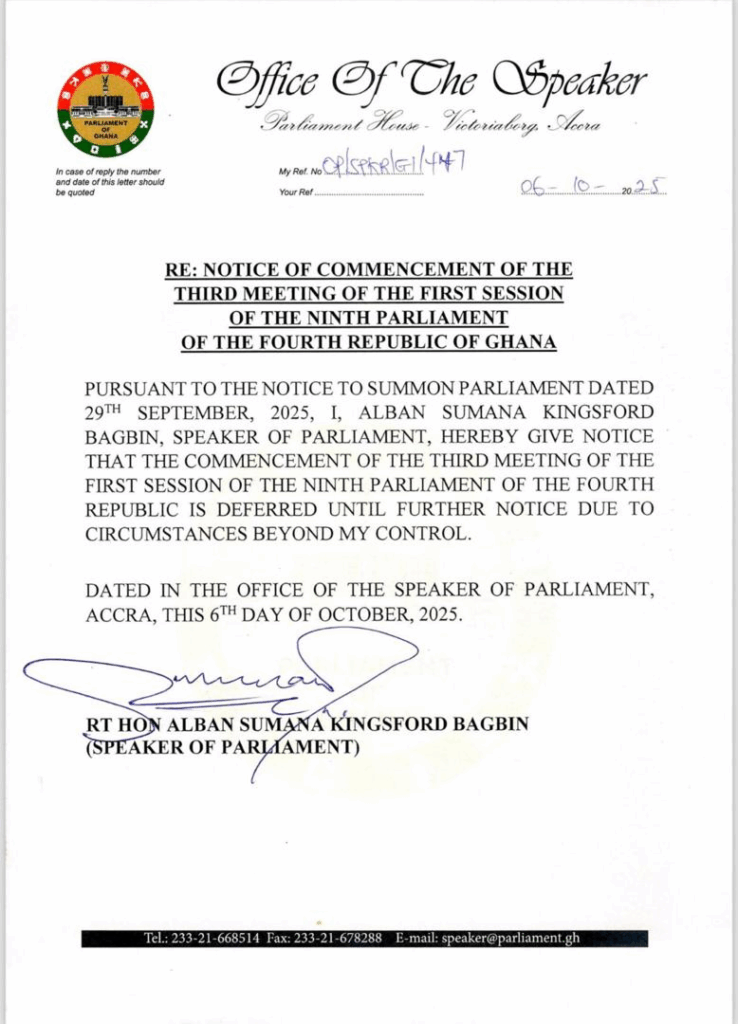
The commencement of the Third Meeting of the First Session of the Ninth Parliament of the Fourth Republic has been postponed.
Speaker of Parliament, Alban Sumana Kinsfor Bagbin, announced in a release that, Parliament was initially scheduled to reconvene on Tuesday, October 14, for the start of the new meeting.
However, circumstances beyond control have led to the new decision.
“I, Alban Sumana Kingsford Bagbin, Speaker of Parliament, hereby give notice that the commencement of the Third Meeting of the First Session of the Ninth Parliament of the Fourth Republic is deferred until further notice due to circumstances beyond my control,” the notice dated October 6, stated.
The notice was issued pursuant to a Notice to Summon Parliament that was earlier dated September 29.
The Speaker, however, assured that further communication will be made once the circumstances necessitating the delay are resolved.
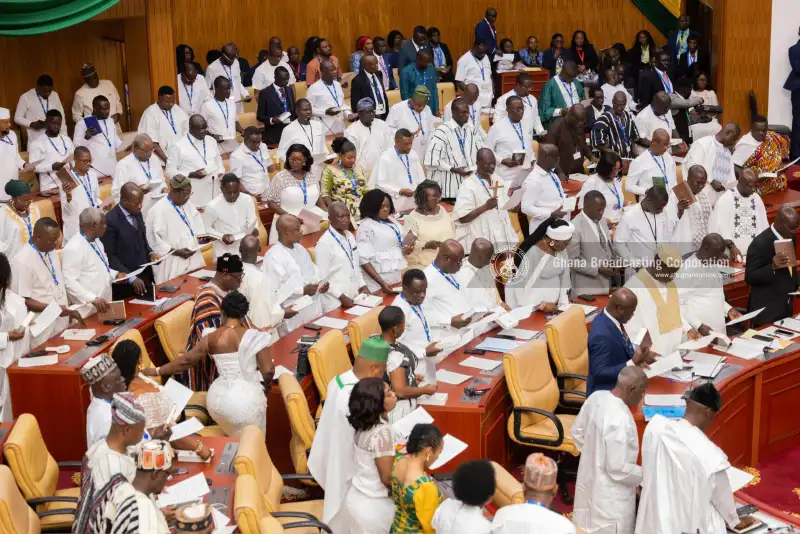
Meanwhile, Members of Parliament (MPs) were expected to reconvene in October, following their recess for the Second Meeting of the First Session of the Ninth Parliament of the Fourth Republic.
This information was made known by the First Deputy Speaker, Honourable Bernard Ahiafor, on Friday, July 31. The legislators on Tuesday, May 17, began their official work following a recess for Easter celebrations last year.
Parliament, from May to August this year, convened a total of 43 sittings; during this period, the legislative body passed several key bills, endorsed certain proposals, and debated several matters of national importance.
Just a few days ago, Parliament wrapped up its debate on the Mid-Year Review Budget Statement and Economic Policy of the Government of Ghana for the 2025 financial year, which was presented by Finance Minister Dr Cassiel Ato Forson.
In the course of the debate, the Deputy Majority Leader and Member of Parliament (MP) for Cape Coast South, George Kweku Ricketts-Hagan, acknowledged the government’s efforts while describing the budget’s content as commendable.
According to him, Ghana now fully controls its gold resources. This, he described as a major and transformative achievement for the country.
In his submission on the floor of the House, Minority Leader Alexander Afenyo-Markin contested the government’s celebratory claims regarding the performance of the local currency. He added that “2022 was a storm for the cedi, but I dare argue, despite all of this, the NPP government stabilized the cedi in 2023.”
Also from the Minority side, Hon. Michael Kwesi Aidoo, Member of Parliament for Oforikrom, criticised the incumbent government for failing to address the real concerns of Ghanaians despite its claims of restoring the value of the cedi.
He stressed, “Whenever you say anything about the issues of the economy, our colleagues will refer you to the dollar, that the dollar has reduced. Mr. Speaker, as I speak to you today, it has not reflected in our pockets.” To him, the Mid-Year Budget Review had nothing new except repetition of words.
Also from the Minority Caucus, Member of Parliament for Takoradi, Kwabena Okyere Darko-Mensah, pushed back against the government’s assertion that its homegrown policies are fueling economic growth.
He argued that the previous New Patriotic Party (NPP) administration’s policies have driven growth in agriculture and fisheries, hence boosting Gross Domestic Product (GDP).
On Thursday, July 24, Finance Minister Dr. Cassiel Ato Forson delivered to Parliament the 2025 Mid-Year Budget Review. This was in accordance with Section 28 of the Public Financial Management Act, 2016 (Act 921), to inform the country on its economic performance and fiscal strategy halfway through the year.
In his delivery, the sector minister noted that in less than 200 days the incumbent government has brought back clarity, certainty, stability, and purpose to the country’s economic policy direction. Dr. Cassiel Ato Forson revealed that in the first six months of the year, the government’s expenditure stood at GH¢109.7 billion, equivalent to 7.8% of the GDP.
He noted that the current expenditure was 14.3% below the programmed amount of GH¢128.0 billion, equivalent to 9.1% of GDP. According to the sector minister, this reflects the government’s strong expenditure control.
During the presentation of the 2025 budget statement, the minister noted that total expenditures (commitment) for 2025 have been programmed at GH¢270.9 billion, down from GH¢279.2 billion in 2024.
Primary expenditure on a commitment basis (expenditures net of interest payments) is projected at GH¢206.8 billion in 2025 (14.8% of GDP), presenting a significant decline from 19.8% of GDP in 2024 and lower than the 2023 level of 15.6% of GDP.
Providing a breakdown of the total expenditure in six months, the minister said that primary expenditure, or non-interest expenditures on a commitment basis, amounted to GH¢84.3 billion, or 6.0% of GDP. This is an improvement of about GH¢13.3 billion over the target of GH¢97.5 billion, which is 7.0% of GDP.
The Finance Minister noted that although Ghana is relying on the domestic market for financing, “We have borrowed less than we planned, signifying strong expenditure control and fiscal discipline.”
Presently, the government is revising both revenue and expenditure projections to reflect the impact of the additional revenue from the Energy Sector Levies (Amendment) Act, 2025 (Act 1141).
Total expenditure on a commitment basis has been revised downward to GH¢269.5 billion from the original budget projection of GH¢270.9 billion. However, primary expenditure has been revised upwards to GH¢209.6 billion from the original budget projection of GH¢206.8 billion.
Total revenue and grants have been revised upwards from the 2025 budget target of GH¢227.1 billion to GH¢229.9 billion, or from 16.2% of GDP to 16.4% of GDP, representing a nominal increase of 1.3%. “The additional revenue of GH¢2.9 billion will come from the increase in revenues from the amendment to the Energy Sector Levies Act,” the minister added.
Interest payments have been revised downwards by GH¢4.3 billion, from the original budget projection of GH¢64.1 billion to GH¢59.9 billion. Domestic interest, on the other hand, has been revised downward by GH¢5.1 billion, mainly on account of gains from the reduction in the treasury bill rates as a result of the implementation of our prudent debt management policies.
However, external interest payments have been revised upward by GH¢795 million to make additional provision for debt service due on post cut-off date disbursements made by our bilateral creditors since 2023. Energy sector payments have also been revised upwards by GH¢2.9 billion to provision for fuel purchases for power generation.In June, Parliament gave the nod to the reinstatement of July 1 as a statutory public holiday following the amendment of the Public Holidays and Commemorative Days (Amendment) Bill, 2025, which amends Act 601.
The amended Act grants an additional holiday for the Muslim community, Shaqq Day, a statutory public holiday to be observed the day after Eid-ul-Fitr. In the same vein, August 4 has been removed from the list of public holidays as Founders’ Day, and instead, September 21 will now be observed as Founder’s Day.
In the same period, Parliament vetted and approved seven (7) justices of the Supreme Court nominated by President John Dramani Mahama.
Parliament prior to its recent recess passed the following bills: the Fisheries and Aquaculture Bill 2025, the University for Development Studies Bill 2025, the Ghana Medical Trust Fund Bill 2025, also known as MahamaCares, and the Social Protection Bill 2025.
The first two bills were approved by the House on July 19. Minister for Fisheries and Aquaculture Hon. Emelia Arthur was present in Parliament for the approval of the Fisheries and Aquaculture Bill 2025.
The sector minister revealed to the House that the bill has been revised to reflect Ghana’s commitment to the Blue Economy agenda by harnessing marine and aquatic resources sustainably to support economic growth, social inclusion, food security, and environmental protection.
Chairman of the Parliamentary Select Committee on Food, Agriculture, and Cocoa Affairs, Hon. Jasaw Seidu Godfred, while presenting the committee’s report, noted that the sustainable management, utilization, and exploitation of the fisheries and aquaculture resources require the existence of a robust legal framework that governs fishing activities, regulates resource extraction, and ensures compliance with international and national environmental standards.
He indicated that the fisheries and aquaculture sectors contribute significantly to national development in areas such as job and wealth creation, poverty reduction, gross domestic product contribution, and foreign exchange.
Minister of Education, Honourable Haruna Iddrisu, also appeared before Parliament for the approval of the University for Development Studies Bill 2025. Explaining the purpose of the bill to the House, Honourable Haruna Iddrisu noted that the bill seeks to establish the University for Development Studies (UDS) through the re-enactment of P.N.D.C.L. 279.
This, he said, will help to restructure and empower the University for Development Studies to provide quality and higher education to meet the diverse and developmental needs of the country.
On his part, Chairman of the Education Select Committee of Parliament, Honorable Peter Nortsu-Kotoe, acknowledged the significant structural changes that have taken place since the establishment of the UDS over the past 32 years of its existence.
He highlighted the need to review P.N.D.C.L. 279 to bring the law into conformity with current policy and best practices adopted in public universities in Ghana to enhance the effectiveness of tertiary institutions in achieving their mandate.
The Ghana Medical Trust Fund Bill, 2025, also known as MahamaCares, which was laid before Parliament on Monday, July 21 and subsequently approved, was opposed by the Minority. The caucus warned that it could put a strain on the National Health Insurance Scheme (NHIS) budget and its operations.
The Mahama Cares fund is expected to play a pivotal role in enhancing healthcare access for many Ghanaians, particularly those battling chronic diseases and unable to afford the necessary medical treatment. The Bill seeks to end favoritism in awarding scholarships, ensuring allocations are based on merit and need.
The Social Protection Bill 2025 will provide a legal framework for social protection programmes that will enhance accessibility and equity in the delivery of social services to the impoverished communities.
“This bill will give legal backing and strengthen regulations of many social intervention initiatives in the country,” the Minister for Gender, Children, and Social Protection, Agnes Naa Momo Lartey, said on the floor of Parliament on Thursday, July 31.
The Bill was passed after it faced strong opposition from the Minority in Parliament on Wednesday, July 30, who claimed that the proceedings lacked the required quorum. However, it has paved the way to set up the Social Protection Fund aimed at providing financial resources to tackle emergencies and the mobilisation of funds for social protection delivery.
The programmes include the Livelihood Empowerment Against Poverty (LEAP), the Ghana School Feeding Programme, Basic Education Capitation Grants, and the National Health Insurance Exemption, among others.
Parliament, however, halted the consideration of the Ghana Scholarships Authority Bill, 2025, to allow for further consultations with stakeholders.
Meanwhile, Parliament is set to introduce the Ghana Investment Promotion Authority (GIPA) Bill, which aims to amend the Ghana Investment Promotion Centre (GIPC) Act. Among the key changes is the proposed renaming of the institution from “Centre” to “Authority,” along with revisions to other core provisions.
The Ghana Deposit Protection (Amendment) Bill is next on Parliament’s agenda. The Bill proposes to change or improve certain parts of the order that protects people’s savings in case a bank fails.
The Exemptions (Amendment) Bill is a proposed law that intends to enhance how tax and duty exemptions are given in Ghana, ensuring that benefits are given to individuals who deserve them.
The other Bills yet to be deliberated by Parliament include the Customs (Amendment) Bill, the Income Tax (Amendment) Bill, the Revenue Administration (Amendment) Regulations, the Public-Private Partnership Regulations, Fees and Charges (Miscellaneous Provisions) Amendment Regulations, the Exemptions Regulations, and the Conduct of Public Officers Bill.
Also, the Criminal and Other Offences Procedure (Amendment) Bill, Economic and Organised Crime Office Bill, Ghana Industrial Property Office Bill, Intestate Succession Bill, Legal Education Reform Bill, Legal Profession Bill, Notaries Public (Amendment) Bill, Presidential Transition (Amendment) Bill, State Property and Contract (Amendment) Bill, and Tribunals Bill are set to receive Parliament’s attention.
Parliament of Ghana has so far this week passed two bills—the Fisheries and Aquaculture Bill 2025 and the University for Development Studies Bill 2025—after taking them through a certificate of urgency.
These bills were approved by the House on July 19. Minister for Fisheries and Aquaculture Hon. Emelia Arthur was present in Parliament for the approval of the Fisheries and Aquaculture Bill 2025.
The sector minister revealed to the House that the bill has been revised to reflect Ghana’s commitment to the Blue Economy agenda by harnessing marine and aquatic resources sustainably to support economic growth, social inclusion, food security, and environmental protection.
Chairman of the Parliamentary Select Committee on Food, Agriculture, and Cocoa Affairs, Hon. Jasaw Seidu Godfred, while presenting the committee’s report, noted that the sustainable management, utilization, and exploitation of the fisheries and aquaculture resources require the existence of a robust legal framework that governs fishing activities, regulates resource extraction, and ensures compliance with international and national environmental standards.
He indicated that the fisheries and aquaculture sectors contribute significantly to national development in areas such as job and wealth creation, poverty reduction, gross domestic product contribution, and foreign exchange.
Minister of Education, Honourable Haruna Iddrisu, also appeared before Parliament for the approval of the University for Development Studies Bill 2025.
Explaining the purpose of the bill to the House, Honourable Haruna Iddrisu noted that the bill seeks to establish the University for Development Studies (UDS) through the re-enactment of P.N.D.C.L. 279.
This, he said, will help to restructure and empower the University for Development Studies to provide quality and higher education to meet the diverse and development needs of the country.
On his part, Chairman of the Education Select Committee of Parliament, Honorable Peter Nortsu-Kotoe, acknowledged the significant structural changes that have taken place since the establishment of the UDS over the past 32 years of its existence.
He highlighted the need to review P.N.D.C.L. 279 to bring the law into conformity with current policy and best practices adopted in public universities in Ghana to enhance the effectiveness of tertiary institutions in achieving their mandate.
Supreme Court nominee Justice Senyo Dzamefe has bemoaned the judiciary’s over-reliance on the executive arm of government for financial assistance.
Appearing before Parliament’s Appointments Committee on Monday, June 16, Justice Dzamefe noted that the practice overrides the autonomy of the judiciary.
“When it comes to the judiciary, yes, we are independent, administratively, yes, we are independent, but financially we are not because you [Parliament] give us money—when the budget comes to you, you give what you think we need,” he told the committee.
He added that, “A lot has to be done to ensure the judiciary does its work without any hindrances.”
In 2021, President Akufo-Addo rescinded a decision to limit budget allocations for Parliament and the Judiciary following opposition from Speaker Alban Bagbin.
Speaker Bagbin, who described Akufo-Addo’s proposal as “worthy of commendation”.
Meanwhile, President John Mahama’s seven Supreme Court judge nominees have begun undergoing vetting.
The process, which commenced today, Monday, June 16, will be brought to a close on Wednesday, June 18.
The committee will be spearheaded by the First Deputy Speaker in Parliament,Bernard Ahiafor.
The vetting process commences at 10am in Committee Rooms 1, 2 & 3 New Administration Block of Parliament.The other listed nominees include Justice Kweku Tawiah Ackaah-Boafo, Justice Philip Bright Mensah, Justice Janapare Bartels-Kodwo, Justice Hafisata Amaleboba.
Their vetting comes after the Speaker of Parliament Alban Kingsford Sumana Bagbin on May 27 referred the nominees to the Appointments Committee for vetting and subsequent approval.
This is in accordance with Article 144(2) of Ghana’s 1992 Constitution, which mandates that Supreme Court nominees undergo parliamentary scrutiny before their appointments are confirmed.
The Appointments Committee, will be chaired by Bernard Ahiafor, and assisted by Emmanuel Armah-Kofi Buah.Other members of the committee also include, Alexander Afenyo-Markin (Ranking Member), Patricia Appiagyei (Deputy Ranking Member), Mahama Ayariga (Majority Leader), Agnes Naa Momo Lartey, Frank Annoh-Dompreh, Patrick Yaw Boamah, Shaibu Mahama, Alhassan Umar, Kwame Governs Agbodza.
About the nominees
Justice Sir Dennis Dominic Adjei – A Court of Appeal judge since 2010, he was elected to the African Court on Human and Peoples’ Rights in 2022 for a six-year term. He has served as Director of the Judicial Training Institute and Dean of the Faculty of Law at GIMPA. He is an Adjunct Professor of Law at multiple universities.
Justice Gbiel Simon Suurbaareh – Appointed to the Court of Appeal in 2010, he previously served as the Supervising High Court Judge in the Eastern Region and is known for his expertise in constitutional and administrative law and represents Court of Appeal judges on Ghana’s Judicial Council.
Justice Senyo Dzamefe – A Court of Appeal judge since 2010, he chaired the Dzamefe Commission, which investigated Ghana’s performance at the 2014 FIFA World Cup. He was elected President of the Association of Magistrates and Judges of Ghana (AMJG) in 2018.
Justice Kweku Tawiah Ackah-Boafo – A Court of Appeal judge, has emphasised the need for legal education reforms and has advocated for the integration of artificial intelligence into Ghana’s legal system to enhance efficiency and transparency.
Justice Philip Bright Mensah – Known for his contributions to appellate jurisprudence, he recently presided over a Court of Appeal panel that directed the Accra High Court to adopt proceedings from a previous trial in the Republic vs. Stephen Kwabena Opuni case.
Justice Janpere Bartels-Kodwo – A Court of Appeal judge, he has been nominated to strengthen the Supreme Court’s capacity amid increasing demands on Ghana’s judiciary.
Justice Hafisata Ameleboba – A Court of Appeal judge, she has been involved in key judicial decisions and reforms. Her nomination is expected to bring diversity and expertise to the Supreme Court.
The governments of Ghana and the United Kingdom (UK) through Parliament and the Foreign, Commonwealth and Development Office (FCDO), in collaboration with the World Bank, are set to launch a new support initiative.
The project aims to enhance the capacity of Members of Parliament (MPs) and their staff in economic and financial governance to improve legislative efficiency and oversight.
Under the theme “Building the Capacity of Parliamentarians for Economic and Financial Governance Project,” the event is taking place at the Justice D.F. Annan Auditorium, Parliament House, Accra, at 10am on Wednesday, June 18.
Rt Hon. Speaker Alban Sumana Kingsford Bagbin is the Special Guest of Honour for the event.
The three bodies have noted the need for continuous development of parliamentary procedures and the importance of enhancing MPs’ understanding of legislative processes to ensure accountability and informed decision-making.
On June 11, the Clerk to Parliament, Mr. Ebenezer Ahumah Djietror, welcomed the project, noting that it will expand Parliament’s engagement with development partners and boost its ability to fulfil its constitutional duties.
He emphasized that a retooled Parliament will be better equipped to fulfil both its legislative and oversight responsibilities.
The Deputy Majority Leader, Hon. Kwaku Ricketts-Hagan, and Deputy Minority Leader, Hon. Patricia Appiagyei, commended the support from the World Bank and FCDO, describing the initiative as timely and impactful.
In his closing remarks, the Majority Leader, Hon. Mahama Ayariga, noted that the current Parliament comprises highly educated members who chair key committees.
He urged committee leaders to take full ownership of the project and ensure its effective implementation to strengthen Parliament’s overall performance.
A month ago, a delegation from the Advanced Command and Staff Course (ACSC), led by Captain Charlotte Yemm, engaged Members of Parliament in a working visit focused on strengthening defence cooperation and addressing key national and regional security concerns.
The visit provided an opportunity for the ACSC and its alumni to interact with Members of Parliament, including those on the Defence and Interior Committee, to discuss shared priorities in peacekeeping, maritime security, cyber threats, and the fight against illegal mining (galamsey).
Vice Chair of the Committee, Hon. Peter Lanchene Toobu, expressed the long-standing UK-Ghana defence partnership and stressed the need for stronger institutional collaboration to respond effectively to emerging threats.
Pointing to links between foreign involvement in galamsey and violent extremism in the Pacific region, Dr. Zanetor Agyeman-Rawlings expanded on the national security implications of illegal mining.
She reiterated the urgent need to treat galamsey not just as an environmental issue, but as a strategic threat to national stability.
Other members of the committee called for enhanced international cooperation and strengthened parliamentary oversight in promoting peace, security, and sustainable development across West Africa.
Parliament has passed the Public Financial Management (Amendment) Act, 2025.
The landmark legislation introduces sweeping reforms aimed at increasing accountability and transparency in Ghana’s public finance system.
Among the key features of the new law are stricter oversight mechanisms, enhanced fiscal responsibility rules, and the establishment of an independent Fiscal Council tasked with ensuring compliance. These measures are designed to promote sustainable fiscal management and prevent the mismanagement of public funds.
Key Reforms Under the Public Financial Management (Amendment) Act, 2025:
Tougher Sanctions for Fiscal Mismanagement:
The Minister of Finance can face censure under Article 82 of the Constitution if fiscal rules are violated.
Ministers and heads of covered entities can be imprisoned for contributing to fiscal slippages.
New Fiscal Responsibility Measures:
A primary balance rule will require an annual surplus of at least 1.5% of GDP.
The public debt-to-GDP ratio will be capped at 45% by 2034 to maintain debt sustainability.
Creation of an Independent Fiscal Council:
The new law establishes an autonomous Fiscal Council to monitor compliance with fiscal responsibility rules, thereby enhancing the credibility of the national budget and safeguarding macroeconomic stability.
Stronger Oversight and Accountability:
The Finance Minister will need Parliamentary or Cabinet approval to suspend fiscal rules during unforeseen economic conditions or force majeure events.
Consolidation of Fiscal Management Laws:
The law consolidates various fiscal rules into a unified legal framework, eliminating redundancies and reinforcing enforcement mechanisms.
As part of the reform, the previous Fiscal Responsibility Act, 2018 (Act 982), has been repealed, and the Presidential Fiscal Advisory Council dissolved. These changes aim to streamline fiscal oversight under the newly formed independent Fiscal Council, which will have the authority to monitor and ensure fiscal discipline.
The passage of this bill comes ahead of the September 2025 deadline for the IMF-supported program, reflecting the Ministry of Finance’s commitment to improving fiscal governance. The reforms are expected to bolster Ghana’s economic resilience by ensuring that public financial management remains transparent, accountable, and sustainable.
The Ministry of Finance has expressed its dedication to working with stakeholders to ensure the full implementation of these reforms, thereby safeguarding the nation’s long-term macroeconomic stability and prosperity.
Parliament has approved the 2025 Appropriation Bill, granting the government access to GH¢293 billion from the Consolidated Fund and other public sources to finance national projects and services.
The bill provides a legal framework for government spending on infrastructure, social services, and economic programs aimed at national growth and stability.
The approval was announced by First Deputy Speaker Bernard Ahiafor, who declared, “Hon. Members, the Appropriation 2025 is now read the third time and accordingly passed.”
This paves the way for the expenditure of GH¢68 billion allocated for wages and salaries, reinforcing the government’s commitment to compensating public sector workers. Additionally, GH¢13 billion has been earmarked for settling arrears from previous years, addressing outstanding financial obligations.
The approval also allows the allocation of funds to critical sectors, including education, healthcare, agriculture, and local governance. A total of GH¢490.65 million, representing 4.72% of the approved budget, has been allocated to the Ministry of Education, the Ghana Education Trust Fund (GETFund), the Youth Employment Agency, and the Scholarship Secretariat to support educational development. Additionally, funds have been earmarked for completing the GETFund Office Building to enhance its operational efficiency.
Parliament has also approved an allocation of GH¢6.37 billion for the Ministry of Defence for the fiscal year ending December 31, 2025. The funds will be used for various defence-related expenditures, including the maintenance of military infrastructure, the procurement of essential equipment, and the strengthening of national security capabilities.
The approval is part of the government’s ongoing efforts to enhance the preparedness of the armed forces and address emerging security challenges.
The budget also prioritizes compensation for public sector workers, with GH¢68 billion allocated for wages and salaries. Healthcare funding has been reinforced with GH¢9.93 billion set aside for the National Health Insurance Scheme (NHIS), ensuring continued access to medical services. Meanwhile, the School Feeding Programme has received GH¢1.788 billion to support meal provision for students, contributing to better educational outcomes.
In a bid to enhance agricultural productivity under the Agriculture for Economic Transformation Agenda (AETA), GH¢1.5 billion has been allocated. Additionally, GH¢7.51 billion has been designated for the District Assembly Common Fund (DACF) to support local governance initiatives.
GH¢96.6 million, equivalent to 0.93% of the total projected national expenditure, has been allocated to the MPs’ Emergency Projects and Monitoring Fund. This will enable Members of Parliament to undertake development initiatives in their constituencies and oversee ongoing projects.
As part of this, each MP will receive GH¢200,000 to fund education-related projects within their constituencies, totaling GH¢55.2 million across Parliament, an increase from the GH¢150,000 allocated per MP in 2024. Furthermore, GH¢150,000 per MP, amounting to GH¢41.4 million overall, has been set aside for project monitoring, up from GH¢100,000 in 2024.
Meanwhile, Parliament has also passed the Ghana Gold Board Bill 2025, establishing the Gold Board to regulate the gold industry, enhance transparency and traceability, and boost foreign exchange earnings.
The bill facilitates the establishment of a newly formed body, GoldBod, which will oversee the purchase, sale, and export of gold, ensuring efficient management of the sector while generating revenue to stabilize the cedi.
Majority Leader Mahama Ayariga described the bill as a historic piece of legislation and urged legislators to take pride in their hard work.
Parliament has passed the Ghana Gold Board Bill 2025, paving the way for the establishment of a regulatory body to oversee the gold industry. The newly created Gold Board will be responsible for regulating gold transactions, improving transparency, and increasing foreign exchange earnings.
The board will monitor the purchase, sale, and export of gold, ensuring efficient sector management while contributing to economic stability and strengthening the cedi.
However, the bill faced resistance from the Minority Caucus, which argued that it could encourage illegal mining, also known as galamsey. The opposition claimed the legislation lacked strong measures to curb illicit mining and might inadvertently legalize unauthorized activities in the industry.
Despite these concerns, the bill was passed by a majority vote. Majority Leader Mahama Ayariga hailed the legislation as groundbreaking, commending Parliament for its commitment and extensive deliberations that led to its approval.
“Mr Speaker, this is a landmark legislation. And those of us who sat through the night to the morning to pass this historic legislation should be proud of ourselves. We have vindicated the trust and confidence Ghanaians reposed in us. Indeed, the 24-hour economy has started in this chamber,” he remarked.
The passage of the Ghana Gold Board Bill 2025 was overshadowed by controversy, as the Minority Caucus staged a walkout during the deliberations.
Their protest stemmed from First Deputy Speaker Bernard Ahiafor’s refusal to accommodate their request to adjourn discussions until 10 a.m. on Saturday, March 29, following the approval of the 2025 Appropriation Bill.
Despite the division in Parliament, the bill has been successfully passed, laying the groundwork for a structured and transparent regulatory framework to govern Ghana’s gold industry.
Managing Director of the National Investment Bank PLC (NIB), Dr. Doliwura Awushi Abdul-Malik Seidu Zakaria, has called on Parliament to expedite the release of GHC2.3 billion earmarked for the bank’s recapitalization.
Leading a 10-member delegation, Dr. Zakaria paid a courtesy visit to the Speaker of Parliament, Rt. Hon. Alban Sumana Kingsford Bagbin, to discuss strengthening ties between NIB and Parliament. The discussions focused on enhancing banking services for Members of Parliament (MPs), parliamentary staff, and the institution as a whole.
During the meeting, Dr. Zakaria highlighted NIB’s financial progress and ongoing efforts to improve its service offerings. He outlined recent enhancements to the bank’s loan packages, including an increase in the Salary Loan and Monitoring and Evaluation Loan for MPs. Additionally, he mentioned the introduction of specialized investment products designed to meet the financial needs of MPs and parliamentary staff.
A key concern raised by Dr. Zakaria was the recapitalization of NIB, a fully state-owned institution. He acknowledged the government’s commitment to injecting GHC2.3 billion into the bank but stressed the need for a swift disbursement of the funds. He emphasized that timely financial support was critical for NIB’s ability to remain competitive, expand its operations, and contribute effectively to Ghana’s economic development.
The Speaker of Parliament welcomed the NIB delegation and commended the bank for its efforts in improving financial services. He reaffirmed Parliament’s readiness to collaborate with NIB and explore ways to strengthen the partnership. He also underscored the importance of financial sustainability for MPs, advocating for a shift away from dependence on government-backed loans for personal financial needs.
Dr. Zakaria concluded by reaffirming NIB’s dedication to providing tailored banking solutions through its Excel Banking Unit, a specialized service designed to offer premium and personalized banking experiences to distinguished clients. He expressed confidence in the bank’s future, citing its extensive branch network, skilled workforce, strong leadership, customer-focused approach, and unwavering commitment to Ghana’s economic growth.
The meeting ended with a mutual commitment to further discussions on enhancing financial services for Parliament while ensuring the growth and stability of NIB.
Speaker of Parliament, Rt. Hon. Alban Sumana Kingsford Bagbin, has hosted Israel’s Ambassador to Ghana, His Excellency Roey Gilad, in a meeting aimed at strengthening diplomatic relations between the two nations.
The discussions focused on deepening bilateral cooperation in areas of mutual interest, fostering economic partnerships, and exploring new opportunities for collaboration.
Key parliamentary figures, including Majority Leader Hon. Mahama Ayariga, Chairman of the Foreign Affairs Committee Hon. Alfred Okoe Vanderpuye, Deputy Ranking Member Hon. Nana Asafo Adjei Ayeh, and Clerk to Parliament Ebenezer Ahumah Djietror, were present at the meeting.
Speaker Bagbin reiterated Ghana’s commitment to engaging with international partners for sustainable development, emphasizing the role of diplomacy in fostering long-term cooperation.
Parliament has given the green light for a budget allocation of GH¢65,899,456.00 to enhance sports development nationwide.
The approval came on Thursday, March 27, 2025, after a motion was tabled by the Minister of Roads and Highways, Kwame Governs Agbodza.
The proposal received widespread backing from lawmakers, including Daniel Nana Addo-Kenneth, MP for Okere Constituency, who underscored the need for proper maintenance of sports infrastructure to sustain growth in the sector.
“Maintenance has been an issue, and if we want to continue developing our sports and engaging the youth, the maintenance aspect should be very important to the ministry.
This will ensure that these facilities last and provide opportunities for young people to develop their talent,” he said.
Hon. Agbodza outlined the ministry’s plans for utilizing the funds, stating that the budget would drive key initiatives to enhance sports nationwide.
“The amount is intended to help the ministry cover the activities of sports in the country, including the development of a new sports policy, the rehabilitation of some stadia, and the establishment of the national sports fund,” he explained.
This approval marks a significant investment in Ghana’s sports sector, promising improved infrastructure and more opportunities for aspiring athletes.
Parliament has given its approval for Michael Harry Yamson to serve as the Administrator of the District Assemblies Common Fund (DACF), following a strong endorsement from the Appointments Committee.
Yamson’s confirmation came after the committee unanimously recommended him for the position, citing his competence, deep knowledge, and expertise in managing financial resources.
Appearing before the Appointments Committee on Thursday, March 20, he fielded questions from lawmakers regarding his vision and strategies for managing the DACF.
During his vetting, Yamson assured Ghanaians of his ability to efficiently oversee the fund, stressing his experience in handling budgets far larger than those under the DACF’s management.
“My professional background in the Fast-Moving Consumer Goods (FMCG) and telecommunications sectors has equipped me with the necessary expertise to excel in this role,” he noted.
With Parliament’s approval, Yamson is now set to take charge of the DACF, a critical fund that supports local governance and development across Ghana.
Parliament has summoned the Minister for the Interior, Muntaka Mubarak, to provide clarity on the search conducted at the residence of former Bank of Ghana Governor, Dr. Ernest Addison.
The directive follows intense public debate and calls for transparency after heavily armed National Security officers reportedly stormed Dr. Addison’s Roman Ridge home on March 19, disabling CCTV cameras and searching the premises.
The operation has sparked concerns over adherence to due process, with members of the Minority demanding accountability. They insist that Parliament must ensure government agencies operate within the bounds of the law.
The Interior Minister is expected to explain the legal basis for the search warrant, the specific allegations that led to the operation, and the conduct of security personnel involved. Lawmakers are also keen to know whether similar actions are planned against other former government officials.
However, Majority Leader Mahama Ayariga has stated that the Minister will not be available to appear before Parliament on March 25, promising that a new date will be announced in due course.
He also rejected claims that the operation was a forceful raid, arguing that it was conducted legally.
“Law enforcement officers lawfully went there to conduct a search, and it is perfectly lawful. And so using the word raid is clearly wrong,” he said.
Meanwhile, sources close to Dr. Addison say he and his family remain shaken by the incident, describing it as an unnecessary and distressing ordeal.
Deputy Attorney General Dr. Justice Srem Sai has confirmed that the National Security raid on the Roman Ridge residence of former Bank of Ghana (BoG) Governor Dr. Ernest Addison on March 19 was legally sanctioned by the Attorney General’s Office and conducted with proper warrants.
During a media engagement on Thursday, March 20, he affirmed, “Every search you see is part of the government’s framework to fight corruption, and we take responsibility for the searches that are happening.”
He also clarified, “Those searches and the mode in which they were done were carried out in accordance with the law. Warrants were procured, and warrants were used to conduct those searches.”
In response to concerns raised by the Minority in Parliament over recent raids, the Deputy Minister disclosed that such actions are part of an ongoing investigation into alleged corruption during the previous administration.
The incumbent government has successfully presented before Parliament the Legislative Instrument (L.I.) aimed at revoking the President’s authority to grant mining licenses in forest reserves at a time when the government has renewed the fight against illegal mining also known as galamsey.
This follows an earlier attempt to introduce the L.I. on Tuesday, which was delayed due to procedural disagreements between the Majority and Minority caucuses.
Minister for Environment, Science, and Technology, Dr. Ibrahim Mohammed Murtala, was initially expected to present the instrument. However, Minority Leader Alexander Afenyo-Markin insisted that it undergo a mandatory pre-laying process before being formally tabled in the House. Majority Leader Mahama Ayariga, on the other hand, argued that the amendment was a straightforward, one-clause revision that had already secured consensus.
After intense deliberations, First Deputy Speaker Bernard Ahiafor ruled that the instrument must be subjected to a three-day pre-laying process. He subsequently tasked the Subsidiary Legislation Committee to review the L.I. and submit its report by Thursday, March 20.
With the committee’s review now completed, the L.I. was successfully laid before Parliament yesterday.
Presenting the instrument on behalf of the Environment Minister, Minister for Local Government Ahmed Ibrahim assured the House that the government had taken public concerns into account. “The revocation will go a long way to help the image of the house,” he noted.
Meanwhile, Patrick Boamah, Chairman of the Subsidiary Legislation Committee, reaffirmed the New Patriotic Party’s (NPP) support for the policy change, stating that there was no opposition from the Majority side.
“This side of the house is not opposed to the revocation of this instrument,” he said.
Once laid, the L.I. will mature after 21 parliamentary sitting days before taking full effect.
L.I. 2462, originally enacted in November 2022 under former President Nana Akufo-Addo, granted the President the authority to issue mining licenses in forest reserves. During his tenure, over 2,100 mining-related permits were issued, including a notable surge of 318 licenses in his final week in office. The law faced widespread criticism for facilitating environmental degradation and worsening the illegal mining crisis.
The introduction of the new L.I. comes amid Ghana’s ongoing battle against illegal mining, commonly known as galamsey. The practice has resulted in severe pollution of water bodies, destruction of forested lands, and a decline in cash crop production, particularly cocoa and cashew.
If passed, the new legislation will mark a significant step toward addressing the environmental damage caused by mining activities, ensuring greater oversight and accountability in the sector.
Parliament is presently debating the 2025 budget statement presented to Parliament on March 11 by Finance Minister Dr Cassiel Ato Forson.
The Majority side of Parliament believes the budget has strategic initiatives to turn around the fortunes of the economy. The Minority side however are displeased with the 2025 budget.
The Speaker of Parliament, Rt. Hon. Alban Sumana Kingsford Bagbin, has officially inaugurated the 9th Parliamentary Service Board, urging its members to uphold transparency, foster bipartisan cooperation, and ensure responsive governance.
Addressing the newly constituted Board, Speaker Bagbin emphasized its crucial role in strengthening the legislative arm of government, enhancing institutional integrity, and maintaining public trust in Parliament. He highlighted the need for effective collaboration to tackle national challenges through a strong and accountable parliamentary framework.
Composition of the 9th Parliamentary Service Board
The Board, chaired by Speaker Bagbin, comprises the following members:
Ebenezer Ahumah Djietror – Clerk to Parliament
Mahama Ayariga – MP for Bawku Central and Majority Leader
Alexander Afenyo-Markin – MP for Effutu and Minority Leader
Alexander Afenyo-Markin
Angela Oforiwa Alorwu-Tay – Former MP for Afadjato South
Angela Oforiwa Alorwu-Tay
Dr. Mark Assibey-Yeboah – Former MP for New Juaben South
Dr. Mark Assibey-Yeboah
Additionally, the First and Second Deputy Speakers of Parliament are part of the Board. Two MPs—Hon. Bernard Ahiafor (MP for Akatsi South) and Hon. Andrew Asiamah (MP for Fomena and Second Deputy Speaker)—have been co-opted as members.
Minority Leader Alexander Afenyo-Markin has refuted claims that his recent remarks on parliamentary security and healthcare were calls for extravagant benefits for Members of Parliament.
He clarified that his comments had been taken out of context and misrepresented by sections of the media.
Speaking during the inauguration of the Parliamentary Service Board for the ninth Parliament, Afenyo-Markin highlighted the urgent need for infrastructure improvements to enhance security and ensure better healthcare services for MPs and parliamentary staff.
“Indeed, when I visited the British Parliament, even within the chamber, there is enhanced security. Here in the public gallery, anybody at all can throw anything at an MP, and there is no security,” he remarked, underscoring the vulnerability of lawmakers.
He further stated, “Mr Speaker, I am therefore looking forward to an enhanced security regime, and I am pleased to depart from this infrastructure. We can begin a conversation for a new chamber befitting the legislative arm of government.”
However, his comments were met with criticism from the Majority Leader, Mahama Ayariga, who rejected the proposal, citing the nation’s ongoing financial constraints.
Matthew 7:16 (KJV)- Ye shall know them by their fruit.
Hon @AfenyoMarkin will never stop amazing Ghanaians with his comments/actions. Any MP or politician who seeks to serve himself/herself should have no business occupying public office.
Following public backlash, Afenyo-Markin took to the X platform on Tuesday, March 18, to clarify his position. He expressed disappointment in how his remarks had been reported, stating, “Unfortunately, much of the media coverage on my comments has been misleading, creating gross misconceptions about my position. The discussion was centered on broader institutional needs, yet selective reporting has misrepresented the intent behind my remarks.”
He explained that his comments were in response to concerns initially raised by Speaker of Parliament Alban Bagbin about security threats faced by MPs and parliamentary staff. “The Speaker bemoaned the state of insecurity in Parliament, highlighting the vulnerability of MPs and Parliamentary Service staff to potential threats,” he noted.
“In response, I suggested that if enhancing security within the current chamber is not feasible, we may have to consider a new chamber with the necessary security features to ensure a safer working environment,” he added.
Regarding healthcare, Afenyo-Markin emphasized that he was merely supporting the Speaker’s concerns about the state of medical care for MPs and staff. “While Parliament currently has a clinic, I suggested that it could be upgraded into a Parliamentary Hospital—similar to the 37 Military Hospital, Police Hospital, Bank of Ghana Hospital, Cocoa Clinic, and SSNIT Hospital.”
He stressed that such a facility would not only serve MPs and parliamentary staff but also extend services to retired officers, former MPs, and, where necessary, the general public. “Although these hospitals by some State Agencies are dedicated to their staff, they are equally open to the general public,” he explained.
Afenyo-Markin also pointed out that many MPs and parliamentary staff struggle with accessing healthcare due to confidentiality concerns. “Establishing a well-equipped medical facility within Parliament is a standard practice in many democratic nations, ensuring that those who serve the country can access prompt, confidential, and cost-effective healthcare when needed.”
“This proposal should, therefore, not be misinterpreted as a call for special privileges, but rather as a functional necessity, just as other critical institutions—such as the military, police, SSNIT, COCOBOD, and Bank of Ghana—have their own dedicated medical facilities. That said, I welcome further engagements on the matter.”
Meanwhile, Speaker Alban Bagbin has reiterated his concerns about the security of lawmakers and parliamentary staff, citing increasing attacks by unknown individuals within the parliamentary enclave.
Speaking at the inauguration, Bagbin disclosed that intruders had previously gained access to the premises, assaulted MPs and staff, and fled by scaling the perimeter wall into a nearby forest. He stressed the urgent need to strengthen security to ensure Parliament functions smoothly.
“One of the challenges that need to be addressed is to secure the parliamentary enclave to ensure the safety of members and staff. This has been a worrying matter for Parliament for some time now, we are actually insecure here.”
He warned that Parliament remains vulnerable to potential attacks, stating, “We are not safe. Sometimes people can come in and attack us or staff and anytime there is an attempt to apprehend them, they scale over the wall and escape into the forest.”
The Speaker urged the Parliamentary Service Board and leadership to prioritize security improvements, noting, “This is vital for the functioning of Parliament. I believe the ninth board will work assiduously to make this a reality. I will call on the leaders of the House to follow up on this matter.”
I have noted the concerns raised regarding my comments on security and healthcare in Parliament during the inauguration of the 9th Parliamentary Service Board.… pic.twitter.com/JMaeDl08DV
— Osahen Alexander Kwamena Afenyo-Markin (@AfenyoMarkin) March 18, 2025
Speaker of Parliament, Alban Bagbin, has raised concerns about the safety of lawmakers and Parliamentary Service staff due to a rise in attacks by unknown individuals within the parliamentary area.
Speaking at the inauguration of the Parliamentary Service Board for the ninth Parliament, Bagbin called on the Majority Leader to take urgent steps to improve security around the House.
He disclosed that intruders had previously managed to enter the premises, assaulting members and staff before escaping by climbing over the perimeter wall into the nearby forest.
The Speaker stressed that boosting security within the parliamentary compound is crucial to ensuring the smooth operation of the legislature.
“One of the challenges that need to be addressed is to secure the parliamentary enclave to ensure the safety of members and staff. This has been a worrying matter for parliament for some time now, we are actually insecure here.
“We are not safe. Sometimes people can come in and attack us or staff and anytime there is an attempt to apprehend them, they scale over the wall and escape into the forest. This is vital for the functioning of parliament. I believe the ninth board will work assiduously to make this a reality.
“I will call on the leaders of the house to follow up on this matter,” he stated.
Ghana’s Parliament approved all pending ministerial and deputy ministerial nominees put forward by President John Dramani Mahama on Friday, March 7, 2025.
The approved appointees—comprising 13 deputy ministers and one Minister of State—are now set to be sworn into office.
The confirmed nominees include Lydia Lamisi Akanvariba as Minister of State for Public Sector Reforms, alongside Dr. Clement Apaak (Deputy Minister of Education), Richard Gyan Mensah (Deputy Minister of Energy), and John Dumelo (Deputy Minister of Food and Agriculture).
Others are Alhassan Suhuyini (Deputy Minister of Roads and Highways), Justice Sai (Deputy Attorney General and Minister of Justice), and Yusif Sulemana (Deputy Minister of Lands and Natural Resources).
The list also includes Yusif Isaka Jajah (Deputy Minister of Tourism, Culture, and Creative Arts), Rita Naa Odorley Sowah (Deputy Minister of Local Government, Chieftaincy, and Religious Affairs), Gizella Tetteh (Deputy Minister of Works, Housing, and Water Resources), and Ernest Brogya Genfi (Deputy Minister of Defence).
With parliamentary approval secured, the nominees will soon be sworn into office to officially assume their roles in government.
Parliament has given the green light to seven deputy ministerial nominees and one Minister of State following their successful vetting last week.
The nominees were recommended for approval by consensus, paving the way for them to officially assume their respective roles.
The confirmation of these officials was announced by First Deputy Speaker Bernard Ahiafor on Friday, March 7, 2025.
Lydia Akanvariba has been confirmed as the Minister of State in charge of Public Sector Reforms. She is expected to lead initiatives aimed at improving efficiency and productivity within the public sector.
The approved deputy ministers will serve in various key ministries to support the government’s agenda. They include:
Thomas Ampem Nyarko – Deputy Minister for Finance
Ebenezer Terlabi – Deputy Minister for Interior
Samson Ahi – Deputy Minister for Trade, Agribusiness, and Industry
Clement Apaak – Deputy Minister for Education
Richard Gyan Mensah – Deputy Minister for Energy
John Dumelo – Deputy Minister for Food and Agriculture
It is expected that they would be sworn in by President John Mahama in the coming days.
A move by the Minority in Parliament to initiate a probe into the mass dismissal of workers hired after December 7 has been blocked.
The Minority, along with two New Patriotic Party (NPP) MPs, had filed a motion urging Parliament to declare the dismissals unconstitutional. However, before the motion could be debated, Majority Leader Mahama Ayariga objected, arguing that the issue was already being litigated in court.
First Deputy Speaker Bernard Ahiafor upheld the objection, effectively preventing the motion from proceeding.
“Accordingly, the motion and the subsequent debate on it is stayed pending the determination of the matter by the Supreme Court. Honorable members accordingly, the objection is sustained. The motion therefore cannot be moved,” he ruled.
The controversy stems from a directive issued in February 2025 by Chief of Staff Julius Debrah, revoking all public service appointments and recruitments made after December 7, 2024.
The decision, justified on grounds of non-compliance with good governance practices, has sparked criticism from opposition figures and affected individuals who argue that it is unjust and unconstitutional.
Parliament has resumed sitting following a three-day parliamentary orientation workshop, aimed at equipping lawmakers with essential skills and knowledge at the Volta Serene Hotel in Ho.
The workshop concluded on March 3. However, the event was marked by the absence of the Minority Caucus, who boycotted the programme over concerns regarding its cost.
The House is debating a number of national issues.
Governor of the Bank of Ghana (BoG), Dr. Johnson Asiama, is set to appear before Parliament on Wednesday, March 5, to provide details on the construction of the central bank’s new headquarters, reportedly costing $250 million.
His invitation follows demands from National Democratic Congress (NDC) Members of Parliament (MPs) for a breakdown of the project’s financing, cost variations, scope, and timeline.
Addressing lawmakers, Majority Leader Mahama Ayariga emphasized the need for accountability and transparency in the project.
“We have decided at the committee meeting that next week, Wednesday, we will invite the Governor of the Bank of Ghana, as an independent constitutional body, to come to this house to brief us on the pricing of the new Bank of Ghana head office building. We want to know how the price variation took place, how quantities were, and the justification for the need for a new Bank of Ghana Headquarters,” he stated.
The inquiry follows the official inauguration of the Bank Square by former President Nana Addo Dankwa Akufo-Addo on November 20, 2024. The facility was designed to integrate advanced technology with modern architecture to enhance the BoG’s capacity in regulating Ghana’s financial system.
During the inauguration, former President Akufo-Addo highlighted the significance of the new headquarters in strengthening Ghana’s financial infrastructure and aligning it with global standards.
Meanwhile, the Office of the Special Prosecutor (OSP) is investigating potential corruption in the procurement process of the BoG headquarters. This probe was initiated in response to a petition from Bawku Central MP Mahama Ayariga, who raised concerns over cost escalations without approval from the Public Procurement Authority (PPA).
The investigation targets former BoG Governor Dr. Ernest Addison, former Deputy Governors Dr. Maxwell Opoku-Afari and Mrs. Elsie Addo Awadzi, as well as the project contractor, Goldkey Properties Ltd.
Ayariga disclosed that in response to his inquiries, Dr. Addison cited “National Security” as the reason for withholding details on project cost variations in a letter dated August 22, 2023. The OSP has yet to release its findings to the public.
Parliament is set to pass the Persons with Disability (Amendment) Bill, a move aimed at strengthening legal protections and improving the rights and welfare of persons with disabilities (PWDs) in Ghana.
The government has also announced plans to introduce a Legislative Instrument (LI) to enhance the implementation of the Persons with Disability Act, 2006 (Act 715), ensuring stronger enforcement of disability rights.
President John Dramani Mahama reaffirmed the government’s dedication to disability inclusion while delivering his State of the Nation Address in Parliament on Thursday. He emphasized the need for equal employment opportunities and the importance of ensuring PWDs have access to education, social protection, and sustainable livelihoods.
As part of this commitment, Mahama stated that the government was determined to enforce the law requiring both public and private sector employers to allocate five per cent of their job vacancies to persons with disabilities.
This push aligns with a Private Member’s Bill tabled in Parliament by Francis-Xavier Sosu, the Member of Parliament (MP) for Madina, on September 5, 2022. The proposed bill seeks to make it mandatory for all public and private institutions to employ PWDs while addressing broader issues related to disability rights.
Beyond employment, Mahama reiterated the government’s commitment to expanding access to education and financial support for persons with disabilities.
“… I want to reiterate our commitment to ensuring that individuals with disabilities have access to free tertiary education and equal opportunities to pursue their academic and professional ambitions,” he stated.
To further enhance social protection, the government is also expanding the Livelihood Empowerment Against Poverty (LEAP) Programme under its “Big LEAP” initiative.
“As we work towards completing the Ghana National Household Data Census by 2025, we will reassess the status of LEAP beneficiary households to facilitate the enrolment of new beneficiaries,” Mahama added.
The passage of the Persons with Disability (Amendment) Bill is expected to provide stronger legal backing for disability rights, ensuring greater inclusion and equal opportunities in all sectors of the economy.
The Clerk to Parliament, Ebenezer Ahumah Djietror, on February 21, led members of staff and some MPs to bid farewell to Bismack Ansu Amoabeng, a staff at the Library Department.
The Clerk to Parliament and the MP for Assin South Constituency, John Ntim Fordjuor were the officiating ministers at the pre burial event.
Bismark worked in the Mails Room and subsequently in the Library Department for almost 30 years.
Member of Parliament for Atwima Nwabiagya North, Frank Yeboah, has urged Ghanaians to protect and the preserve of their indigenous languages.
According to him, the country’s indigenous languages play a crucial role in national identity and cultural heritage.
He made this statement on Friday in commemoration of the International Day of Mother Language.
Addressing Parliament, he urged all citizens to recognise the value of their native tongues and take proactive steps to safeguard them.
Mr Yeboah highlighted the importance of community-driven efforts in language preservation, stressing that initiatives such as storytelling, oral history documentation, and intergenerational language transmission programmes must be actively promoted.
He encouraged schools, traditional authorities, and cultural institutions to collaborate in ensuring that local languages remain relevant in contemporary Ghanaian society.
“Mr Speaker, we cannot afford to lose our indigenous languages, for in them lies the heart and soul of our identity as Ghanaians,” he stated.
“Let us act now to protect and promote them, ensuring that future generations inherit not just the words, but the history, values, and wisdom they carry.”
He further called on policymakers to incorporate indigenous language education into the national curriculum and promote its usage in public and private sectors.
The MP also emphasised the need for media platforms to dedicate more airtime to local languages, ensuring that they remain widely spoken and appreciated.
He concluded by urging all Ghanaians to take pride in their linguistic heritage, noting that preserving mother languages is not merely about communication but about protecting a rich legacy of knowledge and identity.
Tensions escalated in Parliament on Friday, February 21, 2025, as the Majority and Minority clashed over the contempt conviction of Akwatia MP, Ernest Yaw Kumi.
Heated exchanges filled the chamber, with MPs standing and shouting over one another in a chaotic scene captured by JoyNews.
The Majority side firmly opposed allowing Kumi to speak on the floor, citing a bench warrant issued against him. They argued that since the court had declared him in contempt, he could not be permitted to participate in parliamentary proceedings.
Kumi, who has appealed against his contempt ruling, was found guilty by the Koforidua High Court for violating an injunction by proceeding with his swearing-in as an MP. On Wednesday, February 19, 2025, the court withheld sentencing due to his absence and issued a bench warrant for his arrest.
His legal team has since filed an application to put the warrant on hold pending the appeal.
Addressing the press on Thursday, Second Deputy Minority Whip, Jerry Ahmed Shaib, raised concerns about how the court was handling the case. He accused the judge of bias, insisting that the appeal should have been reviewed before any further action was taken.
The controversy surrounding Kumi’s election dates back to December 2024, when the Electoral Commission (EC) declared him the winner of the Akwatia parliamentary seat. However, his victory was challenged in court by the National Democratic Congress (NDC) candidate, Henry Boakye-Yiadom, who alleged electoral irregularities.
As the legal battle continues, Parliament remains divided, with the Minority defending Kumi’s right to participate in proceedings while the Majority insists that the bench warrant prevents him from doing so.
The Majority in Parliament has prevented Akwatia Member of Parliament, Ernest Yaw Kumi, from delivering a statement on the floor, citing his ongoing legal troubles as the reason for the decision.
The caucus argued that an individual with a contempt conviction and an outstanding bench warrant should not be permitted to address the House.
Kumi, who is currently appealing a contempt ruling issued by the Koforidua High Court, has also filed an application for a stay of execution to suspend the court’s order while the appeal is under review.
The High Court found Kumi in contempt for violating an injunction that had barred his swearing-in as an MP. Following his failure to appear before the court for sentencing, a bench warrant was issued for his arrest.
In response, the Minority has criticized the court’s decision, describing the ruling as overly harsh. Speaking to the media, Second Deputy Minority Whip Jerry Ahmed Shaib expressed dissatisfaction with the development.
“Legal steps have been taken. A notice of appeal has been filed against the ruling of the High Court at the Court of Appeal. An application for stay of execution pending appeal has also been filed at the High Court in Koforidua,” Shaib stated.
He further revealed that all relevant parties, including the presiding judge, His Lordship Justice Emmanuel Senyo Amedeheh, have been officially served regarding an application for certiorari and prohibition before the Supreme Court.
“Further legal steps will be taken, and the Minority Caucus in Parliament will keep the Ghanaian public informed on the way forward,” Shaib added.
The Minority also cautioned that the court’s ruling could undermine the democratic values of fairness, justice, and the rule of law if allowed to stand.
Background
The legal battle began on January 3, 2025, when the Koforidua High Court issued an interim injunction preventing Ernest Yaw Kumi from being sworn in as MP for Akwatia. The injunction was filed by Henry Boakye-Yiadom, the National Democratic Congress (NDC) parliamentary candidate and former MP, who disputed the election results.
Despite the court order, Kumi proceeded with his swearing-in on January 7, 2025. His legal team, led by Lawyer Gary Nimako, challenged the injunction, but the court dismissed the application.
On February 19, 2025, the court issued a bench warrant for Kumi’s arrest after he failed to appear for contempt proceedings, citing his disregard for the initial injunction.
Kumi’s appeal and the ongoing legal processes will determine whether he can continue his role as a legislator without legal hindrance.
In a video gone viral, Akwatia Member of Parliament Ernest Yaw Kumi, was spotted making a brief appearance in Parliament before hastily leaving.
The video shared by JoyNews captured the lawmaker entering the chamber, only to pack his belongings and exit within minutes. Attempts to engage him on the matter led to a heated exchange, as Kumi reacted angrily to questions.
The court had earlier ordered his arrest after he failed to appear for sentencing in a contempt case. Kumi was found guilty for defying an injunction issued on January 7, which barred him from being sworn in as an MP due to an unresolved legal dispute over his election.
Justice Senyo Amedahe, who presided over the case, criticized Kumi’s repeated absence from court, dismissing a letter from the parliamentary minority caucus that cited his legislative duties as the reason for his no-show. The judge insisted that accepting the excuse would contradict his own ruling.
With the bench warrant now in effect, law enforcement is expected to act on the court’s directive.
The Parliamentary Service of Ghana, through its Data Management Department, has taken a significant step towards strengthening its collaboration with the Ghana Statistical Service (GSS).
Over the weekend, stakeholders gathered to review a draft Memorandum of Understanding (MoU) between the two institutions, along with a proposed Data Sharing Policy aimed at improving data accessibility and management.
The MoU is designed to enhance the collection, processing, and utilization of legislative, procedural, and administrative data within Parliament while ensuring the timely flow of information from the Ghana Statistical Service. This partnership is expected to improve decision-making processes and transparency in parliamentary activities.
Central to the discussions was the Open Data Policy, which aligns with the Open Government Partnership’s objective of making data freely accessible for public use. To support this initiative, the Data Management Department is working on an Interactive User Interface that will allow the public to access, visualize, and download datasets related to parliamentary affairs.
Additionally, a draft Data Sharing Policy has been introduced to define the conditions and formats for disseminating parliamentary data. This framework aligns with Principles 4 and 5 of the African Charter on Statistics, which emphasize data accessibility, confidentiality, and assurance.
The Data Management Department acknowledged the contribution of ACEPA in fostering a strong working relationship between Parliament and the Ghana Statistical Service. It also expressed appreciation to the Ghana Statistical Service for its ongoing support in ensuring effective data management and sharing.
A delegation of six senior officers of the Department of Research Services of the Parliament of Uganda is on a five-day study visit to the Parliament of Ghana to exchange knowledge and share best practices on researching for legislative bodies in Africa.
At the beginning of their learning and knowledge-sharing, the delegation paid a courtesy call on the Deputy Clerk of Parliament in charge of the Information Management Services.
The deliberations on Monday, among other critical issues, touched on key practices, experiences, and methods of evidence use in the legislative processes.
The Coordinating Director of Media Relations, Public Engagement and Parliamentary Broadcasting, Ms Kate Addo assisted the Deputy Clerk to receive the delegation.
Speaker of Parliament Alban Bagbin has called for divine intervention to restore order and discipline in the legislative chamber, citing persistent disorder among Members of Parliament (MPs).
Speaking at a breakfast prayer meeting, he announced plans to hold the next annual prayer session within the parliamentary chamber itself, hoping to exorcise any disruptive influences affecting lawmakers. His remarks follow recent chaos during an Appointments Committee sitting, which he believes is symptomatic of a deeper issue.
Bagbin expressed his concern over the stark contrast in MPs’ behavior, observing that while they act respectfully in private settings, their conduct in the chamber often descends into turmoil.
“I keep wondering, what is inside them?” he questioned. “The great men and women of the gospel will testify that when they are in church, they behave differently, but in Parliament, it’s a whole different story. If this is the culture of politics, then we truly need God’s intervention.”
The Speaker also noted a troubling pattern where chaos erupts whenever his deputies preside over proceedings, a situation that raises further concerns about discipline and impartiality in the House.
“I often wonder why there is trouble when I’m absent,” he stated. “Just last week, when I handed over to my second deputy speaker, chaos erupted almost immediately. Members were on their feet, singing and shouting. I was in my office, unsure whether to rush back and take over, but I held back to avoid disrupting leadership.”
Reflecting on the matter, he said, “I refrained from returning immediately because that would not demonstrate leadership. Instead, I chose to watch what unfolded and reflect on why this keeps happening.”
Bagbin emphasized the importance of impartiality in presiding over parliamentary affairs, pointing out that Ghana’s decision to have a Speaker who is not an MP was intentional.
“There’s a reason why this country made the decision that the Speaker should not be a Member of Parliament. If the person presiding can vote, it creates bias, leading to disorder. That’s why deputies, when they take the chair, act the way they do.”
He concluded with a call for change, stressing that restoring order and unity in Parliament requires a shift in approach, and above all, divine intervention.
“We need to restore order and unity in Parliament, but that requires a change, and I believe divine intervention is necessary.”
Majority Chief Whip, Nelson-Rockson Dafeamekpor, has noted that he did not get physical with Gushegu Member of Parliament Hassan Tampuli, on January 30 when the ministerial vetting turned chaotic.
In several videos on that sad day, Mr Dafeamekpor was seen in a heated exchange with Mr Tampuli.
Appearing before the committee probing the chaotic vetting, the Majority Chief Whip noted that he only engaged Mr Tampuli when he made a move to rescue Tano South legislator, Charles Asiedu, who was caught in between two tables during the chaos.
In his intervention, the South Dayi legislator noted that he never laid hands on Mr Tampuli despite having his apparel held by his colleague.
According to Mr Dafeamekpor, he raised his hands and exchanged words with Mr Tampuli.
The committee investigating the violent altercation during the January 30 ministerial vetting as part of its third public hearing today engaged key individuals involved in the escalation of unparliamentary conduct by members of the Appointments Committee.
Those expected to testify include Ranking Member Alexander Afenyo-Markin, New Juaben South MP Michael Kofi Okyere Baafi, Majority Chief Whip Rockson-Nelson Dafeamekpor, Communications Minister Sam Nartey George, Minority Chief Whip Frank Annoh-Dompreh, Weija-Gbawe MP Jerry Ahmed Shaib, and Gushegu MP Hassan Tampuli, among others.
Earlier, the Chairman of the Appointments Committee, Bernard Ahiafor, along with Marshal of Parliament Lt. Col. Samuel Kofi Owusu and Clerk to the Appointments Committee Gifty Jiagge Gobah, had appeared before the investigative committee to provide their accounts of the incident.
The Minority members of the Appointments Committee have refused to participate in the scrutiny.
Meanwhile, Speaker Bagbin has revoked the suspension of four Members of Parliament who were sanctioned following violent clashes during the ministerial vetting of Kwabena Mintah Akandoh and Samuel Okudzeto Ablakwa.
The affected MPs—Minority Chief Whip Frank Annoh-Dompreh, Second Minority Whip Jerry Ahmed Shaib, Gushegu MP Alhassan Sulemana Tampuli, and Majority Chief Whip Rockson-Nelson Dafeamekpor—were initially suspended on January 31.
Speaker Bagbin has announced that the legislators responsible for the destruction of tables and microphones would bear the cost of repair and replacement.
Member of Parliament for Tano South, Charles Asiedu, has recounted how sought to protect state properties during a ministerial vetting on January 30 that turned chaotic.
The legislator who was in Parliament to offer support to Charity Gardener, the Ahafo Regional Minister who was then a minister-designate, was part of the side that insisted vetting of Mr Akandoh would take place despite the Minority’s opposition.
When matters escalated, Mr Asiedu noted that he joined forces to support the NDC members of the committee to restore the positioning of tables to allow vetting to continue. However, he and another, Emmanuel Tekenu were overpowered.
He noted that he was overpowered by four individuals including Minority Chief Whip Annoh-Dompreh and Jerry Ahmed.
The committee investigating the violent altercation during the January 30 ministerial vetting as part of its third public hearing today engaged key individuals involved in the escalation of unparliamentary conduct by members of the Appointments Committee.
Those expected to testify include Ranking Member Alexander Afenyo-Markin, New Juaben South MP Michael Kofi Okyere Baafi, Majority Chief Whip Rockson-Nelson Dafeamekpor, Communications Minister Sam Nartey George, Minority Chief Whip Frank Annoh-Dompreh, Weija-Gbawe MP Jerry Ahmed Shaib, and Gushegu MP Hassan Tampuli, among others.
Earlier, the Chairman of the Appointments Committee, Bernard Ahiafor, along with Marshal of Parliament Lt. Col. Samuel Kofi Owusu and Clerk to the Appointments Committee Gifty Jiagge Gobah, had appeared before the investigative committee to provide their accounts of the incident.
The Minority members of the Appointments Committee have refused to participate in the scrutiny.
Meanwhile, Speaker Bagbin has announced that the legislators responsible for the destruction of tables and microphones would bear the cost of repair and replacement.
The Marshal of Parliament, Lt. Col. Samuel Kofi Owusu, has admitted that while adequate security was in place during the vetting of ministerial nominees on January 30, the destruction of state property was unforeseen.
The vetting session, which turned chaotic due to clashes between the Majority and Minority caucuses, resulted in significant damage, prompting Speaker Alban Bagbin to establish an investigative committee to assess the disturbances.
Testifying before the committee on Friday, February 7, the Marshal emphasized that security personnel had been deployed to ensure order but did not anticipate the situation escalating to the point of vandalism.
“We provided enough security at the committee sitting, I think we provided the necessary security for the committee meeting, but little did we know that it would go to the extent of damaging state property,” Lt. Col. Owusu stated.
Explaining how the destruction occurred, he noted that the tables in the chamber were interconnected by cables, and when one was pulled, it triggered a chain reaction that led to the consoles falling and breaking.
“The moment the table was pulled, because the cables were interconnected, that was when the consoles now fell from the table to hit the ground and shattered into pieces,” he explained.
Despite efforts by security personnel to mitigate damage, the Marshal acknowledged that controlling the situation became difficult once the equipment started falling.
“As much as possible, we were also holding them in place so that they were not destroyed,” he added.
However, he expressed regret over the incident, emphasizing that the destruction was not intentional but a consequence of the disorderly scenes that unfolded.
“It was unfortunate that a particular console fell when the table was lifted and got broken,” he said.
The committee is expected to assess the events leading to the disturbances and recommend measures to prevent a recurrence of such incidents in the future.
The Special Committee investigating the recent vetting chaos has resumed its public hearing following a false order announcing a suspension.
The vetting session, held on January 30, descended into chaos as tensions between the Majority and Minority escalated into a physical altercation. The disturbance, which resulted in significant damage to parliamentary property—including broken tables and microphones—was triggered when the Majority pushed to extend the session beyond 10 PM, a move the Minority strongly opposed.
As tempers flared, some Minority MPs dismantled tables, worsening the destruction. The situation became so volatile that police had to intervene to restore order. Despite efforts by Majority Leader Mahama Ayariga and other parliamentary leaders to de-escalate tensions, the committee was forced to adjourn.
Some members of the committee are appearing before the committee to share what truly transpired.
The Clerk to Parliament’s Appointments Committee, Gifty Jiagge-Gobbah, has disclosed that she exited Parliament on the night of Thursday, January 30, following a directive from her husband amid chaotic scenes during the vetting process.
Appearing before the investigative committee probing the disturbances, she detailed the tense moments leading to her decision to leave, explaining how the situation quickly escalated.
“On that fateful Thursday, we had commenced proceedings, but they were disrupted. The members then went into a conclave in the Director of Protocol’s office to agree on how to proceed,” she stated.
She noted that before proceedings resumed, she received multiple instructions from both the Chairman of the Committee and the Minority Chief Whip, which she duly relayed.
While overseeing the vetting of Mr. Nikpe, she observed increasing disorder in the chamber. Concerned about procedural integrity, she became aware that one of the glass doors had been broken and swiftly alerted the Parliamentary Marshal.
However, as tensions mounted, she felt uneasy and decided to seek guidance from her superior, the Clerk to Parliament.
“In my spirit, I wasn’t feeling right, so I called my boss and pleaded with him to come. Within a few minutes, he arrived, and I briefed him on what was going on,” she said.
As the turmoil intensified, she was summoned by the Chairman to swear in Mr. Akandoh. However, before proceeding, she hesitated, awaiting further directives.
“That was when the insults started. I was standing there, shocked at what was happening,” she recalled.
Amid shouts and demands for her to continue with the swearing-in, she maintained her stance.
“They were screaming at me, but I needed a directive from my boss. If I didn’t get instructions, I couldn’t proceed,” she explained.
Feeling increasingly overwhelmed, she then received a series of urgent messages from her husband.
“At the tail end, when the Majority was trying to engage both sides, I got three calls and a message from my dear husband instructing me to leave the premises immediately. That order I took and adhered to, and I left,” she stated.
Following her testimony, Speaker of Parliament Alban Bagbin ordered the investigative committee to suspend its sitting.
Samuel Okudzeto Ablakwa, Ghana’s Foreign Affairs Minister-designate, has expressed his gratitude following his approval by Parliament. In a Facebook post, Ablakwa shared his joy and thanked his supporters for their unwavering trust.
“Glory be to God for my successful parliamentary approval last night, which paves the way for me to become Ghana’s next Foreign Minister. I wish to express my sincerest gratitude to my formidable and patriotic NDC colleagues in Parliament,” he wrote.
“Deepest appreciation to the good people of Ghana and my family for your kind prayers and support. Now, let’s make President Mahama and Ghana proud. For God and Country. Ghana First.”
Ablakwa’s confirmation came after the Minority in Parliament chose to abstain from voting. Their decision was influenced by concerns surrounding the Operation Recover All Loot (ORAL) initiative, past controversies, and other related issues.
With the Minority abstaining, his approval was secured solely through a voice vote. During the parliamentary proceedings, Minority Leader Alexander Afenyo-Markin led the caucus in a symbolic act, requesting water to “wash their hands” of Ablakwa’s approval.
Parliament has officially confirmed the nominations of 17 ministerial appointees, including Kwabena Mintah Akandoh, Samuel Okudzeto Ablakwa, and several others, following a comprehensive debate and voting process.
This approval highlights Parliament’s key role in reviewing and approving executive appointments before they take effect.
However, the approval of North Tongu MP and Foreign Affairs Minister nominee, Samuel Okudzeto Ablakwa, was met with mixed reactions. While the majority in Parliament endorsed his nomination, the Minority abstained from the voting process. Their decision to opt out was based on concerns surrounding the Operation Recover All Loot (ORAL) initiative and past controversies involving Ablakwa.
The Minority’s abstention meant that Mr. Ablakwa’s approval was secured solely through a voice vote. During the proceedings, Minority Leader Alexander Afenyo-Markin led his caucus in a symbolic act, requesting water to “wash their hands” of the approval.
Similarly, the nomination of Sam George as Minister-Designate for Communication, Technology, and Digital Innovation also faced no opposition from the majority side, but the Minority abstained from voting, as was the case with Mr. Ablakwa.
Among the appointees confirmed without any opposition were:
Issifu Seidu – Minister-Designate for Climate Change and Sustainability
Charity Gardiner – Minister-Designate for Ahafo Region
Salisu Bi-Awuribe – Minister-Designate for Savannah Region
Wilbert Petty Brentum – Minister-Designate for Western North Region
Joseph Nelson – Minister-Designate for Western Region
Joseph Addae Akwaboa – Minister-Designate for Bono Region
Francis Owusu Antwi – Minister-Designate for Bono East Region
Felix Kwakye Ofosu – Minister of State-Designate for Government Communications
Ekow Panyin Okyere Eduamoah – Minister-Designate for Central Region
Charles Lwanga Puozuing – Minister-Designate for Upper West Region
Rashid Pelpuo – Minister-Designate for Labour, Jobs, and Employment
Kofi Adams – Minister-Designate for Sports and Recreation
Joseph Nikpe – Minister-Designate for Transport
Murtala Ibrahim – Minister-Designate for Environment, Science, and Technology
The committee tasked with probing the disruptions during the ministerial nominee vetting has kicked off its public hearings today.
Set up by Speaker Alban Bagbin, the committee’s role is to scrutinize the events of January 30, which saw a standoff between the Minority and Majority over the vetting schedule and the destruction of parliamentary equipment.
The committee is chaired by Ho West MP Emmanuel Bedzrah and includes members Kwame Anyimadu-Antwi, Gizella Akushika Tetteh-Agbotui, Abena Osei Asare, Zanetor Agyeman-Rawlings, Vincent Oppong Asamoah, and Bede Anwataazuma Ziedeng. It has been tasked with presenting its findings and recommendations within 10 days.
Minority Leader Alexander Afenyo-Markin has formally apologized to Gifty Jiagge-Gobah, Clerk of the Appointments Committee, following a heated exchange during a recent vetting session.
Afenyo-Markin had accused the Clerk of bias and procedural misconduct, with the Minority subsequently demanding her resignation, citing alleged unprofessional behavior and claims of partisanship favoring the ruling National Democratic Congress (NDC), which they argued compromised the integrity of the vetting process.
However, during a parliamentary sitting on Tuesday, Adaklu MP and Minister for Roads and Highways, Governs Kwame Agbodza, urged Afenyo-Markin to retract his remarks.
In response, the Minority Leader expressed remorse, admitting that his frustration had resulted in an inappropriate outburst.
He acknowledged the importance of maintaining decorum and professionalism within parliamentary proceedings.
“Mr Speaker let me unreservedly say to the clerk to the Appointments Committee Mrs Gifty Jiaggae-Gobah I am sorry. Let me also say to her husband that my comments in terms of internal matter if as a husband he is traumatised by this, I hereby unreservedly apologise. To the children let me unreservedly say sorry to the children.
“Let me unreservedly say sorry to the extended family, those close and dear to her who are affected by my outpour of disappointment in her conduct and to all her colleagues in the parliamentary service including colleagues who felt I could have managed the matter better. Mr Speaker I am sorry,” Afenyo-Markin stated.
Meanwhile, the minority has opposed the approval ofSamuel Nartey Georgeas the minister for Communication, Digital Technology and Innovations.
Speaker of Parliament, Alban Bagbin, has revoked the suspension of four Members of Parliament who were sanctioned following violent clashes during the ministerial vetting of Kwabena Mintah Akandoh and Samuel Okudzeto Ablakwa.
Announcing his decision, Speaker Bagbin declared, “The jurisprudence is very clear. When contempt is clear, you don’t need to set up a committee to investigate the matter. I have lifted the suspension order, and I do so instantly, and it takes effect immediately.”
The affected MPs—Minority Chief Whip Frank Annoh-Dompreh, Second Minority Whip Jerry Ahmed Shaib, Gushegu MP Alhassan Sulemana Tampuli, and Majority Chief Whip Rockson-Nelson Dafeamekpor—were initially suspended on January 31. The disciplinary action was enforced after tensions flared at the Appointments Committee hearing on January 30.
The suspension was met with strong resistance, particularly from New Patriotic Party (NPP) legislators, who staged protests against Speaker Bagbin’s decision. Earlier today, Minority MPs, clad in red and black, marched to the front of the parliamentary chamber to express their displeasure. Security personnel were deployed, erecting a barricade to prevent the suspended MPs from entering the chamber, further escalating tensions.
Prior to the Speaker’s ruling, the Majority Leader and Minority Leader, Mahama Ayariga and Alexander Afenyo-Markin, respectively, urged him to rescind his suspension, as his order will hence serve as a deterrent to other deviant legislators.
With the Speaker’s latest ruling, the four MPs can now resume their parliamentary duties without hindrance. Speaker Bagbin noted that the lawmakers had complied with his earlier directive, paving the way for their reinstatement.
The Members of Parliament on the Minority side who were prevented from accessing the chamber for appearing in an unparliamentary way have been allowed after taking off their red armbands and scarfs.
The New Patriotic Party (NPP) legislators are protesting the suspension of three legislators by Speaker Alban Bagbin.
The affected MPs include Minority Chief Whip Frank Annoh-Dompreh, Second Minority Whip Jerry Ahmed Shaib, Gushegu MP Alhassan Sulemana Tampuli and Majority Chief Whip Rockson-Nelson Dafeamekpor, who is with the government.
In Parliament today, the Minority MPs marched to the front of the chamber clad in red and black. They demanded that the chamber be opened since the Majority MPs have been allowed in.
A police barricade has been erected in Parliament to prevent four suspended Members of Parliament (MPs) from entering the chamber following their two-week suspension.
The suspension of the MPs follows violent clashes during the vetting of MPs Kwabena Mintah Akandoh and Samuel Okudzeto Ablakwa at the Appointments Committee on January 30, 2025. The Speaker enforced the disciplinary action, which took effect on January 31.
The presence of security personnel and the physical barricade have heightened tensions within Parliament. The Minority Caucus has condemned the Speaker’s decision, while Majority leadership has yet to challenge it.
Amid the standoff, Minority Leader Alexander Afenyo-Markin has indicated that efforts are underway to engage the Speaker on the matter.