A boat from the Philippines and a ship from China crashed near a reef that both countries claim in the South China Sea. This is the latest disagreement over territory between the two nations.
The Philippines said China had been causing trouble by harassing, blocking, and doing dangerous moves.
The day after the Philippines said China used water cannons to stop three of its boats, this happened.
There is a disagreement over who owns the South China Sea between China, the Philippines, and other countries.
On Sunday, the Philippines said that China attacked Philippines‘ civilian supply boats at Second Thomas Shoal in the Spratly Islands. This area is a tense spot between the two countries.
A Chinese coast guard ship hit one of the two boats carrying supplies, according to the National Task Force for the West Philippine Sea.
It also said China caused “serious harm” to the engine of a boat by using water cannon.
However, the China Coast Guard claimed that the Philippine boat purposely crashed into the Chinese vessel after ignoring several warnings from us.
The Philippines said China used war cannons to block three of its ships on Saturday. They called it illegal and aggressive. Beijing said it had taken action to control ships that entered its waters without permission.
This week, the Philippines said that China sent a lot of military boats to a reef near its coast in the South China Sea.
Disagreements between the two countries have gotten worse since Ferdinand Marcos Jr became the president of the Philippines last year.
Last month, the Philippines did two patrols in the air and sea with the US and then with Australia a few days later.
In 2016, a court said China’s claim to most of the South China Sea is not valid. But China doesn’t accept this decision and has been making new islands in the area where other countries also claim land.
The disputed sea is causing tension between China and the US. In October, President Joe Biden said the US will protect the Philippines if there is an attack.
President Biden spoke about the Filipino and Chinese ships crashing into each other a few days after it happened.
Taiwan, Malaysia, Vietnam, and Brunei say they own some of the sea.
Tag: Philippine
-
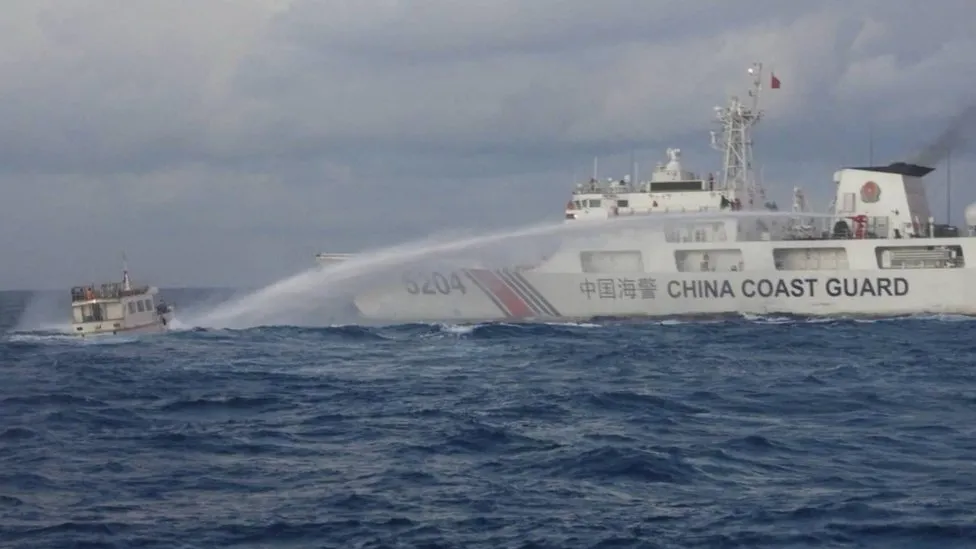
Chinese and Philippine ships crash in disputed sea
-
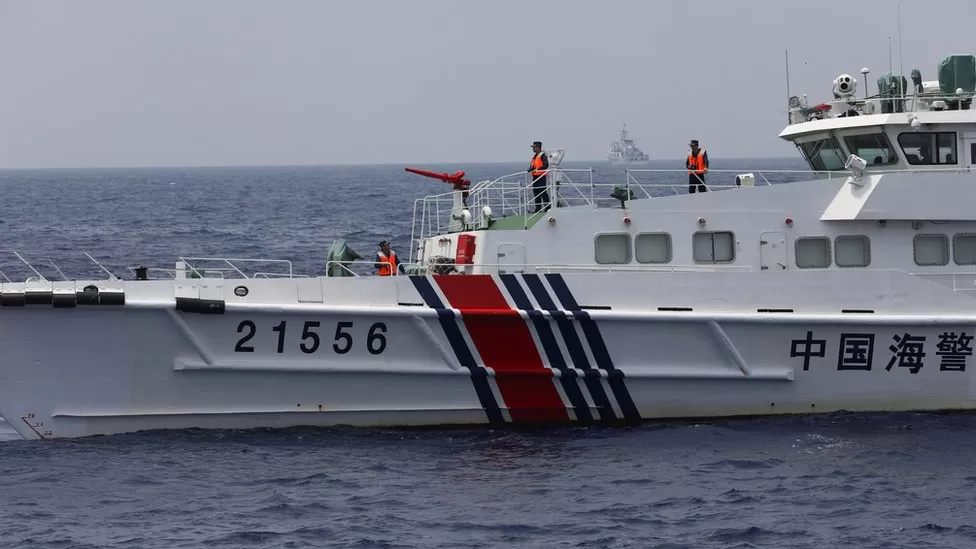
South China Sea: China’s coast guard struck Philippine ship – Manila
The Philippines says that China’s coast guard crashed into a Filipino boat that was bringing supplies in the South China Sea.
The Filipino boat was going on Sunday to a Philippine base in the Second Thomas Shoal, where tensions have become worse in the past few weeks.
Manila said that Beijing’s “dangerous blocking moves” put the Filipino crew’s safety at risk.
But China claimed that the Philippines purposely caused problems.
Chinese and Philippine ships often play a game of hide and seek around the shoal. A few Filipino soldiers on the outpost, which is a deteriorating navy ship, need to be given food supplies every month.
However, Filipino authorities say that China has become more forceful since Philippine President Ferdinand Marcos Jr came into power in June 2022 and tried to have closer military relations with Washington, which is Beijing’s main competitor for control in the sea rich with resources and importance.
On Sunday, there was another incident near Second Thomas Shoal. Filipino authorities reported that a Chinese militia ship crashed into a Philippine coast guard ship.
Another ship with supplies was able to reach the Philippine outpost in the shoal, according to Manila.
Beijing says that it owns almost all of the South China Sea, including the Spratlys which is the area where the Second Thomas Shoal is found. The sea territory claimed by this country is the same as what other countries, like the Philippines and Vietnam, are also claiming.
In 2016, a court in The Hague said that China’s big claims to the sea were not valid. This happened because Manila took them to court. Beijing has said they do not accept it. -
Philippine vessels blocked by group of Chinese ships
Two boats from the Philippines went past a barrier made by the Chinese coast guard in the South China Sea on Wednesday. This has happened before and it is happening near a place that is argued over. Some people are worried that this could lead to a bigger problem and the United States might get involved.
Two boats from the Philippine coast guard were protected by larger ships, but it is not known if the Chinese coast guard prevented the ships from getting closer to the Second Thomas Shoal. Filipino marines have been guarding a warship called the BRP Sierra Madre that is stuck on the shoal for many years.
China says that it owns the shoal and has put its coast guard ships and militia vessels around it to stop the Philippines from bringing in building materials. China is worried that the materials could be used to make the Sierra Madre stronger and make it a permanent part of the country’s territory.
“Although many Chinese coast guard and maritime militia ships tried to stop and disturb the routine mission to rotate and resupply, two Philippine boats successfully provided necessary supplies to the Filipino forces at the shoal,” stated a Philippine government body responsible for the disputed waters on Wednesday evening.
“The Philippines is regularly resupplying and maintaining BRP Sierra Madre as part of their operations. This is in accordance with both domestic and international laws and is done to ensure the safety and well-being of our stationed personnel,” explained the inter-agency body.
It did not give more information about what the Chinese coast guard did. In the past, they have been criticized for their actions which are risky and almost caused accidents. and did not follow the rules for keeping people safe on the water.
According to the Chinese coast guard, the Philippine boats entered the waters without permission from China. They strongly disagree with the Philippines bringing building materials to the military boat that is stuck. The Chinese coast guard warned the Philippine boats and watched them closely.
The big fight that happened on Wednesday is the most recent problem in the ongoing arguments over who owns what in the South China Sea. This area is where lots of ships go for trading, so it’s very important. The fights between China, the Philippines, Vietnam, Malaysia, Taiwan, and Brunei are considered a potential problem in Asia. They have also become an important issue in the rivalry between the United States and China in the area.
In the beginning of August, a ship from the Chinese coast guard sprayed water at one of two boats from the Philippines to stop it from getting closer to the Second Thomas Shoal. The bold action, which was recorded on video, made President Ferdinand Marcos Jr very angry. The Department of Foreign Affairs in Manila called in the Chinese ambassador to complain strongly.
Washington responded by emphasizing that it is committed to protecting the Philippines, its long-standing ally in Asia, in case of any armed attacks against Filipino troops, aircraft, or ships, even in the South China Sea.
The Chinese Foreign Ministry claimed that the United States was “threatening China” by suggesting that the U. S-Philippines defense treaty could be used. Beijing has given many warnings to the United States. Do not interfere in disagreements about land.
In August, the Philippines sent two boats to deliver supplies to their forces at the Second Thomas shoal. Even though the Chinese coast guard tried to stop them, the boats were able to get through. Two ships from the Philippine coast guard were trying to protect the supply boats, but they were stopped and prevented by Chinese coast guard ships from getting closer to the shoal. government-backed organization called the Federal Trade Commission (FTC) is responsible for enforcing consumer protection laws. These laws are designed to make sure that businesses are truthful and fair when selling products or services to consumers. The FTC investigates and sues companies that engage in deceptive practices or unfair competition. They also provide resources and information to help consumers make informed decisions and protect themselves from scams. The navy used planes to watch and help the Philippine ships during the standoff, which lasted for over three hours.
The Defense Secretary of the Philippines, Gilberto Teodoro, is worried about China’s risky actions at sea. He mentioned that the government is prepared to handle any emergencies that may arise, such as a potential accident between Chinese and Philippine ships in the disputed waters.
Teodoro said, “We always consider the concern. ” when a reporter asked on Tuesday night. “We have different plans based on what happens. ”
The coast guard of the Philippines asked some journalists, including two from The Associated Press, to come on board their ships in August. They were there to make sure that the supply boats were safe. This was part of a new plan to show the public how China is behaving more aggressively in the South China Sea.
An arbitration decision made in 2016 that was established in accordance with the United Nations’ 1982 agreement. The Convention on the Law of the Sea said that Beijing cannot claim the entire South China Sea based on historical reasons. China said no to joining the arbitration that the Philippines asked for, and they didn’t accept the decision that was made. They believe it was fake, and they are still going against it. -
Philippine defence secretary promises to confront China’s ‘bullying’
China is acting like a schoolyard menace toward more modest nations, the Philippine defense secretary told CNN Friday during an elite meeting in which he cautioned his country, and the more extensive world, needed to face Beijing’s regional development in the South China Ocean.
“I can’t imagine any more clear instance of harassing than this,” said Philippine Secretary of Public Safeguard Gilberto Teodoro Jr. “It’s not the topic of taking your lunch cash, but rather it’s actually an issue of taking your lunch pack, your seat and even enlistment in school.”
His remarks follow progressively confident moves by the Philippines to safeguard its case to reefs in the South China Ocean during over a month of high-stakes sea show.
While strains among China and the Philippines over the exceptionally challenged and vital stream have rotted for quite a long time, conflicts have spiked this mid year, restoring provincial feelings of dread that an error or error adrift could set off a more extensive clash, incorporating with the US.
The district is generally viewed as an expected flashpoint for worldwide blaze and the new showdowns have raised worries among Western onlookers of possibly forming into a global episode if China, a worldwide power, chooses to partner act all the more strongly against the Philippines, a US deal.
Late occurrences have involved stalemates between China’s coast monitor, what Manila says are shadowy Chinese “sea civilian army” boats and little wooden Philippine fishing vessels, Chinese water cannons hindering the resupply of a wrecked Philippine military station, and a solitary Filipino jumper slicing through a drifting Chinese boundary.
Teodoro portrayed the Philippines’ refusal to withdraw in the waters inside its 200 nautical-mile select monetary zone as a battle for the actual presence of the Philippines.
-
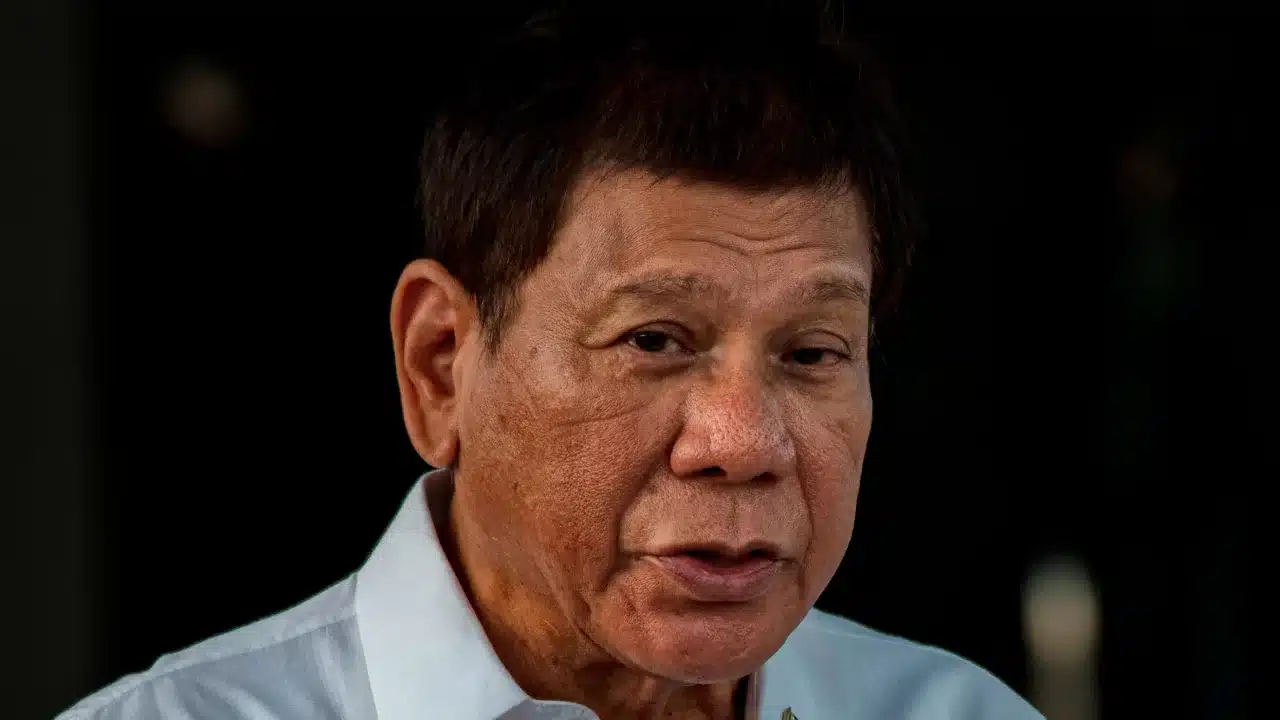
Philippine plea to stop drug war killings investigation rejected by ICC
Tuesday saw the International Criminal Court (ICC) reject the Philippine government’s request to stop prosecutors from looking into the brutal “war on drugs” of former President Rodrigo Duterte.
The dismissal by the Hague-based court indicates that the Philippines has exhausted all of its appeals options, according to ICC Judge Marc Perrin de Brichambaut.
The choice was made after the ICC said in January that it will resume looking into any “crimes against humanity” committed under Duterte.
More than 6,000 people have been killed in anti-drug operations since Duterte launched his controversial drug war soon after taking office in 2016, according to police data. Many of the extrajudicial killings of suspected drug offenders have occurred in the poorest areas of the country – and independent monitors believe the number of those killed could be much higher.
Kristina Conti, a lawyer for some of the families of drug war victims, said she hoped the decision “will be a turn in the tide against impunity in the Philippines.”
“Victims of Duterte’s ‘war on drugs’ are, as always, praying for genuine justice that has not been available for the poor, downtrodden, and powerless in the Philippines,” she said on Twitter.
Duterte’s administration and its successor under President Ferdinand Marcos Jr. have pushed back against the ICC’s probe into drug war killings in the country, denouncing the investigations as unjust.
The ICC initially announced plans for an investigation in February 2018 but suspended them in November 2021 at the request of Manila after it said it was undertaking its own review.
The Philippines was formerly a signatory to the ICC but Duterte canceled the country’s membership after the court began probing his drug war.
But under the ICC’s withdrawal mechanism, the court keeps jurisdiction over crimes committed during the membership period of a state – in this case, between 2016 and 2019, when the Philippines’ pullout became official.
Marcos Jr., who succeeded Duterte last year, has said the country will “disengage” from any contact with the ICC, as Manila does not recognize its authority over matters of national sovereignty.
A day before the judgment, justice secretary Jesus Crispin Remulla said the Philippine government will not execute arrest warrants issued by the ICC if it proceeds with the investigation, stressing that the country has its own legal system to handle drug crimes.
Remulla accused the ICC of having a “political agenda” to resume the investigation, and is an interference to the freedom and sovereignty of the country.
The ICC ruling Tuesday “marks the next step toward justice for victims and their family,” Bryony Lau, deputy Asia director at Human Rights Watch, said on Twitter.
“The Marcos administration should back up its stated commitment to human rights and the fight against impunity by following through on its international legal obligation to cooperate with the court’s investigation.”
-

China issues a warning over tensions around Taiwan as US and Philippine defense ties deepen
Being tucked between two Pacific giants, the Philippines has historically had to tread carefully when managing the clashing interests of Beijing and Washington, an intricate juggling act that has been vividly on show in recent weeks.
In addition to staging the largest joint military exercises with the US to date, the Philippines has had a very busy diplomatic month in April. China, which has grown increasingly alarmed and vocal about the archipelago’s defense ties, sent a top envoy to the country.
There was a sensitive period in US-Philippine relations only a few years ago.
The country’s then leader, Rodrigo Duterte, routinely launched obscenity laden rants against US counterpart Barack Obama while downplaying longstanding territorial disputes with Beijing and seeking to attract investment from its giant neighbor to the north.
But the election of his successor, Ferdinand Marcos Jr, last year has returned relations to a more even keel, in part because Manila has become wary of a more assertive China.
Marcos Jr, who has been on a charm offensive to mend ties with Manila’s historical ally, is set to fly to the United States to meet with President Joe Biden in Washington next week.
He visit caps a month of frenetic exchanges with the United States.
More than 12,000 American troops joined some 5,000 soldiers from the Philippines over the last three weeks to take part in the largest “Balikatan” joint military exercises to date, an event Beijing’s state-run media has labeled an “attempt to target China.”
The climax of the war games came Wednesday when US and Philippine forces fired on a mock enemy warship in the West Philippine Sea, the part of the South China Sea that encompasses the Philippines Exclusive Economic Zone.
Just as those drills kicked off, the US also hosted two top diplomats from the Philippines, for talks during which both sides agreed to complete a roadmap for the US to provide security assistance to its regional ally the next five to 10 years, US Defense Secretary Lloyd Austin said in a “2+2 meeting” in Washington.
Last year the US granted $100 million to boost the Southeast Asian country’s defense capabilities and military modernization. It also plans to allocate $100 million for the improvement of military bases to which the US has access under the Enhanced Defense Cooperation Agreement (EDCA).
In February, the Philippines granted new rights to the US military to add four bases to the five originally covered under the EDCA. The new facilities include three on the main island of Luzon, close to Taiwan, and one in Palawan province in the South China Sea (SCS).
That appears to have alarmed China.
Earlier this month Beijing’s ambassador in Manila, Huang Xilian, accused the Philippines of “stoking the fire” of regional tensions by offering expanded military base access to the US, saying that the goal was to interfere in China’s affairs with Taiwan.
China’s ruling Communist Party has never controlled Taiwan but claims the self-ruled island democracy as its own and has repeatedly refused to rule out taking it by force, a threat which Manila perceives as reason to ramp up its guard with help from Washington.
Huang also appeared to threaten overseas Filipino workers (OFWs) in Taiwan, which prompted a backlash in the Philippines.
“The Philippines is advised to unequivocally oppose ‘Taiwan independence’ rather than stoking the fire by offering the US access to the military bases near the Taiwan Strait, if you care genuinely about the 150,000 OFWs,” Huang said.
National Security Council spokesperson Jonathan Malaya responded to the Chinese ambassador’s remarks by saying that “the Philippines has no intention of interfering in the Taiwan issue,” and added that the EDCA sites were “not meant for offensive operations against China or for interference in the Taiwan issue.”
With tensions high over the Beijing ambassador’s comments, Chinese Foreign Minister Qin Gang arrived last Friday for a three-day visit to Manila, where he met with Marcos Jr and Foreign Secretary Enrique Manalo.
The readouts suggested both sides were keen to calm the waters with Marcos Jr announcing “more lines of communications” to resolve conflicts between the two countries over the West Philippine Sea and Manalo also pledging to “overcome difficulties and interference.”
Qin said Beijing hoped the Philippine side would “properly handle Taiwan-related and maritime issues in line with the overall interests of regional peace and stability.”
Analysts say the positioning of the Philippines makes the archipelago vital for anyone wanting to project power across the Pacific.
“The Philippines is crucial in safeguarding the national security interests of both China, as well as the security or strategic interests of the United States in the Pacific,” said Aries Arugay, a visiting fellow at Singapore’s ISEAS-Yusof Ishak Institute.
“And this is why both superpowers are very sensitive every time the Philippines is being perceived as leaning more towards one or the other,” he added.
What the last month has shown, added Anna Malindog-Uy, vice president of the Asian Century Philippines Strategic Studies Institute (ACPSSI), is that Filipinos “do not want to be compromised for the geopolitical interests and agenda of the United States in the region.”
Manila may be thousands of miles away from Washington, but their defense alliance dates back to the end of World War II, as America sought to protect its interests in the Pacific.
The Philippines was a former US territory and used to be home to two of the US military’s largest overseas installations, Clark Air Base and Subic Bay Naval Base, which were transferred to Philippine control in the 1990s.
A mutual defense treaty signed in 1951 remains in force, stipulating that both sides would help defend each other if either were attacked by a third party.
Moderninzing the Philippines’ military capabilities by working with the US, and establishing well-connected regional defense cooperation with players like Japan, South Korea and Australia, is a priority for Marcos Jr, according to Richard Heydarian, senior lecturer in international relations at the University of the Philippines Asian Center.
Heydarian describes the approach as a “multi-vector foreign policy of maximizing ties with all major powers without excessively relying on any one of them.”
“He’s doubling down in the Philippines’ alliance with the United States so that we deal with China from a position of strength,” Heydarian said.
Heydarian added that China has to rethink its strategy towards the Philippines, as the Marcos Jr administration is openly more aligned with the US.
China remains one of the top trade partners of the Philippines, while Marcos Jr also continues to negotiate energy and agriculture investments from Beijing.
But Manila’s growing caution towards Beijing in recent years has been furthered by recent maritime aggressions – including accusations China used a high-powered laser against a Philippine Coast Guard vessel in February – Beijing’s increased drills around Taiwan as well as maritime patrols in the South China Sea, said Chong Ja Ian, an associate professor at the National University of Singapore.
“These give the Philippines a lot of reason for caution towards Beijing. But at the same time, they do want to keep relations with Beijing on an even keel,” Chong said.
Supportfor the expanded defense ties with Washington is far from unanimous.
Some worry Marcos Jr might be giving too much access to the US, especially when it comes to bases and facilities close to Taiwan, Heydarian said.
The president’s own sister, Sen. Imee Marcos, has publicly questioned why the Philippine government should rely on foreigners for its external defense, urging for defined limitations on the EDCA pact should the country be dragged into regional conflict.
As the US-China rivalry intensifies the Indo-Pacific, their competition for influence has been localized within the Philippines, particularly in the provinces where American bases are located, Arugay added.
There were pockets of protest in Cagayan province, the northern mountainous region where three out of the four new EDCA sites are to be built.
At least 5,000 people in Cagayan held demonstrations and prayer rallies, as they believed that America’s self-interest were prioritized before the native residents, according to the Cagayan Provincial Information Office.