Tag: policy

  • BoG indicates ongoing efforts to sterilize liquidity

    BoG indicates ongoing efforts to sterilize liquidity

    The market is still highly liquid despite the recent change in the Cash Reserve Ratio (CRR) policy in November 2023, which has led the Bank of Ghana (BoG) to announce additional efforts to absorb excess liquidity.

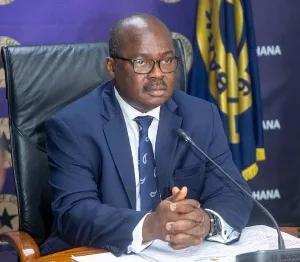
    In a press conference held after the 116th MPC meeting, Dr. Ernest Addison, the governor of the Bank of Ghana, acknowledged the current liquidity situation while highlighting the difficulties banks face in locating appropriate investment opportunities.

    “It appears there’s still quite an amount of liquidity in the market. This is one of the issues we extensively discussed last week. The auctions are oversubscribed and the banks have mobilised a lot of deposits, making them very liquid. However, there aren’t many avenues for investing their resources so they are putting it back into the auction. The economic conditions haven’t improved enough to reduce the risk associated with lending, prompting them to invest in short-term government bills instead,” Dr. Addison stated.

    In a bid to tackle surplus liquidity and contribute to the ongoing battle against inflation, the central bank opted for a unified and increased Cash Reserve Ratio (CRR) at 15 percent, covering both local and foreign currency accounts. However, concerns are surfacing about potential spikes in government borrowing costs within the domestic Treasury market due to this reserve hike.

    When questioned about the impact of the CRR change, Dr. Addison humorously quipped, “The CRR policy change likely had an impact, but there’s still a significant amount of liquidity.”

    The new CRR directive, effective since November 30, 2023, aimed to extract around GH¢11 billion in cedi liquidity from the interbank market while injecting approximately US$750 million. This strategic move was designed to bolster liquidity conditions in the FX market, potentially dampening the depreciation pace during the festive season.

    In 2023, base money growth witnessed a significant slowdown, registering at 29.2 percent by December, compared to the lofty 57.5 percent in December 2022. This deceleration was attributed to robust sterilization efforts by the Bank of Ghana (BoG) and effective liquidity management operations.

    Likewise, interest rates in the money market embarked on a downward journey, with the 91-day and 182-day Treasury bill rates descending to 29.49 percent and 31.70 percent, respectively, in December 2023. The 364-day instrument’s rate also took a dip to 32.97 percent during the same period.

    During its November 2023 Monetary Policy Committee (MPC) meeting, the central bank underscored the slowdown in monetary aggregates’ growth, revealing a year-on-year contraction of 2.6 percent in reserve money during October 2023. The move to unify the CRR for both cedi and foreign currency deposits was a strategic maneuver to navigate excess structural liquidity conditions and bolster the disinflation process.

    Shifting the spotlight to the banking sector’s performance, end-of-year data showcased a ballet of stability, liquidity, and profitability. Recovering from the setbacks of 2022, the sector demonstrated increased net interest income and fees & commissions.

    Despite facing challenges from the Domestic Debt Restructuring and macroeconomic headwinds in 2022, the banking sector exhibited resilience. Capital adequacy levels remained comfortably above the minimum regulatory requirement, and most banks maintained excess liquidity. However, the industry grappled with a rise in the Non-Performing Loan (NPL) ratio, reaching 18.3 percent in October 2023, reflecting elevated credit risk associated with the lingering effects of the 2022 macroeconomic crisis.

    On the lending front, the private sector witnessed sluggish credit expansion, growing at 10.7 percent in December 2023, a stark contrast to the 31.8 percent seen in December 2022, signaling increased risk aversion among banks. The financial landscape, it seems, is engaging in a complex dance of strategy and adaptation.

  • Clearing agents’ productivity rated by Customs at approximately 80%

    Clearing agents’ productivity rated by Customs at approximately 80%

    A principal revenue officer in the Policy and Programmes Unit of the Customs Division of the Ghana Revenue Authority, Smile Agbemenu, has evaluated the productivity of clearing agents at the Ports of Ghana, giving them a rating of nearly 80%.

    During a discussion on the importance of freight forwarders in the age of technology on “Eye on Port,” he highlighted that freight forwarders have performed reasonably well in terms of customs assessment of their operations.

    While there have been challenges, such as incorrect classification by some clearing agents, which can hinder trade facilitation, their overall contribution to trade facilitation remains significant.

    “They have done fairly well and of course, there is room for improvement, and we will continue to do a lot of training sessions for them.

    According to him, one of the strategic aims of the GRA’s Customs division is to use cutting-edge techniques to bring stakeholders and their services considerably closer together, making it easier for freight forwarders to do their tasks.

    He praised freight forwarders for providing enough data to customs that helps with business facilitation on behalf of importers.

    “They are able to take advantage of the pre-arrival processes so as to get all the requirements awaiting the arrival of cargo for inspection and delivery. They have been able to provide us with accurate information and they have not been performing that badly,” he said.

    He said a customs house agent who knowingly files or obtains any false claim, and gives any false or misleading information in any matter pending before the Commissioner General, could have his or her license suspended. He then went on to explain the circumstances under which the license of a clearing agent can be revoked.

    Again, “if you knowingly make any misrepresentations to procure employment in any customs business or represent to a client or prospective clients that the customs house agent can obtain any favor from the Commissioner General or any other public officer in connection with any business.”

    He claimed that a customs house agent’s licenses might be suspended or withdrawn if they give the impression to one of their clients that they can obtain any favor from the Commissioner General.

    He also said that a customs agent could lose their ability to conduct business if they refuse to give their client, who is entitled to it, information concerning customs business.

    “You have to be open and transparent to your client and you need to make him know every information,” he said.

    He said as part of efforts to empower freight forwarders and the trading community, Customs has enriched the clearance platform by making available a lot of information to aid customs business.

    “There is so much rich information that has been made available without you logging onto the platform. We are able to engage not only physically but electronically through this platform,” he said.   

  • Treasury yields rising as govt’s overdependence continues

    Treasury yields rising as govt’s overdependence continues

    The Treasury continues to face elevated short-term yields primarily due to the government’s heavy reliance on T-bills, compounded by persistently high inflation and the subsequent monetary policy measures implemented to counter inflationary pressures.

    Recent data from auctions conducted on September 8, 2023, revealed a concerning interest rate of 32 percent for the 364-day T-bill, while the 91-day T-bill hovered just below 30 percent. These figures underscore the government’s limited alternatives, the high cost of borrowing, and the lingering threat to debt sustainability.

    Investors are demanding higher yields at T-bill auctions due to increased inflation risks, low real returns on fixed-income investments, and market uncertainties. This demand has partly offset the interest savings achieved by lowering T-bill yields following the Domestic Debt Exchange Programme (DDEP).

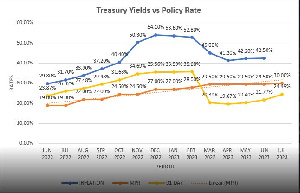
    The government’s strategy to reduce yields after the DDEP resulted in a 17 percent decline in the 91-day T-bill rate, from 35.75 percent pre-DDEP to 18.53 percent by March 20, 2023. However, yields have risen since April due to continued domestic borrowing and limited external funding. Investors are seeking compensation for economic uncertainties, leading to T-bill clearing yields ranging from 27.8 percent to 32 percent.

    In recent Treasury auctions, yields have further increased, with the 91-day, 182-day, and 364-day bills settling at 27.79 percent, 29.12 percent, and 31.97 percent, respectively. These rates have surged since the beginning of the first quarter of 2023, with the 91-day bill rising by 840 basis points (bps), while the 182-day and 364-day bills have increased by 768 bps and 631 bps, respectively.

    These T-bill yields now surpass the coupon rates on restructured bonds. The tight monetary stance is likely to continue pushing yields higher until the government secures concessional funding alternatives.

    In August 2023, the government faced escalating borrowing costs, with the 91-day bill increasing by 178 bps to 27.02 percent, the 182-day bill by 147 bps to 28.62 percent, and the 364-day bill by 93 bps to 31.24 percent. The Treasury successfully sold GH¢12.35 billion worth of bills to cover GH¢10.18 billion in maturing bills, resulting in a maturing cover of 1.21x.

    The government aims to raise GH¢3.76 billion in the upcoming auction on September 15, 2023, highlighting its ongoing need for funds. With policy rates at 30 percent amid elevated inflationary pressures, higher Treasury rates are expected to persist in the near term.

    The mounting borrowing costs pose a challenge to the government’s already strained fiscal position, making it difficult to manage existing debt and fulfill future financial obligations.

    Monetary response to inflation

    In response to emerging inflation risks, the Monetary Policy Committee (MPC) of the Bank of Ghana has implemented a more restrictive monetary policy stance. This shift will have a significant impact on Treasury securities, particularly the 91-day to 364-day T-bills, which are expected to face an extended period of higher yields.

    During its July 2023 policy meeting, the MPC raised the policy rate by 50 basis points (bps) to 30 percent, aiming to address inflation risks and the need for substantial tightening in both fiscal and monetary policy frameworks.

    Despite a decline to 40.1 percent in August 2023, inflation in Ghana remains elevated, with only Sierra Leone (44.98 percent), Sudan (63.3 percent), and Zimbabwe (77.2 percent) experiencing higher rates. Nearby neighbors Côte d’Ivoire and Togo report significantly lower inflation rates at 4.6 and 3.8 percent, respectively.

    Despite efforts to restructure the nation’s debt portfolio, the updated public debt stock, excluding debt from state-owned enterprises and special purpose vehicles (SOE/SPVs), has shown significant growth. This is primarily attributed to an expanding domestic debt burden and earlier exchange rate fluctuations.

    According to the Bank of Ghana’s summary of macroeconomic and financial data published in July 2023, the total debt stock increased by 21.3 percent from December 2022 to GH¢569.3 billion (equivalent to 71.1 percent of GDP) by April 2023. The domestic debt component rose by 6.29 percent, reaching GH¢247.9 billion (equivalent to 30.95 percent of GDP), while external debt in cedi terms surged by 33.41 percent, reaching GH¢321.4 billion (equivalent to 40.13 percent of GDP).

    The government’s ongoing struggle to manage rising borrowing costs, combined with inflationary pressures and a tighter monetary policy rate, underscores the challenges confronting fiscal and economic stability. With the likelihood of even higher yields on the horizon, the government faces a challenging task in navigating these turbulent financial conditions.

    Looking ahead, the market anticipates that yields on Treasury bills will continue to rise, albeit at a slower pace, as the Treasury adjusts its bids in response to persistent demand pressures.

  • Faulty polling in Gabon cause of coup  – EU’s Borrell says

    Faulty polling in Gabon cause of coup – EU’s Borrell says

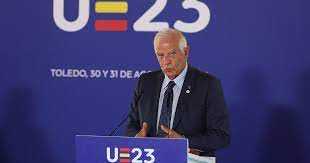
    EU foreign policy chief, Josep Borrell, remarked on Thursday that the military coup in Gabon should not be equated with the crisis in Niger.

    In Gabon, citizens participated in general elections on Saturday. However, following the announcement of President Ali Bongo as the victor on Wednesday, military officers claimed to have taken control and confined him to his residence.

    Borrell explained that their intervention stemmed from the perception that the recently ousted president had secured his position through an unjust election.

    “While military coups are undoubtedly not a solution, we should acknowledge that in Gabon, the elections were marred by irregularities,” he stated.

    He further elaborated, “There are military and institutional coups, where the use of force is not required. If I manipulate elections to attain power, that is also an improper means of seizing authority.”

    Borrell’s comments came amid discussions among EU foreign ministers about aiding the ECOWAS regional group in West Africa in addressing the military takeover that occurred in Niger on July 26.

    Both the EU and ECOWAS are firmly against the military’s overthrow of President Mohamed Bazoum in Niger. However, Borrell argued that the circumstances surrounding the dramatic developments in Gabon should not be directly compared.

    In Niger, the president had been democratically elected, whereas in Gabon, the Bongo family had maintained control over the oil-rich nation for nearly six decades. Ali Bongo assumed the presidency in 2009 after the passing of his father, Omar.

  • Treasury yields will remain high for a while due to the tighter monetary policy

    Treasury yields will remain high for a while due to the tighter monetary policy

    In response to emerging upside risks to inflation, the Monetary Policy Committee (MPC) of the Bank of Ghana has implemented a tighter monetary stance.

    As a result of this move, there will be significant implications for Treasury securities, particularly 91-day to 365-day T-bills, which will experience an extended period of higher yields.

    During its policy meeting on July 23, the MPC raised its policy rate by 50 basis points (bps) to 30 percent. The increase aims to counter inflation risks and calls for substantial tightening in both fiscal and monetary policy frameworks. The Committee highlighted a cumulative 130 bps increase in headline inflation over the past two months, mainly driven by relentless food prices.

    Although the 50 bps hike is considered marginal and precautionary, market observers, such as GCB Capital, suggest that it may lead to higher interest rate demand and potentially moderate credit growth in the short term.

    Since Q1 2023, inflation and general macroeconomic uncertainties have caused higher interest rates, pushing benchmark 91-day bill yields to potentially breach 25 percent at the next auction. This upward trend in yields follows the government’s short-lived efforts to reduce bids and capitalize on strong demand for bills to lower borrowing costs.

    Consequently, yields on the 91-day bill dropped from 35.36 percent in Q4-2022 to 19.39 percent in Q1-2023, while the 182-day bill declined from 35.98 percent to 21.44 percent, and the 364-day bill fell from 35.89 percent to 25.66 percent during the same period.

    At the most recent auction held on July 21, 2023, yields settled even higher, with the 364-day bill clearing at 30.05 percent (+40 bps w/w) and the 182-day bill surging to 26.91 percent (+50 bps w/w), while the 91-day yield increased at a relatively slower pace to 24.92 percent. Cumulatively since Q1 2023, yields on the 91-day have surged by 553 bps, while the 182-day and 364-day bills have surged by 547 bps and 439 bps, respectively.

    These higher T-bill yields now surpass the coupon rates on restructured bonds, and the tighter monetary stance may lead to even higher yields until the Treasury accesses concessional funding alternatives.

    Furthermore, the rising borrowing costs for the government, driven by higher yields on Treasury bills, are adding strain to an already burdened fiscal position. As government borrowing costs increase, managing existing debt burdens and fulfilling future financial commitments become increasingly challenging.

    Despite efforts to restructure the country’s debt portfolio, the updated public debt stock, excluding debt from state-owned enterprises and special purpose vehicles (SOE/SPVs), reflects significant growth mainly due to an increasing domestic debt burden and exchange rate movement earlier in the year.

    According to the BoG’s summary of macroeconomic and financial data published in July 2023, the total debt stock increased by 21.3 percent from December 2022 to GH¢569.3 billion (71.1 percent of GDP) in April 2023. The domestic debt component rose by 6.29 percent, amounting to GH¢15.6 billion, and reaching GH¢247.9 billion (30.95 percent of GDP), while external debt in cedi terms surged by 33.41 percent, totaling GH¢80.5 billion, and amounting to GH¢321.4 billion (40.13 percent of GDP).

    Treasury auctions ahead

    The Treasury faces upcoming Treasury bill maturities on July 31, 2023, with a total face value of GH¢2.02billion across the 91-day and 182-day bills. To roll over these maturities, the Treasury aims to conduct a gross issuance of GH¢2.28billion at the next T-bill auction later in the week.

    Despite the interbank market remaining broadly liquid, the 50 bps increase in policy rate to 30 percent may result in a sharper increase of T-bill yields at the next auction. It is expected that the benchmark 91-day yield will exceed 25 percent at this auction.

    Market expectations indicate that yields on Treasury bills will continue to fluctuate in the near-term, with the potential for further increases. However, the real return on Treasury bills will remain negative until inflation returns to a single-digit figure or drops below 20 percent. The projected range for Treasury yields in the near-term is around 20 percent to 25 percent.

  • “It is a worry to all of us” – BoG Governor on hoarding of foreign currencies

    “It is a worry to all of us” – BoG Governor on hoarding of foreign currencies

    Governor of the Bank of Ghana, Dr. Ernest Addison, has voiced worry about the practice of some people stockpiling enormous sums of foreign currency outside of the banking system.

    The Governor remarked that the behavior of the former Water Resources and Sanitation Minister Cecilia Dapaah allegedly hoarding one million dollars and 300,000 euros at her residence is concerning in response to a question at the Central Bank’s Monetary Policy Committee press conference in Accra.

    He didn’t say anything else, though, about the case that was in court.

    “It is a worry to all of us, but it is a matter that is still unfolding and is in court. Therefore, there is nothing to say about it.”

    Over the years, the Bank of Ghana has urged people and organizations to keep their local and foreign currencies with Ghanaian commercial banks.

    As part of the Inflation Targeting Policy, this will assist in properly monitoring the quantity of currencies in use. For the foreign currencies, it will assist in supplying the commercial banks with the foreign exchange they require to support their international activities.

    What is Bank of Ghana doing to deal with spike in currencies outside Banks?

    The Governor said the Central Bank is using the various monetary tools to deal with the challenge.

    Fresh data from the Central bank showed that currencies outside the banking sector went up from ¢22.1 billion in May 2022 to ¢31.6 billion at the end of May 2023.

    Dr. Ernest Addison explained that the Bank of Ghana has increased its open market operations as well as improved liquidity management instruments to also address the challenge.

    “This is an area that the Bank of Ghana is taking a closer look at when it comes to liquidity operations and expect more measures from the Central Bank in the coming weeks”.

    The Governor noted that there is a seasonal effect in terms of contributing to this spike, adding “One can talk about the purchase of cocoa and gold”.

    But he noted that with the purchase of gold , there had been a cedi cover to deal with this challenge.

    Capitalisation plans of commercial banks in Ghana

    The Governor also announced that all commercial banks have submitted their re-capitalization plans to the Central Bank.

    This is ahead of the September 2023 deadline.

    The Central Bank at the last Monetary Policy Committee (MPC) meeting announced that commercial banks in the country have been directed to submit their recapitalization plans by September 2023.

    This might influence any plan in the future in terms of banks that turn to the BoG for support with respect to operationalization of the Ghana National Financial Stability Fund.

    Suspension of Fidelity and First National Banks’ Forex License

    The Bank of Ghana earlier this month announced the suspension of the forex license of Fidelity Bank and First National Bank of South Africa for breach of operational measures, beginning June 29, 2023.

    The two banks were also fined a combined 1,000 penalty points each for breaching sections 3.4, 3.5, and 3.9 of the Ghana Interbank Forex Market Conduct rules.

    Given the license suspension, customers of the banks had to look elsewhere to do their forex business.

    But responding to questions at the MPC press conference, the Governor said the licenses of these two banks have been restored even ahead of the deadline.

    “The licenses of these commercial banks were restored some two weeks ago, this should mean that they did not do the full one month” the Governor noted.

  • Nigerians welcome student loans but questions linger

    Nigerians welcome student loans but questions linger

    Nigerians in the nation’s capital, Abuja, tell the international media that while they support President Bola Tinubu’s new student loan bill, they have concerns about how it would really be implemented.

    The new policy, which the president signed into law on Monday, offers financial support for poorer students in higher education by enabling them to easily get interest-free loans from the Nigerian Education Loan Fund to cover tuition fees.

    However, students could face two years imprisonment or a 500,000 naira ($1,000; £790) fine if they default on repayments once eligible to do so.

    “I think it’s a very good idea and it’s going to help students,” one young woman tells the BBC, adding that people should not just “collect loan and relax”, referencing the strict rules regarding repayment or jail time.

    One student says the policy is good as fees have increased exponentially.

    However his “biggest worry is how the policy will be driven to a logical conclusion”, because Nigeria struggles to execute good policies, he says.

    Beneficiaries of the loan are expected to start repayment as soon as they gain employment, following the completion of their studies and mandatory national service.

    Most have requested anonymity or, like Zeinab, used a pseudonym for fear of reprisals against them and others.

    Both Sudan’s army chief, General Abdel-Fattah Burhan, and the RSF, led by General Mohamed Hamdan Dagalo, have accused their enemies of such attacks.

    And human rights lawyer Jehanne Henry said that indeed both sides have committed “notorious acts of sexual violence” in the past.

    The governmental Combating Violence Against Women and Children Unit documented 49 assaults in the first two weeks of the war.

    In all but six cases, survivors identified perpetrators “in RSF uniform,” said unit chief Sulaima Ishaq al-Khalifa, adding that there are “new reports night and day.”

    No woman is safe

    “There is not a single woman in Khartoum now who feels safe, not even in her own home,” al-Khalifa said.

    The worst fighting has raged in Khartoum and the Darfur region, where former autocratic leader Omar al-Bashir once unleashed the notorious Janjaweed militia from which the RSF emerged.

    In their scorched-earth campaign since 2003, they committed genocide, war crimes and crimes against humanity, including rape, according to the International Criminal Court.

    Now mass rapes are again being reported in Darfur, said Adjaratou Ndiaye, the U.N. Women representative in Sudan.

    Documented cases, like wider casualty counts, are likely “the tip of the iceberg,” said a Sudanese Women Rights Action group researcher.

    Medics say many victims receive no care as hospitals have been ransacked or destroyed.

    Many cases have been reported by civil society groups known as resistance committees, which long campaigned for democracy.

    A lawyer who has long documented sexual assaults by security forces, said the scourge now impacts “every segment of Sudanese society.”

    “We have seen the rape of young girls and old women, mothers with their children,” she said, adding that to the perpetrators “it doesn’t matter.”

    Amid dire shortages, health workers have struggled to provide HIV medication or emergency contraceptives.

    “The situation is catastrophic,” said a member of the Central Committee of Sudanese Pharmacists.

    Activists and medics are trying to document every attack. The aim, said the lawyer, is “to ensure there is no impunity.”

    Zeinab hopes the rapists will one day face justice but voices resignation.

    “I shared my testimony to try and stop this happening to others, to tell them the road isn’t safe,” she said. “But even when I filed the police report, I knew nothing would come of it. They’re never going to get the men who did this.”

  • Kenya’s shilling drops to a new record after 60 straight days

    Kenya’s shilling drops to a new record after 60 straight days

    After 60 days of falls, the Kenyan shilling experienced its longest losing streak since records began in 1988.

    By 10:55 a.m. in Nairobi, the shilling was down 0.1% against the dollar, bringing its year-to-date loss to more than 5%.

    According to Genghis Capital, which forecasts the shilling to trade as low as 161.40 to the dollar by year’s end, worries about rising US interest rates, declining foreign-exchange reserves, and a deteriorating balance of payments have hurt the currency of East Africa’s largest economy.

    That would mark the biggest annual depreciation since 2008, when the currency tumbled 23%, according to data compiled by Bloomberg. 

    Kenya’s foreign-exchange reserves dropped to $6.56 billion as of March 16, an 11-year low and sufficient to cover just 3.66 months of exports. The central bank’s statutory requirement is to maintain at least four months of coverage.

    The central bank will probably raise its benchmark interest rate from 8.75% at its next Monetary Policy Committee meeting on March 29, Genghis said, after annual inflation quickened for the first time in four months to 9.2% in February. 

    Commercial lenders in Kenya are charging an average spread of 7.50 shillings on the official exchange rate, with some charging as much as 10.50 shillings, Genghis said. 

  • Twitter will ban unlabelled parody accounts, says Elon Musk

    Elon Musk says Twitter users engaging in impersonation without clearly specifying it as a parody account will be permanently suspended.

    Twitter previously issued a warning before suspending accounts, but there would now be no warning, he announced in a series of tweets.

    The company’s new owner laid off around half of the company’s workforce at the end of last week.

    He also confirmed plans to allow users to buy blue-tick verified status.

    Detailing the new policy on parody accounts, Mr Musk tweeted: “Previously, we issued a warning before suspension, but now that we are rolling out widespread verification, there will be no warning.”

    He added that “any name change at all will cause temporary loss of verified checkmark”.

    Going forward, any Twitter handles engaging in impersonation without clearly specifying “parody” will be permanently suspended

    — Elon Musk (@elonmusk) November 6, 2022

    The BBC is not responsible for the content of external sites.View original tweet on Twitter

    1px transparent line

    Several accounts that had changed their name to Elon Musk and mocked the billionaire have been suspended or placed behind a warning sign, including those of US comedian Kathy Griffin and former NFL player Chris Kluwe.

    Other accounts, including one parodying former US President Donald Trump by comedian Tim Heidecker, are yet to be suspended.

    Mr Musk has previously said he opposed permanent bans on Twitter, including that of Mr Trump’s official account. Mr Musk said last week that banned accounts would not be reinstated until there was “a clear process for doing so”.

    The New York Times reported on Sunday that Twitter was delaying the rollout of verification check marks to subscribers of its new service until after Tuesday’s US midterm elections. At the weekend, the social media site’s website app began offering an update that will charge $8 (£7) a month for its blue, verified checkmark.

    On Friday, the billionaire said Twitter was losing more than $4m per day, insisting that this gave him “no choice” over culling around half the company’s 7,500-strong workforce.

    The cuts – as well as Mr Musk’s fierce advocacy of free speech – have caused speculation that Twitter could water down its efforts on content moderation.

    However, Mr Musk has insisted that the firm’s stance towards harmful material remains “absolutely unchanged”. UN human rights chief Volker Turk wrote him an open letter, warning that Twitter had a responsibility to avoid amplifying harmful content.

    Source: BBC

  • Trade Ministry to roll out textile tax stamp from Nov 1

    The implementation of the textiles tax stamps policy aimed at tackling the influx of pirated and fake textiles in the country as well as other challenges in the industry is slated to commence on November 1 this year.

    Implementation modalities of the policy, according to the Minister of Trade and Industry, Alan Kyerematen would include having textiles stamps affixed on all textile prints traded in Ghana.

    Speaking at an engagement forum with textiles wholesalers and retailers on the policy in Accra on Friday, he said, the textiles tax stamp policy was one of six measures aimed at finding lasting solutions to the challenges and also strengthen the textiles sector to create jobs for Ghanaians.

    Mr Kyerematen (second from left) interacting with the traders during the engagement forum

    The forum was to sensitise and educate the public, particularly dealers in the industry on the introduction of the textiles tax stamps as part of the government’s commitment to addressing the challenges of the textiles industry as well as developing the sector to harness the significant gains the sector stands to offer.

    Participants included representatives from the Ministry of Finance, Ghana Revenue Authority-Domestic Tax Revenue Division, Intellectual Property Office and Ghana Standards Authority.

    The other measures, he noted include, Import management systems; Introduction of Designated Entry Corridors (Tema Port and Aflao Border for textile imports); Provision of Incentive Packages for local manufacturers to make them competitive; attract foreign textile manufacturers to set up or relocate their plants in Ghana; and reconstitute the Task Force to embark on effective market monitoring and surveillance.

    Mr Kyerematen revealed that the local demand for African prints was about 120 million yards per annum, of which the local supply is just about 35 per cent (42million yards), with the remaining 65 per cent imported.

    He recalled that the local textiles industry used to be vibrant in the last three decades, but that the influx of pirated designs and gross infringements on trademarks of local textile manufacturers have been identified as two of the key areas which have adversely affected the textiles industry in the country.

    The government, he said, we convinced that the policy measures would lead to the development of the local textile firms to reduce the import of pirated textiles by promoting local manufacturing.

    Mr Kyerematen assured the stakeholders that, despite the introduction of the measures, importation of textiles was still allowed since the country does not currently have the local manufacturing capacity to meet the total national demand of over 120 million yards per annum.

    He expressed the hope that the policies were going to help streamline the imports of textiles and further ensure that all the players involved in the textiles industry benefit.

  • Bawumia to open conference which will determine smartest policies for prosperous future

    The Vice President, Dr. Mahamudu Bawumia will open a multi-day conference in Accra on Thursday at which eminent economists from Ghana and abroad are going to prioritise the smartest solutions to the country’s challenges.

    The conference is organised by the Ghana Priorities project, a collaboration between the National Development Planning Commission (NDPC) and the award-winning think tank Copenhagen Consensus.

    Over the past 18 months, a reference group drawn from the public sector, private sector, civil society organizations, academia, the media, identifiable groups and individuals identified 80 of the most promising solutions for Ghana. 28 teams of Ghanaian, regional and international economists have researched the costs and benefits of each.

    Now, this research is presented to a panel of eminent economists who will rank all the interventions and establish what will do the most good for every cedi spent.

    The Eminent Panel is comprised of Mr Ken Ofori-Atta, Minister of Finance, Prof. George Gyan-Baffour, Minister of Planning, former Finance Minister Prof. Kwesi Botchwey, Prof. Augustin Fosu from the Institute of Statistical, Social and Economic Research (ISSER), University of Ghana, Prof. Ernest Aryeetey, Secretary-General of the African Research Universities Alliance (ARUA), Prof. Eugenia Amporfu from Kwame Nkrumah University of Science and Technology (KNUST), and Prof. Finn Kydland, winner of the Nobel Prize in Economic Sciences.

    Dr. Bjorn Lomborg, President of Copenhagen Consensus and named by TIME magazine as one of the 100 most influential people in the world, will facilitate the work of the panel.

    “It is a great honour to have Mr Ofori-Atta, Prof. Gyan-Baffour, Prof. Botchwey, Prof. Fosu, Prof. Aryeetey, Prof. Amporfu and Prof. Kydland studying the economic, social and environmental impact of policies to help inform the debate on priorities for a prosperous future. The results of their labours can help focus attention on the smartest policies for the country that do the most good for every Ghana cedi spent,” said Dr. Kodjo Esseim Mensah-Abrampa, Director General of the NDPC.

    The Eminent Panel’s prioritized list of the most promising policy pursuits will be presented on Monday, 10 August.

    The Ghana Priorities Eminent Panel Event will be held at the Kempinski Hotel.

    Click on link below for more;