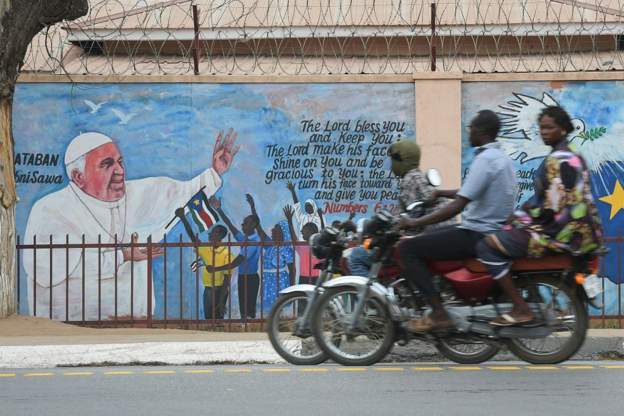
Pope Francis is expected to arrive in South Sudan on Friday, and the Catholic Church there plans to perform special prayers on Thursday for his safe arrival.
Approximately a million people attended one of Pope Francis’ largest Masses, which he conducted on Wednesday in Kinshasa, the capital of the Democratic Republic of the Congo, while he is currently there.
According to Archbishop Stephen Ameyu Martin, the prayers for the Pope’s visit to South Sudan would be performed at the mausoleum of the late president John Garang in Juba.
“I want to make this announcement to all the Christians, let us come here on Thursday afternoon at 17:00 hours (15:00 GMT) to pray for the health of our Holy Father Pope Francis and for his safe arrival in our country on Friday,” Archbishop Ameyu said.
The Mass will be officiated by Archbishop Hubertus van Megen, the Vatican’s ambassador to South Sudan.
The government has reportedly sent 5,000 soldiers and police officers to the nation’s capital to serve as security for the Pope’s visit.
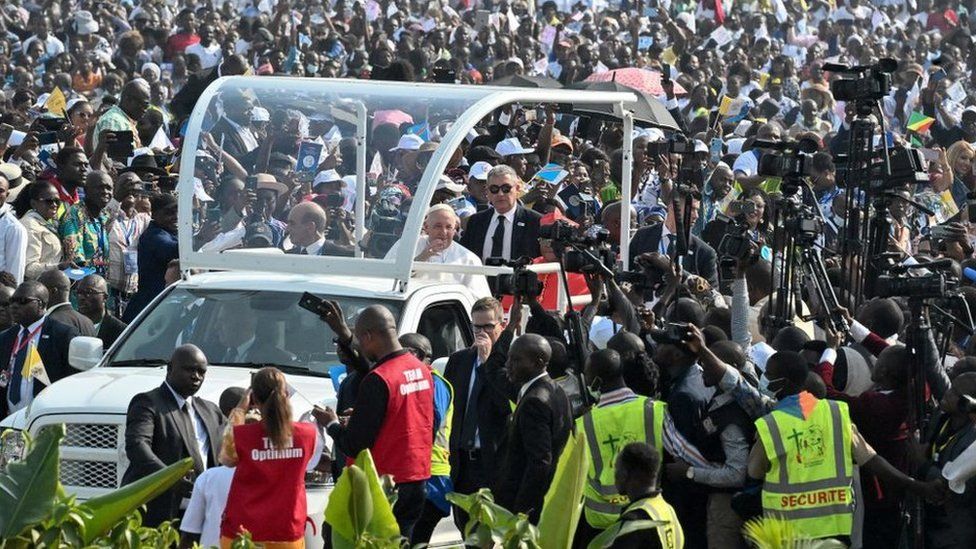
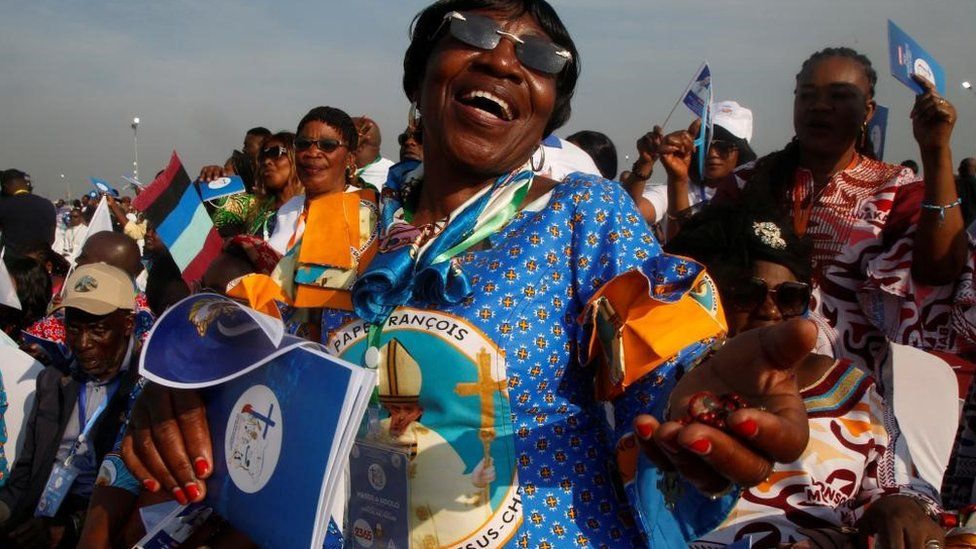
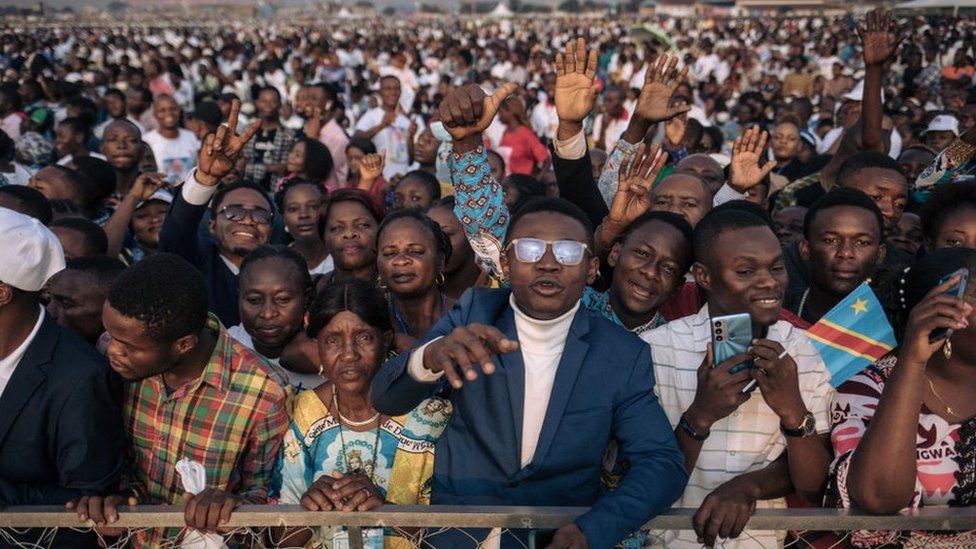
Over a million worshippers turned out for a papal mass in DR Congo’s capital Wednesday, organisers said, on the second day of Pope Francis’s visit to the conflict-torn country.
Many of the faithful in Kinshasa, a deeply observant megacity of some 15 million people, began to arrive at Ndolo airport on Tuesday night to assure themselves of a spot.
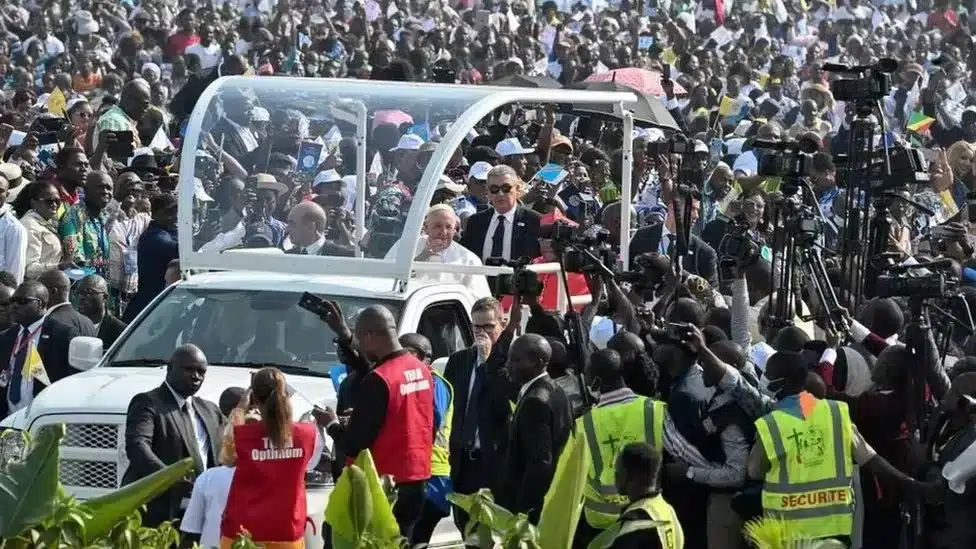
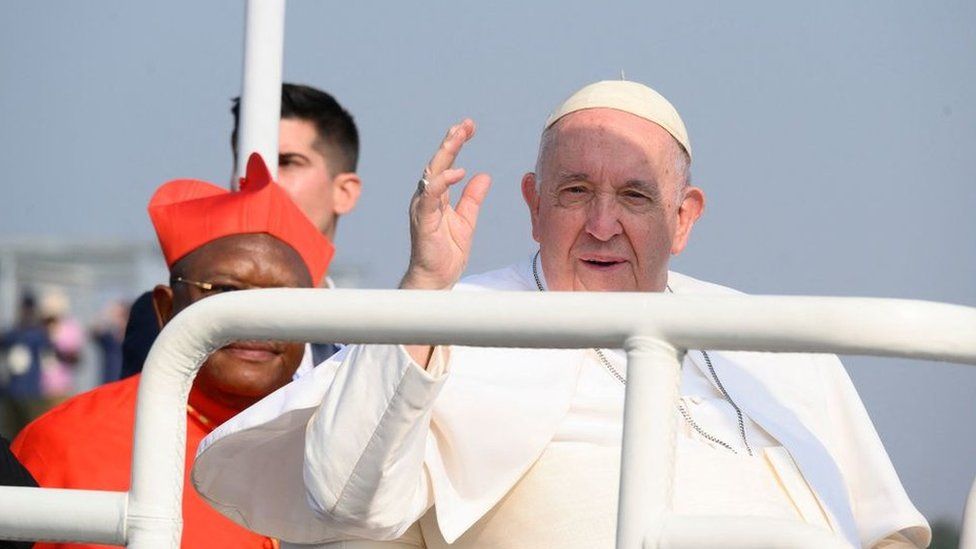
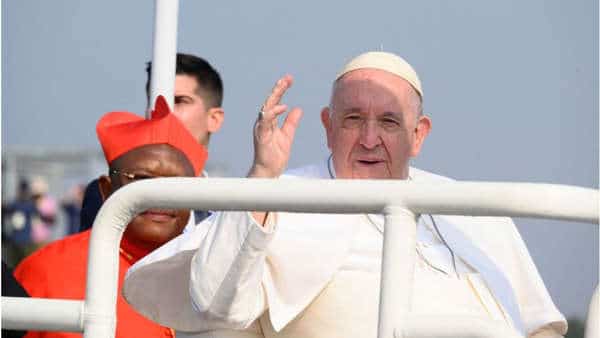
Francis entered the airport grounds aboard his popemobile and was greeted by singing and dancing crowds before the mass began at around 9:30 am (0830 GMT).
Organisers said that over one million people were on the airport tarmac. Adrien Louka, 55, told AFP he had arrived before dawn.
“As our country has many problems, it is reconciliation that we are looking for and the Pope will give a message so that the countries around us leave us in peace,” he added.
Francis wished the crowd peace in Lingala, one of the DRC’s four national languages and the everyday language of Kinshasa.
The pope delivered the rest of his homily in Italian — which was translated into the DRC’s official language French — in which he urged the faithful “not to give in to divisions.”
The 86-year-old pontiff had arrived in the DRC on Tuesday, on the first leg of a six-day trip to Africa that will also include troubled South Sudan.
Huge crowds had also thronged the streets for a glimpse of the popemobile as Francis drove past.
– ‘Massively plundered’ –
A former Belgian colony the size of continental western Europe, the DRC is Africa’s most Catholic country.
About 40 percent of the population of some 100 million people follows the church of Rome, according to estimates.
Another 35 percent of the population is Protestant of various denominations, nine percent is Muslim and 10 percent Kimbanguist — a Christian movement born in the Belgian Congo.
Official Vatican statistics put the proportion of Catholics in the DRC at 49 percent of the population.
During a speech to politicians and dignitaries in Kinshasa’s presidential palace on Tuesday, Francis denounced the “economic colonialism” he suggested had wreaked lasting damage in the DRC.
“This country, massively plundered, has not benefited adequately from its immense resources,” he said, to applause.
Despite abundant mineral reserves, the DRC is one of the poorest countries in the world. About two-thirds of Congolese people live on less than $2.15 a day, according to the World Bank.
– Meeting conflict victims –
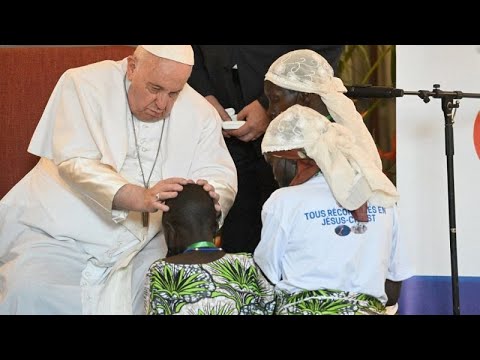
Francis is also due to meet victims of the conflict in eastern Congo in Kinshasa on Wednesday following the mega-mass.
After that, he will talk to representatives from charitable organisations.
The DRC’s east has long been plagued by dozens of armed groups. Since late 2021, M23 rebels have also captured swathes of territory in North Kivu province, coming close to its capital Goma.
The trip to DRC and South Sudan had originally been planned for July 2022, but it was postponed due to the pontiff’s knee pain that has forced him in recent months to use a wheelchair.
Security concerns were also said to play a role in delaying the trip, and a stop in Goma — a city of over a million people on the border with Rwanda — is no longer on the itinerary. “I would have liked to go to Goma too, but with the war, you can’t go there,” Francis told reporters on the plane from Rome.
The Argentine pontiff, in his speech in Kinshasa on Tuesday, urged the need to address the conflict and said he supported regional peace efforts.
Francis also underlined the need for investment in education, and free-and-fair elections, among other issues. On Friday, the pope travels to South Sudan’s capital Juba.
Huge crowds started to gather in Kinshasa well before dawn, including scores of schoolgirls dressed in white who danced along the Pope’s route.
A public holiday was declared, so as many people as possible could attend.
Around half of DR Congo’s population is Catholic – the largest Catholic community in Africa.
It is more than 37 years since a pope had visited the mineral-rich but conflict-ridden country.
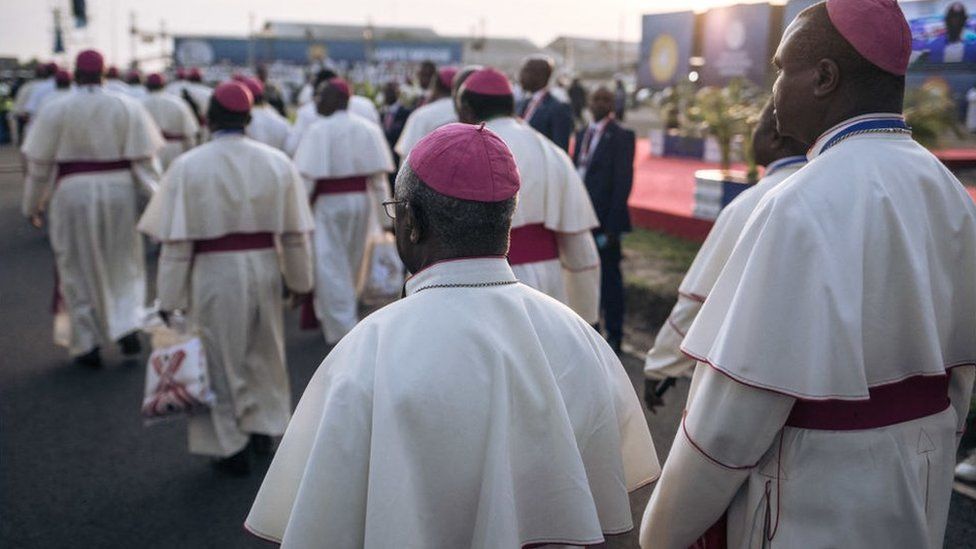
Image caption, Africa is considered the future of Catholicism, but some say it should have more representationImage caption, Many people gathered in the early hours of the morning to see the Pope
There had been some murmurings that the Pope has not been as critical of DR Congo’s political leadership as some had hoped, but the Mass at N’dole airport was a joyful event, and the pontiff did have a strong message of peace for those engaging in conflict in the country.
On the second of his six-day visit to Africa, he said warring sides should forgive one another and grant their opponents a “great amnesty of the heart”.
He went on to espouse the benefits of cleansing one’s heart of “anger and remorse, of every trace of resentment and hostility”.
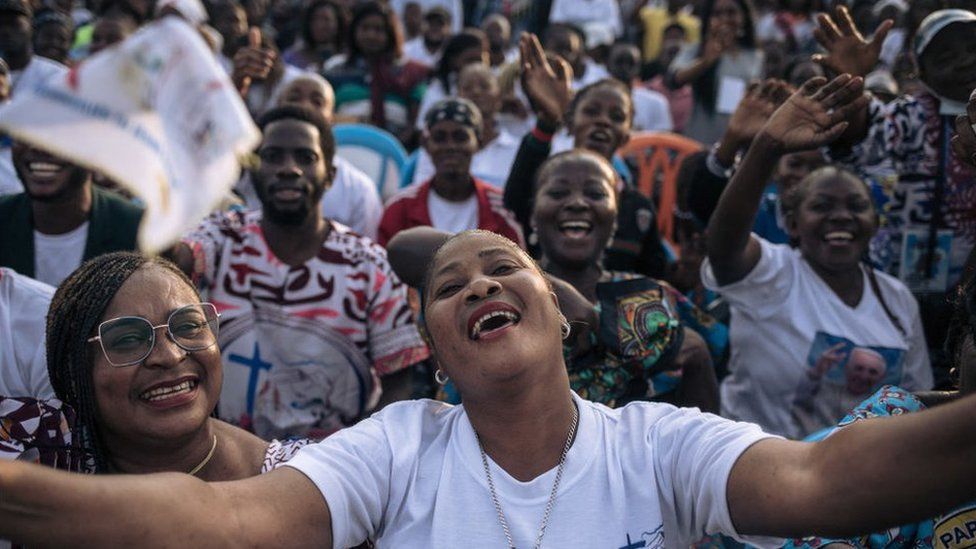
Image caption, It has been nearly four decades since a pope visited DR CongoImage caption, There were jubilant scenes in Kinshasa as the Pope delivered a message on forgiveness
Wednesday’s Mass was tipped to be one of Pope Francis’ largest-ever Masses, second only to one held in the Philippines in 2015, according to Christopher Lamb, the Rome correspondent of the Catholic magazine The Tablet.
In an interview with the BBC’s Newsday radio programme, he said Catholicism was growing in Africa: “This is the future of the church and the growth of the Catholic Church in Africa really is so important to the future of Catholicism.”
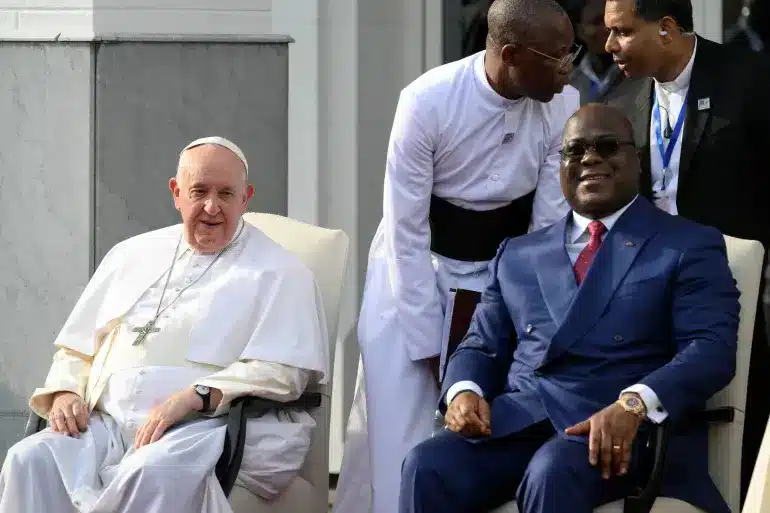
On Tuesday, the Pope met President Félix Tshisekedi and delivered a speech condemning historical exploitation of Africa’s resources, which he described as “economic colonialism”.
He also addressed DR Congo’s plight, as minerals have played a key role in more than three decades of armed conflict there: “Hands off the Democratic Republic of the Congo! Hands off Africa! Stop choking Africa, it is not a mine to be stripped or a terrain to be plundered.”
However, a planned visit to the eastern city of Goma has been cancelled for security reasons. The eastern part of DR Congo is facing escalating violence as security services fight against armed militia groups.
According to the United Nations, some six million people have been forced to flee their homes in DR Congo.
That is one of the largest populations of displaced people in the world, alongside places like Afghanistan, Yemen, Syria and Ukraine.
Most of the displaced are in the eastern provinces of South Kivu, North Kivu and Ituri.
Image caption, The Pope’s welcome to DR Congo has been described as vibrant
Pope Francis has celebrated one of his biggest masses, in Democratic Republic of Congo’s capital, Kinshasa.
It is more than 37 years since a pope visited the mineral-rich but conflict-ridden country.
Estimates say around a million gathered for the open-air mass at N’dole airport, on the second of the pontiff’s six-day visit to Africa.
Around half of DR Congo’s population is Catholic – the largest Catholic community in Africa.
Speaking at the mass, the Catholic leader called for peace in DR Congo, saying warring sides should forgive one another and grant their opponents a “great amnesty of the heart”.
He went on to espouse the benefits of cleansing one’s heart of “anger and remorse, of every trace of resentment and hostility”.
Wednesday’s mass was tipped to be one of the pope’s largest-ever masses, second only to one held in the Philippines in 2014, according to Christopher Lamb, the Rome correspondent of the Catholic magazine The Tablet.
Image caption,There were jubilant scenes in Kinshasa as the Pope delivered a message on forgiveness
In an interview with the BBC’s Newsday radio programme, he said Catholicism was growing in Africa: “This is the future of the church and the growth of the Catholic Church in Africa really is so important to the future of Catholicism.”
On Tuesday, the Pope met President Félix Tshisekedi and delivered a speech condemning historical exploitation of Africa’s resources, which he described as “economic colonialism”.
He also addressed DR Congo’s plight, as minerals have played a key role in more than three decades of armed conflict there: “Hands off the Democratic Republic of the Congo! Hands off Africa! Stop choking Africa, it is not a mine to be stripped or a terrain to be plundered.”
However, a planned visit to the eastern city of Goma has been cancelled for security reasons. The eastern part of DR Congo is facing escalating violence as security services fight against armed militia groups.
According to the United Nations, some six million people have been forced to flee their homes in DR Congo.
That is one of the largest populations of displaced people in the world, alongside places like Afghanistan, Yemen, Syria and Ukraine.
Most of the displaced are in the eastern provinces of South Kivu, North Kivu and Ituri.
Francis, 86, says that a “forgotten genocide” is happening in the DRC as he starts his journey through two African countries.
Pope Francis, who recently arrived in the Democratic Republic of the Congo as part of a trip to two African countries, has demanded that foreign nations stop stealing Africa’s natural resources for the “poison of their own greed.”
Since Pope John Paul II visited the Democratic Republic of the Congo in 1985, when it was still known as Zaire, Pope Francis, 86, is the first pope to make such a trip.
“Hands off the Democratic Republic of the Congo! Hands off Africa!” Francis said on Tuesday to applause in his opening speech to Congolese government authorities and the diplomatic corps in the garden of Kinshasa’s national palace.
Calling Congo’s vast mineral and natural wealth a “diamond of creation”, Francis demanded that foreign interests stop carving up the country for their own interests and acknowledge their role in the economic “enslavement” of the Congolese people.
“Stop choking Africa. It is not a mine to be stripped or a terrain to be plundered,” said history’s first Latin American pope, who has long railed at how wealthy countries have exploited the resources of poorer ones for their own profit.
Residents of Kinshasa welcome Pope Francis on his apostolic journey, in Kinshasa, the Democratic Republic of Congo, on January 31, 2023 [Justin Makangara/Reuters]
Francis pointed the finger at the role colonial powers such as Belgium played in the exploitation of Congo until the country, which is 80 times the size of Belgium, gained its independence in 1960. He also said neighbouring countries are playing a similar role today.
The 86-year-old didn’t identify Belgium or any neighbouring country by name, but he spared no word of condemnation, saying there was a “forgotten genocide” under way.
“The poison of greed has smeared its diamonds with blood,” Francis said.
“May the world acknowledge the catastrophic things that were done over the centuries to the detriment of the local peoples, and not forget this country and this continent.”
Pope Francis is welcomed by residents of Kinshasa on January 31, 2023 [Simone Risoluti/Vatican Media/Handout via Reuters]
Al Jazeera’s Malcolm Webb, reporting from Kinshasa, said hundreds if not thousands of people on the roads followed the pope’s motorcade on motorbikes to the presidential palace from the airport.
“The roads were lined up with church groups and schoolchildren from the many Catholic-run church schools run over here in Congo,” he added.
“The Catholic church runs about 60 percent of health and education services here … it’s what makes the Catholic Church such a significant institution here [in Congo],” Webb added.
About half of Congo’s population of 90 million are Roman Catholics.
The six-day trip, which also includes a stop in South Sudan, was originally scheduled for July 2022, but was postponed because of Francis’s knee problems, which were still so serious on Tuesday that he could not stand to greet journalists in the plane heading to Kinshasa and was forced to use a wheelchair on the ground.
Fighting in DRC
Francis was also supposed to have included a stop in Goma, in eastern Congo, but the surrounding North Kivu region has been plagued by intense fighting between government troops and the M23 rebel group, as well as attacks by fighters linked to the ISIL (ISIS) armed group.
The fighting has displaced some 5.7 million people, a fifth of them last year alone, according to the World Food Programme.
Congo accuses Rwanda of backing the M23 rebel group fighting government troops in the east. Rwanda denies this.
“As well as armed militias, foreign powers hungry for the minerals in our soil commit, with the direct and cowardly support of our neighbour Rwanda, cruel atrocities,” said Congolese President Felix Tshisekedi, speaking just before the pope on the same stage.
The pope said the Congolese people were fighting to preserve their territorial integrity “against deplorable attempts to fragment the country”. The pope did not name Rwanda in his address or take sides in the dispute.
Instead of travelling to Goma, Francis will meet with a delegation of people from the east who will travel to Kinshasa for a private encounter at the Vatican embassy on Wednesday.
The plan calls for them to participate in a ceremony in which they jointly commit to forgiving their assailants.
Marie Louise Wambale had to flee with almost nothing about ten years ago due to fighting between the M23 rebels and the DRC army in the country’s eastern region, and it took her years to rebuild her life.
She hoped, along with the majority of Catholics in the eastern DRC, that Pope Francis would bring a message of hope at a time when the rebels are posing their greatest threat to this region since 2012.
“Many people were disappointed because they wanted to welcome him to our home, for him to come here and live our suffering, to feel it with his own eyes,” she said. “We wanted him to live it because there are many people who have fled the war. There are pregnant mothers who gave birth in the camps in very bad conditions – many women and children are suffering.”
Now Wambale has been tasked with taking this message to the capital, Kinshasa, where she will be among the Congolese faithful chosen to meet Pope Francis.
His long-awaited visit to DRC and South Sudan this week comes after he postponed an earlier trip late last year that had originally included a stop in the volatile east for health reasons. Insecurity, though, has soared in the months since so the pope is limiting his visit to Kinshasa.
“It is clear to anybody that there is a danger. But the danger, I would say, even more than for the pope is for the people,” the Vatican’s ambassador to DRC, Archbishop Ettore Balestrero told The Associated Press news agency.
The security requirements to protect people at a papal mass would be hard under ordinary circumstances, but even more delicate in an already dangerous area like the east, he said.
An estimated two million Congolese are expected at the mass at Kinshasa airport on February 1, which he said would make it the largest crowd event in DRC’s recent history.
Fighting in the eastern DRC, which involves more than 120 armed groups, has simmered for years but spiked in late 2021 with the resurgence of the M23, which had been largely dormant for nearly a decade. The rebels have captured swaths of land and are accused by the United Nations and rights groups of committing atrocities against civilians.
The violence, which has displaced approximately half a million people, has triggered a diplomatic spat with neighbouring Rwanda. Kinshasa has accused Kigali of backing the M23, an allegation also made by UN experts and the European Union.
Rwanda denies backing the group, which continues to resist a concerted pushback from the Congolese military and a regional peacekeeping force.
The region is also increasingly grappling with violence linked to ISIL (ISIS) and al-Qaeda affiliates. Earlier this month, ISIL claimed responsibility for a bomb explosion at a church, which killed at least 14 people and injured dozens while they were praying.
In DRC, the Catholic church mediated rising tensions in 2016 after the government postponed elections, creating an agreement which led to the 2018 vote, said Katharina R Vogeli, founder of CapImpact, a peace-building organisation working in the Great Lakes region.
Religious advisers say people in countries with enormously entrenched problems need to be lifted out of a generational sense of dread and anxiety.
“It’s the message of eternal hope that transcends, which is what people need,” said Ferdinand von Habsburg-Lothringen, a peace-building expert and former adviser to the South Sudan Council of Churches.
“The church has enormous power,” he said. “Though they may not necessarily have political power, they have moral authority.”
Pope Francis has called homosexuality laws “unjust,” saying God loves his children exactly as they are, and has urged Catholic bishops who support the laws towelcome LGBTQ people into the church.
“Being homosexual isn’t a crime,” Francis said during an interview with the Associated Press on Tuesday.
He acknowledged Catholic bishops in some parts of the world support laws criminalising homosexuality or discriminate against the LGBTQ community – and referred to the issue in terms of “sin”.
But he attributed such attitudes to cultural backgrounds and said bishops in particular need to undergo a process of change to recognise the dignity of everyone.
“These bishops have to have a process of conversion,” he said, adding that they should apply “tenderness, please, as God has for each one of us”
Some 67 countries or jurisdictions worldwide criminalise consensual same-sex sexual activity, 11 of which can or do impose the death penalty, according to The Human Dignity Trust, which works to end such laws.
Experts say even where the laws are not enforced, they contribute to harassment, stigmatisation and violence against LGBTQ people.
In the US, more than a dozen states still have anti-sodomy laws on the books despite a 2003 Supreme Court ruling declaring them unconstitutional.
Gay rights advocates say the antiquated laws are used to harass homosexuals, and point to new legislation, such as the so-called “don’t say gay” law in Florida, which forbids instruction on sexual orientation and gender identity from nurseries through to school year four, as evidence of continued efforts to marginalise LGBTQ people.
The United Nations (UN) has repeatedly called for an end to laws criminalising homosexuality outright, saying they violate rights to privacy and freedom from discrimination and are a breach of countries’ obligations under international law to protect the human rights of all people, regardless of their sexual orientation or gender identity.
Being homosexual is not a crime. It’s not a crime. Yes, but it’s a sin. Fine, but first let’s distinguish between a sin and a crime. It’s also a sin to lack charity with one another.
Declaring such laws “unjust”, Francis said the Catholic Church can and should work to put an end to them.
“It must do this. It must do this,” he said.
Francis quoted the Catechism of the Catholic Church in saying gays must be welcomed and respected and should not be marginalised or discriminated against.
“We are all children of God and God loves us as we are and for the strength that each of us fights for our dignity,” Francis said, speaking from the Vatican hotel where he lives.
Such laws are common in Africa and the Middle East and date from British colonial times or are inspired by Islamic law.
Some Catholic bishops have strongly upheld them as consistent with Vatican teaching that considers homosexual activity “intrinsically disordered”, while others have called for them to be overturned as a violation of basic human dignity.
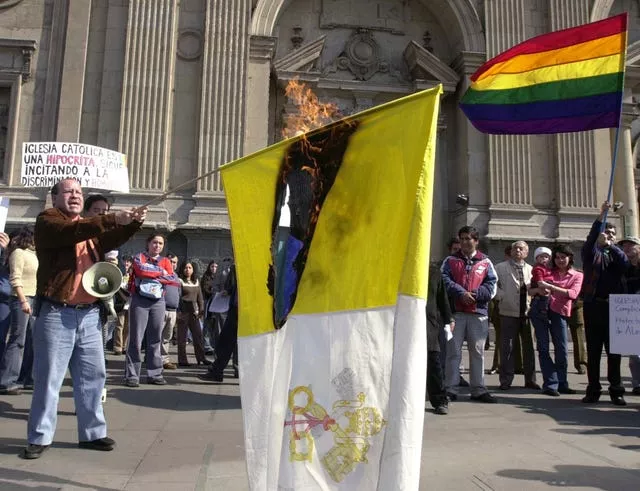
Rolando Jimenez, leader of a Chilean gay rights organisation, holds a flaming Vatican flag during a protest by gay activists against the Roman Catholic Church’s rejection of same-sex marriages, in front of a cathedral in Santiago, Chile, in 2003 (Santiago Llanquin/AP)
In 2019, Francis had been expected to issue a statement opposing criminalisation of homosexuality during a meeting with human rights groups that conducted research into the effects of such laws and so-called “conversion therapies”.
In the end, the pope did not meet with the groups, which instead met with the Vatican number two, who reaffirmed “the dignity of every human person and against every form of violence”.
On Tuesday, Francis said there needs to be a distinction between a crime and a sin with regard to homosexuality.
“Being homosexual is not a crime,” he said.
“It’s not a crime. Yes, but it’s a sin. Fine, but first let’s distinguish between a sin and a crime.”
“It’s also a sin to lack charity with one another,” he added.
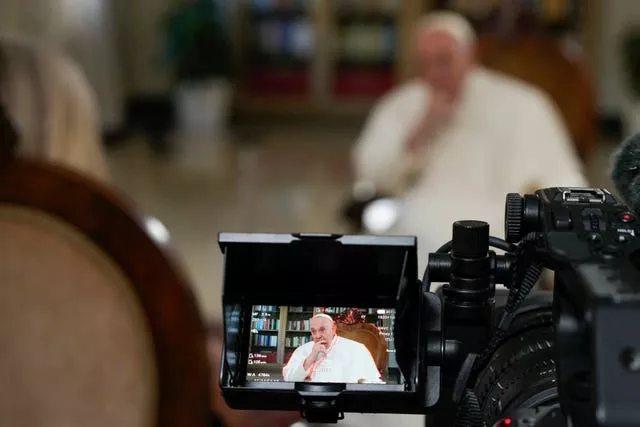
Pope Francis ponders a question during the interview (Andrew Medichini/AP)
Catholic teaching holds that while gay people must be treated with respect, homosexual acts are “intrinsically disordered”.
Francis has not changed that teaching but he has made reaching out to the LGBTQ community a hallmark of his papacy.
Starting with his famous 2013 declaration, “Who am I to judge?” when asked about a purportedly gay priest, Francis has gone on to minister repeatedly and publicly to the gay and trans community.
As archbishop of Buenos Aires, he favoured granting legal protections to same-sex couples as an alternative to endorsing gay marriage, which Catholic doctrine forbids.
Despite such outreach, Francis was criticised by the Catholic LGBTQ community for a 2021 decree from the Vatican’s doctrine office that the church cannot bless same-sex unions “because God cannot bless sin”.
The Vatican in 2008 declined to sign onto a UN declaration that called for the decriminalisation of homosexuality, complaining the text went beyond the original scope and also included language about “sexual orientation” and “gender identity” it found problematic.
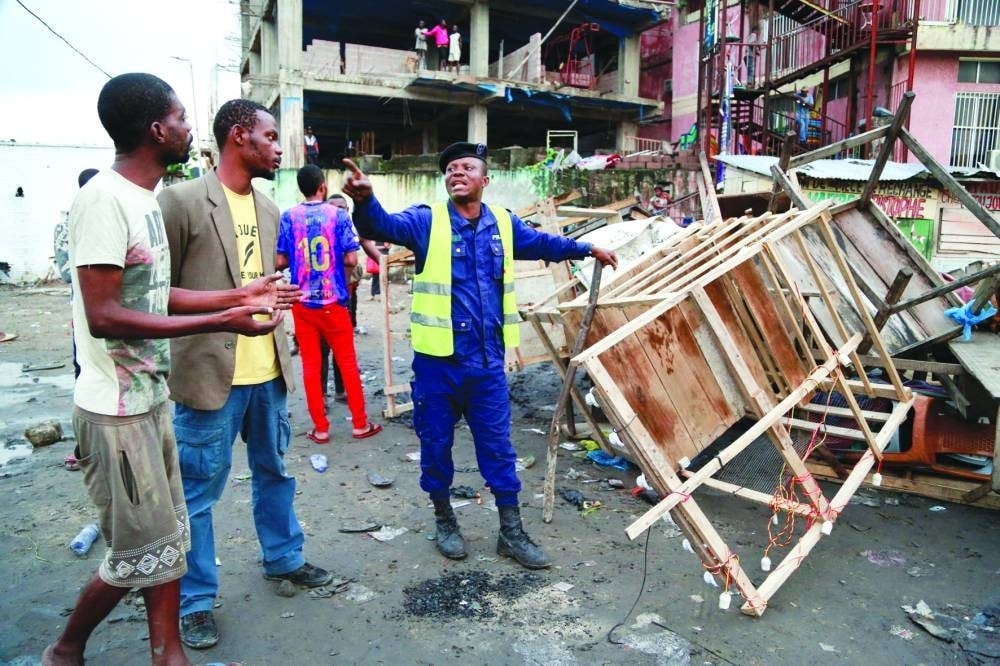
Sanitary police armed with crowbars and a bulldozer set about demolishing makeshift trader stalls crowding downtown streets in the capital of Democratic Republic of Congo ahead of a four-day visit by Pope Francis starting Jan. 31
Standing to one side with a swollen face after he fell while scuffling with police in an unsuccessful effort to save his wares, telephone accessories seller David Mbemba, 19, said he had lost around 100,500 DRC francs ($50) worth of goods.
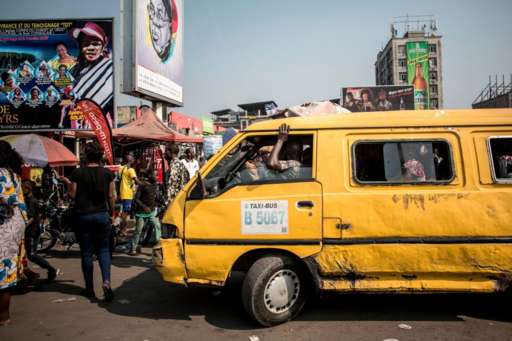
Officials say Kinshasa, a vast impoverished city of 17 million people, is getting a facelift not just to honour the pope but to make its streets and pavements more tidy and orderly even after he’s gone home. But evicted small traders protest that their livelihoods are being destroyed in the process.
The livelihoods of many families in Congo depend on the so-called informal sector of the economy – street stalls, kiosks and hawkers selling a cornucopia of items including food and other basic household goods.
“I am a widow. I have to pay my rent, school fees of my children…I will now starve to death,” said Marth Kayunga, a vendor in the informal market on one of the side streets off Lumumba Boulevard targeted by the sanitary police brigade.
“We knew this operation was to clean up Lumumba Boulevard ahead of the Pope’s visit that we are all waiting for,” said Jesus, a hardware shop owner who gave only his first name.
Lumumba Boulevard is the main thoroughfare leading to the airport, where a gala welcome will be staged for Pope Francis. Authorities had warned that development works would be carried out on sites where the Pope will be received.
“We are surprised the police are coming into the smaller streets because they told us they were just going to remove debris from the main avenue. It’s not fair,” Jesus said, adding that his shop was also torn down.
A spokesperson for the police said only that they were working under the directives of Kinshasa’s regional governor and city authorities such as Ya Lala, who was with the police on the ground directing the operation.
“The clean-up we are doing just now is not only because the Pope is coming,” George Ya Lala, Kinshasa city coordinator for the campaign said, adding the operation would continue even after the Pope went home.
Other sellers like Jean Mbuyu said they had lost everything because they had no prior warning of the clean-up.
Ya Lala disputed this, saying traders had been warned several times to relocate before the police moved in, leaving a chaotic trail of wreckage as they smashed stall after stall, with crowds of traders, family and friends watching in dismay.
Asked for comment on the evictions of traders, the Apostolic Nunciature, Vatican’s diplomatic representation in Kinshasa, told Reuters in a text message that it was not aware of the clean-up operations and had no part in them.
It said the Vatican had only requested that preparations for Francis’s visit be done “in the most sober way. We obviously want the reception sites to be able to accommodate the greatest number of faithful in a secure way and for roads to be secure.”
Market traders in the capital of the Democratic Republic of Congo have expressed dismay at being forced to dismantle their stalls ahead of a visit by Pope Francis.
Officials in Kinshasa say they’re making the streets clean and tidy in time for the Pope’s arrival at the end of the month.
Some traders complained that the police – using crowbars and bulldozers – had been heavy-handed. They also said many people had lost all their goods.
The affected streets include Lumumba Boulevard, the main thoroughfare from the airport, on which a gala welcome will be staged for Pope Francis.
But hawkers are angry that they’re also being forced out of the side streets around the city centre.
Beginning on Monday, the streets of Kinshasa, the capital of the Democratic Republic of the Congo, will undergo renovations in preparation for Pope Francis’ visit at the end of the month.
The main city center will be cleaned up, according to Kinshasa Governor Gentiny Ngobila, and street vendors and abandoned vehicles will be removed from roads leading to the airport.
More than 120 people died as a result of the city’s worst floods in years last month.
This is the first time that the city of at least 14 million residents will be hosting Pope Francis.
A previous pope, the late John Paul II, visited the country twice, in 1980 and 1985, during the rule of former strongman Mobutu Sese Seko.
Catholics make up the majority of the country’s population.
In order to preside over the burial of his predecessor, who resigned from the papacy in 2013, Pope Francis has joined pilgrims in St. Peter’s Square.
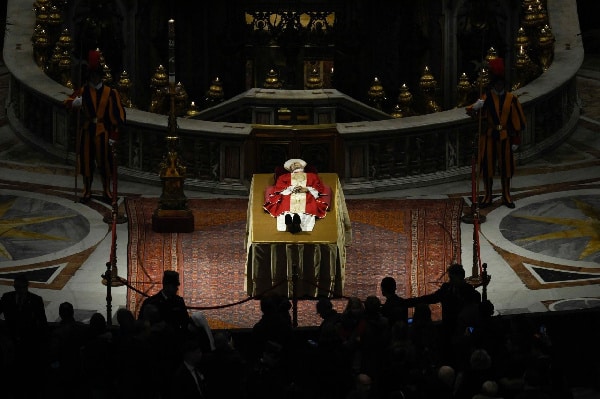
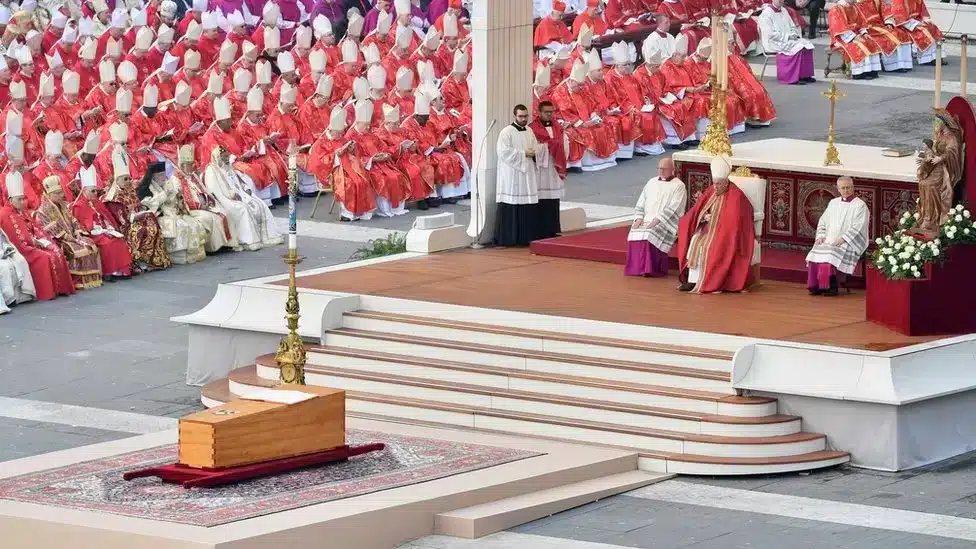
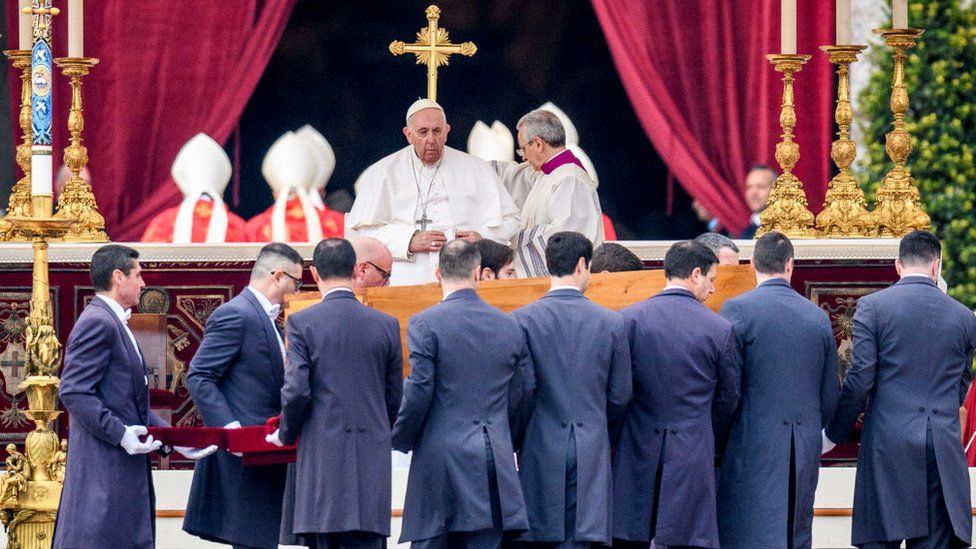
The dome of St Peter’s basilica at the Vatican was shrouded in mist as the cypress-wood coffin containing Pope Benedict XVI’s body was brought out and placed on the steps.
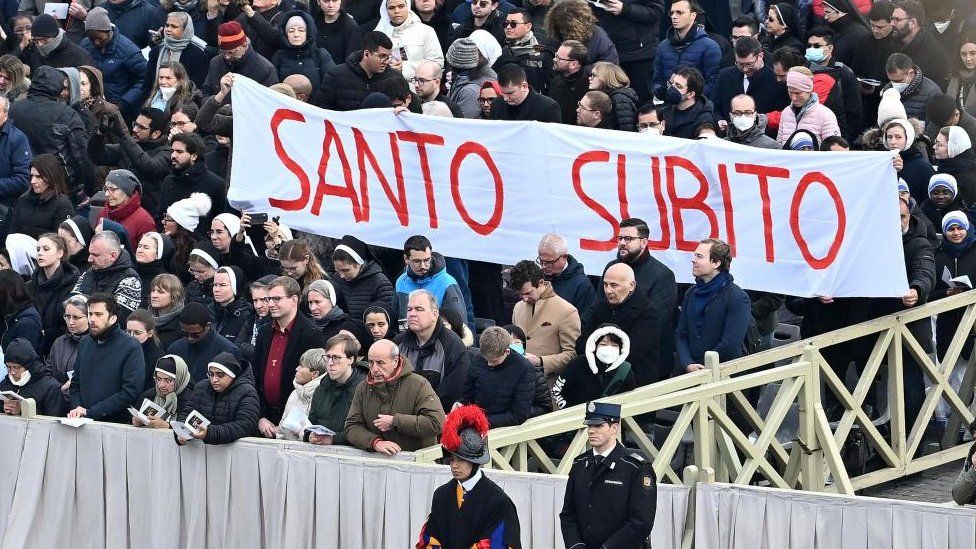
There was applause from the faithful who had gathered for the funeral.
Benedict was then interred in a tomb beneath the basilica.
Clergy from around the world had come – cardinals in red vestments, nuns and monks in their dark robes.
Pope Francis was brought out on to the dais in a wheelchair.
Latin chants sung by the Sistine Chapel choir echoed across the square. The mood was solemn and subdued.
Daniele, a teacher, who had met the former pontiff at a church in Rome, told me the weather matched the occasion. “The fog represents the mystery of Pope Benedict, the mystery of death and life. I feel very happy and emotional to be in St Peter’s Square.”
The pope was “an important voice in the church”, Daniele said.
During the Mass, concelebrated by cardinals, bishops and priests, Pope Francis spoke of “wisdom, tenderness and devotion that he bestowed upon us over the years”.
“Benedict, faithful friend of the Bridegroom,” he said referring to Jesus, “may your joy be complete as you hear his voice, now and forever.”
Some 50,000 mourners came to the funeral, according to police. Official delegations were there from Italy and from former Pope Benedict’s home country of Germany. Other leaders, including the king and queen of Belgium attended in a private capacity.
Benedict’s death brings to an end the era of a pope and a former pope living side by side in the Vatican – an unprecedented situation brought about by Benedict’s resignation almost a decade ago.
Pope Francis has joined pilgrims in St. Peter’s Square to preside over the funeral of his predecessor, Pope Benedict XVI, who resigned as Pope in 2013.
As the cypress-wood coffin containing Pope Benedict XVI’s body was brought out and placed on the steps of St Peter’s Basilica in the Vatican, the dome was shrouded in mist.
The congregation that had gathered for the funeral applauded.
Benedict was then buried beneath the basilica in a tomb.
Clergy from around the world had come—cardinals in red vestments, nuns, and monks in their dark robes.
Pope Francis was brought out onto the dais in a wheelchair.
Latin chants sung by the Sistine Chapel choir echoed across the square. The mood was solemn and subdued.
Daniele, a teacher who had met the former pontiff at a church in Rome, told me the weather matched the occasion. “The fog represents the mystery of Pope Benedict, the mystery of death and life. I feel very happy and emotional to be in St. Peter’s Square.”
The pope was “an important voice in the church”, Daniele said.
During the Mass, concelebrated by cardinals, bishops, and priests, Pope Francis spoke of “wisdom, tenderness, and devotion that he has bestowed upon us over the years”.
“Benedict, faithful friend of the Bridegroom,” he said referring to Jesus, “may your joy be complete as you hear his voice, now and forever.”
Some 50,000 mourners came to the funeral, according to police. Official delegations were there from Italy and from former Pope Benedict’s home country of Germany. Other leaders, including the king and queen of Belgium attended in a private capacity.
Benedict’s death brings to an end the era of a pope and a former pope living side by side in the Vatican – an unprecedented situation brought about by Benedict’s resignation almost a decade ago.
In February 2013, I stood watching in St Peter’s Square as he flew away from the Vatican in a helicopter, at the end of his pontificate.
The ceremonies surrounding his death have been simpler than those for a sitting pope.
Over the past few days, some 200,000 people came to the Vatican to pay their respects to the former pontiff, as he lay in state in front of the main altar in St Peter’s Basilica.
On the day before the funeral, I joined the long line of visitors and mourners queuing to view his body. Dressed in red and gold vestments, he had a rosary clasped in his white, waxy hands.
There was no display of usual papal regalia like the silver staff, a sign that he was no longer Pope when he died.
But in line with tradition, a lead tube containing an account of Benedict’s papacy, as well as other items, including Vatican coins minted during his reign, were placed in the coffin.
At the end of the service, the choir sang, “May the angels lead you into paradise.” Pope Francis placed his hand on the wooden coffin in a final prayer, before it was carried away, to be sealed and placed in another coffin made of zinc with an outer one of wood.
It was buried in the crypt under St Peter’s Basilica, where Pope John Paul II was originally interred in 2005 before his body was moved up to a chapel, after his beatification.
While many leading figures have praised Benedict since his death – paying tribute to his theological studies – there has also been criticism, particularly by victims of sexual abuse by Catholic clergy.
The Snap Survivors network said the former pope “virtually ignored the burning problem of clergy sexual abuse during his tenure in office”.
“In his more than 25 years as the world’s most influential religious figure,Pope Benedict XVI fell short in protecting children and adults around the world.”
In St Peter’s Square, feelings about the former pope were mixed. Gaia from Sardinia said that while Benedict had been “a very good pope, I prefer Pope Francis. I think that he’s closer to people in 2023”.
Simona from Monza in northern Italy told me she was concerned that Francis might follow Benedict’s example and retire.
“I’m worried that he is sick,” she said. “And I really do hope that he still has the strength to keep the Church united and to go on and give hope to this world.”
Christopher Lamb, Vatican correspondent of the Catholic magazine The Tablet, said Francis now faced a new moment in his pontificate, but he expected him to continue his pace of reform within the Church.
“The death of Benedict does leave it open for Francis to step down if he wishes, but I wouldn’t bet on it because this Pope really has a lot to accomplish in terms of reforms.”
Pope Francis has said the world is suffering from a “famine of peace”, in his annual Christmas Day message from the Vatican.
He called for a end to the “senseless war” in Ukraine, condemning what he said was the use of “food as a weapon” of war.
Ukraine shipped about 30% of the world’s wheat and prices have jumped since the Russian invasion in February.
It was Pope Francis’ 10th Christmas Day address since he assumed the papacy.
While the war in Ukraine occupied much of his 10-minute speech, he spoke of “a grave famine of peace also in other regions and other theatres of this Third World War”.
He singled out conflicts and humanitarian crises in the Middle East, Myanmar, Haiti, and the Sahel region of Africa.
The pontiff also prayed for “reconciliation” in Iran, where mass anti-government protests have swept the country for more than three months. The protests there have been met by a crackdown, with more than 500 people, including 69 children, killed, human rights groups say.
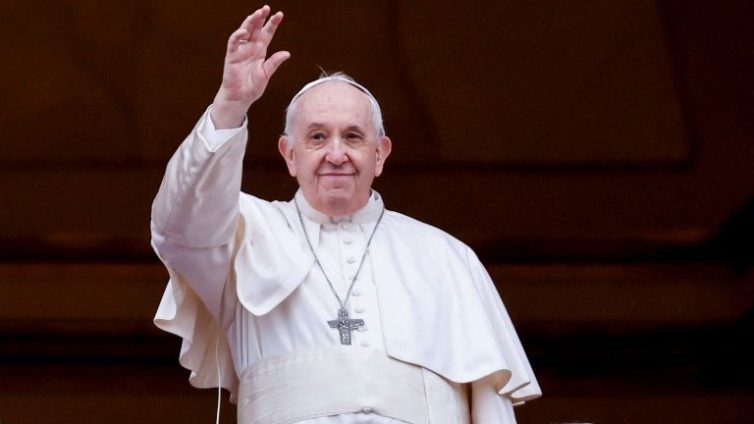
Speaking from a balcony at the basilica overlooking St Peter’s Square, the 86-year-old Pope lamented the human cost of war. He urged not to forget those “who go hungry while huge amounts of food daily go to waste and resources are being spent on weapons”.
“The war in Ukraine has further aggravated this situation, putting entire peoples at risk of famine, especially in Afghanistan and in the countries of the Horn of Africa,” he said.
“We know that every war causes hunger and exploits food as a weapon, hindering its distribution to people already suffering.”
The Pope said “those who hold political responsibilities” should lead the way to make food “solely an instrument of peace”.
His message was followed by the customary Urbi et Orbi (To the City and to the World) blessing, recited in Latin and traditionally in many other languages as well.
Pope Francis has said the world is suffering from a “famine of peace”, in his annual Christmas Day message from the Vatican.
He called for an end to the “senseless war” in Ukraine, condemning what he said was the use of “food as a weapon” of war.
Ukraine shipped about 30% of the world’s wheat and prices have jumped since the Russian invasion in February.
It was Pope Francis’ 10th Christmas Day address since he assumed the papacy.
While the war in Ukraine occupied much of his 10-minute speech, he remarked that “a grave famine of peace also in other regions and other theatres of this Third World War”.
He singled out conflicts and humanitarian crises in the Middle East, Myanmar, Haiti, and the Sahel region of Africa.
The pontiff also prayed for “reconciliation” in Iran, where mass anti-government protests have swept the country for more than three months. The protests there have been met by a crackdown, with more than 500 people, including 69 children, killed, human rights groups say.
Speaking from a balcony at the basilica overlooking St Peter’s Square, the 86-year-old Pope lamented the human cost of war. He urged not to forget those “who go hungry while huge amounts of food daily go to waste and resources are being spent on weapons”.
“The war in Ukraine has further aggravated this situation, putting entire peoples at risk of famine, especially in Afghanistan and in the countries of the Horn of Africa,” he said.
“We know that every war causes hunger and exploits food as a weapon, hindering its distribution to people already suffering.”
The Pope said “those who hold political responsibilities” should lead the way to make food “solely an instrument of peace”.
His message was followed by the customary Urbi et Orbi (To the City and to the World) blessing, recited in Latin and traditionally in many other languages as well.
Congolesegynecologist Denis Mukwege will visit Pope Francis on Friday at the Vatican.
Denis Mukwege is known as “Dr Miracle” for his ability to repair through reconstructive surgery the damage inflicted on women who have been raped.
He was jointly awarded the Nobel Peace Prize in 2018 for his work.
The Popeis scheduled to visit Democratic Republic of Congo in late January 2023, after a previously planned visit was cancelled mid this year.
Dr Mukwege met the Pope three years ago and later told journalists that: “I met with Pope Francis to share my vision for a world where rape is no longer used as a weapon of war.”
The exact agenda of today’s meeting is not known.
Since 1996, the DR Congo has been engulfed in a string of conflicts that have claimed the lives of at least six million people.
Pope Francis told an interfaith summit that religion should never be used to justify violence and urged faith leaders to oppose war leaders’ “childish” whims.
Speaking at an East-West dialogue conference in Bahrain, the head of the Catholic Church warned that the world was on the “brink of a delicate precipice” and warned of a new race to rearm that was redesigning Cold War-era spheres of influence.
Apparently referring to Ukraine, Francis condemned a situation where “a few potentates are caught up in a resolute struggle for partisan interests, reviving obsolete rhetoric, redesigning spheres of influence and opposing blocs”.
“We appear to be witnessing a dramatic and childlike scenario: In the garden of humanity, instead of cultivating our surroundings, we are playing instead with fire, missiles and bombs, weapons that bring sorrow and death, covering our common home with ashes and hatred,” he said.
The Russian Orthodox Church, which sent an envoy to the conference, has strongly supported the Kremlin in its war and justified it on religious grounds.
Pope Francis has warned priests and nuns against watching pornography, and has asked them to delete such materials from their phones.
According to the leader of the Roman Catholic Church, entertaining pornographic scenes “weakens the priestly heart” and keeps the Holy Spirit away from the believer.
The 86-year-old sent out the warning in the Vatican while responding to a question about how digital and social media should be properly utilize.
According to the news outlet, the Pope told priests and seminarians that “the devil enters from” watching porn, hence the need to stay away from it.
“…a vice that so many people have… even priests and nun,” the Pope lamented. “The pure heart, the one that Jesus receives every day, cannot receive this pornographic information.”
“…delete this from your phone, so you will not have temptation in hand,” the BBC said.
Pope Francis proceeded to advise priests and seminarians to use for useful purposes, and should not exhaust their time on it.
Not all men of God have the tedency to overcome temptation, so the Pope’s warning is a step in the right direction.
In 2018, a reverend father was put under house arrest while criminal proceedings were initiated against him after he allegedly raped an 11-year-old girl in a car, claiming he “thought she was at least 15 years old”.
Reports at the time indicated that the suspect, Father Paolo Glaentzer, a septuagenarian, was arrested in July of that year in connection with the crime.
The Italian man of God did not deny having sexual intercourse with the victim, but said it was “an exchange of affection” between him and the girl, who, according to him, looked “much more mature than she was”.
“I found out she was 11 years old… I thought she was at least 15,” he cried.
He blamed his conduct on the devil after finding himself on the wrong side of the Italian laws, which recognised age 16 as the legal age for consent to sex.
Head of the Catholic Church, Pope Francis, has entreated priests and nuns to desist from watching pornography.
He has also asked them to delete such materials from their phones.
The BBC, the 86-year-old sounded the word of warning at a session in the Vatican while responding to a question about how digital and social media should be best used.
According to the news outlet, the Pope told priests and seminarians that “the devil enters from” watching porn, hence the need to stay away from it.
“…a vice that so many people have… even priests and nun,” the Pope lamented. “The pure heart, the one that Jesus receives every day, cannot receive this pornographic information.”
“…delete this from your phone, so you will not have temptation in hand.”
Pope Francis went further to advise priests and seminarians to use social media for good purposes, but not waste too much of their time on it.
Not all men of God have the ability to overcome temptation, so the Pope’s warning is not out of place.
In 2018, a reverend father was put under house arrest while criminal proceedings were initiated against him after he allegedly raped an 11-year-old girl in a car, claiming he “thought she was at least 15 years old”.
Reports at the time indicated that the suspect, Father Paolo Glaentzer, a septuagenarian, was arrested in July of that year in connection with the crime.
The Italian man of God did not deny having sexual intercourse with the victim, but said it was “an exchange of affection” between him and the girl, who, according to him, looked “much more mature than she was”.
“I found out she was 11 years old… I thought she was at least 15,” he cried.
He blamed his conduct on the devil after finding himself on the wrong side of the Italian laws, which recognised age 16 as the legal age for consent to sex.
The Vatican says Pope Francis will not be present at the Queen’s funeral on Monday.
The de facto foreign minister for the Pope will take his seat.
The Vatican says in a statement: “The Most Reverend Paul Gallagher, secretary for relations with states and international organizations, will represent Pope Francis at the funeral of Her Majesty Queen Elizabeth II.
“Over recent months the Pope has suffered ongoing knee trouble that hasimpacted his mobility. On a July trip to Canada, he spent much of his visit in a wheelchair.
Speaking at his weekly general audience, the pontiff said: “I hope that concrete steps will be taken to bring an end to the war and to avert the risk of a nuclear disaster at Zaporizhzhia.”
The religious leader also condemned wars as “madness” and referred to the death of Darya Dugina, the daughter of prominent Russian ultra-nationalist Alexander Dugin, who was killed in a car bombing near Moscow on Saturday.
“Innocents pay for war, innocents,” he said.
On Tuesday, the International Atomic Energy Agency (IAEA) said it would visit the Russian-occupied Zaporizhzhia nuclear power plant within days if talks to gain access succeed.
Russia and Ukraine have repeatedly accused each other of firing at the facility, the largest of its kind in Europe, after Russian forces seized control of the plant earlier this year.
Pope Francis has spoken of his “sorrow, indignation and shame” over the Catholic Church‘s role in the abuse of Canadian Indigenous children in residential schools, as he kicked off a weeklong “penitential pilgrimage” to the country.
The Pope apologized and promised a “serious investigation” into what happened in a speech at a meeting with Indigenous peoples in Edmonton, Alberta, on Monday.
Indigenous leaders have long called for a papal apology for the harm inflicted for decades on Indigenous children, who suffered abuse and the erasure of Indigenous culture in the country’s residential schools.
“I ask forgiveness, in particular, for the ways in which many members of the Church and of religious communities cooperated, not least through their indifference, in projects of cultural destruction and forced assimilation promoted by the governments of that time, which culminated in the system of residential schools,” the pontiff said.
Last year, hundreds of unmarked graves were discovered on the grounds of former residential schools in British Columbia and Saskatchewan.
And Canada’s Truth and Reconciliation Commission has reported that more than 4,000 Indigenous children died either from neglect or abuse in residential schools, many of which were run by the Catholic Church.
“In the face of this deplorable evil, the Church kneels before God and implores his forgiveness for the sins of her children,” said the Pope. “I humbly beg forgiveness for the evil committed by so many Christians against the Indigenous peoples.”
And the pontiff underlined that his apology is just the first step in righting these wrongs.
“An important part of this process will be to conduct a serious investigation into the facts of what took place in the past and to assist the survivors of the residential schools to experience healing from the traumas they suffered,” he said.
The Pope will also travel to Quebec and Iqaluit, capital of the Canadian territory of Nunavut, during the trip. Two Canadian cardinals will accompany him throughout his visit, Cardinal Marc Ouellet and Cardinal Michael Czerny.
Francis, 85, had a trip to Africa earlier this month canceled due to issues with his knee.
CNN’s Rob Picheta, Livia Borghese and Cecilia Armstrong contributed to this report.
The Pope is making a historic visit to offer a formal apology on Canadian soil for the harms done by Catholic-run residential schools across the country.
Pope Francis, 85, has called the visit a “pilgrimage of penance”, and has said he hopes it will help heal the wrongs done to indigenous people in Canada by the Roman Catholic Church.
His itinerary includes stops in the provinces of Alberta and Quebec and the northern territory of Nunavut.
Absent from the Pope’s visit, however, is a stop in British Columbia, where the discovery last summer of evidence of some 200 unmarked graves on the grounds of a former residential school led to nationwide calls for reconciliation.
The Pope will be in Canada until Friday.
Why is the Pope visiting?
Canada has grappled with the path to reconciliation – repairing the relationship between indigenous people, non-indigenous people and the government – in recent years.
In 2015, abuses suffered by residential school survivors were highlighted in a landmark report by Canada’s Truth and Reconciliation Commission (TRC).
The government-funded schools were part of a policy meant to assimilate indigenous children and destroy indigenous cultures and languages.
The Roman Catholic Church operated up to 70% of residential schools. There were more than 130 such schools scattered across the country, the last closing in 1996.
The TRC report highlighted the stories of school survivors. Many were subjected to abuse, illness and malnutrition and the TRC called the residential schools system a central element of a policy of “cultural genocide”.
One of the report’s “Calls to action” was a request for the Pope to apologise for the Catholic Church’s role in running the schools.
The discovery received international attention and sent shockwaves across Canada.
Other First Nations began conducting similar searches near the sites of residential schools and, to date, evidence of over 1,000 graves has been found.
These findings intensified calls from indigenous leaders for a formal apology from the Pope.
In April, he apologised to an indigenous delegation who had travelled to the Vatican, saying the residential schools caused him “pain and shame”.
He promised to meet indigenous communities in Canada and to assist with reconciliation efforts.
What is the Pope’s schedule in Canada?
A mix of public events and private meetings make up the bulk of the Pope’s itinerary.
The pontiff’s first stop is in Alberta, where he will visit the former site of Ermineskin Indian Residential School – one of the largest in Canada – in Maskwacis, a First Nations community south of the city of Edmonton.
“For survivors from coast-to-coast, this is an opportunity – the first and maybe last – to perhaps find some closure for themselves and their families,” Chief Randy Ermineskin said in a statement.
“This will be a difficult process but a necessary one.”
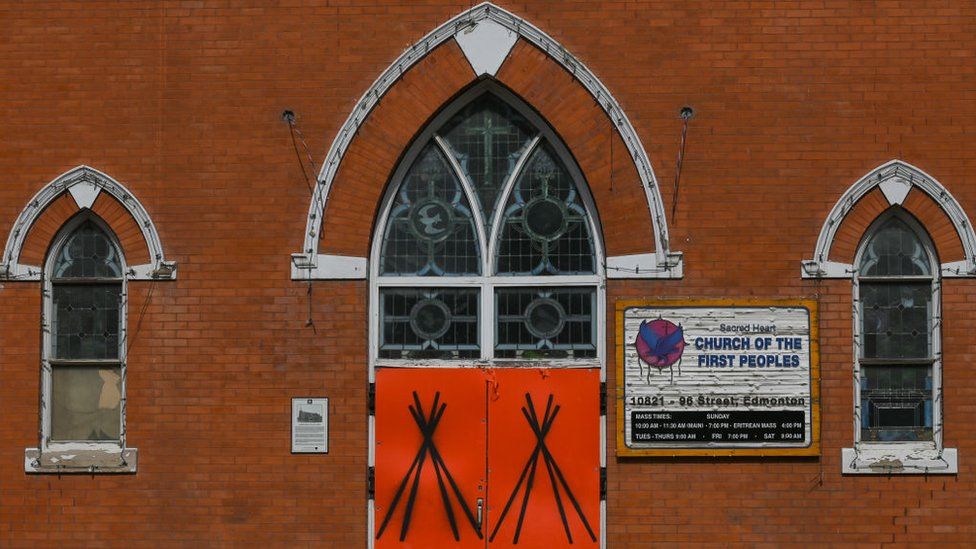
In Edmonton, the Pope will attend Mass and visit the Sacred Heart Church of the First Peoples, the first national parish for indigenous peoples in Canada.
On Wednesday, he will deliver a public address in Quebec City following a meeting with Prime Minister Justin Trudeau and Governor General Mary Simon, the first indigenous person to hold that position.
Pope Francis will celebrate Mass the following day in Sainte-Anne-de-Beaupre, a pilgrimage site for Roman Catholics on the Saint Lawrence River, with 15,000 guests expected to be in attendance.
The Pope’s visit will end with a flight to Iqaluit in Canada’s northern territory of Nunavut, where he is expected to speak privately with residential school survivors and attend a public community event.
A ‘significant’ visit after decades of activism
Canada’s indigenous leaders welcomed the Pope’s apology in Rome, but many hope the pontiff will now expand on his historic remarks.
Crystal Gail Fraser, a Gwichyà Gwich’in assistant professor of history and native studies at the University of Alberta, said the Pope’s visit was “significant”, and followed decades of activism and calls for accountability from indigenous communities.
The discovery of the unmarked graves, she added, is a big reason why the trip is happening now.
Ms Fraser, who also sits on the governing circle of Canada’s National Centre for Truth and Reconciliation, said she will be looking for more than just an apology from Pope Francis.
“Like many other times in Canadian history, we have seen apologies come and go,” Ms Fraser said. “So for me, I’m going to be looking for the actions of the Catholic Church next.”
This includes compensation for survivors and releasing documents about former staff and clergy who operated the schools, she said.
“We’re still in the pursuit of truth,” Ms Fraser said.
Some indigenous leaders want the Catholic Church to renounce a doctrine issued as a series of papal bulls – official documents issued by the Pope – and dating from the 1400s, saying it was used as “legal and moral justification for colonial dispossession” of indigenous people.
The Union of BC Indian Chiefs accused the Pope of showing “blatant disregard” for meaningful acknowledgement of harms done in residential schools.
But given the Pope’s “advanced age and the size of Canada”, the Canadian Conference of Catholic Bishops, tasked with planning his visit, said it focused on “a targeted group of communities” despite several requests to visit sites across the country.
Pope Francis has recently faced health issues, and has been using a wheelchair since May. Ongoing problems with his knee forced him to cancel a recent trip to Africa.
Italian news agencies report that previously conjoined twins have been baptised by Pope Francis in the Vatican City.
Ervina and Prefina, whose skulls were fused together, underwent surgery there last month.
Their mother Ermine Nzotto is from the Central African Republic (CAR). Soon after the operation, she told local media she was keen for the Pope to baptise her daughters because “he has always taken care of the children of Bangui”.
A photo taken at Friday’s ceremony has been shared by former CAR minister Antoinette Montaigne:
Pope Francis called on Saturday for a “more just and equitable society” in the post-coronavirus world, and for people to act to “end the pandemic of poverty”.
“Once we emerge from this pandemic, we will not be able to keep doing what we were doing, and as we were doing it. No, everything will be different,” he said, speaking in Spanish in a video message to mark the feast of Pentecost.
“From the great trials of humanity — among them this pandemic — one emerges better or worse. You don’t emerge the same. I ask this of you: how do you want to come out of it? Better or worse?” he added.
People needed to open their minds and hearts to learn the central lesson from this crisis: “We are one humanity,” said the pope.
“We know it, we knew it, but this pandemic that we are living through has made us experience it in a much more dramatic way,” he added.
Now there was a duty to build a new reality particularly for the poorest, who had been discarded, the pope said.
“All the suffering will be of no use if we do not build together a more just, more equitable, more Christian society, not in name but in reality,” he added.
Pope Francis called on Sunday for an all-embracing vision of the world after the COVID-19 crisis, saying moving on without global solidarity or excluding sectors of society from the recovery would result in “an even worse virusâ€.
The pope left the Vatican for the first time in more than a month to say Mass in an almost empty church a few blocks away to mark Divine Mercy Sunday.
In his homily at the Mass, as well as in his traditional Sunday message afterward, Francis said the recovery could not leave anyone behind and that now was the time to heal injustice around the world because it undermined the health of the entire human family.
“Now, while we are looking forward to a slow and arduous recovery from the pandemic, there is a danger that we will forget those who are left behind,†Francis said in his homily in the church of Santo Spirito in Sassia, chosen because it is also known as the Sanctuary of Divine Mercy.
“The risk is that we may then be struck by an even worse virus, that of selfish indifference. A virus spread by the
thought that life is better if it is better for me, and that everything will be fine if it is fine for me,†he said.
Francis, who last ventured into a deserted Rome on March 15 to pray at two shrines for the end of the pandemic, said the recovery should not sacrifice “those left behind on the altar of progressâ€, particularly the poor.
More than 23,000 people have died from the novel coronavirus in Italy and the Vatican has mirrored the nearly six-week-old lockdown in the country, forcing the pope to hold all his Masses and general audiences without the public.
In his homily, Francis said the pandemic “reminds us that there are no differences or borders between those who sufferâ€.
In his noon message immediately after the Mass, he called for “just sharing among nations and their institutions in order to confront the current crisis in a manner marked by solidarityâ€.
Pope Francis has accepted the resignation of a French cardinal who failed to report an alleged paedophile priest, the Catholic Church in Lyon said Friday.
Archbishop of Lyon Philippe Barbarin is the most senior French priest to be caught up in a global paedophilia scandal that has seen clergy hauled before courts from Argentina to Australia.
Barbarin, 69, a staunch conservative who became archbishop of the French city in 2002, has long been accused by victims’ groups of turning a blind eye to decades of child abuse in his diocese that blighted many lives.
He was convicted last year of not reporting a priest for allegedly abused dozens of boy scouts in the 1980s and 1990s — but the conviction was overturned on appeal in January.
Appeals judges said Barbarin should have reported the priest but found that he could not be held criminally liable because the incidents happened too long ago.
Hours after the ruling, Barbarin announced he would offer his resignation to the pope, who had refused an initial request pending the outcome of the appeal. This time, the pope accepted his offer.
Bernard Preynat, the priest he was initially convicted of protecting, has been defrocked and is awaiting a ruling on March 16 in a sex-abuse trial.
Preynat confessed at trial in January to “caresses” he knew were forbidden and admitted he got sexual pleasure from acts with boy scouts at camps he supervised.
‘Seriously objectionable’
Barbarin was initially given a six-month suspended sentence last March after he failed to report Preynat despite being told of alleged abuse on two occasions — by the priest himself in 2010 and four years later by an alleged victim.
The cardinal said on Friday the last four years had been ones of “great, great suffering” for him, telling KTO Catholic TV channel: “I think there is a great deal of suffering that the victims bore first, and it is really for them that we must pray.
“These were terrible acts and it is important that a page be turned.”
Barbarin’s eventual trial came largely because a group of victims campaigned for an investigation.
The appeals judges said it was “seriously objectionable from a moral point of view” that Preynat had been allowed to remain in contact with children for five years after he confessed the abuse to Barbarin.
Pope Francis has admitted that clerics have sexually abused nuns, and in one case they were kept as sex slaves.
He said in that case his predecessor, Pope Benedict, was forced to shut down an entire congregation of nuns who were being abused by priests.
It is thought to be the first time that Pope Francis has acknowledged the sexual abuse of nuns by the clergy.
He said the Church was attempting to address the problem but said it was “still going on”.
Last November, the Catholic Church’s global organisation for nuns denounced the “culture of silence and secrecy” that prevented them from speaking out.
The Pope’s comments come amid long-running cases of sexual abuse of children and young men by priests at the Church.
What did Pope Francis say?
Speaking to reporters while on a historic tour of the Middle East on Tuesday, the pontiff admitted that the Church had an issue, and the roots lay in society “seeing women as second class”.
He said that priests and bishops had abused nuns, but said the Church was aware of the “scandal” and was “working on it”, adding that a number of clerics had been suspended.
“It’s a path that we’ve been on,” he said.
“Pope Benedict had the courage to dissolve a female congregation which was at a certain level, because this slavery of women had entered it – slavery, even to the point of sexual slavery – on the part of clerics or the founder.”
Pope Francis said sexual abuse of nuns was an ongoing problem, but happened largely in “certain congregations, predominantly new ones”.
“I think it’s still taking place because it’s not as though the moment you become aware of something it goes away.”
Where is the abuse said to have taken place?
The female congregation dissolved in 2005 under Pope Benedict was the Community of St Jean, which was based in France, Alessandro Gisotti of the Vatican press office told CBS News.
In 2013, the Community of St Jean admitted that priests had behaved “in ways that went against chastity” with several women in the order, according to the French Roman Catholic newspaper La Croix.
In a separate case in India last year, a bishop was arrested over allegations that he raped a nun 13 times between 2014 and 2016.
Bishop Franco Mulakkal, who headed the diocese in Jalandhar in the northern state of Punjab, has denied the accusations.
In Chile, reports of abuse of nuns carried out by priests led the Vatican to launch an investigation last year. The women were reportedly removed from the order after highlighting the abuse.
Last year, the Associated Press news agency reported cases of abuse in Italy and Africa.
What have women in the Church said?
Just days ago the Vatican’s women’s magazine, Women Church World, condemned the abuse, saying in some cases nuns were forced to abort priests’ children – something Catholicism forbids.
The magazine’s editor, Lucetta Scaraffia, said Pope Francis’s acknowledgement of the abuse “can be of some help”, but warned that the Church needs to act.
“If the Church continues to close its eyes to the scandal… the condition of oppression of women in the church will never change,” she wrote.
The magazine said the #MeToo movement meant more women were now coming forward with their stories.
Last year, French website Le Parisien reported the case of “Christelle” (in French), a former nun whose name was changed to preserve anonymity.
Christelle said she had suffered sexual abuse at the hands of a priest of her congregation in France between 2010 and 2011.
“His gestures became more and more inappropriate,” she said, adding: “But he kept going… until the day he raped me.
“He was unable to control himself… he had a split personality.”
Ex-pope Benedict XVI seems to have broken his silence recently over key Catholic issues and his comments have raised serious questions within the Church about the extent to which there are, in fact, two “men in white” at the Vatican
In 2013, Benedict became the first pontiff to resign in almost 600 years. He chose to be known thereafter as “pope emeritus” and said he would live “hidden from the world” in a former convent inside the Vatican grounds.
While he initially stuck to his promise to carry out a life of quiet contemplation and academic research, he has since weighed in on the explosive issues of clerical sex abuse and whether the priesthood could be opened to married men.
This week, Benedict’s contribution to a book on celibacy was seen as a strategic attempt to undermine his successor Pope Francis and boost the cause of a combative ultra-conservative wing of the Church.
Experts say the problem is that no rules were drawn up to define what role Benedict should play after he stepped down as head of the church.
“There were hints of a problem right from the start”, when Benedict gave up the papal hat but not the postal address, Richard Gaillardetz, Catholic theology professor at Boston College, told the National Catholic Reporter.
“The publication of views on controverted issues, when offered by a man who insists that he too still deserves the title ‘pope’ (albeit pope emeritus), who continues to wear papal garb and who still resides in the Vatican, is deeply problematic,” Gaillardetz said.
Even Benedict’s supporters said he should have used his given name, Joseph Ratzinger, when signing his contribution to the book.
Historian Francesco Margiotta Broglio, head of Italy’s religious freedom commission, told La Stampa that “Ratzinger should neither write nor speak.
“If he continues to go against the reigning pope, he could become an anti-pope”.
– Putting words in his mouth? –
Benedict’s age and physical frailty — the 92-year old reportedly has difficulty speaking or writing — has prompted some Vatican watchers to question whether he was the author of his published reflections, or whether someone put words in his mouth.
“It seems likely some prelates opposed to Francis have sought to hide their plots in the mantle of the emeritus,” said Massimo Faggioli, theology professor at Villanova University.
The ex-pope said when he resigned that he no longer had the strength of mind or body to carry on. His personal secretary Georg Gaenswein said in 2016 that he was “slowly fading”.
Vatican expert for the Catholic weekly The Tablet, Christopher Lamb, was not the only one to point out that Archbishop Gaenswein — nicknamed “Gorgeous George” by his admirers for his dashing good looks — occupies a crucial, gatekeeper role for the ex-pope.
“Benedict’s interventions over the past year have raised questions regarding whether, given his own infirmity… he is being manipulated by persons eager to undermine the current papacy, even if Benedict himself is not,” Gaillardetz said.
Faggioli pointed out that not only was there still no Church law on how to deal with an incapacitated pope, it “evidently also needs a law concerning the situation created by an incapacitated ’emeritus’ and his entourage”.
Experts said the priority should now be to determine the role and functions of a retired pope, with some suggesting that Francis could change canon law, or set up a commission to suggest some new ground rules.
These could include either giving former bishops of Rome a new pastoral role if they are of working age, or allowing them to retire as designated bishop emeritus of Rome but insist they take off the papal regalia and live outside the Vatican.
Retired Pope Benedict XVI has issued a defence of priestly celibacy in the Catholic Church as his successor considers easing a ban on married men serving as priests.
Pope Benedict made the appeal in a book co-authored with Cardinal Robert Sarah.
It comes in response to a proposal to allow married men to be ordained as priests in the Amazon region.
Pope Benedict, who retired in 2013, said he could not remain silent on the issue.
In the book, Pope Benedict says celibacy, a centuries-old tradition within the Church, has “great significance” because it allows priests to focus on their duties.
The 92-year-old says “it doesn’t seem possible to realise both vocations [priesthood and marriage] simultaneously”.
It is rare for Pope Benedict, who was the first pontiff to resign in almost 600 years, to intervene in clerical matters.
The Vatican is yet to comment on the book, which was previewed in part by French newspaper Le Figaro before its full publication on Monday.
Vatican commentators have reacted with surprise to Benedict’s intervention, suggesting it breaks with convention.
“Benedict XVI is really not breaking his silence because he (and his entourage) never felt bound to that promise. But this is a serious breach,” Massimo Faggioli, a historian and theologian at Villanova University, tweeted.
The comments by Pope Benedict were described as “incredible” by Joshua McElwee, a journalist for the National Catholic Reporter.
A theological conservative with traditional views on Catholic values, Pope Benedict pledged to remain “hidden from the world” when he retired, citing poor health.
But since then, he has made his views known in articles, books and interviews, advocating a different approach to Pope Francis, who is seen as more progressive. Pope Benedict still lives within the walls of the Vatican in a former monastery.
“It happens to me too. I apologise for the bad example given yesterday,” the head of the Catholic church said before celebrating Mass at the Vatican.
Twitter enthusiasts commented with abandon on the pontiff’s prompt riposte to the woman.
Francis had greeted children before the Nativity scene on Saint Peter’s square and was turning away when the woman who had crossed herself then cried out something, pulled on his hand and almost caused him to fall.
The 83-year-old pope grimaced before managing to break free by slapping her hand twice.
He continued his tour, walking with some difficulty while maintaining a slightly greater distance from visitors, and gradually relaxed again as he came into contact with other children.
Twitter comments were mostly supportive of the pontiff’s instinctive reaction.
“HE IS HUMAN.. Been (sic) a Pope doesn’t make you immune to Pain or avoid Reaction to pain,” one typical comment read.
In his first Mass of the New Year, the pontiff later denounced “all violence against women” as “a profanation of God, born of a woman.”
Francis also said women were “the source of life” but deplored that they were constantly “offended, beaten, abused and forced into prostitution” and forced to “supress the life they carry within” them.
He emphasised that the “rebirth of humanity began with a woman,” and bemoaned that women’s bodies were “sacrificed on the profane altars of advertising, profit, pornography.”