Several communities in the Accra East Region will experience power outages from Monday, August 10, as the Electricity Company of Ghana (ECG) undertakes a four-day planned maintenance exercise.
In a public notice shared on its official social media platforms on Saturday, August 8, the national power supplier indicated that the maintenance works are scheduled to take place from Monday, August 10, to Thursday, August 13.
The affected communities are expected to experience possible power interruptions of about eight hours each day, from 9:00 a.m. to 5:00 p.m.
ECG said the exercise is intended to improve electricity service delivery in the affected areas.
See the schedule below:
Monday, August 10
Residents in Teiman, Oyarifa, Mr Smith, parts of Ogbodjo, Tsiamawaa Hospital, Ability and surrounding areas will experience a power outage from 9:00 a.m. to 5:00 p.m.
Tuesday, August 11
The areas expected to experience the outage include Ashiyie, parts of Dodowa, Tobinco, Oasis Estate, Manet Junction and surrounding areas.
Wednesday, August 12
The outage will affect parts of Labone, Agbogba Zongo, Adenta SDA, Tot-to-Teen School, Top Herbal Clinic, parts of Madina, Libya Quarters and surrounding areas.
The planned outage will also run from 9:00 a.m. to 5:00 p.m.
Thursday, August 13
On the final day of the exercise, the outage will affect Achimota School and surrounding areas.
Residents in the Airport vicinity are set to experience a power supply interruption today, the Electricity Company of Ghana (ECG) has announced.
In a public notice shared on its official X (formerly Twitter) platform it indicated that the Airport area and surrounding communities today Sunday, August 2 citing scheduled maintenance works targeted at improving service delivery.
The power interruption is scheduled to run from 9:00 a.m. to 2:00 p.m.
The company has also announced a second temporary outage in parts of Accra East on Monday, August 3, 2026.
According to ECG, the exercise is intended to improve service delivery and will affect customers from 9:00 a.m. to 5:00 p.m.
Affected areas include parts of East Legon, Okponglo, Fafraha, Ashiyie and surrounding communities.
ECG has apologised to customers for the inconvenience the exercise may cause.
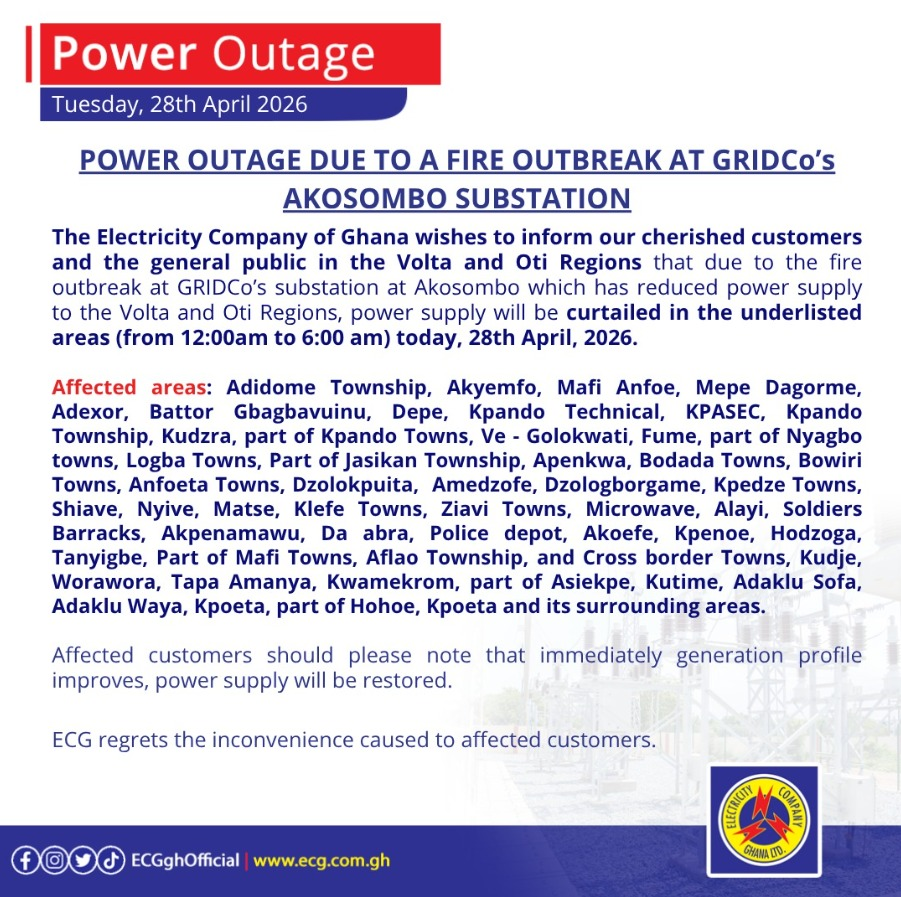
The Electricity Company of Ghana (ECG) has released a list of areas set to suffer outages across some parts of the Volta Region and Accra.
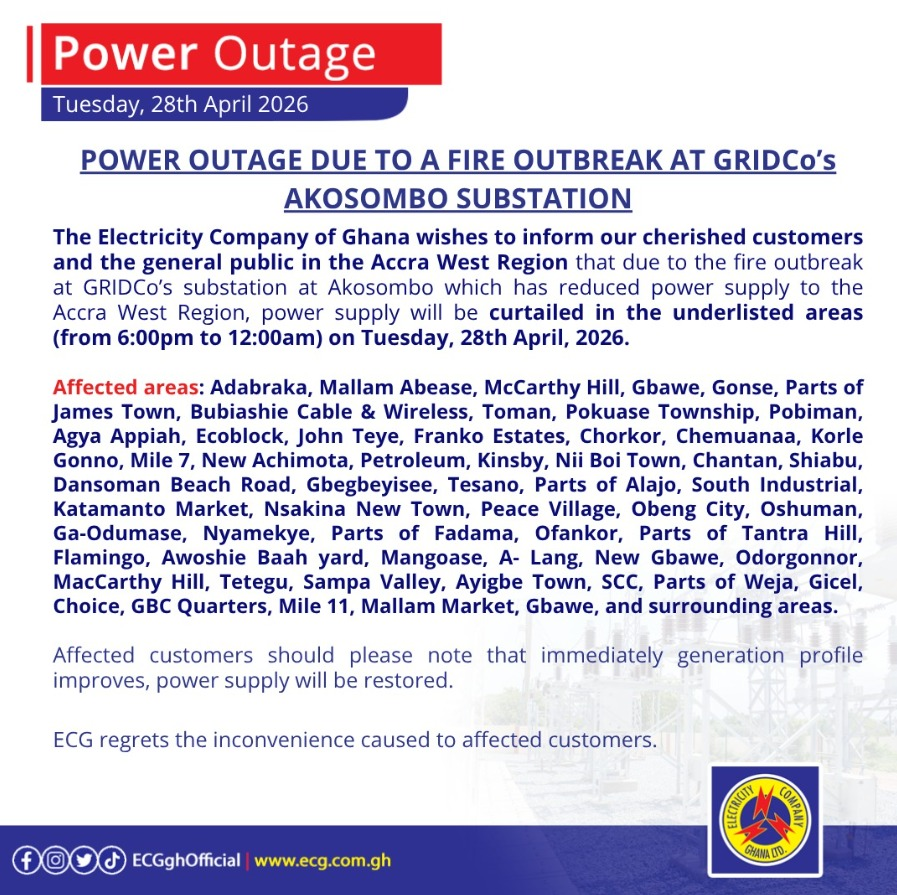
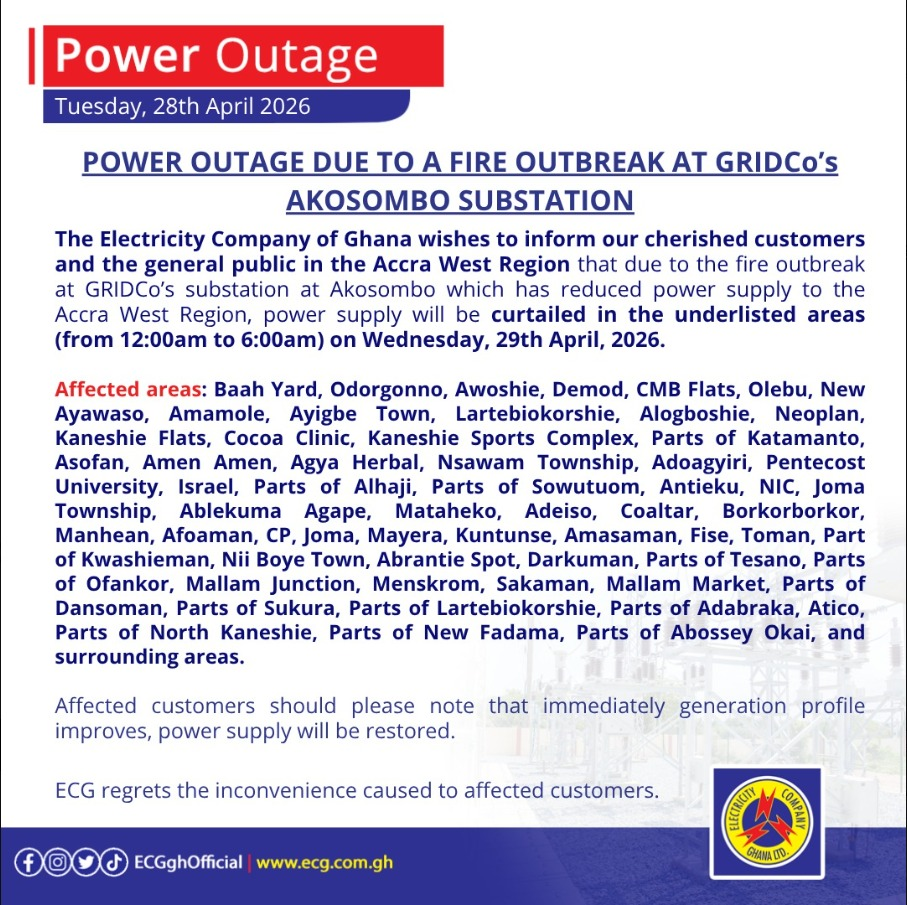
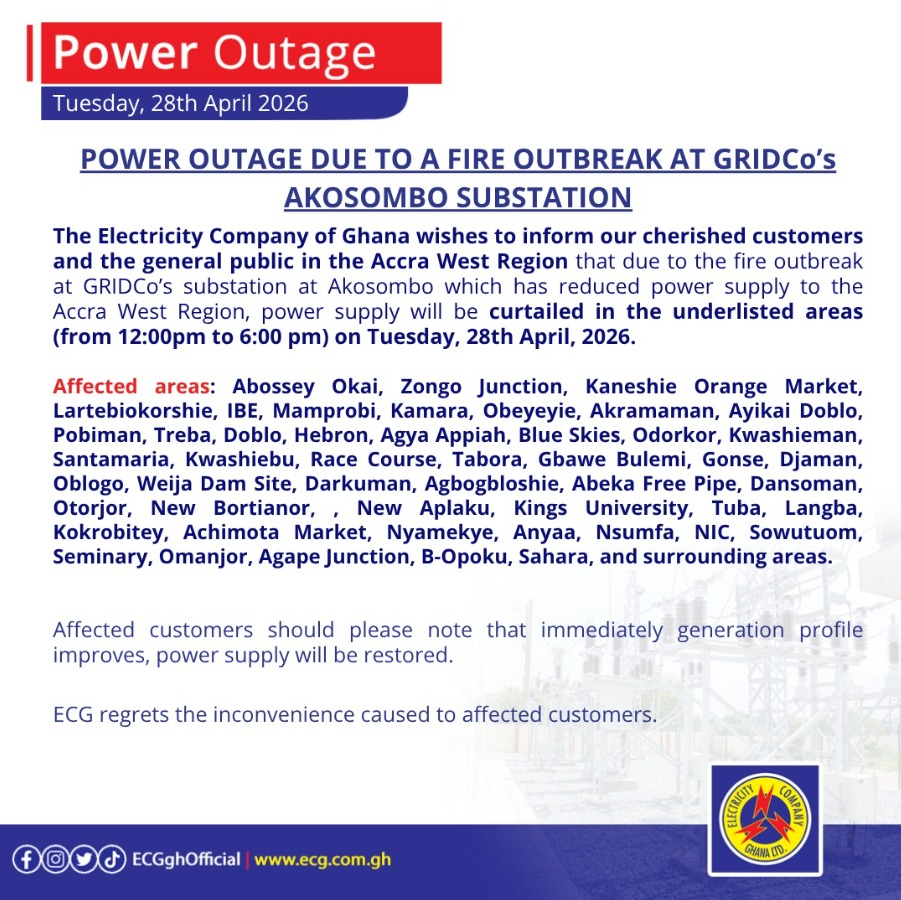
The national power supply company, in a power outage notice dated Tuesday, April 28, indicated that areas listed in the notice will have their power supply curtailed for 6 hours
Residents of Pentecost University, Mallam Junction, New Fadama, and others will be without power for 6 hours tomorrow, Wednesday, April 29.
And today, all underlisted areas, including Mile 7, New Achimota, Nyamekye and Mile 11, will be without power for 6 hours.
See the rest of the list below:
ECG explained that these outages are a result of the recent fire outbreak that occurred at the Akosombo substation, which has led to reduced power supply to parts of the country. However, they assured that efforts are currently underway to ensure that normalcy returns as soon as possible.
It further went on to apologise to the public for any inconvinience.
The outages began after a fire outbreak at the Akosombo GRIDCO substation on April 23, around 2 pm, which blocked about 1,000 megawatts of power.
Speaking on the situation on the Channel One Newsroom on Sunday, April 26, ECG’s General Manager for External Relations, Dr Charles Nii Ayiku Ayiku, was sorry for the inconvenience caused, describing the incident as unexpected and significant.
“I sincerely apologise for the inconvenience our cherished customers are facing. The incident wasn’t expected. It was a major incident which has rendered the entire control room affected and down, and we sincerely apologise to our customers.
“After Akosombo, the fact is that it blocked about 1000 megawatts, but I am sure you also understand that even after losing 1000 megawatts, we have still been consistent with power supply within some parts of the country,” he said.
Dr Ayiku cautioned against calls for a load-shedding timetable at this stage, describing it as premature.
“So if we start talking about a load shedding timetable right now, don’t you think it is too early to call for a load shedding timetable?” he said.
He added that ECG, GRIDCO and the Volta River Authority (VRA) are working together to restore full power supply across the country.
Meanwhile, the Minister of Energy and Green Transition, John Abdulai Jinapor, has directed the Chief Executive Officer of the Ghana Grid Company Limited (GRIDCo) to step aside pending an investigation into a fire at the Akosombo Power Control Centre while taking steps to avert disruptions in Ghana’s power supply following a major fire incident at the Akosombo transmission network.
As part of the measures, Ghana temporarily halted power supply to neighboring countries. The Deputy Energy Minister, Richard Gyan-Mensah disclosed this while engaging the press on Friday, April 24.
Ghana primarily exported electricity to Togo, Benin and Burkina Faso through the 225kV Bolgatanga-Ouagadougou interconnection.
However, these countries were left to temporarily cater for themselves as the fire outbreak damaged a transmission system with a capacity of about 720 megawatts at GRIDCo’s substation at Akosombo.
He added, “The system that got affected was about 720 megawatts. That system transmits power to major parts of the country, so this is a significant hit. The Akosombo Dam generates a little over 1,000 megawatts.”
“This is an emergency that has actually occasioned it. It is brief; it is not something that is going to last longer. I think they have also heard what has happened to us. In this situation, we need to take some actions and this is one of them”.
The ongoing trial concerning ambulance procurement in Accra faced unexpected disruptions due to frequent power outages, known locally as “dumsor.”
These interruptions caused multiple delays during proceedings, frustrating legal teams, witnesses, and attendees.
The trial, being held at the High Court, experienced repeated halts as the city endured intermittent power cuts. These outages not only hindered the flow of legal proceedings but also affected the concentration and effectiveness of arguments presented in court.
During Thursday’s session, focused on cross-examining Richard Jakpa, the third accused, state prosecutors faced challenges due to the power disruptions. Deputy Attorney General started the questioning, with Attorney General Godfred Yeboah taking over at a later stage.
The trial judge expressed concern about the disruptions during breaks caused by the power outages. She noted the adverse effects on trial efficiency and raised worries about potential damage to court equipment from the unstable power supply.
These interruptions underscore ongoing challenges in Ghana’s judicial system amid periodic power shortages affecting various sectors nationwide.
Authorities continue efforts to mitigate disruptions and ensure smooth legal proceedings.
As the trial adjourned for the day, uncertainties remained about how “dumsor” could impact future court sessions and the overall timeline of the ambulance procurement trial.
According to the Public Utility Regulatory Commission (PURC), the Electricity Company of Ghana (ECG) has inaccurately attributed power outages during peak hours to transformer faults.
In March, PURC requested data from ECG concerning all transformers and power outages nationwide.
After analyzing the data provided by ECG, PURC has determined that only 3 out of the 647 outage incidents between 7pm and 11pm from January to March 18, 2024, were actually due to transformer overload.
“Analysis of the data submitted showed that out of 715 transformer details submitted, 31 were loaded less than 70%, 595 were loaded between 70-100% and 89 were loaded above 100%,” portions of the update read.
“The data submitted by ECG was further compared to the total outage data provided by ECG for the period January to March 18, 2024. The Commission established that 647 outage incidents occurred between 7 pm and 11 pm. Of these 647 outage incidents, only 3 were planned outages relating to transformers. The analyses showed that the majority of the outages between 7 pm to 11 pm were as a result of load management operations by GRIDCo and faults unrelated to overloaded transformers,” it added.
“ECG’s attribution of the outages between 7 pm and 11 pm to transformer overload was therefore not factually accurate,” PURC concluded.
PURC also reports that there were 4,142 outages to consumers within ECG’s operational areas between January and March 2024.
Out of this total, 165, which accounts for 3.98% of the outages, were planned by ECG.
Further analysis by PURC revealed that out of the 165 planned outages, 40 were accompanied by public notices. However, there were no notices for the remaining 125 outages, with an additional 38 of the 40 notices not meeting the required three-day statutory notice as outlined in Regulation 39 of L.I. 2413.
This indicates that in 163 instances of planned outages, ECG did not adhere to legal requirements.
Consequently, PURC has imposed fines totaling Five Million, Eight Hundred and Sixty-Eight Thousand Ghana Cedis on ECG board members for their failure to provide the mandated three-day statutory notices to customers during 163 planned outages this year.
The Electricity Company of Ghana (ECG) has issued a notice regarding potential power outages in certain areas of the country.
These outages are anticipated during the peak load period from 7 pm to 11 pm.
According to the power distribution company, the heightened demand has resulted in blown fuses and damaged conductors in approximately 630 transformers nationwide.
The company clarified in a statement dated March 12 that it is installing new facilities and renovating some of these ones in order to guarantee a more reliable supply of electricity.
Speaking to JoyNews, ECG Managing Director Samuel Dubik explained, “I know the engineering team puts out these notices, if my customers are saying they didn’t get them, I’m sorry.”
The power outages are already being referred to by some Ghanaians as the “dumsor,” or return of the power crisis.
But Mr Dubik insists on Joy FM’s Newsite that “there is no dumsor.”
“But everybody wants to stay with the fact that there is dumsor. If there is dumsor that means there is a generational gap, or a generational problem.”
Members of the Minority in Parliament have urged the House leadership to summon the Minister of Energy, Dr. Matthew Opoku Prempreh, to provide an update on the government’s actions to address the recent power outages.
The Member of Parliament for Tamale North, Alhassan Suhuyini, expressed concerns about the adverse effects of the power cuts on households and businesses during the presentation of the business statement for the upcoming year on Friday, March 1.
Mr Suhuyini emphasized the need for the Energy Minister to brief the House on the power situation and the reasons behind the inconsistent power supply.
He highlighted the challenges faced by people and businesses in planning their activities and programs, urging the leadership to ensure clarity on the ongoing power issues.
The MP for Tamale Central, Ibrahim Murtala Mohammed, shared a distressing incident involving a National Service Personnel trapped in a Parliament lift during a power outage.
He stressed the importance of the Energy Minister addressing the House to provide explanations and insights into the power sector’s developments, allowing MPs to inform their constituents about the situation.
“Many people and businesses are unable to plan their activities and their programmes and they also sometimes have to find extra money to power their generators for their businesses and many people do not know what is happening.
“They are told that there are planned and unplanned programmes and load is being shed, so it is important that the leadership of the House makes it possible for the Energy Minister to brief the House next week on the power situation and why fellow countrymen and women have to deal with the on and off situation. Ghanaians need to understand why they sleep in darkness.”
“My issue has to do with the erratic power supply. Just two days ago, there was a National Service Personnel who was trapped in one of the lifts when the power went off. She was traumatized when she finally exited the lift and so are we able to quantify the psychological trauma that people go through as a result of this and so it is essential that the Minister for Energy responds to this House to explain to us so we can explain to our constituents what is happening.”
A significant power outage has affected various regions of the country since approximately 6 pm on October 26, 2023.
The Ghana Grid Company Ltd (GRIDCo) has attributed this outage to challenges arising from a restricted gas supply in Tema.
In their statement issued on Thursday, October 26, GRIDCo expressed that the constrained gas supply situation is expected to result in “a supply deficit of 550MW during peak hours.”
“This will affect power supply to consumers in some parts of the country. The inconvenience caused is deeply regretted,” the statement added.
Read the full statement from GRIDCo below
POWER SUPPLY CHALLENGE
The Ghana Grid Company Ltd, (GRIDCo), the “Operator” of the National Interconnected Transmission System (NITS) informs the general public that due to limited gas supply to Tema, there will be a supply gap of 550MW at peak time.
This will affect power supply to consumers in some parts of the country.
The inconvenience caused is deeply regretted.
ISSUED BY: Corporate Communications Section Ghana Grid Company LTD. (GRIDCo)
In the midst of frequent statewide poweroutages lasting up to 10 hours each day, Eskom’s problematic CEO has resigned.
The resignation of Andre de Ruyter comes amid pressure from the public and various stakeholders as Eskom has failed to keep the lights on, plunging South Africa, the continent’s most developed, into an electricity crisis that appears to be worsening.
The state-owned Eskom confirmed De Ruyter’s resignation Wednesday. He will stay on until March 31 “to ensure continuity while we urgently embark on a search for his successor,” said Eskom Board ChairmanMpho Makwana.
Eskom cannot generate adequate power for South Africa’s consumption and the country has had rolling power cuts for years. But in recent weeks the situation has become much more serious with power cuts of up to 10 hours per day.
Experts warn that ongoing mechanical breakdowns at the country’s ageing coal-fired power stations and backlogs in their maintenance could lead to even longer power cuts that may last 12 to 14 hours per day.
De Ruyter has recently faced criticism from Energy Minister Gwede Mantashe and Public Enterprises Minister Pravin Gordhan.
The country’s failure to secure a stable power supply has been one of the vexing challenges to President Cyril Ramaphosa and is expected to be one of the key issues at the upcoming national conference of the ruling African National Congress.
De Ruyter was appointed Eskom’s chief executive in December 2019 following years of power cuts and wide-ranging allegations of corruption at the utility.
A judicial probe into corruption in government and state-owned enterprises placed Eskom at the center of massive revelations about corruption in government during former President Jacob Zuma’s tenure from 2009 to 2018.
Numerous authorities are looking into the incident after a “targeted” strikeleft thousands of people in North Carolina without power.
In an initial statement shared to social media, the Moore County Sheriff’s Office noted that the mass power outage in the region was being investigated as a “criminal occurrence,” adding that early evidence showed that “intentional vandalism” was to blame. In a follow-up statement, a curfew was announced.
Per a report from regional outlet WBTV, around 36,000 residents were ultimately determined to be without power, with a Duke Energy rep warning that ensuing repair operations could take several days to be completed.
At a press conference on Sunday, Moore County Sheriff Ronnie Fields revealed that the FBI was now involved in the investigation into the attack. At the presser, Fields was asked about speculation that the attack had been carried out to prevent a local drag show from proceeding. Per Fields, police have “not been able to tie anything back to” that as a motive.
North Carolina Police Chief on Unpaid Leave After Reportedly Showing Officers How to Obtain Fake Vaccine Cards
“We faced something last night here in Moore County that we’ve never faced before but I promise you we will get through this and we will get through it together,” Fields said Sunday.
According to Fields, two substations were damaged by gunfire, with evidence at the scene indicating that a firearm had been used to “disable” power equipment. As for whether this is being treated as a domestic terrorism case, Fields said that distinction will be up to federal authorities.
“Domestic terrorism? I can’t answer that,” he said. “Again, we’re looking at all avenues. … I can say this, this individual that don this, it was targeted. It wasn’t random.”
Complex has reached out to the North Carolina State Bureau of Investigation, the FBI’s Charlotte division, and the Moore County Sheriff’s Office for comment. This story may be updated.
On Sunday, North Carolina Governor Roy Cooper called the attack a “serious, intentional crime” for which those responsible will be brought “to justice.”
An attack like this on critical infrastructure is a serious, intentional crime and I expect state and federal authorities to thoroughly investigate and bring those responsible to justice. (2/3)
Ukraine’s sole power grid operator has announced that power outages have been implemented in multiple regions as it prepares to stabilise the energy supply damaged by recent Russian drone and missile attacks.
Ukrenergo said in a statement that people in the capital Kyiv, as well as Chernihiv, Cherkasy, Zhytomyr, Sumy, Kharkiv, and Poltava regions were without power as of 6am local time.
Consumption restrictions are necessary to reduce the load on the grid, ensure sustainable balancing of the power grid and avoid repeated accidents, it said.
Nigeria’s experience in power outages as a result of inadequacy in generation further increased the interest in the nuclear option in the country’s quest to diversify its power generation options, Director, Centre for Energy Research and Training (CERT), Ahmadu Bello University, Prof. S.A. Jonah has said.
Prof. Jonah was speaking on Monday at the opening ceremony of a five-day IAEA-AFRA regional course on demonstration of conditioning operation and storage of Disused Sealed Radioactive Sources (DSRS) for managers, scientists and technicians of nuclear wastes at the research centre.
The objective of the training course is to train local experts and facility operators to acquire sufficient capacity to carry out the handling and conditioning operation under the supervision of IAEA experts.
This involves demonstration on how to characterize, condition and repackage disused sealed radioactive sources (DSRS); and the specific purpose is to provide the practical know-how as well as the hands-on experience to the participants.
Prof. Jonah, who noted that the use of sealed radioactive sources in Nigeria had witnessed an upward surge in health, industrial and petroleum sectors of the economy, explained that globally the interest in nuclear power was also growing to meet the demand for electricity while reducing their carbon dioxide emissions.
“It may be the only source of reliable base load energy for the future, especially with the discovery of substantial amount of uranium in sea water, as well as the fusion reactor technology.
“Therefore, as we continue our march into peaceful applications of nuclear energy in Nigeria and with the successful hosting of this training course at CERT, I would like to assure everyone that we will not rest on our oars in the delivery of peaceful applications of nuclear science and technology to Nigerians as enshrined in our Statute”, he said.
Jonah, a professor of nuclear and reactor physicist, further said that the management of nuclear and radiological materials in a professional manner was very critical for sustainability and socio-economic development of African sub-region.
He said that the training course was to have taken place much earlier than now, but for some unforeseen circumstances, especially COVID-19 pandemic, stressing that the hosting of the training workshop would mark the beginning of more IAEA hosted activities at CERT.
While welcoming the IAEA team of experts led by Miss Vivian Pereira Campos and participants from AFRA countries – Ghana, Ethiopia and Nigeria, Prof. Jonah also said that Nigeria ranked top among countries ready to host training course on the demonstration of conditioning operation under the Project RAF9062.
This, he further explained, was because quite a number of spent radioactive sources had been generated from various practices using radioactive sources, and many of these sources were presently stored in the waste management facility at CERT.
In his remarks, the Chairman and Chief Executive Officer of the Nigeria Atomic Energy Commission (NAEC), Prof. Yusuf A. Ahmed, acknowledged the various supports the International Atomic Energy Agency (IAEA) had been providing to Member States through regional and international projects for handling and conditioning of disused sealed radioactive sources.
The conditioning process, which must follow an established procedure, according to him, was carried out to limit the risk of exposure of disused sealed radioactive sources to people and environment.
Prof. Ahmed, who was represented at the occasion by Prof. A.A. Mati of Centre for Energy Research and Training, Ahmadu Bello University, Zaria, also stressed that Nigeria recognized that a long term commitment to the peaceful, safe and secure use of nuclear technology was based on a sustainable organizational, regulatory, social, technological and economic infrastructure development.
He said that this was in addition to the formulation of deliberate policies and implementation to ensure the safe operation of the nuclear installations throughout their entire life cycle.
Also speaking, the Vice-Chancellor, Ahmadu Bello University, Prof. Kabiru Bala, who declared the training workshop open, said that the University would continue to support CERT as a Centre of Excellence in promoting education and training with regards to nuclear science and technology in the country.
The Vice-Chancellor expressed the University’s immense appreciation to IAEA for its support to CERT in particular and Nigeria in general through the provision of training and research facilities for over three decades.
“In furtherance of this endeavor, only last month, the IAEA and ABU signed an agreement to participate in the Internet Laboratory Project (IRL) on the sideline of the 66th IAEA General Conference”, he said.
This, according to him, was to enhance the teaching and practical applications of nuclear reactor physics in Ahmadu Bello University and other Nigerian universities, which hitherto were limited to theoretical concepts.
Miss Vivian Pereira Campos, who led the IAEA team of experts to the training course, gave an overview of the programme, saying that the essence of the workshop was to provide the participants with requisite skills and techniques to carryout the conditioning operation in the future without guidance and supervision.
Goodwill messages were delivered at the occasion by the Secretary, IAEA-AFRA Management Committee and Deputy Dean, Faculty of Life Sciences, Ahmadu Bello University, Prof. Maryam Aminu; Prof. Sunday Adeyemi Adewuyi, who represented the Chief Medical Director, Ahmadu Bello University Teaching Hospital; and Malam Abdullahi Saleh Na’Allah, who stood in for the Director-General of the Nigerian Nuclear Regulatory Authority (NNRA).
Some of the personalities present at the opening ceremony of the training course included Course Director, Nigeria Atomic Energy Commission, Mr. Emmanuel C. Akueche; and representatives of the Nigeria Defence Academy (NDA) and Nigerian College of Aviation Technology (NCAT), Air Commodore A.I. Hanidu and Malam Nasir Mu’azu, respectively.
South Africa’s President Cyril Ramaphosa, who has cut short foreign visits as the country’s electricity crisis worsens, warned on Monday that there was no prospect of improvement “in the short term”.
“Given the uncertain performance of (state-owned Eskom’s) coal-fired power plant fleet, we will not be able to stop load shedding in the short term. This is the sad reality of a long-standing situation,” he wrote in his weekly letter to the nation.
After several weeks of intense load shedding between June and July, in the middle of the southern winter, Africa’s leading industrial powerhouse is plagued by further drastic power cuts, as the national grid is unable to produce enough power after years of mismanagement and corruption.
This has meant several hours of power cuts for individuals and businesses every day for almost two weeks now. This system of load shedding has been in place for the past 15 years.
Mr Ramaphosa, who was on a trip to the United States and London, announced an early return to the system last week in response to the crisis.
“These last two weeks of load shedding have been extremely frustrating and difficult. The public’s anger is justified,” he said, adding that the power shortage was “jeopardising” the economy.
“In the immediate term, our aim is to reduce the frequency and severity of load shedding by addressing the failures at the power stations,” he continued.
The rise in temperatures with the arrival of spring usually leads to a drop in consumption and reduces the pressure on ageing and poorly maintained power stations.
But a high number of outages has led to a dramatic drop in production, which is also suffering from coal supply problems.
South Africa gets 80% of its electricity from coal, creating severe pollution that environmentalists have denounced.
Calling on South Africans to “use electricity sparingly”, the president assured that measures to create new production capacity are progressing “even if the effects are not immediately felt”.
Cyril Ramaphosa announced in July that the sector would be opened up to the private sector. The country, which obtained €7.7 billion for its energy transition at COP26, signed the first agreements for wind energy production last week.