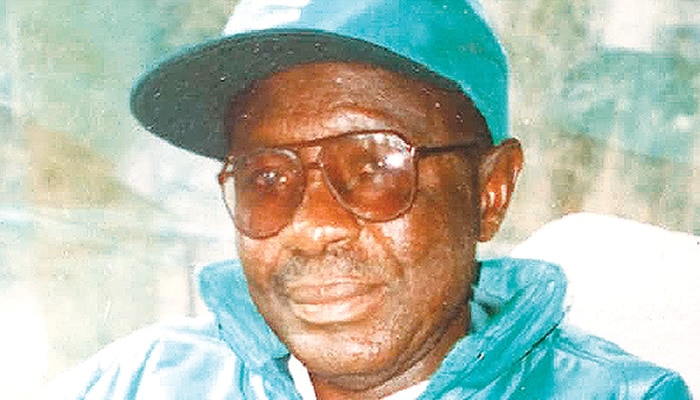
On Monday morning, the news of the death of the former Super Falcons coach who led the team to the World Cup is announced to the nation’s football community.
Mabo reportedly fought a serious illness for weeks before passing away at the age of 80 and leaving behind children and grandchildren.
But later that evening in Jos, Plateau State, a large group of football officials gathered to bury the deceased grassroots football strategist.
According to the report on Punch, Buhari prayed that the soul of the departed one finds favour infront of his Creator. Statement from the Presidency “Mabo was also a legendary footballer in the domestic league, making his mark as a player and captain of Mighty Jets of Jos and also representing the country as a formidable central defender with the Green Eagles.
“As the head coach of the Nigeria women’s national team at the 1999 FIFA Women’s World Cup, 2000 Summer Olympics and 2004 Summer Olympics, the President believes that Mabo’s legacy will live on in the players and the coaches that came in contact with him during his career, as well as the young athletes that will draw inspiration from his managerial abilities in the years to come.
“The President prays that the memory of the departed will be a blessing to those who mourn.”
We remember our pioneer @NGSuper_Falcons coach Ismaila Mabo, who passed away today at the age of 80. He won the first official @CAFwomen's Afcon in 1998 and led Nigeria to a @FIFAWWC quarterfinal at USA 1999. Our condolences to his family and 🇳🇬women's football community. pic.twitter.com/oJp0CfzGxB
Vincent Enyeama named greatest goalie Earlier, Sports Brief had reported how Nigerian legend Vincent Enyeama was named as the greatest African goalkeeper of all-time by the International Federation of Football History and Statistics (IFFHS).
There is no doubt about the fact that Enyeama was an excellent goalkeeper during his active playing days considering his achievement in the national team, Super Eagles.
On Saturday, millions of Nigerians went to the polls to choose a new president, but the voting was marred by several delays. Elections to fill seats in the nation’s parliament are taking place at the same time as the contentious election.
Witness allegations of localised violence at two voting places in Lagos that required the military to interfere were corroborated by CNN. CNN has contacted INEC for a response.
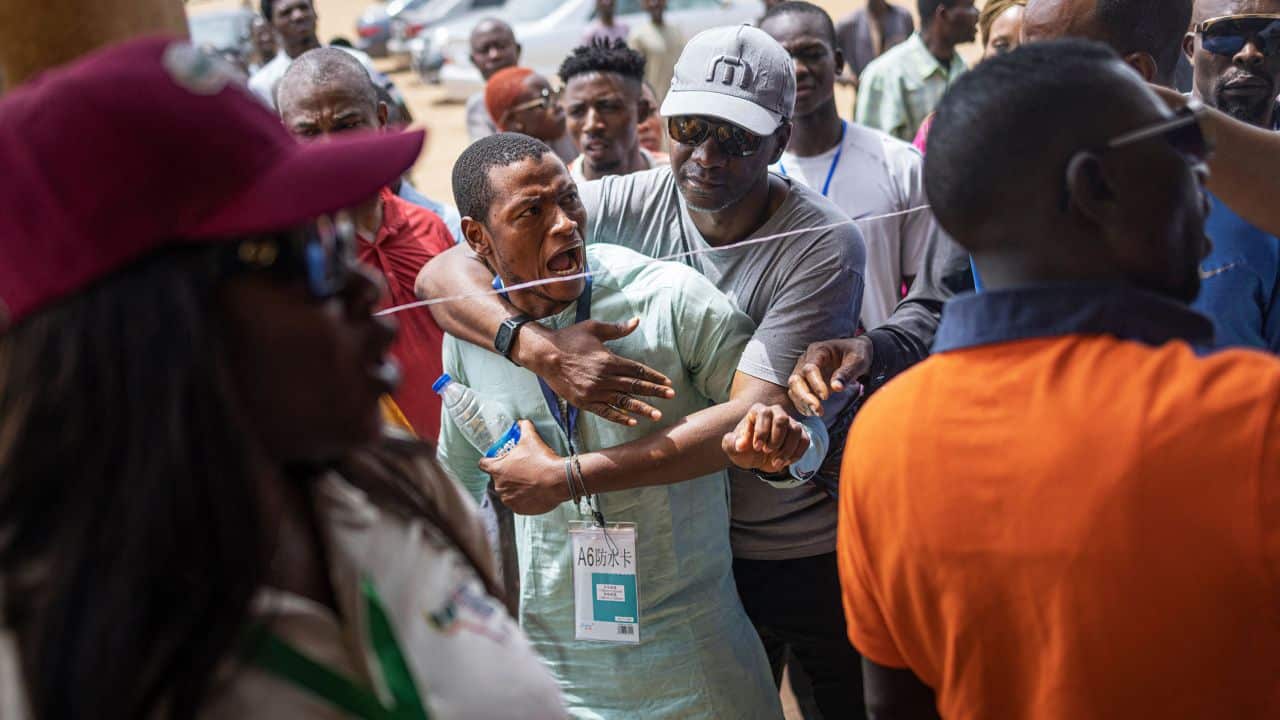
A CNN team saw hectic scenes at a polling place in Maraba, an Abuja suburb, where many voters were having trouble casting their ballots. The Independent National Electoral Commission (INEC) standards, which guarantee voters’ privacy, were broken by those who did manage to cast a ballot since they did so in plain view of people who were standing next to them.
“People are voting in exposed spaces, and everyone can see who they are voting for. There’s no privacy. I won’t be surprised if this polling unit is canceled,” Elias Ajunwa, one registered voter, said.
Ajunwa expressed unease about the situation. “There’s the possibility of any hooligan carting away INEC materials because of how vulnerable the INEC officials and their materials are,” he added.
About 93 million Nigerians in a country of 200 million people are registered to vote, according to electoral body INEC, but only 87 million are holders of a permanent voter card (PVC), a main requirement to cast a ballot. The election will be Africa’s largest democratic exercise.
The Chief Observer of European Union Observation Mission to Nigeria, Barry Andrews, told CNN it was premature to make any conclusions about widespread delays.
“We’ve taken note of those reports and we will look across the country to see whether this a pattern or whether it has in any way hindered the exercise of people’s political rights to vote or caused frustration or caused people to turn away. For the moment, it’s premature to make any conclusions about it.”
People were still waiting to cast their ballots despite polls being expected to close at 2:30 p.m. local time (8:30 a.m. ET). Voting did not start until after the scheduled opening time in some polling stations.
One polling station in Lagos delayed opening as officials were still setting up after polls were meant to open, a CNN team witnessed. An official urged eager voters to be calm and “treat each other with love” as they continued to wait.
The same issue dogged several other voting locations, including in northern Kano State and southern Bayelsa State, with no election officials in sight at 8:30 a.m. local time, according to Reuters. In previous elections, voters in some areas have complained that polling stations opened hours late or did not materialize at all.
Ballots will be counted at polling places at the close of voting and transmitted electronically in real-time to INEC’s Result Viewing portal (IReV), a first of its kind in Nigeria, the commission tells CNN.
“With the electronic transmission system (IREV), people will already know the winners before the official announcement is made,” adds Rotimi Oyekanmi, a spokesman for INEC’s chairperson.
To win, a candidate must garner a sufficient number of ballots to meet the 25% vote spread in 24 of Nigeria’s 36 states. In the absence of this, a second round run-off between the top two candidates will be held within 21 days.
Eighteen candidates are on the ballot for Nigeria’s top, but three are leading the race for the popular vote, according to pre-election surveys.
One of the key contenders is Bola Ahmed Tinubu, the candidate of term-limited President Muhammadu Buhari’s party, the All Progressives Congress (APC). Another is the main opposition leader and former vice president Atiku Abubakar, of the People’s Democratic Party (PDP). And third strong contender, Peter Obi, is running under the lesser known Labour Party, and altered early predictions of the presidential vote, which has typically been two-horse races between the ruling and opposition parties.
Seventy-year-old Tinubu, 70, is a former governor of Nigeria’s wealthy Lagos State, who wields significant influence in the southwestern region where he is acclaimed as a political godfather and kingmaker.
He boasts of aiding the election of Buhari to the presidency and declares it is now his turn to lead the country.
Candidate of the opposition party PDP Abubakar, 76, is a former Nigerian vice president and a staunch capitalist who made his fortune investing in various sectors in the country.
Here’s what to know about Nigeria’s presidential election
Abubakar’s presidential bid (his sixth attempt) had fueled concern that it might usurp an unofficial arrangement to rotate the presidency between Nigeria’s northern and southern regions, since he is from the same northern region as the outgoing leader, Buhari.
Labor Party’s Obi is a two-time former governor of southeastern Anambra State and has been touted as a credible alternative to the two major candidates by his hordes of supporters, mostly young Nigerians who call themselves ‘Obidients.’
Obi is also the only Christian among the leading candidates. His southeastern region has yet to produce a president or vice president since Nigeria returned to civil rule in 1999.
The ruling party’s Tinubu, from the religiously mixed southwestern part of the country, is a Muslim and also chose a Muslim running mate, despite the country’s unofficial tradition of mixed-faith presidential tickets.
All top three candidates are confident they can turn Nigeria’s fortunes around if voted into power, as the country battles myriad economic and security problems that range from fuel and cash shortages to rising terror attacks, high inflation, and a plummeting local currency.
One voter, Wandu, told CNN’s Larry Madowo in Lagos on Saturday that the most important issue is security: “We need someone that has a hold and an understanding of the security challenges that we have. The economy is in free fall. We need someone that has a fair understanding of what we need to be better.”
Nigeria’s security forces have mobilized personnel to ensure hitch-free electioneering across the country.
The run-up to the polls has been fraught with violence that stemmed from protests against unpopular government policies and lethal attacks by armed criminal gangs.
On Wednesday, a senatorial candidate for the Labour Party, was shot and burned in his campaign vehicle in the country’s southeastern Enugu State, police said.
Electoral body INEC suspended the election in Enugu East Senatorial District following the death of the candidate, it tweeted on Saturday, adding that the election will now be held on March 11.
Before the killing, violent protests had erupted across Nigerian states as citizens railed against the scarcity of gasoline in petrol outlets and a shortage of cash that followed a controversial currency redesign.
INEC hasn’t been spared from the chaos; its facilities have been torched in parts of the country.
Voting was canceled at more than 200 planned polling units across Nigeria and voters redirected to other poll locations, INEC said, due to security concerns.
Ahead of the elections, national police ordered a restriction of non-essential vehicular and waterway movements from midnight on election day until 6 p.m., while the country’s immigration service has ordered the closure of Nigeria’s land borders from midnight Saturday until midnight Sunday.
Weeks before polling day, the service had confiscated over 6000 voter cards from illegal migrants, whom it said had other national documents in their possession.
INEC spokesperson Oyekanmi nevertheless insists the poll results will be free and fair.
“The experience Nigerians will have for the 2023 elections will be far better than previous elections and the integrity (of the polls) will be clear for everyone to see,”Oyekanmi told CNN days before the election.
Final results are expected to be announced a few days after polling.
Current President Buhari tweeted on Thursday: “There should be no riots or acts of violence after the announcement of the election results. All grievances, personal or institutional, should be channeled to the relevant Courts.”
The outgoing president of Nigeria, Muhammadu Buhari, has pledged to address the nation’s currency shortage, which is resulting in disorderly situations as citizens scramble to obtain new naira notes.
After 10 February the old notes will become worthless but can be exchanged for a further seven days at the country’s central bank.
“I am aware of the cash shortages and hardship being faced by people and businesses, on account of the Naira redesign,” President Buhari tweeted.
“I want to assure that we are doing everything to resolve these issues. Nigerians should expect significant improvements between now and the February 10 deadline,” he continued.
I am aware of the cash shortages and hardship being faced by people and businesses, on account of the Naira redesign. I want to assure that we are doing everything to resolve these issues. Nigerians should expect significant improvements between now and the February 10 deadline.
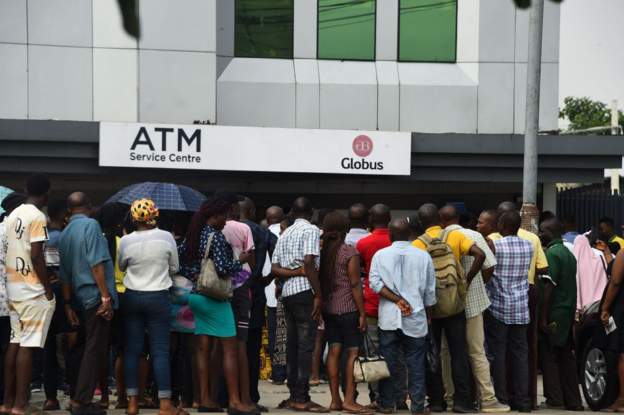
One video showed people fighting at an ATM to get money. Another showed a man stripping down to his underwear as he was waiting at the bank, as we reported on Thursday.
The deadline to exchange the money was supposed to have been 31 January, but it was extended by 10 days to give more people in rural areas time to get the new notes, the central bank’s governor had said.
When the bank announced in October that the 1,000 ($2.18; £1.75), 500 and 200 naira notes were to be replaced, it said 80% of the notes in circulation were outside banks.
The central bank believes that with the redesigned currency it will have a better understanding of the money circulating in the economy so it can better manage inflation.
He has frequently been on medical trips to London in the UK since his assumption of office in 2015.
The Nigerian government has proposed to spend the sum of N393,661,239 on the ongoing construction of the presidential wing of the State House Medical Centre at the Aso Rock Villa, Abuja in 2023.
This is contained in the budget proposal of N20.51 trillion budget President Buhari presented to the joint session of the National Assembly last Friday for the 2023 fiscal year.
However, despite the huge amounts of the money budgeted and claimed to have been expended on the State House clinic, President Buharidoes not make use of the medical centre.
He has frequently been on medical trips to London in the UK since his assumption of office in 2015.
Over the years, billions of naira have been allocated for the construction and equipping of the presidential clinic in the State House, yet, in 2017, the Nigeria’s First Lady, Aisha Muhammadu Buhari berated the management of the State House Clinic as she lamented that on her visit to the hospital, there was no single syringe.
Similarly, President Buhari’s daughter, Zahra reportedly made the same observation on her Instagram handle, when she called out the Permanent Secretary of the State House Clinic, Jalal Arabi, for not being able to provide ‘ordinary paracetamol’ in the clinic even though N331.7 million was allocated to the State House Clinic in that year’s budget.
In 2020 and 2021, the sum of N416.6 million and N1.06 billion were budgeted respectively for the construction of the Presidential (VIP) Wing of the State House Clinic, and as at March this year, the Permanent Secretary, State House, Tijanni Umar, confirmed the money had already been paid in full.
The Permanent Secretary, Umar also disclosed that out of the N20.8 billion allocated for the same project in the 2022 budget, the federal government had paid N8.5 billion.
It therefore means that between 2020 and 2022, at least the sum of N10 billion has been spent on the construction of the Presidential Wing of the State House Clinic which is still neither being used by the President nor his family members.
His visit was meant to commemorate and pay tribute to aid workers killed in the line of duty. He urges the sector to pay particular attention to “emerging issues” including “the increasing number of orphans and widows.
“World Humanitarian Day is commemorated every year on the 19th of August to pay tribute to humanitarian workers killed and injured in the course of their work, to honor all the aid and health workers who continue despite the odds to provide life-saving support and protection to people most in need,” said Babagana Umara Zulum, the Governor of Borno state.
According to the country’s Humanitarian Minister Sadiya Farouq, “since 2016 35 aid workers have died, 72 (have been) wounded and 28 kidnapped.
The jihadist violence has killed over 40,000 people and displaced around two million from their homes in the northeast since 2009, according to the UN.
Boko Haram and rival ISWAP are notorious for kidnapping women, children and aid workers.
They have been engaged in a 12-year-old conflict that has killed more than 40,000 people and displaced around two million.
Nigeria’s President Muhammadu Buhari is optimistic on the country’s economy, the largest in Africa, despite the impact of the coronavirus pandemic.
Mr Buhari says the pandemic has had a “moderate” effect in the country compared to other economies around the world.
Nigeria heavily relies on oil revenues and the economy has been struggling following the sharp fall in global oil prices.
Many Nigerians are complaining of massive job loses and extreme poverty.
Mr Buhari, in a televised address to mark Democracy Day, said the government is employing 700,000 people under a Special Public Works Programme to build roads and clean up the environment.
In April the International Monetary Fund (IMF) approved $3.4bn emergency funding for Nigeria, the largest loan to an African country to assist in dealing with the pandemic.
But there are ongoing discussions to cut basic healthcare budget by almost half, as the country struggles with the pandemic.
President Buhari also said he was upset by the recent spike of gender-based violence, describing the incidents as “heinous crimes” and assured that the perpetrators would be brought to justice.
Nigeria’s President Muhammadu Buhari has appointed a dead man into office, naming the late Tobias Chukwuemeka Okwuru as a board member for a government agency, two months after he died.
Mr Buhari sent a letter to the country’s senate on Tuesday to confirm the list of 37 appointees but was unaware that Mr Okwuru had passed away in February.
The president’s media aide, Lauretta Onochie, said Mr Okwuru was alive when the president appointed him to serve on the board and that “he even came to update his CV, in readiness for the appointment after the Senate screening”.
“When he sadly passed away while waiting for the screening by the Senate, that information was not communicated to the Federal Government,” she said.
This is not the first time Mr Buhari’s presidency has made the grave error of appointing a dead person. In 2017, the president appointed at least five people who were long dead on to several boards of government agencies.
Nigeria’s President Muhammadu Buhari has condemned a series of weekend attacks by gunmen in his home state of Katsina in the north west which left at least 47 people dead.
Armed bandits riding dozens of motorbikes attacked areas of Safana, Dutsinma and Danmusa – shooting people dead and burning down homes in several villages.
The attacks follow months of relative peace in the region.
Mr Buhari suggested that criminals are taking advantage of the lockdown measures imposed to contain the spread of Covid-19 to carry out attacks.
He urged Nigerians not to despair in the face of the killings.
In recent years, states in the north-western part of the country have been badly affected by armed gangs who attack residents and travellers.