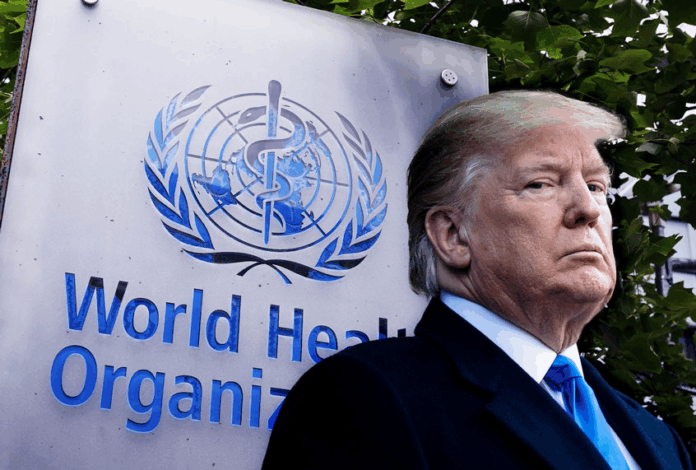
The US has officially severed ties with the World Health Organisation (WHO), drawing the curtains on the about 78-year-old commitment to the health agency.
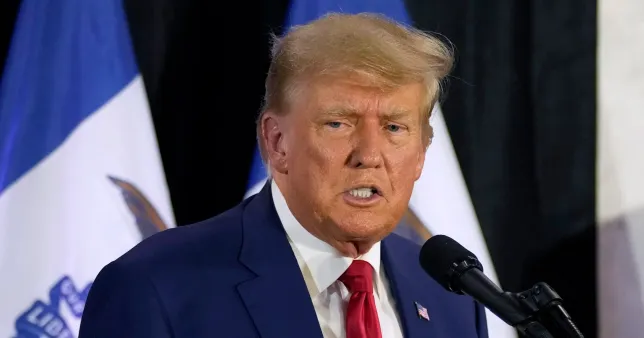
Their withdrawal follows Executive Order 14155, which formally initiated the process and was signed by President Donald Trump on January 20, 2025, just a few days after he assumed office.
On several occasions, he had announced his intention to break away from WHO, citing its close links with China, as part of a broader policy of withdrawing from international organisations that, he argued, did not serve U.S. interests.
As part of the rules governing the withdrawal from the health agency, a member is mandated to serve a year’s notice of intent to withdraw and last year, the White House began the process, which has officially been finalised.
White House announced its withdrawal in a joint statement shared by the US Secretary of State Marco Rubio and Health Secretary Robert F. Kennedy Jr., published Thursday.
“Today, the United States withdrew from the World Health Organisation (WHO), freeing itself from its constraints,” parts of the statement noted.
According to the statement, the US president cited the organisation’s alleged “mishandling of the COVID-19 pandemic” and “other global health crises” among reasons to quit the body.
“This action responds to the WHO’s failures during the COVID‑19 pandemic and seeks to rectify the harm from those failures inflicted on the American people,” the statement added. It also said that US membership in the organisation required “unfairly onerous payments.”
US leaving, but allegedly owes WHO
Despite the USA’s withdrawal, the WHO claims that Washington owes more than $130 million to the global health agency, but there is uncertainty and disagreement over it.
Trump administration officials acknowledge that they haven’t finished working out some issues, such as lost access to data from other countries that could give America an early warning of a potential pandemic in the near future.
Also, a WHO spokesperson has said that an engagement will be held concerning the US departure and other concerns addressed on how the health agency will operate without the global financier’s exit at the WHO’s executive board in February.
Following Trump’s announcement of his intention to exit the WHO, many health experts and other stakeholders urged him to reconsider, including most recently the WHO Director-General Tedros Adhanom Ghebreyesus.
Experts worry about weakened global health security
The greatest among the concerns raised by stakeholders regarding US exit is the financialimpact it stands to have on the agency and that of US’ ability to deal with disease outbreak and potential global health crisis.
The US has historically been the largest funder of the organisation. The specialised health agency is mandated to coordinate preparedness when it comes to disease outbreaks like mpox, Ebola and polio.
It also provides technical assistance to poorer countries, helps distribute scarce vaccines, and sets guidelines for hundreds of health conditions, including mental health and cancer.
“I hope the US will reconsider and rejoin WHO,” Ghebreyesus said at a press briefing earlier this month. “Withdrawing from the WHO is a loss for the United States, and it’s a loss for the rest of the world.”
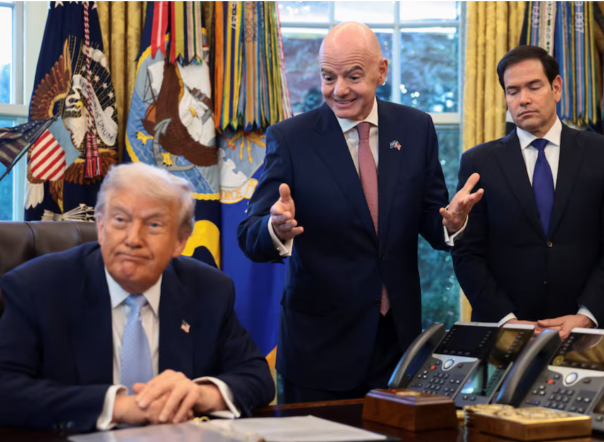
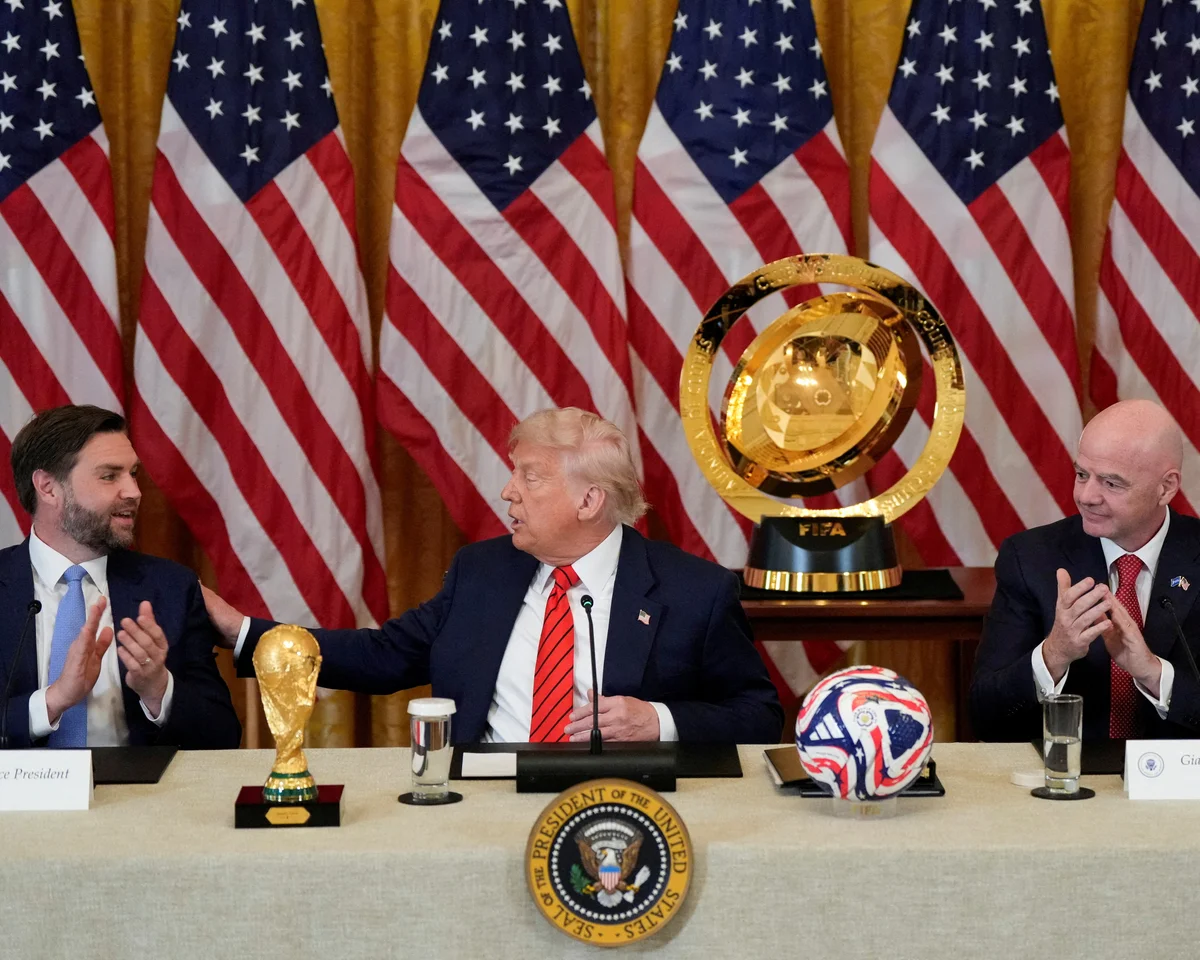
The FIFA World Cup scheduled for June-July 2026 is set to see approximately five to ten million people in attendance, as announced by the president of the football governing body, Gianni Infantino.
Speaking at a joint press briefing with U.S. President Donald Trump at the White House in Washington, D.C., on 17 November, he noted that the tournament is expected to attract millions of people across the three countries set to host the games next year.
“Millions of fans will be coming. One of the things I’ve observed in America is that the stadiums here are really built for people to have fun, to enjoy, to spend time. They don’t just watch the game and leave — they stay for hours, and I think that’s exactly what we need. We need occasions that bring people together from all over the world.”
The USA is giving priority access to fans, the Whitehouse has announced.
People from all over the World will travel to support their countries. Consequently, the Whitehouse has announced that fans set to travel for the tournament to the USA will be given the FIFA Prioritised Appointment Scheduling System (Pass), given that most of the matches will be played there.
The FIFA Prioritised Appointment Scheduling System (FIFA PASS) is a special visa‑interview scheduling program created by the U.S. government and FIFA for the 2026 World Cup. It gives ticket holders priority access to U.S. visa appointments, ensuring fans can travel to matches in North America despite existing visa backlogs.
Speaking during a joint press briefing with FIFA President Gianni Infantino at the White House in Washington, D.C., on 17 November, President Donald Trump mentioned that “I’ve directed my administration to do everything within their power to make the 2026 World Cup an unprecedented success.”
Detailing how the ‘World’ will gain access into the US, the Secretary of State Marco Rubio noted that, ticket-holders for the tournament, set for next June and July in the US, Canada and Mexico, will not be automatically granted a tourist visa.
But foreign nationals with tickets to World Cup football matches could get an interview at an embassy or consulate within six to eight weeks of applying, Rubio said.
“Your ticket is not a visa; it doesn’t guarantee admission to the US. We’re going to do the same vetting as anybody else would get. The only difference here is we’re moving them up in the queue,” the Secretary noted.
The FIFA president also noted that “With this FIFA Pass, we can make sure that those who buy a ticket, who are legitimate football fans or soccer fans, can come and attend the World Cup in the best conditions, starting from getting their visa”.
The announcement of priority visa appointments has been welcomed by many, including the US Travel Association, a tourism industry trade group. “The expedited process for FIFA ticket-holders adds needed efficiency without sacrificing security. This is the kind of practical action that strengthens security, increases capacity and cuts wait times, putting the U.S. on a stronger footing to welcome millions of visitors next year,” the group’s CEO, Geoff Freeman, said in a statement.
The announcement comes after citizens of countries that have already booked their place at the tournament have long wait times for visa appointments.
In Colombia, travellers applying for US visas are currently waiting around 11 months for an interview appointment, according to data published by the US State Department, the agency which processes visa applications.
The average wait time in Mexico City is nine and a half months, while non-Canadian citizen residents of Toronto can expect a wait of 14 months for appointments.
If those wait times hold, the World Cup will have already been played and the golden trophy already awarded by the time fans from some countries have their visas approved or denied.
However, it’s currently unclear whether the new appointment rules will cover ticket-holders from countries whose citizens are mostly or entirely banned from travelling to the US. In June, Trump signed an executive order banning nationals from 12 countries from entering the US, citing an effort to manage security threats
Iran, whose football team has qualified for the World Cup, is among the countries affected by the ban. The June executive order exempts athletes and coaching staff travelling for the World Cup and the 2028 Olympics, although their fans could still face a ban.
The BBC has contacted the US State Department for comment.
Not all travellers coming to the US next year will need a visa. Most citizens of countries under the US waiver programme can ordinarily travel visa-free for up to 90 days. That scheme covers much of Europe, including the UK, along with Japan, Australia and others.
At the two most recent World Cups, in Russia and Qatar, a ticket to a game generated a fan ID that could be used like a visa to enter the host country.
Meanwhile, German manufacturer Adidas, which has been designing World Cup balls since the 1970 tournament, has once again produced the official match ball for the upcoming FIFA 2026 World Cup.
Named Trionda, the ball was officially unveiled on Thursday, October 2, during a global launch event at Brooklyn Bridge Park in New York City. The presentation, hosted jointly by FIFA and Adidas, showcased the ball’s design, technology, and symbolic meaning.
FIFA president Gianni Infantino, during the unveiling of the ball, said, “The Official Match Ball for the FIFA World Cup 26 is here, and it’s a beauty! “I am delighted and proud to present the Trionda.”
Trionda, originating from Spanish, is interpreted as “tri” (three) and “onda” (wave), which signifies the three host countries of the global tournament. Trionda stuns with an aesthetic design which has representations from all three host countries, Canada, Mexico, and the USA, with features including Red panels with maple leaves for Canada, green panels with eagle motifs for Mexico and blue panels with stars for the USA. It also has a central triangle formed by the panel seams, symbolising unity.
President Donald Trump’s Cabinet has issued a firm message to international visitors planning to attend the 2026 FIFA World Cup in the United States: overstaying your visa will not be tolerated.
While emphasizing America’s enthusiasm for welcoming football fans from across the globe to enjoy its world-class stadiums and vibrant culture, officials underscored the importance of adhering strictly to visa regulations.
In a video shared on the social media platform X (formerly Twitter), U.S. Vice President JD Vance warned that individuals who remain in the country beyond their permitted stay will be subject to enforcement actions by relevant authorities.
“I know we will have visitors from close to 100 countries. We want them to come, we want them to celebrate, we want them to watch the games. But when the time is up, they will have to go home — otherwise, they’ll have to talk to the Secretary,” the Vice President said.
U.S. Secretary of Transportation also emphasized the importance of respecting visa rules, while encouraging visitors to explore more of the country during their stay:
“We’re going to encourage everyone to go on a road trip to celebrate our great country. So if you’re coming to see some soccer, go on a road trip and see America. Don’t overstay your visa. Don’t stay too long. But when you come, actually see this great country that we’re going to celebrate over the course of the next year.”
A cautionary message has been issued, seemingly targeting certain Ghanaian football fans who have openly declared their plans to overstay their visit after attending the 2026 World Cup in the United States.
Set to be the most expansive edition yet, the 2026 FIFA World Cup will be jointly hosted by the U.S., Mexico, and Canada — a groundbreaking arrangement involving 16 cities across North America.
This will be the first time the tournament is spread across three countries, and only the second time it’s being co-hosted, following the 2002 edition in Japan and South Korea.
The upcoming World Cup will also make history by expanding to 48 participating nations, up from 32, making it the biggest tournament in the event’s history.
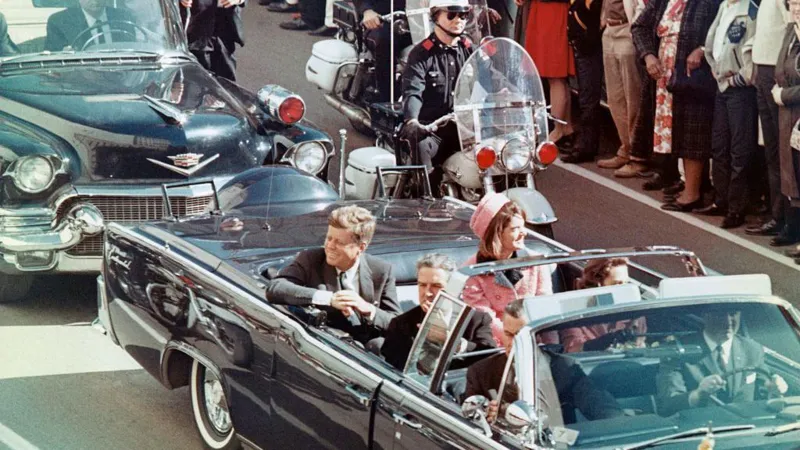
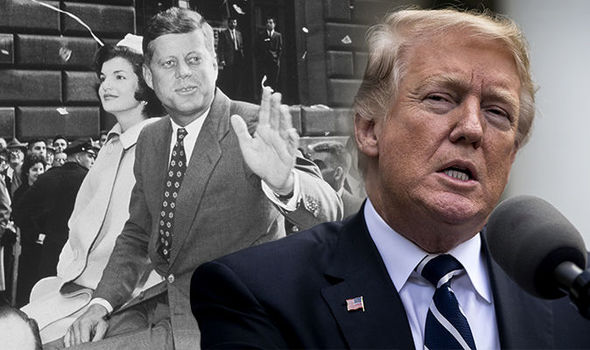
The U.S. government has published the final set of documents related to the assassination of President John F. Kennedy, a case that continues to spark conspiracy theories even after 60 years.
This release follows an executive order by former President Donald Trump, which required all remaining unedited files to be made public. Experts are now analyzing the documents, though not all have been uploaded online yet. They say reviewing them will take time and do not expect any major new discoveries.
Over the years, authorities have released hundreds of thousands of JFK-related files but kept some classified due to national security concerns. Many Americans still doubt that the accused gunman, Lee Harvey Oswald, acted alone.
Kennedy was assassinated in Dallas, Texas, on November 22, 1963. Before the release, Trump announced that 80,000 pages would be made public.
However, from the 1,123 documents published on Tuesday by the National Archives, it is unclear how much of the material is entirely new, as many had previously been shared with some redacted content.
“You got a lot of reading,” Trump told reporters on Monday, previewing the release. “I don’t believe we’re going to redact anything.”
Some of the newly released files still had sections blacked out, while others were difficult to read due to faded text, poor scanning, or content that seemed unrelated to the JFK case, experts noted.
David Barrett, a professor at Villanova University, said that ordinary readers might find the documents confusing. Speaking to CBS News, he described the release as “useful” but did not expect any groundbreaking revelations about Kennedy’s assassination or other matters.
Meanwhile, other JFK researchers believe the American public may continue to question whether more undisclosed files or hidden information still exist.
“I think there may continue to be more record releases,” historian Alice George told Reuters. But she went on to say the passage of time made investigations hard: “It’s much harder to find the truth when most of the people involved are dead.”
U.S. President Donald Trump has announced that his administration will release around 80,000 pages of documents on Tuesday about the assassination of John F. Kennedy.
Speaking at the Kennedy Center on Monday, Trump said the files would provide “a lot of reading” on the 1963 killing of the 35th U.S. president in Dallas, Texas. The assassination has been the subject of various conspiracy theories for more than 60 years.
“I don’t believe we are going to redact anything. I said, ‘just don’t redact, you can’t redact’,” Trump told reporters. “But we are going to be releasing the JFK files.”
Asked if he had seen what was in the files, Trump said he was aware of their contents.
“It’s going to be very interesting,” he said.
Trump’s remarks follow a January executive order calling for the release of all remaining records on the JFK assassination, as well as files related to the assassinations of Robert F Kennedy and the civil rights icon Martin Luther King Jr.
Under the order, Trump instructed the director of national intelligence, Tulsi Gabbard, to present a plan within 15 days for the “full and complete release” of files on the JFK assassination.
Last month, the FBI announced that it had found about 2,400 additional files related to the assassination of John F. Kennedy while conducting searches to meet a government order.
JFK’s assassination has fascinated Americans for decades, with many questioning the official explanation. A 2023 Gallup poll found that 65% of Americans do not believe the Warren Commission’s conclusion that Lee Harvey Oswald acted alone in killing the president. Among those surveyed, 20% suspected Oswald conspired with the U.S. government, while 16% believed he worked with the CIA.
During his first term, Donald Trump pledged to release all remaining documents on JFK’s assassination. However, after requests from the CIA and FBI, his administration only made about 2,800 records public, delaying the release of others. Later, under President Joe Biden, roughly 17,000 more documents were declassified, leaving fewer than 4,700 still partially or fully withheld.
According to the National Archives, over 99% of the nearly 320,000 documents reviewed under the 1992 JFK Records Act have now been made public.
The law mandated the disclosure of all remaining files by October 26, 2017, unless the president determined their release would cause “identifiable harm” to national defence, intelligence operations, law enforcement or foreign relations of such gravity that it “outweighs the public interest in disclosure.”
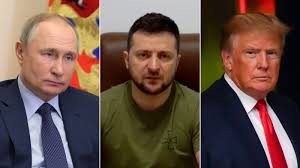
During a press briefing on Tuesday, after U.S. and Russian officials held talks in Saudi Arabia, Trump strongly suggested that Ukrainian President Volodymyr Zelenskyy was responsible for Russia’s invasion.
He also brushed aside concerns about Ukraine not being included in discussions aimed at ending the war.
“I think I have the power to end this war, and I think it’s going very well. But today, I heard, ‘Oh, well, we weren’t invited.’ Well, you’ve been there for three years. You should have ended it…,” Trump said at a news conference at his Mar-a-Lago estate in Palm Beach, Florida.
“You should have never started it. You could have made a deal. I could have made a deal for Ukraine.”
Trump said that he was “much more confident” of reaching an agreement following the talks in Riyadh led by US Secretary of State Marco Rubio and Russian Foreign Minister Sergey Lavrov.
“They were very good. Russia wants to do something, they want to stop the savage barbarism,” he said.
Asked if his administration would support Russia’s calls for elections in Ukraine as part of any peace deal, Trump claimed without evidence that Zelenskyy had an approval rating of just 4 percent and noted that the country’s elections had been suspended under martial law.
In an opinion poll carried out by the Kyiv International Institute of Sociology in December, 52 percent of respondents said they trusted Zelenskyy, down 12 percentage points from February.
“Yeah, I would say that, you know, when you want a seat at the table… Wouldn’t the people of Ukraine have to say like, ‘It’s been a long time since we’ve had an election?’” Trump said.
“That’s not a Russia thing, that’s something coming from me, and coming from many other countries also.”
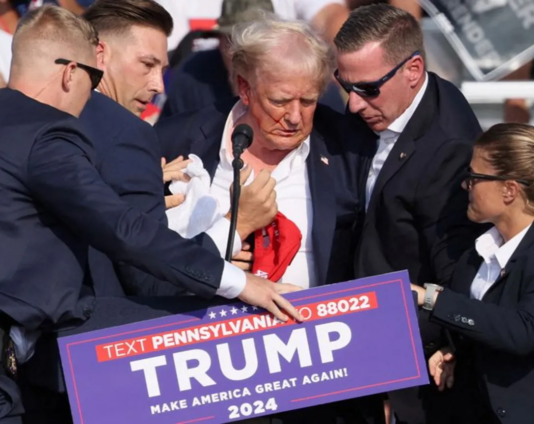
A shooting at a rally for former President Donald Trump in Butler,Pennsylvania, on Saturday night resulted in the deaths of a gunman and one audience member, confirmed by the local district attorney. Another spectator is in serious condition.
During the incident, shots were fired while Trump was addressing the crowd on stage. He sustained injuries and was swiftly attended to by Secret Service agents, who surrounded him after he dropped to the ground. Despite having blood on his face as he was escorted away, Trump raised his fist and shouted to those in attendance.
The Secret Service says Trump is safe and under protective measures. A spokesperson said Trump is “fine” after the “heinous act.”
Following a day of active campaigning for both former President Donald Trump and President Joe Biden in the 2024 presidential race, a shooting occurred outside Trump’s rally venue in Pennsylvania.
According to three law enforcement sources, the shooter was positioned outside the venue. Two of these sources mentioned the shooter was on a roof adjacent to the property. While some law enforcement sources referred to the individual as a sniper, specific details remain unclear.
Butler County District Attorney Richard Goldinger stated that his chief detective informed him the shooter was located on a building adjacent to the property, but he had no further information on the individual.
“It would have required a rifle,” he said. “It was several hundred yards.”
Biden says he’s “grateful” that Trump is OK after shooting
President Joe Biden has responded to the Saturday shooting.
“I have been briefed on the shooting at Donald Trump’s rally in Pennsylvania. I’m grateful to hear that he’s safe and doing well. I’m praying for him and his family and for all those who were at the rally, as we await further information.
Jill and I are grateful to the Secret Service for getting him to safety. There’s no place for this kind of violence in America. We must unite as one nation to condemn it.”
Biden remained mostly out of public view at his residence in Rehoboth Beach, Delaware, on Saturday, but was at St. Edmund’s Catholic Church attending Mass when the shooting took place.
According to the White House, Biden received a briefing on the incident from Secret Service Director Kimberly Cheatle, Homeland Security Secretary Alejandro Mayorkas, and Homeland Security adviser Liz Sherwood-Randall while in Delaware.
A revised indictment in the case involving the classified materials claims that former President Donald Trump tried to erase Mar-a-Lago security footage.
In a superseding indictment, Justice Department prosecutors claim that Trump directed a staff member to erase security camera footage to thwart a federal investigation into the secret materials he carried from the White House to his Florida home.
New counts of obstruction as well as willful retention of national defence records are included in the indictment that was made public on Thursday. The Mar-a-Lago property manager Carlos De Oliveira is listed as a third defendant.
De Oliveira is charged with conspiring to conceal video evidence from investigators with Trump and his valet Walt Nauta, who has already been charged.
The latest accusations were described by the Trump campaign as “nothing more than a continued desperate and flailing attempt by the Biden Crime Family and their Department of Justice to harass President Trump and those around him.”
The campaign claimed that “Deranged Jack Smith knows they have no case” and “is looking for any way to salvage their illegal witch hunt and to get someone other than Donald Trump to run against Crooked Joe Biden.”
In June 2022, De Oliveira allegedly invited another Mar-a-Lago employee to a “audio closet” and instructed them that the talk could not be disclosed with anyone else, according to the new indictment from Special Counsel Smith’s office.
The employee claimed that De Oliveira asked how many days’ worth of surveillance footage were on the server and then told that “the boss” wanted it deleted, apparently referring to Trump.
De Oliveira is accused of saying the “boss” demanded it be done and, “What are we going to do?” after the employee expressed doubt that he could execute the request.
Trump is also accused of allegedly presenting a document about military activity in another nation to a writer and publisher of a memoir for his former chief of staff, Mark Meadows, which is connected to the new offence of deliberately retaining national defence information. In July 2021, the gathering took place at Trump’s golf course in Bedminster, New Jersey.
To criminal allegations in the investigation into sensitive documents, Trump and Nauta have entered a not guilty plea. The trial date, set for May by US District Judge Aileen Cannon, may change if a third defendant in the case is found. Trump’s legal team has said that a fair trial won’t be granted to him until after the 2024 presidential race.
The revised indictment was released at a time when attention was largely on Trump’s legal team’s Thursday meeting with prosecutors. Trump denied a claim that Smith’s probe into his and his associates’ attempts to rig the 2020 election would result in an indictment being given to his lawyers.
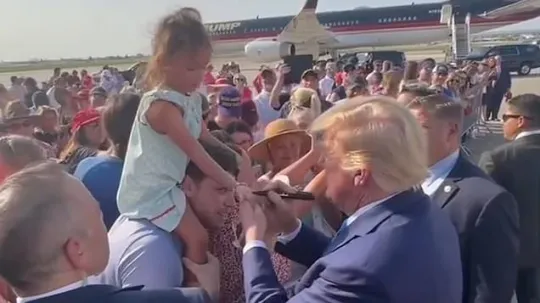
A young girl’s bewildered expression was left when former President Donald Trump signed her hand with a permanent marker.
Trump approached a metal barricade with supporters on the opposite side while he was at a campaign rally. The girl was sitting on her father’s shoulders when he reached out and shook her hand, as seen in a video posted to Twitter by PatriotTakes.
The girl’s right hand was then signed by the former president while her father and she looked on. Trump shook her father’s hand and spoke briefly with him as the daughter sat looking at her signed hand.
Trump went on to sign the white hat of another fan.
It was unclear exactly what Trump had written on the girl’s hand or if it was an autograph.
It appeared to be “Hi!” according to a Twitter user, and PatriotTakes confirmed it could be the case.
Trump has done it in the past as well.
Another video tweeted by PatriotTakes shows Trump signing another young girl’s right hand in March while seated at a table at his Mar-a-Lago estate. As Trump continued to write, her mother grinned and laughed while making the remark, “You can never shower again.”
You have no idea, Trump remarked.
Trump is infamous for signing legislation into law using a thick, permanent black marker.
The most recent signing was a lighter moment for Trump, who is now under investigation for several things that may not preclude him from running for president but may hurt his chances of winning re-election.
Despite being charged with a crime twice—once by the Manhattan district attorney for his alleged involvement in a hush payment to a porn star and once by special counsel Jack Smith for his alleged handling of sensitive information—Trump has continued to campaign.
The former president could also face a third charge after his attorneys met with Smith’s prosecutors on Thursday to discuss a grand jury investigation into the Capitol incident on January 6 and Trump and his associates’ attempts to rig the 2020 election. Trump stated last week that he anticipates being detained and indicted once more.
Trump continues to be the favourite to win the Republican nomination in 2024. The Keystone State will host his first speech since he declared his candidature at his upcoming campaign rally on Saturday night in Erie, Pennsylvania.
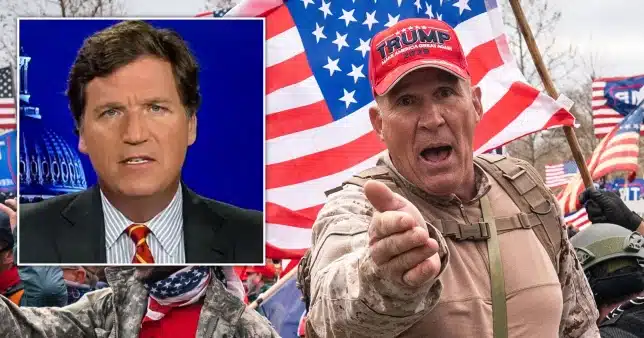
After being falsely accused of being an undercover agent who ignited the Capitol brawl, a Trump supporter sued Fox News and one of the network’s former hosts.
Ray Epps, who twice cast his ballot for the now-former President Donald Trump, filed a complaint, claiming that Fox News and its former anchor Tucker Carlson defamed him by spreading the “fantastical story” that he was a secret government agent who instigated the uprising on January 6.
The lawsuit, which was submitted on Wednesday in Delaware’s Superior Court, accuses Fox News of “creating and disseminating destructive conspiracy theories” in order to deflect responsibility for the 2021 assault from Trump and Republicans.
‘Just as Fox had focused on voting machine companies when falsely claiming a rigged election, Fox knew it needed a scapegoat for January 6th,’ states the complaint obtained by The New York Times.
‘It settled on Ray Epps and began promoting the lie that Epps was a federal agent who incited the attack on the Capitol.’
Carlson on his late-night show Tucker Carlson Tonight in July 2022 claimed without evidence that Epps was a ‘federal agent who helped stage-manage the insurrection’. The show also aired video footage of Epps urging fellow Trump fans to join him in breaching the US Capitol building.
Epps has said on 60 Minutes said that the conspiracy theory led to death threats against him and his wife Robyn and that they had to sell their business and home and move away from Arizona. He is seeking an unspecified amount in damages.
The Trump supporter’s lawsuit is the latest of numerous legal threats that have been lodged against Fox News.
Fox News and Carlson in April ‘agreed to part ways’ for nondisclosed reasons – less than a week after Fox News settled a lawsuit over its 2020 presidential election coverage.
The network agreed to pay Dominion Voting Systems more than $787million and acknowledged that some of its reporting was incorrect, including segments that enabled some Trump allies to amplify false claims of election fraud.
The valet of former president Donald Trump entered a not guilty plea in the case involving the sensitive materials in a federal courtroom in Miami.
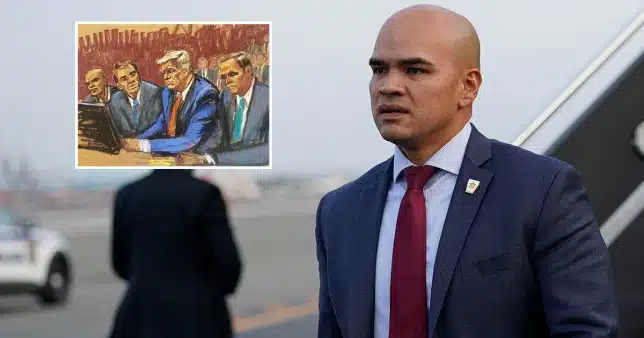
Waltine ‘Walkt’ Nauta, 40, showed up at the James Lawrence King Federal Justice Building on Thursday morning to answer charges that he helped Trump conceal secret documents that the former president took to Mar-a-Lago after leaving the White House.
Six counts, including conspiracy to obstruct justice, withholding and concealing documents, and making false statements, were dismissed when he entered a not guilty plea. When US Magistrate Judge Edwin Torres asked Nauta if he had reviewed the accusations against him, Nauta just said “yes.”
Nauta’s lawyer Stanley Woodward entered Nauta’s plea on his behalf. His attorney in Florida who is assisting in the case, Sasha Dadan, also appeared alongside him.
The arraignment took only a few minutes and Nauta and his two lawyers then went into a conference room without speaking to reporters.
Upon arriving at the courthouse, Nauta did not talk to reporters and only smiled. He wore sunglasses and a navy suit.
Prosecutors claim that Nauta hid boxes of records as Trump’s lawyers were looking for classified material that the Justice Department was seeking. Nauta also lied to investigators in an interview, according to prosecutors.
Nauta first appeared in court alongside Trump on June 13 but was not arraigned because he did not have a lawyer representing him who could practice in Florida. Trump pleaded not guilty to 37 felony charges relating to his alleged mishandling of classified documents that day.
The arraignment for Nauta was scheduled for June 27 but postponed because he did not have an attorney able to practice in Florida.
It is not clear when the trial for Trump and Nauta will start. US District Judge Aileen Cannon initially scheduled it to begin on August 14, but prosecutors requested that it be delayed until December 11.
Trump is the first former president to be hit with criminal charges in federal and state courts.
If convicted, Nauta faces up to 20 years in prison for the most serious charge.
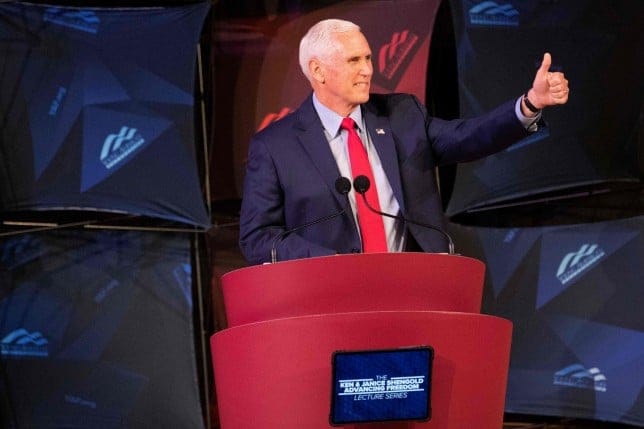
On Monday morning, Pence formally declared his presidential candidature with the Federal Election Commission.
Two days prior to his scheduled appearance at a CNN Republican presidential town hall, he filed his paperwork. On Wednesday, his 64th birthday, Pence will formally begin his campaign for president earlier in the day. The inaugural rally for Pence will take place in Des Moines, Iowa.
A major challenge for Pence, who served as Trump’s vice president, will be winning back the support of Republicans who discounted him after the tumultuous end of Trump administration.
Pence served 12 years in the House and four years as governor of Indiana, before become vice president in 2017. He broke from Trump after refusing to follow his orders to reject President Joe Biden’s victory while presiding over the 2020 Electoral College vote counting.
Pence joins a growing field for the GOP nomination. Florida Governor Ron DeSantis, who has been polling second after Trump, entered the race less than two weeks ago.
The town hall hosted by CNN anchor and chief political correspondent Dana Bash is scheduled to start 9pm ET at Grand View University in Des Moines.
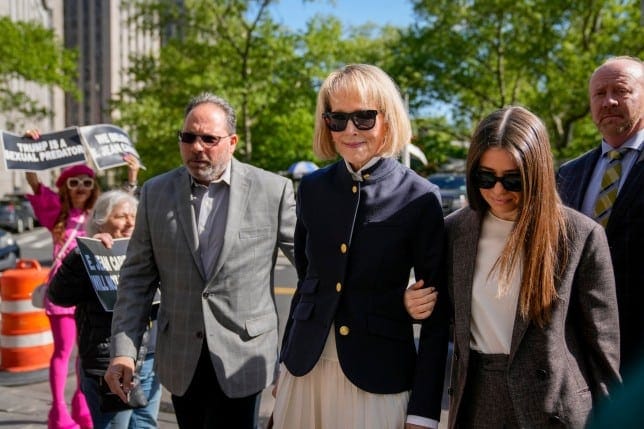
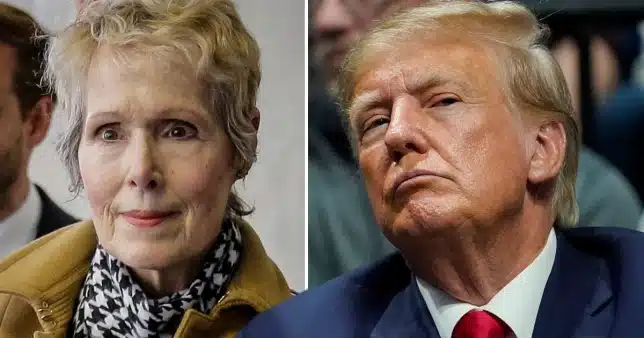
As his accuser took the witness stand again, former President Donald Trump‘s motion to declare a mistrial in his civil rape case was rejected.
On Monday morning, US District Judge Lewis Kaplan denied the motion to throw out the lawsuit filed by columnist E Jean Carroll. Trump’s attorney Tacopina said that Kaplan had rendered “pervasive unfair and prejudicial rulings” against his client.
Tacopina requested Kaplan to alternatively “correct the record for each and every instance in which the Court has mischaracterized the facts of this case to the Jury” in a letter that was submitted earlier in the day. Tacopina pleaded with the judge to “give the Defendant’s counsel more freedom to cross-examine Plaintiff and her witnesses.”
In addition, Tacopina wrote that his questions to Carroll that the judge labeled ‘argumentative’ were actually ‘well-established and accepted’ ways to conduct cross-examination.
Ex-President Donald Trump has not appeared in the rape trial (Picture: Shutterstock)
Carroll returned to the stand just after Kaplan denied the motion for a mistrial. It is her third day testifying and second day facing cross-examination. She told Tacopina that she was born in 1943 and is ‘a member of the silent generation’.
‘Women like me were taught and trained to keep our chins up and to not complain,’ said Carroll.
Tacopina asked Carroll why she decided to sue Trump and not former CBS chairman and CEO Les Moonves, whom she alleges sexually assaulting her in an elevator. Carroll unveiled accusations against Trump and Moonves in her 2019 book. Carroll responded that Trump, whom she claims raped her in a department store dressing room, called her a ‘scam’ while Moonvoes did not.
‘He didn’t call me names,’ Carroll said on Moonves. ‘He didn’t grind my face into the mud like Donald Trump did.’
Carroll in her sexual assault and defamation suit is seeking unspecified damages and for Trump to retract his comments.
Trump has not yet appeared in court for the trial and is not required to.
President Joe Biden‘s advisers are working quickly to finish personnel and operational elements of his reelection campaign before what is predicted to be a tough 19-month battle to persuade the public of his accomplishments and his potential to serve deep into his 80s.
After spending the previous weekend at Camp David, according to people with knowledge of the issue, Biden returned to the White House late on Sunday to thoroughly test-run the campaign and personnel preparations, including any decisions that still required his final approval.
But even as officials made final edits to an announcement video likely to be released Tuesday, marking four years since Biden declared himself a candidate in the 2020 presidential election, the challenges of the upcoming contest were coming into sharper view.
An NBC News poll released Sunday found just 26% of Americans think Biden should run for a second term as president, while 70% say he should not. Among Democrats, 51% say Biden should not run for a second term. That mirrors the findings of other recent polls showing tepid support for a Biden reelection bid, including an AP-NORC poll released Friday and CNN polling released earlier this month.
In the NBC poll, nearly half of those who oppose a Biden run say that his age is a major reason for that view.
Advisers are confident those numbers will mean little in the long run. Republicans – and former President Donald Trump’s candidacy in particular – have “a pretty good track record of bringing our people back home – and out to vote,” one senior Democratic official close to the White House said.
Biden’s advisers also believe his age represents decades of experience, which they say has driven legislative wins delivering tangible economic dividends across the country.
“He is a steady hand, when you look at what’s out there right now with Donald Trump and what we’re hearing again. People don’t want that chaos back again,” said Sen. Amy Klobuchar, a Minnesota Democrat, when asked by CNN’s Dana Bash about Biden’s age on “State of the Union.”
Still, at 80, Biden’s age is certain to act as a central issue in the coming campaign, a fact even many of his Democratic allies privately acknowledge.
News that Biden had decided to launch his reelection campaign this week came as a surprise to a slew of Democratic officials who had been led to believe in recent weeks that Biden was more likely to wait until the summer to announce his bid.
For weeks, Biden advisers and others close to the White House had insisted the president felt no pressure to announce this spring and was keen to allow an increasingly contentious Republican primary to play out without being in the mix as an official candidate.
But other factors also weighed on Biden’s advisers. A messy debt ceiling fight, anticipated this summer, would not be the ideal time to announce a reelection campaign. The president will travel abroad next month for summits in Japan and Australia, and he plans to travel overseas again in July for a NATO summit in Lithuania, squeezing the calendar.
And high-dollar fundraising tends to be slower during the summer months, which could affect Democratic officials’ desire to deliver a strong first quarter haul for the reelection campaign.
Advisers continued to caution that last-minute changes were possible. And while Biden has finished taping a video declaring his candidacy and outlining his argument for a second term, according to people familiar with the matter, aides warned the timing of its release could shift.
As planning for the reelection launch came into public view in recent days, the number of candidates for campaign manager rapidly narrowed from more than a half-dozen to one name.
Biden is poised to name Julie Chavez Rodriguez, a senior White House adviser, to oversee the campaign, two senior Democratic advisers told CNN on Sunday. The choice of campaign chief was among the many outstanding decisions Biden and his team were making as they prepare for the potentially imminent announcement.
Rodriguez, a senior adviser to the president and director of the White House’s Office of Intergovernmental Affairs, has seen her star rise in Biden’s White House.
Biden elevated Rodriguez to the role of senior adviser last summer, adding her to the small circle of his senior-most aides.
While Rodriguez will formally manage the campaign, the effort will also be largely guided from the West Wing, where top aides Anita Dunn, Jen O’Malley Dillon, Mike Donilon and Steve Ricchetti will also play central roles.
Rodriguez, the granddaughter of labor icon Cesar Chavez, has been a longtime Democratic adviser who is close to Biden.
CBS News was first to report the expected decision.
Biden’s final weekend before the expected announcement served as a window into the balancing act to come as he and his top national security officials navigated the complexity of a potentially perilous evacuation of government personnel from the US embassy in war-ravaged Sudan.
Biden has maintained privately that his primary focus is on carrying the duties of the job he was elected to do in 2020.
He gave the order on Saturday to deploy roughly 100 US special operations troops to secure and complete the evacuation of US personnel in Sudan. The operation was successful and no US military and diplomatic personnel were harmed in the roughly hour-long process.
It served as a real-time demonstration of how the next 19 months may unfold for the incumbent running for the White House, where there are no shortage of crises that can turn a message or campaign on its head seemingly overnight.
It also provided a window into another Biden reality, people familiar with the matter said. He will have the ultimate say in the direction of things, even if that say takes longer than some in the party would prefer. That drove some on Biden’s team to warn allies that the Tuesday announcement wasn’t locked in until Biden gave the green light.
The video had been filmed, they noted, and close advisers had accelerated their communications with party officials and donors in the lead up to the announcement. But Biden wasn’t pleased by leaks – and still had much to mull over and discuss about the shape of his nascent campaign over the course of the weekend.
The trial for an alleged rape of a columnist, which was supposed to begin this month, seems to be delayed by the former president Donald Trump.
The trial, which is set to start on April 25, centers on allegations that Trump sexually attacked columnist E Jean Carroll in a changing room at a Manhattan department shop in 1996.
However, Carroll’s lawyers made it evident that a prominent donor to the Democratic Party helped finance her lawsuit, thus Trump’s attorney Alina Habba is asking for a postponement.
The revelation that Carroll received money from American Future Republic, a social welfare organization funded by LinkedIn co-founder Reid Hoffman, puts the lawsuit’s motives and credibility into question, Habba wrote in a letter on Thursday.
Habba said the disclosure feeds into Trump’s defense calling Carroll’s accusations a ‘hoax’ and ‘con job’. Trump had also questioned if the Democratic Party was funding the suit and if Carroll brought it with a political agenda.
Carroll’s lawyer Roberta Kaplan in a letter to the court on Thursday asked the judge to deny Trump’s request for a trial delay.
‘One thing is clear – Trump will stop at nothing to avoid having a jury hear Carroll’s claims,’ wrote Kaplan.
Earlier this week, Trump’s lawyer Joe Tacopina asked for a month delay in the trial, citing some negative publicity around the ex-president’s arraignment in Manhattan Criminal Court on April 4. Trump plead not guilty to 34 felony counts around Manhattan District Attorney Alvin Bragg’s investigation into his alleged role in a hush payment to porn star Stormy Daniels.
‘Holding the trial of this case a mere three weeks after these historic events will guarantee that many, if not most, prospective jurors will have the criminal allegations top of mind when judging President Trump’s defense against Ms Carroll’s allegations,’ wrote Tacopina.
‘President Trump can only receive a fair trial in a calmer media environment than the one created by the New York County district attorney.’
Also on Thursday, the Washington, DC, Court of Appeals refused to decide if Trump can be shielded from the first of two defamation suits brought by Carroll.
The developments unfolded the same day that Trump sat for his second deposition in New York Attorney General Letitia James’ $250million civil lawsuit alleging fraud by him, his three eldest children and the Trump Organization.
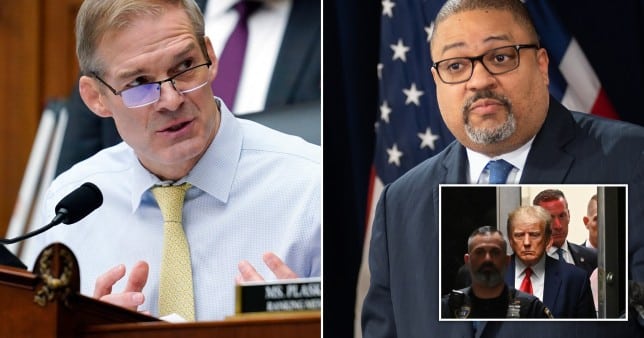
In an effort to prevent congressional Republicans from meddling in the criminal case, the Manhattan district attorney who is pursuing former President Donald Trump has filed a lawsuit against a legislator.
On Tuesday, Republican Rep. Jim Jordan of Ohio was named in a 50-page lawsuit filed in the Southern District of New York by District Attorney Alvin Bragg.
According to The New York Times, the lawsuit accuses Jordan of launching a ‘brazen and unconstitutional onslaught’ against the prosecutors looking into Trump’s hush money issue.
Jordan, the House Judiciary Committee chairman, has led a ‘transparent campaign to intimidate and attack’ on Bragg, claims the suit.
The lawsuit comes a week after Bragg unveiled 34 felony charges against Trump and the ex-president was arraigned in Manhattan Criminal Court. Trump has pleaded not guilty on all counts.
In the suit, Bragg slams Jordan and House Republicans for subpoenaing former assistant district attorney Mark Pomerantz, who was involved in the Trump probe.
‘Rather than allowing the criminal process to proceed in the ordinary course, Chairman Jordan and the committee are participating in a campaign of intimidation, retaliation and obstruction,’ states the suit.
Bragg seeks a court order barring Pomerantz from complying with the subpoena. Pomerantz resigned in early 2022, weeks after Democrat Bragg assumed the district attorney role and decided against seeking an indictment on Trump at the moment.
The subpoena marked a significant escalation in the clash between the Republican-led House Judiciary Committee and Bragg’s office. Bragg is investigating Trump’s alleged involvement in a hush payment to silence porn star Stormy Daniels’ claims of an affair with the ex-president. Bragg’s lawsuit is a tremendous effort to stop interference in the case.
Jordan responded by tweeting on Tuesday afternoon: ‘First, they indict a president for no crime. Then, they sue to block congressional oversight when we ask questions about the federal funds they say they used to do it.’
Since Trump predicted his arrest on March 18, Bragg’s office has received more than 1,000 phone calls and emails from the ex-president’s supporters including many that are ‘threatening and racially charged’, according to the suit.
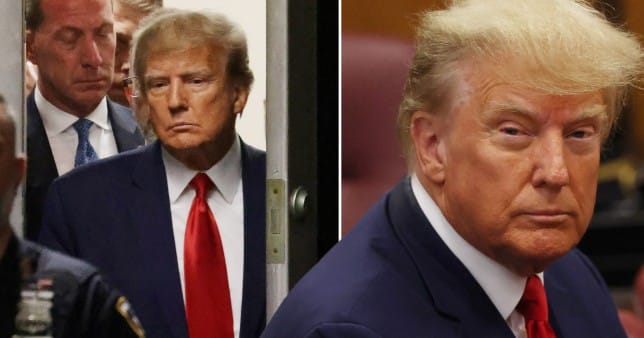
Alvin Bragg, the district attorney for Manhattan, provided more information regarding the accusations that former President Donald Trump is facing.
At Manhattan Criminal Court earlier today, Trump entered a not guilty plea to 34 counts of falsifying financial documents.
Falsifying corporate records with the aim to defraud or conceal another crime is against the law in New York, according to Bragg. 34 false statements that were made to hide additional offenses. Anyone can commit these felonies in the state of New York.
The charges against Trump relate to hush money payments the former president allegedly made to adult film star Stormy Daniels. He reportedly paid the actress for her silence through his attorney, Michael Cohen, and reimbursed him for ‘legal services.’
Manhattan District Attorney announces the 34 charges of falsifying business records against former President Donald Trump (Picture: Reuters)
‘The defendant repeatedly made false statements on New York business records. He also caused others to make false statements,’ Bragg said. ‘The defendant claimed he was paying Michael Cohen for legal services in 2017. This simply was not true.’
Bragg said the payments also violated New York and federal election laws, and accused the former president of running ‘a scheme to buy and suppress negative information to help Mr Trump’s chances in the election.’
Bragg said Trump and Cohen did this by running a ‘catch and kill’ scheme, in which various shell companies bought and suppressed negative stories about Trump before they were widely reported.
‘New York state election law makes it a crime to conspire or promote a candidacy by unlawful means,’ Bragg said.
What is Trump charged with and what’s next?
WHAT’S THIS CASE ABOUT?
The grand jury spent weeks investigating money paid during Trump’s 2016 presidential campaign to two women who alleged that they had extramarital sexual encounters with him.
Trump has denied the allegations.
His former lawyer Michael Cohen, who testified as a key prosecution witness, paid Daniels $130,000 through a shell company he set up and was then reimbursed by Trump, whose company logged the repayments as legal expenses.
Earlier in 2016, Cohen also arranged for former Playboy model Karen McDougal to be paid $150,000 by the publisher of the supermarket tabloid the National Enquirer, which squelched her story in a journalistically dubious practice known as ‘catch and kill’.
WHAT’S AN INDICTMENT?
An indictment is the formal charge brought against someone after a grand jury — which is made up of members of the community — votes and enough members agree there’s sufficient evidence to charge someone with a crime.
The indictment against Trump remains sealed, as is standard in New York before an arraignment. But once the document is made public, it will lay out the crime or crimes that Trump is accused of committing.
Sometimes indictments include a lengthy narrative with lots of details about the allegations, while others are more basic and just outline the charges a defendant is facing.
WHAT ARE THE CHARGES?
Trump is facing multiple charges of falsifying business records, including at least one felony offense, according to two people who spoke on condition of anonymity to discuss information that isn’t yet public.
Under the law, prosecutors must prove there was an ‘intent to defraud’.
The felony falsifying business records offense requires prosecutors to prove that the records were falsified with the intention of committing, aiding or concealing a second crime.
It’s not clear yet what prosecutors allege the second crime to be, but experts have said it is probably some kind of campaign finance violation.
WHAT’S AN ARRAIGNMENT?
An arraignment is generally the first time a defendant appears in court after being charged.
The judge will tell Trump the charges against him and advise him of his right to go to trial and other things.
Trump will enter a plea of not guilty — as is standard for defendants to do at arraignment. The indictment is expected to be unsealed upon his arraignment.
Trump is expected to walk out of the courtroom because the charges against him don’t require that bail be set in New York.
It’s possible — but unlikely — that Judge Juan Merchan could decide that Trump is a flight risk and order him held, with or without bail, though Trump’s lawyers would vigorously fight that.
WHAT WILL TRUMP’S DEFENSE BE?
Trump’s lawyers have vowed to ‘vigorously fight this political prosecution in court’.
Defense attorney Joe Tacopina has described Trump as a victim of extortion who had to pay the money because the allegations were going to be embarrassing to him. But he says it had nothing to do with the campaign.
Trump will no doubt try to fight the case on multiple fronts. He may try to have the case moved out of Manhattan or New York City entirely — arguing he can’t get a fair trial there — though it’s rare for judges to agree to do that.
Trump may also argue that the statute of limitations has passed.
He has complained that the statute of limitations ‘long ago expired’ because the hush money payments and Cohen’s reimbursements happened more than six years ago.
New York’s statute of limitations for most felonies is five years. For misdemeanors, it’s just two years. But in New York, the clock can stop on the statute of limitations when a potential defendant is continuously outside the state.
Trump visited New York rarely over the four years of his presidency and now lives mostly in Florida and New Jersey.
WHAT ARE THE POLITICAL RAMIFICATIONS FOR TRUMP?
Neither the indictment itself nor a conviction would prevent Trump from running for or winning the presidency in 2024.
Already, the charges have been a boon to his fundraising. The campaign announced Friday evening that it had raised over $4 million in the 24 hours after the indictment became public, far smashing its previous record after the FBI search of Trump’s Mar-a-Lago club.
Trump’s team over the weekend blasted out emails full of supportive comments from dozens of top Republicans, many of whom had already been supportive of him leading up to the indictment.
Those likely to be facing off with Trump in next year’s GOP primary contests have also slammed the prosecution.
Former Vice President Mike Pence called the indictment ‘an outrage’ and ‘nothing more than a political prosecution’.
Former South Carolina Governor Nikki Haley said on Twitter that the indictment ‘is more about revenge than it is about justice’.
Biotech investor Vivek Ramaswamy, who is also seeking the GOP presidential nomination, called the indictment ‘a dark moment in American history’.
Florida Governor Ron DeSantis on Saturday accused District Attorney Alvin Bragg of weaponizing the law ‘for political purposes’ to bring a case against a former president, never mentioning Trump by name.
‘True and accurate business records are important everywhere, to be sure. But they are all the more important in Manhattan – the financial center of the world.’
Bragg also said his office was very familiar with prosecuting charges of falsifying business records, calling it the ‘bread and butter of our white collar work.’
According to Bragg, the charge has been used to prosecute cases where defendants violated bank secrecy laws, covered up sex crimes, and committed tax fraud.
‘Fraud presents itself in all different forms in Manhattan,’ Bragg said. ‘At its core, this case today is one with allegations like so many of our white collar cases. Allegations that someone lied again and again to protect their interests and evade the laws to which we are all held accountable.’
Before being charged with a crime in the hush money case, which is scheduled to take place on Tuesday, former President Donald Trump was seen leaving his Mar-a-Lago residence and boarding a plane for New York.
As it made its way to an airport in Palm Beach, Florida, soon after noon on Monday, Trump’s motorcade passed the entrance to his hotel. On the way out of the resort and along a road, about six black automobiles were seen traveling.
A person familiar with the former president’s travel arrangements told CNN that he is scheduled to arrive at Queens’ LaGuardia Airport around 3pm. After his court appearance, according to the source, Trump intends to fly back to Florida.
Trump on Sunday night wrote on his Truth Social platform: ‘I will be leaving Mar-a-Lago on Monday at 12 noon, heading to Trump Tower in New York.’
Trump leaves Mar-a-Lago for his plane to New York to face criminal charges
He added: ‘On Tuesday morning I will be going to, believe it or not, the Courthouse. America was not supposed to be this way!’
Trump is expected to surrender to law enforcement in lower Manhattan early this week. He will be the first ex-president in US history to face criminal charges.
He faces about 30 charges for his alleged role in a $130,000 payment his former lawyer Michael Cohen made to porn star Stormy Daniels to silence her claims of an affair with Trump. The exact charges are not yet known.
Trump’s lawyer Joe Tacopina said he did not know how Tuesday could unfold.
‘This is unprecedented. I don’t know. I’ve done a million arraignments in that courthouse with celebrities and whatnot. But this is a whole different thing. We have Secret Service involved,’ Tacopina told ABC News’ This Week anchor George Stephanopoulos.
‘I understand they’re closing the courthouse for the afternoon. I just don’t know what to expect to see.’
Trump is planning to give a speech back at Mar-a-Lago on Tuesday evening after his arraignment.
A Manhattan grand jury voted on Thursday to indict Trump.
According to reports, the grand jury investigating the hush money scandal involving former President Donald Trump is taking a one-month break. As a result, any indictment would most likely occur in late April at the earliest.
Due in large part to a previously scheduled break, the jurors are not anticipated to hear testimony regarding Trump’s alleged involvement in a hush payment to a porn star for the ensuing month, a source with knowledge of the proceedings told Politico on Wednesday.
Panelists are set to consider evidence in another case on Thursday, after not meeting on Wednesday, the source said. They are slated to convene on a different case on Monday and Wednesday of next week and will be off on Thursday for the Passover holiday. A break for the two weeks following was reportedly programmed back when the jurors first convened in January.
Bragg is investigating any involvement the ex-president had in a $130,000 payment his former personal lawyer Michael Cohen made to silence porn star Stormy Daniels on an alleged affair with Trump.
The grand jury generally meets on Mondays, Wednesdays and Thursdays. They last met on Monday of this week and heard testimony from former National Enquirer publisher David Pecker.
Several of the grand jury’s hearings on Trump’s case have been canceled since the ex-president announced on social media March 18 that he expected to be arrested. Jurors have convened on the case only the past two Mondays.
A spokesperson for Bragg’s office declined to comment to Politico on the apparent monthlong break from the Trump hush money case.
There were recent signs that the grand jury was getting close to voting on whether to indict Trump, especially when they offered him the chance to testify. But there is no deadline to indict Trump.
Some of the thousands of people accused of storming government buildings in an effort to overturn the results of the October election, which former President Jair Bolsonaro lost, have received their first charges from Brazil’s prosecutor-general.
The 39 defendants accused of ransacking Congress were also asked to have 40 million reals ($7.7 million) in assets frozen as a preventive measure and to be imprisoned, according to the prosecutors in the recently established group to combat anti-democratic acts.
The defendants have been charged with armed criminal association, violent attempt to subvert the democratic state of law, staging a coup and damage to public property, the prosecutor general’s office said in a written statement. Their identities have not yet been released.
More than 1,000 people were arrested on the day of the January 8 riot, which bore strong similarities to the January 6, 2021 riots at the US Congress by mobs who wanted to overturn former President Donald Trump’s loss in the November 2020 election.
Rioters who stormed through the Brazilian Congress, presidential palace and Supreme Court in the capital, Brasilia, sought to have the armed forces intervene and overturn Bolsonaro’s loss to President Luiz Inácio Lula da Silva.
The rioters “attempted, with the use of violence and serious threat, to abolish the democratic rule of law, preventing or restricting the exercise of constitutional powers”, according to an excerpt of charges included in a statement. “The ultimate objective of the attack … was the installation of an alternative government regime.”
The attackers were not charged with “terrorism” because under Brazilian law such a charge must involve xenophobia or prejudice based on race, ethnicity or religion.
The prosecutor-general’s office sent its charges to the Supreme Court after the Senate’s president, Rodrigo Pacheco, last week provided a list of people accused of rampaging through Congress. Additional rioters are expected to be charged.
Second Brazilian arrested for anti-Lula bomb plot
On Tuesday, Brazilian police said they arrested a second suspect in a truck bomb attempt that failed just a week before Silva’s inauguration.
The first suspect was arrested on Christmas Eve after the driver of the truck found the device near the airport in the capital Brasilia, where the inauguration happened a week later.
Police said there had been a failed attempt to activate the device.
The first suspect, identified as George Washington de Oliveira Sousa, is a Bolsonaro supporter and told police he wanted to “prevent the establishment of communism in Brazil” under Lula, police said.
An alleged accomplice, Alan Diego dos Santos Rodrigues, 32, has been wanted ever since and handed himself over to police on Tuesday in the state of Mato Grosso.
Meanwhile, Lula has removed 40 troops guarding the presidential residence after expressing distrust in the military for failing to act against demonstrators who ransacked the government buildings.
Most of the troops guarding the Alvorada Palace, as the residence is called, are from the army, but some are also members of the Navy, Air Force and a militarised police force.
Last week, Lula told reporters that security force members were complicit in letting the mob storm the main buildings that form the seat of power in Brasilia.
The establishment of a subcommittee to look into the alleged “weaponization” of government was approved by theUS House of Representatives.
The United States House of Representatives, which is controlled by Republicans, voted on Tuesday to open an inquiry into what they refer to as Democratic President Joe Biden’s “weaponization” of the federal government. Democrats, on the other hand, have called it a partisan fishing trip.
Republicans have pledged to use their new majority to investigate former Republican President Donald Trump and his supporters who stormed the US Capitol on January 6, 2021. These investigations were conducted by the US Justice Department, the Federal Bureau of Investigation (FBI), and other federal agencies.
The party-line vote on Tuesday aims to do just that, setting up a “Select Subcommittee on the Weaponization of the Federal Government”. The body is set to launch a wide-ranging probe of Democrat Biden’s administration, which Republicans accuse of “weaponizing” the FBI against Trump.
Republicans will also investigate claims that the Biden administration has pressured big tech companies to censor views that run contrary to White House policy. The bill establishing the panel said legislators would probe how the executive branch works with the private sector, nonprofit groups and other agencies “to facilitate action against” American citizens.
“We need to get to work now,” Republican James Comer, head of the Oversight Committee, said in a speech on the House floor. “We must expose the abuses committed by the unelected, unaccountable federal bureaucracy.”
Among the federal agencies pinpointed are those looking into Trump’s attempt to overturn his 2020 defeat and alleged mishandling of classified documents. Trump has dismissed these probes as “witch hunts”.
Days after the August search of Trump’s Mar-a-Lago resort for classified material, Republican Representative Elise Stefanik promised to launch a probe of “Joe Biden and his administration’s weaponization of the Department of Justice and FBI”.
“The FBI raid of President Trump is a complete abuse and overreach of its authority,” she said.
Democrats have raised concerns about a provision that authorises the committee to probe “ongoing criminal investigations”, which are generally outside the purview of congressional oversight.
“This is a violation of separation of powers, and it’s also very dangerous,” said Jerrold Nadler, the top Democrat on the Judiciary Committee.
On Monday, the White House said that lawyers for Biden found classified documents at a Washington, DC-based think tank affiliated with the president.
Some Republicans compared that discovery to the criminal investigation into Trump’s removal of classified documents from the White House, though smaller numbers of papers are involved. Biden’s team said it turned the documents over upon discovery, while Trump resisted calls to return the paperwork and now faces an investigation into whether he obstructed justice.
Legal experts said federal law enforcement agencies would almost certainly reject any attempt by a congressional committee to obtain documents related to ongoing investigations.
Scott Perry, a Republican Judiciary Committee member whose phone was seized as part of the federal probe into efforts to overturn the 2020 election, is among those who might seek a subcommittee seat. That would create a situation where he could seek to oversee a federal investigation into himself.
Republican Representative Brian Fitzpatrick, a former FBI agent, told the Reuters news agency he supported the creation of the subcommittee.
But, he added, handing over information on an active investigation was “inconsistent with federal law”.
US congressional investigation into the Capitol riot last year has revealed that, former President Donald Trump should be charged with crimes such as insurrection.
The justice department should bring charges against Mr. Trump, was the unanimous vote of the Democratic-led committee.
A fresh video of former Trump aide Hope Hicks warning him about his legacy was also shown on the panel.
On January 6, 2021, Trump supporters stormed Congress and prevented Joe Biden from being sworn in as president.
Trump, who insists he did nothing wrong, attacked the panel in a statement, calling it a “kangaroo court.”
After spending around 18 months investigating the riot, the House of Representatives select committee recommended at their final meeting on Monday that Mr Trump face four charges:
The justice department – whose prosecutors are already considering whether to charge Mr Trump – does not have to follow a congressional committee’s referral.
While the panel’s actions are mostly symbolic, the chairman described the proposed charges as a “roadmap to justice”.
A justice department spokesman declined to comment on Monday about the referral.
“An insurrection is a rebellion against the authority of the United States,” said congressman Jamie Raskin, a Maryland Democrat who serves on the committee.
“It is a grave federal offence, anchored in the Constitution itself.”
The panel’s seven Democrats and two Republicans released their preliminary 161-page executive summary on Monday.
The House committee has argued Mr Trump spread claims that he knew were false about the 2020 presidential election being stolen, before pressuring state officials, the justice department and his own vice-president to help overturn his defeat. The panel accuses him of inciting the riot at Congress in a last-ditch bid to block the peaceful transfer of power to Mr Biden.
The full report, spanning hundreds of pages, is due to be released on Wednesday.
On Monday, the panel also released a new video from their deposition with longtime Trump aide Hope Hicks, who said she had warned Mr Trump that by continuing to make false claims about the election, he and his team were “damaging his legacy”.
Mr Trump had shrugged off her concern, she said.
The then-Republican president, she testified, “said something along the lines of, ‘Nobody will care about my legacy if I lose, so that won’t matter.
“‘The only thing that matters is winning.’”
The committee also criticised the president’s eldest daughter Ivanka Trump, a former White House aide, for not being “forthcoming” with investigators.
Ms Trump and White House press secretary Kayleigh McEnany “displayed a lack of full recollection of certain issues, or were not otherwise as frank or direct” as other aides to Mr Trump, the report said.
Mr Trump’s presidential campaign, which he launched last month, released a statement accusing the committee of holding “show trials by Never Trump partisans who are a stain on this country’s history”.
“This Kangaroo court has been nothing more than a vanity project that insults Americans’ intelligence and makes a mockery of our democracy.”
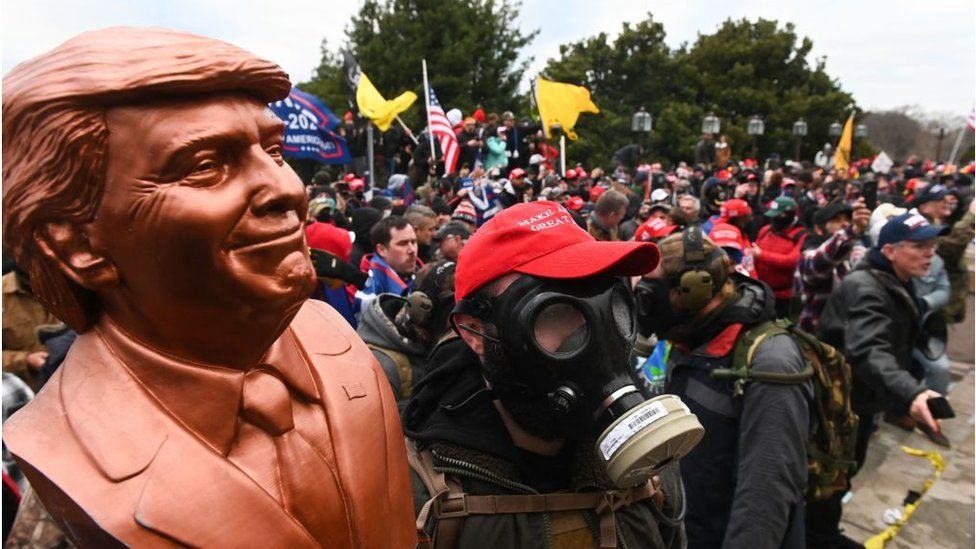
IMAGE SOURCE,GETTY IMAGES Image caption, A Trump bust being held up during the day of the riot at the US Capitol
The committee also said it would refer four Republican members of Congress to the House ethics committee, including Republican leader Kevin McCarthy, for failing to comply with the committee.
“If we are to survive as a nation of laws and democracy, this can never happen again,” said committee chairman Bennie Thompson, a Mississippi Democrat.
The US is stepping up its efforts to slow down China’s development in the semiconductor sector, which is essential for everything from smartphones to military equipment.
Washington announced some of the broadest export controls yet in October, mandating licences for firms exporting chips to China made with US tools or software, regardless of where in the world they were produced.
Washington’s regulations also forbid US citizens and people with green cards from working for specific Chinese chip manufacturers. Permanent residents of the US with a green card are permitted to work there.
It is severing a vital conduit for American talent to travel to China, which will have an impact on the advancement of high-end semiconductors.
Why is the US doing this?
Advanced chips are used to power supercomputers, artificial intelligence and military hardware.
The US says China’s use of the technology poses a threat to its own national security.
Alan Estevez, undersecretary at the US Commerce Department announced the rules, saying his intention was to ensure the US was doing everything it could to prevent “sensitive technologies with military applications” from being acquired by China.
“The threat environment is always changing and we are updating our policies today to make sure we’re addressing the challenges,” he said.
Meanwhile, China has called the controls “technology terrorism”.
Countries in Asia that produce chips – such as Taiwan, Singapore and South Korea – have raised concerns about how this bitter battle is affecting the global supply chain.
And there were three significant developments in the chip conflict over the past week.
More Chinese firms on ‘entity list’
The Biden administration has added 36 more Chinese companies, including major chipmaker YMTC to Washington’s “entity list”.
It means American companies will need government permissionto sell certain technologies to them, and that permission is difficult to secure.
The US restrictions have broad implications. Last week, UK-based computer chip designer Arm confirmed that it was not selling its most advanced designs to Chinese firms including tech giant Alibaba because of US and UK controls.
Arm said it was “committed to adhering to all applicable export laws and regulations in the jurisdictions in which it operates.”
China complains to WTO
China has filed a complaint against the US with the World Trade Organization (WTO) over its export controls on semiconductors and other related technology.
This is the first WTO case Beijing has brought against the US since President Joe Biden took office in January 2021.
In its WTO filing, China alleged that the US is abusing export controls to maintain “its leadership in science, technology, engineering and manufacturing sectors”.
It added that US actions threatened “the stability of the global industrial supply chains”.
The US said in response that the trade body was “not the appropriate forum” to settle concerns related to national security.
US Assistant Secretary of Commerce for Export Administration Thea Kendler said “US national security interests require that we act decisively to deny access to advanced technologies.”
The complaint specifies that the US has imposed restrictions on the export of approximately 2,800 Chinese goods, but only 1,800 of these were allowed under international trade rules.
The United States has 60 days to try to resolve the matter. If not, China will be allowed to request for a panel to review its case.
Earlier this month, the WTO ruled that US tariffs on steel and aluminium that were imposed by the US under former President Donald Trump violated global trade rules.
Two-thirds of all the goods China sells to the US are subject to tariffs.
The US said it “strongly rejects” the ruling and has no intention of removing the measures.
Talks with Japan and the Netherlands
Japan and the Netherlands could possibly impose export controls on China – limiting the ability of Japanese and Dutch companies to sell advanced products to the Chinese market.
On Monday, White House national security advisor Jake Sullivan said the US had discussions with the two major suppliers of chip making equipment around adopting similar US controls on Beijing.
“I’m not going to get ahead of any announcements,” Mr Sullivan told reporters. “I will just say that we are very pleased with the candour, the substance and the intensity of the discussions.”
The US controls do not only target chipmakers. They also affect manufacturers of chip making equipment.
Big companies in Japan or the Netherlands could lose out on a large and lucrative buyer of their high end machines.
Peter Wennink, the chief executive of Dutch chip equipment maker ASML Holding NV, questioned if the Netherlands should restrict exports to China.
Mr Wennink said that the Dutch government, in response to US pressure, had already stopped ASML from selling its most advanced lithography machines to China since 2019.
“Maybe [the US thinks] we should come across the table, but ASML has already sacrificed,” he told Dutch media.
A U.S. official confirmed to CBS News that representatives of former President Donald Trump notified the FBI after discovering additional potentially sensitive documents in a West Palm Beach, Florida, storage facility.
More than 300 documents with classified markings have been discovered at Trump properties so far this year, and two more were found inside a sealed box. The FBI has been given access to the documents.
The information is the first to suggest that Trump properties may have housed or may have held classified materials.
The searches by Trump representatives were conducted around Thanksgiving at three other locations — the former president’s golf club in Bedminster, New Jersey, Trump Tower in New York and in a storage facility at Mar-a-Lago in Florida — according to The Washington Post, which first reported the story.
It comes at a time of growing legal peril for the former president.
The FBI seized 33 boxes of records on Aug. 8 during the execution of a search warrant at Mar-a-Lago, including records that were supposed to be in the hands of the National Archives.
Last month, the Justice Department appointed special counsel Jack Smith to oversee the growing probe into those documents.
Trump has downplayed the importance of the seizures, but critics say his alleged mishandling of the records could have allowed highly sensitive material to fall into the wrong hands.
“The disregard and disdain for legal norms and rules simply cannot be accepted from anyone,” said Democratic Sen. Richard Blumenthal. “No one is above the law.”
Nearly one week after the US midterm elections, the race for control of the lower chamber of Congress remains tight.
Republicans must win at least 218 seats to retake control of the House of Representatives, a task that has become increasingly difficult.
According to CBS News race projections, the party has currently won 214 seats, while Democrats have won 210.
Meanwhile, Democrats retained control of the Senate, the upper chamber of Congress.
The Biden administrationhad feared that a loss of power in Congress would bring the president’s agenda to a halt.
If the two parties split control of Washington, Democrats will “maintain our positions” but voters should not “expect much of anything”, President Biden said on Monday.
Speaking to reporters in Indonesia, where he is attending the G-20 summit, Mr Biden said the results had “sent a very strong message around the world that the United States is ready to play” and wants to remain “fully engaged in the world”.
He noted there was “a strong rejection” of election denialism, political violence and voter intimidation. But he warned that, without a majority in the House, Democrats would be unable to codify abortion rights through legislation, a key priority for liberal voters.
Out of the 11 House races that still remain to be called, most are in western and southwestern states, including California and Arizona.
The latter’s race for governor is also too close to call, with Republican Kari Lake – a chief proponent of false claims that the 2020 election was stolen from Donald Trump – trailing Democrat Katie Hobbs.
A loss for Ms Lake would see her join the ranks of pre-eminent Trump-backed election deniers who lost last week. But a BBC News tally of results found at least 125 election deniers have won races for the House, Senate and governorships.
Newly elected members of Congress, including the first lawmaker from Generation Z and the first openly gay Republican, have already begun arriving in Washington for orientation.
History suggests the party controlling the White House usually loses seats in a midterm election, and Democrats’ performance this year is considered the best for a sitting party in at least 20 years.
That has endangered leadership bids for the top Republicans in the Senate and House ahead of the party’s internal elections on Tuesday.
House Minority Leader Kevin McCarthy – who hopes to succeed Nancy Pelosi as Speaker in the next Congress – and Senate Minority Leader Mitch McConnell are both reportedly scrambling to garner support from their colleagues.
Divisions within the party have been on full display in recent days as former President Donald Trump,who has received some of the blame for a poor showing, prepares to launch another presidential run later this week.
Nancy Pelosi has statedthat the violent attack on her husband has left her “heartbroken and traumatised.”
The speaker of the United States House of Representatives said her family was “grateful for the quick response of law enforcement” and for his medical care.
A male assailant struck Paul Pelosi with a hammer at the couple’s San Francisco home on Friday.
The 82-year-old’s condition “continues to improve” after the attack, Mrs Pelosi said.
He suffered a fractured skull and injuries to his right arm and hands, and remains in hospital receiving “life-saving” care, she said.
The suspect, David Depape, 42, is said to have demanded to see Mrs Pelosi – stoking fears about political violence in the run-up to the 8 November midterm elections.
The speaker – who was on the other side of the country in Washington DC at the time of the assault – flew back to see her husband in hospital.
In her statement, she said prayers and warm-wishers were comfort and were helping Mr Pelosi’s recovery.
Police officers responded to a call at around 02:27 local time (09:27 GMT) on Friday.
They found Mr Pelosi and the suspect struggling over a hammer,but it was wrested from Mr Pelosi by the intruder, who violently assaulted him with it.
The suspect was tackled and disarmed by officers. He had attempted to tie up Mr Pelosi “until Nancy got home”, law enforcement sources told CBS News. He reportedly shouted “where’s Nancy?” during the incident.
He is also facing charges of assault with a deadly weapon, burglary, and several other felonies.
Mrs Pelosi, also 82, is one of the most powerful politicians in the country. She was re-elected to a fourth term as Speaker of the House of Representatives in 2021, making her second in line to the presidency, after Vice-President Kamala Harris.
The Baltimore native has represented the San Francisco area in Congress since 1987 and typically splits her time between California and Washington DC.
She is currently fundraising and campaigning with Democrats around the country ahead of the midterm elections.
Paul Pelosi is the multimillionaire founder of a venture capital firm and lives primarily in San Francisco, where he was born and raised.
The couple has been married since 1963 and have five children.
Members of Congress have been on high alert over security threats since the riot at the US Capitol in January 2021.
Mrs Pelosi’s office in the building was ransacked by supporters of then-President Donald Trump during the riot.
US President Joe Biden has condemned the attack on Paul Pelosi and said “enough is enough” when it comes to violence in politics.
A high-profile Republican Senate candidate running on an anti-abortion platform is facing allegations from a second woman that he paid for her abortion.
Herschel Walker, a former American football star, hopes to unseat Georgia’s Democratic incumbent in the midterm elections next month.
The latest accuser called him “a hypocrite” unfit to be a US senator.
The ex-NFL star has denied both claims, calling the latest one “foolishness”.
Mr Walker, backing former US President Donald Trump, is running neck and neck with Democrat Raphael Warnock in November’s mid-term race.
The second woman spoke anonymously to reporters over Zoom, saying Mr Walker pressured her into ending her pregnancy. Neither woman has revealed her identity publicly.
The woman, who is being named by her lawyer only as “Jane Doe”, told reporters on Wednesday that she had a years-long relationship with Mr Walker while he was married and that he had driven her to a clinic.
She did not appear on camera during the virtual news conference in Los Angeles.
“He had publicly taken the position that he is about life and against abortion under any circumstance, when in fact he pressured me to have an abortion and personally ensured that it occurred by driving me to the clinic and paying for it,” she said.
Her lawyer, Gloria Allred, cited exhibits including alleged love letters, a 1992 voicemail, and a hotel receipt that proved the two had a relationship in the late 1980s and 1990s. The BBC has not inspected the purported evidence.
Speaking at a campaign event in Dillard, Georgia, just before the news conference, Mr Walker – who has staked out a strong anti-abortion stance – called the latest accusation a “lie”.
“I’m done with this foolishness,” he said. “I already told people this is a lie, and I’m not going to entertain, continue, to carry a lie along.”
“And I also want to let you know that I didn’t kill JFK either,” he joked, accusing the Democrats of politically dirty tricks against him.
The new accuser, who says she is an independent voter that supported Donald Trump, said she became pregnant in 1993 by Mr Walker while he was playing for the Dallas Cowboys.
She said Mr Walker “encouraged” and gave her money to have an abortion, but after she became emotional on her first visit to the clinic to complete the procedure, he returned with her the following day and “waited for hours in the parking lot until I came out”.
“I was devastated because I felt like I was pressured into having the abortion,” she said.
Earlier this month, Mr Walker denied a claim from another anonymous woman that he had pressured her and paid for her to get an abortion in 2009.
Mr Walker is challenging the incumbent, Mr Warnock, a pastor at Ebenezer Baptist Church in Atlanta who supports abortion. The extremely close race could determine which party controls the US Senate after next month’s elections.
Warnock campaign spokeswoman Rachel Petri said in a statement on Wednesday: “Today’s new report is just the latest example of a troubling pattern we have seen play out again and again and again.”
Mr Warnock has himself been assailed over reports his church was evicting low-income tenants from apartments it owns, and that he ran over his ex-wife’s foot in a car during a domestic dispute.
Bannon, 68, was indicted last year over his refusal to co-operate with the congressional committee probing the events leading up to the Capitol riot.
The former White House chief strategist is said to have been an unofficial adviser to Mr Trump at the time of the insurrection on 6 January 2021.
He faces up to two years in jail and up to $200,000 (£167,000) in fines.
Speaking to reporters outside court, Bannon vowed to have the case reversed on what his lawyer called a “bullet-proof appeal”.
“We may have lost the battle here today, but we’re not going to lose this war,” he said.
His sentencing has been set for 21 October.
Lawyers with the US Department of Justice had argued that Bannon felt “above the law” by ignoring a “mandatory” legal summons from the congressional committee investigating the 6 January breach of the US Capitol.
“Our government only works if people show up, it only works if people play by the rules, and it only works if people are held accountable when they do not,” prosecutor Molly Gaston said during closing statements.
“The defendant chose allegiance to Donald Trump over compliance with the law.”
Despite vowing to go “medieval” on his enemies, Bannon’s defence team rested its case on Thursday without him testifying and without calling any other witnesses.
Attorneys argued the trial against Bannon was an act of political retribution.
They asserted that, rather than ignoring the subpoenas, he believed he was negotiating on them, and also believed the deadlines in the summons were flexible, not fixed.
In closing statements, defence lawyer Evan Corcoran told the court the path his client took “turned out to be a mistake”, but “was not a crime”.
The 12-member jury panel deliberated for just under three hours on Friday before reaching its verdict.
Bannon was a key player in former President Donald Trump‘s 2016 election win, serving first as his campaign chief and later taking on the role of chief strategist at the White House.
He left that position amid political fallout from a violent far-right rally in Charlottesville, Virginia, in August 2017. But the podcaster is still considered a top ally of Mr Trump.
The House of Representatives select committee investigating the Capitol riots first issued a legal summons to Bannon in September 2021.
The panel has long believed he was involved in efforts by Trump supporters to storm Congress and challenge the outcome of the 2020 presidential election.
It is particularly interested in Bannon’s communications with Mr Trump before the incident, as well as “war room” meetings held at a nearby hotel with other key figures, allegedly as part of a last-ditch attempt to thwart the certification of Joe Biden’s election win.
The day before the attack, he declared on his podcast that “all hell is going to break loose tomorrow”.
But Bannon proclaimed his innocence and defied the subpoenas, saying he would turn it into a “misdemeanour from hell” for the Biden administration.
He also maintained his conversations with the former president were covered by executive privilege, a legal principle that holds communications between presidents and their advisers to be protected from disclosure in order to allow for candid advice.
A judge, however, ruled he could not claim privilege in this case.
The January 6 committee lauded Friday’s verdict as “a victory for the rule of law and an important affirmation of the Select Committee’s work”.
Its statement continued: “Just as there must be accountability for all those responsible for the events of January 6th, anyone who obstructs our investigation into these matters should face consequences. No-one is above the law.”
The new communications director for the Republican Senate nominee in Nevada — a key state that could determine control in Washington — marched to the US Capitol on January 6, 2021, with two members of the far-right extremist group the Oath Keepers including one who was later charged with sedition and another with breaking into the Capitol and at least two others who were charged for illegally entering the building, according to videos reviewed by CNN’s KFile.
Courtney Holland, a Nevada-based political activist who does not appear to have entered the Capitol building herself and has not been charged with crimes related to January 6, was named Adam Laxalt’s top spokeswoman in early July. Laxalt is running against Democratic Sen. Catherine Cortez Masto and the race is considered a toss up.
Holland traveled to Washington, DC, for the January 6, 2021, “Stop the Steal” rally where she was listed as a speaker for a rally to be held near the Capitol following then-President Donald Trump’s speech near the White House. That second rally did not take place as scheduled. She had previously spoken at a November event in Washington, DC, and was photographed with several “Stop the Steal” organizers who also spoke. The “Stop the Steal” movement believes Trump’s lies that the 2020 election was stolen from him.
Early on the morning of January 6, Holland walked with a group to the main rally, which featured Trump, according to a video in a since-deleted tweet on her account archived on the Internet Wayback Machine. The group included three other speakers listed for the rally near the Capitol.
Following Trump’s rally, Holland was part of a group that now-included four other scheduled speakers for the second rally that made their way toward the Capitol guided by three Oath Keepers, according to videos and photos reviewed by CNN’s KFile. Holland said in a statement to CNN on Tuesday that she did not know the men, describing them as “security.” Two of those Oath Keepers, Kenneth Harrelson and Jason Dolan, have since been charged by the Department of Justice for their role in the Capitol attack. Also walking with Holland was Dr. Simone Gold, an anti-vaccine doctor who pleaded guilty in March to entering the Capitol and was recently sentenced to 60 days in jail, and John Strand, a co-defendant in her case who has pleaded not guilty.
There is no indication Holland herself entered the Capitol. Pictures posted by amateur sleuths last year tracking Capitol rioters appear to show Holland in a restricted area in front of the Capitol. Holland later repeatedly downplayed the attack, retweeting false claims suggesting the riot was the work of the far-left group Antifa and a tweet calling the protest “the largest civil rights protest in history.”
Holland told CNN in her Tuesday statement that she went to Washington expecting to attend a “peaceful gathering.” She said she did not know the Oath Keepers who led her to the second “Stop the Steal” event that was supposed to take place near the Capitol. Holland said she has never been subpoenaed, questioned, or accused of wrongdoing and called the riot “an unfortunate day in our country’s history.”
“Like thousands of others I attended the event, with expectations of a peaceful gathering. Event organizers asked me and many others to speak at a permitted area behind the Capitol and provided us with what we were told was event security, who we did not know, to reach the area. Upon reaching the permitted area, I became aware that the situation was deteriorating and decided to leave the Capitol complex to return to my hotel. I intended to speak at a peaceful rally, similar to a previous event held in November. Once it became clear what was happening, I left,” Holland said.
Guided by far-right militia members
Videos on social media and YouTube show Holland marching to the Capitol with her hand on Harrelson’s shoulder. The group appears to be led at points by an unidentified man in a blue blazer wearing an Oath Keepers sweatshirt. The group walked in a “stack” formation that the Department of Justice said the Oath Keepers used to move through crowds on January 6, 2021.
The FBI explained the Oath Keepers’ use of stack formations in a criminal complaint against Harrelson, which does not reference Holland or her group’s walk to the Capitol. “One defining feature of this formation is that members keep their hands on the backs or vests of the person in front of them to remain together while entering a room or weaving through a crowd,” they wrote in the complaint, which includes a photo of a different group of Oath Keepers marching in that formation outside of the Capitol building. “The purpose of maintaining direct physical contact with one another is to efficiently communicate with one another, especially in crowded or noisy areas.”
One video — from the amateur sleuth YouTube account “Hunting Insurrectionists,” which was verified by CNN’s KFile by watching the original videos — tracking their group’s march to the Capitol shows Holland walking from behind with her hand on an Oath Keeper’s shoulder that appears to be Harrelson as someone yells, “make a hole ladies and gentlemen,” for their group to pass. Strand can also briefly be seen talking to Gold. Another YouTube video shows Harrelson, Gold and Strand all marching together with Holland. Dolan appears at the front of the group as well.
Harrelson was charged by the Department of Justice for a number of actions related to breaking into the Capitol, and later he was also charged with sedition. Dolan was also charged by the Department of Justice with five counts related to the Capitol riot, but three of his charges were dropped as part of a plea agreement that included cooperation with the government. Dolan pleaded guilty to two counts of conspiracy and one count of obstruction of an official proceeding.
The documents outlining evidence against Dolan noted both Oath Keepers traveled to Washington together and were frequently together before and during the Capitol riot. It alleged both men brought weapons to the area that they left in Virginia. Dolan’s indictment from the Department of Justice makes reference to his march from the event near the White House.
Numerous members of the Oath Keepers have been charged for their roles breaking into the Capitol building. Last week, the Justice Department released new details that alleged extensive planning by the Oath Keepers to prepare for violence in Washington, DC, on January 6, 2021, including lessons to conduct “hasty ambushes,” a “death list” of Georgia election officials and attempts to acquire homemade firearms.
Holland’s exact movements after getting to the Capitol are unclear.
The group appeared to have made it to the east side of the Capitol, where the second rally was supposed to take place. One video, released by the Department of Justice to news organizations in the case against Harrelson, shows a cell phone video shot by the Oath Keeper on the east side of the Capitol with several members of the stack formation together, including what seems to be Holland.
One video appears to show her on the northwest side of the Capitol building with several members of her group, but not the Oath Keepers. A video from a since-deleted tweet also shows her at the east side of the Capitol near where the video shot by Harrelson was taken.
Following the riot and aftermath, Holland said in since-deleted tweets she would still stand up for Trump.
“Last time I checked the Constitution it said ‘We the People’ not ‘We the Government,’” she said just after the attack, and added in another tweet, “I’m still not giving up on fighting for Trump.”
A year later, Holland maintained on Instagram the riot was “not an insurrection.”
The U.S. Supreme Court on Wednesday dismissed a bid by Republican state officials to take over the legal defense of a hardline immigration rule imposed under former President Donald Trump barring permanent residency for immigrants deemed likely to need government benefits.
The unsigned one-sentence ruling “dismissed as improvidently granted” an appeal by 13 Republican state attorneys general led by Arizona’s Mark Brnovich seeking to defend the rule in court after Democratic President Joe Biden’s administration refused to do so and rescinded it.
The rule widened the scope of immigrants deemed likely to become a “public charge” mainly dependent on the government for subsistence.
The state attorneys general had hoped to ask lower courts to throw out decisions that sided with various challengers to the rule, including a number of Democratic-led states.
Biden’s administration in February proposed a new public charge rule that it called more “fair and humane.” It would avoid penalizing people for seeking medical attention and other services.
Trump’s rule was in effect from February 2020 until Biden’s administration rescinded it in March 2021, acting on a decision in a separate legal case in Illinois that vacated the rule nationwide.
Republican state officials also sought to intervene in that case in their uphill battle to revive Trump’s rule.
U.S. guidelines in place for the past two decades had said immigrants likely to become primarily dependent on direct cash assistance or long-term institutionalization, in a nursing home for example, at public expense would be barred from legal permanent residency, known as a “green card.”
Trump’s policy expanded this to anyone deemed likely to receive a wider range of even non-cash federal benefits such as the Medicaid healthcare program, housing and food assistance for more than an aggregate of 12 months over any 36-month period.
The San Francisco-based 9th U.S. Circuit Court of Appeal decided in 2020 that Trump’s policy impermissibly expanded the definition of who counts as a “public charge” in violation of a federal law called the Administrative Procedure Act. Other courts made similar rulings.
Brnovich sought to intervene in a challenge to Trump’s immigration rule involving three lawsuits, including two filed in California and Washington state by 18 mostly Democratic-led states and the District of Columbia.
Brnovich was joined by officials from Alabama, Arkansas, Indiana, Kansas, Louisiana, Mississippi, Missouri, Montana, Oklahoma, South Carolina, Texas and West Virginia.
The Republican officials said the public charge rule would save states more than $1 billion annually by limiting the immigration of individuals who are not self-sufficient.
During the time the policy was enforced, the government issued only five adverse decisions under it, according to court filings, all of which have since been reversed.
The U.S. Supreme Court on March 3 ruled that Kentucky’s Republican attorney general could seek to restore a restrictive abortion law after the state’s Democratic governor dropped defense of the statute when lower courts struck it down.