Democrats are concerned about Joe Biden’s record-low approval rating, as we’ve previously reported.
His approval rating is the lowest of any president ahead of their first midterm elections, at 40%.
While most presidents experience some loss of support in their first two years, his ratings have fallen lower than those of his recent predecessors; what is the cause of this?
It’s impossible to point to just one issue, but dissatisfaction with the economy seems to be among one of the biggest contributors.
Not all of this was in Mr Biden’s control, as countries are dealing with the aftermath of the pandemic and a spike in gas prices caused by the war in Ukraine.
Asked about this previously, former White House press secretary Jen Psaki offered a similar explanation.
“People are fatigued across the country. It’s impacting how they live, how they work. There are worries about their kids, their ability to experience joyful things in life like concerts and going to restaurants and seeing friends,” she said, describing the impact of the pandemic and rising costs.
But other factors are at play too.
Mr Biden has also seen slipping support among young voters angry about inaction on climate change, healthcare and student debt.
Meanwhile, black voters have been disappointed by a lack of progress on voting rights and police reform.
Although a majority of Americans supported withdrawing US troops, the desperate scenes in Kabul undercut Mr Biden’s authority as a foreign policy expert.
On the final day of campaigning, President Joe Bidenwill hold a rally in Maryland, while his predecessor, Donald Trump, will be in Ohio.
An election year that has unfolded against the backdrop of economic turmoil, the elimination of federal abortion rights, and widespread concerns about the future of democracy is coming to a close with a final full day of campaigning in which leaders from both parties will make urgent appeals to their supporters.
President Joe Biden is holding a Monday evening rally in Maryland, where Democrats have one of their best opportunities to reclaim a Republican-held governor’s seat. The appearance is in line with Biden’s late-campaign strategy of sticking largely to Democratic strongholds rather than stumping in more competitive territory, where control of Congress may ultimately be decided.
Biden’s predecessor Donald Trump will hold his final rally of the campaign in Ohio. As he readies another run for the White House, Ohio holds special meaning for the former president because it was one of the first places where he was able to prove his enduring power among Republican voters.
His backing of JD Vance was crucial in helping the author and venture capitalist – and one-time Trump critic – secure the GOP’s nomination for a Senate seat.
With more than 41 million ballots already cast, Monday’s focus will be ensuring that supporters either meet early voting deadlines or make plans to show up in person on Tuesday. The results will have a powerful effect on the final two years of Biden’s presidency, shaping policy on everything from government spending to military support for Ukraine.
In the first national election since the violent January 6 insurrection, the final days of the campaign focused on fundamental questions about the nation’s political values.
Campaigning in New York for Governor Kathy Hochul on Sunday, Biden said Republicans were willing to condone last year’s mob attack at the US Capitol and that, after the recent assault on Paul Pelosi, husband of House Speaker Nancy Pelosi, some in that party made “light of it” or were “making excuses”.
“There’s never been a time in my career where we’ve glorified violence based on a political preference,” the president said.
Meanwhile, during a Sunday evening Trump rally in Miami, a reference to Nancy Pelosi prompted chants of “Lock her up!” – a stark reminder of the nation’s deep political divide.
Trump speaks at a rally in support of the campaign for Florida Senator Marco Rubio on Sunday in Miami [Rebecca Blackwell/AP Photo]
Trump was campaigning for Florida Senator Marco Rubio’s re-election, but also focused on his own political future. After telling a crowd in Iowa last week that he is “very, very, very probably” going to run for president again, he again teased the possibility on Sunday and encouraged supporters to watch his Ohio rally.
“I will probably have to do it again, but stay tuned,” Trump said, teasing the Monday event. “We have a big, big rally. Stay tuned for tomorrow night.”
Not attending the Miami event was Florida’s Republican Governor Ron DeSantis, who is running for re-election against Democrat Charlie Crist and is widely considered Trump’s most formidable challenger if he also were to get into the White House race.
DeSantis held his own, separate events on Sunday in other parts of the state where he stuck to the centrepieces of his re-election campaign, including railing against COVID-19 vaccine mandates. The governor’s counter-political programming avoided antagonising Trump – meaning it did not deliver the duelling 2024 events that could be in his and Trump’s near future.
Trump said on Sunday that Florida would “re-elect Ron DeSantis as your governor”. But he was more confrontational during a Pennsylvania rally on Saturday, referring to Florida’s governor as “Ron DeSanctimonious”.
It is a rivalry that has been simmering for more than a year as DeSantis has taken increasingly bold steps to boost his national profile and build a deep fundraising network – even as Trump remains unquestionably the party’s most popular leader.
For national Democrats, meanwhile, the focus is on their narrow control of the House and the Senate, which could evaporate after Tuesday.
Voters may rebuke the party controlling the White House and Congress amid surging inflation, concerns about crime and pessimism about the direction of the country. History suggests the party in power will suffer significant losses in the midterms.
Biden has made the case that the nation’s very democracy is on the ballot and the first lady went to Texas on Sunday to sound a similar alarm. “So much is at stake in this election,” Jill Biden said in Houston. “We must speak up on justice and democracy.”
Travelling in Chicago, Vice President Kamala Harris said, “These attacks on our democracy will not only directly impact the people around our country, but arguably around the world.”
Trump has long falsely claimed he lost the 2020 election only because Democrats cheated and has even begun raising the possibility of election fraud this year. Federal intelligence agencies are warning of the possibility of political violence from far-right extremists.
Ronna McDaniel, the Republican National Committee chairwoman, said Democrats were “inflation deniers”, trying to deflect the other side’s branding of her party as anti-democratic for rejecting the results of 2020’s free and fair presidential election simply because Trump lost it.
“If we win back the House and the Senate, it’s the American people saying to Joe Biden, we want you to work on behalf of us and we want you to work across the aisle to solve the problems that we are dealing with,” McDaniel told CNN.
The husband of US House of Representatives Speaker Nancy Pelosi has been “violently assaulted” after a break-in at their California home.
Paul Pelosi, 82, was taken to hospital and is expected to make a full recovery, a spokesperson said.
The suspect, who has not been named, is in custody but the motive for the attack is unclear.
Mrs Pelosi was not at the San Francisco residence when the incident took place on Friday morning.
“The Speaker and her family are grateful to the first responders and medical professionals involved, and request privacy at this time,” a spokesman for the senior Democrat said.
Two people who spoke on condition of anonymity told the Associated Press that the attacker had specifically targeted the residence.
The assailant used a hammer to gain entry, two sources told CBS News, but it is unclear if it was used to attack Mr Pelosi.
Mrs Pelosi is one of the most powerful politicians in the country. She was re-elected to a fourth term as Speaker of the House of Representatives in 2021, making her second in line to the presidency after Vice-President Kamala Harris.
The Baltimore native has represented the San Francisco area in Congress since 1987, and typically splits her time between California and Washington.
She is currently fundraising and campaigning with Democrats around the country ahead of the midterm elections on 8 November, and was in Washington with her security detail at the time of the attack.
Her husband, the multimillionaire founder of a venture capital firm, resides primarily in San Francisco where he was born and raised.
The couple have been married since 1963 and have five children. Their combined net worth, primarily from Mr Pelosi’s investments, has made the speaker one of the richest members of Congress.
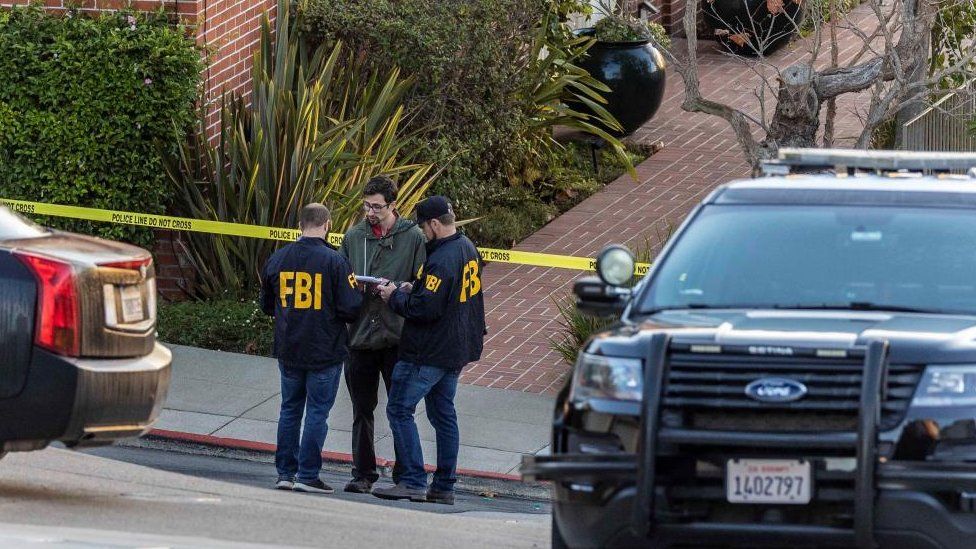
The FBI and the US Capitol Police, which has a field office in California, are assisting San Francisco police with the investigation.
Members of Congress have been on high-alert over security threats since the riot at the US Capitol in January 2021. Mrs Pelosi’s office in the building was ransacked by supporters of then-President Donald Trump during the attack.
And last year, her San Francisco home was reportedly vandalised with graffiti saying “cancel rent”.
Senior Republicans, such as Senate Leader Mitch McConnell, have also been targeted by vandalism in recent times and politicians have raised concerns about an increase in threats.
IMAGE SOURCE,REUTERS Image caption, FBI agents work outside the couple’s San Francisco home – the agency and US Capitol Police are assisting the investigation
In a statement, the White House said President Joe Bidenwas “praying for Paul Pelosi and for Speaker Pelosi’s whole family”.
Chuck Schumer, the top Democrat in the Senate, said: “What happened to Paul Pelosi was a dastardly act. I wish him a speedy recovery.”
Both added that they had spoken to Mrs Pelosi since the incident.
Earlier this year, Mr Pelosi was convicted of driving under the influence of alcohol and causing injury after he crashed his car. The financier pleaded guilty in August and was sentenced to five days in jail.
Following remarks on the status of the nation’s COVID-19 fight in March, President Joe Biden is given his second COVID-19 booster shot from Pfizer by a member of the White House Medical Unit.
File
Image by Rod Lamkey/UPI | Free Image
21 October (UPI)
Pharmaceutical behemoth Pfizer announced on Friday that it would charge up to $130 per dose for its COVID-19 vaccinations, citing the vaccine’s “value.”
According to NBC News and CNN, the vaccine, which is currently free, would cost between $110 and $130 per dose when the U.S. government stops covering the shots at the beginning of 2023.
The cost comes even after Pfizer sold $36.7 billion of its COVID-19 vaccines in 2021, contributing to 45% of the company’s revenue that year.
Oxfam said that drug companies such as Moderna and Pfizer have profited from the monopolies their companies currently hold in vaccines, treatments, tests and personal protective equipment largely coming from public funding.
“Pharmaceutical giants are making over $1,000 a second in profit from vaccines alone and they are charging governments up to 24 times more than it would cost to produce vaccines on a generic basis,” Oxfam said, citing research the nonprofit previously conducted.
Pfizer, which has been accused of using “dirty tactics” to boost profits including funding misinformation about the Oxford University/AstraZeneca vaccine, has sold the most vaccines in the world but has delivered the least to low-income countries as a proportion of total doses sold.
The suspect eluded police officers for several hours before being arrested in a house.
According to US officials, a 15-year-old boy has been arrested on suspicion of killing five people in North Carolina and is in critical condition in a hospital.
The unidentified teenager is accused of fatally shooting two individuals in the state capital of Raleigh before opening fire on a walking route, killing three more people and injuring two others.
Among those killed in the Thursday night attack were a 16-year-old boy named James Roger Thompson, and a 29-year-old off-duty police officer called Gabriel Torres.
The other victims killed in the shooting were 52-year-old Nicole Connors, 34-year-old Mary Marshall, and 49-year-old Susan Karnatz.
Marcille Lynn Gardner, 59, was wounded in the attack and remains in critical conditionin the hospital, while a second police officer, Casey Joseph Clark, was also injured but has been released.
Raleigh police chief Estella Patterson said those killed were a racially diverse group, and authorities have not yet determined a motive for the shooting.
The incident set off a massive police response across the city, with officers searching for the suspect for several hours before cornering him inside a house and arresting him.
Officers from numerous law enforcement agencies swarmed the Hedingham neighbourhood, a residential area northeast of Raleigh city centre, closing roads and warning residents to stay inside while they searched for the shooter.
Image:Residents talk with a police officer in front of the house where the suspected shooter lived
Image:Law enforcement officers work a crime scene in the Hedingham neighbourhood
‘No one should feel this fear’ Governor Roy Cooper called the attack an “infuriating and tragic act of gun violence”.”Today we’re sad, we’re angry and we want to know the answers to all the questions,” he said.
“I think we all know the core truth – no neighbour, no parent, no child, no grandparent, no one should feel this fear in these communities – no one.”
In a statement, President Joe Biden said he and first lady Jill Biden are grieving with victims’ families, and his administration is working with Mr Cooper to help local authorities with their investigation.
“Enough. We’ve grieved and prayed with too many families who have had to bear the terrible burden of these mass shootings,” he said.
Image:The teenage suspect was taken to hospital
Image:A huge police response ensued after the shooting
The incident in Raleigh is just the latest in a violent week across America, with another five people killed in a shooting in South Carolina on Sunday.
On Wednesday night, two police officers were fatally shot in Connecticut after apparently being drawn into an ambush by an emergency call about possible domestic violence.
Police officers have been shot this week in Greenville, Mississippi; Decatur, Illinois; Philadelphia, Las Vegas, and central Florida.
Two of those officers, one in Greenville and one in Las Vegas, were killed.
Thursday’s violence was the 25th mass killing in 2022 in which the victims were fatally shot, according to the Northeastern University Mass Killings database.
A mass killing is defined as when four or more people are killed, excluding the perpetrator.
Nancy Mace of South Carolina said Sunday she believes there is “pressure” for House Republicans to move to impeach President Joe Biden if they gain control of the chamber after the midterm elections.
“I believe there’s pressure on the Republicans to put that forward and have that vote,” Mace told NBC’s Chuck Todd on “Meet the Press” when asked if she foresees impeachment proceedings should her party win control of the House. “I think that’s what some folks are considering.”
But the freshman lawmaker added: “If that happens, I do believe it’s divisive.”
Mace did not mention the source of the alleged pressure and was not asked to elaborate on who is considering the move.
Asked Sunday how she would vote if an impeachment vote came to the floor, Mace said: “I will not vote for impeachment of any president if I feel that due process was stripped away, for anyone. I typically vote constitutionally, regardless of who is in power.”
CNN reported earlier this year that hard-line elements of the House Republican Conference were agitating to launch impeachment proceedings against Biden if the GOP takes power after the midterms — a move GOP leaders have so far declined to embrace.
House Republicans are also plotting revenge on the select committee investigating the January 6, 2021, insurrection, CNN has reported. Former President Donald Trump has been leaning heavily on his Capitol Hill allies to defend him against a slew of damaging revelations about his role in the deadly attack on the US Capitol. And as Republicans search for ways to undermine those findings, their party has started to lay the groundwork to investigate the January 6 panel itself. Some of Trump’s fiercest acolytes have also begun publicly pushing for hearings and probes into his baseless claims of fraud in the 2020 election.
While House GOP leader Kevin McCarthy has vowed to conduct aggressive oversight and investigations in a GOP-led House, it’s unclear just how far he would be willing to go when it comes to January 6 and the 2020 presidential election.
Mace, who flipped a Charleston-area seat in 2020, voted to certify Biden’s presidential election victory, earning Trump’s wrath. Faced with charges of insufficient loyalty to the former President, she drew a Trump-backed primary challenger but ended up prevailing by 8 points in her June primary.
Mace told NBC she was “very much hopeful” to see “a deep bench of Republicans and Democrats who will be running for president” in 2024. But she left the door open to possibly supporting Trump again if he were the 2024 GOP nominee for president.
“I’m going to support whomever Republicans nominate in ’24,” she said.
CNN’s Melanie Zanona, Manu Raju, Gabby Orr and Zachary Cohen contributed to this report.
Landslides and widespread floods were left behind by the storm when it made its way to the Dominican Republic from the west; the situation was too dangerous for urgent repairs.
Puerto Rico is anticipated to get more than usual amounts of rain.
President Joe Biden declared a state of emergency for the US island, allowing authorities to provide disaster relief.
As well as a complete power outage for the 3.3m people living on the Caribbean island, some health centers running on generators were also affected.
Electrical systems in San Juan’s hospital complex have since been restored, the health secretary said.
In some areas it will take days for the power to be reconnected, the operator of the island’s grid, Luma Energy, said.
The Category 1 storm saw winds reach 86mph (140km/h). No deaths have been reported in Puerto Rico, but one person was killed on the French Caribbean island of Guadeloupe when his house was swept away by flooding.
Ports have been closed in Puerto Rico and flights out of the island’s main airport have been canceled.
IMAGES Image caption, Roads have been left flooded
Several roads are also closed and a highway bridge in Utuado, in the island’s central mountainous region, has been washed away by flooding.
Puerto Rico’s governor said schools and government agencies would remain closed on Monday. Pedro Pierluisi urged residents to seek shelter as soon as possible.
Three weeks after that disaster, only about 10% of Puerto Ricans had electricity. The national grid still remains fragile, with power cuts a daily occurrence.
Torrential rains and mudslides are also forecast for the Dominican Republic as the hurricane progresses northwest, with the Turks and Caicos Islands also likely to be affected.
The planned agreement comprises an anti-ship and anti-air missile tracking radar system.
It follows the speaker of the US House of Representatives,  Nancy Pelosi, who visited Taipei last month as the highest-ranking US official to do so in the previous 25 years.
The Chinese embassy in Washington called on the US to revoke the deal or face “counter-measures”.
Spokesman Liu Pengyu said the deal “severely jeopardises” relations between Washington and Beijing.
“China will resolutely take legitimate and necessary counter-measures in light of the development of the situation,” he added.
Beijing sees the self-ruled island as a part of its territory and insists it should be unified with the mainland, by force if necessary.
The US arms sale agreed on Friday still needs to be voted on by the strongly pro-Taiwan US Congress.
The package includes a $655m radar warning system and $355m for 60 Harpoon missiles, which are capable of sinking ships.
It includes $85.6m for Sidewinder surface-to-air and air-to-air missiles, according to the Pentagon’s Defense Security Cooperation Agency.
A spokesperson for the Department of State said the deal was “essential for Taiwan’s security”, and called on Beijing “to cease its military, diplomatic and economic pressure against Taiwan and instead engage in meaningful dialogue”.
“These proposed sales are routine cases to support Taiwan’s continuing efforts to modernize its armed forces and to maintain a credible defensive capability,” the spokesperson said.
The Pentagon last month created a task force to help streamline the sale of American weaponry to foreign allies, the Wall Street Journal reported on Friday.
US lawmakers say that orders placed by Taiwan years ago have gone unfulfilled. Among the backlog are Harpoon and Stinger missiles, which have been sent to Ukraine instead, according to Defense News.
On September 16, South African President Cyril Ramaphosaand the US President Joe Biden will engage each other at the White House.
Issues to be discussed will hover around trade and energy.
In a statement on Thursday, the White House wrote “The leaders, building on their productive call in April and the US-South Africa Strategic Dialogue in August, will discuss opportunities to deepen our cooperation on trade and investment, infrastructure, climate and energy, and health.”
It added that the presidents would also reaffirm the partnerships between their two countries.
They will also “discuss our work together to address regional and global challengesâ€.
“Maga forces are determined to take this country backwards,” he said in a primetime speech in Pennsylvania.
Top Republican Kevin McCarthy gave his own address, saying Mr Biden had “severely wounded America’s soul”.
The duelling speeches come two months before mid-term elections, which will decide the power balance in Washington.
The Democratic president delivered his speech on Thursday night from Independence Hall in Philadelphia, where the US Declaration of Independence was signed. He picked up his 2020 campaign theme of restoring the “soul of America”.
He said he was not condemning all 74 million Americans who voted for Mr Trump two years ago. “Not every Republican, not even a majority of Republicans, are Maga Republicans,” he said.
Â
“But there’s no question,” Mr Biden continued, “that the Republican party today is dominated, driven and intimidated by Donald Trump and the Maga Republicans, and that is a threat to this country.”
Mr Biden said Trump supporters thought of the mob who stormed the US Capitol last year as patriots rather than insurrectionists.
“For a long time,” he continued, “we told ourselves that American democracy is guaranteed. But it’s not. We have to defend it. Protect it. Stand up for it. Each and every one of us.”
In response, Mr Trump posted a defence of his Maga slogan and said his rival had “threatened America”.
Throughout Mr Biden’s speech someone was heard heckling and sounding a bullhorn, according to a BBC reporter at the scene.
Mr Biden addressed the disruption twice, saying the second time: “They’re entitled to be outrageous. This is a democracy.”
The president, who came into office pledging to unite the country, has recently sharpened his rhetoric against supporters of Mr Trump.
Last week Mr Biden equated what he called “extreme” Republicans with “semi-fascism”.
Biden announced Wednesday that his administration will forgive $10,000 for borrowers who make less than $125,000 per year. Low-income borrowers who went to college on Pell Grants will receive up to $20,000 in student loan forgiveness.
This debt relief will give tens of millions of borrowers some breathing room at a time when the cost of living has skyrocketed.
Critically, the cancellation of student debt is being paired with a plan to lift the freeze on federal student debt payments, beginning in January 2023. That means many Americans who haven’t had to pay down student loans since March 2020 will have to begin doing so, eating into their cash flows.
Despite fears that Biden’s student debt relief will fuel already-crippling inflation, economists say the combined impact will be minimal on the economy at large.
“The end of the moratorium will weigh on growth and inflation, while the debt forgiveness will support growth and inflation,” Moody’s Analytics chief economist Mark Zandi told CNN. “The net of these cross-currents is largely a wash.”
Moody’s estimates that the combined impact will reduce real GDP in 2023 by 0.05 percentage points, drive down unemployment by 0.02 percentage points and cut inflation by 0.03 percentage points. In other words, a very tiny effect.
“We’re not talking about raising or lowering inflation by a percentage point or even a half a percentage point. We’re talking about a really small impact,” Dean Baker, co-founder of the Center for Economic and Policy Research, told CNN in a phone interview. “But for individuals this makes a big difference. It wipes out more than half the debt for more than half the borrowers. That’s a big deal.”
Tens of millions of borrowers impacted
The typical undergraduate student with loans graduates with nearly $25,000 in debt, according to a Department of Education analysis cited by the White House.
Up to 43 million borrowers will receive relief from Biden’s student debt plan, including eliminating the full remaining balance for about 20 million borrowers, according to the White House.
The inflationary impact would have been larger if Biden did not impose an income threshold on the debt relief or if he heeded calls from some progressives to wipe out $50,000 in student debt.
Baker praised Biden’s plan as a “good compromise” that avoided going to extremes.
“It’s helping people out, but not giving away the store,” he said.
Some groups, including the NAACP, argue Biden’s debt relief doesn’t go far enough given the mountain of student debt in America.
“Canceling just $10,000 of debt is like pouring a bucket of ice water on a forest fire,” NAACP leaders wrote in a CNN Business opinion piece.
A $300 billion price tag
Of course, there is a cost to canceling student debt. And that cost will be picked up by taxpayers just when deficit reduction had suddenly become a bipartisan trend in Washington.
A one-time cancellation of $10,000 for each borrower earning less than $125,000 will cost the government approximately $300 billion, according to an estimate this week from the Penn Wharton Budget Model. (The Penn Wharton model did not include the cost of wiping out up to $20,000 in student debt for Pell Grant recipients).
Although $300 billion isn’t massive for a $25 trillion economy, the cost of the student debt forgiveness would cancel out the projected federal budget deficit savings from the just-passed Inflation Reduction Act.
“All the deficit reduction will be wiped out,” Marc Goldwein, senior vice president and senior policy director for the Committee for a Responsible Federal Budget, told CNN’s Poppy Harlow.
Note that the White House has hailed the deficit reduction aspect of the Inflation Reduction Act as an important inflation-fighting measure. And this marked a significant shift after years of both parties adding to America’s mountain of debt to fight the Covid-19 pandemic.
Even Jason Furman, head of the Council of Economic Advisers for former President Barack Obama, has doubts about Biden’s plan.
“Pouring roughly half trillion dollars of gasoline on the inflationary fire that is already burning is reckless,” Furman tweeted. “Doing it while going well beyond one campaign promise ($10K of student loan relief) and breaking another (all proposals paid for) is even worse.”
Still, said Zandi of Moody’s, this is a “big positive deal for probably close to 40 million, mostly lower and middle income, Americans, but [a] small negative deal for all American taxpayers.”
‘Sends the wrong message’
Beyond the economic impact, Biden’s plan has sparked questions about fairness because it only helps people who were fortunate enough to go to college.
Rep. Tim Ryan, the Ohio Senate Democratic nominee, said Biden’s decision on student debt “sends the wrong message to the millions of Ohioans without a degree working just as hard to make ends meet.”
“Instead of forgiving student loans for six-figure earners, we should be working to level the playing field for all Americans,” Ryan said.
Citing a Department of Education analysis, the White House said nearly 90% of relief dollars will go to those earning less than $75,000.
The student debt forgiveness comes too late for borrowers who worked for years to pay off their loans, only to now see others have their debt wiped away.
“I take that very seriously,” Baker said of the fairness concerns. “We’re relieving $10,000, not $50,000 or $100,000. That’s why $10,000 is a good number.”
The real problem continues
No matter the amount, wiping out student loan debt doesn’t address the underlying problem: College tuition is way too expensive.
Between 2000 and 2021, the cost of college tuition increased at more than twice the pace of overall inflation, according to Moody’s Analytics. That’s despite a slowdown in tuition hikes during Covid.
The basket of goods measured in the Consumer Price Index cost 57% more in 2021 than it did in 2000, while the cost of college tuition soared by 167%, Moody’s said.
It’s hard to see how eliminating a chunk of student debt solves that issue. And some, including former Treasury Secretary Larry Summers, have warned debt relief could also help raise tuitions.
“Costs are out of control. It’s absurd people have to borrow large amounts and then struggle to pay it back,” said Baker. “That problem is unsolved.”
After a US Supreme Court draft decision on Roe v. Wade was leaked in May, Dr. Joshua Trebach noticed a disturbing turn in the online conversation around abortion.
“I started seeing things on social media, things like TikTok, Twitter, Facebook, Instagram, people saying ‘oh, if Roe v. Wade does get overturned, here are some secret, sneaky ways that you can drink some tea and have an abortion,’ ” Trebach said.
Now that Roe v. Wade has been overturned and some states are putting strict limits on abortions, there’s widespread confusion about whether the procedures are available and to whom. Physicians and poison control officials say they’re worried that people seeking abortions will turn to ineffective and dangerous methods shared online, potentially delaying or preventing safe, proven abortion care.
Social media companies told CNN they’re taking a range of actions, including reviewing some abortion-related posts, elevating content from verified sources, and labeling or removing certain posts.
This type of abortion misinformation is “scary,” said Trebach, an emergency medicine physician and a medical toxicologist in New York City. Some herbs people described may not do anything at all. Others could have a range of medical effects or even be deadly.
Myths about abortion and women’s mental health are widespread, experts say
Trebach said the online posts he saw came from unverified sources and described substances he learned about only in toxicology training. In the US, many herbs and supplements are regulated as food, not drugs, meaning there isn’t safety or efficacy data to back their use. Negative effects from an herb can’t always be treated easily, he said.
“At the end of the day, nothing — no plant, no herb, no tea, no tincture — is going to be safer or more effective than the current medical standard of abortion, the current medical therapies that we have,” he said. “Nothing is a fair substitute for that.”
Julie Weber, board chair of the American Association of Poison Control Centers, said centers have not seen an increase in exposure calls about people attempting abortions, but they’re preparing for it. People can call the association at 1-800-222-1222 or reach experts at poisonhelp.org if they have questions about a substance and its potential effects.
“When I hear or start seeing questions on social media, I hear of people talking about alternative medications or herbal products or supplements, I do get concerned,” Weber said. “And I am concerned with this, and we do want to get that message out there that this is not necessarily a safe alternative or one that’s even going to be effective.”
Tech companies respond
Andrea Miller, president of the advocacy group National Institute for Reproductive Health, has seen abortion misinformation online and said some of it might be coming from “well-intentioned people who are outraged and fearful and want to help right now, but they may inadvertently be sharing information that isn’t accurate or directing people to nefarious resources without realizing it.”
Miller also worries that some posts may be designed to misinform and confuse.
“There has been a calculated, pernicious misinformation campaign that has been many decades in the making from those who are opposed to reproductive freedom, and we anticipate that that is going to be ratcheted up significantly now,” she said.
What is medication abortion, and who has access to it?
One TikTok video — with hashtags such as #womenshealth and #womensrights — listed a range of fruits, herbs and other “DIY” methods that it claimed could induce abortions.
It got more than 244,000 likes before CNN flagged it and it was removed by the platform last week.
TikTok says it’s removing videos about abortion that violate its policy against medical misinformation, although it allows other content on the topics, such as videos discussing access to the procedure, according to a spokesperson. The short-form video platform is also redirecting searches for certain hashtags such as #herbalabortion and #naturalabortion to its Community Guidelines rather than showing results.
Similar posts with misleading, potentially dangerous claims about inducing an abortion have also been shared on Twitter and Facebook, although most appeared to have less reach and engagement than on TikTok.
A Facebook spokesperson said that posts about abortion may be reviewed by its third-party fact-checking partners, and content that is rated “false,” “altered” or “partly false” by fact checkers will have its distribution reduced. Facebook pages, groups or accounts that repeatedly share content debunked by fact checkers may also have their reach reduced or lose the ability to advertise or monetize, according to the company.
Two posts listing potentially harmful claims about self-induced abortion that CNN flagged to Facebook had not been labeled by fact checkers, which choose which content to review, as of Wednesday.
Twitter says it is working to “pre-bunk” misinformation by elevating reliable sources, including on its Trends and Twitter Moments features, according to a spokesperson. Twitter’s rules generally do not prohibit discussion of abortion, contraception or related topics; under the platform’s misinformation policy, it takes action against misleading information related to Covid-19, civic integrity, synthetic and manipulated media, and crisis situations, but the policy does not mention abortion.
As of Wednesday, the platform had not labeled or removed several posts flagged by CNN that contained advice on using herbs or large doses of medication that toxicologists said could be ineffective or harmful.
Miller advises people seeking abortions or information about the procedure to approach the issue in the same way they would any other health concern:
“That is to make sure that they are seeking it out from reputable sources, or if they think ‘hey, that’s an intriguing post, that’s an intriguing thing, I might want to check that out,’ make sure to do some additional research if you’re not confident of the source, even if it’s one of your closest friends and you’re not sure where they got it and they’re not sure where it came from.”
Distraction from truthful information
Doctors CNN spoke with said they’re worried that videos containing abortion misinformation imply there are no paths to legal abortion — which could distract from safe, available options and create more confusion.
“I feel like nowadays, we are lucky that we do have very safe medication abortion options for people, and I’m worried that if people are circulating misinformation, then people will not know that there are ways that they can access safe methods,” said Dr. Jody Steinauer, director of the UCSF Bixby Center for Global Reproductive Health.
Demand for abortion providers is expected to surge in some states. Doctors and nurses turned to TikTok to offer help
Although there are medications that are approved by the US Food and Drug Administration to allow abortion to take place at home, some people may assume they can’t access them, Dr. Nisha Verma, a fellow with the American College of Obstetricians and Gynecologists and an ob/gyn with a specialty in complex family planning.
“Some people may also turn to unsafe abortion methods when they feel they have no other option or based on information they are gathering on social media,” Verma said.
Posts and content on topics that inspire emotion are much more likely to go viral on social media. And that can be dangerous when they contain false or misleading claims.
“Misinformation can be harmful because it may lead people to try to end their pregnancies in an unsafe way, potentially exposing them to serious bodily harm. While people can self-manage their abortions in a safe way, spreading misinformation about unsafe methods of abortion is incredibly dangerous,” Verma said.
Internet searches for medication abortion reached record highs after Supreme Court leak
However, without a federal constitutional right to an abortion, access to abortion differs from state to state. The Biden administration is working across multiple federal agencies to respond to the Roe v. Wade reversal.
On Tuesday, the Justice Department announced a task force aimed at identifying ways to protect reproductive rights in the wake of the Supreme Court decision that struck down the federal right to abortion. And last week, President Joe Biden signed an executive order aimed at protecting access to reproductive health services.
The order attempts to safeguard access to medication abortion and emergency contraception, protect patient privacy and launch public education efforts. It also aims to bolster the security of and the legal options available to those seeking and providing abortion services.
Losing valuable time
Even before the Supreme Court decision, there was evidence that some people tried to self-manage abortions with things like herbs, physical trauma and uterine trauma, said Jenny Higgins, a professor of obstetrics and gynecology at the University of Wisconsin, Madison.
“We, of course, know those techniques are ineffective and, in some cases, also harmful,” Higgins said.
When it comes to methods circulating on social media, she said, her bigger concern is that they will use up valuable time.
Abortion laws impact people trying to become pregnant, too
“Someone might look into alternatives such as herbs, spend time trying to gather information, procure that substance, take the herb, take it again, take it again, and by then, they are later in gestation and maybe even less likely to be able to access effective methods,” Higgins said.
“There’s a real-time constraint here,” she said. “The later people are in gestation, the more effort that needs to be involved in the abortion.”
Being on the border of 10 to 12 weeks of pregnancy can make a big difference in whether someone can safely use FDA-approved abortion drugs, she said.
The available methods for self-managed abortion today are very different from in the pre-Roe era.
“I want people to understand that now we have the very same pills, the very same FDA-approved pills that are used in standard abortion care can be ordered online,” she said. “There are self-managed techniques that are extremely safe and effective.”
The Senate on Sunday afternoon passed Democrats’ $750 billion health care, tax, and climate bill, in a significant victory for President Joe Biden and his party.
The package is the product of painstaking negotiations, and its final passage would give Democrats a chance to achieve major policy objectives ahead of the upcoming midterm elections.
The Democrat-controlled House, which is expected to take up the legislation on Friday, August 12, must approve the bill before Biden can sign it into law.
The sweeping bill — named the Inflation Reduction Act — would represent the largest climate investment in US history and make major changes to health policy by giving Medicare the power for the first time to negotiate the prices of certain prescription drugs and extend expiring health care subsidies for three years.
The legislation would reduce the deficit, be paid for through new taxes — including a 15% minimum tax on large corporations and a 1% tax on stock buybacks — and boost the Internal Revenue Service’s ability to collect.
It would raise over $700 billion in government revenue over 10 years and spend over $430 billion to reduce carbon emissions and extend subsidies for health insurance under the Affordable Care Act and use the rest of the new revenue to reduce the deficit.
Senate Democrats, with a narrow 50-seat majority, stayed unified to pass the legislation, using a special, filibuster-proof process to approve the measure without Republican votes.
The final passage came after a marathon series of contentious amendment votes known as a “vote-a-rama” that stretched nearly 16 hours from late Saturday night until Sunday afternoon.
The conservative US state of Kansas has decided in a referendum to protect abortion rights – in a major victory for pro-choice groups.
Voters overwhelmingly said they did not wish to amend the state constitution to assert there is no right to abortion.
It was the first electoral test of the issue since the US Supreme Court allowed states to ban the procedure.
If the ballot had gone the other way, lawmakers could have moved to further restrict or ban abortion in Kansas.
The ballot question in Kansas had been hotly anticipated since the US Supreme Court two months ago overturned Roe v Wade, the 1973 ruling that legalized abortion nationwide.
Projections suggest Kansans voted by more than 60% to uphold the state’s constitutional right for women to access abortion.
It’s just a projection for now, and the official result will be confirmed in a week.
When Roe v Wade was overturned, President Joe Biden said abortion rights would be an issue for the voters. What’s happened in Kansas has turned that theory into evidence.
The referendum result is being seen as a landslide, in a state that Republican former President Donald Trump won by a convincing margin just two years ago.
For Democrats and pro-choice groups, this is a sign that Americans are deeply unhappy with abortion rights being overturned – and see the Supreme Court’s decision as out of step with the public.
The US holds national mid-term elections on 8 November, with Democrats fighting to retain control of Congress.
Mr. Biden said the result showed “the majority of Americans agree that women should have access to abortion”.
One voter, Taylor Hirth, wept as she celebrated the result with her nine-year-old daughter at a watch party in Overland Park, Kansas.
“I’m a rape survivor, and the thought of my daughter ever becoming pregnant and not being able to do anything about it angers me,” she told the BBC.
“I never thought this would happen here, but we have worked so hard here to get the vote out. Republicans underestimated us.”
Value Them Both, a Kansas-based anti-abortion group said that “Kansans endured an onslaught of misinformation from radical left organizations” over the past six months, that “spread lies” about the amendment.
“This outcome is a temporary setback, and our dedicated fight to value women and babies is far from over,” a message on its Twitter page said.
Kansas officials said voter turnout across the state was significantly higher than expected on a primary voting day when Republicans usually outnumber Democrats by two to one.
With feelings running high in the month before the vote, a Catholic church and a statue of the Virgin Mary were defaced with red paint and a pro-choice slogan.
On the eve of the ballot, some Kansans had received misleading texts urging them to “vote yes” to protect choice, but the opposite was true – a “yes” vote was to take away access to abortion. Tech company Twilio said it had suspended the anonymous sender from its platform.
Although Kansas is staunchly conservative, its abortion regulations are less strict than many other Republican-led states.
It allows pregnancies to be terminated up to 22 weeks with other restrictions, including a mandatory 24-hour waiting period and mandatory parental consent for children.
The legislature of the Great Plains state is controlled by anti-abortion Republicans, but its politically vulnerable governor, Laura Kelly, is a Democrat. She had warned that changing the state constitution would throw Kansas “back into the dark ages”.
More than a dozen Republican-led states have moved to ban or further restrict abortion since the Supreme Court decision on 24 June.
But 10 states across the US, including Kansas, have the right to abortion enshrined in their state constitutions, provisions that can only be overturned through referendums.
Other states, like California and Vermont, are holding votes in November seeking to enhance protections for abortion in their state constitutions.
President Joe Biden and his Chinese counterpart Xi Jinping held a lengthy and candid discussion about Taiwan on Thursday as tensions mount between Washington and Beijing, despite Biden’s one-time hope of stabilizing the world’s most important country-to-country relationship.
The two leaders did agree to begin arrangements for a face-to-face summit, their first as Xi resists travel amid the Covid-19 pandemic. And certain areas of cooperation, including climate change, were hashed out.
But the Taiwan issue proved among the most contentious. The issue has emerged as a serious point of conflict, as US officials fear a more imminent Chinese move on the self-governing island and as a potential visit by House Speaker Nancy Pelosi prompts warnings from Beijing and a concerted effort by the Biden administration to prevent tensions from spiraling out of control.
The matter was discussed at length in the two-hour-and-17-minute phone call Thursday. Xi offered an ominous warning to Biden, according to China’s version of events.
“Public opinion shall not be violated, and if you play with fire you get burned. I hope the US side can see this clearly,” he told Biden, according to China’s state news agency.
The White House’s account of the call was less specific.
“On Taiwan, President Biden underscored that the United States policy has not changed and that the United States strongly opposes unilateral efforts to change the status quo or undermine peace and stability across the Taiwan Strait,” a US readout read.
A senior US administration official called the Taiwan discussion “direct and honest” but downplayed Xi’s warning, suggesting it was standard for the Chinese leader to warn about the risks of “playing with fire.”
The phone call was Biden and Xi’s fifth conversation since February 2021. Ahead of time, US officials said a range of topics — from the tensions surrounding Taiwan to economic competition to the war in Ukraine — were likely to arise.
But hopes for substantially improving ties with Beijing were low. Instead, Biden’s aides hope maintaining a personal connection with Xi can, at most, avoid a miscalculation that might lead to confrontation.
“This is the kind of relationship-tending that President Biden believes strongly in doing, even with nations with which you might have significant differences,” communications coordinator for the National Security Council John Kirby said this week.
As Thursday’s call was concluding, the two leaders made note of how much work they had created for their teams, including arranging the possible in-person meeting. They have yet to meet face-to-face as presidential counterparts.
An opportunity for a summit could arise in November, when a series of summits will occur in Asia — including the Group of 20 in Bali, Indonesia, and the Asia-Pacific Economic Cooperation in Bangkok, Thailand. People familiar with the matter said US officials are looking to arrange such a meeting on the margins of one of the summits.
Planning for Biden’s phone call with Xi predated the furor over Pelosi’s proposed visit to Taipei. Neither side revealed whether Pelosi’s plans were discussed specifically.
Biden is also currently weighing whether to lift some Trump-era tariffs on China in a bid to ease inflation, though White House officials said he hadn’t yet made up his mind and suggested ahead of time the topic wouldn’t factor heavily into his conversation with Xi.
Instead, it is China’s escalating aggression in the region — including over Taiwan and the South China Sea — at the center of the current tensions. US officials fear without open lines of communication, misunderstandings could spiral into unintended conflict.
That includes how Beijing responds to Pelosi’s potential visit to Taiwan.
US and China are on a knife’s edge over Taiwan ahead of the Xi-Biden phone call.
Administration officials have been working quietly over the past week to convince the House speaker of the risks inherent in visiting the self-governing island.
Defense Secretary Lloyd Austin said Wednesday he’d spoken to Pelosi to provide his “assessment of the security situation.”
Pelosi has not made any announcements about her plans for a trip, which haven’t been finalized.
“I never talk about my travel. It’s a danger to me,” she said Wednesday.
Yet even unofficial word that the third-in-line to the US presidency was considering a visit to Taiwan prompted an outsized response from Beijing, which considers visits by top-ranking American officials a sign of diplomatic relations with the island.
“If the US insists on taking its own course, the Chinese military will never sit idly by, and it will definitely take strong actions to thwart any external force’s interference and separatist’s schemes for ‘Taiwan independence,’ and resolutely defend national sovereignty and territorial integrity,” Ministry of Defense Spokesperson Tan Kefei said Tuesday in response to questions over Pelosi’s reported trip to Taipei.
The White House called those comments “unnecessary” and “unhelpful,” saying the rhetoric only served to escalate tensions “in a completely unnecessary manner.”
They also revealed what US officials have said is a misunderstanding by Chinese officials over the significance of Pelosi’s potential visit. The officials said China may be confusing Pelosi’s visit with an official administration visit since both she and Biden are Democrats. Administration officials are concerned that China doesn’t separate Pelosi from Biden much, if at all.
That adds pressure to Biden’s call with Xi. Officials were circumspect about whether Pelosi’s visit would arise, or how much it would factor into the conversation.
But China’s apparent confusion over the differences between the White House and Congress could inject a level of personal animus into the talks.
Administration officials’ concerns over Pelosi’s trip are rooted partly in its timing. It would come at a particularly tense moment, with the upcoming Chinese Communist Party congress during which Xi is expected to seek an unprecedented third term putting pressure on the leadership in Beijing to show strength.
Chinese party officials are expected to begin laying the groundwork for that conference in the coming weeks.
With China recently reporting its worst economic performance in two years, Xi finds himself in a politically sensitive situation ahead of the important meeting.
Biden and Xi spent many hours in each other’s company when each was his country’s vice president, traveling across China and the United States to form a bond.
Biden last spoke to Xi in March, when he worked to convince the Chinese leader not to support Russia amid its invasion of Ukraine. Officials have been watching closely how Beijing responds to the invasion, hoping the mostly united western response — including a withering set of economic sanctions and billions of dollars in arms shipments — proves to illuminate as China considers its actions toward Taiwan.
US officials believe there’s a small risk China would miscalculate in responding to a potential Pelosi visit.
Biden administration officials are concerned that China could seek to declare a no-fly zone over Taiwan ahead of a possible visit as an effort to upend the trip, potentially raising tensions even further in the region, a US official told CNN.
That remains a remote possibility, officials said. More likely, they say, is the possibility China steps up flights further into Taiwan’s self-declared air defense zone, which could trigger renewed discussions about possible responses from Taiwan and the US, the US official added. They did not detail what those possible responses would entail.
President Joe Biden feels well enough to resume physical exercise on his fifth day with Covid-19, his doctor said Tuesday in a letter.
Dr. Kevin O’Connor wrote Biden’s symptoms have “almost completely resolved” and that his vital signs remain “absolutely normal.”
Biden will continue to isolate on day five of his infection, O’Connor wrote. He completed a five-day course of the antiviral Paxlovid on Monday evening.
The President has been isolating in the White House residence since testing positive for Covid on Thursday. He’s spoken to advisers by telephone and participated in virtual meetings with officials.
On Tuesday, he was planning to meet virtually with the head of a South Korean conglomerate that is investing in the United States and with a group of lawmakers to mark the 32nd anniversary of the Americans with Disabilities Act.
Biden’s symptoms have reportedly been steadily improving since he first tested positive. He suffered a cough, sore throat, body aches and a runny nose through the weekend, but his condition had improved by Monday, the White House said.
Participating by video conference in a White House event, Biden’s voice still sounded raspy Monday afternoon. But his doctor said his other symptoms had mostly resolved.
Biden told reporters he’s “feeling great,” and “keeping a full schedule” while isolating as he recovers, but hopes to be back working in person “by the end of the week.”
Biden said that he’s been participating in a battery of tests every evening checking “everything, from the temperature to the oxygen … in my blood, to my pulse to — I mean, just across the board. And so far, everything’s good, I mean, everything’s on the button,” adding he’s “feeling better every day.”
And while he’s still experiencing a “little bit of a sore throat,” Biden said doctors have told him “that’s par for the course, and I think I’m on my way to recovery.”
Once he tests negative, Biden will end his isolation, according to White House officials.
The White House has emphasized that because Biden is vaccinated and boosted, his symptoms have been mild.
President Joe Biden‘s advisers are downplaying recession fears ahead of a highly anticipated report that could show the economy shrinking for a second consecutive quarter.
While there is no steadfast rule governing what defines a recession in the US, it is commonly understood to be two consecutive quarters of GDP shrinking. But a small group of economists on the Business Cycle Dating Committee officially define when the US economy is in a recession, and they define a recession as involving “a significant decline in economic activity that is spread across the economy and lasts more than a few months.”
Director of the National Economic Council Brian Deese argued Monday that if this week’s report from the Commerce Department shows a second consecutive negative quarter of gross domestic product it does not mean the US is in a recession. Using an argument that the White House used regarding an inflation report earlier this month, Deese said the second quarter data — which reflects the April through June period — will be “inherently backward-looking,” and pointed to the jobs created in that time frame.
“Never in the history of our country have we had a recession where the economy was creating jobs, period, let alone creating 400,000 jobs,” Deese told CNN’s John Berman on “New Day.”
Deese and Biden’s other economic advisers are trying to use that squishy definition to argue that the economy is resilient, even if last week’s CNN poll showed the public’s view of the economy is the worst it’s been since 2011.
“Certainly in terms of the technical definition, it’s not a recession. The technical definition considers a much broader spectrum of data points. But in practical terms what matters to American people is whether they have a little economic breathing room, they have more job opportunities, their wages are going up — that has been Joe Biden’s focus since coming into office,” Deese said.
Deese said despite the high gas and grocery prices the nation’s economy is “demonstrating resilience in the face of very significant global economic challenges.” Gas prices have dropped in recent weeks, having dropped about 55 cents over the last month, according to AAA.
“If you look at the labor market, if you look at what consumers are spending, what businesses and households are investing, you continue to see this resilience,” Deese said. “But that’s no reason for complacency. We need to act. We need to act on things like prescription drugs and things like semiconductors right now.”
He urged Congress to take immediate action to bring down costs for American families, including by lowering prescription drug prices and bolstering US computer chip manufacturing, which he noted would help bring down costs for automobiles.
“These are very uncertain times,” Deese said. “And when you go and pull up at the gas station or pull into the grocery store and see these high prices, they not only create hardship but they create uncertainty for what things are going to be like in the future.”
The US is expecting a number of key economic indicator reports this week aside from the second quarter GDP numbers coming Thursday, including Tuesday’s consumer confidence survey and Friday’s Personal Consumption Expenditure index. The Federal Reserve also meets on Wednesday to discuss interest rates.
Other top Biden administration officials continue to insist the economy is not in recession amid widespread inflation. Treasury Secretary Janet Yellen argued Sunday the economy is in “transition” and there is a “slowdown.”
“This is not an economy that’s in recession, but we’re in a period of transition in which growth is slowing,” she told NBC’s “Meet the Press.”
President Joe Biden on Wednesday announced a fresh infusion of $1 billion in weapons for Ukraine that includes anti-ship rocket systems, artillery rockets, howitzers and ammunition.
In a phone call with Ukraine President Volodymyr Zelenskiy, Biden said he told the embattled leader about the new weaponry.
“I informed President Zelenskiy that the United States is providing another $1 billion in security assistance for Ukraine, including additional artillery and coastal defense weapons, as well as ammunition for the artillery and advanced rocket systems,” Biden said in a statement after the 41-minute call.
The president also announced an additional $225 million in humanitarian assistance to help people in Ukraine, including by supplying safe drinking water, critical medical supplies and healthcare, food, shelter, and cash for families to purchase essential items.
The latest weapons packages for Ukraine include 18 howitzers, 36,000 rounds of ammunition for them, two Harpoon coastal defense systems, artillery rockets, secure radios, thousands of night vision devices and funding for training, the Pentagon said.
The aid packages, which come as U.S. Defense Secretary Lloyd Austin is meeting with allies in Brussels, were split into two categories: transfer of excess defense articles from U.S. stocks and other weapons being funded by the Ukraine Security Assistance Initiative (USAI), a separate congressionally authorized program.
Russia’s U.N. Ambassador Vassily Nebenzia on Wednesday accused Western countries of “fighting a proxy war with Russia,” telling reporters: “I would like to say to the Western countries supplying weaponry to Ukraine the blood of civilians is on your hands.”
Ukraine is pressing the United States and other Western nations for speedy deliveries of weapons in the face of increased pressure from Russian forces in the eastern Donbass region.
Oleksandra Ustinova, a member of the Ukrainian Parliament, told reporters at an event organized by the German Marshall Fund: “We need all these weapons to be concentrated in a moment to defeat the Russians, not just keep coming every two or three weeks.”
In May, the Biden administration announced a plan to give Ukraine M142 High Mobility Artillery Rocket Systems after receiving assurances from Kyiv that it would not use them to hit targets inside Russian territory. Biden imposed the condition to try to avoid escalating the Ukraine war.
The rocket artillery in this aid package would have the same range as previous U.S. rocket shipments and is funded using Presidential Drawdown Authority, or PDA, in which the president can authorize the transfer of articles and services from U.S. stocks without congressional approval in response to an emergency, said a source who spoke on condition of anonymity.
For the first time, the United States is sending ground-based Harpoon launchers. In May, Reuters reported the U.S. was working on potential solutions that included pulling a launcher off of a U.S. ship to help provide Harpoon missile launch capability to Ukraine.
Harpoons made by Boeing Co (BA.N) cost about $1.5 million per missile, according to experts and industry executives.
The U.S. Supreme Court on Wednesday dismissed a bid by Republican state officials to take over the legal defense of a hardline immigration rule imposed under former President Donald Trump barring permanent residency for immigrants deemed likely to need government benefits.
The unsigned one-sentence ruling “dismissed as improvidently granted” an appeal by 13 Republican state attorneys general led by Arizona’s Mark Brnovich seeking to defend the rule in court after Democratic President Joe Biden’s administration refused to do so and rescinded it.
The rule widened the scope of immigrants deemed likely to become a “public charge” mainly dependent on the government for subsistence.
The state attorneys general had hoped to ask lower courts to throw out decisions that sided with various challengers to the rule, including a number of Democratic-led states.
Biden’s administration in February proposed a new public charge rule that it called more “fair and humane.” It would avoid penalizing people for seeking medical attention and other services.
Trump’s rule was in effect from February 2020 until Biden’s administration rescinded it in March 2021, acting on a decision in a separate legal case in Illinois that vacated the rule nationwide.
Republican state officials also sought to intervene in that case in their uphill battle to revive Trump’s rule.
U.S. guidelines in place for the past two decades had said immigrants likely to become primarily dependent on direct cash assistance or long-term institutionalization, in a nursing home for example, at public expense would be barred from legal permanent residency, known as a “green card.”
Trump’s policy expanded this to anyone deemed likely to receive a wider range of even non-cash federal benefits such as the Medicaid healthcare program, housing and food assistance for more than an aggregate of 12 months over any 36-month period.
The San Francisco-based 9th U.S. Circuit Court of Appeal decided in 2020 that Trump’s policy impermissibly expanded the definition of who counts as a “public charge” in violation of a federal law called the Administrative Procedure Act. Other courts made similar rulings.
Brnovich sought to intervene in a challenge to Trump’s immigration rule involving three lawsuits, including two filed in California and Washington state by 18 mostly Democratic-led states and the District of Columbia.
Brnovich was joined by officials from Alabama, Arkansas, Indiana, Kansas, Louisiana, Mississippi, Missouri, Montana, Oklahoma, South Carolina, Texas and West Virginia.
The Republican officials said the public charge rule would save states more than $1 billion annually by limiting the immigration of individuals who are not self-sufficient.
During the time the policy was enforced, the government issued only five adverse decisions under it, according to court filings, all of which have since been reversed.
The U.S. Supreme Court on March 3 ruled that Kentucky’s Republican attorney general could seek to restore a restrictive abortion law after the state’s Democratic governor dropped defense of the statute when lower courts struck it down.