President Bola Tinubu has lauded his predecessor and former President Muhammadu Buhari saying he did a good job during his tenure.
Tinubu stated this while delivering his inaugural speech as the 16th President of Nigeria at the Eagle Square today (Monday).
He said, “Permit me to say a few words to my predecessor, President Muhammadu Buhari. You have been a honest man and patriotic leader. Buhari has done his best for the nation.”
Tinubu was sworn in as the 16th President of the Federal Republic of Nigeria.
Similarly, Kashim Shettima was also sworn in as the Vice President of Nigeria.
Chief Justice of the Federation, Olukayode Ariwoola administered the oath of office to the President at 10:40 am, shortly after the Vice President took his oath of office.
After a train struck a public bus in the nation’s commercial center on Thursday, killing six people and wounding scores more, Lagos State Governor Babajide Sanwo-Olu said that he is temporarily suspending his reelection campaign.
According to a statement from Lagos state emergency services, the tragedy occurred at a bus stop in the Ikeja neighborhood of the city of around 20 million inhabitants.
Sanwo-Olu tweeted on Thursday that there were 85 passengers on the bus, including state employees.
“Lagos is in a state of mourning and for the next 3 days, I am suspending all campaign activities. All flags will be flown at half mast and tomorrow all civil servants will work till 12 noon before returning home to be with their loved ones during this trying time,” the governor further said in a series of tweets while calling for blood donations to treat the injured.
Also on Thursday, the country’s President Muhammadu Buhari described the accident as “distressing and extremely sad.”
“The accident at the level crossing involving a train and BRT staff bus is distressing and extremely sad. I pray for the souls of the deceased and quick recovery of the injured,” Buhari said while commending Lagos authorities for intervening swiftly at the scene of the collision.
Security guard Ubong Okon witnessed the aftermath of the crash, which happened from about 7 a.m. to 8 a.m. local time (0600 to 0700 GMT).
“I came out to open the gate, then I saw the train and the bus, I looked inside the bus, there were lots of passengers inside, I went inside and saw people with injuries, there was blood everywhere, then I started to help get people inside the bus out.”
Traffic jams are part of daily life in Lagos, where most people drive with little regard for road and safety rules.
In Africa’s most populous nation, many roads are poorly maintained and riven with potholes, leading to accidents that claim thousands of lives every year.
Aviation Minister Hadi Sirika said in a statement that he has directed Nigeria’s safety investigation agency to look into the cause of the accident.
In a vital presidential election, Nigerians will cast their ballots to choose the nation’s new leader. In addition to electing members of the nation’s parliament, the contentious election is taking place concurrently.
According to the electoral agency INEC, 93 million Nigerians are registered to vote, but only 87 million have a permanent voter card (PVC), which is a necessary prerequisite for voting.
The polls will be open beginning at 8:30 a.m. local time and closing at 2:30 p.m. (or 2:30 a.m. ET Saturday to 8:30 a.m. ET). Yet according to INEC, those who were in line to cast their ballots by the polls closed still have the opportunity to do so.
Ballots will be counted at polling places at the close of voting and transmitted electronically in real-time to INEC’s Result Viewing portal (IReV), a first of its kind in Nigeria, the commission tells CNN.
“With the electronic transmission system (IREV), people will already know the winners before the official announcement is made,” adds Rotimi Oyekanmi, a spokesman for INEC’s chairperson.
To win, a candidate must garner a sufficient number of ballots to meet the 25% vote spread in 24 of Nigeria’s 36 states. In the absence of this, a second round run-off between the top two candidates will be held within 21 days.
Eighteen candidates are on the ballot for Nigeria’s top, but three are leading the race for the popular vote, according to pre-election surveys.
One of the key contenders is Bola Ahmed Tinubu, the candidate of term-limited President Muhammadu Buhari’s party, the All Progressives Congress (APC). Another is the main opposition leader and former vice president Atiku Abubakar, of the People’s Democratic Party (PDP). And third strong contender, Peter Obi, is running under the lesser known Labour Party, and altered early predictions of the presidential vote, which has typically been two-horse races between the ruling and opposition parties.
Seventy-year-old Tinubu, 70, is a former governor of Nigeria’s wealthy Lagos State, who wields significant influence in the southwestern region where he is acclaimed as a political godfather and kingmaker.
He boasts of aiding the election of Buhari to the presidency and declares it is now his turn to lead the country.
Here’s what to know about Nigeria’s presidential election
Candidate of the opposition party PDP Abubakar, 76, is a former Nigerian vice president and a staunch capitalist who made his fortune investing in various sectors in the country.
Abubakar’s presidential bid (his sixth attempt) had fueled concern that it might usurp an unofficial arrangement to rotate the presidency between Nigeria’s northern and southern regions, since he is from the same northern region as the outgoing leader, Buhari.
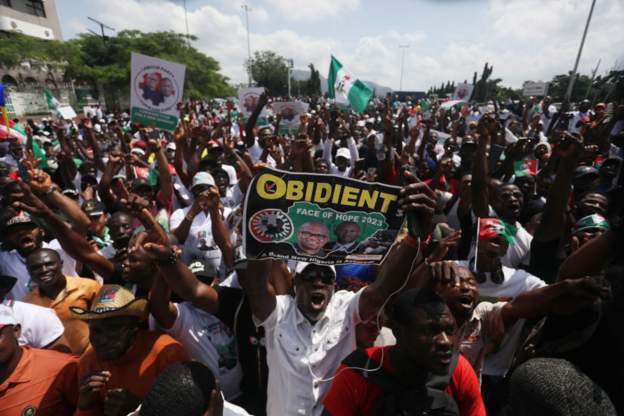
Labor Party’s Obi is a two-time former governor of southeastern Anambra State and has been touted as a credible alternative to the two major candidates by his hordes of supporters, mostly young Nigerians who call themselves ‘Obidients.’
Obi is also the only Christian among the leading candidates. His southeastern region has yet to produce a president or vice president since Nigeria returned to civil rule in 1999.
The ruling party’s Tinubu, from the religiously mixed southwestern part of the country, is a Muslim and also chose a Muslim running mate, despite the country’s unofficial tradition of mixed-faith presidential tickets.
All top three candidates are confident they can turn Nigeria’s fortunes around if voted into power, as the country battles myriad economic and security problems that range from fuel and cash shortages to rising terror attacks, high inflation, and a plummeting local currency.
Nigeria’s security forces have mobilized personnel to ensure hitch-free electioneering across the country.
The run-up to the polls has been fraught with violence that stemmed from protests against unpopular government policies and lethal attacks by armed criminal gangs.
On Wednesday, a senatorial candidate for the Labour Party, was shot and burned in his campaign vehicle in the country’s southeastern Enugu State, police said.
Before the killing, violent protests had erupted across Nigerian states as citizens railed against the scarcity of gasoline in petrol outlets and a shortage of cash that followed a controversial currency redesign.
Electoral body INEC hasn’t been spared from the chaos; its facilities have been torched in parts of the country.
Voting was canceled at more than 200 planned polling units across Nigeria and voters redirected to other poll locations, INEC said, due to security concerns.
Ahead of the elections, national police ordered a restriction of non-essential vehicular and waterway movements from midnight on election day until 6 p.m., while the country’s immigration service has ordered the closure of Nigeria’s land borders from midnight Saturday until midnight Sunday.
Weeks before polling day, the service had confiscated over 6000 voter cards from illegal migrants, whom it said had other national documents in their possession.
INEC spokesperson Oyekanmi nevertheless insists the poll results will be free and fair.
“The experience Nigerians will have for the 2023 elections will be far better than previous elections and the integrity (of the polls) will be clear for everyone to see,”Oyekanmi told CNN days before the election.
Final results are expected to be announced a few days after polling.
After more than one year of posturing, and preparations the stage is finally set and the die is cast.
Nigeria will hold her historic seventh democratic transition polls today.
One woman is contesting the presidential election as 17 men lock horns in the battle to succeed President Muhammadu Buhari, who will complete his second term on May 29, 2023.
Princess Chichi Ojei, the presidential candidate of the Allied People’s Movement, APM, is the only woman in a crowd of 36 presidential and vice presidential standard bearers.
Apart from the presidential election, there will also be battle for the nation’s 109 senatorial districts and 360 House of
Representatives seats. The Independent National Electoral Commission, INEC, has cleared 1101 senatorial and 3122 House of Representatives candidates for the election. However, there will be no senatorial election in Enugu East, where the Labour Party, LP, Candidate, Mr. Oyibo Chukwu, was assassinated by gunmen, last Wednesday.
Section 34 (1) and (3) of the Electoral Act, 2022 provides that if a candidate dies before the elections begin, the elections will be rescheduled within 14 days by the INEC to enable the affected party replace the dead candidate.
in spite of insecurity concerns following series of violence and killings that trailed the campaigns, and attacks on INEC’s facilities, the Police and the electoral commission have declared their readiness to conduct free, fair and violence free polls.
Already, the Police have deployed 310,973 personnel across the over 176,000 polling units where voting will take place.
Polling Units
Nigeria has 176,846 polling units but elections would only take place in 176,606 as 240 of the total figure have no registered voters according to the INEC.
Readiness of electoral umpire
The INEC Chairman, Professor Mahmood, said the commission had recovered from the recent 50 attacks on its facilities and is set for the elections.
Police riot act
The Inspector General of Police, Usman Baba, has ordered restriction of vehicular movement on roads, waterways, and other forms of transportation from 6am to 6pm today except for those on essential duties. The IG said the Police would ensure public order management, safety of the electorate, as well as assist security agencies in effective policing, thereby preventing hoodlums and criminally-minded elements from disrupting the electoral process.
87.2 m voters to decide Atiku, Tinubu, Obi, others’ fate From a voters’ list of 93.469 million, only 87.209 million voters will are eligible to vote today. They were those who collected their Permanent Voters Cards, PVCs, before the deadline to do so ended on February 5, according to the INEC. Among the 18 candidates jostling to succeed President Buhari are Asiwaju Bola Tinubu of the ruling All Progressives Congress, APC; Alhaji Atiku Abubakar of the People’s Democratic Party, PDP; Mr. Peter Obi of the Labour Party, LP; and Senator Rabiu Kwakwanso of the New Nigeria People’s Party, NNPP. Others include Prince Adewole Adebayo of the Social Democratic Party, SDP; Mr. Dumebi Kaachikwu of the African Democratic Congress, ADC; Chief Kola Abiola of the Peoples Redemption Party, PRP; and Mr. Omoyele Sowere of the African Actin Congress, AAC. Also in theerace are Felix Osakwe, National Rescue Movement NRM; Prof Peter Umeadi, All Progressive Grand Alliance, APGA; Dan Nwanyanwu, Zenith Labour Party, ZLP; Oluwafemi Adenuga, Boot Party, BP; Christopher Imumolen, Accord; Hamza Al-Mustapha, Action Alliance, AA; Sani Yabagi Yusuf, African Democratic Party, ADP; Malik Ibrahim Ado, Young Progressive Party, YPP; and Osita Nnadi, Action People’s Party, APP.
Worries over BVAS A key feature of today’s election is the use of Bimodal Voters Accreditation System, BVAS, to authentic voters’ PVCs The INEC has insisted on using BVAS With the introduction of BVAS, balloting may drag into the night today. Reports from the February 4 mock accredidation of voters by INEC in 436 polling units across the country showed that it took two to three minutes to accredit a voter. At two minutes per voter, 30 voters will be accredited in one hour and 300 voters in 10 hours. So if INEC officials arrive on time today and begin the exercise at 8am 300 voters will be accredited by 6pm using one BVAS. With two BVAS, 300 voters may be accredited in five hours. Sorting, counting and announcement of the results of the presidential, senatorial and House of Representatives polls may take two hours or more. So, if voters turnout is impressive, the election may drag into the night and the INEC must make arrangements for power supply or torch lights.
Poor run of women
Only one woman is on the presidential ballot in spite of women’s fresh push for more accommodation for women in the political arena. Women were not on the radar in 1999, when only two candidates, General Olusegun Obasanjo of the Peoples Democratic, PDP, and Chief Olu Falae of the Alliance for Democracy, AD/All Peoples Party, APP, slugged it out with Obasanjo emerging the winner. However, women were on the ballot in 2003, which so far remains their best attempt at occupying Aso Villa. Of the 20 presidential candidates, two were women – Mrs Sarah Jubril of the Progressive Action Congress, PAC, and Major Mojisola Adekunle Obasanjo, retd, of the Masses Movement of Nigeria, MMN. While Major Obasanjo polled 3,757 votes at that election, Mrs Jubril scored 157,560 votes, the highest any woman has ever got in a presidential election in the country. Ever since, the fortunes of women have been dwindling at the presidential polls. In a pool of 27 candidates in 2007, there was only one woman – Major Obasanjo, who garnered a miserly 4,309 votes. In 2011, with 63 political parties in which 20 parties fielded candidates, there was also only one woman – Ebiti Ndok of the United National Party for Development, UNPD, who polled 21,2017 votes. Mrs. Sarah Jubril’s efforts to be on the ballot did not yield dividend. She got one vote at the PDP presidential primary. In 2015, the poor run of women continued. Mrs. Oluremi Sonaiya, was the only female in a crowd of 14 presidential standard bearers and she got 13,076 votes. In 2019, in a crowd of 73 presidential candidates, there were six women, the highest so far in the history of electioneering in Nigeria. However, the women fared badly polling altogether 25,594 votes in a contest that President Buhari polled 15,191,847 of the total votes cast while his closest opponent, Atiku Abubakar of the PDP got 11,262,978 votes, an astonishing victory margin of 3,928,869 votes. The women who part in the 2019 election were Mrs Oby Ezekwesili (ACPN, 7,223 votes); Angela Johnson (AUN, 1,092 votes); Olufunmilayo Adesanya-Davies (MAJA, 2,651 votes); Eunice Atuejide (NIP, 2,248 votes); Rabia Yasai Hassan Cengiz (NAC, 2,279); and Maina Maimuna Kyari (NPC, 10,081 votes). The gains made by women in the last five electoral cycles appeared to have been eroded in 2023 with only one woman standing
As the most populous country in Africa elects a new leader, it will be the largest democratic process on the continent.
The country is currently dealing with a wide range of economic and security issues, from cash and fuel shortages to an increase in terrorism attacks, high inflation, and a falling local currency.
Since the nation’s transition to democratic governance in 1999, no incumbent or former military commander has run for office.
Outgoing President Muhammadu Buhari is term-limited and will step down amid a patchy legacy that has brought “a lot of frustration and anger” to Nigerian voters, analysts say.
Eighteen candidates are in the running for Nigeria’s highest office, each confident they can turn the country’s fortunes around if voted into power, but opinion polls suggest three are leading the race for the popular vote.
One of the key contenders is Bola Ahmed Tinubu, the candidate of Buhari’s party, the All Progressives Congress (APC). Another is the main opposition leader and former vice president Atiku Abubakar, of the People’s Democratic Party (PDP).
Nigeria’s presidential elections have typically been two-horse races between the ruling and opposition parties, but this year’s vote has a third strong contender, Peter Obi, who is running under the lesser known Labour Party.
Tinubu, 70, a former governor of Nigeria’s wealthy Lagos State, wields significant influence in the southwestern region where he is acclaimed as a political godfather and kingmaker.
The affluent political veteran, boasts of aiding the election of Buhari to the presidency on his fourth attempt in 2015, after three previous unsuccessful bids.
After decades as a political puppet master, Tinubu declares it is now his turn to emerge from the shadows into the presidency; his campaign slogan is “Emi Lokan,” which translates to “it is my turn,” in his native Yoruba language.
The ruling party candidate has, however, been dogged by allegations of graft which he strongly denies. Critics say he has also not convincingly addressed concerns about his health, and has, at times, appeared confused and incoherent on the campaign trail. He has also made gaffes that have made him the butt of jokes and viral memes on social media.
Tinubu has also come under criticism for abstaining from presidential debates and delegating questions about his manifesto to members of his team during a recent outing at the UK think tank Chatham House.
One of Tinubu’s main challengers is the opposition party’s Abubakar, who is running for the sixth time following five previous losses.
Abubakar, 76, who served as vice president from 1999 to 2007, is a staunch capitalist who made his fortune investing in various sectors in the country. The tycoon has been investigated for corruption in the past. However, he denies any wrongdoing.
Many believe Abubakar’s presidential ambition might usurp an unofficial arrangement to rotate the presidency between Nigeria’s northern and southern regions, since he is from the same northern region as the outgoing leader, Buhari.
Peter Obi is a two-time former governor of Anambra State who is being touted as a credible alternative to the two major candidates.
Obi eschews the excesses of the typical ‘African Big Man’ leader He shuns a large entourage, flies economy class and carries his own luggage. His “no frills” approach has attracted hordes of supporters, mostly young Nigerians who call themselves ‘Obidients.’
Obi is also the only Christian among the leading candidates. His southeastern region has yet to produce a president or vice president since Nigeria returned to civil rule in 1999.
The ruling party’s Tinubu, although from the religiously mixed southwestern part of the country, is a Muslim and also chose a Muslim running mate, fueling public anger over his choice.
Described by Tinubu as “Mr. Stingy,” Obi, 61, is famed for his frugal approach and is seen as a ‘Mr Clean’ of Nigerian politics.
However, his offshore accounts were among those found in the Pandora Papers, which exposed the hidden riches of the global elite in 2021. Obi denies any wrongdoing.
The past two elections have been postponed at short notice and there are fears this one will suffer the same fate. However the electoral commission insists there will be no disruptions.
Prof. Kingsley Moghalu, a political economist and former presidential candidate in the 2019 election told CNN he expected a high turnout, “except if suppressed by a security breakdown of any sort,” he told CNN.
More than 93 million Nigerians are registered to vote but uncertainty hangs over voter turnout on polling day, with insecurity among the biggest concerns.
Public policy analyst Abideen Olasupo told CNN the uncertainties surrounding this year’s elections have put off many voters.
“Nigerian voters are currently the most disturbed and confused voters in the world right now because they are not sure if the election will hold; and if it will hold, they are not sure if the process will not be manipulated,” Olasupo said.
Citizens have also been disrupted by an attempt to curb vote buying by making the old currency notes useless to prevent rogue politicians from stockpiling cash. But there are fears shortage of the new naira notes could disrupt the elections itself.
Electoral body INEC reportedly warned that the inability of banks to distribute enough of the new cash could make it difficult to pay temporary staff and security guards needed to operate thousands of polling stations for presidential and parliamentary elections on Feb. 25.
As it is, voting will not take place in more than 200 polling units across Nigeria, in places such as Imo and Taraba (two of Nigeria’s conflict-prone states) says INEC, because of concerns over security.
Separatist gangs and marauding gunmen known locally as bandits have terrorized parts of the country through kidnappings for ransom.
Elsewhere,other impediments threaten voter turnout as some Nigerians are yet to collect their permanent voter’s card (PVC) with less than a week to the poll.
The co-founder and head of intelligence at data company Stears, Michael Famoroti, tells CNN that critical issues around security and the economy will be top of mind for voters and could influence their electoral choices.
“Nigerians fall under two buckets: One is insecurity. However, overall, the main issue that Nigerians agree needs to be dealt with is the economy,” he said, with concerns ranging from poverty to unemployment and policy.
“The cash crunch, petrol scarcity … are issues that are likely going to be top of mind for those who make it to the polls and arguably could sway the votes,” Famoroti says.
Fuel shortages and scarcity of the newly redesigned local currency have stirred violent protests in parts of Nigeria as millions of people struggle to get their hands on new versions of bank notes.
Nigerians expect the eventual winner of the presidential poll to hit the ground running in finding solutions to those problems, including tackling the country’s burgeoning debt profile, oil theft, and a controversial petrol subsidy that deprivesthe country of major oil revenue.
The top three candidates have made promises to tackle some of these issues. The ruling party’s Tinubu vows to create jobs, grow the economy, and “obliterate terror, kidnapping, banditry, and violent crime from the face of our nation.”
Touting a “recover Nigeria” mantra, the PDP’s Abubakar says he wants to “block government wastages” by first running a small government, weaning the country off the petrol subsidy, and making it “the hub of crude oil refining in Africa.”
The Labour Party’s Obi says his government will be keen to shift Nigeria’s focus “from consumption to production” while also being determined “to fight and significantly reduce corruption” and create systems to reduce unemployment, insecurity, and inflation.
A predictive poll by Stears puts Obi ahead of the two main challengers in a large voter turnout scenario. A lesser turnout will favor Tinubu, according to the Stears’ poll.
“There was a scenario where we only considered voters who had picked up their PVC … based on that scenario, the Labour Party candidate is the most likely winner,” Famoroti told CNN.
“However, we then also estimated a low turnout scenario. The idea is that these are the harder than hardcore voters and those that most likely will turn up to vote on the day. Under that scenario, the APC candidate … emerges victorious,” he added.
Another poll by Lagos-based SBM Intelligence does not foresee a frontrunner but suggests that Obi and Abubakar could garner a sufficient number of ballots to meet the 25% vote spread in 24 of Nigeria’s 36 states required by law to win.
The forecast is different for the Political Africa Initiative (POLAF) whose survey polled three million people and predicts a close race between the opposition PDP (38%) and the ruling APC (29%).
Obi’s Labour Party is projected to occupy third place with 27% of the votes.
“This election is extremely difficult to predict,” Moghalu, the political economist, told CNN.
“That’s because of the ‘Third Force’ factor of Labor Party candidate Peter Obi, which has scrambled the projections of the two traditionally dominant parties, APC and PDP.
“While many still believe one of the two will come out on top ultimately, the fact that several scientific opinion polls have put Obi in the lead means that the possibility of an upset clearly exists,” says Moghalu.
Moghalu believes Nigerians may vote largely along ethnic and religious lines, as well as traditional party lines.
“The only major factor that is an ‘issue’, and will influence many votes, is the hunger for a change in direction which millions of young and middle-aged voters have, and for that reason support Obi. Will that be enough to propel him to victory? That’s the X-factor.”
President Muhammadu Buhari of Nigeria has ordered the central bank to reintroduce the old 200 naira banknotes into circulation and allow them to coexist with the new ones until April 10th.
At that point, the old 200-naira banknotes will no longer be usable.
yastmastmastmastmastmastmastmastmastmastmastmastmastmasti as
Nigerians have experienced lengthy lines at the cash registers, and some have even camped out in front of banks in an effort to get money first.
In towns and cities, there have been irate demonstrations as people struggle to get help.
Nigeria last year started circulating newly designed 200, 500 and 1,000 naira notes.
The deadline to hand in old notes had been extended once, to February 10, after which the notes would become invalid. The deadline was, however, suspended by the Supreme Court last week.
The executive order establishing a transitional team for the upcoming general elections in Nigeria has been signed by President Muhammadu Buhari.
“The new executive order puts in place a legal framework for the seamless transition of power from one presidential administration to another,” he said.
I have signed Executive Order No. 14 of 2023 on the Facilitation and Management of Presidential Transitions. The new Executive Order puts in place a legal framework for the seamless transition of power from one Presidential Administration to another.
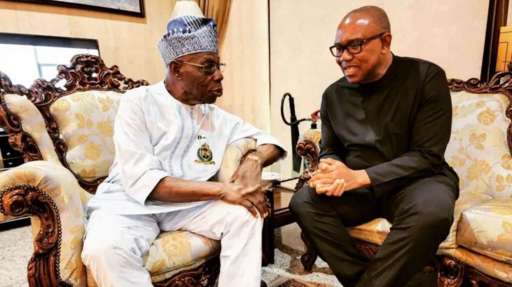
Olusegun Obasanjo, the former president of Nigeria, is at the center of a political uproar after supporting Peter Obi, an opposition candidate for president, ahead of the general election scheduled for next month.
Mr. Obasanjo described Mr. Obi of the Labour Party in his endorsement as a “mentee” with an “edge over other candidates.”
He added that the nation of West Africa had “moved from [the] frying pan into [the] fire and from the mountain top to the valley” in regards to its current situation.
Mr Obasanjo governed Nigeria between 1999 and 2007 as the flag bearer for the now-main opposition PDP party. But he has since distanced himself from the party.
In an angry response, President Muhammadu Buhari’s office said the former leader was “being jealous” and represented the “dark days of Nigeria’s democracy.”
The former president thinks “he is the best ever to lead Nigeria and there will never be another one better than him,” a statement from a presidential aide said.
MORALLY SQUALID OBASANJO ATTACKS LEADERS OUT OF FRUSTRATION
Peter Obi is seen as one of the three main contenders. The others are Bola Ahmed Tinubu of the governng APC and Abubakar Atiku of the opposition PDP.
Local outlets quote Mr Tinubu’s campaign as saying that their candidate “will not lose sleep” over Mr Obasanjo’s endorsement, while Mr Atiku’s camp said the “endorsement of an individual no matter how highly placed does not translate to victory at the polls”.
Nigeria’s President Muhammadu Buhari has summoned heads of security agencies for a meeting on Monday in the capital, Abuja, following terror alerts issued recently by several Western countries.
In a statement, the presidency said the meeting was aimed at reviewing and strengthening the security network across the country.
Last week the UK and US had warned that Islamist militants were likely to target government facilities, places of worship and schools in Abuja and its environs.
The US went further to approve the evacuation of its citizens and non- essential staff. The alerts sparked public anxiety and tension across the country.
Meanwhile reports say a top leader of one jihadist group, Iswap, has been arrested and some militants killed as they attempted to free some of their detained leaders being held at a camp in central Niger state.
The militants were reportedly killed by Nigerian troops after they ran into military ambush in New Bussa, Niger state.
Some junior personnel of the Nigerian Army has again called on President Muhammadu Buhari to increase their salaries.
They alleged that the Nigerian government and army authorities had impoverished those of them in the lower cadre with no increment in their salaries for years with some enduring about 12 years of stagnant pay.
The soldiers noted that to meet their basic financial needs, they now sold their cars, televisions, housing properties, and others.
They urged President Muhammadu Buhari to increase their salaries and inaugurate a committee to investigate happenings in the military, particularly issues involving and affecting the rank and file.
“We the other ranks in the Army are suffering with this current inflation in Nigeria. Sir, we now find it difficult to pay our children’s school fees,” a soldier told SaharaReporters.
“There is serious hunger all over army barracks. As I’m writing this, our soldiers now sell their housing properties before the end of each month, televisions, fridges, or any item that can bring a little amount of money to buy foodstuffs.
“Some even sold their cars, this life is not easy for us soldiers at all, we are all in debt because our salaries are not enough to pay children’s school fees, let alone feeding the families.”
This is coming a few weeks after a soldier, Sergeant Ismaila Ukwuhcodu, wrote a letter to the President over their “meager” pay.
The sergeant had noted that to meet financial needs, soldiers now got “involved in illegal duties, sabotage, arms and ammunition deal, armed robbery and kidnapping” while calling on the President to attend to their plight.
“As a trustee of the Armed Forces of Nigeria, I humbly wish to address this letter to you who called us to serve the nation. The Nigeria Army (NA)is the land component of the Armed Forces created to defend and maintain its territorial integrity from external aggression and act in aid of civil authorities to restore order when called upon by Mr President,” the letter had read.
“In the face of security challenges bedeviling the nation, men of the armed forces sacrifice their lives. Despite the risks involved, NA fall in their responsibility and duty to meet the benefits and services of soldiers not minding the consequences it will breed with time. Perhaps the concept is that “soldiers are illiterates with no prospect for a successful future”.
“The system preaches patriotism, discipline, loyalty, and dedication to duty, regrettable sir, our meager salary makes it difficult for us to care for our families and own personal house while in active service.
“Painfully, we buy uniforms, boots, and other military kits from the same salary to serve Nigeria. Below is the salary breakdown of your soldering per day/month.
“a. Warrant Officer’s Salary is N95,000/31 days =N3,064 per day (28 yrs in service) b. Staff Sergeant Salary is N84,000/31 days = N2,709 per day(26 yrs in) c. Sergeant Salary is N68,000/31 days =N2,193 per day(21 years in) d. Corporal salary is N62,000/31 days = N2,000 per day (16 yrs in) e. Lance Corporal N57,000/31 days = N1,838 per day (10 yrs in) f. Private salary is N50,000/31 days = N1,612 per day (5 years in service)
“To meet financial needs, soldiers involve in illegal duties, sabotage, arms & ammunition deal, armed robbery, and kidnapping. The insensitive negligence to enhancing the salary and welfare of soldiers is the cause of the mass resignation of trained troops.
“The day soldiers will demand their rights will be a sad day for the Nation, on that day, all moral sanctity would have been lost. With due respect Sir, I need respectfully request Mr President and other action addresses to please stand for the principle of truth and moral sanctity by holistically and reflectively acting on serial 3 above with a view to addressing the salary and welfare package of SOLDIERS of the Nigeria Army.”
Candidates for next February’s presidential elections in Nigeriahave signed an agreement promising to run peaceful campaigns.
They’ve also agreed to respect electoral laws before, during and after the elections to ensure a violence-free process.
In a recorded video massage to the signing ceremony in Abuja, outgoing President Muhammadu Buhari urged candidates to run “issue-based campaigns”, shun “personal attacks, insults and incitement” and avoid spreading fake news.
Mr Buhari is serving his second and final term in office and the election will be to choose his successor.
Campaigning for the crucial election in Africa’s largest democracy officially started on Wednesday.
Elections in Nigeria are usually held in a tense atmosphere.
The National Peace Accord initiative was first introduced during the 2015 election season – following post-election violence in 2011 when hundreds of people were killed.
AFPCopyright: AFP Campaign season began on Wednesday
The announced suspension of 53 radio and television stations has provoked a storm of reactions in Nigeria.
The chairman of the National Broadcasting Commission (NBC), however, insists that this measure has “nothing political”.
At a press conference in Abuja last Friday, he explained that the broadcasters concerned had not renewed their licences in time.
He said they owed more than six million euros in total. He gave them 24 hours to pay up or stop broadcasting.
Faced with heavy criticism, the National Broadcasting Commission finally decided to give more time to the media concerned, which are still broadcasting for the time being.
To prevent their closure, two organisations on Wednesday filed a lawsuit, arguing that such action would be an impediment to freedom of expression and information for millions of Nigerians.
Recent torrential rain has caused flooding in Northern Nigeria and has killed about fifty people and displaced many, according to reports from the executive secretary of the State Emergency Management Agency (SEMA) for Jigawa State, Sani Yusuf.
According to Sani Yusuf, executive secretary of the State Emergency Management Agency (SEMA) for Jigawa State, at least 50 people have died, and “many” have been relocated as a result of recent severe rains that triggered floods in northern Nigeria.
“When you go around [Jigawa State], we lost about 50 people to the flood,” Yusuf told reporters on camera Sunday from the city of Dutse, which was broadcast by local media.
Nigeria’s Federal Minister of Humanitarian Affairs Sadiya Farouq also visited Jigawa State recently to distribute relief materials, the federal ministry tweeted.
“This incident is particularly sad because it has become perennial. This is causing serious damage to schools, houses, and the livelihood of the people,” Farouq told reporters on camera.
Farouq said Nigeria’s President Muhammadu Buhari has directed the Ministry of Humanitarian Affairs and Disaster Management to activate National Emergency Management Agency to provide the necessary support to those affected by the floods.
The floods come after days of severe thunderstorms which have prompted flash flooding warnings from the Nigerian Meteorological Agency.
Many parts of Jigawa are vulnerable to flooding after rainstorms. Earlier in August, around seven people died and dozens of buildings were destroyed following flooding from heavy rains in seven districts in the northeastern Nigerian state.
Last year, more than 120 families were displaced in the state’s Guri district when their homes were submerged by floods after a heavy downpour.
“Desilting a river is not a solution to flooding, it’s a temporary solution, it takes a lot of money. If all the budgets of the federal government and Jigawa State are combined to desilt River Hadejia, we cannot achieve it,” Adamu said, adding that: “There are no short-term measures to stop flooding but we can mitigate and do early warning.”