Former US President Donald Trump is blaming his side for “almost forcing” Russian President Vladimir Putin to orchestrate Ukraine’s invasion.
According to him, should he have won the 2020 election and not President Joe Biden, the war between Russia and Ukraine would never have happened.
During an interview on Saturday morning on Real America’s Voice, a right-wing network, the former president said “Ukraine and Russia would not be fighting. It doesn’t mean they’d love each other, but there’s no way they’d be fighting, and there’s no way Putin would have actually gone in.”
“They actually taunted him, if you really look at it, our country and our so-called leadership taunted Putin,” Trump said. “I would listen, I would say, you know, they’re almost forcing him to go in with what they’re saying. The rhetoric was so dumb,” he added.
Trump did not provide any examples of how the US or President Joe Biden “taunted” Putin or what was the supposedly “dumb” rhetoric.
In the build-up to Russia’s invasion of Ukraine, Trump made the same baseless claim that Putin would not have invaded if he was still in power. He cited his positive relationship with the Russian leader.
“I knew Putin very well. I got along with him great. He liked me. I liked him,” Trump said during a “Clay Travis and Buck Sexton Show” appearance on February 22. “I mean, you know, he’s a tough cookie, got a lot of the great charm and a lot of pride, and he loves his country.”
Trump also controversially described Putin’s justification for invading as “savvy” and “genius.”
Trump said the United States “taunted Putin” to the point “of almost forcing him” to invade Ukraine. pic.twitter.com/K29QW8aOoP
The “partial mobilisation” planned by President Vladimir Putin on Wednesday would not affect IT personnel, bankers, or journalists who work for state media.
Around 300,000 citizens face being called up as part of the drive.
The move has prompted a rush toward borders as young men attempt to flee to evade the draft.
Announcing the exemptions on Friday, Russia’s defense ministry said employers must compile a list of workers who meet the criteria and submit it to its offices.
But it accepted some sectors had to be excluded to “ensure the work of specific high-tech industries, as well as Russia’s financial system”.
Some commentators have observed that the text of the mobilization decree has been left vague – potentially allowing it to be widened if necessary.
And one paragraph remains entirely classified. Kremlin spokesman Dmitry Peskov said on Friday this referred to the total number of Russians that could be conscripted, which he said could not be disclosed.
Earlier, the independent newspaper Novaya Gazeta had reported – citing an unnamed government source – that the redacted section allowed for a call-up of up to a million people, rather than the reported 300,000.
Russian men are continuing to try to flee the country to avoid being called up by recruiters for the country’s first military mobilization since World War Two.
In the south, miles-long queues of traffic have formed at the border crossing between Russia and Georgia.
Some of those heading into the neighbouring country have used bicycles to bypass lines of cars and evade a ban on crossing on foot, with others reporting waits of up to 12 hours.
When asked about the war, one man who did not wish to be named told the BBC he had known it was happening but that, until Mr Putin’s declaration of a “partial mobilization”, it had not been his concern.
A Russian student, who also did not want to be identified, said that people had woken up. “They opened their eyes and started thinking about where to hide their children. Now people understand what’s happening because it affects them directly,” he said.
Another IT worker told the BBC that he was opposed to the war, but was too scared to speak out against it.
“I don’t want to risk my life, the life of my family. I don’t want to be put in detention,” he said. “All I could do was to get a Schengen visa. Luckily I got one in May.”
Georgia is one of the few neighbouring countries where Russians can enter without needing to apply for a visa. Border guards in neighbouring Finland, which shares a 1,300km (800 miles) border with Russia but requires an entry visa, told the BBC that queues had grown at various crossing points.
Other destinations reachable by air – such as Istanbul, Belgrade, or Dubai – have seen ticket prices skyrocket immediately after the military call-up was announced, with some destinations sold out completely.
Turkish media have reported a large spike in one-way ticket sales while remaining flights to non-visa destinations can cost thousands of euros.
Several countries are grappling with the prospect of an influx of Russian draft dodgers. Germany’s interior minister signalled on Thursday that that fleeing conscription would be welcome in her country.
Nancy Faeser said deserters threatened by “severe repression” would receive protection on a case-by-case basis, following security checks.
But several other European countries, including Lithuania, Latvia, Estonia, and the Czech Republic, struck a different tone, saying they would not offer to flee Russian refuge. The countries have long pushed the EU to take a harder line on Russia.
“I understand that Russians are fleeing from ever more desperate decisions by Putin,” Czech Foreign Minister Jan Lipavsky said. “But those running because they don’t want to fulfill a duty imposed by their own government, they don’t meet the criteria for a humanitarian visa.”
There were also reports from Russia that some of those detained for protesting had been handed draft papers while in custody at police stations. When asked about the reports, Mr Peskov said that doing so was not against the law.
A top White House source told the BBC that Vladimir Putin’s veiled threats to use nuclear weapons to defend territory in Ukraine are being taken “seriously” by the US.
John Kirby said the US was not changing its “strategic deterrent posture”, but that Mr Putin spoke irresponsibly.
On Wednesday Russia’s leader warned his country would use all the means at its disposal to protect its territory.
It came as four Ukrainian regions part-occupied by Russian forces are about to stage snap votes on joining Russia.
Ukraine and its allies call these votes a sham exercise, designed to give spurious legitimacy to an illegal annexation.
“It is a dangerous precedent for Mr Putin to be using this kind of rhetoric in the context of a war clearly that he’s losing inside Ukraine,” National Security Council spokesman Mr Kirby told the BBC.
“We have to take these threats seriously and we do… We’ve been monitoring, as best we can, his nuclear capabilities, I can tell you that we don’t see any indication that we need to change our strategic deterrent posture at this point.”
“But it’s not going to work,” he said. “No one’s going to recognise it. And what needs to happen is Mr Putin needs to leave Ukraine. He needs to stop this war.”
Russia’s conduct in Ukraine was strongly condemned at a special meeting of the UN Security Council in New York on Thursday.
“This week, President Putin said Russia wouldn’t hesitate to use ‘all weapon systems available’ in response to a threat to its territorial integrity – a threat all the more menacing given Russia’s intention to annex large swaths of Ukraine in the days ahead…” said US Secretary of State Anthony Blinken.
“This from a country that in January of this year joined the other permanent members of the Security Council in signing a statement affirming that ‘nuclear war can never be won and must never be fought.”
But Russian Foreign Minister Sergei Lavrov accused some Security Council members of trying to impose a false narrative on Moscow’s operations in Ukraine and restating allegations that ethnic Russians had been persecuted by Ukrainian government forces.
“There’s an attempt today to impose on us a completely different narrative to show Russian aggression as the origin of all the tragedy,” Mr Lavrov said.
“This ignores the fact that for over eight years the Ukrainian army and fighters from the nationalist formations killed and continue to kill inhabitants of [the east Ukrainian region of] Donbas with impunity simply because they refused to recognise the results of the coup d’etat in Kyiv. They decided to uphold their rights, which were guaranteed by the Ukrainian Constitution, including the right to freely use Russian, their mother tongue.”
Russia attempts to justify its invasion by saying it is fighting neo-Nazis, a claim widely dismissed by the international community, as well as resisting Nato expansion.
In his speech on Wednesday, President Putin also announced a call-up for reservists in a move analysts say is a sign that Russia’s forces in Ukraine are struggling to hold on to the strip of the territory they occupy in the east and south.
President Vladimir Putinissued an order to mobilize soldiers, stepping up Moscow’s apparent military operation in Ukraine.
On Wednesday, Russian President Vladimir Putin authorized a “partial mobilization” that would call up 300,000 Russian citizens who were in the military reserves to serve in Ukraine.
The incident came a day after a series of synchronized actions towards annexation referendums in Russian-occupied Ukrainian territory, and it signaled a dramatic uptick in Russia’s conflict with Ukraine.
Putin spoke in Russian in the televised address. The quotes below have been translated into English.
Partial mobilization
“In such a situation, I consider it necessary to make the following decision, which is fully appropriate to threats we face. Namely, in order to protect our motherland, its sovereignty, and territorial integrity, and to ensure the safety of our people and people in the liberated territories, I consider it necessary to support the proposal of the defense ministry and the General Staff to conduct a partial mobilization in the Russian Federation.”
“We are talking about partial mobilization. That is, only citizens who are currently in the reserves and, above all, those who have served in the armed forces, have military skills and relevant experience. Only they will be subject to conscription.”
Fighting the West
“Today our armed forces are operating across a front line that exceeds 1,000 km, opposing not only neo-Nazi formations but the entire military machine of the collective West.”
“NATO is conducting reconnaissance across the south of Russia. Washington, London, and Brussels are directly pushing Kyiv to move military action to our country. They are openly saying that Russia should be defeated on the battlefield by any means.”
Nuclear weapons
“Nuclear blackmail has also been used. We are talking not only about the shelling of the Zaporizhzhia nuclear plant – encouraged by the West – which threatens to cause a nuclear catastrophe but also about statements from senior representatives of NATO countries about the possibility and permissibility of using weapons of mass destruction against Russia: nuclear weapons.
“I would like to remind those who make such statements about Russia that our country also possesses various means of destruction, and in some cases, they are more modern than those of NATO countries. When the territorial integrity of our country is threatened, we, of course, will use all the means at our disposal to protect Russia and our people.
“This is not a bluff. And those who try to blackmail us with nuclear weapons should know that the weathervane can turn and point towards them.”
“Citizens of Russia can be convinced that our territorial independence and freedom will be provided, and I emphasize this one more time, with all means that we have at our disposal.”
Referendums
“Parliaments in the People’s Republics of the Donbas as well as the civil-military administrations in Kherson and Zaporizhzhia regions have decided to hold referendums on the future of the territories and have appealed to Russia to support such a step. We will do everything to ensure safe conditions to hold the referendums so that people can express their will.
“We will support the decision on their future, which will be made by the majority of residents in the Donetsk and Luhansk People’s Republics, Zaporizhzhia, and Kherson.”
West trying to ‘destroy’ Russia
“In its aggressive anti-Russian policy, the West has crossed every line. We constantly hear threats against our country and our people.”
“The purpose of this West is to weaken, divide and ultimately destroy our country. They are already saying that in 1991 they were able to break up the Soviet Union, and now the time has come for Russia itself that it should disintegrate. And they have been planning it for a long time.”
“The West is not interested in a peaceful solution and making compromises; they just want to break all negotiations.”
The Kremlin leader made his peace request as his troops carried on their gruesome assault after invading Ukraine.
Even Mr. Putin made a mediation offer.
The action took place while a tenuous ceasefire between the two Central Asian countries continued for a second day and as Kyrgyzstan and Tajikistan reported that 71 people had died in recent combat.
The former Soviet republics have both accused each other of using tanks, mortars, rocket artillery, and assault drones to attack outposts and nearby settlements.
Central Asian border issues largely stem from the Soviet era when Moscow tried to divide the region between groups whose settlements were often located amid those of other ethnicities.
Tajikistan reported 35 of its people had been killed.
Mr Putin spoke by telephone to Kyrgyz president Sadyr Japarov and Tajik leader Emomali Rakhmon on Sunday, the Kremlin said.
He urged the sides to prevent further escalation and to take measures to resolve the situation “exclusively by peaceful, political and diplomatic means as soon as possible”, offering assistance, his office said in a statement.
International Atomic Energy Agency (IAEA,) the UN’s nuclear watchdog, reports that Ukraine’s massive Zaporizhzhia nuclear power facility has resumed power supply from the national grid.
Power lines connected to the plant were destroyed by shelling in the region.
The plant’s six reactors are all in a state of cold shutdown, but it still needs outside electricity to keep them cool and prevent a meltdown.
The situation at the plant, which is seized by Russian forces, has reportedly improved but is still unstable, according to the IAEA.
At the beginning of the month, a group of nuclear experts from the IAEA (International Atomic Energy Agency) travelled to Zaporizhzhia, the biggest nuclear facility in Europe.
Russia and Ukraine both blamed each other for the shelling of the facility in southeast Ukraine.
After the IAEA’s first inspection, the agency announced it would maintain a permanent presence in order to monitor the situation.
Members of the team at the site on Saturday learned that one of the four main external power lines damaged by shelling had been repaired, allowing electricity to be received directly from the national grid, the IAEA tweeted on Saturday.
Further east in Ukraine, the discovery of mass graves in Izyum has led the European Union presidency to call for an international tribunal for war crimes to be carried out.
Hundreds of bodies have been discovered buried in a forest at the edge of the city, which recently came under the control of Ukraine after Russian forces retreated.
Many are said to be civilians, women, and children among them.
Ukraine says it believes war crimes have been committed.
“In the 21st Century, such attacks against the civilian population are unthinkable and abhorrent,” said Jan Lipavsky, foreign minister of the Czech Republic which holds the EU’s rotating presidency.
“We must not overlook it. We stand for the punishment of all war criminals,” he wrote in a tweet. “I call for the speedy establishment of a special international tribunal that will prosecute the crime of aggression.”
The separatist mayor of Donetsk city said four people had been killed by Ukrainian government shelling of a central district while the Donetsk region’s Ukrainian governor accused Russian forces of shelling a thermal power plant in Mykolaivka, disrupting drinking water supplies in the area.
Ukrainian troops are continuing their counter-offensive in the country’s north-east, after successfully recapturing territory from Russia in recent days, the UK’s defence ministry says. It adds that Russia has established a defensive line protecting one of its main supply routes from Belgorod, near its border with Ukraine.
Russian President Vladimir Putin said on Friday that Ukrainian counter-offensives would not change Russia’s military plans in the east of Ukraine.
Spokesman Dmitry Peskov said Mr Putin’s work schedule would not permit him to attend the event on Saturday.
He said the Russian leader had paid his respects at the Moscow hospital where Gorbachev died on Tuesday, aged 91.
Gorbachev’s reforms helped end the Cold War, but saw the demise of the Soviet Union, which Mr Putin has lamented.
Warning: some readers may find the video below distressing.
In 2005, the Russian president said the break-up of the USSR was “the greatest geopolitical catastrophe of the [20th] Century”.
However, in his telegram of condolences to Gorbachev’s family on Wednesday, Mr Putin struck a more conciliatory note, describing him as “a politician and statesman who had a huge impact on the course of world history”.
On Thursday, Russian state television showed Mr Putin placing red roses beside Gorbachev’s coffin in Moscow’s Central Clinical Hospital.
“Unfortunately, the president’s work schedule will not allow him to do this on 3 September, so he decided to do it today,” Mr Peskov told reporters.
Gorbachev’s funeral, which will be open to the public, will take place in Moscow’s Hall of Columns.
Afterwards, he will be buried at the city’s Novodevichy cemetery, next to his wife Raisa, who died in 1999.
Mr Peskov said Gorbachev’s ceremony would have “elements” of a state funeral and that the state was helping to organise it.
Mr Putin will not be the only notable absentee from the funeral. Many of the foreign leaders who might have been expected to attend are currently barred from Russian soil, in retaliation for Western sanctions imposed because of Russia’s invasion of Ukraine.
Top politicians from the US, UK, EU, Japan and Canada are among those on the exclusion list, including US President Joe Biden and UK Prime Minister Boris Johnson, as well as the two candidates vying to succeed him, Liz Truss and Rishi Sunak.
The Kremlin would say, what is all the fuss about? Vladimir Putin has expressed his condolences to Mikhail Gorbachev’s family (in a brief telegram). He’s also laid flowers at Gorbachev’s open casket.
But, no, he won’t be going to the funeral. The official reason: no space in his busy schedule. Diary full. That rather unconvincing explanation is fuelling speculation that, in reality, it’s not that Putin has no time, but rather no desire to attend.
In other words, it’s a snub. Why might that be? Well, for a start, to those in power in Russia today, Mikhail Gorbachev is viewed as having been a weak, indecisive leader who let a superpower – and Russia’s global influence – slip away.
What’s more, President Putin has been busy dismantling Mikhail Gorbachev’s legacy. Gorbachev opened up the country, granted freedoms to his people and sought peace and friendship with Western nations. That’s not President Putin’s thing at all. He’s been taking freedoms away, supressing democratic institutions and embracing the idea of confrontation with the West.
That – along with the invasion of Ukraine – is keeping President Putin very busy. No wonder his diary is full.
Due to the need for maintenance, Russia has fully stopped supplying gas to Europe through a major pipeline.
The Nord Stream 1 pipeline will be restricted for the next three days, according to Russian state-owned oil company Gazprom.
Russia already considerably cut back on pipeline-based gas shipments.
It also denies claims that energy supplies were used to penalize Western countries for enacting sanctions in response to the invasion of Ukraine.
The Nord Stream 1 pipeline stretches 1,200km (745 miles) under the Baltic Sea from the Russian coast near St Petersburg to north-eastern Germany.
It opened in 2011 and can send a maximum of 170m cubic metres of gas per day from Russia to Germany.
The pipeline was shut down for 10 days in July – again for repairs, according to Russia – and has recently been operating at just 20% capacity because of what Russia describes as faulty equipment.
European leaders fear Russia could extend the outage in an attempt to drive up gas prices, which have already risen by 400%.
The steep rise threatens to create a cost of living crisis over the winter months, potentially forcing governments to spend billions to ease the burden.
On Tuesday, French Energy Minister Transition Minister Agnes Pannier-Runacher accused Russia of “using gas as a weapon of war”.
She was speaking after Gazprom said it would be suspending gas deliveries to the French energy company Engie.
But Russian President Vladimir Putin‘s spokesman has rejected the accusations and insisted that Western sanctions have caused the interruptions by damaging Russian infrastructure.
He insisted that “technological problems” caused by Western sanctions are the only thing preventing Russia from supplying gas via the pipeline, without specifying what the problems were.
The most recent controversy has been over a turbine that arrived in Germany after being repaired in Canada and which Russia refused to take back, arguing it was subject to the Western sanctions.
Germany, however, denies this.
Earlier this month, Economy Minister Robert Habeck said the pipeline was fully operational and said there were no technical issues as claimed by Russia.
Earlier this week, EU Commission President Ursula von der Leyen promised to intervene in energy markets, telling a conference in Slovenia that they are “no longer fit for purpose”.
“We need a new market model for electricity that really functions and brings us back into balance,” she said.
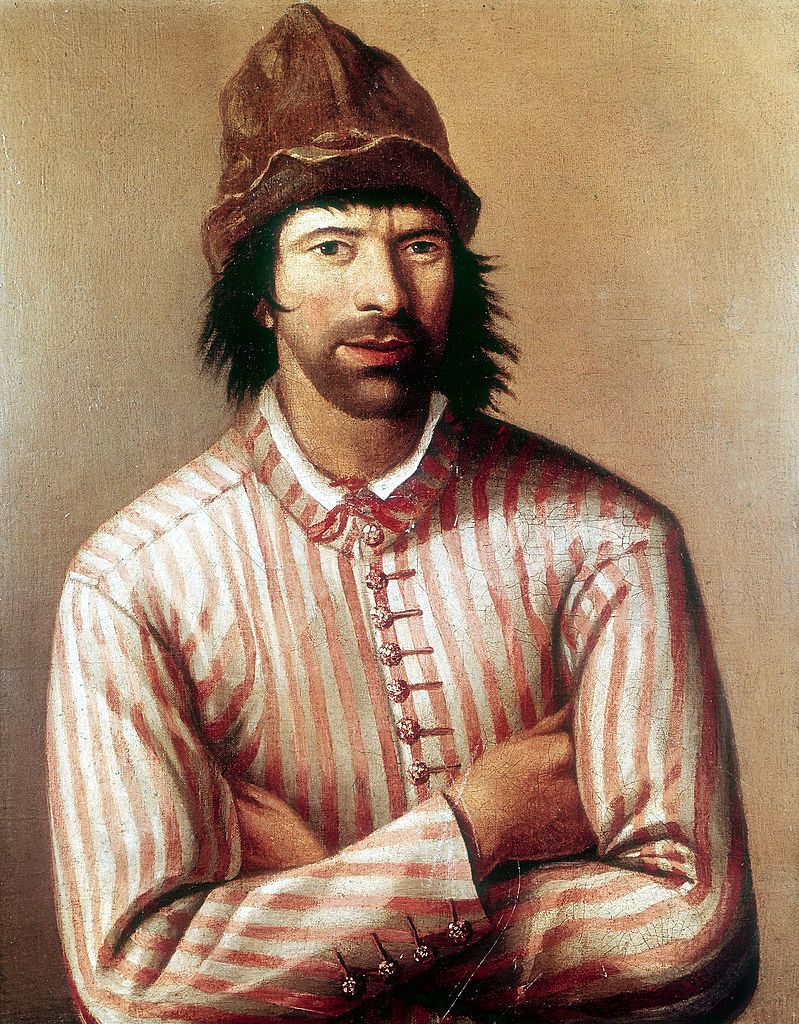
Vladimir Putin’s admiration for Peter the Great is well known, but he now seems to have ideas of “Great”-ness himself.
He has openly compared himself to the Russian tsar, equating Russia’s invasion of Ukraine today with Peter’s expansionist wars some three centuries ago, and making his strongest acknowledgment yet that his own war is a land grab.
Mr Putin’s apparent empire-building ambitions bode ill for Ukraine and have irked other neighbours, including Estonia, which called his comments “completely unacceptable.”
Russia’s president was meeting young scientists and entrepreneurs when he made the remarks. Before talking IT and tech development, he talked politics and power: the new battle he sees for geopolitical dominance. In that, he told his select audience that Peter the Great was a role model.
“You might think he was fighting with Sweden, seizing their lands,” Mr Putin said, referring to the Northern Wars which Peter launched at the turn of the 18th Century as he forged a new Russian Empire.
“But he seized nothing; he reclaimed it!” he said, arguing that Slavs had lived in the area for centuries.
“It seems it has fallen to us, too, to reclaim and strengthen,” Mr Putin concluded, with a near-smirk that left no doubt he was referring to Ukraine and his aims there.
Peter’s rule, he suggested, was proof that expanding Russia had strengthened it.
Putin spoke of Peter the Great as a role model during the meeting
Mr Putin has taken to citing Russia’s past a lot lately, always carefully curated to suit his present-day cause. Several months before he attacked Ukraine, he produced a giant essay in which he essentially argued away the country’s historical right to exist.
When Russia invaded its neighbour on 24 February, Putin falsely claimed it was a “special operation” limited to the eastern Donbas region to “de-Nazify” Ukraine and reduce the supposed threat to Russia.
But even as he was uttering those words, his troops were moving on Kyiv and bombing land even further west. More than 100 days later, a fifth of Ukrainian territory is under Russian military control, with puppet administrations who talk of referenda on joining Russia.
And now Putin feels bold enough to admit that his “operation” is in fact an occupation.
He also seems to believe the West will ultimately accept the reality his troops are fighting to create on the ground.
At the time, “not one European country” recognised Russia’s claim to the land where Peter created St Petersburg as Russia’s bold new capital, Mr Putin said. Now they all do.
His comments have also rattled the Baltic countries. The Estonian foreign ministry summoned the Russian ambassador to condemn his reference to Peter the Great’s assault on Narva, now in Estonia, as Russia “reclaiming and strengthening” its territory.
Getty Images Peter travelled incognito through Europe to get inspiration for modernising Russia
Putin’s use of history is selective.
Peter the Great, though a ruthless autocrat, was a huge admirer of Western ideas, science and culture, famously building St Petersburg as a “window on Europe” and travelling that continent thirsty for knowledge to help drag Russia towards modernity.
Putin’s increasingly repressive rule slowly closed that window on the West; the war on Ukraine has slammed it shut. The idea of the Russian leader touring Holland or Greenwich in search of ideas and inspiration, as the Tsar once did, now seems impossible.
As Putin lectured the young entrepreneurs on an 18th Century tsar, a series of words flashed up behind them: ‘future’, ‘confident’, ‘victory’.
Russia is determined to project defiance in the face of Western condemnation and sanctions and Putin himself certainly appeared relaxed rather than beleaguered.
But perhaps there is another lesson from the history books.
Peter the Great did eventually conquer land from the Baltics to the Black Sea. But Russia was fighting its Great Northern War for 21 years.
Russian Foreign Minister Sergei Lavrov has denied speculation that President Vladimir Putin is ill.
In an interview with French TV, Mr Lavrov said the Russian leader appears in public every day, and no sane person would see any signs of an ailment.
There has been increasing unconfirmed media speculation that Mr Putin, who turns 70 this year, may be suffering from ill health, possibly cancer.
The interview came as Russia continues its advance in Ukraine’s Donbas region.
Mr Lavrov said the “liberation” of the eastern region was an “unconditional priority” for Russia.
He repeated the Kremlin’s widely discredited line that Russia is fighting a “neo-Nazi regime”.
IMAGE SOURCE, REUTERS
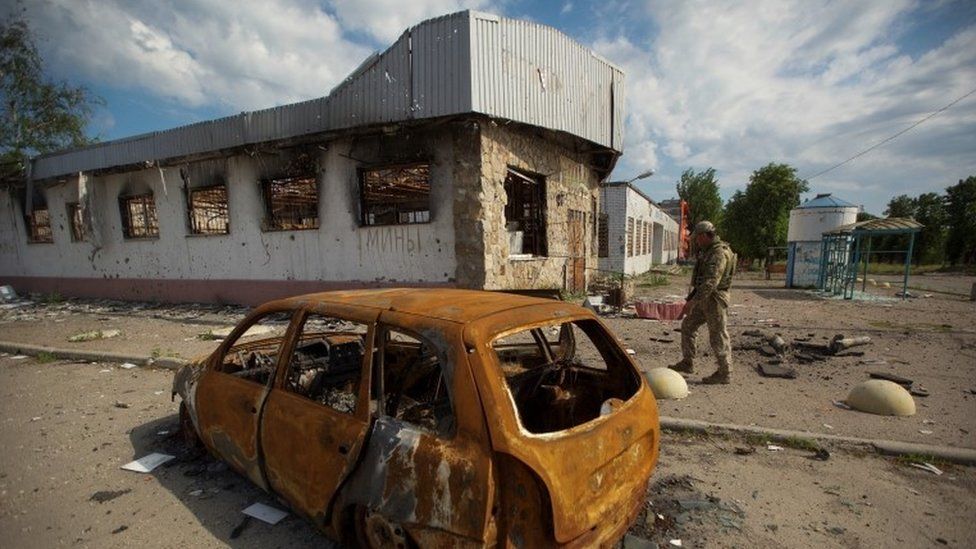
Image caption, A Ukrainian soldier inspects Russian shell damage in Marinka, Donetsk region, this weekend
Noting that President Putin regularly appeared in public, Mr Lavrov told TF1: “I don’t think that sane people can see in this person signs of some kind of illness or ailment.”
“You can watch him on screens, read and listen to his speeches,” he said in comments released by the Russian foreign ministry.
“I leave it to the conscience of those who spread such rumours despite daily opportunities to assess how anyone is looking.”
British intelligence sources were quoted telling media outlets that Mr Putin was seriously ill in the last week. However, rumours about the condition of the Russian leader, long known for his healthy lifestyle and love of sport, have surfaced periodically for years.
Asked about the human cost of the fighting, which has seen devastating artillery and rocket attacks on some urban areas, the foreign minister insisted Russian soldiers were “under strict orders categorically to avoid attacks and strikes on civilian infrastructure”.
Since Russia invaded on 24 February, at least 4,031 civilians have been killed and 4,735 injured, according to the UN, and an unknown number of combatants have died or been wounded. More than 14 million people have fled their homes, with towns and cities reduced to rubble.
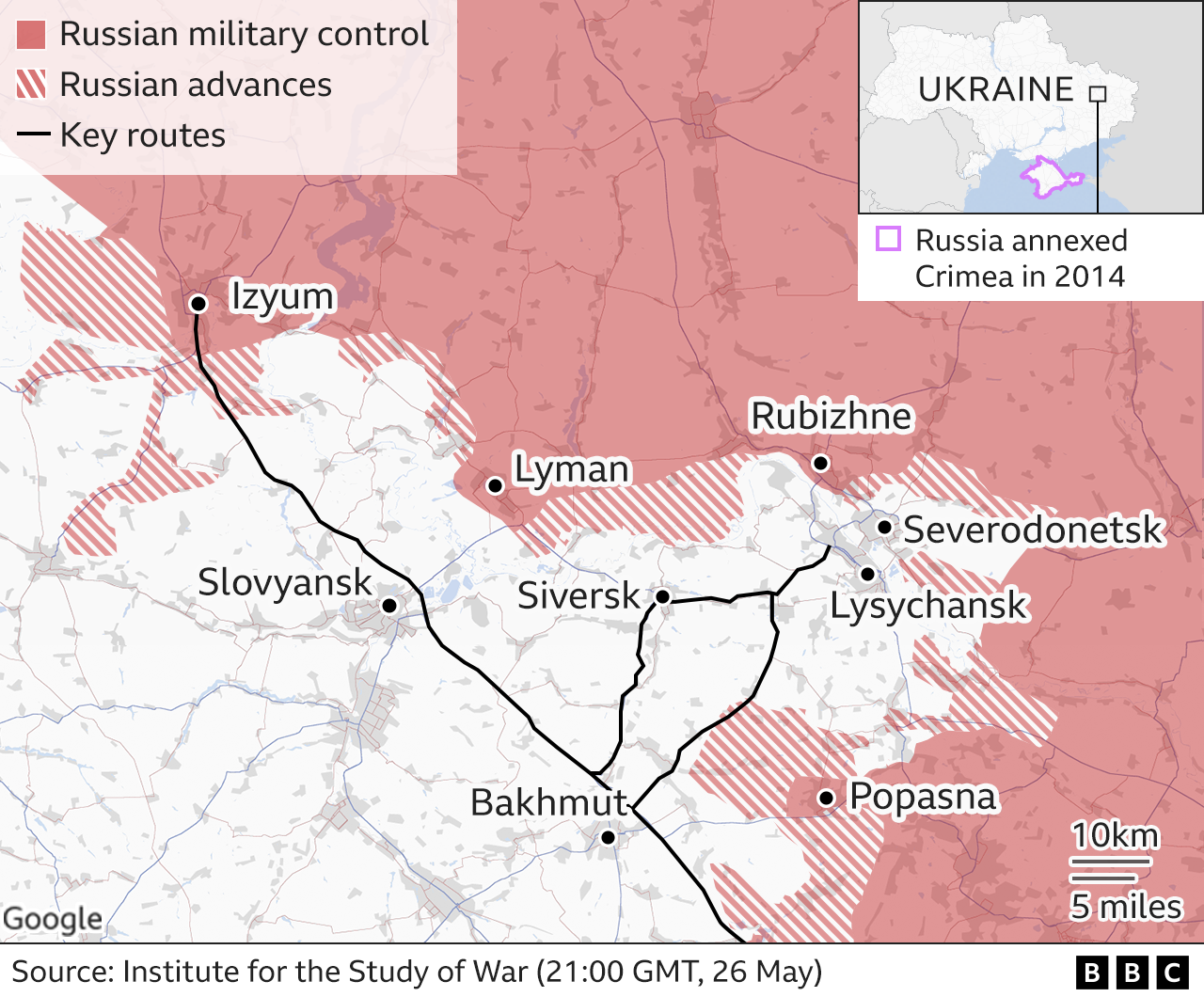
The fighting is now focused on the Donbas – the mining belt made up of the Donetsk and Luhansk regions. Separatists in the two regions, which historically have strong ties to Russia, broke away in 2014 and are now fighting alongside Russian troops to take full control.
Mr Lavrov told TF1 that winning in “the Donetsk and Luhansk regions, recognised by the Russian Federation as independent states, is an unconditional priority”.
However, he added, it was up to the rest of Ukraine if people there were “happy to return to the authority of a neo-Nazi regime that has proven it is Russophobic in essence“.
Russia has already been forced to pull back from an attempt to overrun the capital Kyiv, after been repelled by Ukrainian forces.
They have also been pushed back from the second city, Kharkiv, in recent weeks, with Ukrainian President Volodymyr Zelensky making a morale-boosting trip to the battle scarred city on Sunday.
Speaking in the city, he said his soldiers would defend their land “to the last man”. “They [the Russians] have no chance,” he said. “We will fight and we will definitely win.”