United States President Joe Biden has apologized to UkrainianPresident Volodymyr Zelenskyyfor previous delays in Washington’s aid to Kyiv, emphasizing that the US will continue to support Ukraine.
The two leaders met on Friday in Paris during the D-Day anniversary celebrations, where President Biden announced a $225 million aid package to help rebuild Ukraine’s electric grid.
Biden emphasised that the US will continue to stand with Ukraine against the Russian invasion. “We’re still in – completely, thoroughly,” he said.
Washington has provided tens of billions of dollars to Kyiv to help fend off the Russian offensive that began in February 2022.
But earlier this year, funds available for the Biden administration to help Ukraine began to dwindle during an impasse in Congress to authorise new aid.
Some right-wing lawmakers have been sceptical of US support for Ukraine. Further complicating matters, legislators tried to link Ukraine aid to other issues, including assistance to Israel and domestic priorities.
After months of negotiations between the White House and congressional leaders, lawmakers passed a $61bn Ukraine funding bill in April that Biden signed into law.
The legislation also provided $14bn in military aid to Israel.
“I apologise for the weeks of not knowing what’s going on in terms of funding,” Biden told Zelenskyy, blaming “very conservative” members ofCongress for holding up the funding bill.
During the long-anticipated conversation between the two leaders, Xi appealed for Russia and Ukraine to restart peace talks and warned “there is no winner in a nuclear war”, according to state media.
The Chinese government pledged to send a “special representative” to Kyiv for talks about a possible “political settlement”.
Writing on Twitter following the discussion, Mr Zelenskyy said: “I had a long and meaningful phone call with… President Xi Jinping.
“I believe that this call, as well as the appointment of Ukraine’s ambassador to China, will give a powerful impetus to the development of our bilateral relations.”
It comes two months after Beijing said it wanted to act as a peace mediator.
China has tried to appear neutral about the conflict, but has refused to condemn Moscow’s invasion of Ukraine.
President Xi reportedly said China will send special representatives to Ukraine to hold talks with “all parties” on the “political settlement of the Ukrainian crisis”.
He said China is willing to continue to provide “humanitarian assistance” to Ukraine.
“The two sides should focus on the future, persist in viewing and planning bilateral relations from a long-term perspective, continue the tradition of mutual respect and sincerity between the two sides,” he said.
‘No winner in a nuclear war’
“Negotiation is the only viable way out,” Chinese state TV also quoted Xi as saying in a report about the call.
He added: “There is no winner in a nuclear war.
“All parties concerned should remain calm and restrained in dealing with the nuclear issue and truly look at the future and destiny of themselves and humanity as a whole and work together to manage the crisis.”
Before the February 2022 invasion, the Chinese president and Russian President Vladimir Putin issued a joint statement saying their governments had a “no limits friendship”.
But earlier this year, the Chinese government released a peace proposal and called for a ceasefire and talks.
The phone call between the two leaders was for China another step toward deeper involvement in resolving the ongoing war.
It comes after Mr Zelenskyy said in late March that he had not spoken with Xi since the war began before extending an invitation for him to visit Ukraine.
Why China’s stance matters
An official for China’s foreign ministry added that President Xi’s call with President Zelenskyy “shows China’s objective, impartial position on international affairs”.
They said what the country has done to help resolve the crisis has been “above board”.
Sky’s Asia correspondent Helen-Ann Smith said the phone call between President Zelenskyy and President Xi is “really significant,” adding: “China’s position on this war is really very important, it is presenting itself as a potential peacemaker.”
She added: “It wants to be seen as the power capable of brokering peace because it says it is one of the only mutual parties.
“The West sees that claim with a degree of scepticism. China has never condemned the invasion, but it has providedRussia with finance and technology and significant diplomatic cover.”
It is thought that just before the visit, Russia was made aware of Mr. Biden’s presence in Ukraine.
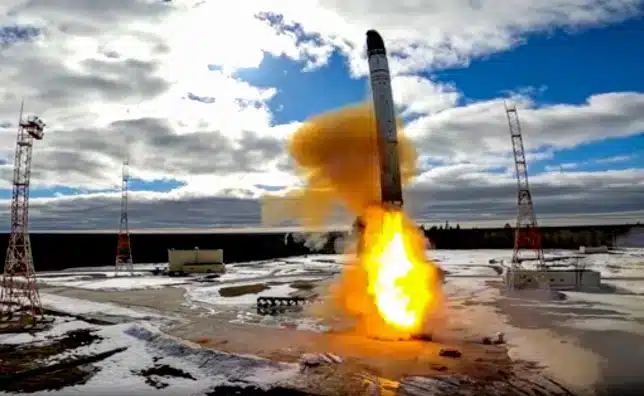
Vladimir Putin reportedly observed an ICBM test for the Satan II, which is believed to have failed, when he was in the city.
The missile is capable of delivering multiple nuclear warheads and is believed to have a range of almost 7000 miles.
According to American reports, the test launch was not considered an escalation of the conflict.
The weapon was also tested in April, mere weeks after Russia invaded Ukraine.
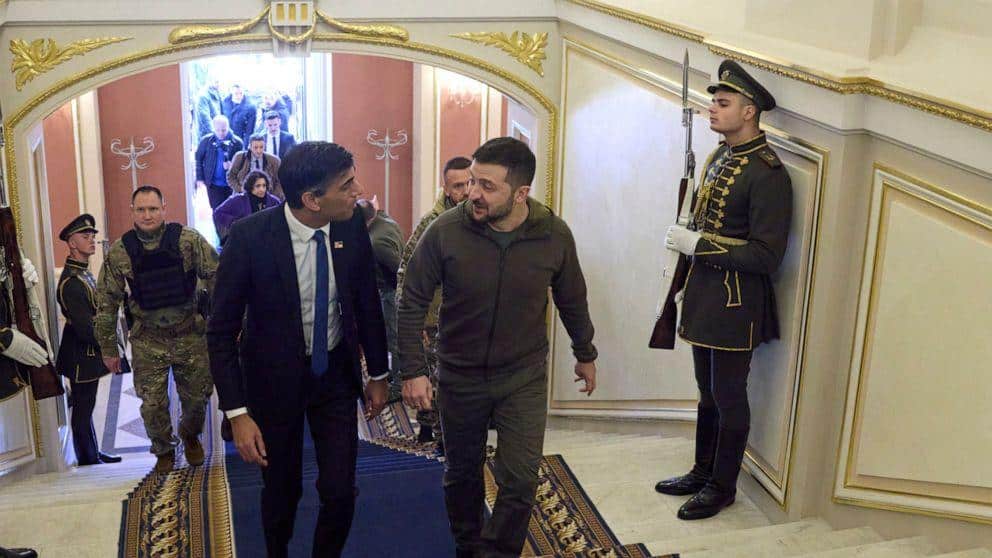
Volodymyr Zelenskiy and Joe Biden walk outside the Mariinskyi Palace (Picture: Reuters)The US President made the surprise trip ahead of the first anniversary of Russia’s invasion of Ukraine (Picture: APAImages/Shutterstock)
Mr Biden is yet to comment on the reported missile launch during his visit in Ukraine.
He had since travelled to Poland to praise allies in Europe.
The President warned of ‘hard and bitter days ahead’ but vowed that the US and allies ‘will not wave’ in supporting the Ukrainians.
‘One year ago, the world was bracing for the fall of Kyiv,” he said before a crowd of thousands outside Warsaw’s Royal Castle.
Both Russia and the US have an variety of deadly weapons at their disposal (Picture: Kevin OReilly/Dailymail.com)
‘I can report: Kyiv stands strong. Kyiv stands proud. It stands tall and, most important, it stands free.’
With Russia and Ukraine preparing spring offensives, Mr Biden insisted there will be no backing down from what he has portrayed as a global struggle between democracy and autocracy.
However, polling suggests American support for ongoing military assistance appears to be softening.
Earlier in the day, Mr Biden with Polish President Andrzej Duda as he began consultations with allies to prepare for a new phase of the war.
Joe Biden delivers a speech marking the one-year anniversary of the Russian invasion of Ukraine, at the Royal Castle Gardens in Warsaw. (Picture: AP/ Evan Vucci)Meanwhile, Vladimir Putin addressed the masses in Russia yesterday and claimed he didn’t start the war (Picture: AP)
Mr Duda praised the American president’s visit to Kyiv as ‘spectacular’, saying it ‘boosted morale of Ukraine’s defenders’.
He said the trip was ‘a sign that the free world, and its biggest leader, the president of the United States, stands by them’.
Mr Zelensky has been pushing the US and European allies to provide fighter jets and long-range missile systems known as ATACMS – which Mr Biden has declined to provide so far.
Yesterday, Putin made an appearance in Moscow to give a speech to Russians.
He claimed he ‘didn’t start the war’ in a rambling address that lasted near to two hours.
A selection of cabinet minsters, deputies and senators were all in attendance as the address is broadcast across the world.
Putin referred to the war as a ‘special military operation’ and referred to the situation in Ukraine as a ‘military coup’.
He claimed Ukrainians have been waiting for his troops to ‘come to their help’ and that the West released a ‘genie in a bottle.’
Putin said: ‘They started the war and we used the force to stop it.”
‘They spent $150bn to support militarily Kyiv’s regime.’
He went on to tell the audience each Russian has a ‘great responsibility’ to ‘protect our people on our historic land.’
The Franco-German meeting with the Ukrainian leader in Paris, according to Prime Minister Giorgia Meloni, did not promote “unity.”
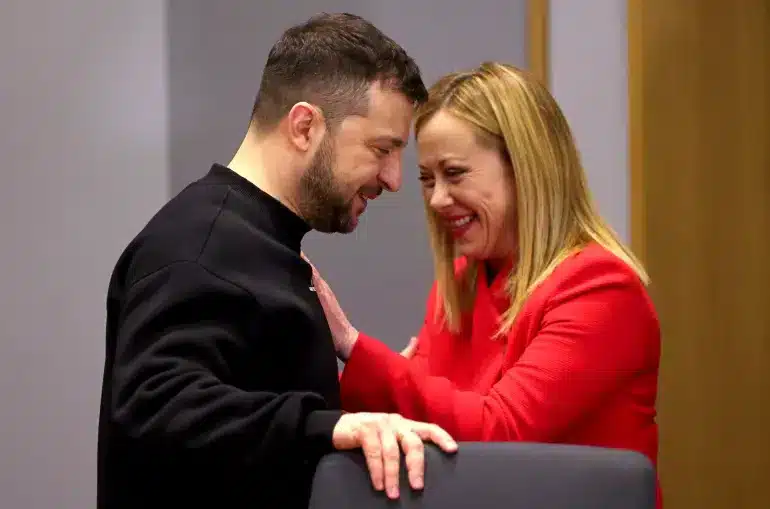
As a result of not being invited to a dinner in Paris with Ukrainian President Volodymyr Zelenskyy, Italian Prime Minister Giorgia Meloni has criticised France and Germany, causing a rift between the European Union’s allies.
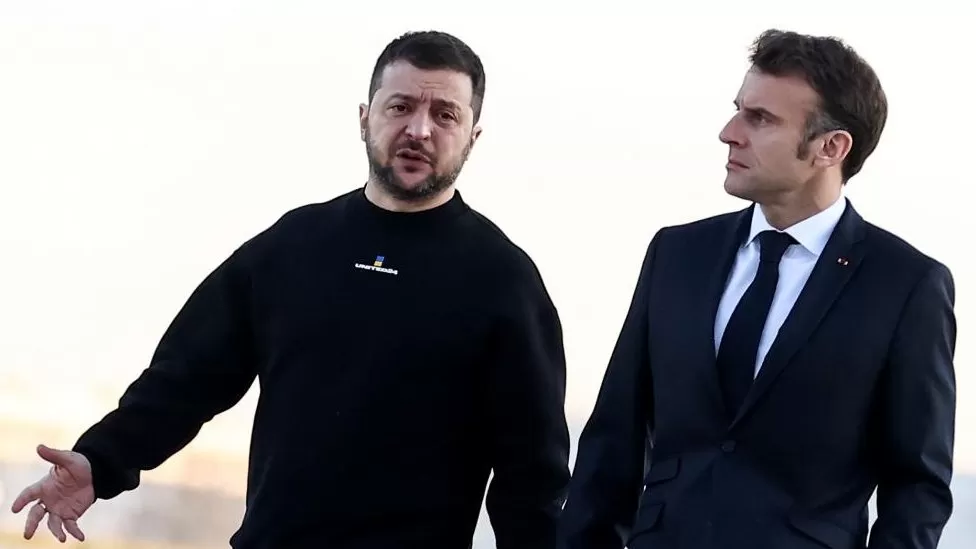
Zelenskyy began a surprise trip to Western Europe on Wednesday with a stop in the United Kingdom. He then travelled to France, where, ahead of a Thursday EU summit, he had a late dinner with Macron and German Chancellor Olaf Scholz.
But unlike the previous year, when Macron and Scholz collaborated closely on Ukraine with the then-Italian Prime Minister Mario Draghi, Meloni was left out in the cold.
Speaking to reporters as she arrived at the Brussels summit on Thursday, Meloni, who took office last October, said she thought the snub was “inappropriate”.
“I think our strength in this fight is unity,” she added.
She later met Zelenskyy on the sidelines of the EU meeting.
Asked about her comments, Macron said he thought Wednesday’s dinner had been fitting.
“As you know, Germany and France have had a special role on the Ukraine question for eight years,” he told reporters, referring to joint mediation by the two countries that tried, and failed, to prevent conflict between Russia and Ukraine.
However, things were different when Draghi, a former president of the European Central Bank, was prime minister. Draghi travelled with Macron and Scholz to Kyiv by train last June and played a leading role with them in shaping EU opposition to Russia following its invasion of Ukraine.
Meloni has pledged to maintain the same pro-Ukraine stance, despite the misgivings of some of her coalition allies, telling reporters on Thursday that providing help to Kyiv was the best way to bring about peace.
Underscoring her willingness to support Kyiv, Italy and France finalised technical talks last week for the joint delivery of a SAMP/T-MAMBA air defence system to Ukraine early this year.
However, Meloni’s brand of nationalist politics has put her at odds with both Macron and Scholz on an array of other issues and the close ties that Draghi forged with Paris and Berlin seem a distant memory.
Paris last November accused Meloni’s new government of breaking a bond of trust and breaching international laws by refusing to take in refugees and migrants saved by a charity rescue ship. The boat eventually docked in France instead.
Earlier this week, French and German ministers flew to Washington together to discuss contested US subsidies with their US counterparts, excluding Italy, which is the second-largest manufacturer in the European Union after Germany.
The president of Ukraine is in Brussels after pleading with the leaders of France, Germany, and the UK to donate fighter jets for the conflict with Russia.
On his second trip outside of Ukraine since the war started, President Volodymyr Zelensky is scheduled to lobby a summit of EU leaders and speak before the European Parliament.
Germany’s Olaf Scholz and France’s Emmanuel Macron reaffirmed in Paris that Russia cannot win the conflict.
France and Germany, according to Mr. Zelensky, have the potential to “change the game.”
The sooner Ukraine receives powerful, long-range weapons and cutting-edge aircraft, he said, “the quicker this Russian aggression will end.” He praised European unity.
He had earlier addressed a joint session of the UK Parliament in Westminster Hall, underlining his plea for fighter jets: “Freedom will win – we know Russia will lose.” Prime Minister Rishi Sunak told him nothing was off the table.
Mr Zelensky flew to Brussels with President Macron on Thursday, after the French leader vowed Ukraine could count on his support, with France “determined to help Ukraine to victory and the re-establishment of its legitimate rights”.
Chancellor Scholz added: “The position is unchanged: Russia must not win this war.”
Although President Macron has previously signalled some openness to providing fighter jets, Mr. Scholz has not.
EU officials know that a strong focus of the Ukrainian leader’s message on Thursday will be on the speedy delivery of weapons already promised as well as the Western planes he is now heavily pitching for.
Mr Zelensky rarely leaves his own country and a senior Ukrainian official said that he travelled to obtain results.
However, Thursday’s EU leaders’ summit is not a forum for weapons pledges but a chance for Ukraine’s president to be in the room with all 27 EU leaders.
He says fighter jets and long-range missiles are important in addition to the Leopard 2 tanks that Western nations have recently committed to supplying. While Mr Zelensky said he had discussed the issue of combat planes in Paris, he warned there was “very little time” to provide much-needed weaponry.
Both the French president and German chancellor have at times faced criticism for being too slow to support Ukraine.
Mr Zelensky has previously expressed frustration with Mr Macron, who has continued to hold phone calls with Russian President Vladimir Putin after the invasion.
But the Ukrainian president told French newspaper Le Figaro he believed Mr Macron had changed. He said his commitment to support Ukraine to victory and the fact he “opened the door” to tank deliveries last month showed this.
The Russian embassy in London earlier warned the UK against supplying fighter jets, which it described as a step that would have ramifications for the whole world.
Moscow has repeatably warned the West against weapons deliveries since the war began, frequently threatening to retaliate against what it calls “provocations”.
Downing Street said UK Defence Secretary Ben Wallace was investigating what aircraft could potentially be offered but stressed that this was “a long-term solution” and that training pilots could take years.
The UK needs to give Ukrainian troops the extra equipment they need to “defeat Putin and restore peace,” according to former prime minister Boris Johnson.
Speaking about the military assistance required to aid Ukraine in its conflict with Russia, Mr. Johnson urged Rishi Sunak to give Ukraine more tanks and jets.
He said: “We have more than 100 Typhoon jets. We have more than 100 Challenger 2 tanks. The best single use for any of these items is to deploy them now for the protection of the Ukrainians—not least because that is how we guarantee our own long-term security.”
The Tory MP went on to say that the investment would help push Mr Putin back and “make our world safer.”
“Now is the time to give them exactly what they need to finish the job,” he added.
Mr Johnson’s call reiterates comments he made during a tour of the US last week in which he called for the West to send F-35s and Typhoons to Kyiv.
The repeated call also comes in the wake of President Volodymyr Zelenskyy’s speech at Westminster Hall today.
Mr Zelensky used an address to the parliament to call for more fighter jets and said he wanted a coalition of nations to supply planes.
However, Mr Sunak continues to resist calls for fighter jets, with the PM’s spokesman saying it would take years to train pilots to fly the jets.
Ukrainian President Volodymyr Zelenskyy will meet British Prime Minister Rishi Sunak during his first trip to the UK since Russia’s invasion last February, according to the UK prime minister’s office.
Zelenskyy will visit Ukrainian troops currently training in Britain and address the British parliament, the statement said on Wednesday.
Sunak’s office announced plans to expand training for the Armed Forces of Ukraine to sea and air – including fighter jet pilots and marines – and accelerate the supply of military equipment.
“President Zelenskyy’s visit to the UK is a testament to his country’s courage, determination and fight, and a testament to the unbreakable friendship between our two countries,” Sunak said in the statement.
News of Zelenskyy’s first wartime visit to theUK comes after the EU said it had invited the Ukrainian leader to Brussels.
The Ukrainian leader says the war will end when Russian troops leave Ukraine or ‘we throw them out’.
Ukrainian President Volodymyr Zelenskyy has rejected a Russian order for a ceasefire during the Orthodox Christmas season, calling it a ruse designed to halt Ukraine’s army’s progress in the eastern Donbas region and allow Moscow to send in more troops.
Following the call for a Christmas truce by the head of the Russian Orthodox Church, Patriarch Kirill of Moscow, Russian President Vladimir Putin ordered a 36-hour ceasefire, which will last from midday Friday (09:00 GMT) until the end of Saturday (21:00 GMT), the Kremlin said on Thursday.
“Taking into account the appeal of His Holiness Patriarch Kirill, I instruct the Minister of Defence of the Russian Federation to introduce a ceasefire regime along the entire line of contact of the parties in Ukraine…” the Kremlin said in a statement citing Putin.
The order did not specify whether the ceasefire would apply to both offensive and defensive operations by Russia, and it was not clear whether Russia would hit back if Ukraine kept fighting.
Speaking pointedly in Russian and addressing the Kremlin and Russians as a whole on Thursday night, Zelenskyy said Moscow had repeatedly ignored Kyiv’s peace plan.
“They now want to use Christmas as a cover, albeit briefly, to stop the advances of our boys in Donbas and bring equipment, ammunition and mobilised troops closer to our positions,” Zelenskyy said in his nightly video address.
“What will that give them? Only yet another increase in their total losses.”
“The whole world knows how the Kremlin uses interruptions in the war to continue the war with new strength,” Zelenskyy said.
The war would end, he said, when Russian troops left Ukraine or were thrown out.
Russia’s Orthodox Church observes Christmas on January 7. Ukraine’s main Orthodox Church has been recognised as independent and rejects any notion of allegiance to the Moscow patriarch. Many Ukrainian believers have also shifted their calendar to celebrate Christmas on December 25 as in the West.
Directing his address to Russian people, Zelenskyy said that ending the war meant “ending your country’s aggression … This continues every day that your soldiers are on our soil … And the war will end either when your soldiers leave or we throw them out”.
The Ukrainian leader also urged Russians to challenge Putin and his portrayal of the war as necessary to safeguard Moscow’s interests against the West.
“In order to end the war more quickly, we need something completely different. We need Russian citizens to find the courage in themselves, albeit for 36 hours, albeit during Christmas, to free themselves of the shameful fear of one man in the Kremlin.”
United States President Joe Biden was equally dismissive of Putin’s announcement.
“He was ready to bomb hospitals and nurseries and churches” on December 25 and on New Year’s Day, Biden said.
“I think he’s trying to find some oxygen,” he added.
The Institute for the Study of War said that Putin’s surprise ceasefire announcement was “an intentional information tactic” designed to portray Ukraine as the aggressor, and a pause in fighting now would primarily benefit Russian forces.
“The announcement of a ceasefire within 24 hours of when it is meant to enter into force suggests that it was announced with the intention of framing Ukrainian forces who continue to fight throughout the timeframe of the ceasefire as unwilling to work towards peace and wanting to fight at all costs,” the Institute said in a briefing paper on Thursday.
“Such a pause would disproportionately benefit Russian troops and begin to deprive Ukraine of the initiative,” the institute said.
The Ukrainian government has rejected calls by seasoned US diplomat Henry Kissingerthat the time had come for a negotiated peace with Russia in order to lessen the likelihood of a devastating world war as “appeasing the aggressor”
The idea was put forth in an opinion piece written by former US Secretary of State Henry Kissinger and published in the Spectator magazine. Kissinger was the mastermind behind the detente policy toward the Soviet Union during the Cold War under disgraced US President Richard Nixon and later President Gerald Ford.
“I have repeatedly expressed my support for the allied military effort to thwart Russia’s aggression in Ukraine,” Kissinger wrote.
“But the time is approaching to build on the strategic changes which have already been accomplished and to integrate them into a new structure towards achieving peace through negotiation,” he wrote.
“The preferred outcome for some is a Russia rendered impotent by the war. I disagree,” Kissinger continued.
Former Secretary of State Henry Kissinger in 2019 [File: Jaime R. Carrero/Reuters]
“For all its propensity to violence, Russia has made decisive contributions to the global equilibrium and to the balance of power for over half a millennium. Its historical role should not be degraded. Russia’s military setbacks have not eliminated its global nuclear reach, enabling it to threaten escalation in Ukraine,” he added.
Kissinger, who has met Russian President Vladimir Putin multiple times, proposed at the World Economic Forum in Davos in May that Ukraine should let Russia keep Crimea, which it annexed in 2014, and that Russia withdraw to the front lines before its February 2022 invasion.
“Mr. Kissinger still has not understood anything … neither the nature of this war, nor its impact on the world order,” Ukrainian presidential aide Mykhailo Podolyak said on Telegram.
“The prescription that the ex-Secretary of State calls for, but is afraid to say out loud, is simple: appease the aggressor by sacrificing parts of Ukraine with guarantees of non-aggression against the other states of Eastern Europe,” he said.
‘The time is approaching to build on the strategic changes which have already been accomplished and to integrate them into a new structure towards achieving peace through negotiation.’
Ukraine has said that it does not believe that Putin — who has said that he is prepared for a long war in Ukraine — is serious about peace, and that there can be no peace until every Russian soldier leaves its territory, including Crimea.
Podolyak added: “All supporters of simple solutions should remember the obvious: any agreement with the devil — a bad peace at the expense of Ukrainian territories — will be a victory for Putin and a recipe for success for autocrats around the world.”
Kremlin officials were not available for comment late on Sunday.
⚡️Zelensky aide rebuffs Kissinger’s proposal for negotiated peace with Russia.
Kyiv dismissed former U.S. Secretary of State Henry Kissinger’s suggestion that the time is approaching to achieve peace through negotiation with Russia, saying his proposal “appeases the aggressor.”
In May, Ukrainian President Volodymyr Zelenskyy denounced suggestions that Ukraine should cede control of territory to Russia in order to secure peace, comparing such a move with the appeasement of Adolf Hitler’s Nazi Germany.
Those “great geopoliticians” who suggest this are disregarding the interests of Ukrainians, “the millions of those who actually live on the territory that they propose exchanging for an illusion of peace”, Zelenskyy said at the time.
“Whatever the Russian state does, you will always find someone who says, ‘let’s take its interests into account’,” Zelenskyy said.
CIA Director William Burnssaid in an interview published on Saturday that while most conflicts end in negotiation, the CIA’s assessment was Russia was not serious yet about a real negotiation to end the war.
‘Hundreds of thousands of rounds of artillery ammunition’ will be included in the new package, according to Sunak’s office, for use against Russia.
A new $304 million package of military aid for Ukraine to support its counteroffensive against Russia will be announced by British Prime Minister Rishi Sunak.
According to a statement from the prime minister’s office released on Monday, the package contains “hundreds of thousands of rounds of artillery” and is intended to guarantee “a constant flow of critical artillery ammunition to Ukraine throughout 2023.”
Later on Monday, according to his office, Sunak will make the declaration at a Joint Expeditionary Force (JEF) summit in Latvia.
The JEF summit brings together leaders from Denmark, Estonia, Finland, Iceland, Latvia, Lithuania, the Netherlands, Norway, Sweden and the United Kingdom, and was called to discuss the “ongoing efforts to counter Russian aggression in the Nordic and Baltic regions”, the statement said.
At the meeting, Sunak will call on Nordic, Baltic and Dutch counterparts to maintain or exceed 2022 levels of support for Ukraine in 2023.
“The UK is already Europe’s leading provider of defensive aid to Ukraine, including sending Multiple Launch Rocket Systems and recently, 125 anti-aircraft guns,” the statement added.
“We have also provided more than 100,000 rounds of ammunition since February, with the deliveries directly linked to successful operations to retake territory in Ukraine.”
Since Russia invaded Ukraine on February 24, the UK has committed some $7.43bn in aid, according to the Kiel Institute for the World Economy, a Germany-based group that tracks support for Kyiv.
The UK is the second-biggest donor nation to Ukraine after the United States, which has pledged some $51bn in humanitarian, financial and military aid, according to the Kiel Institute.
Sunak’s office said the British leader had updated Ukrainian President Volodymyr Zelenskyy on the latest aid last week.
The pair had met in person when Sunak visited Kyiv last month.
Zelenskyy is meanwhile expected to address the JEF summit in the Latvian capital, Riga, via video link, according to Sunak’s office.
The JEF meeting will also discuss further air defence support for Ukraine, which has been scrambling to fend off Russian missile attacks on its critical infrastructure, including its power grid, it said.
Analysts believe, Ukraine’s Patriot air defence capability would be “significant” in defending civilians and critical infrastructure from attacks.
Following an urgent request from Kiev for more powerful weapons to shoot down Russian missiles and drones that have severely damaged the nation’s electric grid and left millions without heat in the bitterly cold winter, the United States is finalising plans to send its sophisticated Patriot air defence system to Ukraine.
According to US government officials quoted by the news agencies Reuters and Associated Press, Washington could make a decision regarding the Patriot as soon as Thursday.
Wednesday morning’s early testing of Ukraine’s air defence systems came after Mayor Vitali Klitschko announced that emergency services had been sent to the Shevchenkivskyi district following explosions.
“Details later,” he added on his Telegram channel.
Ukrainian President Volodymyr Zelenskyy pressed Western leaders as recently as Monday to provide more advanced weapons to his country. The Patriot would be the most advanced surface-to-air missile system the West has provided to Ukraine.
Gaining Patriot air defence capability would be “very, very significant” for Kyiv, said Alexander Vindman, a retired Army lieutenant colonel and onetime leader of Ukraine policy at the White House.
“These are going to be quite capable of dealing with a lot of different challenges the Ukrainians have, especially if the Russians bring in short-range ballistic missiles.”
Russia has continued with air raids on Ukraine, which have destroyed vital infrastructure necessary to provide power, heating and water [Dimitar Dilkoff/AFP]
The Pentagon declined to comment and there was no immediate comment from Ukrainian officials.
Former Russian President Dmitry Medvedev has warned NATO against equipping Kyiv with Patriot missile defences, and it is likely the Kremlin will view the move as an escalation.
Russia invaded Ukraine on February 24 and is now embroiled in a grinding war in the industrialised Donbas region in Ukraine’s east.
Getting through winter
The US has given Ukraine $19.3bn in military assistance since the invasion, which is Europe’s biggest conflict since World War Two.
As a result of Russia’s relentless barrage, the US and its allies have been delivering more air defences to Kyiv, everything from Soviet-era systems to more modern, Western ones.
Millions of civilians are living with cuts to electricity, heating and water as temperatures plummet.
In Paris, about 70 countries and institutions pledged just over 1 billion euros ($1.06 billion) to help maintain Ukraine’s water, food, energy, health and transport in the face of Russia’s attacks, French Foreign Minister Catherine Colonna said.
In his nightly video address, Zelenskyy hailed the pledges as good news.
“Every day, we are gaining new strength for Ukraine to get us through this winter,” he said.
In an address to New Zealand’s parliament on Wednesday, he also called for more assistance to deal with the mines and unexploded ordnance created by the conflict.
“As of now, 174,000 square kilometres (67,000 square miles) of Ukrainian territory are contaminated with mines and unexploded ordnance,” Zelenskyy told legislators.
That is an area roughly the size of Cambodia, Syria or Uruguay.
Zelenskyy urged New Zealand, whose military has extensive experience in mine clearing, to help lead the clean-up effort.
“There is no real peace for any child who can die from a hidden Russian antipersonnel mine,” he said.
Training needed
White House and Pentagon leaders have argued consistently that providing Ukraine with additional air defences is a priority, and Patriot missiles have been under consideration for some time. Officials said that as the winter closed in and the Russian bombardment of civilian infrastructure escalated, that consideration took on increased priority.
One of the US officials told the Reuters news agency that Ukrainian forces would probably be trained in Germany before the Patriot equipment was delivered. Vindman said the training could take several months.
The administration’s potential approval of a Patriot battery was first reported by CNN.
According to officials, the US plan would be to send one Patriot battery. A truck-mounted Patriot battery includes up to eight launchers, each of which can hold four missiles.
The entire system, which includes a phased array radar, a control station, computers and generators, typically requires about 90 soldiers to operate and maintain. However, only three soldiers are needed to actually fire it, according to the US Army.
Russian air attacks have destroyed much of Ukraine’s power infrastructure, leaving people unable to light or heat their homes.
Ukraine’s government has promised to set up shelters to provide heat and water after relentless Russian air attacks that have left its power structure in tatters as temperatures drop and snow falls.
Special “invincibility centres” will be set up around the country to provide citizens with electricity, heat, water, internet, mobile phone connections and a pharmacy, President Volodymyr Zelenskyy said in his nightly video address on Tuesday. The centres will be free of charge and operate 24 hours a day.
Russian attacks have led to prolonged power cuts for as many as 10 million residents at a time. Ukraine has urged people to conserve energy, and the national power grid operator said on Tuesday that the damage had been colossal.
“If massive Russian strikes happen again and it’s clear power will not be restored for hours, the ‘invincibility centres’ will go into action with all key services,” Zelenskyy said.
Ukraine’s Prime Minister Denys Shmyhal said this week that some 8,500 power generator sets were being imported into Ukraine every day.
Much of Ukraine saw its first snow of the winter over the past week.
Authorities have warned of power cuts that could affect millions of people until the end of March – the latest fallout from Russia’s nine-month invasion that has already killed tens of thousands, uprooted millions and pummelled the global economy.
Russia’s attacks on Ukrainian energy facilities follow a series of battlefield setbacks that have included a retreat of its forces from the southern city of Kherson.
A week after being retaken by Ukrainian forces, residents in Kherson were tearing down Russian propaganda billboards and replacing them with pro-Ukrainian signs.
“The moment our soldiers entered, these posters were printed and handed over to us. We found workers to install the posters, and we clean up the advertisement off as quickly as possible,” said Antonina Dobrozhenska, who works at the government’s communications department.
Russian missiles hit a maternity hospital in the Zaporizhzhia region killing a baby, regional governor Oleksandr Starukhsaid on the Telegram messaging service early on Wednesday.
The Reuters news agency was not able to independently verify the report. Russia denies launching attacks on civilians.
Battles also continue to rage in the east, where Russia is pressing an offensive along a stretch of front line west of the city of Donetsk, which has been held by its proxies since 2014. The Donetsk region was the scene of fierce attacks and constant shelling over the past 24 hours, Zelenskyy said.
In Crimea, the Black Sea peninsula that Russia annexed from Ukraine in 2014, Russian air defences were activated and two drone attacks were repelled on Tuesday, including one launched on a power station near Sevastopol, the regional governor said. Sevastopol is the home port of Russia’s Black Sea fleet.
Russian-installed Governor Mikhail Razvozhaev called for calm and said no damage had been caused.
‘Stock up on warm clothes’
The World Health Organization warned this week that hundreds of Ukrainian hospitals and healthcare facilities lacked fuel, water and electricity, and that residents faced a life-threatening winter.
“Ukraine’s health system is facing its darkest days in the war so far. Having endured more than 700 attacks, it is now also a victim of the energy crisis,” Dr Hans Kluge, the WHO regional director for Europe, said in a statement after visiting Ukraine.
Sergey Kovalenko, the head of YASNO, which provides energy for Kyiv, advised citizens to “stock up on warm clothes, blankets … think about options that will help you get through a long outage.”
Russia’s attacks on energy infrastructure are a consequence of Kyiv being unwilling to negotiate, Russia’s state news agency TASS quoted Kremlin spokesman Dmitry Peskov as saying last week.
Russia invaded Ukraine on February 24 claiming it was carrying out a “special military operation” to protect Russian-speaking communities.
Ukraine and its allies say Russia’s actions constitute an unprovoked, imperialist land grab in a neighbouring state that it dominated when the two countries were part of the former Soviet Union.
Western responses have included financial and military aid for Kyiv – it received 2.5 billion euros ($2.57bn) from the EU on Tuesday and is expecting $4.5bn in US aid in coming weeks – and waves of sanctions on Russia.
Turkey’s President Tayyip Erdogan talked on the phone with Ukrainian counterpart Volodymyr Zelenskyy and congratulated each other for the extension of an UN-brokered grains deal, Erdogan’s office said.
Erdogan told Zelenskyy that the grains deal and the prisoner exchange between Russia and Ukraine were positive experiences and that the “extension of this understanding to the negotiation table” would benefit all parties.
The military alliance and analysts say the deadly blast in Poland highlights the need to further strengthen NATO’s eastern flank.
Russia’s war in Ukraine jolted NATO this week when a missile exploded in a Polish village near the Ukrainian border, killing two people.
Immediately after Tuesday’s blast, Polish President Andrzej Duda said the explosive that hit Przewodow, a village of hundreds of people, was “most likely Russian-made” as an investigation was still ongoing.
His statement sent shockwaves across the world, and NATO leaders expressed their will to defend every inch of territory in the world’s largest military alliance, of which Poland is a member.
Military analysts took to social media to suggest that this could be a moment when the alliance would invoke Article 4, a consultation between NATO countries when one member feels threatened, or Article 5, when an attack is considered violence against the entire alliance, allowing NATO to decide on action it deems fit to protect its members.
The same day, Russia pummelled critical Ukrainian infrastructure with a wave of missile strikes.
Ukrainian President Volodymyr Zelenskyy called the explosion in Poland “a very significant escalation” and said, “We must act.”
But NATO and Western nations, including the United States have since calmed fears, suggesting the missile was a stray, likely part of Ukraine’s air defence systems. Nevertheless, they said Russia bears overall responsibility as the aggressor and instigator of the war.
NATO Secretary General Jens Stoltenberg has maintained a cautious stance throughout the episode and did not blame Russia as he waited for Polish intelligence.
A day after the explosion, Duda joined his Western allies to say the blast was probably a Ukrainian accident and did not invoke any NATO article.
Stoltenberg said a preliminary analysis suggests a Ukrainian air defence missile landed in Poland and was fired to defend Ukrainian territory against Russian cruise missile attacks.
“But let me be clear, this is not Ukraine’s fault,” he said, stressing that Russia was still ultimately responsible.
Jim Townsend, US deputy assistant defence secretary for Europe and NATO under former President Barack Obama, welcomed NATO’s approach.
“I think NATO did a great job of being very deliberative and cautious, by putting a story together based on facts,” he told Al Jazeera. “I think the US was like that too amid an environment where everything was very murky with a lot of conflicting information out there.”
“The conflicting information was mainly picked up by the press, and it became a real frenzy,” he said.
Alexander Lanoszka, assistant professor of international relations at Canada’s University of Waterloo, told Al Jazeera that the incident demonstrates that “NATO territory cannot be purely insulated from the air defence challenges that Ukraine faces”.
But a direct military intervention against Russia “is too risky”, he said, “because of states’ reasonable concerns about nuclear escalation. Nevertheless, they might let go of some of the hang-ups they have had about the provision of certain platforms to Ukraine.”
Had NATO concluded the missile was Russian and the blast was an intentional attack, the most likely response would have been “an increase of that military assistance”, Lanoszka said.
“Most likely with air defence but perhaps involving the MGM-140 Army Tactical Missile System surface-to-surface missiles that Ukraine has long been coveting,” he added.
Speaking from the G20 summit in Bali, Indonesia, US President Joe Biden said “it was unlikely” the missile was fired by Russia.
His restraint was lavished with rare praise by the Kremlin.
But Russia slammed some Western countries, especially Poland, over their initial responses.
“We have witnessed another hysterical, frenzied Russophobic reaction, which was not based on any real data,” Kremlin spokesman Dmitry Peskov told reporters.
The blast occurred a day before NATO was due to convene a virtual meeting of the Ukraine Defence Contact Group, in which participants would decide on future packages of military assistance.
“Whatever the actual course of events that led to the tragedy in that Polish village,” Lanoszka said, “it took place on a day when Russia launched a massive missile barrage across all of Ukraine.
“Whenever Russia has suffered a very visible loss on the battlefield, it has tended to retaliate by launching a major air attack against Ukrainian cities.
“Part of the strategy is to create a situation of terror that would have psychological effects on the Ukrainian population so that, as the theory goes, it would be more willing to accept Russian terms.”
Harry Nedelcu, geopolitics director at Rasmussen Global and leader of its Ukraine Advisory Service, also stressed that the incident happened on a day “when a string of Russian missiles hit several Ukrainian cities with an aim of terrorising civilians and targeting power grids. Ukraine, in turn, used its air defence systems. So whichever way you look at it, context matters.”
Townsend said that with Moscow’s intensified campaign, the West and NATO must focus on sending more air defence systems to Poland and countries bordering Russia and Ukraine.
“They may need some more Patriot [missile] systems or something along those lines because there could be other missiles down the road as the war continues,” he said. “Next time it might be a real Russian missile, and we need to be ready for it.”
Speaking to reporters in Brussels, Stoltenberg said the blast in Poland underscores the importance of strengthening the alliance’s eastern flank further and supporting Ukraine.
“At least in the winter weeks ahead, air defence systems will help Ukraine because already we see that the country’s air defence is managing to target a lot of Russian missiles,” Nedelcu said. “So now it’s just about closing that gap and making sure that Russian missiles do not hit their targets.”
Meanwhile, as NATO nations continue to support Poland with its investigation, Townsend said he hopes a sort of “future action report” detailing the entire process of the investigation and the pathway ahead will be made available.
“Pretty early on, NATO nations decided to stay prudent and cautious every step of the way whilst gathering evidence,” he told Al Jazeera. “The alliance did a good job in handling this crisis, but a lot of lessons are also being learned as NATO wades through handling this war and supporting Ukraine.”
“So a study to look at what NATO did right and where more work needs to be done to prevent future incidents like this could be useful,” he said.
As late as Tuesday evening, Zelenskyy maintained that the missile was a “message from Russia to the G20 summit”.
Since Poland and other nations such as Latvia were quick to blame Russia, “this incident further reinforces Russia’s narrative of the West ‘pushing for World War III’,” Kamil Zwolski, associate professor of international politics at the University of Southampton, told Al Jazeera. “But Russia’s reaction was entirely predictable.”
We are getting a bit more on President Volodymyr Zelenskyy’s speech at the G20 summit in Bali.
During his virtual address, the Ukrainian leader presented a 10-point plan for peace with Russia.
He also said there would be no “Minsk 3” deal to end the fighting in Ukraine.
The Minsk agreements were a series of international agreements which sought to end the Donbas war and his statement refers to two failed ceasefire deals between Kyiv and Moscow over the status of the region.
“We will not allow Russia to wait, build up its forces, and then start a new series of terror and global destabilisation. There will be no Minsk 3, which Russia will violate immediately after the agreement,” Mr Zelenskyy said.
Mr Zelenskyy’s 10-point plan for peace are:
Radiation safety and nuclear weapons;
Food safety
Energy security
Release of prisoners and internees
Implementation of the UN Charter
Withdrawal of Russian troops and cessation of hostilities
Interior minister blames blast on Kurdish fighters, says those detained include ‘the person who left the bomb’ on Istiklal Avenue.
Turkish police have arrested 46 people over the explosion in central Istanbul that left at least six people dead and 81 others wounded, Istanbul police have said.
Interior minister Suleyman Soylu told reporters on Monday that the suspects included the “person who left the bomb that caused the explosion” on the busy Istiklal Avenue in Turkey’s largest city.
Al Jazeera’s Sinem Koseoglu, reporting from Istanbul, said a three-year-old girl and her father were among those killed.
#URGENT Person who left bomb that caused explosion Sunday on Istanbul’s Istiklal Avenue arrested by police, says Interior Minister Suleyman Soylu pic.twitter.com/I08OTC4rPb
Soylu blamed the outlawed Kurdistan Workers Party (PKK) for Sunday’s blast, in the popular shopping and tourism spot, saying: “Our assessment is that the order for the deadly terror attack came from Ain al-Arab [Kobane] in northern Syria,” where he said the group has its Syrian headquarters.
“We will retaliate against those who are responsible for this heinous terror attack,” he said, adding that 81 people had been wounded, two of them in critical condition.
Turkish authorities are not ruling out ISIL (ISIS) ties, a senior Turkish official said Monday.
The PKK has issued a statement in which it denied involvement in the attack, and expressed its condolences.
Turkish President Recep Tayyip Erdogan on Sunday described the explosion as “treacherous” and said it “smells like terrorism”.
In initial questioning, the woman said she was trained by Kurdish militants in Syria and entered Turkey through northwest Syria’s Afrin region, the police said.
Television news reports also showed images of a person, who appeared to be a woman, leaving a package below a raised flower bed on Istiklal, which has a tramline running the length of the street.
Al Jazeera’s Koseoglu said two more Syrian nationals were involved in the attack, according to security sources.
“The interior minister mentioned that these perpetrators are linked to the YPG, the Syrian Kurdish fighter group, which Turkey considers as an offshoot of the outlawed PKK,” Koseoglu said.
“We’re waiting for officials to give more details about the suspects… [including] how they crossed the Turkish-Syrian border as Turkey has been very strict about Syrians who are staying in big cities without residential permits or without being registered.”
She added that the woman seems to be in her late twenties or early thirties and “was captured by the police in the place where she was staying” at 2:50am.
According to Istanbul police, 1,200 security cameras have been checked near the site of the explosion. Police have conducted raids at 21 different addresses the female suspect has been identified to have links with.
Istanbul and other Turkish cities have been targeted in the past by Kurdish separatists, ISIL (ISIS), and other groups, including in a series of attacks in 2015 and 2016.
These include twin bombings outside an Istanbul football stadium in December 2016 that killed 38 people and wounded 155. The attack was claimed by an offshoot of the PKK, which has kept up a campaign for Kurdish self-rule in southeastern Turkey since the 1980s and is designated a terrorist group by Turkey, the European Union and the United States.
Regularly targeted by Turkish military operations, the PKK is also at the heart of a tussle between Sweden and Turkey, which has been blocking Stockholm’s entry into NATO since May, accusing it of leniency towards the Kurdish group.
Condemnations of Sunday’s attack and condolences for the victims rolled in from several countries, including Azerbaijan, Egypt, France, Greece, Italy, Pakistan, Ukraine, the United Kingdom, and the US.
Greece “unequivocally” denounced the blast and expressed condolences, while the US said it stood “shoulder-to-shoulder with our NATO ally in countering terrorism”.
French President Emmanuel Macron said in a message to the Turkish people: “We share your pain. We stand with you in the fight against terrorism”.
Ukrainian President Volodymyr Zelenskyy also tweeted in Turkish: “The pain of the friendly Turkish people is our pain.”
European Council President Charles Michel also sent condolences, tweeting: “My thoughts are with the victims and their families.”
The mystery graffiti artistappears to be in Ukraine, where he is credited with three fresh murals.
After unveiling his latest artwork on Instagram, Banksy appears to have verified that he is in Ukraine.
The unidentified graffiti artist posted the painting, which depicts a female gymnast teetering on a destroyed building, late Friday night.
The location was labeled as Borodyanka, in Ukraine’s Kyiv area.
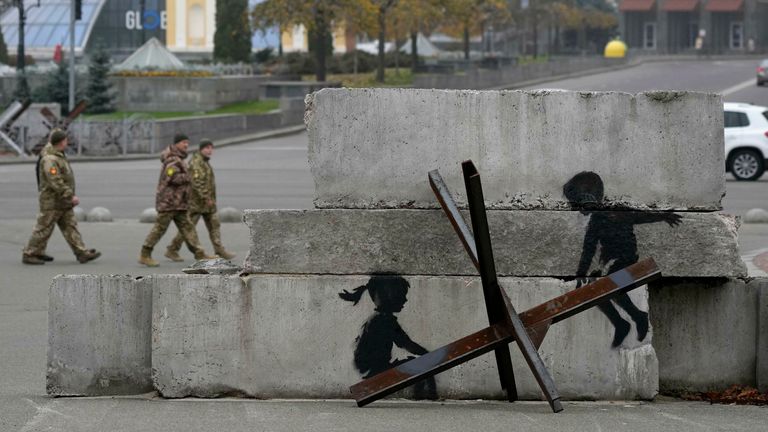
Two other murals were reportedly seen nearby – one depicting a man resembling Russian President Vladimir Putin being flipped during a judo match with a little boy, and another showing two children using a metal tank trap as a seesaw.
Image: The photo of this mural was taken earlier this month when its creator was still unverified. Pic: AP
Borodyanka, northwest of Ukraine’s capital Kyiv, was one of the towns hardest hit by Russia’s bombardment after the invasion began late in February.
It was liberated in April, but for weeks afterward, it was isolated – the power had been knocked out, shops were closed, transport links were not operating and humanitarian agencies and other volunteer groups were the only sources of food, clothes, and other necessities.
Ukraine’s President Volodymyr Zelenskyysaid later that the situation in occupied Borodyanka had been “much more horrific” than in Bucha, where hundreds of civilians were found dead in mass graves.
Kyivdemands that Ukraine’s borders be restored as a precondition for talks, while ruling out any talks with Putin.
According to a senior security official, the return of all captured Ukrainian territory is Kyiv’s main precondition for entering into peace talks with Russia.
The secretary of Ukraine’s National Security and Defense Council, Oleksiy Danilov, stated on Tuesday that the Ukrainian side also required the “guarantee” of modern air defenses, aircraft, tanks, and long-range missiles.
Kyiv has repeatedly called for additional arms from its Western backers following Russia’s invasion in late February.
“Guarantee – modern air defence, aircraft, tanks, and long-range missiles. Strategy – proactive steps. Russian missiles must be destroyed before launch in the air, on land and at sea,” he said.
russia, negotiations. The main condition of the President of🇺🇦is restoration of🇺🇦territorial integrity. Guarantee – modern air defense, aircraft, tanks, and long-range missiles. Strategy – proactive steps.🇷🇺 missiles must be destroyed before launch in the air, on land and at sea.
Danilov’s remarks came after Ukrainian President Volodymyr Zelenskyy said in his overnight address on Monday that he was open to “genuine” negotiations with Russia that would restore Ukraine’s borders.
He also called for compensation following devastating Russian attacks, and demanded those responsible for alleged war crimes are punished.
Talk of a negotiated end to the conflict has risen in recent days, after the Washington Post newspaper reported that the United States has privately encouraged Ukrainian officials to signal an openness to talk with its neighbour.
US officials reportedly want Ukraine to take the moral high ground and appear more interested in negotiations, amid concerns Kyiv might soon lose international support if it remains resolutely against discussions.
After Russia announced the annexation of four partly occupied regions of Ukraine at the end of September, Zelenskyy said Kyiv will not hold talks with Moscow as long as President Vladimir Putin remains in power.
Government figures have restated this position in recent days, saying that Kyiv would however be willing to negotiate with a successor to Putin.
On Monday, Kremlin spokesman Dmitry Peskov said Moscow is open to talks but that Kyiv is refusing them. Russian officials have repeatedly said they will not negotiate over territory they claim to have annexed from Ukraine.
Apart from Russia-ally North Korea, no countries recognise the latest annexations. Most of the world also refuses to recognise Crimea, annexed in 2014, as Russian land.
Meanwhile, the US, Ukraine’s main backer, is holding mid-term elections for Congress on Tuesday.
Although most candidates from bothparties strongly support Kyiv, some right-wing Republican candidates have expressed doubt about the cost of US military aid while others on the left faced backlash after calling for “vigorous” diplomacy to end the war.
The White House says US support for Ukraine will be “unflinching and unwavering” regardless of the outcome of Tuesday’s votes.
The governmentclaims that the move is intended to ensure that its military has enough supplies to fight Russian forces.The Ukrainian government claims it has used wartime laws to seize control of stakes in several “strategically important” companies in order to ensure that its military has enough supplies to repel a Russian invasion.
Defence Minister Oleksii Reznikov announced on Monday the acquisition of a leading engine manufacturer as well as four other energy and manufacturing companies from some of the country’s wealthiest men.
He did not specify the size of the stakes acquired, but stated that the assets of the five companies would be managed by his ministry to meet “urgent” military needs.
“This is about providing fuel and lubricants, repairing military equipment and weapons,” Reznikov told a news conference, alongside Prime Minister Denys Shmyhal and Oleksiy Danilov, secretary of Ukraine’s national security and defence council.
There was no immediate comment by any of the five companies.
During the conference, Shmyhal said the companies being taken under state control make products or provide services that are “critical” for Ukraine’s defence and energy needs.
“These enterprises must operate 24 hours a day, seven days a week for the needs of the state’s defence,” he said.
The announcement comes as Russia unleashed a barrage of air raids on Ukrainian cities in recent weeks, damaging some 40 percent of Ukraine’s energy infrastructure.
It was the first time the government had used martial law for such a move since Russia invaded Ukraine in February. It is also the most dramatic wartime intervention into big business, affecting companies linked to tycoons whose political power Ukraine President Volodymyr Zelenskyy’s team has long sought to curb.
The enterprises include aircraft engine manufacturer Motor Sich working from the partially Russian-controlled region of Zaporizhia, Danilov told the news conference in the capital, Kyiv.
“After martial law is lifted, these assets may be returned to their owners or their value may be reimbursed,” Danilov added.
The other energy and manufacturing companies include Zaporozhtransformator, AvtoKrAZ and the oil and gas company UkrNafta.
The decision was taken at a meeting of top security officials chaired by Zelenskyy on Saturday and went into effect on Sunday.
The companies are partially owned by the state and are associated with powerful businessmen, including billionaires Ihor Kolomoisky and Kostiantyn Zhevaho, as well as businessman Vyacheslav Bohuslayev, who was arrested in October on suspicion of collaborating with Russia.
“This is not nationalisation,” Reznikov said. “This is a direct taking over of assets during wartime. These are totally different legal forms.”
The Kremlin has refused to comment on media reports that high-level US-Russia talks have occurred.
The Kremlin has refused to comment on a Wall Street Journal report that the US held secret talks with top Russian officials about avoiding further escalation in the Ukraine war.
According to the report, US National Security Adviser Jake Sullivan met with President Vladimir Putin’saides in an attempt to reduce the risk of a larger war or nuclear conflict.
“We have nothing to say about this publication,” Kremlin spokesman Dmitry Peskov told reporters on Monday.
The newspaper reported that US officials said Sullivan has been in contact with Yuri Ushakov, a foreign policy adviser to Putin, and Security Council Secretary Nikolai Patrushev.
Peskov also declined to comment on a Washington Post report over the weekend that said the US had privately encouraged Ukraine to negotiate with Russia.
“We have nothing to say about this publication,” Peskov said.
“Once again, I repeat that there are some truthful reports, but for the most part, there are reports that are pure speculation,” he said, directing journalists to contact the White House or the newspaper itself.
Meanwhile, Ukrainian President Volodymyr Zelenskyy said he sees no room for negotiations with Russia, an option he officially ruled out after Russia held illegal referendums that resulted in the “annexation” of four Ukrainian regions in September.
Zelenskyy has said he may negotiate with a new Russian president, whenever one emerges.
The Ukrainian public, having suffered enormously over the past eight months of war, are often outraged whenever foreign figures suggest they accept the conflict’s current state and give in to Russia’s demands.
Recently, tech billionaire Elon Musk tweeted a plan to end the war that would give Crimea to Russia and hold United Nations-organised referendums in the four regions Moscow has annexed about whether Russia stays or goes.
Musk was blasted for it, but a lack of negotiations is causing concern among international powers.
“Ukraine fatigue is a real thing for some of our partners,” an anonymous US official reportedly told the Washington Post.
According to a Wall Street Journal poll, 48 percent of Republicans said the US was doing “too much” to support Ukraine.
With global inflation rates rising, new questions have been raised about the future of the US assistance, which has already reached $18.2bn.
Other nations that were already reluctant to outwardly support Ukraine could also push for more peace talks if the war continues.
Zelenskyy has refused to speak to Russia unless Ukraine regains all its captured territory, but according to the Washington Post, US officials believe the Ukrainian leader will probably be open to negotiations in the winter.
He may be a former British prime minister, but any comment made by Boris Johnson on the war in Ukraine still carries weight, especially when it comes to nuclear weapons.
His uniquely close relationship with Ukrainian President Volodymyr Zelenskyy and his decision to be a leading voice amongst western allies in supporting Ukraine from the outset of the invasion has made London one of Kyiv’s most trusted and valued partners.
It also gave Mr Johnson privileged access during his time in office to the private thoughts of Mr Zelenskyy, as well as a deep understanding of Ukraine’s need to defeat Russia’s invasion and the threats it could face – all the way up to Vladimir Putin launching a nuclear strike.
Having been the leader of a nuclear power, Mr Johnson would have been carefully briefed by officials about the risk of nuclear escalation by Russia and how western allies, led by the United States, might respond.
NATO allies have a deliberate policy of “strategic ambiguity” when it comes to anything nuclear – refusing to set out in public how they might retaliate should the Kremlin choose to break the nuclear taboo and use an atomic weapon against Ukraine.
However, Mr Johnson made clear there would have to be a western response, noting in his interview with Sky News’s Mark Austin that there “are all sorts of options”.
A decision by the UK to send anti-tank weapons to Ukraine, the first of any European nation, in the run-up to the war – followed by a steady flow of increasingly lethal munitions – has made Mr Johnson a legendary figure amongst the Ukrainian public and leadership.
It will be interesting to see how or if the former prime minister will choose to use this special relationship, especially with President Zelenskyy, going forwards.
It is a status his latest successor, Rishi Sunak, will find almost impossible to fill given the personal chemistry that the two men enjoyed.
Mr Johnson was the first foreign leader who Mr Zelenskyy called early on the morning of 24 February, when Russia launched its all-out war.
Britain’s then prime minister then became one of the first western allies to venture to Kyiv as the war raged and even chose a trip to see Mr Zelenskyy as his swansong on the international stage before stepping down from office.
Ukrainians are experiencing their first large-scale statewide power outages as officials reduce supply.
The action is intended to enable energy providers to repair power plants damaged by Russian air attacks.
The president’s office told Ukrainians late on Wednesday to minimise electricity use from 7 am to 11 pm and prepare for temporary blackouts if this was not done.
No schedule was announced for the outages, but cities such as the capital, Kyiv, and Kharkiv announced curbs on the use of electric-powered public transport such as trolleybuses.
They also reduced the frequency of trains on the metro.
President Volodymyr Zelenskyyhas said Russian air strikes damaged 30 percent of Ukraine’s power stations in just over a week.
Former US ambassador to Russia Michael McFaul has been analysing the implications of Vladimir Putin’s latest escalation of his war on Ukraine.
In a Washington Post op-ed, he calls the president’s actions concerning but ultimately self-defeating.
He claims that the leader’s decision to illegally seize Ukrainian territory made reaching a peace agreement substantially more difficult.
In an op-ed in the Washington Post, he decries the president’s actions as worrying but also ultimately self-defeating.
He says the leader’s decision to illegally annex Ukrainian territory made a peace deal significantly harder
“With great difficulty, Ukrainian President Volodymyr Zelenskyy might have been able to fudge some sort of formula tacitly accepting Russian control over Crimea and Donbas, but it will be impossible for him to agree to comparable concessions on Kherson and Zaporizhzhia,” he writes.
Saying Mr Putin “has pushed himself into a corner”, he suggests “the only way to end this war might involve putting someone else in power in Moscow”.
“If the war continues to go badly, the voices quietly supporting suing for peace will grow,” he says.
“Tensions between the Russian military and intelligence services are already spilling into the open. These tensions will only grow if Russia’s soldiers continue to die and retreat in Ukraine.”
On the Russian leader’s threat’s around nuclear weapons, Mr McFaul says: “If Putin were to use a nuclear weapon (God forbid), that might also very likely deliver the final blow to his hold on power in Russia.
“No world leader would support him. The democratic world would be compelled to respond, both with more sophisticated weapons for Ukraine…
“After a nuclear attack, no Ukrainian leader would call for surrender. Instead, Zelensky would have every reason to bring the war to Russia, including attacks on targets in Moscow and other major cities. (Who doubts that Ukraine has sleeper cells in Moscow?) At the same time, it is hard to believe a majority of Russians would welcome the use of nuclear weapons against their Slavic neighbours.
“Putin would likely end up looking alone in his own country, a madman who must be stopped.
“The best way for Putin to hold on to power is to end his invasion today. He could declare victory regarding the defence of Donbas and then order his diplomats to settle into a long negotiation about the borders and political rights of those living in Donbas.
In Kazakhstan’s capital, Astana, Russian President Vladimir Putin visited Qatar’s Emir, Sheikh Tamim bin Hamad Al Thani.
Kremlin aide Yuri Ushakov said politics and trade were the focus of the discussions at Thursday’s meeting.
“I would single out cooperation in the energy market, cooperation between Russia and Qatar within the framework of the Gas Exporting Countries Forum,” he told reporters.
The meeting was an attempt to diffuse tensions between Russia and Qatar, which have grown since the Ukraine crisis broke out earlier this year, according to a source familiar with the talks.
Major gas-exporter Qatar has sought a largely neutral stance on the conflict but several moves by the Gulf Arab state have recently irked Moscow, the source told Reuters news agency.
Sheikh Tamim called Ukrainian President VolodymyrZelenskyy on Monday hours after explosions rocked several Ukrainian cities, including the capital Kyiv. Qatar has criticised Russia’s annexation of Ukrainian territory and was one of eight non-NATO countries to join a NATO meeting earlier this year, the source said.
Russia had shown its displeasure by interfering in key Qatar dossiers, the source said, citing as examples its delivery of humanitarian aid in Syria and its role in facilitating talks between world powers on Tehran’s nuclear programme.
Qatar “needs cordial relations with Russia and others in the region”, in order to continue to play a role as a conflict mediator, the source said.
Elon Musk, the controversial tech billionaire, has stated that his SpaceX company will no longer provide essential satellite services to Ukraine unless the US military contributes tens of millions of dollars every month, according to CNN.
SpaceX requested that the Pentagon, the headquarters of the United States Department of Defense, take over funding for Ukraine’s government and military usage of Starlink.
SpaceX claims this would cost more than $120m (£106m) for the rest of the year and could cost close to $400m (£355m) for the next 12 months.
“We are not in a position to further donate terminals to Ukraine, or fund the existing terminals for an indefinite period of time,” SpaceX’s director of government sales wrote in the letter.
SpaceX has so far donated 20,000 Starlink satellite units to Ukraine since February.
The satellites have been a vital source of communication for Ukraine’s military since they arrived.
They allow Ukraine to fight and stay connected even as mobile phone and internet networks have been destroyed in its war with Russia.
Reports of the letter come a day after Mr Musk denied reports he has spoken to Russian President Vladimir Putin.
The denial follows a Twitter poll he shared earlier this month where he invited his 107.7 million followers to vote on a suggested “Ukraine-Russia Peace plan”, which included permanently ceding Crimea to Russia.
He said new referendums could be held under UN supervision to determine the fate of Russian-controlled territory, and that Ukraine agree to neutrality.
This drew sharp criticism from Ukrainian President Volodymyr Zelenskyy, who proposed his own Twitter poll: “Which @elonmusk do you like more? One who supports Ukraine (or) one who supports Russia.”
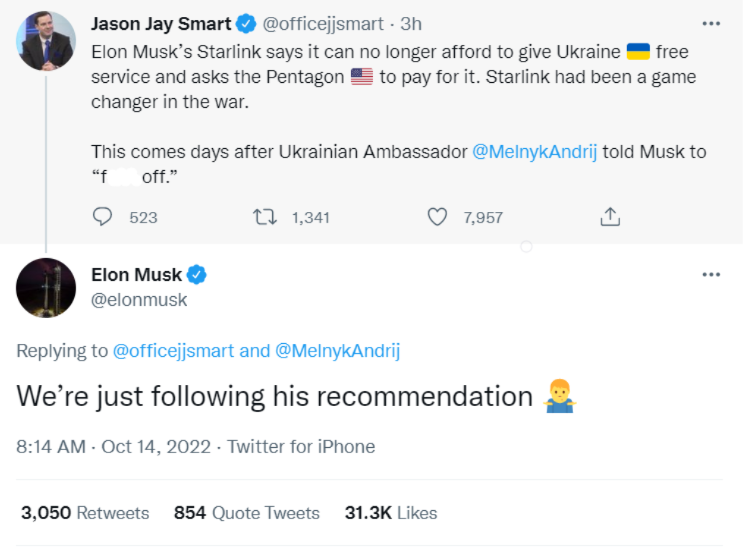
Following reports of SpaceX’s letter to the Pentagon, Kyiv Post correspondent Jason Jay Smartpointed out that it comes days after Ukrainian diplomat Andrij Melynk had tweeted Mr Musk telling him to “f*** off” in response to his Twitter poll.
Mr Musk replied to Mr Smart’s tweet: “We’re just following his recommendation.”
Ukraine-Russia Peace:
– Redo elections of annexed regions under UN supervision. Russia leaves if that is will of the people.
– Crimea formally part of Russia, as it has been since 1783 (until Khrushchev’s mistake).
He said new referendums could be held under UN supervision to determine the fate of Russian-controlled territory, and that Ukraine agree to neutrality.
This drew sharp criticism from Ukrainian President Volodymyr Zelenskyy, who proposed his own Twitter poll: “Which @elonmusk do you like more? One who supports Ukraine (or) one who supports Russia.”
Following reports of SpaceX’s letter to the Pentagon, Kyiv Post correspondent Jason Jay Smart pointed out that it comes days after Ukrainian diplomat Andrij Melynk had tweeted Mr Musk telling him to “f*** off” in response to his Twitter poll.
Mr Musk replied to Mr Smart’s tweet: “We’re just following his recommendation.”
Ukraine “counts on Britain’s leadership”, President Volodymyr Zelenskyyhas said following a call with Prime Minister Liz Truss.
Ms Truss and Mr Zelenskyy spoke today following the wave of attacks which left at least 11 dead and 64 injured.
The missile and drone barrage was launched by Moscow in retaliation for the attack on a bridge linking Russia with Crimea.
The Russian attacks prompted an international outcry, with Ms Truss and fellow leaders of G7 nations expected to hold crisis talks on Tuesday.
Following the call with Mr Zelenskyy,a spokesperson for Ms Truss said the prime minister had stressed that the UK stood “wholeheartedly” behind the Ukrainian leader.
I’ve had a phone call with Prime Minister @trussliz. We count on 🇬🇧’s leadership in consolidating international political and defense support for Ukraine, in particular regarding the protection of our skies. And also in the further isolation of Russia.
Russia’s foreign minister, Sergei Lavrov, says remarks by Ukrainian President Volodymyr Zelenskyy recommending that NATO undertake preventative strikes on Russia validate the need for a “special operation” in Ukraine.
“By doing so, (he) essentially presented the world with further evidence of the threats posed by the Kyiv regime,” Mr Lavrov said.
“This is why a special military operation was launched to neutralise them.”
For context: During an Australian think tank last night, Mr Zelenskyy said he believed strikes were necessary to preclude any use of nuclear weapons.
He did not go into detail about what kind of strikes he meant and made no reference to any need for nuclear strikes.
The Ukrainian leader also urged the world to “show strength” following the annexation of four Ukrainian regions.
He told the think tank: “The head of Russia is now carefully analysing the world’s reaction to the sham referenda he organised on Ukrainian soil and to the announcement of the annexation of our territory.
“He is interested in whether he still has the potential for escalation. If the world’s reaction is weak now, Russia will come up with some new escalation.”
Kremlin spokesman Dmitry Peskov denounced Mr Zelenskyy’s comments as “an appeal to start yet another world war with unpredictable, monstrous consequences”, according to RIA news agency.
Before the host intervenes and denies it, a pundit on Russian official television appears to have revealed that the panellists weren’t intended to bring up the liberated city of Lyman.
Maxim Yusin, a foreign policy specialist, asserts that Russians likewise think the conflict is not going well for their nation.
He says on the show: “I see the dynamics of the military action on the front.
“We aren’t talking about what is happening near Lyman.”
The host then interjects with: “Who forbade you to talk about it?”
Russian troops pulled out of the eastern city of Lyman due to the risk of being encircled by Ukraine’s forces.
Mr Yusin later said on the Russian state TV broadcast: “Ask anyone here, when they’re in the make-up room.
“I think anyone will honestly admit they don’t know whether the mobilisation will help us or not, to change the course of military actions.
“It’s easy to say ‘after the liberation of Zaporizhzhia’.
“Yeah, try liberating it, the way everything is going.”
The host Andrey Norkin also said at one stage the Ukrainians are “planning to declare war against Russia” before another pundit suggest Ukraine might start bombing Moscow.
Retired four-star US army general Barry R McCaffrey shared the video and said it shows “Russian State TV is starting to fragment.”
He continues: “Lyman a disaster for the Russians. The Kherson pocket could lose 15,000 Russian prisoners. The mobilisation a disaster. All pressures on Putin criminal action might generate a desperate reaction. He’s unravelling.”
The Ukrainian president demanded the establishment of a special war tribunal and described alleged war crimes committed by Russia in a pre-recorded video.
He also set out a “formula”, including more military support and punishing Russia on the world stage.
During his address to the UN General Assembly in New York, President Volodymyr Zelensky said that Russia must receive “just punishment” for its invasion of Ukraine.
The Ukrainian president demanded the establishment of a special war tribunal and described alleged war crimes committed by Russia in a pre-recorded video.
r called up 300,000 reservists for duty.
The move prompted rare protests in dozens of Russian cities and Mr Zelensky said the partial mobilization showed his enemy was not serious about peace talks. Monitoring group OVD-Info said 1,315 Russians had been arrested.
The Kremlin said the call-up would be limited to those who had completed military service and had important skills and combat experience. But some of those arrested during protests in Moscow were also told they would have to sign up, reports say.
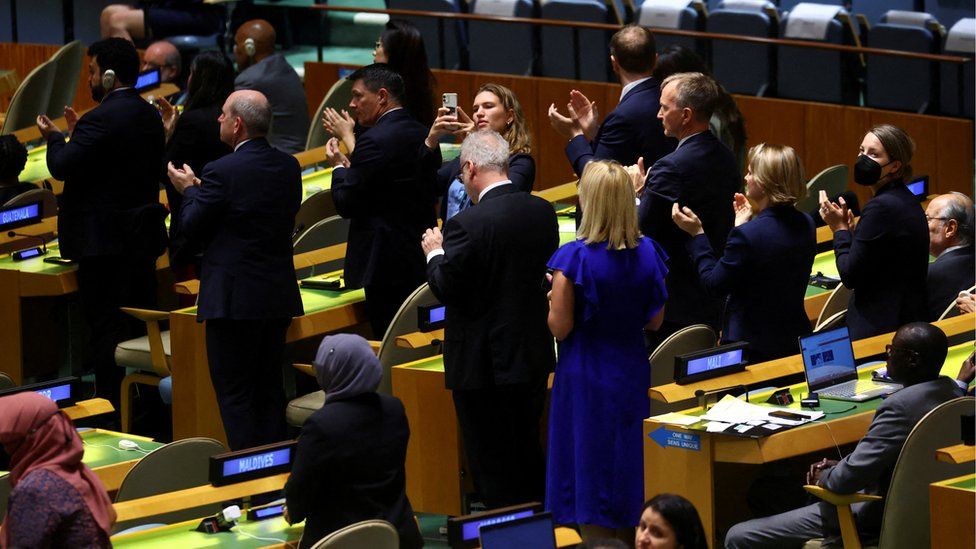
The Ukrainian leader said creating a special tribunal would help hold Moscow to account for stealing territory and murdering thousands of people. His address on Wednesday received a standing ovation from many of the session’s attendees.
Despite Russia’s decision to bolster its military campaign, the two sides took part in the biggest exchange of prisoners since the start of the war.
In a deal brokered by Saudi Arabia, 215 fighters were returned to the Ukrainian side, including 10 foreigners – while Russia took back 55 soldiers. Pro-Russian politician Viktor Medvechuk was also part of the swap. He has been seen as President Putin’s closest ally in Ukraine and faced treason charges.
Ukraine said that among those released were 108 members of the Azov battalion whofor weeks defied Russia’s bombardment of Mariupol and the city’s steel plant.
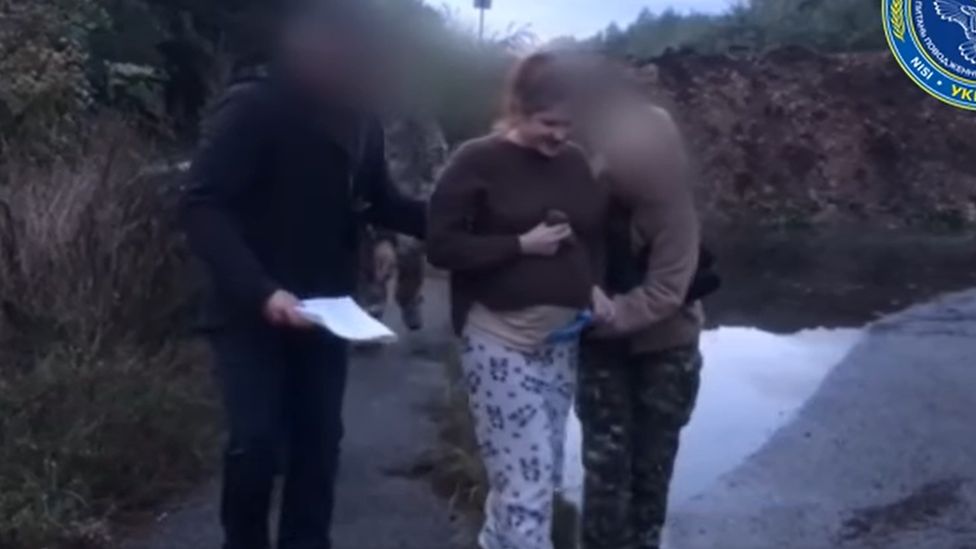
Battalion commander Denys Prokopenko and his deputy were among five senior officers freed. So too was Ukrainian military medic Mariana Mamonova, who is more than eight months pregnant and was being held in the notorious Olenivka prison in an area of eastern Ukraine held by Russian-backed separatists.
IMAGE SOURCE, UKRAINIAN GOVERNMENT Image caption, A heavily pregnant Mariana Mamonova was seen in a video of the exchange released by Ukrainian authorities
A fellow prisoner, who was released in July, told the BBC how the medic was forced to live in a cell with several other people, sleeping on the floor and going outside only once a day. Her husband had feared their baby would be taken away.
Ten foreign prisoners held by Russian-backed forces were also released, including five British nationals and two Americans.
In his UN address, Mr Zelensky condemned Russian plans to stage so-called referendums on joining Russia in occupied areas of Ukraine. The vote which is due to start on Friday has been widely condemned as a sham by Western leaders.
He addressed the discovery of 445 new graves in Izyum, a northeastern city recently retaken from Russian forces during a sweeping Ukrainian counter-offensive.
Mr Zelensky detailed allegations of war crimes in the city, including against one man said to have been castrated and murdered.
“Why are the Russian military so obsessed with castration?” he asked.
IMAGE SOURCE, REUTERSImage caption, Zelensky’s words received a standing ovation from some quarters
The word “punishment” cropped up some 15 times in Mr Zelensky’s speech and was the first of his five non-negotiable conditions for peace.
Russia must face consequences for its aggression, he said, through further sanctions and by the UN stripping Moscow of its powerful role as a permanent Security Council member.
He also called for Ukrainian lives to be protected, and for the country’s internationally-recognized borders to be respected.
As his fourth and fifth conditions, he called for new security guarantees for Kyiv, and for the world to unite in calling out Moscow’s armed aggression.
Later on Wednesday, the European Union’s foreign policy chief said EU countries had agreed to hit Russia with new sanctions.
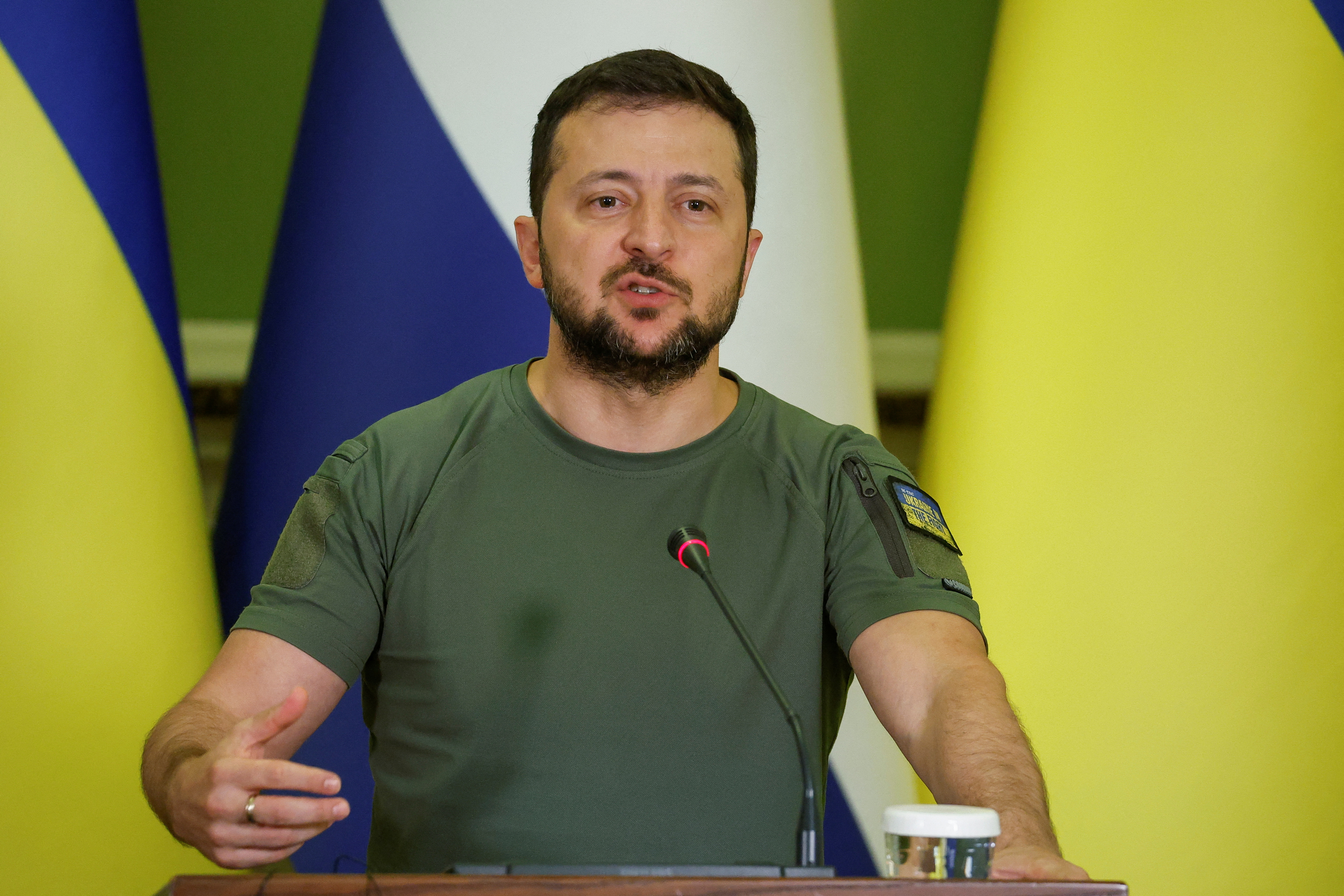
Sporting his signature green T-shirt in his video, Mr Zelensky thanked the 101 countries at the UN which voted to allow him to address the assembly in a video rather than in person.
He blasted the seven countries including Russia which voted against his video appearance and criticized those which have remained neutral during the conflict.
These images show destroyed Russian military vehicles located on a street in Kyiv as the country marks its independence from Soviet rule today.
Authorities in the capital have banned large-scale gatherings until Thursday, fearing the national holiday might bring particularly heavy Russian missile attacks.
Meanwhile, Ukrainian President Volodymyr Zelenskyy has urged the public to be vigilant.
The first grain ship to depart Ukraine since Russia invaded has been cleared to leave Turkish waters for its destination in Lebanon.
A team of officials from Russia, Ukraine, Turkey, and the UN inspected the Razoni’s cargo of 26,000 tonnes of corn and its crew.
The UN said the ship was free to leave for Lebanon on Wednesday.
Russia has been blockading Ukraine’s ports since it invaded in February, intensifying global food shortages.
Under a deal brokered by Turkey and the UN last month, which set up a Joint Coordination Centre (JCC) to oversee exports, both sides agreed shipments could resume.
The Razoni, which left the Ukrainian port of Odesa on Monday, is bound for the Lebanese port of Tripoli.
“The team carried out a three-hour inspection and confirmed that crew and cargo are as authorized and consistent with the information the JCC received before the vessel sailed from Odesa,” the UN said on Wednesday.
“The joint inspection team had the opportunity to discuss with the crew and gain valuable information on the vessel’s journey along the maritime humanitarian corridor in the Black Sea that was agreed by the JCC.
“The JCC will use this voyage in its ongoing work on fine-tuning procedures and processes to enable the continuation of safe passage of commercial vessels across the Black Sea under the Initiative.”
Ukraine has said its naval vessels will guide cargo ships through waters that have been mined.
Ukrainian President Volodymyr Zelensky has said he wants to see grain exports become regular again. In addition to easing food shortages elsewhere, he said he hoped exports would encourage Ukrainian farmers to sow seeds for the next season.
Ukrainian authorities say there are 17 other grain ships waiting to leave the country’s Black Sea ports once the Razoni completes its voyage safely.
The deal between Russia and Ukraine, brokered at the end of July after two months of negotiations, was called into doubt when Russia launched two missiles at the port of Odesa less than 24 hours after the agreement was announced.
Trust is low on both sides, but if kept to, the deal is set to last 120 days and can be renewed if both parties agree.
Russia and Ukraine jointly account for nearly a third of global wheat exports.
Ukraine’s President Volodymyr Zelenskyysacked the head of the country’s domestic security service and state prosecutor, citing hundreds of cases of alleged treason and collaboration with Russia, as Moscow appeared set to step up military operations.
Zelenskiy said more than 60 officials from the SBU security service and prosecutor’s office were working against Ukraine in Russian-occupied territories, and 651 treason and collaboration cases had been opened against law enforcement officials.
The sackings on Sunday of Ivan Bakanov, head of the security service, and Prosecutor General Iryna Venediktova, who led efforts to prosecute Russian war crimes, and the sheer number of treason cases reveals the huge challenge of Russian infiltration as Kyiv battles Moscow in what it says is a fight for survival.
“Such an array of crimes against the foundations of the national security of the state … pose very serious questions to the relevant leaders,” Zelenskiy said. “Each of these questions will receive a proper answer.
In his nightly speech to the nation, Zelenskyy noted the recent arrest on suspicion of treason of the SBU’s former head overseeing the region of Crimea, the peninsula annexed by Russia in 2014 that Kyiv and the West still view as Ukrainian land.
Zelenskiy said he had fired the top security official at the start of the invasion, a decision he said had now been shown to be justified.
“Sufficient evidence has been collected to report this person on suspicion of treason. All his criminal activities are documented,” he said.
3,000 CRUISE MISSILES
After failing to capture the capital Kyiv early in the invasion, Russian forces using a campaign of devastating bombing now control large swaths of Ukraine’s south and east, where pro-Russian separatists already control territory.
Advertisement · Scroll to continue
Zelenskiy said Russia had used more than 3,000 cruise missiles to date, and it was “impossible to count” the number of artillery and other strikes so far.
Dozens of relatives and local residents on Sunday attended the funeral of 4-year-old Liza Dmytrieva, one of 24 people killed in a Russian missile strike in the city of Vinnytsia last week.
Western deliveries of long-range arms are beginning to help Ukraine on the battlefield, with Kyiv citing a string of successful strikes carried out on 30 Russian logistics and ammunitions hubs, using several multiple launch rocket systems recently supplied by the West.
The strikes are causing havoc with Russian supply lines and have significantly reduced Russia’s offensive capability, according to Ukraine’s defence ministry.
Head of the Security Service of Ukraine (SBU) Ivan Bakanov and Ukraine’s Prosecutor General Iryna Venediktova attend a news briefing in Kyiv, Ukraine May 11, 2021. REUTERS/Valentyn Ogirenko
Ukraine’s southern Operational Command reported that in the Kherson region, it had destroyed two Russian Pantsir missile systems, three strategic communication systems, one radar station, two ammunition depots, and 11 armoured and military vehicles on Sunday.
The Russian military are also using radio-electronic warfare to suppress satellite communication channels, the Ukrainian General Staff said in a statement early on Monday.
RUSSIA INTENSIFIES OPERATIONS
Russia has ordered military units to intensify operations to prevent Ukrainian strikes on areas held by Russia, according to Ukraine which on the weekend reported shelling along the frontline in what it said was preparation for a fresh assault.
Ukraine’s general staff said its forces had repelled Russian attacks in several towns in the Donetsk region.
“Fighting is currently ongoing near Hryhorivka near the administrative between Luhansk and Donetsk regions,” it said.
Overnight at least 10 explosions were reported in the southern city of Mykolaiv, but there was no information on casualties, while two people were killed and 10 wounded in Avdiivka and Novy Donbas, said Ukraine’s general staff, citing local officials.
Reuters could not immediately verify the reports.
The British defence ministry said on Sunday that Russia was reinforcing defences across areas it occupies in southern Ukraine after pressure from Ukrainian forces and pledges from Ukrainian leaders to drive Russia out. read more
Russian President Vladimir Putin launched his invasion on Feb. 24 calling it a “special military operation” to demilitarise its neighbour and rid it of dangerous nationalists.
Kyiv and the West say it was an imperialist land grab and attempt to reconquer a country that broke free of Moscow’s rule with the break-up of the Soviet Union in 1991.
The biggest conflict in Europe since World War Two has killed more than 5,000 people, forced more than 6 million to flee Ukraine and left 8 million internally displaced, says the United Nations.
Ukraine and the West say Russian forces are targeting civilians and been involved in war crimes, charges Moscow rejects.