Rescuers in Japan are hurrying to find 242 people who are missing after a very bad earthquake on New Year’s Day.
A very important 72-hour time to find people alive after the earthquake ended late on Thursday.
On Friday, 92 people died from the strong earthquake in the faraway Noto peninsula.
According to Kyodo news agency, Japan’s Self-Defense Forces increased the number of soldiers helping with rescue and relief to 4,600.
Several people are believed to be stuck under their fallen homes, mostly in the towns of Suzu and Wajima. The buildings made of wood can’t handle strong earthquakes that happen often in this country.
Many people still don’t have electricity and water, and some are stuck because of landslides and blocked roads.
“We will keep trying,” said Japanese Prime Minister Fumio Kishida after talking with disaster response officials on Friday.
Mr Kishida asked the rescue and relief workers to do everything they can to help the people in the affected areas.
The earthquake on Monday also caused a small tsunami which flooded at least 296 acres of land in Japan.
Japan said it will use 4. 74 billion yen from its budget to help the victims.
Pictures from the Japan Ground Self Defense Force show soldiers putting food, water, and other supplies onto trucks parked on the road. Soldiers are removing dirt and rubble from roads that were damaged by landslides.
In another picture, soldiers were seen carrying a person on a stretcher along a snowy path.
The BBC saw a lot of damage when they visited Wajima on Wednesday. Some houses and cars were crushed by falling concrete. Several old wooden houses in the town fell down.
The town, which has 23,000 people, looks like a ghost town because most people left when they were told a tsunami might come.
Tag: Prime Minister Fumio Kishida
-
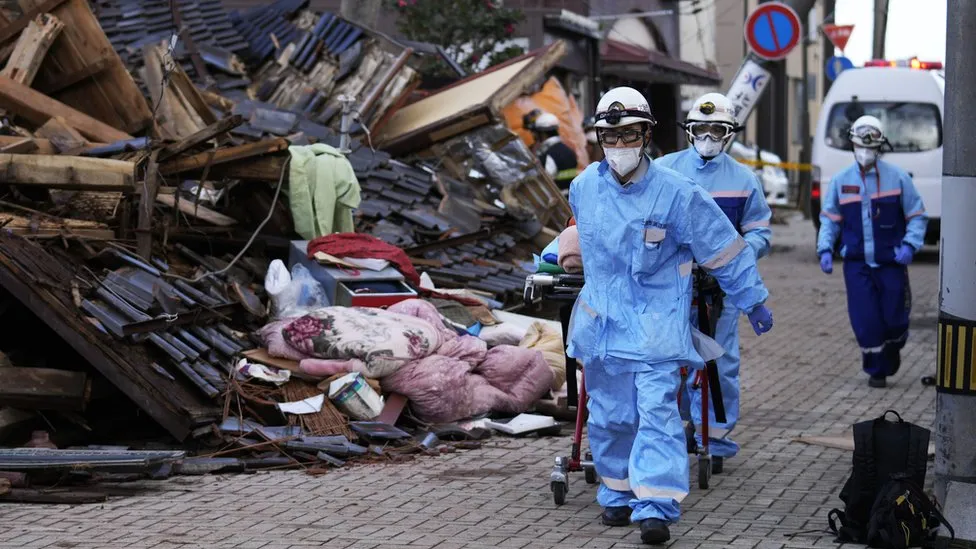
Almost 250 people still missing in Japan following earthquake
-

Japan PM rescued after being hit with smoke bomb
Fumio Kishida, the prime minister of Japan, was unharmed while leaving a public function after what appeared to be a smoke bomb was hurled in his direction.
Local media said that a guy was apprehended on the spot in Wakayama, where Mr. Kishida was scheduled to deliver a speech.
One eyewitness claimed to have seen someone toss something, which was followed by smoke, while another claimed to have heard a loud noise. There were no reported injuries.
In a video, it could be seen that police were surrounding a suspect.
Ryuji Kimura, 24, was apprehended on suspicion of obstructing commerce and later identified by the authorities. His intentions are still a mystery.
Japan’s public broadcaster, NHK, quoted Mr Kishida as saying there was a “loud blast” at the venue. “Police are investigating details, but I’d like to apologise for worrying many people and causing them trouble.”
NHK broadcast footage in which crowds of people appear to be running away from the scene.
The footage also shows people swarm around one man, hold him down, and then carry him away.
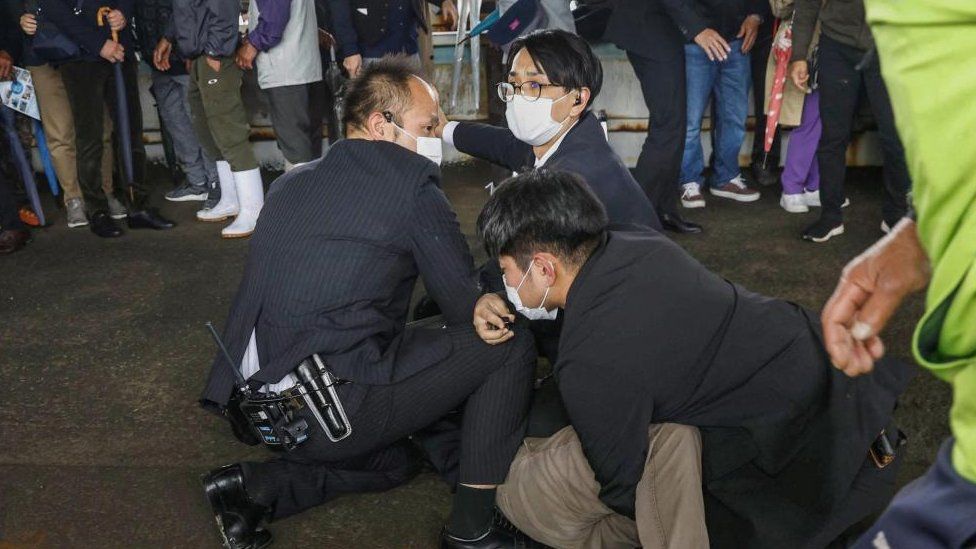
Image caption,A man believed to be a suspect in the smoke-bomb throwing was held by police officers Mr Kishida had just started to deliver a speech after touring the fishing harbour in Wakayama for a campaign event when the object was thrown and he took cover.
After the incident, Mr Kishida addressed a crowd in another location and said the incident should not disrupt the electoral process.
A woman at the scene told NHK: “I was stunned. My heart is still beating fast.”
A person who said they saw an object flying through the air said it gave them a “bad feeling, so we ran away unbelievably fast”.
“Then we heard a really loud noise. It made my daughter cry,” they added.
Another witness told NHK that the crowd began to disperse in panic before the blast was heard, as someone said an explosive had been thrown.
Hiroshi Moriyama, a member of Mr Kishida’s Liberal Democratic Party, said: “That something like this happened in the middle of an election campaign that constitutes the foundation of democracy is regrettable. It’s an unforgivable atrocity.”
Violent attacks are extremely rare in Japan. But there is nervousness about security around politicians, after former Prime Minister Shinzo Abe was shot dead while on the campaign trail last year.
-
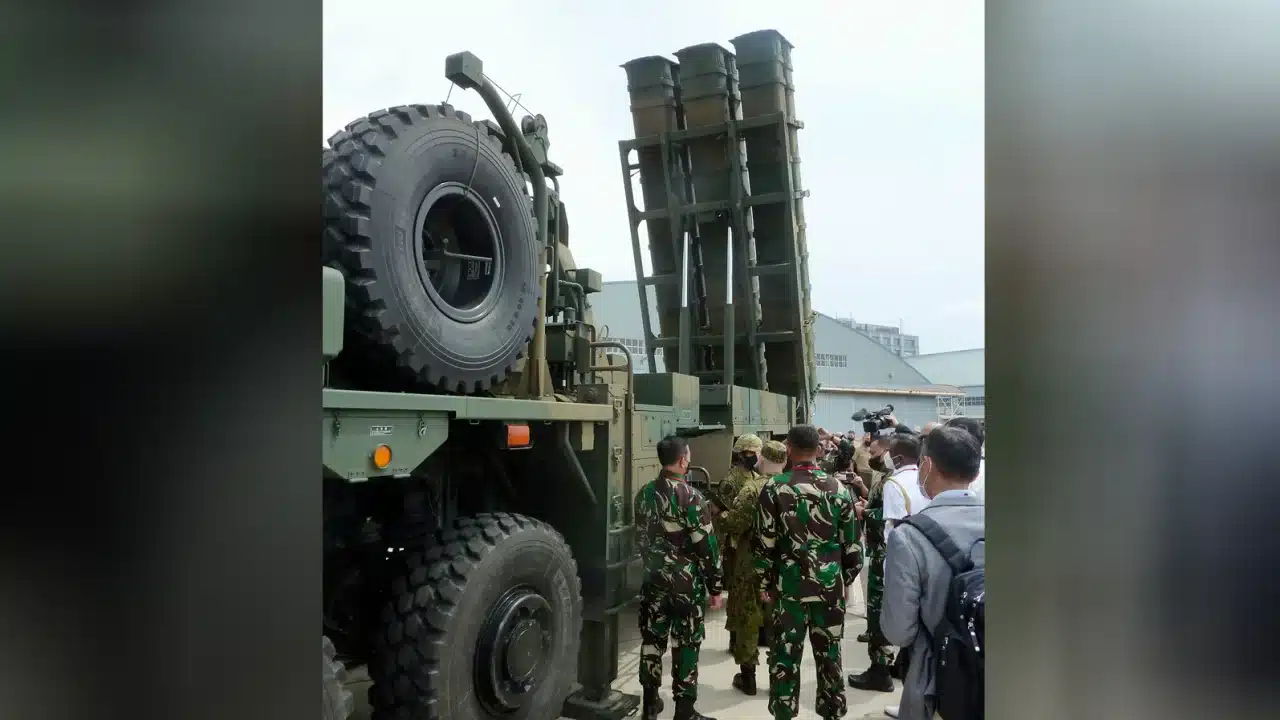
Tensions with China increasing as Japan plans to build long-range missiles
In an effort to fortify its defenses in the face of rising tensions with its neighbor China, Japan on Tuesday unveiled plans to develop and manufacture a variety of sophisticated long-range missiles.
According to the Japanese Defense Ministry, contracts have been inked with Mitsubishi Heavy Industries (MHI) to create and mass-produce the weapons through 2027.
The agreements, totaling more than $2.8 billion, come after Prime Minister Fumio Kishida declared in December that he intended to increase defense spending and give Japan “counterstrike capabilities”—the capacity to attack another country’s territory directly in an emergency and under specific conditions.
In taking the new defense initiatives, Japan is bending the interpretation of its post-World War II constitution, which put constraints on its Self-Defense Forces in that they can only be used for what their name implies, defending the Japanese homeland.
Under the deals, MHI will begin mass production this year on two types of already developed missiles – ground-launched Type 12 guided missiles designed to target ships at sea and hypersonic glide missiles designed for island defense, the ministry said. Deployment of those weapons is scheduled for 2026 and 2027, it said.
The Defense Ministry news release did not say how many of each missile would be acquired.
Meanwhile, MHI will this year begin development of advanced versions of the Type 12 that can also be launched by aircraft and ships. Defense industry news site Janes reported that the updgraded Type 12 will have a range of up to 1,000 kilometers (620 miles), five times the reach of the current version.
At the same time, MHI will begin development of submarine-launched missiles that could be fired by the Japan Maritime Self-Defense Force’s fleet of conventionally powered boats.
In December, Kishida instructed his defense and finance ministers to secure funds to increase Japan’s defense budget to 2% of current GDP in 2027.
Along with the development of Japan’s own missiles, Kishida said in February the country planned to buy as many as 400 Tomahawk cruise missiles from the United States. Tomahawks can hit targets as far as 1,600 kilometers (1,000 miles) away.
Japan’s military buildup comes amid increasing tensions with China, which has been growing its naval and air forces in areas near Japan while claiming the Senkaku Islands, an uninhabited Japanese-controlled chain in the East China Sea, as its sovereign territory.
Meanwhile, China has been upping its military pressure on Taiwan, the self-ruled island whose security Japanese leaders have said is vital to that of Japan.
Just this week, Japan scrambled fighter jets as a Chinese aircraft carrier group came within 230 kilometers (143 miles) of the southern Japanese island of Miyako while it simulated strikes on Taiwan.
Chinese military exercises around Taiwan last August including the launching of ballistic missiles, some of which landed in Japan’s Exclusive Economic Zone.
-

Low birth rates in Japan causes population crisis
The number of births registered in Japan plunged to a new record low last year, the latest alarming figure in a decades-long slide that the government has made significant attempts to stop.
According to statistics provided by the Ministry of Health on Tuesday, the nation experienced 799,728 births in 2022, the fewest ever recorded and the first time the number fell below 800,000.
Throughout the previous 40 years, that number has almost halved; in contrast, Japan saw more than 1.5 million births in 1982.Moreover, Japan reported more than 1.58 million post-war deaths in 2017, a record high.
Deaths have outpaced births in Japan for more than a decade, posing a growing problem for leaders of the world’s third-largest economy. They now face a ballooning elderly population, along with a shrinking workforce to fund pensions and health care as demand from the aging population surges.
Japan’s population has been in steady decline since its economic boom of the 1980s and stood at 125.5 million in 2021, according to the most recent government figures.
Its fertility rate of 1.3 is far below the rate of 2.1 required to maintain a stable population, in the absence of immigration.
The country also has one of the highest life expectancies in the world; in 2020, nearly one in 1,500 people in Japan were age 100 or older, according to government data.
These concerning trends prompted a warning in January from Prime Minister Fumio Kishida that Japan is “on the brink of not being able to maintain social functions.”
“In thinking of the sustainability and inclusiveness of our nation’s economy and society, we place child-rearing support as our most important policy,” he said, adding that Japan “simply cannot wait any longer” in solving the problem of its low birth rate.
A new government agency will be set up in April to focus on the issue, with Kishida saying in January that he wants the government to double its spending on child-related programs.
But money alone might not be able to solve the multi-pronged problem, with various social factors contributing to the low birth rate.
Japan’s high cost of living, limited space and lack of child care support in cities make it difficult to raise children, meaning fewer couples are having kids. Urban couples are also often far from extended family in other regions, who could help provide support.
In 2022, Japan was ranked one of the world’s most expensive places to raise a child, according to research from financial institution Jefferies. And yet, the country’s economy has stalled since the early 1990s, meaning frustratingly low wages and little upward mobility.
The average real annual household income declined from 6.59 million yen ($50,600) in 1995 to 5.64 million yen ($43,300) in 2020, according to 2021 data from the Ministry of Health, Labor and Welfare.
Attitudes toward marriage and starting families have also shifted in recent years, with more couples putting off both during the pandemic – and young people feeling increasingly pessimistic about the future.
It’s a familiar story in East Asia, where South Korea’s fertility rate – already the world’s lowest – dropped yet again last year in the latest setback to the country’s efforts to boost its declining population.
Meanwhile, China is inching closer to officially losing its title as the world’s most populous country to India after its population shrank in 2022 for the first time since the 1960s.
-

Japan pledges to “lead the world” in battling Russian aggression with $5.5 billion Ukraine help
On Monday, Japan vowed to provide $5.5 billion in humanitarian assistance to Ukraine, virtually quadrupling the sum Tokyo had previously promised to Kiev since Moscow invaded its neighbour almost a year ago.
According to Prime Minister Fumio Kishida, “Japan is in a position to lead the world’s efforts to support Ukraine in its struggle against Russian aggression and to defend a free and open international order based on the rule of law.”
Tokyo had previously pledged to send Kyiv $600 million in financial assistance and $700 million worth of humanitarian aid including medical supplies and food assistance. It also joined Western allies in imposing strict sanctions on Russia over its invasion.
Last summer, Kishida said in a speech that Russia’s invasion gave warning that “Ukraine today may be East Asia tomorrow” – and he echoed that language Monday.
“Russia’s aggression against Ukraine is not just a European matter, but a challenge to the rules and principles of the entire international community,” he said.
He added that Japan faces its “most severe” security environment since World War II, citing North Korea’s growing nuclear missile program and “attempts to unilaterally change the status quo by force in the East and South China Seas.”
Kishida did not name specifics, but Tokyo has seen itself increasingly at odds with Beijing over islands claimed by both Japan and China in the East China Sea. Meanwhile, Kishida and other Japanese officials have previously said that peace across the Taiwan Strait is of extreme importance to Japan’s security.
Late last year, Kishida announced a large increase in Japanese military spending and Tokyo’s intention to acquire long-range weapons to counter threats to Japan’s security.
Kishida also announced on Monday that he will host an online summit of G7 leaders with Ukrainian President Volodymyr Zelensky on Friday, the first anniversary of Moscow’s invasion and ahead of the annual G7 summit in Hiroshima in May.
The Japanese leader said Hiroshima was an appropriate venue for the summit as the city was the site of an atomic bombing during World War II and Moscow’s invasion of Ukraine is raising new nuclear fears.
“Due to Russia’s actions, the world now faces a real threat from nuclear weapons,” Kishida said. “It is important to convey the reality of the atomic bombings to the world, including the G7 leaders, as the starting point for all efforts toward nuclear disarmament.”
-
United States, South Korea extend air drills following North Korea missile launch
Washington and Seoul will extend the Vigilant Storm air drills that prompted North Korea to issue a warning.
In response to North Korea‘s latest missile launch, including a suspected intercontinental ballistic missile, South Korea and the United States have agreed to extend their largest-ever military air drills (ICBM).
Hundreds of South Korean and US warplanes, including F-35 stealth fighters, have been staging round-the-clock simulated missions as part of one of the largest air exercises in history.
In a statement on Thursday, the South Korean military said the US had agreed to extend the Vigilant Storm air exercises – which were due to end on Friday – owing to North Korea’s “recent provocations”.
Chairman of South Korea’s Joint Chiefs of Staff Kim Seung-kyum and the head of US Forces Korea Paul LaCamera held a virtual meeting and reaffirmed their commitment to “a stronger combined defence posture”, according to the statement.
The Vigilant Storm drills – which began on Monday – involved some 240 fighter jets and other aircraft conducting about 1,600 joint missions. The air drills followed just days after the South Korean military wrapped up their 12-day Hoguk 22 field exercises, and in which an undisclosed number of US troops had participated.
North Korean has condemned joint military drills between the US and South Korea as a rehearsal for invasion and had warned of “powerful follow-up measures” should air warfare exercises go ahead.
On Thursday, North Korea launched three ballistic missiles, including a suspected ICBM. The launch followed after Wednesday’s firing of 20 missiles, the most in a single day by North Korea, including one that landed off South Korea’s coast for the first time.
Seoul responded by sending fighter jets to fire air-to-ground missiles into water north of its border.
Alongside its missile launches, Pyongyang has adopted an escalatory nuclear doctrine that authorises preemptive nuclear attacks over a variety of loosely defined crisis situations.
South Korea and the US condemned Thursday’s launches, with Washington urging all nations to enforce sanctions on North Korea for violating United Nations Security Council resolutions that bar missiles and nuclear tests.
Ned Price, a spokesman for the US State Department, said North Korea had demonstrated that it was a threat to “its neighbours, the region, international peace and security, and the global non-proliferation regime”.
South Korean Vice Foreign Minister Cho Hyun-dong and US Deputy Secretary of State Wendy Sherman strongly condemned North Korea’s series of missile launches as “deplorable, immoral” during a phone call on Thursday, Seoul’s foreign ministry said.
US President Joe Biden and his national security team was “assessing the situation,” National Security Council spokeswoman Adrienne Watson said in a statement, which added that the United States would take “all necessary measures” to ensure security.
In brief comments to reporters a few minutes later, Prime Minister Fumio Kishida said, “North Korea’s repeated missile launches are an outrage and absolutely cannot be forgiven”.
Kishida called for greater trilateral security cooperation between the US, Japan and South Korea.
Nuclear talks between the US and North Korea broke down in early 2019 over disagreements over denuclearisation steps and have remained stalled since.
North Korea has so far ignored Biden’s calls for open-ended discussions, insisting that Washington should first discard its “hostile” policy, a term it mainly uses to describe sanctions and the joint US-South Korea military exercises.