A court in Pakistan has stopped former Prime Minister Imran Khan from going to prison and facing corruption charges. However, it’s not sure if he will be released from jail.
The former cricket player who became a politician was sent to jail for three years in August because he was found guilty of being involved in corrupt activities. He lost his position in parliament last year before being sent to prison.
Khan is in jail in Attock. He is accused of many cases of corruption, but he strongly denies the accusations.
Because Khan was found guilty, he cannot participate in elections for five years.
Khan says he did not do anything wrong and has asked for a second chance to prove his innocence.
On Tuesday morning, Khan’s lawyer Naeem Panjutha announced on Twitter that our request to delay the punishment has been approved, and the punishment is no longer in effect.
There is some disagreement about whether Khan will be let go after the High Court’s decision because there are other court orders saying he can be arrested in different cases.
It is also not easy to understand how the ban on him running for elections will be impacted.
The Islamabad High Court made a decision soon after the Supreme Court of Pakistan noticed problems with the way Khan’s trial was carried out.
The PTI of Khan requested banning the authorities from arresting him again.
However, the ex prime minister still has many legal cases against him, such as being accused of helping someone commit murder, sharing confidential government information, and planning and leading violent protests.
He has already been taken into custody because he is suspected of sharing secret information and endangering the safety of our country.
Khan believes that the accusations against him are a result of a plot supported by western countries to take away his position of authority.
Last week, a special court in Lahore gave permission to the police to arrest and question Khan for his involvement in the violence that happened after the opposition leader was briefly detained in May this year.
Tag: Prime Minister Imran Khan
-
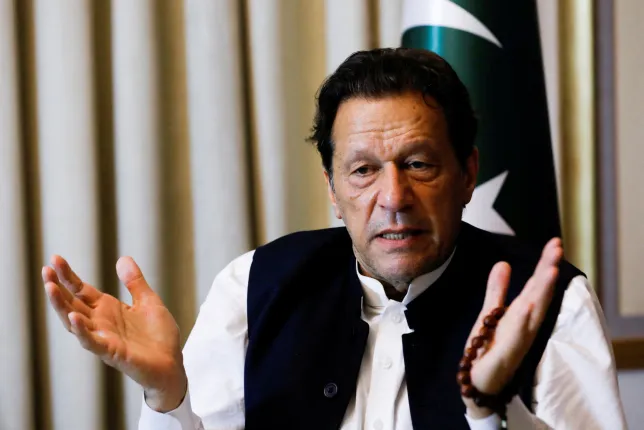
Imran Khan’s prison sentence in Pakistan suspended
-
Imran Khan’s life in danger – Pakistani judge cites an intelligence report
The chief justice of the Islamabad High Court cites an intelligence report that raises concerns about another assassination attempt on the former prime minister.According to a top Pakistani judge, citing an intelligence report, former Prime Minister Imran Khan’s life is in danger due to fears of another assassination attempt on the politician. The remarks were made by Aamer Farooq, the chief justice of the Islamabad High Court, on Friday while hearing a petition filed by a traders’ body regarding road closures in the national capital during political protests.
Khan, 70, was shot in the leg by an assailant earlier this month in Wazirabad while on a “long march” to Islamabad to demand immediate elections.
A supporter of Khan’s Pakistan Tehreek-e-Insaf (PTI) was killed and more than a dozen others wounded in the attack, forcing the party to suspend its march.
The cricketing icon-turned-politician accused Prime Minister Shehbaz Sharif, Interior Minister Rana Sanaullah and military officer General Faisal Naseer of plotting the attack.
Khan did not provide any evidence for his allegations, which were rejected by the government and the army. The suspect was arrested and is being interrogated by the police.
During the hearing on Friday, the police presented before the court an intelligence report which suggested there is a possibility of another attack on Khan once he rejoins the march to Islamabad.
Judge Farooq also asked the PTI to submit a new application to seek permission to hold its rally in Islamabad. He urged the police to ensure the security of the marchers when they reach the city.
Khan, who is recuperating from his bullet wound at his residence in Lahore, has been addressing the marchers through a video link after the “long march” resumed on November 10.
He is expected to rejoin the march when it reaches Rawalpindi later this week.
Since his removal from power in April this year after losing a vote of confidence in parliament, Khan has been holding rallies across Pakistan to press the government to call early elections, otherwise due late next year.
The PTI chief blamed his removal on a “foreign conspiracy” hatched by the United States in collusion with his political opponents and his detractors in the powerful military. Islamabad and Washington have repeatedly denied the charges.
However, in a recent interview to the British newspaper Financial Times, Khan made a U-turn, saying he was willing to move on from the controversy.
“As far as I am concerned, it’s over, it’s behind me. The Pakistan I want to lead must have good relationships with everyone, especially the United States,” he said. -
Imran Khan: Shock and condemnation over the attack on Pakistan’s ex-prime minister
An attack on Pakistan’s former Prime Minister Imran Khan, whose supporters claim was an assassination attempt, has sparked international outrage.
Mr Khan, 70, is recovering in hospital after being shot in the leg during a protest march in Wazirabad, Pakistan’s north-east.
The attack on his convoy killed one person and injured at least ten others.
However, according to his team, Mr Khan is in stable condition and could be discharged in the coming days.
The attack on Mr Khan has electrified the country, which the cricketer-turned-politician led until April, when he was ousted by a parliamentary vote of no confidence.
Schools were closed in the capital, Islamabad, after his party – the Pakistan Tehreek-e-Insaf (PTI) – called for nationwide protests following Friday prayers. President Arif Alvi – a founding member of the PTI – called it a “heinous assassination attempt”.
Mr Khan’s political opponents have also been quick to condemn the attack, with Prime Minister Shehbaz Sharif ordering an immediate investigation.
Meanwhile, US Secretary of State Antony Blinken called for calm, saying: “Violence has no place in politics, and we call on all parties to refrain from violence, harassment and intimidation.”
Pakistan – which is reeling from an ongoing economic crisis and devastating floods – has a record of political violence, with former Prime Minister Benazir Bhutto assassinated in 2007. Many evoked her killing in the wake of the attack on Mr Khan.
How the attack unfolded
Mr Khan – who has been fighting to return to office since he was ousted earlier this year – had been leading a “long march” of protests calling for early elections to facilitate his comeback.
By Thursday, his convoy had reached Wazirabad, where crowds had gathered to hear him speak.
He was stood on top of an open truck-bed surrounded by aides and his other party members when the shots rang out.
“It was so sudden that it took me a while to understand what was going on,” one party staffer, Mueezuddin, told the BBC.
However, from their vantage point they were able to pick out the attacker.
“We saw the attacker had emptied a whole magazine,” Mueezuddin said, “[and he had] loaded another magazine when he was grabbed by a boy from behind.”
Unverified videos on social media show an assailant in the crowd pointing his pistol at Mr Khan’s convoy before being overpowered by Mr Khan’s supporters.
Footage of the incident and witness accounts suggested a security guard was also seen firing from the container.
Mueezuddin said Mr Khan and those around him ducked quickly after the first shots, and when he was hit he remained calm while he was given first aid by his bodyguards.
He was then moved into a bulletproof car and rushed away to hospital in Lahore.
Punjab Chief Minister Pervez Elahi has suggested there may have been more than one attacker, saying Mr Khan had been “shot in the leg from the front while the alleged attacker who was caught on the spot was on the right side”.
Dispute over possible motive
Immediately after the shooting, some of his allies told media that Mr Khan believed the current political leaders – including Prime Minister Sharif, the interior minister and a military general – were behind the attack.
One spokesman, Raoof Hasan, told the BBC’s Newshour programme the government was “attempting to eliminate [Imran Khan] physically”.
But in a press conference on Friday, Interior Minister Rana Sanaullah rejected the allegations, saying that the Punjab government was to blame for any security lapses in the state. “We see Imran Khan as a political opponent, not an enemy,” he added.
Mr Khan, who remains popular, has previously characterised his removal as prime minister as a political conspiracy and been loudly critical for months of the current government and military leaders. Courts have convicted him in recent corruption cases but he has disputed the verdicts as politically motivated.
Police on Tuesday night released a video confession of the man who they said had attempted to kill Mr Khan.
It’s unclear the conditions under which the interview was carried out. But, in response to police asking him why he had opened fire, he said: “He was misguiding the people. I wanted to kill him. I tried to kill him.”
The video has been dismissed by Mr Khan’s allies as a “cover-up”.
One suspect remains in custody but no charges have been laid.
-
Imran Khan’s former case of contempt has been dismissed by a Pakistani court
The five-member bench has accepted Khan’s written apology for comments he made against officials during a rally in August.
A court in the Pakistani capital Islamabad has accepted former Prime Minister Imran Khan’s written apology for comments he made against a female judge in August, relieving him of a contempt case.
The five-member bench, led by Islamabad High Court (IHC) Chief Justice Athar Minallah, expressed its satisfaction with the apology on Monday, adding that the verdict was unanimous.
Khan was charged with contempt of court following a speech he made at a public rally in Islamabad on August 20, during which he threatened “action” against Judge Zeba Chaudhry and senior Islamabad police officials for arresting his top aide Shahbaz Gill, whom he accused police of torture in custody.
Gill was charged with attempting to incite a mutiny in Pakistan’s powerful military after remarks made on a TV show, an allegation Khan’s Pakistan Tehreek-e-Insaf (PTI) party denies.
Khan had initially refused to apologise for his comments but did so eventually, in the last hearing on September 22.
If he had been convicted, he could have been disqualified from running in the next election, which is scheduled for October next year.
title=”YouTube video player” frameborder=”0″ allow=”accelerometer; autoplay; clipboard-write; encrypted-media; gyroscope; picture-in-picture” allowfullscreen></iframe>.
Khan still has another case before the courts regarding the same comments in the August speech, for which he was granted bail on Sunday after an arrest warrant was issued a day before. He has been charged under various sections of the Pakistan Penal Code for the same speech.
He had also been charged under the country’s terrorism laws for the August 20 speech, but a court dropped the charges last month. The IHC had said Khan’s comments did not warrant charges under the harsh Anti-Terrorism Act, which carries a maximum sentence of life in prison and even capital punishment.
Khan’s government was toppled via a parliamentary vote of no confidence in April this year and since then he has been conducting rallies across the country, demanding early elections.
He has also alleged a US-led foreign regime change conspiracy behind the removal of his government, which both US and Pakistani officials have denied.