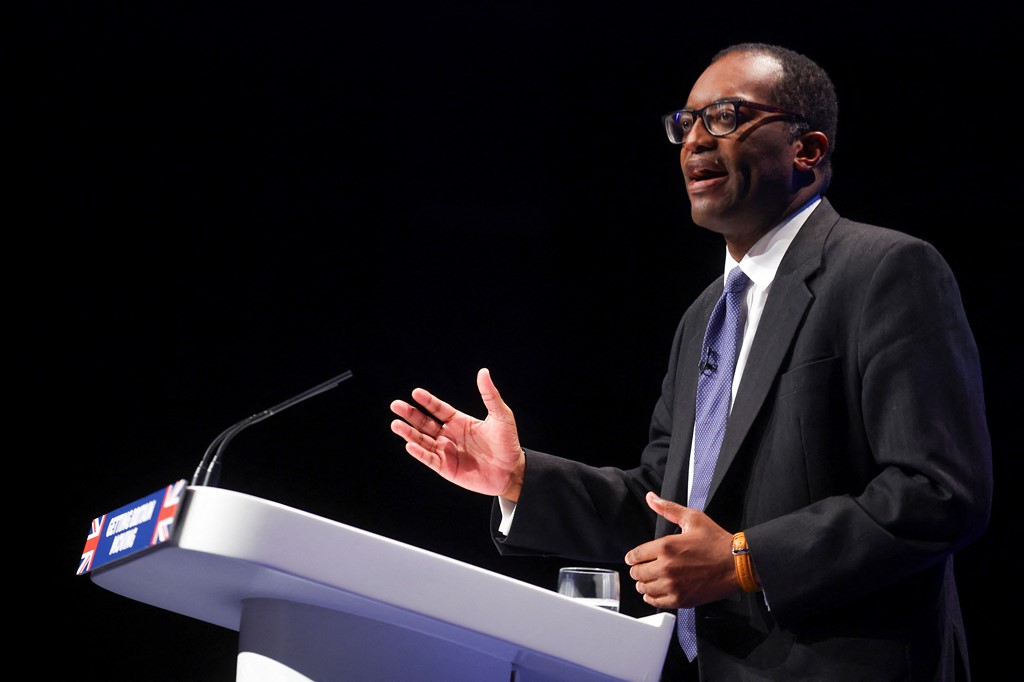
Former chancellor Kwasi Kwarteng has said he warned Liz Truss that her ill-fated economic plans were moving too quickly.
Mr Kwarteng told TalkTV in his first interview since being fired by the then-PM that he had warned her to “slow down” after the September mini-budget.
He claimed he told her she was “mad” to fire him and that if she did, she would only last “three or four weeks.”
“Little did I know it was only going to be six days,” he added.
Mr Kwarteng was dramatically fired by Ms Truss in October, two weeks after their tax-cutting mini-budget sparked turmoil on financial markets.
After abandoning almost all of the plan in a bid to stay in power, she announced her resignation a few days later after support from Tory MPs ebbed away.
Speaking to TalkTV Mr Kwarteng said that he had warned Ms Truss about going at a breakneck speed with economic measures after the mini-budget.
“She said, ‘Well, I’ve only got two years’ and I said, ‘You will have two months if you carry on like this’. And that is, I’m afraid, what happened.”
He also said: “I think the prime minister was very much of the view that we needed to move things fast. But I think it was too quick.”
In the interview he acknowledged he had to “bear some responsibility” for the pace of the changes, which were “too quick”.
He also revealed he found out he was going to be sacked when he saw a journalist tweeting about it while he was in the car going to Downing Street, after being summoned back from a trip to the US.
He said he had told her: “Prime ministers don’t get rid of chancellors.”
The former chancellor said he did not think the prime ministercould fire him “just for implementing what she campaigned on.”
Elon Musk, the inventor of Tesla, has become increasingly significant in discussions about the Ukraine conflict, amid new accusations that he has communicated with Vladimir Putin.
He drew severe criticism after proposing a peace plan in which Ukraine ceded Crimea to Russia.
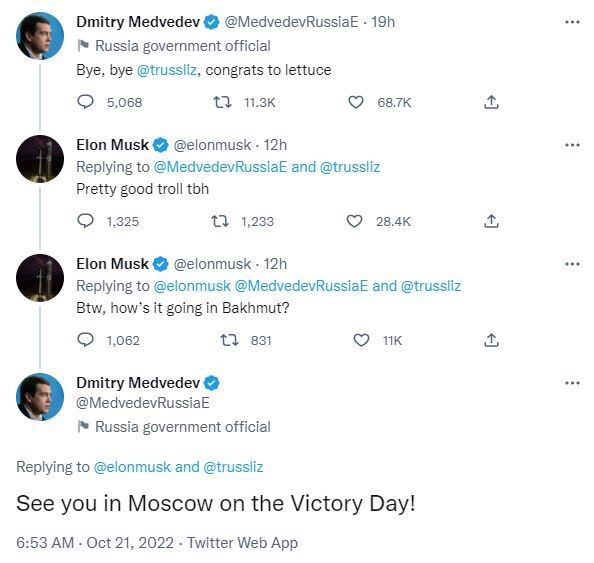
His latest intervention involves a somewhat bizarre Twitter exchange with former Russian prime minister, senior Kremlin official, and prominent Putin ally Dmitry Medvedev.
Musk had complimented Mr Medvedev on a “pretty good troll” after he ridiculed outgoing prime minister Liz Truss.
He then asked the deputy chairman of the Security Council of Russia about it the current situation in Bakhmut, which has faced intense Russian shelling over recent days.
Mr Medvedev concluded (for now at least) the seemingly friendly discussion by suggesting he would see Musk “in Moscow on the Victory Day”.
One Tory MP believes previous leadership challenger and ex-chancellor Rishi Sunak will run to replace Liz Truss.
“I am pretty sure he will, I hope so,” Richard Holden tells Sky News.
The MP says that in the difficult economic times, the party and the country need a PM “who has got the economic experience to deliver real stability over the next few years and get the ship of state back on an even keel” – and that person is Sunak.
He adds: “What we need is competence right at the core of this at the moment… and the economy front and center.
“We have had a really tough time over the past few weeks. Even though I didn’t support Liz [in the leadership contest] I didn’t want it to go the way things have gone.
“What we need to see now is competence at the heart of government and particularly the economic vision.”
But while Holden wants Sunak in Number 10, he also promises he will “unite behind anybody”.
He adds: “The truth is that the Conservative Partyhas got to unite behind whoever is elected to win the next election.”
Liz Truss resigned as Prime Minister just 44 days after succeeding Boris Johnson.
She will be the prime minister with the shortest tenure in modern British political history.
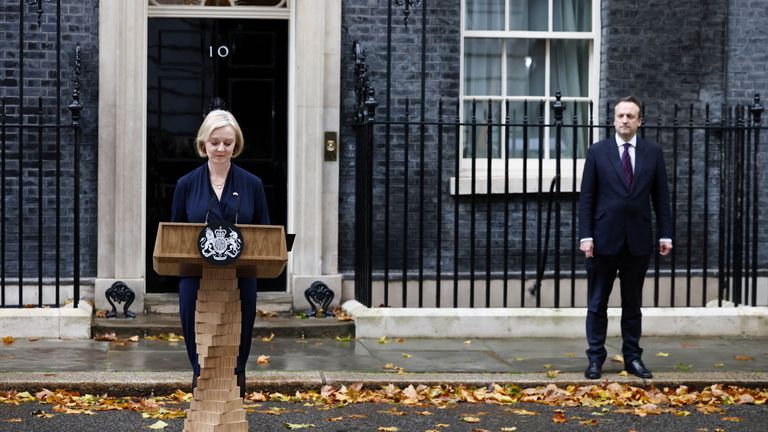
In a statement read outside Downing Street, Ms Truss said: “I came into office at a time of great economic and international instability.
“Families and businesses were worried about how to pay their bills.”
She said she was elected “with a mandate to change this”, adding: “We delivered on energy bills.”
” I recognise, though, given the situation, I cannot deliver the mandate on which I was elected by the Conservative Party,” she said.
“I have therefore spoken to His Majesty the King to notify him that I am resigning as leader of the Conservative Party.
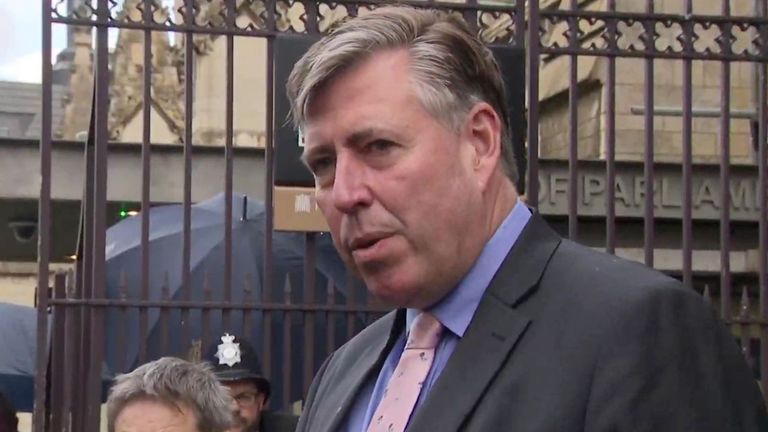
“This morning, I met the chairman of the 1922 committee, Sir Graham Brady. We’ve agreed that there will be a leadership election to be completed within the next week.”
He added: “The Tories cannot respond to their latest shambles by yet again simply clicking their fingers and shuffling the people at the top without the consent of the British people.
“They do not have the mandate to put the country through yet another experiment; Britain is not their personal fiefdom to run how they wish.”
The start of Truss’ downfall
Ms Truss’ downfall started when her former chancellor Kwasi Kwarteng announced his mini-budget a month ago, which prompted weeks of economic turmoil and eventually led to him being sacked last Friday.
Mr Hunt, who voted for Rishi Sunak during the leadership campaign, then took over as chancellor and U-turned on the majority of the unfunded mini-budget tax cuts on Monday – further undercutting Ms Truss’ authority.
On Wednesday afternoon, her home secretary, Suella Braverman then quit after saying she had breached security rules by sending a policy message to a colleague over her personal email by mistake.
It only got worse on Wednesday evening after confusion over whether Labour’s opposition day vote was actually a confidence vote in the government or not – which resulted in allegations of “manhandling” of Tory MPs bycolleagues.
Some Tory MPs had publicly called for Ms Truss’ resignation before that but in the hours before she quit, a flurry of Tory MPs revealed they wanted her to go.
Conservative Party rules prevent a leader from a confidence vote in the first 12 months of their tenure but it is understood after a significant number of MPs wrote to Sir Graham Brady, chair of the 1922 Committee of backbench Tory MPs, calling for her to go, a decision was made that she could not stay.
Liz Truss has insisted that she will lead the Conservatives into the next general election, despite U-turns that have left her fighting for her authority.
The Prime Minister apologized for making mistakes after new chancellor Jeremy Hunt scrapped almost all of her tax-cutting proposals to calm market turbulence.
She went on to say that her month-old premiership “hasn’t been perfect,” but that she had “corrected” flaws.
And she said it would have been “irresponsible” not to change course.
In an interview with the BBC, she said she was still committed to boosting UK economic growth,but acknowledged it would now take longer to achieve.
“I remain committed to the vision, but we will have to deliver that in a different way,” she said.
It comes after a dramatic day at Westminster after Mr Hunt announced that nearly all the tax cuts announced at last month’s mini-budget would be scrapped.
The decision has been welcomed by investors but has left Ms Truss’s economic agenda in tatters only weeks into her time in No 10.
Liz Truss told the BBC’s Chris Mason she was “sorry for the mistakes that have been made”.
In her interview, Ms Truss said she accepted responsibility for going “too far, too fast” – and she wanted to “say sorry for the mistakes that have been made”.
She added that she remained committed to a “low tax, high growth economy” – but preserving economic stability was now the “priority”.
“I do think it is the mark of an honest politician who does say ‘yes, I’ve made a mistake. I’ve addressed that mistake. And now we need to deliver for people.
“It would have been completely irresponsible for me not to act in the national interest in the way I have.”
Shadow Treasury minister James Murray said the PM’s apology “after weeks of blaming everyone else” would not “undo the damage” caused by her mini-budget.
“No sorry can change the fact that this crisis was made in Downing Street but is being paid for by working people,” he added.
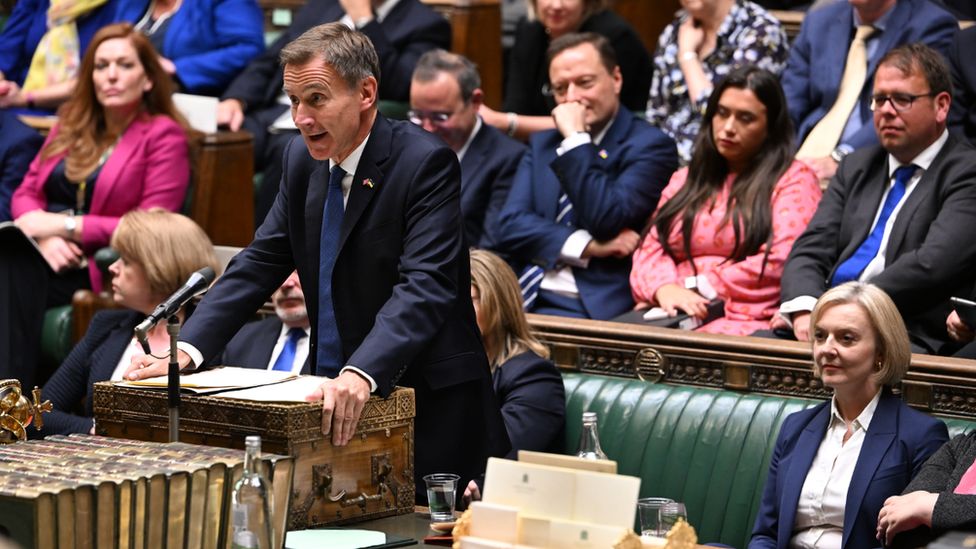
IMAGE SOURCE, JESSICA TAYLOR/UK PARLIAMENT Image caption, Liz Truss sat in the Commons for half an hour as Mr Hunt outlined the U-turns to MPs
Ms Truss watched on silently as Mr Hunt delivered a Commons statement to explain to MPs why the economic strategy, outlined last month by Kwasi Kwarteng, was being torn up.
The chancellor warned that “decisions of eye-watering difficulty” on tax and spending remain ahead of an economic statement on 31 October, when he will give further details of a plan to reduce the UK’s debt burden.
He said further windfall taxes on energy companies – a policy repeatedly rubbished by Ms Truss during her Tory leadership campaign – could not be ruled out, along with changes to the pension triple lock.
Ms Truss refused a Labour request to explain the U-turns to MPs herself before Mr Hunt’s statement, with Commons leader Penny Mordauntsaying the PM had been “detained on urgent business”. The prime minister later arrived in the Commons taking her seat beside Mr Hunt before he began his statement.
Labour leader Sir Keir Starmer accused the PM of leaving an “utter vacuum” in government, while one of his MPs jibed she had been “cowering under a desk”.
In total, £32bn of the £45bn in tax cuts announced at last month’s mini-budget have now been ditched, including plans to cut the basic rate of income tax from 20p to 19p from April.
Cuts to dividend taxes and VAT-free shopping for international tourists have also been scrapped, along with a freeze on alcohol duty rates.
Leadership threats
The government’s energy support package, a policy repeatedly championed by Ms Truss in defence of her premiership, will also be scaled back after six months.
The reversals have prompted some Tory MPs to talk privately about how Ms Truss could be ejected from office, despite party rules preventing a formal leadership challenge for a year.
Tactics reportedly under consideration include submitting no-confidence letters in a bid to force party bosses into a rule change or changing the rules to allow MPs to bypass party members and pick a new leader themselves.
Liberal Democrats leader Ed Davey called for a general election, telling the BBC “the damage has already been done” by the mini-budget.
Shadow Chancellor Rachel Reeves echoed calls for Ms Truss’s removal, telling BBC Breakfast the “only thing left from the Prime Minister’s plan is higher mortgage rates and higher bonuses for bankers”.
Ms Reeves said Labour would fund a longer-running energy bill support package by scrapping non-dom status.
However, there is little agreement over who should take over from Ms Truss if she is removed.
Defence Secretary Ben Wallace has quashed rumours that he could replace Ms Truss should she resign.
Speaking to the Times, he said he will be holding on to his current job and accused Tory MPs of playing “political parlour games”.
Five of the PM’s own MPs have called publicly for her to resign, with others briefing journalists that they think her time in office is up.
Conservative MP Sir Charles Walkerhas been talking to our political editor Beth Rigby and has not held back on his feelings towards the prime minister.
“I think her position is untenable,” he said.
“She has put colleagues, the country, through a huge amount of unnecessary pain and upset and worry.
“We don’t need a disruptor in No 10. We need an uniter.
“I just think… it is just a situation that is… it can only be remedied I think, with a new prime minister.”
Asked about Ms Truss staying in her position, Mr Walker says: “Look the prime minister has had a very torrid six weeks.
“Personally, I don’t think her position is recoverable. She would obviously take a different view.
“But if you read the mood of the parliamentary party, she has lost authority and you can’t lead a party if you don’t have some authority. She doesn’t have much of that.”
Pressed on whether he is calling for Ms Truss to go, Mr Walker replied: “I think it’s her decision right now. I think if she doesn’t go right now, it will not be her decision. That agency will be taken away from her.”
Asked how long he thinks it will be before that decision gets taken one way or the other, Mr Walker says: “A week or two.”
The MP for Broxbourne, who is standing down at the next election,continued: “I’m just so cross. I’ve just had enough. And I think quite a few of my colleagues have had enough and I’ll be dismissed as being tired and emotional.
“And yes, I am tired, and I am emotional, and I am angry. And I’m in the same place as many of my friends, many of my family, and many of my constituents.”
This must bethe most humbling of humble moments for Liz Truss.
Six weeks after becoming prime minister she is being forced to sit in silence as a man who backed her rival in the leadership campaign rips apart her whole plan for the country and turns it into something resembling Rishi Sunak’s prospectus for the government.
Next to the chancellor, two seats away Penny Mordaunt – the woman Ms Truss beat into the Tory leadership runoff.
She has just been fielding questions in the prime minister’s place, at one point assuring MPs that the prime minister was not hiding “under a desk.”
It’s hard to see how Liz Truss comes back from this politically with her vision for the country in tatters and one-time rivals now holding the power in government.
The problem for the prime minister is this isn’t just humbling, it’s humiliating.
DISCLAIMER: Independentghana.com will not be liable for any inaccuracies contained in this article. The views expressed in the article are solely those of the author and do not reflect those of The Independent Ghana
As she laid out her plans for an independent Scotland today,Nicola Sturgeon claimed Prime Minister Liz Truss’ decision not to tender her resignation demonstrates how “badly broken” UK politics is.
Following the chancellor’s emergency statement today, the first minister said that if she had given in to demands made by Tories and commentators on the day of the mini budget to match the UK government’s tax plans she too “would be dealing with something of a financial disaster.”
She said: “It will also be galling, I think, that the one measure that the prime minister has repeatedly cited to effectively justify the market turmoil of recent weeks, the energy price cap has also been curtailed, leaving many people and possibly many businesses without the support with energy bills that they were expecting.”
Launching her economic prospectus paper on Scottish independence, Ms Sturgeon said a “fairer, more sustainable economy was more possible for Scotland with independence than it ever will be with continued Westminster control”.
She said: “In 2014, the choice before the Scottish people was framed by Westminster parties as the strength and stability of the UK on the one hand and the uncertainty of independence on the other. The reality in the years since has been very different.
“It is glaringly obvious now that the UK does not offer economic strength and stability or financial security.”
Setting out some of her plans, Ms Sturgeon said she would create an independent Scottish central bankand confirmed that the policy of the Scottish government was to establish a Scottish pound.
“We would seek to do this as soon as practicable. The precise timing would be determined not by a fixed timetable, but by a set of objective requirements and criteria guided by advice from the central bank and subject to a decision by parliament in the overall interests of the country.”
The prime minister has tweeted to align herself with the announcements made by chancellor Jeremy Hunt (who some Tory MPs are referring to as “de-facto PM) this morning…
The British people rightly want stability, which is why we are addressing the serious challenges we face in worsening economic conditions.
We have taken action to chart a new course for growth that supports and delivers for people across the United Kingdom. https://t.co/P3yglx6efZ
Liz Truss agreed to Jeremy Hunttearing up her mini-budget during a meeting over the weekend.
The prime minister’s official spokesman said: “The chancellor and prime minister discussed these measures and agreed on them over the weekend.”
In a briefing with journalists, the spokesman was asked if Ms Truss would rule out resigning, to which he responded that the PM was working very closely with the chancellor.
The spokesman repeated the admission that the mini-budget “went too far, too fast”.
Ms Truss will be in the House of Commons for Jeremy Hunt’s statement there later today, and will also be meeting with Conservative MPs.
“The prime minister wants to continue to engage with her cabinet colleagues as part of a series of engagements carried out both with cabinet and with Parliament more broadly,” the spokesman said.
Asked whether the government’s commitment to increase defence spending remained, the spokesman said the prime minister and chancellor “remain committed” to increasing defence spending, but added, “the long-term ability to fund increased defence spending will depend on the economic stability and on a healthy growing economy.”
On Monday,the pound gained and government borrowing costs fell as investors welcomed the news that Chancellor Jeremy Hunt is speeding up tax and spending cuts.
In morning trading, sterling gained 1% against the dollar, trading around $1.13.
The interest rate – or yield – on UK government bonds fell as a result of the announcement.
The drop in yields suggests financial markets are welcoming the prospect of changes to economic plans.
Monday is the first time the UK government bond market has reopened since the Bank of England’s emergency support programme ended on Friday.
On Friday, Prime Minister Liz Truss sacked Kwasi Kwarteng as Chancellor and said the mini-budget “went further and faster than markets were expecting”.
The mini-budget was blamed for causing turmoil in the financial markets. The aftermath of Mr Kwarteng’s announcements on 23 September saw the pound slumped to a record low of $1.03 and the cost of government borrowing rise sharply.
“The chancellor will make a statement later today, bringing forward measures from the Medium-Term Fiscal Plan that will support fiscal sustainability,” a Treasury spokesman said.
Mr Hunt is expected to fast-track many billions of pounds worth of tax and spending measures from his debt plan, announcing them a fortnight earlier than expected.
It is the latest of a series of U-turns on policies announced in the mini-budget.
The announcement of the £18bn U-turn on corporation tax on Friday and the firing of Mr Kwarteng did not appear to reassure investors, with UK government borrowing costs climbing on Friday afternoon.
Investors warned that whatever Mr Hunt announces will need to “add up”.
“I think you’ll see a positive reaction to the statement, assuming that the math adds up a bit more than it did before,” Shanti Kelemen, chief investment officer at M&G Wealth, told the BBC.
“What we saw on Friday, as we had markets rise in the lead up to the news that Kwarteng was resigning, but then as soon as it happened, we had a sell-off afterwards.
“So I think it’ll be important that the actual content of what’s being delivered adds up and has some more meat and numbers behind it than what we’ve seen previously.”
The Bank of England stepped in to stabilize the financial markets following the mini-budget, announcing an emergency bond-buying scheme.
Ms Kelemen said that the latest moves from the chancellor showed he acknowledged the government’s role in reassuring the markets.
“They’ve recognized that the uncertainty is damaging the economy,” she said.
“You also see the Bank of England won’t be supporting markets this week. So I think it shows the government is taking a bit more responsibility rather than relying on the Bank of England to buy all the debt.”
The shift in the government’s economic policies and market turmoil in recent weeks has led to Goldman Sachs downgrading its forecasts for UK economic growth.
The investment bank revised its 2023 UK economic output forecast from a 0.4% drop to a 1% contraction.
Goldman said it expected a “more significant recession in the UK” in part due to “significantly tighter financial conditions” and the planned higher corporation tax rate from next April.
Consultancy Pantheon Macroeconomics said the prime minister’s decision to appoint Mr Hunt as chancellorhad “done little to shrink the risk premium embedded in UK assets”.
“Households and businesses, therefore, are still facing a huge increase in their borrowing costs,” their analysts said.
They added the forthcoming real-term reduction in government spending looked “set to be bigger than in the 2010s”.
Andrew Griffith told Sky News that Liz Trussstill has the support of her government despite troubling economic turmoil.
The Financial Secretary to the Treasury said: “Liz Truss has got the support of the Government – it’s really important at this time that we have stability.”
On whether they had got decisions wrong, Mr Griffith said: “Yeah for sure there’s things that everybody in government would regret last week, and that’s why the government has made changes.”
He then argued that the government had got it right on the energy price guarantee and the focus on economic growth.
But pressed on exactly what ministers got wrong, he said: “The rate at which you could proceed and as the chancellor said yesterday, not involving the OBR (Office for Budget Responsibility) in those conversations.
“I think it was well meant to act as quickly as possible but obviouslythat has caused some of the turbulence.”
Mr Griffith was then asked why Kwasi Kwarteng was sacked as chancellor.
“The prime minister concluded that the right thing to do was to make a change. [Liz Truss] has exercised that judgment, she’s brought in a new and really experienced chancellor.
“Now we need a little bit of time to do that work… nobody wants those decisions to be rushed… we want them to be right.”
He said what the public and the economy need is “calm” and “stability” – and the last thing they want is politicians talking about themselves.
Prime Minister Liz Trusshas released a comment piece she wrote for The Sun on Sunday, in which she calls it a “wrench” that “my buddy Kwasi Kwarteng has left government.”
She stressed on Twitter that she will always “act in the national interest, assisting people and businesses across our country.”
Ms Truss added: “We are going to do things differently, charting a new course for growth – it remains the core mission of this government.”
I will always act in the national interest, supporting families and businesses across our country.
We are going to do things differently, charting a new course for growth – it remains the core mission of this government👇https://t.co/CYWRRz27dn
Following repercussions from a mini-budget delivered last month, Kwasi Kwarteng, Chancellor of the Exchequer and close supporter of the Prime Minister, was removed after six weeks in office.
The budget has now prompted market volatility and a rebellion among UK Conservative parliamentary members.
Kwarteng reportedly returned to No. 10 Downing Street where he received official notice of his dismissal after cutting short his trip to the United States of America where he had been attending the IMF/World Bank meetings.
In a statement released after his firing, the British-born Ghanaian admitted that even before taking up the job, he knew he could not tow the lines of those before him, thereby needing to adopt more drastic approaches.
Shortly after Kwasi Kwarteng was fired, a new candidate was appointed in the person on Jeremy Hunt to serve as UK Chancellor of the Exchequer.
Hunt is a known figure in the UK Conservative Party and has previously served as health secretary and foreign secretary.
He has on two occasions contested the Conservative party leadership slot where he lost both times.
Ahead of Liz Truss’ selection to lead the party, Jeremy Hunt was a keen supporter of former chancellor Rishi Sunak over Liz Truss.
Jeremy Hunt is coming to the position as UK Chancellor of Exchequer at a time when the country is facing high inflationary pressures, tumbling currency, rising cost of living and among others.
About Jeremy Hunt
According to the BBC, Jeremy Hunt is a 55-year-old Conservative Member of the UK parliament. Prior to his political life, he grew up in Surrey town of Godalming in the United Kingdom.
He attended Charterhouse School, where he was the head boy who was widely known for his love of cross-country running.
He later attended the prestigious Oxford University where some say his political career began. Hunt during his journey in the University served as president of the Conservative Association.
Prior to being elected to parliament in 2005, Jeremy had a career as an English teacher in Japan and as an entrepreneur where he co-founded the Hotcourses education publisher.
In 2017, the Hotcourses was sold to an investor which earned Hunt a reported net profit of £14 million, making him one of the richest politicians in the UK.
From 2005 to 2007, Jeremy Hunt became the shadow minister for persons with disability. This was somewhat his reward for supporting former UK prime minister, David Cameron.
In 2010, the Conservative-Liberal Democrat coalition government was formed where Jeremy Hunt served in cabinet as secretary of state for culture, Olympics, media and sport.
He also played a pivotal role in the 2012 London Olympics.
However, in politics, there is never a trade-off without scandal as calls grew in 2012 for Jeremy Hunt to resign over his alleged involvement in the BSkyB takeover bid.
It was alleged that Hunt had close contacts with the media empire of controversial mogul Rupert Murdoch but he survived the saga and was appointed health secretary in 2012.
His tenure as the health secretary came at a time when the NHS was facing financial turmoil and challenges.
In an excruciating news conference– so short the gathered political press pack was left open-mouthed as she departed – Liz Truss made her already perilous political position even worse.
Be in absolutely no doubt, the prime minister is in deep trouble.
She has sacked her chancellor, committed a second major U-turn on her mini-budget, and junked the core of her economic policy.
And she did so, awkwardly and uncomfortably, in no more than eight minutes.
In an excruciating news conference – so short the gathered political press pack were left open-mouthed as she departed – Liz Truss made her already perilous political position even worse.
The aim of this breakneck change in direction was to attempt to calm markets and her Conservative colleagues, but instead, she left huge questions unanswered.
It’s worth underlining the significance of what the prime minister just announced.
First, on policy, she has buckled and reversed her position on corporation tax. She will now go ahead with the increase proposed by her leadership rival, Rishi Sunak.
During the contest to replace Boris Johnson as Tory leader, Ms Truss had said increasing the rate from 19% to 25% next April would “put off people who want to invest in Britain” and amount to “cutting off our nose to spite our face”.
It was a significant part of the platform on which she was elected Tory leader, nowhumiliatingly discarded in order to bring in around £18bn to fill the black hole left by last month’s mini-budget.
She said it was a “down payment” on the medium-term fiscal plan due to be set out on 31 October – a signal to the markets that she’s prepared to make more reversals if necessary.
Does she still believe it will put people off investing? We don’t know because she didn’t stick around at the news conference long enough to be asked.
On the sacking of Kwasi Kwarteng as chancellor, she expressed her sorrow – but again, did not answer the obvious question about how she can possibly justify his departure without her own.
she can possibly justify his departure without her own.
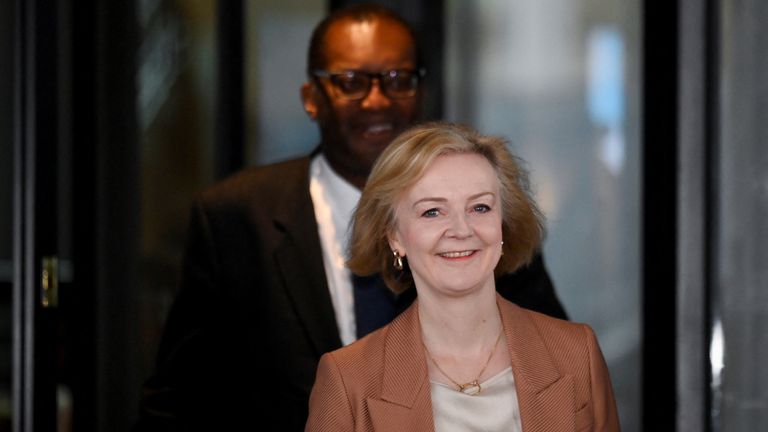
Image:Liz Truss and her former chancellor Kwasi Kwarteng
The chancellor, who was supposed to be one of her closest political friends, was also humiliatingly discarded – along with the government’s radical economic mission for which she had asked him to lead the charge.
The way in which the prime minister delivered this news really matters. Not just because of the lack of scrutiny that came from only taking four questions and barely engaging with them in the answers – but because her party, and indeed the markets, will have been watching to see how she handled the situation.
That news conference was not just about communicating with the public. The messages I received from Conservative MPsahead of the news conference made clear that she needed to put in a really strong, reassuring performance.
Their fears are that she is out of her depth. They want to see that she can handle being prime minister. And the early signs are that her performance today failed on both fronts.
One MP has messaged me saying it was “shockingly bad”, even by Liz Truss’s standards.
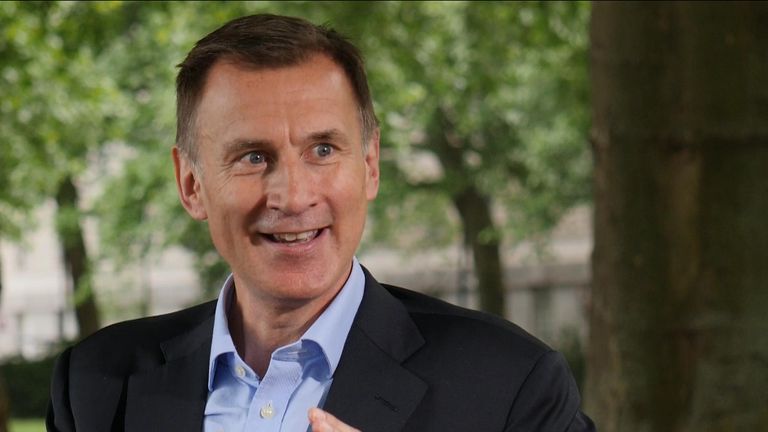
Image:Jeremy Hunt has replaced Kwasi Kwarteng as chancellor
Jeremy Hunt’s installation as the new chancellor may be intended to show the ship is being steadied – that someone with deep experience in government is at the helm of the economy and that markets do not need to fear further surprises.
But power flows from Number 10. The prime minister is the head of government. The prime minister is the person who must command the confidence of the Commons if they are to remain in post.
This prime minister looks out of her depth. “It’s not going to last,” is how one cabinet minister put it to me.
DISCLAIMER: Independentghana.com will not be liable for any inaccuracies contained in this article. The views expressed in the article are solely those of the author’s and do not reflect those of The Independent Ghana
After Kwasi Kwarteng was ousted as chancellor on Friday, the SNP’s Westminster leader Ian Blackford stated Tory prime leaders since 2010 have “collectively got us into this mess.”
Mr Blackford branded the situation a “shambles” and called for a general election after Liz Truss sacked Mr Kwarteng and parachuted former foreign secretary Jeremy Hunt into Number 11 in his place.
“We’ve really seen the credibility for financial competence, for the financial management of this government really put to bed,” he told the BBC.
“Over the last few years, we’ve gone from Cameron, we’ve had Theresa May, we’ve had Boris Johnson, we’ve now had the shambles of Liz Truss.
“None of these prime ministers have acted in the interests of the people of Scotland and collectively they have got us into this mess. It’s not another Tory prime minister that we need. We need away from Westminster, we need independence.”
Mr Blackford joined Labour leader Sir Keir Starmer’s calls for a general election, saying there had been a “whole series” of “shambolic” Tory governments.
Former defence minister Tobias Ellwood has hailed Jeremy Hunt’s appointment as chancellor as a “wise inclusion.”
The influential Tory MP appears to have regained his Conservative whip, tweeting that he’s “off the… naughty step & back in Pty.”
Ellwood had the whip withdrawn – basically meaning he was kicked out of the parliamentary party while keeping his seat – after missing a vote of confidence in Boris Johnson’s government in July.
At the time, he said he’d been unable to return from a meeting overseas.
Just three weeks after the phrase was coined, so-called Trussonomics is no more.
Liz Truss’s ambitious plan for a high-growth, high-wage, low-tax economy didn’t even get off the launch pad. The new Chancellor Jeremy Hunt concedes that mistakes were made in how it was delivered.
In a remarkably frank interview with BBC Radio 4’s Today programme this morning, he admitted there would be difficult decisions ahead.
Some taxes would now go up, he said, and others may not come down as quickly as people want.
Spending will not rise as fast as previously planned. Hunt will now ask all government departments to look for efficiency savings – and said even health and defence are not immune.
He also admitted that “flying blind” was another big error. That was a reference to the failure of his predecessor to submit his plan to be stress-tested by the independent Office for Budget Responsibility (OBR) to make sure the sums added up.
The reaction from the business world has been mixed. One investment fund manager described the reversal in policy as a turning point and described Jeremy Hunt as someone the markets could trust.
But the chairman of supermarket giant Asda, Lord Stuart Rose, described Liz Truss as a “busted flush”, who in his view cannot bring stability to the economy.
The judgment from the markets will come when they re-open at 08:00 on Monday. It will be the first working day since the Bank of England stopped buying government bonds to try and stabilise the pension market. The price of government borrowing was already creeping up again at close-of-play on Friday.
Jeremy Hunt said he had been given a clean slate to re-work the mini-budget. He now has two weeks to make the figures work before delivering his economic plan on 31 October.
DISCLAIMER: Independentghana.com will not be liable for any inaccuracies contained in this article. The views expressed in the article are solely those of the author and do not reflect those of The Independent Ghana
Labour leader Sir Keir Starmerhas hit out at what he called the “grotesque chaos” of chancellor Kwasi Kwarteng’s sacking, as he accused Liz Truss of putting “party first and country second”.
It comes as the turmoil continued within the Conservative party this morning, as new chancellor Jeremy Hunt rowed back on Liz Truss’s promises on tax cuts and public spending.
Mr Hunt told Sky News there were “mistakes” in the mini-budgetand warned of tough times ahead.
Hunt warns of ‘difficult decisions’; follow politics’ latest
“We won’t have the speed of tax cuts we were hoping for, and some taxes will go up”, he said.
He also said that all government departments would have to “find more efficiencies than they were planning to find”.
Mr Hunt was appointed chancellor on Friday, an hour after his predecessor Kwasi Kwartengwas sacked after just 38 days on the job.
Prime Minister Liz Truss has expressed sadness at losing her longtime friend and colleague, Kwasi Kwarteng, from her ministry after dismissing him following a mini-budget presentation.
They both share the same vision for the UK and the same steadfast belief in the prosperity of the country, she said, adding that her fired appointee was “a long-standing friend and colleague.”
Thank you for your letter. As a long-standing friend and colleague, I am deeply sorry to lose you from the Government. We share the same vision for our country and the same firm conviction to go for growth.
You have been Chancellor in extraordinarily challenging times in the face of severe global headwinds.
You have set in train an ambitious set of supply-side reforms that this Government will proudly take forward. These include new investment zones to unleash the potential of parts of our country that have been held back for too long and the removal of EU regulations to help British businesses succeed in the global economy.
I deeply respect the decision you have taken today. You have put the national interest first.
Thank you for your service to this country and your huge friendship and support. I have no doubt you will continue to make a major contribution to public life in the years ahead.
She has sacked her chancellor, committed a second major U-turn on her mini-budget, and junked the core of her economic policy.
And she did so, awkwardly and uncomfortably, in no more than 8 minutes.
In an excruciating new conference – so short that the gathered political press pack were left open-mouthed as she departed – Liz Truss made her already perilous political position even worse.
The aim of this breakneck change in direction was to attempt to calm markets and her Conservative colleagues, but instead, she left huge questions unanswered.
It’s worth underlining the significance of what the prime minister just announced.
First, on policy, she has buckled and reversed her position on corporation tax. She will now go ahead with the increase proposed by her leadership rival, Rishi Sunak.
During the contest to replace Boris Johnson as Tory leader, Ms Truss had said increasing the rate from 19% to 25% next April would “put off people who want to invest in Britain” and amount to “cutting off our nose to spite our face.”
It was a significant part of the platform on which she was elected Tory leader, now humiliatingly discarded in order to bring in around £18 billion to fill the black hole left by last month’s mini-budget.
She said it was a “down payment” on the medium-term fiscal plan due to be set out on 31 October – a signal to the markets that she’s prepared to make more reversals if necessary.
Does she still believe it will put people off investing? We don’t know because she didn’t stick around at the news conference long enough to be asked.
On the sacking of Kwasi Kwarteng as chancellor, she expressed her sorrow – but again, did not answer the obvious question about how she can possibly justify his departure without her own.
The chancellor, who was supposed to be one of her closest political friends, was also humiliatingly discarded – along with the government’s radical economic mission for which she had asked him to lead the charge.
The way in which the prime minister delivered this news really matters. Not just because of the lack of scrutiny that came from only taking four questions and barely engaging with them in the answers – but because her party, and indeed the markets, will have been watching to see how she handled the situation.
That news conference was not just about communicating with the public. The messages I received from Conservative MPs ahead of the news conference made clear that she needed to put in a really strong, reassuring performance.
Their fears are that she is out of her depth. They want to see that she can handle being prime minister. And the early signs are that her performance today failed on both fronts.
One MP has messaged me saying that it was “shockingly bad”, even by Liz Truss’s standards.
Jeremy Hunt’s installation as the new chancellor may be intended to show the ship is being steadied – that someone with deep experience in government is at the helm of the economy and that markets do not need to fear further surprises.
But power flows from Number 10. The prime minister is the head of government.
The prime minister is the person who must command the confidence of the Commons if they are to remain in post.
This prime minister looks out of her depth. “It’s not going to last,” is how one cabinet ministerput it to me.
DISCLAIMER: Independentghana.com will not be liable for any inaccuracies contained in this article. The views expressed in the article are solely those of the author’s, and do not reflect those of The Independent Ghana
Jeremy Hunt, one of the faces of the One Nation Conservative camp within the Tory party, is the new chancellor under a Liz Truss government.
Ideologically they may see eye to eye on keeping corporation tax low – Hunt told Sky’s Sophy Ridge in July he not only wanted the tax not to rise but he wanted it slashed further – but Hunt is by no means seen as an obvious bedfellow for the prime minister.
For example, health secretary, Hunt was in favour of banning junk food adverts before 9 pm as part of a push to reduce childhood obesity. This policy was never implemented, however, as it was seen as a ‘nanny-state’ policy. This is just one example to suggest that these two heavy hitters could end up falling out.
Will Liz Truss’s libertarian instincts put her at loggerheads with her new chancellor? Or will the ideological differences between them make for a more balanced dialogue around the cabinet table?
Strategically, Truss will be hoping that appointing Hunt will assuage Tory anger and bring back the One Nation MPs out for blood. But Hunt inspires a lukewarm reaction (at best), even among sympathetic MPs.
Firstly, he was not even able to gain enough support from fellow MPs in the latest leadership race to make it past the first round of voting.
Secondly, one former cabinet minister told me: “He brings no one with him” and is “yesterday’s man”. Another former minister pleased with the hire said they were happy but not excited, and that it made little difference to Truss’s life expectancy as prime minister: “She cannot reassert her authority after this. It’s over.”
Although sacking Kwasi Kwartengmay look like a sign of strength from Truss, she has now amputated her own political right arm, making her life ten times harder.
Kwarteng and Truss were seen as ideological soulmates, something mirrored in Truss’s letter to her former chancellor where she said: “We share the same vision for our country”.
And now rebellious Tory backbenchers know the lady is for turning, she will be pulled in every which way by the increasingly divided factions of her chaotic party until she is ripped apart beyond repair.
DISCLAIMER: Independentghana.com will not be liable for any inaccuracies contained in this article. The views expressed in the article are solely those of the author’s, and do not reflect those of The Independent Ghana
Labour leader Sir Keir Starmer has said Kwasi Kwarteng’s sacking does not “undo the damage” already inflicted by Liz Truss’s government through the mini-budget.
“Changing the chancellor doesn’t undo the damage made in Downing Street,” he posted on Twitter.
Changing the Chancellor doesn’t undo the damage made in Downing Street.
Liz Truss’ reckless approach has crashed the economy, causing mortgages to skyrocket, and has undermined Britain’s standing on the world stage. 1/2
Prime Minister Liz Trusssays what she has done today is make sure “we have economic stability in this country”.
She says: “Jeremy Hunt as chancellor is somebody who shares my desire for high growth, low tax economy.
“But we recognise because of current market issues, we have to deliver the mission in a different way.
“And that’s where we are absolutely committed to achieving that stability.”
Asked if she will apologise after the former Tory chancellor, Philip Hammond, said that she had trashed the party’s winning reputation for economic competence, she adds: “Well, I am determined to deliver on what I set out when I campaigned to be party leader.
“We need to have a high growth economy, but we have to recognise that we are facing very difficult issues as a country.”
The prime minister then walks off stage having only taken four questions from the press during a news conference that was less than 10 minutes.
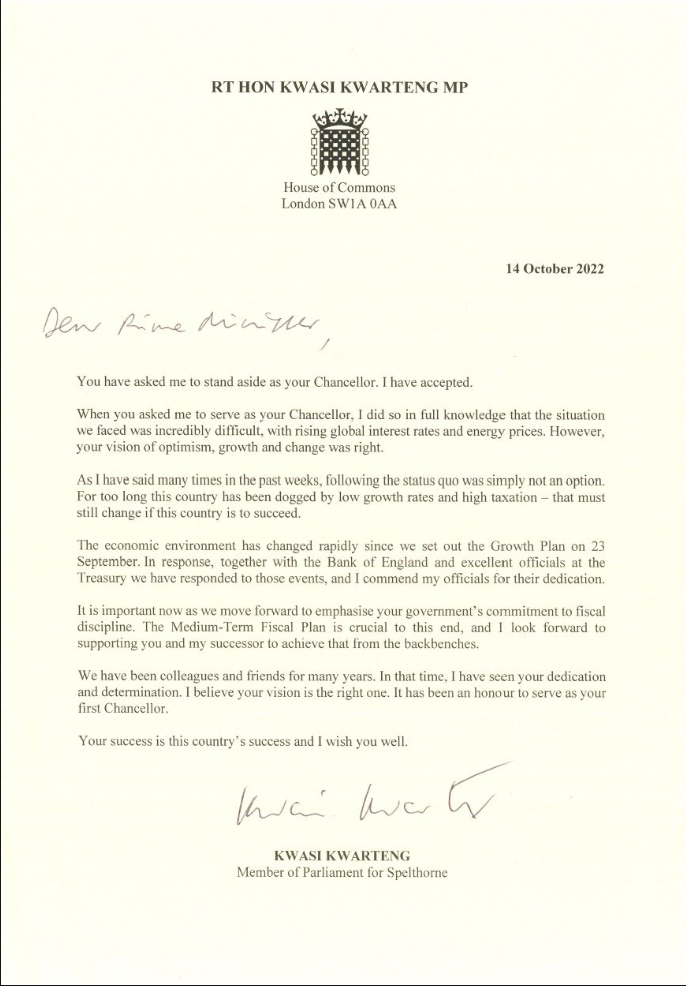
Kwasi Kwartenghas confirmed he has today been sacked as chancellor after just 38 days in the role.
Publishing a letter he has written to Prime Minister Liz Truss on Twitter, Mr Kwarteng said it had been “an honour” to serve as her first chancellor.
Describing the “incredibly difficult” situation Ms Truss’s government inherited, Mr Kwarteng’s letter adds: “However, your vision of optimism, growth and change was right.
“As I have said many times in the past weeks, following the status quo was simply not an option.
“For too long this country has been dogged by low growth rates and high taxation – that must still change if this country is to succeed.”
Despite growing calls for further U-turns over the government’s controversial mini-budget, Mr Kwarteng describes his Medium-Term Fiscal Plan – due to be unveiled on 31 October – as “crucial”.
He says he believes the PM’s “vision is the right one”, adding that he looks forward “to supporting you and my successor” from the back benches.
Mr Kwarteng’s letter concludes: “Your success is this country’s success and I wish you well.”
Discussion is happening at all levels in the Conservative partyabout whether the prime minister can survive – even if she replaces her chancellor.
As one senior minister in her government put it to me this morning before reports that Kwarteng would be sacked: “I honestly don’t think either of them, Liz or Kwasi have a clue, I don’t think they know what they’re doing.”
“They’ve got one shot to satisfy the markets,” the minister said – with a full U-turn on the corporation tax freeze and perhaps more: “The worst possible thing, now the markets have priced in a U-turn on corporation tax would be mealy-mouthed partial U-turn.”
“But my instinct is she won’t survive. She’s introduced herself to the country in the worst way imaginable, and people’s views of her are quite settled now.
“Even if she stays, you can’t have a chancellor who has lost the confidence of the markets, that’s never happened before that I can remember”. The minister said the prime minister might need a complete reboot of the Treasury team to restore confidence, but having jettisoned key parts of her economic programme, “she is a husk.”
This minister and others point out that her controversial supply-side reforms are likely to be opposed in parliament – as are spending cuts on the scale that may be needed to pay for her measures.
Other MPs also say she will need a humiliating change of direction to survive. One long-serving MPsaid: “It’s unfair for Kwasi to go in the sense that it was all her idea, but politics isn’t fair. It’s a matter of survival for her now, there are discussions going on but it’s not organized yet.”
DISCLAIMER: Independentghana.com will not be liable for any inaccuracies contained in this article. The views expressed in the article are solely those of the author’s and do not reflect those of The Independent Ghana
The Bank of England is set to stop its government bond-buying scheme today after attempting to reassure the UK’s financial markets.
The Bank launched the unprecedented intervention after the chancellor’s mini-budget caused chaos within the markets, as well as a potential pension pots crisis.
It promised to buy up to £65bn in government bonds – which are known as gilts – from those who wanted to sell them.
The government issues bonds to raise money for public spending, often used to service pension funds and the life insurance market.
Banks and big financial institutions that buy the gilts from the government at auction can sell them on to smaller financial institutions, traders or investors on the open market.
The price – or rate – at which they are bought and sold will be higher if investors think the government is able to repay the debt when the bond matures.
But when confidence in the UK economy falls, so does the bond price.
This increases the yield, the rate of interest, or the cost of borrowing, as investors seek to protect their money.
How much did the BoE spend on bonds?
The scheme launched by the Bank of England was designed to restore confidence in the government’s finances – increasing bond prices and decreasing the yields it has to pay on them.
Initially, the Bank’s intervention seemed to push down yields on these gilts.
But on Wednesday, yields had surged as high as 5.1%, the same level they reached before the Bank’s initial intervention.
As part of the programme, the Bank bought around £4.35bn of bonds on Wednesday and £4.7bn on Thursday in an increased effort to help soothe the markets.
It brings the total bond buying to £17.8bn.
Ultimately, it has helped to prop up pension funds at a time when they were already under a lot of strain from global financial pressures.
Another U-turn expected
Chancellor Kwasi Kwarteng and Prime Minister Liz Truss are now under pressure to reinstate a planned increase in corporation tax from April.
On Thursday night, the chancellor announced he would be returning to the UK from the US earlier than planned, amid growing expectations of a government U-turn on corporation tax.
The widely anticipated move appeared to reassure the finance industry after Bank of England Governor Andrew Bailey spooked the markets by insisting that the emergency support would not be extended.
Mr Kwarteng has also that there would be “no real cuts to public spending”, appearing to double down on comments made in the House of Commons by the PM on Wednesday.
The government’s plans revolve around securing an increase in economic growth – with a target of an annual rise of around 2.5% in gross domestic product.
The crucial date will be 31 October, when the forecasts presented by the Office for Budget Responsibility alongside the chancellor’s statement will give an assessmentof whether such a plan is realistic.
As a result of the government’s £45 billion in unfunded tax cuts, which were revealed last month and caused havoc in the markets, Prime Minister Liz Truss is facing an open uprising inside her own party.
The foreign secretary has declined to guarantee that the government will implement all of the tax cuts outlined in the disputed mini-budget presented by the chancellor.
James Cleverlytold Sky News “the package the chancellor put forward is pro-growth and is the right answer”.
He refused to rule out further changes, however, dodging multiple questions on whether the government will stick with its plan to scrap the rise in corporation tax.
Asked if there will be no more reversals of policy, Mr Cleverly told Kay Burley: “The chancellor is making a statement on the 31 October which gives a more holistic assessment of the public finances and our response to the global headwinds that every democracy, every economy in the world is facing.
“But as I say, the foundations of that mini-budget, protecting people from energy bill prices, letting people keep more of their earnings, protecting businesses from those energy prices, making sure we are internationally competitive, all those things are really key for the growth agenda the PM is putting forward.”
Probed again on whether the government will be sticking to its tax-cutting mini-budget, the foreign secretary replied that “ultimately, that mini-budget was about protecting tens of millions of people from unaffordable energy prices”.
Pressed specifically on the government’s plan to axe the increase in corporation tax from 19% to 25% in April, Mr Cleverly said: “Well, I mean the chancellor will come to the dispatch box…”
The foreign secretary added it is “absolutely right” the government helps businesses to “stay competitive” and “stay afloat”
“We have got to make sure we can compete internationally with the other places businesses can choose to locate. We have got to make sure we are tax-competitive.”
Prime Minister Liz Truss faces open revolt in her party over the government’s £45bn package of unfunded tax cuts, which unleashed chaos in the markets after it was announced last month.
Ms Truss and Kwasi Kwarteng, the chancellor, have said the cuts are needed to get Britain’s economy growing again, as data published on Wednesday suggested the country is heading for a recession.
Mr Kwarteng will meet with International Monetary Fund (IMF) leaders in Washington DC today after the institution’s chief economist said tax cuts threatened to cause “problems“ for the UK economy.
The IMF has said Britain’s priority should be tackling inflation rather than adding to the price problem through tax giveaways to achieve economic growth.
The prime minister and her chancellor have already been forced into reversing one of the many tax-cutting policies within their plan – scrapping the 45p tax rate for the highest earners.
In her first PMQs since the mini-budget last month, Ms Truss yesterday pledged not to cut public spending to balance the books – despite a leading economics-focused think tank warning the government is billions short of the sums needed.
The Institute for Fiscal Studies has warned the government would have to cut spending or raise taxes by £62bn if it is to stabilize or reduce the national debt as promised.
On Wednesday, Mel Stride, the Tory chairman of the Commons Treasury Committee, said that given Ms Truss’s commitments to protecting public spending, there was a question over whether any plan that did not include “at least some element of the further row back” on the tax-slashing package can reassure investors.
Tories must ‘get back to being fiscally responsible
“Credibility might now be swinging towards evidence of a clear change in tack rather than just coming up with other measures that try to square the fiscal circle,” Mr Stride warned.
While David Davis, the Tory former minister, called the mini-budget a “maxi-shambles” and suggested reversing some of the tax cuts would allow Ms Truss and Mr Kwarteng to avert leadership challenges for a few months.
The foreign secretary later warned Tory MPs against attempting to replace Ms Truss as prime minister.
“Changing the leadership would be a disastrously bad idea not just politically but economically,” he told BBC Radio 4’s Today programme.
Mr Cleverly also rejected an attack by former Tory leader Sir Iain Duncan Smith – who described Bank of England Governor Andrew Bailey as “stupid”.
“Of course, he is not stupid. You don’t get to be governor of the Bank of England if you are stupid,” the foreign secretary told Sky News.
“The job of the Bank of England is to intervene. He is doing his job. It doesn’t mean we always agree with everything the Bank of England governor says or does.”
Some senior Conservative MPs have said that the government may need to reconsider its tax-cutting proposals in order to calm the financial markets and stabilise the economy.
The warnings were issued before the prime minister’s scathing appearance before a gathering of Tory backbenchers.
One loyal minister told the BBC: “We are completely in a dreadful place. There is no way out – maybe Liz Truss will find a way, but I cannot see it.”
Ms Truss has repeatedly defended the proposed tax cuts outlined last month.
The chancellor’s mini-budget on 23 September, which included £45bn of tax cuts funded by borrowing, sparked turmoil on financial markets and prompted the Bank of England to intervene to protect pension funds.
Kwasi Kwarteng is due to set out how he will fund the package and reduce debt on 31 October.
Ms Truss insists cancelling a rise in corporation tax from 19% to 25% due in April and other tax cuts will help boost growth.
The prime minister also believes stepping back from what she describes as the highest tax burden in 70 years would allow the public to keep more of the money they earn at a time of global high prices.
One of the ways the government plans to achieve this is by bringing forward a 1p cut in the lower rate of income tax, so people will be taxed 19% on earnings between £12,571 and £50,270.
But the editor of Conservative Home Paul Goodman has argued the mini-budget is now “more likely than not” to be totally withdrawn.
Mr Goodman told BBC Radio 4’s Today programme he was not sure Conservative ministers and MPs were “capable of putting together a package of public spending cuts on the scale required” to balance the books.
“And if they do, whether [the cuts] are going be acceptable to the markets,” he added. “Or whether the markets are now going to demand the withdrawal, in effect, of the mini-budget.”
Ms Truss has denied she is planning public spending cuts, saying the government would instead focus on reducing debt “by making sure we spend public money well”.
However, Mel Stride, a prominent backer of Ms Truss’s leadership rival Rishi Sunak, suggested the government would need to show a “clear change of tack” to restore credibility with the financial markets.
“Given the current clear government position on protecting public spending, there is an emerging question. Whether any plan that does not now include at least some element of further row back on the tax package can actually satisfy the markets,” he said.
Earlier, he told the Commons he believed it was “quite possible” the chancellor would have to make more changes to the tax cuts announced in his mini-budget.
Asked to confirm whether this possibility was still on the table, Treasury Minister Chris Philp replied: “There are not any plans to reverse any of the tax measures announced in the growth plan.”
Tory MP Kevin Hollinrake, a Sunak supporter, said it would be better for the chancellor to U-turn on aspects of his mini-budget rather than cause more market turmoil.
“I think it’s better to have looked at this more carefully in the context of what’s happened over the last few weeks and say ‘I think we’ve got some of this wrong and these tax cuts need to be introduced over time’,” he told BBC Radio 4’s World at One programme.
He suggested reversing the government’s decision to scrap the planned hike in corporation tax was one potential option.
Meanwhile, former deputy prime minister Damian Green said an obvious way to reduce debt while ruling out public spending cuts would be to defer some tax cuts.
He told BBC Radio 4’s PM programme the reversal of some parts of the mini-budget was being discussed openly by Tory MPs.
Former Conservative minister David Davis suggested overturning some of the tax cuts would “buy some time” and persuade Tory critics to “come in behind them”.
He told ITV’s Peston the mini-budget was a “maxi-shambles” but he did not think there would be moves to replace the prime minister in the next few months as the party would have “zero chance” of winning an election if it was in a “civil war”.
The government has already U-turned on its plan to scrap the top income tax rate, following market turmoil and vocal opposition from some Tories.
However, this only made up £2bn of the tax cuts announced by the chancellor.
On Wednesday evening, Ms Trussfaced sharp criticism from some of her own MPs during a meeting of the 1922 Committee of backbenchers.
Sources in the room told the BBC that Robert Halfon had accused Ms Truss of “trashing blue collar conservatism”.
He told her the party’s record over the past 10 years had included things like boosting apprenticeships and the living wage, whereas she had cut tax for millionaires and wanted to cut affordable housing and benefits.
MPs who were present said he got a cheer, while Ms Truss looked “shocked” and said he could come to speak to her.
They said another Tory MP, James Cartlidge, also criticised the government’s mini-budget, saying the communication had been poor and she had not prepared the markets.
Both MPs supported Mr Sunak during the Tory leadership election.
The BBC’s Nick Watt said he encountered a “wall of derision and unease” about the prime minister outside the room.
The loyal minister also told him: “It’s like Black Wednesday in 1992 when interest rates shot up, we lost economic credibility, and it took us 15 years to get it back.”
However, leaving the meeting the prime minister said it had been “very good”.
One MP who supported Ms Truss in the leadership race said the PM acknowledged during the meeting that she could have laid the ground better for her recent policies.
During the initial election rounds, most MPs did not back Ms Truss to become one of the final two in the contest. She won based on a final voteamong party members.
Ukraine “counts on Britain’s leadership”, President Volodymyr Zelenskyyhas said following a call with Prime Minister Liz Truss.
Ms Truss and Mr Zelenskyy spoke today following the wave of attacks which left at least 11 dead and 64 injured.
The missile and drone barrage was launched by Moscow in retaliation for the attack on a bridge linking Russia with Crimea.
The Russian attacks prompted an international outcry, with Ms Truss and fellow leaders of G7 nations expected to hold crisis talks on Tuesday.
Following the call with Mr Zelenskyy,a spokesperson for Ms Truss said the prime minister had stressed that the UK stood “wholeheartedly” behind the Ukrainian leader.
I’ve had a phone call with Prime Minister @trussliz. We count on 🇬🇧’s leadership in consolidating international political and defense support for Ukraine, in particular regarding the protection of our skies. And also in the further isolation of Russia.
The Tory MP for Bournemouth West has also had the whip suspended while the complaint is investigated.
A No 10 spokesman said: “Following a complaint of serious misconduct, the prime minister has asked Conor Burns MP to leave the government with immediate effect.
“The prime minister took direct action on being informed of this allegation and is clear that all ministers should maintain the high standards of behaviour – as the public rightly expects.”
A whips office spokesman said: “We have suspended the whip pending an investigation into allegations of inappropriate behaviour earlier this week.
“We take all such allegations extremely seriously. The prime minister has been clear that the highest standards in public life must be upheld.”
He has been an MP since 2010 and held a number of ministerial positions under Boris Johnson, to whom he was fiercely loyal.
It comes after the annual Conservative Party conference took place in Birmingham from last Sunday to Wednesday.
Mr Burns, 50, has said he will cooperate fully with the probe and “looks forward to clearing his name”, according to The Sun.
He has been an MP since 2010 and held a number of ministerial positions under Boris Johnson, to whom he was fiercely loyal.
Earlier this year, he infamously claimed the former PM was “ambushed with cake” in defence of claims of a lockdown party in Downing Street.
The allegations against him are the latest to rock the Conservative Party following a string of scandals.
In July, former deputy chief whip Chris Pincherresigned from his post after he was accused of groping two men in a private members’ club – with the fallout ultimately leading to Boris Johnson’s downfall.
And in May, former Tory MP Neil Parish resigned after confessing to watching pornography in the House ofCommons“in a moment of madness”.
Just short of two weeks later, an unnamed Conservative MP was arrested on suspicion of rape and sexual assault offences spanning seven years.
Government minister Victoria Prentis said the allegations were “obviously concerning”, but she had been assured the matter was being taken “very seriously”.
“I think all I can say is that the Prime Minister has taken decisive action, and we’ll make sure that this is properly investigated,” she told Times Radio.
“In terms of politics as a whole it’s always worrying because we all expect and hope to maintain the highest standards in public life.”
They say there can be no new projects if there is to be a chance of keeping global temperature rises under 1.5C.
Both the Intergovernmental Panel on Climate Change (IPCC), the global body for climate science, and the International Energy Agency (IEA) have expressed such a view.
Business Secretary Jacob Rees-Mogg says the new exploration will boost energy security and support skilled jobs.
And supporters of new exploration insist it is compatible with the government’s legal commitment to reach net zero greenhouse gas emissions by 2050. They say the North Sea fossil fuel will replace imported fuel and so have a lower carbon footprint in production and transportation.
Licences are being made available for 898 sectors of the North Sea – known as blocks.
“Putin’s illegal invasion of Ukraine means it is now more important than ever that we make the most of sovereign energy resources,” Mr Rees-Mogg said in a statement.
The licensing process will be fast-tracked in parts of the North Sea that are near existing infrastructure and so have the potential to be developed quickly, according to the North Sea Transition Authority. It says the average time between discovery and first production is close to five years but that gap is shrinking.
Both campaigners and the oil industry agree that the reserves will not be large enough to have a significant impact on the prices consumers pay for energy in the UK.
“This government’s energy policy benefits fossil fuel companies and no one else,” said Philip Evans, energy transition campaigner for Greenpeace UK.
“New oil and gas licences won’t lower energy bills for struggling families this winter or any winter soon nor provide energy security in the medium term.”
North Sea oil and gas production peaked about 20 years ago and since then the UK has gone from producing more oil and gas than it needs, to importing it from other countries.
Offshore Energies in the UK, which represents the oil and gas industry says there could be as much as 15 billion barrels of oil left in the North Sea. It says that new fields will be less polluting than their predecessors and in a statement said there would be an environmental “bonus”.
The decision to launch a licensing round follows the publication of the government’s “Climate Compatibility Checkpoint”, which “aims to ensure” the new exploration aligns with the UK’s climate objectives.
Throughout her leadership campaign, Ms. Truss had refrained from stating whether the French President was a “friend or foe.”
The French President said he hoped for a “new phase” in post-Brexit relations.
The pair agreed to step up cooperation on “ending” small boat crossings in the Channel and announced a summit in 2023.
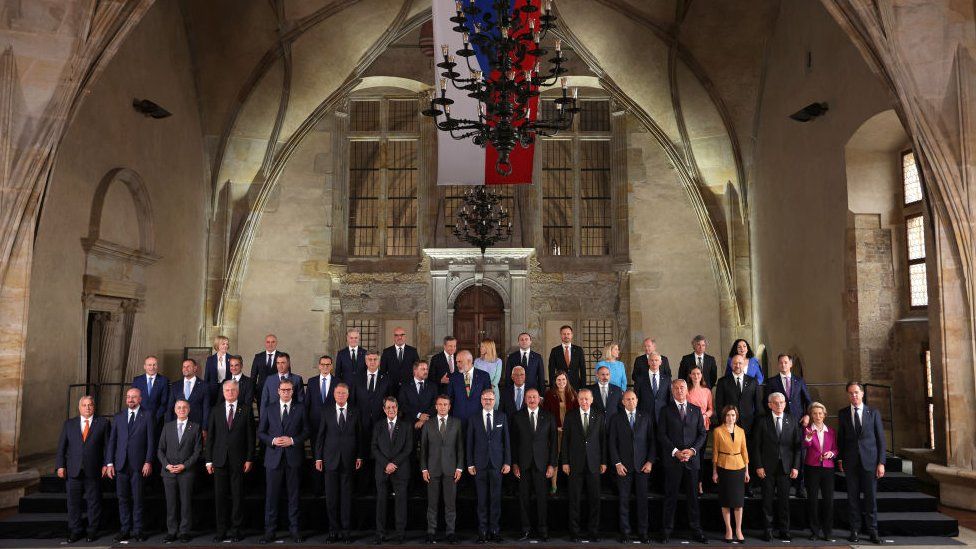
Leaders from the EU, the UK, Turkey, Norway, and the Balkans met at the first European Political Community in Prague on Thursday.
They discussed energy, migration, and security, with a particular focus on the war in Ukraine. Ukrainian President Volodymyr Zelensky spoke via video link.
The summit billed as a European Political Community beyond the EU has been championed by Mr Macron, who told reporters on Thursday it sent a “message of unity”.
IMAGE SOURCE, SEAN GALLUP/GETTY IMAGES Image caption, Among the European leaders taking part were Liz Truss (top left) and Turkey’s Recep Tayyip Erdogan (bottom row, 7th from the right)
The prime minister and Mr Macron released a joint statement promising an “ambitious” package of measures aimed at “ending” small boat crossings on the Channel.
Mr Macron said: “We have values and history so I’m happy that we meet again.
“This is an island, but this island didn’t move from the rest of the continent so we do have so many things in common.”
Ukraine’s president told the summit: “You and I are now in a strong position to direct all the possible might of Europe to end the war and guarantee long-term peace for Ukraine, for Europe, for the world.”
Following the meetings, Ms Truss said: “Leaders leave this summit with a greater collective resolve to stand up to Russian aggression.
“What we have seen in Prague is a forceful show of solidarity with Ukraine, and for the principles of freedom and democracy.”
As well as the UK, non-EU members Switzerland, Turkey, Norway, Iceland, Georgia, Azerbaijan, and western Balkan countries took part in the first gathering of the EPC.
Britain is now expected to host the fourth EPC meeting in 2024, with Moldova and Spain to hold the second and third respectively.
When he proposed the plan this year, Mr Macron said it would “offer a platform for political co-ordination” for countries, both those in the EU and those not.
Russia’s invasion of Ukraine gave new impetus for cooperation among nations beyond the EU’s 27 member states.
But the EPC has no institutions or dedicated staff. That has led to questions about how any decisions would be implemented.
If it proves to be a success, it may continue to take place up to twice a year. If it’s a failure, it could fizzle out.
Centre for European Reform Director, Charles Grant said one of the measures of success will be “does it persuade Serbia, Azerbaijan, and Turkey to lean a bit more to the West and less towards Russia”.
In its latest economic update, Deutsche Bank said: “Since our last growth update, the UK economic outlook has weakened further.
“We now see the UK in a recessionary orbit with growth likely to remain subdued for much of the next year or so, with GDP slowing from 4.5% this year (previously: 3.5%) to -0.5% next year (previously: 0%), and rising by 1% in 2024 (previously: 1%).
“We now expect GDP to return to its pre-pandemic level only in 2024, with growth recovering to its trend rate (1.25%) around the middle of the decade.”
Pensions faced being wound up due to the turmoil in the markets following the mini-budget, the deputy governor of the Bank of England has said.
Sir Jon Cunliffe was writing in response to a letter from the chair of the Treasury Select Committee, Mel Stride.
In it, Sir John noted that the “first concerns” about the state of the economy came after the “growth plan” announced by Chancellor Kwasi Kwarteng on 23 September.
Sir John added that the following week, the Bank got news of “increasing severity” from the markets – including some types of pension funds that lend the government money and get paid back over decades.
On Tuesday night, the Bank was told by managers that somepension funds risked falling into “negative net asset values” – and may begin “the process of winding up” on Wednesday 28 September.
This would have had a knock-on effect and threatened “severe disruption of core funding markets and consequent widespread financial instability”, the deputy governor said.
Bank of England employees worked overnight to come up with a plan to buy some government debt to stabilise the market.
So far, £3.7bn worth of debt has been purchased by the Bank.
The government has urged nurses to “carefully consider” the impact on patients.
The RCN has been calling for a rise of 5% above the RPI inflation rate of 12%, but no UK nation has offered close to that.
In England and Wales, NHS staff, including nurses, are being given an average of 4.75% more, with extra for the lowest paid, while in Scotland, 5% has been given. In Northern Ireland, nurses are yet to receive a pay award.
The RCN said it had commissioned research showing average pay had fallen by 6% between 2011 and 2021 – once inflation had been taken into account – compared with the 4.6% average for the whole economy.
General secretary Pat Cullen told the BBC: “We’re not asking for the salaries of bankers or billionaires that seems to be the focus of this government.
“We’re just asking for a decent wage for our nursing staff so they can continue to do the brilliant job they do every day for their patients, and so that we can absolutely retain the staff that we’ve got.”
She added: “They need to give them a decent wage so they can look after their families, pay their bills.”
Speaking about how a strike would work, she added: “We will add no additional risk to the risk patients are facing every single day as a consequence of not having the right numbers and expertise of nursing staff looking after them.”
Starting salaries for nurses in England are currently just above £27,000, rising to nearly £55,000 for the most senior nurses.
The RCN said the average pay for a full-time established nurse was just above £32,000 last year – similar to average pay across the economy.
The union is inviting members of the public to co-sign a letter to Prime Minister Liz Truss, backing its stance.
IMAGE SOURCE,GETTY IMAGES Image caption, The Department of Health and Social Care in England said it valued “the hard work of NHS nurses”
The 380,000 members of Unison, including about 50,000 nurses, are also being balloted.
These ballot papers have been sent out in Scotland, with the rest of the UK following suit in the coming weeks.
Midwives in Scotland have also been balloted on strike action by the Royal College of Midwives, while the British Medical Association has said it will ballot junior doctors over industrial action.
A spokeswoman for the Department of Health and Social Care in England pointed out the independent NHS Pay Review Body had recommended its pay award.
And it followed a 3% pay rise last year, in recognition of work during the pandemic, despite a public-sector pay freeze.
“We value the hard work of NHS nurses and are working hard to support them. Industrial action is a matter for unions and we urge them to carefully consider the potential impacts on patients,” she added.
Scottish Health Secretary Humza Yousaf said: “Any ballot for industrial action is disappointing. We are engaged with health unions and I hope we can come to an agreement on pay in the near future.”
In 2019, RCN members went on strike in Northern Ireland over pay, while nurses who are members of Unison in England walked out in 2014 over pay.
During any strike action, some nurses would continue to work to ensure emergency and urgent services continue.
Liz Truss says, one of the reasons we are facing this global crisis is because, collectively the West failed to do enough.
“We became complacent. We did not spend enough on defence. We became too dependent on authoritarian regimes for cheap goods and energy,” she tells the crowd in Birmingham.
She goes on to say the country “did not stand up to Russia early enough” but “we will ensure this never happens again.”
“So we are taking decisive action to reinforce our energy security,” Ms Truss says.
“We are opening more gas fields in the North Sea and delivering more renewables and nuclear energy.
“That is how we will protect the great British environment, deliver on our commitment to net zero, and tackle climate change.
“We are also taking decisive action to strengthen our borders by beefing up our Border Force and expanding the Rwanda scheme.
Ms Truss also says Vladimir Putin’s “illegal annexation of Ukrainian territory is the latest act in his campaign to subvert democracy and violate international law”.
“We should not give in to those who want a deal which trades away Ukrainian land,” she adds.
Liz Truss refers to the European war, COVID’s aftermath, and the current global economic crisis when she describes the task as being of “immense proportions.”
She says more government intervention makes people feel smaller and means you “feel it’s less worthwhile working the extra hour, going for a better job”.
She says stamp duty is being cut, the National Insurance rise is being reversed next month, corporation tax cut, and the basic rate of income tax brought down.
She mentions her U-turn on cutting the 45p rate of income tax and says it was a distraction.
“That is why we are no longer proceeding with it,” Ms Truss admits.
“I get it and I have listened.”
The PM gets a chuckle as she says she was in shock when she opened her first paycheck to see how much money the taxman had taken out.
“That is why we must always be careful with taxpayer’s money,” she says.
“And it is why this government will always be fiscally responsible.”
The first verse of the song might raise eyebrows given the past week:
You’ve done me wrong, your time is up
You took a sip from the devil’s cup
You broke my heart, there’s no way back
Move right out of here, baby, go on pack your bags.
And the chorus could be seen as a hint to Tory MPs who have spoken out against the PM:
‘Cause I’m movin’ on up, you’re movin’ on out
Movin’ on up, nothin’ can stop me
Movin’ on up, you’re movin’ on out
Time to break free, nothin’ can stop me.
The 45p tax rate was introduced in Chancellor Kwasi Kwarteng’s tax-cutting mini-budget last month and overturned last week. On Tuesday, Home Secretary Suella Braverman accused Tory MPs of launching a “coup” against the PM.
Foreign Secretary James Cleverly has urged his ministerial colleagues to keep their views on government policy “around the cabinet table” as Liz Truss faces an open split within her top team over the 45p tax rate U-turn.
The senior cabinet member warned his peers that it is “always better to feed straight into the boss” if there are any issues regarding “policy or the relationship with other ministers”.
On Tuesday, Home Secretary Suella Braverman accused Tory MPs of staging a “coup” against the PM over the 45p tax rate – a policy which was unveiled in Chancellor Kwasi Kwarteng’s tax-cutting mini-budget last month and reversed last week.
“She chose the words that she chose,” the foreign secretary told Sky News, responding to Ms Braverman’s comments.
“But when you’re in government, you have the opportunity to feed your ideas straight to the top machine. It’s always best done around the cabinet table or in the cabinet committee meetings.
“My view is anything to do with policy or the relationship with other ministers – always better to feed straight into the boss”.
The Levelling Up, Housing and Communities secretary posted on social media: “Suella speaks a lot of good sense, as usual.”
The tax cut for the wealthiest 1% was one of a raft announced by Mr Kwarteng in his mini-budget less than two weeks ago that led to market turmoil – with the pound plummeting, the Bank of England having to step in to rescue pension funds, and mortgage products being withdrawn.
Despite standing by the policy in the opening days of the conference, Mr Kwarteng confirmed on Monday it would no longer go ahead, saying the measure had become a “distraction” from his objective to grow the economy.
Yesterday, Ms Truss told Sky News’ political editor, Beth Rigby, she had “absolutely no shame” in performing the dramatic U-turn.
Mr Cleverly told Kay Burley that “a lot of discussions weren’t able to be had” over the chancellor’s mini-budget proposals because of the death of the Queen.
The foreign secretary also disputed that a U-turn took place, adding: “What you’re describing as a U-turn is the smallest element of a really big and significant support package to families, a tax cut to families, the stimulus package for the British economy.”
Ms Truss is also facing the threat of another major split within her top team over the level of benefits.
On Tuesday, Leader of the House of Commons Penny Mordaunt joined backbench rebels in calling for welfare payments to be raised in line with inflation, which has been at around 10%, rather than earnings at 5%.
Two additional cabinet ministers have also told Sky News that they believe benefits should be uprated in line with inflation.
Sky News understands that Chairman of the 1922 Committee of backbench Conservative MPs Sir Graham Brady has warned Ms Truss any attempt to uprate benefits by average earnings rather than by inflation is unlikely to get through Parliament.
At around 11 am, Ms Truss is due to deliver her keynote speech at the Conservative Party’s conference in Birmingham as she battles to save her premiership just one month into the job.
The PM will wrap up the event by defending her approach and pledging a “new Britain for the new era” after a week of U-turns and infighting.
PM: I am ‘not ashamed’ for listening
The prime minister will tell her audience: “Whenever there is change, there is disruption. Not everyone will be in favour.
“We need to grow the pie so that everyone gets a bigger slice.”
She is expected to say: “I am determined to take a new approach and break us out of this high-tax, low-growth cycle.”
Ms Truss will also put her government forward as having an “iron grip” on the UK’s finances that will help everyone.
The hall in Birmingham is not expected to be full as many MPs said they were leaving on Tuesday evening ahead of train strikes on Wednesday.
Margaret Thatcher would never have tried to cut benefits amid the cost of living crisis, Conservative former minister David Davis has said.
Speaking to BBC Radio 4’s Today programme today, he said while the Tory leader modelled herself on Ms Thatcher, she should “actually model herself really on Thatcher”.
“Thatcher was strategically terribly bold, but actually tactically incredibly careful. And (Liz Truss) should do the same,” he said.
“All this stuff about, let’s say one of the controversies, cutting benefits. Well, that’s not a real option. Margaret Thatcher would never have tried that, and under these circumstances with the winter coming up that we have.”
Asked what he would say to those in his party who want to change leader, Mr Davis said: “Well, firstly, you haven’t got time for that.
Addressing Ms Truss’s start as prime minister, he added: “It would be a very, very unwise person who tried to make a judgment over two years on what’s happened in four weeks.”
Giving his keynote Conservative Party conference speech following the 45p tax rate cut U-turn earlier this morning, Kwasi Kwarteng began by saying: “What a day.
“It has been tough, but we need to get on with the job in hand.”
The chancellor continues: “No more distractions, we have a plan and we have to get on and deliver it.”
But the chancellor acknowledges that his tax-cutting mini-budget caused economic turmoil, saying: “I know the plan we put forward 10 days ago caused a little turbulence. I get it.”
Liz Truss and her ministersarrived as anticipated in a combative, flinty tone, ready to stick with their mini-maxi budget.
In her no-surrender speech on the 45p top tax rate, the prime minister paid homage to Thatcher by blaming international forces for domestic interest rate increases that are driving up mortgage and business costs for millions of people.
Conservative party chairman Jake Berry went further, suggesting markets can overreact.
The only contrition so far has been an acknowledgment that the communications around the growth plan weren’t up to scratch.
So far so expected.
But a number of unexpected things have already happened today.
First is the public scale of the opposition the PM is already experiencing.
Mel Stride, chair of the Treasury Select Committee, wants to bring forward the Office for Budget Responsibility forecasts.
Others are planning to speak publicly.
Secondly is the huge disquiet from dozens of Tories not in Birmingham who are contemplating how to stop – in their view – Ms Truss wrecking the reputation for financial probity of the Conservative Party.
One Tory MP even suggested they would contemplate voting to force a general election soon, arguing it could be in the national interest, even if that meant expulsion from the party and being ostracised by everyone who they have worked with in the last decade.
Thirdly, confusingly, Liz Truss has knocked down her relationship with her Chancellor Kwasi Kwarteng.
She appeared to blame him for the 45p tax row, saying it was his decision, as she admitted it wasn’t put to the cabinet.
This prompted even Truss loyalist Nadine Dorries to raise an eyebrow, saying “there is a balance, and throwing your chancellor under a bus on the first day of the conference really isn’t it. Fingers crossed things to improve and settle down from now.”
Last week, Sky News outlined how Ms Truss needed convincing by Mr Kwarteng to acknowledge the Bank of England’s concerns.
This creates a toxic impression the two are not getting along. This isn’t a straightforward start to Ms Truss’s first conference.
After the mini-budget, Prime Minister Liz Trussacknowledged there had been “disruption” in the UK economy.
She declared in a letter to The Sun that she had “acted forcefully” and would maintain a “iron grip” on the country’s finances.
The government unveiled £45bn of tax cuts funded by borrowing last week – but did not accompany it with the usual economic assessment of the plans.
That worried investors causing the pound to slump and forcing the Bank of England to step in to reassure markets.
Ms Truss has resisted calls to reverse the cuts or to bring forward the publication of the independent fiscal watchdog’s economic forecasts and analysis of her tax plans.
The prime minister said she was “committed” to publishing the Office for Budget Responsibility (OBR) forecast on 23 November, the same day the chancellor is due to set out further economic plans, after she met the OBR on Friday.
But some Conservative MPs want to see this sooner to reassure the financial markets after turbulent trading.
The Treasury argues it should wait until additional changes are announced.
Ms Truss wrote in the Sun: “I am going to do things differently. It involves difficult decisions and does involve a disruption in the short term.”
She reiterated her commitment to “get the economy growing”, with plans to stimulate growth expected to include measures in eight areas – business regulation, agriculture, housing and planning, immigration, mobile and broadband, financial services, childcare, and energy.
And she insisted she would maintain an “iron grip on the national finances”.
Her chancellor, Kwasi Kwarteng, writing in the Telegraph newspaper, insisted that November’s statement would include a “credible plan” to get the public finances back on track, with a “commitment to spending discipline”.
“The British taxpayer expects their government to work as efficiently and effectively as possible, and we will deliver on that expectation,” Mr Kwarteng said.
But senior minister Simon Clarke told the Times newspaper the government needed to explain more about how it would control spending, as well as boost economic growth.
“We have acquired spending habits that outstrip our ability to pay for it. That needs to change,” he said.
He suggested the government was looking to make significant cuts and “trim the fat” when it comes to public spending.
“I think it is important that we look at a state which is extremely large, and look at how we can make sure that it is in full alignment with a lower tax economy.”
Ms Truss confirmed on Thursday that she was looking for cuts across the government as a way to pay for the mini-budget measures.
Waveney MP Peter Aldous said the timing of last Friday’s plan had been “hopelessly wrong”, and the rest of the details should be brought forward to October.
Liberal Democrat leader Sir Ed Davey argued that the government, by waiting until 23 November, was allowing the UK economy to “fly blind” for two months.
“Families and businesses can’t afford to wait any longer for this government to fix their botched, unfair budget,” he said.
IMAGE SOURCE,PA MEDIA Image caption, Leading members of the Office of Budget Responsibility arriving at 10 Downing Street for a rare meeting with the prime minister
What is the Office for Budget Responsibility?
The Office for Budget Responsibility is the independent watchdog for the government’s finances.
It usually produces economic forecasts twice a year, to accompany each autumn budget and spring statement.
It scrutinises government plans, to increase taxes or borrowing for example, and predicts what the likely impact on the overall economy will be.
These forecasts are so important because a strong one gives investors confidence to put money into the UK economy – whereas a weak one is likely to have the opposite effect.
The government can request forecasts from the OBR at any time to get independent advice on big moves.
But it did not take the OBR up on its offer ahead of last week’s mini-budget. This is thought to have undermined confidence in the markets.
This led to the pound dropping to its lowest rate against the dollar in 37 years on Monday, before returning to its previous level.
The government’s tax-cutting plan faced criticism from the International Monetary Fund, and the pound dropped to a 37-year low of $1.03 on Monday.
On Friday, the sterling rose to $1.12 – close to the level the currency was at before the mini-budget was announced.
Despite that, the rating agency Standard & Poor’s cut the outlook for its AA credit rating for British government debt from “stable” to “negative” on Friday, because of the prospect of higher borrowing needed to fund the pledges.
In recent days, the Conservatives have posted some of their worst opinion poll ratings in more than 20 years.
A poll published on Thursday by Survation put the party on 28%, more than 21 points behind Labour, while a separate survey by YouGov put the Tories on 21%, 33 points adrift.
Labour’s shadow business secretary Jonathan Reynolds said ministers should “get back to Parliament, revoke the changes, and start again to try and rebuild confidence”.
And Conservative MP Martin Vickers urged the prime minister not to scrap the 45p tax rate and the bankers’ bonus cap, describing the move as “a political own goal”.
However, another Tory backbencher, Andrea Leadsom, said the mini-budget was “unashamedly pro-growth”, and that the markets were “wrong to be jittery” about the changes.
Donetsk, Luhansk, Kherson, and Zaporizhzhia would never be accepted by the UK, according to Prime Minister Liz Truss.
In advance of President Vladimir Putin’s anticipated decision to recognise the territories once occupied by Ukraine as Russian following widely condemned referendums, she released a statement on Friday morning.
She said: “Vladimir Putin has, once again, acted in violation of international law with clear disregard for the lives of the Ukrainian people he claims to represent.
“The UK will never ignore the sovereign will of those people and we will never accept the regions of Donetsk, Luhansk, Kherson, and Zaporizhzhia as anything other than Ukrainian territory.
“Putin cannot be allowed to alter international bordersusing brute force. We will ensure he loses this illegal war.”
The prime minister’s initial instinct had been to stand firm and say little or nothing while faced with market turmoil, spiking borrowing costs, and the drop in the value of the pound in foreign exchange markets.
However, after a meeting with Chancellor Kwasi Kwarteng yesterday, Ms Truss agreed the Treasury would issue a statement promising further details on 23 November on how the government would ensure borrowing would not spiral out of control.
In effect, this gives the government eight weeks to come up with a plan to stabilise the markets – likely to involve spending cuts in Whitehall, public services, investment, and probably welfare.
The government will reject claims circulating in Whitehall that the meeting between Ms Truss and Mr Kwarteng was “argumentative” and descended into a “shouting match”.
This comes as the chancellor plans to hold further emergency meetings with global bankers this week to discourage them from speculating on the pound.
There is deep concern in the City that Treasury ministers are still gunning for Andrew Bailey, the governor of the Bank of England, and his two most senior lieutenants, with some believing that removing this team from office would dent Britain’s global reputation for stability.
Sky News can confirm that Monday’s meeting between the chancellor and prime minister concentrated on whether to issue a statement and what to say, with the two sides initially taking different positions.
One source said that the chancellor was more sympathetic to the Bank’s concernsthan the PM.
The prime minister’s team was aware that the Bank of England was going to issue a statement after the close of markets on Monday.
In the end, the Treasury issued an almost simultaneous statement promising to release economic forecasts by the Office for Budget Responsibility and a plan on debt on 23 November.
Most of the UK’s energy suppliers must improve how they help people who are struggling to pay their bills, watchdog Ofgem has said.
Its review found failures in firms being able to identify which customers were having payment difficulties and a lack of help with payment plans.
The government has stepped in to cap a typical household energy bill at £2,500 a year until 2024 but this is still unaffordable for many customers.
This bill rise comes in on 1 October.
Campaigners have warned millions of people will still face fuel poverty this winter, despite Prime Minister Liz Truss‘ multi-billion pound plan to ease the impact of higher gas and electricity bills.
A household is considered to be in fuel poverty if it has to spend 10% or more of its income on energy.
If you are struggling to afford your gas and electricity bills, Citizens Advice recommends contacting your supplier directly and offering to come up with a payment plan.
Energy suppliers must offer payment plans that customers can afford, under Ofgem rules. In addition, those on pre-payment meters who do not have the money to top them up can ask for emergency credit.
Citizens Advice said that by the end of August its frontline staff had supported more than 15,000 people who were unable to top up their prepayment meter.
The charity’s chief executive, Dame Clare Moriarty, said Ofgem’s review showed some energy companies were “falling drastically short of the mark”.
“This is utterly unacceptable given the huge cost-of-living pressures people are facing,” she said. “Suppliers need to up their game and Ofgem needs to hold them to task.”
Ofgem chief executive Jonathan Brearley said its review found some suppliers had fallen short of the standards expected by the watchdog and urged them to “step up”.
“Although the government’s package of support will provide some welcome relief, it’s critical that, going into this tough winter, energy companies prioritise the needs of vulnerable customers struggling to pay their bills,” he said.
Ofgem’s findings on how companies support struggling customers
Severe weaknesses
TruEnergy
Utilita
ScottishPower
Moderate weaknesses
E
Good
Green Energy
Outfox
Bulb
Minor issues
Ecotricity
EDF
E.ON
Octopus
OVO
Shell
Utility Warehouse
So Energy
No significant issues
British Gas
All the energy companies identified have been asked to submit information to Ofgem to set out how they will improve their service.
Ofgem said it had already issued provisional orders to Utilita and ScottishPower, meaning they must take specific and urgent actions.
A ScottishPower spokesperson said: “We’re disappointed that all of the effort our staff make to help our customers manage affordability challenges has resulted in this conclusion from Ofgem.
“We will now work with Ofgem to implement their recommendations.”
A Utilita spokesperson said the company was “very disappointed” about Ofgem’s “decision to issue a provisional order rather than to engage with us”.
“Our staff are deeply committed to helping customers through the cost-of-living crisis and the financial support we offer is extensive: In 2022 alone, we will provide financial assistance more than a million times to customers who need our help,” it added.