Tag: Prime Minister Liz Truss

  • After the decline of the pound, the bank will “not hesitate” to boost interest rates

    The pound hit a record low versus the US dollar, prompting the Bank of England to declare that it will “not hesitate” to raise interest rates in order to combat inflation.

    The Bank stated that it was “closely monitoring developments” and will decide on any course of action in November.

    Its statement came after the Treasury said it would publish a plan to tackle debt in a bid to reassure investors.

    In Asia currency market trade on Tuesday, the pound rose by more than 1% to top $1.08.

    On Monday, some UK lenders said that they were halting new mortgage deals.

    Halifax, the UK’s largest mortgage lender, said it would temporarily withdraw all mortgage products that come with a fee due to the market volatility.

    Virgin Money and Skipton Building Society have also stopped offering mortgage products to new customers.

    Experts said a rise in the cost of long-term borrowing due to the market turmoil meant the cost to lenders of offering new mortgage deals was too expensive.

    Sterling fell to an all-time low earlier against the US dollar after Chancellor Kwasi Kwarteng pledged further tax cuts at the weekend on top of Friday’s mini-budget where he announced the biggest tax cuts in 50 years.

    The pound had been sliding as global markets reacted to the sharp increase in government borrowing required to fund the cuts.

    A weak pound makes it more expensive to buy imported goods and risks pushing up the rising cost of living even further. Imports of commodities priced in dollars, including oil and gas, are also more expensive.

    UK inflation, the rate at which prices rise, is already rising at its fastest rate for 40 years.

    Some economists had predicted the Bank of England would call an emergency meeting in the coming days to raise interest rates in a bid to stem the fall, as well as calm rising prices.

    But the Bank of England instead said it was “monitoring developments in financial markets very closely” and would make a full assessment at its next meeting on 3 November.

    Investors are now predicting that interest rates could more than double by next spring to 5.8% from their current 2.25%, to curb high inflation, which is expected to be fuelled by the huge tax cuts announced in Friday’s mini-budget.

    ‘Not affordable’

    Samuel Tombs, chief UK economist at Pantheon Macroeconomics, said if interest rates rise as predicted, the average household refinancing a two-year fixed rate mortgage in the first half of next year would see monthly payments jump to £1,490 from £863.

    “Many simply won’t be able to afford this,” he said.

    A late afternoon double dose of attempted reassurance – firstly from the Treasury, and then from the Bank of England.

    What’s new from the Treasury is a timeline with dates attached. There will be a series of statements from various cabinet ministers about ideas we heard about on Friday.

    And then in just under two months, a parliamentary moment. What’s being described as the “Medium Term Fiscal Plan” – and the Office for Budget Responsibility’s number crunching.

    In short, what the Treasury is attempting to say is this: don’t panic, we know what we’re doing.

    Well, let’s see what the markets do next.

    The market volatility following Mr Kwarteng’s mini-budget has also been linked in part to the government’s decision not to publish a forecast of expected UK growth and government borrowing from independent forecaster the Office for Budget Responsibility.

    Martin Weale, Professor of Economics at King’s College London and former member of the Bank of England’s Monetary Policy Committee, which votes on interest rates, told BBC Radio 4’s PM programme that people “are concerned that the government has no plan for bringing the national debt under control.”

    “Sterling has fallen because market traders have been frightened by the government’s policies, and I think they got further frightened by the sense over the weekend that this was only the first installment of some tax cuts.”

    But Lord David Frost, Conservative peer and former chief Brexit negotiator, said the reaction on global markets was “an overreaction”.

    “I don’t think anything has gone wrong, actually, Liz Truss promised change, a different economic approach to get us back to growth and away from stagnation.”

    He said as part of this change in approach, interest rates would rise and the government would need to provide additional support via tax cuts, and whilst it would need to reduce spending medium term, the details of that would come in November.

    The government said its financial plan set for 23 November would include full growth and borrowing forecasts from the Office for Budget Responsibility.

    It also pledged to set out further details on the government’s spending rules, including how it will try to decrease debt.

    Paul Dales, the chief UK economist at Capital Economics, said given the pound had fallen back since the statements from the Bank and the Treasury the markets “may well need more reassurance and some actual action”, saying a change in policy from the government or an interest rate hike from the Bank at an emergency meeting before 3 November may be necessary.
  • Palestinians: Tempers high over probable UK Jerusalem embassy move

    The UK’s plan to relocate its embassy from Tel Aviv to Jerusalem has been labeled as a “blatant violation of international law” by the Palestinians.

    While at the UN, UK PM Liz Truss reportedly informed her Israeli colleague, Yair Lapid, of the review.

    Such a move would be highly controversial. The opening of the US embassy in Jerusalem in 2018 was met with outrage across the Arab world.

    Mr Lapid tweeted his thanks to Ms Truss for “positively considering” it.

    He described Ms Truss as his “good friend”, writing in Hebrew after the pair met on the fringes of the UN General Assembly in New York.

    Downing Street has not given any indication of timing but has confirmed that a review is underway.

    British officials said they would not speculate on the outcome, adding that Ms Truss was aware of the sensitivity and importance of the location of the British embassy in Israel.

    The status of Jerusalem is one of the thorniest issues in the decades-old Israel-Palestinian conflict.

    Israel sees the entire city as its eternal, undivided capital while Palestinians claim the eastern part as the capital of their hoped-for future state.

    East Jerusalem, along with the West Bank and Gaza Strip, were captured by Israel from Jordan and Egypt in the 1967 Middle East war and have since been viewed internationally as occupied Palestinian territory.

    On Twitter, the Palestinian ambassador to the UK, Husam Zomlot, wrote that it was “extremely unfortunate” that Ms Truss had used her first appearance at the UN as prime minister to “commit to potentially breaking international law”.

    He said any embassy move would be “a blatant violation” of “the UK’s historic responsibilities”, undermining the two-state solution of an independent Palestinian state alongside Israel to the Israel-Palestinian conflict.

    “Such promise is immoral, illegal and irresponsible!” he said.

    Up until now, the UK – like most other countries – has kept its embassy in Tel Aviv, rather than in bitterly contested Jerusalem, holding that it should only move to the holy city after a final peace deal between Israel and the Palestinians.

    Britain has a consulate in East Jerusalem.

    Ms Truss reportedly raised the idea of relocating the embassy during the recent Conservative leadership campaign.

    When US President Donald Trump recognised Jerusalem as Israel’s capital – fulfilling a campaign promise – it brought international condemnation. It also led to a flare-up in violence in which dozens of Palestinians were killed by Israeli forces.

    At the time, the British PM, Theresa May, criticised the US action.

    The only countries to have since followed Mr Trump’s example by moving their embassies from Tel Aviv to Jerusalem have been Honduras, Guatemala and Kosovo.

    While US President Joe Biden has renewed Washington’s commitment to a two-state solution, he has not gone back on the recognition of Jerusalem as Israel’s capital.

  • UK: Income tax to decrease by 1 penny from April

    From April of next year, the majority of taxpayers will pay one penny less in income tax per pound.

    New chancellor Kwasi Kwarteng said the cut in the basic rate of income tax from 20% to 19% would benefit more than 31 million people.

    The cut, which applies to people who earn between £12,571 to £50,270, comes a year earlier than planned.

    In a surprise move, the 45% highest tax band for people who earn over £150,000 a year has also been axed.

    The reduction in income tax, along with the reversal of the National Insurance rise, will see higher earners save more money.

    A person earning £20,000 a year will save £167, according to analysts at EY.

    Meanwhile, an individual with an income of £40,000 will save £617 and a person with earnings of £60,000 will save £969. A person on £100,000 will get an extra £1,469.

    During his mini-budget, the chancellor said high tax rates “damage Britain’s competitiveness” and reduce incentives for new businesses, arguing that tax cuts are “central to solving the riddle of growth”.

    Mr. Kwarteng said scrapping the highest 45% tax rate would also “reward enterprise and growth”.

    The policy change means people earning more than £150,000 a year will instead pay the tax rate of 40%, which is applicable to earnings of more than £50,270 a year.

    However, the change will not apply to Scotland where income tax bands are different. People in Scotland who earn more than £150,000 a year currently pay a 46% rate. The cut in basic rate tax to 19p in the pound also does not apply in Scotland.

    Rachel McEleney, associate tax director at consultancy firm Deloitte, said under the new policy, higher rate taxpayers would save £377 next year, compared to this year.

    She said the majority of taxpayers in England, Wales, and Northern Ireland, who will pay the basic rate of 19%, will see “some savings, albeit less” from April.

    Ms McEleney said for a person will earnings of £200,000 a year, who do not live in Scotland, their income tax bill would be reduced from £74,960 this financial year to £72,083 in next year, resulting in a tax saving of £2,877.

    Labour shadow chancellor Rachel Reeves said the mini-budget prioritized big business over working people by relying on a theory of “trickle-down economics”.

    “The prime minister and chancellor are like two desperate gamblers in a casino chasing a losing run,” she said in response to Mr Kwarteng’s plans.

    Households across the UK have been feeling the pinch of higher prices in recent months, with higher energy bills and rising food prices fuelling inflation to a 40-year high.

    The government has announced support to help with energy costs, limiting the typical household bill to £2,500 a year until 2024, but bills are still set to rise in October.

    Rebecca McDonald, the chief economist at the Joseph Rowntree Foundation charity, said the government had chosen to “turn its back on millions who are on the lowest incomes”.

    “This is a budget that has wilfully ignored families struggling through a cost of living emergency and instead targeted its action at the richest,” she said.

    “Families on low incomes can’t wait for the promised benefits of economic growth to trickle down into their pockets.”

    However, Mark Littlewood, director general at free-market think tank the Institute of Economic Affairs, said the axing of the highest rate of income tax would mean higher earners would spend “more time boosting their own productivity”

    “The additional rate of income tax (45p) was always performative politics rather than sound economics,” he said. “The 1p off the basic rate of income tax will put more money in people’s pockets.”

    The abolition of the highest tax band, which was introduced in 2010, came as a surprise to many economists.

    “It really is that kind of rabbit out of the hat..that not only is the additional rate going to be completely abolished, but also the cuts to the basic rate of income tax are going to be brought forward a year,” said Michael Brown, head of market intelligence at finance firm Caxton.

  • Tax cuts are welcomed by most Tory MPs, but not all of them

    Some members of the Conservative Party appear to have embraced Kwasi Kwarteng’s tax-cutting proposals.

    Beth Rigby, the political editor for Sky, has spoken with some of the chancellor’s colleagues.

    One said it was now “starting to look like a Conservative government”, while another said they were very supportive.

    A third said there was no future in the “steady as she goes” approach pursued under the previous chancellor Rishi Sunak, and that now is the right time to go for growth.

    However, it is notable that those who opposed the tax-cutting, high-spending plans outlined by Liz Truss in her bid to be Tory leader seem to be keeping their cards close to their chest.

    Criticisms have still been made about the lack of an official OBR forecast.

    Sunak supporter and Treasury committee chair Mel Stride said there was a “vast void at the centre of the announcements”.

    Veteran Conservative Sir Roger Gale said: “Fortune favours the brave, but not the foolhardy.

    “Without the support of an OBR Kwasi Kwarteng’s not-so-mini budget is certainly brave but also looks very high risk indeed. I trust that the promised detailed figures will underpin his calculations.”

    The Treasury is understood to have based its analysis on the OBR forecast from March, with updated market prices.

    Mr Kwarteng said a full OBR forecast would be completed by the end of the year.

  • Chancellor Kwasi Kwarteng pledges to end ‘cycle of stagnation’ in mini-budget

    As he announced his mini-budget, Chancellor Kwasi Kwarteng promised to “turn the vicious cycle of stagnation into a virtuous cycle of growth.”

    He is proposing the largest tax cuts since 1988, which will be paid for by a significant increase in borrowing.

    It is being seen as a major change of direction for the government under new Prime Minister Liz Truss.

    It comes as the Bank of England warns the UK may already be in recession.

    In a departure from Boris Johnson’s economic policies, Mr Kwarteng has scrapped plans to push up taxes to pay for public services with the aim of kick-starting the UK’s sluggish economy.

    In a statement to the Commons, he said: “Growth is not as high as it needs to be, which has made it harder to pay for public services, requiring taxes to rise.

    “This cycle of stagnation has led to the tax burden being forecast to reach the highest levels since the late 1940s.

    “We are determined to break that cycle. We need a new approach for a new era focused on growth.”

    The government normally releases an independent forecast of how major tax changes will impact the economy, but Mr Kwarteng has opted not to do this, as his statement is not technically a Budget.

    However, Mr Kwarteng promised the Office for Budget Responsibility would publish a full economic forecast before the end of the year, with a second to follow in the new year.

    The Institute for Fiscal Studies thinks tank has published its own analysis, saying: “The government is choosing to ramp up borrowing just as it becomes more expensive to do so, in a gamble on growth that may not pay off.”

    The mini-budget fulfilled promises to reverse the rise in National Insurance payments introduced by Boris Johnson to pay for social care and tackle the NHS backlog.

    Mr Kwarteng confirmed a planned corporation tax increase from 19% to 25% would also be scrapped.

    The chancellor also announced an increase to the threshold people in England starts paying stamp duty on home purchases to £250,000.

    For first-time buyers, the threshold will rise to £425,000.

    There are likely to be changes in income tax.

    Mr Kwarteng confirmed the cap on bankers’ bonuses would be lifted and new investment zones would be established, where businesses would benefit from tax cuts and planning rules would be relaxed to encourage house building.

    The cost of cutting these taxes is estimated at about £30bn a year.

    The statement also included details of the cost of the government’s plan to cap energy bills for households and businesses.

    Mr Kwarteng said these estimated costs were “particularly uncertain, given volatile energy prices” but based on recent prices the total cost of the package for the six months from October was expected to be around £60bn.

    “We expect the cost to come down as we negotiate new, long-term energy contracts with suppliers,” he added.

  • National Insurance rise to be repealed from 6 November – Kwasi Kwarteng

    Chancellor Kwasi Kwarteng,has announced that the National Insurance increase from April will be repealed starting on November 6.

    The 1.25% increase was put in place by the former chancellor Rishi Sunak, but Liz Truss promised to reverse it during the Tory leadership race.

    He said: “Taxing our way to prosperity has never worked.

    “To raise living standards for all, we need to be unapologetic about growing our economy. Cutting tax is crucial to this.”

    The Treasury said most employees will receive a cut to their national insurance contribution directly via their employer’s payroll in their November pay, although some may be delayed to December or January.

    They calculate that almost 28 million people will keep an extra £330 of their money on average next year, whilst 920,000 businesses are set to save almost £10,000 on average next year thanks to the change

    In a tweet, Mr Kwarteng called it a “tax cut for workers”.

    The tax hike was put in place to help fix the NHS backlog and fund social care sector improvements. It was due to raise around £13bn per year.

    However, Ms Truss argued it was wrong of her party to break its 2019 manifesto commitment not to raise taxes and said the extra funds can be raised through general taxation.

    The chancellor confirmed today that the funding for health and social care services will be maintained at the same level as if the levy was in place.

    MPs are expected to vote on repealing the health and social care levy once they return from party conferences in October.

    Downing Street said the repeal Bill was part of the government’s commitment to “a low tax, high growth” economy.

    “This is delivering on a commitment the PM made on the (Tory leadership) campaign trail,” a No 10 spokeswoman said.

    The move comes ahead of Chancellor Kwarteng’s “fiscal event” on Friday when he will set out more details of the government’s plans to cut taxes, including scrapping a planned rise in corporation tax.


  • Government lifts ban on fracking for shale gas

    The government has reportedly violated a manifesto pledge not to allow the controversial method unless research demonstrated that it could be done “categorically” safely by lifting the ban on fracking for shale gas.

    Business and energy secretary Jacob Rees-Mogg said strengthening the UK’s energy security is “an absolute priority” in light of “Putin’s illegal invasion of Ukraine and weaponization of energy”.

  • Picture of first prisoner of war released

    The first picture of the 10 Russian prisoners of war has surfaced.

    Five British nationals are among them, with other prisoners from America, Sweden, Croatia, and Morocco.

    The Saudi foreign ministry said the plane carrying the prisoners has landed in the kingdom.

    Prime Minister Liz Truss said they were handed over following efforts by the Ukrainian president Volodymyr Zelenskyy and Saudi Arabian mediation.


  • Partial mobilization call: A ‘statement of weakness’ – Truss and Von der Leyen

    Prime Minister Liz Truss and President of the European Commission, Ursula Von der Leyen, have described Vladimir Putin’s call for partial mobilisation as a  “statement of weakness”.

    The pair released a joint statement after meeting at the UN General Assembly in New York.

    A Downing Street spokesperson said: “They strongly condemned Russia’s actions in Ukraine and agreed that Putin’s recent calls to mobilise parts of the population were a sign that Russia’s invasion is failing. It is a statement of weakness.”

    Earlier today, the Russian president announced a partial military mobilisation, with 300,000 reservists set to be called up as the Kremlin attempts to regain ground in the face of a counter-attack by Ukraine’s forces.

    The spokesperson added that Ms Truss and Ms Von der Leyen “underscored their joint commitment to sustaining support for Ukraine in its struggle as long as it takes”.

    The pair also discussed UK-EU relations including energy, food security, and the Northern Ireland Protocol.

  • King Charles vows to serve with ‘loyalty, respect and love’ in first address to nation

    Despite his grief, the King has already started carrying out royal duties, holding his first audience with and greeting well-wishers gathered outside Buckingham Palace earlier on Friday.

    King Charles vowed to serve the people of the United Kingdom with “loyalty, respect, and love” during his first televised address to the nation.

    Offering words of comfort following the death of his mother, Queen Elizabeth II, the King paid tribute to her “love, affection, guidance, understanding and example” in a speech from Buckingham Palace.

    “Queen Elizabeth was a life well lived; a promise with destiny kept and she is mourned most deeply in her passing. That promise of lifelong service I renew to you all today,” he said.

    “Throughout her life, Her Majesty The Queen – my beloved mother – was an inspiration and example to me and to all my family, and we owe her the most heartfelt debt any family can owe to their mother.”

    A memorial service for the Queen is being held at St Paul’s Cathedral, with 2,000 members of the public joining politicians, including the prime minister, to watch his address.

    Speaking from the Blue Drawing Room of the palace, where his mother recorded some of her Christmas messages, His Majesty dedicated part of his speech to other senior royals, including his wife and children.

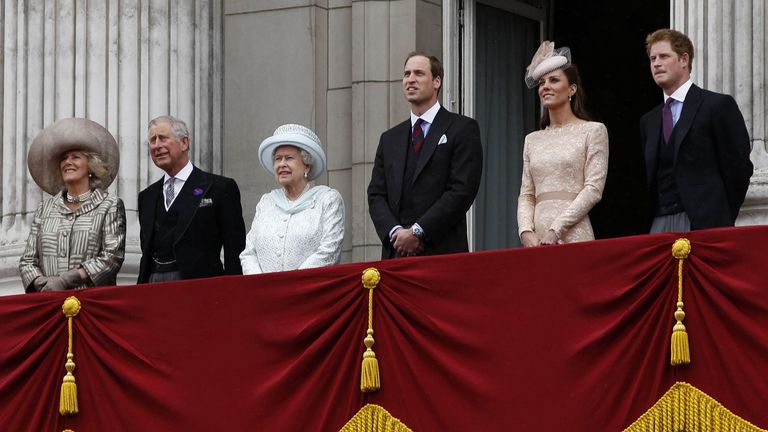
    (left - right) Camilla, Duchess of Cornwall, Prince Charles, Queen Elizabeth II, Prince William, Catherine, Duchess of Cambridge and Prince Harry stand on the balcony at Buckingham Palace during the Diamond Jubilee celebrations in central London.

    Of Camilla, now the Queen Consort, he said: “I know she will bring to the demands of her new role the steadfast devotion to duty on which I have come to rely so much.”

    Speaking about his eldest son Prince William, who is now the Duke of Cornwall, Prince of Wales, and heir to the throne, the King said he would “continue to inspire” alongside his wife, Catherine.

    He expressed his love for the Duke and Duchess of Sussex, Harry and Meghan “as they continue to build their lives overseas” – in what could be considered a symbol of his bid for reconciliation amid past troubles with the couple.

    As he begins his reign, the King also set out his changing role, saying it will “no longer be possible” for him to give as much “time and energies to the charities and issues” he cares “so deeply” about.

    ‘To my darling Mama…’

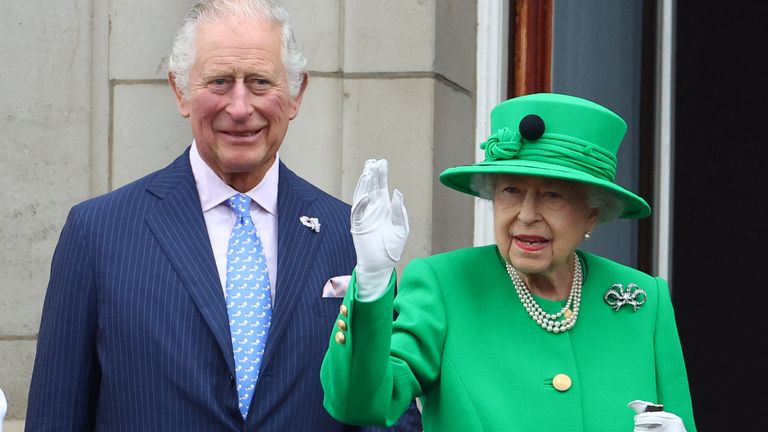
     Queen Elizabeth and Prince Charles stand on a balcony during the Platinum Jubilee Pageant, marking the end of the celebrations for the Platinum Jubilee of Britain's Queen Elizabeth, in London, Britain, June 5, 2022. REUTERS/Hannah McKay/Pool

    King Charles sat to deliver his address, with a posy of sweet peas mixed with rosemary placed on a desk in front of him, which represents remembrance.

    “On behalf of all my family, I can only offer the most sincere and heartfelt thanks for your condolences and support,” the King said.

    “They mean more to me than I can ever possibly express.

    “And to my darling Mama, as you begin your last great journey to join my dear late Papa, I want simply to say this: thank you.”

    He thanked the Queen for her “love and devotion” before concluding his address with a quote from the William Shakespeare play Hamlet.

    “May ‘flights of Angels sing thee to thy rest,” His Majesty said.

    Monarch already carrying out royal duties

    The address was broadcast after King Charles was seen meeting well-wishers waiting outside Buckingham Palace.

    He shook hands with dozens of people and was also hugged and kissed before walking through the palace gates with his wife by his side.

    Despite his grief, the monarch has already started carrying out royal duties, holding his first audience with Prime Minister Liz Truss earlier on Friday.

    He returned to London with the Queen Consort, after spending Thursday at Balmoral to be with the Queen before she died.

    Dressed in a black suit and tie, the grieving King left the royal residence seated in the back of a car, with his wife in the front passenger seat, as they were driven to Aberdeen airport.

    The monarch is due to be proclaimed at the Accession Council at 10 am on Saturday in the State Apartments of St James’s Palace, Buckingham Palace has said – with the process televised for the first time in history.

  • Queen’s memorial service: Liz Truss gives a reading

    Prime Minister Liz Truss now delivers a reading at the service at St Paul’s.

    Wearing the black dress she was pictured in earlier when she attended the audience with King Charles III at Buckingham Palace, she stands in front of the congregation to read from the Book of Romans.

    “We do not live to ourselves and we do not die to ourselves; if we live, we live to the Lord, and if we die, we die to the Lord.”

    “So then, whether we live or whether we die, we are the Lord’s,” she reads.

  • PM will explore energy market reform to cut bills

    The government plans to move nuclear and renewable electricity generators to lower price contracts to cut bills, Prime Minister Liz Truss has said.

    “Renewable and nuclear generators will move on to contracts for difference, to end the situation where electricity prices are set by the marginal price of gas,” Truss told Parliament.

    The price paid to these companies is often set by the most costly generator.

    Moving nuclear and renewable generators onto lower-priced contracts “will mean that generators are receiving a fair price reflecting their cost of production, further bringing down the cost of this intervention,” Truss said.

    The government will ask renewable and nuclear generators to take up new 10 or 15-year contracts at fixed prices well below the current rates, sources familiar with the discussions say.

    Liz Truss says she won’t introduce a windfall tax on energy companies, but she will need to address the issue of their huge profits.

    The energy market consultancy Cornwall Insight estimates energy prices are likely to be more than £40bn higher because of the fact that some electricity generators are being paid based on the hugely inflated gas price.

    That is a particularly pressing issue when the government is planning to spend tens of billions of pounds of taxpayers’ money subsidising the nation’s energy bills.

    Paying renewable energy companies less than the market price for gas would mean a very significant reduction in revenues for them, at least in the medium term.

    Yet RenewableUK, the industry body which represents most of the wind power companies in this group, has accepted this approach in principle.

    “We’re keen to work collaboratively with the government” on the issue, RenewableUK’s CEO Dan McGrail said.

    “It makes no sense to allow the exorbitantly expensive cost of gas to set the price for the whole of the electricity market”, he said.

    RenewableUK represents most of the biggest renewable businesses in the UK including Orsted, Scottish Power, SSE, RWE and EDF.

    It confirms its members have had a “series of discussions” with the government on the issue and says it is waiting for the government to “take a position”.

    So, why might they accept this huge potential hit to profits?

    RenewableUK says it is because the companies recognise it isn’t fair for consumers to face such high prices at a time of national crisis.

    Those close to the discussions say they are probably also being offered a generous long-term price to reflect the short-term loss of profits.

    Shadow climate change secretary Ed Miliband told BBC Radio 4’s Today programme on Thursday that such long-term fixed-price contracts would have the effect of ensuring huge profits for electricity companies for years to come.

    “This is a proposal from (energy industry trade association) Energy UK, and let’s be clear about this proposal: This would lock in massive windfall profits for these electricity generators.

    “Let me explain why: what Energy UK have said is we’ll accept slightly lower prices now, so we can have much higher prices over the following 15 years.

    “This would be a terrible deal for the British people, a terrible deal for billpayers.

    “It is much better – if there are these unexpected windfalls, and there are – the right thing to do, the fair thing to do, is not to do some dodgy deal with these companies, but to do a windfall tax.

    Liz Truss may be ideologically opposed to windfall taxes but paying private companies billions of pounds in excess profits from the public purse is also a political liability.

    The companies know that if a solution isn’t found she might deicide she has to hold her nose and impose such a tax, and that if she does, she might go after the billions of profits the companies have already made.

    Source: BBC