Newly sworn-in UK Prime Minister, Liz Truss, has made a major reshuffle hours after succeeding Boris Johnson.
Now at the helm of affairs are key allies of hers.
Kwasi Kwartenghas been made chancellor, James Cleverly becomes foreign secretary and Suella Braverman replaces Priti Patel as home secretary.
One of Ms Truss’s closest friends, Therese Coffey, is now the health secretary and deputy PM.
Her new cabinet will meet ahead of her first Prime Minister’s Questions later.
None of those who backed her defeated rival, Rishi Sunak, will remain in her full cabinet, with Dominic Raab, Grant Shapps, George Eustice and Steve Barclay all returning to the backbenches.
But Ms Truss’s press secretary said the changes would “unify” the Tory Party and pointed to senior roles for five of her leadership rivals: Suella Braverman, Tom Tugendhat as security minister, Kemi Badenoch as trade secretary, Penny Mordaunt as leader of the Commons, and Nadhim Zahawi as chancellor of the Duchy of Lancaster.
For the first time, none of the top four “great offices of state” – prime minister, chancellor, home secretary and foreign secretary – is held by a white man.
Meanwhile, the new PM made her first call to a fellow foreign leader, pledging the UK’s ongoing support to Ukraine in a call with President Volodymyr Zelensky.
No 10 said Ms Truss was also “delighted” to accept an invitation to visit Ukraine.
She later spoke to US President Joe Biden, where the pair discussed the importance of the UK reaching an agreement with the EU over post-Brexit trading rules in Northern Ireland.
UK-France relations are heading for “serious problems” if the nations cannot say whether they are friends or enemies, the French President has said.
Emmanuel Macron reacted to remarks made by Foreign Secretary Liz Truss, who said the jury was out on whether the French president was “friend or foe”.
Mr Macron insisted the UK remained an ally, despite the occasional error made by its leaders.
And Prime Minister Boris Johnson said Mr Macron was a “good buddy” of the UK.
Senior politicians have accused Ms Truss, who is favourite to succeed Mr Johnson as prime minister next month, of damaging the UK’s relationship with France, a close ally.
Ms Truss – the UK’s top diplomat – was asked about French relations during a Conservative Party event, where she and her leadership rival, Rishi Sunak, took questions from party members.
She said “the jury was out” on whether Mr Macron was a friend or foe, and she would judge him on “deeds not words”, prompting cheers and applause from the audience.
Her comments came at the end of the leadership event – known as a hustings – during a series of “quickfire questions” posed by the host.
When asked the same question, Mr Sunak said Mr Macron was a “friend”.
Speaking to reporters on Friday, Mr Macron said he would have given a similar response to Mr Sunak’s, had he been asked the same question about the next leader of the UK.
“If the French and British are not capable of saying whether we are friends or enemies – the term is not neutral – we are going to have a problem,” Mr Macron said.
He said the UK was a “friend, strong and allied, whoever its leaders are and sometimes in spite of the leaders and the small mistakes they can make in
Chancellor Nadhim Zahawi defended Ms Truss’s comments, calling them “light-hearted”.
While he stressed the importance of the UK’s close relationship with France, he suggested Ms Truss had made the comments with “a touch of humour”.
But Labour’s David Lammy accused Ms Truss of “a woeful lack of judgement”, saying she had insulted one of “Britain’s closest allies”.
One Conservative minister said Ms Truss’s comments had “completely undermined our relationship with France”, calling her a “faux Thatcher”, a reference to the Eurosceptic former Tory prime minister.
In a tweet, former foreign minister Alistair Burt said Ms Truss had made a “serious error” and should have struck a more diplomatic tone.
Former Conservative minister Gavin Barwell also questioned Ms Truss’s comment, saying: “You would have thought the foreign secretary was aware we are in a military alliance with France.”
Another ex-Tory minister, David Gauke, said: “There’s playing to the gallery and then there’s letting the prejudices of the gallery go to your head, especially when now is one of the worst times to try to fragment the West.”
Ms Truss’s comments have been picked up by French media, who have highlighted recent tensions between Paris and London.
The UK and France have clashed over several issues in recent years, including migrant boat crossings in the Channel, a military pact between Britain, the US and Australia, and Brexit measures involving Northern Ireland.
Mr Macron, who was re-elected for a second term earlier this year, has sometimes publicly criticised the Conservative government’s approach.
Last year Mr Macron reacted angrily to Mr Johnson’s public call for France to take back migrants who reached the UK.
The French president accused the prime minister of not being “serious” by making the call on Twitter, though they have since been pictured arm-in-arm at a G7 summit in Germany this year.
The country‘s opposition parties brought forward a case that Mr Prayuth has overstayed his term in office.
Thailand’s constitution limits prime ministers to eight years in office.
Prayuth Chan-ocha seized power in a military coup in 2014, and retained office in 2019 under a military government-guided election.
A final ruling is still due, but the court ordered Mr Prayuth’s suspension while it considers the case.
It comes as he has over the past few years been facing growing opposition, though he survived a no-confidence vote against him last month.
Protesters had earlier gathered outside parliament buildings in the capital, Bangkok, demanding his resignation.
Opponents and activists pushing for Mr Prayuth’s removal had argued his term began when as junta leader, he seized power in the May 2014 coup and was appointed the prime minister of the new military government in August 2014. Thus his term, should end this week, they argued.
However his supporters say his term only began in 2017 – when a new constitution came into force- or even after a general election in 2019 that saw him elected into power.
Under these terms, he could technically continue serving until 2027 – if he wins an upcoming general election.
Deputy Prime Minister Prawit Wongsuwan, 77, also a former army chief, will likely become the interim prime minister, according to the cabinet line of succession.
A controversial decision to dissolve Vanuatu‘s parliament looked set to be challenged in court, as opponents accused the country’s embattled prime minister of illegally dodging a Friday vote of no confidence.
Hours before a parliamentary vote that could have brought down Prime Minister Bob Loughman’s government, he engineered parliament to be dissolved, triggering elections two years earlier than expected.
The opposition — backed by 17 members of government — had backed a vote of no confidence in Loughman, who has led the Pacific island nation since 2020.
Opposition figure Ralph Regenvanu said he would be “challenging this dissolution in court”, with an emergency petition expected to come as soon as Monday.
The tussle is likely to spell a period of political tumult in Vanuatu, which has traditionally been more stable than the neighboring Solomon Islands or Papua New Guinea.
“It’s unprecedented,” said Tess Newton Cain, a long-time Vanuatu watcher and project lead for the Pacific hub at Griffith University, but “not a constitutional crisis at this stage”.
Politics in Vanuatu centres around personal ties and regional politics, rather than ideological parties. Membership of coalitions and even political parties can be fluid.
The decision to dissolve parliament was carried out by recently elected president Nikenike Vurobaravu, a party ally of Loughman, prompting questions about political interference.
Loughman insisted the decision was above board.
“The president exercised powers invested in him by the constitution and as a caretaker Prime Minister of a caretaker government, we welcome the decision,” he said.
If the decision is upheld, Vanuatu will face elections within the next 60 days.
Before parliament was dissolved, a general election had not been due to be held on Vanuatu until 2024.
In June, the country announced agreements with Beijing, deepening their economic ties with China, after Loughman met Chinese Foreign Minister Wang Yi in the capital Port Vila.
Pacific nations have come under intense political scrutiny amid China-US tensions, with Beijing seeking to increase its security and trade presence in the region.
The gap between the two candidates to replace Boris Johnson has narrowed, but Liz Truss is set to win by a long way – however Conservative members still prefer Boris Johnson and think ousting him was a mistake
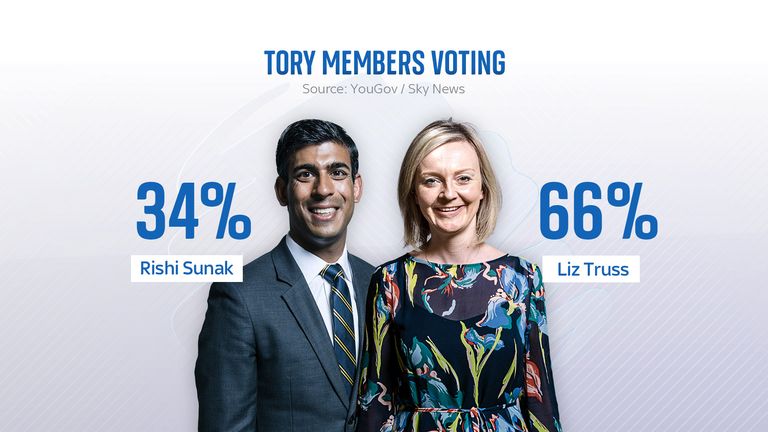
Liz Truss is set to win the Tory leadership contest by a decisive margin next month, according to an exclusive Sky News poll that gives the foreign secretary a 32-point lead over rival Rishi Sunak.
The poll also shows that the legacy and personality of Boris Johnson is likely to loom large over the next prime minister as there is huge regret among Tory members over the decision to oust him in July.
The YouGov survey suggests 66% of members are voting for Ms Truss and 34% are backing Mr Sunak, once those who do not know or will not vote are excluded.
The race has tightened very slightly since a YouGov poll of members just over two weeks ago, when Ms Truss had a 38 percentage point lead.
Australian PM Anthony Albanese says he will investigate reports that his predecessor, Scott Morrison, secretly assumed three roles in the ministry.
Mr. Morrison became joint minister for the health, finance, and resources portfolios in the two years before he lost power in May, local media report.
Mr. Albanese said he would seek legal advice about the decisions, calling them “unacceptable” and “just weird”.
The former prime minister has declined to comment.
On Monday, Governor-General David Hurley – the Queen’s representative in Australia – confirmed he had signed an “administrative instrument” that had allowed Mr. Morrison to secretly take on the portfolios. It was “consistent with section 64 of the constitution”, a spokesperson said.
But Mr. Albanese, law experts, and Mr. Morrison’s former colleagues have criticized the secrecy surrounding it.
Even some ministers were reportedly not aware they were sharing portfolios with the former prime minister.
“This is the sort of ‘tin pot’ activity that we would ridicule if it was in a non-democratic country,” Mr. Albanese told reporters on Monday.
Local media reported that former Health Minister Greg Hunt agreed in 2020 to share his portfolio in the event he became incapacitated from Covid.
But then-Finance Minister Mathias Cormann – now head of the OECD – only learned last week that his role had been jointly held, said a report by local outlet News.com.au.
Mr. Morrison was sworn in as a second resources minister – joining Keith Pitt – last year. Mr. Morrison used his powers to block a gas exploration license in New South Wales – a decision opposed by Mr. Pitt.
Mr. Albanese said he would not speculate on forthcoming legal advice but accused his predecessor of having governed “in the shadows”.
When asked to respond to Mr. Albanese’s comments, Mr. Morrison said he wasn’t aware of them. “Since leaving the job I haven’t engaged in any day-to-day politics,” he told Sky News Australia.
“I found out about it, and I disagree with it. I believe in a cabinet system of government where ministers are responsible for their own portfolios. We don’t have a presidential form of government,” Mr. Joyce told Channel 7.
The center-right coalition suffered a convincing defeat in May’s general election. It lost many seats in cities – where climate action and political integrity were seen as key issues.
In July, Mr. Morrison drew controversy by telling churchgoers “don’t trust in governments” and “don’t trust in the United Nations” during a speech in Perth.
There are so many questions and you’d be forgiven for being confused. No one is sure who knew what, when.
It would be normal for a leader to make sure that someone can step up and do the job if a minister is incapacitated, especially at the height of the pandemic.
But there are many ways of doing this. Why did it have to be him? And more crucially, why the secrecy?
As it stands, nothing about these gels. But here’s why this could potentially be a big deal.
For a leader of any country, let alone a democracy, to take over several portfolios without the public’s knowledge or the knowledge of his own colleagues, raises serious questions.
If confirmed, this also means that the then-prime minister was potentially aiming to centralize power so that the decision-making would ultimately come down to him.
Remember, this was happening at a time when Australia was in and out of lockdowns and when the Morrison government faced a lot of criticism for the way they handled the vaccination program.
Confidence in the Morrison government was waning – but as the current prime minister put it, it seems that even Scott Morrison had no confidence in the Morrison government.
The person most likely to replace Boris Johnson as leader of Britain’s governing Conservative Party and Prime Minister of the UK is a political chameleon who has gone from radical abolitionist to flag-bearer of the Euroskeptic, Conservative right.
Liz Truss, who was only elected to Parliament in 2010, has — in a relatively short period of time — established herself as a political force of nature who pursues her agenda with relentless vigor and unequivocal enthusiasm.
However, with most opinion polls suggesting she’s poised to get the keys to Number 10 Downing Street, her critics are asking: What exactly does she stand for?
Many who have observed her over the years question whether she has any sincere beliefs at all, or if she simply endorses whatever is the most convenient at the time.
To say that Truss has been on a political journey would be an understatement. She was born in 1975 into a family that she herself has described as “to the left of Labour,” the main socialist opposition. She grew up in parts of the UK that didn’t traditionally vote Conservative, moving between Scotland and the north of England.
In contrast to her privately educated Cabinet colleagues, Truss went to a state school in Leeds, and later won a place at Oxford University. There she was an active member of the Liberal Democrats, a centrist opposition party that has long been an effective opponent to the Conservatives in large parts of England.
During her time as a Liberal Democrat, Truss supported the legalization of cannabis and the abolition of the royal family — positions that are at total odds with what most would consider to be mainstream Conservatism in 2022.
Truss says she joined the Conservatives in 1996, just two years after she gave a speech at a Liberal Democrat conference calling for the end of the monarchy.
Even then, fellow Liberal Democrats questioned her sincerity and spotted traits that they still see in her today.
“I honestly think she was playing to the gallery back then, whether she was talking about decriminalizing drugs or abolishing the monarchy,” Neil Fawcett, a Liberal Democrat councilor who campaigned with Truss in the ’90s, told CNN.  “I think she is someone who plays to the gallery with whatever audience she is talking to, and I genuinely don’t know if she ever believes anything she says, then or now.”
Truss has certainly continued to capture the attention of her audience. Since joining the Conservatives and becoming a member of Parliament, she has fervently supported almost every conceivable ideology. She served loyally under three prime ministers in several different cabinet jobs, and is currently foreign secretary.
Most notably, she supported remaining in the European Union in 2016. At the time, Truss tweeted that she was backing those who wanted to remain in the bloc because “it is in Britain’s economic interest and means we can focus on vital economic and social reform at home.”
Truss now backs Brexit, saying that her fears before the referendum that it could cause “disruption” were mistaken. The aspiring Tory leader is even threatening to scrap all remaining EU legislation in the UK and override the Brexit deal that Johnson negotiated with Brussels in a way that the EU believes is illegal. She has also blamed France and the EU for border checks at Dover, the main port between the UK and France.
There is a debate within the Conservative Party as to how real this support of Euroskepticism really is. Some think Truss was reluctantly following government orders at the time of the referendum in 2016, which opposed Brexit. Others find that argument inconceivable.
Anna Soubry, a former Conservative cabinet minister, told CNN that Truss “had the most cover out of any of us to support Brexit. Her brief at the time included the farming community, who supported Brexit on the whole. I sat around the cabinet table and heard everyone’s reason for doing what they did and find it hard to believe she’s changed her mind quite this much.”
On the other hand, Gavin Barwell, who served as former Prime Minister Theresa May’s chief-of-staff, said that, after the Brexit vote, “Truss made a decision very quickly that there wasn’t room for a compromise. If you were to do it, it needed to be done fully. And as the stalemate dragged on, she argued that a binary choice was coming between leaving with no deal and Brexit being reversed, and the latter would be catastrophic for the government.”
The closer she edges to power, the more Britons wonder what a Truss premiership would look like. She has campaigned to lead on the most conservative of agendas. She has pledged to slash taxes from day one, tear up EU regulations and encourage private sector growth with low corporation tax. She has said that she will not impose a windfall tax on energy companies despite them posting huge profits during the cost-of-living and energy crisis.
These sorts of policies are, of course, red meat to the Conservative members who will ultimately vote for her. And while some of those who know her question how much she actually believes in them, there is little doubt she will put her full effort into implementing them and making her impact immediately felt.
It’s likely that a Truss premiership would ultimately look a lot like Johnson’s, but with a greater emphasis on cutting taxes, shrinking the state and, potentially, an even harder line on Europe. Critics have said that the tax cuts she’s promised would lead to even greater inflation and rises in interest rates amid a forecast recession. Questions have also been raised over a pledge Truss made to cut public sector pay, allegedly saving the public $8.8 billion. Her economics have been questioned by her critics, and the uproar over perceived callousness towards public sector workers forced Truss to U-turn.
Julian Glover, a journalist and speech writer to former Prime Minister David Cameron, was a university contemporary of Truss and remembers traits in her that are still recognizable today: Determined but unfocused.
“We only passed each other briefly and she was in a different year to me, but despite that, she stands out in my memory as a sort of strange, unfocused force, hugely in favor of action and change,” said Glover. “It was always hard to see the aim of it all, or where it might lead, except that she would be at the center of it.”
Roger Crouch, who succeeded Truss as president of Oxford University Liberal Democrats, told CNN that he remembers a woman who was “determined, single-minded and willing to challenge orthodox and prevailing, often male, wisdom.”
Unlike many of those who knew Truss in her younger years, Crouch, who is now a teacher, thinks that her opinions haven’t changed a huge amount since the ’90s. “Liz was always more of a privatizing, libertarian liberal so there is a consistent thread of thought there. I remember a student discussion group in which she advocated privatization of lamp posts.”
If she wins, Truss will have a hard time uniting her party, which has been in power for 12 years and has been bitterly divided over Brexit for six of them.
She will also have to lead the country through its worst cost-of-living crisis in decades. Inflation is at a 40-year high, energy bills are set to increase by hundreds, possibly thousands of pounds a year, and the UK is forecast to enter a recession before the end of the year. This winter, many families will have to make a tough choice between eating or heating. And for a party that has been in power for over a decade, it’s hard to deflect the blame for that onto anyone else.
Her supporters see the chance for a fresh start in Truss. They believe that with Brexit out of the way and the scandals that led to Johnson’s downfall soon to be a distant memory, the party will turn its focus to remaining in power and winning a historic fourth consecutive general election.
For her detractors, it is more complicated. During this leadership contest those who have supported her rivals feel that they have been unfairly maligned simply for disputing that Truss should be handed the keys to Downing Street.
When it comes to running the country, this might be a problem for Truss. She had the support of fewer MPs than her rival Rishi Sunak during the early stages of the contest and the bad blood between the two camps has worsened over time.
And for all of Truss’s determination and single-mindedness, if she takes over a party torn by infighting and suffering in the polls during a cost-of-living crisis that happened under the Conservatives’ watch, she might find her key objective too hard a task to achieve: Making her party electable at the next general election after almost a decade and a half in power.
For millions of Indians, getting access to clean water is still a distant dream. People living in rural areas travel miles on foot, across harsh terrain, to collect water from sources that are not always clean.
In 2019, India’s Prime Minister Narendra Modi launched the Jal Jeevan (water is life) Mission, which aims to bring tap water to every Indian home by 2024. Millions of households have benefitted from the programme.
With just two years to go before the deadline, millions are still waiting to get clean tap water.
The BBC’s Divya Arya travelled across the country to see the successes of the programme and also the challenges that remain.
The MP Chris Pincher – at the time, the Conservative deputy chief whip – went to a private members’ club in London. In his words, he “drank far too much” and “embarrassed himself”.
He was accused of groping two men, which led to flurry of allegations, some dating back years. It set off a chain of events that ended with the prime minister’s downfall.
First, Downing Street said Mr Johnsonwas not aware of “specific allegations” about Mr Pincher before appointing him as deputy chief whip in February. Ministers later reiterated this line – even though it turned out to be inaccurate.
On 4 July, the BBC reported Mr Johnson had been aware of a formal complaint. The next day, a former civil servant – Lord McDonald – said the prime minister had been told of the complaint in person.
Mr Johnson then admitted he had been told in 2019, and apologised for appointing Mr Pincher as deputy chief whip.
Partygate
Media caption, Watch Boris Johnson admit to attending the No 10 party in May 2020
In April this year, the prime minister was fined for breaking lockdown rules, after attending a gathering on his birthday in June 2020.
He also apologised for going to a “bring your own booze” party in the Downing Street garden during the first lockdown.
More widely, the Metropolitan Police issued 126 fines to 83 people for breaking lockdown rules in Downing Street and Whitehall.
And a report by Sue Gray – a senior civil servant – described a series of social events by political staff that broke lockdown rules.
“The senior leadership at the centre, both political and official, must bear responsibility for this culture,” she wrote.
Last December, Mr Johnson told the Commons that “all guidance was followed completely in No 10”. He is now being investigated by a Commons committee over whether he knowingly misled Parliament.
The cost of living crisis – and a tax rise
Inflation has risen sharply in 2022, to the current rate of 9.1%.
Many of the reasons were outside of Boris Johnson’s control. Russia’s invasion of Ukraine, for example, has led to rises in oil prices and the cost of food.
And, while the government has taken some steps – for example, by cutting fuel duty by 5p per litre – it also went ahead with a tax rise in April. National Insurance went up by 1.25 pence in the pound.
The government said the tax rise would pay for health and social care, and changes that kicked in this week softened the blow – but anyone earning more than £34,000 a year will still pay more.
“In the middle of the worst cost of living crisis for decades,” said Labour leader Sir Keir Starmer in April, “the government chooses to increase taxes on working people”.
Owen Paterson row
In October 2021, a House of Commons committee recommended a 30-day suspension for then-Conservative MP Owen Paterson.
The committee said he broke lobbying rules, to try to benefit companies who paid him.
But the Conservatives – led by the prime minister – voted to pause his suspension, and set up a new committee to look at how investigations were carried out.
After an outcry, Mr Paterson ended up resigning. Mr Johnson later admitted he had “crashed the car” in his handling of the case.
Lack of focus – and ideas
Media caption, Watch: ‘Enough is enough,’ says Sajid Javid in his resignation speech
Boris Johnson won his thumping majority on the back of a clear, easy-to-follow policy – Get Brexit Done.
But since then, his critics said, there was a lack of focus and ideas in Downing Street.
His ex-adviser turned chief critic, Dominic Cummings, repeatedly accused him of being an out-of-control shopping trolley, veering from position to position.
Others questioned the prime minister’s philosophy – or, indeed, if he had one. In June, Conservative MP and former minister Jeremy Hunt accused Mr Johnson of lacking “integrity, competence, and vision”.
Mr Hunt was speaking before a confidence vote, which Mr Johnsonwon – but the complaints were getting louder.
The by-election defeats kept coming. After the latest, Mr Johnson said he would not undergo a “psychological transformation”.
But that, now, is not the concern of Conservative MPs. They have spoken, and the prime minister is going.
Prime Minister Giuseppe Conte came under attack on Monday from Italy’s Catholic bishops and even some of his own cabinet members for refusing to reintroduce mass once the coronavirus lockdown is lifted.
Conte has unveiled a gradual easing of restrictions that will restore some semblance of former life starting on May 4.
The Mediterranean country’s official death toll of 26,664 is Europe’s highest and second globally only to the United States.
But the number of infections has been ebbing and scientists believe the contagion rate is low enough to gradually get back to work.
Conte has allowed Italians to take strolls in parks and go jogging starting next Monday.
More stores will reopen and restaurants will resume takeout service.
Even museums will unlock their gates on May 18 in an effort to draw back tourists and help out Italy’s devastated hotel and services industry.
But there will still be no mass and attendance at funerals will be limited to 15 people.
Conte and Health Minister Roberto Speranza agreed with a scientific committee conclusion that “the elderly in the parish are too frail to risk”, La Repubblica daily wrote.
The bishops are livid.
“We cannot accept to see the freedom of worship compromised,” the Italian Episcopal Conference of the country’s top bishops said in a statement.
“Why on earth, with proper precautions, can you go to a museum but not to mass?”
Powerful enemies
The Corriere della Sera newspaper said the bishops had been lobbying Conte to allow Sunday mass services that would be limited to about 20 people.
They also urged up to 15 people to be permitted to attend weddings and baptisms.
But Conte only allowed broader access to funerals and promised to look into how other religious curbs can be relaxed in the coming weeks.
“I understand that freedom of worship is a fundamental people’s right,” Conte told the nation on Sunday.
“I understand your suffering. But we must continue discussing this further with the scientific committee.”
Italy’s Family Minister Elena Bonetti called Conte’s decision “incomprehensible”.
“It is up to politicians to protect the country’s wellbeing, and religious freedom is among our fundamental rights,” the minister said.
La Repubblica daily warned that Conte was developing powerful enemies at a critical juncture.
Italy’s competing political forces had appeared to put aside their squabbles as the nation entered what was widely regarded as its gravest emergency since World War II.
But Conte has been coming under growing criticism and pressure from regional leaders and political opponents as he decides which industries to open up first.
“This is the (bishops’) first open conflict with the prime minister,” La Repubblica noted.