The US State Department said on Friday that they really did not like the way the Hong Kong authorities were treating the family members of pro-democracy activists who are living in other countries.
The US expressed worry about activists such as Nathan Law, Joshua Wong, and Elmer Yuen. It mentioned that their family members and friends were detained and questioned by the Hong Kong police, which was a major concern for the US.
Spokesperson Matthew Miller said the Hong Kong authorities should stop bothering the family members of democracy activists.
Miller said that the intentional effort to scare and quiet down people who are using their basic rights and freedoms is continuing to make the situation in Hong Kong worse. This is another way to make people scared and quiet when they are in another country, and force them to come back.
In July, Hong Kong police searched the home of a democratic activist named Law and took his family members away to ask them questions. They have offered a reward of HK$1 million for any information that can help catch Law and other well-known activists who are hiding outside their own country and are wanted for crimes against national security.
The person named Law cut off contact with his family in Hong Kong after coming to Britain. He has been given permission to stay in the country because he is seeking protection from persecution.
On July 11, his parents and older brother were taken away to be asked if they had been giving him money. According to the city’s public broadcaster RTHK, police sources said that all three were let go afterwards.
Hong Kong police have reported that they have taken two men and a woman for questioning. They are being investigated by the national security department. It could not recognize them.
The government of Hong Kong has said many times that the national security law imposed by Beijing in 2020 does not take away people’s freedoms. It says that the law stopped the disorder and brought back peace to the city after the big protests for democracy.
Some people have said that lawyers and activists broke a law meant to protect the country. They are being accused of things like working with people from other countries and trying to overthrow the government.
The US State Department asked the Hong Kong government and China to respect the rights and freedoms of the people in Hong Kong, as stated in the Basic Law and the agreement between China and Britain.
Tag: pro-democracy activists
-
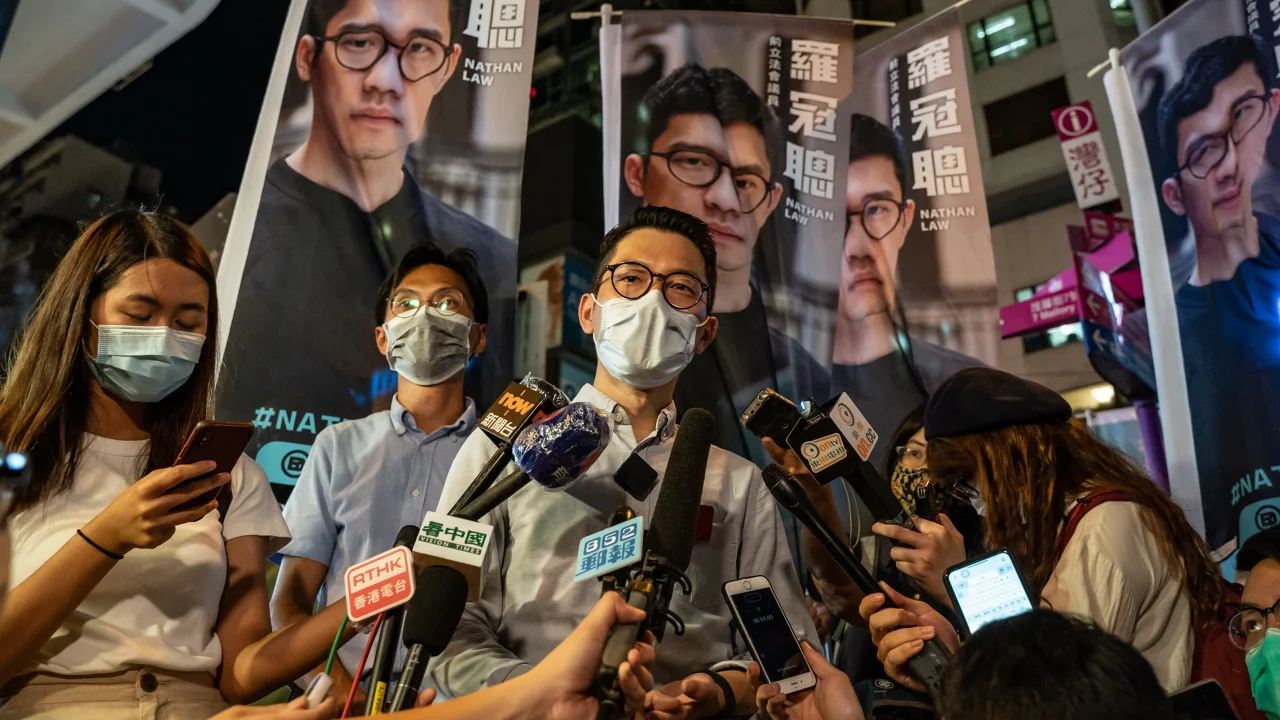
US denounces Hong Kong’s ‘abuse’ of families of pro-democracy activists
-

Hong Kong on democracy test as 47 prepare to face court
The activists and politicians were apprehended in a dawn raid two years ago, and they are accused of organising an unofficial primary ahead of a legislative election that was later postponed.
On Monday, Hong Kong’s largest national security trial began with 47 pro-democracy activists and politicians accused of “conspiring to commit subversion” by holding an unofficial public vote in 2020, just days after a new, stringent security law was put into place.
16 people are anticipated to enter not guilty pleas, though that number may change by Monday as defendants consider their options in light of possible sentences.
Those charged include prominent activists “Long Hair” Leung Kwok-hung and Gordon Ng Ching-hang, who faces potential life imprisonment as one of five people accused of being a “major organiser” of a poll conceived as a way for the democratic camp to choose their strongest candidates for a Legislative Council election that was later postponed.
Defendants who plead guilty will be sentenced after the trial has concluded and include internationally-known activists like Joshua Wong, who has already been convicted on other charges, and Claudia Mo, a former journalist turned legislator. Together, the 47 account for much of what remains of Hong Kong’s pro-democracy leadership after mass protests calling for political reform in 2019 came to an inconclusive end with the arrival of COVID-19, and the national security law pushed many into exile.
Unofficially on trial is the future of Hong Kong’s democracy movement, said Eric Lai, a non-resident fellow at Georgetown Center for Asian Law, as “pro-democracy activities and participating in the legislature” could be seen as threats to national security in the future.
“The majority of public opinion in the city, the pro-democracy camp, has received more than 60 percent of the vote in the previous decade’s elections and now the government chose to arrest and criminalise all the major leaders in Hong Kong,” Lai told Al Jazeera.
“In a way, it’s a trial for these leaders but also for their supports.”

Only a few of the 47 arrested have secured bail, including former legislator Helena Wong Pik-wan. The prosecutor’s appeal against the decision was rejected [File: Lam Yik/Reuters] Under the security law, which took effect on June 30, 2020, the defendants face up to three years in prison for conspiracy to commit subversive activities, between three and 10 years imprisonment for “active participation” in the conspiracy, and between 10 years and life imprisonment if they are deemed “principal offenders”.
The latter charge applies only to Ng and four other defendants: former university professor Benny Tai, former legislator Au Nok-hin, and former district councillors Andrew Hiu Ka-yin and Chung Kam-lun.
Tai and Au face some of the most serious charges, according to court documents, for their “clear attempt to subvert the State power, paralyse the operation of the [Hong Kong] Government”, according to prosecutors. Prosecutors also allege the defendants hoped a crackdown on their activities would garner international support and lead to the imposition of sanctions on Hong Kong and Chinese officials.
Media ban
Held in July 2020, the vote was intended as an unofficial “primary” for pro-democracy candidates running in the planned September 2020 Legislative Council election.
Candidates hoped to secure a victory for the democracy camp and use the electoral majority to bring about democratic change in Hong Kong.
Some of the platform echoed demands from the city’s mass protests in 2014 and 2019, including the resignation of then-Chief Executive Carrie Lam, an independent inquiry into allegations of police brutality during the protests and political reform with the aim of introducing universal suffrage for the territory.
Under Hong Kong’s current political system, its leader is chosen by a group of people selected by Beijing and only a portion of its legislative seats are decided by the popular vote.
The July 2020 election drew more than 600,000 voters, many of whom waited in line for hours to take part, but the results were de facto voided when the government announced the legislative election would be delayed for a year due to COVID-19.
Following the poll, as Hong Kong locked down, police swooped on the 47 defendants and six other individuals in a dawn round-up of a kind typically reserved for organised crime groups.
The vast majority of the 47 have been kept in prison since their arrest in January 2021, with bail granted to just 13 people. Due to strict COVID-19 regulations, detained activists were unable to see their families and lawyers, or receive mail, for months.
Some defendants have reportedly been unable to access Statements of Facts detailing the charges levelled against them, so their lawyers have been forced to proceed blindly through the legal system. The case was subject to a media ban that was only lifted in August last year.
William Nee, a researcher and advocacy coordinator at Chinese Human Rights Defenders, likens the trial to a “pre-emptive strike” against an entire generation of democracy activists and former legislators who range in age from 24 to 66.
“The charges are absolutely absurd from an international law point of view. People have the right to run for office. Once elected, they have the right to vote how they want. Clearly, Beijing is saying the mere fact you might want to run and cast votes that go against our wishes is a conspiracy to commit subversion is absolutely against international laws and standards,” Nee said.
“That’s what’s in many ways so egregious about this case. It’s a naked assault on democracy in Hong Kong.”
Unpredictable
Under Hong Kong’s common law system, criminal defendants can typically receive a reduction in their sentence of as much as 25 percent for pleading guilty on the first day of trial, but this does not apply to national security trials. Neither does the jury system, with this trial to be heard by a panel of three judges hand-picked by the city’s chief executive.

The trial is expected to last about 90 days with some defendants facing a life term for alleged ‘subversion’ [File: Isaac Lawrence/AFP] Maya Wang, a senior China researcher at Human Rights Watch describes the national security system as a “Frankenstein” parallel system carved into Hong Kong’s once respected legal system.
The trial is expected to last about 90 days. It is possible that at the end of it, the accused will receive a reprieve of “time served” for their pre-trial detention but most face a minimum sentence of three years imprisonment.
“Everything is going to be quite unpredictable as we go along. I think what is quite clear is that Beijing is using fairly elaborate legalese to dismantle Hong Kong’s pro-democracy movement,” Wang told Al Jazeera.
“Seeing them on trial and being detained is such a cognitive dissonance for so many people in Hong Kong. It really is a visual representation of repression.”