Tag: Pyongyang

  • In two weeks: North Korea carries out sixth missile launch

    On Thursday, North Korea launched two more ballistic missiles, making it the sixth such banned launch in less than two weeks.

    On Wednesday, Pyongyang defined its recent offensive as “just counteraction measures” in response to joint military exercises between the US and South Korea.

    On Tuesday Pyongyang fired a missile over Japan, prompting the US to call an emergency UN Security Council meeting.

    At the meeting, the US accused Russia and China of protecting the North from stronger sanctions.

    By opposing further sanctions Moscow and Beijing had given Pyongyang “blanket protection”, the US ambassador to the UN said. The Chinese and Russian representatives said increased dialogue was better than punishment.

    For the past two months the US, South Korea, and Japan have been holding a series of combined exercises as they practice how to defeat and deter a North Korean attack. These drills have antagonised North Korean leader Kim Jong-un, who sees them as proof his enemies are preparing for war.

    In its statement, the North accused the US of “escalating the military tensions on the Korean peninsula”.

    On Wednesday the US, Japan, and South Korea carried out further drills, which they said were a response to Tuesday’s launch. The US said there was “no equivalency” between a banned missile test-fire and security drills.

    The US also redeployed its aircraft carrier the USS Ronald Reagan near the Korean peninsula

    South Korea and Japan said the first of Thursday’s missiles, launched at about 06:00 local time (21:00 GMT) flew about 350km (217 miles) with a maximum altitude of around 100km, while the second missile had a flight range of about 800km at an altitude of around 50km.

    The recent flurry of launches is strongly reminiscent of the period leading up to its last nuclear weapon test in 2017.

    Back then, as is happening now, the North tested missiles, there was no dialogue with the US, and Pyongyang fired two missiles over Japan.

    Satellite imagery shows that the North has been restoring tunnels at their nuclear testing site, which they had claimed to have destroyed in 2018 during a short-lived diplomatic rapprochement with the US under President Trump.

    Last month, North Korea also revised its nuclear laws, with leader Kim Jong Un declaring his country an “irreversible” nuclear power.

    With everything in place, Kim appears to be waiting for a politically opportune moment to carry out its seventh nuclear test.

    Analysts believe a test is most likely to happen during the window of three weeks between the Communist Party Congress in China later this month and the US mid-term elections in early November.

    North Korea’s recent launches

    • Sunday 25 September: A short-range missile fired the day after a US naval carrier arrived in waters around the Korean peninsula. 600km distance/60km altitude
    • Wednesday 28 September: Two short-range missiles fired on the eve of US Vice President Kamala Harris’ visit to Seoul and the DMZ. 360km distance/30km altitude
    • Thursday 29 September: Two short-range missiles after Harris departed South Korea. 300km distance/50km altitude
    • Saturday 1 October:Two short-range missiles fired amid continuing US-South Korea-Japan drills. 400km distance/50km altitude
    • Tuesday 4 October: An intermediate-range ballistic missile fired over Japan. 4,500km distance/2,800km altitude
    • Thursday 6 October: Two more short-range missiles fired. 800km distance/50km altitude

  • South Korean military issues apology following terrifying missile launch failure

    After a failed missile launch during a joint drill with the United States alarmed locals in the coastal city of Gangneung, the South Korean military has apologized.

    They reported hearing an explosion and seeing a fire overnight.

    But the military, which has said there were no casualties, did not acknowledge the incident until seven hours later.

    The launch was in response to North Korea firing a missile over Japan early on Tuesday.

    This is the first time Pyongyang has flown a missile over Japan since 2017 – and it prompted a show of force from the US, Japan, and South Korea which conducted military drills. Seoul and Washington also fired a volley of missiles into the East Sea – also known as the Sea of Japan – between the Korean peninsula and Japan.

    The South Korean military later confirmed that one of their missiles failed soon after it was launched and crashed – this was separate from the ones launched by the US.

    The military also said that the Hyunmoo-2 missile carried a warhead but that it did not explode, and apologised for causing worry.

    Residents in Gangneung said they saw a bright flash and heard an explosion at around 01:00 on Wednesday (16:00 GMT Tuesday).

    They were left in the dark for hours, and many of them posted on social media wondering what had happened while sharing photos and videos of the incident. The footage showed what appeared to be a brightly burning fire, with smoke rising from a distance.

    “I can’t sleep because I feel anxious [after hearing] the explosion,” said one user, according to news site Kang Won Ilbo. Another wondered if a plane had crashed.

    Presentational white space

    North Korea’s missile launch on Tuesday was the fifth carried out by Pyongyang in a week. Many of its missile tests are conducted on a flight path that reaches a high altitude, avoiding flights over its neighbours.

    But firing over or past Japan allows North Korean scientists to test missiles under circumstances “that are more representative of the conditions they’d endure in real-world use”, analyst Ankit Panda told news agency Reuters.

    In September, North Korea passed a law declaring itself to be a nuclear weapons state, with leader Kim Jong-un ruling out the possibility of talks on de-nuclearization.


  • Ukraine war: North Korea arming Russia – US reports

    As a result of Western sanctions, Russia apparently has been obliged to purchase weapons from North Korea in order to maintain its invading force in Ukraine.

    Russian media reports that it has purchased millions of rockets and artillery ammunition from Pyongyang.

    Last week it received the first order of new Iranian drones, US reports said.

    New Russian missile strikes have been reported across Ukraine, with a fuel depot set on fire in the Kryvyi Rih area and deadly attacks on Kharkiv.

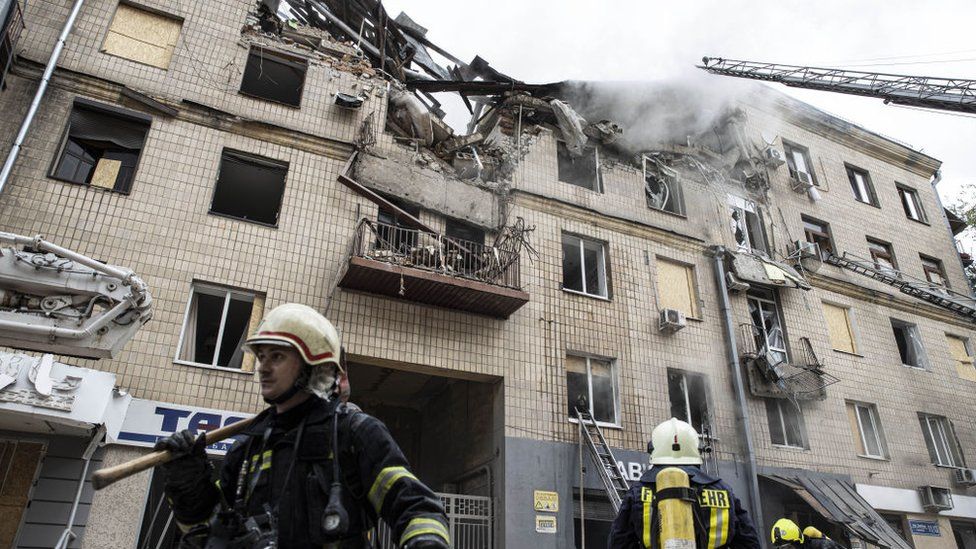
    In the north-eastern city of Kharkiv, a woman’s body was found after a strike destroyed the upper part of a block of flats, local authorities said.

    Firefighters near a damaged building in Kharkiv, 6 September
    IMAGE SOURCE, GETTY IMAGES
    Image caption,

    Flats were destroyed in Kharkiv

    In Kryvyi Rih, in central Ukraine, thick black smoke billowed from the depot in a photo posted by the governor of the Dnipropetrovsk region.

    It was attacked with two missiles on Monday evening, Valentyn Reznichenko said, adding that there was no immediate information about casualties.

    In another development, Russian-backed separatists controlling Donetsk said parts of the eastern city had been shelled by Ukrainian government forces on Tuesday, with one civilian wounded.

    A US official said Russia would be forced to buy additional North Korean weaponry as the war dragged on.

    Iran and North Korea, themselves both the targets of significant Western sanctions, have sought to deepen ties with Russia since President Vladimir Putin launched his invasion of Ukraine in February.

    Kim Jong-un’s government has blamed the US for the conflict and accused the West of pursuing a “hegemonic policy” that justified Russia’s use of force.

    Last month, North Korea recognized the independence of two Russian-backed breakaway regions in eastern Ukraine – the Donetsk and Luhansk people’s republics – and vowed to deepen its “comradely friendship” with Moscow. Mr Putin said the two countries would expand their “comprehensive and constructive bilateral relations”, according to North Korean state media.

    The exact size and scale of the new weapons deliveries reported by the New York Times and Associated Press news agency remain unclear.

    But a US official said turning to North Korea for support demonstrated that “the Russian military continues to suffer from severe supply shortages in Ukraine, due in part to export controls and sanctions”.

    Broad economic sanctions have done little to damage Russia’s income from energy exports, according to a Finnish think tank the Centre for Research on Energy and Clean Air. It estimates Russia has made €158bn (£136bn) from surging fossil fuel prices during the six-month invasion, with EU imports accounting for more than half of that.

    However, the US and EU believe that Moscow’s ability to resupply its military has been impaired.

    Last week, officials in the Biden administration told US media that the first shipments of Iranian-made drones had also been delivered to Russia.

    US intelligence officers believe that Russian operators have travelled to Iran to receive training on the Mohajer-6 and Shahed series weapons.

    But they told reporters recently that many of the drones had been beset by mechanical and technical problems since delivery.

    Iran has officially denied delivering weapons to either side of the conflict, but in July US National Security Advisor Jake Sullivan said Tehran was planning to supply Moscow with potentially hundreds of drones for its war in Ukraine, some with combat capabilities.

    On Tuesday, UK defence officials said in a daily update that Russia was struggling to maintain its supply of battlefield drones in the face of significant “combat losses”.

    “It is likely that Russia is struggling to maintain stocks of UAVs [unmanned aerial vehicles], exacerbated by component shortages resulting from international sanctions,” the update said.

    “The limited availability of reconnaissance UAVs is likely degrading commanders’ tactical situational awareness and increasingly hampering Russian operations,” the officials added.

  • Coronavirus: Foreigners leave North Korea on first commercial flight for weeks

    Around 60 foreigners who were quarantined for weeks in the North Korean capital, Pyongyang, have finally left the country.

    The Air Koryo flight to Vladivostok is the first commercial flight to leave North Korea in over a month, said specialist news site NK News.

    Flight KOR271 landed in the far-eastern Russian city on Monday morning.

    The embassy staff who left had been confined to their compounds for weeks during February and early March.

    North Korea quarantined hundreds of foreigners in the capital in an attempt to stop the coronavirus from breaking out.

    Russian ambassador Alexander Matsegora described the conditions as “morally crushing”.

    There have been no reported cases of coronavirus in North Korea, though some experts have cast doubt on this.

    North Korea borders China, where the virus emerged, and South Korea, where there has been a major outbreak.

    Flight KOR271 left Pyongyang at 08:40 local time on Monday (23:40 on Sunday) and arrived in Vladivostok at 10:47, said flight tracking site FlightAware.

    At least 60 diplomats and embassy staff were thought to be on the flight. It’s not known how or when they will return to their home countries.

    The British ambassador to North Korea tweeted early on Monday that he was “sad to say farewell to colleagues from [the] Germany Embassy and French Office”.

    Colin Crooks added that other embassies were closing temporarily but that the British embassy would remain open.

    He also tweeted pictures showing two white minivans taking staff to the airport.

    North Korea had previously quarantined around 380 foreigners – mostly diplomats and staff in Pyongyang – in their compounds for at least 30 days.

    It lifted the restrictions last week after more than a month.

    Swedish ambassador Joachim Bergstrom reacting by tweeting a selfie with the caption: “I have never been happier standing on Kim ll Sung Square.”

    However, foreigners’ interactions with locals were still restricted, said NK News, as they were not allowed to visit restaurants, shops, gyms and hotels in the city.

    There are concerns that North Korea, which is subject to international sanctions, lacks the health infrastructure to test and treat those infected.

    The number of infections worldwide is more than 107,000, with about 3,600 deaths.

    Source: bbc.com