England have “silenced” their pre-tournament critics with “faultless” performances on their way to the World Cup quarter-finals, says Declan Rice.
Gareth Southgate’s side comfortably beat Senegal 3-0 on Sunday to set up a quarter-final against reigning world champions France.
England have won three and drawn one of their four matches in Qatar.
“I don’t think we get the credit we deserve in our performances,” said West Ham midfielder Rice, 23.
“If you look at other teams, like the Netherlands and Argentina, they win their games comfortably and they get called ‘masterclasses’.
“With us, it always gets picked off. The negative things always come that way. If you look at the last couple of games, it’s been faultless. I think countries should be starting to fear us now because we’re a great team.”
England have scored 12 goals in four matches in Qatar – the country’s joint-most at a major tournament, level with their 12 goals at the 2018 World Cup.
They have also kept a clean sheet in their past three games at the World Cup – their best run of games without conceding a goal in the competition since 1982.
“Going into the tournament, there was a lot of talk that we don’t score enough goals. That’s another one we’ve kept people quiet on,” added Rice.
“There was a lot of scrutiny around the defence and conceding goals, but it’s been solid. We’re going to keep building and pushing.”
Faced with the prospect of coming up against Paris St-Germain and France superstar Kylian Mbappe in Saturday’s quarter-final (19:00 GMT kick-off), Rice said England have nothing to fear.
“These are the games we want to play in. They only come around once. England versus France, quarter-final – it doesn’t get bigger than that,” he added.
“I’m sure the world will be watching. We really want to progress. There’s no point buzzing [about victory over Senegal] if we can’t push on and beat France.”
Tottenham defender Eric Dier added: “When you get to the quarter-finals of the World Cup, everyone is going to be very good. It is to be expected.
“No-one will fear anyone. They’re a great team with very great players – but so are we.”
The World Cup has received a lot of attention in Chinese state media this week, but the matches are fueling frustrations that people in the country are being left out of the festivities.
Aside from China’s men’s national team failing to qualify, scenes of maskless celebrations and raucous gatherings in Qatar have irritated viewers, who have been discouraged from gathering to watch the games.
Many people have used the World Cup to express their displeasure with China’s current policies. To prevent the virus from spreading, the country maintains a zero-Covid policy, in which entire communities are shut down over single cases of the virus.
China is currently experiencing its worst outbreak in six months, and localised lockdowns have surged over the last couple of weeks. In the past 24 hours, China has recorded more than 28,000 new cases; these are in every single provincial-level region.
Football is very popular in China. President Xi Jinping is known for being a lover of the sport, and he has spoken previously of it being a dream for the country to win the World Cup .
As a result, matches are being shown on national broadcaster CCTV, and state media have sought to amplify China’s “presence”. The Global Times has reported on how China-made products “ranging from buses to the [Lusail] stadium, and even air conditioning units are well represented at the event”.
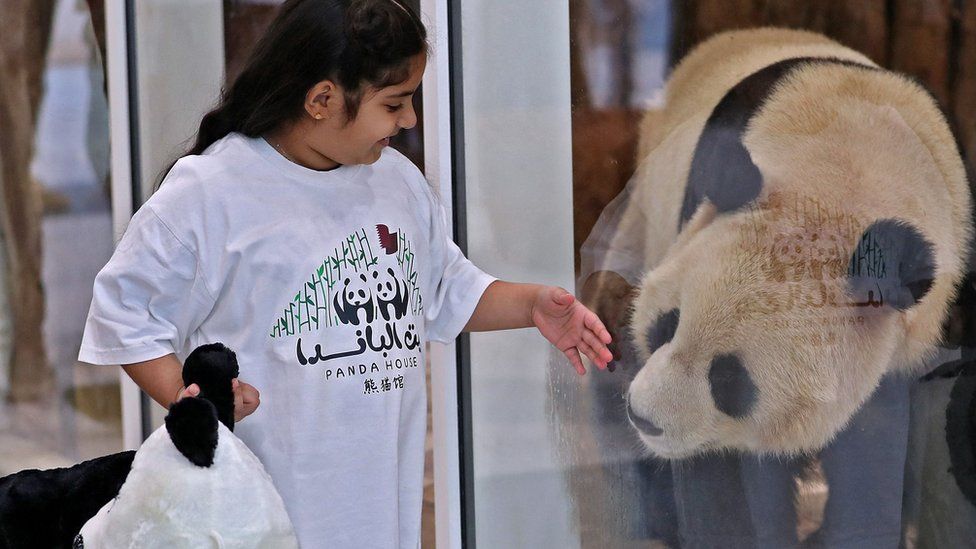
Leading outlets such as CCTV have also promoted the presence of Chinese flagbearers at the opening ceremony, and how two giant pandas arrived in Qatar to “meet” visitors arriving for the event.
IMAGE SOURCE,GETTY IMAGES Image caption, A child plays with one of the Chinese giant pandas given to Qatar to mark the start of the World Cup
But it is evident that Covid-19 has put a damper on the celebrations. In major cities, outbreaks have resulted in non-essential businesses once again closing, and people being urged to limit their movements.
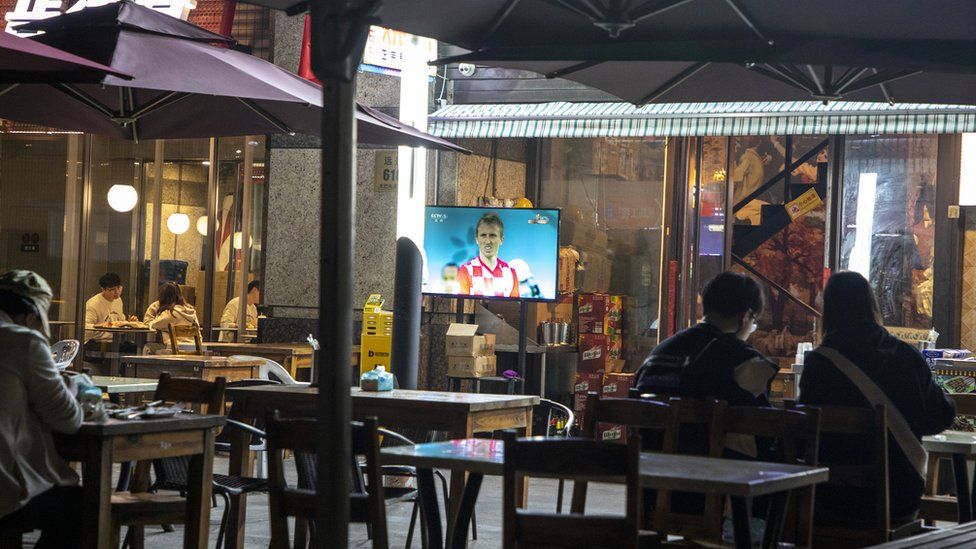
With no bars to go to, the Global Times newspaper says some fans are “choosing to watch the games at home with their families”. Others have also reportedly taken to camping sites.
IMAGE SOURCE,GETTY IMAGES Image caption, This was the scene in a sparsely filled pub in Shanghai while the World Cup was being shown
Many are feeling acute isolation watching this year’s event.
An open letter questioning the country’s continued zero-Covid policies and asking if China was “on the same planet” as Qatar quickly spread on mobile messenger WeChat on Tuesday, before being censored.
Comments on the Twitter-like Weibo social network are rife from viewers who speak about how watching this year’s matches is making them feel divided from the rest of the world.
Some speak of their perception that it is “weird” to see hundreds of thousands of people gathering, without wearing masks or needing to show evidence of a recent Covid-19 test. “There are no separate seats so people can maintain social distance, and there is nobody dressed in white and blue [medical] garb on the sidelines. This planet has become really divided.”
“On one side of the world, there is the carnival that is the World Cup, on the other are rules not to visit public places for five days,” one says.
Some say they have had difficulty explaining to their children why the scenes from the World Cup are so different to those people face at home.
There are many in China, though, who have been critical of countries overseas opening up while the World Health Organization still calls the Covid-19 virus an “acute global emergency”.
However, there is no end in sight to China’s existing measures. This week, the National Health Commission spokesman “warned against any slacking in epidemic prevention and control” and urged “more resolute and decisive measures” to bring cases under control.
Local governments in major cities have reintroduced mass testing and travel restrictions and ultimately delivered a message that people should try to stay at home.
But after three years of such measures, people are frustrated, resulting in protests in the last month in both the cities of Guangzhou and Zhengzhou.
Football fans who have shelled out for expensive hospitality suites at the Qatar World Cup will not be affected by the last-minute stadium beer ban.
It comes after the sale of alcohol at stadiums in the country was banned just two days before the tournament.
Initially, fans were due to be able to buy Budweiser – a sponsor of the tournament – within each of the eight World Cup stadiums, but a last-minute U-turn means alcohol can no longer be consumed within stadium perimeters.
Supporters will still be able to consume alcohol in designated fan zones.
However, it has emerged that the only people exempt from the stadium alcohol ban will be those in pricey corporate hospitality.
MATCH Hospitality, the worldwide provider of the FIFA World Cup 2022 official hospitality programme, confirmed that its hospitality suites will not be affected by the ban.
In a statement, it said: “Please note that those in corporate areas of the stadiums, which include official hospitality spaces, will be served alcohol as per the product inclusions of the product purchased.”
More than 240,000 hospitality packages have reportedly been sold, ranging in luxury and price. One suite, which can accommodate 44 people, sold for £2.1 million, according to Metro.
Perks of corporate hospitality packages can include glass-fronted boxes, access to stadium seats, as well as a dedicated concierge, live chef stations and multi-course menus.
MATCH Hospitality also offers ‘MATCH House’, a venue which allows people to watch live-streamed matches for specific games without having a suite, and include beer and wine.
Packages for the venue, which is at the FIFA Fan Festival site, can be booked by game and range from $450 per person to $1,145.
Some fans have forked out for private suits for the tournament. (MATCH Hospitality)
The alcohol ban in stadiums is believed to have come after pressure from Qatar’s rulers, including the Gulf state’s Emir, and reportedly led to crisis talks between FIFA and Budweiser’s beer’s brewer, AB In-Bev.
The last-minute U-turn sparked anger from the Football Supporters’ Association, who accused organisers of a “total lack of communication”.
“Some fans like a beer at a game and some don’t, but the real issue is the last minute U-turn which speaks to a wider problem – the total lack of communication and clarity from the organising committee towards supporters,” a spokesperson said.
“If they can change their minds on this at a moment’s notice, with no explanation, supporters will have understandable concerns about whether they will fulfil other promises relating to accommodation, transport or cultural issues.”
In a statement FIFA said: “Following discussions between host country authorities and FIFA, a decision has been made to focus the sale of alcoholic beverages on the FIFA Fan Festival, other fan destinations and licensed venues, removing sales points of beer from Qatar’s FIFA World Cup 2022 stadium perimeters.
“There is no impact to the sale of Bud Zero which will remain available at all Qatar’s World Cup stadiums.
“Host country authorities and FIFA will continue to ensure that the stadiums and surrounding areas provide an enjoyable, respectful and pleasant experience for all fans.”
Speaking shortly after the news broke, England goalkeeper Aaron Ramsdale said he thought travelling fans would find a way of enjoying themselves despite the ban.
He said: “I think the fans will find some way of having a beer, I don’t think you need to do it so much at the game.
“Hopefully, with them not being able to drink we can perform on the pitch to give them that excitement and buzz. But we also have to respect the rules and continue to work, we will put pressure on ourselves to entertain from the football pitch.”
Russia’s President Vladimir Putinsaid Moscow is interested in working closely with Qatar to ensure stability in the global gas market during a call with Qatar’s Emir Sheikh Tamim bin Hamad Al Thani, the Kremlin said.
Putin congratulated Qatar on hosting the upcoming FIFA World Cup, which kicks off this weekend.
FIFA banned Russia, which hosted the previous tournament in 2018, from participating in its competitions earlier this year in response to Russia’s invasion of Ukraine.
Alcohol will not be sold to fans at the World Cup’s eight stadiums in Qatar after Fifa changed its policy two days before the start of the tournament.
Alcohol was set to be served “in select areas within stadiums”, despite its sale being strictly controlled in the Muslim country.
Those in corporate areas of stadiums at the tournament will still be able to purchase alcohol.
The World Cup starts on Sunday when Qatar play Ecuador.
Budweiser, a major sponsor of Fifa, is owned by beer maker AB InBev and had exclusive rights to sell beer at the World Cup.
“Following discussions between host country authorities and Fifa, a decision has been made to focus the sale of alcoholic beverages on the Fifa fan festival, other fan destinations and licensed venues, removing sales points of beer from Qatar’s Fifa World Cup 2022 stadium perimeters,” said a statement from world football’s governing body.
“There is no impact to the sale of Bud Zero which will remain available at all Qatar’s World Cup stadiums.
“Host country authorities and Fifa will continue to ensure that the stadiums and surrounding areas provide an enjoyable, respectful and pleasant experience for all fans.
“The tournament organisers appreciate AB InBev’s understanding and continuous support to our joint commitment to cater for everyone during the Fifa World Cup Qatar 2022.”
Budweiser posted a message on Twitter on Friday saying, “Well, this is awkward” before the post was later deleted.
An AB InBev spokesperson said that they could not proceed with “some of the planned stadium activations” because of “circumstances beyond our control”.
The Football Supporters’ Association (FSA) criticised the timing of the decision to ban the sale of beer for most fans.
“Some fans like a beer at a game and some don’t, but the real issue is the last minute U-turn which speaks to a wider problem – the total lack of communication and clarity from the organising committee towards supporters,” said an FSA spokesperson.
“If they can change their minds on this at a moment’s notice, with no explanation, supporters will have understandable concerns about whether they will fulfil other promises relating to accommodation, transport or cultural issues.”
In August, Fifa changed the start date of the World Cup so that the first game of the competition would be Qatar facing Ecuador.
The game was scheduled to be played on 21 November as the third game, with Senegal against the Netherlands set to be the opening match earlier that day.
Sports scientists and mathematicians have spent years studying the best and fairest ways to organise tournaments.
With five billion people expected to tune in to the 2022 World Cup in Qatar, the pressure to get it right is on.
The most frequent criticism of FIFA’s draws for World Cup groups is that they tend to produce groups of unequal strength.
Some may get a comparatively easy ride through the group stage while others could find themselves in a “group of death”.
Organisers need to make sure strong teams aren’t penalised for their strength, while avoiding the emergence of any weak groups, to maintain fairness and keep TV audiences riveted.
How does it work?
FIFA’s seeding system assigns the host nation and the seven strongest teams to each of the eight groups. To guarantee a geographical spread, it defines six qualifying zones: Africa, Asia, Europe, North and Central America, with the Caribbean, Oceania and South America in the final pot.
No two teams from the same zone – except Europe – can be in the same group, while no more than two European teams can be in the same group.
At first glance, this year’s draw seems pretty even-handed. Group E, with Spain and Germany, looks sewn up from the start, as does Group F, with Belgium and Croatia. But anything could happen in the other groups.
Ordering the groups at Qatar 2022 according to their average FIFA world rankings reveals each one’s overall strength.
We can also determine the spread of rankings within a group to judge which is the most competitive.
8. Group A: Netherlands, Senegal, Ecuador, Qatar
With an average world ranking of 30, and a spread of 48 ranking places between strongest and weakest, Group A seems the weakest. The Netherlands (8th), should sail through. Senegal (18th) should see off Ecuador (44th). Qatar (50th) have a home advantage – and when players have experience playing in the Middle East’s conditions, this could count for a lot.
7: Group H: Portugal, Uruguay, South Korea, Ghana
Weighing in with an average world ranking of 28 and a spread of 52 rankings, Group H is the second weakest. Portugal (9th), Uruguay (14th) and South Korea (28th) will be pushing hard for the knockout spots. Ghana (61) will be lucky to progress.
6. Group C: Argentina, Mexico, Poland, Saudi Arabia
The group has an average world ranking of 23.25 and a spread of 48 places. Argentina (9th) will be among the tournament favourites but to get there, they’ll need to see off Mexico (13th), as well as Poland (26th) and Saudi Arabia (51st).
5. Group D: France, Denmark, Tunisia, Australia
The next toughest pool has an average world ranking of 20.5 and a spread of 34 positions. France (4th) and Denmark (10th) will likely see off Tunisia (30th) and Australia (38th) but the European teams will need to ensure their consistency through the early stages of the tournament.
4. Group G: Brazil, Switzerland, Serbia, Cameroon
This group has an average world ranking of 20 and a spread of 42 ranking positions. Brazil (1st) are legends of the game and the most successful national team in the history of the World Cup with five titles. Switzerland (15th), Serbia (21st) and Cameroon (43rd) do not ensure this group’s destiny is written yet, with the Serbians’ dogged tenacity and the flair of Cameroon being crucial to their chances.
3. Group F: Belgium, Croatia, Morocco, Canada
The Belgians may not spring to mind as one of the world’s top footballing nations, but they are currently ranked second in the world. And in a group with an average world ranking of 19.25 and a spread of 39 places, the Red Devils should face no problem getting through. Croatia (12th) will be in hot pursuit, while Morocco (22nd) and Canada (41st) may struggle to get to the later stages of the competition.
2. Group E: Spain, Germany, Japan, Costa Rica
This group has an average world ranking of 18.25 and a spread of 24 ranking places. Spain (7th) and Germany (11th) will likely be favourites to top Group E, but Japan (24th), semi-finalists in 2002, can’t be written off. With Costa Rica (31st), expect a strong challenge from all in this group.
1. Group A: England, USA, Iran, Wales
The toughest group of all due to the average world ranking of 15 and a spread of just 15 places. It is also the tightest and most competitive.
England (5th) must be considered a serious challenger for the trophy. But there could be fireworks, as England take on their neighbours, Wales (19th), and USA (16th) face off against geopolitical rival Iran (20th).
Yet, mere statistics don’t equal results on the pitch.
Which teams can find it within themselves to become more than the sum of their parts? Who can defy the odds within 90 minutes? This is, after all, why we all watch the beautiful game.
Ghana coach Otto Addo has managed to drop fifth highest scorer in the Portuguese top flight Abdul-Aziz Yakubu from Ghana’s 55-man provisional WC squad.
The Ghana forward has had a great start to the season so far in the Portuguese Primeira Liga for his club.
Abdul-Aziz Yakubu has scored five goals in 11 league games in the Portuguese Primeira Liga which means he’s the fifth-best scorer but third in terms of goals scored as three players are tied on six goals.
In the Portuguese the top-flight this season, he has also provided three assists for Rio Ave who returned to the top-flight league in Portugal this season.
The forward has formed a formidable partnership with Emmanuel Boateng in Rio Ave’s attack, complementing each other quite well and banging in the goals for the Green and Whites outfit.
Aziz has scored more goals than Felix Afena-Gyan, Kwasi Wriedt, Caleb Ekuban and Antoine Semenyo and has the same number of league goals as Inaki Williams.
The young attacker was tipped to make the final 26-man squad but has surprisingly been excluded from the 55-man squad submitted by the Ghana head coach Otto Addo.
Apostle Dr. David Thomas Aboagye-Mensah, an evangelist has called on Christians throughout the country to offer prayers for the senior national soccer team, the Black Stars to succeed in this year’s World Cup Soccer Fiesta.
The competition is slated for Qatar from November 20 to December 18, 2022.
Apostle Dr Aboagye-Mensah who shared his sentiments on Black Stars participation in the global soccer fiesta with the Ghana News Agency in Accra said between April and July this year, he toured all the 16 regions of the country and with selected churches held prayer sessions for the Black Stars.
The evangelist who is the Founder of both the Christ Universal Network and Office of God’s Prayer Ambassador said, challenged the Catholic Bishops Council, the Christian Council of Ghana, the Ghana Pentecostal Christian Association and other affiliate Christian bodies to take up his call and mobilize their congregants to pray for the national team.
Explaining the significance e of 30 years after the promulgation of Ghana’s Fourth Republican Constitution in 1992, the evangelist said there was Biblical evidence that Saul, Joseph, David and Jesus Christ all attained the age 30 before they were ushered into their kingship, blessings and glory.
Elaborating, he said, even though Joseph was sold by his brothers, he was freed and became Prime Minister of Egypt at the age of 30.
Saul, the first King of Israel was enthroned at age 30, David ascended the throne in Israel also at the age of 30, while Jesus Christ began his ministry also at the same, age he said.
Then again, Apostle Dr. Aboagye-Mensah said if the Black Stars in the Fourth Republic were going to the World cup for the Fourth time, it was incumbent upon Christians to invoke the Presence, Spirit and Power of the Fourth Man, believed in the Holy Bible as Jesus Christ, who showed up in the burning furnace of Shadrach, Meshach and Abednego thus saving them.
That done, he believed, the Black Stars would be victorious at the end of the tournament.
The national team, he asserted, possessed talented players, who when focused and dedicated, and got moral support and prayers from Ghanaians, could bring laurels to the nation
Apostle Dr Aboagye-Mensah appealed to the Ministry of Youth and Sports, the Ghana Football Association (GFA), the Christian community and the government for sponsorship in his prayers crusade for the victory of the Black Stars.
More than 1,300 “violent and abusive” football supporters across the UK will be required to give up their passports ahead of the upcoming 2022 World Cup in Qatar.
The new measures, which are set to come into effect on Friday (Oct. 14), will mean that those with banning orders will be unable to attend the tournament next month.
The Home Office said those who refuse to surrender their passport and attempt to travel to the competition would be at risk of a six-month prison sentence and an unlimited fine.
From November 10, any of the 1,308 people with banning orders wishing to keep hold of their passport to visit other countries will need to seek permission and face being subjected to checks.
Boasting the 98% compliance rate back in 2018, Home Secretary Suella Braverman said: “We are all looking forward to cheering England and Wales on in Qatar and we will not let the behaviour of a minority of lawbreakers tarnish what will be an exciting tournament. Violence, abuse and disorder is not tolerated here, and this criminal behaviour will not be tolerated at the World Cup which is why we are taking this firm approach.”
She added: “As with all events of this nature, we are working closely with the host authorities on the safety of British nationals attending and on delivering a successful and enjoyable event.”
England captain Harry Kane has said he has discussed taking a unified stance on the human rights issues surrounding this year’s men’s World Cup in Qatar with Denmark’s Christian Eriksen and France captain Hugo Lloris.
“Christian Eriksen got in touch with me a couple of weeks ago now,” the 28-year-old told reporters during a press conference on Monday, Reuters reported.
Kane, who is teammates with Lloris at Premier League club Tottenham Hotspur, said: “Obviously, there is Hugo Lloris, who I am in touch with a lot anyway. So the discussion was there to maybe do something as a collective.
“When we come to a decision of something we want to do, for sure, we will share it,” he added, speaking ahead of his side’s UEFA Nations League match against Hungary on Tuesday. “I think it will be important to do it collectively. I feel like it will be a bit more of a stance, a bit more power.”
CNN has contacted Qatar’s Supreme Committee for Delivery and Legacy (SC), which is in charge of coordinating the tournament, for a response.
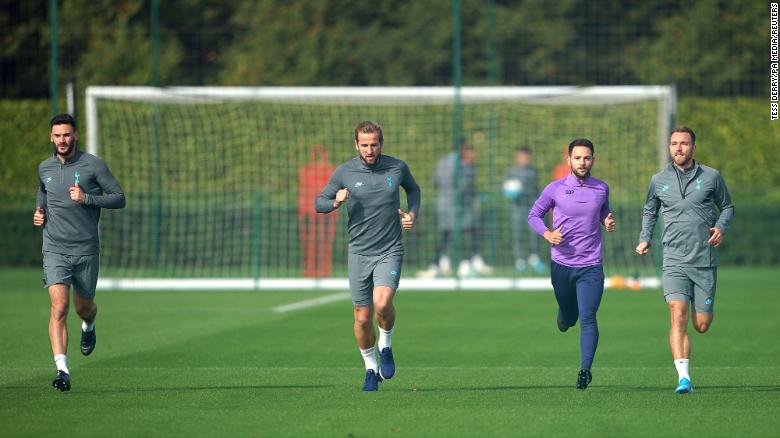
Hugo Lloris (far left), Harry Kane (center left) and Christian Eriksen (far right) during a training session when they were Tottenham teammates.
Human rights issues
Much of the buildup to this year’s tournament has focused on Qatar’s treatment of migrant workers and the country’s anti-homosexuality laws.
In May, Norway’s FA President Lise Klaveness gave a stinging speech where she said the decision to give World Cup hosting rights to Qatar was “unacceptable,” insisting that FIFA should do more to uphold its principles of human rights.
A month later, Amnesty International sent an open letter co-signed by other human rights organizations to FIFA President Gianni Infantino, asking football’s international governing body to designate at least $440 million to reimburse migrant workers.
The letter followed a report published by Amnesty in April that said security guards who are migrant workers in Qatar — including some with jobs on projects linked to the World Cup — are being put through working conditions “which amount to forced labor.”
In a statement, Qatar’s Supreme Committee for Delivery and Legacy said it has been “committed to protecting the health, safety and security of any worker engaged on official FIFA World Cup projects.”
However, the Amnesty report claimed the SC and FIFA fell short of conducting “adequate due diligence” before contracting private companies for the World Cup.
Australian footballer Josh Cavallo has also spoken out ahead of this year’s World Cup.
Until Blackpool FC’s Jake Daniels came out as gay in May, Cavallo was the only current, openly gay player in men’s top flight football. He told English newspaper the Guardian last year that he would be “scared” to play at the 2022 World Cup in Qatar, where homosexuality is illegal and punishable by up to three years in prison.
Responding to Cavallo’s fears, Nasser Al Khater, the chief executive of the tournament’s organizing committee, told CNN Sport’s Amanda Davies: “On the contrary, we welcome him here in the state of Qatar, we welcome him to come and see even prior to the World Cup … Nobody feels threatened here, nobody feels unsafe.”
‘They’re making a stand’
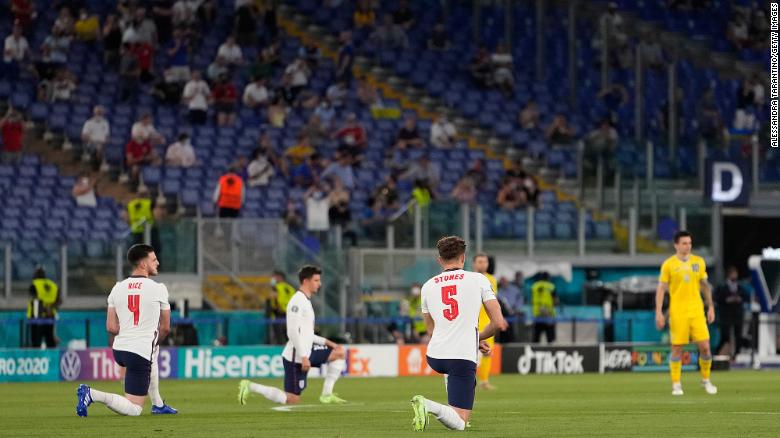
Declan Rice (far left) and John Stones (center right) take the knee prior to England’s Euro 2020 quarterfinal against Ukraine.
The current roster of footballers in England’s men’s national team have historically taken a stance on social issues.
Before and during the Euro 2020 tournament last summer, England’s players took the knee ahead of each game — an act manager Gareth Southgate said showed their support of anti-racism — even though the gesture continued to divide fans.
In 2020, England forward Marcus Rashford steered a campaign to end child food poverty and successfully persuaded the UK government to reverse its decision to not extend free school meal vouchers for disadvantaged children during the summer holidays.
“They’re making a stand every time they speak,” Southgate said during the press conference on Monday.
Southgate said he had met with some of the workers in Qatar and “had a long discussion” with them, adding, “I’m back out there in a few weeks.”
“The FA are doing things. I know Harry has had conversations with some of the other captains as well, because we think some collective standpoints would be important,” Southgate added.
“I think to have that consistency, I don’t think countries are wanting to outdo each other or pick each other off. I think they’re trying to do something that would try to make a difference if possible. So, you know, there’s a lot going on behind the scenes.”
The World Cup is set to take place from November 21 to December 18 later this year.
Emir of Qatar, Sheikh Tamim bin Hamad Al Thani, has disclosed the upcoming 2022 FIFA World Cup will be a special one as he opens up on discrimination against the Arabs.
“For decades now, the Middle East has suffered from discrimination,” he said on Monday.
“And I have found, that such discrimination, is largely based on people not knowing us, and in some cases, refusing to get to know us. Even today, there are still people who cannot accept the idea, that an Arab-Muslim country would host a tournament like the World Cup.
“These individuals, including many in positions of influence, have launched attacks, at a pace never seen before,” the emir said.
Qatar’s leader said that other countries and regions had already staged major events, “despite the fact that each of those countries, has its own particular problems and challenges.
“Qatar is just like your own country… not perfect, constantly trying to improve, and full of hope, for a brighter future.
“We are so proud of the development, reform, and progress we have made, and we are grateful for the spotlight that the World Cup provided, which inspired us, to make these changes at lightening-speed,” he said.
The 2022 World Cup will be staged in the Asian country between November and December later this year.


 At first glance, this year’s draw seems pretty even-handed. Group E, with Spain and Germany, looks sewn up from the start, as does Group F, with Belgium and Croatia. But anything could happen in the other groups.
 4. Group G: Brazil, Switzerland, Serbia, Cameroon