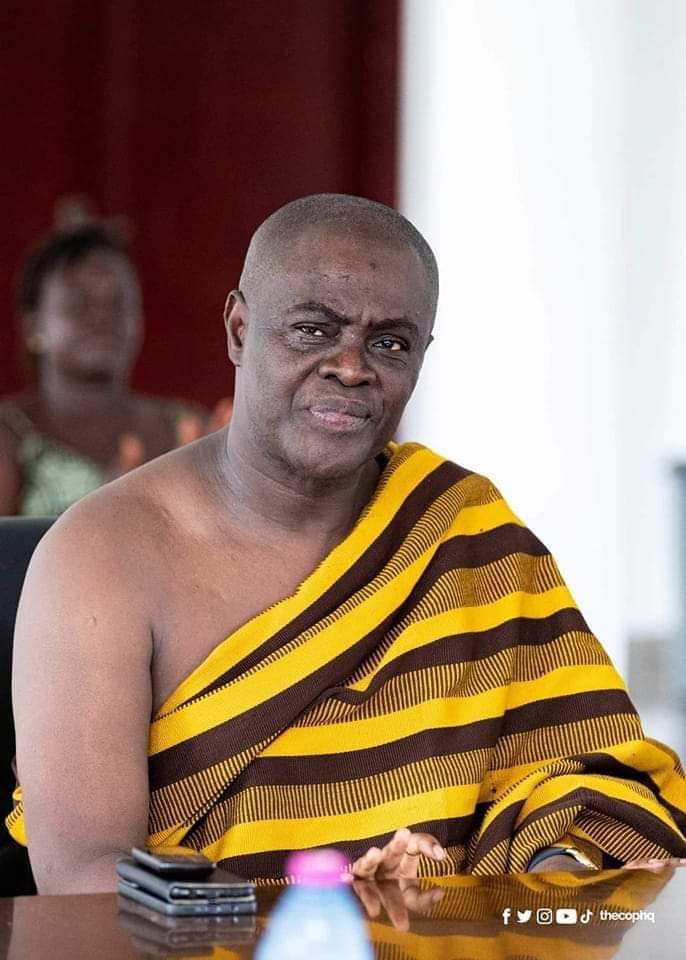
Founder, and leader of Ebenezer Miracle Worship Centre, Prophet Ebenezer Adarkwa Yiadom, popularly known as Opambour, has strongly criticized the Dormaahene, Oseadeeyo Agyeman Badu II for his recent attacks on the Ashanti kingdom and its ruler, the Asantehene Otumfuo Osei Tutu II.
Opambour asserted that the status of Asantehene, Otumfuo Osei Tutu II, as a ‘king’ is unquestionable, as his throne surpasses any other traditional ruler in the country.
He dismissed arguments challenging Otumfuo’s supremacy and pointed to Otumfuo’s invitation by King Charles III during the late Queen Elizabeth II’s funeral as evidence of his elevated status.
Speaking on Prophet 1 TV, Opambour advised Dormaahene to cease his criticisms of Otumfuo, emphasizing the difference in their respective positions of kingship. Opambour even suggested that the Dormaahene should ‘shut up’ regarding his critiques.
“Was he invited by King Charles during the Queen’s funeral? Dormaahene should stop doing that. We don’t want this to continue. Whatever Otumfuo’s state is, we like it, so he should shut up,” exclaimed Opambour.
Opambour highlighted Otumfuo’s unique privilege at the late Queen’s funeral, stating, “When King Charles’s mother died, Otumfuo was allowed to enter the palace with his convoy while presidents were denied such privilege.”
📌His Majesty Otumfuo Osei Tutu II, Asantehene, has received the invitation of His Majesty King Charles III to attend the events marking the State Funeral of Her Majesty Queen Elizabeth II.#Opemsuoradio#opemsuo1047pic.twitter.com/gxlFenGnzU
The Dormaahene Osagyefo Oseadeayo Agyeman Badu II, had in a recent interview with Ghanaweb, stated that there is “no King in Ghana” as the 1992 constitution does not make any reference to that title.
He also cautioned chiefs under the Dormaa jurisdiction against paying allegiance to any paramountcy aside from the one that granted them their throne.
These remarks, alongside numerous other anti-Otumfuo comments from Dormaahene, have ignited widespread debates regarding the extent of Asantehene’s authority and his influence over subordinate stools within the Kingdom.
The ongoing discourse delves into the intricacies of traditional hierarchies, raising questions about the dynamics of power and allegiance within the Ashanti Kingdom.
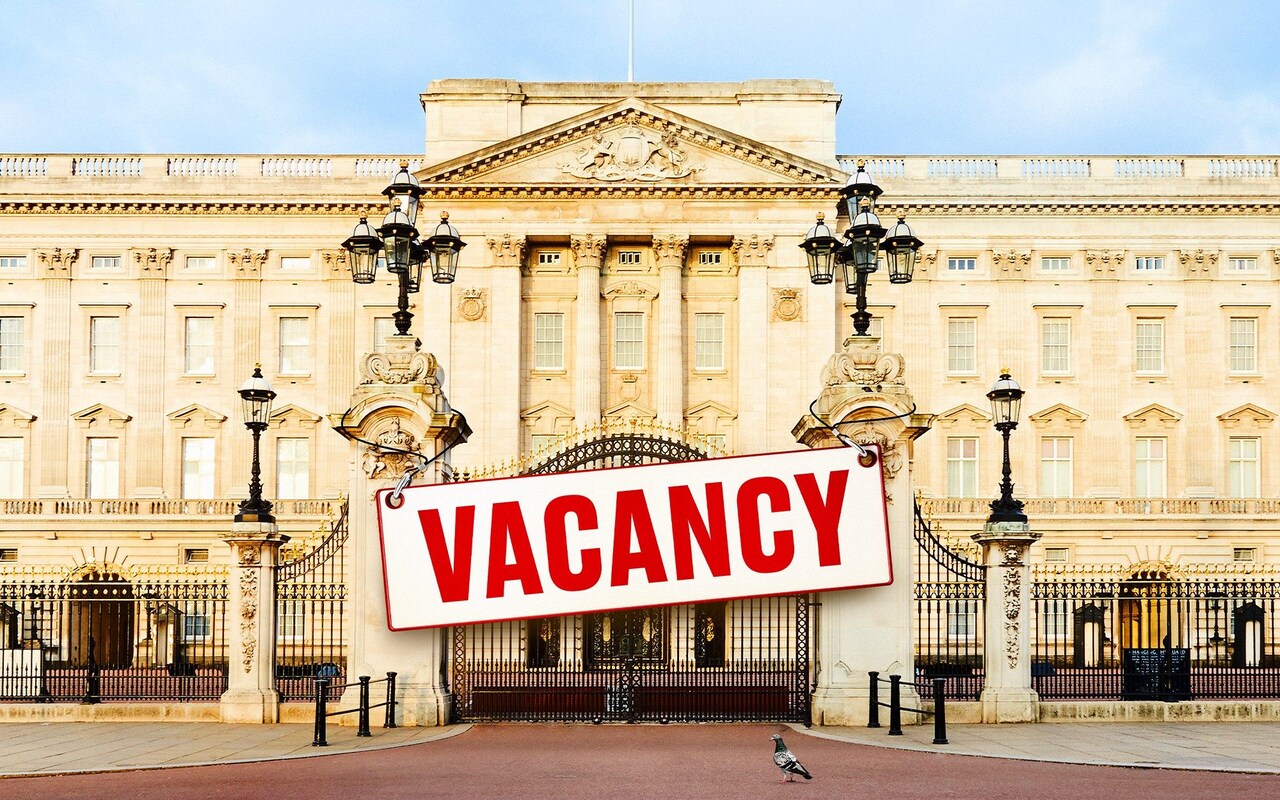
It has 775 rooms, a cinema, pool, tennis court, secret doorways, 42 acres of gardens and a lake, so why has it fallen out of favour?
Each year, millions of tourists press their faces through the gates of Buckingham Palace just to marvel at its Portland stone facade and imagine the sumptuous interiors that lie beyond.
But, for all its majestic scale and appearance, admirably central location and extraordinary range of accommodation and facilities, none of those qualified seem keen to take up residence.
Elizabeth II and Prince Philip had no affection for the place, and King Charles and Queen Camilla do not, by all accounts, relish the prospect of relocating there from Clarence House once current refurbishment work is completed. The late Queen signed off the ambitious £369 million project in 2017.
Earlier this month, a spokesman for the King said it was “currently the intention” that their majesties would move in when workmen move out in 2027. It was a long way short of saying they could not wait to live in the world’s most famous palace, and will do little to dampen speculation that the couple might never occupy it.
By the time the reservicing work is completed, the King and Queen will both be pushing 80 – not the sort of age at which most people are considering a house move. The King has lived at Clarence House for 20 years and made it his own with the help of interior designer Robert Kime, whereas the Palace’s interiors are preserved in aspic.
The grand White Drawing Room Credit: Getty
The truth is that Buckingham Palace is the least homely of the 12 residences that the King uses each year, so it is little wonder that it inspires so little affection.
Even his mother, the epitome of duty, was reluctant to move in when she became sovereign in 1952. According to legend, it was only when her prime minister, Winston Churchill, put his foot down that she gave up hope of staying in Clarence House.
“You are basically living above the office,” said one former servant, “so it doesn’t lend itself to privacy and it’s not an easy place to relax.”
Monarchs only stay at Buckingham Palace when they are working, meaning that for them it is a physical representation of the responsibilities that weigh heavily upon them, rather like the Downing Street flat is to the Prime Minister. Conversely Balmoral, Sandringham and Windsor (and Highgrove in the King’s case) represent a chance to get away from those duties, even if red boxes and prime ministerial visits continue.
Nor does the Palace compensate its occupants by offering them the sort of luxury living that those millions of tourists might imagine.
“Ironically, you couldn’t describe the Royal living quarters at Buckingham Palace as palatial,” says one former servant. “When private citizens buy a big house, they use all of it as their living space, but at Buckingham Palace they are confined to a small corner of quite a draughty building.
“You are talking about a bedroom, bathroom, sitting room, reception area and not much more than that.
Buckingham Palace’s State Dining Room has hosted many special events over the decades Credit: PA
“It has to be said that the King has always operated on the basis that he is happy with a bedroom, study and sitting room, but even Clarence House has more private living space, as the first and second floors are just for the King and Queen.”
Generations of Royal family members have found Palace life challenging. Edward VIII complained about “the gloom of Buckingham Palace” and how the family would “freeze up” as soon as they went inside. When the then Princess Elizabeth moved in with her family in 1937, the Palace had a full-time pest controller to dispose of mice, and her governess likened staying at the Palace to “camping in a museum”.
The mice were still in residence when the Obamas stayed at the Palace in 2011 (Barack Obama was terrified his wife, Michelle, who is frightened of mice, would find out), and the couple found themselves accommodated for the first and only time in a presidential guest suite that did not have an en-suite bathroom. The Obamas had to cross a corridor to clean their teeth and wash.
Queen Elizabeth II, US President Barack Obama, Michelle Obama and Prince Philip, Duke of Edinburgh, arrive for a state banquet at Buckingham Palace Credit: Getty
The private apartments are contained at the back of the north wing – the rear right-hand corner when looking at the front of the building – with a view looking out onto Constitution Hill.
The majority of the 775 rooms are accounted for by the 188 staff bedrooms, 52 guest rooms, 92 offices, 78 bathrooms, 19 state rooms and various other service rooms, including kitchens, storage rooms and staff canteens.
Clarence House is also rather easier to heat. Throughout her life, the late Queen used a two-bar electric fire to heat rooms at Buckingham Palace in which enormous fireplaces were never lit. The King is so appalled at the energy bills for Buckingham Palace that he has ordered staff to set the thermostats at no higher than 19C (66F) in the winter, and when rooms are not being used they are turned down to 16C, with radiators turned off completely at weekends. He has also stopped heating the swimming pool. It has cut the carbon footprint and kept costs down, but adds to the impression of a building that has been mothballed.
The King likes his homes to be well ventilated anyway, but the Queen feels the cold, and friends of the couple say it is no secret that Her Majesty is even less keen on a move to Buckingham Palace than her husband.
“The King is very mindful of appearances and having the monarch living at monarchy HQ,” said one royal source. “He doesn’t view these things as a choice; he just views it as what is done.”
The King knows that staging balcony appearances in a vacated building would not be the same Credit: PA
Would all those millions of tourists still flock to Buckingham Palace come rain or shine if it were unoccupied?
Visit Britain says it has never asked that question in any tourist surveys, but the King does not want to risk finding out the answer. He knows that family appearances on the balcony, in particular, are a hugely important driver of public affection for the monarchy, and that staging such moments in a vacated building would never be the same.
Sir Michael Stevens, keeper of the privy purse, said last month that the Palace will remain “at the heart of Royal and national life” once the current refurbishments are complete, which have included rewiring and the installation of lifts to make the building more accessible.
He was at pains to point out that even with building work going on, the Palace hosted garden parties, receptions, lunches, investitures and formal dinners.
It will take 18 months to clear 70,000 objects from the north wing, which houses the royal apartments, followed by two years of construction work on the wing.
At the presentation of the Royal Household’s annual accounts last month, a Buckingham Palace spokesman said: “It is currently the intention that Their Majesties will occupy the private apartments of Her Late Majesty at the end of the reservicing programme. At this point, I’m not in a position to speculate about the future use of Clarence House.”
Part of the equivocation could be down to a realisation that as the King and Queen approach their 80s, their health could be a factor in any decision to upend their lives with a move to the Palace.
If for any reason they did not move in, it could mean that the late Queen was the last monarch to reside in the building.
King George VI and Queen Elizabeth, the late Queen Mother, at the Palace in 1948 Credit: Corbis/Getty
What, then, would become of it? One thing that is already guaranteed is that the Palace’s 10-week summer opening to tourists will be extended in order to maximise revenue (all of which goes towards running costs), and more parts of the Palace could be opened up to the paying public.
There has already been speculation that the whole building could be turned into a museum, enabling the Royal Collection Trust to display more of its million-object collection.
The drawback with that idea is that it would clash with set-piece events such as garden parties, investitures and state banquets, which cannot realistically be carried out at any other royal building in the capital.
There is also little appetite from the London Assembly for another art gallery in a city that already has the National Gallery, the Tate, the National Portrait Gallery, the Royal Academy, the Hayward Gallery and the Wallace Collection, among others.
So it seems likely that the King will have to become a reluctant resident in a home built for Georgian tastes and finances, embraced by Queen Victoria, but imperfect for the means and mores of a 21st-century monarch.
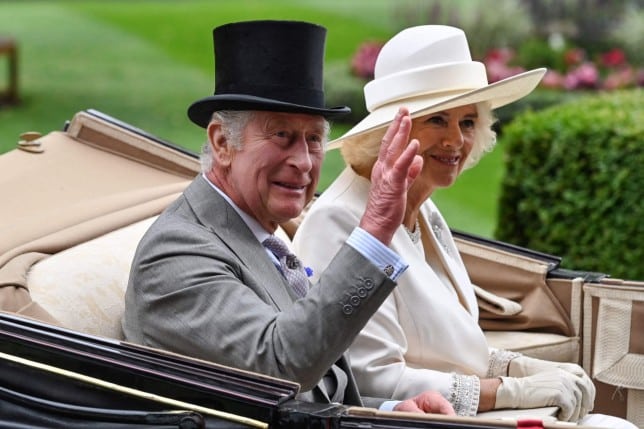
Charles and Camilla attended Royal Ascot for the first time since ascending to the throne, paying a heartfelt homage to the Queen and her passion for horses.
The Royal couple visited the athletic event for the first time in their new roles, wishing racegoers success, and ushering in a new era for Ascot.
In a joint foreword for the official programme, they acknowledged Queen Elizabeth‘s “lifelong interest” in the racing event as they rushed onto the Berkshire course in the customary carriage parade.
The pair waved to the crowds who filled the grandstand on the first of five days of racing and were joined by the Duke and Duchess of Wellington in their carriage.
Behind them travelled the Princess Royal with Camilla’s younger sister Annabel Elliot, the Queen’s nephew Sir Ben Elliot, former co-chair of the Conservative Party knighted in Boris Johnson’s resignation honours list, and his wife Lady Elliot, daughter of musician Steve Winwood.
The late Queen was a passionate racehorse breeder and had more than 20 Royal Ascot winners during her 70-year reign.
In memory of her commitment to the event the race – Platinum Jubilee Stakes- has been renamed the Queen Elizabeth II Jubilee stakes.
Before the carriage rides old footage from the Queen’s most memorable Royal Ascot moments was played on the big screens and was applauded by the crowds at the end.
Charles and his wife, who have taken on the late monarch’s thoroughbreds, will be carrying on her tradition and have entered a string of horses over the next five days.
The official programme featured Charles and Camilla’s intertwined cyphers on the cover and in their joint foreword said: ‘We are happy in the knowledge that this historic race meeting continues to be a key influence on the global racing and breeding industries.
‘The royal meeting always played a central role in her late majesty Queen Elizabeth’s calendar and the naming of the Queen Elizabeth II Jubilee Stakes will be a most appropriate way to mark this lifelong interest.
‘A photographic exhibition in the Grandstand will also celebrate the late Queen’s close association with Royal Ascot, including images of some of her 24 winners.
‘We are sure that this exhibition will prompt many happy memories.’
They went on to say: ‘Finally, we wish the very best of good fortune to all the owners, breeders, trainers, jockeys and hardworking stable staff with runners this week.
‘It is a huge and rare achievement to have a runner at Royal Ascot and we very much hope that you all enjoy the experience.’
One benefit of Queen Elizabeth‘s that stood out over her 70-year reign was the fact that she celebrated two birthdays, which was something the rest of us could only hope for.
Her Majesty was born on April 21st, 1926, but her ‘formal birthday celebration’ was the annual Trooping of the Colour parade, which takes place in the summer, typically in June.
Today, June 17, is Trooping of the Colour, and King Charles will carry on the tradition for the first time as monarch while also marking his “official birthday.”
But why does the King have two birthdays, and how did the tradition begin?
Why does King Charles III have two birthdays?
King Charles will carry on the tradition of Trooping the Colour, which dates all the way back to 1748.
So, as a result, it’s implied he will indeed continue having two birthdays.
The first royal ruler to have two birthday celebrations was the Queen’s distant relative, King George II – who wished to throw a public celebration, with a parade and plenty of pomp and circumstance to mark the occasion of his birthday.
However, having been born in November, the odds on the weather holding out for a huge outdoor bash in the UK were pretty slim.
Instead, the monarch decided to use the UK’s annual military parade held in the summer as his official birthday celebration, meaning that he would mark his birthday twice – once for the public in the summer and once in private in November.
Rather conveniently, our now King’s birthday is also in November – so Charles’ decision to host Trooping the Colour 2023 on June 17 feels more connected to history than ever before.
When it’s eventually time for the nation to have a King William, the tradition of two birthdays might come to an end.
This is because William’s birthday is already in June.
At the beginning of the recently concluded season, no rational pundit or fan expected Arsenal to be contenders for the title,not even Mikel Arteta.
Hope is often the culprit that leads to despair, as when hope fades, people tend to grasp onto anything to avoid sinking into misery.
Aiming for a top-four finish appeared to be a realistic goal for a young team that was still adjusting to the challenges of English top-tier football.
But game by game, the Gunners went from strength to strength and by the time the season took a break to pave way for the2022 World Cup in Qatar – it looked as if Arteta could lead the young guns to a first Premier League title since Arsene Wenger’s ‘Invincibles’ in 2004.
After all, almost every team that has been on top of the league on New Year’s Day went on to win the title.
Arsenal’s ‘excuses’ for losing EPL
But unknown to Arteta and Arsenal fans, they were facing the unstoppable and well-oiled force that is Manchester City.
One knows how the story goes by now – Pep Guardiola won his third consecutive league title.
Enter the excuses:
Well, from injuries to key players like William Saliba to the inexperience of the young players, Arsenal fans have conjured up reasons why their side couldn’t last the mile.
But no excuse seems crazier than one Gunners fan, who blamed Queen Elizabeth II’s death last year for their struggles at the end of the season.
In a TikTok video shared by @globalmanunitedfans, the unidentified Arsenal fan claims the Queen’s passing came just when his team were at the peak of their season.
Queen Elizabeth II’s death
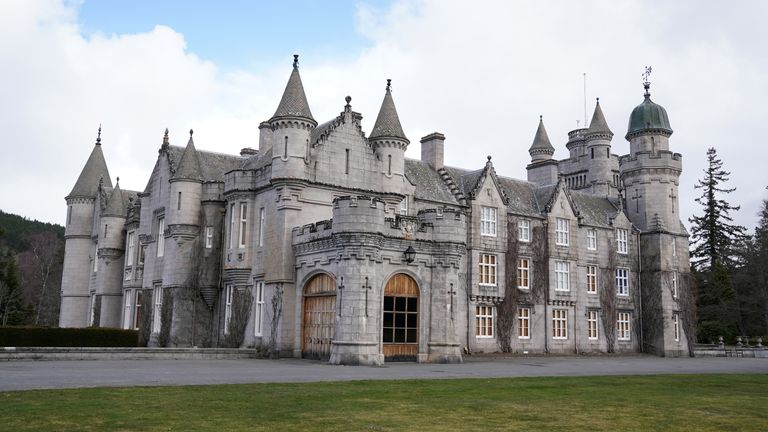
Queen Elizabeth II passed on aged 96 years on September 8, 2022, at the Balmoral Castle after ruling for 70 years, as reported by BBC News.
Before her death, Arsenal were supposed to play City on October 19, but a lot of fixtures were rescheduled to allow the nation to mourn the death of the longest-serving monarch.
As the fan argues, had the game been played when it was intended, Arsenal could have beaten Manchester City.
“Our form going into that game was crazy. We had just registered six consecutive wins. We were phenomenal. We were absolutely on fire.
We had no injuries. City had just drawn with Copenhagen [in the Champions League] and lost to Liverpool. We were unlucky because it was a once-in-a-lifetime incident.”
It’s perhaps a good thing he started his argument with the phrase ‘bear with me’.
When the two sides eventually met in the rescheduled fixture on April 26, the defending champions blew away Arsenal 4-1 to register the first tectonic shift in the title race.
The EPL title loss is a moment that will take a while before it fades away, but the young stars under Arteta can take solace in the fact that they dared to rival City for the title.
For Arsenal fans, any excuse that helps them sleep at night is understandable.
Aguero backs Arsenal, Manchester United
Sports Brief also reported that Sergio Aguero named the only two teams he believes have what it takes to challenge Manchester City for the Premier League title next season.
Kun, who won the English top flight on five occasions with the mighty Citizens, has backed Arsenal to challenge City for the crown next season, and feels Man United can too.
Queen Elizabeth had two birthdays, which was a privilege that the rest of us could only imagine. This benefit stood out throughout her 70-year reign.
Her Majesty was born on April 21st, 1926, but every year, in June normally, the summer parade Trooping the Colour served as her “official birthday celebration.”
Will the newly crowned King Charles III continue the custom after his coronation today?
Queen Elizabeth had two birthdays, which was a privilege that the rest of us could only imagine. This benefit stood out throughout her 70-year reign.
Her Majesty was born on April 21st, 1926, but every year, in June normally, the summer parade Trooping the Colour served as her “official birthday celebration.”
Will the newly crowned King Charles III continue the custom after his coronation today?
Will King Charles III have two birthdays?
King Charles will carry on the tradition of Trooping the Colour, which dates all the way back to 1748.
So, as a result, it’s implied he will indeed continue having two birthdays.
The first royal ruler to have two birthday celebrations was the Queen’s distant relative, King George II – who wished to throw a public celebration, with a parade and plenty of pomp and circumstance to mark the occasion of his birthday.
However, having been born in November, the odds on the weather holding out for a huge outdoor bash in the UK were pretty slim.
Instead, the monarch decided to use the UK’s annual military parade held in the summer as his official birthday celebration, meaning that he would mark his birthday twice – once for the public in the summer and once in private in November.
Rather conveniently, our now king’s birthday is also in November – so Charles’ decision to host Trooping the Colour 2023 on June 17 feels more connected to history than ever before.
When it’s eventually time for the nation to have a King William, the tradition of two birthdays might come to an end.
This is because William’s birthday is already in June.
420 years have passed since Queen Elizabeth I passed away, but researchers now think they know how she died.
After losing her adviser and several close friends, the ‘Virgin Queen‘ was said to have experienced depression in the final weeks of her life.
She was also dealing with other excruciating conditions, such as rotten teeth that had caused abscesses in her mouth, pus-filled glands, a swelling hand that required the removal of her coronation ring, and mental health issues that caused her to withdraw from public life.
However, a modern-day autopsy carried out by Home Office pathologist Dr. Brett Lockyer has concluded that it was pneumonia that ultimately killed her.
In the second and final episode of the Sky History series Royal Autopsy, Professor Alice Roberts had previously helped investigate the cause of death for King Charles II, with tonight’s episode focusing on the last Tudor ruler.
Investigating the clues that had been left behind, they looked at several health issues that could have killed her.
The ‘Virgin Queen’ died aged 69 in 1603
Before this investigation, Elizabeth I’s cause of death aged 69 was unclear, and while it was suspected it could be blood poisoning, she made her wishes very clear before she died that she did not want a post-mortem carried out.
Explaining how obsessed Elizabeth was with projecting an appearance of youth to maintain power, Professor Roberts investigated how the white make-up she used, a trend at the time, could have been dangerous.
‘She pasted this onto her face day in day out for years…it was a toxic metal,’ she explained in the episode.
Although it didn’t kill her, Dr. Lockyer did say that the Queen had been suffering from the effects of chronic lead poisoning, which had caused significant hair loss and rotting teeth.
‘They were in terrible condition and there was some dental abscess and gingivitis,’ Dr. Lockyer explained.
‘The Queen’s final months must have been agony,’ Professor Roberts added.
Home Office pathologist Dr. Brett Lockyer and Professor Alice Roberts lead the series (Picture: Sky)
The two did also speculate that bacteria from infections in her mouth could have contributed to her death.
‘It does cause a lot of pain because infection was building up and it was not going to have made talking or swallowing very easy for her,’ Dr. Lockyer said.
‘It’s an end-of-life condition effectively. Her body is slowing down and closing down.’
Although it was a sign that she was dying, it was not the cause. A swelling to her left hand also indicated her heart was not functioning properly.
Linda Marlowe plays Queen Elizabeth I in the series (Picture: Sky/Paul Olding)
After 45 years on the throne, her coronation ring had to be cut off because of the severity of the swelling, also leading the two experts to consider if sepsis developed because of this.
Thin and emaciated by the time she died; the autopsy carried out based on the symptoms she was displaying showed that Elizabeth had a fluid build up in her lungs and her heart was not pumping effectively.
But when it came to making his conclusion, Dr. Lockyer said he was sure that what had killed her on March 24, 1603, was pneumonia.
‘That was the reason she died. I think the infection in her lungs possibly entering into her system gave her blood poisoning,’ he said.
‘The heart failure could have very well of been tipped over. Her heart was working to a point until it encounters something which meant it had to work harder to get blood around the system, so the cause of death is going to be the bronchial pneumonia, without a shadow of a doubt, but the heart failure had an added role.’
As Professor Roberts explained there had been some ‘red herrings’ in the investigation, but that hundreds of years later, we now know what killed the last monarch of the House of Tudor.
Despite jeers from the crowd gathered outside of King Charles III’smost recent engagement, he maintained his composure and continued.
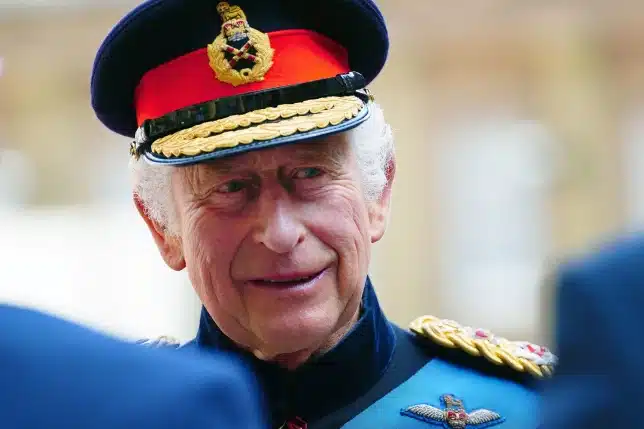
The King, 74, visited Milton Keynes on Thursday to mark the city’s promotion to that status as part of Queen Elizabeth II’s Platinum Jubilee. Protesters held up yellow signs that said “Not My King” as he approached the Church of Christ the Cornerstone.
Twenty protesters, according to Daily Express Royals correspondent Richard Palmer’s tweet, were present. The anti-monarchy group Republic, which intends to demonstrate against King Charles’ coronation on May 6, organised the effort.
The King appeared to ignore the protestors and seemed to be in good spirits as he shook hands with people who came out to see him, some waving Union Jack flags. As seen in a video shared on Twitter by Heart News East, a chorus of “God Save the King” rang out in a show of support.
ARTHUR EDWARDS/POOL/AFP VIA GETTY
In December, King Charles kept his cool during a walkabout in Luton when an egg was allegedly thrown in his direction. He was greeting well-wishers gathered outside Luton Town Hall when an egg flew towards where he stood, the Associated Press reported. According to the outlet, protection officers redirected the royal to another point, where he continued shaking hands with the people who came out to see him. Bedfordshire Police said that a man in his 20s was detained and taken into custody, the BBC reported.
Similarly, in early November, the King and Queen Camilla were on a walkabout in York when someone in the crowd threw eggs in their direction, the projectiles landing just inches away. King Charles and Queen Camilla, both 75, were out at Micklegate Bar, a historic gateway in the northern English city where the monarch traditionally enters, when the food was thrown. A protester — who reportedly called out, “This country was built on the blood of slaves” — was detained by four police officers, according to the Northern Echo.
Charles followed in his late mother’s footsteps at the Church of Christ the Cornerstone. The hub was the first ecumenical city centre church in the U.K. and was formally opened by Queen Elizabeth in 1992.
Inside, King Charles attended a reception to meet local groups dedicated to charity, business, faith, the environment and the arts in Milton Keynes, which is about a two-hour drive north of London. He then moved to the Milton Keynes Food Bank to learn more about the organization’s outreach and impact in the area.
The monarch gave a short speech, in which he said he was “delighted” to celebrate Milton Keynes’ new city status.
“So ladies and gentlemen, as you mark your well-deserved status as one of England’s newest cities, I can only offer my heartfelt congratulations and my very best wishes for the future,” he said.
MARK CUTHBERT/UK PRESS VIA GETTY
The sovereign was alone during Thursday’s outing, as his wife, Queen Camilla, has tested positive for COVID-19 for the second time. Buckingham Palace announced the news Monday and confirmed the Queen Consort would be canceling her engagements for the rest of the week.
“After suffering the symptoms of a cold,Her Majesty The Queen Consort has tested positive for the COVID virus,” the palace said in a statement. “With regret, she has therefore cancelled all her public engagements for this week and sends her sincere apologies to those who had been due to attend them.”
The Duke of Sussex claims in his memoir that Queen Elizabeth II’s response to his request for her approval to marry Meghan was “cryptic.”
Prince Harry was unsure whether his grandmother was trying to tell him she wanted to refuse his request, was being sarcastic or playing word games.
The Duke feared he was “doomed to be the next Margaret”, he writes, in reference to his great aunt, Princess Margaret, who was not allowed to marry the love of her life, divorcee Peter Townsend.
The Duke recounts the moment he plucked up the courage to ask the Queen in his forthcoming book, Spare, which is officially published on Tuesday but was released early in Spain.
He admits he was “scared” and always nervous in her presence. And the moment was made even more awkward when the Queen simply replied: “Well then I suppose I have to say yes.”
Harry had no idea what she was saying.
‘She felt she had to say yes?’
He writes: “She felt she had to say yes? Did that mean that she was saying yes, but wanted to say no?
“I didn’t understand. Was she being sarcastic? Ironic? Deliberately cryptic? Was she allowing herself a bit of wordplay? I don’t remember my grandmother being a fan of wordplay and this would have been the strangest time to start being one (without mentioning tremendously inappropriate).”
The Duke had earlier confided in his aides, Ed Lane Fox and Jason Knauf, that he wanted to propose but was told there were “strict rules” governing such things and that first and foremost, he would have to ask his grandmother.
Harry suggests he was taken aback by the suggestion, asking if that was a “real rule”.
“It didn’t make any sense,” he writes. “A grown man asking his grandmother for permission to marry.”
However, he recalls the “absurdity” of his father, then 56, having to ask permission to marry the Queen Consort.
The Duke picked an October 2017 family shooting trip at Sandringham to make his move.
He opted not to tell Prince William of his plans because he had already warned him against it. “Too fast, too soon,” he is alleged to have said.
Harry claims his brother was “pretty discouraging” about him dating an “American actress” at all, implying that her nationality and profession was akin to being a “convicted criminal”.
Prince Harry claims his brother was ‘discouraging’ about him marrying an ‘American actress’ – KIRSTY O’CONNOR/AFP
On the day in question, he watched the late Queen drive a Range Rover into the middle of a field to look for dead birds, alone and with no security.
“I tried to engage her in some light chat to loosen her up,” he writes.
“The full seriousness of all this was finally starting to sink in.”
The Duke muses over what would happen if his grandmother said no. Would he dare to disobey her or would he have to end his relationship with Meghan?
“This moment was either the start of my life or the end,” he says. “It would all come down to the words I chose, how I delivered them and how granny heard them.”
With a dead bird in each hand, he chased after the Queen as she approached her vehicle, surrounded by hunting dogs.
“I needed to get to it without one more second of hesitation,” he writes.
“I saw her waiting for me to speak, and not waiting patiently.
“Her expression screamed: ‘Out with it.’”
Agonisingly long pause
He says: “Granny, you already know that I love Meg a lot, and I have decided that I’d like to ask her to marry me, and they’ve told me that… well…. I have to get your authorisation before asking for her hand.”
She replies: “You have to do that?”
“Yes,” he says. “That’s what your people have said and mine too.”
The Duke reveals her expression was impenetrable during an agonisingly long pause.
Eventually, she replies: “Well then I suppose I have to say yes.”
He finally realises that she has given him permission to marry and “splutters” thank you.
He was desperate to hug her, he says, but did not. Instead, he helped her into the vehicle and they made their way back to the rest of the family.
The death of Queen Elizabeth II has prompted an outpouring of reflection and reaction online. But not all was grief – some young Africans instead are sharing images and stories of their own elders, who endured a brutal period of British colonial history during the Queen’s long reign.
“I cannot mourn,” one wrote on Twitter, posting an image of what she said was her grandmother’s “movement pass” – a colonial document which prevented free travel for Kenyans under British rule in the east African country.
Another wrote that her grandmother “used to narrate to us how they were beaten & how their husbands were taken away from them & left to look after their kids,” during colonial times. “May we never forget them. They are our heroes,” she added.
Their refusal to mourn highlights the complexity of the legacy of the Queen, who despite widespread popularity was also seen as a symbol of oppression in parts of the world where the British Empire once extended.
Kenya, which had been under British rule since 1895, was named an official colony in 1920 and remained that way until it won independence in 1963. Among the worst atrocities under British rule occurred during the Mau Mau uprising, which started in 1952 – the year Queen Elizabeth took the throne.
The colonial administration at the time carried out extreme acts of torture, including castration and sexual assault, in detainment camps where as many as 150,000 Kenyans were held. Elderly Kenyans who sued for compensation in 2011 were ultimately awarded £19.9 million by a British court, to be split between more than 5,000 claimants.
The UK Foreign Secretary at the time, William Hague, said: “The British Government recognises that Kenyans were subject to torture and other forms of ill treatment at the hands of the colonial administration. The British government sincerely regrets that these abuses took place, and that they marred Kenya’s progress towards independence.”
Africa’s memory of the Queen cannot be separated from that colonial past, professor of communication Farooq Kperogi at Kennesaw State University told CNN.
“The Queen’s legacy started in colonialism and is still wrapped in it. It used to be said that the sun did not set over the British empire. No amount of compassion or sympathy that her death has generated can wipe that away,” he told CNN.
While many African leaders have mourned her passing – including Nigeria’s President Muhammadu Buhari, who described her reign as “unique and wonderful” – other prominent voices in regional politics have not.
In South Africa, one opposition party, the Economic Freedom Fighters (EFF), was unequivocal. “We do not mourn the death of Elizabeth, because to us her death is a reminder of a very tragic period in this country and Africa’s history,” the EFF said in a statement.
“Our interaction with Britain has been one of pain, … death and dispossession, and of the dehumanisation of the African people,” it added.
Others recalled Britain’s role in the Nigerian civil war, where arms were secretly supplied to the government for use against Biafrans who wanted to form a breakaway republic. Between 1 million and 3 million people died in that war. British musician John Lennon returned his MBE, an honorary title, to the Queen in protest over Britain’s role in the war.
Still, many on the continent remember the Queen as a stabilizing force who brought about positive change during her reign.
Ayodele Modupe Obayelu from Nigeria told CNN: “Her reign saw the end of the British Empire and the African countries … became a Republic. She doesn’t really deserve any award or standing ovation for it, but it was a step in the right direction.”
And Ovation magazine publisher Dele Momodu was full of praise, recounting meeting her in 2003 in Abuja while covering her visit to Nigeria. He added that he had fled Nigeria for the UK in 1995, during the dictator Sani Abacha’s regime.
“I told her I was a refugee and now the publisher of a magazine. She told me ‘congratulations,’ and moved on to the other people on the line. I salute her. She worked to the very end and was never tired of working for her country. She did her best for her country and that is a lesson in leadership,” he told CNN.
Momodu believes that the Queen did try to “atone” for the brutality of the British Empire. “She came to Nigeria during our independence and some of the artifacts were returned under her reign. That is why the Commonwealth continues to thrive. I feel very sad that the world has lost a great human being.”
Adekunbi Rowland, also from Nigeria, said: “The Queen’s passing represents the end of an era. As a woman, I’m intrigued by her story. This young woman had an unprecedented accession to the throne, and with much grace and dignity did everything in her power to protect the country and Commonwealth she loved no matter what it took.”
The Queen once declared, “I think I have seen more of Africa than almost anybody.”
She made her first official overseas visit to South Africa in 1947, as a princess and would go on to visit more than 120 countries during her reign, many of them on the continent.
It was while visiting Kenya in 1952 that she learned that she had become Queen. Her father George passed away while she was there with Prince Phillip and she immediately ascended the throne.
As colonialism later crumbled and gave way to independence and self-rule in what had been British overseas territories, the former colonies became part of a Commonwealth group of nations with the Queen at its head and she worked tirelessly to keep the group together over the years.
She forged strong bonds with African leaders, including Nelson Mandela, whom she visited twice in South Africa, and Kwame Nkrumah, with whom she was famously pictured dancing during her visit to Ghana in 1961.
However, there is now a growing clamor for independence and accountability over Britain’s past crimes such as slavery. In November 2021, Barbados removed the Queen as its head of state, 55 years after it declared independence from Britain, and other Caribbean countries, such as Jamaica, have indicated they intend to do the same.
Prince William and his wife, Catherine, Duchess of Cambridge, visited Jamaica in March but they faced protests and calls for reparations during the trip. There were also calls for a formal apology for the royal family’s links to slavery.
“During her 70 years on the throne, your grandmother has done nothing to redress and atone for the suffering of our ancestors that took place during her reign and/or during the entire period of British trafficking of Africans, enslavement, indentureship and colonization,” wrote members of a protest group, the Advocates Network Jamaica.
In June, Prince Charles became the first UK royal to visit Rwanda, where he was representing the Queen at the Commonwealth Heads of Government Meeting.
Following his mother’s death, he now heads the Commonwealth, and will embark on a new relationship with its members, about a third of which are in Africa.
Some are asking whether he will be as effective in building the organization as his mother, and above all, how relevant it still is, given its roots in Empire.
When Prince Harry and Meghan Markle welcomed their first child, it was decided he would be known as Archie Harrison Mountbatten-Windsor.
Archie would have gotten the “courtesy title” of Earl of Dumbarton upon his birth, but the couple announced he was not given a title and, instead, could be given the secondary Sussex title before inheriting the dukedom.
Following Harry and Meghan’s exit from the firm, however, and their bombshell interview with Oprah Winfrey, the Duchess of Sussex revealed Archie was actually not given a title.
She told the talk show host: “They didn’t want him to be a prince or princess, not knowing what the gender would be, which would be different from protocol, and (said) that he wasn’t going to receive security.”
She added, in a blow to the royal family: “In those months when I was pregnant… we have in tandem the conversation of, you won’t be given security, not gonna be given a title and also concerns and conversations about how dark his skin might be when he’s born.”
Now, according to a rule established by King George V after he issued a Letters Patent in 1917: “The grandchildren of the sons of any such sovereign in the direct male line (save only the eldest living son of the eldest son of the Prince of Wales) shall have and enjoy in all occasions the style and title enjoyed by the children of dukes of these our realms.”
This essentially means King Charles can now give prince and princess titles to both Archie and Lilibet. When – and if – that will happen, though, is unclear.
The Sussexes are still at odds with the firm, with sources saying though they appeared to unite following the queen’s death and the proceedings that followed, “no meaningful rapprochement” has been made.
Meanwhile, behind the scenes, there’ve been arguments over titles for Harry and Meghan’s children, according to People, with a spokesperson saying nothing of the sort will be decided while the family is in mourning; the mourning period will last one more week after the funeral.
How the line of succession looks after the death of the Queen
Of course, one can’t help but wonder about the likelihood of the above, with the royal website having already updated William’s title to Prince of Wales and all three of his children to Prince George of Wales, Princess Charlotte of Wales and Prince Louis of Wales.
The Duke of Sussex’s children, now sixth and seventh in line to the throne behind their father, are still listed as Master Archie Mountbatten-Windsor and Miss Lilibet Mountbatten-Windsor.
The director/actor/writer discussed the controversial couple — to whom he opened his home when they first moved to California — on Wednesday’s Today With Hoda & Jenna. He spoke about the “support” he offered when they stepped down as senior members of the British royal family, allowing them to live in his Beverly Hills mansion for months and use his security detail during the spring of 2020.
“It was a very difficult time for them,” Perry said.
He continued, “What I know about the two of them, and I wish the world knew, [is] how much these two people love each other. They found each other out of all these odds against them finding each other. They found each other and the love they have is really, really moving and I wanted to do anything I could to support them.”
Perry said he looks at the couple as an example of what he’d like to have in a relationship. (Perry and longtime girlfriend, Gelila Bekele, with whom he shares a son, split in 2020.)
“If I don’t have that, what she and Harry have, I don’t want it,” he said. “It’s true.”
The former Suits actress recently talked about Perry befriending her soon after she married Harry in 2018. While they hadn’t met, he communicated to her that he was praying for her “and that he understood what this meant,” she told The Cut in August. “He could only imagine what it was like” for a biracial American to marry a British royal. The billionaire media mogul urged her to reach out if she ever needed support.
In 2020, she did — after she and Harry abruptly left Britain and royal life. They had set up a temporary home, with son Archie (they now also have Lilibet), in Canada, but their whereabouts had been discovered by the media and they had no security, having relinquished their royal roles.
“Sometimes, you can tell your life story to a stranger on a plane as opposed to some of the people that are closest to you,” Markle said of reaching out to Perry — whom she still hadn’t met in person — for advice on their next move. The man behind the Madea franchise offered them his Beverly Hills mansion, and security detail, while they plotted their next move. They lived there for several months before buying their $14.7 million Montecito, Calif., compound.
In Markle’s sitting room of her new home — where neighbors include Oprah Winfrey (friend of Perry and the couple) — is a grand piano Perry gave her as a housewarming gift, with the instruction: “Write the soundtrack for your life,” as it was noted in The Cut interview.
Harry and Markle returned to the spotlight in England this month after the death of Queen Elizabeth on Sept. 8. Their every move has been chronicled as they reunited with the royal family — amid their ongoing estrangement, which exploded after their bombshell Winfrey interview in 2021 — to mourn the long-reigning monarch who was buried on Monday.
A royal insider told People magazine that William and Kate reuniting with Harry and Meghan “was awkward. Both couples found it hard. They were in a stoic spirit of just getting through it for the queen.”
Queen Elizabeth II’s state funeral on 19 September was an occasion complete with much pomp and ceremony, befitting her 70-year reign. Much has been reported, however, of King Charles III’s aspirations for a ‘slimmed-down’ monarchy – a notion that’s becoming all the more appropriate in light of the cost of living crisis. So what can we expect from the new King’s coronation, as an event traditionally associated with grandeur and majesty?
Following his mother’s death on 8 September, no date has been announced for the King’s coronation: a milestone that will formally mark his transition to the role of monarch. Royal precedent has typically dictated that the event come many months after the initial accession, due first to the observance of a respectful mourning period, as well as on account of the planning and preparation required. The coronation of the late Queen, for example, on 2 June 1953, came over a year after the death of her father in February 1952. The Telegraph reports that the King will likely be crowned next spring or summer.
On Monday, September 19, 2022; people from all walks of life attended the state funeral of Queen Elizabeth II at the Westminster Abbey in London.
Millions across the world followed the event on TV, online and across social media platforms as the world paid its last respects to the monarch who reigned for seven decades.
The event as expected was strictly by invitation, so much so that, even some world leaders were not invited – among others, Vladimir Putin and Emerson Mnangagwa, presidents of Russia and Zimbabwe respectively.
According to reports, four Ghanaians were formally invited to the event for different reasons. Ghana’s First Couple were in London for the event as were two other personalities with Ghanaian parentage who are British.
Nana Kofi Twumasi-Ankrah, a one-time equerry of the Queen was in attendance, escorting the cortege on its last journey from the Westminster Abbey to the Royal Vault. The fourth Ghanaian was Kwasi Kwarteng.
Kwarteng, who is British-born but with Ghanaian ancestry, and the current UK Chancellor of the Exchequer (Finance Minister), was also in attendance.
He, however, courted controversy on social media after he was captured in a viral video smiling at a point during the ceremony – specifically when a two-minute silence had been declared for the memory of the queen.
Angry social media users – especially on Twitter – called for his head for desecrating what was a solemn occasion for the nation.
Others also alleged that Kwarteng was smiling at himself because he was most likely picking a personal call and had been told something that gave his cause to smile at a rather off time.
Kwarteng, as a senior member of Prime Minister Liz Truss’ government had a prominent seat at the venue of the service.
Below are some of the critical tweets:
This is extraordinarily dreadful and concerning! Britain’s new chancellor @KwasiKwarteng laughing during the service of the #queensfuneral
Totally disrespectful but also raises more questions around his suitability for office.pic.twitter.com/JyoYzpSWUE
When Kwasi Kwarteng delivers his mini budget on Friday all opposition MP’s should coke up, wipe their brows, sway uncontrollably, and laugh like the laughing policeman. pic.twitter.com/mxPRaQ3aNG
For two minutes today the drumming will cease, the pipers will fall silent, the march of boots on procession routes will still.
For two minutes today, at the end of the funeral service in Westminster Abbey, before the national anthem is heard, before the coffin is taken away for committal and burial at Windsor, there will be silence.
And a door will swing shut.
A reign of seven decades will come to a close. For 10 rather bewildering days we have spoken of the Queen and the new king as if they could somehow both be with us.
Today that long week of transition comes to an end.
In the earliest years of her reign, a new Elizabethan Age was proclaimed by some. Such was the excitement over the young queen, the marvels of technology and the new prosperity, after the grinding grey of the depression years, the sacrifice of World War Two and the hard road of recovery after it.
She – wise in her earliest decades to fickle fashion – dismissed all that talk. But if this was not an age – and who are we to contradict her? – then it was an era, the Elizabethan Era.
Over decades of wrenching change, she was constancy, for a largely still-conservative country. That profile on the stamps, that voice at Christmas, that bowed head on Remembrance Sunday.
Today the door swings shut on that.
It swings shut too on “Prince” Charles, on his many decades as Prince of Wales.
His staff always bridled at the idea of him as an understudy or apprentice, pointing to his decades of achievement, of carving out a distinct role.
His challenge, once Royal Mourning is over, is in part to enjoy – and show that he enjoys – the role of monarch.
His mother understood that part of the job was to rally people – to take people’s minds off bills and dull jobs and complaining relatives, to entertain and divert and sometimes delight.
That he did good work as prince, transforming so many lives for the better, is unquestionable. But often, alongside, the impression given was that things were grim, that there was a lot of cause for complaint. The word “appalling” seemed to come up a lot.
Now the door swings shut on that. Britons want to see the best of themselves reflected in their sovereign.
And, as the silence stretches out across Westminster, across the capital and the country, the door swings shut on Elizabeth, on the woman known to so many and never really known at all, on the little girl known to her grandpa as Lilibet.
The proclamation has been read out by the Accession Council and Prince Charles Philip Arthur George is now Charles III.
The Accession Council, a body made up of senior politicians, judges and officials, proclaimed him as the monarch in the State Apartments.
It is the first time the historic ceremony has been televised.
The King himself was not present to begin with, but he attended the second part of the ceremony to hold his first Privy Council meeting.
Clerk of the Privy Council Richard Tilbrook proclaimed Charles “King, head of the Commonwealth, defender of the faith”, before declaring “God Save the King”.
The new King announced the death of his “beloved mother, the Queen”, adding that “The whole world sympathises with me in the irreparable loss we’ve all suffered.”
King Charles III pledged to uphold the constitution with the help of God Almighty just as his mother did.
“My mother’s reign was unequalled in its duration, dedication and devotion. Even as we grieve, we give thanks for this most faithful life.I am deeply aware of this great inheritance and of the duties and heavy responsibilities of sovereignty which have now passed to me,” he said.
Charles III then took the oath related to the security of the Church of Scotland and then signed the oath he has just declared in front of the Privy Council.
Witnesses including Prince William – the new Prince of Wales, Camilla, the Queen Consort have added their signatures to the document.
Prime Minister Liz Truss and Archbishop Justin Welby watched on as the signing of the proclamation took place.
Former UK prime ministers – including Gordon Brown, David Cameron Boris Johnson and Theresa May – lined up as the proclamation of the new king is read out.
Councillors lined up in the Throne Room of St James’s Palace for part two of the ceremony to greet the King.
Currently, members are exiting the Throne Room and signing the proclamation.
Also, the new King is about to be proclaimed publicly on the balcony overlooking Friars’ Court.
In his opening remarks, King Charles paid tribute to his late mother, Queen Elizabeth, describing her passing as “a moment of greatest sadness for me and all members of my familyâ€.
King Charles III expressed awareness and acknowledgment of the messages of commiserations from around the world.
He said that his family will find comfort in the “respect and deep affection in which The Queen†was widely held.
After Queen Elizabeth II passed away on Thursday, September 9, as such, King Charles III was proclaimed King of England.
The throne passed immediately and without ceremony to the heir, Charles, the former Prince of Wales following confirmation of the demise of his mother, Queen Elizabeth II on Thursday, September 8, 2022.
According to BBC, there are several protocols and traditional steps that he must go through to be crowned King.
There will be a new title for Charles’ wife, whose full title will be Queen Consort – consort is the term used for the spouse of the monarch.
Minutes before both Ms Truss and Labour leader Sir Keir Starmer had been informed of the news and had left the chamber.
Ms Truss later tweeted: “The whole country will be deeply concerned by the news from Buckingham Palace this lunchtime.
“My thoughts – and the thoughts of people across our United Kingdom – are with Her Majesty The Queen and her family at this time.”
Her words were echoed by other politicians.
Labour leader Sir Keir said he was “deeply worried” by the news and that he joined “everyone across the United Kingdom in hoping for her recovery”.
Scottish First Minister Nicola Sturgeon said: “All of us are feeling profoundly concerned at reports of Her Majesty’s health.
“My thoughts and wishes are with the Queen and all of the Royal Family at this time.”
Mark Drakeford – the first minister of Wales – said he was concerned to hear the news and that he sent his “best wishes to Her Majesty and her family on behalf of the people of Wales”.
Liberal Democrat leader Sir Ed Davey tweeted: “The whole nation’s thoughts and prayers are with Her Majesty The Queen and her family as we all hope and pray for her full recovery.”
Former Conservative Prime Minister David Cameron said he was “deeply concerned by the news this afternoon from Buckingham Palace.
“I send my heartfelt thoughts and prayers to Her Majesty The Queen and the Royal Family at this worrying time.”
Tony Blair – Labour prime minister from 1997 to 2007 – also said he was “deeply concerned” by the news and that his “thoughts and prayers” were with the Queen and her family.
On Wednesday, an online meeting between senior politicians and the Queen was postponed.
Buckingham Palace said the Queen had been advised to rest after “a full day” on Tuesday during which she met the outgoing prime minister Boris Johnson and his successor Ms Truss.
BBC political editor Chris Mason says: “It’s been a busy week for the monarch with that handover of power, her playing that crucial constitutional role in the resignation of one prime minister and the assumption of office of another.
“And we’ve also known in terms of her interactions with political leaders that they have dialled down a little bit, certainly in terms of the physical exertions required of her to perform them have dialled down in recent months.
“The overriding impression here at Westminster is the same it will be around the country – one of deep concern from our political leaders and politicians more broadly.”
The British monarch, Queen Elizabeth has experienced mobility problems since last autumn, and she now frequently employs a walking stick. She had to reschedule a number of public events earlier this year, which meant that she significantly missed her Platinum Jubilee celebrations.
The Queen will receive the new prime minister at her Balmoral estate in Scotland for the first time in her long reign.
Her Majesty will meet them on 6 September, a day after the new prime minister is announced.
She would normally appoint prime ministers from Buckingham Palace or Windsor Castle.
However, the 96-year-old monarch has been advised to remain at her Balmoral residence in Aberdeenshire, where she is enjoying her summer holiday.
It will be from there that she will install either Rishi Sunak or Liz Truss as prime minister on 6 September, breaking years of royal precedent.
It is understood the decision was taken at this stage in order to provide certainty for the prime minister’s diary.
If the Queen had experienced an episodic mobility issue next week and the plan had been to travel to London or Windsor, it would have led to alternative arrangements needing to be made at the last minute.
Since last autumn, the Queen has suffered from mobility issues and now regularly uses a walking stick.
This year, she has been forced to cut several official engagements short, and she notably missed much of her Platinum Jubilee celebrations, only appearing briefly on the palace balcony.
In June, she missed Royal Ascot for the first time since her coronation, with the Duke of Kent taking her place in leading the royal carriage procession.
She also contracted COVID-19 back in February, and later spoke about how it left her feeling “very tired and exhausted”.
The winner of the Tory leadership contest to succeed Boris Johnson is set to be announced on Monday 5 September.
His successor will then travel to Balmoral to be officially appointed by the Queen the following day.
Queen Elizabeth made some last-minute changes to her will to make sure Kate Middleton and Princess Charlotte would get the bulk of her jewellery collection worth $110M, a new report claimed.
Sources told Star Magazine, in its latest edition, that Queen Elizabethhas been rethinking her plans amid her health issues.
The monarch has been rarely seen in public lately, but she joined Princess Anne in opening a new building at Thames Hospice in Maidenhead, England.
At the time, Queen Elizabeth donned a blue floral frock and sported her signature necklace of pearls and a large, bejewelled brooch that belonged to her personally and not to the Crown. It is said to be an important distinction, especially for her heirs.
The jewels belonging to the Royal Collection, part of the regalia used in state ceremonies, will automatically pass to Prince Charles during his reign as King.
Why Queen Elizabeth and the Royal Family don’t have last names
However, the personal pieces of Queen Elizabeth, which are more than 300 items are hers to give as she chooses.
An unnamed source told the entertainment news outlet, “She’s been focusing on her beloved pieces and who deserves what.
“The whispers are that she’s made some last-minute changes to her will that’ll be a shocking surprise for her heirs.”
Insiders believe that Kate Middleton will be the big winner. Queen Elizabeth is rumoured to hand over some of her baubles to Princess Anne and Prince Andrew’s daughters Princess Beatrice and Princess Eugenie.
The unnamed informant claimed, “Kate Middleton and her daughter, Princess Charlotte are likely to get the bulk of the collection. Kate is clearly the family favourite.”
Camilla Parker-Bowles, who will wear the crown before Kate Middleton, has reportedly never been close with Queen Elizabeth and should not expect more than a token.
A tattler said, “She’d never say it, of course, but it’s one of the reasons Camilla resents Kate.”
Star Magazine noted that Prince Charles’ second wife could take some comfort that it’s the other duchess, Meghan Markle, and her daughter, Lilibet,who could really end up getting the royal shaft.
An unnamed source said, “There’s very good chance Queen won’t leave either of them any jewels of value.”
However, given Meghan Markle and Prince Harry’s decision to move to the U.S., “it’s not surprising, since they’re not working members of the royal family anymore. But, it would be a real slap in the face.
Queen Elizabeth has yet to report to the claims that she is taking account of her heirs, with more than $110M worth of jewellery in her private collection.
So, avid supporters of the British monarch should take all these unverified reports with a huge grain of salt until everything is proven true and correct.
London (CNN) — Britain’s Queen Elizabeth II canceled her planned virtual engagements on Tuesday as she continues to suffer from mild Covid-19 symptoms, Buckingham Palace has said.
The palace announced Sunday that the 95-year-old monarch had contracted the virus.
“As Her Majesty is still experiencing mild cold-like symptoms she has decided not to undertake her planned virtual engagements today, but will continue with light duties,” the palace said.
Light duties likely refer to her head of state responsibilities such as reading and answering documents and letters, which she receives daily in her famous red despatch boxes.
A source close to the palace told CNN that the Queen’s further engagements over the coming week will be decided upon nearer the time.Concern for the Queen’s health has been renewed given her advanced age and health issues late last year. However, she has continued to work since Sunday despite testing positive for the coronavirus, issuing a message of condolence to the people of Brazil over flooding in the country on Monday.Â
The Queen’s diagnosis is the latest Covid case to hit the royal household. Her eldest son and heir to the British throne, Prince Charles, contracted the virus for a second time on February 10, and had seen his mother “recently.” Days later, his wife, Camilla, also tested positive.
Additionally, a royal source told CNN Sunday that there had recently been “a number of cases … diagnosed in the Windsor Castle team.”
UK media have reported that the Queen is fully vaccinated. Buckingham Palace previously confirmed both the monarch and her late husband, Prince Philip, had received their first doses of a Covid-19 vaccine in January 2021. The palace has declined to reveal any information regarding subsequent vaccinations, citing medical privacy.
The Queen met with incoming Defence Services Secretary Major General Eldon Millar and his predecessor on February 16. The Queen — who reached the milestone of 70 years as British monarch on February 6 — had only recently resumed in-person engagements after taking a step back on advice from doctors to rest following an overnight hospital stay in October for an undisclosed reason.
She has used a walking stick at several engagements in recent months and referenced her mobility at an event last week. While holding an audience with two military secretaries in the Oak Room at Windsor Castle, she quipped: “Well, as you can see, I can’t move,” while gesturing to her leg. A royal source told CNN at the time that she was believed to have been feeling slightly stiff rather than injured or unwell.
She also has made plans to appear at a number of major engagements next month: a diplomatic reception at Windsor Castle on March 2, the annual Commonwealth Service at Westminster Abbey on March 14; and a service of thanksgiving for Prince Philip at the same venue on March 29.
Nationwide celebrations for her Platinum Jubilee are set to take place in June.
A 95-year-old Ghanaian World War Two veteran is to be honoured by Queen Elizabeth for his fundraising efforts.
Private Joseph Hammond walked two miles (3.2km) a day for a week in May, raising $35,000 (£28,000) for frontline health workers and veterans in Africa.
“I was overwhelmed and filled with joy,” he said on hearing he was to get a Commonwealth Point of Light award.
He said he had been inspired by fellow veteran Capt Tom Moore, who raised more than £32m in the UK to fight Covid-19.
Capt Moore completed 100 laps of his garden in the run-up to his 100th birthday in April for NHS charities.
This prompted Pte Hammond to start his own campaign to raise money to buy personal protection equipment (PPE) for health workers and to protect vulnerable veterans on the African continent.
He started each day’s walk in the capital, Accra, early in the morning so he could complete his two miles before the heat and humidity of the day peaked, reports the BBC’s Thomas Naadi.
He wants to raise about $600,000 in total, so the former Ghanaian soldier, who like Capt Moore fought in Burma, hopes donations will continue to be made, our reporter says.
‘He is a force of nature’
Iain Walker, the UK high commissioner to Ghana who joined Pte Hammond on his walk, said the Queen presented Points of Light awards to outstanding volunteers across the Commonwealth who changed the lives of their community.
“Pte Hammond exemplifies these qualities. It has been a privilege to get to know Pte Hammond and to experience his selflessness,” he said.
Earlier this month, he had received a letter from Prince Harry, the Queen’s grandson, commending him on his walk.




:max_bytes(150000):strip_icc():focal(749x0:751x2):format(webp)/king-charles-church-of-christ-021623-5-cc4f068e42f64c9caf5bde526b7c5152.jpg)
:max_bytes(150000):strip_icc():focal(749x0:751x2):format(webp)/king-charles-church-of-christ-021623-6-55e1027a8aea4ac7bbe9779d074d34d3.jpg)