Tag: Queen Elizabeth II

  • Death of Queen Elizabeth II: The moment history stops

    This is the moment history stops; for a minute, an hour, for a day, or a week; this is the moment history stops.

    Across a life and reign, two moments from two very different eras illuminate the thread that bound the many decades together. At each a chair, a desk, a microphone, a speech. In each, that high-pitched voice, those clipped precise vowels, that slight hesitation about public speaking that would never quite seem to leave her.

    Quote: 'I shall not have the strength to carry out this resolution alone'

    One moment is sun-dappled, though the British people were suffering through a terrible post-war winter. A young woman, barely more than a girl really, sits straight-backed, her dark hair pulled up, two strings of pearls around her neck. Her youthful skin is flawless, she is very beautiful. A life opens out ahead of her.

    She pledges that life to her audience around the world. She tells them: “I shall not have the strength to carry out this resolution alone.” And she asks for their company in the years to come.

    Two moments from two eras – the Queen makes a broadcast on her 21st birthday, top, and on the 75th anniversary of the end of the Second World War in Europe

    The other speech is more formal. More than seven decades later, on the 75th anniversary of the day the war in Europe ended, she sits behind a desk, a picture of her father, the late King, in uniform, to her right.

    Her hair – still pulled up – is white now. She wears a blue dress, two brooches, and three strings of pearls. The many decades have left their mark, but her eyes still sparkle and her voice is still clear. The desk is practically empty but for the photo and to the right, in the foreground, a dark khaki cap, with a badge on its front.

    “All had a part to play,” she says of a long-ago war.

    The cap belonged to Second Subaltern Windsor, of the Auxiliary Territorial Service; the young Princess Elizabeth nagged her adoring father to allow her to join, so she could serve in uniform, even as the war that defined her – and for many decades her nation – drew to an end. Now, 75 years on, the cap has pride of place as she speaks to the nation on the anniversary of a great and heroic victory.
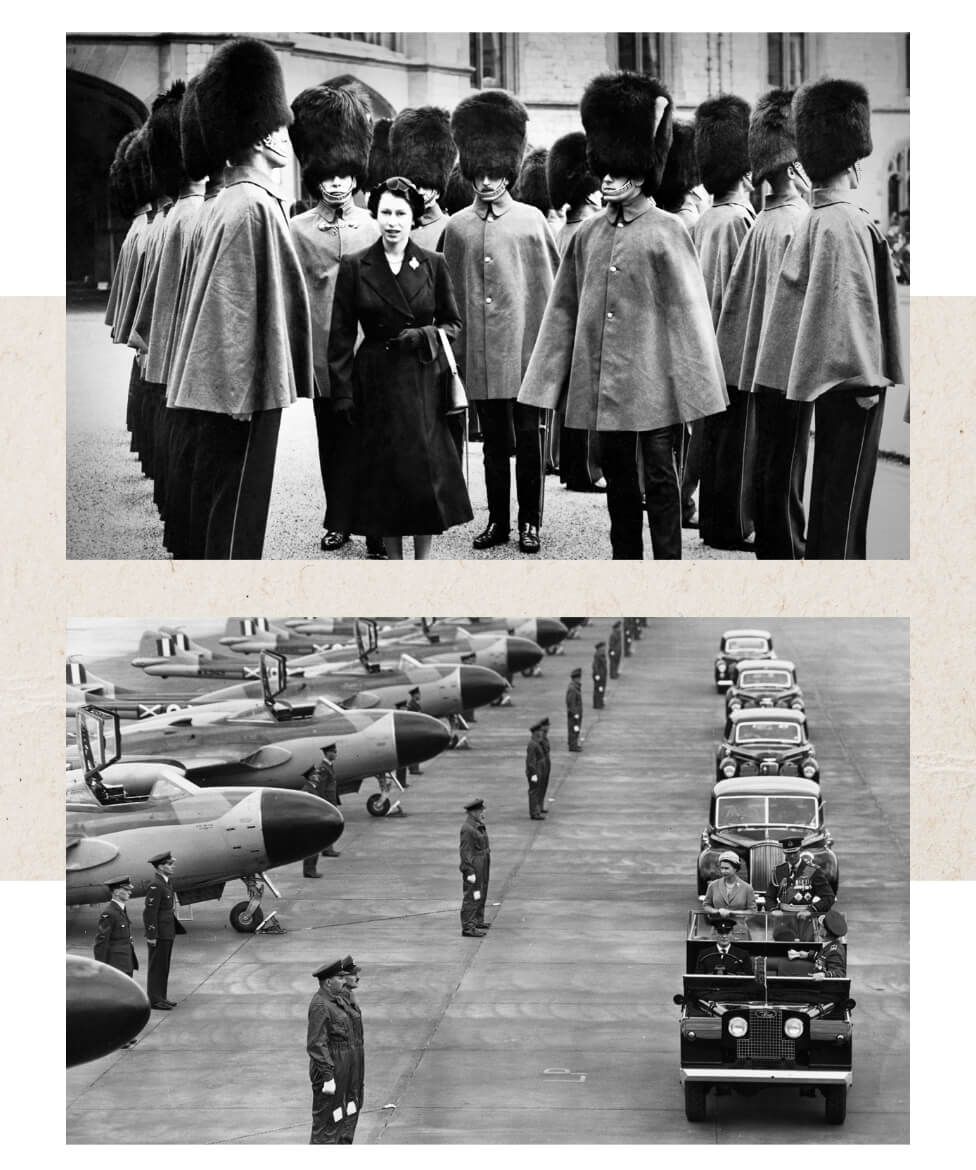
    Two pictures of the Queen, the top one showing her inspecting Grenadier Guards in 1952, the bottom one inspecting RAF crews in 1957

    The cap is a simple reminder of what she admired most – service: the service she offered that golden day decades beforehand, the service she saw in her formative years as nation, Commonwealth and Empire gave life and limb so that others could be free; the service that she believed lay at the heart of the Crown she inherited and devoted her long life to.

    Three decades on from that vow of service, she would allow herself a rare moment of public introspection; “Although that vow was made ‘in my salad days when I was green in judgement’,” she told the Guildhall on her Silver Jubilee, “I do not regret or retract one word of it.”

    Quote: 'I have to be seen to be believed'

    Over the decades she spoke little, and revealed even less, about herself in public. She – a child of the broadcast age – never gave an interview. Once or twice she would be filmed “in conversation” with a trusted friend, talking amicably about something uncontroversial, like the royal jewellery collection.

    Her words would be scoured for a hint of controversy or an opening into her character. But she was too careful – and her friends too loyal – for anything important to slip out.

    She did not neglect the medium that came of age as she did. It was her decision to allow her coronation to be televised, her decision to televise the Christmas Broadcast, and her decision to speak live to the nation after the death of Diana, Princess of Wales. “I have to be seen to be believed,” she would say.

    Service to the nation – being crowned in 1953, and with then Prime Minister Edward Heath at a concert in 1973

    Broadcast and newspaper coverage, the endless pictures of her in well-chosen gowns and dresses – these were part of what it was to be Queen, part of the job she had pledged her life to. Talking about her feelings publicly was not.

    And she came from a generation – and from a nation – that did not feel the need to share its feelings. The nation would change. She would not.

    Here fate and character would collide. It was her fate to take the Crown as the country moved into far-reaching change. But the Queen was open about her liking for tradition, for the ways things had always been done, and her dislike of change.

    Quote: 'I find that one of the sad things is that people don't take on jobs for life'

    Her heart was in the countryside, and there, with horses and dogs and amongst those who loved animals as she did, was the reassurance of a place that changed incrementally, if at all.

    “I find that one of the sad things,” she would say in the late 1980s, is “that people don’t take on jobs for life, they try different things the whole time.”

    Monarch and monarchy fitted hand-in-glove; a sovereign who relished tradition leading an institution established upon it.
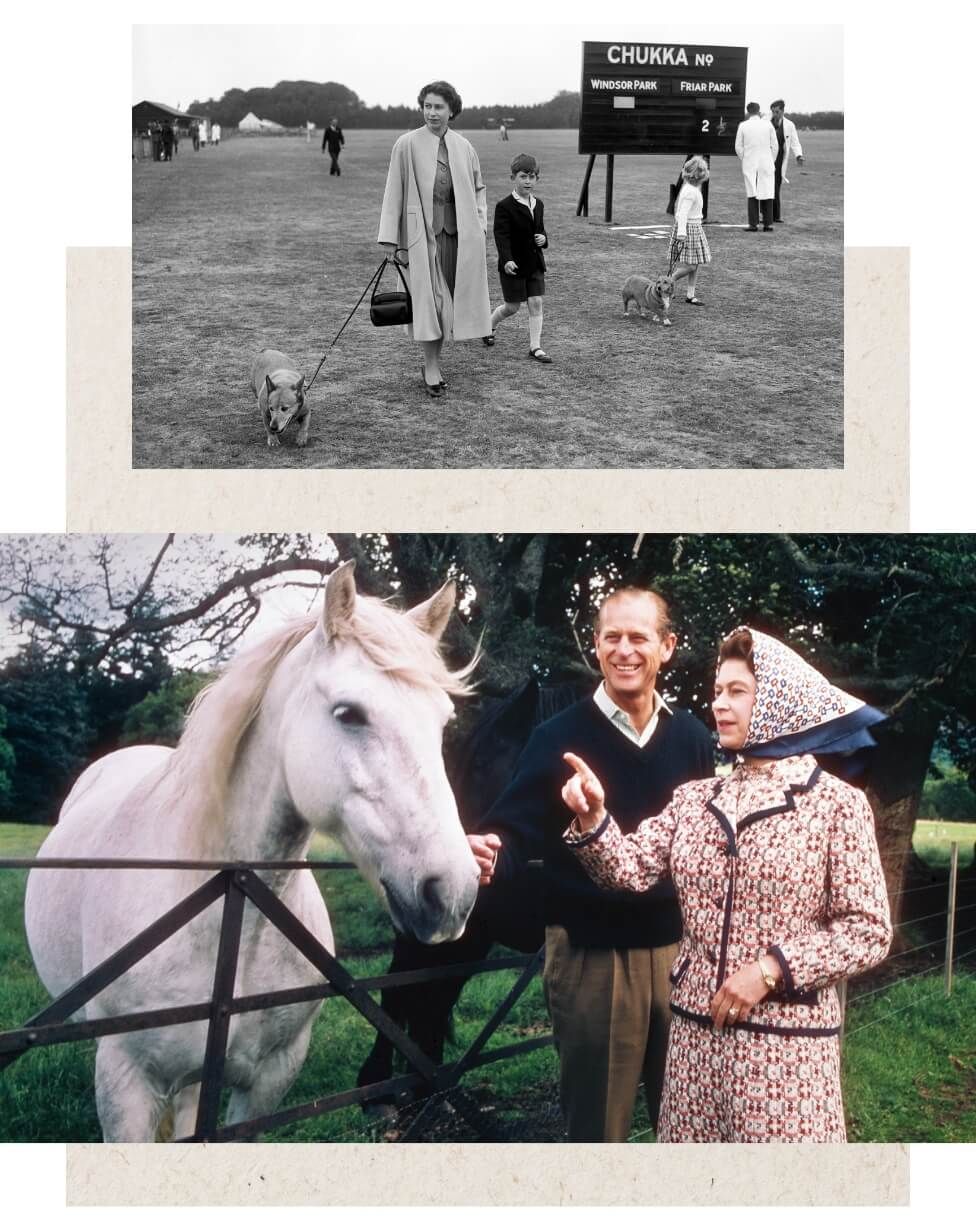
    Two pictures of the Queen, one with Prince Charles and Princess Anne and two corgis, walking in Windsor Great Park in 1956, the other with Prince Philip standing next to a white horse on a farm on the Balmoral Estate in Scotland in 1972
    A life-long love of the countryside – in Windsor Great Park with Prince Charles and Princess Anne in 1956, and with Prince Philip at a farm on the Balmoral Estate in Scotland in 1972


    Beyond the palace gates, a whirlwind of change would transform Britain. She came to the throne at a tipping point in British history. Victorious in – but exhausted by – war, the country was no longer a global, military, or economic power.

    The rise of trade unions, the collective provision of services, and the creation of a universal welfare state signalled a sea-change in the organization of state and economy. The stately withdrawal from Empire became a hurried exit.

    As her reign progressed, the old order – Church and aristocracy, the gradations of class and knowing your place – crumbled. Financial success and celebrity overtook accident of birth as a measure of societal achievement.

    Consumer goods – fridges, washing machines, televisions, and vacuum cleaners – transformed homes and social lives. Women joined the workforce; old working-class communities were swept away with the slums that housed them; a society once cohesive and homogeneous became mobile, atomized, and diverse, uprooted from old certainties and loyalties.

    There was some change at the Palace too, especially early in the reign – the end of the debutante “season” would mean the daughters of the “best” families would no longer be presented at court, and fresh faces were seen among those invited to lunch and dinner, and television meant Britons could see their Queen and how she lived – first for the Christmas broadcast, then for a full-length documentary in the late 1960s.

    But this was changed with a very small “c”; as her seventh decade on the throne drew to a close, the rhythm of the monarchy remained one which would be recognizable from the first, one which her father or even her grandfather would be unsurprised by Christmas and New year at Sandringham, Easter at Windsor, the long summer break in Balmoral, Trooping the Colour, Royal Ascot, the Investitures, the Changing of the Guard, Remembrance Sunday.


    Changing times – riding the London Underground in 1969, and preparing to deliver her televised Christmas message in 1967, the first to be delivered in colour.


    Changing times – riding the London Underground in 1969, and preparing to deliver her televised Christmas message in 1967, the first to be delivered in colour

    When change pressed in all around, she resisted. Her fate was to inherit the crown as the country stood on the cusp of change, and to reign as change swirled around the palace. Her character dictated that she would not change with it, would not bend to fashion. That resistance, that deep appreciation – love, even – of tradition, was her greatest strength, and led to perhaps her greatest test and gravest crisis, as her family unravelled.

    Family always came second to the Crown. When her first two children, Prince Charles and Princess Anne, were little more than toddlers, they were left behind – as she and her sister Princess Margaret had been left behind by their parents two decades earlier – as the Queen and the Duke of Edinburgh went on a six-month world tour.

    She was not an unfeeling mother, but she was a remote one. The Crown and its responsibilities had come to her when she was just 25, and she took those responsibilities very seriously. Many decisions about the children were delegated to the duke.

    Three of her four children’s marriages would end in divorce. She believed in marriage, it was part of her Christian faith and her understanding of what knitted society together. “Divorce and separation,” she once said, “are responsible for some of the darkest evils in our society today.”

    No doubt that view, held by many in the late 1940s, mellowed as the years went by. But no parent relishes seeing their child’s marriage fail. The Queen’s self-proclaimed “annus horribilis” in 1992 saw the separation of the Duke and Duchess of York, the divorce of Princess Anne and Captain Mark Phillips and the separation of the Prince and Princess of Wales.

    “A low point in her life,” wrote one biographer, not because of what had led to the rare public admission of tough times, “but because of the lack of gratitude, even derision, with which her 40 years of dedication appeared to have been crowned.”

    Her first decade had passed in a dazzle of adulation, at home and abroad. Vast crowds turned out for her on international tours. Back home, some proclaimed a new Elizabethan Age, although the Queen was clever enough to immediately disavow it.
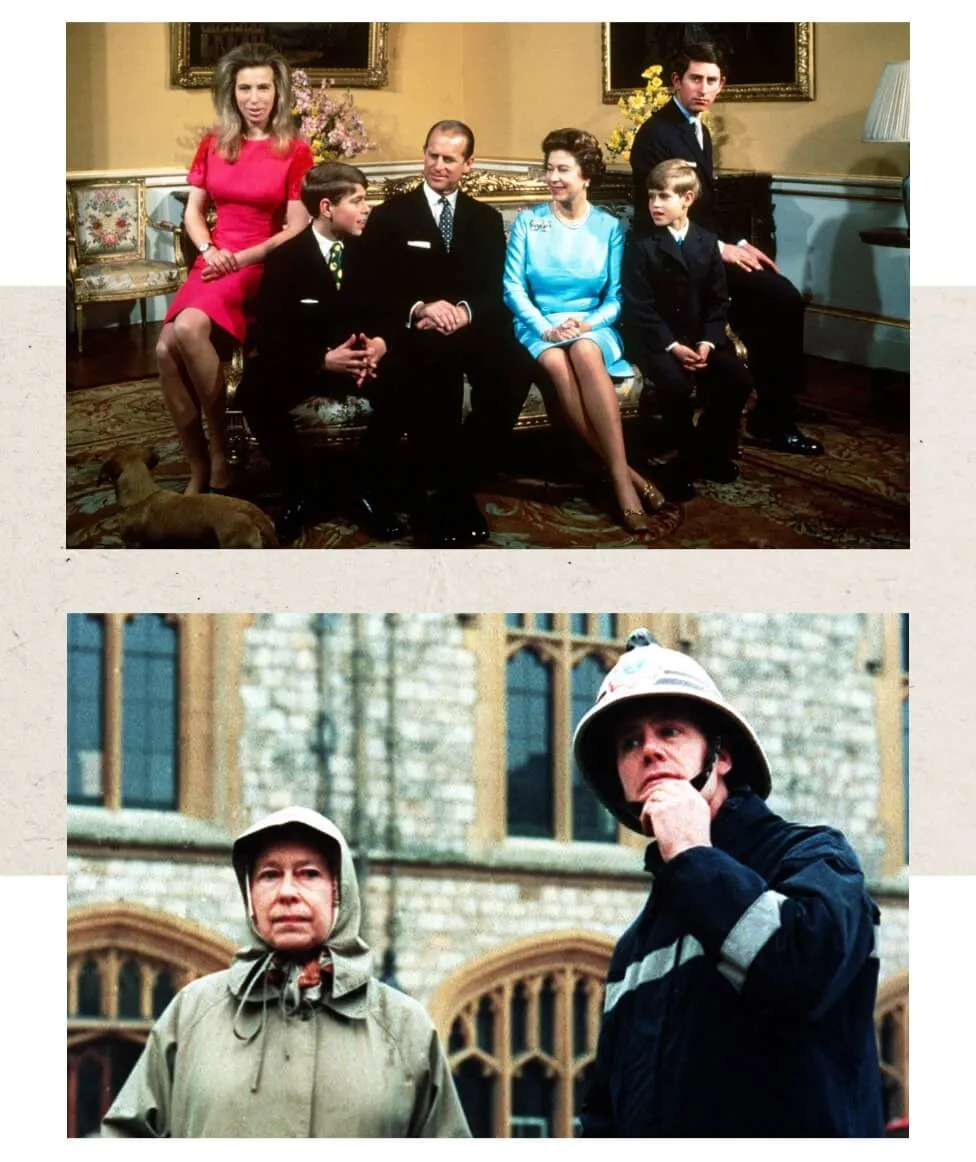
    Two pictures of the Queen, one of her with Prince Philip, on a sofa, surrounded by their children, from left to right: Princess Anne, Prince Andrew, Prince Edward and Prince Charles, the other picture is the Queen standing next to a fireman after a fire at her home in Windsor
    Image caption,

    Family time and personal loss – with Prince Philip and their four children in 1972, and looking at fire damage to Windsor Castle in 1992.

    The 1960s saw a slow cooling off – the Queen was more involved with her family, the novelty of a new monarch had passed, and the generation of the post-war baby boom now coming of age was gripped by different passions than their parents. The 1970s and 80s saw no let-up in her service, but the focus of some Royalty enthusiasts – and the media – shifted to her children, their marriages, and their partners.

    By the mid-90s, the monarchy seemed to some to be out of touch with the popular mood; in the newspaper comment columns, there was a direct criticism of the Queen, and contemplation of the monarchy’s future. Her reign at times seemed associated with another epoch. What was her place – and the monarchy’s – in the new “Cool Britannia” and the informal style embraced by Tony Blair? How did the Palace – repository of tradition – fit in with the popular demand for change expressed in Labour’s crushing election victory?

    Just months after that victory, one hot August night in Paris, came the death of Diana, Princess of Wales. A broiling carpet of flowers soon stretched out in front of Kensington Palace. The flag pole above Buckingham Palace remained bare. Many in the nation found themselves desolate at the loss of the Princess.

    “Show us you care, Ma’am” bayed the Daily Express headline. “Where is our Queen? Where is her flag?” demanded the Sun. For five long days, the Queen remained in Balmoral, seemingly unaware of the spasm sweeping parts of the country. Perhaps, as the Palace would brief afterward, it was to protect and console the young Princes William and Harry.

    But given her character, that deep dislike of change appears to have driven the decisions taken at the time; Balmoral was not to be interrupted, no flag ever flew from Buckingham Palace in her absence, and the Royal Standard never flew at half-mast.

    It was a terrible misjudgement. She hurried back to the capital, back to Buckingham Palace. She stopped to look at the flowers piling up all around. “We were not confident,” one former official told a biographer, “that when the Queen got out of the car, she would not be hissed and jeered.” It was that bad.

    Joy and tragedy – the Queen with Prince Charles and his then-fiancée Lady Diana Spencer in 1981, and with Prince Philip among the floral tributes following the death of Diana, Princess of Wales, in 1997

    She had refused to broadcast at first, then yielded, then agreed to speak live. She spoke to the nation, just before the BBC Six O’clock news. She – who had once driven broadcast executives to despair with her wooden delivery – barely had time to prepare.

    Her performance was flawless, her speech brief but perfectly pitched. She spoke of “lessons to be learned”; she spoke “as a grandmother”; she spoke of the “determination to cherish” Diana’s memory.

    It was a triumph, pulled from the jaws of deep crisis. The poison swirling around the Royal Family, around the Palace and around the very institution of the monarchy, was drawn. Once in her reign – just once – fate and character had collided with near-disastrous consequences.

    They would combine more happily in the Queen’s international role. By the time of her death, she had not toured for many years. But for decades she was not only a global celebrity like no other but also a subtle instrument of influence.

    Nothing would compare to the first dazzling decade of her reign, before television made her image commonplace and her tours accessible from the living room. On her long 1954 tour of Australia, two-thirds of the country is thought to have turned out to see her; in 1961 two million people lined the road from the airport to the Indian capital Delhi; in Calcutta three-and-half million would stand and wait to see the daughter of the last Emperor.

    Fate would dictate that she would oversee the long twilight of the Empire, though not once did the Queen attend a flag-lowering ceremony. Many times in the 1950s and 60s, a member of the Royal Family would stand as the Union flag came down over a former colony, the national anthem playing one last time.

    A determination that something should emerge from the imperial family that she had pledged to serve, would mean that she would build a new association on the ashes of Britain’s imperial legacy.

    In palaces and houses dotted across the capital and the country, lived her blood family. Across the world was spread her territorial family – a group of wildly diverse nations, vast and tiny, rich and impoverished, republics and monarchies – that she charmed and cajoled and nudged to remember what bound them together, and what together they might achieve.

    International tours were taken on behalf of the government of the day; they were tools of foreign policy – if not explicitly, then on the understanding that the Queen’s influence would be beneficial to the relationships between Britain and the places she visited.

    It looked glamorous – the Royal Yacht, the Queen’s Flight, banquets, and galas – and before international air travel became commonplace, it was an extraordinary experience. But it was always hard work, long days and weeks of receptions, exhibitions, openings, lunches with officials, state dinners and speeches given and listened to patiently. Those who have observed a royal tour find it hard to imagine it is any fun for those at the heart of it.

  • ‘This is our country’s saddest day’: Former PM Johnson

    Former prime minister Boris Johnson – who left the top job on Tuesday after meeting with the Queen – has paid tribute to the monarch.

    In a lengthy statement, he says there is “an ache at the passing of our Queen” in “the hearts of every one of us”.

  • Rainbow appears as people gather outside Buckingham Palace

    As the news has spread, the crowds have grown significantly outside Buckingham Palace.

    Many people have come alone to take at the moment, while others have come in groups with friends.

    Australian Chloe Hogan pictured with her two friends outside Buckinham Palace

    Australian Chloe Hogan made her way to the palace after hearing the news about the Queen’s health in her family group chat down. She says: “I think it’s quite scary that we don’t know what’s going to happen.” The Queen is also the monarch of Australia.

    Chloe adds: “I think if anything did happen Australians would be just as devastated as when Princess Diana died, the exact same thing.

    “It would be devastating, and everyone would be like people in the UK would be.”

    Facing the Queen Victoria monument Liran Shufman, from Italy, is joining dozens of people in taking a picture of a rainbow.

    The 40-year-old says the rainbow is hopefully a sign that the Queen will return to good health.

    Liran Shufman, from Italy takes a picture of the rainbow that appeared outside the palace

    Source: bbc.com

  • Crowds begin to gather outside Buckingham Palace

    As news of the Queen’s health travel, some citizens are already gathered in front of Buckingham PalaceTourists stand in the rain outside Buckingham Palace in LondonTourists stand in the rain outside Buckingham Palace in London

    Tourists have started gathering in the rain outside Buckingham Palace in London, following news that the Queen is under medical supervision at Balmoral
    People are keeping across the latest news on their phones


    Some people have congregated on the stone steps up to The Queen Victoria Memorial, opposite the palace


    Tourists stand in the rain outside Buckingham Palace in London

  • Some tourists in tears outside Buckingham Palace

    At Buckingham Palace, some tourists are in tears at the news about the Queen’s health.

    Sue and Andy Alderman from Somerset were visiting London and decided to head to Buckingham Palace when they heard the announcement that the Queen was unwell.

    They said they were stunned by the news but that they thought the Queen had been looking frail since the death of the Duke of Edinburgh. They hoped there would be better news about her health.

    Pam told me crying that: “She’s the only Queen we’ve had. All of my life. She’s such a lovely lady. It’s such a shock.” They added they were both thinkings of the Queen’s family at this time.

    As would be expected, journalists, photographers, and camera crews from across the world are now reporting from outside Buckingham Palace, where just months ago the Queen appeared waving from its balcony during her Platinum Jubilee celebrations.

    Source: bbc.com

  • Prince William, Andrew and Edward land in Aberdeen

    The plane that landed in Aberdeen was carrying the Duke of Cambridge, the Duke of York, and the Earl and Countess of Wessex, the BBC understands.

    Figures were seen disembarking the plane and getting into cars on the airport runway. It’s expected they will now travel to Balmoral Castle – a journey of around an hour.

    Source: bbc.com

  • Power dressing: The Queen’s unique style

    She’s one of the most photographed women in history and over the past 70 years has defined what it means to dress like a queen.

    Not trendsetting or daring, but iconic.

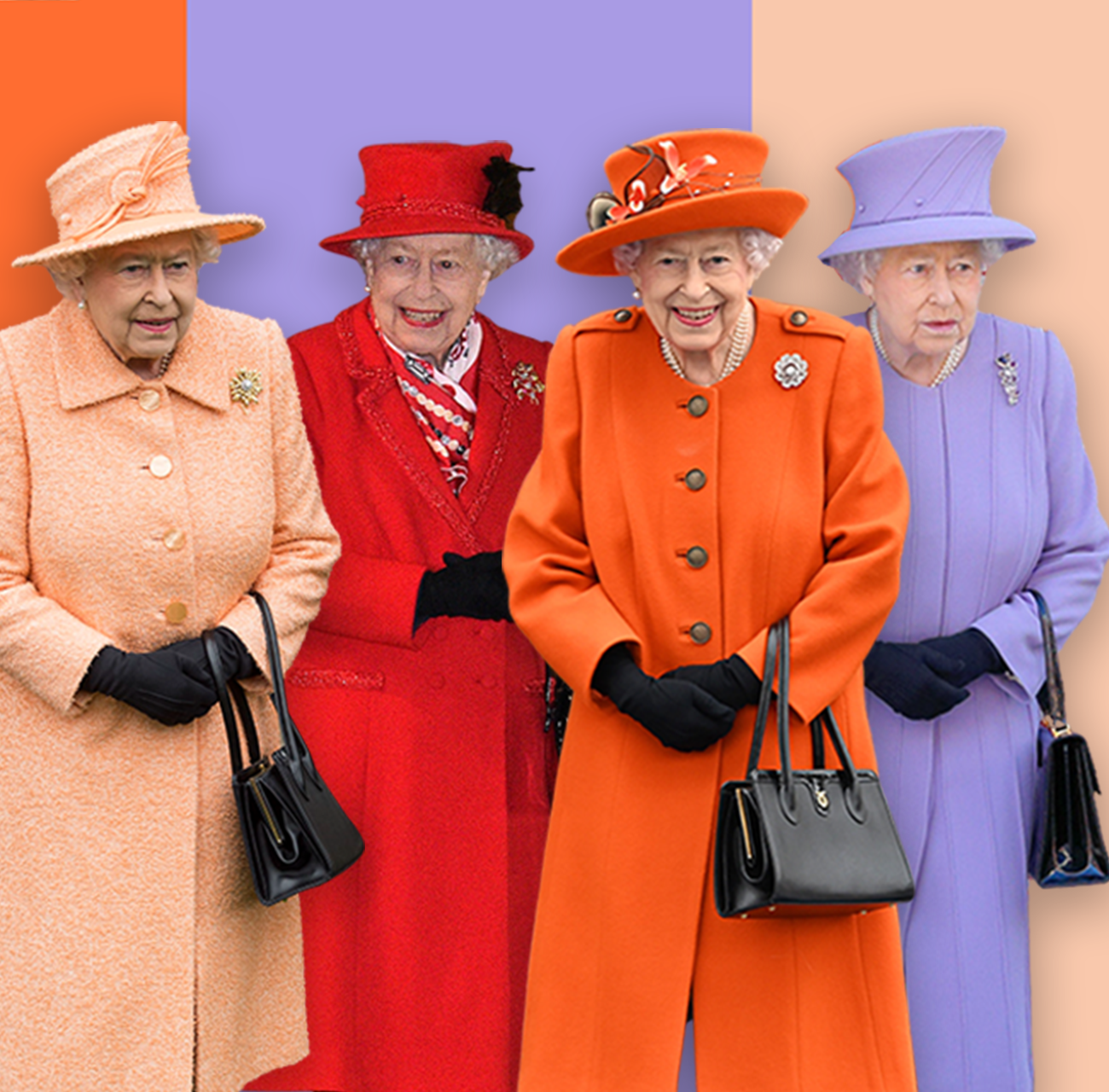
    She’s become famous for her brightly coloured dresses and coats paired with a matching hat, accessorised with her signature square handbag, a string of pearls and a jewelled brooch. It sounds simple but the Queen’s style has become a powerful formula.

    It’s a style that has been honed and refined over seven decades, helped by the close relationships she has developed with trusted designers and dressers.

    “Royal fashion is fun, powerful and steeped with meaning,” says author and royal fashion commentator Elizabeth Holmes. “Her image is a huge part of her legacy.”

    Dazzling and intricate

    The Queen has always had a very clear idea of what she wanted to look like, says historian Michael Pick.

    “People have said she has no idea about clothes, but that is simply not true. She is very astute about what suits her,” Pick says.

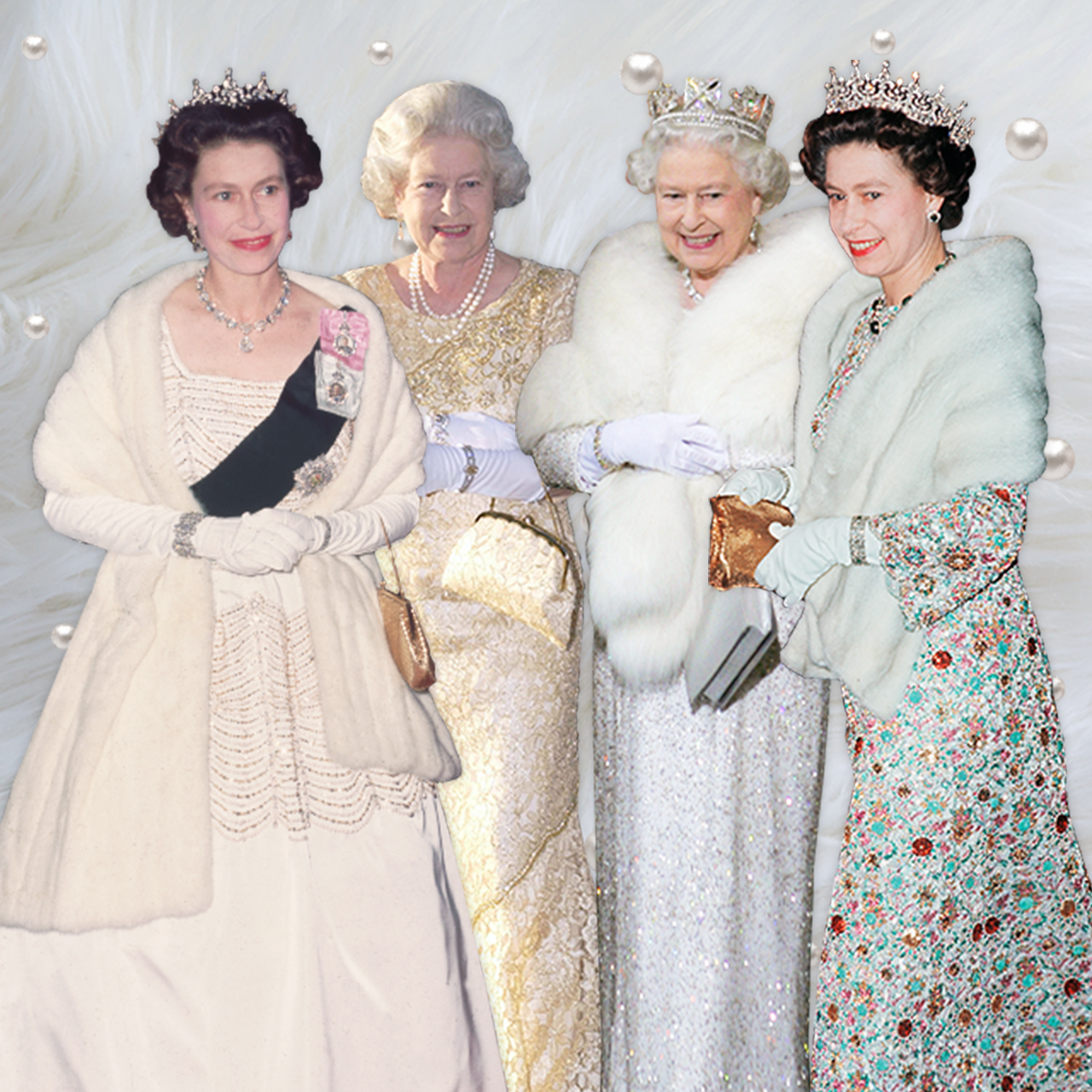
    When she was in her 20s, Princess Elizabeth began working with designer Norman Hartnell, a relationship she inherited from the Queen Mother. Full-skirted dresses with a nipped in waist, influenced by French couture, were paired with white fur stoles and diamond tiaras.

    As she took on her new role as Queen, Hartnell helped her to dazzle her way through state banquets and royal tours in a host of tulle and satin gowns, intricately embellished with seed pearls, crystals and beads.

    Hartnell also created two of the most important dresses she would ever wear – her wedding dress and the gown she wore for her coronation. He describes the process as a collaboration. “For her coronation dress Hartnell produced about eight designs and she chose elements from them all and made it her own,” Pick says.


    Queen Elizabeth II in four different jewelled evening gowns
    For the Queen, working with the same people was not just about trust, but was also down to necessity.

    Hartnell had the largest couture house in London along with the largest embroidery workroom, and for someone as busy as the Queen who needed hundreds of new outfits each year, it meant he had the capacity to design and produce what she needed.

    Still, the scale of the job meant she also asked designer Hardy Amies to work with her, beginning with a wardrobe of looks for a tour of Canada in 1951.

    Amies led the Queen into a slightly more crisp and understated look, with tailored day clothes and sleeker eveningwear. Then Ian Thomas took her through the 1970s and 1980s in a flurry of brightly coloured chiffon, floral prints and bows.

    For the last 24 years her outfits have been designed and produced in-house by a small team of around 10 people, led by her personal dresser Angela Kelly.

    Each item the Queen wears is bespoke, and before the pandemic she was attending more then 300 engagements a year. “It’s a huge amount of work,” Pick says. “You don’t want the monarch wearing something someone else is wearing. The public expects something different.

    “Hartnell and Amies made her more individual, while Angela Kelly has been very clever and managed to take her individual style and make it sparkle.”

    Hat, bag, shoes

    When the Queen steps out in public every aspect of her appearance has been meticulously planned.

    Fabrics are checked to see how they drape or might behave in a breeze. The bright colours, chosen for the season and occasion, give instant impact so that she stands out in a crowd. A hat gives her slight stature more height and highlights her face.

    She wears sensible block-heeled shoes – handmade and worn in by Kelly herself to make sure they are comfortable – and there is always a clear umbrella with a colour-matched trim on standby, so even the unpredictable British weather won’t get in her way.
    Queen Elizabeth II in colour matching coats and hats
    This uniform-way of dressing maximises her comfort on long days, but also helps define her role, says Elizabeth Holmes.

    “Her job is to be a calm and consistent presence. Her clothes are a mix of knowing what to expect but also with an ability to surprise and delight.

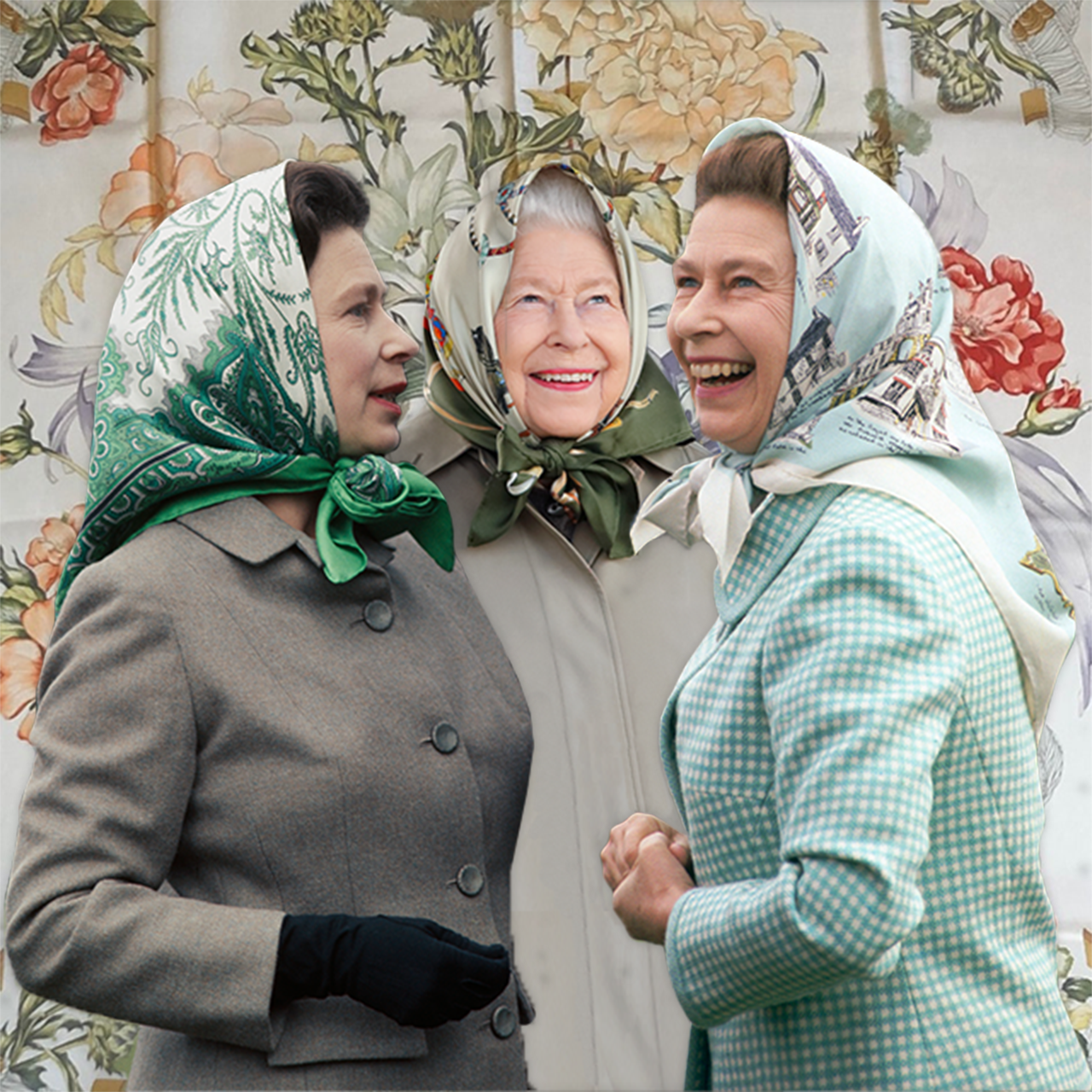
    “Even in the casual moments there is a sense of uniform, with her headscarf and wellies. It keeps the continuity and also shows she is never off duty.”

    Arguably the most iconic part of the Queen’s look is the thing that has remained virtually unchanged throughout her reign: her famous shampoo and set is almost identical to the style she wore when she came to the throne in 1953.

    But for the change in colour as she got older and embraced her natural grey, it has retained the two distinctive wave curls at the front and firm and structured curls around the back, formed perfectly to host a crown or hat.

    The traditional style, set on rollers under a dryer, was the hairstyle of choice for many of Britain’s fashion conscious women in the post-war years but while trends have moved on the Queen has been loyal to it ever since.

    “Her hair is quite conventional for a woman her age, but it is a strong look, softened by curls to give it a gentleness,” says royal and celebrity hairdresser Richard Ward. “I think her hair sums up what we all really value about her,” he says. “It is sensible, practical and elegant.”


    Queen Elizabeth II in silk headscarf

    Another of the Queen’s most iconic style points is the famous top-handled Launer handbag.

    Unlike other classic designer bags such as the Hermes Birkin or the Chanel 2.55, which are popular with women aged from their 20s to their 70s, Launer is not as fashionable or desirable for younger women, says Charlotte Rogers, a luxury accessories expert.

    But there is still a big market for them in other countries, especially the Middle East. The Queen’s royal seal of approval changes everything for a brand. “The fact the Queen still uses Launer bags is huge,” Rogers says. “Royals are the ultimate influencers.”

    The handbags retail for around £1,500-£2,000, and the Queen is said to have a collection of over 200 in different colours and styles.

    It seems in her Jubilee year the Queen has become more influential than ever, which is no mean feat for a woman in her 90s, says Rogers.

    “She’s age appropriate, a style much like my grandmother used to wear for special occasions and I think she is influential to older ladies,” she says. “Pins and brooches were seen as so unfashionable and now I can’t buy enough of them. They sell so quickly.”

    Royal influence

    The Queen’s clothes are not just style choices but also brand statements, steeped with meaning and influence. Whether she’s wearing a jewelled gown or a tweed skirt every outfit says something about her and her role as an ambassador and figurehead.

    “Her wardrobe is her communication,” says Matthew Storey, curator at Historic Royal Palaces.

    She has to be prepared, reliable and traditional. But while walking the line of being accessible and reassuring her clothes also “have to be worthy of royalty,” Holmes says.


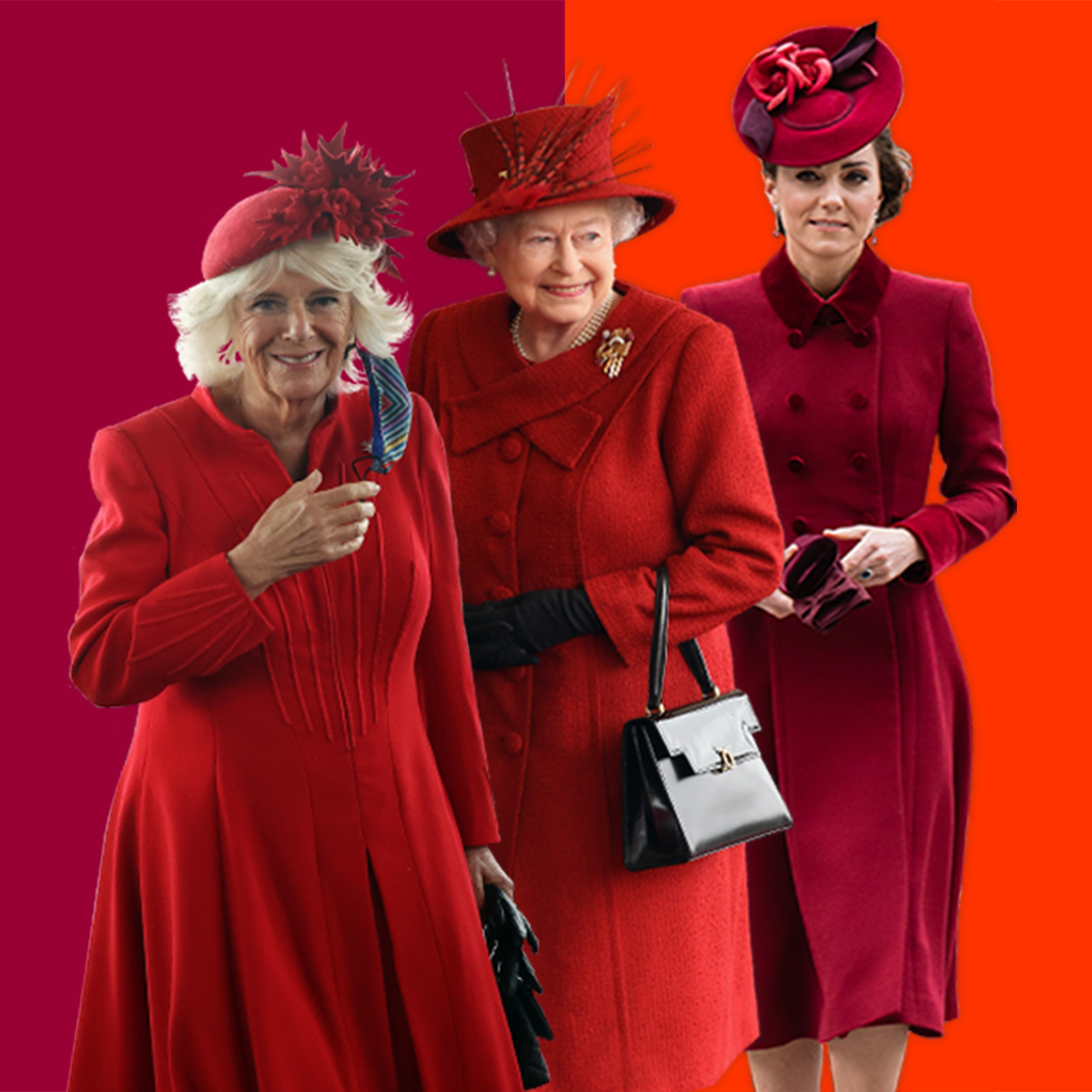
    Queen Elizabeth II, Camilla Duchess of Cornwall and Catherine, Duchess of Cambridge all wearing red outfits

    “It’s part of the bedazzling of the crown. With the Queen her clothes are bespoke. You can’t buy them but it means they can be seen and admired.”

    There’s also a diplomatic role, subtle nods to a country or event shown in emblems or colours she wears.

    “The subtle pink coloured dress she wore to the opening ceremony of the London 2012 Olympic Games was chosen because it was on none of the national flags. It stood out but it also wasn’t showing any allegiance,” Storey says.

    Like other iconic brands she also means many different things to people.

    “Like a work of art you interpret her in your own way,” says Jeetendr Sehdev, author and celebrity branding expert.

    “Do we really know who she is? I’m not sure we do. But what we do know is what she means to us and the things she stands for – her strength, boldness and authenticity – remain relevant even among young people.”

    Younger royals like Camilla, Duchess of Cornwall, and Catherine, Duchess of Cambridge, are clearly inspired by her, but the Queen stands far and above, he says.

    There’s great affection for how she looks, Holmes says. She has a signature style that will forever remind people of her.

    “No-one else dresses like her,” she says. “That’s her job and it’s profound.”

    All pictures are subject to copyright

    Source: BBC

  • UK Royal Family: Who is in it and what does the Queen do?

    The UK is having a four-day bank holiday weekend in June as part of celebrations for the Queen’s Platinum Jubilee.

    In February, the Queen became the longest-serving British monarch, and the first to reach 70 years on the throne.

    Queen Elizabeth II has been the UK’s head of state since 1952, when her father King George VI died. She is also the head of state for 15 Commonwealth countries.

    But this could change. Last year Barbdos removed the Queen as its head of state and became a republic. Since then, six Caribbean nations have indicated they plan to follow suit: Antigua and Barbuda, the Bahamas, Belize, Grenada, Jamaica, and St Kitts and Nevis.

    What is the Queen’s Jubilee?

    The Queen was born on 21 April 1926 but she celebrates two birthdays every year. The second is the day the official celebrations take place and is usually on the second Saturday in June.

    This started with her great-grandfather Edward VII, who was born in November, to make it more likely that there would be good weather for a public celebration.

    This year’s jubilee will be the Queen’s fourth – she celebrated her Silver Jubilee in 1977, her Golden Jubilee in 2002 and her Diamond Jubilee in 2012.

    There are several events planned throughout the year, but the main celebrations are during June’s four-day bank holiday weekend, and include a special Trooping of the Colour, a concert outside Buckingham Palace, and a pageant.

    Thousands of street parties will be held across the country. Pubs, bars and nightclubs will also be able to stay open until 01:00 BST.

    As part of the opening celebrations for the Jubilee, the Queen will be joined by members of her family on the balcony of Buckingham Palace on 2 June.

    The Palace has confirmed that Prince Harry and Prince Andrew will not be present as it will only be for “members of the Royal Family who are currently undertaking official public duties”.

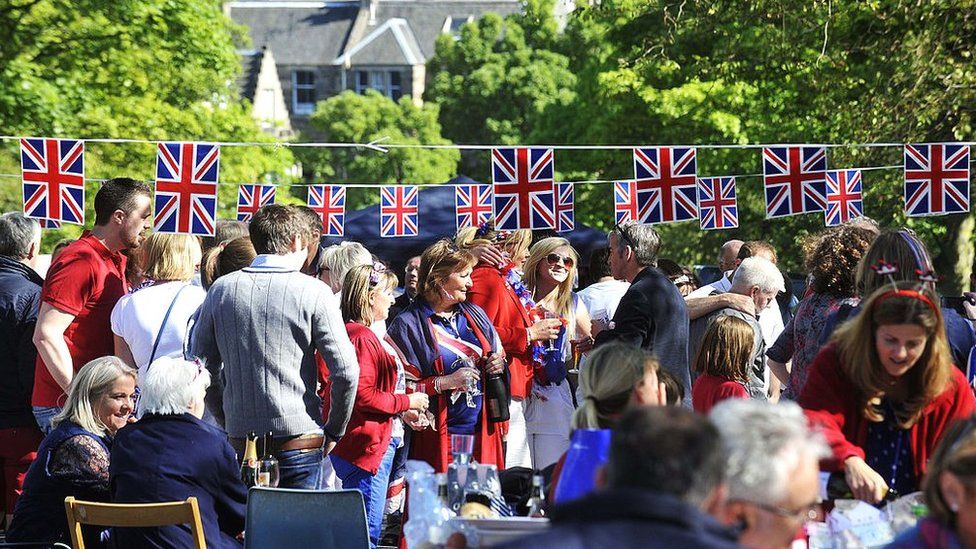
    Revellers with Britain's Union flags during a party to celebrate the Queen's Diamond Jubilee in Edinburgh on June 3, 2012Getty Images: Many street parties were held to celebrate the Queen’s Diamond Jubilee in 2012

    How popular is the monarchy?

    A recent poll by YouGov suggested that 62% think the country should continue to have a monarchy, with 22% saying it should have an elected head of state instead.

    Last year, two Ipsos Mori polls gave broadly similar results, with only one in five believing that abolishing the monarchy would be good for the UK.

    However, the YouGov poll suggested that there had been a decline in those in favour of the monarchy in the past decade, from 75% in 2012, to 62% now.

    While there was majority support for the monarchy among older age groups, the poll indicated this might not be true for younger people.

    In 2011, when YouGov first started tracking the issue, 59% of 18 to 24-year-olds thought the monarchy should continue, compared with 33% today.

    When was the Queen crowned and what happens at coronation?

    When a monarch dies, the heir immediately becomes king or queen. The coronation is the ceremony at which the monarch is formally crowned. It takes place after a period of mourning for the previous sovereign.

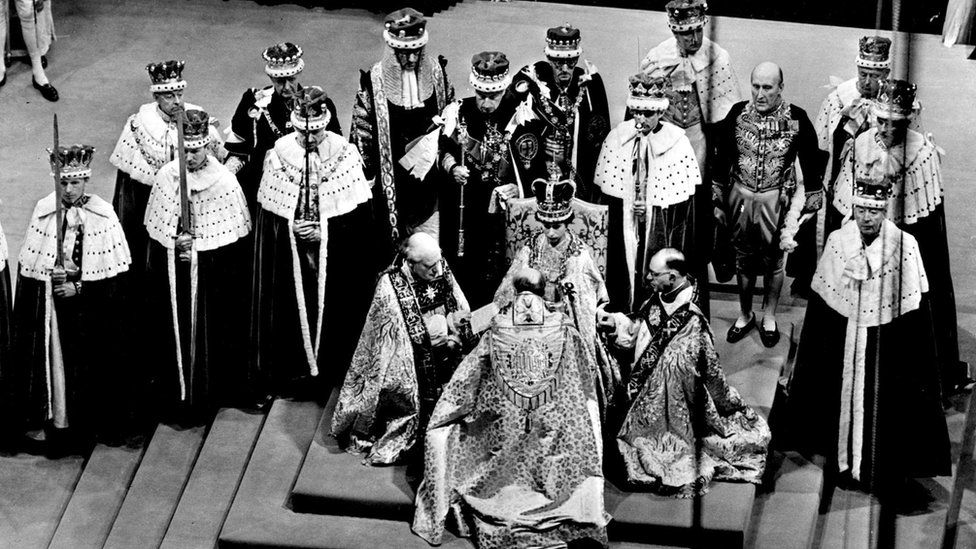
    Elizabeth II was crowned on 2 June 1953. Her coronation was the first to be broadcast live on TV. More than 20 million people tuned in.

    The central elements of the ceremony have barely changed for hundreds of years. The coronation is performed by the Archbishop of Canterbury. The monarch is anointed with “holy oil”, receives the orb and sceptre – symbols of royalty – and is crowned with the St Edward’s Crown, the centrepiece of the Crown Jewels.

    The coronation of Queen Elizabeth, June 1953PA Media: More than 20 million people watched the Queen’s coronation on television on 2 June, 1953.

    How many children and grandchildren does the Queen have? And how does succession work?

    The Queen was married to her late husband, Prince Philip, who died in April 2021, for more than 73 years. They had four children, eight grandchildren and 12 great-grandchildren. Prince Charles is her first-born, followed by Princess Anne, Prince Andrew and Prince Edward.

    The order of succession sets out which member of the Royal Family takes over as monarch when the existing one dies or abdicates. First in line – the heir to the throne – is the monarch’s first-born child.

    Royal succession rules were amended in 2013 to ensure that sons no longer take precedence over their older sisters.

    Prince Charles is the Queen’s heir. His eldest son, Prince William, is second in line, and William’s eldest child, Prince George, is third.

    Prince Charles would act as “regent” if his mother was not able to perform due to ill-health. This means he would take on the role of the monarch, without officially taking the position.

    Source: BBC

  • Platinum Jubilee: Crowd cheers Queen at palace as Jubilee begins

    Roaring crowds cheered the Queen as she joined other royals on the balcony of Buckingham Palace on the first of four days of Platinum Jubilee celebrations.

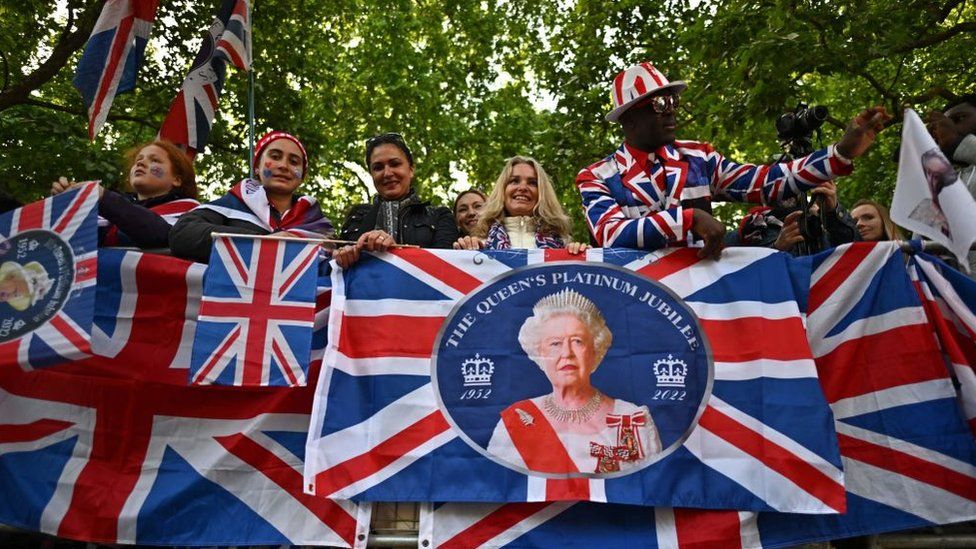
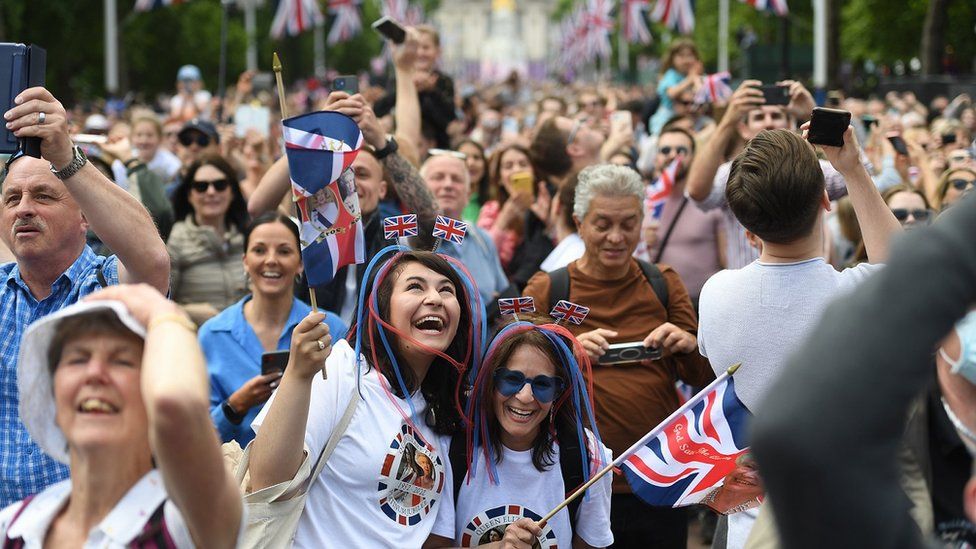
    Thousands flooded The Mall, waving flags in the brilliant sunshine to celebrate the Queen’s 70-year reign.

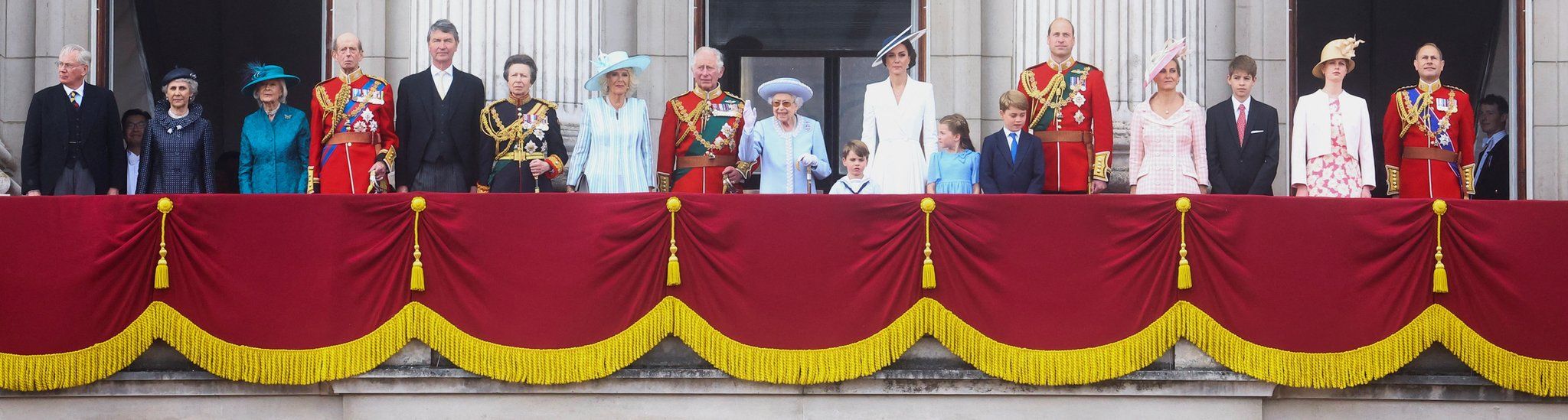
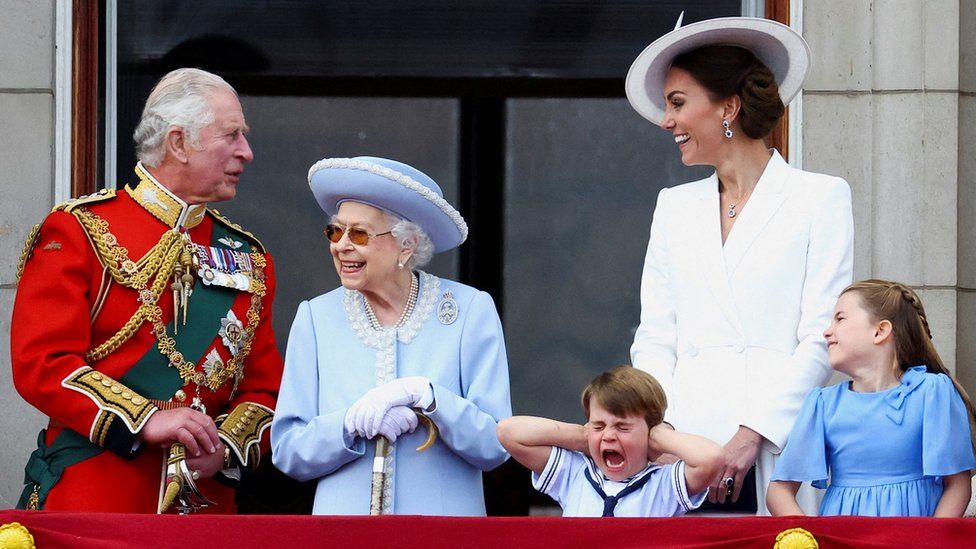
    The 96-year-old watched a flypast with 17 other royals and was immediately flanked by Prince Charles and four-year old great-grandson Prince Louis.

    The Queen looked delighted as she and Prince Louis chatted during the event.

    But the noise of the 70-aircraft flypast was too much for the young prince, who was pictured covering his ears and tightly shutting his eyes.

    The parade marked the start of a long bank holiday weekend of events celebrating the Queen’s reign – the longest by a British monarch.

    Riding on horseback and wearing the Platinum Jubilee medal with his uniform, the Prince of Wales inspected the troops in his mother’s place.

    The Queen, who was using a walking stick, has limited her appearances in recent months due to mobility issues.

    As the soldiers marched towards Buckingham Palace at the end of the parade, the Queen emerged on to the balcony, accompanied by cheers from the crowd.

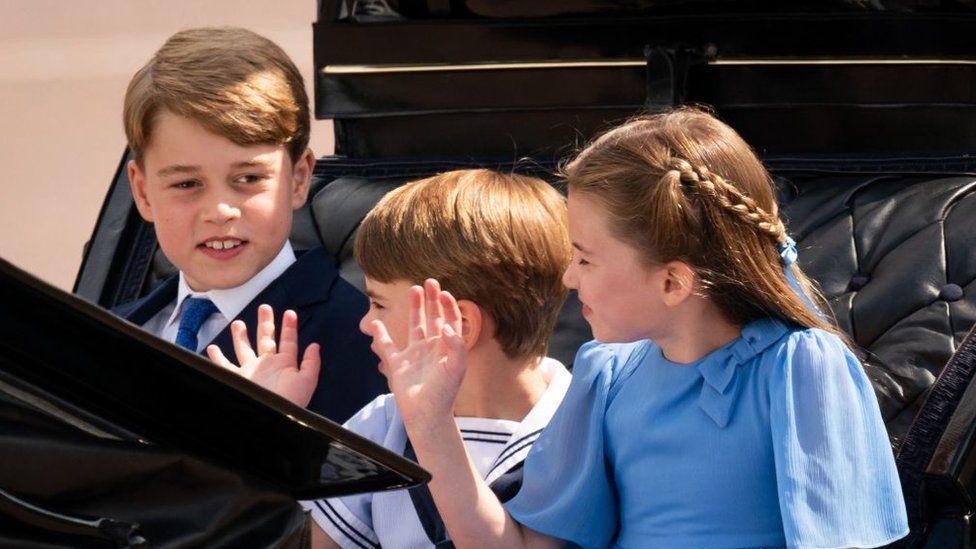
    Princes George and Louis, Princess Charlotte, the Duchess of Cambridge and Duchess of Cornwall arriving at Horse Guards' Parade by carriageIMAGE SOURCE, GETTY IMAGES
    Image caption, Princes George and Prince Louis with Princess Charlotte arrived by carriage with their mother, the Duchess of Cambridge, and Camilla, Duchess of Cornwall
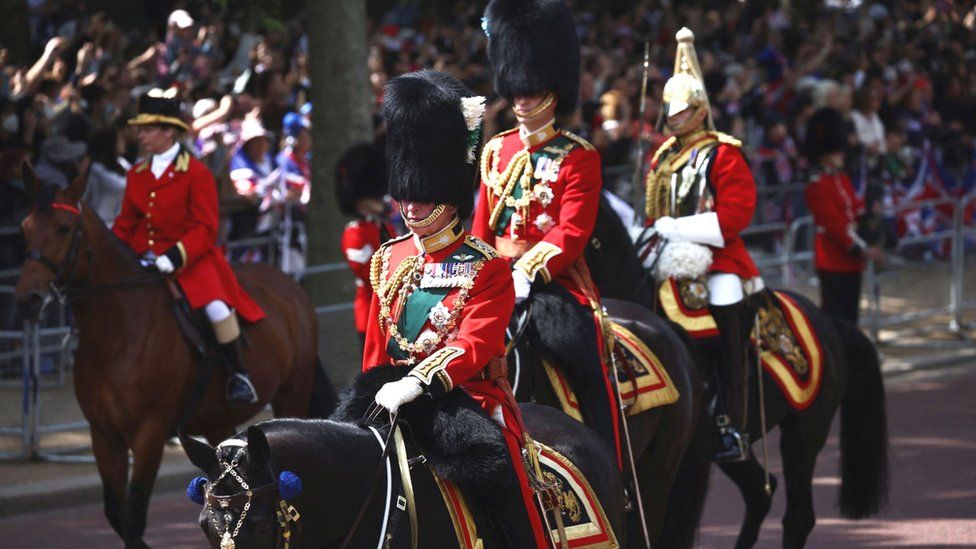
    Prince Charles and Prince William on horseback during Trooping the ColourIMAGE SOURCE, REUTERS
    Image caption, Prince Charles and Prince William rode on horseback during the parade
    Crowds on the Mall for Trooping the ColourIMAGE SOURCE, GETTY IMAGES
    Image caption, A large crowd lined the Mall, some of whom had camped overnight for the best spot

    More than 1,500 officers and soldiers along with 350 horses from the Household Division took part in Trooping the Colour, the first time the parade has been staged in full since the pandemic.

    After the parade, more than 70 aircraft – including Spitfires from World War Two, Apache helicopters, Typhoons and the Red Arrows – took part in the flypast over Buckingham Palace.

    Several jets flew in formation to form the number 70 in honour of the Queen’s long reign

    Flag-waving spectators look up as a group of planes fly in formation to spell out '70' to mark the Queen's reignIMAGE SOURCE, GETTY IMAGES
    The Queen flanked by 17 other senior royals on the balconyIMAGE SOURCE, REUTERS
    Image caption, The Queen’s youngest son, Prince Edward, took up a position on the far right of the balcony, standing with his immediate family, meaning he was cropped out of many pictures seen on the day

    Prince Charles, the Duchess of Cornwall, the Princess Royal, the Duke and Duchess of Cambridge and their three children – Prince George, Princess Charlotte and Prince Louis – flanked the monarch on the balcony – the Royal Family’s first gathering there since 2019.

    It had been decided only “working royals” would appear, which excluded the Duke and Duchess of Sussex, and the Queen’s son, the Duke of York.

    Prince Andrew, whose royal titles were returned to the Crown amid a lawsuit in the US, did not attend. He had been due to attend Friday’s thanksgiving service, but on Thursday afternoon Buckingham Palace said he would miss it as he had tested positive for Covid.

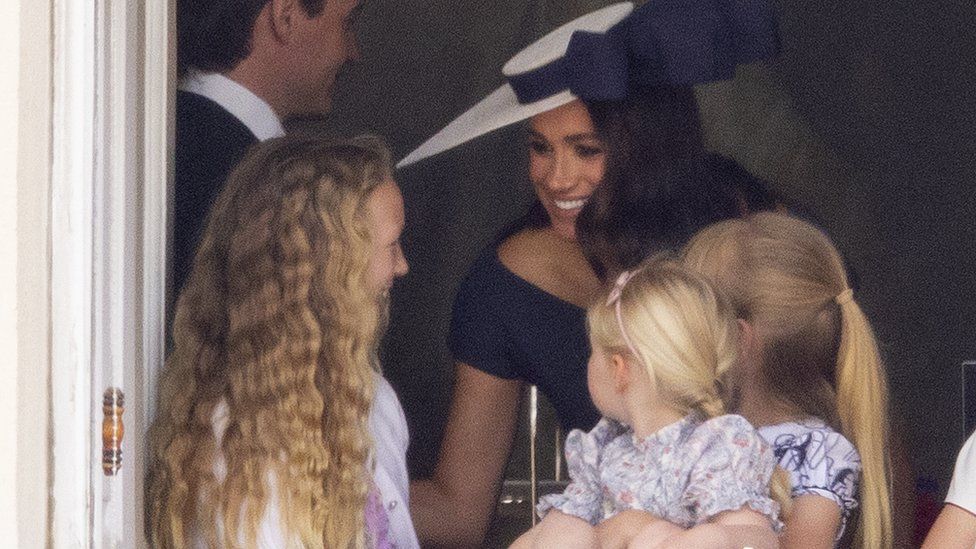
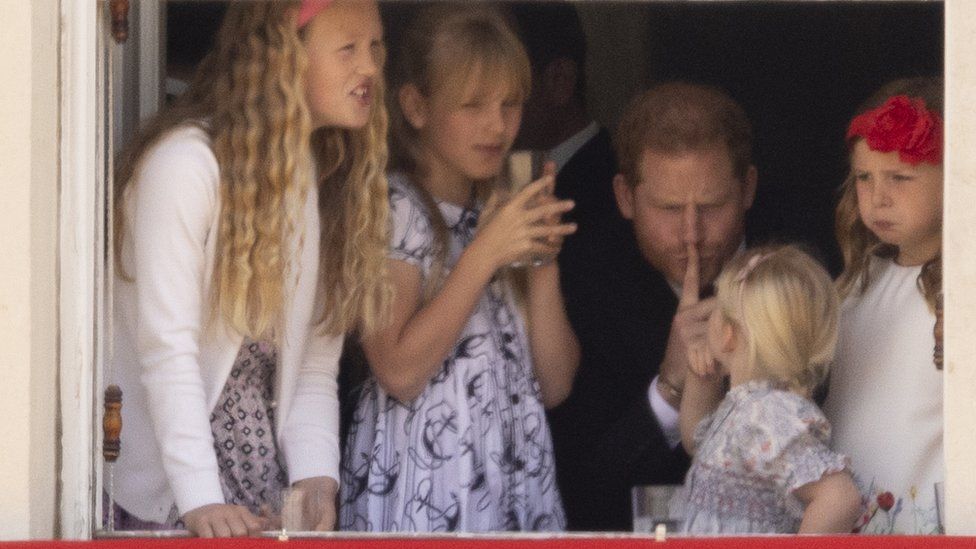
    Prince Harry and Meghan, who now live in the US, watched Trooping the Colour from a vantage point in the Duke of Wellington’s former office, overlooking Horse Guards Parade.

    They travelled with their children Archie, three, and Lilibet, who turns one on Saturday. Lilibet is the family nickname for the Queen.

    Meghan Markle with Savannah Phillips and Mia TindallIMAGE SOURCE, KELVIN BRUCE
    Image caption, Meghan appeared at the window of the Major General’s office overlooking the Trooping of the Colour
    Prince Harry puts his finger to his lips with Savannah Phillips and Mia Tindall in the Major General's office overlooking The Trooping of the ColourIMAGE SOURCE, KELVIN BRUCE
    Image caption, Prince Harry was also spotted with Savannah Phillips and Mia Tindall at the same window
  • Platinum Jubilee: Queen pulls out of St Paul’s Cathedral service

    The Queen will not attend Friday’s Jubilee service at St Paul’s Cathedral after experiencing discomfort while watching Thursday’s parade at Buckingham Palace.

    The decision was made with “great reluctance” after considering the “journey and activity required”, the palace said.

    However, she did take part in a beacon lighting ceremony on Thursday evening.

    Four days of celebrations marking the Queen’s 70-year reign began earlier.

    The 96-year-old monarch appeared twice on the Buckingham Palace balcony, flanked by other senior royals, as they watched a military parade and waved at thousands of well-wishers gathered on The Mall.

    Hours after the ceremony, the palace confirmed she would not attend Friday’s thanksgiving service, but said she “would like to thank all those who made today such a memorable occasion”.

    The next Jubilee event the Queen is due to attend is the derby at Epsom race course on Saturday, although it is yet not known whether she will still appear at the horse race.

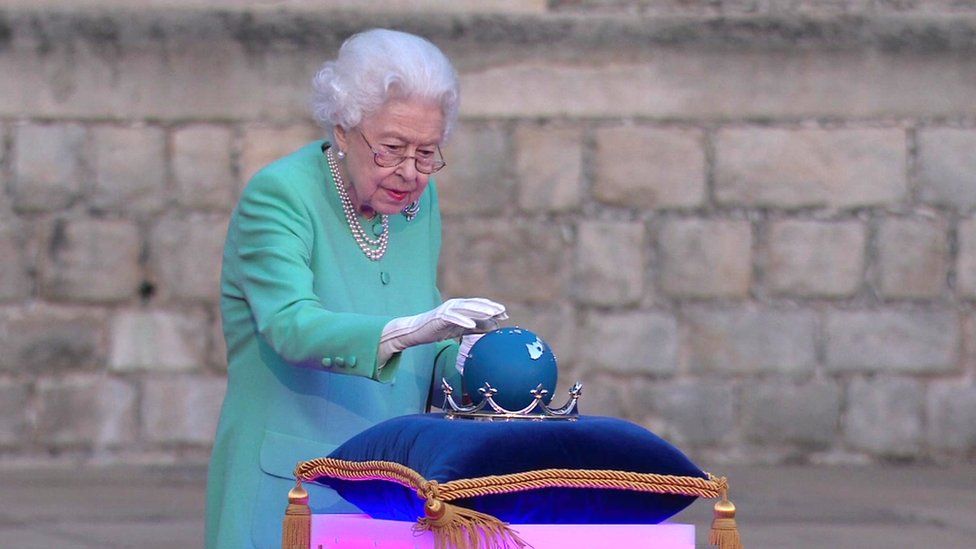
    The Queen touching a globe to light the "Tree of Trees"
    Image caption, At dusk on Thursday the Queen took part in a beacon-lighting event, touching a symbolic globe to start the ceremony

    The service at St Paul’s in central London will give thanks for the Queen’s seven decades as monarch.

    Senior royals including the Prince of Wales, Duchess of Cornwall and the Duke and Duchess of Cambridge will all attend, with Prince Charles officially representing the Queen.

    The Duke and Duchess of Sussex – who have flown over from California – will also join. It will be Prince Harry and Meghan’s first royal event together since leaving the UK two years ago.

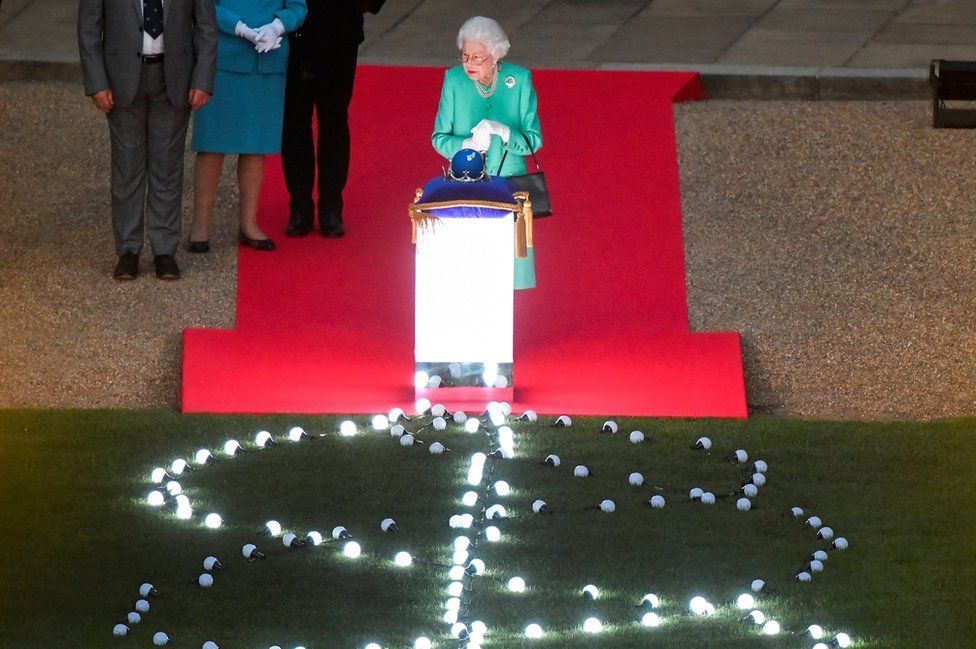
    The Queen standing in front of the globeIMAGE SOURCE, REUTERS
    Image caption, The Queen set off a river of lights which lit the principal beacon, rounding off the first day of celebrations

    However, Prince Andrew will be absent after testing positive for Covid.

    The royals will be joined by more than 400 honours recipients, including NHS and key workers, public servants and representatives from charities and the Armed Forces.

    Prime Minister Boris Johnson will give a reading from the New Testament, while the sermon will be given by the Archbishop of York Stephen Cottrell, after Archbishop of Canterbury Justin Welby tested positive for Covid-19.

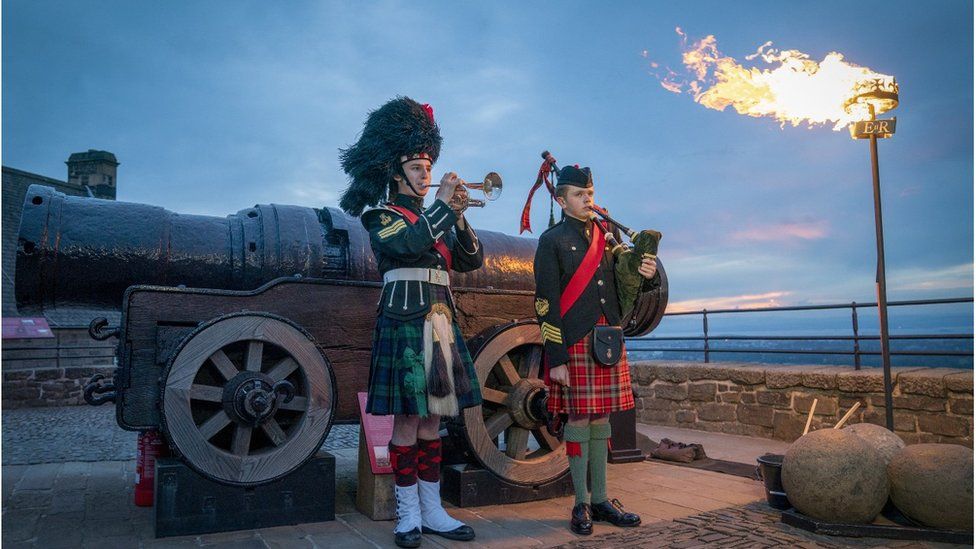
    Edinburgh Castle beaconIMAGE SOURCE, PA MEDIA
    Image caption, The Platinum Jubilee beacon at Edinburgh Castle

    The largest church bell in the UK, the 16-tonne Great Paul, will ring continuously for four hours after the service. The event begins at 11:30 BST on Friday, with coverage starting on BBC One from 09:15.

    Other political attendees will include Labour leader Sir Keir Starmer, cabinet members, former prime ministers and the leaders of the devolved administrations in Scotland, Wales and Northern Ireland.

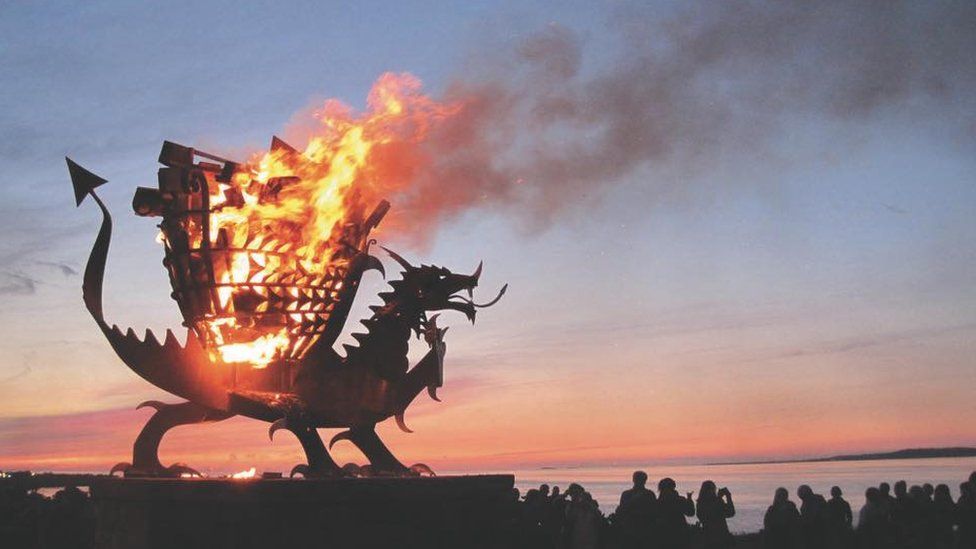
    Bagillt beaconIMAGE SOURCE, FLINTSHIRE COUNTY COUNCIL
    Image caption, In Wales, a striking dragon-shaped beacon was lit in Bagillt, Flintshire

    Young people representing countries where the Queen is head of state will lead an ‘Act of Commitment’ to celebrate her life and reign.

    Thursday evening’s beacon lighting event saw the Queen symbolically touch a globe to begin the ceremony at Windsor Castle.

    The head of state illuminated the globe, sending a chain of lights from her Windsor Castle home to Buckingham Palace, where Prince William watched as a sculpture, the Tree of Trees, was bathed in light.

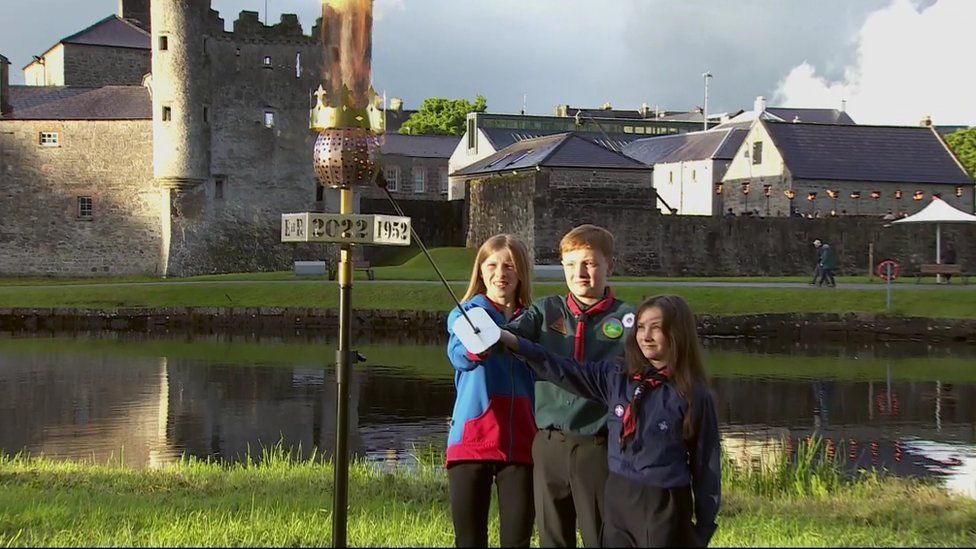
    Local scouts Hayley Woods, Erin McCullough-Daley and Evan Clarke light beacon at Enniskillen CastleImage caption, A beacon being lit at Enniskillen Castle in Northern Ireland

    Thousands of beacons were also lit across the UK and the Commonwealth to mark the Queen’s Platinum Jubilee.

    Beacons were visible around Scotland to mark the occasion, with tributes being lit at landmarks from Edinburgh Castle to Ben Nevis – Britain’s highest mountain.

    One of the main flames to be lit in Wales was outside the Pierhead building in Cardiff Bay, where the evening’s celebrations were capped with a firework display over the water.

    In Northern Ireland, 13 beacons were lit at Enniskillen Castle, while the building was illuminated purple and two beams of light were projected into the night sky.

    The service is not the first engagement the Queen has had to miss in recent months because of health problems.

    In May, she missed the State Opening of Parliament because of “episodic mobility problems” and in February she caught Covid, which she said left her feeling “very tired and exhausted”.

    The Prince of Wales, the Queen, Prince Louis, the Duchess of Cambridge an Princess CharlotteIMAGE SOURCE, REUTERS
    Image caption, While the Queen seemed delighted, the noise of the 70-aircraft flypast was too much for four-year-old Prince Louis
    Two women with blue and red hair extensions and Jubilee t-shirts wave union flags on a packed Mall outside Buckingham PalaceIMAGE SOURCE, EPA
    Image caption, Thousands of people flocked to The Mall in the June sunshine to celebrate

    Source: BBC

  • Platinum Jubilee: 70 years of the Queen in 70 seconds

    A quick look back at the Queen’s 70 years on the throne and her past jubilee speeches.

    This will be Queen Elizabeth II’s Platinum Jubilee. She celebrated her Silver Jubilee in 1977, her Golden Jubilee in 2002 and her Diamond Jubilee in 2012.

    Video produced by Daniel South

    Source: BBC News
  • Queen’s Birthday Honours: Rio Ferdinand, Gareth Bale, Eve Muirhead and Moeen Ali honoured

    Olympic gold medallist Eve Muirhead has been named on the Queen’s Birthday Honours list, alongside cricketer Moeen Ali and ex-footballer Rio Ferdinand.

    Muirhead won curling gold at the Beijing Winter Olympics and has been made an OBE, while the rest of her team become MBEs.

    Moeen and Ferdinand are both made an OBE, while Wales footballer Gareth Bale becomes an MBE.

    Broadcaster Clare Balding and Tracey Crouch MP are both made CBEs.

    The latest round of honours are to mark the Queen’s Jubilee Birthday celebrations to mark 70 years of service.

    Former sports minister Crouch chaired a fan-led review of football following a number of high-profile crises in the sport, such as the failed European Super League and the collapse of Bury FC. Its primary recommendation to create a new independent regulator for English football has been endorsed by the government.

    Balding is recognised for her ability in front of the camera and her charity work. She holds ambassadorial positions with many organisations, including StreetVet and the Helen Rollason Cancer Charity.

    Simpson brothers Neil and Andrew are also included on the list of MBEs after both winning gold at the Paralympic Games.

    Younger brother Neil, 19, was guided by brother Andrew, 21, to become GB’s third-ever Winter Games gold medallist and the first male to achieve the feat after successes for Kelly Gallagher in 2014 and Menna Fitzpatrick in 2018.

    Muirhead’s rink defeated Japan to win Team GB’s only gold medal in Beijing. Team-mates Vicky Wright, Jen Dodds, Hailey Duff and Mili Smith become MBEs, along with coach David Murdoch.

    Scot Muirhead, 32, who has appeared at four Olympics, added to the bronze she won in Sochi in 2014.

    England and Worcestershire all-rounder Moeen, 34, announced his retirement from Test cricket in September 2021 but has continued to play for the limited-overs side and was part of the Twenty20 team to reach the semi-finals of last year’s World Cup.

    He scored 2,914 runs and took 195 wickets in 64 Test matches, having made his debut against Sri Lanka in 2014.

    Television pundit and former Manchester United, Leeds, West Ham and England defender Ferdinand is honoured for services to football and charity. He set up the Rio Ferdinand Foundation this year, which works with young people and aids community development.

    Snooker players Judd Trump and Mark Selby win recognition too. Former world champion Selby has become an advocate for mental health awareness after admitting his mental health struggles in January. Trump reached the final of this year’s World Championship, losing to Ronnie O’Sullivan.

    Wigan Warriors and England rugby league legend Sean O’Loughlin is also included.

    Football players honoured

    Others made an OBE include former England footballers Mike Summerbee and Luther Blissett, who starred for Manchester City and Watford respectively.

    Wales and outgoing Real Madrid forward Bale won a joint-record fifth Champions League title on Saturday, albeit having barely featured this season. He spent last season on loan at former club Tottenham.

    However, he won three La Liga titles, four Club World Cups, three Uefa Super Cups, one Copa del Rey and three Spanish Super Cups with Madrid, as well as helping Wales to two successive European Championships.

    He is joined as an MBE by veteran Liverpool and former England midfielder James Milner.

    In the past season Milner helped Liverpool win the FA Cup and League Cup, as well as reach the Champions League final.

    Richard Bevan, the chief executive of the League Managers’ Association, has also been made an OBE while former Scotland and Hibernian goalkeeper Alan Rough is an MBE.

    Paralympians and Olympians

    Husband and wife Neil and Lora Fachie are MBEs after both winning Paralympic cycling gold within the space of 16 minutes.

    Neil and pilot Matt Rotherham smashed their own world record to win gold in the B 1,000m time trial, before Lora and Corrine Hall successfully retained their B 3,000m pursuit crown.

    Gaz Choudhry, who won Paralympic wheelchair basketball bronze and coached the team in Tokyo and Para-athlete Sammi Kinghorn, a Paralympic silver and bronze medallist, are both made MBEs.

    Georgina Harland is also an MBE for her work as the first female chef de mission of the British Olympic Association for the Winter Olympics.

    Swimmer Hannah Miley, who represented Britain in swimming at three Olympic Games and won the Commonwealth Games 400m individual medley titles in 2010 and 2014, has also been recognised with an MBE.

    Muirhead ends wait for gold medal

    Muirhead brought watching British team-mates in the Ice Cube to their feet as she scored a superb four in the seventh end to effectively clinch the Olympic title.

    Her performance was the more remarkable for her having returned from hip surgery.

    She described the winning moment as a “dream” after emulating the gold won by Rhona Howie’s team at Salt Lake City in 2002.

    Muirhead said: “There were times during this season that I would never have thought what I managed to go on and achieve was possible.

    “I am absolutely delighted to be sharing this honour with my team-mates, because without them there’s no way I could have been in this position.”

    The gold medal capped an incredible 12 months for Muirhead, who led Scotland to eighth at the World Championships last year.

    After that disappointment nine players were put into a squad selection process and Muirhead, Wright, Dodds, and Duff emerged. They went on to win the European Championships in December before sealing their spot in Beijing in a tense qualifier just weeks before the Games.

    Muirhead added: “It just goes to show that the team around me never gives up and that you can accomplish anything if you set your mind to it.”

    Moeen rewarded for career

    Moeen says he ended his Test career because he found the format “really difficult to get into” and “really long” – despite having an impressive career and being promoted to vice-captain.

    The left-handed batter and off-spinner hit five centuries and took five five-wicket hauls in Tests, finishing with a batting average of 28.29 and a bowling average of 36.66.

    Only 15 bowlers have taken more Test wickets for England and Moeen is ranked third among English spinners, behind Derek Underwood (297) and Graeme Swann (255).

    “It’s an honour to be recognised, it’s amazing and my family are really proud and happy,” he said. “More than anything, I know it makes my parents happy.”

    But he acknowledged his Pakistani heritage and Muslim faith had made him an ambassador for inclusivity in the sport too.

    “It’s not about runs and wickets. I think it’s more about the journey I’ve been through. It’s my background, my upbringing and all those kinds of things I’ve been through throughout my life.”

    In 2017, Moeen became the fifth-fastest player in terms of matches played to reach 2,000 runs and 100 wickets, also taking a hat-trick against South Africa that year to seal a series win at The Oval.

    He was part of the 2015 Ashes winning side but struggled during the 2017-18 series in Australia and took a break from cricket after being dropped during the 2019 Ashes at home.

    The Queen’s Birthday Honours list for sport

    Commander of the Order of the British Empire (CBE)

    Clare Victoria Balding (broadcaster), for services to sport and charity

    Tracey Crouch MP (former sports minister), for parliamentary and public service

    Officers of the Order of the British Empire (OBE)

    Moeen Ali (cricketer), for services to cricket

    Richard Harrison Bevan (chief executive of League Managers Association), for services to football

    Luther Loide Blissett (ex-footballer and patron, Sporting Memories), for services to football and to charity

    Lora Marie Fachie (cyclist), for services to cycling

    Neil Michael Fachie (cyclist), for services to cycling

    Rio Gavin Ferdinand (pundit and ex-footballer), for services to football and to charity

    David Peter Hadfield (president, Boccia International Sports Federation), for services to sport

    Corinne Claire Hall (cyclist), for services to cycling

    Hugh Morris (chief executive, Glamorgan County Cricket Club), for services to cricket and to charity

    Eve Muirhead (skip, British Olympic Curling Team), for services to curling

    Sean O’Loughlin (rugby league player), for services to rugby league

    Professor Nicholas Sheridan Peirce, (chief medical officer, England and Wales Cricket Board), for services to sport during Covid-19

    Michael Summerbee (ex-footballer), for services to football and to charity

    Karen Margaret Tonge (chair, Para Table Tennis), for services to table tennis

    Members of the Order of the British Empire (MBE)

    Gareth Frank Bale (footballer), for services to football and to charity

    Ghazain Choudhury (wheelchair basketballer), for services to wheelchair basketball

    Jennifer Carmichael Dodds (curler), for services to curling

    Hailey Caitlin Rose Duff (curler), for services to curling

    William Robert Leckie Duncan (curler), for services to curling and to charity

    Thomas Scott Dyson (chief coach, Paralympic Pathway, British Rowing), for services to Paralympic rowing

    Gary Kenneth Hall (Performance Director, British Taekwondo), for services to taekwondo

    Benjamin Robert Hawes (chair, Athletes Commission, British Olympic Association), for services to sport

    Elizabeth Ellen Hughes (director of special projects, Sport England), for services to sport during Covid-19

    Samantha May Kinghorn (para-athlete), for services to disability sport

    Shirley McCay (hockey player), for services to hockey and to the community in Northern Ireland

    Hannah Lousie Miley (swimmer), for services to swimming and to women in sport

    Dr Ian Stuart Miller (lately chief medical officer, British Paralympic Association), for services to Paralympic Sport

    James Philip Milner (footballer), for services to football and charity

    David Matthew Murdoch (head coach, British Curling Team), for services to curling

    Verity Leigh Naylor (director of operations, British Paralympic Association), for services to Paralympic sport

    Alan Rough (ex-footballer), for services to football and to charity in Scotland

    Eilish Rutherford (para-hockey player), for services to sport and to charity in Northern Ireland

    Andrew Peter Ryan (executive director, Association of Summer Olympic International Federations), for services to sport

    Douglas Gordon Samuel, (lately chief executive officer, Spartans Community Football Academy). For services to Association Football and to the community in North Edinburgh

    Georgina Claire Seccombe (Harland) (chef de mission, Team GB, Olympic Games 2021), for services to Olympic sport

    Mark Selby (snooker player), for services to snooker and to charity

    Neil Douglas Hamilton Simpson (para-alpine skier), for services to skiing

    Andrew William Ramsay Simpson (para-alpine skier), for services to skiing

    Mili Smith (curler), for services to curling

    Stephen Connell Stewart (director of sport and exercise, University of St Andrews), for services to sport

    Judd Trump (snooker), for services to snooker and to charity

    Anwar Uddin, (Fans For Diversity campaign manager, The Football Supporters’ Association), for services to association football

    Georgina Astrid Usher, (British Fencing chief executive), for services to fencing (London)

    Tracy Whittaker-Smith (head national coach, Trampoline, British Gymnastics), for services to trampolining

    David Brynmor Williams (ex-rugby union player), for services to sport and to charity in Wales

    Victoria Wright (curler), for services to curling

    Source: BBC

  • Platinum Jubilee of Queen Elizabeth II: Eight towns to be made cities

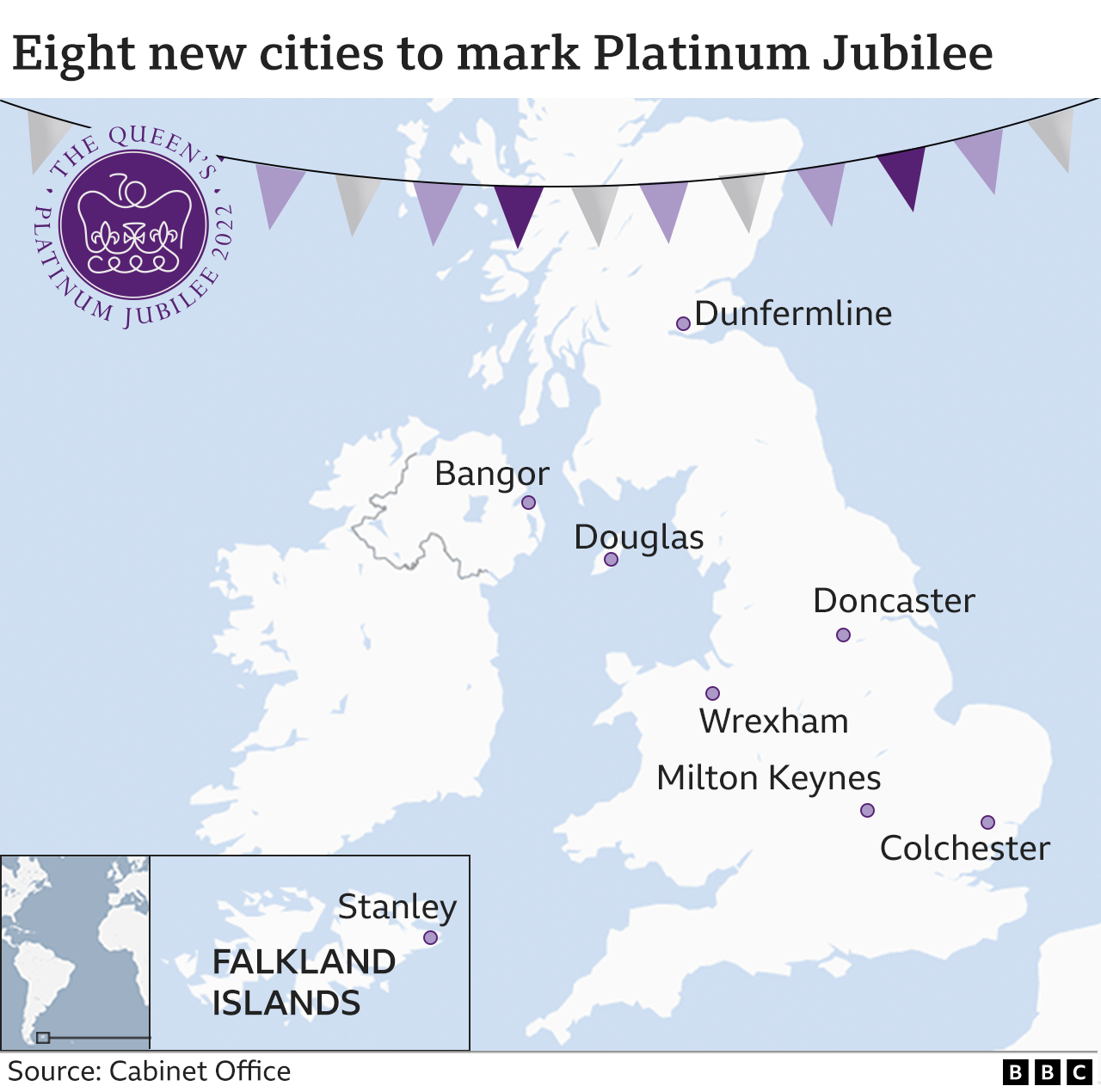
    Eight new cities have been named for the Queen’s Platinum Jubilee, with at least one in every UK nation – and on the Falkland Islands and Isle of Man.

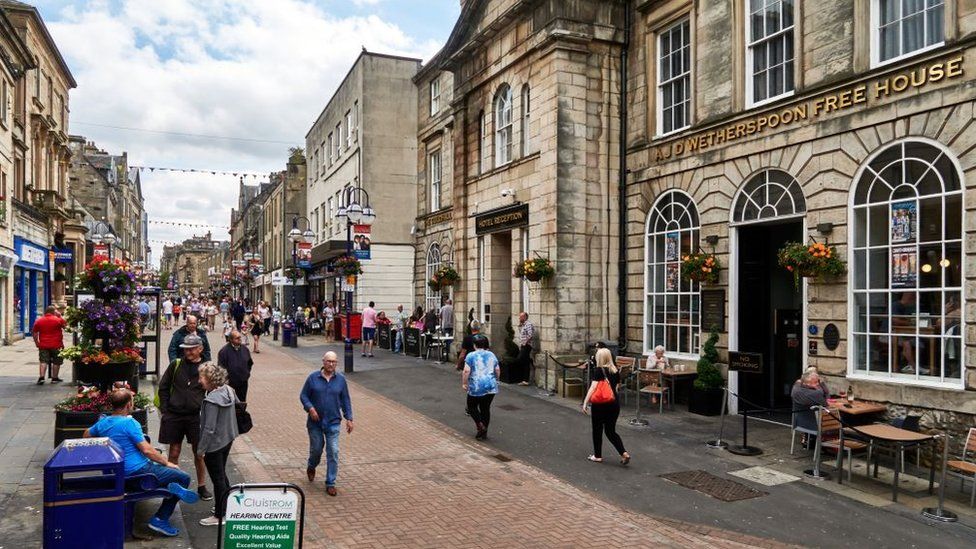
    Milton Keynes in England, Dunfermline in Scotland, Bangor in Northern Ireland and Wrexham in Wales all get the title.

    It is a first for places in an Overseas Territory – Stanley, in the Falklands – and a crown dependency – Douglas, in the Isle of Man – to win city status.

    Colchester and Doncaster complete the list getting the royal honour.

    The Platinum Jubilee civic honours competition required applicants to show their cultural heritage and royal links as well as how their local identity and communities meant they deserved to be granted city status.

    The new cities can expect a boost to local communities and the opening up of new opportunities for people who live there, the Cabinet Office said.

    It cited research that suggested previous winner Perth, in Scotland, saw the local economy expand by 12% in the decade it was granted city status, after it put them on the international map as a place to do business.

    Map showing new Jubilee cities

    The last competition to win civic honours in 2012 marked the Queen’s Diamond Jubilee. For the first time this year, Crown Dependencies and Overseas Territories were allowed to apply.

    The announcement of the latest civic honours takes the number of official cities in mainland UK to 76, with 55 in England, eight in Scotland, seven in Wales and six in Northern Ireland.

    The winners and details from their bids for city status include:

    Bangor, County Down, Northern Ireland

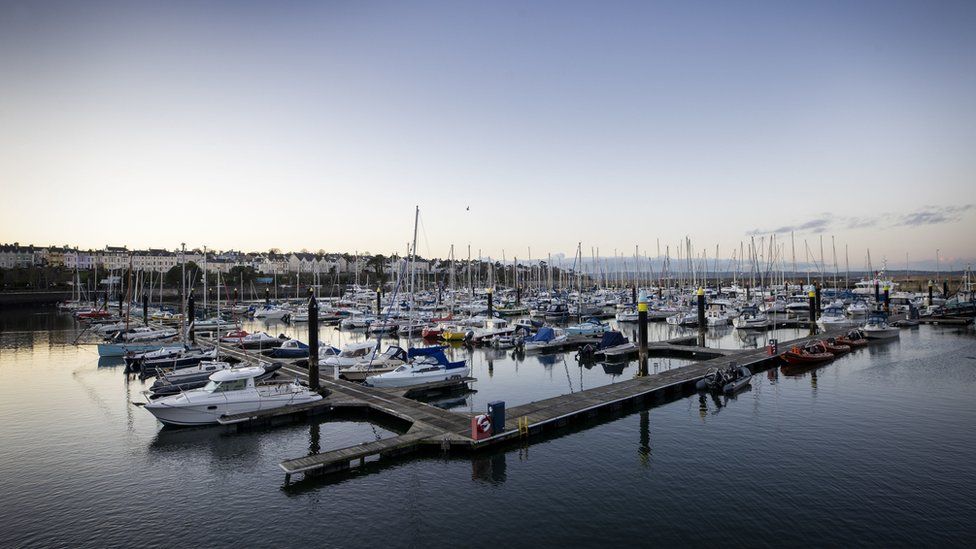
    BangorIMAGE SOURCE, PA MEDIA
    Image caption, Due to its location at the mouth of the Belfast Lough, Bangor was a key site for the Allies during the Second World War
    • Due to its location at the mouth of the Belfast Lough, Bangor, with a population of 61,011, was a key site for the Allies during the Second World War
    • In May 1944, Supreme Commander of Allied Forces Dwight D Eisenhower, who later became US president, gave a speech to 30,000 assembled troops in Bangor shortly before ships left for Normandy and the D-Day landings
    • The Queen and Duke of Edinburgh visited Bangor Castle in 1961 and, after lunching at the Royal Ulster Yacht Club that day, the duke took part in a regatta race

    Colchester, Essex, England

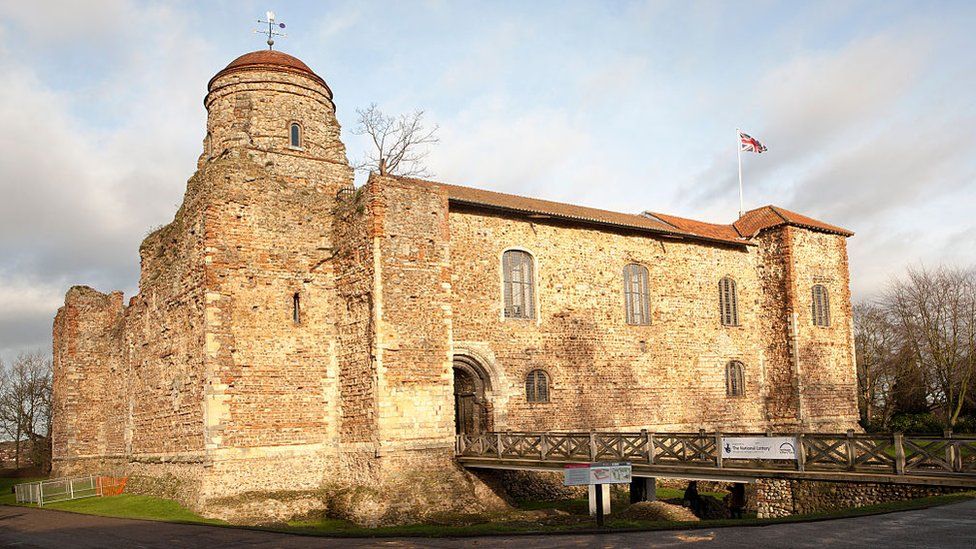
    Colchester CastleIMAGE SOURCE, GETTY IMAGES
    Image caption, Colchester Castle was built on the foundations of a Roman temple
    • Colchester, with a population of 119,441, is Britain’s first recorded settlement and its first capital
    • It has been a garrison town for the past 165 years and for the past 21 years has been home to 16 Air Assault Brigade, the UK’s rapid response force
    • It is the second Essex town to become a city this year after Southend was given the status in October following the death of MP Sir David Amess, who often championed its campaign for city status

    Doncaster, South Yorkshire, England

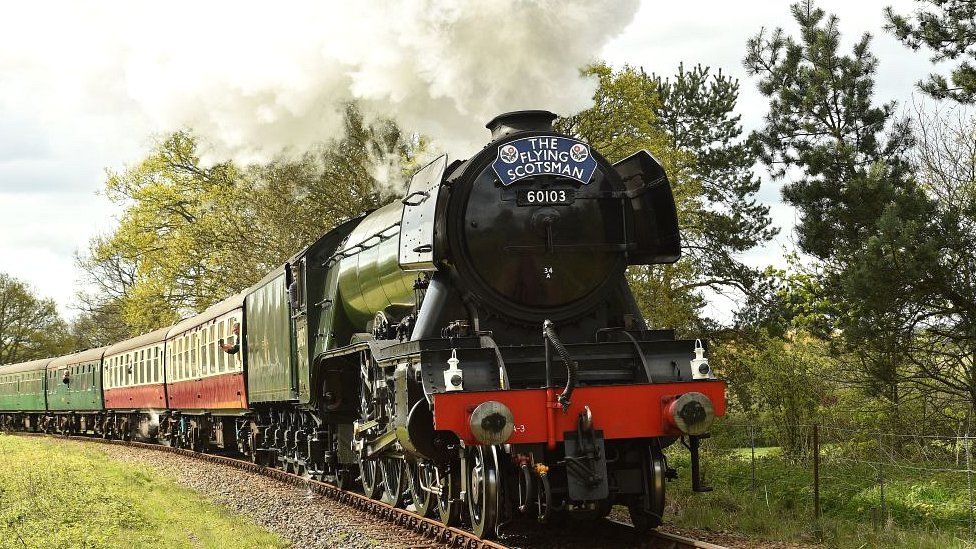
    Flying ScotsmanIMAGE SOURCE, GETTY IMAGES
    Image caption, The Flying Scotsman locomotive was built in Doncaster
    • Originally a Roman settlement, Doncaster, which has a population of 110,000, is almost 2,000 years old
    • Noted for its railway heritage, the Flying Scotsman and the Mallard locomotives were both built there
    • It is also home to the St Leger flat course. Founded in 1776, it is the oldest classic horse race in the world and has been attended by the Queen and other royals throughout history

    Douglas, Isle of Man

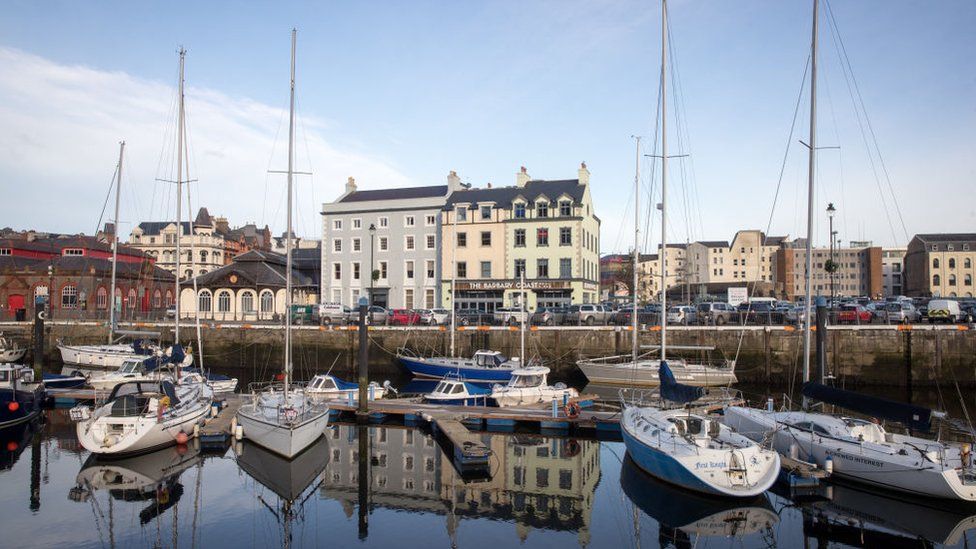
    Douglas Isle of ManIMAGE SOURCE, GETTY IMAGES
    Image caption, Douglas is the island’s main port
    • The Queen is patron of the Royal National Lifeboat Institution (RNLI) which started in Douglas, which has a population of 26,677 (2021 census)
    • Its Royal Hall plays host to annual flagship concerts by the Isle of Man Symphony Orchestra, the Isle of Man Choral Society and the Manx Last Night of the Proms

    Dunfermline, Fife, Scotland

    DunfermlineIMAGE SOURCE, GETTY IMAGES
    Image caption, Dunfermline’s most famous son is Andrew Carnegie,whose steel industry helped build America
    • Its annual fireworks display attracts some 30,000 local people, while the Christmas light event packed the town centre with 10,000 people
    • Dunfermline’s most famous son is Andrew Carnegie whose steel industry helped build America. His philanthropy started the world’s public library system, and he gave away the equivalent of £65bn in today’s money
    • Dunfermline, with a population of 58,508 was one of the seats of the kings of Scotland in the middle ages. Robert the Bruce was buried in Dunfermline Abbey after his death in 1329

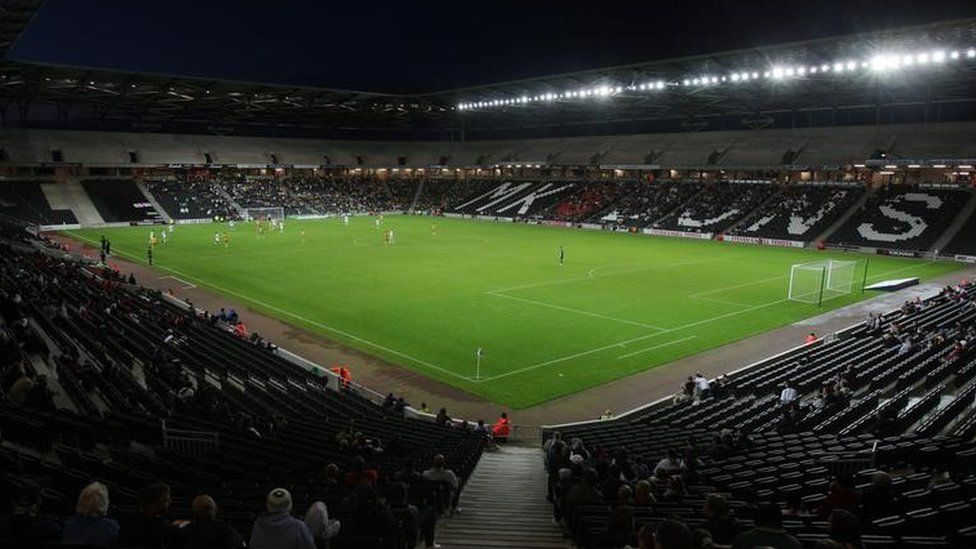
    Milton Keynes, Buckinghamshire, England

    MK Dons stadiumIMAGE SOURCE, PA
    Image caption, Milton Keynes is the home of MK Dons, formed in 2004
    • It was created in 1967 to alleviate housing shortages in overcrowded London
    • With an urban area population of 171,750 (2011 census), it has 27 conservation areas, 50 scheduled monuments, 1,100 listed buildings and 270 works of public art
    • The Open University, the world’s first degree-awarding, distance learning institution, was set up in Milton Keynes in 1967; and its University Hospital NHS Foundation Trust established the nation’s first independent medical school

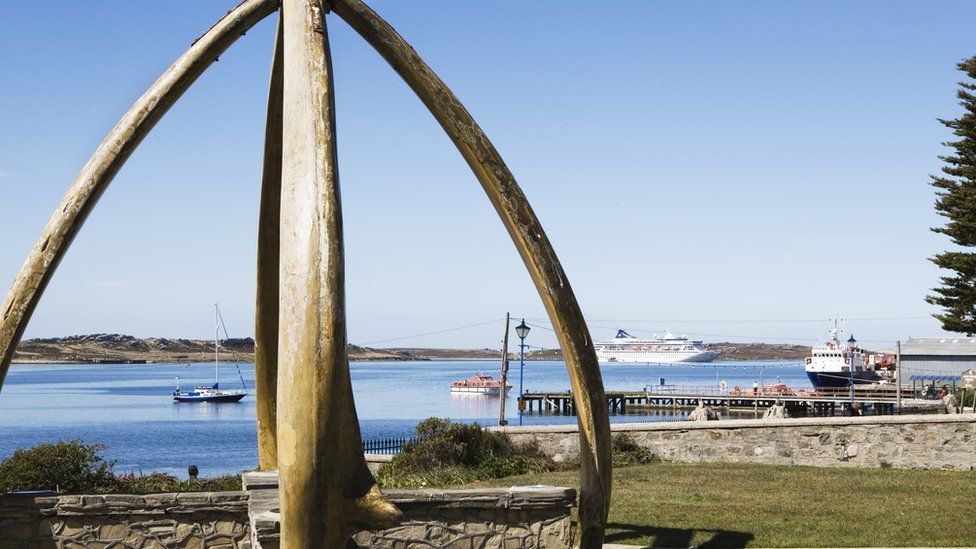
    Stanley, Falkland Islands

    Whalebone Arch at Port StanleyIMAGE SOURCE, GETTY IMAGES
    Image caption, The Whalebone arch in Stanley was erected in 1933 to mark a century of British administration
    • Members of the Royal Family have regularly visited the islands, including the late Duke of Edinburgh in 1957. In 2016, the Duke of Cambridge spent six weeks on the islands as a search and rescue helicopter pilot
    • Holidays and events specific to the islands, which had a population of 2,458 in 2016 (according to its most recent census), are held annually – such as Peat Cutting Monday. The sacrifices made during the Falklands War are also remembered – 2022 marks 40 years since the conflict

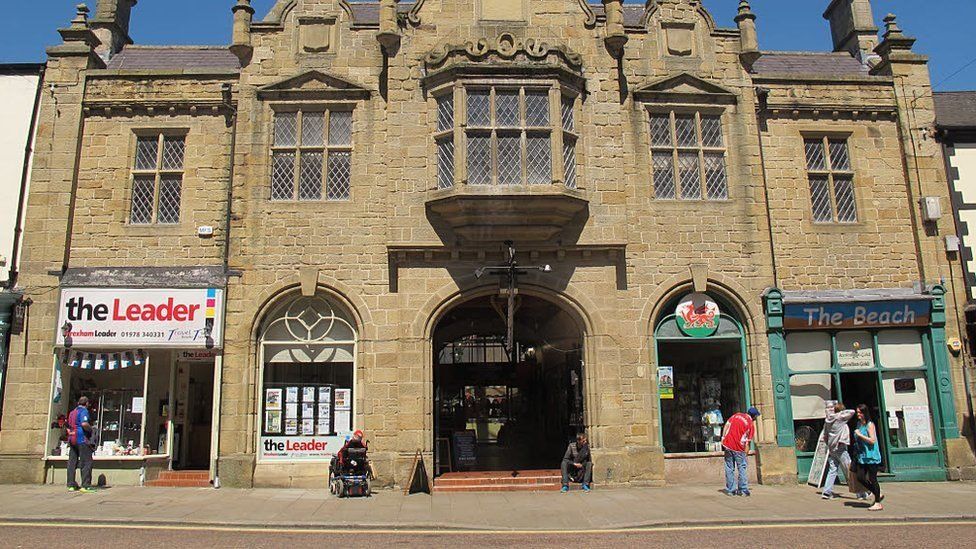
    Wrexham, north east Wales

    Wrexham Butchers MarketIMAGE SOURCE, STEPHEN CRAVEN/GEOGRAPH
    Image caption, Wrexham has tried to become a city three times since 2000
    • Established in 1864, Wrexham Football Club is among the oldest professional football clubs in the UK and is owned by Hollywood stars – the actor Ryan Reynolds and Rob McElhenney, creator of It’s Always Sunny in Philadelphia
    • The area, with a population of 61,603, is home to the Pontcysyllte Aqueduct, a Unesco World Heritage site

    Almost 40 locations submitted bids for city status when applications opened last year.

    City status is often associated with having a cathedral, university, or large population, but there are no set rules for being granted the status, which is awarded by the monarch on advice of ministers.

    Chelmsford, in England, Lisburn in Northern Ireland and Newport in Wales were among previous winners of the competition for city status – which has taken place during each of the last three jubilee years.

    Each new city will receive the award formally through a Letters Patent, which will be presented later in the year.

    Meanwhile, the city of Southampton has won the competition for Lord Mayoralty status – which means the mayor can be called Lord Mayor – joining the ranks of previous Jubilee competition winners including Chester, Exeter and Armagh.

    Source: BBC 
  • Queen cancels virtual engagements as she is still experiencing mild Covid symptoms

    London (CNN) — Britain’s Queen Elizabeth II canceled her planned virtual engagements on Tuesday as she continues to suffer from mild Covid-19 symptoms, Buckingham Palace has said.

    The palace announced Sunday that the 95-year-old monarch had contracted the virus.

    “As Her Majesty is still experiencing mild cold-like symptoms she has decided not to undertake her planned virtual engagements today, but will continue with light duties,” the palace said. 

    Light duties likely refer to her head of state responsibilities such as reading and answering documents and letters, which she receives daily in her famous red despatch boxes.

    A source close to the palace told CNN that the Queen’s further engagements over the coming week will be decided upon nearer the time.Concern for the Queen’s health has been renewed given her advanced age and health issues late last year. However, she has continued to work since Sunday despite testing positive for the coronavirus, issuing a message of condolence to the people of Brazil over flooding in the country on Monday. 

    The Queen’s diagnosis is the latest Covid case to hit the royal household. Her eldest son and heir to the British throne, Prince Charles, contracted the virus for a second time on February 10, and had seen his mother “recently.” Days later, his wife, Camilla, also tested positive. 

    Additionally, a royal source told CNN Sunday that there had recently been “a number of cases … diagnosed in the Windsor Castle team.” 

    UK media have reported that the Queen is fully vaccinated. Buckingham Palace previously confirmed both the monarch and her late husband, Prince Philip, had received their first doses of a Covid-19 vaccine in January 2021. The palace has declined to reveal any information regarding subsequent vaccinations, citing medical privacy.

    The Queen met with incoming Defence Services Secretary Major General Eldon Millar and his predecessor on February 16. The Queen — who reached the milestone of 70 years as British monarch on February 6 — had only recently resumed in-person engagements after taking a step back on advice from doctors to rest following an overnight hospital stay in October for an undisclosed reason.

    She has used a walking stick at several engagements in recent months and referenced her mobility at an event last week. While holding an audience with two military secretaries in the Oak Room at Windsor Castle, she quipped: “Well, as you can see, I can’t move,” while gesturing to her leg. A royal source told CNN at the time that she was believed to have been feeling slightly stiff rather than injured or unwell.

    She also has made plans to appear at a number of major engagements next month: a diplomatic reception at Windsor Castle on March 2, the annual Commonwealth Service at Westminster Abbey on March 14; and a service of thanksgiving for Prince Philip at the same venue on March 29.

    Nationwide celebrations for her Platinum Jubilee are set to take place in June.

    Source: edition.cnn.com