Tag: Rail

  • Train drivers from 12 different companies will strike again later this month

    The announcement of another train driver strike comes on the same day that London Underground workers go on strike, rendering large sections of the Tube network inoperable.

    Train drivers in England have declared a new strike in their long-running pay and conditions dispute.

    After months of walkouts by various groups, members of the Aslef union will strike on Saturday, November 26th, causing even more disruption for passengers.

    The 12 companies involved are Avanti West Coast; Chiltern Railways; CrossCountry; East Midlands Railway; Great Western Railway; Greater Anglia; London North Eastern Railway; London Overground; Northern Trains; Southeastern; Transpennine Express, and West Midlands Trains.

    The rail network has been crippled by strikes as workers fight for inflation-busting pay rises amid the cost of living crisis.

    Strikes on 5, 7 and 9 November were called off, but at too short notice to reinstate services, leaving Bonfire Night travellers stuck.

    Today, members of Unite and the Rail, Maritime and Transport (RMT) union have walked out over jobs and pensions.

    It means no services on large parts of the London Underground.

    Only the Central, Northern, District, Elizabeth, Overground and DLR lines are running, but with reduced services.

    Train companies with big profits should make ‘proper pay offer’

    Aslef general secretary Mick Whelan said of the latest industrial action: “We don’t want to be taking this action.

    “We have come to the table, as we always will, in good faith but while the industry continues to make no offer – due to the dodgy deal they signed with the Department for Transport – we have no choice but to take strike action again.

    “They want drivers to take a real terms pay cut.

    “With inflation now well into double figures, train drivers who kept Britain moving through the pandemic are now being expected to work just as hard this year as last year but for less. Most of these drivers have not had an increase in salary since 2019.

    “We want the companies – which are making huge profits – to make a proper pay offer so that our members can keep up with the cost of living.”
  • South Africa’s rail, port workers to strike over wages

    Workers at South Africa’s state-owned logistics firm Transnet will go on strike from Thursday over a wage dispute, two labour unions said, in a move that could halt the export of key minerals and other cargo.

    Transnet has been operating below capacity due to a shortage of locomotives, poor maintenance and vandalism and theft of its infrastructure, costing miners billions of rand in potential revenue. A strike would paralyse freight rail services and impact South Africa’s ports, also managed by Transnet.

    The United National Transport Union (UNTU), the biggest labour union at the company, said it had served notice to begin industrial action on Thursday. The other union at Transnet, South African Transport and Allied Workers Union (SATAWU), said it would join in the strike from Monday.

    Both unions said Transnet’s offer of a 1.5 percent pay increase from October 1 fell below their demands.

    “Transnet…must provide a salary increase offer that is aligned with the increased cost of living, cost of housing, medical costs, housing and, of course, the consumer price index (CPI) that is currently running at 7.6 percent,” UNTU said in a statement.

    In recent years, the cost of living has soared in Africa’s most developed economy, worsened by the COVID-19 pandemic and the increase in prices of items like bread due to global supply chain disruptions since Russia’s invasion of Ukraine.

    In July, former President Thabo Mbeki warned that there could be an “Arab Spring-type uprising” in the country due to the situation.

    Transnet has said any increase beyond its current wage offer would not be sustainable.

    “Transnet has consistently made the point that its wage bill currently makes up over 66 percent of monthly operating costs. This is not sustainable, particularly given the current operational and financial performance,” it said in a statement on Tuesday.

    Transnet has applied to the Commission for Conciliation, Mediation and Arbitration (CCMA), a state agency that mediates labour disputes, for further talks with the unions.

    Both UNTU and SATAWU said the mediation, which is due to start on October 12, would not affect their plans to go on strike.


    Source: Algazeera


  • Unions have announced additional action in response to Kwarteng’s “anti-democratic” crackdown on strikes

    The chancellor’s plan was quickly followed by the announcements of two additional unions to join the rail strikes on October 1. As a result, all unions are participating, and there won’t be training services in various parts of the country.

    Unions have condemned Kwasi Kwarteng’s plan to introduce a law that will require members to vote on pay offers before strikes can happen.

    The chancellor, announcing a mini-budget, said it was “unacceptable” industrial action was causing so much disruption – ahead of fresh rail strikes next week.

    He said other European countries had minimum service levels to stop “militant trade unions” closing down transport systems.

    Mr Kwarteng said the government would do the same “and go further”.

    “We will legislate to require unions to put pay offers to a member vote to ensure strikes can only be called once negotiations have genuinely broken down,” he said.

    Moments after his comments, two unions, Unite and the Transport Salaried Staffs Association (TSSA), announced fresh rail strikes in the long-running dispute over jobs, pay, and conditions.

    It means all the major rail unions are now taking strike action on 1 October, threatening a complete shutdown of the network for the first time since the row blew up earlier this year.

    Further action is planned on 5 and 8 October, with Network Rail saying only about 11% of services will operate on 1 October and in some parts of the country there will be no trains at all.

    The strikes will affect the Conservative Party conference in Birmingham, which takes place from 1-5 October, while the London Marathon takes place on 2 October when train services will also be affected.

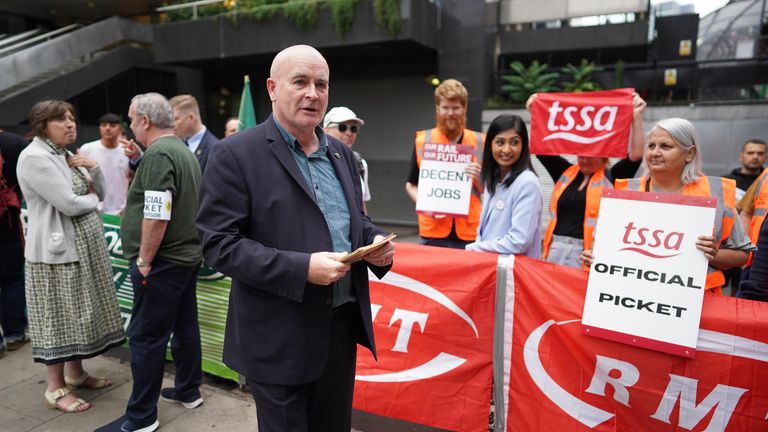
    Mick Lynch, general secretary of the Rail, Maritime and Transport union (RMT) on the picket line outside London Euston train station. Picture date: Thursday August 18, 2022.
    Mick Lynch, general secretary of the RMT, said the plan was not the right move

    Mick Lynch, general secretary of the Rail, Maritime, and Transport (RMT) union, said: “We already have the most severe anti-democratic trade union laws in western Europe and this latest threat will rightly enrage our members.

    “The government should be working towards a negotiated settlement in the national rail dispute, not seeking to make it even harder to take effective strike action.

    “RMT and other unions will not sit idly by or meekly accept any further obstacles on their members exercising the basic human right to withdraw their labour.”

    Manuel Cortes, general secretary of the TSSA, said: “Unions are democratic organizations and industrial action only occurs as a last resort and after a postal ballot of members which also includes having to meet undemocratic thresholds.

    “Frankly, having to ballot our members on pay offers before they can take industrial action will not make a blind bit of difference.

    “If the offer is rubbish, it will still be rubbish whether our elected workplace reps have consulted our members on it or a ballot has taken place.

    “This new Tory proposal will serve only to elongate disputes and generate greater anger among union members. It will do precisely nothing to encourage employers to come to the negotiating table with realistic offers.”