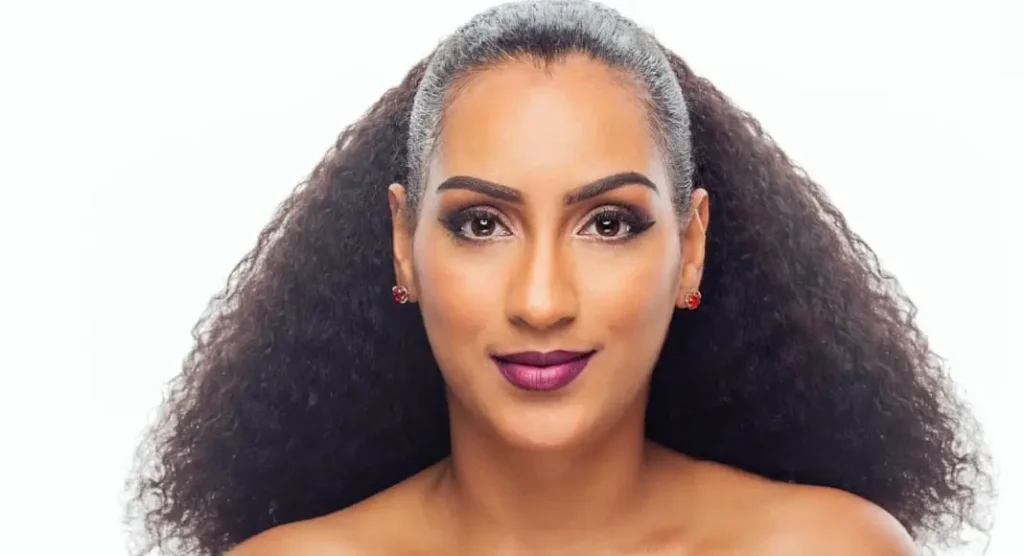
The actress claims that despite her repeated requests for her ex-boyfriend to stop, he persisted in forcing himself into a sexual encounter with her.
“I kept saying no, stop it, stop it but he will pin me down to do whatever it is”.
She further narrated that this said boyfriend will rather be smiling and saying “’don’t worry’, and you are kissing whilst I am crying; that means you are a rapist”.
The mother of one recounted this chilling story whilst speaking on the ‘With Chude’ TV show.
“I had to leave that relationship, I had to,” she told the host of the show. “I fought my way out of that relationship because he even locked me up in the house,” she revealed.
In an excerpt of the interview seen by pulse.com.gh, she continued that “he locked me up in the house for some days until my sister Sonia came to find me”.
According to Juliet, the ex-fiancée of Safo Kantanka Jnr, she was scared of the guy because he was thick and tall.
“I was scared because what do I do, this guy was huge, he is taller than me, and imagining someone like this pinning you down. He can raise me up and pin me against the wall. You are against the wall and you can’t do anything,” the actress recounted.
In the video below, she added that the rape happened every day. “It was every day and I am not happy, you seeing that I am not happy but every day. Every day, he wanted to do something, that is rape”.
Juliet Ibrahim did not however disclose who this ex-boyfriend of hers is. She seized the moment to advise women to speak against such forceful sexual encounters if even it is from their husbands.
“In those kinds of cases you can not even explain, who do you go and tell? Who is going to come and fight for you? At that time you are naïve but ladies you can report it now, go and report. if your husband is forcing you to do when you are not in the mood, it is rape”.
Juliet Ibrahim is a Ghanaian actress, film producer and singer of Lebanese, Ghanaian and Liberian descent. She won the Best Actress in a Leading Role award at the 2010 Ghana Movie Awards for her role in 4 Play. She has been referred to as the “Most Beautiful West African Woman” according to A-listers Magazine.
Early life
Juliet Ibrahim was born to a Lebanese father and a Ghanaian-Liberian mother. She is the oldest child and has two sisters including the actress Sonia Ibrahim, and a brother. Juliet and her siblings spent the longest part of their childhood in Lebanon and Ivory Coast due to civil wars.[citation needed] She had her primary education in Lebanon, then proceeded to Ivory Coast for her secondary education where she lived with her parents. She studied at the Ghana Institute of Languages, where she studied English, French, and Spanish. She also studied marketing, Advertising, and Public Relations at the Ghana Institute of Journalism.
Ibrahim has commented that in Africa she is not regarded as a black woman because of her skin tone, but outside Africa, she is recognized as being black. She objected to the term ‘half-caste’ and said that she was ‘Black and proud of it
Career
Ibrahim made her acting debut in the 2005 film Crime to Christ starring Majid Michel. Her first Nollywood film was Yankee Boys and she has featured in more than 50 films afterward. In 2014 she produced her first film Number One Fan, where she stars as an actress being stalked on by a fan in the film. Her second movie, Shattered Romance, featuring Nigerian and Ghanaian actors, launched amidst fanfare in Accra, Ghana on December 5 2014. Her new TV series; Every Woman Has A Story, where she debuted her directorial skills is airing on Terrestrial TV and her new reality show, The Perfect Assistant, will be unveiled soon. She has also featured in Twi movies, in Yoruba language films, and also in Ladan Aure, a Hausa Language film.
A 25-year-old woman is fighting for her life after being attacked and raped by five armed robbers who she believes to be herdsmen while she was at home in Gomoa Ojobi in the Central Region’s Gomoa East District.
After attacking and raping the victim, the suspects also went to Awutu Ahentia and stole over 10 cows but failed to transport the cows to their destination due to hot chase by some other herdsmen.
The suspects fled from the Ojobi community leaving their sprinter bus with the registration number GG 2766-21 where some angry residents in the area vandalised the vehicle.
Speaking to Angel News Correspondent, Opanyin Darko, the Fulanis Chief of Gomoa Ojobi, Haskan Garu Imorro, described the incident as appalling and inhumane.
According to him, the suspects overpowered the woman’s husband by tying him with rope and took his wife to the bush nearby bush and raped her.
A Norwegian model took the stand in Harvey Weinstein’s trial on Wednesday and testified that the former movie mogul allegedly raped her, masturbated in front of her and propositioned her for a threesome.
The complex testimony spanned a series of events over a number of years. The alleged incidents occurred during industry events such as the BAFTA Awards, New York Fashion Week, the Cannes Film Festival and AFI Fest, as well as an audition for the musical film “Nine,” which was distributed by The Weinstein Company in 2009.
More from Variety
Weinstein’s defense questioned the woman, known in the case as Natassia M., as to why she agreed to see Weinstein repeatedly after she alleges she was sexually assaulted. She spoke about the power imbalance between her and Weinstein, telling the jury she was concerned that if she didn’t keep up a friendly relationship with Weinstein, he would blacklist her from the biz.
Natassia M. was called by the prosecution to prove a pattern of conduct, as an uncharged witness in the case. (There are four Jane Does and four uncharged witnesses in the trial.)
“He was called ‘One Phone Call Away Harvey,’ meaning he could make you or break you. He was the most powerful person in Hollywood. He created stars,” Natassia M. said on the stand. “The asymmetrical power situation was so large, I felt like there was this powerful guy who could ruin my career, who had the destiny of people’s life in his hands.”
The first time Natassia M. encountered Weinstein, they had no interaction, but she noticed him staring at her across the room. It was 2002 and she was at the restaurant Cipriani in New York City with Naomi Campbell, with whom she was working on a modeling gig.
“He was sitting in a chair at a restaurant, staring at me, gazing at me for a very long time. He would not break his gaze, so I yelled in the restaurant, ‘Who the fuck is that fat fuck who is sliming me?’” she testified, then stating that Campbell said, “That’s Harvey Weinstein.” She said, “I yelled out, ‘I don’t give a fuck who it is. That guy is sliming me.’”
When Weinstein’s attorney, Mark Werksman, questioned Natassia M., he asked her, “‘Who is that fat fucking pig?’ Is that what beautiful models call overweight men?”
Natassia M. continued to chronicle her story. After that moment in 2002, she didn’t come across him again until the Cannes Film Festival in 2003 where she was with her friend, the actor Michelle Rodriguez, and they stayed in a hotel room arranged by Weinstein’s company, but had no actual interaction with him. After that, she saw Weinstein at NYFF in 2007 where she was making the press rounds, per her obligations as the face of a major modeling campaign. At NYFF, when she was at a fashion show for work, her publicist arranged for her to take a photo with Weinstein. She says when they took the photo, he was standing right next to his then-wife, Marchesa co-founder Georgina Chapman. “Mr. Weinstein’s first comments out of his mouth were, ‘Where are you staying and what’s your room number?’” Natassia M. says she was “flabbergasted” because she had never spoken to Weinstein before in her life.
The next time she saw Weinstein was soon after, at a BAFTA afterparty in London in 2008. The publicist for her modeling campaign arranged for her to once again take photos with Weinstein, thinking it would be good branding. They had a brief interaction at the industry event, took some photos and that was that. Until Weinstein suddenly barged into her hotel room in the middle of the night, unannounced. Natassia M. explained that she has no idea how Weinstein knew where she was staying, but she was woken up in the wee hours of the morning to Weinstein knocking loudly on her door and shouting his name to let her in. She was confused and opened the door. “He just stormed in,” she said.
“He said, ‘No one gets to be an A-lister unless it goes through me!’” she continued. “I just thought this guy is so powerful, I have no idea what to do in this situation and I completely froze … I was just so scared of this guy. He had so much power.”
Natassia M. said Weinstein told her to “think about all the Oscars” that celebrities have won and thanked him during their acceptance speeches. She told the jury she interpreted that as, “Everybody had to go through him — meaning, comply.”
That’s when Weinstein allegedly raped her. “He took off his pants and pushed me on the bed and climbed on top of me and I said to him, ‘I don’t do the casting couch thing.’” She shared graphic details with the jury, recalling, “It didn’t last that long because I had zero response because I just played dead. He got off me and finished off himself. He ejaculated into his hand … I did not fight him. I did not scream. I literally was frozen … I couldn’t think.”
Weinstein left her hotel room shortly after the alleged assault. When she woke up, she noticed a movie script on her nightstand for “Nine,” the theatrical musical that Weinstein produced in 2009. She assumed Weinstein left the script there for her to see.
She did not call the police to report the alleged incident in London “because if you’re an actress and you’re a problem, you don’t work,” she told the jury. “If you are difficult, that thing goes around Hollywood that this person is difficult.”
Natassia M. did not have any more contact with Weinstein in London, but when she was back in Los Angeles where she lived, she wanted to pursue to role in “Nine,” despite the alleged assault. “I wanted to make the best of this situation,” she said. “I thought I could avoid him, but I wanted to earn the part.”
Back in L.A., she signed up for singing and dancing lessons since “Nine” was a musical, and told the jury that she spent a lot of her money on the training because she was so committed to earning the part. She eventually got an audition, and when she showed up, she was stunned and “horrified” that Weinstein was there. “I couldn’t concentrate on my audition. I was thrown off,” she said. “He was sitting right there and I didn’t know he was going to be there.”
After the audition, Natassia M. sent an email with an MP3 recording of a singing demo to Weinstein and his staff. She explained that she paid herself to use a recording studio for the demo because she was taking the role so seriously. She said that Weinstein responded and instructed her not to send the demo tape to his office, and instead told her to meet his assistant at the Peninsula Hotel in Beverly Hills, Calif. She agreed, thinking she’d meet the assistant in the lobby and would never see Weinstein. “I tried to give her the CD, and she said, ‘No, Mr. Weinstein wants you to follow me and talk about the movie.”
When she arrived to Weinstein’s room with his assistant, she gave Weinstein the demo tape and he chuckled and tossed it aside, she said. She suddenly realized that the assistant was gone. “He tricked me to coming into his hotel,” she testified. “All of a sudden, I’m in his hotel room.”
She then noticed another woman in the hotel room. “I can’t believe he has me in this fucking suite with a prostitute. And I was furious,” she said, then telling the jury that they propositioned her for a threesome. Natassia M. told the jury that she was upset and felt coerced, but she wanted the movie role, and thought she could manage the situation.
She thought, “I’ll just pretend I’m really innocent, and not do anything … And this prostitute, who I think is a prostitute, is like, ‘Oh she’s so shy,’ and her and Weinstein were laughing. And she gave him a blowjob.” (The judge blocked the prosecution from naming the woman who was allegedly with Weinstein in the hotel room, though she was also associated with another Jane Doe’s allegations, earlier in the trial.) Natassia M. agreed to participate by putting on a robe and watching Weinstein with the other woman, but told jurors she did not engage and put on an act.
“I was still trying to manage the situation because I really wanted to be able to do a quality movie,” Natassia M. explained. “He has you by the fucking throat, knowing that if you don’t comply that your career is down the drain … and that’s not right.”
After that alleged incident at the Peninsula in 2008, Natassia M. did not see Weinstein until a few years later when she said she randomly bumped into him at an Oscars party that she attended with her boyfriend at Soho House in L.A. When Weinstein saw her, he pulled her aside, she testified, and said, “I thought you were going to go to the tabloids.” She told Weinstein she would never “mess around with the most powerful guy in Hollywood,” and he said, “It pays to be my friend.” She thought, “Shit, I have to pretend to be his friend [and] then maybe, he will fix any damage that he’s done to my career.”
After that conversation, Natassia M. believed that Weinstein blacklisted her, so she told the jury that she figured it would be smart to stay in touch with Weinstein for career purposes. She ended up seeing Weinstein a few more times, mostly at her request, when she would contact him to ask for business meetings with her friends, as a favor. She made arrangements to meet with Weinstein at AFI Fest in Los Angeles with one of her producer friends, which she said resulted in Weinstein asking her back to the Montage hotel where she agreed to watch him shower. In New York City, she had set a meeting with Weinstein and her friend who wanted to discuss incorporating his celebrity connections for charity, and Natassia M. told the jury that the business dinner turned into Weinstein guiding her upstairs to his office and groping and masturbating in front of her.
During cross-examination, Weinsein’s defense showed an email where Natassia M. invited Weinstein to a 2011 Cannes Film Festival party where one of her friends was presenting a film. She wrote, “The film has Oscar written all over it” and signed the email, “Love you Harvey.”
Weinstein’s attorney continuously asked Natassia M. why she remained in contact with Weinstein, suggesting that she wanted to use his power for her own benefit. She said that she only wanted to help her friends, and never expected Weinstein to abuse her again and again. “Usually when people ask me to help them, I say, ‘Yes,’” she said. “But you’re asking for help from someone who raped you,” Weinstein’s attorney Werksman retorted.
“This is like the fourth time that you’ve followed along with some assistant against your will?” Werksman continued.
Natassia M. replied, “Against my inner wishes. And yes … when you’re meeting Mr. Weinstein, you hope things are going to get better.” Shifting to another alleged encounter, Werksman sarcastically asked, “Is there where you said, ‘I can’t believe you’ve gotten me in this situation for now the fifth time, so I’m outta here?’”
Trying to prove that Natassia M. knew what she was getting involved with when she saw Weinstein, his attorney looked at her on the stand and said, “You’ve gotta do what you’ve gotta do to get ahead in Hollywood.”
Following the day in court, Gloria Allred, who represents Natassia M., issued a statement to Variety, applauding her client.
“She testified that she told Harvey Weinstein that she did not do ‘the casting couch,’ but despite telling him that, he raped her and engaged in other unwelcome sexual conduct with her,” Allred said, in part. “She was on the witness stand for most of the day, and underwent a rapid fire intense cross-examination by the defense. Despite the many attempts by Harvey Weinstein’s lawyers to discredit her and undermine her testimony, she stood her ground and told her truth. I was very proud of her and the courage that she demonstrated, as she testified in the criminal trial of People vs. Harvey Weinstein today.”
Two years ago, Isobel, a British woman in her early 20s, went to the police and told them how a gang of men had sexuallyexploited her.
Warning: This story contains descriptions of violence and sexual violence
For the previous four years the gang had relentlessly trafficked her across England, driving her to towns and cities where she was raped hundreds of times in takeaways, warehouses and in empty flats, by men who paid her abusers. The gang of men, of Pakistani heritage, subjected her to extreme violence and regularly poured petrol over her, threatening to kill her if she disclosed the abuse.
Isobel, not her real name, went to the policeafter seeing news that a grooming gang in another part of the country had been jailed. She says after reporting what happened, however, nobody got in touch with her for three weeks. When a police officer finally did contact her, Isobel says she felt victim-blamed and was asked why she was still in contact with her abusers.
Isobel was keen to see her perpetrators prosecuted, but says when she asked police how they were going to keep her safe – by providing a safehouse during their investigation – no plan was put in place. The gang knew where she lived and despite being temporarily free, she lived in fear.
The police also failed to refer Isobel to the National Referral Mechanism (NRM), a government framework that provides victims of modern slavery – including sexual exploitation victims – with vital support to rebuild their lives, including access to safehouses, counselling, financial support and legal aid.
British nationals are more likely to be referred to the NRM than victims from overseas – 31% of potential victims who were referred in 2021 were British nationals. Of those referred to the NRM because of sexual exploitation, the BBC’s File on 4 found there were 462 British girls and women in 2021 – compared with 46 non-British nationals.
But Robyn Phillips, director of operations at the Human Trafficking Foundation, says there is a perception that trafficking has to cross international borders – and it is access to safehouses that British victims find most difficult to secure.
‘Let down’
The gang discovered Isobel was talking to the police and began sending her threatening messages. Isobel told the police, but when no safeguarding measures were put in place, she withdrew from the investigation and the case was dropped. She was forced back into a life of exploitation by the gang and she became pregnant.
Isobel told her abusers she was expecting a baby, but says as one of them was the likely father, they were fearful that DNA evidence would identify them. She says the gang punched her in the stomach telling her: “I’m gonna beat it out of you – it’ll be the devil child.”
Isobel suffered a miscarriage and went to a Sexual Assault Centre, where she was finally referred to the NRM. She was also introduced to Jess Phillips, Labour’s shadow minister for domestic violence and safeguarding, who thought Isobel’s case was “so horrifying” that she went to meet her.
After talking to the MP, Isobel decided to go back to the police and try and get support from the NRM to rebuild her life. But it wasn’t easy. ”I asked my National Referral Mechanism worker about legal aid,” says Isobel. “She started to be angry and was like ‘you don’t need that legal advice, because you’re not an immigrant’.”
The National Referral Mechanism
The National Referral Mechanism (NRM) is a Home Office framework for identifying and referring potential victims of modern slavery and ensuring they receive the appropriate support
A person who is suspected to be a victim is referred to the NRM from a first responder agency, which can be police forces, immigration authorities, the National Crime Agency, local authorities or charities such as the Salvation Army, NSPCC or Barnardo’s
Once a referral is made, it is assessed and someone who is believed to have been a victim of trafficking or modern slavery is first given a reasonable grounds decision and can access support before being given a conclusive grounds decision, where it is accepted they were a victim
Ms Phillips says the NRM was originally designed for victims from abroad and there is a failure to provide services for “this kind of active exploitation”.
“There’s victim-blaming at lots of different levels, whether that’s police, whether that is the sort of service provision that’s meant to sit around exploitation and trafficking, and in [Isobel’s] case, it has just failed her at every point,” she says.
A year after she had been referred to the NRM, Isobel still hadn’t received the help she was entitled to. The police investigation, which had resumed after her miscarriage, fell apart after officers failed again to put safeguarding measures in place. Now at her most vulnerable, her abusers turned up at her home again and drove her to a town where she was raped by a group of men.
She called the police and her NRW worker, who got in touch with the Salvation Army, which runs the government’s modern slavery support contract. Isobel says the Salvation Army offered her a safehouse but was told she had to give up her phone. Initially she refused to do so, and she says when she called back to say she had changed her mind she was told it was too late.
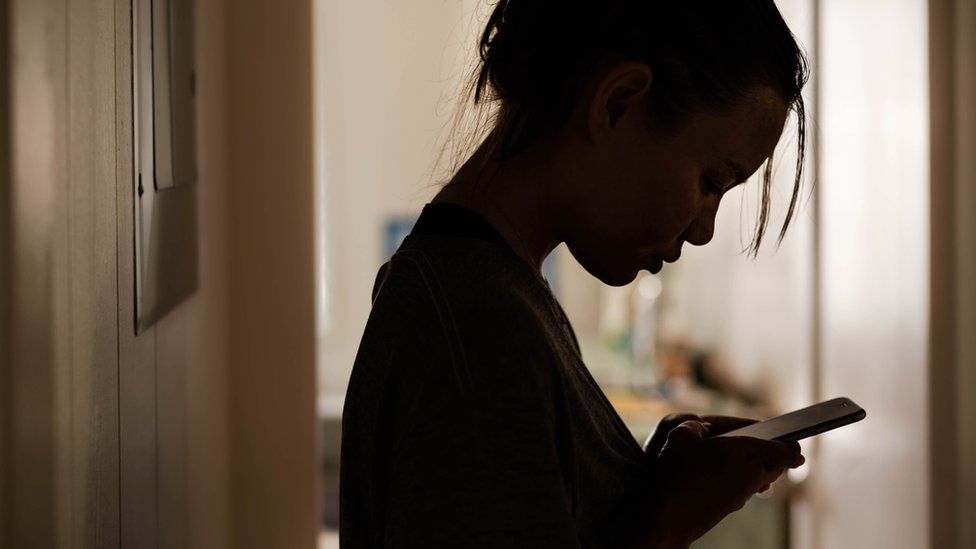
Image source, Getty ImagesImage caption, Isobel was finally offered a place at a safehouse, but was told she had to give up her phone (picture posed by a model)
Emilie Martin, from the Salvation Army, says it is not common practice for someone to be asked to give up their mobile phone, but where it does happen the individual will be issued with a replacement. She says the NRM also “provides the same needs for individuals who are British nationals and those who aren’t”.
The Home Office said it is “committed to tackling modern slavery and helping victims recover” and expects “police forces to investigate cases of sexual exploitation, pursue perpetrators and support victims”.
The National Police Chiefs Council said a dedicated national team has been set up to improve the response to modern slavery across all police forces and ensure the “ruthless criminals behind these offences are brought to justice”.
But Maggie Oliver,a former Greater Manchester Police detective, who exposed the Rochdale grooming scandal – which resulted in nine men being convicted of sex trafficking 10 years ago – says British victims of sexual exploitation in the UK are viewed differently to those being trafficked into the country.
She says authorities fail to understand that victims need protection wherever they come from. “If it happened to my daughter, I would think very, very carefully about whether I involved the police, because I think the damage victims suffer is often made ten times worse by the authorities that let them down.”
Isobel’s future remains unclear. She says she’s constantly checking over her shoulder to see if there’s anyone following her and that while she would like to see her abusers jailed, she’s “got no trust in the police because they’ve literally just failed me from day one”.
More than anything, she says she just wants to be safe.
Offering support is way to help sexually abused survivors.
Sexual assault is illegal, unwanted or unwelcome form of sexual contact such as rape, touching or groping without consent.
Anyone can be a victim of sexual assault, it is not gender specific or age specific.
Sexual assault victims find this to be a very traumatic one, thus it is important that as a friend or family or cousin to give them all the support because they would be needing a lot of it.
Knowing the right kind of words to say is also important, you do not want to say things that could result in them having flashbacks or panic attacks and in the long run, prevent stigmatization.
Here is how you can support your friend who has been sexually abused:
1. Listen to them
At this point, they don’t need you to tell them why it happened or what they could have done to prevent it from happening. They don’t want to hear what you have to say if it is not going to make the situation better. They do not need you to judge them, all you need to do is listen to them. Don’t be too quick to speak, listen while they let everything all out.
2. Show support
If your friend calls you and they tell you that they have been sexually assaulted, it is because they trust you and they feel you can support or help them.
Let them know that they have your unwavering support through their trying times. Follow them to the clinic or hospital, you can also follow them to the therapist. Let them know that you are on their side.
3. Let them know that you believe them
One of the main reasons why rape survivors do not speak up is because they fear that society might not believe their sexual assault story. Do not interrogate them or try to challenge their story.
This helps to stop the stigmatization that usually surrounds rape.
A 21-year-old man reported to be the stepson of Deputy Works and Housing Minister, Barbara Ayisi is in the grips of the police for raping a Form 1 student of Ghana National College.
The suspect who is a Form 3 student of the same school is said to be the son of Communications Director of the National Disaster Management Organisation (NADMO), George Ayisi.
According to a report by myjoyonline.com, the suspect invited the girl to a place out of the school where he forced himself on her.
After finding out about his action, the school authorities lodged a complaint with the police for his arrest.
The report further states that parents of both students were invited to the school for a meeting before the suspect’s arrest.
The Domestic Violence Victims Support Unit (DOVVSU) has sent the docket to the Attorney General for advice before sending the case to court.
Meanwhile, the victim has been booked for a session with a psychologist.
A man has been arrested for allegedly raping a 5-year-old girl in the grounds of the US Embassy in New Delhi, according to police.
The girl was playing outside the embassy’s staff quarters on Saturday before she “was lured and raped by a neighbor,” Eish Singhal, deputy commissioner of Delhi police, told CNN.
The girl, who is the daughter of a housekeeper employed by the embassy, later identified the 25-year-old male suspect, who has been arrested and charged with rape, police said.
“She was able to identify him point blank and there is no doubt over this,” Singhal said, adding that the suspect remains in custody.
The incident has appalled embassy staff. In a statement to CNN, a US Embassy spokesperson said “we were deeply disturbed by the alleged misconduct.”
“We promptly took action when we were informed of the allegation, and brought this matter to the attention of the police. Of course, we are cooperating fully with them,” the spokesperson said.
An investigation has been launched, and a court date has yet to be set.
In the wake of a brutal 2012 Delhi gang rape — which brought worldwide condemnation and still haunts the collective memory of women in India’s capital — lawmakers passed a series of amendments to the existing rape laws.
The amended law lengthened prison terms and introduced the death penalty in cases in which the victim is younger than 12 years of age.
In 2018, more than 33,000 cases of alleged rape were reported — roughly 91 cases each day, according to India’s National Crime Records Bureau — but experts say the real number is likely much higher, owing to the shame attached to sexual assault and the social barriers faced by victims.