The United Nations is thinking about sending help to Sudan through a different path from South Sudan because they are having trouble reaching many areas of the country.
Rick Brennan, from the World Health Organisation (WHO), said they were planning to set up operations that would go across the borders from South Sudan into South and West Kordofan in Sudan.
He said the war has caused a big problem for people and made it hard for workers to do their jobs.
The fighting between the army and the paramilitary Rapid Support Forces (RSF) has made almost half of the people in Sudan need help.
Over seven million people have left their homes, which makes Sudan the biggest displacement crisis in the world.
Tag: Rapid Support Forces
-

UN searches for new humanitarian entry point into Sudan
-
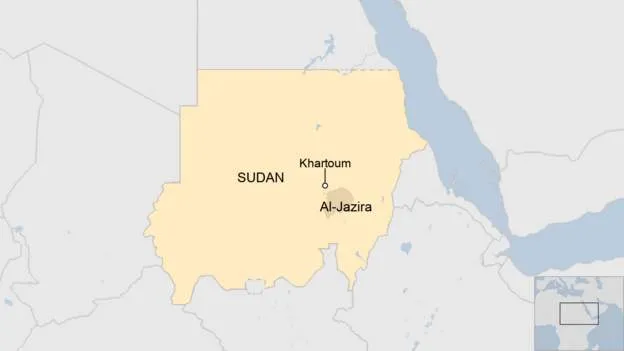
Sudan violence reportedly expanding to former safe haven
There are reports of big fighting near the capital of Sudan, Khartoum. Many civilians who were forced to leave their homes because of the war live there.
People who saw it happening say that the paramilitary Rapid Support Forces (RSF) entered al-Jazira state in a big way.
It was a pretty safe place.
Since the fighting started in April, about seven million people from Sudan had to leave their homes.
Less than a week ago, local leaders said that the fighting groups in Sudan had agreed to meet in person to talk and try to stop the fighting.
However, the fighting is getting worse and the people who have been forced to leave their homes are preparing to run away to save themselves once more.
Fighting for control of Khartoum made almost 500,000 people move south to al-Jazira.
However, the RSF launched a big attack and now there is fighting near the state capital, Wad Madina, with fighter jets flying overhead.
This area grows a lot of food, but because of the war, many people who need help getting food cannot get it. -
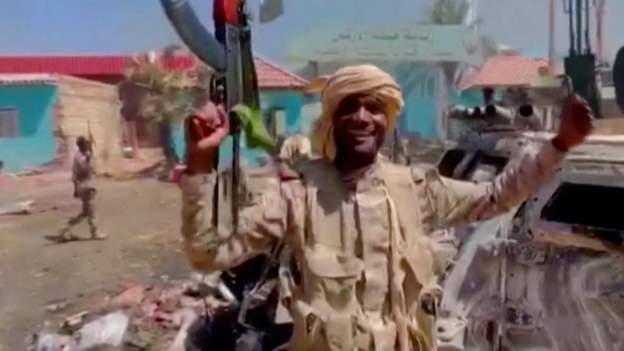
Army of Sudan detains Rapid Support Forces child soldiers
Sudan’s military has taken custody of kids who were made to fight with the Rapid Support Forces (RSF) in the current conflict.
Sudan TV, which is owned by the government, has reported that an unknown amount of children are being kept in Wadi Saidna, located in northern Khartoum.
On September 15th, the SAF gave 30 kids who were captured during war to the International Committee of the Red Cross (ICRC).
People have accused the RSF of breaking international rules by getting young people to join the fighting in Sudan.
The RSF announced that 260 soldiers from the Sudan army joined them in Khartoum on Saturday.
The army and the RSF are still fighting in Khartoum, Darfur, and Kordofan. Meanwhile, reports say that talks in Saudi Arabia are trying to achieve a ceasefire and provide help for people in need. -
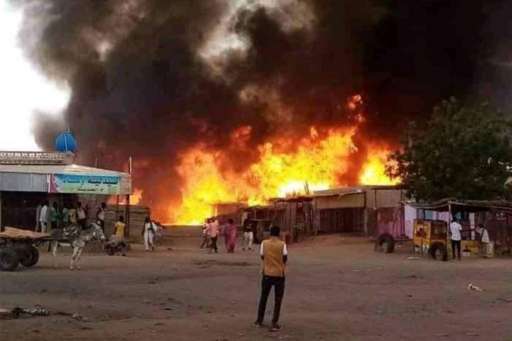
RSF opposes ‘unfair, US sanctions against Sudan
Sudan’s paramilitary Rapid Support Forces (RSF) has strongly criticized the United States’ imposition of sanctions against two of its leaders, denouncing them as “unjust and astonishing.”
On Wednesday, the US enforced financial sanctions on RSF’s deputy leader, Abdel Rahim Dagalo, and imposed a travel ban on the group’s commander in West Darfur state, Gen Abdul Rahman Juma, citing alleged human rights abuses as the reason.
Both Mr. Dagalo and Gen Juma vehemently denied these accusations from the US, describing them as “false and misleading.”
In a statement posted on X (formerly known as Twitter) on Thursday, the RSF expressed its deep dissatisfaction with the US sanctions, characterizing them as “stunning, regrettable, and inequitable.” The RSF argued that these sanctions would not contribute to one of the primary goals, which is to seek a comprehensive solution to the crisis in Sudan.
The group further accused the US of turning a blind eye to “atrocious crimes” committed by Sudan’s regular army, including indiscriminate bombings of civilian areas and the mistreatment of anti-war activists.
The paramilitary organization contended that these sanctions would only complicate the efforts led by the US to establish lasting peace in Sudan. Additionally, it’s worth noting that in June, Washington also imposed sanctions on companies owned by various warring factions within the Sudanese military.
-
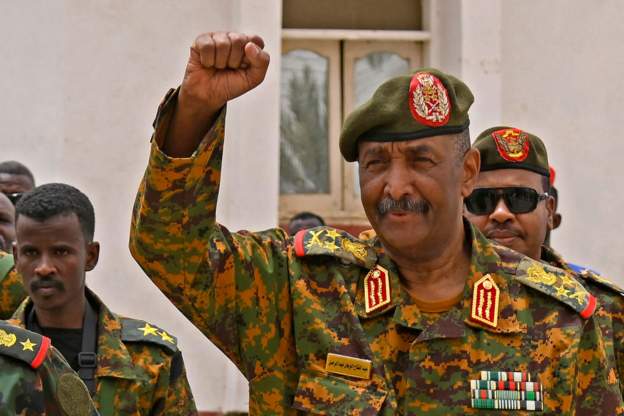
It’s not the right time for negotiations – Head of Sudan army says
The leader of Sudan’s army has once again said that he will not have discussions with the Rapid Support Forces (RSF) to stop the four-month-long conflict in Sudan, which has caused many deaths.
General Abdel Fattah al-Burhan is visiting Egypt to have a conversation with President Abdel Fattah al-Sisi.
This is the first time the general is travelling outside the country since the war started.
However, he made it clear that this was not the beginning of a new plan to end the conflict.
General Burhan spoke to reporters in Egypt:
This group (the RSF) is different from our people in Sudan. ”We have nothing to tell them, and now is not the right time for discussions. We are using all our time and efforts to focus on this war and put an end to this rebellion”.
”This group, called the RSF, is different from our people in Sudan”.”We don’t have anything to tell them, and right now is not the moment to discuss things. We are focusing all our time on this war and trying to put an end to this rebellion”.
”We are determined to finish this time and become even stronger, confident, and proud”.
”We are determined to finish this time and emerge from it stronger, unwavering, and feeling proud”. -
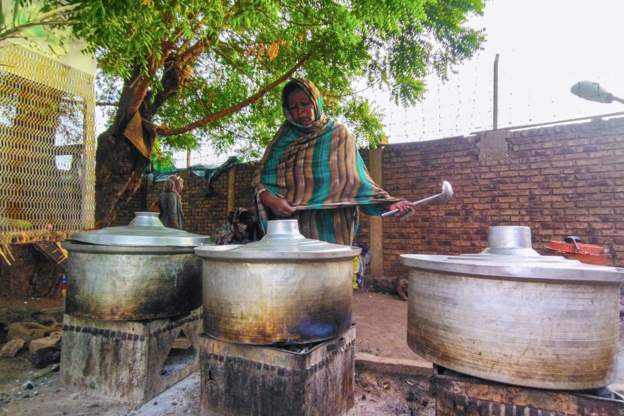
Millions in Sudan on the verge of starvation – Aid chiefs
Four months into the fighting in Sudan, international relief organisations have warned that the situation is out of control, with massive displacement and millions on the verge of famine.
The leaders of 20 international groups announced in a joint statement that more than four million people had fled their homes and 14 million children required humanitarian relief.
They urged the combatants to put a halt to their hostilities and provide secure passage for assistance delivery.
Clashes between the Sudanese army and the paramilitary Rapid Support Forces (RSF) have plagued the Darfur area and the country’s capital, Khartoum.
-
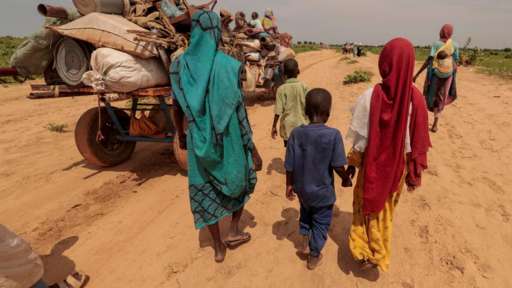
Amnesty accuses paramilitary, RSF of inciting war in Sudan
Amnesty International has urged the conflicting parties in Sudan to put an end to their war crimes.
It claims that purposeful and indiscriminate attacks are killing a lot of civilians.
The majority of those who were questioned by the rights organization had fled from the Darfur region to camps in Chad.
Numerous children and women, some as young as 12, have allegedly been the victims of sexual violence, including rape.
According to Amnesty International, the majority of the crimes were committed by members of the Rapid Support Forces and affiliated Arab militias.
Acute food shortages are anticipated to affect more than 20 million people in Sudan, or more than 40% of the population, according to UN agencies and NGOs.
-
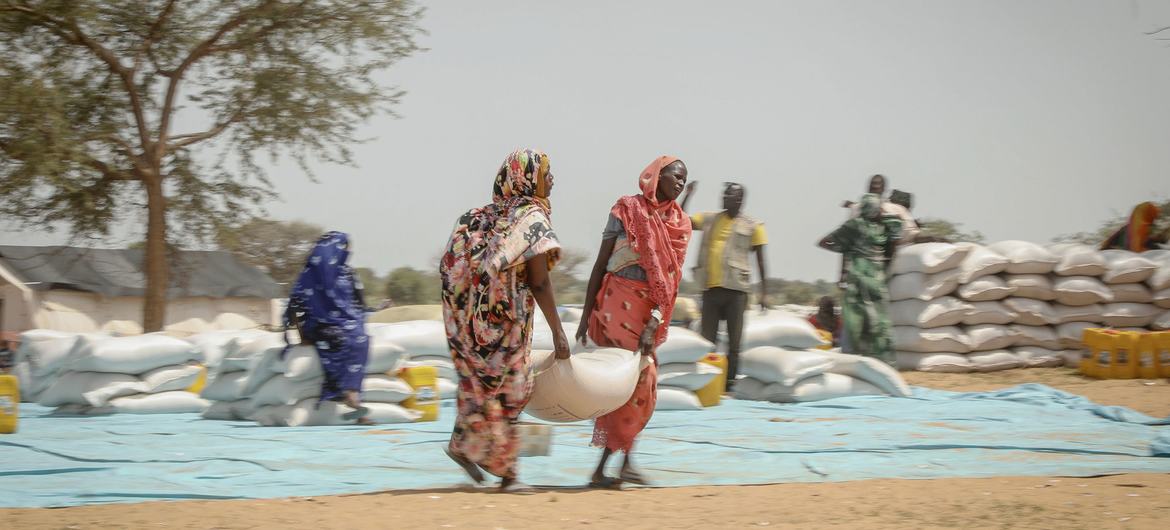
Almost 4 million displaced by Sudan conflict – UN migration agency
Recent data from the International Organization for Migration (IOM) reveals the severe impact of the clash between the Sudanese army and paramilitaries, resulting in an astonishing number of displaced people.
A staggering 926,000 individuals have sought refuge in neighboring countries, while 3.02 million remain internally displaced within Sudan.
The displacement has affected all 18 states in Sudan, with River Nile (15%), North (11%), North Darfur (9%), and White Nile (9%) being the most heavily impacted regions. A significant majority of the internally displaced individuals, 71%, originated from Khartoum State.
The current estimate of displacements over the past 108 days exceeds the total recorded for the previous four years, according to the IOM.
However, access to many areas remains restricted due to ongoing fighting, leading to assessments based on preliminary reports or estimates.
The situation for refugees seeking shelter in neighboring countries has been harrowing, with overcrowded displacement camps and difficulties in providing aid, exacerbated by the approaching rainy season.
The rainy season also poses the risk of flooding, adding to the already fragile conditions.
The conflict, which began in mid-April between Sudan’s armed forces and the paramilitary Rapid Support Forces (RSF), has caused widespread displacement, loss of life, injuries, and a growing humanitarian crisis. Attacks on public institutions, looting, and occupation of private homes continue in the capital, Khartoum, and clashes persist in four out of the five Darfur states.
Displaced populations in hard-to-reach locations are facing challenges in accessing healthcare services, leading to cases of infectious diseases and other illnesses. The situation is worsened by attacks on over 50 health facilities.
The United Nations High Commissioner for Refugees, Filippo Grandi, called for an immediate end to the conflict on the 100th day since its onset.
The UN’s humanitarian affairs office, OCHA, has also warned that hunger and displacement due to the war are spiraling out of control.
The Integrated Food Security Phase Classification (IPC) analysis indicates that more than six million people, around 13% of the population, are now one step away from famine. Overall, over 20 million people in Sudan are facing high levels of acute food insecurity due to conflict, economic decline, and mass displacement.
-
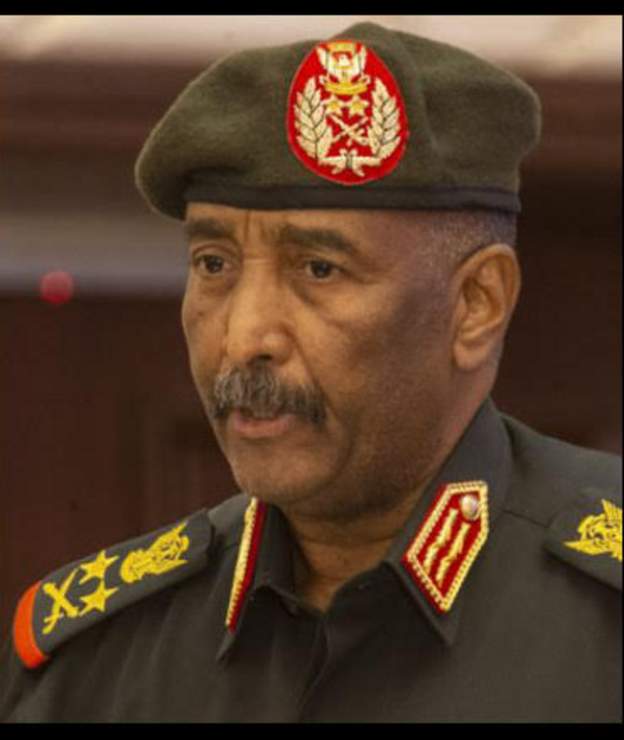
No use for talks without a genuine ceasefire – Burhan
The Saudi-US-mediated discussions between the Sudan Armed Forces (SAF) and the Rapid Support Forces (RSF) that started on May 6 in Jeddah have not yet yielded much public information.
But SAF leader Gen Abdel Fattah al-Burhan on Monday told Egypt’s Al-Qahera News TV that “there is no use in sitting at the negotiating table in Saudi Arabia” without a genuine ceasefire.
Gen Burhan said he welcomed all initiatives that aim to stop bloodshed but stressed that the RSF must give up its weapons.
A Saudi diplomat had earlier told AFP news agency that the discussions have yielded “no major progress”.
Numerous ceasefires have been violated since the conflict erupted on 15 April.
-

Attacks have resumed despite ceasefire – RSF claims
Despite a ceasefire, the paramilitary Rapid Support Forces (RSF) has made claims that their enemy, the regular Sudanese military, has repeatedly airstriked their bases throughout Khartoum.
The RSF said these targeted residential areas of the capital.
In a statement issued last night, seen by BBC Monitoring, the group claimed it controlled the majority of Khartoum. We’ve not been able to verify this.
Some of the latest clashes between the army and RSF have been happening around the army headquarters and the Republican Palace in Khartoum – and some parts of the Khartoum’s twin city of Omdurman.
However, other parts of Khartoum and Khartoum Bahri, to the north, remain largely calm.
The rival factions officially agreed to extend a ceasefire for another 72 hours on Thursday night.
-
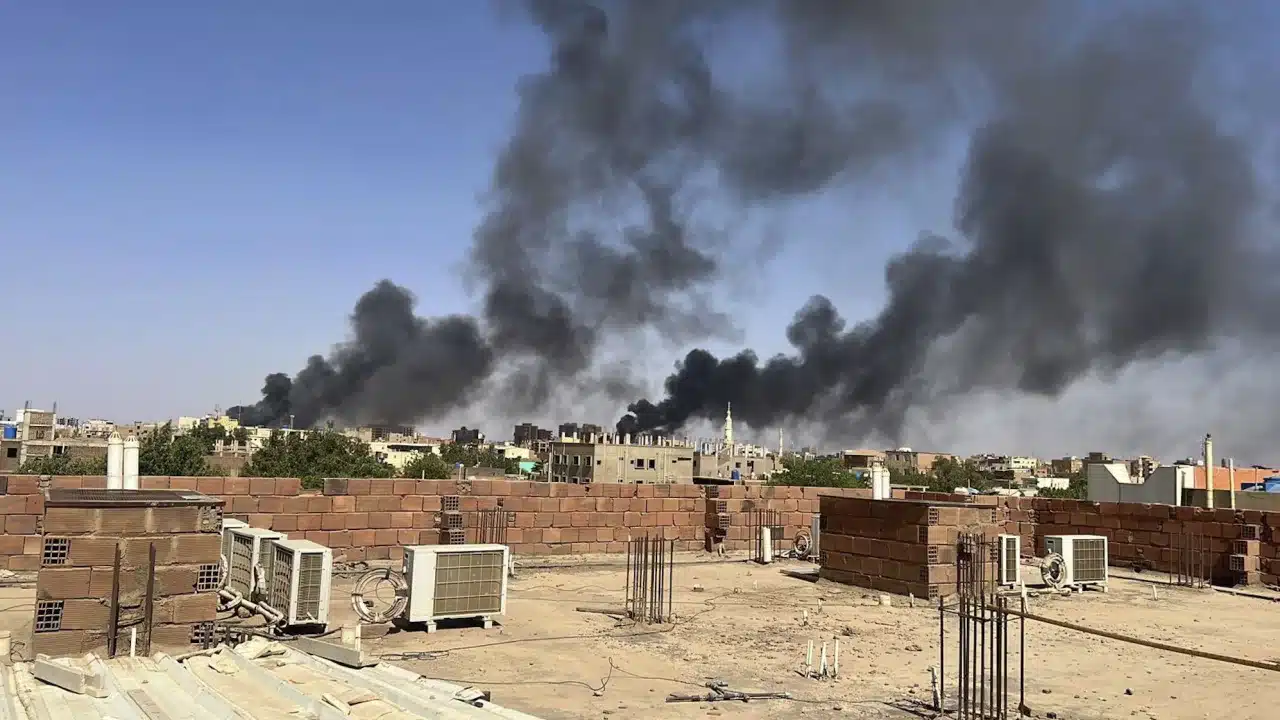
Foreign nationals trapped in Sudan to be evacuated for the first time
A week after fierce fighting broke out between two opposing parties in Sudan, Saudi Arabia is the first nation to announce the evacuation of its stranded residents.
“Several nationals of brotherly and friendly countries,” according to the Saudi foreign ministry, were evacuated with Saudi citizens. The hundreds of persons brought to safety include Kuwaiti citizens, although it is unclear which other countries are represented.
The declaration followed statements that the Rapid Support Forces (RSF) and Sudan Armed Forces (SAF) were prepared to assist in the evacuation of foreign nationals.
The SAF said in a statement Saturday that its leader, Gen. Abdel Fattah al-Burhan, has “agreed to provide the necessary assistance” to facilitate the safe evacuation of foreign citizens from the country in response to “calls from a number of heads of states.”
“The evacuation of all missions whose countries made such a request is expected to begin within the coming hours, as the United States, the UK, France, and China will evacuate their diplomats and nationals by air by military transport aircrafts belonging to their respective armed forces from Khartoum and this is expected to begin immediately,” the SAF said in the statement, posted on its Facebook page.
According to a list released by Saudi Arabia’s Ministry of Foreign Affairs on Saturday, 91 of its citizens had been evacuated, along with 66 nationals from 12 other countries which included Qatar, the United Arab Emirates, Egypt, Tunisia, Pakistan, India, Bulgaria, Bangladesh, the Philippines, Canada, and Burkina Faso.
It did not provide an exact breakdown of how many evacuees came from each of the countries it listed.
Kuwait thanked Saudi Arabia for evacuating its citizens from Sudan to Jeddah, in a statement released by its foreign ministry on Saturday.
But it did not specify how many Kuwaiti nationals had been evacuated.
Iraq’s Foreign Affairs Ministry told CNN via phone that there had been a “special operation” to evacuate its diplomats from their embassy in the capital Khartoum.
Ministry spokesperson Ahmad al-Sahaaf said the diplomats had been moved to “a safe place in Sudan” following the operation, but declined to give further details.
The developments came as the United States evacuated government personnel in an operation involving special forces.
The mission was led by US Africa Command and conducted in close coordination with the State Department, said Lloyd Austin, the US Secretary of Defense.
Fierce fighting broke out in Sudan last Saturday between the SAF and the paramilitary RSF, led by Mohamed Hamdan Dagalo.
The two are former allies but tensions between them arose during negotiations to integrate the RSF into the country’s military as part of plans to restore civilian rule.
More than 420 people have been killed and 3,700 injured in the fighting, according to the World Health Organization (WHO), and on the ground the humanitarian situation is worsening.
The UN says people are increasingly fleeing areas hit by fighting, including Khartoum. Up to 20,000 refugees have arrived in neighboring Chad, the UN says.
On Saturday, fresh clashes between the two groups shattered a three-day ceasefire declared for the Muslim holiday of Eid.
Fighting was reported in Khartoum on Saturday, with witnesses telling CNN fierce clashes were taking place in the vicinity of the presidential palace and the sounds of explosions and warplanes flying overhead could be heard.
Dagalo said he spoke to French Foreign Minister Catherine Colonna on Saturday and they discussed “the current situation, the reasons [that] led to the exacerbation of the situation” and the possibility of opening evacuation corridors.
Also on Saturday, British Prime Minister Rishi Sunak chaired an emergency meeting to discuss the situation.
CNN has learned that British evacuation efforts will not be happening imminently, but a government spokesperson told CNN they were doing “everything possible” to support British nationals.
A spokesperson for the European Union said that an estimated 1,500 citizens from various EU countries are currently in Sudan.
“They are facing a very difficult situation and their safety is a priority. We urge both sides (the Sudanese Armed Forces and the Rapid Support Forces) to stop fighting and allow for safe passage out of the country,” the spokesperson said, adding the EU was working with member states to find solutions and get these people out of the country.
It is unclear how many US citizens are in Sudan. The State Department does not keep official counts of US citizens in foreign countries and Americans are not required to register when they go abroad. US State Department officials told staffers estimated 16,000 American citizens in Sudan, most of whom are dual nationals.
-
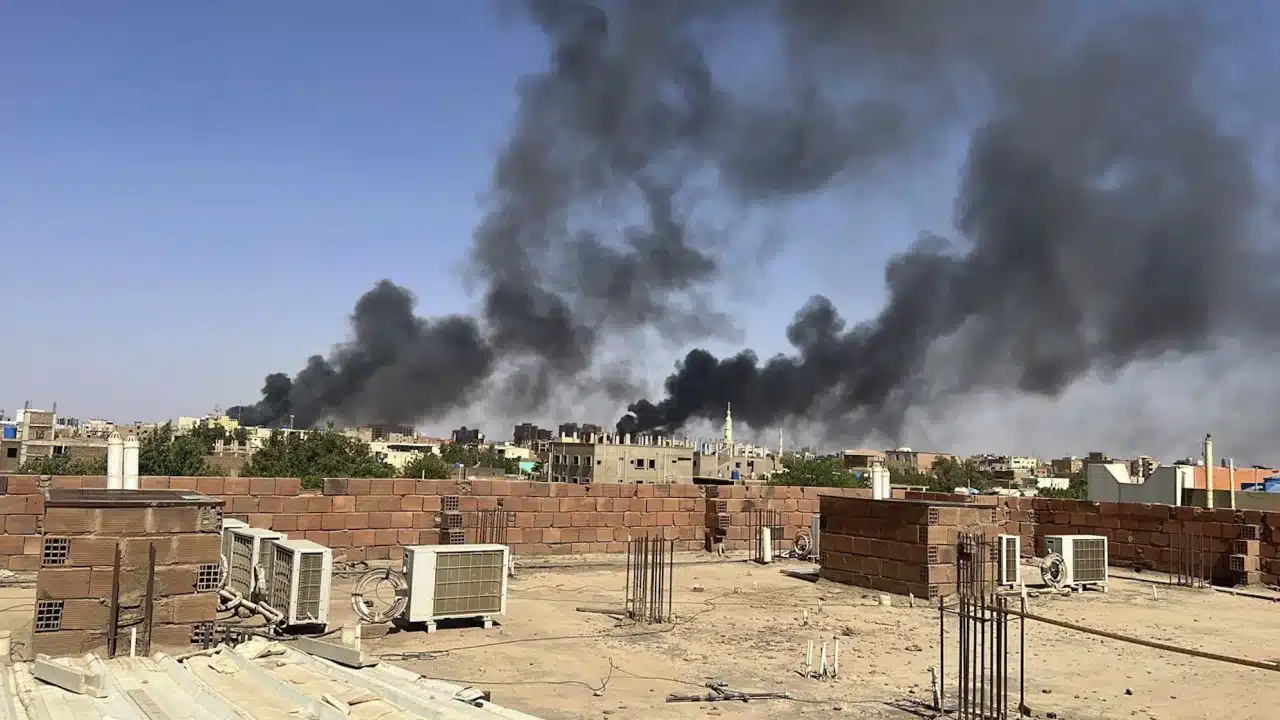
Foreigners caught up fighting in Sudan likely to be evacuated
After a week of battle, there is now hope that foreign countries may soon assist in the evacuation of foreign nationals after both of the opposing parties vying for control of Sudan declared they are prepared to do so.
The Sudanese army announced in a statement that it had consented to assist in the evacuation of citizens and diplomats from a number of nations, including the United States, the United Kingdom, France, and China.
According to the announcement, evacuations are anticipated to start “within the coming hours.”
On Friday, the Rapid Support Forces (RSF) said they were ready to partially reopen all airports in Sudan to air traffic to allow countries to evacuate their nationals.
Fierce fighting broke out in Sudan last Saturday between the Sudan Armed Forces (SAF), commanded by Sudan’s military leader General Abdel Fattah Al-Burhan and the paramilitary RSF, led by Mohamed Hamdan Dagalo.
The two are former allies but tensions between them arose during negotiations to integrate the RSF into the country’s military as part of plans to restore civilian rule.
The humanitarian situation on the ground is worsening. Many residents of the capital Khartoum have been stuck inside for a week and up to 20,000 refugees from Sudan’s Darfur region have fled to Chad in recent days, according to a statement from the UN Refugee Agency.
More than 400 people have been killed and 3,550 injured, according to the World Health Organization (WHO).
The announcements on evacuations came as fresh clashes between the two groups shattered a three-day ceasefire declared for the Muslim holiday of Eid.
Fighting was reported in Khartoum on Saturday, with witnesses telling CNN fierce clashes were taking place in the vicinity of the presidential palace and the sounds of explosions and warplanes flying overhead could be heard.
Saudi Arabia said Saturday its evacuation efforts were under way. The Saudi foreign ministry said in a statement that the government was evacuating its citizens from Sudan alongside “several nationals of brotherly and friendly countries.”
CNN has reach out to the other countries named in the SAF statement.
A spokesperson for the European Union said that estimated 1,500 citizens from various EU countries are currently in Sudan.
“They are facing a very difficult situation and their safety is a priority. We urge both sides (the Sudanese Armed Forces and the Rapid Support Forces) to stop fighting and allow for safe passage out of the country,” the spokesperson said, adding the EU was working with member states to find solutions and get these people out of the country.
It is unclear how many US citizens are in Sudan. The State Department does not keep official counts of US citizens in foreign countries and Americans are not required to register when they go abroad. US State Department officials told staffers estimated 16,000 American citizens in Sudan, most of whom are dual nationals.
A US State Department spokesperson told CNN that the department remains in close contact with its embassy in Khartoum and have “have full accountability of our personnel.”
“For their safety, I cannot discuss the details of their movements or whereabouts,” the spokesperson added.
-
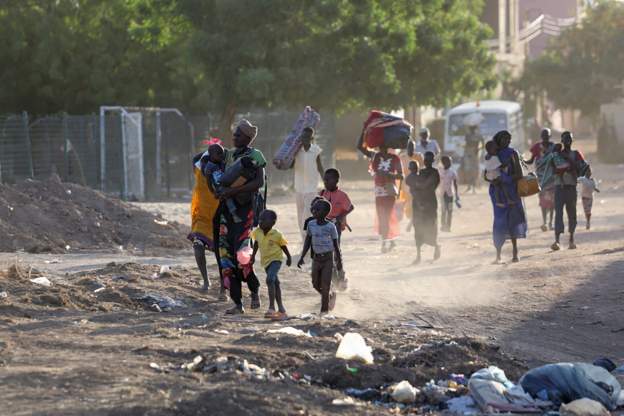
Khartoum residents flee as ‘hellish’ conditions in Sudan continue
Sudan’s conflict between the army and Rapid Support Forces (RSF) continues for a sixth day.
Due to the chaos, residents have been fleeing Khartoum, and this is due to fear about dwindling food supplies and the collapse of medical services.
According to Norway’s ambassador to Sudan Endre Stiansen, the current conditions are “hellish”.
Per reports, about 270 people have died as a result of the unrest happening.
Sudan’s paramilitary group Rapid Support Forces on Wednesday said it set up a call centre to receive distress calls from the citizens and foreigners in the capital, Khartoum.
“The room operates under the supervision of a force comprising various legal, medical and rescue teams, a direct communication mechanism is allocated to serve 24/7, to provide humanitarian aid and contribute to evacuations and resolve insecurities,” the group said in a statement posted on Twitter.
It said the room was located in the RSF’s controlled areas in Khartoum.
Meanwhile, the Libyan National Army (LNA), a group of armed forces loyal to Gen Khalifa Haftar, has denied providing support to a rival party in Sudan amid the deadly fighting.
Gen Haftar heads Libya’s parallel government in control in the east of the country, but which is not recognised by the international community
“The General Command categorically denies reports of providing support to one party against the other,” LNA spokesman Ahmad Mesmari is quoted as saying in statement by the Reuters news agency.
He said the army was ready to play a mediating role between the rival parties in Sudan.
-

Half of the hospitals in Sudan’s capital temporally closed as death toll increases
According to a top relief agency, half the hospitals in Sudan’s capital are “out of action” as a result of the conflict’s escalating casualties and the grave medical needs of many of the injured.
Abdalla Hussein, the operational manager for Médecins Sans Frontières in Sudan, stated, “According to the information we have in Khartoum, 50% of hospitals have been out of operation in the first 72 hours.” He explained, “This is because the hospitals itself have been the target of shelling or bombing or the employees didn’t feel secure going there.
According to the World Health Organization (WHO), at least 270 people have been killed and more than 2,600 injured since the clashes erupted on Saturday between Sudan’s army and the paramilitary Rapid Support Forces (RSF).
At the heart of the conflict is a power struggle between the groups’ leaders: Sudan’s military chief Abdel Fattah al-Burhan and RSF leader Mohamed Hamdan Dagalo, also known as Hemedti.
As residents cower from gunfire, international governments have called for a ceasefire so authorities can distribute aid and coordinate evacuations amid attacks on foreign nationals, including diplomatic staff.
On Wednesday, Japan said it was preparing to send its military to evacuate nationals from Sudan.
Japan has been able to contact all 60 of its nationals in Sudan, including embassy staff, Chief Cabinet Secretary Hirokazu Matsuno said during an emergency news conference. There are no reports of injuries among them, though food and water are scarce, and power cuts have become frequent as the security situation deteriorates.
Further details about the deployment of Japan’s Self-Defense Forces will be discussed in the future, he added
The United States has not announced any plans for an evacuation operation for Americans in Sudan, but has urged its nationals to stay indoors, shelter in place, and stay away from windows.
Other countries have published advisories to their national in Sudan. China has asked its citizens there to stay vigilant and to register their information online with the Chinese Embassy in Khartoum. The Indian Embassy in Sudan also issued an advisory on Tuesday asking its citizens to stay indoors and ration supplies due to looting.
The advisories come as reports emerge of attacks on foreign nationals and staffers.
Armed personnel stormed the homes of people working for the UN and other international organizations in downtown Khartoum, according to reports in an internal UN document seen by CNN.
According to the document, the gunmen sexually assaulted women and stole belongings including cars. One incident of rape was also reported. These armed personnel, “reportedly from RSF, are entering the residences of expats, separating men and women and taking them away,” read the report.
CNN has not been able to independently verify the alleged attacks.The RSF denied the claims, blaming Sudan’s armed forces for committing the crimes while wearing RSF uniforms. The armed forces have denied involvement in the violations, and reiterated accusations that the RSF has committed crimes against humanity.
In separate incidents cited in the document, two Nigerian men working for an international organization were abducted and later released; a building housing the UN Office for the Coordination of Humanitarian Affairs was targeted; and a rocket-propelled grenade hit the home of a local UN staff member in Khartoum.
Other incidents in recent days include a US diplomatic convoy coming under gunfire, the EU ambassador to Sudan being assaulted in his Khartoum residency, and three workers from the UN’s World Food Programme (WFP) killed in clashes.
-

Close to 200 dead in Sudan conflict
The fighting happening in Sudan over power struggle is reported to have claimed about 200 lives.
The Sudanese army and a paramilitary group called the Rapid Support Forces (RSF) who began fighting over the weekend are reportedly still engaged in fierce fighting to control the military headquarters in the capital.
Sounds of gunfire are still being heard in Sudan’s capital Khartoum despite mounting pressure for rival groups to cease the fighting.
A justice and democracy campaigner in Khartoum, Hala Y Alkarib, has told the media that she could still hear very loud artillery sounds around her.
“There is nowhere to go because it’s more dangerous to step out and there are no safe routes,” she said, adding that the situation in Khartoum is “extremely deteriorating”.
Both parties have claimed control of the army command as well as the main airport.
Source: The Independent Ghana
-

Two opposing generals struggle for power in Sudan
Hopes for a peaceful switch to civilian government have been dashed by fierce fighting throughout Sudan.
Two opposing generals’ forces are fighting for power, and as is so frequently the case, civilians have been hit hardest, with dozens of deaths and hundreds of injuries.
What you should know is as follows.
Abdel Fattah al-Burhan, the paramilitary Rapid Support Forces (RSF) commander, and Mohamed Hamdan Dagalo are the two men at the center of the fighting.
They had previously been allies. The two collaborated to remove Omar al-Bashir as president of Sudan in 2019 and were instrumental in the military takeover of that country in 2021.
However, tensions arose during negotiations to integrate the RSF into the country’s military as part of plans to restore civilian rule.
The key question: who would be subordinate to who under the new hierarchy.
These hostilities, sources told CNN, are the culmination of what both parties view as an existential fight for dominance.
It is difficult to overstate how seismic Bashir’s overthrow was. He had led the country for nearly three decades when popular protests that began over soaring bread prices toppled him from power.
During his rule, South Sudan split from the north while the International Criminal Court issued an arrest warrant for Bashir alleged war crimes in Darfur, a separatist Western region.
After Bashir’s ouster, Sudan was ruled by an uneasy alliance between the military and civilian groups.
That all ended in 2021, when the power-sharing government was dissolved by armed forces.
The Rapid Support Forces are the preeminent paramilitary group in Sudan, whose leader, Dagalo, has enjoyed a rapid rise to power.
During Sudan’s Darfur conflict in the early 2000s, he was the leader of Sudan’s notorious Janjaweed forces, implicated in human rights violations and atrocities.
An international outcry saw Bashir formalize the group into paramilitary forces known as the Border Intelligence Units.
In 2007, its troops became part of the country’s intelligence services and, in 2013, Bashir created the RSF, a paramilitary group overseen by him and led by Dagalo.
Dagalo turned against Bashir in 2019, but not before his forces opened fire on an anti-Bashir, pro-democracy sit-in in Khartoum, killing at least 118 people.
He was later appointed deputy of the transitional Sovereign Council that ruled Sudan in partnership with civilian leadership.
Burhan is essentially Sudan’s leader. At the time of Bashir’s toppling, Burhan was the army’s inspector general.
His career has run an almost parallel course to Dagalo’s.
He also rose to prominence in the 2000’s for his role in the dark days of the Darfur conflict, where the two men are believed to have first came into contact.
Al-Burhan and Hemedti both cemented their rise to power by currying favor with the Gulf powerhouses.
They commanded separate battalions of Sudanese forces, who were sent to serve with the Saudi-led coalition forces in Yemen.
Now they find themselves locked in a power struggle.
Where the fighting will end is unclear. Both sides claim control over key sites and fighting has been reported across the country in places far from the capital Khartoum.
While various official and non-official estimates place the Sudanese armed forces at around 210-220,000, the RSF are believed to number approximately 70,000 but are better trained and better equipped.
International powers have expressed alarm. Apart from concerns over civilians there are likely other motivations at play – Sudan is resource-rich and strategically located.
CNN has previously reported on how Russia has colluded with Sudan’s military leaders to smuggle gold out of Sudan.
Dagalo’s forces were a key recipient of Russian training and weaponry, and Sudan’s military leader Burhan is also believed by CNN’s Sudanese sources to have been backed by Russia, before international pressure forced him to publicly disavow the presence of the Russian mercenary group Wagner, in Sudan.
Sudan’s neighbors Egypt and South Sudan have offered to mediate, but in the meantime all that is certain is more misery for the Sudanese people.
-

Sudan’s third day of fierce fighting nears death toll of 100
As fierce battle entered its third day and the death toll approached 100, hundreds more were injured, residents of Khartoum, the capital of Sudan, awoke on Monday to the sounds of artillery and warplane bombardment.
The country’s military and the paramilitary Rapid Support Forces (RSF), led by Mohamed Hamdan Dagalo, commonly known as Hemedti, clashed for the first time on Saturday. Hemedti told CNN on Sunday that the army had violated a UN-brokered interim humanitarian ceasefire.
Eyewitnesses in Khartoum told CNN on Monday they heard mortars and artillery in the early hours of the morning, with the fighting intensifying after dawn prayers in the direction of Khartoum International Airport and Sudanese Army garrison sites.
Verified video footage shows military jets and helicopters hitting the airport;other clips show the charred remains of the army’s General Command building nearby after it was engulfed in fire on Sunday.
Residents in neighborhoodseast of the airport told CNN they sawwarplanesbombing sites east of the command. “We saw explosions and smoke rising from Obaid Khatim Street, and immediately after that, anti-aircraft artillery fired massively towards the planes,” one eyewitness said.
In the Kafouri area, north of Khartoum, clashes and street fights broke out at dawn Monday, prompting residents to begin evacuating women and children from the area, Sudanese journalist Fathi Al-Ardi wrote on Facebook. In the Kalakla area, south of the capital, residents reported the walls of their houses shaking from explosions.
Reports also emerged of battles hundreds of miles away in the eastern city of Port Sudan and the western Darfur region over the weekend.
As of Monday, at least 97 people have been killed, according to the Preliminary Committee of Sudanese Doctors trade union. Earlier on Sunday, the World Health Organization estimated more than 1,126 were injured.
The WHO has warned that doctors and nurses are struggling to reach people in need of urgent care, and are lacking essential supplies.
“Supplies distributed by WHO to health facilities prior to this recent escalation of conflict are now exhausted, and many of the nine hospitals in Khartoum receiving injured civilians are reporting shortages of blood, transfusion equipment, intravenous fluids, medical supplies, and other life-saving commodities,” the organization said on Sunday.
Water and power cuts are affecting the functionality of health facilities, and shortages of fuel for hospital generators are also being reported,” the WHO added.
In the CNN interview, Dagalo blamed the military for starting the conflict and claimed RSF “had to keep fighting to defend ourselves.”
He speculated that the army chief and his rival, Abdel Fattah al-Burhan, had lost control of the military. When asked if his endgame was to rule Sudan, Dagalo said he had “no such intentions,” and that there should be a civilian government.
Amid the fighting, civilians have been warned to stay indoors. One local resident tweeted that they were “trapped inside our own homes with little to no protection at all.”
“All we can hear is continuous blast after blast. What exactly is happening and where we don’t know, but it feels like it’s directly over our heads,” they wrote.
Access to information is also limited, with the government-owned national TV channel now off the air. Television employees told CNN that it is in the hands of the RSF.
The conflict has put other countries and organizations on high alert, with the United Nations’ World Food Program temporarily halting all operations in Sudan after three employees were killed in clashes on Saturday.
UN and other humanitarian facilities in Darfur have been looted, while a WFP-managed aircraft was seriously damaged by gunfire in Khartoum, impeding the WFP’s ability to transport aid and workers within the country, the international aid agency said.
Qatar Airways announced Sunday it was temporarily suspending flights to and from Khartoum due to the closure of its airport and airspace.
On Sunday, Dagalo told CNN the RSF was in control of the airport, as well as several other government buildings in the capital.
Meanwhile, Mexico is working to evacuate its citizens from Sudan, with the country’s foreign minister saying Sunday it is looking to “expedite” their exit.
The United States embassy in Sudan said Sunday there were no plans for a government-coordinated evacuation yet for Americans in the country, citing the closure of the Khartoum airport. It advised US citizens to stay indoors and shelter in place, adding that it would make an announcement “if evacuation of private US citizens becomes necessary.”
The fresh clashes have prompted widespread calls for peace and negotiations. The head of the African Union Commission, Moussa Faki, is scheduled to arrive in Khartoum on Monday, in an attempt to stop the fighting.
US Secretary of State Antony Blinken and UK Foreign Secretary James Cleverly also for an immediate ceasefire.
“People in Sudan want the military back in the barracks, they want democracy, they want a civilian-led government. Sudan needs to return to that path,” Blinken said, speaking on the sidelines of the G7 foreign minister talks in Japan on Monday.
The UN’s political mission in Sudan has said the country’s two warring factions have agreed to a “proposal” although it is not yet clear what that entails.
At the heart of the clashes is a power struggle between the two military leaders, Dagalo and Burhan.
The pair had worked together to topple ousted Sudanese President Omar al-Bashir in 2019, and played a pivotal role in the military coup in 2021, which ended a power-sharing agreement between the military and civilian groups.
The military has been in charge of Sudan since then, with Burhan and Dagalo at the helm.
But recent talks led to cracks in the alliance between the two men. The negotiations have sought to integrate the RSF into the country’s military, as part of the effort to transition to civilian rule.
Sources in Sudan’s civilian movement and Sudanese military sources told CNN the main points of contention included the timeline for the merger of the forces, the status given to RSF officers in the future hierarchy, and whether RSF forces should be under the command of the army chief, rather than Sudan’s commander-in-chief, who is currently Burhan.
-

Find out the story behind the military rivalry happening in Sudan
An aggressive power struggle inside the military leadership of the country is the root cause of the fighting that has broken out in the Sudanese capital, Khartoum, and other parts of the nation.
Members of the paramilitary Rapid Support Forces (RSF) and regular soldiers are fighting in critical strategic locations throughout the capital.
What’s the background to the fighting?
Since a coup in October 2021, Sudan has been run by a council of generals and there are two military men at the centre of the dispute.
Gen Abdel Fattah al-Burhan, who is the head of the armed forces and in effect the country’s president.
And his deputy and leader of the RSF, Gen Mohamed Hamdan Dagalo, better known as Hemedti.
They have disagreed on the direction the country is going in and the proposed move towards civilian rule.
One of the main sticking points is over the plans to include the 100,000-strong RSF into the army and who would then lead the new force.
Why did it all kick off on Saturday?
The violence follows days of tension as members of the RSF were redeployed around the country in a move that the army saw as a threat.
There had been some hope that talks could resolve the situation but these never happened.
It is not clear who fired the first shot on Saturday morning but there are fears that this will worsen an already unstable situation.
Diplomats have urged the two sides to cease fire.
Who are the Rapid Support Forces?
The RSF was formed in 2013 and has its origins in the notorious Janjaweed militia that brutally fought off rebels in Darfur.
Since then, Gen Dagalo has built a powerful force that has intervened in conflicts in Yemen and Libya and controls some of Sudan’s gold mines.
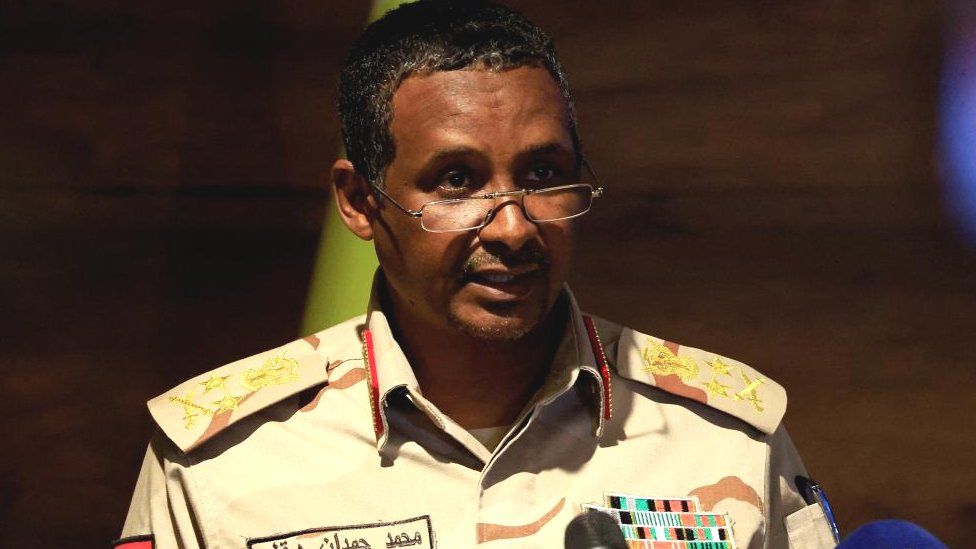
Image caption,Rivalry between Gen Mohamed Hamdan Dagalo (pictured) and Gen Abdel Fattah al-Burhan is at the heart of the problem It has also been accused of human rights abuses, including the massacre of more than 120 protesters in June 2019.
Such a strong force outside the army has been seen as a source of instability in the country.
Why is the military in charge?
This fighting is the latest episode in bouts of tension that followed the ousting of long-serving President Omar al-Bashir in 2019.
There were huge street protests calling for an end to his near-three decade rule and the army mounted a coup to get rid of him.
But the civilians continued to demand a role in the plan to move towards democratic rule.
A joint military-civilian government was then established but that was overthrown in another coup in October 2021.
And since then the rivalry between Gen Burhan and Gen Dagalo has intensified.
A framework deal to put power back in the hands of civilians was agreed last December but talks to finalise the details have failed.
What could happen now?
If the fighting continues then it could further fragment the country and worsen political turbulence.
Diplomats, who have played a crucial role in trying to urge a return to civilian rule, will be desperate to find a way to get the two generals to talk.
In the meantime, it will be the ordinary Sudanese who will have to live through yet another period of uncertainty.
Source: BBC