The EFL has accused Reading of frequently breaking its financial rules by neglecting to pay its players throughout the 2022–23 season.
The accusations pertain to three different instances in which the team was relegated from the Championship and player pay were not paid on time and in full on each occasion.
Further accused of permitting the team to violate the EFL’s financial regulations is owner Dai Yongge.
Reading were docked six points in April for breaking profit and sustainability rules which ultimately led to them finishing in the bottom three and dropping into League One.
Manager Paul Ince was sacked later that month with the club on a winless run of eight games.
He was replaced by interim boss Noel Hunt who failed to win any of his five matches in charge.
An EFL statement read: “The charges relate to the club failing to meet their obligations to pay its players’ wages on time and in full on or around 31 October 2022, 30 November 2022 and 28 April 2023.
“Yongge Dai, the club’s owner, has also been charged with causing the club to be in breach of EFL regulations despite his commitment to fund the cash requirements of the club.
“The club and Mr Dai have until 4pm on Thursday 29 June 2023 to respond to the charges.”
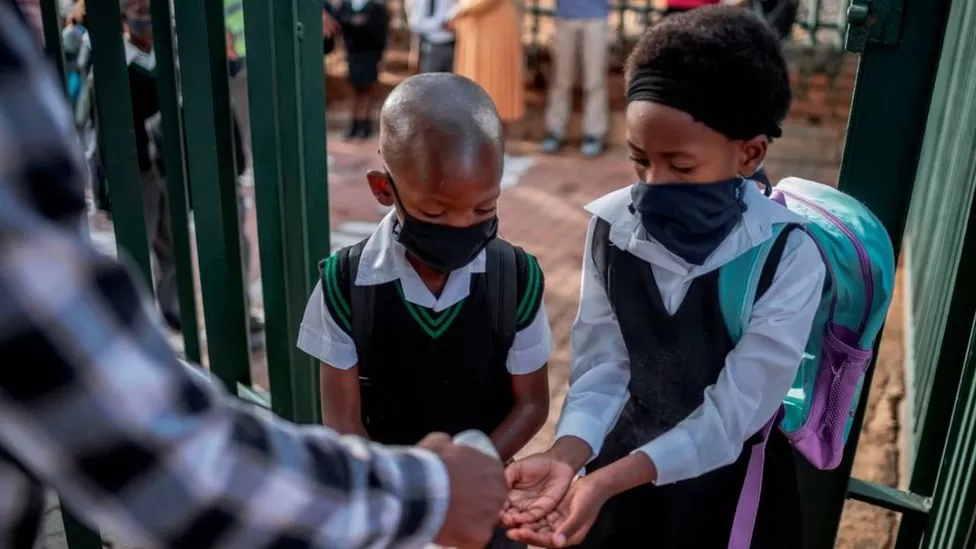
Eight out of 10 South African school children struggle to read by the age of ten, an international study has found.
South Africa ranked last out of 57 countries assessed in the Progress in International Reading Literacy Study, which tested the reading ability of 400,000 students globally in 2021.
Illiteracy among South African children rose from 78% in 2016 to 81%.
The country’s education minister blamed the results on school closures during the Covid-19 pandemic.
Describing the results as “disappointingly low”, Angie Motshekga also said the country’s education system was faced with significant historical challenges, including poverty, inequality and inadequate infrastructure.
In many primary schools “reading instruction often focuses solely on oral performance, neglecting reading comprehension and making sense of written words”, she added.
South Africa’s education minister said the disappointing results were a result of school closures during the Covid-19 pandemic
The study showed that 81% of South African children could not read for comprehension in any of the country’s 11 official languages.
Alongside Morocco and Egypt, South Africa was one of only three African countries which participated in the assessments to monitor trends in literacy and reading comprehension of nine- and 10-year-olds.
Based on tests taken every five years at the end of the school year, the new study places countries in a global education league table.
Singapore secured top spot in the rankings with an average score of 587, while South Africa ranked last on 288 points – below second-last Egypt’s average of 378. The scores are benchmarked against an international average of 500.
The study also showed that overall, girls were ahead of boys in their reading achievement in nearly all of the assessed countries, but the gender gap has narrowed in the most recent testing round.
South Africa’s struggles with its education system are longstanding, with significant inequality between black and white students a consequence of the segregation of children under apartheid.
Education is one the single biggest budget expenses for the government, which can lead to disappointment over poor performance in studies like this.
A lack of suitable reading materials and inadequate infrastructure in schools, often things like toilets, have contributed to the crisis.
Minister of Education, Dr Yaw Osei Adutwum, has bemoaned the poor reading culture in the various educational institutions in the country, particularly the primary level.
During a press briefing on Tuesday ahead of the grand opening of the Accra World Book Capital, the Education Minister revealed that as of 2022, about 38 percent of students in Primary 2 across the country could read – an improvement of the 2 percent recorded in 2015.
This indicates that 62 percent of these students are unable to read.
“In our own dear country Ghana, in 2015, primary 2, only 2 per cent could read. Various interventions that have been put in place have allowed us to know from our last 2022 national assessment which every student in primary 2 was assessed, we have now moved to 38 per cent.
“It is no mere accomplishment but I am not happy. When we say that 62 percent of the students can still not read,” he stated.
Despite the 36 percent improvement in seven years, he noted that the current statistics is “unacceptable.”
The Education Minister indicated that a primary 4 assessment has been conducted and “we are waiting to see the results.”
According to Dr Adutwum, the poor culture of reading in society has translated into what has been recorded in schools, even at the primary level.
He noted that reading should not be coerced but be accepted as a fun habit which transforms minds and subsequently reshapes society.
“Books transform minds. And minds transform society. We can’t talk about the transformation of our nation without bringing to bear the importance of reading and in getting children who read for fun.
I think that is what we need to do more. Children should not see reading as something required by school. If they see it as something required by school, when they graduate they do not read any longer and that is not how you create lifelong learners,” he bemoaned.
He therefore spoke greatly of the Accra World Book Capital initiative noting that its objective is to ensure that individuals are excited about picking up books and reading.
The minister pledged that “we are going to do everything possible to take advantage of the spotlight which is on Accra to begin to not just improve literacy among students, create a culture of life learning but beyond that.”
“Also give opportunities for people to write and publish for us to buy and read,” he further noted.
Research shows that reading builds one’s vocabulary, empathy, reduces stress and depression symptoms, prevents age-related cognitive decline and extends one’s lifespan.
In September 2021, Accra was selected by the United Nations Educational, Scientific and Cultural Organization (UNESCO) as the 2023 World Book Capital, following evaluation by the World Book Capital Advisory Committee.
President Akufo-Addo will on April 24, 2023, perform the grand opening of the Accra World Book Capital, 2023 at the Accra Conference Centre.
In attendance at the event would be a wide array of important international personalities including Members of the Diplomatic Community in Ghana, UNESCO Representatives in the Africa Region and its Paris headquarters, and Directors as well as Representatives of the United Nations Agencies home and abroad.
The others include Development Partners, City Mayors from the World Book Capital Network, and personalities from the International Publishers Association (IPA), the International Federation of Library Associations and Institutions (IFLA), as well as the International Authors Forum (IAF).
A right back from Ghana, Andy Yiadom, played for Reading in their 1-0 English Championship victory over Coventry on Saturday.
The 31-year-old, who did not make Ghana’s final World Cup roster for Qatar in 2022, played the entire game.
In a cagey first half, both goalkeepers were called into action to maintain the 0-0 scoreline.
Reading’s Joe Lumley saved well from Callum O’Hare while Coventry’s Ben Wilson kept out a fine Yakou Meite header.
Coventry went behind 12 minutes into the second period, when Frenchman Amadou Mbengue was on hand to nod in his first Reading goal.
And City, try as they did, were unable to force a fightback as the hosts held on with relative ease.
Reading went into the World Cup recess in poor form, with only two wins from 10 games, while Coventry had won seven of their nine matches, including their last four without conceding a goal, to move from bottom of the Championship to 11th place.
Yiadom has made 20 league appearances for Reading so far this season.
A left defender for the Black Stars, Baba Rahman has reunited with his Reading colleagues to begin pre-season training for the resumption of the English championship.
Following his nation’s elimination from the World Cup in Qatar, the Ghanaian international traveled back to England.
Rahman, who is on loan at Reading from Chelsea, featured in all three matches at the tournament but Ghana failed to progress beyond the group stage.
“It was a great experience and I really loved it. It was really great,” said the defender following his return to Bearwood Park.
The 28-year-old took part in training on Thursday as manager Paul Ince prepares his team ahead of their game against Coventry on Saturday.
Rahman has been an important player for the Royals since joining the club last season, where he helped them beat the drop.
This season, Reading led by Ghanaian compatriot Andy Yiadom will be hoping to make a return to the English Premier League.
Reading was not something I loved to do when I was a tweenager!
And I know that may come to you as a surprise considering my line of work, but that’s the truth. I mean, we were made to read books in our time. “Go to the naughty corner (or your room) and read your book!” – a parent would say to a recalcitrant tweenager.
“Go to the library and read a book; and think about what you did wrong”, my teacher would say to me for being disruptive in class. What? You didn’t think I gave my teachers stress, like some of you are doing now? LoL!!
The Gilded Ones
And when that happened, I would refuse to read a book. Within moments, I would realise I was bored and wanted something to do in my confined space. Then I would reach for a book to just flip through the pages, and I found myself reading. Then, next thing I knew, I was either bursting out laughing or tearing up because I was moved by the story, and “Your time is up; you can go back to class”, the librarian would announce to me.
And this was how my love for reading was nurtured. I loved to read because it took me to some place instead of the current place I found myself, especially if I didn’t like it there. Through reading, I had travelled to many different countries around the world before actually setting foot there.
The places I enjoyed the most, mainly because they tugged at the African in me (read as relatable), were Senegal, Kenya, Nigeria, South Africa and somewhere in the deep south of America (a predominantly African American community).
When I was in secondary school, by which time my love for reading was firmly established, I read books by African authors. Again, not by choice, but this time I’d say it was curated…deliberately chosen to have a certain effect on our thinking, maybe? Or not?
I will admit that these books exposed me to the cultures of some settings in Africa. I found out that Senegal is a West African country that has a 95 percent Muslim population and considered begging for alms a part of their culture. Soweto in South Africa, when I read about it, was a place where African children had to live with the reality and harsh effects of Apartheid; Kenya’s Mau Mau revolution to reclaim their land and freedom from the colonisers. When I read Chinua Achebe’s Things Fall Apart, I was taken in by how very verbose and colourful Nigerians were with language – and the intrusion of Western missionaries and colonial governments among the Igbos.
What all these books did for me was to prepare me for my later travels to these countries. I was knowledgeable (albeit a tad) about these countries to the point where I could hold conversations with their citizens when we met. Remember, in our time, we didn’t have the Internet, which now allows you to read up on anything and anywhere under the sun before you venture there.
I love my African-authored books, especially those that dwell on their culture and societal structures or challenges. I have noticed, though, that many of you do not have such books in your collection nor have you read any (or should that be, enough?) To be fair, finding such books – targetted at you, tweenagers – is quite the task, so I’m not blaming you. However, I would love to introduce you to a few of these books; read them before you finish secondary school, and you will notice how your perspective in and about life will shape up
Things Fall Apart – Chinua Achebe (Penguin Modern Classics edition): the struggle between change and tradition is explored through the life of a young Nigerian man, Okonkwo.
Purple Hibiscus – Chimamanda Ngozi Adichie: explores the themes of religious hypocrisy, finding one’s voice, and the persistence of love through the story of a young Nigerian woman struggling to find her way in a world beset with conflict and strife.
The Marriage of Anansewaa – Ama Ata Aidoo: tells of a father, Ananse, who submits his daughter’s suitors to test to find out which one of them can display financial strength and also seek the welfare of his daughter.
The Gilded Ones – Namina Forna: an action-packed new fantasy series following the story of a young female, named Deka, who lives in the West-African-inspired society of Otera, where women live to be of service to men, and their roles in everyday life are grounded in misogyny.
Lyndon Dykes’ late penalty gave QPR a 2-1 victory over Reading and moved them up to third in the Championship table.
Reading, who started the night in third place and would have gone top had they won, went ahead at Loftus Road through Andy Carroll’s penalty.
But Dykes, on his 27th birthday, equalised with his first goal in 11 matches and then, with six minutes remaining, he netted from the spot to give the Rs a third consecutive win and take them level on points with leaders Sheffield United, who play on Saturday.
Carroll opened the scoring on the half-hour mark after Lucas Joao had been clipped by Tim Iroegbunam near the edge of the area – the veteran striker’s first goal for Reading since rejoining the club last month.
It came after Rangershad been denied what looked like an obvious penalty of their own.
Ilias Chair’s cross was headed back towards goal by Iroegbunam and defender Sam Hutchinson clearly used his arm to divert the ball out for a corner.
QPR, without injured talisman Chris Willock, caused Reading problems early on, with Tyler Roberts’ strike bringing a save from Joe Lumley as the visitors struggled to get out of their own half.
Rangers’ night took a turn for the worse when right-back Ethan Laird, outstanding since arriving on loan from Manchester United, went off with a hamstring injury shortly before Reading went ahead against the run of play.
But Michael Beale’s side hit back slightly less than three minutes after falling behind.
Laird’s replacement, Osman Kakay, did superbly on the right and his cross was met at the near post by Dykes, who sent a diving header beyond former QPR keeper Lumley and into the far corner of the net.
Reading had much more of the ball in the second half, but Lumley twice prevented them from falling behind.
Roberts missed a great chance when his header from Chair’s cross was saved at point-blank range by Lumley, who also did well to keep out a strike from Chair as Rangers pushed for a second goal.
And that goal arrived when Dykes slotted home after Rangers were awarded a penalty – their first of the season – following Mamadou Loum’s needless foul on Iroegbunam.
QPR keeper Seny Dieng ensured his team took the points by tipping away Tom Ince’s last-minute free-kick.
An enthusiastic Reading supporter who is thrilled about Baba Rahman’s comeback to the Championship team has created a lovely poem to honor the Ghanaian defender’s second coming.
The well-written poem was shared by the fan on Twitter, hours after it was announced that Rahman had secured a return to the club.
Reading outbid a number of clubs, including Championship rivals West Brom, to sign the committed left-back on a season-long loan.
The Chelsea player has returned to Reading on loan for the second consecutive season after spending last season there.
“We are delighted to announce that Baba Rahman has sealed a return to Reading Football Club for a second season-long loan spell in blue and white hoops,†Reading announced.
Almost exactly a year ago, Baba first arrived at Bearwood Park ahead of an impressive campaign spent as a Royal; he registered a total of 29 starts at left-back during the club’s 150th-anniversary campaign and made a crucial contribution in our fight for Championship survival last season.
During that campaign, he also represented his country to feature alongside Royals skipper Andy Yiadom in the Africa Cup of Nations and he will be hoping for another successful season as a Reading player ahead of this year’s FIFA World Cup Finals in Qatar.
Head of Football Operations, Mark Bowen, said: “Through his energetic, wholehearted and powerful performances on the pitch and his infectious character off it, Baba became something of a fans favourite here at Reading last season. Since the day his loan spell ended in the summer, we have been hoping to bring him back and I am very pleased we have been able to secure his services for the 2022-23 campaign.â€
Hi @babarahmangh – I hope you don’t mind, but on behalf of all the #readingfc fans, I have written you a very special acrostic poem entitled “Any Royals Still Awake”.
Chelsea defender signed his contract on Tuesday afternoon, marking his return to the English Championship after spending last season on loan there.
The transfer is done, with an official announcement expected before the summer transfer window shuts on Wednesday.
Ghanasoccernet has reported a move for Rahman to Reading throughout the transfer window, but Championship rivals West Brom were also interested.
West Brom were eager to sign Rahman and were at one point neck and neck with Reading for his signature. Clubs in France, Germany, and Spain also expressed interest.
However, Rahman believes that a move to Reading is more appropriate, given that he enjoyed his first spell.
The left-back performed admirably for them last season, becoming a fan favourite.
Rahman started 29 games for Reading last season, recording 38 interceptions, 51 tackles, and 90 crosses.
Chelsea have approved Rahman’s move to Reading.
The Blues signed Rahman for an undisclosed fee, which was reported to be an initial £14 million, with a potential fee of nearly £22 million.
Rahman’s contract with Chelsea was extended until 2024 in June of last year.
The 28-year-old will be given regular playing time at Reading, ensuring that he is in peak condition for Ghana’s 2022 World Cup campaign.
Rahman is Ghana’s first choice for the left-back position ahead of the global showpiece in Qatar.
The First Lady Rebecca Akufo-Addo has identified reading as the panacea to enhancing the quality of education and deepening the intellect of the youth.
According to Mrs Akufo-Addo, people with high literacy skills are better positioned to expedite the development of a country and meet its challenges, stating, “a literate population and communities are in a far better position to develop and innovate than less literate societiesâ€.
Mrs Akufo-Addo who is also the Executive Director of the Rebecca Foundation, made these comments when she opened a 40-seater computerised library facility in Moree in the Central region.
The library, stocked with modern computers and books on different subjects is expected to serve as an attractive and welcoming environment for the youth to develop the habit and delight in reading.
Stressing on the importance of reading and its many benefits Mrs Akufo-Addo said, in a growing competitive world where life-long learning has become the only way to grow intellectually and build a wealth of knowledge, many children in sub-Saharan Africa struggle at the lower primary level to read in the official or any local language and in instances where they can read, they are unable to understand what they read.
She said a vast amount of information in the world is spread through written works and considering the impact of newspapers, books, and the internet in our daily lives, anyone with limited literacy skills is virtually excluded from written information that can change their lives.
Mrs Akufo-Addo stated that it is this plethora of benefits inherent in the ability and habit of reading that informed the Rebecca Foundation to come up with the “Learning to Read, Reading to Learn†initiative, a two-part concept made up of a television reading programme, now in its second season, and provision of much-needed libraries in some school clusters across the country.
She said the Rebecca Foundation has so far built three of such computerised libraries in the Dafiama Bissue Issah in the Upper West Region, Sefwi Debiso in the Western North Region, Wenchi in the Bono Region and will soon construct three more libraries at Kumawu in the Ashanti Region, Krachi East in the Oti Region and Achimota school in the Greater Accra Region.
The First Lady charged the youth to strive to read as many books as possible stating, “when I launched the Learning to Read, Reading to Learn initiative, I charged our children to read a book each day. I repeat this charge today. Read, learn new words, learn new things and consider writing your own little storiesâ€.
Mrs Akufo-Addo also urged the Ministry of Education to incorporate library services as a critical component of the educational reforms for basic schools as research has shown the significant role of school libraries in building a reading culture.
On behalf of The Rebecca Foundation, the First Lady extended her profound gratitude to the Ghana Library Authority, Ghana Book Development Council, Metropolitan and District Assemblies, the Ghana Education Service and donors for assisting the Foundation in its literacy enhancing endeavours.
The man held on suspicion of killing three people in Reading is Khairi Saadallah.
The 25-year-old from the town was arrested at the scene and police say they are not looking for anyone else over the terrorist incident.
Security sources told the BBC he is originally from Libya.
Prime Minister Boris Johnson said he was “appalled and sickened” by the attack in a park on Saturday evening.
The prime minister praised the bravery of the unarmed officers who arrested the suspect.
A witness told the BBC he saw a man moving between groups of people in Forbury Gardens, a park in Reading town centre, trying to stab them.
Three other people were injured in the attack at about 19:00 BST on Saturday.
Metropolitan Police Assistant Commissioner Neil Basu, head of counter-terrorism policing, described it as an “atrocity”.
Saturday’s horrifying killings may be another example of what security chiefs call “lone actor” attack where a single individual turns extremist beliefs into murderous actions.
In November last year, the UK’s official threat level from terrorism was reduced from “severe” to “substantial” – meaning it remained likely – but there was no intelligence of an immediate risk to life.
Since then, there have already been three major incidents in which two people have died. Two of those attacks were carried out by lone individuals.
Today, detectives will be interviewing their suspect – and a huge operation will have swung into operation.
Electronic analysts will delve into any social media accounts linked to the suspect; they’ll trawl every call and text message going back years, looking for contacts with extremists.
Intelligence officers at MI5 will review both their open and closed case files on so-called “subjects of Interest”.
A picture will emerge of the suspect’s movements. What led to the attack may be very difficult to identify.
Thames Valley Police said on Sunday morning that the attack was now being treated as terrorism and that counter-terrorism police would be taking over the investigation.
The force’s chief constable, John Campbell, told reporters later that a man was arrested within five minutes of the first emergency call made to police – at 18:56 BST on Saturday.
He said lives had been “devastated” by the incident, but added that there was not believed to be a wider risk to the public and there was nothing to suggest anyone else was involved in the attack.
Of the three injured people, one was seen at the John Radcliffe Hospital in Oxford, where they were discharged without being admitted to hospital.
Two were admitted to the Royal Berkshire Hospital in Reading. One has been discharged, while another remains in a stable condition under observation.
The UK’s terrorism threat level of “substantial” is the third of five ratings at which the threat level can stand.